2 Corinthians 8:3

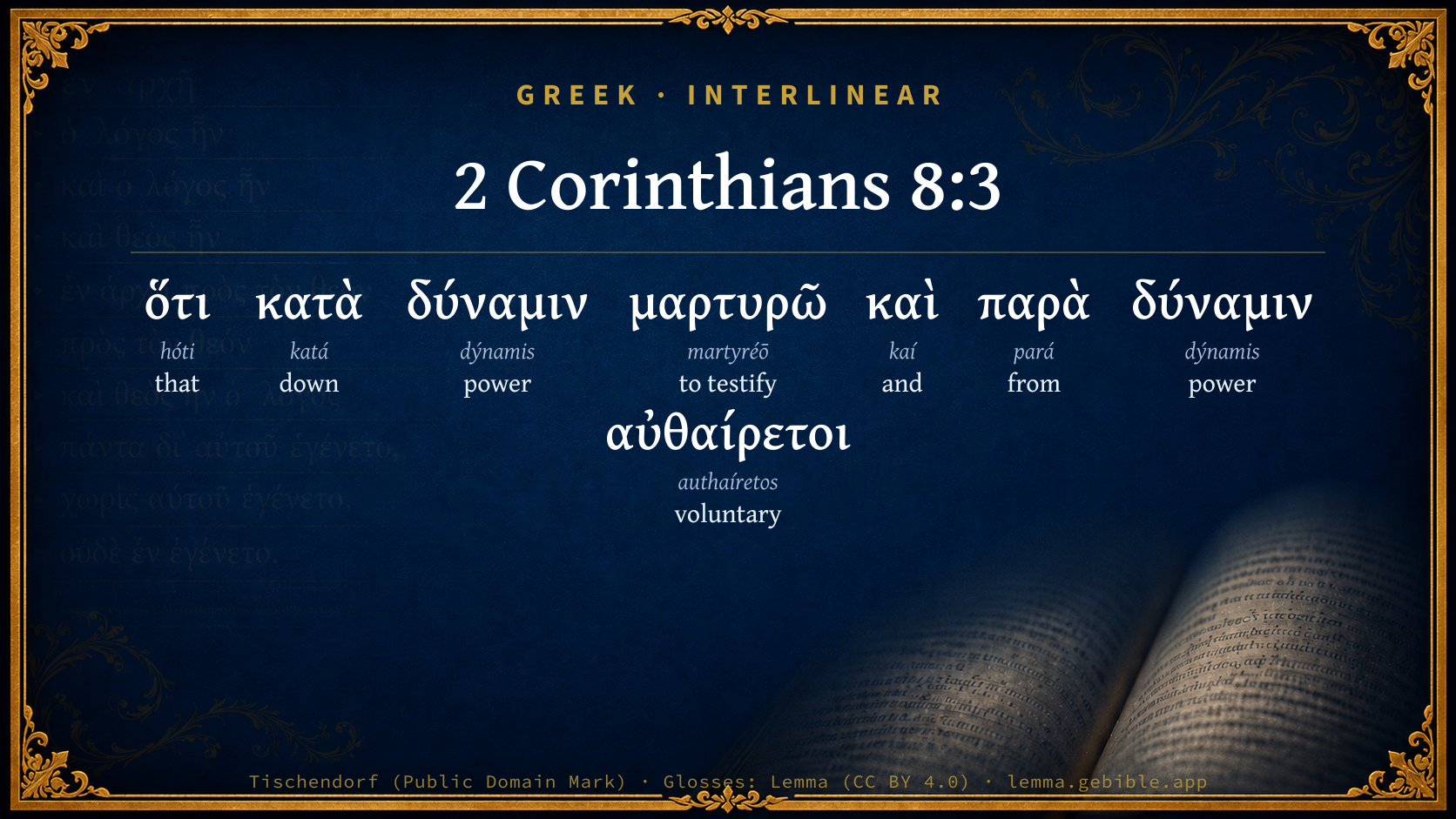
Greek (Tischendorf 8th ed.) 2 Corinthians 8:3 appears in the Greek New Testament. The text above is from the Tischendorf 8th edition. Each word links to its Strong’s number and a concise gloss. Click any word for its full Thayer’s Greek Lexicon entry.
Download image
Cite this verse

2 Corinthians 8:3 (World English Bible). Public Domain. Lemma interlinear Bible study tool, https://lemma.gebible.app/v/2-corinthians/8/3.

Show BibTeX & RIS
BibTeX
RIS
English Translation
For according to their power, I testify, yes and beyond their power, they gave of their own accord,
World English Bible · Public Domain
Highlights
  • 1 first appearance in the Greek New Testament
Full analysis ↓
Download a study sheet

One document with this verse’s original text, its word-by-word gloss line, the meaning frame, cross-references with their text, attributed commentary, and full source and license credits — printable, and it pastes into notes with its structure intact.

This verse Autodidact and up

Study sheet (.html) Plain text (.txt)

A passage Seminary Student

Up to 50 verses in one chapter. A passage sheet keeps up to 6 commentary sources and 12 cross-references per verse, in the order this page ranks them, and says so on the sheet whenever that leaves anything out. Ask for a single verse and you get the Autodidact verse sheet above.

Everything on this page stays free to read, with no account — the sheet is a download of what is already on screen, not access to it.

Want to remove ads? Support Godless Engineer
Compare translations 3

The same verse in 3 English versions, stacked beneath the original-language interlinear above. Click any original word for its lexicon entry.

Each is an independent rendering of the whole verse — the interlinear is not word-aligned to these translations.

Highlighted words mark where these versions differ — a whole-verse word diff, not a word-by-word alignment.

  • World English Bible Public Domain
    For according to their power, I testify, yes and beyond their power, they gave of their own accord,
  • King James Version Public Domain
    For to their power, I bear record, yea, and beyond their power they were willing of themselves;
  • unfoldingWord Literal Text CC BY-SA 4.0
    For I testify that according to their ability, and beyond their ability, of their own accord,

unfoldingWord Literal Text — © unfoldingWord, licensed CC BY-SA 4.0. Word-aligned USFM3 via Door43 (git.door43.org/unfoldingWord/en_ult).

Versions to compare (up to 4)

3 of 4 selected

Show all 19 translations

Every available English version of this verse, each an independent rendering of the whole verse.

  • World English Bible Public Domain
    For according to their power, I testify, yes and beyond their power, they gave of their own accord,
  • Berean Standard Bible Public Domain
    For I testify that they gave according to their ability and even beyond it. Of their own accord,
  • Majority Standard Bible Public Domain
    For I testify that they gave according to their ability and even beyond it. Of their own accord,
  • King James Version Public Domain
    For to their power, I bear record, yea, and beyond their power they were willing of themselves;
  • American Standard Version (1901) Public Domain
    For according to their power, I bear witness, yea and beyond their power, `they gave' of their own accord,
  • Revised Version (1885) Public Domain
    For according to their power, I bear witness, yea and beyond their power, they gave of their own accord,
  • Geneva Bible (1599) Public Domain
    For to their power (I beare record) yea, and beyonde their power, they were willing,
  • Douay-Rheims (1899) Public Domain
    For according to their power ( I bear them witness), and beyond their power, they were willing.
  • Young's Literal Translation Public Domain
    because, according to `their' power, I testify, and above `their' power, they were willing of themselves,
  • Literal Standard Version CC BY-SA 4.0
    because, according to [their] power, I testify, and above [their] power, they were willing of themselves,
  • Unlocked Literal Bible CC BY-SA 4.0
    For I bear witness that they gave as much as they were able, and even beyond what they were able, and of their own free will,
  • unfoldingWord Literal Text CC BY-SA 4.0
    For I testify that according to their ability, and beyond their ability, of their own accord,
  • Darby Bible Public Domain
    For according to [their] power, I bear witness, and beyond [their] power, [they were] willing of their own accord,
  • World Messianic Bible Public Domain
    For according to their power, I testify, yes and beyond their power, they gave of their own accord,
  • Webster's Bible Public Domain
    For to their power, I bear testimony, and even beyond their power, they were willing of themselves;
  • Free Bible Version CC BY-SA 4.0
    I can confirm that they gave what they could, in fact even more than that! By their own choice
  • Bible in Basic English Public Domain
    For I give them witness, that as they were able, and even more than they were able, they gave from the impulse of their hearts,
  • Text-Critical English NT CC BY 4.0
    For I testify that according to their ability, and even beyond their ability, they gave of their own accord,
  • Tyndale New Testament (1534) Public Domain
    For to their powers (I beare recorde) yee and beyonde their power they were willynge of their owne accorde

Literal Standard Version (2020), Covenant Press — licensed CC BY-SA 4.0. Text via the HelloAO Bible API (eBible.org). Unlocked Literal Bible (unfoldingWord) — licensed CC BY-SA 4.0. Text via the HelloAO Bible API (eBible.org). unfoldingWord Literal Text — © unfoldingWord, licensed CC BY-SA 4.0. Word-aligned USFM3 via Door43 (git.door43.org/unfoldingWord/en_ult). Free Bible Version, Dr. Jonathan Gallagher — licensed CC BY-SA 4.0. Text via the HelloAO Bible API (eBible.org).

Word by word

More ways to search: Search by grammar → Find every occurrence → Compare this word →

Practice this passage: Drill this verse → Learn its vocabulary →

About this verse

These counts appear in no published source. They are computed here, from the morphology-tagged text and Lemma’s own curated glosses. What Lemma adds →

8
words
7
distinct lemmas
Pauline Epistles
section

Notable vocabulary

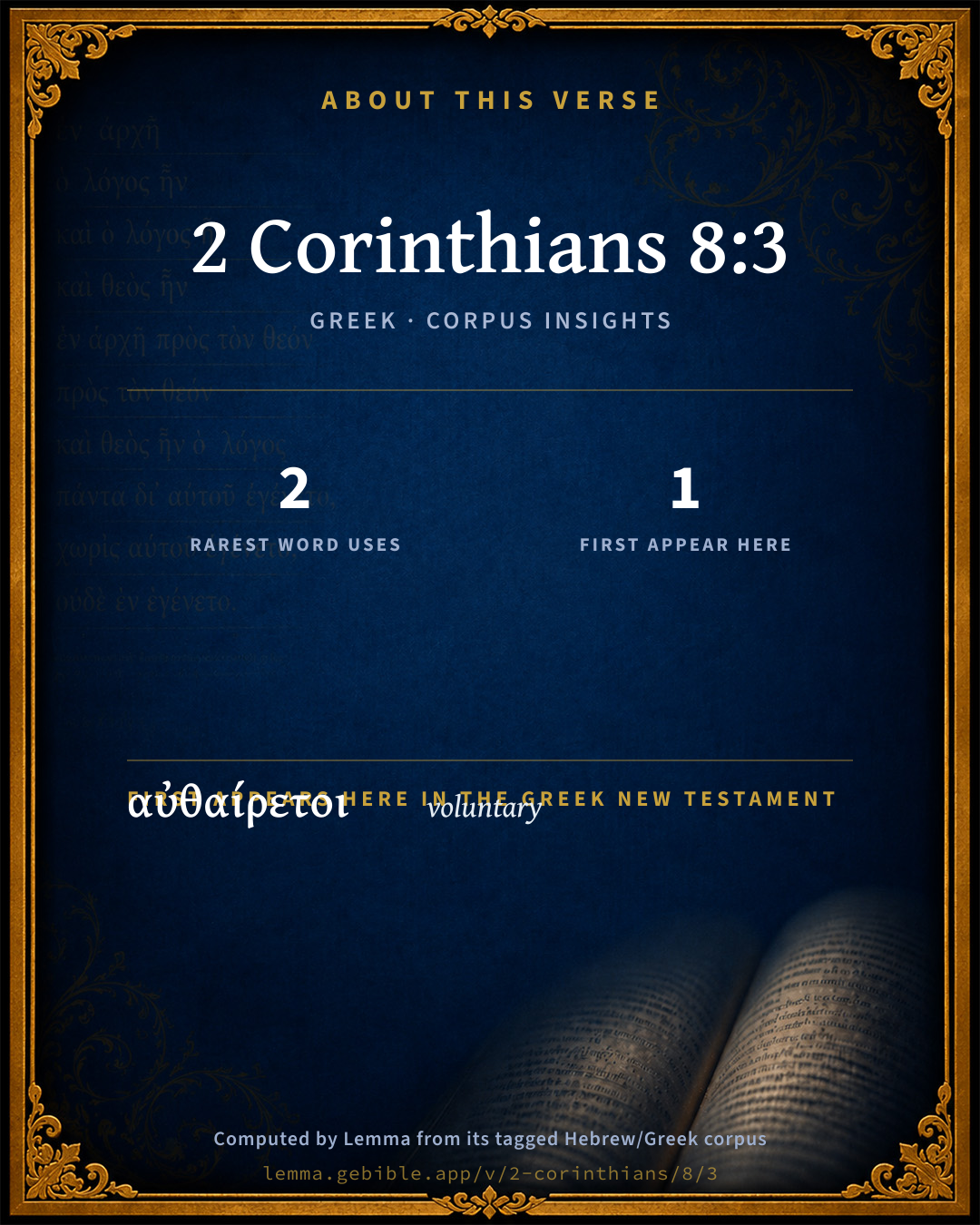
The rarest word here is αὐθαίρετοι voluntary G830 — appearing just 2 times in the whole Greek New Testament.

First appearance in Scripture

This word makes its first canonical appearance in the Greek New Testament here:

  • αὐθαίρετοι voluntary G830

Shared distinctive vocabulary

αὐθαίρετοι voluntary G830 occurs in 2 verses of the Greek New Testament. Also found in:

Repetition

A word recurs within this verse:

  • δύναμιν power G1411 ×2

Cross-references

22

Topical passages linked to 2 Corinthians 8:3 in the Treasury of Scripture Knowledge — connected by theme and wording, ordered by reader-vote popularity; previews shown in the World English Bible.

  • Exodus 35:5 'Take from among you an offering to Yahweh. Whoever is of a willing heart, let him bring it, Yahweh's offering: gold, silver, brass,
  • Exodus 35:29 The children of Israel brought a freewill offering to Yahweh; every man and woman, whose heart made them willing to bring for all the work, which Yahweh had commanded to be made by Moses.
  • Exodus 35:21–22 They came, everyone whose heart stirred him up, and everyone whom his spirit made willing, and brought Yahweh's offering, for the work of the tent of meeting, and for all of its service, and for the holy garments.
  • 2 Corinthians 9:6–7 Remember this: he who sows sparingly will also reap sparingly. He who sows bountifully will also reap bountifully.
  • Philemon 1:14 But I was willing to do nothing without your consent, that your goodness would not be as of necessity, but of free will.
  • 1 Chronicles 29:9 Then the people rejoiced, because they offered willingly, because with a perfect heart they offered willingly to Yahweh: and David the king also rejoiced with great joy.
  • Acts 11:29 As any of the disciples had plenty, each determined to send relief to the brothers who lived in Judea;
  • 1 Corinthians 9:17 For if I do this of my own will, I have a reward. But if not of my own will, I have a stewardship entrusted to me.
  • 1 Corinthians 16:2 On the first day of the week, let each one of you save, as he may prosper, that no collections be made when I come.
  • 1 Chronicles 29:5–6 of gold for the [things of] gold, and of silver for the [things of] silver, and for all manner of work [to be made] by the hands of artificers. Who then offers willingly to consecrate himself this day to Yahweh?
  • 1 Chronicles 29:13–17 Now therefore, our God, we thank you, and praise your glorious name.
  • Philippians 2:13 For it is God who works in you both to will and to work, for his good pleasure.
  • Psalms 110:3 Your people offer themselves willingly in the day of your power, in holy array. Out of the womb of the morning, you have the dew of your youth.
  • Romans 10:2 For I testify about them that they have a zeal for God, but not according to knowledge.
  • 2 Corinthians 8:11–12 But now complete the doing also, that as there was the readiness to be willing, so there may be the completion also out of your ability.
  • 2 Corinthians 8:16–17 But thanks be to God, who puts the same earnest care for you into the heart of Titus.
  • Galatians 4:15 What was the blessing you enjoyed? For I testify to you that, if possible, you would have plucked out your eyes and given them to me.
  • Colossians 4:13 For I testify about him, that he has great zeal for you, and for those in Laodicea, and for those in Hierapolis.
  • 1 Thessalonians 2:8 Even so, affectionately longing for you, we were well pleased to impart to you, not the Gospel of God only, but also our own souls, because you had become very dear to us.
  • 1 Peter 4:11 If any man speaks, let it be as it were oracles of God. If any man serves, let it be as of the strength which God supplies, that in all things God may be glorified through Jesus Christ, to whom belong the glory and the dominion forever and ever. Amen.
  • 1 Peter 5:2 Shepherd the flock of God which is among you, exercising the oversight, not under compulsion, but voluntarily, not for dishonest gain, but willingly;
  • Mark 14:8 She has done what she could. She has anointed my body beforehand for the burying.

Cross-references courtesy of OpenBible.info (CC BY 4.0).

Commentary

Notes on 2 Corinthians 8:3 from classic Christian and Jewish commentators (each source and its license shown beneath its notes). The classic Christian expositions comment on the surrounding passage and are grouped to its opening verse, so a note may address several verses; the Jewish commentaries on the Tanakh (Rashi and others) are per-verse, so they appear only where the commentator wrote on this verse.

Lemma curates 59 commentaries, every one of them public domain or Creative Commons licensed, each selected and text-cleaned for this edition rather than reprinted as found. About our sources →

Joseph Benson's Commentary

2Co 8:3-5. For to their power, &c. — According to their ability, yea, and beyond their ability; they were willing of themselves — Without our soliciting them. This, as Macknight justly observes, is no hyperbole, but an animated expression, strongly descriptive of the generosity of the Macedonians. They were willing to give more than they were well able, considering the distresses under which they themselves laboured. Praying us with much entreaty — Probably St. Paul had lovingly admonished them not to do beyond their power; that we would receive the gift — Which their bounty had prepared, and take a part in ministering it to the saints. And this they did, not as we hoped — That is, beyond all we could have hoped; and first gave their own selves, and all they had, to the Lord — To his honour and service; and unto us — Resigned themselves to us; by the will of God — In obedience to his will, to be wholly directed by us; that is, to do what we should think most advisable in present circumstances.

Joseph Benson's Commentary on the Old and New Testaments (1811–1818) — public domain. Text from a community e-Sword module.

Bengel's Gnomon

Johann Albrecht Bengel

2Co 8:3. Ὅτι, because) Anaphora with epitasis.[44]—ΜΑΡΤΥΡῶ, I bear witness) This expression has respect to the words, κατὰ, according to, and παρὰ, beyond.—αὐθαίρετοι) of their own accord; not only not being besought, but they themselves beseeching us. See the following verse.

[44] See App. The same ὅτι, already used 2Co 8:2, is again by Anaphora used here, to mark the beginnings of sections or sentences. The κατὰ δύναμιν makes an emphatic addition or epitasis.—ED.

Bengel's Gnomon of the New Testament — English translation (T&T Clark, Edinburgh, 1860) — public domain. Text from a community e-Sword module.

Meyer's Critical & Exegetical Commentary

Heinrich August Wilhelm Meyer

2Co_8:3-5. Ὅτι is not dependent on γνωρίζομεν (Hofmann), but gives the proof of what was just said: εἰς τὸν πλοῦτον τῆς ἁπλ. αὐτ.

The construction is plain; for there is no need to supply an ἦσαν, as many wish, after αὐθαίρετοι or after δεόμενοι, but, as Bengel aptly remarks: ἔδωκαν … totam periochae structuram sustinet. Comp. Fritzsche, Dissert. II. p. 49; Billroth, Ewald, Osiander, Hofmann. There are, namely (and in accordance therewith the punctuation is to be fixed), four modal definitions attached to this ἔδωκαν: They gave (1) according to and beyond their means; (2) of their ovm impulse; (3) urgently entreating us for the χάρις and κοινωνία κ.τ.λ.; and (4) not as we hoped, but themselves, etc. This last modal definition is naturally and quite logically attached by καί (hence καὶ οὐ καθὼς ἠλπίσ.); and Rückert (comp. de Wette and Neander) is arbitrary in holding this καί to prove that Paul allowed the sentence he had begun to drop, and appended a new one, so that after ἠλπίσαμεν we should have to supply an ἐγένετο or ἐποίησαν.

μαρτυρῶ] I testify it, a parenthetic assurance. Comp. the Greek use of οἶμαι and the like (Bornem. ad Xen. Conv. p. 71, 179; Stallb. ad Plat. Gorg. p. 460 A).

παρὰ δύναμιν] i.e. more amply than was accordant with their resources. See Homer, Il. xiii. 787; Thucyd. i. 70. 2; Lucian. Nigr. 28, de Dom. 10. The same, in substantial meaning, is ὑπὲρ δύναμιν, 2Co_1:8; Dem. 292. 25. It forms, with κατὰ δύναμ., a climactic definition of ἔδωκαν, not of αὐθαίρ., to which it is not suitabl.

αὐθαίρετοι] excludes human persuasion or compulsion, not the divine influence (see 2Co_8:5, διὰ θελήματος θεοῦ); we must not, with Rückert, hold it, on account of the remark 2Co_9:2, to be an exaggeration, since the latter notice does not deny the self-determination of the Macedonians, but, when compared with our passage, exhibits as the real state of the case this, that Paul had boasted of the readiness of the Achaeans before the Macedonians, but without exhortation to the latter, and that these thereupon, of their own accord, without urging, had resolved on making a contribution, and had given very amply. Comp. Chrysostom on 2Co_9:2. αὐθαίρετος, free-willed, self-determined, only here and at 2Co_8:17 in the N. T., often in the classic writers; seldom of persons (Xen. Anab. v. 7. 29; Lucian. Catapl. 4). Comp. the adverb in 2Ma_6:19; 3Ma_6:6.

μετὰ πολλῆς … εἰς τ. ἁγίους] to be taken together: with much exhortation entreating us for the kindness and the participation of the service being rendered for the saints, i.e. urgently entreating us that the kindness might be shown them of permitting them to take active part in the … work of collections. Οὐχ ἡμεῖς αὐτῶν ἐδεήθημεν, ἀλλʼ αὐτοὶ ἡμῶν, Chrysostom; and in the κοινωνία sought they saw a kindness to be shown to themselves: they knew how to value the work of love thus highly. The χάρις, namely, here is not grace from God (Hofmann and the older commentators), since it was requested from the apostle, but τὴν χάριν κ. τ. κοινων. is a true ἓν διὰ δυοῖν (the favour, and indeed the partaking, i.e. the favour of partaking). See Fritzsche, ad Matth. p. 854, and generally, Nägelsbach on Il. iii. 100, p. 461, ed. 3. Bengel, who likewise rejects the δέξασθαι ἡμᾶς of the Recepta, connects τὴν χάριν κ. τὴν κοινωνίαν κ.τ.λ. with ἔδωκαν; but what a prolix designation of the withal quite self-evident object of ἔδωκαν would that be, while δεόμενοι ἡμῶν would remain quite open and void of definition! On δεῖσθαι, with accusative of the thing and genitive of the person, comp. Plato, Apol. p. 18 A, p. 41 E; Xen. Cyrop. i. 4. 12; Anab. vii. 3. 5; 3 Esd. 8:53. Yet in the classics the accusative of the object is the neuter of a pronoun, like τοῦτο ὑμῶν δέομαι; ὅπερ ὑμῶν δέομαι, and the like, or of an adjective (Krüger on Thuc. i. 32. 1).

τῆς εἰς τοὺς ἁγίους] In this addition (comp. 1Co_16:1), which would in itself be superfluous, there lies a motive of the δεόμενοι.

καὶ οὐ καθὼς ἠλπίσαμεν] for but a little could be expected from the oppressed and poor Macedonians! Οὐ περὶ τῆς γνώμης λέγει, ἀ̓λλὰ περὶ τοῦ πλήθους τῶν χρημάτων, Theodoret. According to Hofmann, the words are meant only to affirm that the Macedonians had joined in the contribution quite of their own resolution, which had not been expected by the apostle. But in this case the remark, which on this interpretation would be no independent element, but only the negative expression of what was already said in αὐθαίρετοι, would have had its logical position immediately behind αὐθαίρετοι; and it must have run not as it is written by Paul, but: καθὲς οὐκ ἠλπίσαμεν. No, the apostle says: and their giving did not remain within the limits of the hope which we had formed regarding them, but far surpassed these (ἀλλʼ ἑαυτοὺς κ.τ.λ.).

ἀλλʼ ἑαυτοὺς κ.τ.λ.] but themselves they gave, etc. An expression of the highest Christian readiness of sacrifice and liberality, which, by giving up all individual interests, is not only a contribution of money, but a self-surrender, in the first instance, to the Lord, since in fact Christ is thereby served, and also to him who conducts the work of collection, since he is to the giver the organ of Christ. Flatt and Billroth, following Mosheim and Heumann, are wrong in making πρῶτον before in the sense: before I asked them. This reference is not in the least implied in the immediate context (οὐ καθὼς ἠλπίσ.); and if it were, πρῶτον must have had the first place:[269] ἀλλὰ πρῶτον ἑαυτοὺς ἔδωκαν κ.τ.λ. As the words stand, ἑαυτούς has the emphasis of the contrast with οὐ καθὼς ἠλπίσ. Bengel also (comp. Schrader) is wrong in thinking that in πρῶτον there is implied prae munere: the Macedonians, before they made collection, had first given themselves to the Lord, and then left it to the apostle to determine how large their contribution should be. In that case there must have been inserted καὶ τὰ χρήματα ἡμῖν, or something similar, as a correlative to ἑαυτοὺς πρῶτον τῷ κυρίῳ. It is wrong to find in ἑαυτούς the idea merely of voluntarily.[270] without any summons, because it is object of the having given. It must have run: αὐτοὶ ἑαυτοὺς κ.τ.λ. (comp. 2Co_1:9), or without stress on the self-object, ἈΦʼ ἙΑΥΤῶΝ.

ΚΑῚ ἩΜῖΝ] Paul does not say ἜΠΕΙΤΑ ἩΜῖΝ (in opposition to the usual opinion that καί stands for ἜΠΕΙΤΑ; so also Rückert), because the surrender to the Lord is not a prius in time, but in degree: to the Lord before all, and to us. So Rom_1:16; Rom_2:9-10.

διὰ θελήμ. θεοῦ] not exactly an expression of modesty (Billroth),for it is only arbitrary to limit it merely to καὶ ἡμῖν (so also Bengel, Ewald),but added quite according to the requirement of religious feeling: for God has, according to His will, so wrought on their dispositions, that they, etc. Comp. 2Co_8:1; 2Co_8:16.

[269] This also in opposition to Hofmann, who, in consistency with his inappropriate interpretation of κ. οὐ καθ. ἠλπίσ., takes πρῶτον: without such a thought (such a hope) having occurred to me. Besides, πρῶτον would not mean without, but before that, etc.

[270] So Hofmann; whence there would result even a threefold expression of the voluntary act, namely: (1) in αὐθαίρετοι; (2) in κ. οὐ καθ. ἠλπίσ., and (3) in ἑαυτούς.

Meyer — Critical and Exegetical Commentary on the New Testament — English translation by Peter Christie, edited by Frederick Crombie (T&T Clark, 1880) — public domain. Text from a community e-Sword module.

Expositor's Greek Testament

ed. W. Robertson Nicoll

2Co 8:3-4 . αὐθαίρετοι μετὰ πολλ . παρακ . κ . τ . λ .: of their own accord begging of us with much entreaty (the constr. is clumsy but perhaps unbroken; we should expect ἔδωκαν after αὐθαίρετοι , but the verb is found in 2Co 8:5 ) the favour, sc. , of giving ( cf. , for this sense of χάρις , Act 24:27 ; Act 25:3 , Sir 30:6 ), and the participation in the ministering to the saints, sc. , the poor Christians in Judæa. The Macedonian Christians did not wait to be asked to give; they asked to be allowed the privilege of giving ( cf. Act 20:35 ). διακονία is the regular word for such charitable service ( cf. Act 6:1 ; Act 11:29 , Rom 15:25 ; Rom 15:31 , chap. 2Co 9:1 ; 2Co 9:12 , etc.), a primary duty of the διάκονοι being the administration of alms.

2Co 8:3 . ὅτι κατὰ δύναμιν κ . τ . λ .: for according to their power, I bear witness, yea and beyond their power . Field quotes a good parallel from Josephus, Antt. , iii., 6. 1, who has κατὰ δύναμιν … παρὰ δύναμιν as here.

The Expositor's Greek Testament, edited by W. Robertson Nicoll (1897–1910) — public domain. Text from a community e-Sword module.

Geneva Bible (1599)

Geneva Bible translators

Of their own accord they were liberal.

Geneva Bible (1599) marginal notes — public domain. Text via Bolls.life.

Jamieson, Fausset & Brown

Robert Jamieson, A. R. Fausset & David Brown

they were willing--rather, supply from Co2 8:5, the ellipsis thus, "According to their power . . . yea, and beyond their power, THEY GAVE."

of themselves--not only not being besought, but themselves beseeching us.

Jamieson, Fausset & Brown — Commentary Critical and Explanatory on the Whole Bible (1871) — public domain (CC PDM 1.0). Text via the HelloAO Bible API.

Adam Clarke's Commentary

Verse 3. For to their power, c.] In their liberality they had no rule but their ability they believed they were bound to contribute all they could; and even this rule they transgressed, for they went beyond their power-they deprived themselves for a time of the necessaries of life, in order to give to others who were destitute even of necessaries.

Adam Clarke's Commentary on the Bible (1810–1826) — public domain. Text from a community e-Sword/MySword module.

John Calvin's Commentaries

3. To their power, and even beyond their power. When he says that they were willing of themselves, he means that they were, of their own accord, so well prepared for the duty, that they needed no exhortation. It was a great thing — to strive up to the measure of their ability; and hence, to exert themselves beyond their ability, showed a rare, and truly admirable excellence. Now he speaks according to the common custom of men, for the common rule of doing good is that which Solomon prescribes, (Proverbs 5:15) —

to drink water out of our own fountains, and let the rivulets go past, that they may flow onwards to others.

The Macedonians, on the other hand, making no account of themselves, and almost losing sight of themselves, concerned themselves rather as to providing for others. In fine, those that are in straitened circumstances are willing beyond their ability, if they lay out any thing upon others from their slender means.

John Calvin's Commentaries (1540-1563) — public domain. Text from the Calvin Translation Society English edition (1840s-50s) via the Christian Classics Ethereal Library (ccel.org). Calvin's coverage is partial (roughly two-thirds of the Bible); uncommented books and verses are honest gaps, never fabricated. The 19th-century editor's footnotes and remarks are omitted so the notes are faithfully Calvin's own voice.

Ellicott's Commentary for English Readers

(3) They were willing of themselves.—Literally, spontaneously. This was the point of excellence which he wished to indicate as an example to the Corinthians. Those of Macedonia needed no appeal or counsel such as he had given to the Corinthians and to others.

A Bible Commentary for English Readers, edited by Charles John Ellicott (1878–1897) — public domain. Text from a community e-Sword module.

The Cambridge Bible for Schools and Colleges

gen. ed. J. J. S. Perowne

3. willing of themselves] Willynge of their owne accorde, Tyndale. Literally, of their own choice, not excluding, however, as Meyer well remarks, Divine, but only human, influence in the matter. Cf. 2Co_8:17.

The Cambridge Bible for Schools and Colleges (gen. ed. J. J. S. Perowne; Cambridge University Press, 1878–1918) — public domain. Text from a community e-Sword module.

John Gill's Exposition

For to their power, I bear record,.... They gave according to their ability, to the utmost of it, which is the most that can be desired, or be given; for no man can give more than he has, nor is he required to do more than he is able:

yea, and beyond their power they were willing of themselves; not that they did or could do beyond their power; but they were "willing" beyond their power; their hearts were larger than their purses; they would gladly have done more than they had ability to do; and to this the apostle bears testimony to give it credit, which otherwise might have been called in question: and it is to be observed, that these churches communicated in this cheerful manner and large way, considering their circumstances, to the utmost of their ability, "of themselves"; unasked, not having been put upon, pressed, and urged to such a service; for persons to give when they are asked, especially when they do it readily, at once, without demurring upon it, and with cheerfulness, is much; but to give unasked discovers a very generous and beneficent disposition: this is reckoned by the Jews as one of the excellencies in giving of alms (u),

"when a man gives into the hands of another , "before he asks"; and the next degree to this is, when he gives to him after he asks; and the next to this, who gives less than is proper, but with a cheerful countenance.''

(u) Maimon. Hileh. Mattanot Anayim, c. 10. sect. 11, 12, 13.

John Gill's Exposition of the Whole Bible (1746–1763) — public domain (CC PDM 1.0). Text via the HelloAO Bible API.

Trapp's Complete Commentary

John Trapp

3 For to their power, I bear record, yea, and beyond their power they were willing of themselves;

Ver. 3. Yea, and beyond their power] One such poor Macedonian might well shame a hundred rich Corinthian curmudgeons. {a} They knew that Manus pauperum est gazophylacium Christi, The hand of the poor man is the treasury of Christ, and might haply have heard of their once King Alexander the Great, how that when he had undertaken the conquest of the Persian empire, he gave away his treasure; and being asked where it was, he pointed to the poor, and said, In scriniis, in my chests; and when he was further asked what he kept for himself, he answered, Spem maiorum et meliorum, The hope of greater and better things.

They were willing] Gr. Αυθαιρετοι, they were volunteers, full of cheerful charity. So were Aidanus, and after him Mr Fox, who gave his horse to a poor beggar that answered him discreetly. Mr Greenham also gave more than he could spare; so that he usually lacked money to get in his harvest.

{a} An avaricious churlish fellow; a miser, a niggard ŒD

John Trapp, A Commentary or Exposition upon All the Books of the Old and New Testament (1647–1656) — public domain. Text from a community e-Sword module.

Albert Barnes' Notes on the Bible

For to their power - To the utmost of their ability.

I bear record - Paul had founded those churches and had spent much time with them. He was therefore well qualified to bear testimony in regard to their condition.

Yea, and beyond their power - Beyond what could have been expected; or beyond what it would have been thought possible in their condition. Doddridge remarks that this is a noble hyperbole, similar to that used by Demosthenes when he says, “I have performed all, even with an industry beyond my power.” The sense is, they were willing to give more than they were well able. It shows the strong interest which they had in the subject, and the anxious desire which they had to relieve the needs of others.

Of themselves - (αὐθαίρεται authairetai). Acting from choice, self-moved, voluntarily, of their own accord. They did not wait to be urged and pressed to do it. They rejoiced in the opportunity of doing it. They came forward of their own accord and made the contribution. “God loveth a cheerful giver” 2Co 9:7; and from all the accounts which we have of these churches in Macedonia it is evident that they were greatly distinguished for their cheerful liberality.

Albert Barnes' Notes on the Bible (1834–1885) — public domain. Text from a community e-Sword/MySword module.

Matthew Poole's English Annotations

Two things the apostle commendeth in the charity of the churches of Macedonia:

1. The quantity of their gift, which, he saith, was to their power, yea, ( on his knowledge), beyond what they were able.

2. Their freedom in the action; so as they did not need the apostle’s exhortations and arguments, but did it of themselves freely and cheerfully.

Matthew Poole's English Annotations on the Holy Bible (1683–1685) — public domain. Text from a community e-Sword/MySword module.

The Pulpit Commentary

They were willing of themselves. "Of their own accord," as in ver. 17. The verb in the original is energetically omitted, with the "they gave" of ver. 5. St. Paul does not mean that the notion of making the collection originated with them, (2Co_9:2) but only that they displayed a voluntary energy in carrying it out.

The Pulpit Commentary (1880–1919), ed. H.D.M. Spence-Jones & Joseph S. Exell — public domain. Text from a community e-Sword module.

Burkitt's Expository Notes on the New Testament

William Burkitt

Three things are here recorded as the glory of the Macedonian’s charity.

(1.) It was profusely liberal, beyond their ability: To their power, yea, and beyond their power, they were ready. Though, generally speaking, we are to consult our own ability and present circumstances in all our charitable distributions; yet there may be, and sometimes are, emergent occasions, as may make it a necessary duty to administer to other’s necessities far beyond our own ability.

(2.) Their charity was purely voluntary; They were willing of themselves; that is, unsolicited by the apostle, unasked by any other, only prompted to it by the grace of God: They made a collection amongst themselves freely and cheerfully.

(3.) Their charity was accompanied with importunity to the apostle to receive and distribute it. He was so far from intreating them to give, that they intreated him to receive their collection, and to take care for its conveyance to them, and distribution among them: Praying us with much intreaty, that we would receive this their gift, and fellowship of ministry to the saints.

William Burkitt's Expository Notes on the New Testament (1700–1703) — public domain. Text from a community e-Sword module.

McGarvey & Pendleton's Commentaries

J. W. McGarvey

For according to their power, I bear witness, yea and beyond their power, they gave of their own accord ,

J. W. McGarvey (with Philip Y. Pendleton), Commentaries on the New Testament (The Fourfold Gospel, 1914; Acts; and the epistles) — public domain. Text from a community e-Sword/MySword module.

The People's New Testament

B. W. Johnson

3. For to their power. It was not the greatness of their contribution, but the fact that they gave not only up to, but even beyond their ability, which made their liberality so rich. The widow who gave her mite did more than the rich men who cast in out of their abundance. Willing of themselves. Required no urging.

B. W. Johnson's The People's New Testament with Notes (1889–1891) — public domain. Electronic text from the Christian Classics Ethereal Library (CCEL) ThML edition.

unfoldingWord translationNotes

Door43 World Missions Community

they gave

This refers to the churches in Macedonia.

of their own free will

"voluntarily"

this ministry to the believers

Paul is referring to providing money to the believers in Jerusalem. AT: "this ministry of providing for the believers in Jerusalem" (See: Assumed Knowledge and Implicit Information)

translationWords

testimony

beg

plea

to minister

believe

lord

will of God

unfoldingWord translationNotes — © Distant Shores Media and the Door43 World Missions Community, licensed CC BY-SA 4.0. Source: git.door43.org/Door43/en_tn.

Cambridge Greek Testament for Schools and Colleges

3–5. The main clause in this long sentence is ἑαυτοὺς ἔδωκαν τῷ κυρίῳ: totam periochae structuram sustinet (Bengel). Of this self-sacrifice four things are stated: (1) it was to the extent of their power and beyond it; (2) it was of their own free will; (3) it was accompanied by much entreaty that they might be allowed to share in the ministering to the saints; (4) it was beyond the Apostle’s experience. Both the A.V. and the R.V. break up the long sentence by inserting words which are not in the Greek. In the A.V., not only ‘they were’ and ‘they did’ should be in italics, but also ‘take upon us’ and ‘this’ before ‘they did’: all these are insertions. Moreover ‘that we would receive’ is no part of the true text. See critical note. The whole sentence runs thus; For according to their power, I bear witness, and beyond their power, of their own accord, with much entreaty (or, exhortation, as 2Co 5:17) beseeching of us the grace and the fellowship of the ministering to the saints, and not just as we expected, but first they gave their own selves to the Lord. Comp. Luk 21:2-4.

3. μαρτυρῶ. Comp. Gal 4:15; Rom 10:2; Col 4:13.

παρὰ δύναμιν. Stronger than ὑπὲρ δύναμιν (2Co 1:8). Not to be taken with αὐθαίρετοι, as if the meaning were fecerunt quod potuerunt, et magis quam facultas sineret tribuere voluerunt (Atto Vercell.).

αὐθαίρετοι. In the N.T. only here and 2Co 8:17; not in the LXX. In classical Greek it is more often used of things that are chosen than of persons that choose. Here it means that the Apostle had no need to beg them to help; they begged to be allowed to do so. Tam simpliciter et devote obtulerunt quod ultra vires eorum erat, ut cum lacrymis deprecantes offerrent, ut vel sic cogerent accipi a se quod accipiendum non videbatur, quia plus erat quam poterat eorum substantia (Herveius Burgidol.).

Cambridge Greek Testament for Schools and Colleges (Cambridge University Press, 1896; 21 vols, various authors incl. Carr, Maclear, Plummer, Farrar, Lumby, Moule, M. R. James, Simcox) — public domain. Text from a community e-Sword module.

Alford’s Greek Testament

Henry Alford

3-5.] Proof of this. There is no difficulty, and no ellipsis, in the construction. For according to their power, I testify, and beyond their power, voluntarily, with much exhortation beseeching of us the grace and fellowship of the ministry to the saints (i.e. to allow them a share in that grace and fellowship), and not as we expected (i.e. far beyond our expectation), but themselves they gave first (i.e. above all: as the inducing motive: not first in point of time, but in point of importance, see Rom 2:9, Rom 2:10) to the Lord, and to us by the will of God (the Giver of grace, who made them willing to do this: not = κατὰ τὸ θέλ. τ. θ., which only expresses (whatever it may imply) consonance with the divine will: διὰ τοῦ θελ. τ. θ. makes the divine will the agent).

Henry Alford, The Greek Testament (1849–1861) — public domain. Text from a community e-Sword module.

International Critical Commentary

3-5. ὅτι κατὰ δύναμιν … διὰ θελήματος Θεοῦ. It will be convenient to take the whole of this long sentence first, and then examine the separate clauses; the constr. is irregular, owing to prolonged dictation. ‘For according to their power, I bear witness, and beyond their power, of their own accord, with much entreaty beseeching of us the favour and the fellowship of the ministering to the saints; and [this] not in the way that we expected, but it was their own selves that they gave first of all to the Lord and to us, through the will of God.’ Three things have been already stated with regard to the help given by the Macedonian Christians. It was rendered (1) in a time of great affliction, (2) in spite of great poverty, (3) with great joy. The Apostle now adds four more particulars. The help was rendered (4) to an extent quite beyond their small means, (5) of their own free will, (6) so much so that they begged to be permitted to take part in ministering to their fellow-Christians, (7) placing themselves at the disposal of St Paul in a way quite beyond his expectation. The long and awkward sentence requires to be broken up, and this almost necessarily involves inserting a few words. But AV is not quite consistent in putting what is inserted in italics; for ‘take upon us’ (v. 4) and ‘this’ (v. 5) should be in italics as well as ‘their,’ ‘they were,’ and ‘they did.’ Moreover, ‘that we should receive’ (v. 4) is no part of the true text (see below). In RV. ‘this grace’ (v. 4) is in excess of the Greek, which has ‘the grace.’ But, in order to make the meaning clear it is almost necessary, with RV., to have ‘they gave’ twice, although it comes only once in the Greek.

3. μαρτυρῶ. Nowhere else is the word used absolutely, as here; cf. Gal 4:15; Rom 10:2; Col 4:13; Rev 22:18. With this parenthetical insertion of a confirmatory statement comp. ὡς τέκνοις λέγω (6:13), λέγω ὑμῖν (Luk 13:24), and the classical οἶδα, οἶμαι, ὁρᾷς. Blass, § 79.7.

παρὰ δύναμιν. Somewhat stronger than ὑπὲρ δύναμιν (1:8), which K L P have here; it implies not only ‘above and beyond,’ but ‘against, contrary to’ (Heb 11:11). It was a sort of contradiction to their poverty to give so much. The words do not belong to αὐθαίρετοι, ‘spontaneous beyond their power,’ but to the belated ἔδωκαν.*

αὐθαίρετοι. The word occurs nowhere in Bibl. Grk., excepting here and v. 17. In Xen. Anab. v. vii. 29 we have it of selfelected commanders, but it is more often used of things which are spontaneously accepted, death, slavery, etc. (Thuc. 6:40). Cf. αὐθαιρέτως (2 Macc. 6:19; 3 Macc. 6:6), in the same sense as αὐθαίρετοι here, viz. of persons acting spontaneously. The combination ἑκουσίως καὶ αὐθαιρέτως is freq. in papyri. Of course this excludes only the Apostle’s asking; vv. 1 and 5 show that the Divine prompting is fully recognized.

International Critical Commentary — older volumes (1896–1929), various authors — public domain. Text from a community e-Sword module.

Vincent's Word Studies in the New Testament

Marvin R. Vincent

They were willing [αυθαιρετοι] . The adjective stands alone. Only here and ver. 17. Lit., self - chosen, and so Rev., of their own accord.

Marvin R. Vincent, Word Studies in the New Testament (1887–1900) — public domain. Text from a community e-Sword/MySword module.

Lesson kit

Teaching starters — assembled from the data on this page, not authored interpretation. Every prompt links to the verse data it draws on. Edit before teaching.

2 Corinthians, in the Pauline Epistles, opens this verse with 8 words (7 distinct Greek lemmas). Its most distinctive word is authaíretos (“voluntary”). A historical commentator’s framing appears above. Read the whole chapter for the surrounding context.

Discussion questions

  1. What does “voluntary” (authaíretos) contribute to the verse as a whole?
  2. This is the first place “voluntary” appears in Scripture (first appears here). What does its debut here establish?
  3. How does 2 Corinthians 8:17, which shares the word «voluntary», read alongside this verse?
  4. What does the repetition of “power” (2× in this one verse) do in this verse?
  5. These translations render this verse differently. What is at stake in choosing one wording over another?
  6. Compare how Joseph Benson's Commentary and Bengel's Gnomon read this verse. Where do they agree or differ?

Things to notice

  • 1 word makes its first canonical appearance in Scripture here.
  • These translations choose different wording for 13 words in this verse.
  • “power” occurs 2× in this single verse.
  • 7 distinct Greek lemmas span 8 words in this verse.

Reading settings

Reading text

Shown beneath each verse's original-language words.

Old Testament
Old Testament edition

Read the OT as the Masoretic Hebrew (MT) or the Greek Septuagint (LXX).

English shown for the Greek Septuagint (in the Hebrew ↔ Greek comparison).

Comparing translations? Open the Compare panel on any verse page to stack up to four side by side.