Revelation 4:11

Greek (Tischendorf 8th ed.) Revelation 4:11 appears in the Greek New Testament. The text above is from the Tischendorf 8th edition. Each word links to its Strong’s number and a concise gloss. Click any word for its full Thayer’s Greek Lexicon entry.
Download image
Cite this verse

Revelation 4:11 (World English Bible). Public Domain. Lemma interlinear Bible study tool, https://lemma.gebible.app/v/revelation/4/11.

Show BibTeX & RIS
BibTeX
RIS
English Translation
"Worthy are you, our Lord and God, the Holy One, to receive the glory, the honor, and the power, for you created all things, and because of your desire they existed, and were created!"
World English Bible · Public Domain
Download a study sheet

One document with this verse’s original text, its word-by-word gloss line, the meaning frame, cross-references with their text, attributed commentary, and full source and license credits — printable, and it pastes into notes with its structure intact.

This verse Autodidact and up

Study sheet (.html) Plain text (.txt)

A passage Seminary Student

Up to 50 verses in one chapter. A passage sheet keeps up to 6 commentary sources and 12 cross-references per verse, in the order this page ranks them, and says so on the sheet whenever that leaves anything out. Ask for a single verse and you get the Autodidact verse sheet above.

Everything on this page stays free to read, with no account — the sheet is a download of what is already on screen, not access to it.

Want to remove ads? Support Godless Engineer
Compare translations 3

The same verse in 3 English versions, stacked beneath the original-language interlinear above. Click any original word for its lexicon entry.

Each is an independent rendering of the whole verse — the interlinear is not word-aligned to these translations.

Highlighted words mark where these versions differ — a whole-verse word diff, not a word-by-word alignment.

  • World English Bible Public Domain
    "Worthy are you, our Lord and God, the Holy One, to receive the glory, the honor, and the power, for you created all things, and because of your desire they existed, and were created!"
  • King James Version Public Domain
    Thou art worthy, O Lord, to receive glory and honour and power: for thou hast created all things, and for thy pleasure they are and were created.
  • unfoldingWord Literal Text CC BY-SA 4.0
    “Worthy are you, our Lord and God, to receive glory and honor and power, because you have created all things, and by your will they existed and were created.”

unfoldingWord Literal Text — © unfoldingWord, licensed CC BY-SA 4.0. Word-aligned USFM3 via Door43 (git.door43.org/unfoldingWord/en_ult).

Versions to compare (up to 4)

3 of 4 selected

Show all 19 translations

Every available English version of this verse, each an independent rendering of the whole verse.

  • World English Bible Public Domain
    "Worthy are you, our Lord and God, the Holy One, to receive the glory, the honor, and the power, for you created all things, and because of your desire they existed, and were created!"
  • Berean Standard Bible Public Domain
    “Worthy are You, our Lord and God, to receive glory and honor and power, for You created all things; by Your will they exist and came to be.”
  • Majority Standard Bible Public Domain
    “Worthy are You, our Lord and God, the Holy One, to receive glory and honor and power, for You created all things; by Your will they exist and were created.”
  • King James Version Public Domain
    Thou art worthy, O Lord, to receive glory and honour and power: for thou hast created all things, and for thy pleasure they are and were created.
  • American Standard Version (1901) Public Domain
    Worthy art thou, our Lord and our God, to receive the glory and the honor and the power: for thou didst create all things, and because of thy will they were, and were created.
  • Revised Version (1885) Public Domain
    Worthy art thou, our Lord and our God, to receive the glory and the honour and the power: for thou didst create all things, and because of thy will they were, and were created.
  • Geneva Bible (1599) Public Domain
    Thou art worthy, O Lord, to receiue glory and honour, and power: for thou hast created all things, and for thy wils sake they are, and haue beene created.
  • Douay-Rheims (1899) Public Domain
    Thou art worthy, O Lord our God, to receive glory, and honour, and power: because thou hast created all things; and for thy will they were, and have been created.
  • Young's Literal Translation Public Domain
    `Worthy art Thou, O Lord, to receive the glory, and the honour, and the power, because Thou -- Thou didst create the all things, and because of Thy will are they, and they were created.'
  • Literal Standard Version CC BY-SA 4.0
    “Worthy are You, our Lord and God, to receive the glory, and the honor, and the power, because You created all things, and because of Your will they existed and were created.”
  • Unlocked Literal Bible CC BY-SA 4.0
    “Worthy are you, our Lord and our God, to receive glory and honor and power, for you created all things, and by your will they existed and were created.”
  • unfoldingWord Literal Text CC BY-SA 4.0
    “Worthy are you, our Lord and God, to receive glory and honor and power, because you have created all things, and by your will they existed and were created.”
  • Darby Bible Public Domain
    Thou art worthy, O our Lord and [our] God, to receive glory and honour and power; for *thou* hast created all things, and for thy will they were, and they have been created.
  • World Messianic Bible Public Domain
    “Worthy are you, our Lord and God, the Holy One, to receive the glory, the honor, and the power, for you created all things, and because of your desire they existed and were created!”
  • Webster's Bible Public Domain
    Thou art worthy, O Lord, to receive glory, and honor, and power: for thou hast created all things, and for thy pleasure they are and were created.
  • Free Bible Version CC BY-SA 4.0
    “Our Lord and our God, you are worthy to be given glory, and honor, and authority, for you created everything. Your will brought Creation into existence.”
  • Bible in Basic English Public Domain
    It is right, our Lord and our God, for you to have glory and honour and power: because by you were all things made, and by your desire they came into being.
  • Text-Critical English NT CC BY 4.0
    “Yoʋ are worthy, our Lord and God, the Holy One, to receive glory, honor, and power; for yoʋ created all things, and by yoʋr will they came into existence and were created.”
  • Tyndale New Testament (1534) Public Domain
    thou arte worthy lorde to receave glory and honoure and power for thou haste created all thinges and for thy wylles sake they are and were created.

Literal Standard Version (2020), Covenant Press — licensed CC BY-SA 4.0. Text via the HelloAO Bible API (eBible.org). Unlocked Literal Bible (unfoldingWord) — licensed CC BY-SA 4.0. Text via the HelloAO Bible API (eBible.org). unfoldingWord Literal Text — © unfoldingWord, licensed CC BY-SA 4.0. Word-aligned USFM3 via Door43 (git.door43.org/unfoldingWord/en_ult). Free Bible Version, Dr. Jonathan Gallagher — licensed CC BY-SA 4.0. Text via the HelloAO Bible API (eBible.org).

Word by word

More ways to search: Search by grammar → Find every occurrence → Compare this word →

Practice this passage: Drill this verse → Learn its vocabulary →

ἔκτισας
ktízō
G2936
“to create”
Verb, Aorist, Active, Indicative, 2nd person, Singular
Part of Speech
Verb
Tense
Aorist
Voice
Active
Mood
Indicative
Person
2nd person
Number
Singular
Full Thayer's Definition

Origin: probably akin to G2932 (through the idea of proprietor-ship of the manufacturer)

TDNT: 19:40,5

1. to make habitable, to people, a place, region, island a. to found a city, colony, state 2. to create a. of God creating the worlds b. to form, shape, i.e. to completely change or transform
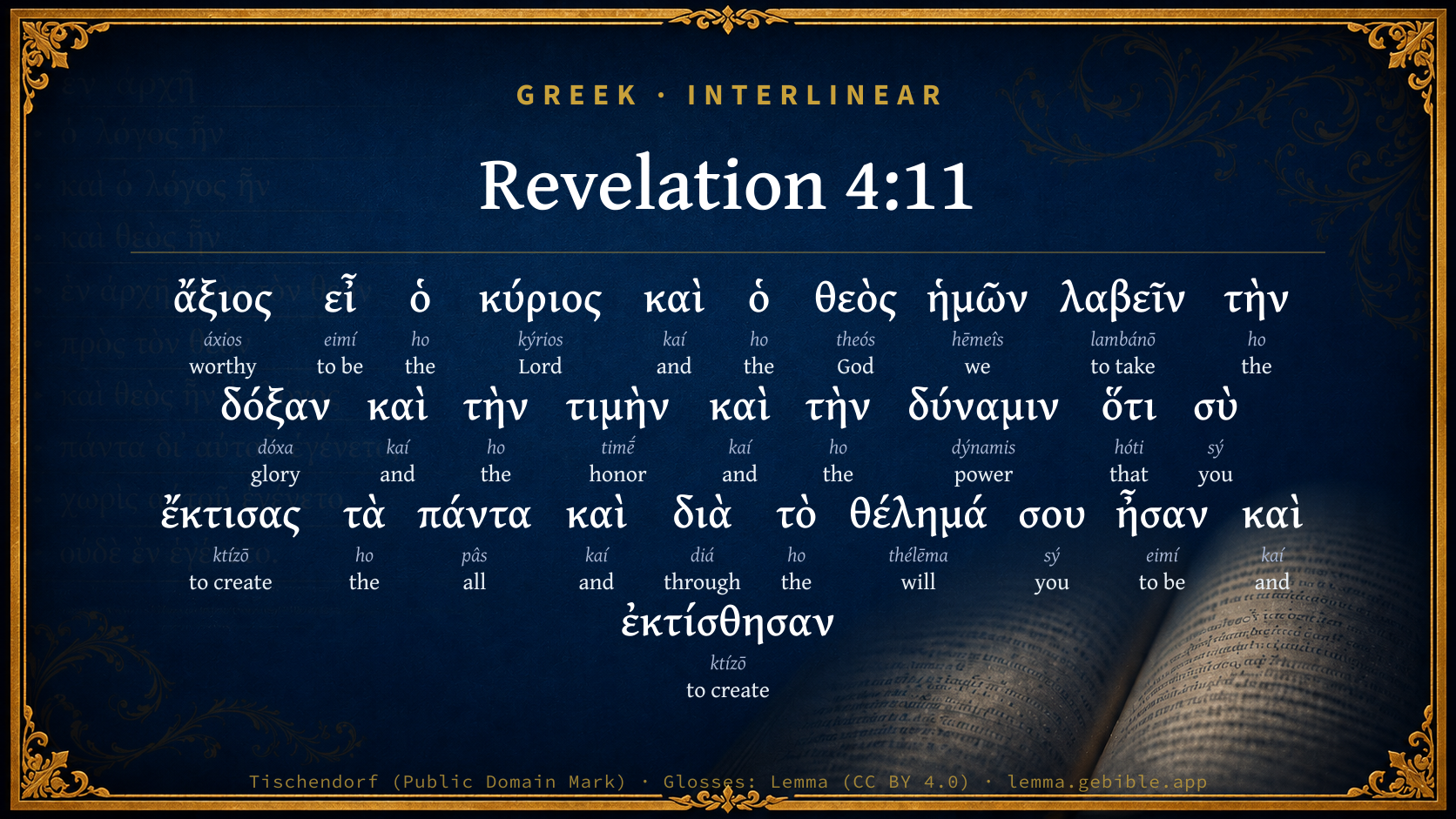
  1. ἄξιος áxios G514 “worthy” Adjective, Nominative, Singular, Masculine
  2. εἶ eimí G1510 “to be” Verb, Present, Active, Indicative, 2nd person, Singular
  3. ὁ ho G3588 “the” Article, Nominative, Singular, Masculine
  4. κύριος kýrios G2962 “Lord” Noun, Nominative, Singular, Masculine
  5. καὶ kaí G2532 “and” Conjunction
  6. ὁ ho G3588 “the” Article, Nominative, Singular, Masculine
  7. θεὸς theós G2316 “God” Noun, Nominative, Singular, Masculine
  8. ἡμῶν hēmeîs G2249 “we” Personal pronoun, 1st person, Genitive, Plural
  9. λαβεῖν lambánō G2983 “to take” Verb, Aorist, Active, Infinitive
  10. τὴν ho G3588 “the” Article, Accusative, Singular, Feminine
  11. δόξαν dóxa G1391 “glory” Noun, Accusative, Singular, Feminine
  12. καὶ kaí G2532 “and” Conjunction
  13. τὴν ho G3588 “the” Article, Accusative, Singular, Feminine
  14. τιμὴν timḗ G5092 “honor” Noun, Accusative, Singular, Feminine
  15. καὶ kaí G2532 “and” Conjunction
  16. τὴν ho G3588 “the” Article, Accusative, Singular, Feminine
  17. δύναμιν dýnamis G1411 “power” Noun, Accusative, Singular, Feminine
  18. ὅτι hóti G3754 “that” Conjunction
  19. σὺ sý G4771 “you” Personal pronoun, 2nd person, Nominative, Singular
  20. τὰ ho G3588 “the” Article, Accusative, Plural, Neuter
  21. πάντα pâs G3956 “all” Adjective, Accusative, Plural, Neuter
  22. καὶ kaí G2532 “and” Conjunction
  23. διὰ diá G1223 “through” Preposition
  24. τὸ ho G3588 “the” Article, Accusative, Singular, Neuter
  25. θέλημά thélēma G2307 “will” Noun, Accusative, Singular, Neuter
  26. σου sý G4771 “you” Personal pronoun, 2nd person, Genitive, Singular
  27. ἦσαν eimí G1510 “to be” Verb, Imperfect, Active, Indicative, 3rd person, Plural
  28. καὶ kaí G2532 “and” Conjunction
  29. ἐκτίσθησαν ktízō G2936 “to create” Verb, Aorist, Passive, Indicative, 3rd person, Plural

About this verse

These counts appear in no published source. They are computed here, from the morphology-tagged text and Lemma’s own curated glosses. What Lemma adds →

30
words
17
distinct lemmas
Revelation
section

Notable vocabulary

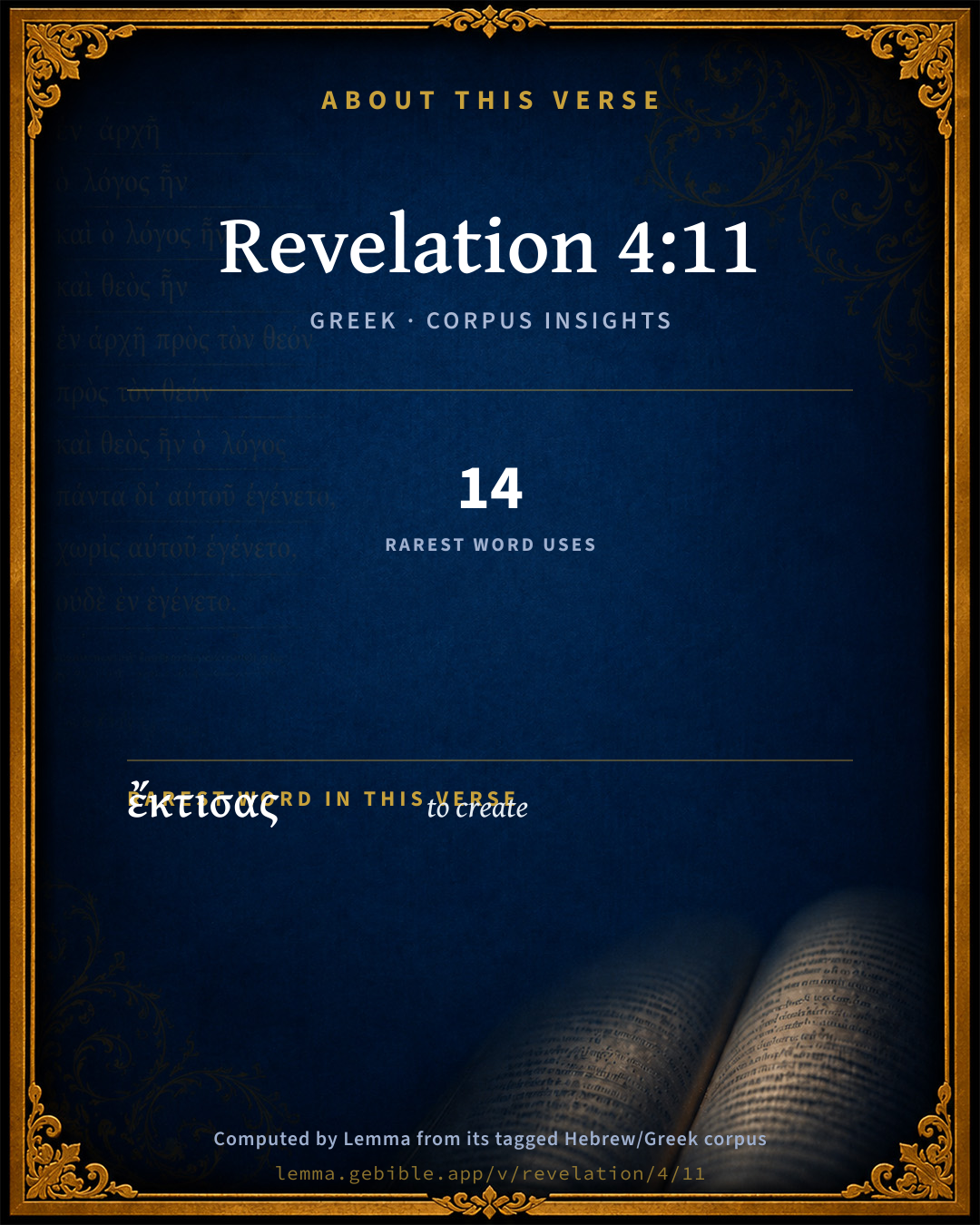
The rarest word here is ἔκτισας to create G2936 — appearing just 14 times in the whole Greek New Testament.

Shared distinctive vocabulary

ἔκτισας to create G2936 occurs in 12 verses of the Greek New Testament. Also found in:

Repetition

Words recur within this verse:

Cross-references

29

Topical passages linked to Revelation 4:11 in the Treasury of Scripture Knowledge — connected by theme and wording, ordered by reader-vote popularity; previews shown in the World English Bible.

  • Colossians 1:16–17 For by him were all things created, in the heavens and on the earth, things visible and things invisible, whether thrones or dominions or principalities or powers; all things have been created through him, and for him.
  • Revelation 5:12 saying with a loud voice, "Worthy is the Lamb who has been killed to receive the power, wealth, wisdom, strength, honor, glory, and blessing!"
  • Isaiah 40:28 Have you not known? have you not heard? The everlasting God, Yahweh, the Creator of the ends of the earth, doesn't faint, neither is weary; there is no searching of his understanding.
  • Proverbs 16:4 Yahweh has made everything for its own end-- Yes, even the wicked for the day of evil.
  • John 1:1–3 In the beginning was the Word, and the Word was with God, and the Word was God.
  • Revelation 10:6 and swore by him who lives forever and ever, who created heaven and the things that are in it, the earth and the things that are in it, and the sea and the things that are in it, that there will no longer be delay,
  • Revelation 14:7 He said with a loud voice, "Fear the Lord, and give him glory; for the hour of his judgment has come. Worship him who made the heaven, the earth, the sea, and the springs of waters!"
  • Romans 11:36 For of him, and through him, and to him, are all things. To him be the glory for ever! Amen.
  • Revelation 5:9 They sang a new song, saying, "You are worthy to take the book, And to open its seals: For you were killed, And bought us for God with your blood, Out of every tribe, language, people, and nation,
  • Psalms 29:1–2 Ascribe to Yahweh, you sons of the mighty, Ascribe to Yahweh glory and strength.
  • Hebrews 1:10 And, "You, Lord, in the beginning, laid the foundation of the earth. The heavens are the works of your hands.
  • Genesis 1:1 In the beginning God created the heavens and the earth.
  • Ephesians 3:9 and to make all men see what is the administration of the mystery which for ages has been hidden in God, who created all things through Jesus Christ;
  • Jeremiah 32:17 Ah Lord Yahweh! behold, you have made the heavens and the earth by your great power and by your outstretched arm; there is nothing too hard for you,
  • Acts 14:15 "Men, why are you doing these things? We also are men of like passions with you, and bring you good news, that you should turn from these vain things to the living God, who made the sky and the earth and the sea, and all that is in them;
  • Nehemiah 9:5 Then the Levites, Jeshua, and Kadmiel, Bani, Hashabneiah, Sherebiah, Hodiah, Shebaniah, [and] Pethahiah, said, Stand up and bless Yahweh your God from everlasting to everlasting; and blessed be your glorious name, which is exalted above all blessing and praise.
  • Psalms 18:3 I call on Yahweh, who is worthy to be praised; And I am saved from my enemies.
  • 2 Samuel 22:4 I will call on Yahweh, who is worthy to be praised: So shall I be saved from my enemies.
  • Acts 17:24 The God who made the world and all things in it, he, being Lord of heaven and earth, doesn't dwell in temples made with hands,
  • 1 Chronicles 16:28–29 Ascribe to Yahweh, you relatives of the peoples, Ascribe to Yahweh glory and strength;
  • Job 36:3 I will get my knowledge from afar, And will ascribe righteousness to my Maker.
  • Psalms 96:7–8 Ascribe to Yahweh, you families of nations, Ascribe to Yahweh glory and strength.
  • Revelation 5:2 I saw a mighty angel proclaiming with a loud voice, "Who is worthy to open the book, and to break its seals?"
  • Psalms 68:34 Ascribe strength to God! His excellency is over Israel, His strength is in the skies.
  • Deuteronomy 32:4 The Rock, his work is perfect; For all his ways are justice: A God of faithfulness and without iniquity, Just and right is he.
  • Isaiah 40:26 Lift up your eyes on high, and see who has created these, who brings out their host by number; he calls them all by name; by the greatness of his might, and because he is strong in power, not one is lacking.
  • Jeremiah 10:11 Thus shall you say to them, The gods that have not made the heavens and the earth, these shall perish from the earth, and from under the heavens.
  • Hebrews 1:2 has at the end of these days spoken to us by his Son, whom he appointed heir of all things, through whom also he made the worlds.
  • Exodus 20:11 for in six days Yahweh made heaven and earth, the sea, and all that is in them, and rested the seventh day; therefore Yahweh blessed the Sabbath day, and made it holy.

Cross-references courtesy of OpenBible.info (CC BY 4.0).

Where the printed editions differ

2 variants

Places in this verse where the major printed Greek editions disagree on the wording in a way that affects the translation — a comparison of editions, not a manuscript-by-manuscript collation. The editions are the modern critical texts (Nestlé-Aland 28/27, SBL, Westcott-Hort, Tregelles, Tyndale House) and the traditional texts behind the KJV (the Textus Receptus and the Byzantine/Majority text). It is not a claim about which reading is original.

  1. Extra text
    καὶ ὁ θεὸς ἡμῶν,

    “and the God of us,”

    In NA28NA27TynSBLWHTregByz Not in TR

    καὶ ὁ θεὸς ἡμῶν, (kai ho theos hēmōn) 'and the God of us,' is only in older manuscripts (NA28+NA27+Tyn+SBL+WH+Treg+Byz)

  2. Extra text
    ὁ ἅγιος,

    “the Holy One”

    In Byz Not in NA28NA27TynSBLWHTregTR

    ὁ (ho) 'the' is only in a few manuscripts (Byz)

Textual data: Translators Amalgamated Greek New Testament (STEPBible TAGNT) · CC BY 4.0.

Commentary

Notes on Revelation 4:11 from classic Christian and Jewish commentators (each source and its license shown beneath its notes). The classic Christian expositions comment on the surrounding passage and are grouped to its opening verse, so a note may address several verses; the Jewish commentaries on the Tanakh (Rashi and others) are per-verse, so they appear only where the commentator wrote on this verse.

Lemma curates 59 commentaries, every one of them public domain or Creative Commons licensed, each selected and text-cleaned for this edition rather than reprinted as found. About our sources →

Tyndale Open Study Notes

Tyndale Open Resources

4:11 You are worthy: This phrase is never used of God in the Old Testament but was frequently used in Rome during emperor worship. As emphasized here, only God deserves worship. • you created all things: Many in the ancient world believed that the gods were too busy to be concerned with humans. But God is Almighty in more than a philosophical sense; he is involved as Creator and Lord. In Revelation, creation affirms that God is in sovereign control of the world (see 3:14; 10:6; 14:7; 21:1). • they exist because you created what you pleased: God had a purpose for everything that he created.

Tyndale Open Study Notes — © Tyndale Open Resources, licensed CC BY-SA 4.0. Text via the HelloAO Bible API.

Bengel's Gnomon

Johann Albrecht Bengel

Rev 4:11. Θέλημα, pleasure [will]) רצון, a free and gracious will.—ἐκτίσθησαν) They are created, that is, they remain in existence. There are other expressions very similar: he shall be blessed, that is, he shall continue blessed, Gen 27:33; I have written, that is, I do not change it, Joh 19:22; is tamed, that is, permits itself to be tamed, Jas 3:7; shall be changed, i.e. shall undergo a change, and continue changed, Heb 1:12. [Creation is the foundation of all the other works of GOD, and therefore it is the ground also of all the thanksgiving which arises from His creatures.—V. g.]

Bengel's Gnomon of the New Testament — English translation (T&T Clark, Edinburgh, 1860) — public domain. Text from a community e-Sword module.

Meyer's Critical & Exegetical Commentary

Heinrich August Wilhelm Meyer

Rev_4:11. Not without significance, the elders who, as representatives of the redeemed, stand in a still closer relation to their Lord and God than the four beings, address the Enthroned One: ὁ κυρ. καὶ ὁ θεὸς ἡμῶν.[1832]

ἌΞΙΟς ΕἸ ΛΑΒΕἸΥ. Cf. Rev_5:12. That God not only when he is worshipped, but also when he exterminates his enemies, receives glory,[1833] does not belong here.

ΤῊΝ ΔΟΞ., Κ.Τ.Λ., the elders say, because in replying they look back in a certain respect to Rev_4:8.[1834]

ΚΑῚ ΤῊΝ ΔΈΝΑΜΙΝ. While the representatives of even creation are right in offering thanks (Rev_4:8), especially suitable in the mouth of the elders, who although naturally also belonging to creation, yet with a certain objectivity regard the work of creation (ὅτι σὺ ἔκτισας, κ.τ.λ.), is the thankful acknowledgment of the power of the Creator revealed therein.[1835]

ΚΑῚ ὉΙᾺ ΤῸ ΘΈΛΗΜΆ ΣΟΥ ἮΣΑΝ. The Vulg., correctly: On account of thy will. Luther, incorrectly: Through thy will. Concerning ΔΙᾺ with the accus. to designate the ground, not the means, cf. Joh_6:57; Winer, p. 372.

In regard to ἮΣΑΝ, the reference may be considered impossible: In thy disposition from eternity, before they were created;[1836] and just as little dare the ἘΚΤΊΣΘΗΣΑΝ be applied to regeneration through Christ,[1837] if the ἮΣΑΝ be correctly referred to the creation. Bengels explanation of the ἮΣΑΝ: All things were, from the creation to the time of this ascription of praise, and still henceforth. Hereby the preservation of all created things is praised, is also artificial; while his explanation of ἐκτίσθησαν: Since thou hast created all things, they remain as long as thou wilt have them, is utterly incorrect. The ἮΣΑΝ is taken mostly[1838] as synonymous with ἘΚΤΊΣΘΗΣΧΝ; but ἮΣΑΝ is not equivalent to ἘΓΈΝΟΝΤΟ or ἘΓΕΝΉΘΗΣΑΝ.[1839] On the contrary, after the divine work of creation is mentioned (ἜΚΤΙΣΑς), the idea recurs to the same point with vivid clearness: as all things were, which before were not. The καὶ ἐκτίσθησαν is, then, not synonymous with the ἮΣΑΝ, but presents expressly the precise fact upon which the ἮΣΑΝ depends: they were created. Thus the lauded work of the Creator (ΣῪ ἜΚΤΙΣΑς) is made manifest even to the creatures by the idea in its two modifications of the ἮΣΑΝ and ἘΚΤΊΣΘΗΣΑΝ.

[1832] See Critical Notes.

[1833] Beng. Cf. Rev_11:17.

[1834] Beng.

[1835] Cf. Rom_1:20.

[1836] N. de Lyra.

[1837] Grot.

[1838] They came into being: De Wette. Cf. C. a Lap., Eichh., Herd., Hengstenb., Ebrard.

[1839] Psa_33:9.

Meyer — Critical and Exegetical Commentary on the New Testament — English translation by Peter Christie, edited by Frederick Crombie (T&T Clark, 1880) — public domain. Text from a community e-Sword module.

Expositor's Greek Testament

ed. W. Robertson Nicoll

Rev 4:11 . An implicit refutation of the dualistic idea, developed by Cerinthus, the traditional opponent of John in Asia Minor, that creation was the work of some angel or power separate from God (Iren. i. 26, iv. 32, Hippol. Haer. vii. 33, x. 1). The enthusiastic assent of the πρεσβύτεροι to the adoration of the Creator is expressed in word as well as in action. σύ emphatic = the usual apocalyptic (R.J., 295, 296) emphasis on creation as a proof of God’s power in providence and claims on mankind ( e.g. 4 Ezr 3:4 , “thou didst fashion the earth, and that thyself alone”). That God the redeemer is God the creator, forms one of the O.T. ideas which acquire special weight in the Apocalypse. Despite the contradictions of experience and the apparent triumph of Satan, the apocalypses of the age never gave way to dualism. Their firm hope was that the world, ideally God’s, would become actually his when messiah’s work was done; hence, as here, the assertion of his complete power over nature and nations. “Because thou didst will it ( σύ , σου , emphatic) they existed and were created” (act and process of creation). As an answer to polytheism this cardinal belief in God the creator came presently to the front in the second century creeds and apologies. But the idea here is different alike from contemporary Jewish and from subsequent Christian speculation, the former holding that creation was for the sake of Israel ( cf. 4 Esd. 6:55, 7:11, 9:13, Apoc. Bar. xiv. 18, 19, xv. 7, Ass. Mos. i. 12, etc., a favourite rabbinic belief), the latter convinced that it was for the sake of the Christian church ( cf. Herm. Vis. ii. 4). Nor is there any evident trace of the finer idea (En. iii v., Clem. Rom. xx., etc.) which contrasted the irregularities and impiety of men with the order and obedience of the universe. The conception of the holy ones rendering ceaseless praise in heaven would be familiar to early Christians in touch with Hellenic ideas and associations; e.g. , Hekataeus of Abdera, in his sketch of the ideal pious folk, compares them to the priests of Apollo, διὰ τὸ τὸν θεὸν τοῦτον καθʼ ἡμέραν ὑπʼ αὐτῶν ὑμνεῖσθαι μετʼ ᾠδῆς συνεχῶς (Dieterich 36 f., cf. Apoc. Pet. 19 20). Test. Lev 3Lev 3 ἐν δὲ τῷ μετʼ αὐτόν εἰσι θρόνοι κ . ἐξουσίαι ἐν ᾧ ὕμνοι ἀεὶ τῷ θεῷ προσφέρονται .

The Expositor's Greek Testament, edited by W. Robertson Nicoll (1897–1910) — public domain. Text from a community e-Sword module.

Geneva Bible (1599)

Geneva Bible translators

The sum of their speech: that all glory must be given unto God: the reason, because he is the eternal beginning of all things, from whose only will they have their being and are governed: and finally in all respects are that which they are.

That is, that thou shouldest challenge the same to thyself alone. But as for us, we are unworthy, that even by thy goodness we should be made partakers of this glory. And hitherto hath been handled the principal cause unapproachable, which is God.

Geneva Bible (1599) marginal notes — public domain. Text via Bolls.life.

Jamieson, Fausset & Brown

Robert Jamieson, A. R. Fausset & David Brown

O Lord--The two oldest manuscripts, A, B, Vulgate, and Syriac add, "and our God." "Our" by virtue of creation, and especially redemption. One oldest manuscript, B, and Syriac insert "the Holy One." But another, A, Vulgate, and Coptic omit this, as English Version does.

glory, &c.--"the glory . . . the honour . . . the power."

thou--emphatic in the Greek: "It is THOU who didst create."

all things--Greek, "the all things": the universe.

for, &c.--Greek, "on account of"; "for the sake of Thy pleasure," or "will." English Version is good Greek. Though the context better suits, it was because of Thy will, that "they were" (so one oldest manuscript, A, Vulgate, Syriac, and Coptic read, instead of English Version "are": another oldest manuscript, B, reads, "They were not, and were created," were created out of nothing), that is, were existing, as contrasted with their previous non-existence. With God to will is to effect: to determine is to perform. So in Gen 1:3, "Let there be light, and there was light": in Hebrew an expressive tautology, the same word and tense and letters being used for "let there be," and "there was," marking the simultaneity and identity of the will and the effect. D. LONGINUS [On the Sublime, 9], a heathen, praises this description of God's power by "the lawgiver of the Jews, no ordinary man," as one worthy of the theme.

were created--by Thy definite act of creation at a definite time.

Next: Revelation Chapter 5

Jamieson, Fausset & Brown — Commentary Critical and Explanatory on the Whole Bible (1871) — public domain (CC PDM 1.0). Text via the HelloAO Bible API.

Adam Clarke's Commentary

Verse 11. Thou art worthy, O Lord, to receive] Thus all creation acknowledges the supremacy of God; and we learn from this song that he made all things for his pleasure; and through the same motive he preserves. Hence it is most evident, that he hateth nothing that he has made, and could have made no intelligent creature with the design to make it eternally miserable. It is strange that a contrary supposition has ever entered into the heart of man; and it is high time that the benevolent nature of the Supreme God should be fully vindicated from aspersions of this kind.

Adam Clarke's Commentary on the Bible (1810–1826) — public domain. Text from a community e-Sword/MySword module.

Ellicott's Commentary for English Readers

(11) The doxology is three-fold. (See Note on Rev_1:6.) It should run—

“Worthy art Thou, O Lord, and our God,

To receive the glory, and the honour, and the power,

Because Thou didst create all things,

And through (or, owing to—i.e., because of) Thy will they were (not ‘ are’) and were created.”

The existence of all things was owing to the will of God, as also was the creation of all things, which was the realisation or manifestation of that will.

A Bible Commentary for English Readers, edited by Charles John Ellicott (1878–1897) — public domain. Text from a community e-Sword module.

The Cambridge Bible for Schools and Colleges

gen. ed. J. J. S. Perowne

11. Thou art worthy, &c.] Here we have the praise of God the Creator by His Creatures as such: in the next ch. we have the praise of the Redeemer.

for thy pleasure] Better, because of Thy will.

they are] Read they were: not exactly “they came into being,” but “they had their being,”—as the simple verb substantive is very well translated in Act_17:28.

The Cambridge Bible for Schools and Colleges (gen. ed. J. J. S. Perowne; Cambridge University Press, 1878–1918) — public domain. Text from a community e-Sword module.

John Gill's Exposition

Thou art worthy, O Lord, to receive glory honour, and power,.... The Alexandrian copy, and some others, the Complutensian edition, the Vulgate Latin version, and all the Oriental ones, read, "thou art worthy, O Lord, and our God, to receive"; that is, to receive the acknowledgment and ascription of glory, honour, and power; for otherwise God cannot be said to receive these from his creatures, than by their confessing and declaring that they belong unto him: and that for the reasons following,

for thou hast created all things; the whole universe, the heavens, the earth, and sea, and all that in them are:

and for thy pleasure they are and were created; God is the first cause, and the last end of all things; by his power they are made, and according to his will, and for his own glory, and therefore is worthy of such a doxology; see Pro 16:4. What is here said is contrary to a notion imbibed by the Jews (z), that the world was not created but for the sake of the Israelites: and elsewhere (a) they say,

"the world was not created but for David; and one says for Moses; and Rabbi Jochanan says for the Messiah;''

which last is truest.

(z) Zohar in Exod. fol. 6. 3. & Tzeror Hammor, fol. 109. 1. & 161. 3. (a) T. Bab. Sanhedrin, fol. 98. 2.

Next: Revelation Chapter 5

John Gill's Exposition of the Whole Bible (1746–1763) — public domain (CC PDM 1.0). Text via the HelloAO Bible API.

Trapp's Complete Commentary

John Trapp

11 Thou art worthy, O Lord, to receive glory and honour and power: for thou hast created all things, and for thy pleasure they are and were created.

Ver. 11. Thou art worthy] If we would have our souls set as a pearl in that fair ring of heavenly courtiers that compass the Lamb’s throne, let us praise God as they do.

For thou hast created] Our service must not be rash but reasonable, Rom 12:1, such as whereof we can render a reason. God hates a blind sacrifice, a Samaritan’s service, when men worship they know not what nor why, Joh 4:22.

And were created] God’s power put forth in the creation and administration of the world is twice here mentioned; as that which can never be sufficiently admired and adored. {See Trapp on "Gen 1:1"}

John Trapp, A Commentary or Exposition upon All the Books of the Old and New Testament (1647–1656) — public domain. Text from a community e-Sword module.

Albert Barnes' Notes on the Bible

Thou art worthy, O Lord - In thy character, perfections, and government, there is what makes it proper that universal praise should be rendered. The feeling of all true worshippers is, that (God is worthy of the praise that is ascribed to him. No man worships him aright who does not feel that there is that in his nature and his doings which makes it proper that he should receive universal adoration.

To receive glory - To have praise or glory ascribed to thee.

And honour - To be honored; that is, to be approached and adored as worthy of honor.

And power - To have power ascribed to thee, or to be regarded as having infinite power. Man can confer no power on God, but he may acknowledge what he has, and adore him for its exertion in his behalf and in the government of the world.

For thou hast created all things - Thus, laying the foundation for praise. No one can contemplate this vast and wonderful universe without seeing that He who has made it is worthy to “receive glory, and honor, and power.” Compare the notes on Job 38:7.

And for thy pleasure they are - They exist by thy will - διὰ τὸ θέλημά dia to thelēma. The meaning is, that they owe their existence to the will of God, and therefore their creation lays the foundation for praise. He “spake, and it was done; he commanded, and it stood fast.” He said, “Let there be light; and there was light.” There is no other reason why the universe exists at all than that such was the will of God; there is nothing else that is to be adduced as explaining the fact that anything has now a being. The putting forth of that will explains all; and, consequently, whatever wisdom, power, goodness, is manifested in the universe, is to be traced to God, and is the expression of what was in him from eternity. It is proper, then, to “look up through nature to nature’s God,” and wherever we see greatness or goodness in the works of creation, to regard them as the faint expression of what exists essentially in the Creator.

And were created - Bringing more distinctly into notice the fact that they owe their existence to his will. They are not eternal; they are not self-existent; they were formed from nothing. This concludes the magnificent introduction to the principal visions in this book. It is beautifully appropriate to the solemn disclosures which are to be made in the following portions of the book, and, as in the case of Isaiah and Ezekiel, was eminently adapted to impress the mind of the holy seer with awe. Heaven is opened to his view; the throne of God is seen; there is a vision of Him who sits upon that throne; thunders and voices are heard around the throne; the lightnings play; and a rainbow, symbol of peace, encircles all; the representatives of the redeemed church, occupying subordinate thrones, and in robes of victory, and with crowns on their heads, are there; a vast smooth expanse like the sea is spread out before the throne; and the emblems of the wisdom, the power, the vigilance, the energy, the strength of the divine administration are there, represented as in the act of bringing honor to God, and proclaiming his praise. The mind of John was doubtless prepared by these august visions for the disclosures which follow; and the mind of the reader should in like manner be deeply and solemnly impressed when he contemplates them, as if he looked into heaven, and saw the impressive grandeur of the worship there. Let us fancy ourselves, therefore, with the holy seer looking into heaven, and listen with reverence to what the great God discloses respecting the various changes that are to occur until every foe of the church shall be subdued, and the earth shall acknowledge his sway, and the whole scene shall close in the triumphs and joys of heaven.

Albert Barnes' Notes on the Bible (1834–1885) — public domain. Text from a community e-Sword/MySword module.

Matthew Poole's English Annotations

All the praises, homages, and acknowledgments of all the creatures is thy due; as then art he who gavest the first being to all creatures, and therefore gavest it them, that they might praise, honour, serve, and obey thee.

Matthew Poole's English Annotations on the Holy Bible (1683–1685) — public domain. Text from a community e-Sword/MySword module.

Whedon's Commentary on the Bible

Daniel D. Whedon

11. Hast created—As response to the creational representatives; it is the creation that the elders now celebrate.

For thy pleasure—A decidedly incorrect translation. The Greek signifies, on account of thy will. The creation is the consequence of the divine volition.

They are—They now exist.

Were created—Were brought into existence at first. This verse is quoted in Dr. Hodge’s Theology to prove that God’s end in creation was solely his own good pleasure and glory. But, whether that doctrine is true or not, it is not contained in these words. The text only traces the creation to the divine volition, without explicitly declaring what was the end or motive of the volition. But the thanks rendered certainly imply that a moving influence was the divine goodness, and a moving end was the happiness of the created.

SCENERY AND SCOPE OF THE APOCALYPTIC VISION.—For a clear understanding of the movements of the book, it is all important to keep in mind the following view of the visional world into which John now enters.

The door in heaven admits John into the symbolic heaven, or region and scene of Apocalyptic evolutions. The divine throne and state were on an ideal plain of vision from which a wide range on all sides can be seen.

Above is the firmament, or firmamental heaven, in which the dragon is first seen, Rev_12:2; and from which the angel of chap. 10, and Christ in Rev_19:11, descend; and a midheaven where the birds fly. See note Rev_19:17; Rev_8:13; Rev_14:6. Above the firmament is the highest heaven, whence the New Jerusalem comes down, Rev_21:2. Below, in more or less distant view, are the earth and sea, and even the crater of the bottomless pit, (Rev_9:1; Rev_20:3,) and lake of fire, Rev_20:10. Near at hand are Mount Zion, Rev_9:1, and the temple, Rev_9:10, with its court, sanctuary, and altar, 11. This divine throne in regal state maintains its permanent position through the whole Apocalypse. Even when the old heaven and earth disappear, and the great white throne of judgment (Rev_20:11) and the new earth appear, (Rev_21:1,) this throne of Revelation remains in its moveless, ideal position. And St. John is supposed to stand permanently in its front, at due distance to command, with his observant eye, the whole scene. We imagine the throne to be in the Holy of Holies, yet so as to be usually unconcealed by curtain or wall from the seer’s eye. But once does our seer leave the presence of the Apocalyptic throne; namely, when he visits the wilderness of the harlot, 17. Perhaps, also, a second time, when he scales the top of a high mountain to survey the New Jerusalem, Rev_21:10.

In the following passages John’s symbolic or scenic heaven is meant: Rev_4:1-2; Rev_8:1; Rev_14:17; Rev_15:5; Rev_16:17.

In the following, the astronomic, firmamental, or atmospheric heaven: Rev_5:3; Rev_5:13; Rev_6:13-14; Rev_8:10; Rev_9:1; Rev_10:1; Rev_10:4-6; Rev_10:8; Rev_11:6; Rev_11:12-13; Rev_11:15; Rev_11:19; Rev_12:1; Rev_12:3-4; Rev_12:7-8; Rev_12:10; Rev_12:12; Rev_13:6; Rev_13:13; Rev_15:1; Rev_16:11; Rev_16:21; Rev_18:1; Rev_18:4-5; Rev_18:20; Rev_19:1; Rev_19:11; Rev_19:14; Rev_19:17; Rev_20:1; Rev_20:9; Rev_20:11; Rev_21:1. On this heaven, as a place of superhuman beings, see Eph_2:2; Eph_4:9-10. Highest heavens, God’s residence, Rev_21:2-3; Rev_21:10. God’s throne, Rev_12:5.

Daniel D. Whedon (gen. ed.), Commentary on the Old and New Testaments (1874–1909) — public domain. Text from a community e-Sword module.

The Pulpit Commentary

Thou art worthy, O Lord; or, thou art worthy, our Lord and our God. In 13, the Syriac, Andreas, Arethas, Theodore-Stud., Arm., and many others, agiov , "the holy one," is added. To receive glory and honour and power (thn doxan , etc.). The presence of the article either

(1) denotes universality, and the expression is thus equivalent to "all glory," "all honour," "all power; or

(2) refers to the glory and honour mentioned in ver. 9. The former view seems more probable. (cf. Rev_1:6) The Church is represented as ascribing to God all power (dunamin); that power which he exercises in its fulness in heaven, and which, though partially abrogated on earth, he will nevertheless again take up, as foretold in Rev_11:17. For thou hast created all things; or, for thou didst create all things (to panta ) the universe. The representatives of creation thank God for their existence; the Church sees in his creation reason to ascribe power to him. Thus the reason for the doxology is given thou didst create." And for thy pleasure; much better, as in the Revised Version, and because of thy will (dia to yelma). When God willed it, the universe had no existence; again, when he willed it, the universe came into being. They are, and were created; or, they were, and were created (Revised Version). There are three variations in the reading of this passage:

(1) hsan is read in an alfere Vulgate, Coptic, Syriac, Arethas, Primasius (in another version), anon-Augustine, Haymo;

(2) eisi is read in S, P, 1, 7, 35, 49, 79, 87, 91, et al. et Andreas;

(3) ouk hsan is read in B, 14, 38, 51. "They were" signifies "they existed," whereas before they were not in existence; "and were created" points to the manner of coming into existence and the Person to whom this existence was due. If eisi be read, the meaning is the same. Ouk hsan would simplify the sentence very much. It would then run: For thy pleasure, or, At thy will they were not existent, and again, at thy will they were created. But the weight of authority is against this reading.

The Pulpit Commentary (1880–1919), ed. H.D.M. Spence-Jones & Joseph S. Exell — public domain. Text from a community e-Sword module.

John Wesley's Explanatory Notes

Worthy art thou to receive - This he receives not only when he is thus praised, but also when he destroys his enemies and glorifies himself anew. The glory and the honour and the power - Answering the thrice-holy of the living creatures, verse 9. ver. 9, For thou hast created all things - Creation is the ground of all the works of God: therefore, for this, as well as for his other works, will he be praised to all eternity. And through thy will they were - They began to be. It is to the free, gracious and powerfully- working will of Him who cannot possibly need anything that all things owe their first existence. And are created - That is, continue in being ever since they were created.

John Wesley, Explanatory Notes Upon the Whole Bible (1754–1765) — public domain. Text via the GEBible commentary corpus.

The People's New Testament

B. W. Johnson

11. Worthy art thou, etc. The chorus in which they join ascribes all glory to God as his right as the Creator. Because of thy will they were. Not as in the Common Version. They do not say that God created all things “for his pleasure,” but that his will was the efficient cause.

ADDITIONAL NOTES.

The meaning of the Twenty-four Elders and the Four Living Creatures has been the subject of much discussion. It has been held by many discreet commentators that the first symbolizes the Redeemed Church, and the latter the Animated Creation, joined around the throne in the praises of the Almighty. It is always with hesitation and a degree of pain that I differ from those whose opinions I have studied with profit, but I am compelled to think that none of the explanations are entirely adequate. I give below my reasons, and what I think the correct view:

The Four Living Creatures. —What is symbolized by these forms? If the reader will turn to Ezek. 1, he will find that the exiled prophet of the old dispensation saw by the river Chebar of Babylon, the same beings that John described in this chapter. While there are minor differences, the great features are the same. Each prophet, John and Ezekiel, sees (1) four living creatures; both see (2) four faces, like those of a man, a lion, an ox or calf, and a flying eagle; (3) the living creatures of each prophet are full of eyes; (4) in each case they are winged. There is one minor difference in the wings: John sees six wings, while Ezekiel mentions four wings and a pair of hands under the wings, making six members. The seraphim of Isaiah, chapter 6 had six wings. The similar appearance, and the fact that the same Greek term is used to represent them, proves beyond doubt that the “four beasts” of John are the “four living creatures” of Ezekiel. If we therefore can ascertain the significance of the symbols beheld by the Old Testament prophets, we will be able to ascertain what the same symbols mean in Revelation. We are not left in doubt about the identity of the beings described by them. In the tenth chapter Ezekiel describes certain beings that he beheld the second time; and in verse 22 he says: “And the likeness of their faces was the same faces which I saw by the river Chebar, their appearances and themselves.” He also says in verse 15, that these are the “living creatures I saw by the river Chebar.” Again, in verse 20 he affirms the same thing, and says: “I knew that they were the cherubim.” Isaiah, on the other hand, declares that the figures he saw were seraphim.

Here, then, is solid ground. The four living creatures, or “beasts,” of John are not the four elements, four quarters of the earth, four continents, or four evangelists, but are cherubim or seraphim. The forms seen by these prophets are probably symbolical of their nature and work. The information given in the Scriptures is scanty, but they are always represented as being very near the throne of God. When man sinned, it was cherubim who guarded the way to the tree of life. In the tabernacle cherubim hovered over the mercy seat and were figured upon the curtains. The Almighty is addressed elsewhere as the One who dwells between the cherubim The brightness of the glory of the Lord is represented as attending them in Ezekiel; and in the vision of John they are “in the midst of and around the throne.” In the fifth chapter the Lamb stands “in the midst of the throne and of the four beasts.” In some way the cherubim are immediately about the throne of God.

The forms seen by Isaiah, Ezekiel and John have a symbolical significance. These angelic intelligences represent the courage of the lion, the patient strength of the ox, the intellect of the man, and the swiftness of the eagle. They are full of eyes, or see all things; their wings are always in motion, or they are distinguished by tireless activity, and the continually cry, “Holy, holy, holy, Lord God Almighty;” or, without ceasing they minister to the glory of God. Thus much can be said concerning the “four beasts,” or “cherubim,” without indulging in speculation. Cherubim are present at the fall of man; cherubim also celebrate his redemption and the triumph of the reign of Christ. Whether they also symbolize four forms of earthly creation is a matter left to conjecture.

The Four and Twenty Elders. —What has been said will aid us to determine the meaning of these heavenly elders. It has been usually held that they were men, representative of the redeemed. The number has been troublesome, but they have been supposed to represent the twelve apostles and twelve patriarchs. I think that a careful examination of all the passages in which they occur will show that they are of kindred character to the cherubim (the four beasts) and to the angels.

1. They are about the throne—(4:4.) 2. When the cherubim give glory to God, they also worship—(4:10.) 3. Together they sing the new song—(5:9.)* 4. When the angels honour the Lamb, these unite in saying, Amen—(5:14.) 5. When the innumerable multitude of redeemed, clothed in white robes, praise God for salvation, the angels and elders, and four beasts are not with these redeemed ones, but about the throne, and join together in a separate ascription of praise from that offered by men—(7:9–12.) 6. One of the elders informs John concerning those arrayed in white robes, and it is evident that he does not belong to their number—(7:13.)

7. When the final triumph comes, and the seventh trumpet angel proclaims that “the kingdoms of this world are become the kingdoms of our Lord and his Christ,” the four and twenty elders who were sitting on their seats before the throne fell upon their faces and gave thanks to God—(11:17.)

8. In chapter 14, the Lamb has one hundred and forty and four thousand saints about him, who sing a new song “before the throne, and before the four beasts, and the elders.” From all these passages, it will be seen that the elders are grouped, not with the martyrs, or redeemed, or the one hundred and forty and four thousand; not with saved men, but with the angels and the cherubim about the throne of God. This distinction marks their character. They belong to the heavenly intelligences; to the same class as the cherubim and angels. They are princes of heaven. They are twenty-four in number. This number is probably associated with the twenty-four courses of priests engaged in the service of the temple, the institutions of which were “patterns of things in the heavens.” They are of the retinue that surround the throne and serve in the presence of God, and they constantly join in the adoration of the angelic hosts, and are incessantly employed in carrying out God's plans for the salvation of the world.* See the New Song in the Revised Version. The New Song praises the Lamb for redeeming men and making them a kingdom and priests, but the Four Living Creatures and the Twenty-four Elders neither here nor elsewhere offer praises for their own redemption. They do not belong to the redeemed.

B. W. Johnson's The People's New Testament with Notes (1889–1891) — public domain. Electronic text from the Christian Classics Ethereal Library (CCEL) ThML edition.

Cambridge Greek Testament for Schools and Colleges

11. ὁ κύριος καὶ ὁ θεὸς ἡμῶν. Text. Rec[173] with 1 substitutes κύριε; א prefixes this to text.

[173] Rec. Textus Receptus as printed by Scrivener.

ἦσαν καὶ ἐκτίσθησαν. With א and most versions (including Tyconius); Text. Rec[174] reads εἰσὶν καὶ ἐκτίσθησαν with P 1 arm[175]; B2 οὐκ ἦσαν καὶ ἐκτίσθησαν; A omits καὶ ἐκτίσθησαν; Primas[176] omits ἦσαν καὶ.

[174] Rec. Textus Receptus as printed by Scrivener.

[175] Armenian.

[176] Primasius, edited by Haussleiter.

11. ἄξιος εἶ. Here we have the praise of God the Creator by His creatures as such: in the next ch. we have the praise of the Redeemer.

λαβεῖν. Generally explained in the sense that by ascribing these things to God His creatures render Him what is His due: it would be possible also to explain it in the sense of εἴληφας Rev 11:17; God has a right to take to Himself all manner of preeminence in the world He has made.

διὰ τὸ θέλημά σου. “Because it pleased Thee”: “for Thy pleasure” in A. V[182] does not necessarily mean “that Thou mightest delight Thyself in them”; “pleasure” = “good pleasure.”

[182] Authorised Version.

ἦσαν. Not “they came into being,” but “they had their being” as the simple verb substantive is very well translated in Act 17:28.

Cambridge Greek Testament for Schools and Colleges (Cambridge University Press, 1896; 21 vols, various authors incl. Carr, Maclear, Plummer, Farrar, Lumby, Moule, M. R. James, Simcox) — public domain. Text from a community e-Sword module.

Vincent's Word Studies in the New Testament

Marvin R. Vincent

O Lord [κυριε] . Read oJ kuriov kai oJ Qeov hJmwn our Lord and our God. So Rev. See on Mt 21:3.

To receive [λαβειν] . Or perhaps, better, to take, since the glory, honor, and power are the absolute possession of the Almighty. See on Joh 3:32. Power. Instead of the thanks in the ascription of the living creatures. In the excess of gratitude, self is forgotten. Their thanksgiving is a tribute to the creative power which called them into being. Note the articles, "the glory," etc. (so Rev.), expressing the absoluteness and universality of these attributes. See on chapter Rev 1:6.

All things [τα παντα] . With the article signifying the universe. For thy pleasure [δια το θελημα σου] . Lit., because of thy will. So Rev. Alford justly remarks : "For thy pleasure of the A. V. introduces An element entirely strange to the context, and, however true in fact, most inappropriate here, where the oti for renders a reason for the worthiness to take honor and glory and power."

They are [εισιν] . Read hsan they were. One of the great MSS., B, reads oujk hsan they were not; i e., they were created out of nothing. The were is not came into being, but simply they existed. See on Joh 1:3; Joh 7:34; Joh 8:58. Some explain, they existed in contrast with their previous non - existence; in which case it would seem that the order of the two clauses should have been reversed; besides which it is not John's habit to apply this verb to temporary and passing objects. Professor Milligan refers it to the eternal type existing in the divine mind before anything was created, and in conformity with which it was made when the moment of creation arrived. Compare Heb 8:5. "Was the heaven then or the world, whether called by this or any other more acceptable name - assuming the name, I am asking a question which has to be asked at the beginning of every inquiry - was the world, I say, always in existence and without beginning, or created and having a beginning? Created, I reply, being visible and tangible and having a body, and therefore sensible; and all sensible things which are apprehended by opinion and sense are in a process of creation and created. Now that which is created must of necessity be created by a cause. But how can we find out the father and maker of all this universe? And when we have found him, to speak of his nature to all men is impossible. Yet one more question has to be asked about him, which of the patterns had the artificer in view when he made the world ? - the pattern which is unchangeable, or that which is created ? If the world be indeed fair and the artificer good, then, as is plain, he must have looked to that which is eternal. But if what cannot be said without blasphemy is true, then he looked to the created pattern. Every one will see that he must have looked to the eternal, for the world is the fairest of creations and he is the best of causes" (Plato, "Timaeus," 28, 29).

Marvin R. Vincent, Word Studies in the New Testament (1887–1900) — public domain. Text from a community e-Sword/MySword module.

Lesson kit

Teaching starters — assembled from the data on this page, not authored interpretation. Every prompt links to the verse data it draws on. Edit before teaching.

Revelation, in the Revelation, opens this verse with 30 words (17 distinct Greek lemmas). Its most distinctive word is ktízō (“to create”). A historical commentator’s framing appears above. Read the whole chapter for the surrounding context.

Discussion questions

  1. How does “to create” (ktízō) shape what this verse is saying?
  2. How does Mark 13:19, which shares the word «to create», read alongside this verse?
  3. What does the repetition of “to be” (2× in this one verse) do in this verse?
  4. These translations render this verse differently; the difference is in the English rendering, not the original. What questions does that raise?
  5. Compare how Tyndale Open Study Notes and Bengel's Gnomon read this verse. Where do they agree or differ?

Things to notice

Reading settings

Reading text

Shown beneath each verse's original-language words.

Old Testament
Old Testament edition

Read the OT as the Masoretic Hebrew (MT) or the Greek Septuagint (LXX).

English shown for the Greek Septuagint (in the Hebrew ↔ Greek comparison).

Comparing translations? Open the Compare panel on any verse page to stack up to four side by side.