
Revelation 13:2

Greek (Tischendorf 8th ed.) Revelation 13:2 appears in the Greek New Testament. The text above is from the Tischendorf 8th edition. Each word links to its Strong’s number and a concise gloss. Click any word for its full Thayer’s Greek Lexicon entry.
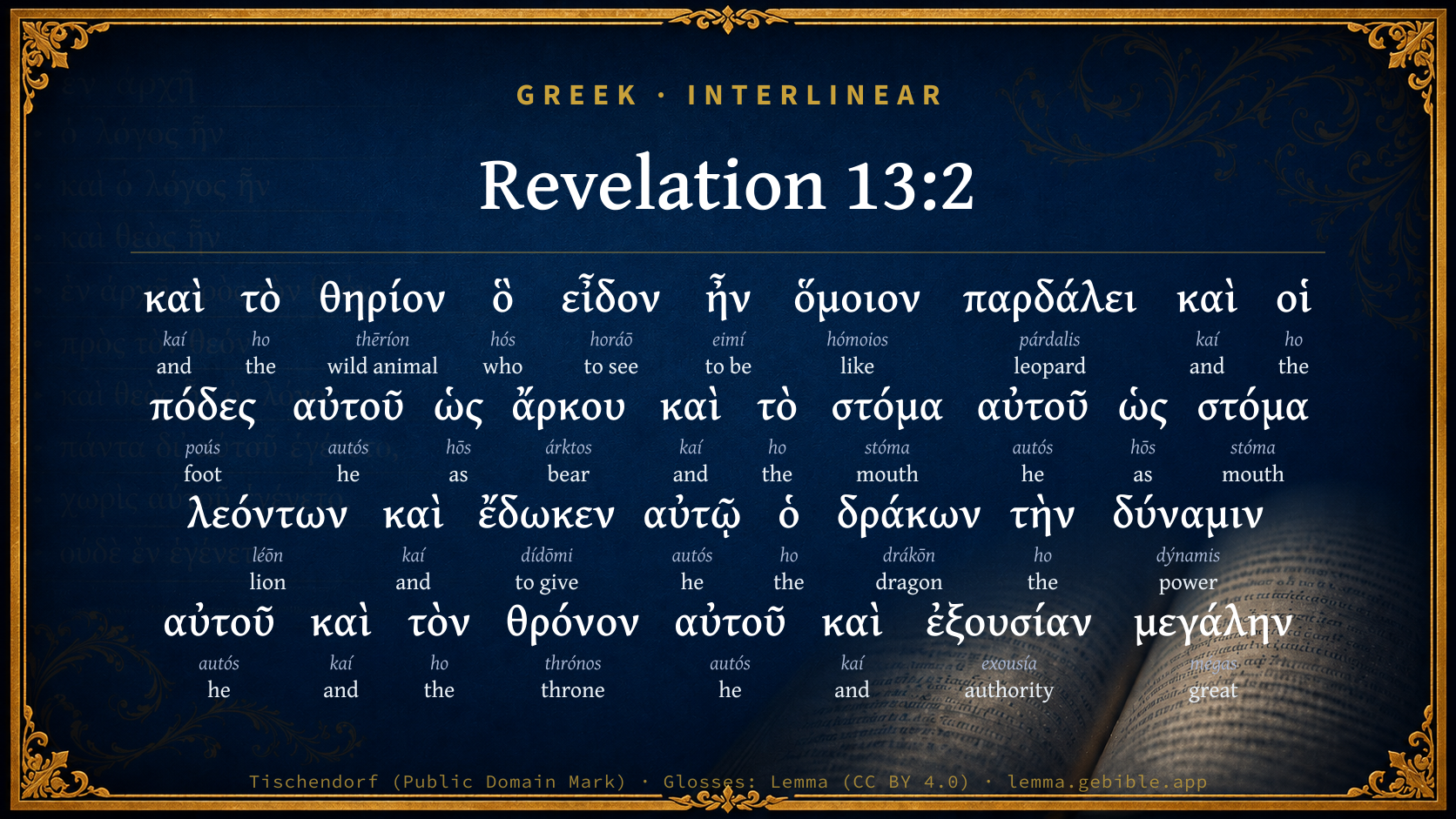
Download image
Cite this verse

Revelation 13:2 (World English Bible). Public Domain. Lemma interlinear Bible study tool, https://lemma.gebible.app/v/revelation/13/2.

Show BibTeX & RIS
BibTeX
RIS
English Translation
The beast which I saw was like a leopard, and his feet were like those of a bear, and his mouth like the mouth of a lion. The dragon gave him his power, his throne, and great authority.
World English Bible · Public Domain
Highlights
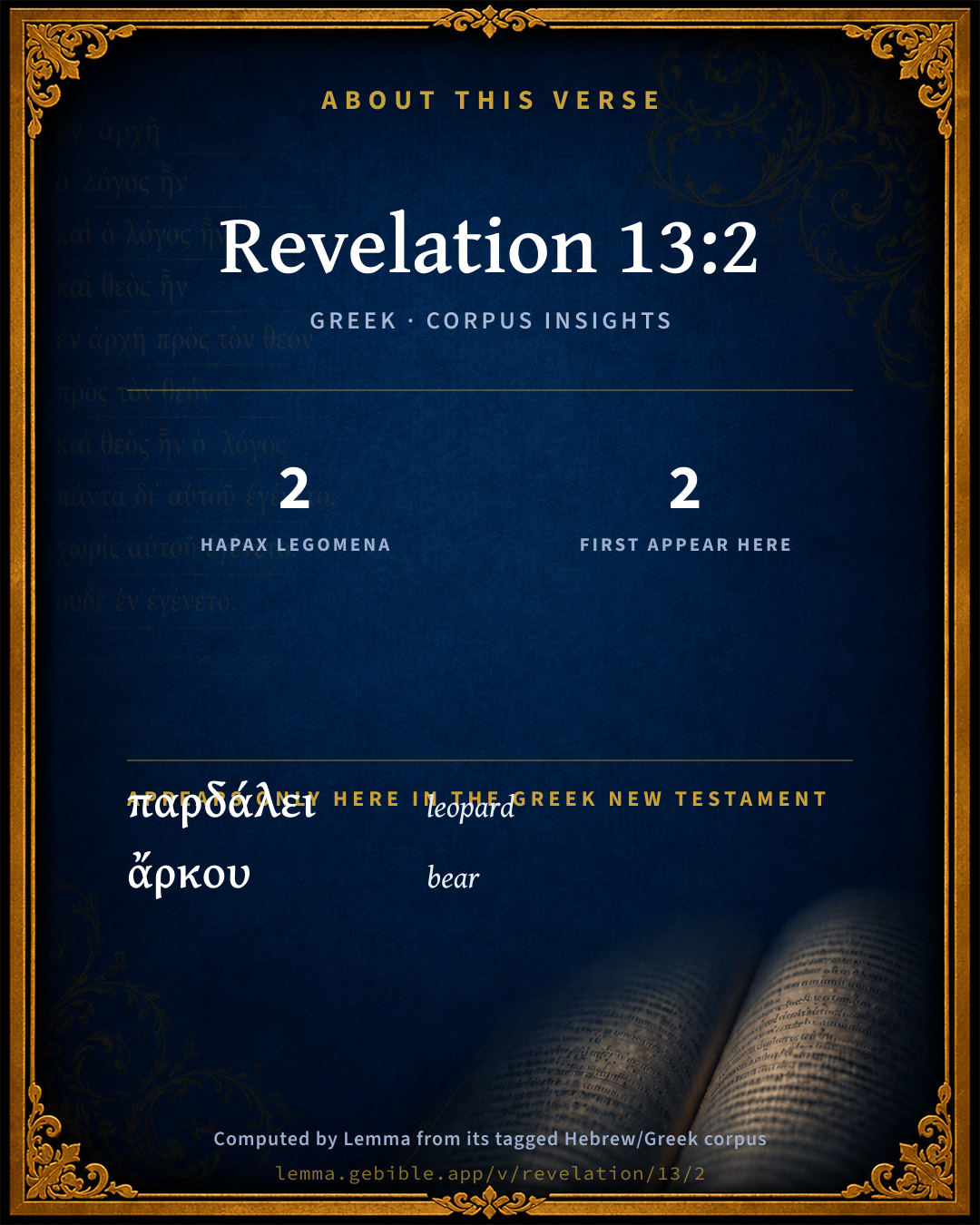
  • 2 hapax legomena — only here in the Greek New Testament
  • 2 first appearances in the Greek New Testament
Full analysis ↓
Download a study sheet

One document with this verse’s original text, its word-by-word gloss line, the meaning frame, cross-references with their text, attributed commentary, and full source and license credits — printable, and it pastes into notes with its structure intact.

This verse Autodidact and up

Study sheet (.html) Plain text (.txt)

A passage Seminary Student

Up to 50 verses in one chapter. A passage sheet keeps up to 6 commentary sources and 12 cross-references per verse, in the order this page ranks them, and says so on the sheet whenever that leaves anything out. Ask for a single verse and you get the Autodidact verse sheet above.

Everything on this page stays free to read, with no account — the sheet is a download of what is already on screen, not access to it.

Want to remove ads? Support Godless Engineer
Compare translations 3

The same verse in 3 English versions, stacked beneath the original-language interlinear above. Click any original word for its lexicon entry.

Each is an independent rendering of the whole verse — the interlinear is not word-aligned to these translations.

Highlighted words mark where these versions differ — a whole-verse word diff, not a word-by-word alignment.

  • World English Bible Public Domain
    The beast which I saw was like a leopard, and his feet were like those of a bear, and his mouth like the mouth of a lion. The dragon gave him his power, his throne, and great authority.
  • King James Version Public Domain
    And the beast which I saw was like unto a leopard, and his feet were as the feet of a bear, and his mouth as the mouth of a lion: and the dragon gave him his power, and his seat, and great authority.
  • unfoldingWord Literal Text CC BY-SA 4.0
    And the beast that I saw was like a leopard and its feet as of a bear and its mouth as the mouth of a lion, and the dragon gave to it his power and his throne and great authority.

unfoldingWord Literal Text — © unfoldingWord, licensed CC BY-SA 4.0. Word-aligned USFM3 via Door43 (git.door43.org/unfoldingWord/en_ult).

Versions to compare (up to 4)

3 of 4 selected

Show all 19 translations

Every available English version of this verse, each an independent rendering of the whole verse.

  • World English Bible Public Domain
    The beast which I saw was like a leopard, and his feet were like those of a bear, and his mouth like the mouth of a lion. The dragon gave him his power, his throne, and great authority.
  • Berean Standard Bible Public Domain
    The beast I saw was like a leopard, with the feet of a bear and the mouth of a lion. And the dragon gave the beast his power and his throne and great authority.
  • Majority Standard Bible Public Domain
    The beast I saw was like a leopard, with the feet of a bear and the mouth of a lion. And the dragon gave the beast his power and his throne and great authority.
  • King James Version Public Domain
    And the beast which I saw was like unto a leopard, and his feet were as the feet of a bear, and his mouth as the mouth of a lion: and the dragon gave him his power, and his seat, and great authority.
  • American Standard Version (1901) Public Domain
    And the beast which I saw was like unto a leopard, and his feet were as `the feet' of a bear, and his mouth as the mouth of a lion: and the dragon gave him his power, and his throne, and great authority.
  • Revised Version (1885) Public Domain
    And the beast which I saw was like unto a leopard, and his feet were as the feet of a bear, and his mouth as the mouth of a lion: and the dragon gave him his power, and his throne, and great authority.
  • Geneva Bible (1599) Public Domain
    And the beast which I sawe, was like a Leopard, and his feete like a beares, and his mouth as the mouth of a lion: and the dragon gaue him his power and his throne, and great authoritie.
  • Douay-Rheims (1899) Public Domain
    And the beast, which I saw, was like to a leopard, and his feet were as the feet of a bear, and his mouth as the mouth of a lion. And the dragon gave him his own strength, and great power.
  • Young's Literal Translation Public Domain
    and the beast that I saw was like to a leopard, and its feet as of a bear, and its mouth as the mouth of a lion, and the dragon did give to it his power, and his throne, and great authority.
  • Literal Standard Version CC BY-SA 4.0
    and the beast that I saw was like to a leopard, and its feet as of a bear, and its mouth as the mouth of a lion, and the dragon gave to it his power, and his throne, and great authority.
  • Unlocked Literal Bible CC BY-SA 4.0
    This beast I saw was like a leopard. Its feet were like a bear's feet, and its mouth was like a lion's mouth. The dragon gave his power to it, and his throne, and his great authority to rule.
  • unfoldingWord Literal Text CC BY-SA 4.0
    And the beast that I saw was like a leopard and its feet as of a bear and its mouth as the mouth of a lion, and the dragon gave to it his power and his throne and great authority.
  • Darby Bible Public Domain
    And the beast which I saw was like to a leopardess, and its feet as of a bear, and its mouth as a lion's mouth; and the dragon gave to it his power, and his throne, and great authority;
  • World Messianic Bible Public Domain
    The beast which I saw was like a leopard, and his feet were like those of a bear, and his mouth like the mouth of a lion. The dragon gave him his power, his throne, and great authority.
  • Webster's Bible Public Domain
    And the beast which I saw was like a leopard, and his feet were as the feet of a bear, and his mouth as the mouth of a lion: and the dragon gave him his power, and his seat, and great authority.
  • Free Bible Version CC BY-SA 4.0
    The beast I saw looked like a leopard, but his feet looked like those of a bear, and his mouth looked like that of a lion. The dragon gave the beast his power, his throne, and great authority.
  • Bible in Basic English Public Domain
    And the beast which I saw was like a leopard, and his feet were as the feet of a bear, and his mouth as the mouth of a lion: and the dragon gave him his power and his seat and great authority.
  • Text-Critical English NT CC BY 4.0
    The beast I saw was like a leopard; his feet were like those of a bear, and his mouth was like the mouth of a lion. The dragon gave the beast his power, his throne, and great authority.
  • Tyndale New Testament (1534) Public Domain
    And the beast which I sawe was lyke a catt of the mountayne and his fete were as the fete of a bear and his mouth as the mouthe of a lyon. And the dragon gave him his power and his seate and grett auctorite:

Literal Standard Version (2020), Covenant Press — licensed CC BY-SA 4.0. Text via the HelloAO Bible API (eBible.org). Unlocked Literal Bible (unfoldingWord) — licensed CC BY-SA 4.0. Text via the HelloAO Bible API (eBible.org). unfoldingWord Literal Text — © unfoldingWord, licensed CC BY-SA 4.0. Word-aligned USFM3 via Door43 (git.door43.org/unfoldingWord/en_ult). Free Bible Version, Dr. Jonathan Gallagher — licensed CC BY-SA 4.0. Text via the HelloAO Bible API (eBible.org).

Word by word

More ways to search: Search by grammar → Find every occurrence → Compare this word →

Practice this passage: Drill this verse → Learn its vocabulary →

παρδάλει
párdalis
G3917
“leopard”
Noun, Dative, Singular, Feminine
Part of Speech
Noun
Case
Dative
Number
Singular
Gender
Feminine
Full Thayer's Definition

Origin: from pardos (a panther)

TDNT: None

1. a pard, panther, leopard 2. a very fierce Asiatic and African animal, having a tawny skin marked with large black spots
  1. καὶ kaí G2532 “and” Conjunction
  2. τὸ ho G3588 “the” Article, Nominative, Singular, Neuter
  3. θηρίον thēríon G2342 “wild animal” Noun, Nominative, Singular, Neuter
  4. ὃ hós G3739 “who” Relative pronoun, Accusative, Singular, Neuter
  5. εἶδον horáō G3708 “to see” Verb, Aorist, Active, Indicative, 1st person, Singular
  6. ἦν eimí G1510 “to be” Verb, Imperfect, Active, Indicative, 3rd person, Singular
  7. ὅμοιον hómoios G3664 “like” Adjective, Nominative, Singular, Neuter
  8. καὶ kaí G2532 “and” Conjunction
  9. οἱ ho G3588 “the” Article, Nominative, Plural, Masculine
  10. πόδες poús G4228 “foot” Noun, Nominative, Plural, Masculine
  11. αὐτοῦ autós G846 “he” Personal pronoun, Genitive, Singular, Neuter
  12. ὡς hōs G5613 “as” Adverb
  13. ἄρκου árktos G715 “bear” Noun, Genitive, Singular, Feminine
  14. καὶ kaí G2532 “and” Conjunction
  15. τὸ ho G3588 “the” Article, Nominative, Singular, Neuter
  16. στόμα stóma G4750 “mouth” Noun, Nominative, Singular, Neuter
  17. αὐτοῦ autós G846 “he” Personal pronoun, Genitive, Singular, Neuter
  18. ὡς hōs G5613 “as” Adverb
  19. στόμα stóma G4750 “mouth” Noun, Nominative, Singular, Neuter
  20. λεόντων léōn G3023 “lion” Noun, Genitive, Plural, Masculine
  21. καὶ kaí G2532 “and” Conjunction
  22. ἔδωκεν dídōmi G1325 “to give” Verb, Aorist, Active, Indicative, 3rd person, Singular
  23. αὐτῷ autós G846 “he” Personal pronoun, Dative, Singular, Neuter
  24. ὁ ho G3588 “the” Article, Nominative, Singular, Masculine
  25. δράκων drákōn G1404 “dragon” Noun, Nominative, Singular, Masculine
  26. τὴν ho G3588 “the” Article, Accusative, Singular, Feminine
  27. δύναμιν dýnamis G1411 “power” Noun, Accusative, Singular, Feminine
  28. αὐτοῦ autós G846 “he” Personal pronoun, Genitive, Singular, Masculine
  29. καὶ kaí G2532 “and” Conjunction
  30. τὸν ho G3588 “the” Article, Accusative, Singular, Masculine
  31. θρόνον thrónos G2362 “throne” Noun, Accusative, Singular, Masculine
  32. αὐτοῦ autós G846 “he” Personal pronoun, Genitive, Singular, Masculine
  33. καὶ kaí G2532 “and” Conjunction
  34. ἐξουσίαν exousía G1849 “authority” Noun, Accusative, Singular, Feminine
  35. μεγάλην mégas G3173 “great” Adjective, Accusative, Singular, Feminine

About this verse

These counts appear in no published source. They are computed here, from the morphology-tagged text and Lemma’s own curated glosses. What Lemma adds →

36
words
20
distinct lemmas
Revelation
section

Notable vocabulary

2 hapax legomena — words that appear only here in the entire Greek New Testament:

  • παρδάλει leopard G3917
  • ἄρκου bear G715

First appearance in Scripture

These words make their first canonical appearance in the Greek New Testament here:

  • παρδάλει leopard G3917
  • ἄρκου bear G715

Shared distinctive vocabulary

λεόντων lion G3023 occurs in 9 verses of the Greek New Testament. Also found in:
Repetition

Words recur within this verse:

Cross-references

24

Topical passages linked to Revelation 13:2 in the Treasury of Scripture Knowledge — connected by theme and wording, ordered by reader-vote popularity; previews shown in the World English Bible.

  • Daniel 7:4–7 The first was like a lion, and had eagle's wings: I saw until the wings of it were plucked, and it was lifted up from the earth, and made to stand on two feet as a man; and a man's heart was given to it.
  • 1 Peter 5:8 Be sober and self-controlled. Be watchful. Your adversary the devil, walks around like a roaring lion, seeking whom he may devour.
  • Revelation 12:9 The great dragon was thrown down, the old serpent, he who is called the devil and Satan, the deceiver of the whole world. He was thrown down to the earth, and his angels were thrown down with him.
  • Revelation 17:12 The ten horns that you saw are ten kings who have received no kingdom as yet, but they receive authority as kings, with the beast, for one hour.
  • Revelation 20:2 He seized the dragon, the old serpent, which is the devil and Satan, who deceives the whole inhabited earth, and bound him for a thousand years,
  • Revelation 12:3–4 Another sign was seen in heaven. Behold, a great red dragon, having seven heads and ten horns, and on his heads seven crowns.
  • Revelation 12:13 When the dragon saw that he was thrown down to the earth, he persecuted the woman who gave birth to the male child.
  • Revelation 12:15 The serpent spewed water out of his mouth after the woman like a river, that he might cause her to be carried away by the stream.
  • Revelation 13:4 They worshiped the dragon, because he gave his authority to the beast, and they worshiped the beast, saying, "Who is like the beast? Who is able to make war with him?"
  • Revelation 19:20 The beast was taken, and with him the false prophet who worked the signs in his sight, with which he deceived those who had received the mark of the beast and those who worshiped his image. These two were thrown alive into the lake of fire that burns with sulfur.
  • Amos 5:19 As if a man fled from a lion, And a bear met him; Or he went into the house and leaned his hand on the wall, And a snake bit him.
  • Revelation 16:10 The fifth poured out his bowl on the throne of the beast, and his kingdom was darkened. They gnawed their tongues because of the pain,
  • 1 Samuel 17:34–37 David said to Saul, Your servant was keeping his father's sheep; and when there came a lion, or a bear, and took a lamb out of the flock,
  • 2 Kings 2:24 He looked behind him and saw them, and cursed them in the name of Yahweh. There came forth two she-bears out of the wood, and mauled forty-two lads of them.
  • Psalms 22:21 Save me from the lion's mouth; Yes, from the horns of the wild oxen you have answered me.
  • Proverbs 17:12 Let a bear robbed of her cubs meet a man, Rather than a fool in his folly.
  • Proverbs 28:15 As a roaring lion or a charging bear, So is a wicked ruler over helpless people.
  • Isaiah 5:29 Their roaring will be like a lioness. They will roar like young lions. Yes, they shall roar, And seize their prey and carry it off, And there will be no one to deliver.
  • Jeremiah 5:6 Therefore a lion out of the forest shall kill them, a wolf of the evenings shall destroy them, a leopard shall watch against their cities; everyone who goes out there shall be torn in pieces; because their transgressions are many, [and] their backsliding is increased.
  • Jeremiah 13:23 Can the Ethiopian change his skin, or the leopard his spots? then may you also do good, who are accustomed to do evil.
  • Hosea 13:7–8 Therefore am I to them like a lion; Like a leopard I will lurk by the path.
  • Hosea 11:10 They will walk after Yahweh, Who will roar like a lion; For he will roar, and the children will come trembling from the west.
  • Amos 3:12 Thus says Yahweh: "As the shepherd rescues out of the mouth of the lion two legs, Or a piece of an ear, So shall the children of Israel be rescued who sit in Samaria on the corner of a couch, And on the silken cushions of a bed."
  • Habakkuk 1:8 Their horses also are swifter than leopards, and are more fierce than the evening wolves. Their horsemen press proudly on. Yes, their horsemen come from afar. They fly as an eagle that hurries to devour.

Cross-references courtesy of OpenBible.info (CC BY 4.0).

Commentary

Notes on Revelation 13:2 from classic Christian and Jewish commentators (each source and its license shown beneath its notes). The classic Christian expositions comment on the surrounding passage and are grouped to its opening verse, so a note may address several verses; the Jewish commentaries on the Tanakh (Rashi and others) are per-verse, so they appear only where the commentator wrote on this verse.

Lemma curates 59 commentaries, every one of them public domain or Creative Commons licensed, each selected and text-cleaned for this edition rather than reprinted as found. About our sources →

Tyndale Open Study Notes

Tyndale Open Resources

13:2 Satan makes the beast a pseudo-deity by giving it his power, throne, and authority. In the first century, Roman emperors increasingly claimed divinity.

Tyndale Open Study Notes — © Tyndale Open Resources, licensed CC BY-SA 4.0. Text via the HelloAO Bible API.

Meyer's Critical & Exegetical Commentary

Heinrich August Wilhelm Meyer

Rev_13:2. That the description of the form of the beast has been developed from Dan_7:4 sqq., is at once manifest; but it must not be overlooked, that the Apocalyptic portrayal of it has an essentially distinct conception and purpose. Daniel portrays four worldly kingdoms succeeding one another (the Chaldaean, Medan, Persian, and Greek), and that, too, in such a way that the forms of beasts which symbolize the first three kingdoms are not only like a lion, a bear, and a leopard, but also bear within themselves other significative marks, while the fourth worldly kingdom is represented under the form of a monster, not specifically determined, as, on the one hand, by the great iron teeth, the power of this kingdom, devouring and crushing all, and on the other, however, by the ten horns, beneath which again a small horn comes forth corruptibly, it is symbolized how Antiochus Epiphanes finally rises as the blasphemous usurper of the Greek Empire ruled by the ten kings successively. John, however, describes not four or more, but in any case one kingdom; whether he have in mind the undivided idea of the world-power in general, which has attained form in many concrete empires,from the Egyptian to the Roman of that time,[3250]or, without definite reference to the earlier empires, refer only to the present Roman. At all events, it is incorrect to mangle the undivided form of the beast, and to explain perhaps with Wetst., who inverts the order: The mouth of the lion designates the greed and avarice of Galba; the form of the leopard, the inconsiderate rashness and inchastity of Otho; the feet of the bear, the ferocity and torpor of Vitellius. But it is no less incorrect when Andreas so interprets the combined form of the beast that he refers the leopard, etc., to that definite kingdom which he understands by the beast in Daniel 7, but in connection therewith attempts to preserve the unity of the idea by considering the antichrist, the coming ruler of the Roman Empire, as possessor at the same time of those three kingdoms;[3251] as it depends in general only upon an inaccurate combination with ch. 17, when in this passage the beast from the sea is regarded the antichrist himself, or his kingdom, in the sense that not the present Roman empire, but one not to be expected until the end of days, is to be understood;[3252] for the tendency of the entire statement of ch. 13[3253] pertains not to the pure future, as though an antichristian efficacy of Satan and the worldly power in his service, as it will have place only at the end of days, were to be described, but the world-power already present, ruling over all in blasphemous pride and oppressing believers,[3254] appears here in a way that undoubtedly makes us recognize its antichristian nature as to how it stands in the service of Satan himself. This antichristian world-power,and that, too, in the definite appearance of the present Roman Empire,

John beholds in a form of a beast, whose threefold composition of the leopard, bear, and lion is to be explained as little in the sense of Daniel 7, as the ten horns of Rev_13:1 are to be combined with the fourth beast, which in Daniel bears this number of horns.[3255] Just as the ten coroneted horns (and the seven heads) serve only to designate a particular individuality of the Roman Empire symbolized by the entire form of beast, entirely apart from the fact that in Daniel a fourth empire is symbolized by a monstrous beast with ten horns, so also the combination of the Apocalyptic beast does not have the sense that, in the empire signified by this beast, either the definite empire[3256] of Daniel, or all empires in general, inclusive of the present Roman and the still future,[3257] i.e., the Germano-Slavic,[3258] appear combined, and accordingly the beast out of the sea signifies the world-power only abstractly;[3259] but, on the contrary, the form of a beast which is compared as a whole to the leopard, which is as rapid in its movements as it is strong,[3260] is furnished with feet like the paws of a bear,[3261] while its mouth is like the jaws of a lion, so that thus the entire monstrous beast, which unites in itself the most dreadful weapons of the strongest beasts, informs us of the rapacity and power of the Roman Empire displayed in the same. The special interpretation of particular features reaches too far, and is, therefore, arbitrary, as in Beda: ΠΆΡΔ., on account of the variety of nations;[3262] ἌΡΚ., on account of spite and madness; ΛΈ., on account of bravery of body and pride of tongue.

[3250] Hengstenb., etc.

[3251] πάρδ. designates the Greek, ἄρκ. the Persian, λέ. the Babylonian empire: ὦν κρατησει ὁ Ἀντίχριστος ὡς Ρ̓ωμαίων βασιλεὐς ἐλευσόμενος

[3252] Against C. a Lap., Hofm., etc.

[3253] Cf. already ch. 12.

[3254] Which John, of course, considers to be such as is immediately judged and brought to naught by the coming of the Lord.

[3255] Against Züll., De Wette.

[3256] Andr., etc.

[3257] Hengstenb.

[3258] Auberlen.

[3259] The ungodly world-power as a whole.

[3260] Cf. Jer_5:6; Hos_13:7; Sir_28:23, where, in order to illustrate dreadful strength, the leopard is compared with the lion and the wolf.

[3261] ὡς ἄρκ. Cf. Rev_4:6; Rev_4:8. Var. Lect. Rev_9:7-9.

[3262] Cf. Grot.: The leopard is an animal of various color; thus Roman Idolatry had as its gods, males, females, the greatest, the least, etc. Coccejus: Of various color. For to this beast belong Christiaus serving bishops, and yet constituting another source of faith, also Arians, Mussulmans, etc. Vitr., etc.

καὶ ἔδωκεν, κ.τ.λ. Here is shown the reason why the dragon, who in Rev_12:17 has entered into a conflict against believers, has come upon the shore of the sea (Rev. 12:18): he has called the beast from the sea in order to equip him with his own power, and thus to make him an instrument of his wrath. In what way the dragon accomplished this impartation, ἔδωκεν αὐτῷ, we dare not ask, since John does not declare it, for properly he does not attempt to state what is not made visible.

Worthy of notice is the inner relation of the three points, τὴν δύναμιν αὐτ., τ. θρόνον αὐτ., and ἐξουσίαν μεγάλην. The δύναμις imparted to the beast, which is expressly marked as diabolical (δύν. αὐτού), is shown in his power over freedom and life (Rev_13:10), and the entire business of men (Rev_13:17). But the dragon also, by giving his throne to the beast, invests it with a βασιλεία, so that now a throne can be ascribed to the beast himself (Rev_16:10): hence the more definite view of the worldly dominion of the beast is here presented. Finally, the ἐξουσία μεγάλη[3263] designates the great, yet always definite and limited, plenitude of power, in order by the medium of that ΔΎΝΑΜΙς to work within the entire sphere of nature and to serve the purpose of the dragon.

[3263] Cf. Rev_6:8, Rev_9:3, Rev_10:9.

Meyer — Critical and Exegetical Commentary on the New Testament — English translation by Peter Christie, edited by Frederick Crombie (T&T Clark, 1880) — public domain. Text from a community e-Sword module.

Expositor's Greek Testament

ed. W. Robertson Nicoll

Rev 13:2 . The empire gathered up all the obnoxious qualities of Israel’s former oppressors: craft, lust of blood, and vicious energy. Hence the combination of traits from Daniel’s four beasts: general appearance that of a fierce panther, feet like a bear’s ( i.e. , plantigrade), jaws like a lion’s (of devouring strength) a Palestinian (Hos 13:7-8 ) picture of a perfect beast of prey, raging and ravening, before whom the church, like Dryden’s milk-white Hind, “was often forced to fly, And doom’d to death, though fated not to die”. καὶ ἔδωκεν κ . τ . λ ., connecting the empire with the dragon of 12 and stamping it as Satanic ( cf. Lueken, 22 f.; Weinel, 11 12), as a weird and wild messiah of the devil on earth.

The Expositor's Greek Testament, edited by W. Robertson Nicoll (1897–1910) — public domain. Text from a community e-Sword module.

Geneva Bible (1599)

Geneva Bible translators

That is, he lent the same unto the beast to use, when he perceived that himself could not escape, but must needs be taken by the hand of the Angel, and cast into the bottomless pit, Rev. 20, yet did not he abandon the same utterly from himself, but that he might use it as long as he could.

Swift as the Leopard, easily clasping all things, as the bear doth with his foot, and tearing and devouring all things with the mouth as doth the Lion.

Geneva Bible (1599) marginal notes — public domain. Text via Bolls.life.

Jamieson, Fausset & Brown

Robert Jamieson, A. R. Fausset & David Brown

leopard . . . bear . . . lion--This beast unites in itself the God-opposed characteristics of the three preceding kingdoms, resembling respectively the leopard, bear, and lion. It rises up out of the sea, as Daniel's four beasts, and has ten horns, as Daniel's fourth beast, and seven heads, as Daniel's four beasts had in all, namely, one on the first, one on the second, four on the third, and one on the fourth. Thus it represents comprehensively in one figure the world power (which in Daniel is represented by four) of all times and places, not merely of one period and one locality, viewed as opposed to God; just as the woman is the Church of all ages. This view is favored also by the fact, that the beast is the vicarious representative of Satan, who similarly has seven heads and ten horns: a general description of his universal power in all ages and places of the world. Satan appears as a serpent, as being the archetype of the beast nature (Rev 12:9). "If the seven heads meant merely seven Roman emperors, one cannot understand why they alone should be mentioned in the original image of Satan, whereas it is perfectly intelligible if we suppose them to represent Satan's power on earth viewed collectively" [AUBERLEN].

Jamieson, Fausset & Brown — Commentary Critical and Explanatory on the Whole Bible (1871) — public domain (CC PDM 1.0). Text via the HelloAO Bible API.

Adam Clarke's Commentary

Verse 2. And the beast which I saw was like unto a leopard] This similitude of the beast to a leopard appears to be an allusion to the third beast of Daniel, which is well known to represent the empire of the Greeks. The Latin empire greatly resembled the modern empire of the Greeks; for that the power of the Greeks was still said to be like a leopard, even after its subjugation by the Romans, is evident from Da 7:12: "As concerning the rest of the beasts, they had their dominion taken away; yet their lives were prolonged for a season and time." The Latin empire was, in the first place, like to its contemporary, because both adhered to an idolatrous system of worship, professedly Christian, but really antichristian; and it is well known that the Greek and Latin Churches abound in monstrous absurdities. Secondly, Both empires were similar in their opposition to the spread of pure Christianity; though it must be allowed that the Latins far outstripped the Greeks in this particular. Thirdly, Both empires were similar in respect to the civil authority being powerfully depressed by the ecclesiastical; though it must be granted the authority of the Latin Church was more strongly marked, and of much longer continuance. The excommunication of the Greek emperor by the Patriarch Arsenius, and the consequences of that excommunication, afford a remarkable example of the great power of the Greek clergy. But the beast of St. John, though in its general appearance it resembles a leopard, yet differs from it in having feet like those of a bear. The second beast of Daniel was likened to a bear, and there can be no doubt that the kingdom of the Medes and Persians was intended; and it is very properly likened to this animal, because it was one of the most inhuman governments that ever existed, and a bear is the well known Scripture emblem of cruelty. See 2Sa 17:8, and Ho 13:8. Is not cruelty a striking characteristic of the papal Latin empire? Have not the subjects of this empire literally trampled to death all those in their power who would not obey their idolatrous requisitions? In Fox's Book of Martyrs, and other works which treat upon this subject, will be found a melancholy catalogue of the horrid tortures and most lingering deaths which they have obliged great numbers of Christians to suffer. In this sense the feet of the beast were as the feet of a bear. Another particular in which the beast differed from a leopard was, in having a mouth like a lion. "It is," says Dr. More, "like the Babylonish kingdom (the first beast of Daniel, which is likened to a lion) in its cruel decrees against such as will not obey their idolatrous edicts, nor worship the golden image that Nebuchadnezzar had set up. Their stubbornness must be punished by a hot fiery furnace; fire and fagot must be prepared for them that will not submit to this new Roman idolatry."

And the dragon gave him his power, and his seat, and great authority.] It was said of the dragon, in Re 12:8, that his place was found no more in heaven; the dragon here cannot therefore be the heathen Roman empire, as this was abolished previously to the rising up of the beast. It must then allude to the restoration of one of the DRACONIC heads of the beast, as will be seen in the explanation of the following verse, and more fully in the notes on Re 17:1-18.

Adam Clarke's Commentary on the Bible (1810–1826) — public domain. Text from a community e-Sword/MySword module.

Ellicott's Commentary for English Readers

(2) And the beast . . .—The wild beast combined the features of three wild animals: the leopard, the bear, the lion. In Daniel’s vision (Dan_7:4) the kingdoms were described: the first, like a lion; the second, like a bear; the third, like a leopard or panther. Here all these features are combined, because the wild beast is a representative of all forms of world-power, which have been swift to shed blood: like a leopard leaping on the prey, tenacious and relentless as a bear, and all devouring (their throat is an open sepulchre) as a lion. The reader will remember the wild beasts which in vision hindered Dante when he sought to ascend the “pleasant mount”—the “cause and source of all delight.” The leopard, the lion, the wolf were symbols of luxuriousness, cruel ambition, and hungry and heartless avarice, which oppose men and nations when they seek the Holy Hill, where the light of God ever rests. (Comp. Inferno, i. 10-74)

And the dragon.—Read, And the dragon gave him his power and his throne (not his “seat,” as in the English version; it is the royal seat, the throne, which is meant). (See Notes on Rev_11:16 and Rev_4:4.)

And great authority.—It is through this succession of world-powers that the dragon carries on his war. The wild beast becomes the vicegerent, so to speak, of the prince of this world.

A Bible Commentary for English Readers, edited by Charles John Ellicott (1878–1897) — public domain. Text from a community e-Sword module.

The Cambridge Bible for Schools and Colleges

gen. ed. J. J. S. Perowne

2. like unto a leopard … bear … lion] The fourth beast in Daniel 7 is not described as like any ordinary animal: here he is described as combining the likeness of the other three. We may draw the inference mentioned on Rev_13:1, that this beast is not the fourth, but a combination of all four: but on the simpler view the description is not less appropriate. The Rome of St John’s day was “like unto” a Greek empire, and at the same time embodied elements derived from Babylon, and from Persia. And if we watch the “spirit of Antichrist” that is working in our day, we shall see it in the various forms of Hellenic aestheticism, of Persian luxury, and of Chaldean scientific necessarianism. It remains for this spirit to mount the imperial throne of Rome, when he who now letteth is taken out of the way.

the dragon gave him his power] It is the Devil’s interest and policy to disguise his working under the forms of the world: at present, he has actually persuaded many to disbelieve in his existence.

seat] Better, throne. The words rendered “power” and “authority” here are the same as “strength” and “power” in Rev_12:10. Antichrist, or the Antichristian empire, bears just the same relation to the Devil as the true Christ to God.

The Cambridge Bible for Schools and Colleges (gen. ed. J. J. S. Perowne; Cambridge University Press, 1878–1918) — public domain. Text from a community e-Sword module.

John Gill's Exposition

And the beast which I saw was like unto a leopard,.... To which the Grecian kingdom is compared in Dan 7:6; because of that rapidity and swiftness with which Alexander overran the world, and set up this monarchy; and to which the Roman Papal monarchy bears some resemblance; for as the Grecian monarchy was divided into several parts, which the leopard's spots may also point out, so the Roman empire was divided into ten parts, and united under the pope, as the head of them; and may be, in this form, compared to a leopard for its swiftness, Hab 1:8; because this beast, as soon as he arose and got power, quickly, and in a very short time, extended it over all emperors, kings, princes, bishops, and over all kingdoms and churches; and for its spots, Jer 13:23, which may be expressive both of the spots of sin and immorality of every kind, and of errors and heresies, superstition and idolatry, with which antichrist and his followers abound; and for its insidiousness and cruelty, Jer 5:6. It lies in wait for its prey, and suddenly falls upon it, and devours it; and is a lively picture of the cunning sleight of the antichristian party, who lie in wait to deceive, and of their blood thirstiness and barbarity. It is reported (c) of the leopard, that it is of a sweet smell, and by its odour it draws the fawns, does, &c. near it, and then makes a prey of them; so antichrist, by outward riches and preferments, by the external pomp and splendour of his religion, by his living wonders and miracles, and by his great pretensions to holiness and the like, allures multitudes unto him, and destroys them.

And his feet were as the feet of a bear; to which the Persian monarchy is compared, Dan 7:5. And this, as some think, may denote the strength and stability of the kingdom of antichrist, it having already endured a great while, and will be thought to be very firm and stable when its ruin is near; or rather the wars and fightings of antichrist against the saints, the fore feet of the bear being what that creature lights with, and tears and destroys such as oppose it, or fall a prey to it; and may also, as before, express the voraciousness and cruelty of antichrist, with respect to the bodies and souls of men:

and his mouth, as the mouth of a lion: to which creature the Babylonian monarchy is compared, Dan 7:4, uttering out blasphemies against God, threatening ruin and destruction to men, and injecting fear into them, as the roaring of a lion does, and seizing upon, and devouring their estates and possessions, as well as butchering their persons. This beast has all the properties of the several beasts in Daniel's prophecy, wherefore all the figures there made use of to describe them are put together, to point unto us this monster of iniquity.

And the dragon gave him his power: for the coming of antichrist is after the working of Satan, Th2 1:9; he gave him his cunning and subtlety, as the old serpent, and taught him his arts and tricks to deceive mankind; and gave him a power to do signs and lying wonders, as well as communicated his malice and cruelty to persecute and oppress the saints; or an "army" of ecclesiastics to fight under him, and for him:

and his seat; at Rome, for there Satan's seat was, Rev 2:13, in the time of the Pagan Roman empire, which was quitted by Dioclesian and Maximian, when they resigned the government of it, the one being at Nicomedia, and the other at Milan; and when Constantine came to the throne, he removed to Byzantium, and rebuilt it, and called it after his name Constantinople, and had his residence there, as had all the eastern emperors afterwards; and as for the western emperors, they chiefly resided either at Milan or Ravenna, to which last place Odoacer, Theodoric, and other Gothic kings retired, when the government was in their hands; so that hereby this seat was empty, and way was made for antichrist to take it, as he did.

And great authority; over the Roman empire, and the kings and kingdoms in it; he gave him his authority as the god of this world; what Christ refused at the hands of Satan, that his pretended vicar took, even the kingdoms of this world, and the glory of them; yea, assumed to himself all power in heaven, earth, and hell, signified by his triple crown, at the instigation of the devil; so that it appears that he is not the vicar of Christ, but the vicar of the devil; and not the successor of Peter, but the successor of Satan; and that he holds his possessions, not by the donation of Constantine, but by the gift of the dragon.

(c) Aelian. de Animal. l. 5. c. 40.

John Gill's Exposition of the Whole Bible (1746–1763) — public domain (CC PDM 1.0). Text via the HelloAO Bible API.

Trapp's Complete Commentary

John Trapp

2 And the beast which I saw was like unto a leopard, and his feet were as the feet of a bear, and his mouth as the mouth of a lion: and the dragon gave him his power, and his seat, and great authority.

Ver. 2. Like unto a leopard] Which is the female among the panthers, the property whereof is, as Pliny telleth us, with her sweet smell to allure the beasts unto her, hiding her terrible head, till she hath them within her reach, and then teareth them in pieces. Just so dealeth Rome with her unhappy proselytes. The Papacy is an alluring, tempting, bewitching religion. No sin past, but the pope can pardon it; none to come, but he can dispense with it, Etiamsi per impossibile, matrem Dei quis vitiasset, said Tecelius.

As the feet of a bear] Which stands firm on her hinder feet, and fights with her fore feet; so doth the Papacy with its canons, decrees, traditions, &c.

As the mouth of a lion] Wide, ravenous, roaring, and insatiable.

And the dragon gave him his power] This bargain was offered to Christ, Mat 4:8-10, but he would none of it. The bramble in Jotham’s parable thought it a goodly thing to reign; so did not the vine and fig tree.

John Trapp, A Commentary or Exposition upon All the Books of the Old and New Testament (1647–1656) — public domain. Text from a community e-Sword module.

Albert Barnes' Notes on the Bible

And the beast which I saw was like unto a leopard - For a description of the leopard, see the notes on Dan 7:6. It is distinguished for bloodthirstiness and cruelty, and thus becomes an emblem of a fierce, tyrannical power. In its general character it resembles a lion and the lion and the leopard are often referred to together. In this description, it is observable that John has combined in one animal or monster, all those which Daniel brought successively on the scene of action as representing different empires. Thus in Dan 7:2-7 the lion is introduced as the symbol of the Babylonian power; the bear, as the symbol of the Medo-Persian; the leopard, as the symbol of the Macedonian; and a nondescript animal, fierce, cruel, and mighty, with two horns as the symbol of the Roman. See the notes on that passage. In John there is one animal representing the Roman power, as if it were made up of all these: a leopard with the feet of a bear, and the mouth of a lion, with two horns, and with the general description of a fierce monster. There was an obvious propriety in this, in speaking of the Roman power, for it was, in fact, made up of the empires represented by the other symbols in Daniel, and “combined in itself all the elements of the terrible and the oppressive, which had existed in the aggregate in the other great empires that preceded it.” At the same time there was an obvious propriety in the symbol itself; for the bloodthirstiness and cruelty of the leopard would well represent the ferocity and cruelty of the Roman power, especially as John saw it here as the great antagonistic power of the true church, sustaining the papal claim, and thirsting for blood.

And his feet were as the feet of a bear - See the notes on Dan 7:5. The idea here seems to be that of strength, as the strength of the bear resides much in its feet and claws. At the same time, there is the idea of a combination of fierce qualities - as if the bloodthirstiness, the cruelty, and the agility of the leopard were united with the strength of the bear.

And his mouth as the mouth of a lion - See the notes on Dan 7:4. The month of the lion is made to seize and hold its prey, and is indicative of the character of the animal as a beast of prey. John has thus brought together the qualities of activity, bloodthirstiness, strength, ferocity, all as symbolical of the power that was intended to be represented. It is hardly necessary to say that this description is one that would apply well, in all respects, to Rome; nor is it necessary to say, that if it be supposed that he meant to refer to Rome, this is such a description as he would have adopted.

And the dragon - See the notes on Rev 12:3.

Gave him his power - Satan claimed, in the time of the Saviour, all power over the kingdoms of the world, and asserted that he could give them to whomsoever he pleased. See the notes on Mat 4:8-9. How far the power of Satan in this respect may extend, it may not be possible to determine; but it cannot be doubted that the Roman power seemed to have such an origin, and that in the main it was such as, on that supposition, it would be. In its arrogance and haughtiness - in its thirst for dominion - in its persecutions - it had such characteristics as we may suppose Satan would originate. If, therefore, as the whole connection leads us to suppose, this refers to the Roman secular power, considered as the support of the papacy, there is the most evident propriety in the representation.

And his seat - θρόνον thronon. Hence, our word “throne.” The word properly means a seat; then a high seat; then a throne, as that on which a king sits. Here it refers to this power as exercising dominion on the earth.

And great authority - The authority was great. It extended over a large part of the earth, and, alike in its extent and character, it was such as we may suppose Satan would set up in the world.

Albert Barnes' Notes on the Bible (1834–1885) — public domain. Text from a community e-Sword/MySword module.

Haydock's Catholic Bible Commentary

M. Bossuet, bishop of Meaux, observes in the emperors Maximian Herculeus, Galerius Maximin, and Dioclesian, the distinguishing characters of these three animals. The leopard represents Maximian, a changeable, restless and cruel prince. The bear figures Galerius Maximin, a man from the north of cruel and brutal disposition, terrible mein, and gigantic stature. Lactantius moreover informs us, that he took a pleasure in feeding bears, which bore so great a resemblance to him in size and brutality. The lion, in fine, is the symbol of Dioclesian, who was cruel and vehement against Christians. (Calmet) --- The whole of this is by Pastorini applied to the empire of Rome, which was composed of the territories of the three preceding empires, which are represented by Daniel under the figure of these animals. And as the body of the beast was like to a leopard, the centre and capital of the Roman empire, under antichrist will be the Grecian empire, denoted by the leopard, of which Constantinople became the capital. Various interpreters explain the whole of this vision by different ways. (Haydock)

George Leo Haydock (1774–1849), Haydock's Catholic Family Bible and Commentary, 1859 edition — public domain. Excludes Psalms (Douay-Rheims chapter numbering differs from Protestant) and Deuterocanonical books (Catholic canon only).

Matthew Poole's English Annotations

Daniel, in his vision of the Chaldaic, Persian, Grecian, and Roman monarchies, by which the world was successively ruled from his time to St. John’s, and many years after, had the first represented to him by a lion, for its nobleness and fierceness; the second by a bear, for its cruelty; the third, by a leopard, for the smallness of its bulk, the swiftness of its conquests, its strength, &c.; the fourth, by a beast (not named) strong, and exceedingly terrible, that had great iron teeth, that devoured, and brake in pieces, and stamped the residue under its feet. This beast is certainly here described, which had several forms: John saw it at first under the representation of a red dragon, which signified that empire, while pagan, for three hundred years after Christ; in which time the old serpent could prevail nothing against the church. Then (after a rest to the church of a few years, which ended with Theodosius about the year 380 or 400) he saw it under the form of

a leopard, ruled by Arian emperors till near 600. This beast had

the feet of a bear and

the mouth of a lion. These emperors, with the Goths and Vandals that were Arians, were as cruel to true Christians as the pagan emperors had been. Gitimer, king of the Vandals, Anno 530, and the Goths under Totilas, 540, made miserable havoc amongst the Christians.

And the dragon gave him his power; these together inherited both the power of the heathen emperors, and their seat, and Rome, which was their seat, or throne, and exercised there

great authority. All this was done in the form of a leopard, not so terrible as that of a dragon; for the Arians disclaimed paganism, and the worship of pagan idols. All this while the papacy was creeping up, but till the year 552, or thereabouts, the Goths and Vandals, and other barbarous nations, were not driven out of Italy. Totilas (who took Rome Anno 547) was then killed, and Thejas succeeded him, who was the last king of the Goths in Italy, who about twenty years after was beaten by Narsetes, and driven out, after the Goths and. Vandals had reigned in Italy about seventy-seven years.

Matthew Poole's English Annotations on the Holy Bible (1683–1685) — public domain. Text from a community e-Sword/MySword module.

Whedon's Commentary on the Bible

Daniel D. Whedon

2. Leopard… bear… lion—The first three beasts in Daniel’s vision, (Daniel 7;) here given in reverse order as tracing them backward. Hence this beast, while identical with Daniel’s fourth beast, takes in all the previous three. Nay, its seven heads go still farther back, Rev_17:10. Horns were observed by the primitive races of men to be not only the outgrowth of the strength of the animal that bore them, but also his instrument of defense, power, and supremacy; and so horns became the emblem of human power—of a ruler, and even of an empire. “My horn hast thou exalted,” said David; Job’s horn was defiled in the dust; and Christ is “a horn of salvation,” Luk_1:69. Hence, in prophetic symbol a horn is a kingdom, or of a king, as embodying a kingdom; never, perhaps, a king as a single individual. In Dan_8:5, Alexander the Great is symbolized as a goat with “one notable horn;” and a horned goat was the national symbol of Macedon. The coins presented the head of Alexander himself as horned. In the apocalypse the ten horns are the ten nations of Europe which arose out of the Roman empire—which had no developed nationalities as yet—which would for awhile identify themselves with the antichristic harlot, and then finally destroy her. See notes on Rev_17:10-17.

And as Daniel’s beasts are not single kings, but kingdoms, empires, through their whole duration, so of this beast, the seven heads are not single kings, but great historic monarchies. Daniel’s golden image, by his own interpretation, with an equal vastness, covers the course of empires; its head, trunk, and limbs standing for individual races. Even the word “kings,” in Daniel, means kingdoms. See note on Rev_17:10.

Daniel says to Nebuchadnezzar, (Dan_2:37-38,) “Thou, O king, art a king of kings… after thee shall arise another kingdom inferior to thee, and another third kingdom.” And so in Dan_7:17, “These great beasts, which are four, are four kings;” and yet further: “The fourth beast shall be the fourth kingdom.” Nebuchadnezzar and his kingdom were one. But as Daniel’s development of the course of empires retained no traces of Nebuchadnezzar’s personality, so John’s prophetic history had nothing to do with the history of Nero or either of the emperors of Rome personally.

Dragon gave him his power—The dragon is Satan, the personal antichrist; in the beast he wore a new guise. With our notes on this chapter compare our whole comment on 2Th_2:1-12. The beast became a visible representative antichrist because Satan became its real soul. See note on 2Th_2:6; 2Th_2:9.

2. The orthography of the name should be the orthography of good authority and use. If the name be made out by mutilations, by giving false letters, or abstracting true ones, almost any name can be made to fit. Lateinos, all scholars allow to be unexceptionable in this respect. But the name of Mohammed, in the Greek form, as Moametis, given by some commentators, has no authority, and, after a thorough investigation by scholars, is shown to be spurious.

Daniel D. Whedon (gen. ed.), Commentary on the Old and New Testaments (1874–1909) — public domain. Text from a community e-Sword module.

The Pulpit Commentary

And the beast which I saw was like unto a leopard, and his feet were as the feet of a bear, and his mouth as the mouth of a lion. The similarity to the vision of Da 7 is very evident; the resemblance extending even to the language, which is here very like the LXX version of Daniel. Cf. especially the form arkov (found in all the best manuscripts) with that of the LXX of Dan_7:5. In the vision of Daniel four beasts are seen rising from the sea. The first was like a lion, the second like a bear, the third like a leopard, the fourth was distinguished by the ten horns. Here the four are combined in the one appearance of the beast. The qualities which are indicated by the animals named are very generally agreed upon. The lion denotes lordly dominion and rule; the bear suggests crushing force and tenacity of purpose; the leopard is distinguished for its swiftness and cruel blood thirstiness. These characteristics marked the Roman empire at the time of this vision, and this probably was the first fulfilment of the vision. The same qualities have, however, been exhibited at all times by the persecutors of the Church of God, and thus the application may be extended, and the vision represents (as Alford says) "not the Roman empire merely, but the aggregate of the empires of this world as opposed to Christ and his kingdom." And the dragon gave him his power, and his seat, and great authority; and his throne. The dragon and this beast are essentially one, since the latter wields all the influence of the former. The devil lost his throne in heaven; through the power of the world he temporarily regains a throne as the "prince of this world." Christ, by his incarnation, destroyed much of the personal nature of the devil"s influence over men. By that the devil was completely bound as regards the righteous; (cf. the interpretation of Rev_20:2) but his power to work mischief he transfers to the nations of the world, who become his instrument for that purpose.

The Pulpit Commentary (1880–1919), ed. H.D.M. Spence-Jones & Joseph S. Exell — public domain. Text from a community e-Sword module.

John Wesley's Explanatory Notes

The three first beasts in Daniel are like "a leopard," "a bear," and "a lion." In all parts, except his feet and mouth, this beast was like a leopard or female panther; which is fierce as a lion or bear, but is also swift and subtle. Such is the Papacy, which has partly by subtilty, partly by force, gained power over so many nations. The extremely various usages, manners, and ways of the Pope, may likewise be compared to the spots of the leopard. And his feet were as the feet of a bear - Which are very strong, and armed with sharp claws. And, as clumsy as they seem, he can therewith walk, stand upright, climb, or seize anything. So does this beast seize and take for his prey whatever comes within the reach of his claws. And his mouth was as the mouth of a lion - To roar, and to devour. And the dragon - Whose vassal and vicegerent he is. Gave him his power - His own strength and innumerable forces. And his throne - So that he might command whatever he would, having great, absolute authority. The dragon had his throne in heathen Rome, so long as idolatry and persecution reigned there. And after he was disturbed in his possession, yet would he never wholly resign, till he gave it to the beast in Christian Rome, so called.

John Wesley, Explanatory Notes Upon the Whole Bible (1754–1765) — public domain. Text via the GEBible commentary corpus.

Scofield Reference Notes

C. I. Scofield

like unto a leopard

The three animals, leopard, bear, and lion, are found in Dan 7:4-6 as symbols of the empires which preceded Rome, and whose characteristics all entered into the qualities of the Roman empire: Macedonian swiftness of conquest, Persian tenacity of purpose, Babylonish voracity.

The Scofield Reference Bible (1917 edition), notes by C. I. Scofield — public domain. Text from a community e-Sword module.

Burkitt's Expository Notes on the New Testament

William Burkitt

St. John here proceeds in giving a farther description of this monstrous beast; it was in appearance like a leopard, spotted with divers kinds of idolatry, with variety of idol gods; with feet like a bear, denoting its strength and fierceness; its mouth like a lion, that is, cruel and ravenous.

Next an account is given from whom this beast receives its power and authority; the dragon, that is, the devil, by God’s permission, gave unto this beast power and great authority, to deceive by strong delusions, and hurt the soul, as also to kill and destroy the body.

Note here, That when the dragon is said to give the beast his throne and power, his seat and great authority, we must not understand it as by right, for all power is from God, but as by usurpation, belonging to him. That authority, which is claimed to depose kings, to dispose of kingdoms, to dispense with the laws of God, all this is from the dragon, and in no wise from God. The dragon gave the beast his power, his seat, and great authority.

William Burkitt's Expository Notes on the New Testament (1700–1703) — public domain. Text from a community e-Sword module.

The People's New Testament

B. W. Johnson

2. And the beast … was like unto a leopard. It was a composite beast which united the characteristics of the beasts seen by Daniel in his vision (Dan. 7:1–6). The animals combined are all cruel, terrible beasts of prey; a terror to man. And the dragon gave him his power. That is, this beast was called forth to do the dragon's work, and acted by the dragon's authority.

B. W. Johnson's The People's New Testament with Notes (1889–1891) — public domain. Electronic text from the Christian Classics Ethereal Library (CCEL) ThML edition.

Cambridge Greek Testament for Schools and Colleges

2. ἄρκου. Text. Rec[441] reads ἄρκτου, so do some cursives.

[441] Rec. Textus Receptus as printed by Scrivener.

λέοντος. Tisch[442] reads λεόντων with א syr[443] and Victorin.

[442] Tischendorf: eighth edition; where the text aud notes differ the latter are cited.

[443] Syriac.

2. τὸ θηρίον δ εἶδον κ.τ.λ. The fourth beast in Daniel 7 is not described as like any ordinary animal: here he is described as combining the likeness of the other three. We may draw the inference mentioned on Rev 13:1, that this beast is not the fourth, but a combination of all four: but on the simpler view the description is not less appropriate. The Rome of St John’s day was “like unto” a Greek empire, and at the same time embodied elements derived from Babylon and from Persia. And if we watch the “spirit of Antichrist” that is working in our day, we shall see it in the various forms of Hellenic aestheticism, of Persian luxury, and of Chaldean scientific necessarianism. It remains for this spirit to mount the imperial throne of Rome, when he who now letteth is taken out of the way.

καὶ ἔδωκεν αὐτῷ ὁ δράκων. It is the Devil’s interest and policy to disguise his working under the forms of the world: at present, he has actually persuaded many to disbelieve in his existence.

τὴν δύναμιν αὐτοῦ, καὶ τὸν θρόνον αὐτοῦ, καὶ ἐξουσίαν μεγάλην. For δύναμιν and ἐξουσίαν see on Rev 12:10, for θρόνον on Rev 2:13. Antichrist, or the Antichristian empire, bears just the same relation to the Devil as the true Christ to God.

Cambridge Greek Testament for Schools and Colleges (Cambridge University Press, 1896; 21 vols, various authors incl. Carr, Maclear, Plummer, Farrar, Lumby, Moule, M. R. James, Simcox) — public domain. Text from a community e-Sword module.

Vincent's Word Studies in the New Testament

Marvin R. Vincent

A leopard [παρδαλει] . The ancients do not seem to have distinguished between the leopard, the panther, and the ounce. The word stands for either. Leopard is leo - pard, the lion - pard, which was supposed to be a mongrel between a panther and a lioness. Compare Dan 7:6.

Bear. Compare Dan 7:5.

Lion. Compare Dan 7:4.

Marvin R. Vincent, Word Studies in the New Testament (1887–1900) — public domain. Text from a community e-Sword/MySword module.

Lesson kit

Teaching starters — assembled from the data on this page, not authored interpretation. Every prompt links to the verse data it draws on. Edit before teaching.

Revelation, in the Revelation, opens this verse with 36 words (20 distinct Greek lemmas). Its most distinctive word is párdalis (“leopard”). A historical commentator’s framing appears above. Read the whole chapter for the surrounding context.

Discussion questions

  1. How does “leopard” (párdalis) shape what this verse is saying?
  2. 2 words here appear nowhere else in the Greek New Testament. Why might the author reach for such rare wording?
  3. 2 words make their first appearance in Scripture here. What does this debut establish?
  4. How does 2 Timothy 4:17, which shares the word «lion», read alongside this verse?
  5. What does the repetition of “mouth” (2× in this one verse) do in this verse?
  6. These translations render this verse differently; the difference is in the English rendering, not the original. What questions does that raise?
  7. Compare how Tyndale Open Study Notes and Meyer's Critical & Exegetical Commentary read this verse. Where do they agree or differ?

Things to notice

  • 2 words in this verse appear nowhere else in the Greek New Testament.
  • 2 words make their first canonical appearance in Scripture here.
  • These translations choose different wording for 4 words in this verse.
  • “mouth” occurs 2× in this single verse.
  • 20 distinct Greek lemmas span 36 words in this verse.

Reading settings

Reading text

Shown beneath each verse's original-language words.

Old Testament
Old Testament edition

Read the OT as the Masoretic Hebrew (MT) or the Greek Septuagint (LXX).

English shown for the Greek Septuagint (in the Hebrew ↔ Greek comparison).

Comparing translations? Open the Compare panel on any verse page to stack up to four side by side.