1 Peter 1:5

Greek (Tischendorf 8th ed.) 1 Peter 1:5 appears in the Greek New Testament. The text above is from the Tischendorf 8th edition. Each word links to its Strong’s number and a concise gloss. Click any word for its full Thayer’s Greek Lexicon entry.
Download image
Cite this verse

1 Peter 1:5 (World English Bible). Public Domain. Lemma interlinear Bible study tool, https://lemma.gebible.app/v/1-peter/1/5.

Show BibTeX & RIS
BibTeX
RIS
English Translation
who by the power of God are guarded through faith for a salvation ready to be revealed in the last time.
World English Bible · Public Domain
Download a study sheet

One document with this verse’s original text, its word-by-word gloss line, the meaning frame, cross-references with their text, attributed commentary, and full source and license credits — printable, and it pastes into notes with its structure intact.

This verse Autodidact and up

Study sheet (.html) Plain text (.txt)

A passage Seminary Student

Up to 50 verses in one chapter. A passage sheet keeps up to 6 commentary sources and 12 cross-references per verse, in the order this page ranks them, and says so on the sheet whenever that leaves anything out. Ask for a single verse and you get the Autodidact verse sheet above.

Everything on this page stays free to read, with no account — the sheet is a download of what is already on screen, not access to it.

Want to remove ads? Support Godless Engineer
Compare translations 3

The same verse in 3 English versions, stacked beneath the original-language interlinear above. Click any original word for its lexicon entry.

Each is an independent rendering of the whole verse — the interlinear is not word-aligned to these translations.

Highlighted words mark where these versions differ — a whole-verse word diff, not a word-by-word alignment.

  • World English Bible Public Domain
    who by the power of God are guarded through faith for a salvation ready to be revealed in the last time.
  • King James Version Public Domain
    Who are kept by the power of God through faith unto salvation ready to be revealed in the last time.
  • unfoldingWord Literal Text CC BY-SA 4.0
    the ones being protected by the power of God through faith for a salvation ready to be revealed in the last time.

unfoldingWord Literal Text — © unfoldingWord, licensed CC BY-SA 4.0. Word-aligned USFM3 via Door43 (git.door43.org/unfoldingWord/en_ult).

Versions to compare (up to 4)

3 of 4 selected

Show all 19 translations

Every available English version of this verse, each an independent rendering of the whole verse.

  • World English Bible Public Domain
    who by the power of God are guarded through faith for a salvation ready to be revealed in the last time.
  • Berean Standard Bible Public Domain
    who through faith are shielded by God’s power for the salvation that is ready to be revealed in the last time.
  • Majority Standard Bible Public Domain
    who through faith are shielded by God’s power for the salvation that is ready to be revealed in the last time.
  • King James Version Public Domain
    Who are kept by the power of God through faith unto salvation ready to be revealed in the last time.
  • American Standard Version (1901) Public Domain
    who by the power of God are guarded through faith unto a salvation ready to be revealed in the last time.
  • Revised Version (1885) Public Domain
    who by the power of God are guarded through faith unto a salvation ready to be revealed in the last time.
  • Geneva Bible (1599) Public Domain
    Which are kept by the power of God through faith vnto saluation, which is prepared to be shewed in the last time.
  • Douay-Rheims (1899) Public Domain
    Who, by the power of God, are kept by faith unto salvation, ready to be revealed in the last time.
  • Young's Literal Translation Public Domain
    who, in the power of God are being guarded, through faith, unto salvation, ready to be revealed in the last time,
  • Literal Standard Version CC BY-SA 4.0
    who, in the power of God are being guarded, through faith, to salvation, ready to be revealed in the last time,
  • Unlocked Literal Bible CC BY-SA 4.0
    You are protected by God's power through faith, for the salvation that is ready to be revealed in the last times.
  • unfoldingWord Literal Text CC BY-SA 4.0
    the ones being protected by the power of God through faith for a salvation ready to be revealed in the last time.
  • Darby Bible Public Domain
    who are kept guarded by [the] power of God through faith for salvation ready to be revealed in [the] last time.
  • World Messianic Bible Public Domain
    who by the power of God are guarded through faith for a salvation ready to be revealed in the last time.
  • Webster's Bible Public Domain
    Who are kept by the power of God through faith to salvation ready to be revealed in the last time.
  • Free Bible Version CC BY-SA 4.0
    Through your trust in him, God will protect you by his power until salvation arrives—the salvation that is ready to be revealed at the last day.
  • Bible in Basic English Public Domain
    Who, by the power of God are kept, through faith, for that salvation, which will be seen at the last day.
  • Text-Critical English NT CC BY 4.0
    who by the power of God are being guarded through faith for a salvation ready to be revealed in the last time.
  • Tyndale New Testament (1534) Public Domain
    which are kept by the power of God thorow fayth vnto salvacion which salvacion is prepared all redy to be shewed in the last tyme

Literal Standard Version (2020), Covenant Press — licensed CC BY-SA 4.0. Text via the HelloAO Bible API (eBible.org). Unlocked Literal Bible (unfoldingWord) — licensed CC BY-SA 4.0. Text via the HelloAO Bible API (eBible.org). unfoldingWord Literal Text — © unfoldingWord, licensed CC BY-SA 4.0. Word-aligned USFM3 via Door43 (git.door43.org/unfoldingWord/en_ult). Free Bible Version, Dr. Jonathan Gallagher — licensed CC BY-SA 4.0. Text via the HelloAO Bible API (eBible.org).

Word by word

More ways to search: Search by grammar → Find every occurrence → Compare this word →

Practice this passage: Drill this verse → Learn its vocabulary →

φρουρουμένους
phrouréō
G5432
“to guard”
Verb, Present, Passive, Participle, Accusative, Plural, Masculine
Part of Speech
Verb
Tense
Present
Voice
Passive
Mood
Participle
Case
Accusative
Number
Plural
Gender
Masculine
Full Thayer's Definition

Origin: from a compound of G4253 and G3708

TDNT: None

1. to guard, protect by a military guard, either to prevent hostile invasion, or to keep the inhabitants of a besieged city from flight 2. metaph. a. under the control of the Mosaic law, that he might not escape from its power b. to protect by guarding, to keep c. by watching and guarding to preserve one for the attainment of something
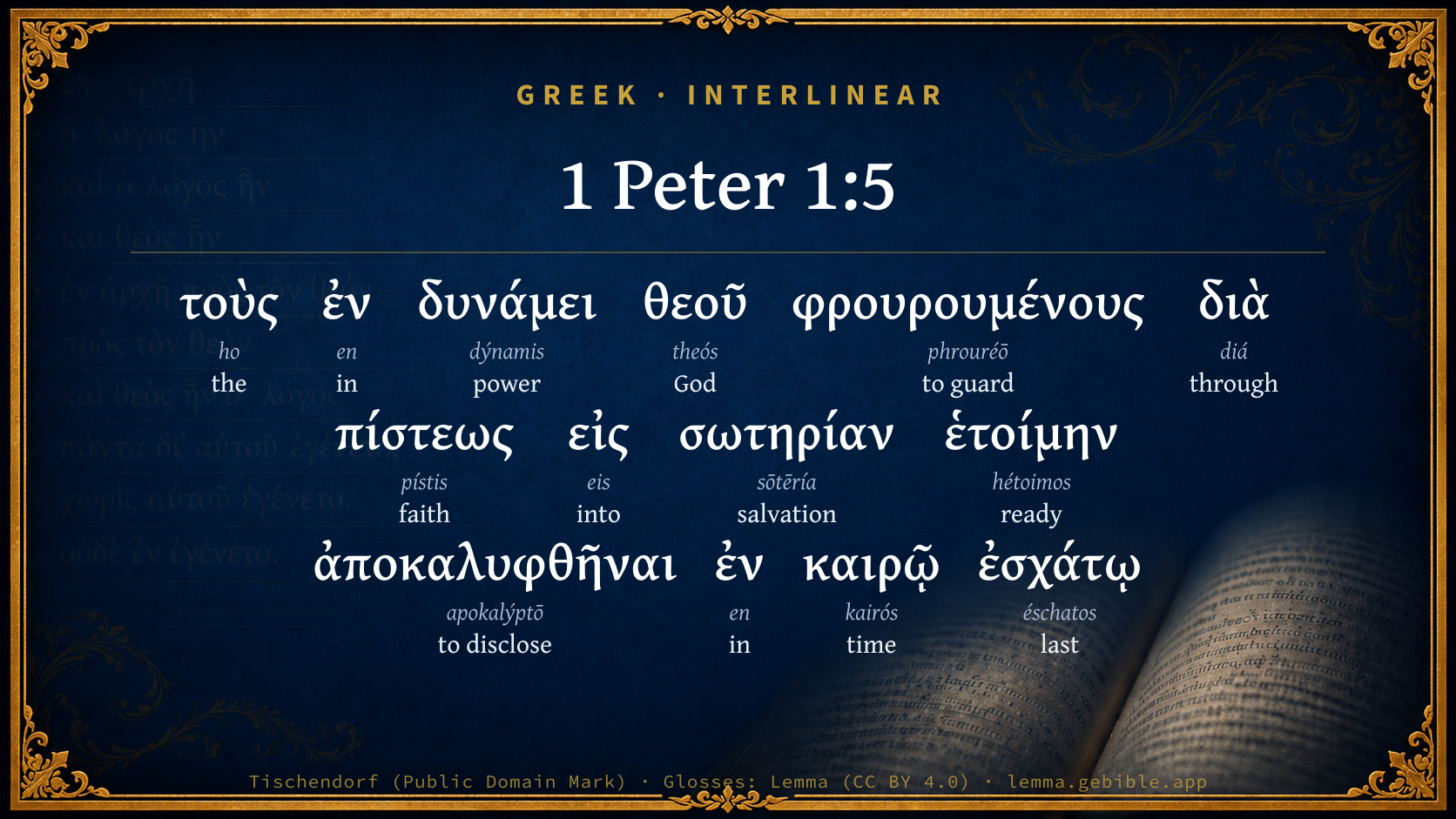
  1. τοὺς ho G3588 “the” Article, Accusative, Plural, Masculine
  2. ἐν en G1722 “in” Preposition
  3. δυνάμει dýnamis G1411 “power” Noun, Dative, Singular, Feminine
  4. θεοῦ theós G2316 “God” Noun, Genitive, Singular, Masculine
  5. διὰ diá G1223 “through” Preposition
  6. πίστεως pístis G4102 “faith” Noun, Genitive, Singular, Feminine
  7. εἰς eis G1519 “into” Preposition
  8. σωτηρίαν sōtēría G4991 “salvation” Noun, Accusative, Singular, Feminine
  9. ἑτοίμην hétoimos G2092 “ready” Adjective, Accusative, Singular, Feminine
  10. ἀποκαλυφθῆναι apokalýptō G601 “to disclose” Verb, Aorist, Passive, Infinitive
  11. ἐν en G1722 “in” Preposition
  12. καιρῷ kairós G2540 “time” Noun, Dative, Singular, Masculine
  13. ἐσχάτῳ éschatos G2078 “last” Adjective, Dative, Singular, Masculine, Superlative

About this verse

These counts appear in no published source. They are computed here, from the morphology-tagged text and Lemma’s own curated glosses. What Lemma adds →

14
words
13
distinct lemmas
General Epistles
section

Notable vocabulary

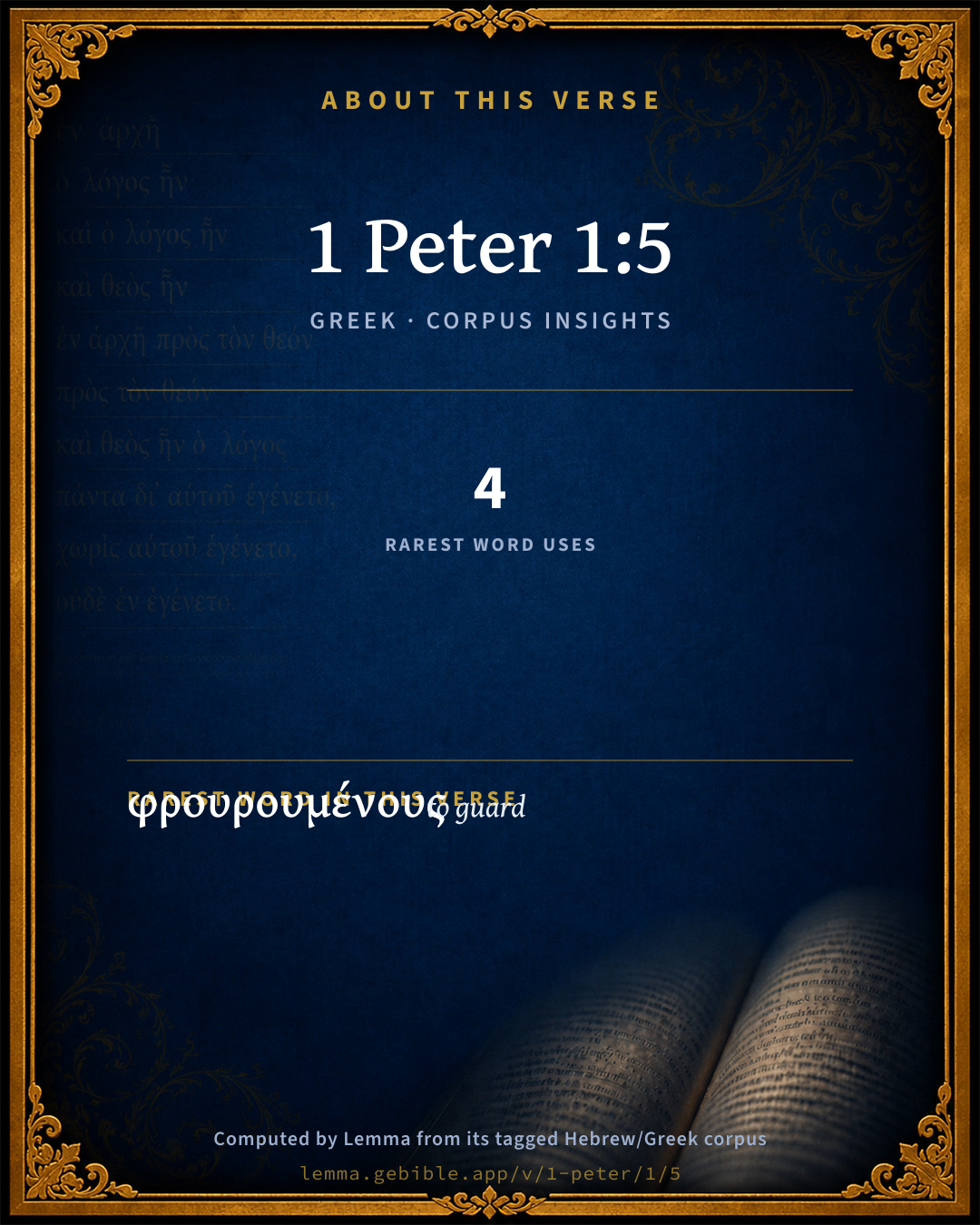
The rarest word here is φρουρουμένους to guard G5432 — appearing just 4 times in the whole Greek New Testament.

Shared distinctive vocabulary

φρουρουμένους to guard G5432 occurs in 4 verses of the Greek New Testament. Also found in:

Repetition

A word recurs within this verse:

Cross-references

35

Topical passages linked to 1 Peter 1:5 in the Treasury of Scripture Knowledge — connected by theme and wording, ordered by reader-vote popularity; previews shown in the World English Bible.

  • Philippians 1:6 being confident of this very thing, that he who began a good work in you will complete it until the day of Jesus Christ.
  • Ephesians 2:8 for by grace you have been saved through faith, and that not of yourselves; it is the gift of God,
  • Romans 8:31–39 What then shall we say about these things? If God is for us, who can be against us?
  • 2 Thessalonians 2:13–14 But we are bound to always give thanks to God for you, brothers loved by the Lord, because God chose you from the beginning for salvation through sanctification of the Spirit and belief in the truth;
  • Job 19:25 But as for me, I know that my Redeemer lives. In the end, he will stand upon the earth.
  • John 10:28–30 I give eternal life to them. They will never perish, and no one will snatch them out of my hand.
  • 1 Peter 1:13 Therefore, prepare your minds for action, be sober and set your hope fully on the grace that will be brought to you at the revelation of Jesus Christ--
  • Hebrews 9:28 so Christ also, having been once offered to bear the sins of many, will appear a second time, without sin, to those who are eagerly waiting for him for salvation.
  • John 17:11–12 I am no more in the world, but these are in the world, and I am coming to you. Holy Father, keep them through your name which you have given me, that they may be one, even as we are.
  • Galatians 2:20 I have been crucified with Christ, and it is no longer I that live, but Christ living in me. That life which I now live in the flesh, I live by faith in the Son of God, who loved me, and gave himself up for me.
  • Jude 1:1 Jude, a servant of Jesus Christ, and brother of James, to those who are called, sanctified by God the Father, and kept for Jesus Christ:
  • Psalms 37:23–24 A man's goings are established by Yahweh. He delights in his way.
  • Ephesians 3:17 that Christ may dwell in your hearts through faith; to the end that you, being rooted and grounded in love,
  • 2 Timothy 3:15 From infancy, you have known the sacred writings which are able to make you wise for salvation through faith, which is in Christ Jesus.
  • John 5:24 "Most assuredly I tell you, he who hears my word, and believes him who sent me, has eternal life, and doesn't come into judgment, but has passed out of death into life.
  • John 17:15 I pray not that you would take them from the world, but that you would keep them from the evil one.
  • Romans 11:20 True; by their unbelief they were broken off, and you stand by your faith. Don't be conceited, but fear;
  • 1 Samuel 2:9 He will keep the feet of his holy ones; But the wicked shall be put to silence in darkness; For by strength shall no man prevail.
  • Psalms 37:28 For Yahweh loves justice, And doesn't forsake his saints. They are preserved forever, But the children of the wicked shall be cut off.
  • Psalms 125:1–2 Those who trust in Yahweh are as Mount Zion, Which can't be moved, but remains forever.
  • Isaiah 45:17 [But] Israel shall be saved by Yahweh with an everlasting salvation: you shall not be disappointed nor confounded world without end.
  • Isaiah 51:6 Lift up your eyes to the heavens, and look on the earth beneath; for the heavens shall vanish away like smoke, and the earth shall wax old like a garment; and those who dwell therein shall die in like manner: but my salvation shall be forever, and my righteousness shall not be abolished.
  • John 12:48 He who rejects me, and doesn't receive my sayings, has one who judges him. The word that I spoke, the same will judge him in the last day.
  • 1 Thessalonians 1:3–4 remembering without ceasing your work of faith and labor of love and patience of hope in our Lord Jesus Christ, before our God and Father.
  • Titus 2:13 looking for the blessed hope and appearing of the glory of our great God and Savior, Jesus Christ;
  • Psalms 103:17–18 But Yahweh's loving kindness is from everlasting to everlasting with those who fear him, His righteousness to children's children;
  • Isaiah 54:17 No weapon that is formed against you shall prosper; and every tongue that shall rise against you in judgment you shall condemn. This is the heritage of the servants of Yahweh, and their righteousness which is of me, says Yahweh.
  • Jeremiah 32:40 and I will make an everlasting covenant with them, that I will not turn away from following them, to do them good; and I will put my fear in their hearts, that they may not depart from me.
  • 1 Timothy 6:14–15 that you keep the commandment without spot, blameless, until the appearing of our Lord Jesus Christ;
  • Hebrews 6:12 that you won't be sluggish, but imitators of those who through faith and patience inherited the promises.
  • Jude 1:24 Now to him who is able to keep them from stumbling, and to present you faultless before the presence of his glory in great joy,
  • Proverbs 2:8 That he may guard the paths of justice, And preserve the way of his saints.
  • John 4:14 but whoever drinks of the water that I will give him will never thirst again; but the water that I will give him will become in him a well of water springing up to eternal life."
  • 2 Corinthians 1:24 Not that we have lordship over your faith, but are fellow workers with you for your joy. For you stand firm in faith.
  • 1 John 3:2 Beloved, now we are children of God, and it is not yet revealed what we will be. But we know that, when he is revealed, we will be like him; for we will see him just as he is.

Cross-references courtesy of OpenBible.info (CC BY 4.0).

Commentary

Notes on 1 Peter 1:5 from classic Christian and Jewish commentators (each source and its license shown beneath its notes). The classic Christian expositions comment on the surrounding passage and are grouped to its opening verse, so a note may address several verses; the Jewish commentaries on the Tanakh (Rashi and others) are per-verse, so they appear only where the commentator wrote on this verse.

Lemma curates 59 commentaries, every one of them public domain or Creative Commons licensed, each selected and text-cleaned for this edition rather than reprinted as found. About our sources →

Joseph Benson's Commentary

1Pe 1:5. Who are kept — Who, though now surrounded with many apparent dangers, are not left defenceless, but are guarded, kept as in a garrison, as the word φρουρουμενους signifies; by the power of God — Which worketh all in all; or secured from all real harm, under the observation of his all-seeing eye, and the protection of his almighty hand; through faith — Through the continued exercise of that faith, by which alone salvation is both received and retained. The clause is very emphatical: “It represents,” says Macknight, “believers as attacked by evil spirits and wicked men, their enemies, but defended against those attacks by the power of God, through the influence of their faith, (1Jn 5:4,) just as those who remain in an impregnable fortress are secured from the attacks of their enemies by its ramparts and walls.” Ready — Ετοιμην, prepared, to be revealed — In all its glory; in the last time — The time of Christ’s second coming; the grand period, in which all the mysteries of divine providence shall beautifully and gloriously terminate. Some have thought that by the salvation here spoken of, the apostle meant the preservation from the destruction brought on the Jewish nation by the Romans, which preservation the disciples of Christ “obtained, by observing the signs mentioned in their Master’s prophecy concerning that event. For, when they saw these signs take place, they fled from Jerusalem to places of safety, agreeably to their Master’s order, Mat 24:16. But what is said, 1Pe 1:9-12, concerning this salvation; that it is a salvation, not of the body, but of the soul, to be bestowed as the reward of faith; that the prophets, who foretold this salvation, searched diligently among what people, and at what time, the means of procuring it were accomplished; that it was revealed to the prophets that these means were to be accomplished, not among them, but among us; and that these things were to be preached by the apostles as actually come to pass: I say, the above- mentioned particulars concerning the salvation to be revealed in the last time, do not agree to the deliverance of the Christians from the destruction of Jerusalem, but are applicable only to the salvation of believers in general from eternal death, by a resurrection to an immortal life in heaven, at the time of Christ’s coming, when this salvation is to be revealed; and that time is called the last time, because it will be the concluding scene of God’s dispensations relating to our world.” — Macknight.

Joseph Benson's Commentary on the Old and New Testaments (1811–1818) — public domain. Text from a community e-Sword module.

MacLaren's Expositions of Holy Scripture

Alexander MacLaren

Proverbs

KEEPING AND KEPT

Pro 4:23. - 1Pe 1:5.

The former of these texts imposes a stringent duty, the latter promises divine help to perform it. The relation between them is that between the Law and the Gospel. The Law commands, the Gospel gives power to obey. The Law pays no attention to man’s weakness, and points no finger to the source of strength. Its office is to set clearly forth what we ought to be, not to aid us in becoming so. ‘Here is your duty, do it’ is, doubtless, a needful message, but it is a chilly one, and it may well be doubted if it ever rouses a soul to right action. Moralists have hammered away at preaching self-restraint and a close watch over the fountain of actions within from the beginning, but their exhortations have little effect unless they can add to their icy injunctions the warmth of the promise of our second text, and point to a divine Keeper who will make duty possible. We must be kept by God, if we are ever to succeed in keeping our wayward hearts.

I. Without our guarding our hearts, no noble life is possible.

The Old Testament psychology differs from our popular allocation of certain faculties to bodily organs. We use head and heart, roughly speaking, as being respectively the seats of thought and of emotion. But the Old Testament locates in the heart the centre of personal being. It is not merely the home of the affections, but the seat of will, moral purpose. As this text says, ‘the issues of life’ flow from it in all the multitudinous variety of their forms. The stream parts into many heads, but it has one fountain. To the Hebrew thinkers the heart was the indivisible, central unity which manifested itself in the whole of the outward life. ‘As a man thinketh in his heart, so is he.’ The heart is the man. And that personal centre has a moral character which comes to light in, and gives unity and character to, all his deeds.

That solemn thought that every one of us has a definite moral character, and that our deeds are not an accidental set of outward actions but flow from an inner fountain, needs to be driven home to our consciences, for most of the actions of most men are done so mechanically, and reflected on so little by the doers, that the conviction of their having any moral character at all, or of our incurring any responsibility for them, is almost extinct in us, unless when something startles conscience into protest.

It is this shrouded inner self to which supreme care is to be directed. All noble ethical teaching concurs in this-that a man who seeks to be right must keep, in the sense both of watching and of guarding, his inner self. Conduct is more easily regulated than character-and less worth regulating. It avails little to plant watchers on the stream half way to the sea. Control must be exercised at the source, if it is to be effectual. The counsel of our first text is a commonplace of all wholesome moral teaching since the beginning of the world. The phrase ‘with all diligence’ is literally ‘above all guarding,’ and energetically expresses the supremacy of this keeping. It should be the foremost, all-pervading aim of every wise man who would not let his life run to waste. It may be turned into more modern language, meaning just what this ancient sage meant, if we put it as, ‘Guard thy character with more carefulness than thou dost thy most precious possessions, for it needs continual watchfulness, and, untended, will go to rack and ruin.’ The exhortation finds a response in every heart, and may seem too familiar and trite to bear dwelling on, but we may be allowed to touch lightly on one or two of the plain reasons which enforce it on every man who is not what Proverbs very unpolitely calls ‘a fool.’

That guarding is plainly imposed as necessary, by the very constitution of our manhood. Our nature is evidently not a republic, but a monarchy. It is full of blind impulses, and hungry desires, which take no heed of any law but their own satisfaction. If the reins are thrown on the necks of these untamed horses, they will drag the man to destruction. They are only safe when they are curbed and bitted, and held well in. Then there are tastes and inclinations which need guidance and are plainly meant to be subordinate. The will is to govern all the lower self, and conscience is to govern the will. Unmistakably there are parts of every man’s nature which are meant to serve, and parts which are appointed to rule, and to let the servants usurp the place of the rulers is to bring about as wild a confusion within as the Ecclesiast lamented that he had seen in the anarchic times when he wrote-princes walking and beggars on horseback. As George Herbert has it-

‘Give not thy humours way;

God gave them to thee under lock and key.’

Then, further, that guarding is plainly imperative, because there is an outer world which appeals to our needs and desires, irrespective altogether of right and wrong and of the moral consequences of gratifying these. Put a loaf before a starving man and his impulse will be to clutch and devour it, without regard to whether it is his or no. Show any of our animal propensities its appropriate food, and it asks no questions as to right or wrong, but is stirred to grasp its natural food. And even the higher and nobler parts of our nature are but too apt to seek their gratification without having the license of conscience for doing so, and sometimes in defiance of its plain prohibitions. It is never safe to trust the guidance of life to tastes, inclinations, or to anything but clear reason, set in motion by calm will, and acting under the approbation of ‘the Lord Chief Justice, Conscience.’

But again, seeing that the world has more evil than good in it, the keeping of the heart will always consist rather in repelling solicitations to yielding to evil. In short, the power and the habit of sternly saying ‘No’ to the whole crowd of tempters is always the main secret of a noble life. ‘He that hath no rule over his own spirit is like a city broken down and without walls.’

II. There is no effectual guarding unless God guards.

The counsel in Proverbs is not mere toothless moral commonplace, but is associated, in the preceding chapter, with fatherly advice to ‘let thine heart keep my commandments’ and to ‘trust in the Lord with all thine heart.’ The heart that so trusts will be safely guarded, and only such a heart will be. The inherent weakness of all attempts at self-keeping is that keeper and kept being one and the same personality, the more we need to be kept the less able we are to effect it. If in the very garrison are traitors, how shall the fortress be defended? If, then, we are to exercise an effectual guard over our characters and control over our natures, we must have an outward standard of right and wrong which shall not be deflected by variations in our temperature. We need a fixed light to steer towards, which is stable on the stable shore, and is not tossing up and down on our decks. We shall cleanse our way only when we ‘take heed thereto, according to Thy word.’ For even God’s viceroy within, the sovereign conscience, can be warped, perverted, silenced, and is not immune from the spreading infection of evil. When it turns to God, as a mirror to the sun, it is irradiated and flashes bright illumination into dark corners, but its power depends on its being thus lit by radiations from the very Light of Life. And if we are ever to have a coercive power over the rebellious powers within, we must have God’s power breathed into us, giving grip and energy to all the good within, quickening every lofty desire, satisfying every aspiration that feels after Him, cowing all our evil and being the very self of ourselves.

We need an outward motive which will stimulate and stir to effort. Our wills are lamed for good, and the world has strong charms that appeal to us. And if we are not to yield to these, there must be somewhere a stronger motive than any that the sorceress world has in its stores, that shall constrainingly draw us to ways that, because they tend upward, and yield no pabulum for the lower self, are difficult for sluggish feet. To the writer of this Book of Proverbs the name of God bore in it such a motive. To us the name of Jesus, which is Love, bears a yet mightier appeal, and the motive which lies in His death for us is strong enough, and it alone is strong enough, to fire our whole selves with enthusiastic, grateful love, which will burn up our sloth, and sweep our evil out of our hearts, and make us swift and glad to do all that may please Him. If there must be fresh reinforcements thrown into the town of Mansoul, as there must be if it is not to be captured, there is one sure way of securing these. Our second text tells us whence the relieving force must come. If we are to keep our hearts with all diligence, we must be ‘kept by the power of God,’ and that power is not merely to make diversion outside the beleaguered fortress which may force the besiegers to retreat and give up their effort, but is to enter in and possess the soul which it wills to defend. It is when the enemy sees that new succours have, in some mysterious way, been introduced, that he gives up his siege. It is God in us that is our security.

III. There is no keeping by God without faith.

Peter was an expert in such matters, for he had had a bitter experience to teach him how soon and surely self-confidence became self-despair. ‘Though all should forsake Thee, yet will not I,’ was said but a few hours before he denied Jesus. His faith failed, and then the divine guard that was keeping his soul passed thence, and, left alone, he fell.

That divine Power is exerted for our keeping on condition of our trusting ourselves to Him and trusting Him for ourselves. And that condition is no arbitrary one, but is prescribed by the very nature of divine help and of human faith. If God could keep our souls without our trust in Him He would. He does so keep them as far as is possible, but for all the choicer blessings of His giving, and especially for that of keeping us free from the domination of our lower selves, there must be in us faith if there is to be in God help. The hand that lays hold on God in Christ must be stretched out and must grasp His warm, gentle, and strong hand, if the tingling touch of it is to infuse strength. If the relieving force is victoriously to enter our hearts, we must throw open the gates and welcome it. Faith is but the open door for God’s entrance. It has no efficacy in itself any more than a door has, but all its blessedness depends on what it admits into the hidden chambers of the heart.

I reiterate what I have tried to show in these poor words. There is no noble life without our guarding our hearts; there is no effectual guarding unless God guards; there is no divine guarding unless through our faith. It is vain to preach self-governing and self-keeping. Unless we can tell the beleaguered heart, ‘The Lord is thy Keeper; He will keep thee from all evil; He will keep thy soul,’ we only add one more impossible command to a man’s burden. And we do not apprehend nor experience the divine keeping in its most blessed and fullest reality, unless we find it in Jesus, who is ‘able to keep us from falling, and to present us faultless before the presence of His glory with exceeding joy.’

1 Peter

BY, THROUGH, UNTO

1Pe 1:5

The Revised Version substitutes ‘guarded’ for ‘kept,’ and the alteration, though slight, is important, for it not only more accurately preserves the meaning of the word employed, but it retains the military metaphor which is in it. The force of the expression will appear if I refer, in a sentence, to other cases in which it is employed in the New Testament. For instance, we read that the governor of Damascus ‘kept the city with a garrison,’ which is the same word, and in its purely metaphorical usage Paul employs it when he says that ‘the peace of God shall keep’--guard, garrison--’your hearts and minds in Christ Jesus.’ We have to think of some defenceless position, some unwalled village out in the open, with a strong force round it, through which no assailant can break, and in the midst of which the weakest can sit secure. Peter thinks that every Christian has assailants whom no Christian by himself can repel, but that he may, if he likes, have an impregnable ring of defence drawn round him, which shall fling back in idle spray the wildest onset of the waves, as a breakwater or a cliff might do.

Then there is another very beautiful and striking point to be made, and that is the connection between the words of my text and those immediately preceding. The Apostle has been speaking about ‘the inheritance incorruptible, and undefiled, and that fadeth not away,’ and he says ‘it is reserved in Heaven for you who are kept.’ So, then, the same power is working on both sides of the veil, preserving the inheritance for the heirs, and preserving the heirs for the inheritance. It will not fail them, and they will not miss it. It were of little avail to care for either of the two members separately, but the same hand that is preparing the inheritance and making it ready for the owners is round about the pilgrims, and taking care of them till they get home.

So, then, our Apostle is looking at this keeping in three aspects, suggested by his three words ‘by,’ ‘through,’ ‘unto,’ which respectively express the real cause or power, the condition or occasion on which that power works, and the end or purpose to which it works. So these three little words will do for lines on which to run our thoughts now--’by,’ ‘through,’ ‘for.’

I. In the first place, what are we guarded for?

‘Guarded ... unto salvation.’ Now that great word ‘salvation’ was a new and strange one to Peter’s readers--so new and strange that probably they did not understand it in its full nobleness and sweep. Our understanding of it, or, at least, our impression of it, is weakened by precisely the opposite cause. It has become so tarnished and smooth-rubbed that it creates very little definite impression. Like a bit of seaweed lifted out of the sunny waves which opened its fronds and brightened its delicate colours, it has become dry and hard and sapless and dim. But let me try for one moment to freshen it for our conceptions and our hearts. Salvation has in it the double idea of being made safe, and being made sound. Peril threatening to slay, and sickness unto death, are the implications of the conditions which this great word presupposes. The man that needs to be saved needs to be rescued from peril and needs to be healed of a disease. And if you do not know and feel that that is you, then you have not learned the first letters of the alphabet which are necessary to spell ‘salvation.’ You, I, every man, we are all sick unto death, because the poison of self-will and sin is running hot through all our veins, and we are all in deadly peril because of that poison-peril of death, peril arising from the weight of guilt that presses upon us, peril from our inevitable collision with the Divine law and government which make for righteousness.

And so salvation means, negatively, the deliverance from all the evils, whether they be evils of sorrow or evils of sin, which can affect a man, and which do affect us all in some measure. But it means far more than that, for God’s salvation is no half-and-half thing, contented, as some benevolent man might be, in a widespread flood or disaster, with rescuing the victims and putting them high up enough for the water not to reach them, and leaving them there shivering cold and starving. But when God begins by taking away evils, it is in order that He may clear a path for flooding us with good. And so salvation is not merely what some of you think it is, the escape from a hell, nor only what some of you more nobly take it to be, a deliverance from the power of sin in your hearts; but it is the investiture of each of us with every good and glory, whether of happiness or of purity, which it is possible for a man to receive and for God to give. It is the great word of the New Testament, and they do a very questionable service to humanity who weaken the grandeur and the greatness of the Scriptural conception of salvation, by weakening the darkness and the terribleness of the Scriptural conception of the dangers and the sicknesses from which it delivers.

But, then, there is another point that I would suggest raised by the words of my text in their connection. Peter is here evidently speaking about a future manifestation of absolute exemption from all the ills that flesh and spirit are heir to, and radiant investure with all the good that humanity can put on, which lies beyond the great barrier of this mortal life. And that complete salvation, in its double aspect, is obviously the end for which all that guarding of life is lavished upon us, as it is the end for which all the discipline of life is given to us, and as it is the end for which the bitter agony and pain of the Christ on the Cross were freely rendered. But that ultimate and superlative perfection has its roots and its beginning here. And so in Scripture you find salvation sometimes regarded as a thing in the past experience of every Christian man which he received at the very beginning of his course, and sometimes you have it treated as being progressive, running on continually through all his days; and sometimes you have it treated, as in my text, as laid up yonder, and only to be reached when life is done with. But just a verse or two after my text we read that the Christian man here, on condition of his loving Jesus Christ and believing in Him, rejoices because he here and now ‘receives the end of his faith, even the salvation of his soul.’ And so there are the two things--the incipient germ to-day, the full-foliaged fruit-bearing tree planted in the higher house of the Lord.

These two things are inseparably intertwined. The Christian life in its imperfection here, the partial salvation of to-day demands, unless the universe is a chaos and there is no personal God the centre of it, a future life, in which all that is here tendency shall be realised possession, and in which all that here but puts up a pale and feeble shoot above the ground, shall grow and blossom and bear fruit unto life eternal. ‘Like the new moon with a ragged edge, e’en in its imperfections beautiful,’ all the characteristics of Christian life on earth prophesy that the orb is crescent, and will one day round itself into its pure silvery completeness. If you see a great wall in some palace, with slabs of polished marble for most of its length, and here and there stretches of course rubble shoved in, you would know that that was not the final condition, that the rubble had to be cased over, or taken out and replaced by the lucent slab that reflected the light, and showed, by its reflecting, its own mottled beauty. Thus the very inconsistencies, the thwarted desires, the broken resolutions, the aspiration that never can clothe themselves in the flesh of reality, which belong to the Christian life, declare that this is but the first stage of the structure, and point onwards to the time when the imperfections shall be swept away, ‘and for brass He will bring gold, for iron He will bring silver,’ and then the windows shall be set ‘in agates, and the gates in carbuncles, and all the borders in pleasant stones.’ Perfect salvation is obviously the only issue of the present imperfect salvation.

That is what you are ‘kept’ for. That is what Christ died to bring you. That is what God, like a patient workman bringing out the pattern in his loom by many a throw of a sharp-pointed shuttle, and much twisting of the threads into patterns, is trying to make of you, and that is what Christ on the Cross has died to effect. Brethren, let us think more than we do, not only of the partial beginnings here, but of that perfect salvation for which Christian men are being ‘kept’ and guarded, and which, if you and I will observe the conditions, is as sure to come as that X, Y, Z follow A, B, C. That is what we are kept for.

II. Notice what we are guarded by.

‘The power of God,’ says Peter, laying hold of the most general expression that he can find, not caring to define ways and means, but pointing to the one great force that is sure to do it.

Now if we were to translate with perfect literality, we should read, not by the power of God, but in the power of God. And whilst it is quite probable that what Peter meant was ‘by,’ I think it adds great force and beauty to the passage, and is entirely accordant with the military metaphor, which I have already pointed out, if we keep the simple local sense of the word, and read, ‘guarded in the power of God.’ And that suggests a whole stream of Scriptural representations, both in the Old and in the New Testament. Let me recall one or two. ‘The name of the Lord is a strong tower; the righteous runneth into it and is safe.’ ‘He that dwelleth in the secret place of the Most High shall abide under the shadow of the Almighty.’ ‘Israel shall dwell safely,’ says one of the old prophets, ‘in unwalled villages, for I will be a wall of fire round about her.’ The psalmist said, ‘The Angel of the Lord encampeth round about them that fear Him.’ And all these representations concur in this one thought, that we are safe, enclosed in God, and that He, by His power, compasses us about. And so no foe can get at us who cannot break down or climb over the encircling wall of defence. An army in an enemy’s country will march in hollow square, and put its most precious treasures, or its weaker members, its sick, its women, its children, its footsore, into the middle there, and with a line of lances on either side, and stalwart arms to wield them, the feeblest need fear no foe. We ‘are kept in the power of God unto salvation.’

But do not forget how, far beyond the psalmist and prophet, and in something far more sublime and wonderful than a poetic figure, the New Testament catches up the same phrase, and gives us, as the condition of vitality, as the condition of fertility, as the condition of tranquillity, as the condition of security, the same thing--’in Christ.’ Remember His very last words prior to His great intercessory prayer, in which He spoke about keeping those that were given Him in His name. And just before that He said to them, ‘In the world ye shall have tribulation, but in Me ye shall have peace.’ Kept, guarded as behind the battlements of some great fort, which has in its centre a quiet, armoured chamber into which no noise of battle, nor shout of foeman, can ever come. ‘In Christ,’ though the world is all in arms without, ‘ye shall have peace.’ ‘Guarded in the power of God unto salvation.’

III. Lastly, what we are kept through.

‘Through faith.’ Now there we come across another of the words which we know so well that we do not understand them. You all think that it is the right thing for me to preach about ‘faith.’ I daresay some of you have never tried to apprehend what it means. And I daresay there are a great many of you to whom the utterance of the word suggests that I am plunging into the bathos and commonplaces of the pulpit. Perhaps, if you would try to understand it, you would find it was a bigger thing than you fancied. What is faith? I will give you another expression that has not so many theological accretions sticking to it, and which means precisely the same thing--trust. And we all know that we do not trust with our heads, but with our hearts and wills. You may believe undoubtedly, and have no faith at all, for it is the heart and the will that go forth, and clutch at the thing trusted; or, as I should rather say, at the person trusted; for, at bottom, what we trust is always a person, and even when we ‘trust to nature,’ it is because, more or less clearly, we feel that somehow or other at the back of nature there is a Will and an Intelligence that are working and trustworthy. However, that is a subject that I do not need to touch upon here. Faith is trust, trust in a Person, trust that, like the fabled goddess rising, radiant and aspiring to the heavens, out of the roll of the tempestuous ocean, springs from the depths of absolute self-distrust and diffidence. There is a spurious kind of faith which has no good in it, just because it did not begin with going down into the depths of one’s own heart, and finding out how rotten and hopeless everything was there. My friend, no man has a vigorous Christian faith who has not been very near utter despair. ‘Out of the depths have I cried unto Thee.’ The zenith, which is the highest point in the sky above us, is always just as far aloft as the nadir, which is the lowest point in the sky at the Antipodes, is beneath us. Your faith is measured by your self-despair.

Further, why is it that I must have faith in order to get God’s power at work in me? Many people seem to think that faith is appointed by God as the condition of salvation out of mere arbitrary selection and caprice. Not at all. If God could save you without your faith, He would do it. He does not, because He cannot. Why must I have faith in order that God’s power may keep me? Why must you open your window in order to let the fresh air in? Why must you pull up the blind in order to let the light in? Why must you take your medicine or your food if you want to be cured or nourished? Why must you pull the trigger if your revolver is to go off? Unless I trust God, distrusting myself, and the spark of faith is struck out of the rock of my heart by the sharp steel in the midst of the darkness of despair, God cannot pour out upon me His power. There is nothing arbitrary about it. It is inseparable from the very nature of the case. If you do not want Him, you cannot have Him. If you do not know that you need Him, you cannot have Him. If you do not trust that He will come to you and help you, you will not have Him.

So then, brother, your faith, my faith, anybody’s faith is nothing of itself. It is only the valve that opens and lets the steam rush in. It is only the tap you turn to let Thirlmere come into your basins. It is not you that saves yourself. It is not your faith that keeps you, any more than it is the outstretched hand with which a man, ready to stumble, grasps the hand of a stalwart, steadfast man on the pavement by his side that keeps him up. It is the other man’s hand that holds you up, but it is your hand that lays hold of him. It is God that saves, it is God that guards, it is God that is able to keep us from falling, and to give us an inheritance among all them that are sanctified. He will do it if we turn to Him, and ask and expect Him to do it. If you will comply with the conditions and not else, He will fulfil His promise and accomplish His purpose. But my unbelief can thwart Omnipotence, and hinder Christ’s all-loving purpose, just as on earth we read that ‘He could there do no mighty works because of their unbelief.’ I am sure that there are people here who all their lives long have been thus hampering Omnipotence and neutralising the love of Christ, and making His sacrifice impotent and His wish to save them vain. Stretch out your hands as this very Peter once did, crying, ‘Lord, save, or I perish’; and He will answer, not by word only, but by act: ‘According to thy faith be it unto thee.’ Salvation, here and hereafter, is God’s work alone. It cannot be exercised towards a man who has not faith. It will certainly be exercised towards any man who has.

Help us, O Lord, we beseech Thee, to live the lives which we live in the flesh by the faith of the Son of God. And may we know what it is to be in him, strengthened within the might of His spirit.

Alexander MacLaren, Expositions of Holy Scripture (1904–1910) — public domain. Text from a community e-Sword module.

Tyndale Open Study Notes

Tyndale Open Resources

1:5 until you receive this salvation: In the New Testament, salvation often refers to final rescue from sin and death at the time of Christ’s return. This hope encourages believers to persevere to the end (see also 1:9, 10; 2:2; 4:18). • ready to be revealed: The future revealing of God’s salvation contrasts with the present hiddenness of God and his purposes (see also 1:7, 13).

Tyndale Open Study Notes — © Tyndale Open Resources, licensed CC BY-SA 4.0. Text via the HelloAO Bible API.

Bengel's Gnomon

Johann Albrecht Bengel

1Pe 1:5. Ἐν δυνάμει Θεοῦ, by the power of God) He Himself does it, and will do it entirely: ch. 1Pe 5:10. Comp. 2Pe 1:3.[4] No one can propose to himself, in what way he may wish to arrive at the goal. It is the power of God which gives us safety against our enemies; it is the long-suffering of the Lord which gives us safety against ourselves: 2Pe 3:15. The apostles themselves are a proof of this.—φρουρουμένους, who are guarded) The inheritance is kept in safety; the heirs are guarded. Neither shall it be wanting to them, nor they to it. A remarkable confirmation [sample of how the word of God strengthens and guards believers] occurs, 2Pe 3:17.—διὰ πίστεως, by faith) It is by faith that salvation is both received and kept.—ἑτοίμην ἀποκαλυφθῆναι, ready to be revealed) The revelation takes place at the last day: the preparations for it began to be made when Christ came.—ἀποκαλυφθῆναι, to be revealed) A frequent word in this Epistle: 1Pe 1:7; 1Pe 1:12-13; 1Pe 4:13; 1Pe 5:1.—ἐν καιρῷ ἐσχάτῳ, in the last time) Peter considers the whole of the time, from the beginning of the New Testament to the coming of Christ in glory, as one time, and that short, in comparison with the times of the Old Testament. Comp. note on Act 1:11. Therefore in depends upon ready.[5]

[4] 1Th 5:24; Mat 19:26. If deprived of this protection, how could we continue stedfast in the presence of the adversary? 1Pe 5:8.—V. g.

[5] Not as Engl. Vers. upon “revealed.” The preparations for its being “revealed” take place in this present, i.e. the last time.—E.

Bengel's Gnomon of the New Testament — English translation (T&T Clark, Edinburgh, 1860) — public domain. Text from a community e-Sword module.

Meyer's Critical & Exegetical Commentary

Heinrich August Wilhelm Meyer

1Pe_1:5. As the basis of the thought: τετηρημένην … εἰς ὑμᾶς, the apostle subjoins to ὑμᾶς the additional τοὺς ἐν δυνάμει φρουρουμένους … εἰς σωτηρίαν, by which is expressed not the condition on which the readers might hope for the heavenly κληρονομία, but the reason why they possess expectations of it. The chief emphasis lies not on ἐν δυνάμει Θεοῦ (Schott), but on φρουρουμένους … εἰς σωτηρίαν, inasmuch as the former expression serves only to define the φρουρεῖσθαι more precisely. Gerhard incorrectly makes the accusative depend on ἀναγεννήσας. The prep. ἐν (as distinguished from the following διά) points out the δύναμις Θεοῦ as the causa efficiens (Gerhard), so that Luthers: out of Gods power is in sense correct; the φρουρεῖσθαι is based on the δύν. Θεοῦ. Steinmeyer wrongly explains, referring to Gal_3:23, the δύναμις Θεοῦ as the φρουρά within which the Christians as believers (διὰ πίστεως equal to πιστεύοντες!) are kept, velut sub vetere T. lex carcerum instar exstitit, in quibus οἱ ὑπὸ νόμον ὄντες custodiebantur. To assume an antithesis between the δύν. Θεοῦ and the law in explanation of this passage, is entirely unjustifiable. By δύν. Θεοῦ is not to be understood, with de Wette and Weiss (p. 189), the Holy Spirit; He is never in any passage of the N. T. (not even in Luk_1:35) designated by these words. The means by which the power of God effects the preservation is the πίστις,[55] the ultimate origin of which nevertheless is also the gracious will of God.

On φρουρουμένους, Vorstius rightly remarks: notatur talis custodia, quae praesidium habet adjunctum.[56] The word by which the apostle even here makes reference to the subsequent ἘΝ ΠΟΙΚΊΛΟΙς ΠΕΙΡΑΣΜΟῖς, 1Pe_1:6, has its nearer definition in the following ΕἸς ΣΩΤΗΡΊΑΝ ἙΤΟΊΜΗΝ ἈΠΟΚΑΛΥΦΘῆΝΑΙ, which by Calvin (haec duo membra appositive lego, ut posterius sit prioris expositio, rem unam duobus modis exprimit), Steiger, and others is joined to ἈΝΑΓΕΝΝΉΣΑς as a co-ordinate adjunct to ΕἸς ΚΛΗΡΟΝΟΜΊΑΝ. It is preferable to connect them with ΦΡΟΥΡΟΥΜΈΝΟΥς; the more so that ΚΛΗΡΟΝΟΜΊΑ, with its predicates, so fully characterizes the object of hope, that ΕἸς ΣΩΤΗΡΊΑΝ Κ.Τ.Λ. would add nothing further (Wiesinger). The introduction of ὙΜᾶς, too, is decidedly opposed to the former construction. There is nothing to support the connection with ΠΊΣΤΕΩς, in which ΣΩΤΗΡΊΑ would be regarded as the object of faith. According to the correct construction, the verbal conception is more nearly defined by the addition of the origin, means, and end, cf. 1Pe_1:2-3.[57] The word ΣΩΤΗΡΊΑ is hereas the conjoined ἙΤΟΊΜΗ ἈΠΟΚΑΛΥΦΘῆΝΑΙ showsa positive conception; namely: the salvation effected and completed by Christ, not simply a negative idea, deliverance from ἀπώλεια (Weiss, p. 79). It does not follow from the circumstance that ΚΛΗΡΟΝΟΜΊΑ and ΣΩΤΗΡΊΑ are synonymous terms, that the former is only the negative side of the completed salvation.

The verb ἈΠΟΚΑΛΥΦΘῆΝΑΙ is here, as elsewhere, used to denote the disclosure of what is already in existence (with God ἘΝ ΟὐΡΑΝΟῖς, 1Pe_1:4), but as yet hidden. ἝΤΟΙΜΟς is here, like ΜΈΛΛΩΝ often, joined cum. inf. pass. (see Gal_3:23. On the use of the inf. aor. in this connection, see Winer, p. 311 f. [E. T. 419 f.]); ΜΈΛΛΩΝ nevertheless has a less strong force. The future salvation lies ready to be revealed, that is to say: ἐν καιρῷ ἐσχάτῳ, by which is denoted the time when the worlds history will be closed (not the relatively last; Bengel: in comparatione temporum V. T.; but absolutely the last time ἘΝ ἈΠΟΚΑΛΎΨΕΙ Ἰ. ΧΡ., 1Pe_1:7. Wiesinger[58]). When this time will be, the apostle does not say; but his whole manner of expression indicates that in hope it floated before his vision as one near at hand; cf. chap. 1Pe_4:7.

[55] πίστις implies the entire and full Christian faith; not simply confidence in God (Weiss), nor the mere confident assurance of the salvation which is ready to be revealed (Hofmann); these are single elements which it includes, but which do not exhaust the idea. According to Schott, the apostle has omitted the article, in order to emphasize the fact that he means that faith which, as to its inmost nature, is not dependent on sight(!).

[56] Aretius rightly observes: militare est vocabulum φρουρά: praesidium. Pii igitur, dum sunt in periculis, sciant totidem eis divinitus parata esse praesidia: millia millium custodiunt eos. Finis est salus.Bengel also aptly says: haereditas servata est; haeredes custodiuntur, neque ilia his, neque hi deerunt illi.

[57] Schott justly calls attention to the relation of φρουρουμένους to τετηρημένην: If the reserving of the inheritance for Christians is not to be fruitless, it must be accompanied by a … preserving of them on earth for that inheritance. He states the difference between the two expressions thus: As regards the inheritance, it is only necessary that its existence should not cease. Christians, on the other hand, must be guarded and preserved from influences endangering their state of salvation,

[58] Schott unjustifiably supposes that the want of the article indicates that the σωτηρία would take place at a time which, from this very fact, must be regarded as the last.

Meyer — Critical and Exegetical Commentary on the New Testament — English translation by Peter Christie, edited by Frederick Crombie (T&T Clark, 1880) — public domain. Text from a community e-Sword module.

Expositor's Greek Testament

ed. W. Robertson Nicoll

1Pe 1:5 . The Christians addressed are to complete the metaphor from other passages in the Epistle a spiritual house (2 5.), which is besieged by the devil (1Pe 1:8 ) but guarded and garrisoned by God’s Power. So long as they have faith (1Pe 1:9 ) they are safe: “our faith lays hold upon this power and this power strengthens faith and so we are preserved” (Leighton). Without responsive faith God’s power is powerless to heal or to guard ( cf. Mar 6:5 f. and accounts of Jesus’ miracles generally, Jas 1:6 f.). The language seems to echo Rom 1:16 , δύναμις θεοῦ εἰς σωτηρίαν παντὶ τῷ πιστεύοντι , combined with Gal 3:23 ( cf. Phi 4:7 ) where also the distinctive φρουρεῖν occurs in similar context. The Power ( גבורתא ) of God is put for Jehovah in the Targum of Isa. xxxiii. 21; and the corresponding use of ἡ δύναμις is found in Mar 14:62 (see Dalman, 200 f.; and add ἡ μεγαλωσύνη , a more exact rendering, of Heb 1:3 ; Heb 8:1 ). In Philo God’s powers are personified self-manifestations. εἰς σωτηρίαν , κ . τ . λ ., is probably the third clause qualification of φρουρ . (cf. 1Pe 1:2-3 ). Below, the salvation of souls is described as the goal of faith (9) in a passage where the ἑτοίμην , κ . τ . λ ., qualify σωτηρίαν rather than κληρονομίαν which is explained by σωτ … ἐσχάτῳ . Salvation is to St. Peter that salvation which is to be revealed in the future ( cf. 1Pe 1:9 , 1Pe 2:2 ; so Rom 13:11 , νῦν ἐγγύτερον … ἡ σωτηρία ). Partial anticipations he neglects; for them as for Christ the glory follows the present suffering. The idea of the revelation of salvation comes from Psa 98:2 ( cf. Isa 56:1 ) which has influenced St. Paul also (Rom 1:16 f.). ἑτοίμην seems to be simply the equivalent of צתיר prepared , which St. Paul renders with more attention to current usage than etymology by μέλλουσαν (Rom 8:18 ; Gal 3:23 ; so 1Pe 5:1 ). This weaker sense begins with Deu 32:35 (LXX, πάρεστιν ἕτοιμα . as Peter here) and prevails in new Hebrew (Tarphon sai … the recompense of the reward of the righteous is for the time to come . העתיר לבא , Aboth, ii. 16). But the proper significance of the word is recognised and utilised in the Parables of Jesus, Mat 24:4 ; Mat 24:8 .

καιρῷ ἐσχάτῳ , still anarthrous as being technical term indefinite as the time is unknown as well as in accordance with authors’ custom ( cf. δύναμις , πιστέως , σωτηριαν above); cf. Joh 2:18 .

The Expositor's Greek Testament, edited by W. Robertson Nicoll (1897–1910) — public domain. Text from a community e-Sword module.

Geneva Bible (1599)

Geneva Bible translators

Now he showeth by what way we come unto that glory, to wit, through all kinds of afflictions, wherein notwithstanding faith maketh us so secure, that we are not only not overcome with sorrow, but also through the beholding of God himself (who otherwise is invisible) with the eyes of faith are unspeakably joyful: because all such things, as they are but for a time, so are they not applied unto us to destroy us, but as it were by fire to purge us, and to make us perfect, that at the length we may obtain salvation.

This is that time which Daniel calleth the time of the end, when as that great restoring of all things shall be, which all creatures look for. Rom. 8:19.

Geneva Bible (1599) marginal notes — public domain. Text via Bolls.life.

Jamieson, Fausset & Brown

Robert Jamieson, A. R. Fausset & David Brown

kept--Greek, "who are being guarded." He answers the objection, Of what use is it that salvation is "reserved" for us in heaven, as in a calm secure haven, when we are tossed in the world as on a troubled sea in the midst of a thousand wrecks? [CALVIN]. As the inheritance is "kept" (Pe1 1:4) safely for the far distant "heirs," so must they be "guarded" in their persons so as to be sure of reaching it. Neither shall it be wanting to them, nor they to it. "We are guarded in the world as our inheritance is kept in heaven." This defines the "you" of Pe1 1:4. The inheritance, remember, belongs only to those who "endure unto the end," being "guarded" by, or IN "the power of God, through faith." Contrast Luk 8:13. God Himself is our sole guarding power. "It is His power which saves us from our enemies. It is His long-suffering which saves us from ourselves" [BENGEL]. Jde 1:1, "preserved in Christ Jesus"; Phi 1:6; Phi 4:7, "keep"; Greek, "guard," as here. This guarding is effected, on the part of God, by His "power," the efficient cause; on the part of man, "through faith," the effective means.

by--Greek, "in." The believer lives spiritually in God, and in virtue of His power, and God lives in him. "In" marks that the cause is inherent in the means, working organically through them with living influence, so that the means, in so far as the cause works organically through them, exist also in the cause. The power of God which guards the believer is no external force working upon him from without with mechanical necessity, but the spiritual power of God in which he lives, and with whose Spirit he is clothed. It comes down on, and then dwells in him, even as he is in it [STEIGER]. Let none flatter himself he is being guarded by the power of God unto salvation, if he be not walking by faith. Neither speculative knowledge and reason, nor works of seeming charity, will avail, severed from faith. It is through faith that salvation is both received and kept.

unto salvation--the final end of the new birth. "Salvation," not merely accomplished for us in title by Christ, and made over to us on our believing, but actually manifested, and finally completed.

ready to be revealed--When Christ shall be revealed, it shall be revealed. The preparations for it are being made now, and began when Christ came: "All things are now ready"; the salvation is already accomplished, and only waits the Lord's time to be manifested: He "is ready to judge."

last time--the last day, closing the day of grace; the day of judgment, of redemption, of the restitution of all things, and of perdition of the ungodly.

Jamieson, Fausset & Brown — Commentary Critical and Explanatory on the Whole Bible (1871) — public domain (CC PDM 1.0). Text via the HelloAO Bible API.

Adam Clarke's Commentary

Verse 5. Who are kept] φρουρουμενονς. Who are defended as in a fortress or castle. There is a remarkable correspondence between the two verbs used in this sentence: the verb τηρεω, signifies to keep, watch, guard; and τηρησις, is a place of custody or prison. And φρουρεω, from φρουρος, a sentinel, signifies to keep as under a military guard. See on Gal 3:22; Gal 3:23. The true disciples of Christ are under the continual watchful care of God, and the inheritance is guarded for them. In some countries military posts are constantly kept on the confines, in order to prevent irruptions from a neighbouring people; and, in many cases, heirs, while in their minority, are kept in fortified places under military guards.

By the power of God] Εν δυναμει Θεου· By the mighty and miracle-working power of God; for nothing less is necessary to keep and preserve, in this state of continual trial, a soul from the contagion that is in the world. But this power of God is interested in the behalf of the soul by faith; to believe is our work, the exertion of the almighty power is of God. No persevering without the power, and no power without faith.

Ready to be revealed] Or rather, Prepared to be revealed. The inheritance is prepared for you; but its glories will not be revealed till the last time-till ye have done with life, and passed through your probation, having held fast faith and a good conscience. Some by salvation understand the deliverance of the Christians from the sackage of Jerusalem, the end of the Jewish polity being called the last time; others suppose it to refer to the day of judgment, and the glorification of the body and soul in heaven.

Adam Clarke's Commentary on the Bible (1810–1826) — public domain. Text from a community e-Sword/MySword module.

John Calvin's Commentaries

5 Who are kept by the power of God We are to notice the connection when he says, that we are kept while in the world, and at the same time our inheritance is reserved in heaven; otherwise this thought would immediately creep in, “What does it avail us that our salvation is laid up in heaven, when we are tossed here and there in this world as in a turbulent sea? What can it avail us that our salvation is secured in a quiet harbour, when we are driven to and fro amidst thousand shipwrecks?” The apostle, therefore, anticipates objections of this kind, when he shews, that though we are in the world exposed to dangers, we are yet kept by faith; and that though we are thus nigh to death, we are yet safe under the guardianship of faith. But as faith itself, through the infirmity of the flesh, often quails, we might be always anxious about the morrow, were not the Lord to aid us.

And, indeed, we see that under the Papacy a diabolical opinion prevails, that we ought to doubt our final perseverance, because we are uncertain whether we shall be tomorrow in the same state of grace. But Peter did not thus leave us in suspense; for he testifies that we stand by the power of God, lest any doubt arising from a consciousness of our own infirmity, should disquiet us. How weak soever we may then be, yet our salvation is not uncertain, because it is sustained by God’s power. As, then, we are begotten by faith, so faith itself receives its stability from God’s power. Hence is its security, not only for the present, but also for the future.

Unto salvation As we are by nature impatient of delay, and soon succumb under weariness, he therefore reminds us that salvation is not deferred because it is not yet prepared, but because the time of its revelation is not yet come. This doctrine is intended to nourish and sustain our hope. Moreover, he calls the day of judgment the last time, because the restitution of all things is not to be previously expected, for the intervening time is still in progress. What is elsewhere called the last time, is the whole from the coming of Christ; it is so called from a comparison with the preceding ages. But Peter had a regard to the end of the world.

John Calvin's Commentaries (1540-1563) — public domain. Text from the Calvin Translation Society English edition (1840s-50s) via the Christian Classics Ethereal Library (ccel.org). Calvin's coverage is partial (roughly two-thirds of the Bible); uncommented books and verses are honest gaps, never fabricated. The 19th-century editor's footnotes and remarks are omitted so the notes are faithfully Calvin's own voice.

Ellicott's Commentary for English Readers

(5) Who are kept.—This explains the word “you:” “those, I mean, who are under the guardianship of God’s power.” Bengel says, “As the inheritance hath been preserved, so are the heirs guarded; neither shall it fail them, nor they it.”

Through faith.—The Apostle is fearful lest the last words should give a false assurance. God can guard none of us, in spite of His “power,” unless there be a corresponding exertion upon our part—which is here called “faith”—combining the notions of staunch fidelity and of trustfulness in spite of appearances. It is through such trustful fidelity that we are guarded.

Unto salvation.—These words “unto” arise like point beyond point in the endless vista. “Begotten unto an inheritance, which hath bee reserved unto you, who are kept safe unto a deliverance.” This Salvation, spoken of again in 1Pe_1:9, must not be taken in the bald sense of salvation from damnation. Indeed, the thought of the perdition of the lost does not enter at all into the passage. The salvation, or deliverance, is primarily a deliverance from all the trials and persecutions, struggles and temptations of this life—an emergence into the state of peace and rest, as we can see from the verses that follow.

Ready to be revealed in the last time.—How such an assurance helps to form the very “faith” through which the treasure is secured! That perfect state of peace, that heavenly inheritance, is not something to be prepared hereafter, but there it is. If only our eyes were opened, we should already see it. It is all ready, only waiting for the great moment. The tense of the word “revealed” implies the suddenness of the unveiling. It will be but the work of an instant to put aside the curtain and show the inheritance which has been kept hidden so long behind it. This, however, will not take place till the exact period (so the word for “time” suggests; comp. 2Th_2:6), and that period will be the last of the world’s history. For such teaching the Hebrews would be well prepared by the Old Testament—for instance, comp. Dan_12:9; Dan_12:13—and it was the earliest kind teaching culled for converts out of the “oracles of God” (Heb_5:12; Heb_6:2).

A Bible Commentary for English Readers, edited by Charles John Ellicott (1878–1897) — public domain. Text from a community e-Sword module.

The Cambridge Bible for Schools and Colleges

gen. ed. J. J. S. Perowne

5. who are kept by the power of God through faith] In the word for “kept,” we have, as in 2Co_11:32 in its literal, and Php_4:7 in its figurative sense, the idea of being “guarded” as men are guarded in a camp or citadel. Of that guarding we have (1) the objective aspect, the “power of God” being as the force that encompasses and protects us, and (2) the subjective faith, as that through which, as in the vision of Elisha’s servant (2Ki_6:16), we feel that we are guarded, and see that “those that are with us are more than they that be against us.”

unto salvation ready to be revealed in the last time] It is clear that the word “salvation” is used here, with its highest possible connotation, as including not only present pardon and peace, but also, as in Rom_13:11, 1Th_5:8, the full consummation of blessedness. In this sense it is identical with the “manifestation of the sons of God” of Rom_8:19, the “glory which shall be revealed.”

The Cambridge Bible for Schools and Colleges (gen. ed. J. J. S. Perowne; Cambridge University Press, 1878–1918) — public domain. Text from a community e-Sword module.

John Gill's Exposition

Who are kept by the power of God,.... This is a description of the persons for whom the inheritance is reserved in heaven; they are not only chosen to salvation, and begotten again to an inheritance, but they are preserved unto it; their happiness is very great; their inheritance is safe in heaven for them, and they are kept below, amidst a thousand snares and difficulties, till they safely arrive to the possession of that: they are kept, not in and by themselves, the way of man is not in himself; nor in the hands of angels, for no such trust does God put in them; but in the hands of Jesus Christ, where they are safe, and out of which none can pluck them; on him, as a foundation, and in him, as a strong hold; they are kept in the love of God, and on his heart, from whence they can never be separated, and in the covenant of grace, out of which they will never be put; and in a state of justification, and shall never enter into condemnation; and in the family of God, for, being sons, they are no more servants; and in a state of grace and holiness, in the fear of God, and faith of Christ, and love to both; and in the path of truth, from whence they can never finally and totally fall: for though they are not kept from the being of sin, and the workings of it, and slips and falls into it, yet from being destroyed by it; and though not from Satan, and his temptations, yet from being overcome by them; and though not entirely from unbelief, doubts, and fears, yet from final unbelief; for Christ prays for them, that their faith fail not; and from a final and total falling away from grace into sin: and they are kept thus, not by their own power and might, or that of any mere creature, but "by the power of God"; meaning, not the Gospel, nor the Spirit of God, but the perfection of his power; by which they are kept, as with a guard, or in a garrison, as the word here used signifies; not only angels encamp about them, and salvation is for walls and bulwarks, all around them; but God himself, in the perfection of his power, is a wall of fire to them; he is round about them from henceforth and for ever; their place of defence is the munition of rocks; his name is a strong tower, where they run and are safe: it is added,

through faith; some versions read it, "and by faith", as the Syriac and Ethiopic; by that faith which is of the operation of God, of which Christ is the author and finisher, and shall never fail, it being supported by the same power the saints are kept; through faith in the power and faithfulness of God; through faith looking to Christ, leaning on him, and living upon him; by faith getting the victory over the world, and every other enemy, and being more than conquerors, through Christ. That to which the saints are kept is, "unto salvation"; salvation is already obtained for them, by the obedience and sufferings of Christ, and is applied to them in conversion, by the Spirit of Christ; but the full enjoyment of it, which is here intended, is reserved for them in heaven; and to this they are kept, being heirs of it, and shall certainly possess it: and which

is ready to be revealed in the last time; it is "ready", being a kingdom prepared from the foundation of the world, and a salvation obtained by the blood of Christ, and a mansion of glory made fit for them, through the presence and intercession of their Redeemer: and it is ready "to be revealed"; in a short time it will be made manifest; at present it is much out of sight; eye has not seen, nor ear heard the full glories of it; saints themselves as yet do not know what they shall be, and have: but "in the last time", when Christ shall come a second time to judge the world, he will raise the dead bodies of his saints; and then this salvation shall be fully manifested to them; and they shall enjoy it both in soul and body to all eternity.

John Gill's Exposition of the Whole Bible (1746–1763) — public domain (CC PDM 1.0). Text via the HelloAO Bible API.

Trapp's Complete Commentary

John Trapp

5 Who are kept by the power of God through faith unto salvation ready to be revealed in the last time.

Ver. 5. Who are kept] φρουρουμενοι, as with a guard, or as in a garrison, that is, well fenced with walls and works, and so is made impregnable.

By the power of God] Much seen in the saints’ perseverance. "My Father is stronger than all; none therefore can take you out of my hands, since I and the Father are one," Joh 10:29-30.

John Trapp, A Commentary or Exposition upon All the Books of the Old and New Testament (1647–1656) — public domain. Text from a community e-Sword module.

Albert Barnes' Notes on the Bible

Who are kept by the power of God - That is, “kept” or preserved in the faith and hope of the gospel; who are preserved from apostacy, or so kept that you will finally obtain salvation. The word which is used here, and rendered “kept,” (φρουρέω phroureō,) is rendered in 2Co 11:32, kept with a garrison; in Gal 3:23, and here, kept; in Phi 4:7, shall keep. It does not elsewhere occur in the New Testament. It means to keep, as in a garrison or fortress; or as with a military watch. The idea is, that there was a faithful guardianship exercised over them to save them from danger, as a castle or garrison is watched to guard it against the approach of an enemy. The meaning is, that they were weak in themselves, and were surrounded by temptations; and that the only reason why they were preserved was, that God exerted his power to keep them. The only reason which any Christians have to suppose they will ever reach heaven, is the fact that God keeps them by his own power. Compare the Phi 1:6 note; 2Ti 1:12; 2Ti 4:18 notes. If it were left to the will of man; to the strength of his own resolutions; to his power to meet temptations, and to any probability that he would of himself continue to walk in the path of life, there would be no certainty that anyone would be saved.

Through faith - That is, he does not keep us by the mere exertion of power, but he excites faith in our hearts, and makes that the means of keeping us. As long as we have faith in God, and in his promises, we are safe. When that fails, we are weak; and if it should fail altogether, we could not be saved. Compare the notes at Eph 2:8.

Unto salvation - Not preserved for a little period, and then suffered to fall away, but so kept as to be saved. We may remark here that Peter, as well as Paul, believed in the doctrine of the perseverance of the saints. If he did not, how could he have addressed these Christians in this manner, and said that they were “kept by the power of God unto salvation?” What evidence could he have had that they would obtain salvation, unless he believed in the general truth that it was the purpose of God to keep all who were truly converted?

Ready to be revealed in the last time - That is, when the world shall close. Then it shall be made manifest to assembled worlds that such an inheritance was “reserved” for you, and that you were “kept” in order to inherit it. Compare Mat 25:34. This verse, then, teaches that the doctrine that the saints will persevere and be saved, is true. They are “kept by the power of God to salvation;” and as God has all power, and guards them with reference to this end, it cannot be but that they will be saved. It may be added:

(a)That it is very desirable that the doctrine should be true. Man is so weak and feeble, so liable to fall, and so exposed to temptation, that it is in itself every way a thing to be wished that his salvation should be in some safer hands than his own.

If it is desirable that it should be true, it is fair to infer that it is true, for God has made all the arrangements for the salvation of his people which are really desirable and proper. The only security for the salvation of anyone is founded on that doctrine.

If it were left entirely to the hands of people, even the best of people, what assurance could there be that anyone could be saved? Did not Adam fall? Did not holy angels fall? Have not some of the best of men fallen into sin? And who has such a strength of holiness that he could certainly confide in it to make his own salvation sure? Any man must know little of himself, and of the human heart, who supposes that he has such a strength of virtue that he would never fall away if left to himself. But if this be so, then his only hope of salvation is in the fact that God intends to “keep his people by his own power through faith unto salvation.”

Albert Barnes' Notes on the Bible (1834–1885) — public domain. Text from a community e-Sword/MySword module.

Matthew Poole's English Annotations

Who are kept: lest it should be objected, that though the inheritance be safe in heaven, yet the heirs are in danger here upon earth, by reason of the power and stratagems of enemies, and their own imprudence and weakness; he adds, that not only their inheritance is reserved for them, but they preserved unto it, kept securely and carefully, as with a garrison, (for so the word signifies), against all the assaults, incursions, and devices of the devil and the world.

By the power of God; which power is infinite and invincible, and therefore able to keep them, Joh 10:28,29; Ro 8:31,38,39; 2Ti 1:12.

Through faith; which, resting on the power of God, overcomes all their enemies, the flesh, 1Jo 3:9, the devil, 1Pe 5:9; Eph 6:16, and the world, 1Jo 5:4. It implies, that not only they themselves are kept through faith, whereby they rely on the power of their Keeper, and his promises of keeping them, but that they and their faith too are kept by the power of God.

Unto salvation; viz. full and complete in glory, and not only begun and imperfect here.

Ready; as being already purchased, prepared, and laid up for them; and so he intimates, that their not as yet possessing it, is not because it is not ready for them, but because the time of their being put in possession of it is not yet come.

To be revealed: it was said to be reserved in heaven, 1Pe 1:4, kept safe, but close too, as a rich treasure, the greatness of it is not yet known, even to them that are the heirs of it, Col 3:3,4; 1Jo 3:2; here he adds, that it is to be revealed, and made known to them, so soon as the time of its manifestation shall come.

In the last time; simply and absolutely the last, viz. the day of judgment, which is called the last day, Joh 6:39,40; 11:24; 12:48.

Matthew Poole's English Annotations on the Holy Bible (1683–1685) — public domain. Text from a community e-Sword/MySword module.

Whedon's Commentary on the Bible

Daniel D. Whedon

5. Kept—A military word implying guarding, as in a fortress. The inheritance is kept in heaven for you; you are kept on earth for the inheritance. Old Testament imagery sets forth God as a shield, refuge, fortress, and tower, showing the perfect security of them who dwell in him. Blessed are they whose guard Omnipotence becomes! Note on Joh_17:12; Rom_8:35.

By the power—Literally, who in the power of God are being guarded through faith. Power is the element in which they live and are kept; but it is the power of the Holy Spirit, abiding with all believers. Carnal professors and Christless backsliders know it not. Only through faith on man’s part, as the means, continually laying hold of the Holy Spirit, does the power of God become efficient.

Unto salvation— Showing the end of the being kept; namely, the actual possession of the inheritance. It is complete and final deliverance from the curse of sin, including victory over death in the resurrection; and it is also, on the positive side, entrance into the fulness of eternal glory.

Ready—It is fully prepared; but its certain and glorious manifestation will be only at the day of judgment.

Daniel D. Whedon (gen. ed.), Commentary on the Old and New Testaments (1874–1909) — public domain. Text from a community e-Sword module.

The Pulpit Commentary

Who are kept by the power of God. "Hereditas servata est," says Bengel, "heredes custodiuntur?" The verb frourein, is a military word. "The governor under Areas the king kept guarded the city of the Damascenes"; (2Co_11:32) the peace of God shall keep "guard." (Php_4:7) the hearts of those who trust in him, they are guarded by a heavenly host; "The angel of the Lord encampeth around them that fear him;" they are guarded by, or rather, according to the exact rendering, in the power of God. His power is all around them; it is the sphere in which they live and move; no harm can reach them in that all-embracing shelter. Through faith. Faith, the evidence of things not seen, realizes the presence of the heavenly guard, and gives courage and confidence to the Christian when assailed by temptations and dangers; the servant of Elisha feared no more the hosts of Syria, when he saw the mountain full of chariots and horses of fire round about his master. Faith is the instrument by means of which we grasp the Divine strength, so that it is made perfect in our weakness. Unto salvation ready to be revealed in the last time. By "salvation" St. Peter means not merely present deliverance from sin, bat everlasting life, the joy of our Lord, the deep, full blessedness of his elect in heaven. Eye hath not seen it yet, it hath not entered into the heart of man. But it is ready to be revealed; the veil which now hides it from us will be withdrawn in the last time, when the last page of this world"s history shall have been written, when the number of the elect shall be accomplished, and the eternal purpose of God shall have been fulfilled.

The heirs kept for the inheritance.

The power of God works on both sides of the veil preserving the inheritance for the heirs, and here keeping the heirs for the inheritance. Both forms of the Divine energy are needful if either is to be effectual. It were little joy to know how secure the riches of the future lay in God"s treasure-chambers unless we know that he will also help our weakness and bring us to possess them. So every source of fear is dried up by this double assurance of the one mighty hand preserving us for our heritage and it for us. There is another double truth here in the brief words, "by the power of God through faith." On the one hand, the Divine grace which sustains; and on the other hand, the human faith which takes the grace the one being the condition and the other the real cause. These two have been wrenched apart and been regarded as contradictory, and Christendom has been divided into two camps, with these two for their war cries; and here they lie harmoniously in one sentence, and complete each other.

I WHAT THE HEIRS ARE KEPT BY. The military metaphor in the word "kept" is not to be passed by. We have the same word in its literal, 2Co_11:32 ("kept with a garrison and employed figuratively as here in. Php_4:7 ("the peace of God shall keep your hearts and minds Our weak natures are garrisoned as it were by reinforcements of Divine strength. Not by providences acting on our outward lives only, or by any forces upholding us as with external help, but by pouring power to resist and to overcome into our souls does God keep us in our conflicts with evil. His grace within us is yet more blessed than his hand around us. "I can do all things," said Paul, "through Christ strengthening me within." An indwelling Lord is our security. The hard-pressed fort is relieved by fresh troops joining the feeble defenders. We have the right to expect an actual communication of Divine strength breathed into our weakness. As the prophet laid his hands on the king"s hands ere he drew the bow, in token of strength infused, so the touch of Christ"s tender and strong hand will teach our "hands to war," so that a "bow of steel will be bent by our arms." We are "kept by literally, "in the power of God." It may not be fanciful to keep the local meaning of the preposition here, and to think of that power as lying around us like some fortress, whose massive walls keep the feeblest in safety. If we keep within our castle, no harm shall befall. The enemy may prowl round the base of the fortress reared high on the cliff, but they cannot climb to it, and their fire cannot shake a stone in its walls. If we dwell in God, we dwell in safety, and whatever storms of war rage without, deep peace abides within.

II WHAT WE ARE KEPT THROUGH. Faith is the condition, the necessary condition, on which God"s power works in and on us. The garrison which God sends to hold our hearts cannot enter unless we open the gate and let down the drawbridge to receive them. Our faith has no power in itself, but as our receptivity for Divine influences it is omnipotent. It is only a channel the pipe which conveys the water, the hand which grasps God"s hand, the open door through which angels can enter and encamp in our poor hearts. They cannot come to our help without it. They will certainly enter if we exercise this faith. Its elements are conscious need, lowly sense of our own weakness, and self distrust, absolute dependence on God in Christ, and a calm confidence and expectation of victory, which, when based on God, is reasonable and self-fulfilling. The measure of our faith will be the measure of our possession of the Divine power. If we open the gate but partially, we hinder the marching in of the celestial warriors whom God sends to our help. "Open thy mouth wide, and I will fill it.

III WHAT WE ARE KEPT FOR. The "salvation ready to be revealed" is equivalent to the "inheritance" spoken of in ver. 4. "Salvation" here is of course used in its fullest meaning complete and eternal deliverance from all the ills that flesh is heir to, and all the sins that mar the spirit, and complete and eternal possession of all the perfection and blessedness possible to glorified humanity. That complete flooding out of evil by the inrushing tide of glory is the goal alike of regeneration (Ver. 3) and of the sedulous guardianship of God"s grace. It is but the completion of the begun salvation of earth, as the full corn in the ear which gladdens the golden harvest-time is of the tiny shoot peeping above the furrows in bleak, windy March. It is "ready to be revealed," says Peter. Possibly the meaning may be that this "salvation" is conceived of as lying hidden beneath much sin and imperfection in the hearts of Christians, as the full-spread beech-life lies wrapped up in the brown cone that braves the winter. The ultimate completed form of any germ may be said to lie ready to be revealed in its earliest form, and so may the remotest glories of the perfect salvation of the future be said to lie hid in the present, waiting for "the revelation of the sons of God." But perhaps, with more probability, we may regard this expression as in a general way parallel to the reservation of the inheritance, and. as being a strong metaphor intended to convey the certainty of our possession of it, if we on our parts are faithful. Nor must we forget that Christ has gone "to prepare a place" for us; his entrance into the heavens making heaven ready for us in mysterious manner, and his abiding there making our entrance there possible. That other order of things is close around us, enfolding this visible, touching it at every point. The separation is thin and filmy, nothing solid, only a veil. A touch of God"s hand on the curtain, and it runs back rattling on its rings, and all the glory blazes out. All is ready ready from all eternity in the Divine counsels, made ready once for all in time by Christ"s death and ascension, being made ready in our hearts day by day by his gracious discipline and indwelling life. At last the veil wilt be done away and the salvation revealed. What an apocalypse that will be! If we open our hearts wide for the entrance of Christ"s healing and upholding power, we shall be made ready to go in with him to the feast prepared for believing hearts from of old. Trusting to his death and sharing his life, the heirs will be kept for the inheritance, and the inheritance for the heirs. A.M.

The Pulpit Commentary (1880–1919), ed. H.D.M. Spence-Jones & Joseph S. Exell — public domain. Text from a community e-Sword module.

John Wesley's Explanatory Notes

Who are kept - The inheritance is reserved; the heirs are kept for it. By the power of God - Which worketh all in all, which guards us against all our enemies. Through faith - Through which alone salvation is both received and retained. Ready to be revealed - That Rev. is made in the last day. It was more and more ready to be revealed, ever since Christ came.

John Wesley, Explanatory Notes Upon the Whole Bible (1754–1765) — public domain. Text via the GEBible commentary corpus.

Burkitt's Expository Notes on the New Testament

William Burkitt

Here our apostle seems to pre-occupate and prevent an objection. Some might say, "Though the saints’ inheritance be safe in heaven, yet they are in danger here on earth:" Be it so, as if our apostle had said, yet they are and shall be kept by God’s power, and their own faith, to eternal salvation.

Note here, 1. We are kept; it implies we are in danger, in great danger of missing salvation, by reason of the number, power, and policy, of our spiritual enemies, corruption and sin within, the devil and the world without; but we are kept as in a garrison; so the word signifies: saints are preserved like beseiged cities; the general whom they fight under, and hold out for, preserves them, by sending in fresh recruits, supplies from the Holy Spirit, and by cutting off such succours as our lusts and spiritual enemies would send forth against us, so that they starve, and shall not vanquish us, but we them. We are kept; eternal thanks for such a keeper!

Note, 2. What it is believers are kept and preserved to, namely, salvation: he does not say they are or shall be kept from trouble and affliction; that their fingers shall not ache in this world: he has made no such promise, and we must expect no such promise, and we must expect no such preservation, but the contrary: In the world ye shall have tribulation, says Christ, the captain of our salvation, Joh 16:1 But safety and rest, happiness and ease, shall be our portion in the coming world.

Note, 3. The means by which we are thus kept unto salvation.

1. On God’s part, almighty power. If left one moment to ourselves, we become a prey to every temptation. How did the devil baffle and befool Adam in innocency, when he had his wits about him, by being left in the hand of his own counsels! Lord, in a worst hand thou canst not leave us than our own!

2. On our part we are kept through faith. Our own endeavour must accompany God’s power, in order to our preservation. We are kept by the power of God through faith; by both jointly, by neither singly. God’s power will not keep us without our care, neither can our care secure us without the help of his power. We and our faith must be kept by the power of God; what God does for us, he does by us; he requires the use of our faculties, and the concurrence of our own endeavours, in order to our salvation.

Note, 4. The time when the saints’ complete salvation shall be revealed to them, and they have the full and final fruition of that;-- Ready to be revealed in the last time.

Mark, the saints’ salvation in heaven is a mystery, an hidden mystery, not yet revealed; revealed only to saints on earth by faith, to saints in heaven by sight; but the full revelation is not to be expected and enjoyed by glorified saints before the day of judgment, called here the last time: Ready to be revealed in the last time.

Our apostle told us, 1Pe 1:4, it was reserved in heaven for us, kept safe for us, but kept close in heaven: it is an inestimably rich treasure; they that are heirs of it on earth, yea, they that are possessed of it in heaven, do not as yet fully understand and know the transcendency of it, but it shall be revealed to them at the last day.

William Burkitt's Expository Notes on the New Testament (1700–1703) — public domain. Text from a community e-Sword module.

The People's New Testament

B. W. Johnson

5. Who are kept by the power of God. The inheritance is reserved for those who are kept safe by God's power, through faith, so that they endure to the end.

B. W. Johnson's The People's New Testament with Notes (1889–1891) — public domain. Electronic text from the Christian Classics Ethereal Library (CCEL) ThML edition.

Cambridge Greek Testament for Schools and Colleges

5. ἐν δυνάμει θεοῦ may describe the fortress in which or the garrison by which the Christian is guarded.

διὰ πίστεως. Faith in God’s promised deliverance is the condition by which man must avail himself of the divine protection.

εἰς σωτηρίαν. It is simpler to connect the words with those which immediately precede them rather than with ἀναγεννήσας or ἐλπίδα. In this case they may be dependent on φρουρουμένους if σωτηρία is understood in the sense of final and completed deliverance. But the words which follow seem rather to regard the deliverance as something which Christians are already receiving, something predicted by prophets but now proclaimed. It seems better therefore to couple διὰ πίστεως εἰς σωτηρίαν together. (For εἰς σωτηρίαν governed by a substantive cf. Rom 1:16, δύναμις θεοῦ εἰς σωτηρίαν; Rom 10:1, δέησις εἰς σ.; 2Co 7:10, μετάνοιαν εἰς σ.; and cf. Rom 10:10, ὁμολογεῖται εἰς σ.)

σωτηρία (S. and H. Rom. p. 23), “The fundamental idea contained in the word is the removal of dangers menacing to life and the consequent placing of life in conditions favourable to free and healthy expansion.” In the earlier books of the O.T. it denotes deliverance from physical peril (Jdg 15:18; 1Sa 11:9; 1Sa 11:13, etc.). But gradually it tended to be appropriated to the great deliverances of the nation, e.g. the Passage of the Red Sea (Exo 14:13, etc.) and the Return from Exile (Isa 45:17, etc.). Thus by a natural transition it was associated with the Messianic deliverance in the lower forms of the Jewish Messianic expectation (Ps. Sol. 10:9, 12:7; Test. XII. Patr. Sym. 7; Jud 1:22; Benj. 9, 10) [the form used in all these passages is σωτήριον, cf. Luk 2:32]. In this sense of Messianic national deliverance it is used in Luk 1:69; Luk 1:71; Luk 1:77. It was also associated with the higher form of the Christian hope, Act 4:12; Act 13:26, etc.

In this latter sense σωτηρία covers the whole range of the Messianic deliverance both in its negative aspect as a rescuing from the wrath under which the whole world is lying and in its positive aspect as the imparting of “eternal life,” cf. 1Th 5:9-10. The σωτηρία is not yet fully complete. Christians have to grow towards it (1Pe 2:2), to work it out (Php 2:12), they may neglect it (Heb 2:3). It is nearer than it was when they first became believers (Rom 13:11). It is to perfect our salvation that the Return of Christ is awaited (Heb 9:28). But “now is the day of salvation” (2Co 6:2); the deliverance is already at work for those who have faith to accept it. They do here and now receive that deliverance of their true selves, their true lives (σωτηρίαν ψυχῶν), which is the goal of their faith.

ἑτοίμην ἀποκαλυφθῆναι ἐν καιρῷ ἐσχάτῳ. Dr Chase (Hastings, D. of B. III. 795) connects these words with κληρονομίαν, and interprets ἐν καιρῷ ἐσχάτῳ in the same sense as ἐπʼ ἐσχάτου τῶν χρόνων in 1Pe 1:20 as referring to the Messianic age which is described in prophecy as “the last days” (Isa 2:2; Hos 3:5; Mic 4:1). The actual phrase, καιρὸς ἔσχατος, does not occur, but καιρὸς is used in eschatological passages in Daniel and in the N.T. (e.g. 1Pe 4:17; Rev 1:3). According to this interpretation the clause is correlative to τετηρημένην ἐν οὐρανοῖς. It is however more natural to take the clause with the immediately preceding word σωτηρίαν, in which case καιρῷ ἐσχάτῳ might mean either “the last day”—or as Dr Hort would explain it—“a season of extremity,” “when things are at their worst.” The phrase is so used in Classical writers (Polyb. XXIX. 11, 12; Plut. Syl. XII. 458 F). But there is no instance in Biblical Greek of ἔσχατος in that sense, and neither of the two last interpretations make it reasonably possible to connect ἐν ᾧ ἀγαλλιᾶσθε with καιρῷ, which is grammatically the natural antecedent. It would involve taking ἀγαλλιᾶσθε either as an imperative or as a quasi future.

But, if καιρῷ ἐσχάτῳ is taken in the sense of the Messianic age, the καιρός which the Prophets sought to ascertain (1Pe 1:11), the clause may still refer to σωτηρίαν if ἑτοίμην is understood as practically equivalent to ἡτοιμασμένην. This is virtually the purport of 1Pe 1:10-11, and the clause thus becomes correlative to κληρονομίαν τετηρημένην and would mean that the σωτηρίαν, which the readers are described as already receiving, was all along in readiness to be revealed “when the fulness of the time was come.”

In any case ἑτοίμην means more than μέλλουσαν (1Pe 1:1). The thought that God’s plan of salvation was prepared beforehand as a new revelation to Gentiles as well as being the realization of Israel’s hopes occurs in Luk 2:30-32, to τὸ σωτήριόν σου ὃ ἡτοίμασας … φῶς εἰς ἀποκάλυψιν ἐθνῶν καὶ δόξαν λαοῦ σου Ἰσραήλ.

Cambridge Greek Testament for Schools and Colleges (Cambridge University Press, 1896; 21 vols, various authors incl. Carr, Maclear, Plummer, Farrar, Lumby, Moule, M. R. James, Simcox) — public domain. Text from a community e-Sword module.

Alford’s Greek Testament

Henry Alford

5.] who are being guarded (“Quid juvat, salutem nobis in cœlo esse repositam, quum nos in mundo tanquam in turbulento mari jactemur? quid juvat, salutem nostram statui in tranquillo portu, quum inter mille naufragia fluctuemur? Prævenit apostolus ejusmodi objectiones,” &c. Calvin. “Hæreditas servata est: hæredes custodiuntur: neque illa his, neque hi deerunt illi. Corroboratio insignis.” Bengel. “Militare est vocabulum φρουρά: præsidium. Pii igitur dum sunt in periculis, sciant totidem eis divinitus parata esse præsidia: millia millium custodiunt eos.” Aretius, in Huther) in (ἐν, of the power in which, and by virtue of which, the φρουρά is effectual: not, as Steinmeyer, al., “in,” as in a φρουρά or fortress) the power of God by (the δύναμις θεοῦ was the efficient cause: now we come to the effective means) faith (“The causes of our preservation are two: 1. Supreme, the power of God; 2. Subordinate, faith.… Our faith lays hold upon this power, and this power strengthens faith, and so we are preserved.” Leighton) unto (the end and limit of the φρουρεῖσθαι: cf. the very similar expression, in ref. Gal., ἐφρουρούμεθα συγκλειόμενοι εἰς τὴν μέλλουσαν πίστιν ἀποκαλυφθῆναι. Calvin, Steiger, al. take this εἰς as co-ordinate with εἰς κληρ. above, and this clause as a second (third) pendant on ἀναγεννήσας: “Rem unam duobus modis exprimit,” Calv. But it seems better, as in Gal. l. c., to attach εἰς to φρουουρμένους) salvation (σωτηρία, though in itself a merely negative idea, involves in itself, and came to mean in the N. T., the positive setting in bliss of the people of God: cf. ver. 9: Jas 1:21 al. fr.) ready (stronger than μέλλουσαν, Gal 3:23: Rom 8:18: ch. 5:1) to be revealed (see the two last cited places. The stress of the ἑτοίμην ἀποκαλυφθῆναι is, as Wiesinger well remarks, not the nearness of the ἀποκάλυψις, but the fact of the salvation being ready to be revealed: not yet to be brought in and accomplished, but already complete, and only waiting God’s time to be manifested. On the inf. aor. after ἑτοίμην, here giving the rapid completion of the act of ἀποκάλυψις as contrasted with the enduring φρουρεῖσθαι, see Winer, § 44. 7, b, c) in the last time (not, as Bengel, “in comparatione ad tempora V. T.,” but absolutely, as in τῇ ἐσχάτῃ ἡμέρᾳ. It is otherwise in Jud 1:18, where see):

Henry Alford, The Greek Testament (1849–1861) — public domain. Text from a community e-Sword module.

Vincent's Word Studies in the New Testament

Marvin R. Vincent

Kept [φρουρουμενους] . A military term. Lit., garrisoned. Rev., guarded. Compare 2Co 11:32, and the beautiful metaphorical use of the word at Phi 4:7, "shall guard your hearts." The present participle indicates something in progress, a continuous process of protection. Hence, lit., who are being guarded. "The inheritance is kept; the heirs are guarded" (Bengel).

By [εν] the power; through [δια] faith; unto [εις] salvation. By, indicating the efficient cause; through, the secondary agency; unto, the result.

Salvation. Note the frequent occurrence of this word, vv. 9, 10. Ready [ετοιμην] . Stronger than about to be, or destined to be, implying a state of waiting or preparedness, and thus harmonizing with reserved.

Marvin R. Vincent, Word Studies in the New Testament (1887–1900) — public domain. Text from a community e-Sword/MySword module.

Lesson kit

Teaching starters — assembled from the data on this page, not authored interpretation. Every prompt links to the verse data it draws on. Edit before teaching.

1 Peter, in the General Epistles, opens this verse with 14 words (13 distinct Greek lemmas). Its most distinctive word is phrouréō (“to guard”). A historical commentator’s framing appears above. Read the whole chapter for the surrounding context.

Discussion questions

  1. The word phrouréō carries the sense “to guard.” How does it shape the verse?
  2. How does 2 Corinthians 11:32, which shares the word «to guard», read alongside this verse?
  3. What does the repetition of “in” (2× in this one verse) do in this verse?
  4. These translations render this verse differently. What is at stake in choosing one wording over another?
  5. Compare how Joseph Benson's Commentary and MacLaren's Expositions of Holy Scripture read this verse. Where do they agree or differ?

Things to notice

Reading settings

Reading text

Shown beneath each verse's original-language words.

Old Testament
Old Testament edition

Read the OT as the Masoretic Hebrew (MT) or the Greek Septuagint (LXX).

English shown for the Greek Septuagint (in the Hebrew ↔ Greek comparison).

Comparing translations? Open the Compare panel on any verse page to stack up to four side by side.