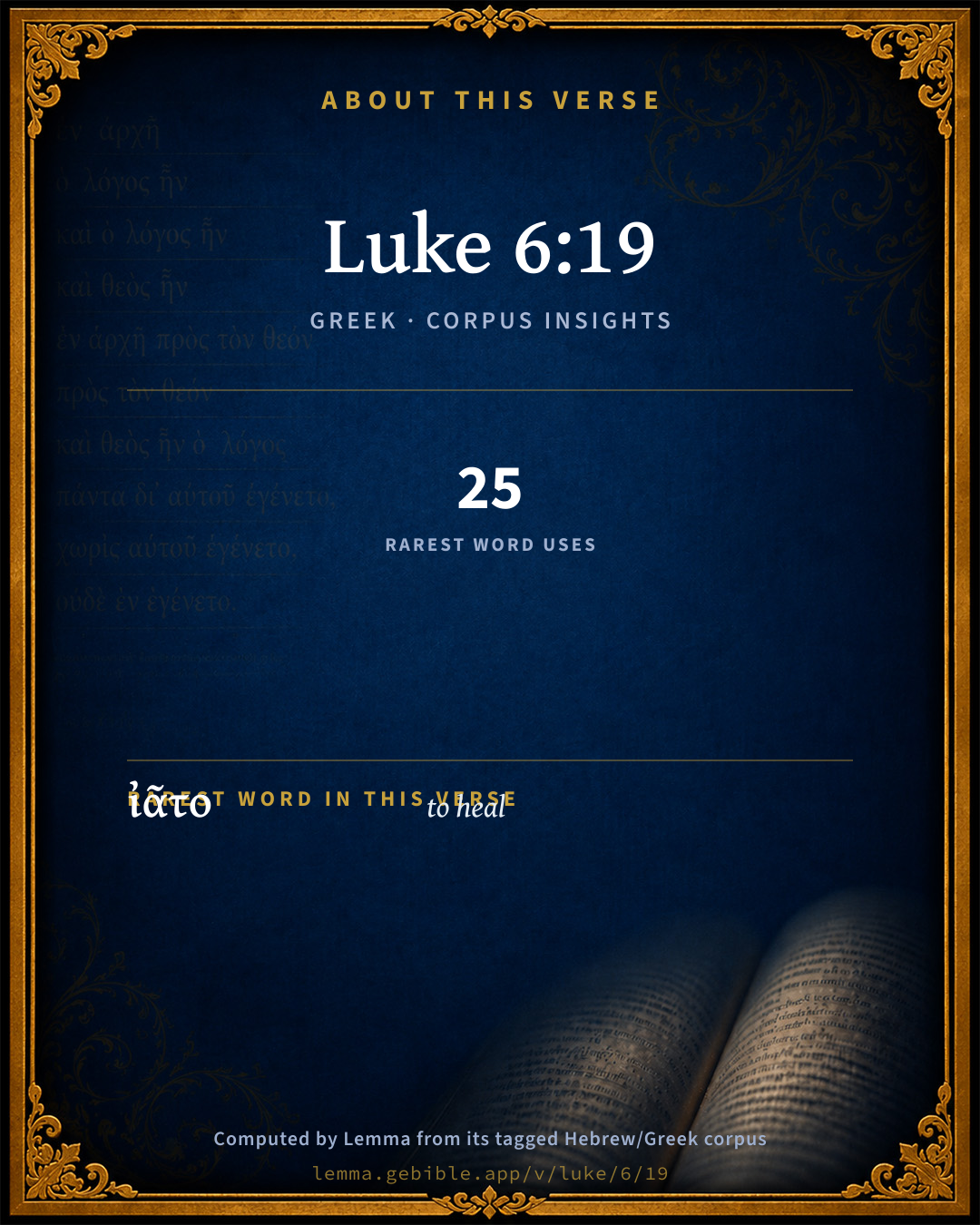
Luke 6:19

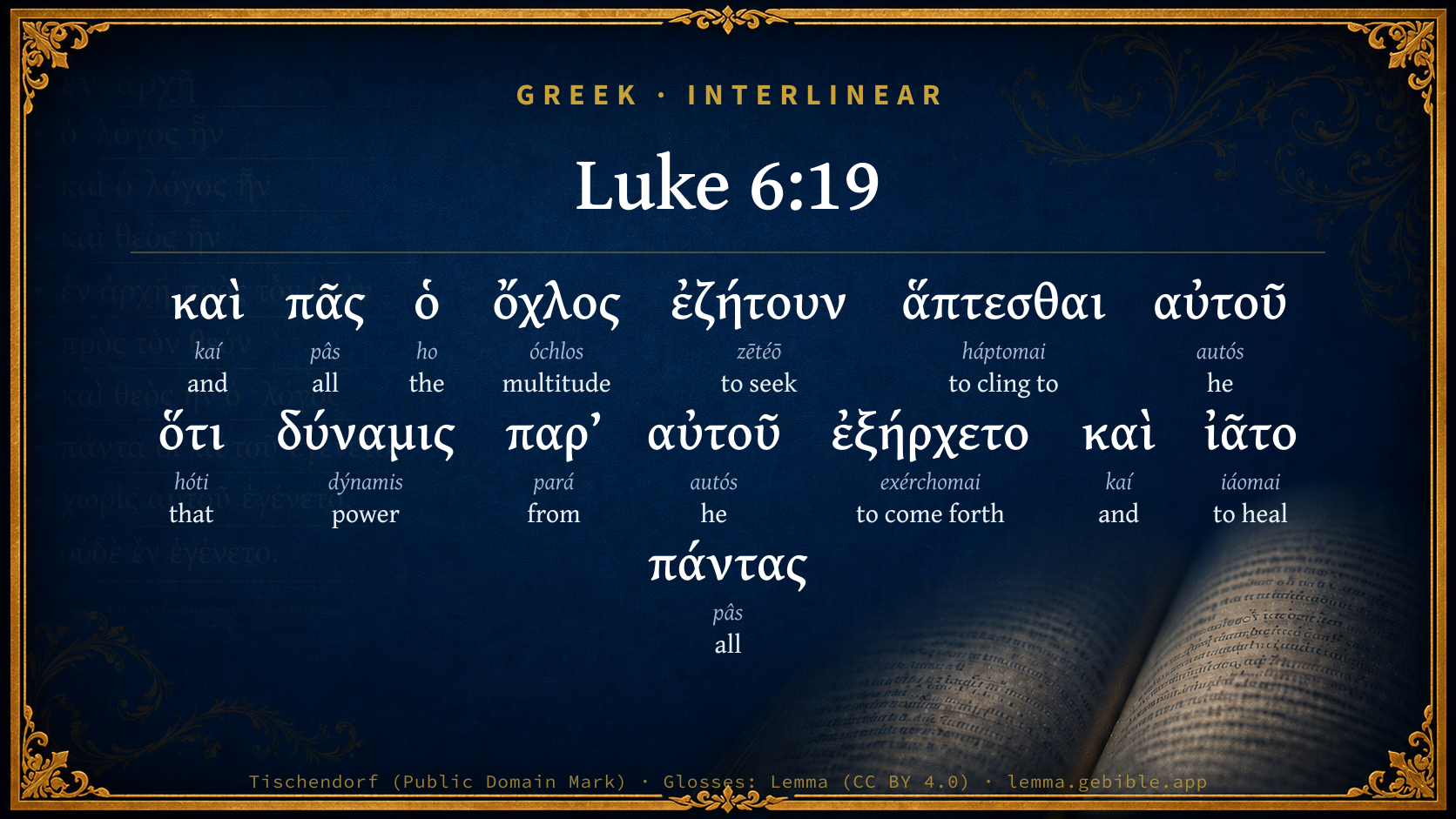
Greek (Tischendorf 8th ed.) Luke 6:19 appears in the Greek New Testament. The text above is from the Tischendorf 8th edition. Each word links to its Strong’s number and a concise gloss. Click any word for its full Thayer’s Greek Lexicon entry.
Download image
Cite this verse

Luke 6:19 (World English Bible). Public Domain. Lemma interlinear Bible study tool, https://lemma.gebible.app/v/luke/6/19.

Show BibTeX & RIS
BibTeX
RIS
English Translation
All the multitude sought to touch him, for power came out from him and healed them all.
World English Bible · Public Domain
Download a study sheet

One document with this verse’s original text, its word-by-word gloss line, the meaning frame, cross-references with their text, attributed commentary, and full source and license credits — printable, and it pastes into notes with its structure intact.

This verse Autodidact and up

Study sheet (.html) Plain text (.txt)

A passage Seminary Student

Up to 50 verses in one chapter. A passage sheet keeps up to 6 commentary sources and 12 cross-references per verse, in the order this page ranks them, and says so on the sheet whenever that leaves anything out. Ask for a single verse and you get the Autodidact verse sheet above.

Everything on this page stays free to read, with no account — the sheet is a download of what is already on screen, not access to it.

Want to remove ads? Support Godless Engineer
Compare translations 3

The same verse in 3 English versions, stacked beneath the original-language interlinear above. Click any original word for its lexicon entry.

Each is an independent rendering of the whole verse — the interlinear is not word-aligned to these translations.

Highlighted words mark where these versions differ — a whole-verse word diff, not a word-by-word alignment.

  • World English Bible Public Domain
    All the multitude sought to touch him, for power came out from him and healed them all.
  • King James Version Public Domain
    And the whole multitude sought to touch him: for there went virtue out of him, and healed them all.
  • unfoldingWord Literal Text CC BY-SA 4.0
    And the whole crowd was seeking to touch him because power was coming out from him and healing everyone.

unfoldingWord Literal Text — © unfoldingWord, licensed CC BY-SA 4.0. Word-aligned USFM3 via Door43 (git.door43.org/unfoldingWord/en_ult).

Versions to compare (up to 4)

3 of 4 selected

Show all 19 translations

Every available English version of this verse, each an independent rendering of the whole verse.

  • World English Bible Public Domain
    All the multitude sought to touch him, for power came out from him and healed them all.
  • Berean Standard Bible Public Domain
    The entire crowd was trying to touch Him, because power was coming from Him and healing them all.
  • Majority Standard Bible Public Domain
    The entire crowd was trying to touch Him, because power was coming from Him and healing them all.
  • King James Version Public Domain
    And the whole multitude sought to touch him: for there went virtue out of him, and healed them all.
  • American Standard Version (1901) Public Domain
    And all the multitude sought to touch him; for power came forth from him, and healed `them' all.
  • Revised Version (1885) Public Domain
    And all the multitude sought to touch him: for power came forth from him, and healed them all.
  • Geneva Bible (1599) Public Domain
    And the whole multitude sought to touch him: for there went vertue out of him, and healed them all.
  • Douay-Rheims (1899) Public Domain
    And all the multitude sought to touch him, for virtue went out from him, and healed all.
  • Young's Literal Translation Public Domain
    and all the multitude were seeking to touch him, because power from him was going forth, and he was healing all.
  • Literal Standard Version CC BY-SA 4.0
    And all the multitude were seeking to touch Him, because power was going forth from Him, and He was healing all.
  • Unlocked Literal Bible CC BY-SA 4.0
    Everyone in the crowd kept trying to touch him because power to heal was coming out from him, and he healed them all.
  • unfoldingWord Literal Text CC BY-SA 4.0
    And the whole crowd was seeking to touch him because power was coming out from him and healing everyone.
  • Darby Bible Public Domain
    And all the crowd sought to touch him, for power went out from him and healed all.
  • World Messianic Bible Public Domain
    All the multitude sought to touch him, for power came out of him and healed them all.
  • Webster's Bible Public Domain
    And the whole multitude sought to touch him; for there went virtue out of him, and healed them all.
  • Free Bible Version CC BY-SA 4.0
    Everyone in the crowd tried to touch him, because power was coming out from him and healing them all.
  • Bible in Basic English Public Domain
    And all the people were desiring to be touched by him, for power came from him and made them all well.
  • Text-Critical English NT CC BY 4.0
    The entire crowd was trying to touch him, because power was coming out from him and healing them all.
  • Tyndale New Testament (1534) Public Domain
    And all the people preased to touche him: for there went vertue out of him and healed them all.

Literal Standard Version (2020), Covenant Press — licensed CC BY-SA 4.0. Text via the HelloAO Bible API (eBible.org). Unlocked Literal Bible (unfoldingWord) — licensed CC BY-SA 4.0. Text via the HelloAO Bible API (eBible.org). unfoldingWord Literal Text — © unfoldingWord, licensed CC BY-SA 4.0. Word-aligned USFM3 via Door43 (git.door43.org/unfoldingWord/en_ult). Free Bible Version, Dr. Jonathan Gallagher — licensed CC BY-SA 4.0. Text via the HelloAO Bible API (eBible.org).

Word by word

More ways to search: Search by grammar → Find every occurrence → Compare this word →

Practice this passage: Drill this verse → Learn its vocabulary →

ἰᾶτο
iáomai
G2390
“to heal”
Verb, Imperfect, Middle or Passive deponent, Indicative, 3rd person, Singular
Part of Speech
Verb
Tense
Imperfect
Voice
Middle or Passive deponent
Mood
Indicative
Person
3rd person
Number
Singular
Full Thayer's Definition

Origin: middle voice of apparently a primary verb

TDNT: 06:14,3

1. to cure, heal 2. to make whole a. to free from errors and sins, to bring about (one's) salvation
  1. καὶ kaí G2532 “and” Conjunction
  2. πᾶς pâs G3956 “all” Adjective, Nominative, Singular, Masculine
  3. ὁ ho G3588 “the” Article, Nominative, Singular, Masculine
  4. ὄχλος óchlos G3793 “multitude” Noun, Nominative, Singular, Masculine
  5. ἐζήτουν zētéō G2212 “to seek” Verb, Imperfect, Active, Indicative, 3rd person, Plural
  6. ἅπτεσθαι háptomai G680 “to cling to” Verb, Present, Middle, Infinitive
  7. αὐτοῦ autós G846 “he” Personal pronoun, Genitive, Singular, Masculine
  8. ὅτι hóti G3754 “that” Conjunction
  9. δύναμις dýnamis G1411 “power” Noun, Nominative, Singular, Feminine
  10. παρ’ pará G3844 “from” Preposition
  11. αὐτοῦ autós G846 “he” Personal pronoun, Genitive, Singular, Masculine
  12. ἐξήρχετο exérchomai G1831 “to come forth” Verb, Imperfect, Middle or Passive deponent, Indicative, 3rd person, Singular
  13. καὶ kaí G2532 “and” Conjunction
  14. πάντας pâs G3956 “all” Adjective, Accusative, Plural, Masculine

About this verse

These counts appear in no published source. They are computed here, from the morphology-tagged text and Lemma’s own curated glosses. What Lemma adds →

15
words
12
distinct lemmas
Gospels
section

Notable vocabulary

The rarest word here is ἰᾶτο to heal G2390 — appearing just 25 times in the whole Greek New Testament.

Shared distinctive vocabulary

ἰᾶτο to heal G2390 occurs in 25 verses of the Greek New Testament. Also found in:

Repetition

Words recur within this verse:

  • πᾶς all G3956 ×2
  • καὶ and G2532 ×2
  • αὐτοῦ he G846 ×2

Cross-references

14

Topical passages linked to Luke 6:19 in the Treasury of Scripture Knowledge — connected by theme and wording, ordered by reader-vote popularity; previews shown in the World English Bible.

  • Matthew 14:36 and they begged him that they might just touch the fringe of his garment. As many as touched it were made whole.
  • Mark 3:10 For he had healed many, so that as many as had diseases pressed on him that they might touch him.
  • Acts 5:15–16 They even carried out the sick into the streets, and laid them on cots and mattresses, so that as Peter came by, at the least his shadow might overshadow some of them.
  • Mark 5:30 Immediately Jesus, perceiving in himself that the power had gone out from him, turned around in the crowd, and asked, "Who touched my clothes?"
  • Mark 6:56 Wherever he entered, into villages, or into cities, or into the country, they laid the sick in the marketplaces, and begged him that they might touch just the fringe of his garment; and as many as touched him were made well.
  • Matthew 9:20–21 Behold, a woman who had an issue of blood for twelve years came behind him, and touched the tassels of his garment;
  • Mark 8:22 He came to Bethsaida. They brought a blind man to him, and begged him to touch him.
  • Luke 8:45–46 Jesus said, "Who touched me?" When all denied it, Peter and those with him said, "Master, the multitudes press and jostle you, and you say, 'Who touched me?'"
  • 1 Peter 2:9 But you are a chosen race, a royal priesthood, a holy nation, a people for God's own possession, that you may show forth the excellencies of him who called you out of darkness into his marvelous light:
  • 2 Kings 13:21 It happened, as they were burying a man, that behold, they spied a band; and they cast the man into the tomb of Elisha: and as soon as the man touched the bones of Elisha, he revived, and stood up on his feet.
  • Luke 5:17 It happened on one of those days, that he was teaching; and there were Pharisees and teachers of the law sitting by, who had come out of every village of Galilee, Judea, and Jerusalem. The power of the Lord was with him to heal them.
  • Acts 19:12 so that even handkerchiefs or aprons were carried away from his body to the sick, and the evil spirits went out.
  • John 3:14–15 As Moses lifted up the serpent in the wilderness, even so must the Son of Man be lifted up,
  • Numbers 21:8–9 Yahweh said to Moses, Make you a fiery serpent, and set it on a standard: and it shall happen, that everyone who is bitten, when he sees it, shall live.

Cross-references courtesy of OpenBible.info (CC BY 4.0).

Commentary

Notes on Luke 6:19 from classic Christian and Jewish commentators (each source and its license shown beneath its notes). The classic Christian expositions comment on the surrounding passage and are grouped to its opening verse, so a note may address several verses; the Jewish commentaries on the Tanakh (Rashi and others) are per-verse, so they appear only where the commentator wrote on this verse.

Lemma curates 59 commentaries, every one of them public domain or Creative Commons licensed, each selected and text-cleaned for this edition rather than reprinted as found. About our sources →

The Biblical Illustrator

Joseph S. Exell

Luk_6:17; Luk_6:19

And the whole multitude sought to touch Him: for there went virtue out of Him, and healed them all

Christ the fountain of health

The subject will be found to involve two considerations; what is the virtue which proceeds out of Christ?

by what means is it appropriated to men?

I. We begin by observing, that in addition to the superiority of our Lords miracles in point of number over those of every other, there is also a great distinction in the manner of their achievement. The apostles, for example, nowhere pretend to have accomplished the prodigies which they performed by their own ability. The words of healing are, In the Name of Jesus Christ of Nazareth, rise up and walk. The distinction to which we advert is very obvious; the miracles of the apostles were wrought by an agency not their own; their touch, their voice, their shadow, had no inherent power to do cures; from Christs own person went out immediately the virtue which healed them all. The difference is remarkable. It is as though the indwelling Godhead did so impregnate the human flesh with life-giving energy, that no sickness or weakness could remain after contact with that immaculate frame. There resided in that sinless body a fulness of grace. It was, as it were, a spring of life to the bodies of others; the virtue dwelt in it, and was drawn forth by an act of faith in the diseased. Such we conceive to be the original meaning of the text; and thus understood, it will be found accurately to describe also the influence of Christ upon ourselves. The fact is not only that God chose to regard the offspring of Adam as iniquitous, but that they really were so. Thus, we repeat, it is not sufficient to consider that Adams fault placed his descendants in the position of criminals; it did really and actually render them corrupt. And what has Christ done for the vast family of man thus contemplated? We reply, in the words of the text, virtue goeth out of His body to heal them all. The Redeemer, we are told, took not on Him the nature of angels, but of men. Christ Jesus, the Second Adam, is set forth to be the Restorer of human nature. He removes the inherent disease, He destroys the natural defilement. From Him a new period commences; to all His disciples He is the new Stock, the Root, the Stem.

II. It remains that we very briefly allude to THE MEANS BY WHICH THE HEALING VIRTUE WHICH RESIDES IN CHRIST, IS APPROPRIATED TO MAN. Now as respects the communication of the healing virtue of Christs Manhood to our souls, we hesitate not to place it in the two Sacraments of Baptism and the Lords Supper. These are between us and the Second Adam, what fleshly procreation is between us and the first Adam. There is healing virtue in the Second Adam; we obtain a share of it through our union with Him by His appointed ordinances. By the Sacraments we are spiritually connected with Christ, as closely as we are carnally connected with Adam and Eve. We are members of His body, of His flesh, and of His bones. In Him was life, but how was this life to be communicated to others? In Him was purity, but how should it be transmitted? He was the Being set forth to make all things new, but how was a connection to be wrought out between Him and us t Indeed not by any carnal alliance, but in a new and living way. Through these Sacraments, duly administered and faithfully taken, virtue goeth out of Him for the healing of the nations. And in connection with the present subject of discourse, it seems appropriate to remind you, in conclusion, that whilst our Lords Incarnation as a whole is full of healing virtue for all generations of believers, so are the several events of His life, taken separately, imbued with a similar efficiency. We have been very much struck with that most solemn part of the Litany, in which we call upon God the Son to deliver us, making mention of the various pains which He endured. By Thy holy Nativity and Circumcision; by Thy Baptism, Fasting, and Temptation; and then, in deeper and more thrilling strain, By Thine Agony and Bloody Sweat; by Thy Cross and PaSsion; by Thy precious Death and Burial, Good Lord, deliver us. It is probable that by many the passage is only regarded as an adjuration to the Second Person to be merciful unto us, by the strong plea of what He has done and suffered. The Church reminds her Lord, if we may so speak, of His own sorrows, and by the thought of them claims His grace. But is this all? We think not. We believe there is implied in the awful supplication the truth, that every one of the Redeemers acts, one by one recalled, is full of its own peculiar virtue. Thus in praying to be saved by His Nativity, we pray that we may be born anew unto holiness. The Collects for the days on which these single acts of Christ are commemorated, teach us what appropriate power belongs to each act. Turn to the Collect of the Circumcision. We find the mention of Christs Circumcision connected with the true circumcision of our spirits, the mortification, i.e., of our hearts and all our members. The Fasting and Temptation of the Saviour, as brought before us on the First Sunday in Lent, are to enable us to subdue our flesh to the Spirit. His Cross and Passion are to convey to us the grace of patience like His own. His Burial is to qualify us to be buried with Him, that through the grave and gate of death we may pass to our joyful resurrection. And thus are we to regard everything that He did; every act of His is as it were sacramental in its nature, associated with its own appropriate grace. You will at once see what a stupendous importance is thus attached to the least action of Christ. Here, then, is the Fountain of our life; there is no sin so great that Christ cannot cleanse; no weakness so inherent which He will not strengthen. Neither time nor distance can set bounds to those health-giving streams which flow from Him. (Bishop Woodford.)

Healing for the soul

I. Then, as it respects the soul of man, THERE IS A DISEASE WHICH IS COMMON TO US ALL; AND THE ANALOGY BETWEEN THE SOUL AND BODY MUST HERE BE MANIFEST TO THE MOST SUPERFICIAL OBSERVER. In the great majority of instances, you need not inform even a child of the existence in any individual of bodily disease; for, however incompetent he may be to investigate the cause, he is perfectly familiar with the effect. Sometimes the morbid affection disfigures the countenance, sometimes it distorts the shape, sometimes it impedes the motion and paralyzes the limbs; in one it affects the utterance, in another it obscures the faculties of the mind, in a third it is betrayed at intervals by convulsive starts and spasms of sudden agony, in a fourth it antedates the halting step and wasted form of age ere yet the noon of life is past, and causes its victim to walk abroad amongst the living, impressed in their sight with the ghastly lineaments of death. And are not the effects, or symptoms, of the spiritual disease precisely similar? But here, again, an important feature in the analogy is presented to us, by the expedients which men employ, whether of business, or pleasure, or intemperance, or excess, in order to stifle thought. These things act upon the soul like opiates on the body; they mitigate the present suffering, but they aggravate the symptoms of the disease; they obscure the perception of danger, but they enhance and accelerate the danger itself. Under this head, moreover, we may learn another lesson, namely, that a knowledge of the disease is a prerequisite to the seeking of the remedy. They who brought to the Lord Jesus all that were diseased, laid the sick before Him in the streets; but neither would the sick have consented to be brought, had they not been conscious of the malady within, nor would their friends and kindred have brought them, had they not discerned the symptoms of it, as developed and exhibited without.

II. Such, then, being the disease, WHAT, IN THE NEXT PLACE, IS THE REMEDY? NOW, there can be no reasonable doubt, that on the occasion to which my text refers, and on other similar occasions, many sad effects of human infirmity and suffering, not a few of them incurable, and acknowledged to be so, by all human skill, because inaccessible to all known remedies, were exhibited in the presence of the Lord. We must set ourselves in right earnest to apply to the throbbing festering conscience the balm of Christs atonement, and to embody in the life the features of Christs example.

III. Since, then, THE REMEDY FOR OUR SPIRITUAL DISEASE IS JUST AS UNIVERSAL AS THE EXTENT OF IT--for all that believe are justified freely by Gods grace--and since it is also unfailing in its efficacy, for the blood of Jesus Christ cleanseth from all sin; the narrative of the context is to teach us, next, the process of its application, In every ease they did what they could; and we should at least learn, from their example, this lesson, that what we can do we are not to leave undone.

IV. it only remains, then, that we complete our view of this most instructive and interesting analogy, by looking at THE RESULT OF THE APPLICATION OF SUCH A REMEDY--that remedy being the blood of Christ applied by the prayer of faith, or, if you will, the prayer against unbelief. What this will be, we may gather from the narration of either evangelist, which speaks of recovery at once universal and complete. As many as touched Him, said St. Matthew, or rather, as the margin reads, as many as touched it (that is, the hem of the garment), were made whole; and as you have heard by St. Luke in the text, though there was a multitude around Him, there went virtue out of Him, and healed them all. If the sick had not come, or had not been brought to Jesus, they would not have been healed; many blind were there in Israel, many lame, many palsied, many lepers, many demoniacs, many lunatics, who did not come, and therefore were not healed. But the amount of our individual responsibility depends upon the amount of our individual knowledge and of our individual opportunity; and if we know that all were healed who did come, or who were even brought, in faith, what greater encouragement and inducement can we desire for ourselves? (T. Dale M. A.)

Christ healing bodily disease emblematic of the Churchs functions

The whole multitude sought to touch Him; for there went virtue out of Him, and healed them all.

1. Familiar as this statement must be to us, there is something in it truly wonderful and most worthy of admiration--I mean, that there is in the gospel this universal power to adapt itself to man. It constitutes perhaps its most wonderful and distinctive feature. We shall search in vain in any other system for its resemblance. In many systems, more or less of human invention--in systems of philosophy, so called--we may find attempts to remedy some of the evils under which man labours; one applies itself to one kind, and another to another; but often the remedy for one is fatal to the other. But the gospel is a universal remedy. In a word, there is truly no form of evil which the gospel of Christ does not meet and rectify; no want which it does not supply; no real good which it does not impart.

2. And scarcely less remarkable is it to observe how it takes hold of all the natural forms of character, and turns them to due account; how it enlists on the side of what is good even the natural temperaments of men. The burning zeal of a Peter, the restless energy of a Paul, the fervour and impetuosity of a John and James--it takes them all, sanctifies them all, concentrates them all on one holy end. These, and such like human dispositions, left to their natural courses, would have branched off into various forms of evil. But lo! they are touched by Gods Spirit from above, the gospel pours down upon them its sanctifying influences, turns the dross into gold, and makes what would have been natural imperfections (to say the least) to become noble features in the Christian character. Such, my brethren, is the power of the gospel; such is the virtue which goes out of Christ to heal. For if we inquire how the gospel possesses and exerts this influence, the reply assuredly is--By making Christ known to us. And here, too, the incident before us is strikingly emblematic. The thronging multitude were healed by touching Christ; and to us the gospel is made the power of God unto salvation, simply by bringing us, so to speak, into spiritual contact with Christ. The power of His blessed sacraments consists in this: holy baptism uniting us to Christ and giving us spiritual life in Him--the holy Eucharist sustaining that life through the communion of thebody and blood of Christ. And so the Word of the gospel is effectual to its appointed end by testifying of Christ. He is the centre and the source of all its blessings.

3. But now let us carry this emblematic style of our blessed Lords teaching one step further. If we study the character of His ministry, there is no feature in it which we shall find more prominent than this: that it bore on its very front the aspect of mercy, and this not only in respect to the salvation of the soul from sin and misery, but also in a compassionate care for the bodily necessities of men. And now, my brethren, let us consider the application of this matter to ourselves. It is the high and holy prerogative of the Church to be on earth the representative of her Divine Master. Her highest and most glorious function--nay, we may say her only function--is to carry on and perfect the work of mercy which He began; ofspreading the knowledge of salvation through the world, and of blessing all who come within the influence of the Churchs sphere. We all know, from the history of the Acts of the Apostles, how well the early Church sustained this blessed office; not only by working miracles while that power lasted, but also by her self-denying charity--by a common fund, abundantly supported by the liberality of the first Christians, for the relief of every want and of every woe, to which our fallen human nature is subject. Wherever the Church was planted, there a fountain of mercy and goodness was opened; there a tree was planted, whose leaves were for the healing of the nations. It brought, indeed, richer mercies than the natural eye could see or the natural ear could hear--salvation for the immortal soul, deliverance from the bands of sin and death, and the glorious liberty of the children of God; but in its zeal for the salvation of the immortal soul, it did not overlook the transient sufferings of the perishing body. It did not wait until the blind eyes and the dull hearts could perceive and appreciate those higher blessings which it had to bestow; but it accompanied the Word of grace with acts of more ostensible mercy. (W. Dodsworth, M. A.)

Christs healing power

Miracles, according to the records of Christs life, were of most frequent occurrence, not occasional. They were the simple details of His life, coming as naturally from Him as acts of kindness from the benevolent heart or gifts from the charitable. It was thus He expressed His sympathy with the poor and suffering. In this way Christ showed His message of mercy to man, and revealed the nature of that redemption of the race which He began by living and dying for the world. In no other way could He so deeply have impressed the world with the distinctive character of His redeeming power.

I. CHRISTS POWER TO HEAL THE SOUL IS IN HIMSELF ALONE. It is not easy to understand this--that Christ, and Christ alone, is the source of all healing. We can understand that a doctrine received by the mind shall restore the mind to health; or that the heart may find rest in some object on which it shall place its affections; but that it is only from Christ that this healing power comes--why, it is hard to conceive. Men cannot apprehend the truth of God, even as Jesus reveals it, without Divine aid. The reason is strong, the will vigorous, the understanding clear; but there is need of the power of Gods Spirit, and that can only come through our personal touching of Christ. Power goes forth from Him--as the soul receives the Holy Ghost.

II. CHRISTS POWER TO HEAL IS NOT EXERCISED INDISCRIMINATELY, BUT ONLY UPON THOSE WHO GO TO HIM. There are always many who see Him, and yet do not know Him, and are not healed by Him? Why? Because they do not seek to touch Him. You must go to Him, not trust a mothers prayers--you must go yourself. Observe here, too, that the touch was effectual; touch His body and bodily disease was cured, because it was the touch of faith. Not the accidental touch, but the touch on purpose; not the touch which may be put forth out of curiosity, nor to escape the evil consequences of your sin; but the touch of the soul that wants to be healed.

III. CHRISTS POWER IS EXERCISED TO HEAL ALL WHO TOUCH HIM. None were disappointed. None were too ill, too diseased. There was no asking, How came you in this state? Your own faults, &c. (H. W. Butcher.)

The philanthrophy of Christianity

The power which Jesus Christ exercised over physical disease was a guarantee that as long as He lived He would be surrounded by great multitudes of people. Those who would never go to Him for spiritual gifts would be sure to find Him in the time of physical pain and fear. It is thus that, even now, God binds the human race to Himself. They hunger and thirst; they are in sorrow and great distress; times of impoverishment and desolation overtake them; and under such circumstances the better nature rises and yearns for protection and comfort. The Church should create for itself a large sphere of practical service, because there are many who cannot understand the metaphysics of Christianity who may be touched by its philanthropy. Jesus Christs plan was to take hold of human nature as it chose to present itself to his attention; hence we find him not only speaking essential truths to Nicodemus, but attending to the bodily necessities of those who had no understanding whatever of the spiritual kingdom which He came to establish. (Dr. Parker.)

The Biblical Illustrator, edited by Joseph S. Exell (c. 1880s–1900s) — public domain. Text from a community e-Sword module.

Expositor's Greek Testament

ed. W. Robertson Nicoll

Luk 6:19 . δύναμις may be nominative both to ἐξήρχετο and to ἰατο (A. V [64] and R. V [65] ), or we may render: “power went forth from Him and He healed all”.

[64] Authorised Version.

[65] Revised Version.

The Expositor's Greek Testament, edited by W. Robertson Nicoll (1897–1910) — public domain. Text from a community e-Sword module.

Jamieson, Fausset & Brown

Robert Jamieson, A. R. Fausset & David Brown

healed--kept healing, denoting successive acts of mercy till it went over "all" that needed. There is something unusually grand and pictorial in this touch of description.

Jamieson, Fausset & Brown — Commentary Critical and Explanatory on the Whole Bible (1871) — public domain (CC PDM 1.0). Text via the HelloAO Bible API.

Ellicott's Commentary for English Readers

(19) There went virtue out of him.—The use of the term “virtue” (or power) in this technical sense is peculiar to St. Luke, and may be noted as characteristic of the medical Evangelist. (Comp. Introduction.)

A Bible Commentary for English Readers, edited by Charles John Ellicott (1878–1897) — public domain. Text from a community e-Sword module.

The Cambridge Bible for Schools and Colleges

gen. ed. J. J. S. Perowne

19. to touch him] Compare Luk_8:44; Mat_14:36; Mar_5:30.

The Cambridge Bible for Schools and Colleges (gen. ed. J. J. S. Perowne; Cambridge University Press, 1878–1918) — public domain. Text from a community e-Sword module.

John Gill's Exposition

And he lifted up his eyes on his disciples,.... Either the whole company of them, or rather the twelve apostles, whom he saw coming to him, and fixing his eyes on them, he sat,

and said; what follows, with many other things recorded by Matthew:

blessed be ye poor; not only in the things of this world, having left all for Christ, but poor in Spirit, as in Mat 5:3; see Gill on Mat 5:3,

for yours is the kingdom of God; or heaven, so in Mat 5:3.

John Gill's Exposition of the Whole Bible (1746–1763) — public domain (CC PDM 1.0). Text via the HelloAO Bible API.

Albert Barnes' Notes on the Bible

Virtue - Healing power. See the notes at Mar 5:30.

Albert Barnes' Notes on the Bible (1834–1885) — public domain. Text from a community e-Sword/MySword module.

The Pulpit Commentary

And the whole multitude sought to touch him: for there went virtue out of him, and healed them all. The words here used are few, and we pass them over often without pausing to think of what they involve. It was, perhaps, the hour in the ministry of Jesus when his miraculous power was most abundantly displayed.

The Pulpit Commentary (1880–1919), ed. H.D.M. Spence-Jones & Joseph S. Exell — public domain. Text from a community e-Sword module.

Cambridge Greek Testament for Schools and Colleges

19. ἅπτεσθαι αὐτοῦ. Compare Luk 8:44; Mat 14:36; Mar 5:30.

Cambridge Greek Testament for Schools and Colleges (Cambridge University Press, 1896; 21 vols, various authors incl. Carr, Maclear, Plummer, Farrar, Lumby, Moule, M. R. James, Simcox) — public domain. Text from a community e-Sword module.

Alford’s Greek Testament

Henry Alford

19.] Luke uses the same expression, of power going forth from our Lord, in ch. 8:46.

Henry Alford, The Greek Testament (1849–1861) — public domain. Text from a community e-Sword module.

Vincent's Word Studies in the New Testament

Marvin R. Vincent

Sought - went out [εζητουνεξηρχετο] . Both imperfects. The A. V. and Rev. lose in vividness by not rendering them accordingly. The multitudes were all the while seeking to touch him, for virtue was going out of him.

Healed [ιατο] . Compare Mt 14:36; Mr 6:56, where dieswqhsan, were thoroughly saved, and ejswzonto, were saved, are used. Luke is more technical, using the strictly medical term, which occurs twenty eight times in the New Testament, seventeen of these in Luke. Luke also uses the two words employed by Matthew and Mark, but always with some addition showing the nature of the saving. Thus Luk 7:3, where diaswsh, (A. V., heal) is explained by verse 7, ijaqhsetai, the technical word, shall be healed, and by verse 10, "found the servant whole (uJgiainonta, another professional word - see on chapter Luk 5:31) that had been sick." Compare, also, Luk 8:35, 36, 44, 47, 48. Medical writers do not use swzein or diaswzein, to save, as equivalent to ijasqai, to heal, but in the sense of escaping from a severe illness or from some calamity. Luke employs it in the sense - Act 27:44; Act 28:1.

THE SERMON ON THE MOUNT.

20 - 49. Compare Mt 5:1 to Mt 8:1.

Marvin R. Vincent, Word Studies in the New Testament (1887–1900) — public domain. Text from a community e-Sword/MySword module.

Lesson kit

Teaching starters — assembled from the data on this page, not authored interpretation. Every prompt links to the verse data it draws on. Edit before teaching.

Luke, in the Gospels, opens this verse with 15 words (12 distinct Greek lemmas). Its most distinctive word is iáomai (“to heal”). A historical commentator’s framing appears above. Read the whole chapter for the surrounding context.

Discussion questions

  1. What does “to heal” (iáomai) contribute to the verse as a whole?
  2. How does Matthew 8:8, which shares the word «to heal», read alongside this verse?
  3. What does the repetition of “all” (2× in this one verse) do in this verse?
  4. These translations render this verse differently; the difference is in the English rendering, not the original. What questions does that raise?
  5. Compare how The Biblical Illustrator and Expositor's Greek Testament read this verse. Where do they agree or differ?

Things to notice

Reading settings

Reading text

Shown beneath each verse's original-language words.

Old Testament
Old Testament edition

Read the OT as the Masoretic Hebrew (MT) or the Greek Septuagint (LXX).

English shown for the Greek Septuagint (in the Hebrew ↔ Greek comparison).

Comparing translations? Open the Compare panel on any verse page to stack up to four side by side.