2 Timothy 1:8

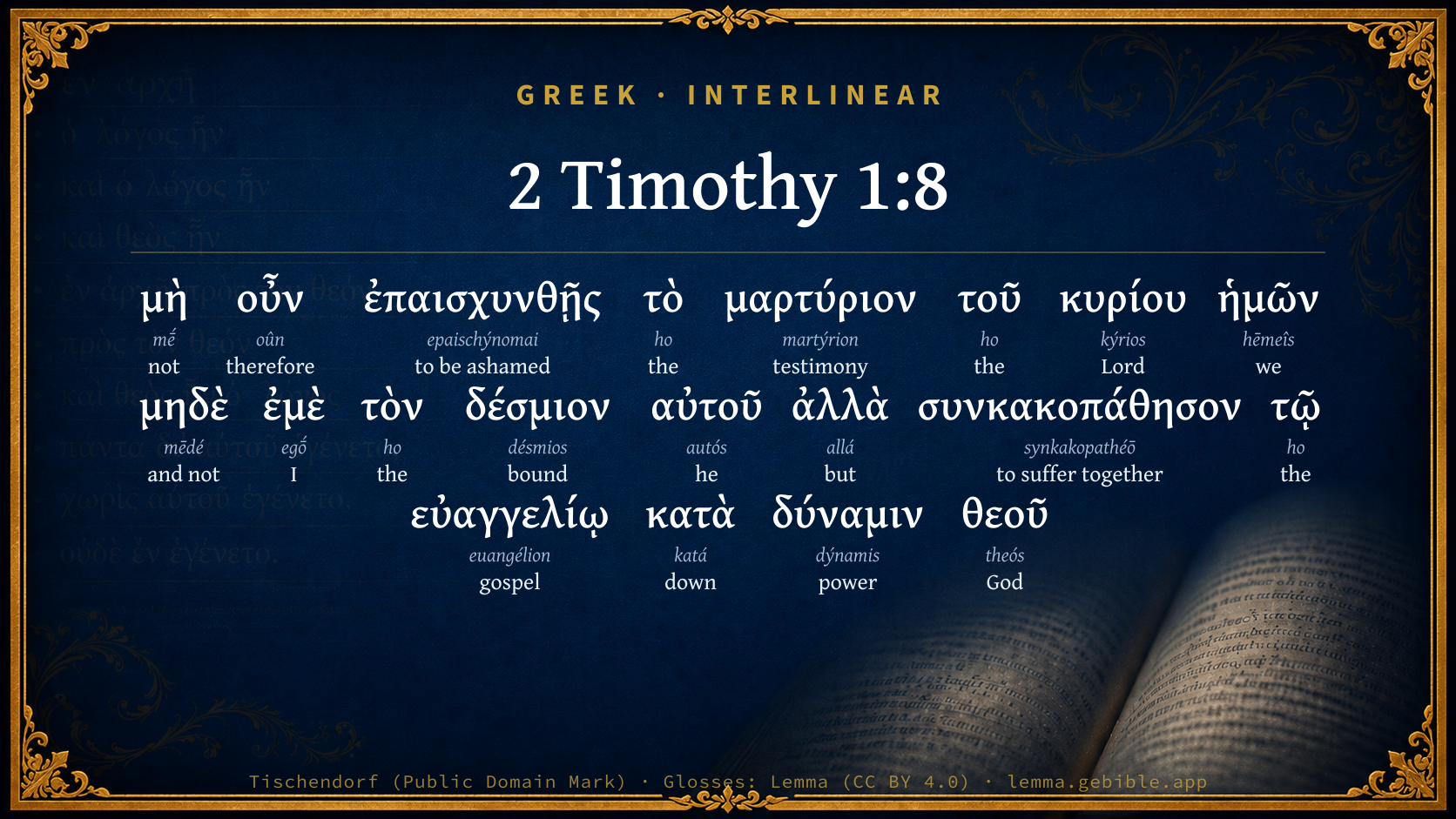
Greek (Tischendorf 8th ed.) 2 Timothy 1:8 appears in the Greek New Testament. The text above is from the Tischendorf 8th edition. Each word links to its Strong’s number and a concise gloss. Click any word for its full Thayer’s Greek Lexicon entry.
Download image
Cite this verse

2 Timothy 1:8 (World English Bible). Public Domain. Lemma interlinear Bible study tool, https://lemma.gebible.app/v/2-timothy/1/8.

Show BibTeX & RIS
BibTeX
RIS
English Translation
Therefore don't be ashamed of the testimony of our Lord, nor of me his prisoner; but endure hardship for the Gospel according to the power of God,
World English Bible · Public Domain
Highlights
  • 1 first appearance in the Greek New Testament
Full analysis ↓
Download a study sheet

One document with this verse’s original text, its word-by-word gloss line, the meaning frame, cross-references with their text, attributed commentary, and full source and license credits — printable, and it pastes into notes with its structure intact.

This verse Autodidact and up

Study sheet (.html) Plain text (.txt)

A passage Seminary Student

Up to 50 verses in one chapter. A passage sheet keeps up to 6 commentary sources and 12 cross-references per verse, in the order this page ranks them, and says so on the sheet whenever that leaves anything out. Ask for a single verse and you get the Autodidact verse sheet above.

Everything on this page stays free to read, with no account — the sheet is a download of what is already on screen, not access to it.

Want to remove ads? Support Godless Engineer
Compare translations 3

The same verse in 3 English versions, stacked beneath the original-language interlinear above. Click any original word for its lexicon entry.

Each is an independent rendering of the whole verse — the interlinear is not word-aligned to these translations.

Highlighted words mark where these versions differ — a whole-verse word diff, not a word-by-word alignment.

  • World English Bible Public Domain
    Therefore don't be ashamed of the testimony of our Lord, nor of me his prisoner; but endure hardship for the Gospel according to the power of God,
  • King James Version Public Domain
    Be not thou therefore ashamed of the testimony of our Lord, nor of me his prisoner: but be thou partaker of the afflictions of the gospel according to the power of God;
  • unfoldingWord Literal Text CC BY-SA 4.0
    Therefore, do not be ashamed of the testimony of our Lord, nor of me, his prisoner, but suffer together for the gospel, according to the power of God,

unfoldingWord Literal Text — © unfoldingWord, licensed CC BY-SA 4.0. Word-aligned USFM3 via Door43 (git.door43.org/unfoldingWord/en_ult).

Versions to compare (up to 4)

3 of 4 selected

Show all 19 translations

Every available English version of this verse, each an independent rendering of the whole verse.

  • World English Bible Public Domain
    Therefore don't be ashamed of the testimony of our Lord, nor of me his prisoner; but endure hardship for the Gospel according to the power of God,
  • Berean Standard Bible Public Domain
    So do not be ashamed of the testimony of our Lord, or of me, His prisoner. Instead, join me in suffering for the gospel by the power of God.
  • Majority Standard Bible Public Domain
    So do not be ashamed of the testimony of our Lord, or of me, His prisoner. Instead, join me in suffering for the gospel by the power of God.
  • King James Version Public Domain
    Be not thou therefore ashamed of the testimony of our Lord, nor of me his prisoner: but be thou partaker of the afflictions of the gospel according to the power of God;
  • American Standard Version (1901) Public Domain
    Be not ashamed therefore of the testimony of our Lord, nor of me his prisoner: but suffer hardship with the gospel according to the power of God;
  • Revised Version (1885) Public Domain
    Be not ashamed therefore of the testimony of our Lord, nor of me his prisoner: but suffer hardship with the gospel according to the power of God;
  • Geneva Bible (1599) Public Domain
    Be not therefore ashamed of the testimonie of our Lord, neither of me his prisoner: but be partaker of the afflictions of the Gospel, according to the power of God,
  • Douay-Rheims (1899) Public Domain
    Be not thou therefore ashamed of the testimony of our Lord, nor of me his prisoner: but labour with the gospel, according to the power of God,
  • Young's Literal Translation Public Domain
    therefore thou mayest not be ashamed of the testimony of our Lord, nor of me his prisoner, but do thou suffer evil along with the good news according to the power of God,
  • Literal Standard Version CC BY-SA 4.0
    therefore you may not be ashamed of the testimony of our Lord, nor of me His prisoner, but you suffer evil along with the good news according to the power of God,
  • Unlocked Literal Bible CC BY-SA 4.0
    So do not be ashamed of the testimony about our Lord, nor of me, Paul, his prisoner. Instead, share in suffering for the gospel according to the power of God.
  • unfoldingWord Literal Text CC BY-SA 4.0
    Therefore, do not be ashamed of the testimony of our Lord, nor of me, his prisoner, but suffer together for the gospel, according to the power of God,
  • Darby Bible Public Domain
    Be not therefore ashamed of the testimony of our Lord, nor of me his prisoner; but suffer evil along with the glad tidings, according to the power of God;
  • World Messianic Bible Public Domain
    Therefore don’t be ashamed of the testimony of our Lord, nor of me his prisoner; but endure hardship for the Good News according to the power of God,
  • Webster's Bible Public Domain
    Be not thou therefore ashamed of the testimony of our Lord, nor of me his prisoner: but be thou partaker of the afflictions of the gospel according to the power of God;
  • Free Bible Version CC BY-SA 4.0
    So don't be ashamed to tell others about our Lord, or be ashamed of me. Instead be ready to share in suffering for the good news as God gives you strength.
  • Bible in Basic English Public Domain
    Have no feeling of shame, then, for the witness of our Lord or for me, his prisoner: but undergo all things for the good news in the measure of the power of God;
  • Text-Critical English NT CC BY 4.0
    Therefore do not be ashamed of the testimony of our Lord or of me his prisoner. Rather, join with me in suffering for the gospel as you rely on the power of God.
  • Tyndale New Testament (1534) Public Domain
    Be not a shamed to testyfye oure lorde nether be a shamed of me which am bounde for his sake: but suffre adversite with the gospell also thorow the power of god

Literal Standard Version (2020), Covenant Press — licensed CC BY-SA 4.0. Text via the HelloAO Bible API (eBible.org). Unlocked Literal Bible (unfoldingWord) — licensed CC BY-SA 4.0. Text via the HelloAO Bible API (eBible.org). unfoldingWord Literal Text — © unfoldingWord, licensed CC BY-SA 4.0. Word-aligned USFM3 via Door43 (git.door43.org/unfoldingWord/en_ult). Free Bible Version, Dr. Jonathan Gallagher — licensed CC BY-SA 4.0. Text via the HelloAO Bible API (eBible.org).

Word by word

More ways to search: Search by grammar → Find every occurrence → Compare this word →

Practice this passage: Drill this verse → Learn its vocabulary →

συνκακοπάθησον
synkakopathéō
G4777
“to suffer together”
Verb, Aorist, Active, Imperative, 2nd person, Singular
Part of Speech
Verb
Tense
Aorist
Voice
Active
Mood
Imperative
Person
2nd person
Number
Singular
Full Thayer's Definition

Origin: from G4862 and G2553

TDNT: 20:36,8

1. to suffer hardship together with one
  1. μὴ mḗ G3361 “not” Particle, Negative
  2. οὖν oûn G3767 “therefore” Conjunction
  3. ἐπαισχυνθῇς epaischýnomai G1870 “to be ashamed” Verb, Aorist, Passive deponent, Subjunctive, 2nd person, Singular
  4. τὸ ho G3588 “the” Article, Accusative, Singular, Neuter
  5. μαρτύριον martýrion G3142 “testimony” Noun, Accusative, Singular, Neuter
  6. τοῦ ho G3588 “the” Article, Genitive, Singular, Masculine
  7. κυρίου kýrios G2962 “Lord” Noun, Genitive, Singular, Masculine
  8. ἡμῶν hēmeîs G2249 “we” Personal pronoun, 1st person, Genitive, Plural
  9. μηδὲ mēdé G3366 “and not” Conjunction, Negative
  10. ἐμὲ egṓ G1473 “I” Personal pronoun, 1st person, Accusative, Singular
  11. τὸν ho G3588 “the” Article, Accusative, Singular, Masculine
  12. δέσμιον désmios G1198 “bound” Noun, Accusative, Singular, Masculine
  13. αὐτοῦ autós G846 “he” Personal pronoun, Genitive, Singular, Masculine
  14. ἀλλὰ allá G235 “but” Conjunction
  15. τῷ ho G3588 “the” Article, Dative, Singular, Neuter
  16. εὐαγγελίῳ euangélion G2098 “gospel” Noun, Dative, Singular, Neuter
  17. κατὰ katá G2596 “down” Preposition
  18. δύναμιν dýnamis G1411 “power” Noun, Accusative, Singular, Feminine
  19. θεοῦ theós G2316 “God” Noun, Genitive, Singular, Masculine

About this verse

These counts appear in no published source. They are computed here, from the morphology-tagged text and Lemma’s own curated glosses. What Lemma adds →

20
words
17
distinct lemmas
Pauline Epistles
section

Notable vocabulary

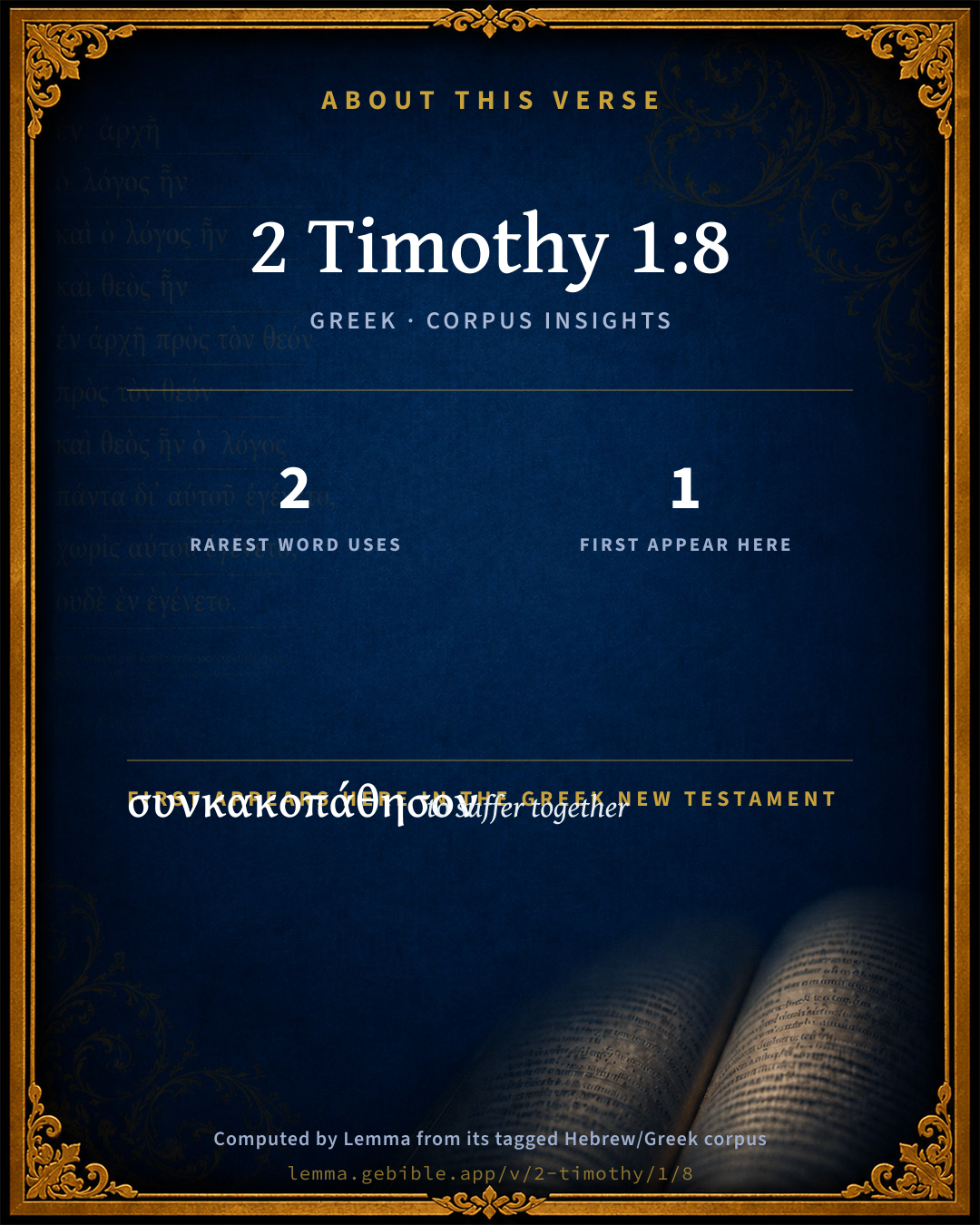
The rarest word here is συνκακοπάθησον to suffer together G4777 — appearing just 2 times in the whole Greek New Testament.

First appearance in Scripture

This word makes its first canonical appearance in the Greek New Testament here:

  • συνκακοπάθησον to suffer together G4777

Shared distinctive vocabulary

συνκακοπάθησον to suffer together G4777 occurs in 2 verses of the Greek New Testament. Also found in:

Repetition

A word recurs within this verse:

Cross-references

46

Topical passages linked to 2 Timothy 1:8 in the Treasury of Scripture Knowledge — connected by theme and wording, ordered by reader-vote popularity; previews shown in the World English Bible.

  • Romans 1:16 For I am not ashamed of the Gospel of Christ, for it is the power of God for salvation for everyone who believes; for the Jew first, and also for the Greek.
  • Mark 8:38 For whoever will be ashamed of me and of my words in this adulterous and sinful generation, the Son of Man also will be ashamed of him, when he comes in the glory of his Father with the holy angels."
  • 2 Timothy 4:5 But you be sober in all things, suffer hardship, do the work of an evangelist, and fulfill your ministry.
  • 1 Peter 4:13–15 But because you are partakers of Christ's sufferings, rejoice; that at the revelation of his glory also you may rejoice with exceeding joy.
  • Revelation 12:11 They overcame him because of the Lamb's blood, and because of the word of their testimony. They didn't love their life, even to death.
  • 2 Timothy 1:12 For this cause I suffer also these things. Yet I am not ashamed, for I know him whom I have believed, and I am persuaded that he is able to guard that which I have committed to him against that day.
  • 2 Timothy 2:9 in which I suffer hardship to the point of chains as a criminal. But God's word isn't chained.
  • Ephesians 3:1 For this cause I, Paul, am the prisoner of Christ Jesus on behalf of you Gentiles,
  • Luke 9:26 For whoever will be ashamed of me and of my words, of him will the Son of Man be ashamed, when he comes in his glory, and the glory of the Father, and of the holy angels.
  • Philippians 3:10 that I may know him, and the power of his resurrection, and the fellowship of his sufferings, becoming conformed to his death;
  • 2 Corinthians 12:9–10 He has said to me, "My grace is sufficient for you, for my power is made perfect in weakness." Most gladly therefore I will rather glory in my weaknesses, that the power of Christ may rest on me.
  • Ephesians 4:1 I therefore, the prisoner in the Lord, beg you to walk worthily of the calling with which you were called,
  • 2 Timothy 1:16 May the Lord grant mercy to the house of Onesiphorus, for he often refreshed me, and was not ashamed of my chain,
  • Romans 16:25
  • Ephesians 3:13 Therefore I ask that you may not lose heart at my troubles for you, which are your glory.
  • Philippians 1:7 It is even right for me to think this way on behalf of all of you, because I have you in my heart, because, both in my bonds and in the defense and confirmation of the Gospel, you all are partakers with me of grace.
  • 1 Thessalonians 3:4 For most assuredly, when we were with you, we told you beforehand that we are to suffer affliction, even as it happened, and you know.
  • 2 Timothy 2:3 You therefore must endure hardship, as a good soldier of Christ Jesus.
  • 2 Timothy 2:11–12 This saying is faithful: For if we died with him, We will also live with him.
  • 1 Peter 1:5 who by the power of God are guarded through faith for a salvation ready to be revealed in the last time.
  • 1 John 5:11–12 The testimony is this, that God gave to us eternal life, and this life is in his Son.
  • Jude 1:24 Now to him who is able to keep them from stumbling, and to present you faultless before the presence of his glory in great joy,
  • Revelation 1:9 I John, your brother and partner with you in oppression, Kingdom, and perseverance in Christ Jesus, was on the isle that is called Patmos because of God's Word and the testimony of Jesus Christ.
  • Acts 5:41 They therefore departed from the presence of the council, rejoicing that they were counted worthy to suffer dishonor for Jesus' name.
  • Romans 9:33 even as it is written, "Behold, I lay in Zion a stumbling stone and a rock of offense; And no one who believes in him will be disappointed."
  • Philippians 4:13 I can do all things through Christ, who strengthens me.
  • 2 Timothy 4:17 But the Lord stood by me, and strengthened me, that through me the message might be fully proclaimed, and that all the Gentiles might hear; and I was delivered out of the mouth of the lion.
  • 1 John 4:14 We have seen and testify that the Father has sent the Son as the Savior of the world.
  • Psalms 119:46 I will also speak of your statutes before kings, And will not be disappointed.
  • John 19:35 He who has seen has testified, and his testimony is true. He knows that he tells the truth, that you may believe.
  • Romans 8:17–18 and if children, then heirs; heirs of God, and joint-heirs with Christ; if indeed we suffer with him, that we may also be glorified with him.
  • 1 Corinthians 1:6 even as the testimony of Christ was confirmed in you:
  • 2 Corinthians 11:23–27 Are they servants of Christ? (I speak as one beside himself) I am more so; in labors more abundantly, in prisons more abundantly, in stripes above measure, in deaths often.
  • Revelation 1:2 who testified to God's word, and of the testimony of Jesus Christ, about everything that he saw.
  • Revelation 19:10 I fell down before his feet to worship him. He said to me, "Look! Don't do it! I am a fellow bondservant with you and with your brothers who hold the testimony of Jesus. Worship God, for the testimony of Jesus is the Spirit of Prophecy."
  • Psalms 19:7 Yahweh's law is perfect, restoring the soul. Yahweh's testimony is sure, making wise the simple.
  • Isaiah 51:7 Listen to me, you who know righteousness, the people in whose heart is my law; don't you fear the reproach of men, neither be you dismayed at their insults.
  • John 15:27 You will also testify, because you have been with me from the beginning.
  • Romans 8:36 Even as it is written, "For your sake we are killed all day long. We were accounted as sheep for the slaughter."
  • 1 Corinthians 4:9–13 For, I think that God has displayed us, the apostles, last of all, like men sentenced to death. For we are made a spectacle to the world, both to angels and men.
  • 2 Corinthians 6:7 in the word of truth, in the power of God; by the armor of righteousness on the right hand and on the left,
  • Ephesians 4:17 This I say therefore, and testify in the Lord, that you no longer walk as the rest of the Gentiles also walk, in the futility of their mind,
  • Colossians 1:24 Now I rejoice in my sufferings for your sake, and fill up on my part that which is lacking of the afflictions of Christ in my flesh for his body's sake, which is the assembly;
  • Isaiah 8:20 To the law and to the testimony! if they don't speak according to this word, surely there is no morning for them.
  • Colossians 1:11 strengthened with all power, according to the might of his glory, for all endurance and perseverance with joy;
  • 1 Timothy 2:6 who gave himself as a ransom for all; the testimony in its own times;

Cross-references courtesy of OpenBible.info (CC BY 4.0).

Commentary

Notes on 2 Timothy 1:8 from classic Christian and Jewish commentators (each source and its license shown beneath its notes). The classic Christian expositions comment on the surrounding passage and are grouped to its opening verse, so a note may address several verses; the Jewish commentaries on the Tanakh (Rashi and others) are per-verse, so they appear only where the commentator wrote on this verse.

Lemma curates 59 commentaries, every one of them public domain or Creative Commons licensed, each selected and text-cleaned for this edition rather than reprinted as found. About our sources →

Jamieson, Fausset & Brown

Robert Jamieson, A. R. Fausset & David Brown

therefore--seeing that God hath given us such a spirit, not that of fear.

Be not thou . . . ashamed--I agree with ELLICOTT, in opposition to ALFORD, that the Greek subjunctive here, with the negative, implies action completed at one time, not continued action, which the present imperative would express; thus implying that Timothy had not decidedly yet evinced such feeling of shame; though I think, Paul, amidst the desertion of others who once promised fair, and from being aware of Timothy's constitutional timidity (see on Ti2 1:7), felt it necessary to stir him up and guard him against the possibility of unchristian dereliction of duty as to bold confession of Christ. Shame (Ti2 1:8) is the companion of fear (Ti2 1:7); if fear be overcome, false shame flees [BENGEL]. Paul himself (Ti2 1:12), and Onesiphorus (Ti2 1:16), were instances of fearless profession removing false shame. He presents in contrast sad instances of fear and shame (Ti2 1:15).

of the testimony of our Lord--of the testimony which thou art bound to give in the cause of our Lord; he says "our," to connect Timothy and himself together in the testimony which both should give for their common Lord. The testimony which Christ gave before Pilate (Ti1 6:12-13), is an incentive to the believer that he should, after His Lord's example, witness a good testimony or confession.

nor of me his prisoner--The cause of God's servants is the cause of God Himself (Eph 4:1). Timothy might easily be tempted to be ashamed of one in prison, especially as not only worldly shame, but great risk, attended any recognition of Paul the prisoner.

be thou partaker--with me.

of the gospel--rather, as Greek, "for the Gospel," that is, suffered for the Gospel (Ti2 2:3-5; Plm 1:13).

according to the power of God--exhibited in having saved and called us (Ti2 1:9). God who has done the greater act of power (that is, saved us), will surely do the less (carry us safe through afflictions borne for the Gospel). "Think not that thou hast to bear these afflictions by thine own power; nay, it is by the power of God. It was a greater exercise of power than His making the heaven, His persuading the world to embrace salvation" [CHRYSOSTOM].

Jamieson, Fausset & Brown — Commentary Critical and Explanatory on the Whole Bible (1871) — public domain (CC PDM 1.0). Text via the HelloAO Bible API.

John Calvin's Commentaries

8 Be not ashamed, therefore He said this, because the confession of the gospel was accounted infamous; and therefore he forbids that either ambition or the fear of disgrace shall prevent or retard him from the liberty of preaching the gospel. And he infers this from what has been already said; for he who is armed with the power of God will not tremble at the noise raised by the world, but will reckon it honorable that wicked men mark them with disgrace.

And justly does he call the gospel the testimony of our Lord; because, although he has no need of our assistance, yet he lays upon us this duty, that we shall give “testimony” to him for maintaining his glory. It is a great and distinguished honor which he confers upon us, and, indeed, upon all, (for there is no Christian that ought not to reckon himself a witness of Christ,) but chiefly pastors and teachers, as Christ said to the apostles, —

“Ye shall be witnesses to me,” (Acts 1:8.)

Accordingly, the more hateful the doctrine of the gospel is in the world, the more earnestly should they labor to confess it openly.

When he adds, nor of me; by this word he reminds Timothy not to refuse to be his companion, as in a cause common to both of them; for, when we begin to withdraw from the society of those who, for the name of Christ, suffer persecution, what else do we seek than that the gospel shall be free from all persecution? Now, though there were not wanting many wicked men who thus ridiculed Timothy, — “Do you not see what has befallen your master? Do you not know that the same reward awaits you also? Why do you press upon us a doctrine which you see is hissed at by the whole world?” — still he must have been cheered by this exhortation, — “You have no reason to be ashamed of me, in that which is not shameful, for I am Christ’s prisoner;” that is, “Not for any crime or evil deed, but for his name I am kept in prison.”

But be thou a partaker of the afflictions of the gospel He lays down a method by which that which he enjoins may be done; that is, if Timothy shall prepare himself for enduring the afflictions which are connected with the gospel. Whosoever shall revolt at and shrink from the cross will always be ashamed of the gospel. Not without good reason, therefore, does Paul, while he exhorts to boldness of confession, in order that he may not exhort in vain, speak to him also about bearing the cross.

He adds, according to the power of God; because, but for this, and if he did not support us, we should immediately sink under the load. And this clause contains both admonition and consolation. The admonition is, to turn away his eyes from his present weakness, and, relying on the assistance of God, to venture and undertake what is beyond his strength. The consolation is, that, if we endure anything on account of the gospel, God will come forth as our deliverer, that by his power, we may obtain the victory.

John Calvin's Commentaries (1540-1563) — public domain. Text from the Calvin Translation Society English edition (1840s-50s) via the Christian Classics Ethereal Library (ccel.org). Calvin's coverage is partial (roughly two-thirds of the Bible); uncommented books and verses are honest gaps, never fabricated. The 19th-century editor's footnotes and remarks are omitted so the notes are faithfully Calvin's own voice.

Matthew Poole's English Annotations

Be not thou therefore ashamed of the testimony of our Lord; either the testimony of Christ himself; who before Pontius Pilate witnessed a good confession; or that testimony which thou art obliged to give, for the ministers of Christ are to be witnesses unto him, Act 1:8.

Nor of me his prisoner: by this it appears that Paul was a prisoner at Rome when he wrote this; he would not have Timothy ashamed to own him, and the doctrine he had taught, because of that circumstance.

But be thou partaker of the afflictions of the gospel; that is, be thou content, if God calls thee to it, to take a share with me in those afflictions which I suffer for preaching and professing the gospel, or those afflictions which are inseparable from the gospel.

According to the power of God; through the power of God, for it is given to us on the behalf of Christ, as to believe, so to suffer for Christ’s sake, Phi 1:29.

Matthew Poole's English Annotations on the Holy Bible (1683–1685) — public domain. Text from a community e-Sword/MySword module.

The Biblical Illustrator

Joseph S. Exell

2Ti_1:8

Be not thou therefore ashamed of the testimony of our Lord, nor of me His prisoner.

Not ashamed of Christianity

It was natural and right that an old warrior whose armour was worn with use should charge the young soldier to bear himself bravely in the war. Cowardice is bad always, whether in the physical heroisms of the battle-field, or the moral heroisms of common duty. We are cautioned against being ashamed! And shame is the child of doubt as well as the child of fear!

I. We should not be ashamed of a testimony for Christ, because Christianity gives the true reading of our moral nature. What are we? Apart from Christ, the world is just as much divided in its philosophical schools on this question as ever it was. The Utilitarian moralists enthrone the selfish instinct, and make the foundation of morals mere utility, or the greatest happiness principle; they test the morality of actions by their consequences, as if it were possible to trace them through all their sequences to their ultimate results, as if a man could thus judge, unless all the future ages were before him. But in setting up this standard, with one sharp and almost contemptuous sweep, they cut away the entire moral nature of man. Conscience has no place in their creed. My own belief, says Mr. Mill, is that the moral feelings are not innate, but acquired. Surely a fearful reading of human nature! Let us make man in our image becomes only a morbid dream of some early dramatist of creation! How this theory of human nature would, if adopted, ultimately affect society may perhaps best be understood by another sentence of Stuart Mill--The proper limit to self-indulgence is that one shall neither hurt himself nor hurt others. Imagine this, a man is not to consult conscience, or the sense of right and wrong, he is neither to be cheered by conscience nor to be scourged by remorse, but is suffered to take his stand amongst his fellow-beings, as a mere conscience-less, calculating machine, weighing not the moral wrong, but the outward harmfulness of self-indulgence. If I turn from the school of Buckle and Mill to the modern scientific school, if captivated by the discoveries of modern science, I sit as a disciple at the feet of Huxley or Darwin, my power to realise any lofty conception even of this present life is gone! I feel like a man who has saved his purse and lost his gold, or who has kept safely the golden frame but lost the portrait it contained. Let us look at their position! We are declared to be the last and noblest form of a long series of developments; we trace these back to the elementary types of life. It may constitute a theory of physical nature, it cannot constitute a theory of human nature. It has no explanation whatever of the past of our race. Yes, the gospel makes us feel the grandeur of life as life; its rewards here are moral, its punishments the same. Instead of bidding us to think alone on consequences, it reminds us that God searcheth the heart. Its garland of victory is the well done of conscience, its scourge of woe is the agony of remorse.

II. We should not be ashamed of Christianity, because it gives the true reading of mans religious nature. Man must worship. We all admit that. History proves it. A nation without its altars is as undiscoverable as a firmament without its stars! But what says Paul to Timothy?--This is a faithful saying, and worthy of all acceptation, that Christ Jesus came into the world to save sinners, This charge I commit unto thee, son Timothy. Yes! Yes! this was the message! Christ the Saviour of men! This it is that comes home to the heart and conscience of humanity everywhere. This is the great message we preach in the face of all modern endeavours to give the gospel only a place in the religions of the world. Yes! how that meets the soul-needs of man! Conscience is at rest beneath that cross where Christ the Lamb of God taketh away the sins of the world. Pardon, virtue, self-denial, sacrifice, peace, hope, joy, love, these are the growths of the Christian life--these blossom on no other tree but the Tree of Life.

III. We should not de ashamed of Christianity, because it gives the true reading of mans human life. Whatever the old theologies may have said, human life is divine. I mean by that, that the world into which we are born finds place and play for all our varied human faculties. It is manifest that mans nature is a mistake, and the world a mistake, if a man is to move on in a region of Asceticism, or a transcendental region of Mysticism. Take this life! I say this is a beautiful world to live in. It is a world of colour! It is a world of sound! It is a world of mystery! It is a world of enterprise! It is a world of motion! It is a world of taste! It is a world, in fact, full of manifestations of adaptation to the being to be placed upon it by God. Now, if it were worldliness to touch all these things, then we are tempted to worldliness every hour, every moment, and the world is a cruel enchantress, that meets us at every step. Surely you know well that this is not worldliness, that Christ did not teach us it was worldliness. Mans nature too would be a mistake. He has not only eyes to lift to heaven and knees to bend to earth, he has hands to toil with, a home to care for, a country to serve, and a whole round of earthly duties to discharge. Still it is a charge brought against Christianity that it is indifferent to human culture and affection. Now, I do admit this, that a mans personal relation to God is the first question which the gospel of Christ deals with: he is to be brought nigh by the blood of Christ, to be a temple of the Holy Ghost, to rejoice in a spiritual sonship. But it is also true that all other duties and relationships are lifted into higher spheres, and ruled by higher motives. Christianity is not responsible for the perversion of ascetics, nor is it responsible for the abuse of worldlings. The Christians of Apostolic times must keep themselves unspotted from the world, not by avoiding the very possibility of its stains, but by a life in God which preserves them from the power of evil. And so must we: the difficulties of the case are the difficulties of moral life. Christianity consecrates the life of the family, the life of the city, the life of the state.

IV. We should not be ashamed of a testimony for Christ, for Christianity gives a true reading of life, in Christ Himself. Christ is not only a Teacher; Christ is not only a Saviour; though He is both these. Christ is Christian life! He is His own religion alive and in action! When we study Christianity, we not only study the Evangels and the Epistles; we study Christ, Christs life is the ideal of all Christian life! As such I ask you to mark its practical side; its human side; its relation to all the interests, physical, social, and divine of the world Christ came to ransom and to save. Christs hours of prayer occupied much of His earthly life, but He was not one-sided in His life. How active He was--He went about doing good. How reasonable He was--He reasoned with the Jews out of their Scriptures. How home-loving He was--He abode at the house of Martha, and her sister Mary. How lifes cheerful pleasures found Him a sharer in them--His first miracle was wrought at the marriage feast of Cana in Galilee. How social He was--He dined at the house of the Pharisee. How actively compassionate He was--He healed all their sick. How wonderfully He carried the golden thread of the heavenly through the warp and woof of the earthly life. Oh! it is something beautiful indeed to possess that life. In all your experiences of emotion, awe, reverence, tenderness, it is not enough to feel the thrill of mere sensation. As Christ was consecrated to His Father, so must we be to Him!

V. We should not be ashamed of the testimony of Christ, for Christianity neglected wrongs our nature. All truth neglected wrongs our nature! I mean scientific truth, as well as religious truth. If I believe the world goes round, and if to propitiate priests, or to provide for some supposed protection of the Churchs creed, I say the world does not go round, I wrong my mind. If I reject religious truth, I wrong my mind in the worst sense; I wrong my conscience and my heart. That man is to be pitied who bears about with him the murdered body of truth! There are such men, they know the gospel, they need no further commendations of it to the conscience and the heart. I say Divine demonstration has been made to the faculty of judgment, and to the faculty of feeling. And yet as the apostle says, They know not the truth. They perpetuate that hideous immorality of bartering their souls for ease, pleasure, and sin! Verily he that knew his Lords will and did it not, shall be beaten with many stripes.

VI. We should not be ashamed of a testimony for Christ, because Christianity in all these scenes stands alone. Its position is unique! This one thing we know, that a Saviour such as I have been speaking of, is none other but Christ. If there is, and we are to be confronted with some new Saviour, it is time that the criticisms of the day gave us a new Christ. We exhaust other subjects, but we never exhaust Christi With admiring and adoring homage we take our stand behind the Cross, and say to a world that wants a Saviour--Behold the Lamb of God that taketh away the sins of the world. Produce your cause, says the Most High to all who would now declare His Anointed One! Beside Me, there is no Saviour! (W. M. Statham, M. A.)

Power of personal testimony

Mr. Blackwood was the means of my conversion twenty-four years ago. And what was it that laid hold of me? I was then as worldly a young man as any in London, but I went to hear him speak at Streatham, having given a promise to do so to the young lady who was afterwards my wife, and is now in heaven. The sermon did not produce much impression upon me, but afterwards Mr. Blackwood walked up to me, and put his hand on my shoulder, and in his own loving way said: Dear friend, I do not think that I have seen you at this meeting before. Are you a Christian? I know Christ; I have proved Him; do you know Him? I had to say, No, I do not. What the sermon did not do that testimony did, and I had no peace until I found the Saviour two days afterwards. Twenty-four years have passed since then; eighteen of them I have spent amongst the poor of the East of London, and I am more persuaded than ever that what the Church of Jesus Christ needs is not mere oratory, mere eloquence, mere wealth, but men who not only bear Christs name, but come right out for Him, so that no one in their senses can doubt their being children of God. (A. G. Brown.)

Cowardice rebuked

Thirty years ago, more or less, there was a boy in Scotland who would go to sea. His name was James, and his father was a respected citizen of a good town six miles from the sea. On Jamess first voyage to Calcutta he kept up the habit of praying in the forecastle before turning in to his hammock, for he had been accustomed to do so regularly at home. Nobody said anything to him on the matter, but Bob Shearer, an able seamen, watched him. In Calcutta some of the seamen left the ship, and others were engaged in their place to work the ship home. One of these was a rough, whose name was Robert. Hence he was called English Bob, and Shearer was called Scotch Bob. One night, soon after the homeward voyage began, James was on his knees, when the eye of English Bob happened to fall on him. I declare, he cried, with an oath, heres a younker praying. Did you ever? And thereupon he flung a heavy shoe at his head with excellent aim. Before James had time to rise Scotch Bob had the coward by the throat and told him to come upstairs and settle with him at once. The result was that English Bob got soundly and wholesomely thrashed. That night James went into his hammock without praying. But he had not time to fall asleep before Scotch Bob came and pitched him out. What do you mean, you young coward? Say your prayers like a man! Do you think Im going to fight for you and be disgraced in this way? And so James never again failed to kneel before he slept, and feels to this day that his being ashamed of his Father in heaven and of the Saviour who died for him was well rebuked by the friendly courage of Bob Shearer. Long after, when his name had a title before it, and he was at the head of his profession, James had pleasure in finding Bob Sbearers mother, and bringing her to visit the mother who had taught him to pray. This story is related by James himself.

True friendship

Let me ask you a question. What would you take for the greatest proof of downright friendship a man could show you? That is too hard a question to answer all at once. Well, I may be wrong, but the deepest outcome of friendship seems to me, on the part of the superior at least, the permission, or better still, the call, to share in his sufferings. (Geo. Macdonald.)

Definition of a friend

What is a friend but one whom I can trust; one who, in sorrows hour, will mingle his tears with mine; one on whose support I can reckon when my back is at the wall! (T. Guthrie, D. D.)

According to the power of God.

What power of God? has been asked. Not according to the power we get from God, but according to the power which God has displayed towards us in our calling and in our marvellous salvation. In other words, God with great power has succoured us; surely we may be confident that He will never leave us, never desert us; but in the hours of our sorest trouble incurred for Him will keep us and will bring us safely through it. (H. D. M. Spence, M. A.)

The Biblical Illustrator, edited by Joseph S. Exell (c. 1880s–1900s) — public domain. Text from a community e-Sword module.

Joseph Benson's Commentary

2Ti 1:8-10. Be not thou, therefore — Discouraged by any dangers or trials; or ashamed of the testimony of our Lord — The gospel which testifies of Christ, or of testifying the truth and importance of it to all men; nor of me his prisoner — The cause of the servants of God, doing his work, cannot be separated from the cause of God himself. But be thou partaker of the afflictions of the gospel — Of such afflictions as I endure for the gospel’s sake: or, be ready to undergo the persecutions and troubles which attend the profession and preaching of the gospel: according to the power of God — That is, as God shall enable thee; who hath saved us —

By faith in his Son and in his gospel, from sin and misery, present and eternal, and therefore we may the more readily endure any temporal evils for the gospel. The love of the Father, the grace of our Saviour, and the whole economy of salvation, are here admirably described. And called us with a holy calling — A calling holy in regard, 1st, Of the author, God; 2d, The means, his word and Spirit; 3d, The end, holiness; not according to our works — See on Rom 9:11; Rom 11:6. But according to his own purpose and grace — That is, his gracious purpose; (see on Eph 3:11;) which was given us in Christ — Through his mediation and grace; before the world began — He being appointed, in the everlasting and unchangeable counsels of God, to be the Redeemer and Saviour of all that should believe in and obey him. But now is made manifest — Is openly revealed and exhibited; by the appearing of our Saviour — By his manifestation in the flesh, and the publication of the gospel of his grace. Who hath abolished death — Hath obtained for persevering believers a glorious resurrection even from temporal death hereafter, and deliverance from the sting of it here; with a title to, and meetness for, the eternal life of both soul and body; so that death shall be completely swallowed up in victory. And hath brought life and immortality to light — Hath clearly revealed by the gospel that immortal life which he hath purchased for us. Or, if αφθαρσιαν be rendered, as it properly may, not immortality, but incorruption, the meaning will be, he hath clearly revealed the life, or existence and happiness, of the soul immediately after death, and the incorruption of the body: or rather, hath made them clear; for the word φωτιζω, here used, means to make a thing clear and plain which was formerly obscure, a translation which is more proper here than to bring to light. “For the Israelites had an obscure knowledge of the immortality of the soul, and of the resurrection of the body, given them in the writings of Moses, as is plain from our Lord’s words, (Luk 20:37,) and from what is related 2Ma 7:9; 2Ma 7:14; 2Ma 7:23. Nevertheless, as these things were but obscurely revealed in the ancient oracles, the far more clear discovery of them in the gospel, but especially Christ’s express promise to raise the dead, and give eternal life to believers, might with the greatest propriety be called a making these things clear.” The heathen also had some confused hopes of the immortality of the soul, but as they had no ground for these hopes but uncertain tradition and their own wishes, they were much in the dark concerning it.

Joseph Benson's Commentary on the Old and New Testaments (1811–1818) — public domain. Text from a community e-Sword module.

The Preacher's Complete Homiletical Commentary

Joseph S. Exell (gen. ed.)

CRITICAL AND EXPLANATORY NOTES

2Ti_1:8. Of me His prisoner.—This might mean—(a) the prisoner belonging to Him; or (b) one who is a prisoner for His sake; or again (c) one whom He has bound: (b) seems best. Be thou partaker of the afflictions of the gospel.—R.V. “suffer hardship with the gospel.” Alford, Huther, and Ellicott prefer “but suffer [with me] for the gospel.” According to the power of God.—“In accordance with the power of God which is effectual in thee,” or “which will not fail thee.”

2Ti_1:9. Not according to our works, but … His own purpose.—“Purpose” here must not be interpreted quite as “foreordination.”

2Ti_1:10. By the appearing.—Lit. “by the epiphany.” This is the only use of the word to describe the advent of Christ in the flesh. It not only covers the act and moment of arrival, but indicates the resultant presence. In 2 Maccabees the word is used frequently of God’s miraculous interposition on behalf of His people. Who hath abolished.—In the Septuagint this word means “to make to cease.” In St. Paul’s writings it always denotes a complete ceasing, an annihilation. Compare also Heb_2:14 : “In order that He might destroy [R.V. bring to nought] … the devil.”

2Ti_1:11. A preacher, and an apostle, and a teacher.—The first with reference to the work and the method of doing it; the second with reference to his commission and the authority behind him; the third with reference to the recipients of the message, who need continual instruction in it.

2Ti_1:12. For I know whom I have believed.—A.V. margin, “trusted.” Note the distinction between knowledge and trust. Faith with Paul has to do with salvation as a present thing. That which I have committed unto Him.—The Greek is capable of two meanings, as the R.V. margin shows. “My deposit” may be that which I entrust to another, or that which another commits to my care. See 2Ti_1:14.

MAIN HOMILETICS OF THE PARAGRAPH.—2Ti_1:8-12

The Hardships of the Ministerial life—

I. Are to be fearlessly endured.—

1. In company with the bravest of God’s servants. “Be not thou therefore ashamed of the testimony of our Lord, nor of me His prisoner: but be thou partaker of the afflictions of the gospel” (2Ti_1:8). These words come with weight from the lips of a brave old warrior like Paul, and could not but inspirit the timid evangelist as they have inspired the courage of many sufferers for the truth since that day. Shame is the result of fear; but the love of Christ and His truth conquers fear and gives us boldness in witnessing and in suffering for Him. Some of the noblest men and women who have ever lived have endured inexpressible tortures for the gospel’s sake. We may never be called to suffer as they did; but whatever may be our afflictions in the gospel, their heroism and fortitude will ever be an example to animate and sustain us.

2. Being assured of Divine help. “According to the power of God” (2Ti_1:8). The early martyrs were strengthened in the midst of their sufferings not only by the truth in which they believed and which became so precious to them, but by the power of God directly imparted to their souls. He who originated the gospel and who has saved us will never fail to help us in whatever sufferings we may be involved for the sake of the gospel. “Think not,” writes Chrysostom, “that thou hast to bear these afflictions by thine own power; nay, it is by the power of God. It was a greater exercise of power than His making the heaven, His persuading the world to embrace salvation.” The help of God fills the soul with fearlessness, and enables us even to rejoice in tribulation.

II. Are trifling compared with the substantial character of the gospel.—

1. This gospel provides a plan of salvation Divinely prearranged (2Ti_1:9). The purpose to save was in the Divine mind before the world began, and was elaborated independent of any works of our own. Though we are sinners, God calls us with a holy calling; the call comes wholly from God and claims us wholly for God. The blessings offered to us in the gospel abundantly recompense us for whatever affliction we are called to endure.

2. This gospel reveals an immortality of blessedness by the manifestation of Christ (2Ti_1:10). The epiphany of Christ has wonderfully changed the outlook for humanity. Death, the dread and bondage of universal men, is abolished by the gospel, and the endless glories of another world are unveiled. In the Zend-Avesta we are told there is a tree, the king of trees, which is called the Death-Destroyer. It grows by the fountain of Ardecision—that is, by the water of life—and its sap confers immortality. It is but a tradition taken from the Bible. To come to Christ, to feed on Him by faith, as He is made known to us in the gospel, is to gain an immortality of bliss.

3. The proclamation of this gospel is an honourable and important commission (2Ti_1:11). The apostle regarded it as the highest distinction of his life that he was appointed a preacher and apostle of the gospel and a teacher of this glad evangel to the Gentiles, who had till his day been shut off from the religious privileges that had been exclusively claimed by the Jews. The first Jewish Christian believers were slow to admit that the heathen had an equal right with themselves to all the blessings of the new covenant. The Jewish prejudices of Paul were destroyed by his miraculous conversion, and it was revealed to him that his great life-mission was to proclaim to the Gentiles the unsearchable riches of Christ, in which they had an equal share with all nations. The Christian missionary is honoured with a world-wide commission.

III. Are counterbalanced by the assurance of personal safety in the future (2Ti_1:12).—God had committed to Paul the gospel as a sacred deposit for the salvation of others; and he has committed himself—his body, soul, and spirit—as a holy deposit to the Divine care, to be kept to the day of eternal redemption, The same gospel which he declares to others is the only ground for the preacher’s own salvation. The celebrated Philippe de Mornay, prime minister of Henry IV. of France, one of the greatest statesmen and the most exemplary Christians of his age, being asked a little before his death if he still retained the same assured hope of future bliss which he had enjoyed during his illness, replied, “I am as confident of it from the incontestable evidence of the Spirit of God, as I ever was of any mathematical truth from all the demonstrations of Euclid.”

Lessons.—

1. Fidelity in ministerial work involves labour and suffering.

2. Whatever hardships the preaching of the gospel imposes should be cheerfully borne.

3. The more we suffer for the truth the greater will be our reward.

GERM NOTES ON THE VERSES

2Ti_1:8. The Folly of Moral Cowardice.

I. Indolent indecision is an instrument of Satan for preserving the spirits of men in captivity to his will.

II. Shame—the fear of man’s opinion—is another.

III. Are you ashamed of believing certain established truths such as the gospel comprises?

IV. Is it of the prudence of your course you are ashamed?

V. Is it of your superiority to common temptations, of hopes that place you above the pleasures of this world, and a serenity unaffected by its troubles?

VI. Are you indeed ashamed of communion with God?—A. Butler.

2Ti_1:10. Death defeated.

I. Let us inquire why, since Christ has abolished death, it is appointed to all men to die.—

1. This is from no want of power.

2. From no want of merit in the work of human redemption.

3. But it is in order that the truth of God might be vindicated.

4. In order that it may remain as an example of the evil of sin.

5. In order that it may remain as a way of destroying sin.

6. In order to hint at the immortality beyond the grave.

7. In order to teach men the lesson of faith in God.

8. In order to enhance the glory of the ultimate conquest of the Redeemer.

II. Let us inquire in what sense Christ hath abolished death.—

1. It is not a mark of God’s vindictive displeasure.

2. The empire of death is not perpetual.—Homiletic Quarterly.

The Christian in Heaven.

I. The Scripture aids us in conceiving of the heavenly world.—

1. It enables us to conceive of it negatively.

2. Figuratively.

3. Comparatively.

4. Positively.

II. The principal constituents of the heavenly state.—

1. You may reckon upon pre-eminent knowledge.

2. Perfect purity.

3. Delightful associations.

4. On the presence and sight of the Saviour.

5. The most exquisite enjoyment.

6. The perpetuity of all this.

III. The Christian in his final destiny.—

1. He is in heaven as a monument of Divine grace.

2. See the conduct of God towards him in this world explained and vindicated.

3. See the justification of his choice.

4. Inquire whether you will be a partaker of the same blessedness.—W. Jay.

Immortality.

I. Christ hath revealed the fact.

II. The gospel hath shed all the light we have on the nature of the life beyond, the mode or manner of immortality.

III. The gospel has not only brought immortality to light, but has revealed the means of reaching it.—J. Hamilton.

2Ti_1:12. Faith out of Danger—

I. Because of what we know of the character of the Saviour.

II. Because we know His ability

III. Because of our persuasion of His fidelity.

The Preacher's Complete Homiletical Commentary (gen. ed. Joseph S. Exell; Funk & Wagnalls, c. 1892) — public domain (pre-1929). A full-Bible homiletical/sermon-outline anthology covering 65 of 66 books (2 John is absent from the source module). Text from a community e-Sword module.

Fairbairn on Ezekiel, Jonah & the Pastoral Epistles

Patrick Fairbairn

Ver. 8. Be not thou therefore ashamed of the testimony of our Lord, nor of me His prisoner. Having received from God such a spirit, show it now by repressing all emotions of shame, and boldly avowing your adherence to the faith of Christ, and your connection with me as His apostle. The exhortation does not imply that any indication had yet been given by Timothy of an improper sense of shame; rather the reverse, indeed,—it is a fatherly admonition, lest he should give way to the feeling (μὴ ἐπαισχυνθῇς, coupled here, as elsewhere, with the accusative, 2Ti 1:16, Rom 1:16). But amid the painful experiences of the apostle at the time of his writing,—seeing how one after another of his old friends had been dropping away from him, and now only one faithful companion remained to stand by him (2Ti 4:10-11),—we cannot wonder that he should have manifested solicitude about his beloved Timothy, and called him to exhibit another spirit. The testimony of Christ, or, as it is put somewhat unusually, of our Lord (see, however, 1Ti 1:14, Heb 7:14), is certainly not Christ’s personal martyrion. His martyr death, or the witnessing that had to be borne respecting it, but all that the faithful servant and minister of Christ was bound to testify concerning His person and work, His life and death. The genitive, therefore, is the genitive of the object (μαρ. τοῦ Κυρίου): the primary aim of apostolic and evangelistic work was to bear witness about Him (Act 1:8, Act 2:32). And with this primary testimony St. Paul couples himself as the Lord’s prisoner,—a prisoner, that is, for the Lord’s sake, and in a sense also (though this only by implication) by the Lord’s appointment. It was the duty of Timothy to be no more ashamed of the apostle in such a crisis than of the gospel itself: for Christ was, in a manner, suffering in His servant; and to turn the back on the one (considering the closeness of Timothy’s relation to him), would have been virtually to turn it on the other.

From what Timothy should not do, the apostle proceeds to say what he should: But suffer hardship with me for the gospel, according to the power of God. The preposition (σὺν) in the verb—(συγκακοπάθησον—seems to be most naturally referred to the apostle; as the question which now presented itself for solution was, whether Timothy would join himself with the apostle in suffering for the gospel, or to avoid the suffering would stand aloof. Not, therefore, as in the A.V., “be partaker of the afflictions of the gospel” (which also somewhat harshly represents the gospel as susceptible of suffering), but be partaker of affliction, or suffer hardship with me, for the gospel—εὐαγγελίῳ—the Dat. of interest, for its sake, or on its behalf We have a similar mode of expression in Php 1:27, “Striving together for the faith of the gospel” (συναθλοῦντες τῇ πίστει τοῦ εὐαγ.). When the apostle exhorts Timothy to share with him in this readiness to suffer for the gospel according to the power of God, he points to the great things done by God in the matter of salvation as a ground and motive for something corresponding being done by us: Consider what power He has displayed in meeting with and overcoming the evils of our condition, and in that power show that you have become a partaker. Chrys.: “Because it was a hard saying, Suffer hardship, he again comforts him, saying, not according to our works; that is, Do not think to bear these things by thine own power, but by the power of God; for it is thine to choose and be ready to undertake, but it is God’s to relieve and to give rest. Then also he brings forth proofs of His [God’s] power: Consider how thou wert saved; how thou wert called. As he says elsewhere, According to His mighty power that works in us. Thus there is greater power required to persuade the world than to make the heavens. How wert thou called?” he asks: “By a holy calling. That is. He made those holy who were sinners and enemies; and these things are not of us—they are the gift of God.”

Patrick Fairbairn — An Exposition of Ezekiel (1851), Jonah (1849), and The Pastoral Epistles (1874) — public domain. Text from a community e-Sword module.

Tyndale Open Study Notes

Tyndale Open Resources

1:8 This verse summarizes the letter. Timothy would probably experience suffering (2:3; 3:12; 4:5; see Heb 13:23) both in coming to Rome and in his subsequent ministry as Paul’s successor.

Tyndale Open Study Notes — © Tyndale Open Resources, licensed CC BY-SA 4.0. Text via the HelloAO Bible API.

Bengel's Gnomon

Johann Albrecht Bengel

2Ti 1:8. Μὴ οὖν ἐπαισχυνθῇς, be not thou therefore ashamed) Shame is the companion of fear; if fear be overcome, false shame flees away. Comp. 2Ti 1:12; 2Ti 1:16, where Paul proposes his own example and that of Onesiphorus, adding, in conjunction with this, examples of a contrary character in 2Ti 1:15.—τοῦ Κυρίου ἡμῶν, of our Lord) A rare Antonomasia. Elsewhere Paul either omits our, or adds the name of Jesus Christ. Now, when he says our Lord, he places Him in opposition to Cæsar, whom his courtiers so called.—μηδὲ ἐμὲ, nor of me) The cause of the servants of God cannot be separated from the cause of God.—τὸν δέσμιον, His prisoner) Men are easily ashamed of those that are in prison, especially at Rome.—συγκακοπάθησον, but be thou partaker of the afflictions) Suffer afflictions [Endure hardness], ch. 2Ti 2:3-5: and that too together with me and with the Gospel.—δύναμιν, power) This, which is far above all things beside, is nervously described, 2Ti 1:9-10; and at the same time the previous exhortation, 2Ti 1:8, is deduced from the subject itself, and derives its strength from the following description, 2Ti 1:9-10.—Θεοῦ, of God) Jesus Christ and the Holy Spirit are mentioned, 2Ti 1:13-14.

Bengel's Gnomon of the New Testament — English translation (T&T Clark, Edinburgh, 1860) — public domain. Text from a community e-Sword module.

Meyer's Critical & Exegetical Commentary

Heinrich August Wilhelm Meyer

2Ti_1:8. Μὴ οὖν (deduction from what has preceded: since God has given us the spirit of δύναμις κ.τ.λ., then, etc.) ἐπαισχυνθῆς τὸ μαρτύριον τοῦ κυρίου ἡμῶν] On the construction, comp. Rom_1:16 : οὐ ἐπαισχύνομαι τὸ εὐαγγέλιον.

μαρτύριον, like μαρτυρεῖν in 1Ti_3:16, does not denote the martyrdom of Christ, nor even specially the testimony regarding the martyr-death of Christ (Chrysostom: μὴ αἰσχύνου, ὅτι τὸν ἐσταυρωμένον κηρύσσεις), but more generally the testimony regarding Christ, which certainly includes the other special meaning. Κυρίου is not the subjective genitive (Wahl: testimonium quod dixit Jesus de rebus divinis quas audivit a Patre; Hofmann: the truth of salvation witnessed by Christ[10]), but the objective (de Wette, Wiesinger).

The connection between this and the preceding thought is brought out by Bengels words: timorem pudor comitatur; victo timore, fugit pudor malus.

ΜΗΔῈ ἘΜῈ ΤῸΝ ΔΈΣΜΙΟΝ ΑὐΤΟῦ] Paul places himself in immediate connection with the gospel, as he was a prisoner because of his witness of Christ; and the reason of the special mention of himself lies in the summons to Timothy to come to him at Rome.[11] Paul calls himself ΔΈΣΜΙΟς ΧΡΙΣΤΟῦ here and at Eph_3:1, Phm_1:9, because he bore his bonds for Christs sake; or better, because Christ (Christs cause) had brought him into imprisonment and was keeping him there (Winer, p. 178 [E. T. p. 236]; Meyer on Eph_3:1; Wiesinger). The expression in Phm_1:13 : ΔΕΣΜΟῚ ΤΟῦ ΕὐΑΓΓΕΛΊΟΥ, forbids the explanation: a prisoner belonging to Christ. Hofmann is inaccurate: a prisoner whose bonds are part of his relation to Christ.

ἈΛΛᾺ ΣΥΓΚΑΚΟΠΆΘΗΣΟΝ Τῷ ΕὐΑΓΓΕΛΊῼ] but suffer with (sc. me) for the gospel; the verb, occurring only here and perhaps at 2Ti_2:3 (the simple form at 2Ti_2:9, 2Ti_4:5; Jam_5:13), is limited more precisely by the reference to the previous ἐμέ. Luther (suffer with the gospel, as I do) refers the ΣΥΝ to the dative following; but against this there is the unsuitable collocation of person and thing. Chrysostom rightly says: ΣΥΓΚΑΚΟΠΆΘΗΣΟΝ, ΦΗΣῚ, Τῷ ΕὐΑΓΓΕΛΊῼ, ΟὐΧ Ὡς ΤΟῦ ΕὐΑΓΓΕΛΊΟΥ ΚΑΚΟΠΑΘΟῦΝΤΟς, ἈΛΛᾺ ΤῸΝ ΜΑΘΗΤῊΝ ΔΙΕΓΕΊΡΩΝ ὙΠῈΡ ΤΟῦ ΕὐΑΓΓΕΛΊΟΥ ΠΆΣΧΕΙΝ. The dative Τῷ ΕὐΑΓΓ. is to be taken as dativus commodi (Mack, Matthies, Wiesinger, van Oosterzee, Plitt, Hofmann), as in Php_1:27 : ΣΥΝΑΘΛΟῦΝΤΕς Τῇ ΠΊΣΤΕΙ ΤΟῦ ΕὐΑΓΓΕΛΊΟΥ; in Heb_11:25 : ΣΥΓΚΑΚΟΥΧΕῖΣΘΑΙ Τῷ ΛΑῷ, the dative has another meaning.

ΚΑΤᾺ ΔΎΝΑΜΙΝ ΘΕΟῦ] These words do not belong, as Heinrichs thinks possible, to Τῷ ΕὐΑΓΓΕΛΊῼ, in the sense: doctrina cui inest ΔΎΝΑΜΙς ΘΕΟῦ, but to the preceding verb. The meaning, however, is not: strengthened through Gods aid (Heydenreich), but ΚΑΤΆ denotes the suitability: in accordance with the power of God which is effectual in thee, or which will not fail thee (Hofmann). ΔΎΝΑΜΙς ΘΕΟῦ is not here the power produced by God, nor is it Gods own power (Wiesinger), in the sense of an abstract idea apart from its actual working in the believer.

[10] Hofmann for this explanation appeals wrongly to 1Co_1:6; 1Co_2:1; besides, μαρτύριον does not mean truth of salvation, unless it is so defined.

[11] Wiesinger: Here the twofold contents of the epistle are set forth as the theme; for the contents of the epistle are simply the general duties laid on Timothy as a preacher of the gospel, and the particular service of love which he was to render to the imprisoned apostle.

Meyer — Critical and Exegetical Commentary on the New Testament — English translation by Peter Christie, edited by Frederick Crombie (T&T Clark, 1880) — public domain. Text from a community e-Sword module.

Expositor's Greek Testament

ed. W. Robertson Nicoll

2Ti 1:8 . μὴ οὖν ἐπαισχυνθῇς : The Saying of Jesus (Mar 8:38 = Luk 9:26 ) was probably in St. Paul’s mind. He alludes to it again, 2Ti 2:12 . The aor. subj. with μὴ forbids the supposition that Timothy had actually done what St. Paul warns him against doing (Winer-Moulton, Grammar , p. 628, and J. H. Moulton, Grammar , vol. i. p. 122 sq .). See note on 1Ti 4:14 . Personal appeals are a feature of this epistle cf. 2Ti 1:13 , 2Ti 2:3 ; 2Ti 2:15 , 2Ti 3:14 , 2Ti 4:1-2 ; 2Ti 4:5 .

τὸ μαρτύριον τ . Κυρίου : Testimony borne by our Lord , His words, His ethical and spiritual teaching, by which Christianity has influenced the ideals and practice of society. The gen. after μαρτύριον is best taken as subjective. See 1Co 1:6 ; 1Co 2:1 ; 2Th 1:10 .

τοῦ Κυρίου ἡμῶν : See note on 1Ti 1:14 .

ἐμὲ τὸν δέσμιον αὐτοῦ : This does not mean one made prisoner by the Lord , but one who belongs to the Lord and is a prisoner for His sake . There is nothing figurative about δέσμιος . St. Paul calls himself ὁ δέσμ . τ . Χρ . Ἰησ . in Eph 3:1 , δέσμ . Χρ . Ἰησ . Phm 1:1 ; Phm 1:9 . The idea is more clearly expressed in ὁ δέσμ . ἐν Κυρίῳ Eph 4:1 . He is a prisoner; he is also “in Christ”. The expression also suggests the thought that his earthly imprisonment is ordered by the Lord, not by man. The present captivity is alluded to again in 2Ti 1:16 and 2Ti 2:9 . It is not the same figure as in 2Co 2:14 , “God which always leadeth us in triumph in Christ” as His captives. See Lightfoot on Col 2:15 .

συνκακοπάθησον τῷ εὐαγγελίῳ : Join us [ the Lord and me ] in our sufferings for the Gospel’s sake . More than once in this epistle St. Paul declares that he is suffering ( πάσχω , 2Ti 1:12 ; κακοπαθῶ , 2Ti 2:9 ). He has said, “Be not ashamed … of me”; but he has just coupled the testimony of the Lord with his own; and further on (2Ti 2:8 ) Jesus Christ is noted as the great illustration of the law, “No cross, no crown”. See note there. It is best then to give a wider reference than μοι to the συν in συνκακοπάθ . The R.V., Suffer hardship with the gospel is needlessly harsh. The dat. τῷ εὐαγγελίῳ is the dativus commodi .

κατὰ δύναμιν θεοῦ must be connected with συνκακοπάθ .; and this suggests that the power of God here means power given by God , as in 2Co 6:7 , 1Pe 1:5 , “the power that worketh in us” (Eph 3:20 ), the assured possession of which would brace Timothy to suffer hardship. Alf. and Ell., following Bengel, take it subjectively: the power of God displayed in our salvation (as in Rom 1:16 ; 1Co 1:18 ; 1Co 1:24 ; 1Co 2:5 ; 2Co 13:4 ). But St. Paul could scarcely exhort Timothy to display a degree of fortitude comparable to God’s active power. The next verse, τοῦ σώσαντος , κ . τ . λ ., is not a detailed description of God’s power to save, but a recalling of the fact that Timothy had actually experienced God’s saving grace in the past. This consideration would stimulate Timothy to play the man.

2Ti 1:8 to 2Ti 2:2 . The leading thoughts in this section are ( a ) the Day of reward and judgment which is surely coming (2Ti 1:12 ; 2Ti 1:18 ), ( b ) the unreasonableness therefore of cowardly shame (2Ti 1:8 ; 2Ti 1:12 ; 2Ti 1:16 ), and ( c ) the necessity that Timothy should guard the deposit and hand it on (2Ti 1:14 to 2Ti 2:2 ).

Be not ashamed, therefore, of the Gospel to which our Lord was not ashamed to testify; nor be ashamed of me, who am in prison because of testimony borne to Him and it. Share our sufferings in the strength given by God, whose power is displayed in the Gospel of life of which I was appointed a preacher. This is the direct cause of my present lot; but I am not ashamed; for I know the power of Him to whom I have committed myself in trust. Do you imitate His faithfulness: guard the deposit committed to you. I am not asking you to do more than some others have done. You know Onesiphorus and his work as well as I do. When all turned their backs on me, he was not ashamed to make inquiries for me; and, finding me in prison, he constantly cheered me by his visits. May God bless him and his! Do you, then, welcome the strengthening grace of Christ, and provide for a succession of faithful teachers to preserve intact the sacred deposit of the faith.

The Expositor's Greek Testament, edited by W. Robertson Nicoll (1897–1910) — public domain. Text from a community e-Sword module.

Geneva Bible (1599)

Geneva Bible translators

Through the power of God.

He proveth that the ignominy or shame of the cross is not only not to be ashamed of, but also that it is glorious and most honorable: first, because the Gospel wherefore the godly are afflicted, is the testimony of Christ: and secondly, because at length the great virtue and power of God appeareth in them.

For his sake.

The Gospel after a sort is said to be afflicted in them that preach it.

Geneva Bible (1599) marginal notes — public domain. Text via Bolls.life.

Adam Clarke's Commentary

Verse 8. Be not - ashamed of the testimony] The testimony of Christ is the Gospel in general, which proclaims Christ crucified, and redemption through his blood. In the sight of the world, there appeared to be reason why a man should be ashamed of this; ashamed of him who was crucified as a malefactor; but, when this Gospel became the power of God to the salvation of every one that believed, it was a subject to exult in. Hence the apostle, Ro 1:16, said, I am not ashamed of the Gospel of Christ; where see the note.

Nor of me his prisoner] When our friends are in power and credit, we can readily acknowledge them, and take opportunities to show that we have such and such connections; but when the person falls into disgrace or discredit, though we cannot pretend not to know him, yet we take care not to acknowledge him. This induced Cicero, in relation to friendships, to give for a maxim - Amicus certus in re incerta cernitur: "A true friend is known in adverse circumstances;" and from this we have borrowed our proverb, A friend in need, is a friend indeed.

Be thou partaker of the afflictions of the Gospel] No parent could love a child better than Paul loved Timothy; and, behold! he who could wish him nothing but what was great, honourable, and good, wishes him to be a partaker of the afflictions of the Gospel! Because, to suffer for Christ, and suffer with Christ, was the highest glory to which any human being in this state could arrive. The royal way to the crown of glory, is by the cross of Christ.

According to the power of God.] While thou hast no more affliction than thou hast grace to sustain thee under, thou canst have no cause to complain. And God will take care that if a faithful discharge of thy duty shall expose thee to afflictions, his power manifested in thee shall be in proportion to thy necessities. His load cannot be oppressive, who is strengthened to bear it by the power of God.

Adam Clarke's Commentary on the Bible (1810–1826) — public domain. Text from a community e-Sword/MySword module.

Ellicott's Commentary for English Readers

(8) Be not thou therefore ashamed of the testimony of our Lord.—Seeing, then—remembering, then, that God gave you and me (notice the beautiful courtesy of the old martyr waiting for death, death the human guerdon of his fearless life, coupling, as he has been doing, his sorrow-stricken, dispirited friend with himself, whom no danger, no failure had ever affected)—remembering, then, the spirit of power, love, and self-control given to us, do not thou be ashamed of the testimony of the Lord. This “testimony” of which Timothy was not to be ashamed, of course includes the sufferings and the shame of Christ. In these, before mocking, scornful men, must Timothy, as an example to the flock, rather glory; but “the testimony” signifies much more than what relates only to the Passion story. The Christian, instead of being ashamed of his “profession,” must before the world show fearlessly that its hopes and its promises are his most precious treasure.

Nor of me his prisoner.—Nor must Timothy either then, or in days to come, be afraid of confessing before men that he had been the disciple and friend of the prisoner St. Paul, who had paid so dearly for the courage of his opinions. Nor Timothy, nor any Christian must shrink from openly espousing the unpopular cause of the Crucified, or from publicly declaring their sympathy with its hated martyrs.

But be thou partaker of the afflictions of the gospel.—More accurately rendered, but rather suffer afflictions for the gospel. But, on the contrary, instead of injuring the good cause by faint-hearted conduct, should Timothy rather be ready to suffer, if need be, with St. Paul, ready to bear some shame with him, ready to incur, perhaps, sore danger for the gospel’s sake; and then St. Paul, emphasising his words, and strengthening with a new strength his argument and his exhortation, adds, “in accordance with the power of God”—yes, join with me in suffering, if needs be, for the gospel. Mighty and pitiful was God’s power towards us: great, surely, in proportion should be our readiness to suffer in return, if He asks this—as He is now doing from you and me—at our hands.

According to the power of God.—What power of God? has been asked. Not according to the power we get from God, but according to the power which God has displayed towards us in our calling and in our marvellous salvation. In other words, God, with great power, has succoured us; surely we may be confident that He will never leave us, never desert us, but in the hour of our sorest trouble incurred for Him will help us, and will bring us safely through it. So Chrysostom, who, while asserting that suffering will be borne, but not in our strength but in God’s, says, “Consider how thou hast been saved, and how thou hast been called;” inferring that He who has done so great things for man, in his calling and in his salvation, will never let him want for strength.

A Bible Commentary for English Readers, edited by Charles John Ellicott (1878–1897) — public domain. Text from a community e-Sword module.

The Cambridge Bible for Schools and Colleges

gen. ed. J. J. S. Perowne

8–12. Appeal to Timothy to be a brave Champion both of the saving work of Christ and of the suffering witness of St Paul

8. Be not thou therefore ashamed] Omit ‘thou’ here, and in ‘be thou partaker;’ the stress is on the ‘shame’ and ‘suffering,’ and no pronoun is expressed in Greek.

the testimony] For, in behalf of, the Cross of Christ, recalling the very words of Christ, when He first declared ‘the Cross,’ Luk_9:26, ‘whosoever shall be ashamed of me.’ ‘Testimony’ is the neuter word as in 1Ti_2:6 (see note). Here with gen. objective, though in 2Th_1:10 with gen. subjective ‘our testimony unto you.’

our Lord] The phrase occurs only here and in 1Ti_1:14, in St Paul; but is used also by St Peter, 2Pe_3:15, ‘the longsuffering of our Lord,’ and in Heb_7:14, ‘our Lord sprang out of Juda.’

Both quasi-imperative and imperative are aorist, and contrasted with present imperatives imply the taking up or not taking up a particular line of action in contrast with the continuing or not continuing some course. Whether or not Timothy had as yet shewn shame or cowardice, this exhortation delicately looks only to the future. Winer, § 56 b.

me his prisoner] See Introduction, p. 44.

partaker of the afflictions of the gospel] Vulg., Th. Mops. (true reading), ‘collabora Euangelio.’ R.V. suffer hardship with the gospel. The exact form occurs 2Ti_2:2 with no case attached: the thought in both places is the same, and is again elaborated in the rhythmical refrain of 2Ti_2:11-12. Fellowship with Christ, with the Gospel, with St Paul—it is all one and the same thing. ‘With the Gospel’ is more natural than ‘for the Gospel,’ which would need a preposition, ‘in behalf of,’ ‘for the sake of,’ ‘in or ‘unto’ according to N.T. usage. For the personifying, which is quite in St Paul’s manner, compare Tit_2:5, ‘that the word of God be not blasphemed;’ Rom_10:16, ‘they did not all obey the Gospel;’ Php_4:14, ‘ye had fellowship with my affliction;’ and especially Php_1:27, ‘with one soul striving together with the faith of the Gospel.’

according to the power of God] Looks back to 2Ti_1:7; God, who giveth, hath power.

The Cambridge Bible for Schools and Colleges (gen. ed. J. J. S. Perowne; Cambridge University Press, 1878–1918) — public domain. Text from a community e-Sword module.

John Gill's Exposition

Be not then therefore ashamed of the testimony of our Lord,.... Either that testimony which Christ bore personally by his doctrine and miracles, and by his sufferings and death; or rather the Gospel so called, because it comes from Christ, and because it is a testimony concerning him; concerning his person, his offices, his righteousness, blood, sacrifice, and satisfaction; concerning his obedience, sufferings, death, resurrection, ascension, session at God's right hand, intercession for his people, and second coming to judgment; and concerning life and salvation by him: and which no preacher or professor of Christ has reason to be ashamed of, it being so true in itself, so great, so glorious, and so useful; and whoever is, Christ will be ashamed of him another day:

nor of me his prisoner; for Paul was now a prisoner at Rome, but not for any capital crime, or for any immorality, but for the sake of Christ, and for preaching his Gospel; wherefore none of his friends had any reason to be ashamed of him; he was suffering in a glorious cause, and setting a noble example to others; it looks as if Timothy was somewhat blameworthy in this respect.

But be thou partaker of the afflictions of the Gospel; the Gospel is here represented as a person suffering afflictions, and the apostle would have Timothy suffer them as that did, and along with it; he means those afflictions which come upon men for preaching and professing the Gospel; for though the Gospel is a Gospel of peace, yet, through the corruption and depravity of men, it brings a sword, division, and trouble. Tribulation arises on account of it; and this should be endured patiently, and constantly, for the sake of it:

according to the power of God; which is only sufficient to enable persons to bear them; and is mentioned for the encouragement of Timothy and others, to endure them cheerfully.

John Gill's Exposition of the Whole Bible (1746–1763) — public domain (CC PDM 1.0). Text via the HelloAO Bible API.

Trapp's Complete Commentary

John Trapp

8 Be not thou therefore ashamed of the testimony of our Lord, nor of me his prisoner: but be thou partaker of the afflictions of the gospel according to the power of God;

Ver. 8. Afflictions of the gospel] Affliction is Evangelii genius, a type of the gospel, saith Calvin; hence it is called "the word of Christ’s patience," Rev 2:2; Rev 2:19

According to the power of God] For unless he supports us by his power, we shall never bear up in affliction.

John Trapp, A Commentary or Exposition upon All the Books of the Old and New Testament (1647–1656) — public domain. Text from a community e-Sword module.

Albert Barnes' Notes on the Bible

Be not thou therefore ashamed of the testimony of our Lord - Do not be ashamed to bear your testimony to the doctrines taught by the Lord Jesus; Joh 3:11, Joh 3:32-33; Joh 7:7; compare Act 10:22; Act 20:24; 1Co 1:6; Rev 22:16. Paul seems to have apprehended that Timothy was in some danger of being ashamed of this gospel, or of shrinking back from its open avowal in the trials and persecutions to which he now saw it exposed him.

Nor of me his prisoner - Of the testimony which I have borne to the truth of the gospel. This passage proves that, when Paul wrote this Epistle, he was in confinement; compare Eph 3:1; Eph 6:20; Phi 1:13-14, Phi 1:16; Col 4:3, Col 4:18; Phm 1:9. Timothy knew that he had been thrown into prison on account of his love for the gospel. To avoid that himself, there might be some danger that a timid young man might shrink from an open avowal of his belief in the same system of truth.

But be thou partaker of the afflictions of the gospel - The sufferings to which the profession of the gospel may expose you; compare the notes at Col 1:24.

According to the power of God - That is, according to the power which God gives to those who are afflicted on account of the gospel. The apostle evidently supposes that they who were subjected to trials on account of the gospel, might look for divine strength to uphold them, and asks him to endure those trials, relying on that strength, and not on his own.

Albert Barnes' Notes on the Bible (1834–1885) — public domain. Text from a community e-Sword/MySword module.

Haydock's Catholic Bible Commentary

Labour with [5] the gospel. That is, labour with me in preaching, &c. Or by the Greek, be partner with me in suffering. (Witham)

===============================

[BIBLIOGRAPHY]

Collabora, Greek: sugkakopatheson. Mala ferto mecum.

George Leo Haydock (1774–1849), Haydock's Catholic Family Bible and Commentary, 1859 edition — public domain. Excludes Psalms (Douay-Rheims chapter numbering differs from Protestant) and Deuterocanonical books (Catholic canon only).

Whedon's Commentary on the Bible

Daniel D. Whedon

8. Be not… ashamed—As I am not ashamed, 2Ti_1:12.

Therefore— From the fact that ours is the spirit of power, able to vanquish all false shame.

Testimony—In behalf of our Lord; or more properly and forcibly, the Lord’s testimony, a testimony to be performed by us, but truly his. And so in the phrase his prisoner, Paul means to call himself, tersely, Christ’s prisoner; kept a prisoner by Christ in behalf of his gospel.

Partaker—As I am Christ’s prisoner, so be thou co-sharer with me of the afflictions of the gospel, dismissing fear and shame, and maintaining a firm sympathy.

According to—In proportion to the power of God viewed here by St. Paul (as in Eph_1:19) as stupendously displayed in the system of salvation as now described in the verse following.

Daniel D. Whedon (gen. ed.), Commentary on the Old and New Testaments (1874–1909) — public domain. Text from a community e-Sword module.

The Pulpit Commentary

Be not ashamed therefore for be not thou therefore ashamed, A.V; suffer hardship with the gospel for be thou partaker of the afflictions of the gospel, A.V Be not ashamed, etc. The exhortation based upon the previous statement. The spirit of power and love must show itself in a brave, unflinching acceptance of all the hardships and afflictions incident to a faithful execution of his episcopal office. (comp. Rom_1:16) Suffer hardship with the gospel. This, of course, is a possible rendering, but an unnatural one, and not at all in harmony with the context. The force of sun in sugkakopaqhson (only found here in the New Testament and in the R.T. of (2Ti_2:3) is manifestly to associate Timothy with St. Paul in the afflictions of the gospel. "Be a fellow partaker with me of the afflictions," which is in obvious contrast with being ashamed of the testimony of the Lord and of the apostle his prisoner. The gospel (tw eujaggeliw); i.e. for the gospel, asstei), Php_1:27, "striving for the faith of the gospel" (th pi) and as Chrysostom explains it: Upeou (Huther). According to the power of God; either "according to that spirit of power which God gave you at your ordination," or "according to the mighty power of God manifested in our salvation and in the resurrection of our Lord Jesus Christ." The latter seems to be what St. Paul had in his mind. Timothy ought to feel that this power was on his side.

Vers. 8-18.

Constancy in the hour of danger.

There are great differences of natural temperament in different men. There are those whose courage is naturally high. Their instinct is to brave danger, and to be confident of overcoming it. They do not know what nervousness, or sinking of heart, or the devices of timidity, mean. Others are of a wholly different temperament. The approach of danger unnerves them. Their instinct is to avoid, not to overcome, danger; to shrink from suffering, not to confront it. There are ever in the Church the bold and dauntless Gideons, and the wavering and timid Peters. But the grace of God is able to strengthen the weak hands and to confirm the feeble knees. He can say to them that are of fearful heart, "Be strong; fear not." lie can give power to the faint, and increase strength to them that have no might. And there is perhaps no more edifying sight than that of the quiet unboasting courage of those whose natural timidity has been overcome by an overpowering sense of duty and of love to Christ, and who have learnt, in the exercises of prayer and meditation on the cross of Christ, to endure hardness without flinching, as good soldiers of Jesus Christ. But to yield to fear, and, under its influence, to be ashamed to confess the Name of Jesus Christ, and to repudiate fellowship with those who are suffering for Christ"s sake and the gospel"s, lest we should fall into the same reproach with them, is sin, and sin most unworthy of those for whom Christ died, and who have been made partakers of so great salvation. No plea of natural timidity can excuse such unworthy conduct. It behoves, therefore, men of a timid and gentle spirit to fortify their faith by frequent contemplation of the cross of Christ, and habitually to take up that cross, and by it crucify the flesh with its affections and lusts. Let them think often of their holy calling, remember that they are the servants of him who "endured the cross, despising the shame," and look forward to the recompense of reward. Let them contrast the base, unmanly conduct of the men of Asia, who turned away from the noble Paul in his hour of danger, with the faithful, generous conduct of Onesiphorus, who sought him out in his prison and was not ashamed of his chain. And surely they will come to the conclusion that affliction with the people of God is better than immunity from suffering purchased by shame and sin.

Warning to Timothy not to be ashamed of the gospel, nor to shrink from afflictions.

This exhortation is dependent upon the previous counsel.

I THE MINISTER OF GOD MUST NOT BE ASHAMED OF THE GOSPEL. "Be not thou therefore ashamed of the testimony of the Lord, nor of me his prisoner.

1. The testimony of the Lord is that borne concerning his doctrine,sufferings, and death; in a word, the gospel itself.

2. No Christian can be ashamed of a gospel of such power, so true, so gracious, so useful.

3. No Christian can be ashamed of its confessors. The apostle was a prisoner at Rome for its sake, not for crime of any sort. The gospel then laboured under an immense load of pagan prejudice, and Timothy needed to be reminded of his obligations to sympathize with its greatest expounder.

II THE MINISTER OF GOD MUST SHARE IN THE AFFLICTIONS OF THE GOSPEL. "But be thou partaker of the afflictions of the gospel according to the power of God.

1. Though it is a gospel of peace, it brings a sword wherever it goes, and involves its preachers in tribulations arising out of the perverseness of men who thwart and despise it.

2. We ought to suffer hardship for the gospel, by the consideration that the God who has saved us with such a strong hand is able to succour us under all our afflictions. T.C.

The Pulpit Commentary (1880–1919), ed. H.D.M. Spence-Jones & Joseph S. Exell — public domain. Text from a community e-Sword module.

John Wesley's Explanatory Notes

Therefore be not thou ashamed - When fear is banished, evil shame also flees away. Of the testimony of our Lord - The gospel, and of testifying the truth of it to all men. Nor of me - The cause of the servants of God doing his work, cannot be separated from the cause of God himself. But be thou partaker of the afflictions - Which I endure for the gospel's sake. According to the power of God - This which overcomes all things is nervously described in the two next verses.

John Wesley, Explanatory Notes Upon the Whole Bible (1754–1765) — public domain. Text via the GEBible commentary corpus.

Kretzmann's Popular Commentary

Paul E. Kretzmann

An Admonition to Steadfastness.

v. 8. Be not thou, therefore, ashamed of the testimony of our Lord, nor of me, His prisoner; but be thou partaker of the afflictions of the Gospel according to the power of God,

v. 9. who hath saved us, and called us with an holy calling, not according to our works, but according to His own purpose and grace, which was given us in Christ Jesus before the world began,

v. 10. but now is made manifest by the appearing of our Savior Jesus Christ, who hath abolished death, and hath brought life and immortality to light through the Gospel;

v. 11. whereunto I am appointed a preacher and an apostle and a teacher of the Gentiles.

v. 12. For the which cause I also suffer these things. Nevertheless I am not ashamed; for I know whom I have believed, and am persuaded that He is able to keep that which I have committed unto Him against that day.

v. 13. Hold fast the form of sound words which thou hast heard of me, in faith and love which is in Christ Jesus.

v. 14. that good thing which was committed unto thee keep by the Holy Ghost, which dwelleth in us.

The knowledge of God’s love in Christ Jesus and the gift of God’s grace are the fundamental factors in the work of Timothy; they obligated him to show all staunchness in confessing Christ, in defending the faith. This thought St. Paul brings out with fine tact: Do not, then, be ashamed of the testimony of our Lord nor of me, His prisoner, but join me in suffering for the Gospel according to the power of God. Timothy should not dread nor fear the dishonor and disgrace which his confessing of Christ was sure to bring upon him; he should not flee from the lot which is inevitable to the followers of Christ. See Rom 1:16; Mar 8:38; Heb 11:26. The apostle calls the entire preaching of the New Testament the testimony of Christ, because Christ is the content of the entire doctrine of salvation; His person and work should be proclaimed from every pulpit that bears the name Christian; the message of the Gospel is that of eternal life, because it testifies of Christ, Joh 5:39; 1Co 1:6. Just because every person that openly professed his allegiance to the so-called sect of the Christians had to expect persecution and dishonor to strike him, therefore Timothy was not to be ashamed of his confession. But this attitude included yet another point. Timothy might be inclined to withdraw from Paul in the latter’s present unfortunate situation. The apostle, however, was not languishing in prison on account of any crime committed by him. He was a prisoner of the Lord; for the sake of Jesus whom he had so freely and gladly confessed before men he had been imprisoned. His fetters thus were his badge of honor, and Timothy was to acknowledge them as such. Instead of being ashamed of Jesus and of Paul, His apostle, now bound for His sake, Timothy should rather join him in suffering for the Gospel. Should the same fate strike him which had come upon his beloved teacher, Timothy should not hesitate for a moment in showing his willingness to bear the yoke of his Lord. So much he could do, not, indeed, by his own reason and strength, but in accordance with, in the measure of, the power of God in him. Christ, the Lord of His Church, always imparts that amount of strength which is necessary for bearing sufferings for His sake.

If there is any thought which, above all others, ought to make us willing to suffer persecutions for the sake of our Lord, it is that of our redemption in Christ: Who has saved us and called us with a holy calling, not according to our works, but according to His own purpose and grace, which was given us in Christ Jesus before the time of this world. The apostle uses the strongest argument at his disposal for impressing upon Timothy and every Christian the necessity of remaining steadfast in the confession of Christ unto the end. It is God that saved us, that is our Savior; the salvation is complete, ready before the eyes and hearts of all men. And so far as its application to the believers is concerned, the apostle says that God has called us, He has extended to us the invitation to accept the reconciliation made for all men. This invitation was a holy call, for it was issued by the holy God, applied by the Holy Ghost, and has for its purpose a life of consecration. In no manner does the merit of man come into consideration in this call, for it was not extended to us because of our works. God did not look upon any man with the intention of finding something in his character or attitude which would make him more willing to accept the proffered grace. At the same time, however, He did not issue an absolute call, simply on the basis of the majesty of His divine will. He called men rather according to His own purpose and grace. It was God’s own free counsel and intention, a counsel of grace, of His free love and favor, whose revelation took place in Christ Jesus. Before the foundations of the world were laid, before God had created a single human being, His gracious counsel of love was formulated, which resulted in our call, by virtue of which we should be His own and live with Him world without end. In Christ Jesus His grace was given us, for His redemption earned it for us.

The grace of God in Christ Jesus was thus present and ready from eternity. Then, in the fullness of time, God made known His grace to mankind: But now manifested through the appearance of our Savior Christ Jesus, when He rendered death ineffectual, but brought life and immortality to light through the Gospel. The grace which was planned and prepared in Christ Jesus was made manifest, not by a mere teaching or preaching, but by a bodily manifestation which could be conceived of by the senses, Joh 1:14. Through the entire life, suffering, and death of Christ the grace of God has been made manifest. In this way God’s grace was brought to the attention of men in bodily, visible form, in the shape of the Redeemer, who was their brother according to the flesh. His manifestation culminated in His rendering death helpless, in taking away the power from temporal death, thus making it a mere figurehead, 1Co 15:55-57, Since death, in its true essence, signifies a separation from God and from the life in God, therefore it has lost its terrors for the believers. Death can no longer conquer us, who are in Christ Jesus. Instead of that, life and immortality are our lot through the work of our Savior. We have reentered the fellowship of life with God; the true life in and with God lies before us in immeasurable fullness. The original blessed condition of Paradise has now again been made possible; the life in and with God shows itself in immortality, in incorruption. Salvation with all the glories of heaven is ours; it is no longer hidden from our eyes, but is set before us in the brightest, clearest light through the Gospel; for this is the message of the completed redemption, of the revelation of life without end. Such is the blessed glory of the Gospel, as the apostle has briefly summarized it here for Timothy as well as for the Christians of all times.

In bringing out his connection with the Gospel, the apostle now incidentally gives a reason why Timothy should not be ashamed of him: To which I have been appointed herald and apostle and teacher. Every word used by the apostle brings out a certain phase of his work. He is a herald, a proclaimer of the great and wonderful works of God. Not only the foundation of a proper Christian understanding should be laid by his preaching, but the Christians should also grow in knowledge of their Lord Jesus Christ by the same method. He is an apostle; he belongs to the number of men who for all times were to be the teachers of the New Testament Church. And finally, Paul was a teacher, as all true ministers should be, his special field being that of the Gentiles. He did not operate with the excellencies of man’s wisdom, but taught the mystery of the kingdom of God, both publicly and privately. How could Timothy, under the circumstances, feel ashamed of his teacher?

But the sufferings of Paul also should not provoke this feeling of shame in him: For which reason also I suffer these things, but am not ashamed. In the ministry, in the office which God entrusted to him, with every mark of distinction, the enmity of the world had struck him; he had been subjected to misery, persecution, imprisonment. Since, however, these sufferings are to be expected in the regular discharge of the holy office, he does not in any way look upon them as a disgrace. To suffer for the sake of Christ is not a dishonor, but an honor. For this reason the apostle is able to write in the joyful confidence of faith: For I know in whom my faith rests, and I am persuaded that He is able to keep that which I have entrusted to Him until that day. Every word here is an expression of firm trust in God. He does not rely upon his feelings, upon his own ideas and notions; his knowledge is based upon the Word and cannot therefore be shaken. He has gained a conviction which is more certain than all asseverations of mere men: he has the promise of God in His infallible Word. For the apostle has entrusted the salvation of his soul to the heavenly Father, and his faith has the conviction based upon His Word that the precious treasure is safe in His hands, Joh 10:28. For God is able, fully competent, to guard this inestimable blessing. We are kept by the power of God through faith unto salvation, 1Pe 1:5.

The admonition, then, follows as a matter of course: The example of wholesome words hold fast which thou hast heard from me, in faith as well as in love which is in Christ Jesus. The personal example of Paul was an important factor in his work; what he had done and said should be a type for Timothy to follow. It seems that he has reference to some summary or outline of the Gospel-truth which he had transmitted to his pupil, a teaching of wholesome words, entirely free from the morbid outgrowths which the errorists showed. This summary of doctrine Timothy was to use in faith and love in Christ Jesus. Having the conviction of faith that the Gospel as taught by Paul was the truth, he would not suffer himself to become apostate to that truth. Having true, cordial love toward Christ in his heart, he would know that every defection from the truth committed to his charge would deeply grieve his Savior. A simple adherence to the words of Scripture is the safest way to avoid most of the difficulties with which sectarians are always grappling; for it is only when a person goes beyond the words of divine revelation that he meets with contradictions or apparently incompatible statements.

In connection with this thought the apostle once more urges his pupil; The excellent deposit guard through the Holy Spirit, that dwells in us. Having just admonished Timothy to adhere to the form of sound doctrine for his own person, Paul now drives home the other truth, namely, that this precious deposit of the pure truth must be guarded against all contamination. In his own power, by his own reason and strength, it is true that no pastor is able to defend and guard the doctrine of Christ against the various attacks that are made against it, against the suspicions that are being spread concerning it. If a man studies the Bible just as he does any other book, if he believes that the application of mere worldly wisdom will suffice for its defense, he will soon find out just how badly in error he was with his ideas. The precious blessing of evangelical truth can be kept safe only through the Holy Ghost. Even in Baptism this Spirit has made His abode in us, and He will continue to use our hearts as His shrine as long as we continue in the words of our Savior. What comfort for the simple, faithful minister of the Word!

Paul E. Kretzmann, Popular Commentary of the Bible (1921–1924) — public domain. Text from a community e-Sword module.

The People's New Testament

B. W. Johnson

8–12. Be not … ashamed. Since “the spirit of fear” was not imparted, there must be boldness to testify for the Lord. Of me, his prisoner. Though a prisoner, he was a prisoner for righteousness' sake. It may be that this was a gentle rebuke; that Timothy had failed in boldness. Be thou partaker. Ready to share with me whatever may befall. According to the power of God. Suffer afflictions, bearing them, sustained by the power of God.

B. W. Johnson's The People's New Testament with Notes (1889–1891) — public domain. Electronic text from the Christian Classics Ethereal Library (CCEL) ThML edition.

unfoldingWord translationNotes

Door43 World Missions Community

of the testimony

"of testifying" or "of telling others"

his prisoner

"a prisoner for his sake" or "a prisoner because I testify about the Lord"

share in suffering for the gospel

Paul speaks of suffering as if it were an object that could be shared or distributed among people. AT: "suffer with me for the gospel" (See: Metaphor)

gospel according to the power of God

"gospel, allowing God to make you strong"

with a holy calling

"with a calling that set us apart as his people" or "to be his holy people"

He did this

"He saved and called us"

not according to our works

"not because we did anything to deserve it"

but according to his own plan and grace

"but because he planned to show us kindness"

in Christ Jesus

"through our relationship to Christ Jesus"

before times ever began

"before the world began" or "before time began"

God's salvation has been revealed by the appearing of our Savior Christ Jesus

Paul speaks of salvation as if it were an object that could uncovered and shown to people. This can be stated in active form. AT: "God has shown how he will save us by sending our Savior Christ Jesus" (See: Metaphor and Active or Passive)

who put an end to death

Paul speaks of death as if it were an independent process instead of the event of people dying. AT: "who destroyed death" or "who made it possible for people not to remain dead forever" (See: Metaphor)

brought life that never ends to light through the gospel

Paul speaks of teaching about eternal life as if it were an object that could be brought from darkness into light so that people could see it. AT: "taught what life that never ends is by preaching the gospel" (See: Metaphor)

I was appointed a preacher

This can be stated in active form. AT: "God chose me to be a preacher" (See: Active or Passive)

translationWords

shame

testimony

prison

suffer

good news

save

call

holy

grace

in Christ

save

reveal

Savior

die

life

appoint

preach

apostle

teacher

unfoldingWord translationNotes — © Distant Shores Media and the Door43 World Missions Community, licensed CC BY-SA 4.0. Source: git.door43.org/Door43/en_tn.

Cambridge Greek Testament for Schools and Colleges

8. μὴ οὖν ἐπαισχυνθῇς. The exhortation is consequent on the assertion of the gift of the Spirit in 2Ti 1:7; as Bengel has it “victo timore, fugit pudor malus.”

τοῦ κυρίου ἡμῶν ‘about our Lord’; cp. τὸ μαρτύριον τοῦ Χριστοῦ (1Co 1:6). see on 1Ti 1:14 for the title.

τὸν δέσμιον αὐτοῦ. Cp. Eph 3:1 and Phm 1:9: ‘whom He has bound.’ This is not merely a suggestion to Timothy to hasten to Rome; but a general exhortation to courage in upholding St Paul’s teaching.

συνκακοπάθησον, ‘bravely endure your share of suffering’ in company with St Paul and all the martyrs of Christ. The word is only found in the Greek Bible here and at 2Ti 2:3.

τῷ εὐαγγελίῳ, dat. commodi, ‘for the Gospel’s sake.’

κατὰ δύναμιν θεοῦ. To be taken with συνκακοπάθησον, ‘according to the power which God gives.’ It seems better to refer back to the δύναμις of 2Ti 1:7 (cp. 2Co 6:7) rather than forward to the power of God displayed in the process of salvation of 2Ti 1:9.

Cambridge Greek Testament for Schools and Colleges (Cambridge University Press, 1896; 21 vols, various authors incl. Carr, Maclear, Plummer, Farrar, Lumby, Moule, M. R. James, Simcox) — public domain. Text from a community e-Sword module.

Alford’s Greek Testament

Henry Alford

8.] Be not then (seeing that God gave us such a Spirit, not the other) ashamed of (for construction see reff. I cannot see, with Ellic., that the aor. subjunc. with μή, ‘ne te pudeat unquam,’ as Leo, implies in matter of fact that “Timothy had as yet evinced no such feeling.” Surely, granting that such is the primary constructional inference from the words, it would be just in keeping with the delicate tact of the Apostle, to use such form of admonition, when in fact the blame had been already partly incurred. See note on ver. 1) the testimony of our Lord (i.e. the testimony which thou art to give concerning our Lord, gen. objective: not ‘the testimony which He bore,’ gen. subjective, as Corn.-a-lap., al.,—nor, as Chrys. (apparently), ‘the martyrdom of our Lord,’ nor must we, with Mack, lay stress on κυρίου, and understand the μαρτύριον to be especially this, that Jesus is the Lord. The ἡμῶν is added, hardly for the reason Bengel gives, ‘hunc opponit Cæsari, quem sui sic appellabant,’ which would hardly have been thus expressed, requiring more prominence to be given to ἡμῶν,—but because, being about to introduce himself, he binds by this word Timotheus and himself together), nor of me His prisoner (I would hardly say, with De W., Huther, al., that this refers only to the services which the Apostle expected from Timotheus in coming to him at Rome: such thought may have been in his mind, and may have mingled with his motive in making the exhortation: but I believe the main reference to be to his duty as upholding St. Paul and his teaching in the face of personal danger and persecution. It is impossible to deny that the above personal reference does enter again and again: but I cannot believe it to be more than secondary. On the expression, τὸν δέσμιον αὐτοῦ, see Eph 3:1 note: the gen. implies not possession, but the reason for which he was imprisoned, cf. Phm 1:13, δεσμοὶ τοῦ εὐαγγελίου), but suffer hardship with me for the Gospel (this is the meaning (ref.), and not ‘suffer hardship together with the Gospel,’ as Thdrt. (τῶν κηρύκων τὸ πάθος τοῦ εὐαγγελίου προσηγόρευσε πάθος), Calv. (?), Grot. (‘προσωποποιεῖ evangelium, eique sensum tribuit, quomodo alibi legi, morti, peccato’): for St. Paul, speaking of his own bonds, ch. 2:9, says, ὁ λόγος τοῦ θεοῦ οὐ δέδεται. This συγκακοπάθησον extends the sphere of his fellow-suffering with the Apostle beyond his mere visiting Rome) according to the power of God (what power? that which God has manifested in our salvation, as described below (gen. subj.), or that which God imparts to us (gen. obj.),—God’s power, or the power which we get from God? On all grounds, the former seems to me the juster and worthier sense: the former, as implying indeed the latter à fortiori—that God, who by his strong hand and mighty arm has done all this for us, will help us through all trouble incurred for Him. Chrys. gives this meaning very finely: ἐπεὶ φορτικὸν ἦν τὸ εἰπεῖν, κακοπάθησον, πάλιν αὐτὸν παραμυθεῖται λέγων, οὐ κατὰ τὰ ἔργα ἡμῶν· τουτέστι, μὴ τῇ δυνάμει λογίζου τῇ σῇ, ἀλλὰ τῇ τοῦ θεοῦ ταῦτα φέρειν. σὸν μὲν γὰρ τὸ ἑλέσθαι καὶ προθυμηθῆναι, θεοῦ δὲ τὸ κουφίσαι καὶ παῦσαι. εἶτα καὶ τῆς δυνάμεως αὐτοῦ δείκνυσι τὰ τεκμήρια. πῶς ἐσώθης ἐννόει, πῶς ἐκλήθης. ὥσπερ φησὶν ἀλλαχοῦ, κατὰ τὴν ἐνέργειαν αὐτοῦ τὴν ἐνεργουμένην ἐν ἡμῖν. οὕτω τοῦ ποιῆσαι τὸν οὐρανὸν μείζων δύναμις αὕτη ἦν, τὸ πεῖσαι τὴν οἰκουμένην), who saved us (all believers: there is no reason for limiting this ἡμᾶς to Paul and Timotheus. It is painful to see such Commentators as De Wette so blinded by a preconceived notion of the spuriousness of the Epistle, as to call this which follows ‘eine ganz allgemeine überflüssige Erinnerung an die christlichen Heilsthatsachen.’ I need hardly say to the reader who has been hitherto following the course and spirit of the passage, that it is in the strictest coherence, as indeed is shewn by Chrys. above. ‘Be not cowardly nor ashamed of the Gospel, but join me in endurance on its behalf, according to God’s power, who has given such proofs of that power and of its exercise towards us, in saving us,—calling us in Christ,—destroying death—&c., of which endurance I am an example (11-13)—which example do thou follow’ (13, 14)), and called us (this, as indeed the whole context, shews that it is the Father who is spoken of: see note on Gal 1:6), with an holy (τουτέστιν, ἁγίους ἐξειργάσατο ἁμαρτωλοὺς ὄντας καὶ ἐχθρούς, Chrys. κλῆσις expressing the state, rather than merely the summoning into it (as does ‘vocation’ also), ἁγία is its quality) calling (see Eph 4:1; Eph 1:18: Rom 8:28-30, and notes), not according to (after the measure of, in accordance with) our works: but according to (after the measure of, in pursuance of) his own purpose (τουτέστιν οὐδενὸς ἀναγκάζοντος, οὐδενὸς συμβουλεύοντος, ἀλλʼ ἐξ ἰδίας προθέσεως, οἴκοθεν ἐκ τῆς ἀγαθότητος αὐτοῦ ὁρμώμενος, Chrys. οὐκ εἰς τὸν ἡμέτερον ἀποβλέψας βίον, ἀλλὰ διὰ μόνην φιλανθρωπίαν, Thdrt. “Originem tam vocationis nostræ quam totius salutis designat: non enim erant nobis opera quibus Deum præveniremus: sed totum a gratuito ejus proposito et electione pendet.” Calv.), and (according to) the grace which was given to us (this expression, which properly belongs only to an actual imparting, is used, because, as De W., that which God determines in Eternity, is as good as already accomplished in time. No weakening of δοθεῖσαν into destinatam must be thought of) in Christ Jesus (as its element and condition, see Eph 1:4; Eph 3:11) before the periods of ages (see reff.; τουτέστιν, ἀναρχῶς, Chrys. It is hardly possible in the presence of Scripture analogy to take the expression πρὸ χρόνων αἰωνίων as ‘meaning (? Conyb.) the Jewish dispensation:’ still less, as Dr. Burton, that ‘the scheme of redemption was arranged by God immediately after the fall, before any ages or dispensations.’ Even Calvin’s interpretation, ‘perpetuam annorum seriem a mundo condito,’ fails to reach the full meaning. In the parallel, Rom 16:25, the mystery of redemption is described as having been χρόνοις αἰωνίοις σεσιγημένον,—which obviously includes ages previous to the καταβολὴ κόσμου as well as after it;—see Eph 3:11, compared with 1:4: 1Co 2:7), but (contrast to the concealment from eternity in the manifestation in time) manifested now (νυνὶ τοῖς προορισθεῖσι τὸ πέρας ἐπέθηκε, Thdrt. See Col 1:26; Tit 1:3) by the appearing (in the flesh: here only used thus, see reff.: but not referring to the birth only: ‘His whole manifestation’) of our Saviour Jesus Christ, who abolished (‘when he made of none effect,’ Ellic., objecting to my rendering, as confounding an anarthrous participle with one preceded by the article. But, pace tanti viri, and recognizing to the full the distinction, I must hold that the slightly ratiocinative force of the anarthrous participle is more accurately represented by “who abolished,” than by introducing the temporal element contained in “when He.” The bald literal rendering, ‘abolishing (not, ‘having abolished;’ the aor. participles are synchronous throughout) as He did,’ is most nearly approached by ‘who abolished:’ and it is an approximation to the sense, not grammatical purism, which must be our object) (indeed) death (cf. especially 1Co 15:26. By the death of Christ, Death has lost his sting, and is henceforth of no more account: consequently the mere act of natural death is evermore treated by the Lord Himself and his Apostles as of no account: cf. Joh 11:26; Rom 8:2, Rom 8:38: 1Co 15:55; Heb 2:14: and its actual and total abolition foretold, Rev 21:4. θάνατον must be kept here to its literal sense, and its spiritual only so far understood as involved in the other. The delivering from the fear of death is manifestly not to the purpose, even did διὰ τοῦ εὐαγγ. belong to both participles. Notice τὸν θάνατον. As Bengel says, ‘Articulus notanter positus.’ As if he had said, ‘Orcum illum.’ ζωήν and ἀφθαρσίαν below have no articles), but (contrast to the gloom involved in θάνατον) brought to light (threw light upon, see ref. 1 Cor., and thus made visible what was before hidden: ἀντὶ τοῦ προμηνύσαντος, Thdrt.) life (i.e. the new and glorious life of the Spirit, begun here below and enduring for ever: the only life worthy of being so called) and incorruptibility (immortality—of the new life, not merely of the risen body: that is not in question here, but is, though a glorious yet only a secondary consequence of this ἀφθαρσία; see Rom 8:11) by means of the (preaching of the) Gospel (which makes these glorious things known to men. These words are better taken as belonging only to φωτ. δὲ ζω. κ. ἀφθ., not to καταργ. μὲν τὸν θάν. For this former is an absolute act of Christ, the latter a manifestation to those who see it), for which (viz. the εὐαγγέλιον, the publication of this good news to men) I was appointed a herald, and an apostle, and a teacher of the Gentiles (see the same expression, and note, in 1Ti 2:7. The connexion in which he here introduces himself is noticed above, on ver. 8. It is to bring in his own example and endurance in sufferings, and grounds of trust, for a pattern to Timotheus): on which account (viz. because Ι ἐτέθην, as above) I also (besides doing the active work of such a mission. Or καί may be taken with ταῦτα, as Ellic.,—‘even these things’) am suffering these things (viz. the things implied in τὸν δέσμιον αὐτοῦ, ver. 8, and further specified by way of explanation and encouragement to Timotheus below, ver. 15): but I am not ashamed (cf. μὴ ἐπαισχυνθῇς, ver. 8), for I know whom I have trusted (hardly to be formally expressed so strongly as De W. ‘in whom I have put my trust’ (εἰς ὃν πεπ.), though the meaning, in the spiritual explanation, is virtually the same: the metaphor here is that of a pledge deposited, and the depositor trusting the depositary: and it is best to keep to the figure. The ᾧ refers to God, as Tit 3:8: Act 27:25?), and am persuaded that He is able (reff. as used of God) to keep my deposit (how are the words to be taken,—and what is meant by them? Does μου import, the deposit which He has entrusted to me, or the deposit which I have entrusted to Him? Let us consider the latter first. In this case μου is the gen. subjective. Now what is there which the Apostle can be said to have entrusted to God? Some say, (a) his eternal reward, the crown laid up for him, ch. 4:8; so Thl., Beza, Calov., Wolf (‘hoc est κληρονομία quæ dicitur τετηρημένη ἐν οὐρανοῖς, 1Pe 1:4: habes hic τὸ φυλάσσειν’): but then we should have this reward represented as a matter not of God’s free grace, but of his own, delivered to God to keep: (b) his soul, as in 1Pe 4:19: Luk 23:46: so Grot. (‘Deus apud nos deponit verbum suum: nos apud Deum deponimus spiritum nostrum’), Beng. (‘anima nostra: nos ipsi, et portio nostra cœlestis. Paulus, decessui proximus, duo deposita habebat: alterum Domino, alterum Timotheo committendum’), Conyb. and others (see this treated below): (c) his salvation, so Ambr., Calv., Huther, al. (see ib.): (d) the believers who had been converted by his means, as Chrys. and Thl. (alt.), and as in the Ep. ad Heron. of the Pseudo-Ignatius, 7, p. 916,—φύλαξόν μου τὴν παραθήκην· … παρατίθημί σοι τὴν ἐκκλησίαν Ἀντιοχέων, which hardly needs refutation, as altogether unsupported by the context. Then, under the former head, which would make μου a gen. possessive, we have the following meanings assigned:—(e) the Holy Spirit, as Thdrt. (ὅσην παρέσχε μοι τοῦ πνεύματος χάριν ἀκήρατον φυλάξει μέχρι τῆς αὐτοῦ παρουσίας):—(f) the faith, and its proclamation to the world. So Chrys. (τί ἐστι παρακαταθήκη; ἡ πίστις, τὸ κήρυγμα: but only as an alternative, see above), Ellic.; not Grot. as De W. see above: (g) the apostolic office (Corn.-a-lap., Heinrichs, De W., al.) which the Apostle regarded as a thing entrusted to him, a stewardship, 1Co 9:17: (h) the faithful who had been converted by him, in the (alternative in Chrys. and Thl.) view of their having been committed to him by Christ: (i) his own soul, as entrusted to him by God, as Bretschneider, al., after Josephus, B. J. iii. 8. 5, where speaking against suicide, he says, εἰλήφαμεν παρʼ αὐτοῦ τὸ εἶναι … ψυχὴ ἀθάνατος ἀεί, καὶ θεοῦ μοῖρα τοῖς σώμασιν ἐνοικίζεται. εἶτα ἂν μὲν ἀφανίσῃ τις ἀνθρώπου παρακαταθήκην, ἢ διάθηται κακῶς, πονηρὸς εἶναι δοκεῖ καὶ ἄπιστος. And even more strikingly Philo, quis rerum div. hæres, 26, vol. i. p. 491:—τοῦτʼ ἔπαινός ἐστι τοῦ σπουδαίου, τὴν ἱερὰν ἣν ἔλαβε παρακαταθήκην, ψυχῆς, αἰσθήσεως, λόγου, θείας σοφίας, ἀνθρωπίνης ἐπιστήμης, καθαρῶς καὶ ἀδόλως, μὴ ἑαυτῷ, μόνῳ δὲ τῷ πεπιστευκότι φυλάξαντος. And Hermas Pastor, ii. 3, p. 918: “qui ergo mentiuntur, abnegant Dominum, non reddentes Domino depositum, quod acceperunt.” On all these, and this view of the παραθήκη generally, I may remark, that we may fairly be guided by the same words παραθήκην φύλαξον in ver. 14 as to their sense here. And from this consideration I deduce an inference precisely the contrary to that of De Wette. He argues from it, that παραθήκη must necessarily have the same meaning in both places, without reference to the verb with which it is joined: and consequently that because in ver. 14 it signifies a matter entrusted to Timotheus, therefore here it must signify a matter entrusted to St. Paul. But this surely is a very lax and careless way of reasoning. The analogy between the two verses, if good for any thing, goes farther than this. As, in ver. 14, παραθήκην φυλάξαι is said of the subject of the sentence, viz. Timotheus, keeping a deposit entrusted to him,—so here παραθήκην φυλάξαι must be said of the subject of the sentence, viz. God, keeping a deposit entrusted to Him. Otherwise, while keeping the mere word παραθήκη to the same formal meaning in both places, we shall, most harshly and unnaturally, be requiring the phrase παραθήκην φυλάξαι to bear, in two almost consecutive verses, two totally different meanings. The analogy therefore of ver. 14, which De W. uses so abundantly for his view, makes, if thoroughly considered, entirely against it, and in fact necessitates the adoption of the first alternative, viz. the objective genitive,—and the deposit committed by the Apostle to God. And when we enquire what this deposit was, we have the reply, I conceive, in the previous words, ᾧ πεπίστευκα (see this especially shewn in the quotation from Philo above, where the πεπιστευκώς is God, not man). He had entrusted himself, body, soul, and spirit, to the keeping of his heavenly Father, and lay safe in his hands, confident of His abiding and effectual care. A strong confirmation of this view is gained,—notwithstanding what Ellic. says of the moral reference there, and not here: for the parallel is to be sought not between φυλάξαι and ἁγιάσαι, but between φυλάξαι and τηρῆσαι, which is a very close one,—from 1Th 5:23, αὐτὺς δὲ ὁ θεὸς τῆς εἰρήνης ἁγιάσαι ὑμᾶς ὁλοτελεῖς, καὶ ὁλόκληρον ὑμῶν τὸ πνεῦμα καὶ ἡ ψυχὴ καὶ τὸ σῶμα ἀμέμπτως ἐν τῇ παρουσίᾳ τοῦ κυρίου ἡμῶν Ἰησοῦ χριστοῦ τηρηθείη) for (with reference to, as an object;—‘against,’ as we say, in a temporal sense: not simply ‘until’) that day (viz. the day of the παρουσία; see reff., and cf. especially ch. 4:8).

Henry Alford, The Greek Testament (1849–1861) — public domain. Text from a community e-Sword module.

International Critical Commentary

8. τὸ μαρτύριον] The witness to a crucified Messiah, “to Jews a stumblingblock, to Gentiles foolishness,” 1Co 1:23.

τοῦ κυρίου ἡμῶν] perhaps with conscious contrast to the Emperor, “hunc opponit Cæsari quem sui sic appellabant” (Bengel); cf. Tit 2:13 note.

τὸν δέσμιον αὐτοῦ] cf. Eph 3:1, Php 1:12 sqq. which show the strain which St. Paul’s imprisonment laid upon his converts.

συγκακοπάθησον] here only in N.T. and not found in earlier writers: probably coined by St. Paul, who frequently coins compounds of σύν out of his deep sense of the close “withness” of Christians with each other and with Christ. The main thought here is “suffer with me on behalf of the Gospel”; cf. 2:3, 9, 3:10 (“collabora in Evangelio,” Ambros.), rather than “suffer with the Gospel” (“collabora Evangelio,” Vulg.), which may also be included; cf. 1Co 13:6 ἡ ἀγάπη . . . συγχαίρει τῇ ἀληθείᾳ.

International Critical Commentary — older volumes (1896–1929), various authors — public domain. Text from a community e-Sword module.

Vincent's Word Studies in the New Testament

Marvin R. Vincent

Be not ashamed [μη επαισχυνθης] . See on Luk 9:26.

Testimony [μαρτυριον] . See on 1Ti 2:6.

His prisoner [δεσμιον αυτου] . Paul styles himself the prisoner of the Lord, Eph 3:1; Eph 4:1, Phl 1:9. Only here in Pastorals. Not in a figurative sense, one who belongs to Christ, but one who is imprisoned because of his labors as an apostle of Christ. On Paul 's supposed second imprisonment, see Intro.

Be partaker of the afflictions [συνκακοπαθησον] . Only here and chapter 2Ti 2:3. o LXX, o Class. The compounded sun with, not with the gospel, as Rev., but with me. Share afflictions with me for the gospel. According to the power of God. Which enables him to endure hardness. Connect with be partaker, etc.

Marvin R. Vincent, Word Studies in the New Testament (1887–1900) — public domain. Text from a community e-Sword/MySword module.

Lesson kit

Teaching starters — assembled from the data on this page, not authored interpretation. Every prompt links to the verse data it draws on. Edit before teaching.

2 Timothy, in the Pauline Epistles, opens this verse with 20 words (17 distinct Greek lemmas). Its most distinctive word is synkakopathéō (“to suffer together”). A historical commentator’s framing appears above. Read the whole chapter for the surrounding context.

Discussion questions

  1. The word synkakopathéō carries the sense “to suffer together.” How does it shape the verse?
  2. This is the first place “to suffer together” appears in Scripture (first appears here). What does its debut here establish?
  3. How does 2 Timothy 2:3, which shares the word «to suffer together», read alongside this verse?
  4. What does the repetition of “the” (4× in this one verse) do in this verse?
  5. These translations render this verse differently. What is at stake in choosing one wording over another?
  6. Compare how Jamieson, Fausset & Brown and John Calvin's Commentaries read this verse. Where do they agree or differ?

Things to notice

  • 1 word makes its first canonical appearance in Scripture here.
  • These translations choose different wording for 8 words in this verse.
  • “the” occurs 4× in this single verse.
  • 17 distinct Greek lemmas span 20 words in this verse.

Reading settings

Reading text

Shown beneath each verse's original-language words.

Old Testament
Old Testament edition

Read the OT as the Masoretic Hebrew (MT) or the Greek Septuagint (LXX).

English shown for the Greek Septuagint (in the Hebrew ↔ Greek comparison).

Comparing translations? Open the Compare panel on any verse page to stack up to four side by side.