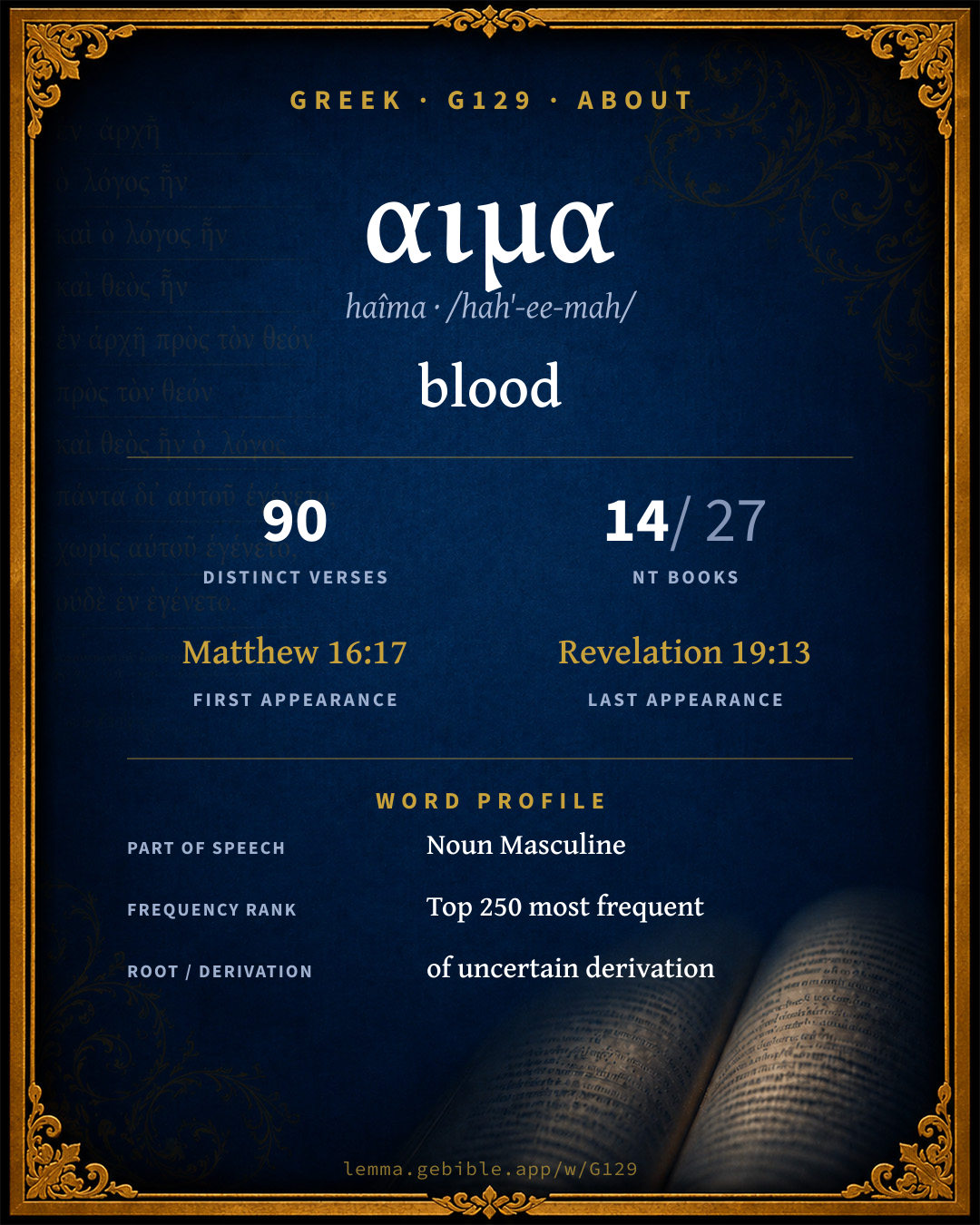
αἷμα
blood
‘blood’ is one of 2 main senses fuller range ↓
Full lexicon entry — Thayer's Greek Lexicon
From Thayer's Greek Lexicon
Where this word appears
See every Genitive-case word in the Greek New Testament →
Grammar key — what these labels mean
Part of speech
- Noun
- A naming word — a person, place, thing, or idea.
Case
- Genitive
- The case of source, possession, or “of” — answers “whose / from what.”
- Nominative
- The case of the subject (and the predicate nominative).
- Dative
- The case of the indirect object, means, or location — “to / for / with / in.”
- Accusative
- The case of the direct object and of extent.
Gender
- Neuter
- Grammatically neuter.
Number
- Singular
- One.
- Plural
- More than one.
Grammatical forms
- Noun, Genitive, Singular, Neuter 33 times (34%)
- Noun, Nominative, Singular, Neuter 24 times (25%)
- Noun, Dative, Singular, Neuter 20 times (21%)
- Noun, Accusative, Singular, Neuter 18 times (19%)
- Noun, Accusative, Plural, Neuter 1 time (1%)
- Noun, Genitive, Plural, Neuter 1 time (1%)
Parsed forms decoded from the imported morphology (Robinson–Tischendorf, public domain), counted across 97 parsed occurrences — not distinct verses.
Every verse where G129 appears — 90 distinct verses across 14 books. Click any verse to open its interlinear word-by-word view. Verse text shown in the World English Bible for context — . Each verse’s Greek form is shown with its reference; the English is not keyword-highlighted, since the data carries no word-level English alignment. Use “Compare translations” on any verse to read it across multiple English versions. This concordance covers the Greek New Testament; Septuagint (Greek Old Testament) occurrences of this word are not indexed here.
Matthew 9 verses
- Matthew 16:17 αἷμα n nom sg neut Jesus answered him, "Blessed are you, Simon Bar Jonah, for flesh and blood has not revealed this to you, but my Father who is in heaven.
- Matthew 23:30 αἵματι n dat sg neut and say, 'If we had lived in the days of our fathers, we wouldn't have been partakers with them in the blood of the prophets.'
- Matthew 23:35 αἷμα αἵματος αἵματος n nom sg neut n gen sg neut n gen sg neut that on you may come all the righteous blood shed on the earth, from the blood of righteous Abel to the blood of Zachariah son of Barachiah, whom you killed between the sanctuary and the altar.
- Matthew 26:28 αἷμά n nom sg neut for this is my blood of the new covenant, which is poured out for many for the remission of sins.
- Matthew 27:4 αἷμα n acc sg neut saying, "I have sinned in that I betrayed innocent blood." But they said, "What is that to us? You see to it."
- Matthew 27:6 αἵματός n gen sg neut The chief priests took the pieces of silver, and said, "It's not lawful to put them into the treasury, since it is the price of blood."
- Matthew 27:8 αἵματος n gen sg neut Therefore that field was called "The Field of Blood" to this day.
- Matthew 27:24 αἵματος n gen sg neut So when Pilate saw that nothing was being gained, but rather that a disturbance was starting, he took water, and washed his hands before the multitude, saying, "I am innocent of the blood of this righteous person. You see to it."
- Matthew 27:25 αἷμα n nom sg neut All the people answered, "May his blood be on us, and on our children!"
Mark 3 verses
- Mark 5:25 αἵματος n gen sg neut A certain woman, who had an issue of blood for twelve years,
- Mark 5:29 αἵματος n gen sg neut Immediately the flow of her blood was dried up, and she felt in her body that she was healed of her affliction.
- Mark 14:24 αἷμά n nom sg neut He said to them, "This is my blood of the new covenant, which is poured out for many.
Luke 7 verses
- Luke 8:43 αἵματος n gen sg neut A woman who had a flow of blood for twelve years, who had spent all her living on physicians, and could not be healed by any,
- Luke 8:44 αἵματος n gen sg neut came behind him, and touched the fringe of his cloak, and immediately the flow of her blood stopped.
- Luke 11:50 αἷμα n nom sg neut that the blood of all the prophets, which was shed from the foundation of the world, may be required of this generation;
- Luke 11:51 αἵματος αἵματος n gen sg neut n gen sg neut from the blood of Abel to the blood of Zachariah, who perished between the altar and the sanctuary.' Yes, I tell you, it will be required of this generation.
- Luke 13:1 αἷμα n acc sg neut Now there were some present at the same time who told him about the Galileans, whose blood Pilate had mixed with their sacrifices.
- Luke 22:20 αἵματί n dat sg neut Likewise, he took the cup after supper, saying, "This cup is the new covenant in my blood, which is poured out for you.
- Luke 22:44 αἵματος n gen sg neut Being in agony he prayed more earnestly. His sweat became like great drops of blood falling down on the ground.
John 6 verses
- John 1:13 αἱμάτων n gen pl neut who were born not of blood, nor of the will of the flesh, nor of the will of man, but of God.
- John 6:53 αἷμα n acc sg neut Jesus therefore said to them, "Most assuredly I tell you, unless you eat the flesh of the Son of Man and drink his blood, you don't have life in yourselves.
- John 6:54 αἷμα n acc sg neut He who eats my flesh and drinks my blood has eternal life, and I will raise him up at the last day.
- John 6:55 αἷμά n nom sg neut For my flesh is food indeed, and my blood is drink indeed.
- John 6:56 αἷμα n acc sg neut He who eats my flesh and drinks my blood lives in me, and I in him.
- John 19:34 αἷμα n nom sg neut However one of the soldiers pierced his side with a spear, and immediately blood and water came out.
Acts 11 verses
- Acts 1:19 αἵματος n gen sg neut It became known to everyone who lived in Jerusalem that in their language that field was called 'Akeldama,' that is, 'The field of blood.'
- Acts 2:19 αἷμα n acc sg neut I will show wonders in the sky above, And signs on the earth beneath; Blood, and fire, and billows of smoke.
- Acts 2:20 αἷμα n acc sg neut The sun will be turned into darkness, And the moon into blood, Before the great and glorious day of the Lord comes.
- Acts 5:28 αἷμα n acc sg neut saying, "Didn't we strictly charge you not to teach in this name? Behold, you have filled Jerusalem with your teaching, and intend to bring this man's blood on us."
- Acts 15:20 αἵματος n gen sg neut but that we write to them that they abstain from the pollution of idols, from sexual immorality, from what is strangled, and from blood.
- Acts 15:29 αἵματος n gen sg neut that you abstain from things sacrificed to idols, from blood, from things strangled, and from sexual immorality, from which if you keep yourselves, it will be well with you. Farewell."
- Acts 18:6 αἷμα n nom sg neut When they opposed him and blasphemed, he shook out his clothing and said to them, "Your blood be on your own heads! I am clean. From now on, I will go to the Gentiles!"
- Acts 20:26 αἵματος n gen sg neut Therefore I testify to you this day that I am clean from the blood of all men,
- Acts 20:28 αἵματος n gen sg neut Take heed, therefore, to yourselves, and to all the flock, in which the Holy Spirit has made you overseers, to shepherd the assembly of the Lord and God which he purchased with his own blood.
- Acts 21:25 αἷμα n acc sg neut But concerning the Gentiles who believe, we have written our decision that they should observe no such thing, except that they should keep themselves from food offered to idols, from blood, from strangled things, and from sexual immorality."
- Acts 22:20 αἷμα n nom sg neut When the blood of Stephen, your witness, was shed, I also was standing by, and consenting to his death, and guarding the cloaks of those who killed him.'
Romans 3 verses
- Romans 3:15 αἷμα n acc sg neut "Their feet are swift to shed blood.
- Romans 3:25 αἵματι n dat sg neut whom God set forth to be an atoning sacrifice, through faith in his blood, for a demonstration of his righteousness through the passing over of prior sins, in God's forbearance;
- Romans 5:9 αἵματι n dat sg neut Much more then, being now justified by his blood, we will be saved from God's wrath through him.
1 Corinthians 4 verses
- 1 Corinthians 10:16 αἵματος n gen sg neut The cup of blessing which we bless, isn't it a communion of the blood of Christ? The bread which we break, isn't it a communion of the body of Christ?
- 1 Corinthians 11:25 αἵματι n dat sg neut In the same way he also took the cup, after supper, saying, "This cup is the new covenant in my blood. Do this, as often as you drink, in memory of me."
- 1 Corinthians 11:27 αἵματος n gen sg neut Therefore whoever eats this bread or drinks the Lord's cup in a manner unworthy of the Lord will be guilty of the body and the blood of the Lord.
- 1 Corinthians 15:50 αἷμα n nom sg neut Now I say this, brothers, that flesh and blood can't inherit the Kingdom of God; neither does corruption inherit incorruption.
Galatians 1 verse
Ephesians 3 verses
- Ephesians 1:7 αἵματος n gen sg neut in whom we have our redemption through his blood, the forgiveness of our trespasses, according to the riches of his grace,
- Ephesians 2:13 αἵματι n dat sg neut But now in Christ Jesus you who once were far off are made near in the blood of Christ.
- Ephesians 6:12 αἷμα n acc sg neut For our wrestling is not against flesh and blood, but against the principalities, against the powers, against the world's rulers of the darkness of this age, and against the spiritual hosts of wickedness in the heavenly places.
Colossians 1 verse
Hebrews 20 verses
- Hebrews 2:14 αἵματος n gen sg neut Since then the children have shared in flesh and blood, he also himself in like manner partook of the same, that through death he might bring to nothing him who had the power of death, that is, the devil,
- Hebrews 9:7 αἵματος n gen sg neut but into the second the high priest alone, once in the year, not without blood, which he offers for himself, and for the errors of the people.
- Hebrews 9:12 αἵματος αἵματος n gen sg neut n gen sg neut nor yet through the blood of goats and calves, but through his own blood, entered in once for all into the Holy Place, having obtained eternal redemption.
- Hebrews 9:13 αἷμα n nom sg neut For if the blood of goats and bulls, and the ashes of a heifer sprinkling those who have been defiled, sanctify to the cleanness of the flesh:
- Hebrews 9:14 αἷμα n nom sg neut how much more will the blood of Christ, who through the eternal Spirit offered himself without blemish to God, cleanse your conscience from dead works to serve the living God?
- Hebrews 9:18 αἵματος n gen sg neut Therefore even the first covenant has not been dedicated without blood.
- Hebrews 9:19 αἷμα n acc sg neut For when every commandment had been spoken by Moses to all the people according to the law, he took the blood of the calves and the goats, with water and scarlet wool and hyssop, and sprinkled both the book itself and all the people,
- Hebrews 9:20 αἷμα n nom sg neut saying, "This is the blood of the covenant which God has commanded you."
- Hebrews 9:21 αἵματι n dat sg neut Moreover he sprinkled the tabernacle and all the vessels of the ministry in like manner with the blood.
- Hebrews 9:22 αἵματι n dat sg neut According to the law, nearly everything is cleansed with blood, and apart from shedding of blood there is no remission.
- Hebrews 9:25 αἵματι n dat sg neut nor yet that he should offer himself often, as the high priest enters into the holy place year by year with blood not his own,
- Hebrews 10:4 αἷμα n nom sg neut For it is impossible that the blood of bulls and goats should take away sins.
- Hebrews 10:19 αἵματι n dat sg neut Having therefore, brothers, boldness to enter into the holy place by the blood of Jesus,
- Hebrews 10:29 αἷμα n acc sg neut How much worse punishment, do you think, will he be judged worthy of, who has trodden under foot the Son of God, and has counted the blood of the covenant with which he was sanctified an unholy thing, and has insulted the Spirit of grace?
- Hebrews 11:28 αἵματος n gen sg neut By faith, he kept the Passover, and the sprinkling of the blood, that the destroyer of the firstborn should not touch them.
- Hebrews 12:4 αἵματος n gen sg neut You have not yet resisted to blood, striving against sin;
- Hebrews 12:24 αἵματι n dat sg neut to Jesus, the mediator of a new covenant, and to the blood of sprinkling that speaks better than that of Abel.
- Hebrews 13:11 αἷμα n nom sg neut For the bodies of those animals, whose blood is brought into the holy place by the high priest as an offering for sin, are burned outside of the camp.
- Hebrews 13:12 αἵματος n gen sg neut Therefore Jesus also, that he might sanctify the people through his own blood, suffered outside of the gate.
- Hebrews 13:20 αἵματι n dat sg neut Now may the God of peace, who brought again from the dead the great shepherd of the sheep with the blood of an eternal covenant, our Lord Jesus,
1 Peter 2 verses
- 1 Peter 1:2 αἵματος n gen sg neut according to the foreknowledge of God the Father, in sanctification of the Spirit, that you may obey Jesus Christ and be sprinkled in his blood: Grace to you and peace be multiplied.
- 1 Peter 1:19 αἵματι n dat sg neut but with precious blood, as of a lamb without spot, the blood of Christ;
1 John 3 verses
- 1 John 1:7 αἷμα n nom sg neut But if we walk in the light, as he is in the light, we have fellowship with one another, and the blood of Jesus Christ, his Son, cleanses us from all sin.
- 1 John 5:6 αἵματος αἵματι n gen sg neut n dat sg neut This is he who came by water and blood, Jesus Christ; not with the water only, but with the water and the blood. It is the Spirit who testifies, because the Spirit is the truth.
- 1 John 5:8 αἷμα n nom sg neut the Spirit, and the water, and the blood; and the three agree as one.
Revelation 17 verses
- Revelation 1:5 αἵματι n dat sg neut and from Jesus Christ, the faithful witness, the firstborn of the dead, and the ruler of the kings of the earth. To him who loves us, and washed us from our sins by his blood;
- Revelation 5:9 αἵματί n dat sg neut They sang a new song, saying, "You are worthy to take the book, And to open its seals: For you were killed, And bought us for God with your blood, Out of every tribe, language, people, and nation,
- Revelation 6:10 αἷμα n acc sg neut They cried with a loud voice, saying, "How long, Master, the holy and true, until you judge and avenge our blood on those who dwell on the earth?"
- Revelation 6:12 αἷμα n nom sg neut I saw when he opened the sixth seal, and there was a great earthquake. The sun became black as sackcloth made of hair, and the whole moon became as blood.
- Revelation 7:14 αἵματι n dat sg neut I told him, "My lord, you know." He said to me, "These are those who came out of the great tribulation. They washed their robes, and made them white in the Lamb's blood.
- Revelation 8:7 αἵματι n dat sg neut The first sounded, and there followed hail and fire, mixed with blood, and they were thrown to the earth. One third of the earth was burnt up, and one third of the trees were burnt up, and all green grass was burnt up.
- Revelation 8:8 αἷμα n nom sg neut The second angel sounded, and something like a great burning mountain was thrown into the sea. One third of the sea became blood,
- Revelation 11:6 αἷμα n acc sg neut These have the power to shut up the sky, that it may not rain during the days of their prophecy. They have power over the waters, to turn them into blood, and to strike the earth with every plague, as often as they desire.
- Revelation 12:11 αἷμα n acc sg neut They overcame him because of the Lamb's blood, and because of the word of their testimony. They didn't love their life, even to death.
- Revelation 14:20 αἷμα n nom sg neut The winepress was trodden outside of the city, and blood came out from the winepress, even to the bridles of the horses, as far as one thousand six hundred stadia.
- Revelation 16:3 αἷμα n nom sg neut The second angel poured out his bowl into the sea, and it became blood as of a dead man. Every living thing in the sea died.
- Revelation 16:4 αἷμα n nom sg neut The third poured out his bowl into the rivers and springs of water, and they became blood.
- Revelation 16:6 αἵματα αἷμα n acc pl neut n acc sg neut For they poured out the blood of the saints and the prophets, and you have given them blood to drink. They deserve this."
- Revelation 17:6 αἵματος αἵματος n gen sg neut n gen sg neut I saw the woman drunken with the blood of the saints, and with the blood of the martyrs of Jesus. When I saw her, I wondered with great amazement.
- Revelation 18:24 αἷμα n nom sg neut In her was found the blood of prophets and of saints, and of all who have been slain on the earth."
- Revelation 19:2 αἷμα n acc sg neut for true and righteous are his judgments. For he has judged the great prostitute, who corrupted the earth with her sexual immorality, and he has avenged the blood of his servants at her hand."
- Revelation 19:13 αἵματι n dat sg neut He is clothed in a garment sprinkled with blood. His name is called "The Word of God."
About this entry
At a glance — auto-summarized from this page’s data, not written by a person. Every figure links to its source below. This summary describes the numbers; it doesn’t interpret them.
At its core, αιμα (haîma) means “blood.” First canonically at Matthew 16:17, it enters the text early. It appears 90 verses across 14 books of the Greek New Testament, among its moderately common vocabulary. Catalogued under 2 senses, its meaning is not single-sense. It shares a root with αιματεκχυσια and αιμορρεω. Each statement above links to its evidence; the full detail follows below.
Gloss history
Strong's 1890 vs modern scholarship
About this word
Strong's G129 catalogs a Greek word from the Greek New Testament.
These counts are not copied from any lexicon or concordance. They are computed here, from the morphology-tagged Greek New Testament. What Lemma adds →
- 90
- distinct verses
- The word appears in 90 distinct verses.
- 14 / 27
- NT books
- The word appears in 14 of 27 New Testament books.
- #174
- by frequency
- Top 250 most frequent Greek words (rank 174 of 5,347 Greek words by occurrence).
View all 90 occurrences in the concordance →
Most concentrated in
- Hebrews 20 verses 22%
- Revelation 17 verses 19%
- Acts 11 verses 12%
By section of the New Testament
By traditional corpus
Conventional, traditional groupings — biblical authorship is debated, so this is a traditional corpus grouping, not an authorship claim. Some books belong to more than one corpus (Luke is in both the Gospels and the Lukan corpus, and so on), so these shares overlap and need not total 100%. Each figure is a share of the word’s 90 distinct verses.
- Johannine 26 verses · 29%
- Gospels 25 verses · 28%
- Hebrews 20 verses · 22%
- Lukan (Luke–Acts) 18 verses · 20%
- Revelation 17 verses · 19%
- Pauline corpus 12 verses · 13%
- General (Catholic) Epistles 5 verses · 6%
How translations render this word
Counts come from each version’s own published word-to-Strong’s tagging or interlinear alignment — an approximate guide to how each version renders this word, not a word-level alignment the data otherwise carries. Because each total is that version’s own tagged count, the per-version totals vary from one another and need not match the appearance or distinct-verse counts above. These counts may also differ from a printed concordance because Lemma counts each distinctly tagged rendering and does not collapse phrase taggings into a single head-word total. This is a fixed set of word-tagged versions (KJV, ASV, BSB, ULT) and does not change with the reading translation you choose elsewhere. Each version’s license is shown beside its name below (and on Sources).
- King James Version: Blood 98×
- American Standard Version: Blood 91×
- Berean Standard Bible: Blood 90×, Bleeding 4×
- unfoldingWord Literal Text: Blood 96×, The 3×, Of 2×
King James Version Public Domain
Renders G129 across 99 tagged occurrences — most commonly:
Plus 1 rendering that appears only once — usually multi-word phrases or single function words the recovered tagging swept in, not distinct renderings.
American Standard Version Public Domain
Renders G129 across 95 tagged occurrences — most commonly:
Plus 4 renderings that appear only once — usually multi-word phrases or single function words the recovered tagging swept in, not distinct renderings.
Berean Standard Bible Public Domain
Renders G129 across 96 tagged occurrences — most commonly:
Plus 2 renderings that appear only once — usually multi-word phrases or single function words the recovered tagging swept in, not distinct renderings. Not rendered by a distinct English word in 1 further occurrence.
unfoldingWord Literal Text CC BY-SA 4.0
Renders G129 across 103 tagged occurrences — most commonly:
Plus 2 renderings that appear only once — usually multi-word phrases or single function words the recovered tagging swept in, not distinct renderings.
Senses in Thayer's
The 2 senses Thayer's distinguishes for this word, in lexicon order (not ranked by frequency or importance). The full entry — with sub-senses — is in the Lexicon Entry tab.
- blood
- blood shed, to be shed by violence, slay, murder
Word origin
Origin: of uncertain derivation
Of uncertain derivation; blood literally (of men or animals) figuratively (the juice of grapes) or specifically (the atoning blood of christ); by implication bloodshed also kindred : - blood.
— Strong’s Exhaustive Concordance (1890), public domain.
Forms in the corpus
The 8 distinct written forms G129 takes in the Greek New Testament, most frequent first — each parse links to that case’s occurrences in the concordance.
| Form | Parsing | Example | Uses |
|---|---|---|---|
| αἷμα haîma | Noun, Nominative, Singular, Neuter | Matthew 16:17 | 39 |
| αἵματος haímatos | Noun, Genitive, Singular, Neuter | Matthew 23:35 | 32 |
| αἵματι haímati | Noun, Dative, Singular, Neuter | Matthew 23:30 | 18 |
| αἷμά haîmá | Noun, Nominative, Singular, Neuter | Matthew 26:28 | 3 |
| αἵματί haímatí | Noun, Dative, Singular, Neuter | Luke 22:20 | 2 |
| αἱμάτων haimátōn | Noun, Genitive, Plural, Neuter | John 1:13 | 1 |
| αἵματα haímata | Noun, Accusative, Plural, Neuter | Revelation 16:6 | 1 |
| αἵματός haímatós | Noun, Genitive, Singular, Neuter | Matthew 27:6 | 1 |
Same root — word family
Other Thayer's entries built from the same root as G129, grouped by Strong’s listed origin. These share a root / origin per the lexicon — not necessarily a shared meaning. Each links to that word’s own entry.
Derived from this word
Compare all same-root words → They share a root, not necessarily a meaning.
Septuagint usage
The same Greek word αιμα appears 347 times in the Greek Old Testament (Septuagint), across 284 verses in 28 books.
- 347
- LXX occurrences
- Tagged occurrences of this Greek word in the Septuagint.
- 284
- verses
- Distinct Septuagint verses containing this word.
- 28 / 39
- OT books
- The word appears in 28 of the 39 Old Testament books.
Sample Septuagint occurrences
- Genesis 4:10 αἷμα
- Exodus 4:9 αἷμα
- Leviticus 1:5 αἷμα
- Numbers 18:17 αἷμα
- Deuteronomy 12:16 αἷμα
- Joshua 20:3 αἷμα
- Judges 9:24 αἷμα
- 1 Samuel 14:32 αἷμα
- 2 Samuel 1:16 αἷμα
- 1 Kings 2:5 αἷμα
- 2 Kings 3:22 αἷμα
- 1 Chronicles 11:19 αἷμα
Septuagint occurrences (same lexeme)
Every verse where the same Strong’s number (G129) appears in the Greek Septuagint — showing the first 50 of 284. Verse text shown in the World English Bible for context; the Greek form is the matched word — the English is not keyword-highlighted.
- Genesis 4:10 αἷμα Yahweh said, "What have you done? The voice of your brother's blood cries to me from the ground.
- Genesis 4:11 αἷμα Now you are cursed because of the ground, which has opened its mouth to receive your brother's blood from your hand.
- Genesis 9:4 αἷμα But flesh with the life of it, the blood of it, you shall not eat.
- Genesis 9:5 αἷμα I will surely require your blood of your lives. At the hand of every animal I will require it. At the hand of man, even at the hand of every man's brother, I will require the life of man.
- Genesis 9:6 αἷμα Whoever sheds man's blood, by man will his blood be shed, for in the image of God made he man.
- Genesis 37:22 αἷμα Reuben said to them, "Shed no blood. Throw him into this pit that is in the wilderness, but lay no hand on him"-- that he might deliver him out of their hand, to restore him to his father.
- Genesis 37:26 αἷμα Judah said to his brothers, "What profit is it if we kill our brother and conceal his blood?
- Genesis 37:31 αἷμα They took Joseph's coat, and killed a male goat, and dipped the coat in the blood.
- Genesis 42:22 αἷμα Reuben answered them, saying, "Didn't I tell you, saying, 'Don't sin against the child,' and you wouldn't listen? Therefore also, behold, his blood is required."
- Genesis 49:11 αἷμα Binding his foal to the vine, His donkey's colt to the choice vine; He has washed his garments in wine, His robes in the blood of grapes:
- Exodus 4:9 αἷμα It will happen, if they will not believe even these two signs, neither listen to your voice, that you shall take of the water of the river, and pour it on the dry land. The water which you take out of the river will become blood on the dry land."
- Exodus 4:25 αἷμα Then Zipporah took a flint, and cut off the foreskin of her son, and cast it at his feet; and she said, "Surely you are a bridegroom of blood to me."
- Exodus 4:26 αἷμα So he let him alone. Then she said, "You are a bridegroom of blood," because of the circumcision.
- Exodus 7:17 αἷμα Thus says Yahweh, "In this you shall know that I am Yahweh. Behold, I will strike with the rod that is in my hand on the waters which are in the river, and they shall be turned to blood.
- Exodus 7:19 αἷμα Yahweh said to Moses, "Tell Aaron, 'Take your rod, and stretch out your hand over the waters of Egypt, over their rivers, over their streams, and over their pools, and over all their ponds of water, that they may become blood; and there shall be blood throughout all the land of Egypt, both in vessels of wood and in vessels of stone.'"
- Exodus 7:20 αἷμα Moses and Aaron did so, as Yahweh commanded; and he lifted up the rod, and struck the waters that were in the river, in the sight of Pharaoh, and in the sight of his servants; and all the waters that were in the river were turned to blood.
- Exodus 7:21 αἷμα The fish that were in the river died; and the river became foul, and the Egyptians couldn't drink water from the river; and the blood was throughout all the land of Egypt.
- Exodus 12:7 αἷμα They shall take some of the blood, and put it on the two side-posts and on the lintel, on the houses in which they shall eat it.
- Exodus 12:13 αἷμα The blood shall be to you for a token on the houses where you are: and when I see the blood, I will pass over you, and there shall no plague be on you to destroy you, when I strike the land of Egypt.
- Exodus 12:22 αἷμα You shall take a bunch of hyssop, and dip it in the blood that is in the basin, and strike the lintel and the two side-posts with the blood that is in the basin; and none of you shall go out of the door of his house until the morning.
- Exodus 12:23 αἷμα For Yahweh will pass through to strike the Egyptians; and when he sees the blood on the lintel, and on the two side-posts, Yahweh will pass over the door, and will not allow the destroyer to come in to your houses to strike you.
- Exodus 23:18 αἷμα "You shall not offer the blood of my sacrifice with leavened bread, neither shall the fat of my feast remain all night until the morning.
- Exodus 24:6 αἷμα Moses took half of the blood and put it in basins, and half of the blood he sprinkled on the altar.
- Exodus 24:8 αἷμα Moses took the blood, and sprinkled it on the people, and said, "Look, this is the blood of the covenant, which Yahweh has made with you concerning all these words."
- Exodus 29:12 αἷμα You shall take of the blood of the bull, and put it on the horns of the altar with your finger; and you shall pour out all the blood at the base of the altar.
- Exodus 29:16 αἷμα You shall kill the ram, and you shall take its blood, and sprinkle it around on the altar.
- Exodus 29:20 αἷμα Then you shall kill the ram, and take some of its blood, and put it on the tip of the right ear of Aaron, and on the tip of the right ear of his sons, and on the thumb of their right hand, and on the big toe of their right foot, and sprinkle the blood on the altar round about.
- Exodus 29:21 αἷμα You shall take of the blood that is on the altar, and of the anointing oil, and sprinkle it on Aaron, and on his garments, and on his sons, and on the garments of his sons with him: and he shall be made holy, and his garments, and his sons, and his sons' garments with him.
- Exodus 30:10 αἷμα Aaron shall make atonement on its horns once in the year; with the blood of the sin offering of atonement once in the year he shall make atonement for it throughout your generations. It is most holy to Yahweh."
- Exodus 34:25 αἷμα "You shall not offer the blood of my sacrifice with leavened bread; neither shall the sacrifice of the feast of the Passover be left to the morning.
- Leviticus 1:5 αἷμα He shall kill the bull before Yahweh. Aaron's sons, the priests, shall present the blood and sprinkle the blood around on the altar that is at the door of the Tent of Meeting.
- Leviticus 1:11 αἷμα He shall kill it on the north side of the altar before Yahweh. Aaron's sons, the priests, shall sprinkle its blood around on the altar.
- Leviticus 1:15 αἷμα The priest shall bring it to the altar, and wring off its head, and burn it on the altar; and its blood shall be drained out on the side of the altar;
- Leviticus 3:2 αἷμα He shall lay his hand on the head of his offering, and kill it at the door of the tent of meeting: and Aaron's sons the priests shall sprinkle the blood on the altar round about.
- Leviticus 3:8 αἷμα and he shall lay his hand on the head of his offering, and kill it before the tent of meeting: and Aaron's sons shall sprinkle its blood on the altar round about.
- Leviticus 3:13 αἷμα and he shall lay his hand on its head, and kill it before the tent of meeting; and the sons of Aaron shall sprinkle its blood on the altar round about.
- Leviticus 3:17 αἷμα "'It shall be a perpetual statute throughout your generations in all your dwellings, that you shall eat neither fat nor blood.'"
- Leviticus 4:5 αἷμα The anointed priest shall take some of the blood of the bull, and bring it to the Tent of Meeting.
- Leviticus 4:6 αἷμα The priest shall dip his finger in the blood, and sprinkle some of the blood seven times before Yahweh, before the veil of the sanctuary.
- Leviticus 4:7 αἷμα The priest shall put some of the blood on the horns of the altar of sweet incense before Yahweh, which is in the tent of meeting; and he shall pour out all the blood of the bull out at the base of the altar of burnt offering, which is at the door of the Tent of Meeting.
- Leviticus 4:16 αἷμα The anointed priest shall bring of the blood of the bull to the Tent of Meeting:
- Leviticus 4:17 αἷμα and the priest shall dip his finger in the blood, and sprinkle it seven times before Yahweh, before the veil.
- Leviticus 4:18 αἷμα He shall put some of the blood on the horns of the altar which is before Yahweh, that is in the Tent of Meeting; and the rest of the blood he shall pour out at the base of the altar of burnt offering, which is at the door of the Tent of Meeting.
- Leviticus 4:25 αἷμα The priest shall take some of the blood of the sin offering with his finger, and put it on the horns of the altar of burnt offering. He shall pour out the rest of its blood at the base of the altar of burnt offering.
- Leviticus 4:30 αἷμα The priest shall take some of its blood with his finger, and put it on the horns of the altar of burnt offering; and the rest of its blood he shall pour out at the base of the altar.
- Leviticus 4:34 αἷμα The priest shall take some of the blood of the sin offering with his finger, and put it on the horns of the altar of burnt offering; and all the rest of its blood he shall pour out at the base of the altar.
- Leviticus 5:9 αἷμα He shall sprinkle some of the blood of the sin offering on the side of the altar; and the rest of the blood shall be drained out at the base of the altar. It is a sin offering.
- Leviticus 6:20 αἷμα "This is the offering of Aaron and of his sons, which they shall offer to Yahweh in the day when he is anointed: the tenth part of an ephah of fine flour for a meal offering perpetually, half of it in the morning, and half of it in the evening.
- Leviticus 6:23 αἷμα Every meal offering of a priest shall be wholly burned. It shall not be eaten."
- Leviticus 7:2 αἷμα In the place where they kill the burnt offering, he shall kill the trespass offering; and its blood he shall sprinkle on the altar round about.
These are occurrences of the same Greek lexeme (G129) in the Septuagint — not a translation of any one Hebrew word. The store carries no word-level Hebrew↔Greek alignment, so no Hebrew original is asserted here. Counts come from the recovered LXX Strong's tagging — high-frequency vocabulary is well covered, while rare or late forms may be untagged — so they reflect tagged occurrences and may slightly undercount.