
Revelation 6:12

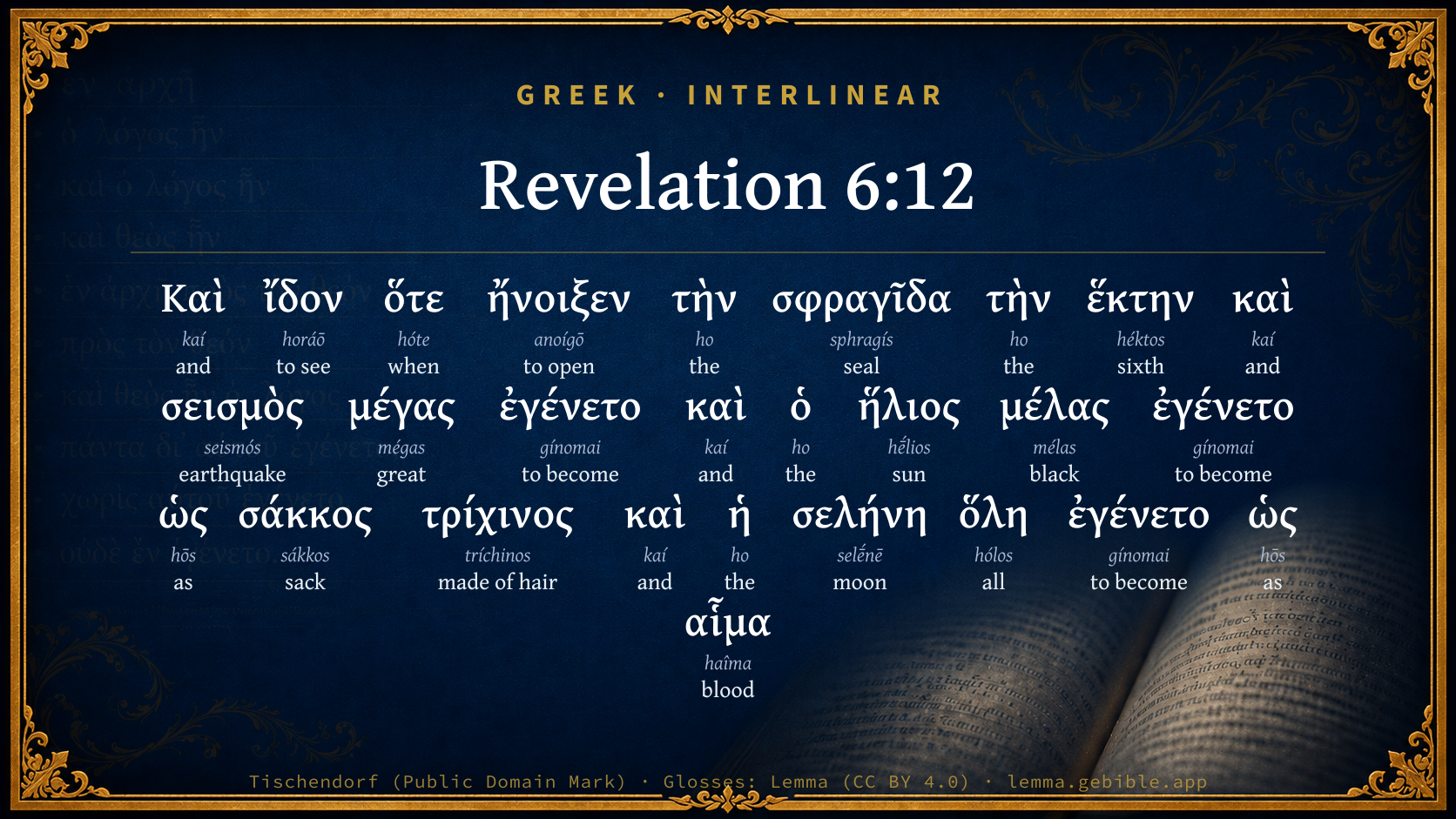
Greek (Tischendorf 8th ed.) Revelation 6:12 appears in the Greek New Testament. The text above is from the Tischendorf 8th edition. Each word links to its Strong’s number and a concise gloss. Click any word for its full Thayer’s Greek Lexicon entry.
Download image
Cite this verse

Revelation 6:12 (World English Bible). Public Domain. Lemma interlinear Bible study tool, https://lemma.gebible.app/v/revelation/6/12.

Show BibTeX & RIS
BibTeX
RIS
English Translation
I saw when he opened the sixth seal, and there was a great earthquake. The sun became black as sackcloth made of hair, and the whole moon became as blood.
World English Bible · Public Domain
Highlights
  • 1 hapax legomenon — only here in the Greek New Testament
  • 1 first appearance in the Greek New Testament
Full analysis ↓
Download a study sheet

One document with this verse’s original text, its word-by-word gloss line, the meaning frame, cross-references with their text, attributed commentary, and full source and license credits — printable, and it pastes into notes with its structure intact.

This verse Autodidact and up

Study sheet (.html) Plain text (.txt)

A passage Seminary Student

Up to 50 verses in one chapter. A passage sheet keeps up to 6 commentary sources and 12 cross-references per verse, in the order this page ranks them, and says so on the sheet whenever that leaves anything out. Ask for a single verse and you get the Autodidact verse sheet above.

Everything on this page stays free to read, with no account — the sheet is a download of what is already on screen, not access to it.

Want to remove ads? Support Godless Engineer
Compare translations 3

The same verse in 3 English versions, stacked beneath the original-language interlinear above. Click any original word for its lexicon entry.

Each is an independent rendering of the whole verse — the interlinear is not word-aligned to these translations.

Highlighted words mark where these versions differ — a whole-verse word diff, not a word-by-word alignment.

  • World English Bible Public Domain
    I saw when he opened the sixth seal, and there was a great earthquake. The sun became black as sackcloth made of hair, and the whole moon became as blood.
  • King James Version Public Domain
    And I beheld when he had opened the sixth seal, and, lo, there was a great earthquake; and the sun became black as sackcloth of hair, and the moon became as blood;
  • unfoldingWord Literal Text CC BY-SA 4.0
    And I saw when he opened the sixth seal, and a great earthquake happened, and the sun became black, like sackcloth of hair, and the full moon became like blood,

unfoldingWord Literal Text — © unfoldingWord, licensed CC BY-SA 4.0. Word-aligned USFM3 via Door43 (git.door43.org/unfoldingWord/en_ult).

Versions to compare (up to 4)

3 of 4 selected

Show all 19 translations

Every available English version of this verse, each an independent rendering of the whole verse.

  • World English Bible Public Domain
    I saw when he opened the sixth seal, and there was a great earthquake. The sun became black as sackcloth made of hair, and the whole moon became as blood.
  • Berean Standard Bible Public Domain
    And when I saw the Lamb open the sixth seal, there was a great earthquake, and the sun became black like sackcloth of goat hair, and the whole moon turned blood red,
  • Majority Standard Bible Public Domain
    And I watched as the Lamb opened the sixth seal, and there was a great earthquake, and the sun became black like sackcloth of goat hair, and the whole moon turned blood red,
  • King James Version Public Domain
    And I beheld when he had opened the sixth seal, and, lo, there was a great earthquake; and the sun became black as sackcloth of hair, and the moon became as blood;
  • American Standard Version (1901) Public Domain
    And I saw when he opened the sixth seal, and there was a great earthquake; and the sun became black as sackcloth of hair, and the whole moon became as blood;
  • Revised Version (1885) Public Domain
    And I saw when he opened the sixth seal, and there was a great earthquake; and the sun became black as sackcloth of hair, and the whole moon became as blood;
  • Geneva Bible (1599) Public Domain
    And I behelde when hee had opened the sixt seale, and loe, there was a great earthquake, and the sunne was as blacke as sackecloth of heare, and the moone was like blood.
  • Douay-Rheims (1899) Public Domain
    And I saw, when he had opened the sixth seal, and behold there was a great earthquake, and the sun became black as sackcloth of hair: and the whole moon became as blood:
  • Young's Literal Translation Public Domain
    And I saw when he opened the sixth seal, and lo, a great earthquake came, and the sun became black as sackcloth of hair, and the moon became as blood,
  • Literal Standard Version CC BY-SA 4.0
    And I saw when He opened the sixth seal, and behold, a great earthquake came, and the sun became black as sackcloth of hair, and the moon became as blood,
  • Unlocked Literal Bible CC BY-SA 4.0
    When the Lamb opened the sixth seal, I watched and there was a great earthquake. The sun became as black as sackcloth, and the full moon became like blood.
  • unfoldingWord Literal Text CC BY-SA 4.0
    And I saw when he opened the sixth seal, and a great earthquake happened, and the sun became black, like sackcloth of hair, and the full moon became like blood,
  • Darby Bible Public Domain
    And I saw when it opened the sixth seal, and there was a great earthquake; and the sun became black as hair sackcloth, and the whole moon became as blood,
  • World Messianic Bible Public Domain
    I saw when he opened the sixth seal, and there was a great earthquake. The sun became black as sackcloth made of hair, and the whole moon became as blood.
  • Webster's Bible Public Domain
    And I beheld when he had opened the sixth seal, and lo, there was a great earthquake; and the sun became black as sackcloth of hair, and the moon became as blood:
  • Free Bible Version CC BY-SA 4.0
    When he opened the sixth seal there was a tremendous earthquake. The sun turned black like hair sackcloth and the whole moon turned red like blood.
  • Bible in Basic English Public Domain
    And I saw when the sixth stamp was undone, and there was a great earth-shock; and the sun became black as haircloth, and all the moon became as blood;
  • Text-Critical English NT CC BY 4.0
    Then I watched as the Lamb opened the sixth seal, and there was a great earthquake. The sun became as black as sackcloth made of goat hair, the entire moon became like blood,
  • Tyndale New Testament (1534) Public Domain
    And I behelde when he opened the sixte seale and loo there was a grett erth quake and the sunne was as blacke as sacke clothe made of heare. And the mone wexed even as bloud:

Literal Standard Version (2020), Covenant Press — licensed CC BY-SA 4.0. Text via the HelloAO Bible API (eBible.org). Unlocked Literal Bible (unfoldingWord) — licensed CC BY-SA 4.0. Text via the HelloAO Bible API (eBible.org). unfoldingWord Literal Text — © unfoldingWord, licensed CC BY-SA 4.0. Word-aligned USFM3 via Door43 (git.door43.org/unfoldingWord/en_ult). Free Bible Version, Dr. Jonathan Gallagher — licensed CC BY-SA 4.0. Text via the HelloAO Bible API (eBible.org).

Word by word

More ways to search: Search by grammar → Find every occurrence → Compare this word →

Practice this passage: Drill this verse → Learn its vocabulary →

τρίχινος
tríchinos
G5155
“made of hair”
Adjective, Nominative, Singular, Masculine
Part of Speech
Adjective
Case
Nominative
Number
Singular
Gender
Masculine
Full Thayer's Definition

Origin: from G2359

TDNT: None

1. made of hair
  1. Καὶ kaí G2532 “and” Conjunction
  2. ἴδον horáō G3708 “to see” Verb, Aorist, Active, Indicative, 1st person, Singular
  3. ὅτε hóte G3753 “when” Adverb
  4. ἤνοιξεν anoígō G455 “to open” Verb, Aorist, Active, Indicative, 3rd person, Singular
  5. τὴν ho G3588 “the” Article, Accusative, Singular, Feminine
  6. σφραγῖδα sphragís G4973 “seal” Noun, Accusative, Singular, Feminine
  7. τὴν ho G3588 “the” Article, Accusative, Singular, Feminine
  8. ἕκτην héktos G1623 “sixth” Adjective, Accusative, Singular, Feminine
  9. καὶ kaí G2532 “and” Conjunction
  10. σεισμὸς seismós G4578 “earthquake” Noun, Nominative, Singular, Masculine
  11. μέγας mégas G3173 “great” Adjective, Nominative, Singular, Masculine
  12. ἐγένετο gínomai G1096 “to become” Verb, Aorist, Middle deponent, Indicative, 3rd person, Singular
  13. καὶ kaí G2532 “and” Conjunction
  14. ὁ ho G3588 “the” Article, Nominative, Singular, Masculine
  15. ἥλιος hḗlios G2246 “sun” Noun, Nominative, Singular, Masculine
  16. μέλας mélas G3189 “black” Adjective, Nominative, Singular, Masculine
  17. ἐγένετο gínomai G1096 “to become” Verb, Aorist, Middle deponent, Indicative, 3rd person, Singular
  18. ὡς hōs G5613 “as” Adverb
  19. σάκκος sákkos G4526 “sack” Noun, Nominative, Singular, Masculine
  20. καὶ kaí G2532 “and” Conjunction
  21. ἡ ho G3588 “the” Article, Nominative, Singular, Feminine
  22. σελήνη selḗnē G4582 “moon” Noun, Nominative, Singular, Feminine
  23. ὅλη hólos G3650 “all” Adjective, Nominative, Singular, Feminine
  24. ἐγένετο gínomai G1096 “to become” Verb, Aorist, Middle deponent, Indicative, 3rd person, Singular
  25. ὡς hōs G5613 “as” Adverb
  26. αἷμα haîma G129 “blood” Noun, Nominative, Singular, Neuter

About this verse

These counts appear in no published source. They are computed here, from the morphology-tagged text and Lemma’s own curated glosses. What Lemma adds →

27
words
18
distinct lemmas
Revelation
section

Notable vocabulary

1 hapax legomenon — a word that appears only here in the entire Greek New Testament:

  • τρίχινος made of hair G5155

First appearance in Scripture

This word makes its first canonical appearance in the Greek New Testament here:

  • τρίχινος made of hair G5155

Shared distinctive vocabulary

μέλας black G3189 occurs in 3 verses of the Greek New Testament. Also found in:
Repetition

Words recur within this verse:

  • ἐγένετο to become G1096 ×3
  • Καὶ and G2532 ×4
  • τὴν the G3588 ×4
  • ὡς as G5613 ×2

Cross-references

26

Topical passages linked to Revelation 6:12 in the Treasury of Scripture Knowledge — connected by theme and wording, ordered by reader-vote popularity; previews shown in the World English Bible.

  • Matthew 24:29 But immediately after the oppression of those days, the sun will be darkened, the moon will not give its light, the stars will fall from the sky, and the powers of the heavens will be shaken;
  • Joel 2:10 The earth quakes before them. The heavens tremble. The sun and the moon are darkened, And the stars withdraw their shining.
  • Acts 2:19–20 I will show wonders in the sky above, And signs on the earth beneath; Blood, and fire, and billows of smoke.
  • Mark 13:24–25 But in those days, after that oppression, the sun will be darkened, the moon will not give its light,
  • Joel 2:30–31 I will show wonders in the heavens and in the earth: Blood, fire, and pillars of smoke.
  • Joel 3:15 The sun and the moon are darkened, And the stars withdraw their shining."
  • Amos 8:9 "It will happen in that day," says the Lord Yahweh, "That I will cause the sun to go down at noon, And I will darken the earth in the clear day.
  • Isaiah 13:9–10 Behold, the day of Yahweh comes, cruel, with wrath and fierce anger; to make the land a desolation, and to destroy the sinners of it out of it.
  • Revelation 16:18 There were lightnings, sounds, and thunders; and there was a great earthquake, such as was not since there were men on the earth, so great an earthquake, so mighty.
  • Ezekiel 32:7–8 When I shall extinguish you, I will cover the heavens, and make the stars of it dark; I will cover the sun with a cloud, and the moon shall not give its light.
  • Isaiah 50:3 I clothe the heavens with blackness, and I make sackcloth their covering.
  • Revelation 11:13 In that day there was a great earthquake, and a tenth of the city fell. Seven thousand people were killed in the earthquake, and the rest were terrified, and gave glory to the God of heaven.
  • Isaiah 29:6 She shall be visited of Yahweh of Hosts with thunder, and with earthquake, and great noise, with whirlwind and tempest, and the flame of a devouring fire.
  • Haggai 2:6–7 For this is what Yahweh of Hosts says: 'Yet once, it is a little while, and I will shake the heavens, the earth, the sea, and the dry land;
  • Revelation 8:5 The angel took the censer, and he filled it with the fire of the altar, and threw it on the earth. There followed thunders, sounds, lightnings, and an earthquake.
  • Isaiah 24:23 Then the moon shall be confounded, and the sun ashamed; for Yahweh of Hosts will reign on Mount Zion, and in Jerusalem; and before his elders shall be glory.
  • Haggai 2:21–22 "Speak to Zerubbabel, governor of Judah, saying, 'I will shake the heavens and the earth.
  • Matthew 24:7 For nation will rise against nation, and kingdom against kingdom; and there will be famines, plagues, and earthquakes in various places.
  • 1 Kings 19:11–13 He said, Go forth, and stand on the mountain before Yahweh. Behold, Yahweh passed by, and a great and strong wind tore the mountains, and broke in pieces the rocks before Yahweh; but Yahweh was not in the wind: and after the wind an earthquake; but Yahweh was not in the earthquake:
  • Isaiah 60:19–20 The sun shall be no more your light by day; neither for brightness shall the moon give light to you: but Yahweh will be to you an everlasting light, and your God your glory.
  • Zechariah 14:5 You shall flee by the valley of my mountains; for the valley of the mountains shall reach to Azel; yes, you shall flee, just like you fled from before the earthquake in the days of Uzziah king of Judah. Yahweh my God will come, and all the holy ones with you.
  • Matthew 27:45 Now from the sixth hour there was darkness over all the land until the ninth hour.
  • Matthew 27:54 Now the centurion, and those who were with him watching Jesus, when they saw the earthquake, and the things that were done, feared exceedingly, saying, "Truly this was the Son of God."
  • Matthew 28:2 Behold, there was a great earthquake, for an angel of the Lord descended from the sky, and came and rolled away the stone from the door, and sat on it.
  • Mark 15:33 When the sixth hour had come, there was darkness over the whole land until the ninth hour.
  • Luke 23:44–45 It was now about the sixth hour, and darkness came over the whole land until the ninth hour.

Cross-references courtesy of OpenBible.info (CC BY 4.0).

Where the printed editions differ

2 variants

Places in this verse where the major printed Greek editions disagree on the wording in a way that affects the translation — a comparison of editions, not a manuscript-by-manuscript collation. The editions are the modern critical texts (Nestlé-Aland 28/27, SBL, Westcott-Hort, Tregelles, Tyndale House) and the traditional texts behind the KJV (the Textus Receptus and the Byzantine/Majority text). It is not a claim about which reading is original.

  1. Extra text
    ἰδού

    “behold”

    In TR Not in NA28NA27TynSBLWHTregByz

    ἰδού (idou) 'behold' is only in traditional manuscripts (TR)

  2. Extra text
    ὅλη

    “whole”

    In NA28NA27TynSBLWHTregByz Not in TR

    ὅλη (holē) 'whole' is only in older manuscripts (NA28+NA27+Tyn+SBL+WH+Treg+Byz)

Textual data: Translators Amalgamated Greek New Testament (STEPBible TAGNT) · CC BY 4.0.

Commentary

Notes on Revelation 6:12 from classic Christian and Jewish commentators (each source and its license shown beneath its notes). The classic Christian expositions comment on the surrounding passage and are grouped to its opening verse, so a note may address several verses; the Jewish commentaries on the Tanakh (Rashi and others) are per-verse, so they appear only where the commentator wrote on this verse.

Lemma curates 59 commentaries, every one of them public domain or Creative Commons licensed, each selected and text-cleaned for this edition rather than reprinted as found. About our sources →

Jamieson, Fausset & Brown

Robert Jamieson, A. R. Fausset & David Brown

As Rev 6:4, Rev 6:6-8, the sword, famine, and pestilence, answer to Mat 24:6-7; Rev 6:9-10, as to martyrdoms, answer to Mat 24:9-10; so this passage, Rev 6:12, Rev 6:17, answers to Mat 24:29-30, "the sun shall be darkened, and the moon shall not give her light, and the stars shall fall from heaven; . . . then shall all the tribes of the earth mourn, and they shall see the Son of man coming"; imagery describing the portents of the immediate coming of the day of the Lord; but not the coming itself until the elect are sealed, and the judgments invoked by the martyrs descend on the earth, the sea, and the trees (Rev 7:1-3).

and, lo--So A reads. But B and C omit "lo."

earthquake--Greek, "shaking" of the heavens, the sea, and the dry land; the shaking of these mutable things being the necessary preliminary to the setting up of those things which cannot be shaken. This is one of the catchwords [WORDSWORTH] connecting the sixth seal with the sixth trumpet (Rev 11:13) and the seventh vial (Rev 16:17-21); also the seventh seal (Rev 8:5).

sackcloth--One kind, made of the "hair" of Cilician goats, was called "cilicium," or Cilician cloth, and was used for tents, &c. Paul, a Cilician, made such tents (Act 18:3).

moon--A, B, C, and oldest versions read, "the whole moon"; the full moon; not merely the crescent moon.

as blood-- (Joe 2:31).

Jamieson, Fausset & Brown — Commentary Critical and Explanatory on the Whole Bible (1871) — public domain (CC PDM 1.0). Text via the HelloAO Bible API.

The Cambridge Bible for Schools and Colleges

gen. ed. J. J. S. Perowne

The Sixth Seal, Rev_6:12-17

12. a great earthquake] Earthquakes follow wars, famines, and pestilences in Mat_24:7, as the earlier signs of the approach of Christ’s Coming. But here it is coupled with the darkening of the sun and fall of the stars which, ibid. 29, precede His Coming immediately: whence Alford says, that here it is more than the earth that quakes—that it is a fulfilment of Hag_2:6, cf. Heb_12:26 sqq.

black as sackcloth] The image is used in Isa_50:3.

the moon became] Read, the moon wholly became, or, the whole [i.e. full] moon became.

as blood] From Joe_2:31, “the sun shall be turned into darkness, and the moon into blood.” The image, no doubt, is suggested by the phenomena of natural total eclipses, when the sun disappears entirely, but the moon, though ceasing to be luminous, does not in general become invisible, but assumes a dull reddish colour. We are told of “signs in the Heaven” before the fall of Jerusalem which, if natural, must be assigned to this last cause, and in any case may be regarded as partial fulfilments of these prophecies, and types of their final fulfilment. See Jos. B. J. VI. Rev_6:3; Tac. Hist. V. xiii. 1.

The Cambridge Bible for Schools and Colleges (gen. ed. J. J. S. Perowne; Cambridge University Press, 1878–1918) — public domain. Text from a community e-Sword module.

Albert Barnes' Notes on the Bible

And I beheld when he had opened the sixth seal - See the notes at Rev 5:1; Rev 6:1.

And, lo, there was a great earthquake - Before endeavoring to ascertain to what the sixth seal was designed to refer, it is proper, as in the previous cases, to furnish a particular explanation of the meaning of the symbols. All the symbols represented in the opening of this seal denote consternation, commotion, changes; but still they are all significant, and we are to suppose that something would occur corresponding with each one of them. It cannot be supposed that the things here described were represented on the part of the roll or volume that was now unfolded in any other way than that they were pictures, or that the whole was a species of panoramic representation made to pass before the eyes. Thus understood, it would not be difficult to represent each one of these things in a painting: as the heaving ground - the agitated forests - the trembling hills - the falling cities and houses - the sun blackened, and the moon turned to blood:

(a) The earthquake, Rev 6:12; “There was a great earthquake.” The word used here denotes a shaking or agitation of the earth. The effect, when violent, is to produce important changes - opening chasms in the earth; throwing down houses and temples; sinking hills, and elevating plains; causing ponds and lakes to dry up, or forming them where none existed; elevating the ocean from its bed, rending rocks, etc. As all that occurs in the opening of the other seals is symbolical, it is to be presumed that this is also, and that for the fulfillment of this we are not to look for a literal earthquake, but for such agitations and changes in the world as would be properly symbolized by this. The earthquake, as a symbol, would merely denote great agitations or overturnings on the earth. The particular character of those changes must be determined by other circumstances in the symbol that would limit and explain it.

There are, it is said, but three literal earthquakes referred to in the Scripture: that mentioned in 1Ki 19:11; that in Uzziah’s time, Amo 1:1; Zec 14:5; and what took place at the Saviour’s death. All the rest are emblematical or symbolical-referring mostly to civil commotions and changes. Then in Hag 2:6-7; “Yet once, it is a little while, and I will shake the heavens and the earth, and the sea, and the dry land, and I will shake all nations, and the desire of all nations shall come; and I will fill this house with glory, saith the Lord of hosts.” That is, there would be great agitations in the world before he came. See the notes on Heb 12:26-28. So also great changes and commotions are referred to in Isa 24:19-20; “The earth is utterly broken down, the earth is clean dissolved, the earth is moved exceedingly. The earth shall reel to and fro like a drunkard, and shall be removed like a cottage.” An earthquake, if there were no other circumstances limiting and explaining the symbol, would merely denote great agitation and commotion - as if states and empires were tumbling to ruin. As this is here a mere symbol, it is not necessary to look for a literal fulfillment, or to expect to find in history actual earthquakes to which this had reference, anymore than when it is said that “the heavens departed as a scroll” we are to expect that they will be literally rolled up; but if, in the course of history, earthquakes preceded remarkable political convulsions and revolutions, it would be proper to represent such events in this way.

(b) The darkening of the sun: “And the sun became black as sackcloth of hair.” Sackcloth was a coarse black cloth, commonly, though not always, made of hair. It was used for sacks, for strainers, and for mourning garments; and as thus worn it was not an improper emblem of sadness and distress. The idea here is, that the sun put on a dark, dingy, doleful appearance, as if it were in mourning. The general image, then, in this emblem, is that of calamity - as if the very sun should put on the robes of mourning. We are by no means to suppose that this was literally to occur, but that some great calamity would happen, of which this would be an appropriate emblem. See the Isa 13:10 note; Mat 24:29 note; Compare Isa 24:23; Isa 34:4; 1, 3; Isa 60:19-20; Eze 32:7-8; Joe 2:10; Joe 3:15-16; Amo 8:9. What is the particular nature of the calamity is to be learned from other parts of the symbol.

(c) The discoloration of the moon: “And the moon became as blood.” Red like blood - either from the smoke and vapor that usually precedes an earthquake, or as a mere emblem. This also would betoken calamity, and perhaps the symbol may be so far limited and modified by this as to denote war, for that would be most naturally suggested by the color - red. Compare the notes on Rev 6:4 of this chapter. But any great calamity would be appropriately represented by this - as the change of the moon to such a color would be a natural emblem of distress.

(d) The falling of the stars, Rev 6:13; “And the stars of heaven fell unto the earth.” This language is derived from the poetic idea that the sky seems to be a solid concave, in which the stars are set, and that when any convulsion takes place, that concave will be shaken, and the stars will be loosened and fall from their places. See this language explained in the notes on Isa 34:4. Sometimes the expanse above us is spoken of as a curtain that is spread out, and that may be rolled up; sometimes as a solid crystalline expanse in which the stars are fixed. According to either representation the stars are described as falling to the earth. If the expanse is rolled up, the stars, having nothing to support them, fall if violent tempests or concussions shake the heavens, the stars, loosened from their fixtures, fall to the earth. Stars, in the Scriptures, are symbols of princes and rulers (see Dan 8:10; Rev 8:10-11; Rev 9:1); and the natural meaning of this symbol is, that there would be commotions which would unsettle princes, and bring them down from their thrones - like stars falling from the sky.

Even as a fig tree casteth her untimely figs - Mart., “green”; Greek, ὀλύνθους olunthous. This word properly denotes “winter-figs,” or such as grow under the leaves, and do not ripen at the proper season, but hang upon the trees during the winter (Robinson, Lexicon). This fruit seldom matures, and easily falls off in the spring of the year (Stuart, in loco). A violent wind shaking a plantation of fig-trees would of course cast many such figs to the ground. The point of the comparison is, the ease with which the stars would seem to be shaken from their places, and hence, the ease with which, in these commotions, princes would be dethroned.

(e) The departing of the heavens, Rev 6:14; “And the heaven departed as a scroll.” That is, as a book or volume - βιβλίον biblion - rolled up. The heavens are here described as spread out, and their passing away is represented by the idea that they might be rolled up, and thus disappear. See the notes on Isa 34:4. This, too, is a symbol, and we are not to suppose that it will literally occur. Indeed it never can literally occur; and we are not, therefore, to look for the fulfillment of this in any physical fact that would correspond with what is here said. The plain meaning is, that there would be changes as if such an event would happen; that is, that revolutions would occur in the high places of the earth, and among those in power, as if the stars should fall, and the very heavens were swept away. This is the natural meaning of the symbol, and this accords with the usage of the language elsewhere.

(f) The removal of mountains and islands, Rev 6:14; “And every mountain and island were moved out of their places.” This would denote convulsions in the political or moral world, as great as would occur in the physical world if the very mountains were removed and the islands should change their places. We are not to suppose that this would literally occur; but we should be authorized from this to expect that, in regard to those things which seemed to be permanent and fixed on an immov able basis, like mountains and islands, there would be violent and important changes. If thrones and dynasties long established were overthrown; if institutions that seemed to be fixed and per manent were abolished; if a new order of things should rise in the political world, the meaning of the symbol, so far as the language is concerned, would be fulfilled.

(g) The universal consternation, Rev 6:15-17; “And the kings of the earth, etc.” The design of these verses Rev 6:15-17, in the varied language used, is evidently to denote universal consternation and alarm - as if the earth should be convulsed, and the stars should fall, and the heavens should pass away. This consternation would extend to all classes of people, and fill the world with alarm, as if the end of all things were coming.

The kings of the earth - Rulers - all who occupied thrones.

The great men - High officers of state.

And the rich men - Their wealth would not secure them from destruction, and they would be alarmed like others.

And the chief captains - The commanders of armies, who tremble like other men when God appears judgment.

And the mighty men - Men of great prowess in battle, but who feel now that they have no power to withstand God.

And every bondman - Servant - δοῦλος doulos. This word does not necessarily denote a slave (compare the Eph 6:5 note; 1Ti 6:1 note; Phm 1:16 note), but here the connection seems to demand it, for it stands in contrast with freeman. There were, in fact, slaves in the Roman empire, and there is no objection in supposing that they are here referred to. There is no reason why they should not be filled with consternation as well as others; and as this does not refer to the end of the world, or the day of judgment, the word here determines nothing as to the question whether slavery is to continue on the earth.

And every freeman - Whether the master of slaves or not. The idea is, that all classes of people, high and low, would be filled with alarm.

Hid themselves in the dens - Among the caves or caverns in the mountains. See the notes on Isa 2:19. These places were resorted to for safety in times of danger. Compare 1Sa 13:6; 24; Jdg 6:2; Jer 41:9; Josephus, Antiq. book 14, chapter 15; Jewish Wars, book 1, chapter 16.

And in the rocks of the mountains - Among the crags or the fastnesses of the mountains - also natural places of refuge in times of hostile invasion or danger. See the notes on Isa 2:21.

And said to the mountains and rocks, Fall on us, ... - Rev 6:16. This language is found substantially in Hos 10:8; “And they shall say to the mountains, Cover us; and to the hills, Fall on us.” It is also used by the Saviour as denoting the consternation which would occur at his coming: “Then shall they begin to say to the mountains, Fall on us; and to the hills, Cover us,” Luk 23:30. It is language denoting consternation, and an awful fear of impending wrath. The state of mind is that where there is an apprehension that God himself is coming forth with the direct instruments of his vengeance, and where there is a desire rather to be crushed by falling rocks and hills than by the vengeance of his uplifted arm.

From the face of him that sitteth on the throne - The face of God - for he seems to be coming forth with the displays of his vengeance. It is not said that God would actually come forth in a visible form, lint their consternation would be as great as if he were to do this; the state of mind indicated by this was an apprehension that it would be so.

And from the wrath of the Lamb - The Lamb of God; the Lord Jesus. See the notes on Rev 5:6. There seems to be an incongruity between the words “wrath,” and “Lamb”; but the word “Lamb” here is so far a proper name as to be used only to designate the Redeemer. He comes forth to execute wrath, not as a Lamb, but as the Son of God, who bore that name. It would seem from this that they who thus dreaded the impending terrors were aware of their source, or had knowledge enough to understand by whom they were to be inflicted. They would see that these were divine judgments, and would apprehend that the end of the world drew near.

For the great day of his wrath is come - Rev 6:17. The threatening judgments would be so severe and awful that they would suppose that the end of the world was coming.

And who shall be able to stand? - To stand before him, or to withstand his judgments.

It is unnecessary to say that there has been, in this case, as in reference to every other part of the Book of Revelation, a great diversity of opinion respecting the events symbolized by this seal. Grotius applied it to the wars between the Jews and Romans under Nero and Vespasian; Dr. Hammond supposed that the defeat of the Jewish leaders in those wars was particularly symbolized; Mr. Brightman referred these symbols to the persecution under Diocletian; Mr. Mede, Dr. Cressner, Dr. More, Mr. Whiston, Mr. Jurien, Mr. Daubuz, Mr. Lowman, Dr. Newton, Mr. Elliott, and others, refer it to the defeat of the pagan powers, and the final suppression of those powers as opposed to Christianity; Vitringa regarded it as foreshadowing the overthrow of the anti-Christian powers of the western Roman empire; Cocceius explains it of the wars of the Emperor Frederick against the German princes in the sixteenth century; Dr. Woodhouse, of the day of vengeance at the end of the world; Mr. Cunninghame, of the same period as the seventh trumpet, commencing with the French revolution, and to be consummated by the visible advent of the Son of God; Prof. Stuart, of the destruction of Jerusalem; and Mr. Lord, of a series of events, part of which are fulfilled, three of them corresponding with the first three vials - the first expressive of the revolution of France, the second of despotism extending through several rears, and the third of the overthrow of that violent dynasty, at the fall of Bonaparte, in 1815.

It is not my purpose to examine these views; but, amidst this great variety of opinion, it seems to me that the obvious and natural application of the opening of the seal has not been adverted to. I shall suggest it because it is the most natural and obvious, and seems to be demanded by the explanations given of the previous seals. It is, in one word, the impending judgments from the invasions of the northern hordes of Goths and Vandals, threatening the breaking up of the Roman empire - the gathering of the storm, and the hovering of those barbarians on the borders of the empire; the approaches which they made from time to time toward the capital, though restrained as yet from taking it; the tempest of wrath that was, as it were, suspended yet on the frontiers, until the events recorded in the next chapter should occur, then bursting forth in wrath in successive blasts, as denoted by the first four trumpets of the seventh seal Rev 8:1-13, when the empire was entirely overthrown by the Goths and Vandals. The precise point of time which I suppose this seal occupies is that succeeding the last persecution.

It embraces the preparatory arrangements of these hordes of invaders - their gathering on the frontiers of the empire - their threatened approaches toward the capital - and the formation of such vast armies as would produce universal consternation. A brief notice of these preparatory scenes, as adapted to produce the alarm referred to in the opening of the sixth seal, is all that will be necessary here; the more complete detail must be reserved for the explanation of the four trumpets of the seventh seal, when the work of destruction was consummated. These preparations and threatened invasions were events sufficiently important in their relation to the church, to what preceded, and to the future history of the world, to be symbolized here; and they are events in which all the particulars of the symbol may find a fulfillment. Anyone has only to took on a chart of history to see how appropriately this application of the symbol follows, if the previous explanations have been correct. In the illustration of this, in order to show the probability that these events are referred to by the symbols of the sixth seal, I would submit the following remarks:

(1) The time is what would be naturally suggested by this seal in its relation to the others. If the fifth referred to the persecutions under Diocletian - the last great persecution of the pagan powers in attempting to extinguish the Christian name - then we should naturally look for the fulfillment of the opening of the next in some event, or series of events, which would succeed that at no very distant interval, and that pertained to the empire or power that had been the prominent subject of the predictions in the previous seals. It would also be natural to look for some events that might be regarded as conveying an expression of the divine feeling in regard to that power, or that would present it in such an aspect that it would be seen that its power to persecute was at an end. This natural expectation would be answered either by some symbol that would refer to the complete triumph of the Christian system, or by such a series of judgments as would break the persecuting power itself in pieces. Now the threatened irruption of the northern barbarians followed the series of events already described with sufficient nearness to make it proper to regard that series of events as referred to.

(2) The events were of sufficient importance in the history of the empire to deserve this notice in the foreshadowing of what would occur. They were connected with the breaking up of that mighty power, and the complete change of the aspect of the world, in a political and religious point of view. A new order of things arose in the world’s history. A new religion became established. New kingdoms from the fragments of the once-mighty Roman empire were founded, and the affairs of the world were put on a new footing. These mighty northern hordes not only spread consternation and alarm, as if the world were coming to an end, but they laid the foundations of kingdoms which continue to this day. In fact, few more important events have occurred in history.

(3) This series of events was introduced in the manner described in the opening of the sixth seal. I have already said that it is not necessary to suppose, in the fulfillment of the symbol, that there would be a literal earthquake; but nothing in the symbol forbids us to suppose that there might be, and if there were we could not but consider it as remarkable. Now it so happens that the series of events pertaining to the Gothic invasions is introduced by Mr. Gibbon in the following language: “365 a.d. In the second year of the reign of Valentinian and Valens, on the morning of the twenty-first day of July, the greatest part of the Roman world was shaken by a violent and destructive earthquake. The impression was communicated to the waters; the shores of the Mediterranean were left dry by the sudden retreat of the sea; great quantities of fish were caught with the hand; large vessels were stranded on the mud; and a curious spectator amused his eye, or rather his fancy, by contemplating the various appearances of valleys and mountains which had never before, since the formation of the globe, been exposed to the sun. But the tide soon returned, with the weight of an immense and irresistible deluge, which was severely felt on the coasts of Sicily, of Dalmatia, of Greece, and of Egypt; large boats were transported, and lodged on the roofs of houses, or at the distance of two miles from the shore; the people, with their habitations, were swept away by the waters; and the city of Alexandria annually commemorated the day on which fifty thousand persons had lost their lives in the inundation.

This calamity, the report of which was magnified from one province to another, astonished and terrified the subjects of Rome; and their affrighted imagination enlarged the real extent of the momentary evil. They recollected the preceding earthquakes which had subverted the cities of Palestine and Bithynia; they considered these alarming strokes as the prelude only of still more dreadful calamities, and their fearful vanity was disposed to confound the symptoms of a declining empire and a sinking world,” vol. ii. pp. 115, 116. Mr. Gibbon then proceeds to detail the evils of war, as greatly surpassing the calamities produced by any natural causes, and adds (p. 116), “In the disastrous period of the fall of the Roman empire, which may be justly dated from the reign of Valens, the happiness and security of each individual was personally attacked; and the arts and labors of ages were rudely defaced by the barbarians of Scythia and Germany.” He then proceeds with an exceedingly interesting description of the origin, the habits, and the movements of the Tartar nations, particularly the Huns, as they moved to the West, and precipitated the Gothic nations on the provinces of the Roman empire, until Rome itself was thrice besieged, was taken, and was sacked (ii. 116-266).

The earthquake referred to occurred in 365 a.d. The movements of the Huns from their territories in the neighborhood of China had commenced about 100 a.d., and in 375 a.d. they overcame the Goths lying along the Danube. The Goths, pressed and overcome by these savage invaders, asked permission of the Romans to cross the Danube, to find protection in the Roman empire, and to cultivate the waste lands of Thrace (Gibbon, ii. 129, 130). In the year 376 they were transported over the Danube, by the permission of the Roman emperor Valens; an event which, according to Mr. Gibbon, in its ultimate result, was the cause of the downfall of the empire; for they learned their own strength; they were attracted by the riches of the capital and the hope of reward, until they finally drew the Western emperor to Ravenna, sacked Rome, and took possession of Italy.

(4) A slight reference to the series of events in these periods of consternation and conquest may show more closely the nature of the alarms which would be caused by the prospect of these dreadful invasions, and may prepare us for a better understanding of the successive calamities which occurred under these invaders, when the empire fell, as described by the four first trumpets of the seventh seal. I shall copy from the tables of contents of Mr. Gibbon’s history, under the twenty-sixth, thirtieth, and thirty-first chapters:

“ad

365

Earthquakes.

376

The Huns and Goths.

100

The emigration of the Huns.

375

Their victories over the Goths.

376

The Goths implore the protection of Valens.

376

They are transported over the Danube into the Roman Empire.

376

They penetrate into Thrace.

377

Union of the Goths with Huns, Alani, etc.

378

Battle of Hadrianople.

378

The defeat of the Romans.

383-395

The settlement of the Goths in Thrace and Asia.

395

Revolt of the Goths.

396

Alaric marches into Greece.

398

Is proclaimed king of the Visigoths.

400-403

He invades Italy.

406

Radagaisus invades Italy.

406

Besieges Florence.

406

Threatens Rome.

406

The remainder of the Germans invade Gaul.

407

Desolation of Gaul.

408

Alaric marches to Rome.

408

First siege of Rome by the Goths.

408

Famine, plague, superstition.

409

Alaric accepts a ransom and raises the siege.

409

Fruitless negotiations for peace.

409

Second siege of Rome by the Goths.

410

Third siege and sack of Rome by the Goths.

410

Respect of the Goths for the Christian religion.

410

Pillage and fire of Rome.

410

Captives and fugitives.

411-416

Fall of the usurpers Jovinus, Sebastian, and Attalus.

409

Invasion of Spain by the Suevi, Vandals, Alani, etc.

415-418

The Goths conquer and restore Spain.”

(5) This would coincide, in the effects produced on the empire, with the consternation and alarm described in the passage before us. The symbols are such as would be employed on the supposition that these are the events referred to; they are such as the events are suited to suggest. The mighty preparations in the East and North - the report of which could not but spread through the empire - would be appropriately symbolized by the earthquake, the darkened sun, the moon becoming like blood, the stars falling, the departing heavens, and the kings and great men of the earth fleeing in alarm to find a place of safety, as if the end of the world were drawing near. Nothing could have been so well adapted to produce the consternation described in the opening of the sixth seal, as the dreaded approach of vast hosts of barbarians from the regions of the North. This alarm would be increased by the fact that their numbers were unknown; that their origin was hidden; and that the advancing multitudes would sweep everything before them.

As in other cases, also, rumour would increase their numbers and augment their ferocity. The sudden shock of an earthquake, the falling stars, the departing heavens, the removal of mountains and islands, and the consternation of kings and all classes of people, would be the appropriate emblems to represent these impending calamities. In confirmation of this, and as showing the effect produced by the approach of the Goths, and the dread of the Gothic arms, in causing universal consternation, the following extracts may be adduced from Mr. Gibbon, when describing the threatened invasion of Alaric, king of the Visigoths. He quotes from Claudian. “‘Fame,’ says the poet,’ encircling with terror her gloomy wings, proclaimed the march of the barbarian army, and filled Italy with consternation.’” Mr. Gibbon adds, “the apprehensions of each individual were increased in just proportion to the measure of his fortune; and the most timid, who had already embarked their valuable effects, meditated their escape to the island of Sicily, or to the African coast. The public distress was aggravated by the fears and reproaches of superstition. Every hour produced some horrid tale of strange and portentous accidents; the pagans deplored the neglect of omens and the interruption of sacrifices; but the Christians still derived some comfort from the powerful intercession of the saints and martyrs,” ii. 218, 219. See further illustrations in the notes on Rev 8:7-13.

Albert Barnes' Notes on the Bible (1834–1885) — public domain. Text from a community e-Sword/MySword module.

Joseph Benson's Commentary

Rev 6:12-17. And I beheld — Further in my vision; when he — The Lamb; had opened the sixth seal; and lo! there was a great earthquake — Greek, σεισμος μεγας εγενετο, there was a great concussion: for the expression comprehends the shaking of heaven as well as of the earth; and the sun became black as sackcloth of hair — It lost its usual lustre, and looked black and dark, as in a total eclipse; and the moon became as blood — Instead of appearing with its usual brightness in the heavens, it appeared of a dusky-red colour, as blood. And the stars of heaven fell — They seemed to disappear out of their places in the heavens, and to fall down upon the earth, like meteors, or as blasted fruit is blown down from the trees upon the ground in a violent storm. And the heaven departed as a scroll, &c. — It was further represented to me in my vision as if the heavens were no longer spread over the earth, but rolled up together as a roll of parchment; and every mountain and every island — The most secure from the danger of earthquakes, were not only shaken, but quite overturned and destroyed; so as never to be restored again: and all this, says Lowman, “to signify, according to the expressions of ancient prophecy, such a downfall of the empire and power of heathen Rome, as should never be recovered; but the power of these idolatrous enemies of the Christian faith should cease and be no more, as the power of the Assyrians and Babylonians, the ancient enemies of God’s people, was destroyed and never recovered.” Thus the Prophet Joel describing, in the beautiful images of prophetic style, a famine to be occasioned by a great number of locusts, which were to devour the whole fruits of the earth, so expresses it, Joe 2:10; The earth shall quake before them, the heavens shall tremble, the sun and moon shall be dark, and the stars shall withdraw their shining. The Prophet Isaiah, prophesying of a great destruction of God’s enemies, for their opposition to his church, (which he calls the day of the Lord’s vengeance, and the year of recompenses for the controversy of Zion, Isa 34:8,) thus describes it, Rev 6:4; And all the host of heaven shall be dissolved, and the heavens shall be rolled together as a scroll, and all their hosts shall fall down as the leaf falleth off from the vine, and as a falling fig from the fig-tree. The general meaning of which expressions is explained in the following verse; For my sword shall be bathed in heaven; behold it shall come down upon Idumea, and upon the people of my curse to judgment. In like manner, the same prophet thus expresses the judgments of God in the punishment of sinners, Isa 13:10; For the stars of heaven and the constellations thereof shall not give their light; the sun shall be darkened in his going forth, and the moon shall not cause her light to shine. The meaning of which is thus explained in the next words, Rev 6:11; I will punish the world for their evil, and the wicked for their iniquity; and I will cause the arrogancy of the proud to cease, and will lay low the haughtiness of the terrible. The Prophet Ezekiel uses the same images to express the downfall of oppressive empires and power. Thus in the prophecy of the destruction of the empire of Egypt by the empire of Babylon, Eze 32:7-8; And when I shall put thee out, I will cover the heaven, and make the stars thereof dark; I will cover the sun with a cloud, and the moon shall not give her light; all the bright lights of heaven will I make dark over thee, and set darkness upon thy land, saith the Lord God. And Jeremiah, concerning the land of Judah, Jer 4:23-24; I beheld the earth, and, lo! it was without form and void; and the heavens, and they had no light; I beheld the mountains, and, lo, they trembled; and all the hills moved lightly. And thus our Saviour himself also speaks, concerning the destruction of Jerusalem, Mat 24:29; The sun shall be darkened, and the moon shall not give her light, and the stars shall fall from heaven, and the powers of the heavens shall be shaken. Now it is certain, says Bishop Newton, who interprets this prophecy in the same manner, that the fall of any of those cities and kingdoms was not of greater concern and consequence to the world, nor more deserving to be described in such pompous figures, than the fall of the pagan Roman empire, when the great lights of the heathen world, the sun, moon, and stars, the powers civil and ecclesiastical, were all eclipsed and obscured, the heathen emperors and Cesars were slain, the heathen priests and augurs were extirpated, the heathen officers and magistrates were removed, the temples demolished, and their revenues appropriated to better uses. It is customary with the prophets, after they have described a thing in the most symbolical and figurative diction, to represent the same again in plainer language; and the same method is observed here, Rev 6:15-17:

And the kings of the earth, and the great men, and the rich men, and the chief captains, and the mighty men, and every bond-man and every free- man; — That is, Maximian, Galerius, Maximin, Maxentius, Licinius, &c., with all their adherents and followers, were so routed and dispersed, that they hid themselves in the dens, and in the rocks of the mountains, and said to the mountains and rocks, Fall on us and hide us — Expressions used, as in other prophets, (Isa 2:19; Isa 2:21; Hos 10:8; Luk 23:30,) to denote the utmost terror and consternation; Fall on us, and hide us from the face of him that sitteth on the throne, and from the wrath of the Lamb, &c. — This is therefore a triumph of Christ over his heathen enemies, and a triumph after a severe persecution; so that the time and all the circumstances, as well as the series and order of the prophecy, agree perfectly with this interpretation. Galerius, Maximin, and Licinius made even a public confession of their guilt, recalled their decrees and edicts against the Christians, and acknowledged the just judgments of God and of Christ in their destruction. The history of this extraordinary event is given more at large by Lowman, from whose account the following short extract is taken. A short time after the heavy persecution of Dioclesian, termed, in the prophecy, a little season, (Rev 6:11,) a very great change took place in the heathen Roman empire, attended with great calamities on the persecutors of the Christians, even such as broke in pieces their oppressive power. Dioclesian and Maximian had been compelled by Galerius to resign the empire and retire to private life; but upon the death of Constantius, and the accession of his son Constantine to his part of the empire, Maxentius having got himself declared emperor at Rome, Galerius, to suppress this rebellion, persuaded Maximian to resume the empire, which he did; but in a short time had the mortification of being deposed; and soon after, having in vain attempted to take the life of Constantine, put an end to his own life. Galerius was smitten with a very loathsome and incurable distemper, attended with such insupportable torments, that he often endeavoured to kill himself, and caused some of his physicians to be put to death because their medicines had not been effectual to remove his disorder. At last, his wicked and cruel conduct toward the Christians being brought to his remembrance, as the cause of his sufferings, he immediately put an end to the persecution (that had been carried on against them) by a public edict, in which he particularly desired their prayers for his recovery. Soon after this public acknowledgment, however, in favour of Christianity, he died of his loathsome distemper. Constantine, who had become a great favourer of the Christians, marched against Maxentius, who opposed him with an army of one hundred and seventy thousand foot, and eighteen thousand horse; after a very fierce and bloody battle, Maxentius was defeated by Constantine, who, having upon this victory secured to himself the whole empire of the west, gave free liberty to Christians openly to profess their religion. But in the east, Maximian revoked the liberties which had been granted to the Christians, and made war against Licinius; being defeated, however, with great slaughter of his numerous army, he put many heathen priests and soothsayers to death as cheats. But not long after, when he was endeavouring to try the event of a second battle, he was seized with a violent distemper, attended with intolerable pains and torments all over his body; so that, after being wasted to a skeleton, and becoming quite blind, he at length died in rage and despair; confessing, upon his death-bed, that his torments were a just punishment upon him for his malicious and unprovoked proceedings against Christ and his religion.

Constantine and Licinius now remained sole emperors, the former in the west, and the latter in the east. Licinius having cruelly persecuted the Christians in his part of the empire, a war broke out between him and Constantine, in which Licinius was overcome, and forced to flee; and after renewing the war, and carrying it on with greater fury than before, he was again defeated in a general battle, in which it is said one hundred thousand men were slain. He also was taken prisoner, and though his life was then spared, yet upon new attempts against the life of Constantine, he was put to death, and with him ended all the heathen power of Rome. Thus, by great and frequent calamities, in which so many emperors had their share one after another, this wonderful change was wrought in the heathen Roman empire. So that their power to oppress and persecute the Christians fell, never to rise again; and, together with it, fell the pagan superstition and idolatry. “This part of history,” as Lowman observes, “is very proper to the general design of this whole revelation; to support the patience, and encourage the perseverance of the church, by such an instance of God’s power and faithfulness in the protection of the religion of Christ, and punishment of its enemies. We see in this period, during the persecution of heathen Rome, the church in a state of great trial and suffering, and yet preserved and protected, and finally obtaining a state of peace and safety, when all the power of its persecutors was totally destroyed by God’s overruling providence. Thus this history confirms the general truth of all the prophecies: and the particular predictions of each of them severally: — a strong encouragement to the patience and constancy of the true church.”

Joseph Benson's Commentary on the Old and New Testaments (1811–1818) — public domain. Text from a community e-Sword module.

Whedon's Commentary on the Bible

Daniel D. Whedon

Sixth seal—Final earthly DISSOLUTION AND DOOM, Rev_6:12-17.

12. And—”The interpretation of the sixth seal,” says Alford truly, “is a crucial point in apocalyptic exegesis. We may unhesitatingly set down all interpretations as wrong which view as the fulfilment of this passage any period except the coming of the Lord.” The parallel passages are Mat_24:29-35; Mat_25:31-46. Hengstenberg’s objection, that the resurrection and other things are omitted, is equally true of both these passages. No one picture in Scripture of the final day is complete. The completion must be attained by a blending of cognate passages.

A great earthquake—The Greek word for earthquake does not limit the quake to the earth, but implies a concussion which, as here, may include heaven as well as earth.

Sun… moon—On their obscuration by the atmospheric commotions of the day of dissolution, see our note on Mat_24:29.

Black as sackcloth—The cilicium, on which see note, Act_18:3.

Daniel D. Whedon (gen. ed.), Commentary on the Old and New Testaments (1874–1909) — public domain. Text from a community e-Sword module.

The Pulpit Commentary

And I beheld when he had opened the sixth seal; and I saw when he opened. The events described accompany the opening as in the case of the preceding visions (see on vers. 1, 3, 5, etc.). The sixth seal describes the end of the world the transition of the saints from earth to heaven, with the accompanying circumstances. It is important to remember that the whole is a vision, and we must therefore guard against expecting a literal interpretation of the language used. Following the manner of the prophets, and the description given by our Lord himself of the judgment day, St. John portrays the wonder and awe and consternation which will then be prevalent under the figure of falling stars. etc. How much, if any, may, in the destruction of the world, literally come to pass, it is impossible to say; but we must be content to receive the general impression which is undoubtedly intended to be conveyed to us, without pressing the individual particulars too far. The symbolism, as usual, bears evidence of its Old Testament origin; and the influence of our Lord"s description in Matthew 24 is noticeable. The special revelation of God"s presence or of his judgments is usually depicted under the figure of terrestrial commotion. (see Rev_6:1; also Isa_2:19 Isa_13:12 Isa_34:4 Eze_32:7, 8 Hos_10:8 Joe_2:30 Hag_2:6) The last three seals seem connected more especially with life in the next world. The fifth seal displays to us the souls of the faithful in peace, but desiring the perfect consummation of their bliss; the sixth announces the certainty of future judgment, when all will be set right, when the righteous will be preserved and the wicked justly recompensed; the seventh typifies the indescribable joy and peace of heaven. It seems reasonable, therefore, to consider the passage Rev_6:12-17; Rev_7:1-17 as all contained under the sixth seal; since, although set forth at rather greater length than the other seals, it all follows in natural sequence the destruction of the earth, the fear of the wicked, the preservation and joy of the righteous; and then follows heaven, portrayed under the opening of the seventh seal. Some have tried to separate on Revelation 7 as "an episode," or rather two episodes, commencing at, and marked off by, the meta touto of ver. 1 and meta tauta of ver. 9, "after these things." But this expression, though undoubtedly marking, the beginning of a fresh phase of the subject, does not necessarily imply the opening of an entirely new and unconnected discourse. This view of the sixth seal is in harmony with what appears to be the general plan of the visions of the seals. It is important to bear in mind, in our interpretation of the Apocalypse, these two principles first, the book was addressed to certain Christians for a definite purpose, and its object would be set forth so as to be comprehended by them; second, the truths thus contained must be such as to be applicable to the position of mankind in general in all ages. We have, therefore, to inquire to whom and for what purpose the book was primarily written, and then how the lessons contained can benefit mankind in general. It thus appears that the message was originally intended as an encouragement and a support to those Christians who were being persecuted, and were suffering in various ways, and whose patience might be inadequate to preserve them through trials so severe or so long. The visions of the seals would speak plainly to such as these. The first four would tell them that, though they must not doubt of Christ"s final victory, it is yet with God"s knowledge and permission that this life is afflicted with troubles of different kinds; it is not because God is weak, forgetful, or unjust Then, lest any should be tempted to ask, "Is it worth while? If Christianity involves all this suffering, would it not be better to be as the world is, and escape?" a picture of the future is given. The fifth seal shows that, immediately upon the completion of this life, the souls of the righteous are at peace; and the sixth seal shows that a day of reckoning will certainly come for the world; while the seventh seal is an assurance of heaven. It is worth while, therefore, to endure and to persevere, both on account of God"s reward to the just, and his retribution upon the unjust. Thus would the signification of the visions be easily comprehended by those for whom they were originally intended; and the same lessons are equally valuable for the Church at all time. Grotius considers that this vision refers to the destruction of Jerusalem; Elliott, Faber, and Mede refer its accomplishment to the beginning of the fourth century; Wordsworth sees the "last age" of the Church represented; Stern thinks it indicates the general state of the Church; Wetstein, the commotions in Judaea previous to the destruction of Jerusalem; while Cunninghame and Frere see a reference to the French Revolution of 1789. But these interpretations do not fulfil the conditions mentioned above, since the Christians to whom this book is addressed were ignorant of those events yet in the future. And, lo, there was a great earthquake. Omit "lo." The earthquake is the usual manifestation of God"s presence or special dealing with men (vide supra). This is the answer to the question of the saints in the fifth seal the period of probation is finite. And the sun became black as sackcloth of hair. Thus Isa_50:3, "I clothe the heavens with blackness, and I make sackcloth their covering". (cf. Mat_24:29) And the moon became as blood; the whole moon. (cf. Joe_2:31, quoted in Act_2:20)

Vers. 12-17. The final judgment of the enemies of the Church.

The time of the suffering comes to an end. Evil cannot forever triumph. The Lord reserves his rewards for his faithful ones. Nor can the enemies of truth and righteousness escape. Suffering as the Church was when St. John wrote these wonderful words, an assurance that their wrong should not go unjudged and unavenged was needful to uphold the sinking, fainting, feeble, suffering ones. "Vengeance belongeth unto me: I will recompense, saith the Lord." Now do the enemies prove "it is a fearful thing to fall into the hands of the living God." The breaking of the sixth seal is the signal for a just judgment of the cruel persecuting ones the wolves that ravened the flock of God. It is the response to the cry, "How long, O Master, the holy and true, dost thou not judge and avenge our blood on them that dwell on the earth?" The "little while" is concluded; the cup of iniquity full. Terrific and awe inspiring in the utmost degree is the picture of the great and terrible day of the Lord.

I THE REPRESENTATION OF THE DIVINE JUDGMENT ON THE UNGODLY ANTAGONISTS OF THE CHURCH TAKES THE FORM OF AN UPHEAVAL OF THE VISIBLE UNIVERSE. It is the destruction of the worldly sphere. All those things that seem to be fixed and permanent are moved out of their place. The earth is rent and quakes; the sun is darkened; the moon is as blood; the stars fall like unripe figs; the heaven is removed as a scroll; the mountains and islands are moved from their places. So is taught the instability of all earthly things the earthly, which is the sphere of the Church"s enemies.

II THE DIVINE JUDGMENTS INSPIRE THE UTMOST TERROR INTO THE HEARTS OF THE UNGODLY WORLDLY POWERS. They fear they fly they seek death.

III THE DREAD OF THE UNGODLY IS EXCITED BY THE VISION OF HIM WHO IS DEAR TO THE FAITHFUL. The ground of offence is antagonism to him that sitteth on the throne, and to the Lamb, to whom the Church gives glory. The judgment upon the adversaries is found in the revelation of the Divine government, and the power and authority of the despised Redeemer. As the obedient and faithful ones find their joy and rejoicing in the presence of God and the Lamb, so do the enemies of truth find therein their greatest punishment. R.G.

The Pulpit Commentary (1880–1919), ed. H.D.M. Spence-Jones & Joseph S. Exell — public domain. Text from a community e-Sword module.

Tyndale Open Study Notes

Tyndale Open Resources

6:12-17 The opening of the sixth seal offers a glimpse into the end of the created order.

6:12-14 These cataclysmic signs are associated in Scripture with the day of the Lord, when God’s judgment will overturn the whole created order (see Isa 13:4-12; 34:1-4; Joel 2:1-32; Zeph 2:1-3; Mark 13:1-37).

Tyndale Open Study Notes — © Tyndale Open Resources, licensed CC BY-SA 4.0. Text via the HelloAO Bible API.

Bengel's Gnomon

Johann Albrecht Bengel

Rev 6:12. Τὴν ἕκτην, the sixth) See notes at Rev 6:9. D. Lange, Comm. Apoc., f. 11, says, that it is proved by the agreement of almost all interpreters, that the events of the sixth seal are future. But almost all interpreters, with the exception of those who refer it to the very consummation of the world, interpret it of the past; as even the Apocalyptic Parallels of Sentiments by Jungnitius teach, p. 138, and following. As far as relates to the subject, he has not proved that this seal refers to those things which are about to take place before the end of the world, and have not however as yet taken place: and yet on this theory he has built up the whole mass of his superstructure, fol. foll. Wherefore this ought to have been demonstrated as firmly as possible. We lately vindicated the passage from Matthew 24, to which there is a parallel in Luke 21—ὁ ἥλιος—ἡ σελήνη,[79] the sun—the moon) They are here taken in their literal sense. There is a description of the alarm occasioned to the dead by that condition of the universe which there shall be at the last day: an alarm occasioned at the time when the Apocalypse was written: which even at that early time truly said, it is coming. [It is plain that these things cannot be referred to the destruction of the world itself; for there follows at length (not until after the sixth) the seventh seal, containing many things, and those of importance: nor to any other judgment, to be put into execution against enemies; of whom, in fact, the mention is made afterwards. In like manner, under the fifth seal, it was revealed to the souls under the altar, out of favour to them, what was being done on their account. The beginning is made from the earth; as ch. Rev 20:11.—V. g.][80]

[79] The epithet, ὅλη, is considered of less importance in the margin of Ed. maj. than in Ed. 2 and Vers. Germ.—E. B.

[80] Ver. 15. ἔκρυψαν ἑαυτοὺς, hid themselves) Where was now the spirit of those whom the world had so greatly feared?—V. g.

Bengel's Gnomon of the New Testament — English translation (T&T Clark, Edinburgh, 1860) — public domain. Text from a community e-Sword module.

Meyer's Critical & Exegetical Commentary

Heinrich August Wilhelm Meyer

Rev_6:12-17. The sixth seal-vision. As the visions portrayed, Rev_6:3-8, have presented the signs of his coming, announced by the Lord himself in his eschatological discourse (Mat_24:6 sqq.), and as, also, the fifth seal-vision stands in close connection with Mat_24:9, so the sixth vision brings what is found in Mat_24:7 (σεισμοὶ κατὰ τόπους), and especially the signs predicted in Mat_6:29, which[2154] refer to the immediate entrance of the day of judgment itself.[2155] Incorrect, therefore, because of the connection with what precedes, not only does that explanation appear to be, according to which the entire description, Rev_6:12-17, refers to the Jewish-Roman war, and the great day of wrath, Rev_6:17, is regarded as nothing else than the destruction of Jerusalem;[2156] but, also, that which seems to be directly the opposite, yet which actually depends upon a similarly arbitrary treatment, as well as also, in many particular interpretations, the harmonious exposition of allegorizing expositors from Victorin. to Hengstenberg,[2157] who in the earthquake, the darkening of the sun, etc., find figurative prophecies of certain events pertaining to the development of the Church, etc. If the reference of the entire vision be limited to the destruction of Jerusalem, it is, of course, more natural in Rev_6:12 (ὁ ἥλ. ἐγ. μελ., κ.τ.λ.) to think of an eclipse of the sun and moon at the time of Claudius,[2158] than, with Böhmer, to interpret sun and moon as prophecy and the law; but even Grot. cannot adequately represent the context, since he refers to the falling of the stars, Rev_6:13, as a prognostic of terrible events derived from the notions of the time, and on ὁ οὐρανὸς ἀπεχ., κ.τ.λ., he has to remark: Because of thick clouds, the heavens cannot be seen.[2159] In arbitrariness of allegorical interpretation, Böhmer[2160] vies with Victorin., Beda, Vitr., Hengstenb., etc. The earthquake, Rev_6:12, is made to signify great revolutions in political or ecclesiastical spheres;[2161] the sun becoming black is intended to be the blasphemed Christ,[2162] prophecy,[2163] worldly emperors and kings;[2164] the blood-red moon, the Church reddened by the blood of martyrs,[2165] the law,[2166] spiritual princes;[2167] the fallen stars, the fallen, exalted church-teachers,[2168] the Jews who desert the true Church for corrupt Judaism, which is signified by the earth;[2169] the mountains and islands are prophets and philosophical pursuits,[2170] etc. The whole refers, according to Vitr., to the destruction of the papal dominion, and the fearful disturbances in the political governments of Europe which were attached to the Papacy.[2171] Hengstenb. is distinguished from these interpreters only by indecision. The earthquake, the eclipse of sun and moon, the falling of the stars, etc., are to him figurative of grievous and disturbed times, which impend by Gods judgment over his enemies. Heaven, e.g., he says on Rev_6:13, is the heaven of princes, the entire magisterial and sovereign estate. The stars are individual princes and nobles. This figurative explanation is regarded as necessary because the falling from heaven of the stars, generally so called, would destroy every thing, while, in what follows, the races of the earth appear as still existing; to which Ebrard objects: The shaking down is only from the standpoint of the appearance to human vision; while the human eye sees the stars sinking as stars to earth, yet must they in reality sink, and pass far from the earth in the void expanse.

[2154] Cf. Rev_6:16-17, with Mat_24:30 sqq.; Luk_23:30.

[2155] Cf. Ew., De Wette, Ebrard.

[2156] Grot., Wetst., Alcas., Herd., Böhmer.

[2157] Cf. Beda, N. de Lyra, Aret., Zeger, Vitr., etc.

[2158] Grot.

[2159] Cf. also Eich.

[2160] Cf. Alcas., etc.

[2161] Böhm., Vitr.

[2162] N. de Lyra, Aret.

[2163] Böhm.

[2164] Vitr.

[2165] N. de Lyra, Aret.

[2166] Böhm.

[2167] Vitr.

[2168] N. de Lyra, Aret., Vitr.

[2169] Böhm.

[2170] Aret.

[2171] Cf. Rev_16:17 sq.

The context itself should have been a sufficient protection from all these aberrations; for here, just as in the preceding seal-visions, the simple admonition is entirely valid, that every thing portrayed in Rev_6:12-17 is the subject of a vision, and not something objectively real. In the vision, John beholds as the stars fall to the earth (εἰς τ. γην, not in the expanse). The consideration, how after such an event men can still live upon earth, is here utterly strange, and contrary to the context. For the sixth seal-vision concludes with the express testimony, thatas also its entire contents, in harmony with Mat_24:27 sqq., indicatethe day of final judgment has come, and is now present.[2172] 1 There is, therefore, actually,i.e., if that which was shown in Rev_6:12-17 in vision to the gazing prophet occurred at the end of days,no further life of the human race on this earth any longer possible, as, with the destruction of the world (Rev_6:12 sqq.), the day of the Lord begins. The signs are made known: ὍΤΙ ἘΓΓΎς ἘΣΤΙΝ ἘΠῚ ΘΎΡΑΙς.[2173] Already also the unbelieving note that the day of wrath has come (Rev_6:15 sqq.). It may accordingly be expected that the seventh seal is opened immediately after Rev_6:17; and thus to the seer is shown the judgment itself, with its condemning and its beatifying influence. That this does not happen now,[2174] but that first of all ch. 7 is still placed before the seventh seal, and that then, again, the last seal itself brings an entire series of visions, can interfere with the clear meaning of the sixth seal-vision the less, as the further development has the correct meaning just as it has been given.[2175]

[2172] ἦλθεν, v. 17.

[2173] Mat_24:33.

[2174] Although in fact from the seventh seal, the entire rest of the prophecy, even that of the final judgment corresponding to the fundamental plan of Rev_5:1 sqq., proceeds.

[2175] Cf. Introd., sec. 1, and on ch. Rev_7:8.

σεισμός. As Rev_11:13, Rev_16:18, Rev_8:5.[2176] Earthquake;[2177] not indefinitely, trembling,[2178] for it is not at all said that by this ΣΕΙΣΜΌς the heavens shall be shaken.

Ὡς ΣΆΚΚΟς ΤΡΊΧΙΝΟς. Cf. Isa_50:3.

Ὡς ΑἸΜΑ. Cf. Joe_3:4.

Τ. ὈΛΎΝΘΟΥς. Hesych: ὌΛΥΝΘΟς, ΤῸ ΜῊ ΠΕΠΑΜΜΈΝΟΝ ΣΥΚΟΝ.[2179] Cf. Son_2:13. פַנִּים Winer, Rwb., B. I., 429.

Ὁ ΟὐΡΑΝῸς ΑΠΕΧΩΡΊΣΘΗ Ὡς ΒΙΒΛΊΟΝ ἙΛΙΣΣΌΜΕΝΟΝ. Cf. Isa_34:4. The idea that the firmament itself, from which the stars fall,[2180] gradually vanishes,[2181] is illustrated by the rolling-together of a book, since the heaven, the firmament, appears stretched out like tent-canvas.[2182]

πᾶν ὄρος, κ.τ.λ. As in Rev_16:20, a quaking is indicated, overthrowing the foundations of the earth, and therefore final: no mountain, no island, remains on its old place. The destruction is complete.

Also, thereby, that terror now seizes (Rev_6:15) all, without exception, who have to fear the judgment; and by the way in which they make known their amazement (Rev_6:16 sqq.), especially by the express words on ὃτι ἠλθεν, κ.τ.λ., it is clearly indicated that the subject from Rev_6:12 is the opening of the final judgment.

οἱ βασιλεῖς, κ.τ.λ. The κατοικοῦντες ἐπι τῆς γῆς, in the sense of Rev_6:10, is here, as in Rev_19:18, so introduced, that they appear not only collectively,[2183] but that the significant classification, at the same time, proves how no kind of earthly greatness or power, the previous cause of insolent assurance, can afford any protection whatever.[2184] Kings share the anguish with the humblest slaves.[2185] In addition to ΒΑΣΙΛΕῖς Τ. Γ., the proper rulers,[2186] ΟἹ ΜΕΓΙΣΤᾶΝΕς, are first mentioned. The expression, belonging to the later Greek,[2187] presents here[2188] high civil officers, especially courtiers,[2189] in distinction from chief commanders (ΧΙΛΊΑΡΧΟΙ). In addition to the ΠΛΟΎΣΙΟΙ, distinguished by wealth, are the ἸΣΧΥΡΟΙ,[2190] not the mighty of every kind,[2191] but[2192] such as excel in physical strength[2193]

ἔκρυψαν

ὀρέων. Those alarmed, even unto despair, seek in the mountains and rocks not so much ineffectual protection,[2194] as rather, as their own words show,[2195] death through which to escape the impending judgment of wrath.[2196]

ἀπὸ προσώπου τοῦ καθ., κ.τ.λ. The style is of such kind as to bear without doubt in Rev_6:16, as well as in Rev_6:17, traces of Johns own peculiar feeling. The ἀπὸ προσώπου[2197] is biblical; the τ. καθημ. ἐπὶ τ. θρ and the οργ. τ. ἀρνίου refer back to ch. Rev_4:5; the expression ἡ ἡμ. ἡ μεγ. τ. ὀ. αὐτ. depends upon Joe_3:4; Joe_1:15; Joe_2:2, Isa_63:4, etc.; and the question τἱς δυν. σταθῆναι, on Nah_1:6, Mal_3:2.[2198] Yet the entire discourse, even though Rev_6:17 be not regarded the words of John, has its truth in the mouth of unbelievers, since, just as they must recognize the Lord himself when he will appear,[2199] so also will they discern in the terrible signs (Rev_6:12 sqq.) the commencement of the day of judgment.

[2176] Cf. Isa_13:13.

[2177] Hengstenb.

[2178] De Wette.

[2179] ὁλυνθος, the fig not ripened.

[2180] Cf. Gen_1:14 sqq.

[2181] Departs: ἁπεχ. Vulg.: recessit. Incorrectly, Ew. ii.: was rent in a place.

[2182] Isa_40:22; Psa_104:2.

[2183] Cf. Mat_25:32 : πάντα τὰ ἔθνη.

[2184] Klief. understands from erroneous pre-suppositions (see on Rev_1:20) no blind heathen, but the masses of baptized nations who have fallen into Laodicean feelings.

[2185] Cf. also Bengel, Hengstenb., Ebrard.

[2186] Cf. Act_4:26.

[2187] Rev_18:23; Mar_6:21; cf. LXX. Jer_14:3; Neh_3:10; Isa_34:12; Dan_5:1.

[2188] Cf. Mar_6:51; Dan_5:1.

[2189] Ebrard, etc.

[2190] Var.: δυνατά.

[2191] Ebrard; prevailing in influence, Ewald.

[2192] Cf. Rev_19:18, Rev_5:2, Rev_10:1, Rev_18:8; Rev_18:21, also Rev_18:2; Rev_18:10, Rev_19:6.

[2193] Cf. Psa_33:16 sqq., Psa_147:10; Ew. ii.; warriors, according to Jos_10:2; 1Ki_11:28.

[2194] Cf. Isa_2:10 sqq.

[2195] Rev_6:16; cf. Hos_10:8; Luk_23:30.

[2196] Cf. Hengstenb., Ebrard.

[2197] Beng.: The face against them that do evil, Psa_34:17.

[2198] Cf. Ewald, etc.

[2199] Cf. Rev_1:7.

Meyer — Critical and Exegetical Commentary on the New Testament — English translation by Peter Christie, edited by Frederick Crombie (T&T Clark, 1880) — public domain. Text from a community e-Sword module.

Expositor's Greek Testament

ed. W. Robertson Nicoll

Rev 6:12-17 . The sixth seal opened ( cf. Crashaw’s To the Name of Jesus , 220 234).

Rev 6:12-14 . The earthquake (reff.), darkening of sun by atmospheric disturbances, (Verg. Georg . i. 463 f., Lucan i. 75 f. 522 f., Compare Ass. Mos. Rev 10:4 f.: et tremebit terra. Usque ad fines suas concutietur … sol non dab it lumen et in tenebras conuertet se, etc.; for Babylonian background cf. Schrader, 3 392 f.), reddening of the full moon as in a total eclipse ( cf. reff.), the dropping of stars, the removal of the sky, and the displacement of mountain and island (En. i. 6, see below on Rev 14:20 ) are all more or less stereotyped features of the physical situation in apocalyptic eschatology, where naturally ( cf. Jos. Bell . iv. 4, 5) agonies and distortions of the universe precede some divine punishment of men (Verg. Georg . i. 365 f.).

The Expositor's Greek Testament, edited by W. Robertson Nicoll (1897–1910) — public domain. Text from a community e-Sword module.

Geneva Bible (1599)

Geneva Bible translators

So they called in old time those woven works that were of hair.

The sixth sign, the narration whereof hath two parts, the sign, and the event. The sign is, that the earth, heaven, and the things that are in them for the horror of the sins of the world upon those most heavy foretellings of God, and complaints of the Saints shall be shaken most vehemently, trembling in horrible manner, and losing their light in this verse: falling from on high, verse 13, withdrawing themselves and flying away for the greatness of the trouble, verse 14. So boldly do all creatures depend upon the will of God, and content themselves in his glory.

Geneva Bible (1599) marginal notes — public domain. Text via Bolls.life.

Adam Clarke's Commentary

Verse 12. The sixth seal] This seal also is opened and introduced by Jesus Christ alone.

A great earthquake] A most stupendous change in the civil and religious constitution of the world. If it refer to Constantine the Great, the change that was made by his conversion to Christianity might be very properly represented under the emblem of an earthquake, and the other symbols mentioned in this and the following verses.

The sun-the ancient pagan government of the Roman empire, was totally darkened; and, like a black hair sackcloth, was degraded and humbled to the dust.

The moon-the ecclesiastical state of the same empire, became as blood-was totally ruined, their sacred rites abrogated, their priests and religious institutions desecrated, their altars cast down, their temples destroyed, or turned into places for Christian worship.

Adam Clarke's Commentary on the Bible (1810–1826) — public domain. Text from a community e-Sword/MySword module.

Ellicott's Commentary for English Readers

(12-14) And I beheld . . .—Better, And I saw when He opened the sixth seal, and (omit “lo!”) a great shaking took place, and the sun became black as sackcloth of hair, and the moon all became as blood, and the stars of the heaven fell to the earth, as a fig-tree casts its winter figs when shaken by a great wind, and the heaven departed like a scroll being rolled up, and every mountain and island were moved out of their places. It is well to keep in mind the parallel imagery of the Old Testament. The shaking (“earthquake” is hardly an adequate rendering, as the shaking extends to heaven as well as earth) was spoken of by Haggai: “Yet once for all” (not “once more,” as in the English version) “shake I not the earth only, but also the heavens. And this word ‘Once for all’ signifieth the removing of those things that are shaken” (Hag_2:6, and Heb_12:26-27). Sun black as sackcloth: Joel has a similar thought —“the sun shall be turned into darkness” (Joe_2:30-31); and Isaiah,‘‘ I clothe the heavens with blackness, and I make sackcloth their covering” (Isa_1:3). The moon as blood is repeated from Joe_2:30-31. The falling of the stars of heaven has its parallel in Isa_34:3-4, “All the host of heaven shall be dissolved.” As a fig-tree is an echo of Isa_34:4. It will be seen by these passages how closely the writer of the Apocalypse has kept to Old Testament imagery; and that events, such as great calamities, changes, and revolutions in the world’s history, are described by emblems similar to those used here. St. Peter, for example, illustrates the great spiritual revolution of the Day of Pentecost by the passage from Joel, “The sun turned into darkness and the moon into blood.” Hence it seems right to regard the language here as figurative, and to bear in mind that, though its fullest application belongs to the final advent, there may be many anticipatory advents. The judgment is often rehearsed before the day of judgment; the ages of oppression end in a day of catastrophe and confusion in which the righteous laws of a righteous King avenge themselves on the law breakers; the old lights and landmarks are for a time obliterated, and feeble, but pretentious, religionists are swept off as autumn figs from the fig-tree, and the proud and mighty are dismayed; things come to a crisis, and men “are proven by the hour” of that judgment; the unripe or untimely fruit drops off, as those who have no root in themselves fall away, and as the feebly- founded house fell in the tempest (Mat_7:26-27). If this be so in the minor and preliminary crisis of the world, how much more so in the final crisis, which will try all? “Let him that thinketh he standeth take heed lest he fall.” The untimely figs, or unripe figs, are the grosses, or winter figs, which grow under the leaves, and do not ripen at the proper season, but hang upon the trees till the winter. They are a fit emblem of those who have not used the opportunity and season to ripen for God. Like the unwise virgins, they have not replenished their lamps with oil; or, to use the unique expression of St. Luke, they bring no fruit to perfection (Luk_8:14). The crisis thus puts the feeble, timid, and negligent to the test, and also proves the vanity of those who make any world-power their confidence. As the day of the Lord of which Isaiah spoke was upon every one that was proud and lifted up, upon the cedars and oaks, upon the towers and fenced walls, upon the loftiness and haughtiness of men, so does the Apocalyptic seer behold the dismay which falls upon every form of vain gloriousness, pretence, and pride.

(12-17) The sixth seal.—The seals follow the lines laid down by our Lord in Matthew 24. There He tells His disciples that wars (Rev_6:6), famines and pestilences (Rev_6:7), and persecutions (Rev_6:9) are to be expected; these are necessary features in the history of the world. But these features are described by our Master as preliminary to His Coming and the end of the world (Mat_24:3), and that when these had wrought their work then the Coming of the Son of Man would take place (Mat_24:29-31). With this guide, it is impossible for us to deny that the opening of this sixth seal has reference to the Coming of the Son of Man, and finds its final and ultimate fulfilment in the day when He will come to gather His elect from the four winds. But it is not to be forgotten that our Lord wished us to regard certain great culminating epochs as in a secondary sense His advents. The eagles which swept down upon the carcase of any corrupt nationality were proofs of His reign and true shadows of His coming. The features indicated in the seals have a sequence which has been reproduced in the history of nations and churches. The promise of good; the breaking forth of the spirit of violence; the time of social misery, want, disease; the oppression of the good; revolution— these have repeated themselves in Jewish, Roman, French, and other histories; and the prophecy is not exhausted yet.

A Bible Commentary for English Readers, edited by Charles John Ellicott (1878–1897) — public domain. Text from a community e-Sword module.

John Gill's Exposition

And I beheld when he had opened the sixth seal,.... Of the sealed book which the Lamb took out of the hand of him that sat upon the throne, in order to open it, and unloose its seals. About this seal interpreters much differ; some refer this to the destruction of Jerusalem, because of the likeness of expressions here used, and in Mat 24:7; but this was past many years before this seal was opened; and besides, though that time was a day of wrath to the uttermost upon the Jewish people, and it was the Lamb's day of wrath, taking vengeance on them for their unbelief and rejection of him as the Messiah; yet they had no sense of the Lamb, nor any apprehension of his wrath at that time, nor have they now, but imputed their calamity to their divisions and quarrels among themselves. Others think this seal belongs to the destruction of the Roman empire by the Goths, Huns, Vandals, &c. but it should be observed, that the empire stood some hundreds of years after the end of the fifth seal and the opening of this; and it was after the seventh seal, and at the sounding of the trumpets, that that destruction came on; moreover, that calamity was by the savageness of some barbarous nations which overrun the empire, but this here spoken of comes from the wrath of the Lamb; add to which, that that calamity distressed the Christians in the empire, and them chiefly, whereas this falls only upon the enemies of the Lamb, and the persecutors of his people. Others are of opinion that this has respect to the strange change of affairs in the church of Christ, through the rise, power, and tyranny of antichrist; by "the earthquake" they suppose is meant the shaking of both church and state by the man of sin; who shook the doctrines, ordinances, and discipline of the church, and threw all into confusion, and introduced a new face of things; and also shook the kingdoms of the earth, and the thrones and crowns of princes: by the "sun" becoming "black", they think is meant the sun of righteousness, Jesus Christ, who was obscured in the doctrines concerning him, as the one and only Mediator, and justification by his righteousness, and pardon through his blood, by introducing the mediation of angels and saints, the doctrine of justification by works, and the doctrine of merit, works of supererogation, indulgences, pardons, penance, and purgatory: by the "moon" they understand the church, which receives all its light, grace, righteousness, and holiness, from Christ, and which, like the moon, is changeable as to its outward form and circumstances; and this became "as blood", through the persecutions, massacres, and cruelties of the Romish antichrist, who has been made drunk with the blood of the saints and martyrs of Jesus: the "stars" they take to be the ministers of the word; either hypocritical ones, who were like unripe figs, destitute of true grace, and so were easily shaken with the wind of Papal power, and fell into the earth, and apostatized from the faith, and conformed to the corruptions of antichrist; or the true ministers of the Gospel, who were put to death, and that to an untimely and violent one, signified by the shaking of untimely figs by a mighty wind: by the "heaven" departing as a scroll rolled up, they suppose is designed either the church, which fled into the wilderness, and remained invisible during the Papal power and cruelty; or else the Scriptures, which the pope made himself sole judge and interpreter of and shut up from the common people in an unknown language, and forbid the laity the reading of them: by "mountains" they think are intended the kings and princes of the earth, who were obliged to submit to the Romish antichrist, and give their kingdoms to him, and receive their crowns and kingdoms from him, and be his vassals: and by "the islands", the people their subjects, who were forced to acknowledge him as the supreme head, and receive his mark in their right hand or forehead, or they could not buy and sell: and by all ranks and degrees of men, as "kings", &c. hiding themselves in rocks and mountains, and calling upon them to fall on them and cover them, they apply either to their invoking the virgin Mary, and other saints, to intercede for them, and screen them from the wrath of God and Christ, on account of their sins; or else to the persecutors of the saints, of every rank and in every age, and to the punishments that shall fall upon them. But however feasible this interpretation may seem to be, it is certain that this was not the face of things at the close of the fifth seal, or the Dioclesian persecution, and at the opening of the sixth, when Constantine came to the imperial throne, for then the church appeared as she is described in Rev 12:1; which is just the reverse of this. There are others, who because of the very awful things here spoken of, and the very awful language in which they are expressed, conclude that this seal respects the day of judgment; not considering that the fifth seal ends about the year 313, at the close of the last of the ten persecutions, and that the sixth seal begins where that ends; and though above 1750 years have elapsed since that time, yet the day of judgment is not come, and we know not when it will; besides, here is another seal, a seventh seal, which follows, and introduces punishments on the Roman empire, and seven vials follow, which pour out plagues upon antichrist, all which can never be thought to be after the day of judgment; moreover, the account of the day of judgment stands in its proper place in Rev 20:12; after the destruction of Babylon, the first resurrection, and the saints' thousand years' reign with Christ. But to proceed; the business which is the subject of this seal is the removing of Paganism, and Pagan governors out of the Roman empire; this was the thing the rider upon the white horse, under the first seal, set out upon to effect, and never ceased until he had accomplished it; and this is what ensued upon the close of the fifth seal, when Pagan persecution ceased, on Constantine, a Christian emperor, having the reins of power in his hands; and it cannot be thought, that so wonderful a change of things as this should be omitted in this prophetic history; and it is easy to observe that changes in kingdoms and governments, both as to the polity and religion of them, are sometimes expressed in such like figurative terms as here; see Isa 13:9; and which may be accommodated to this event as follows:

and, lo, there was a great earthquake; or "shaking", both of the heavens and earth, and which, as it denotes in Hag 2:6; compared with Heb 12:26; the removing of Jewish worship and ordinances, in order to make way for the Christian ordinances and institutions, which were to remain; so here it intends the removing of Pagan worship and idolatry, and of Pagan magistrates, that the Christian religion and Christian magistrates might take place. This, with what follows, concerning the darkness of the sun and moon, might be literally true; and it seems by historians, that there were such phenomena about those times; for it is asserted (h), that a very great earthquake in Syria followed the Dioclesian persecution, which shook and caused to fall the tops of houses at Tyre and Sidon, and killed many thousands; and some such like happened at Rome, and at Spoletum, where above three hundred and fifty Pagans perished, as they were serving their idols. It is also observed (i), that the moon was turned into blood in the times of Galerius, who succeeded. Dioclesian; and that the sun failed, and the stars shined for four hours, when Licinius was conquered by Constantine; but then these may be considered as symbols of the change in the empire.

And the sun came black as sackcloth of hair; which is made of black hairs; see Isa 50:3; as when eclipsed. The sun was the chief deity worshipped by the Heathens, under various names, and this becoming black, may design the removing of their principal gods from their honour and glory, or the downfall of idolatry, which the Jews (k) call , "the sun of idolatry", which they suppose is meant in Sol 1:6. And Satan, the god of this world, who was worshipped in different forms, now fell, as Lucifer, the son of the morning, and as lightning from heaven, and was cast down from all his dignity, influence, and power, to the earth; for the casting out of the red dragon, the old serpent, and Satan, after his combat with Michael and his angels, in Rev 12:3, refers to this very time; likewise the chief magistrate, the Heathen Roman emperor, may be included; and it is remarkable, that Dioclesian the emperor, who had now retired from the imperial government, and was under a cloud, under disgrace, and in distress, had, in the zenith of his glory, caused himself to be worshipped as a god, and as the brother of the sun and moon.

And the moon became as blood; as when obscured; the Alexandrian copy and some others, the Complutensian edition, the Vulgate Latin, and all the Oriental versions, read, "the whole moon"; this may design the next Heathen deity, or class of deities, for the moon was also worshipped by the Heathens under different names; and may likewise include the Pagan priesthood, which was next, and was annexed to the imperial dignity; and which was disused by, Constantine and his successors; and even the very title, and the robe which was a symbol of it, were laid aside as unworthy of Christian princes; see Mede upon the place.

(h) Magdeburg. Centuriator. cent. 4. c. 3. p. 86. & c. 13. p. 837. (i) Alsted. Chronolog. Thesaur. p. 59. (k) Shirhashirim Rabba, fol. 6. 2.

John Gill's Exposition of the Whole Bible (1746–1763) — public domain (CC PDM 1.0). Text via the HelloAO Bible API.

Trapp's Complete Commentary

John Trapp

12 And I beheld when he had opened the sixth seal, and, lo, there was a great earthquake; and the sun became black as sackcloth of hair, and the moon became as blood;

Ver. 12. There was a great earthquake] Understand hereby those horrible commotions and confusions that occured in the Roman empire upon those ten bloody persecutions, and the earnest supplications of the saints which can work wonders in heaven and earth. The death and destruction of the persecutors was (as it was said of the death of Arius) precationis opus non morbi, the effect of faithful prayers calling for full and final vengeance. (Socrates i. 15.)

The sun became black] It is ordinary in Scripture to set forth horrible commotions of commonwealths by such figurative expressions as these, Jer 4:23-31 Joe 2:10-11 Isa 13:10.

John Trapp, A Commentary or Exposition upon All the Books of the Old and New Testament (1647–1656) — public domain. Text from a community e-Sword module.

Haydock's Catholic Bible Commentary

At the opening of the sixth seal....a great earthquake, &c. Many think that these dreadful signs, of the sun turning black, &c. are not to happen till the time of antichrist, a little before the end of the world. See Matthew xiv.; Luke xxi.; Isaias xiii. and xxxiv.; Ezechiel xxxiii.; Daniel xii.; &c. Others apply these prodigies to God’s visible chastisements, on the heathen emperors and persecutors of the Christians, before the first Christian emperor Constantine. (Witham) --- And I saw. The sixth seal being opened, St. John sees painted before him the severe and terrible manner in which the Almighty would revenge himself on his enemies. It may refer either to the time of Constantine, when we behold the Christian religion triumphing on the ruins of paganism, and after his death, and that of his sons, the empire of Rome given up a prey to barbarians, Rome itself taken and pillaged, and all the provinces thrown into dreadful disorder and consternation; or it may likewise refer to the day of general judgment, when the Almighty will make sinners drink the wine of his indignation, in presence of all the just; of which dreadful time of vengeance all other particular judgments are only imperfect figures. (Victorin; Ven. Bede; Tichon) --- St. John, in imitation of the ancient prophets, makes use of the earthquake, &c. hyperbolically, to mark more strongly the dreadful and horrible evils with which the Roman empire, and its persecuting emperors, we to be overwhelmed. Rome itself was filled with wars and seditions, both at home and abroad. The emperors were all destroyed by the Almighty in a most singular manner; witness Maxentius, who was thrown headlong into the Tiber; Maximin Jovius, who, under a horrible and incurable disease, owned the hand of the Almighty afflicting him; Maximin Daia, who, being overcome in battle, fled away in disguise, and at last, seized with a strange disease, his bowels were all consumed, he lost his eyes, and died reduced to a mere skeleton. Witness likewise Licinius, who, being engaged with Constantine, was always beaten, and at length strangled. Maximian also, the rival of Constantine, who strangled himself in Marseilles, where he had been confined. (Calmet)

George Leo Haydock (1774–1849), Haydock's Catholic Family Bible and Commentary, 1859 edition — public domain. Excludes Psalms (Douay-Rheims chapter numbering differs from Protestant) and Deuterocanonical books (Catholic canon only).

Matthew Poole's English Annotations

And I beheld when he had opened the sixth seal; the sixth of those seals with which the book was sealed, mentioned Rev 5:1; this signifieth the revelation of some things which should happen in some certain period of time, but what period is the question, as to which interpreters differ. Some think, the time when Jerusalem was taken; but this was a time past twenty-six or twenty-seven years before John was in Patmos, where he had this vision about things that shall be, Rev 1:1; 22:6. Some think, that period of time which shall be immediately before the day of judgment; but that guess seemeth worse, for after this there was a seventh seal to be opened. Some think, the period of the church’s conflict with antichrist. But Mr. Mede’s judgment (followed by many other famous men) seems best, that it denotes that period when Constantine, the first Christian emperor, restored peace to the church, by overturning the whole pagan state, and making Christianity the religion of the greatest part of the world. This was about the year 311, and perfected upon his victory over Licinius, 325. In this I acquiesce. Let us now see how what is said in this and the following verses about this period will agree to that time.

And, lo, there was a great earthquake: the great question is here, what is meant by this great earthquake, the darkening of the sun, the moon becoming as blood, &c. No history recording any such prodigies, hath made many (taking these things in the natural, literal sense) to say the period under the first seal signifies either the time when Jerusalem was taken, or the day of judgment; but there is a metaphorical sense of these expressions, very usual in the prophetical writings, to show great changes in states; and in this sense it is to be taken here. Thus the prophet describeth the great change God would make in Jerusalem, Isa 29:6, Thou shalt be visited of the Lord of hosts with thunder, and with earthquake, and great noise, with storm and tempest, and the flame of devouring fire: and Jer 15:9, Her sun is gone down whlie it was yet day. And, Eze 32:7, the change God would work in the ruin of Egypt, is thus expressed: When I shall put thee out, I will cover the heaven, and make the stars thereof dark; and the moon shall not give her light. All the bright lights of heaven will I make dark over thee. So Joe 2:10,31, and Joe 3:15. What is an earthquake, but the shaking of the earth? And under this notion God expresseth the changes he makes in states and kingdoms, Isa 2:19,21; 24:18; Hag 2:6,7. Thus by

earthquake here is to be understood a great change in the Roman empire.

And the sun became black as sackcloth of hair, and the moon became as blood: the sun signifies those that are in the highest power; the moon, those that are next to them in place and dignity.

Matthew Poole's English Annotations on the Holy Bible (1683–1685) — public domain. Text from a community e-Sword/MySword module.

John Wesley's Explanatory Notes

And I saw - This sixth seal seems particularly to point out God's judgment on the wicked departed. St. John saw how the end of the world was even then set before those unhappy spirits. This representation might be made to them, without anything of it being perceived upon earth. The like representation is made in heaven, chap. xi, 18. And there was a great earthquake - Or shaking, not of the earth only, but the heavens. This is a farther description of the representation made to those unhappy souls.

John Wesley, Explanatory Notes Upon the Whole Bible (1754–1765) — public domain. Text via the GEBible commentary corpus.

Kretzmann's Popular Commentary

Paul E. Kretzmann

The opening of the sixth seal:

v. 12. And I beheld when He had opened the sixth seal, and, lo, there was a great earthquake; and the sun became black as sackcloth of hair, and the moon became as blood;

v. 13. and the stars of heaven fell unto the earth, even as a fig-tree casteth her untimely figs when she is shaken of a mighty wind.

v. 14. And the heaven departed as a scroll when it is rolled together; and every mountain and island were moved out of their places.

v. 15. And the kings of the earth and the great men and the rich men and the chief captains and the mighty men and every bondman and every free man hid themselves in the dens and in the rocks of the mountains,

v. 16. and said to the mountains and rocks, Fall on us, and hide us from the face of Him that sitteth on the throne, and from the wrath of the Lamb;

v. 17. for the great day of His wrath is come, and who shall be able to stand?

There is an obvious agreement here with Mat 24:1-51, where the Lord speaks of the signs and wonders which would precede the Judgment and the end of the world. For although not all the scenes of Judgment are here included, yet the most important ones stand out plainly: And I saw when He opened the sixth seal, and a great earthquake happened, and the sun became black as sackcloth, and the full moon became like blood, and the stars of heaven fell to the earth, as a fig-tree casts her figs when shaken by a mighty wind. With the opening of the sixth seal by the Lamb the special signs which should usher in the last day were enacted before the eyes of John. There was a great and terrible earthquake, Luk 21:11; the sun and the moon were darkened, Joe 2:31; Mat 24:29; the stars fell down from the firmament, Mat 24:29; all nature was in an uproar, the universe was disintegrating. And still more: And the heaven was removed like a rolled-up scroll, and every mountain and island was displaced from its location. The firmament of the heavens, apparently secure for eternity, will not escape in the last great disturbances of the universe. Just as a roll of parchment is rolled up and laid aside, so the firmament will be removed. And at the same time the solid mountains that have withstood the storms of centuries, and the islands that have defied the billows of untold hurricanes, will be displaced, set aside, as no longer needed.

What effect this would have on the people of the world is also shown: And the kings of the earth and the mighty ones and the generals and the wealthy and the strong ones and every slave and freeman hid themselves in the caves and in the rocks of the mountains, and said to the mountains and the rocks, Fall upon us and hide us from the face of Him that sits upon the throne, and from the wrath of the Lamb; for the great day of Their wrath has come, and who is able to stand? Here the terror and despair of the enemies of the Lord, of which He Himself has prophesied, is delineated. On the last great day the defiant authority of the proud rulers of the world, of kings and mighty ones and generals, will sink into the dust, and they will seek respite and deliverance like the lowest of their subjects. Then all the wealth of the earth will not buy salvation, and the strength of a thousand oxen will not effect escape. Then the slaves and the freemen will be on the same level, and no man will think of social distinctions. And they all, filled with unspeakable dread, will cower in abject terror and fly to the crags and caves of the mountains, vainly hoping to find a spot where the angry glances of the holy God will not strike them, where the wrath of the Lamb, whose sacrifice they rejected in their unbelief, will not find them. That is what the breaking of the sixth seal uncovered: the terrors of the godless world on the day of the Judgment of God. Only the Christians, certain of the atonement of Christ which they have accepted by faith, will rejoice on that day, knowing that their redemption is nigh.

Summary

As the Lamb opens six of the seven seals on the scroll in. the hand of God, some of the tribulations and persecutions of the last days of the world are exhibited, culminating in the terrors of the last day, but also the deliverance of the martyrs, with the promise that God would vindicate his holiness.

Paul E. Kretzmann, Popular Commentary of the Bible (1921–1924) — public domain. Text from a community e-Sword module.

Burkitt's Expository Notes on the New Testament

William Burkitt

A threefold interpretation is given relating to this sixth seal, and the opening of it.

1. Some apply it altogether to the Jews, and that their destruction in Judea and at Jerusalem was so dismal, that it was represented to St. John as the darkening of the sun, and the moon looking like blood, and the stars falling, such calamities impending as if heaven and earth were dissolving: doubtless at and before the destruction of Jerusalem there was a confluence of such calamities, so dismal, and so dreadful, as can very difficultly be represented or described.

2. Others apply it to the overthrow of Paganism, and the destruction of the Heathen emperors; the fall of Paganism, by means of Constantines’s conversion to the Christian faith, was the most terrible judgment that ever fell upon the devil’s kingdom: and accordingly, by the earth’s quaking, the sun’s becoming black, the moon’s becoming blood, and the stars falling from heaven to earth, is to be understood the great changes that were made in the Roman empire, by overturning the whole Pagan state, and making Christianity the religion of the greatest part of the world; so that the sense of the foregoing expression is metaphorical, and signifies a great and general alteration of the face of affairs, as if the world was to be another thing.

But, 3. There are that interpret all this of the great and horrible confusion of the Christian world under Antichrist, when Christ the Sun of righteousness began to be obscured, that is, his doctrine concerning his offices and benefits darkened; the moon or church turned into blood; the stars or pastors fallen from heavenly offices; the scriptures, like the heavens rolled up, forbidden to be read; the mountains, kings and princes, in jeopardy; and the islands brought under Antichrist’s yoke and tyranny.

Lastly, Some apply all this to the last dissolution of the world, and the final judgment of the great day; according to what follows in the three next verses.

William Burkitt's Expository Notes on the New Testament (1700–1703) — public domain. Text from a community e-Sword module.

The People's New Testament

B. W. Johnson

12–17. There was a great earthquake. The symbol of political or moral agitation and upheaval. The sun became black as sackcloth. The sun, moon, and stars are symbols of earthly dignitaries, great lights in the political or religious heavens. In the dream of Joseph, which so maddened his brethren, these terms are used in this meaning, as well as by the ancient prophets. In the East it was common to liken the king or emperor to the sun, and the stars as the symbols of princes or rulers. For the use of the term we refer the reader to Dan. 8:10. The blackness of the sun and the bloody hue of the moon point out scenes of mourning and bloodshed among rulers and princes. The falling of the stars would indicate the downfall of those who had high places on the earth, or rather within the Roman Empire.

B. W. Johnson's The People's New Testament with Notes (1889–1891) — public domain. Electronic text from the Christian Classics Ethereal Library (CCEL) ThML edition.

unfoldingWord translationNotes

Door43 World Missions Community

the sixth seal

"the next seal" or "seal number six" (See: Ordinal Numbers)

as black as sackcloth

Sometimes sackcloth was made of black hair. People would wear sackcloth when they were mourning. The image of sackcloth is meant to lead people to think of death and mourning. AT: "as black as mourning clothes" (See: Simile)

like blood

The image of blood is meant to lead people to think of death. How it was like blood can be stated clearly. AT: "red like blood" (See: Simile)

just as a fig tree drops its unripe fruit when shaken by a stormy wind

This can be stated in active form. AT: "just as a stormy wind shakes a fig tree and causes it to drop its unripe fruit" (See: Active or Passive)

The sky vanished like a scroll that was being rolled up

The sky was normally thought of as being strong like a sheet of metal, but now it was weak like a sheet of paper and easily torn and rolled up. (See: Simile)

translationWords

lamb

seal

sackcloth

blood

heaven

earth

fig

scroll

unfoldingWord translationNotes — © Distant Shores Media and the Door43 World Missions Community, licensed CC BY-SA 4.0. Source: git.door43.org/Door43/en_tn.

Cambridge Greek Testament for Schools and Colleges

12–17. THE SIXTH SEAL

12. καὶ σεισμὸς with אB2CP 1 and early Vg[253] *; Text. Rec[254] reads καὶ ἰδοὺ σεισμὸς with A and late Vg[255]

[253] Vulgate.

[254] Rec. Textus Receptus as printed by Scrivener.

[255] Vulgate.

μέγας ἐγένετο with אB2CP; A reads ἐγένετο μέγας.

ἐγένετο μέλας with ACP; Tisch[256] reads μέλας ἐγένετο with אB2.

[256] Tischendorf: eighth edition; where the text aud notes differ the latter are cited.

ὄλη. Text. Rec[257] omits with P 1.

[257] Rec. Textus Receptus as printed by Scrivener.

12. σεισμὸς μέγας. Earthquakes follow wars and famines, in Mat 24:7, as the earlier signs of the approach of Christ’s Coming. But here it is coupled with the darkening of the sun and fall of the stars which, ibid. 29, precede His Coming immediately: whence Alford says, that here it is more than the earth that quakes—that it is a fulfilment of Hag 2:6-7, cf. Heb 12:26 sqq.

μέλας ὡς σάκκος. Isa 50:3 ἐνδύσω τὸν οὐρανὸν σκότος καὶ ὡς σάκκον θήσω τὸ περιβόλαιον αὐτοῦ.

ἡ σελήνη ὅλη ἐγένετο. The moon wholly became, or, perhaps the whole [i.e. full] moon became.

ὡς αἷμα. From Joe 2:31 ὁ ἥλιος μεταστραφήσεται εἰς σκότος καὶ ἡ σελήνη εἰς αἶμα. The image, no doubt, is suggested by the phenomena of natural total eclipses, when the sun disappears entirely, but the moon, though ceasing to be luminous, does not in general become invisible, but assumes a dull reddish colour. Perhaps the “blood and fire and pillars of smoke” of the preceding verse of Joel stand in similar relations to the natural phenomena of the aurora borealis. We are told of “signs in the Heaven” before the fall of Jerusalem which, if natural, must be assigned to this last cause, and in any case may be regarded as partial fulfilments of these prophecies, and types of their final fulfilment. See Jos. B. J. VI. Rev 6:3; Tac. Hist. v. xiii. 1.

Cambridge Greek Testament for Schools and Colleges (Cambridge University Press, 1896; 21 vols, various authors incl. Carr, Maclear, Plummer, Farrar, Lumby, Moule, M. R. James, Simcox) — public domain. Text from a community e-Sword module.

Alford’s Greek Testament

Henry Alford

12-7:17.] Opening of the sixth seal, and its attendant visions. And herein (12-17) Immediate approach of the great day of the Lord, Mat 24:29 : (7:1-8) gathering of the elect out of the four winds, Mat 24:31: (7:9-17) vision of the whole glorified church, Mat_25.

The interpretation of this sixth seal is a crucial point in Apocalyptic exegesis. We may unhesitatingly set down all interpretations as wrong, which view as the fulfilment of this passage any period except that of the coming of the Lord. See the grounds of this below. And I saw when he opened the sixth seal, and a great earthquake took place (we have no word but “earthquake” for σεισμός, but it does not by any means cover the meaning. For here the heavens are shaken (against Düsterd.), and the sea, and the dry land. See Hag 2:6, Hag 2:7, and the comment in Heb 12:26 f. Compare also Zec 14:4, Zec 14:5), and the sun became black as sackcloth of hair (see ref. Isa. The cloth meant is the cilicium: see note on Act 18:3. This answers to Mat 24:29,—εὐθὺς δὲ μετὰ τὴν θλῖψιν τῶν ἡμερῶν ἐκείνων ὁ ἥλιος σκοτισθήσεται.…, and to ὁ ἥλιος μεταστραφήσεται εἰς σκότος, in Joe 2:31), and the whole moon (i. e. not the moon in her crescent or her incomplete form, but entire; as we say, the full moon) became as blood (so Matt. l. c., καὶ ἡ σελήνη οὐ δώσει τὸ φέγγος αὐτῆς; and Joe 2:31, καὶ ἡ σελήνη εἰς αἷμα, πρὶν ἐλθεῖν τὴν ἡμέραν κυρίου τὴν μεγάλην καὶ ἐπιφανῆ), and the stars of the heaven fell to the earth (so Matt. l. c., καὶ οἱ ἀστέρες πεσοῦνται ἀπὸ τοῦ οὐρανοῦ), as a fig-tree casteth her unripe figs (ὄλυνθος, τὸ μὴ πεπαμμένον σῦκον, Hesych. De W. explains it to mean, the winter figs, which almost always fall off unripe) when shaken by a great wind (so Matt. again, l. c., καὶ αἱ δυνάμεις τῶν οὐρανῶν σαλευθήσονται. It is remarkable, that in Matt., when the description has finished, the next words are ἀπὸ τῆς συκῆς μάθετε τὴν παραβολήν. The similitude from the fig-tree, though a different one, rises to the mind of the Apostle as he sees in vision the fulfilment of his Master’s words which were so shortly followed by a similar illustration. The imagery itself, as that in the beginning of the next verse, is from Isa 34:4). And the heaven parted asunder as a scroll when rolled up (the stars having fallen from it, the firmament itself was removed away, as an open scroll which is rolled up and put by. So also almost verbatim, Isa 34:4), and every mountain and island were moved out of their places (cf. again Mat 24:35, ὁ οὐρανὸς καὶ ἡ γῆ παρελεύσεται: the whole earth is broken up by a change as total as any of those previous ones which have prepared it for its present inhabitants. Cf. ch. 16:20; and Nah 1:5, τὰ ὄρη ἐσείσθησαν ἀπʼ αὐτοῦ καὶ οἱ βουνοὶ ἐσαλεύθησαν, καὶ ἀνεστὰλη ἡ γῆ ἀπὸ προσώπου αὐτοῦ ἡ σύμπασα καὶ πάντες οἱ κατοικοῦντες ἐν αὐτῇ). And the kings of the earth and the great men (the word μεγιστᾶνες belongs to later Greek. It serves here to designate the great civil officers, statesmen and courtiers, as distinguished from the next following) and the chief captains (see reff., especially those in Acts, where the officer in command of the garrison at Jerusalem is so called) and the rich men and the strong men (hitherto the enumeration has comprised all those who from their circumstances would have most ground for trust in the permanence of the existing state of the earth: these last, the ἰσχυροί, being perhaps the physically strong, cf. Ps. 32:16: or perhaps all those who on account of any ἰσχύς, physical or intellectual, are of the number of the sturdy or stout-hearted. The word is commonly used by the LXX as an epithet or even as a name (ὁ ἰσχυρός) of Jehovah: but also as here: see reff. Now, the catalogue becomes more general) and every man, bond and free, hid themselves in (εἰς, pregn.; ran for shelter into) the caves and in the rocks of the mountains (see reff. Isa., from which the imagery comes), and say to the mountains and to the rooks, Fall upon us and hide us from the countenance (see ref., and cf. Psa 33:16, πρόσωπον κυρίου ἐπὶ ποιοῦντας κακά) of Him that sitteth upon the throne, and from the wrath of the Lamb (the imagery is from Hos 10:8, further impressed by our Lord’s solemn saying on the way to Calvary, Luk 23:30:—the meaning, that all these shall seek death or annihilation in terror of the coming day, when they shall have to stand before God): because the great day (we have no way in English of expressing the ἡ μεγάλη without an awkward periphrasis. The art. lifts the adjective out of its mere epithetal office, and makes it almost a title—the day, that great day: cf. Act 8:10, where the people say of Simon Magus, οὗτός ἐστιν ἡ δύναμις τοῦ θεοῦ ἡ καλουμένη μεγάλη. This name, ἡ ἡμ. ἡ μεγάλη, if properly considered, should have kept expositors firm here to the great verity of this part of the Apocalyptic visions, and prevented them from going in omnia alia as they have done) of His wrath is come (the virtually perfect sense of the aor. ἦλθεν here can hardly be questioned. Yet even here an account may be given of the aoristic use: see note on ch. 11:15), and who is able to stand (reff., and Mal 3:2)? We are thus brought to the very threshold itself of the great day of the Lord’s coming. It has not yet happened: but the tribes of the earth are troubled at its immediate approach, and those terrible signs with which all Scripture ushers it in, have taken place. We are now then arrived at the time described in Mat 24:30: the coming itself of the Son of man being for a while kept in the background, as hereafter to be resumed. He is seen as it were coming: but before the vengeance is fully accomplished, the elect of God then living on the earth must be gathered, as Mat 24:31, out of the four winds of heaven, from among the inhabitants of the earth. To this ingathering the sealing in our text is the necessary preliminary. The correspondence between the series of prophecies holds even in the minutest particulars, and where they do not correspond, their very differences are full of instruction. See these pointed out as we proceed.

Henry Alford, The Greek Testament (1849–1861) — public domain. Text from a community e-Sword module.

Vincent's Word Studies in the New Testament

Marvin R. Vincent

The sixth seal. "The Apocalypse is molded by the great discourse of our Lord upon 'the last things' which has been preserved for us in the first three Gospels (Mt 24:4; 25.; Mr 13:5 - 37; Luk 21:8 - 36; compare Rev 17:20 - 37). The parallelism between the two is, to a certain extent, acknowledged by all inquirers, and is indeed, in many respects, so obvious, that it can hardly escape the notice of even the ordinary reader. Let any one compare, for example, the account of the opening of the sixth seal with the description of the end (Mt 24:29, 30), and he will see that the one is almost a transcript of the other. It is remarkable that we find no account of this discourse in the Gospel of St. John; nor does it seem as sufficient explanation of the omission that the later Evangelist was satisfied with the records of the discourse already given by his predecessors" (Milligan).

Earthquake [σεισμος] . Lit., shaking. Used also of a tempest. See on Mt 8:24, and compare Mt 24:7. The word here is not necessarily confined to shaking the earth. In Mt 24:29, it is predicted that the powers of the heavens shall be shaken (saleuqhsontai, see on Luk 21:26). Here also the heaven is removed (verse 14). Compare Heb 12:26, where the verb seiw to shake (kindred with seismov) is used.

Black as sackcloth of hair [μελας ως σακκος] . Compare Mt 24:29; Isa 50:3; Isa 13:10; Jer 4:23; Eze 32:7, 8; Joe 2:31; Joe 3:15; Amo 8:9, 10; Mic 3:6. For sackcloth, see on Luk 10:13. The moon [η σεληνη] . Add olh whole. Rev., the whole moon.

Marvin R. Vincent, Word Studies in the New Testament (1887–1900) — public domain. Text from a community e-Sword/MySword module.

Lesson kit

Teaching starters — assembled from the data on this page, not authored interpretation. Every prompt links to the verse data it draws on. Edit before teaching.

Revelation, in the Revelation, opens this verse with 27 words (18 distinct Greek lemmas). Its most distinctive word is tríchinos (“made of hair”). A historical commentator’s framing appears above. Read the whole chapter for the surrounding context.

Discussion questions

  1. How does “made of hair” (tríchinos) shape what this verse is saying?
  2. This verse holds 1 word here found nowhere else in the Greek New Testament. What might the rare word draw attention to?
  3. The word “made of hair” first appears here in Scripture. What is being introduced at this debut?
  4. Matthew 5:36 shares the word «black» with this verse. How do the two illuminate each other?
  5. “to become” occurs 3× in this one verse. What is the effect of the repetition?
  6. These translations render this verse differently; the difference is in the English rendering, not the original. What questions does that raise?
  7. Reading how Jamieson, Fausset & Brown and The Cambridge Bible for Schools and Colleges read this verse, where do the two commentators agree and where do they part?

Things to notice

  • 1 word in this verse appears nowhere else in the Greek New Testament.
  • 1 word makes its first canonical appearance in Scripture here.
  • These translations choose different wording for 10 words in this verse.
  • “to become” occurs 3× in this single verse.
  • 18 distinct Greek lemmas span 27 words in this verse.

Reading settings

Reading text

Shown beneath each verse's original-language words.

Old Testament
Old Testament edition

Read the OT as the Masoretic Hebrew (MT) or the Greek Septuagint (LXX).

English shown for the Greek Septuagint (in the Hebrew ↔ Greek comparison).

Comparing translations? Open the Compare panel on any verse page to stack up to four side by side.