1 John 5:6

Greek (Tischendorf 8th ed.) 1 John 5:6 appears in the Greek New Testament. The text above is from the Tischendorf 8th edition. Each word links to its Strong’s number and a concise gloss. Click any word for its full Thayer’s Greek Lexicon entry.
Download image
Cite this verse

1 John 5:6 (World English Bible). Public Domain. Lemma interlinear Bible study tool, https://lemma.gebible.app/v/1-john/5/6.

Show BibTeX & RIS
BibTeX
RIS
English Translation
This is he who came by water and blood, Jesus Christ; not with the water only, but with the water and the blood. It is the Spirit who testifies, because the Spirit is the truth.
World English Bible · Public Domain
Download a study sheet

One document with this verse’s original text, its word-by-word gloss line, the meaning frame, cross-references with their text, attributed commentary, and full source and license credits — printable, and it pastes into notes with its structure intact.

This verse Autodidact and up

Study sheet (.html) Plain text (.txt)

A passage Seminary Student

Up to 50 verses in one chapter. A passage sheet keeps up to 6 commentary sources and 12 cross-references per verse, in the order this page ranks them, and says so on the sheet whenever that leaves anything out. Ask for a single verse and you get the Autodidact verse sheet above.

Everything on this page stays free to read, with no account — the sheet is a download of what is already on screen, not access to it.

Want to remove ads? Support Godless Engineer
Compare translations 3

The same verse in 3 English versions, stacked beneath the original-language interlinear above. Click any original word for its lexicon entry.

Each is an independent rendering of the whole verse — the interlinear is not word-aligned to these translations.

Highlighted words mark where these versions differ — a whole-verse word diff, not a word-by-word alignment.

  • World English Bible Public Domain
    This is he who came by water and blood, Jesus Christ; not with the water only, but with the water and the blood. It is the Spirit who testifies, because the Spirit is the truth.
  • King James Version Public Domain
    This is he that came by water and blood, even Jesus Christ; not by water only, but by water and blood. And it is the Spirit that beareth witness, because the Spirit is truth.
  • unfoldingWord Literal Text CC BY-SA 4.0
    This is the one having come by water and blood: Jesus Christ—not in water alone, but in water and in blood. And the Spirit is the one testifying, because the Spirit is truth.

unfoldingWord Literal Text — © unfoldingWord, licensed CC BY-SA 4.0. Word-aligned USFM3 via Door43 (git.door43.org/unfoldingWord/en_ult).

Versions to compare (up to 4)

3 of 4 selected

Show all 19 translations

Every available English version of this verse, each an independent rendering of the whole verse.

  • World English Bible Public Domain
    This is he who came by water and blood, Jesus Christ; not with the water only, but with the water and the blood. It is the Spirit who testifies, because the Spirit is the truth.
  • Berean Standard Bible Public Domain
    This is the One who came by water and blood, Jesus Christ—not by water alone, but by water and blood. And it is the Spirit who testifies to this, because the Spirit is the truth.
  • Majority Standard Bible Public Domain
    This is the One who came by water and blood, Jesus Christ—not by water alone, but by water and blood. And it is the Spirit who testifies to this, because the Spirit is the truth.
  • King James Version Public Domain
    This is he that came by water and blood, even Jesus Christ; not by water only, but by water and blood. And it is the Spirit that beareth witness, because the Spirit is truth.
  • American Standard Version (1901) Public Domain
    This is he that came by water and blood, `even' Jesus Christ; not with the water only, but with the water and with the blood.
  • Revised Version (1885) Public Domain
    This is he that came by water and blood, even Jesus Christ; not with the water only, but with the water and with the blood.
  • Geneva Bible (1599) Public Domain
    This is that Iesus Christ that came by water and blood: not by water onely, but by water and blood: and it is that Spirit, that beareth witnesse: for that Spirit is trueth.
  • Douay-Rheims (1899) Public Domain
    This is he that came by water and blood, Jesus Christ: not by water only, but by water and blood. And it is the Spirit which testifieth, that Christ is the truth.
  • Young's Literal Translation Public Domain
    This one is he who did come through water and blood -- Jesus the Christ, not in the water only, but in the water and the blood; and the Spirit it is that is testifying, because the Spirit is the truth,
  • Literal Standard Version CC BY-SA 4.0
    This One is He who came through water and blood—Jesus the Christ, not in water only, but in the water and the blood; and the Spirit is the [One] testifying, because the Spirit is the truth,
  • Unlocked Literal Bible CC BY-SA 4.0
    This is the one who came by water and blood: Jesus Christ. He came not only by water, but also by water and blood.
  • unfoldingWord Literal Text CC BY-SA 4.0
    This is the one having come by water and blood: Jesus Christ—not in water alone, but in water and in blood. And the Spirit is the one testifying, because the Spirit is truth.
  • Darby Bible Public Domain
    This is he that came by water and blood, Jesus [the] Christ; not by water only, but by water and blood. And it is the Spirit that bears witness, for the Spirit is the truth.
  • World Messianic Bible Public Domain
    This is he who came by water and blood, Yeshua the Messiah; not with the water only, but with the water and the blood. It is the Spirit who testifies, because the Spirit is the truth.
  • Webster's Bible Public Domain
    This is he that came by water and blood, even Jesus Christ; not by water only, but by water and blood. And it is the Spirit that beareth testimony, because the Spirit is truth.
  • Free Bible Version CC BY-SA 4.0
    He is the one who came through water and blood, Jesus Christ. He did not only come by water, but by water and blood. The Spirit gives evidence to confirm this, for the Spirit is the truth.
  • Bible in Basic English Public Domain
    This is he who came by water and by blood, Jesus Christ; not by water only but by water and by blood.
  • Text-Critical English NT CC BY 4.0
    This is he who came by water and blood—Jesus Christ. He did not come by water only, but by water and blood. It is the Spirit who testifies, because the Spirit is the truth.
  • Tyndale New Testament (1534) Public Domain
    This Iesus Christ is he that cam by water and bloud not by water only: but by water and bloud. And it is the sprete that beareth witnes because the sprete ys trueth.

Literal Standard Version (2020), Covenant Press — licensed CC BY-SA 4.0. Text via the HelloAO Bible API (eBible.org). Unlocked Literal Bible (unfoldingWord) — licensed CC BY-SA 4.0. Text via the HelloAO Bible API (eBible.org). unfoldingWord Literal Text — © unfoldingWord, licensed CC BY-SA 4.0. Word-aligned USFM3 via Door43 (git.door43.org/unfoldingWord/en_ult). Free Bible Version, Dr. Jonathan Gallagher — licensed CC BY-SA 4.0. Text via the HelloAO Bible API (eBible.org).

Word by word

More ways to search: Search by grammar → Find every occurrence → Compare this word →

Practice this passage: Drill this verse → Learn its vocabulary →

μόνον
mónon
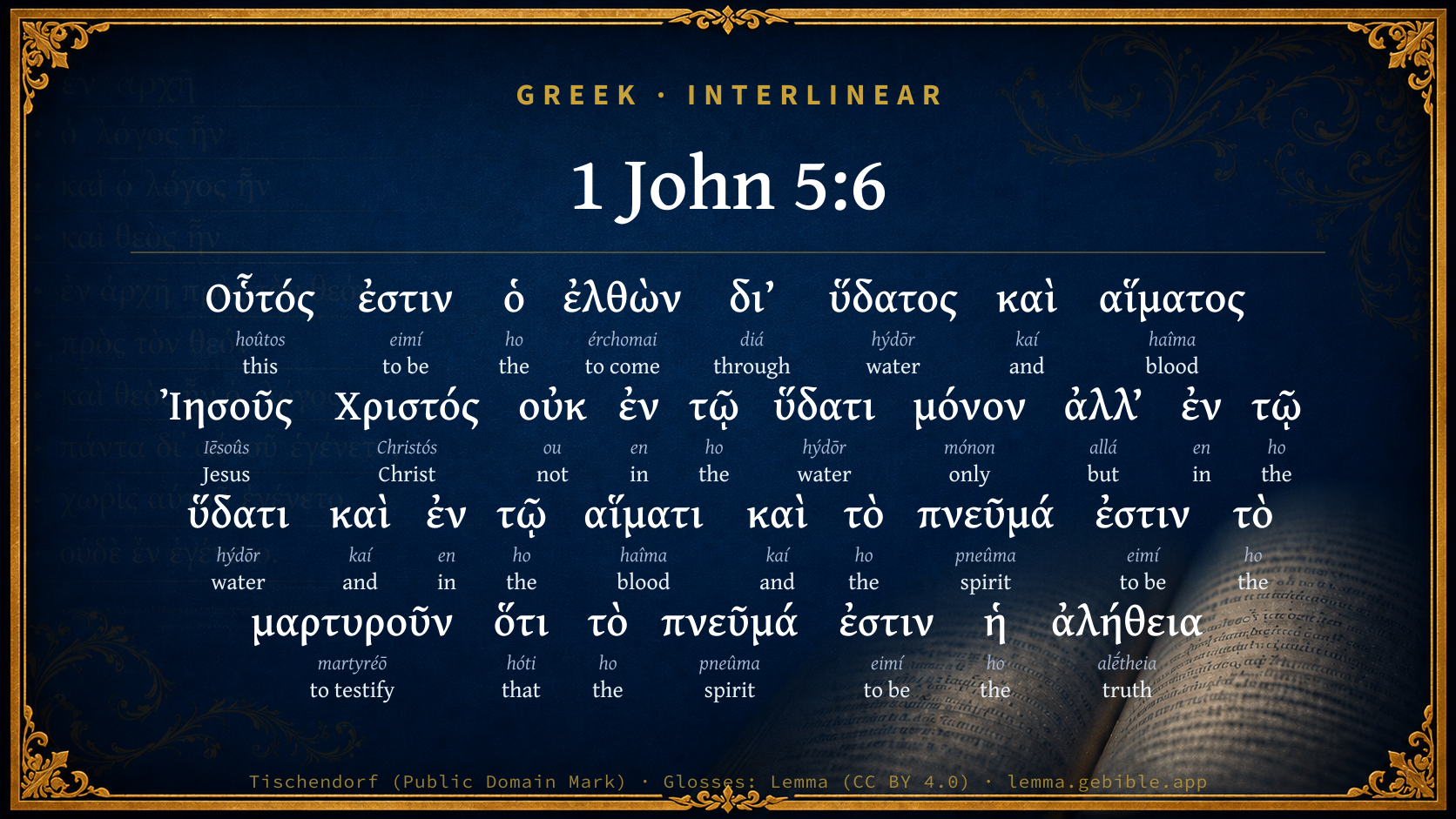
  1. Οὗτός hoûtos G3778 “this” Demonstrative pronoun, Nominative, Singular, Masculine
  2. ἐστιν eimí G1510 “to be” Verb, Present, Active, Indicative, 3rd person, Singular
  3. ὁ ho G3588 “the” Article, Nominative, Singular, Masculine
  4. ἐλθὼν érchomai G2064 “to come” Verb, Aorist, Active, Participle, Nominative, Singular, Masculine
  5. δι’ diá G1223 “through” Preposition
  6. ὕδατος hýdōr G5204 “water” Noun, Genitive, Singular, Neuter
  7. καὶ kaí G2532 “and” Conjunction
  8. αἵματος haîma G129 “blood” Noun, Genitive, Singular, Neuter
  9. Ἰησοῦς Iēsoûs G2424 “Jesus” Noun, Nominative, Singular, Masculine
  10. Χριστός Christós G5547 “Christ” Noun, Nominative, Singular, Masculine
  11. οὐκ ou G3756 “not” Particle, Negative
  12. ἐν en G1722 “in” Preposition
  13. τῷ ho G3588 “the” Article, Dative, Singular, Neuter
  14. ὕδατι hýdōr G5204 “water” Noun, Dative, Singular, Neuter
  15. ἀλλ’ allá G235 “but” Conjunction
  16. ἐν en G1722 “in” Preposition
  17. τῷ ho G3588 “the” Article, Dative, Singular, Neuter
  18. ὕδατι hýdōr G5204 “water” Noun, Dative, Singular, Neuter
  19. καὶ kaí G2532 “and” Conjunction
  20. ἐν en G1722 “in” Preposition
  21. τῷ ho G3588 “the” Article, Dative, Singular, Neuter
  22. αἵματι haîma G129 “blood” Noun, Dative, Singular, Neuter
  23. καὶ kaí G2532 “and” Conjunction
  24. τὸ ho G3588 “the” Article, Nominative, Singular, Neuter
  25. πνεῦμά pneûma G4151 “spirit” Noun, Nominative, Singular, Neuter
  26. ἐστιν eimí G1510 “to be” Verb, Present, Active, Indicative, 3rd person, Singular
  27. τὸ ho G3588 “the” Article, Nominative, Singular, Neuter
  28. μαρτυροῦν martyréō G3140 “to testify” Verb, Present, Active, Participle, Nominative, Singular, Neuter
  29. ὅτι hóti G3754 “that” Conjunction
  30. τὸ ho G3588 “the” Article, Nominative, Singular, Neuter
  31. πνεῦμά pneûma G4151 “spirit” Noun, Nominative, Singular, Neuter
  32. ἐστιν eimí G1510 “to be” Verb, Present, Active, Indicative, 3rd person, Singular
  33. ἡ ho G3588 “the” Article, Nominative, Singular, Feminine
  34. ἀλήθεια alḗtheia G225 “truth” Noun, Nominative, Singular, Feminine

About this verse

These counts appear in no published source. They are computed here, from the morphology-tagged text and Lemma’s own curated glosses. What Lemma adds →

35
words
18
distinct lemmas
General Epistles
section

Repetition

Words recur within this verse:

  • ἐστιν to be G1510 ×3
  • ὕδατος water G5204 ×3
  • αἵματος blood G129 ×2
  • πνεῦμά spirit G4151 ×2
  • ὁ the G3588 ×8
  • καὶ and G2532 ×3
  • ἐν in G1722 ×3

Cross-references

38

Topical passages linked to 1 John 5:6 in the Treasury of Scripture Knowledge — connected by theme and wording, ordered by reader-vote popularity; previews shown in the World English Bible.

  • John 15:26 "When the Counselor has come, whom I will send to you from the Father, the Spirit of truth, who proceeds from the Father, he will testify about me.
  • Hebrews 9:14 how much more will the blood of Christ, who through the eternal Spirit offered himself without blemish to God, cleanse your conscience from dead works to serve the living God?
  • John 16:13 However when he, the Spirit of truth, has come, he will guide you into all truth, for he will not speak from himself; but whatever he hears, he will speak. He will declare to you things that are coming.
  • Mark 14:24 He said to them, "This is my blood of the new covenant, which is poured out for many.
  • John 14:17 the Spirit of truth, whom the world can't receive; for it doesn't see him, neither knows him. You know him, for he lives with you, and will be in you.
  • Hebrews 12:24 to Jesus, the mediator of a new covenant, and to the blood of sprinkling that speaks better than that of Abel.
  • Luke 22:20 Likewise, he took the cup after supper, saying, "This cup is the new covenant in my blood, which is poured out for you.
  • Leviticus 17:11 For the life of the flesh is in the blood; and I have given it to you on the altar to make atonement for your souls: for it is the blood that makes atonement by reason of the life.
  • Ezekiel 36:25 I will sprinkle clean water on you, and you shall be clean: from all your filthiness, and from all your idols, will I cleanse you.
  • Matthew 26:28 for this is my blood of the new covenant, which is poured out for many for the remission of sins.
  • John 4:14 but whoever drinks of the water that I will give him will never thirst again; but the water that I will give him will become in him a well of water springing up to eternal life."
  • Hebrews 13:20 Now may the God of peace, who brought again from the dead the great shepherd of the sheep with the blood of an eternal covenant, our Lord Jesus,
  • 1 Peter 1:2 according to the foreknowledge of God the Father, in sanctification of the Spirit, that you may obey Jesus Christ and be sprinkled in his blood: Grace to you and peace be multiplied.
  • Revelation 5:9 They sang a new song, saying, "You are worthy to take the book, And to open its seals: For you were killed, And bought us for God with your blood, Out of every tribe, language, people, and nation,
  • Revelation 7:14 I told him, "My lord, you know." He said to me, "These are those who came out of the great tribulation. They washed their robes, and made them white in the Lamb's blood.
  • Zechariah 9:11 As for you also, Because of the blood of your covenant, I have set free your prisoners from the pit in which is no water.
  • John 3:5 Jesus answered, "Most assuredly I tell you, unless one is born of water and spirit, he can't enter into the Kingdom of God!
  • John 4:10 Jesus answered her, "If you knew the gift of God, and who it is who says to you, 'Give me a drink,' you would have asked him, and he would have given you living water."
  • John 6:55 For my flesh is food indeed, and my blood is drink indeed.
  • John 19:34–35 However one of the soldiers pierced his side with a spear, and immediately blood and water came out.
  • Ephesians 1:7 in whom we have our redemption through his blood, the forgiveness of our trespasses, according to the riches of his grace,
  • Ephesians 5:25–27 Husbands, love your wives, even as Christ also loved the assembly, and gave himself up for it;
  • Titus 3:5 not by works of righteousness, which we did ourselves, but according to his mercy, he saved us, through the washing of regeneration and renewing by the Holy Spirit,
  • 1 John 1:7 But if we walk in the light, as he is in the light, we have fellowship with one another, and the blood of Jesus Christ, his Son, cleanses us from all sin.
  • Isaiah 45:3–4 and I will give you the treasures of darkness, and hidden riches of secret places, that you may know that it is I, Yahweh, who call you by your name, even the God of Israel.
  • John 1:31–33 I didn't know him, but for this reason I came baptizing in water: that he would be revealed to Israel."
  • John 7:38–39 He who believes in me, as the Scripture has said, from within him will flow rivers of living water."
  • Acts 8:36 As they went on the way, they came to some water, and the eunuch said, "Behold, here is water. What is keeping me from being baptized?"
  • Romans 3:25 whom God set forth to be an atoning sacrifice, through faith in his blood, for a demonstration of his righteousness through the passing over of prior sins, in God's forbearance;
  • Hebrews 9:7 but into the second the high priest alone, once in the year, not without blood, which he offers for himself, and for the errors of the people.
  • Hebrews 10:29 How much worse punishment, do you think, will he be judged worthy of, who has trodden under foot the Son of God, and has counted the blood of the covenant with which he was sanctified an unholy thing, and has insulted the Spirit of grace?
  • 1 Peter 3:21 This is a symbol of baptism, which now saves you-- not the putting away of the filth of the flesh, but the answer of a good conscience toward God, through the resurrection of Jesus Christ,
  • 1 John 5:7–8 For there are three who testify:
  • Revelation 1:5 and from Jesus Christ, the faithful witness, the firstborn of the dead, and the ruler of the kings of the earth. To him who loves us, and washed us from our sins by his blood;
  • John 14:6 Jesus said to him, "I am the way, the truth, and the life. No one comes to the Father, except through me.
  • Colossians 1:4 having heard of your faith in Christ Jesus, and of the love which you have toward all the saints,
  • 1 Timothy 3:16 Without controversy, the mystery of godliness is great: God was revealed in the flesh, Justified in the spirit, Seen by angels, Preached among the nations, Believed on in the world, And received up in glory.
  • 1 John 4:10 In this is love, not that we loved God, but that he loved us, and sent his Son as the atoning sacrifice for our sins.

Cross-references courtesy of OpenBible.info (CC BY 4.0).

Commentary

Notes on 1 John 5:6 from classic Christian and Jewish commentators (each source and its license shown beneath its notes). The classic Christian expositions comment on the surrounding passage and are grouped to its opening verse, so a note may address several verses; the Jewish commentaries on the Tanakh (Rashi and others) are per-verse, so they appear only where the commentator wrote on this verse.

Lemma curates 59 commentaries, every one of them public domain or Creative Commons licensed, each selected and text-cleaned for this edition rather than reprinted as found. About our sources →

Matthew Henry's Commentary

The faith of the Christian believer (or the believer in Christ) being thus mighty and victorious, it had need to be well founded, to be furnished with unquestionable celestial evidence concerning the divine mission, authority, and office of the Lord Jesus; and it is so; he brings his credentials along with him, and he brings them in a way by which he came and in the witness that attends him.

I. In the way and manner by which he came; not barely by which he came into the world, but by and with which he came, and appeared, and acted, as a Saviour in the world: This is he that came by water and blood. He came to save us from our sins, to give us eternal life, and bring us to God; and, that he might the more assuredly do this, he came by, or with, water and blood. Even Jesus Christ; Jesus Christ, I say, did so; and none but he. And I say it again, not by or with water only, but by and with water and blood, Jo1 5:6. Jesus Christ came with water and blood, as the notes and signatures of the true effectual Saviour of the world; and he came by water and blood as the means by which he would heal and save us. That he must and did thus come in his saving office may appear by our remembering these things: -

1. We are inwardly and outwardly defiled. (1.) Inwardly, by the power and pollution off sin and in our nature. For our cleansing from this we need spiritual water; such as can reach the soul and the powers of it. Accordingly, there is in and by Christ Jesus the washing of regeneration and the renewing of the Holy Ghost. And this was intimated to the apostles by our Lord, when he washed their feet, and said to Peter, who refused to be washed, Except I wash thee, thou hast no part in me. (2.) We are defiled outwardly, by the guilt and condemning power of sin upon our persons. By this we are separated from God, and banished from his favourable, gracious, beatific presence for ever. From this we must be purged by atoning blood. It is the law or determination in the court of heaven that without shedding of blood there shall be no remission, Heb 9:22. The Saviour from sin therefore must come with blood.

2. Both these ways of cleansing were represented in the old ceremonial institutions of God. Persons and things must be purified by water and blood. There were divers washings and carnal ordinances imposed till the time of reformation, Heb 9:10. The ashes of a heifer, mixed with water, sprinkling the unclean, sanctifieth to the purifying of the flesh, Heb 9:13; Num 19:9. And likewise almost all things are, by the law, purged with blood, Heb 9:22. As those show us our double defilement, so they indicate the Saviour's two-fold purgation.

3. At and upon the death of Jesus Christ, his side being pierced with a soldier's spear, out of the wound there immediately issued water and blood. This the beloved apostle saw, and he seems to have been affected with the sight; he alone records it, and seems to reckon himself obliged to record it, and seems to reckon himself obliged to record it, as containing something mysterious in it: And he that saw it bore record, and his record is true. And he knoweth, being an eye-witness, that he saith true, that you might believe, and that you might believe this particularly, that out of his pierced side forthwith there came water and blood, Joh 19:34, Joh 19:35. Now this water and blood are comprehensive of all that is necessary and effectual to our salvation. By the water our souls are washed and purified for heaven and the region of saints in light. By the blood God is glorified, his law is honoured, and his vindictive excellences are illustrated and displayed. Whom God hath set forth, or purposed, or proposed, a propitiation through faith in his blood, or a propitiation in or by his blood through faith, to declare his righteousness, that he may be just, and the justifier of him that believeth in Jesus, Rom 3:25, Rom 3:26. By the blood we are justified, reconciled, and presented righteous to God. By the blood, the curse of the law being satisfied, and purifying Spirit is obtained for the internal ablution of our natures. Christ hath redeemed us from the curse of the law, that the blessing of Abraham might come on the Gentiles, that we might receive the promise of the Spirit, the promised Spirit, through faith, Gal 3:13, etc. The water, as well as the blood, issued out of the side of the sacrificed Redeemer. The water and the blood then comprehend all things that can be requisite to our salvation. They will consecrate and sanctify to that purpose all that God shall appoint or make use of in order to that great end. He loved the church, and gave himself for it, that he might sanctify and cleanse it with the washing of water by the word, that he might present it to himself a glorious church, Eph 5:25-27. He who comes by water and blood is an accurate perfect Saviour. And this is he who comes by water and blood, even Jesus Christ! Thus we see in what way and manner, or, if you please, with what utensils, he comes. But we see his credentials also,

II. In the witness that attends him, and that is, the divine Spirit, that Spirit to whom the perfecting of the works of God is usually attributed: And it is the Spirit that beareth witness, Jo1 5:6. It was meet that the commissioned Saviour of the world should have a constant agent to support his work, and testify of him to the world. It was meet that a divine power should attend him, his gospel, and servants; and notify to the world upon what errand and office they came, and by what authority they were sent: this was done in and by the Spirit of God, according to the Saviour's own prediction, "He shall glorify me, even when I shall be rejected and crucified by men, for he shall receive or take of mine. He shall not receive my immediate office; he shall not die and rise again for you; but he shall receive of mine, shall proceed on the foundation I have laid, shall take up my institution, and truth, and cause, and shall further show it unto you, and by you to the world," Joh 16:14. And then the apostle adds the commendation or the acceptableness of this witness: Because the Spirit is truth, Jo1 5:6. He is the Spirit of God, and cannot lie. There is a copy that would afford us a very suitable reading thus: because, or that, Christ is the truth. And so it indicates the matter of the Spirit's testimony, the thing which he attests, and that is, the truth of Christ: And it is the Spirit that beareth witness that Christ is the truth; and consequently that Christianity, or the Christian religion, is the truth of the day, the truth of God. But it is meet that one or two copies should alter the text; and our present reading is very agreeable, and so we retain it. The Spirit is truth. He is indeed the Spirit of truth, Joh 14:17. And that the Spirit is truth, and a witness worthy of all acceptation, appears in that he is a heavenly witness, or one of the witnesses that in and from heaven bore testimony concerning the truth and authority of Christ. Because (or for) there are three that bear record in heaven, the Father, the Word, and the Holy Ghost, and these three are one. And so Jo1 5:7 most appositely occurs, as a proof of the authenticity of the Spirit's testimony; he must needs be true, or even truth itself, if he be not only a witness in heaven, but even one (not in testimony only, for so an angel may be, but in being and essence) with the Father and the Word. But here,

1. We are stopped in our course by the contest there is about the genuineness of Jo1 5:7. It is alleged that many old Greek manuscripts have it not. We shall not here enter into the controversy. It should seem that the critics are not agreed what manuscripts have it and what not; nor do they sufficiently inform us of the integrity and value of the manuscripts they peruse. Some may be so faulty, as I have an old printed Greek Testament so full of errata, that one would think no critic would establish a various lection thereupon. But let the judicious collators of copies manage that business. There are some rational surmises that seem to support the present text and reading. As,

(1.) If we admit Jo1 5:8, in the room of Jo1 5:7, it looks too like a tautology and repetition of what was included in Jo1 5:6, This is he that came by water and blood, not by water only, but by water and blood; and it is the Spirit that beareth witness. For there are three that bear witness, the Spirit, the water, and the blood. This does not assign near so noble an introduction of these three witnesses as our present reading does.

(2.) It is observed that many copies read that distinctive clause, upon the earth: There are three that bear record upon the earth. Now this bears a visible opposition to some witness or witnesses elsewhere, and therefore we are told, by the adversaries of the text, that this clause must be supposed to be omitted in most books that want Jo1 5:7. But it should for the same reason be so in all. Take we Jo1 5:6, This is he that came by water and blood. And it is the Spirit that beareth witness, because the Spirit is truth. It would not now naturally and properly be added, For there are three that bear record on earth, unless we should suppose that the apostle would tell us that all the witnesses are such as are on earth, when yet he would assure us that one is infallibly true, or even truth itself.

(3.) It is observed that there is a variety of reading even in the Greek text, as in Jo1 5:7. Some copies read hen eisi - are one; others (at least the Complutensian) eis to hen eisin - are to one, or agree in one; and in Jo1 5:8 (in that part that it is supposed should be admitted), instead of the common en tē gē - in earth, the Complutensian reads epi tēs gēs - upon earth, which seems to show that that edition depended upon some Greek authority, and not merely, as some would have us believe, upon the authority either of the vulgar Latin or of Thomas Aquinas, though his testimony may be added thereto.

(4.) The seventh verse is very agreeable to the style and the theology of our apostle; as, [1.] He delights in the title the Father, whether he indicates thereby God only, or a divine person distinguished from the Son. I and the Father are one. And Yet I am not alone; because the Father is with me. I will pray the Father, and he shall give you another comforter. If any man love the world, the love of the Father is not in him. Grace be with you, and peace from God the Father, and from the Lord Jesus Christ, the Son of the Father, Jo2 1:3. Then, [2.] The name the Word is known to be almost (if not quite) peculiar to this apostle. Had the text been devised by another, it had been more easy and obvious, from the form of baptism, and the common language of the church, to have used the name Son instead of that of the Word. As it is observed that Tertullian and Cyprian use that name, even when they refer to this verse; or it is made an objection against their referring to this verse, because they speak of the Son, not the Word; and yet Cyprian's expression seems to be very clear by the citation of Facundus himself. Quod Johannis apostoli testimonium beatus Cyprianus, Carthaginensis antistes et martyr, in epistol sive libro, quem de Trinitate scripsit, de Patre, Filio, et Spiritu sancto dictum intelligit; ait enim, Dicit Dominus, Ego et Pater unum sumus; et iterum de Patre, Filio, et Spiritu sancto scriptum est, Et hi tres unum sunt. - Blessed Cyprian, the Carthaginian bishop and martyr, in the epistle or book he wrote concerning the Trinity, considered the testimony of the apostle John as relating to the Father, the Son, and Holy Spirit; for he says, the Lord says, I and the Father are one; and again, of the Father, the Son, and the Holy Spirit it is written, And these three are one. Now it is nowhere written that these are one, but in Jo1 5:7. It is probable than that St. Cyprian, either depending on his memory, or rather intending things more than words, persons more than names, or calling persons by their names more usual in the church (both in popular and polemic discourses), called the second by the name of the Son rather than of the Word. If any man can admit Facundus's fancy, that Cyprian meant that the Spirit, the water, and the blood, were indeed the Father, Word, and Spirit, that John said were one, he may enjoy his opinion to himself. For, First, He must suppose that Cyprian not only changed all the names, but the apostle's order too. For the blood (the Son), which Cyprian puts second, the apostle puts last. And, Secondly, He must suppose that Cyprian thought that by the blood which issued out of the side of the Son the apostle intended the Son himself, who might as well have been denoted by the water, - that by the water, which also issued from the side of the Son, the apostle intended the person of the Holy Ghost, - that by the Spirit, which in v. 6 is said to be truth, and in the gospel is called the Spirit of truth, the apostle meant the person of the Father, though he is nowhere else so called when joined with the Son and the Holy Ghost. We require good proof that the Carthaginian father could so understand the apostle. He who so understands him must believe too that the Father, Son, and Holy Spirit, are said to be three witnesses on earth. Thirdly, Facundus acknowledges that Cyprian says that of his three it is written, Et hi tres unum sunt - and these three are one. Now these are the words, not of Jo1 5:8, but of Jo1 5:7. They are not used concerning the three on earth, the Spirit, the water, and the blood; but the three in heaven, the Father, and the Word, and the Holy Ghost. So we are told that the author of the book De baptismo haereticorum, allowed to be contemporary with Cyprian, cites John's words, agreeably to the Greek manuscripts and the ancient versions, thus: Ait enim Johannes de Domino nostro in epistol nos docens, Hic es qui venit per aquam et sanguinem, Jesus Christus, non in aqu tantum, sed in aqu et sanguine; et Spiritus est qui testimonium perhibet, quia Spiritus est veritas; quia tres testimonium perhibent, Spiritus et aqua et sanguis, et isti tres in unum sunt - For John, in his epistle, says concerning our Lord, This is he, Jesus Christ, who came by water and blood, not in water only, but in water and blood; and it is the Spirit that bears witness, because the Spirit is truth; for there are three that bear witness, the Spirit, the water, and the blood, and these three agree in one. If all the Greek manuscripts and ancient versions say concerning the Spirit, the water, and the blood, that in unum sunt - they agree in one, then it was not of them that Cyprian spoke, whatever variety there might be in the copies in his time, when he said it is written, unum sunt - they are one. And therefore Cyprian's words seem still to be a firm testimony to v. 7, and an intimation likewise that a forger of the text would have scarcely so exactly hit upon the apostolical name for the second witness in heaven, the Word. Them, [3.] As only this apostle records the history of the water and blood flowing out of the Saviour's side, so it is he only, or he principally, who registers to us the Saviour's promise and prediction of the Holy spirit's coming to glorify him, and to testify of him, and to convince the world of its own unbelief and of his righteousness, as in his gospel, Joh 14:16, Joh 14:17, Joh 14:26; Joh 15:26; Joh 16:7-15. It is most suitable then to the diction and to the gospel of this apostle thus to mention the Holy Ghost as a witness for Jesus Christ. Then,

(5.) It was far more easy for a transcriber, by turning away his eye, or by the obscurity of the copy, it being obliterated or defaced on the top or bottom of a page, or worn away in such materials as the ancients had to write upon, to lose and omit the passage, than for an interpolator to devise and insert it. He must be very bold and impudent who could hope to escape detection and shame; and profane too, who durst venture to make an addition to a supposed sacred book. And,

(6.) It can scarcely be supposed that, when the apostle is representing the Christian's faith in overcoming the world, and the foundation it relies upon in adhering to Jesus Christ, and the various testimony that was attended him, especially when we consider that he meant to infer, as he does (Jo1 5:9), If we receive the witness of men, the witness of God is greater; for this (which he had rehearsed before) is the witness of God which he hath testified of his Son. Now in the three witnesses on earth there is neither all the witness of God, nor indeed any witness who is truly and immediately God. The antitrinitarian opposers of the text will deny that either the Spirit, or the water, or the blood, is God himself; but, upon our present reading, here is a noble enumeration of the several witnesses and testimonies supporting the truth of the Lord Jesus and the divinity of his institution. Here is the most excellent abridgment or breviate of the motives to faith in Christ, of the credentials the Saviour brings with him, and of the evidences of our Christianity, that is to be found, I think, in the book of God, upon which single account, even waiving the doctrine of the divine Trinity, the text is worthy of all acceptation.

2. Having these rational grounds on out side, we proceed. The apostle, having told us that the Spirit that bears witness to Christ is truth, shows us that he is so, by assuring us that he is in heaven, and that there are others also who cannot but be true, or truth itself, concurring in testimony with him: For there are three that bear record in heaven, the Father, the Word, and the Holy Ghost, and these three are one, Jo1 5:7.

(1.) Here is a trinity of heavenly witnesses, such as have testified and vouched to the world the veracity and authority of the Lord Jesus in his office and claims, where, [1.] The first that occurs in order is the Father; he set his seal to the commission of the Lord Christ all the while he was here; more especially, First, In proclaiming him at his baptism, Mat 3:17. Secondly, In confirming his character at the transfiguration, Mat 17:5. Thirdly, In accompanying him with miraculous power and works: If I do not the works of my Father, believe me not; but if I do, though you believe not me, believe the works, that you may know and believe that the Father is in me, and I in him, Joh 10:37, Joh 10:38. Fourthly, In avouching at his death, Mat 27:54. Fifthly, In raising him from the dead, and receiving him up to his glory: He shall convince the world - of righteousness, because I go to my Father, and you see me no more, Joh 16:10, and Rom 1:4. [2.] The second witness in the Word, a mysterious name, importing the highest nature that belongs to the Saviour of Jesus Christ, wherein he existed before the world was, whereby he made the world, and whereby he was truly God with the Father. He must bear witness to the human nature, or to the man Christ Jesus, in and by whom he redeemed and saved us; and he bore witness, First, By the mighty works that he wrought. Joh 5:17, My Father worketh hitherto, and I work. Secondly, In conferring a glory upon him at his transfiguration. And we beheld his glory, the glory as of the only-begotten of the Father, Joh 1:14. Thirdly, In raising him from the dead. Joh 2:19, Destroy this temple, and in three days will I raise it up. [3.] The third witness is the Holy Ghost, or the Holy Spirit, and august, venerable name, the possessor, proprietor, and author of holiness. True and faithful must he be to whom the Spirit of holiness sets his seal and solemn testimony. So he did to the Lord Jesus, the head of the Christian world; and that in such instances as these: - First, In the miraculous production of his immaculate human nature in the virgin's womb. The Holy Ghost shall come upon thee, Luk 1:35, etc. Secondly, In the visible descent upon him at his baptism. The Holy Ghost descended in a bodily shape, Luk 3:22, etc. Thirdly, In an effectual conquest of the spirits of hell and darkness. If I cast out devils by the Spirit of God, then the kingdom of God has come unto you, Mat 12:28. Fourthly, In the visible potent descent upon the apostles, to furnish them with gifts and powers to preach him and his gospel to the world after he himself had gone to heaven, Act 1:4, Act 1:5; Act 2:2-4, etc. Fifthly, In supporting the name, gospel, and interest of Christ, by miraculous gifts and operations by and upon the disciples, and in the churches, for two hundred years (Co1 12:7), concerning which see Dr. Whitby's excellent discourse in the preface to the second volume of his Commentary on the New Testament. These are witnesses in heaven; and they bear record from heaven; and they are one, it should seem, not only in testimony (for that is implied in their being three witnesses to one and the same thing), but upon a higher account, as they are in heaven; they are one in their heavenly being and essence; and, if one with the Father, they must be one God.

(2.) To these there is opposed, though with them joined, a trinity of witnesses on earth, such as continue here below: And there are three that bear witness on earth, the spirit, the water, and the blood; and these three agree in one, Jo1 5:8. [1.] Of these witnesses the first is the spirit. This must be distinguished from the person of the Holy Ghost, who is in heaven. We must say then, with the Saviour (according to what is reported by this apostle), that which is born of the Spirit is spirit, Joh 3:6. The disciples of the Saviour are, as well as others, born after the flesh. They come into the world endued with a corrupt carnal disposition, which is enmity to God. This disposition must be mortified and abolished. A new nature must be communicated. Old lusts and corruptions must be eradicated, and the true disciple become a new creature. The regeneration or renovation of souls is a testimony to the Saviour. It is his actual though initial salvation. It is a testimony on earth, because it continues with the church here, and is not performed in that conspicuous astonishing manner in which signs from heaven are accomplished. To this Spirit belong not only the regeneration and conversion of the church, but its progressive sanctification, victory over the world, her peace, and love, and joy, and all that grace by which she is made meet for the inheritance of the saints in light. [2.] The second is the water. This was before considered as a means of salvation, now as a testimony to the Saviour himself, and intimates his purity and purifying power. And so it seems to comprehend, First, The purity of his own nature and conduct in the world. He was holy, harmless, and undefiled. Secondly, The testimony of John's baptism, who bore witness of him, prepared a people for him, and referred them to him, Mar 1:4, Mar 1:7, Mar 1:8. Thirdly, The purity of his own doctrine, by which souls are purified and washed. Now you are clean through the word that I have spoken unto you, Joh 15:3. Fourthly, The actual and active purity and holiness of his disciples. His body is the holy catholic church. Seeing you have purified your souls in obeying the truth through the Spirit, Pe1 1:22. And this signed and sealed by, Fifthly, The baptism that he has appointed for the initiation or introduction of his disciples, in which he signally (or by that sign) says, Except I wash thee, thou hast no part in me. Not the putting away of the filth of the flesh, but the answer of a good conscience towards God, Pe1 3:21. [3.] The third witness is the blood; this he shed, and this was our ransom. This testifies for Jesus Christ, First, In that it sealed up and finished the sacrifices of the Old Testament, Christ, our Passover, was sacrificed for us. Secondly, In that it confirmed his own predictions, and the truth of all his ministry and doctrine, Joh 18:37. Thirdly, In that it showed unparalleled love to God, in that he would die a sacrifice to his honour and glory, in making atonement for the sins of the world, Joh 14:30, Joh 14:31. Fourthly, In that it demonstrated unspeakable love to us; and none will deceive those whom they entirely love, Joh 14:13-15. Fifthly, In that it demonstrated the disinterestedness of the Lord Jesus as to any secular interest and advantage. No impostor and deceiver ever proposes to himself contempt and a violent cruel death, Joh 18:36. Sixthly, In that it lays obligation on his disciple to suffer and die for him. No deceiver would invite proselytes to his side and interest at the rate that the Lord Jesus did. You shall be hated of all men for my sake. They shall put you out of their synagogues; and the time comes that whosoever kills you will think that he doeth God service, Joh 16:2. He frequently calls his servants to a conformity with him in sufferings: Let us go forth therefore unto him without the camp, bearing his reproach, Heb 13:13. This shows that neither he nor his kingdom is of this world. Seventhly, The benefits accruing and procured by his blood (well understood) must immediately demonstrate that he is indeed the Saviour of the world. And then, Eighthly, These are signified and sealed in the institution of his own supper: This is my blood of the New Testament (which ratifies the New Testament), which is shed for many, for the remission of sins, Mat 26:28. Such are the witnesses on earth. Such is the various testimony given to the author of our religion. No wonder if the rejector of all this evidence he judged as a blasphemer of the Spirit of God, and be left to perish without remedy in his sins. These three witnesses (being more different than the three former) are not so properly said to be one as to be for one, to be for one and the same purpose and cause, or to agree in one, in one and the same thing among themselves, and in the same testimony with those who bear record from heaven.

III. The apostle justly concludes, If we receive the witness of men, the witness of God is greater; for this is the witness of God, that he hath testified of his Son, Jo1 5:9. Here we have, 1. A supposition well founded upon the premises. Here is the witness of God, the witness whereby God hath testified of his Son, which surely must intimate some immediate irrefragable testimony, and that of the Father concerning his Son; he has by himself proclaimed and avouched him to the world. 2. The authority and acceptableness of his testimony; and that argued from the less to the greater: If we receive the witness of men (and such testimony is and must be admitted in all judicatories and in all nations), the witness of God is greater. It is truth itself, of highest authority and most unquestionable infallibility. And then there is, 3. The application of the rule to the present case: For this is the witness, and here is the witness of God even of the Father, as well as of the Word and Spirit, which he hath testified of, and wherein he hath attested, his Son. God, that cannot lie, hath given sufficient assurance to the world that Jesus Christ is his Son, the Son of his love, and Son by office, to reconcile and recover the world unto himself; he testified therefore the truth and divine origin of the Christian religion, and that it is the sure appointed way and means of bringing us to God.

Matthew Henry's Commentary on the Whole Bible (1708–1710) — public domain (CC PDM 1.0). Text via the HelloAO Bible API.

The Biblical Illustrator

Joseph S. Exell

1Jn_5:6

This is He that came by water and blood, even Jesus Christ

Christ coming by water and blood

1.

There was living then at Ephesus a conspicuous and enterprising teacher, whom not a few were likely to regard as more profound and philosophical than St. John, who himself, very probably, looked down with superb indulgence on the aged Galilean as pious enough in his simple way, but quite uncultured, without any speculative ability,--with crude and unspiritual views of God and the universe, and wholly unfit to interpret Hebraic ideas to men who had breathed the air of Gnostic wisdom. One confusion, he would say, which John makes, must be most carefully avoided: you must draw a sharp distinction between Jesus and Christ. Jesus was simply a man eminent for wisdom and goodness, but not supernaturally born,--on whom, at His baptism, a heavenly power called Christ descended, to use Him as an instrument for revealing truth and working miracles, but to depart from Him before He suffered and died. Now St. John contradicts this absolutely. He insists that Jesus is Christ, that Jesus, who is Christ, is also the Son of God. You must, he says in effect, be quite clear in your minds on this point; Cerinthus has tried to break up one Person into two; you must keep no terms with that theory of separation; you must hold to the truth of the oneness. This one Jesus Christ came by water and blood; that is, His Baptism and His Passion were means to the end for which He came. The selfsame Person who stooped to the waters of Jordan gave up His blood to be shed for us on Golgotha. This is He, the one indivisible Christ, in whom to believe is to overcome the world.

2. But then comes in, we may be sure, a reference to underlying spiritual realities. Water and blood, in connection with Christ, could not but be invested in St. Johns mind with the ideas of cleansing and of propitiation, as when he saw the gush of blood and water from the side of the sacred body he was apparently struck with a combination which seemed to present in a kind of symbolical unity the purifying and the atoning aspect of Christs work. Many will accept Christ as a peerless model of conduct, and will honestly desire to guide their lives by the rule of His ethical teaching, who yet recoil from the mystery of what the apostles call propitiation, and explain away the emphasis with which apostles attribute virtue to His blood. And yet the theory which reduces the Atonement to a signal display of sympathy, whereby One who was Himself sinless identified Himself with the shame and misery of sinners in order to reclaim them, will be found to impair the belief in our Saviours personal Divinity, and fails to account for, or to justify, the mass of varied language by which Scripture conveys to us the significance of His death. No, believe it, both sides of truth are indispensable; our Lord was given to be a sacrifice; and also to be an example; and the dependence of purification on the Atonement may at least be illustrated by the order of those words, forthwith out of His side came blood and water.

3. But yet once more: when we hear that He came by water and blood, it is well-nigh impossible not to think of that great ordinance in which water is made the effectual sign, that is, the organ or instrument, of a new birth; and of that still greater rite which embodies for us, in a concrete form, the new and better covenant, and in which, as St. Augustine says, we drink that which was paid for us. By the mercifully considerate provision of Him who is God and man for us who have souls and bodies, the sacraments of the gospel, with their outward forms and inward gifts, are the chief means whereby His purifying and propitiating action is applied to those on whose behalf He came. The whole thought, then, unfolds itself symmetrically; the events of Christs baptism and death call up the idea of His two-fold spiritual activity, which again presents itself in close revealed connection with the laver or font of our regeneration, and with the cup which conveys to us the blood of the Great Sacrifice, and which, from that point of view, may naturally be taken to represent both kinds of the Holy Eucharist. And here, too, the warning sentence may be needed. The baptized Churchman who is not a communicant would do well to remember that Christ came not with water only, but with water and blood. (W. Bright, D. D.)

The water and the blood

By the form of the expression, not by water only, it is implied that there are two beliefs as to the object of Jesus Christs coming into the world--one of them going beyond the other, and taking in something that the other leaves out. There were probably those then, there are certainly those now, who would have no difficulty in accepting the main facts of Christs birth and biography, would admit Him to be a memorable teacher, a reformer of society, a leader among moralists and philanthropists; but they would allow nothing further in His claims, as the Head of the Church or the Saviour of mankind. They would probably declare that nothing further was needed to make men all that they ought to be. But they were wrong. Four thousand years of Jewish and Gentile self-righteousness had proved that there is no self-recovering power in humanity alone. First the water. Water is the emblem of spiritual purification, because it is the common instrument of outward washing. Our Lord Himself, who was able to set all symbols and all forms aside if He chose, went down into the water, at the beginning of His lifes work, in order, we are told, that He might fulfil all righteousness. He came by water. Go teach the nations of the earth and baptize them with water, was His last commission, when His work was done. So it is that each individual Christian life, as well as the whole body of Christ, after Him, came by water. Why is this? Because one great part of our Saviours work is to purify mens lives. He was baptized with their baptism, and they with His. The world was to sneer at Him, and spit upon Him, in spite of His purity: in being holy for them He will also be washed with them. He came by water. Accordingly one great part of the power of Christ among men, through the gospel and the Church, is the cleansing away of moral corruptions. He that hath this hope in Him purifieth himself. Stains on the lips, the hands, the habits; stains on social courtesies, domestic dispositions, and even on Church observances; worst of all, stains on the sacred temple walls of the soul itself--these all have to be washed away. Christ came to cleanse His followers from all unrighteousness. He came by water. But now shall we not only say, This is true, but shall we go on to say, This is all that our Saviour gives us, and this is the whole of His gospel: Christianity is a system of moral education and religious improvement; nothing more? This is He that came by water and blood; not by water only, but by water and blood. The daily sacrifice of four thousand preparatory years had presignified it to a waiting world. As the passion flower sprang out of the common earth, and held up its bright blossom and natural image of the tree at Calvary, ages before the real Cross was planted in its soil, so the passion promise of prophecy bloomed in the expectant faith of the race at the very gates of Eden. The serpent had polluted Paradise; but after all, the womans seed should bruise the serpents head. Man knew from the beginning that he must have a Saviour to look to, or humanity itself would die. Somewhere among the sons of men there must be One Perfect Obedience, One Sufficient Sacrifice, needing not, like those shadowy sacrifices which prepared the way, to be often offered, but once offered. Then a living and loving faith in Him will work out the true and healing life in every believing heart. There is a fountain opened for sin, and for uncleanness; but it is not a water fountain. Only he who doeth the deeds of the Law--so it reads--will live by them. Who of us has done them? Where are we then if there is water only, example and precept only, commandments only, sorrow upon sorrow when they are broken, and the breaking repeated still? Among the most remarkable of Overbecks striking series of pictures illustrating the life of Jesus, there is one that represents Him as a Child in the carpenters shop. Like other children, He has been playing with the tools, and has taken up the saw. A look of solemnity passes over His radiant face; and by the shadow that falls on the floor underneath you see that the block of wood He is sawing out is taking the shape of a cross. Joseph looks on in a kind of perplexed reverence, and the Virgin mother by His side with a sad admiration, as if Simeons prediction were already beginning to have its accomplishment, and the sword were piercing her own soul also. This is not imagination; it is rather interpretation. The artist is only an expositor of the evangelist. This is He that came by water and blood. From the outset of His personal ministry--as it had been from the foundation of the world--the Saviour was pointing to the sacrifice, journeying always towards Calvary. Other prophets and reformers had come by water, preaching purification for the future. He alone came by blood, giving, in Himself, atonement for past and future both. (Bp. Huntington.)

Redemption by blood

I. This is he that came by water. Our Lord came from Galilee to Jordan, a lengthened journey, for the purpose of being baptized. This shows the importance of the ordinance.

II. This is He that came by blood--not by water only, but by water and blood. The manner in which this announcement is made, is well fitted to impress us with its importance. The blood is noticed with peculiar emphasis. Important as it was, that Christ came by water, it was still more so that He came by blood. By the one He undertook the work, but by the other He executed it.

1. Christ came by blood that the prophecies might be fulfilled.

2. Christ came by blood, and so accomplished the design of the ancient law.

3. When Christ came by blood He secured all the blessings of redemption for His people.

4. When He came by blood He opened up a way of access for the sinner to God and to glory.

III. The confirmation of the spirits testimony. And it is the Spirit that beareth witness, because the Spirit is truth. The witness of the Spirit was borne to Christ during the whole period of His ministry. But the witness of which the text speaks points to that which was borne by the Spirit after the death of Christ. It began with His resurrection. He was quickened by the Spirit on the third, the appointed day. And oh, what a glorious testimony was borne to Him then (Col_2:15; Rom_1:4). This testimony was continued in His ascension. During His sojourn of forty days on earth, subsequent to His resurrection, Jesus spoke much of the Spirit to His disciples. Then, in due time, was the Spirit poured out from on high. On the Day of Pentecost He came in a rushing mighty wind, and in cloven tongues like as of fire. By the transactions of that day the triumphs of the Saviour were manifested to all. Nor did the Spirit then cease His testimony. He continued and increased it in the ministry of the apostles (Mar_16:20). (J. Morgan, D. D.)

The water and the blood; or complete purification

The design of Christs death was to procure both the justification and sanctification of the Church.

I. The first part of this design is declared by St. John, in this epistle (1Jn_1:7). Cleansing is a term which supposes defilement; and sin is, in Scripture, represented as horribly defiling, rendering the soul impure, odious, and abominable in the sight of God, who is perfectly pure and holy. If we are duly sensible of our sinful defilement, we shall certainly be anxious for cleansing. And how can this be obtained? The tears of repentance will not wash away our sins. Nor is mere reformation and moral improvement sufficient. But, behold the Divine provision! Behold the precious blood issuing from the wounded side of the Son of God! The blood of which we speak, procures the justification of all who believe. We are said to be justified through faith in His (Christs) blood; elsewhere, to be brought nigh by His blood; and again, to be redeemed by His blood; and to be washed from our sins in His blood. But it is through faith that we are thus justified; Jesus Christ is the propitiation for our sins: but it is through faith in His blood; it must be received by every man, for himself, in particular. The perfect efficacy of this blood is frequently expressed in Scripture in very strong terms: I have blotted out, saith God, thy sins, as a thick cloud. Though your sins be as scarlet, they shall be as white as snow. Yea, saith the penitent psalmist, Wash me, and I shall be whiter than snow; and again, As far as the east is from the west, so far hath He removed our transgressions from us. This is He that came by blood.

II. This is he that came by water. This signifies a second blessed effect of the death of Christ, the sanctification of believers, in virtue of that death.

1. It is by the mediation of Christ, meritoriously. We owe to Jesus Christ the renovation of our nature in the image of God; for He died to bring us to God; to redeem us to God (Eph_5:25; Eph_5:27).

2. It is through faith in Christ, instrumentally.

3. But it is efficiently, by the Holy Spirit, that believers are sanctified.

4. The sanctification of believers is promoted by the means of grace, as religious ordinances of Divine appointment are properly called.

5. To these we may add, the various afflictions with which God, in His holy providence, visits His people.

Conclusion:

1. Let us reflect, with becoming humility, on our natural defilement.

2. If we are by nature thus defiled, how necessary is it that we should be cleansed?

3. Let believers in Christ, already sanctified in part, still look to Jesus for further supplies of grace. (G. Burder.)

And it is the Spirit that beareth witness, because the Spirit is truth--

Grounds of faith in the resurrection

It is natural to ask, What is the evidence that Christ did really rise from the dead? St. John says, It is the Spirit that beareth witness. St. John, indeed, is speaking immediately of that faith in our Lords eternal Sonship which overcomes the world. But since the resurrection is the main proof of our Lords Divinity, it follows that the Spirit must also bear witness to the resurrection. And He does this in two ways. It is His work, that those historical proofs of the resurrection which have come down to us, and which address themselves to our natural reasoning faculties, have been marshalled, recognised, preserved, transmitted in the Church of Christ. He bears another witness, as we shall presently see, by His action, not so much on the intelligence, as on the will of the believing Christian.

I. In order to know that our Lord did really rise from the dead, we have to satisfy ourselves that three distinct questions can be answered.

1. Whether Jesus Christ did really die upon the Cross. The wonder is not that He died when He did, after hanging for three hours in agony, but that, after all His sufferings at the hands of the soldiers and the populace, before His crucifixion, He should have lived so long. Yet suppose that what looked like death on the Cross was only a fainting fit. Would He have survived the wound in His side, inflicted by the soldiers lance, through which the blood yet remaining in His heart and the water of the pericardium escaped? But suppose, against all this evidence, that when Jesus was taken down from the Cross, He was still living. Then He must have been suffocated by Joseph of Arimathaea and Nicodemus when they embalmed Him. The Jews carefully inspected and sealed His tomb: they had sentinels placed there; and were satisfied that the work was thoroughly done. To do them justice, the Jews have never denied the reality of our Lords death; it is impossible to do so, without paradox.

2. Whether the disciples did not take our Lords dead body out of His sepulchre.

(1) They would not have wished to do it. Why should they? They either believed that He would rise from the dead, or they did not. If they did believe it, they would have shrunk from disturbing His grave, as from an act not less unnecessary than profane. If they did not believe in it, and instead of abandoning themselves to unreflecting grief, allowed themselves to think steadily, what must have been their estimate of their dead Master? They must now have thought of Him as of one who had deceived them, or who was Himself deceived. On either supposition, why should they rouse the anger of the Jews, and incur the danger of swift and heavy punishment?

(2) But had they desired, they surely would not have dared it. Until Pentecost, they were, by their own account, very timid men.

(3) And, once more, had they desired and dared to remove our Lords body from its grave, such a feat was obviously beyond their power. The tomb was guarded by soldiers.

3. The amount of positive testimony which goes to show that Jesus Christ did rise from the dead.

(1) The witness of all the apostles. They gave their lives in attestation of this fact. Their conduct after the day of Pentecost is throughout that of men whose trustworthiness and sincerity of purpose are beyond dispute.

(2) The testimony of a large number of persons besides the apostles. Take the case of the three thousand converts on the day of Pentecost. They had unrivalled opportunities for satisfying themselves of its being a reality or a fiction. Yet at the risk of comfort, position, nay, life, they publicly professed their belief in its truth. Or consider the case of the two hundred and fifty and more persons still living when St. Paul wrote the First Epistle to the Corinthians, who had seen the risen Jesus on one occasion during the forty days. Five hundred persons could not be simultaneously deluded. Their testimony would be considered decisive as to any ordinary occurrence, where men wished only to ascertain the simple truth.

II. The force of this body of testimony is not really weakened by objections which do not directly challenge it, and which turn on accessory or subordinate points.

1. For instance, it is said that the evangelical accounts of the resurrection itself, and of our Lords subsequent appearances, are difficult to reconcile with each other. At first sight they are; but only at first sight. In order to reconcile them two things are necessary: first, patience, and secondly, a determination to exclude everything from the narrative which does not lie in the text of the Gospels. The differences are just what might be expected in four narratives of the same event, composed at different periods, by different authors, who had distinct sources of information at command. Each says what he has to say with blunt and simple directness, without an eye to the statements of the others, or to the possible comment of hostile critics.

2. It is, further, objected that the resurrection was not sufficiently public. Jesus Christ ought to have left His grave, so it is urged, in the sight of a crowd of lookers on; and, when risen, He ought to have hastened to show Himself to the persons least likely to believe in His resurrection--to the Jews at large, to the high priests, to Pilate, to His executioners.

(1) Here it is obvious, first of all, that the guards may very well have seen Jesus leave His tomb. Scripture says nothing on the point. But they were terrified, almost to death, at the sight of the angel of the sepulchre. Any number of witnesses who had been present would have been as much frightened as were the guards.

(2) Nor is the old objection of Celsus, that Jesus Christ ought to have shown Himself to the Jews and to His judges in order to rebuke their unbelief, more reasonable. Had He appeared to the chief priests, would they have believed in Him? Would they not have denied His identity, or argued that a devil had taken His form before their eyes, just as of old they had ascribed His miracles to Beelzebub? The Jews had ample opportunities of ascertaining that the resurrection was a fact, if they had desired to do so. But as it was, they were not in a mood to be convinced, even by the evidence of their senses.

(3) Far deeper than these objections is that which really lies against all miracles whatever, as being at variance with that conception of a rigid uniformity in the processes of nature, which is one of the intellectual fashions of our day. Suffice it to say, that any idea of natural law which is held to make a miracle impossible, is also inconsistent with belief in the existence of God.

III. Here, then, we are coming round to the point from which we started. For it is natural to ask, why, if the resurrection can be proved by evidence so generally sufficient, it was at the time, and is still, rejected by a great many intelligent men? The answer to this natural and legitimate question is of practical importance to all of us. There can, I apprehend, be no sort of doubt that if an ordinary historical occurrence, such as the death of Julius Caesar, were attested as clearly as the resurrection of our Lord--not more clearly, nor less--as having taken place nineteen centuries ago, all the world would believe it as a matter of course. The reason why the resurrection was not always believed upon the evidence of those who witnessed to it is, because to believe it means, for a consistent and thoughtful man, to believe in and to accept a great deal else. To believe the resurrection is to believe implicitly in the Christian faith. It is no mere speculative question whether Jesus Christ did or did not rise from the dead; it is an eminently practical one. The intellect is not more interested in it than the will; perhaps it is even less interested. The real difficulties of belief lie, generally speaking, with the will. And nothing is more certain, I may add, more alarming, than the power of the will to shape, check, promote, control conviction. And such is the power of the will that it can give effect to this decision. It can baulk and thwart the action of the intellect; give it a perverse twist, and even set it scheming how best to discredit or refute the truth which but now it was on the point of accepting. And thus we may understand what it is that the Spirit does to produce faith. He does not set aside or extinguish the operations of the natural reason; reason too is a guide to truth which God has given us. But He does change the temper, or the direction of the will. And thus He sets the reason free to do justice to the evidence before it. It is thus that within us the Spirit beareth witness. The evidence for the resurrection was not stronger on the Day of Pentecost than it was on the day before. But the descent of the Spirit made it morally possible for three thousand converts to do that evidence something like justice. And now we can see why St. Paul makes so much of faith--especially in a risen Christ--in his great Epistles. If the understanding were alone concerned there would be no more reason for our being justified by faith in a crucified and risen Christ than for our being justified by our assent to the conclusion of a problem in Euclid. It is because the will must endorse the verdict of the understanding, and so must mean obedience as well as assent, that by grace are ye saved through faith; and that not of yourselves: it is the gift of God. (Canon Liddon.)

The Spirits witness to Christ

There are five respects in which that Divine agent may be represented as bearing witness to Christ.

(1) He bore witness by the types and prophecies of the Jewish dispensation--both of which foretold Christs advent, character, and work.

(2) He bore witness by qualifying Christ, as man, for His mediatorial offices (Isa_11:1-3).

(3) The Spirit bore witness to Christ by the signs and wonders which He enabled the apostles to perform in attestation of their Divine commission.

(4) He bears witness to Christ in that Holy Bible which so clearly and impressively unfolds His glory and His grace.

(5) He bears witness also by revealing Gods Son in the soul--by bringing the gospel practically to bear on the understanding, the conscience, and the heart. (A. S. Patterson, D. D.)

The Biblical Illustrator, edited by Joseph S. Exell (c. 1880s–1900s) — public domain. Text from a community e-Sword module.

Joseph Benson's Commentary

1Jn 5:6. This is he that came by water and blood — Here the apostle evidently alludes to the testimony borne by him in his gospel, that when the soldier pierced Christ’s side, forthwith there came out blood and water; a fact which the apostle represents as of great importance; adding, He that saw it bare record, and his record is true: and he knoweth that he saith true, that ye might believe. It was important, not only, 1st, As being a full proof, in opposition to the doctrine of the Docetæ, that Christ came in the flesh, and really died; of which see on Joh 19:34 : but, 2d, Because it was emblematical of the offices which he sustained, and of the salvation he hath procured for his people. For the water was a symbol of the purity of his doctrine, instructing men in the purest morals, and of his own pure and holy example; and, what is of still greater importance, of the purifying grace of which he is the fountain, sanctifying and cleansing such as believe in him, from all filthiness of flesh and spirit: while the blood which issued from him was an emblem both of the sufferings which awaited his followers, who were to seal the truth with their blood, and of his own sufferings, whereby he hath made atonement for the sins of the world, and procured for his followers a free and full justification. Thus, as an eminent divine observes, he also manifested himself to be the Son of God, the promised Messiah, by fulfilling those types and ceremonies of the law which were performed by water and blood: the former whereof, denoting purification from sin, he fulfilled by cleansing us by his Spirit, (signified by water, Joh 7:38-39,) from the corruption of nature, and the power and pollution of sin, and so restoring the image of God in us, Eze 36:25; Eze 36:27; Eph 5:25-26; Tit 2:14; Tit 3:5. The latter, which prefigured the expiation of our sin, he fulfilled by shedding his blood to atone for our sins, and to procure for us deliverance from the guilt and punishment of them, (Rom 5:9; Gal 3:13; Eph 1:7,) and to restore us to the favour of God again. Not by water only — Not only was his doctrine pure, and his life holy, and not only may purifying grace be derived from him, but he came by blood, shed for the expiation of our guilt, for these things must go together; because it will not avail us to be enabled to avoid sin, and to live in a holy manner for the time to come, except the sins of the time past be expiated. And it is the Spirit that beareth witness — To these things, namely, in the writings of the ancient prophets, who have spoken largely concerning both, and in the discourses and writings of the apostles, who have borne a still more clear and full testimony to them; and also in the hearts of all the faithful, who, as they are fully convinced of their need of both pardon and holiness, so through the merits and Spirit of Christ they receive both.

Joseph Benson's Commentary on the Old and New Testaments (1811–1818) — public domain. Text from a community e-Sword module.

Whedon's Commentary on the Bible

Daniel D. Whedon

2. And Christ, divinely attested by the threefold, witnesses, is supremely worthy of faith, 1Jn_5:6-10.

6. This… Jesus, named in previous verse.

He that came—For this Jesus is truly the great he… that came. He was God’s predicted COMER; and his coming was the Advent. And he came, attested by two tokens divinely appointed, namely, water and blood. There have been many fanciful interpretations of the water and blood; but the best commentators now agree that the water was the water of Christ’s baptism, and the blood the propitiating blood of his crucifixion. And thus, as Huther well notes, the commencement and the ending of our Lord’s ministry are symbolized by these two elements. The came, therefore, refers not to his birth, but to his office and earthly life, which are thus one extended coming. Yet John uses the past tense came to denote that definite historical fact, and not any continuous spiritual coming through ages. The preposition by should rather be through, and the meaning is, that he came into manifestation and proof as Son of God and Messiah through these two attesting tokens.

Not by water only… blood—John the Baptist came by water only; not also by blood. His water would have been of no avail but for the Propitiator’s blood. It was the blood which, with its divine self-sacrifice by the Sufferer, and its power of propitiation, gave all the value to the water. The Greek prepositions here before water and blood are neither by nor through, but are expressively changed to in with the article: in the water and in the blood. Our apostle beholds the mystical coming, the coming as of his person, enveloped in these elements.

Spirit… witness—At his baptism the descending Spirit, in form as a dove, identified him as the Son in whom God was “well pleased.” The same Spirit was secured by his death to be the witnessing heritage of the Church, commencing his work on the memorable day of Pentecost.

Spirit… truth—The Spirit is not only true, but is very truth itself, as God is very love itself. It is the Spirit whose testimony gives force to the tokens, water and blood; which elevates and transforms them into witness; by which means the witnesses are three.

Daniel D. Whedon (gen. ed.), Commentary on the Old and New Testaments (1874–1909) — public domain. Text from a community e-Sword module.

The Expositor's Bible

Chapter 16

THE GOSPEL AS A GOSPEL OF WITNESS; THE THREE WITNESSES

1Jn_5:6-10

IT has been said that Apostles and apostolic men were as far as possible removed from common sense, and have no conception of evidence in our acceptation of the word. About this statement there is scarcely even superficial plausibility. Common sense is the measure of ordinary human tact among palpable realities. In relation to human existence it is the balance of the estimative faculties; the instinctive summary of inductions which makes us rightly credulous and rightly incredulous, which teaches us the supreme lesson of life, when to say "yes." and when to say "no." Uncommon sense is superhuman tact among no less real, but at present impalpable realities; the spiritual faculty of forming spiritual inductions aright. So St. John, among the three great canons of primary truth with which he closes his Epistle, writes-"we know that the Son of God hath come and is present, and hath given us understanding, that we know Him who is true." So with evidences. Apostles did not draw them out with the same logical precision, or rather not in the same logical form. Yet they rested their conclusions upon the same abiding principle of evidence, the primary axiom of our entire social life, that there is a degree of human evidence which practically cannot deceive. "If we receive the witness of men." The form of expression implies that we certainly do.

Peculiar difficulty has been felt in understanding the paragraph. And one portion of it remains difficult after any explanation. But we shall succeed in apprehending it as a whole only upon condition of taking one guiding principle of interpretation with us.

The word witness is St. Johns central thought here. He is determined to beat it into our thoughts by the most unsparing iteration. He repeats it ten times over, as substantive or verb, in six verses. His object is to turn our attention to his Gospel, and to this distinguishing feature of it-its being from beginning to end a Gospel of witness. This witness he declares to be fivefold.

(1) The witness of the Spirit, of which the fourth Gospel is preeminently full.

(2) The witness of the Divine Humanity, of the God-Man, who is not man deified, but God humanified. This verse is no doubt partly polemical, against heretics of the day, who would clip the great picture of the Gospel, and force it into the petty frame of their theory. This is He (the Apostle urges) who came on the stage of the worlds and the Churchs history as the Messiah, under the condition, so to speak, of water and blood; bringing with him, accompanied by, not the water only, but the water and the blood. Cerinthus separated the Christ, the divine Aeon, from Jesus the holy but mortal man. The two, the divine potency and the human existence, met at the waters of Jordan, on the day of the Baptism, when the Christ united himself to Jesus. But the union was brief and unessential. Before the crucifixion, the divine ideal Christ withdrew. The man suffered. The impassible immortal potency was far away in heaven. St. John denies the fortuitous juxtaposition of two accidentally united existences. We worship one Lord Jesus Christ, attested not only by Baptism in Jordan, the witness of water, but by the death on Calvary, the witness of blood. He came by water and blood, as the means by which His office was manifested; but with the water and with the blood, as the sphere in which He exercises that office. When we turn to the Gospel, and look at the pierced side, we read of blood and water, the order of actual history and physiological fact. Here St. John takes the ideal, mystical, sacramental order, water and blood-cleansing and redemption- and the sacraments which perpetually symbolise and convey them. Thus we have Spirit, water, blood. "Three are they who are ever witnessing." These are three great centres round which St. Johns Gospel turns. These are the three genuine witnesses, the trinity of witness, the shadow of the Trinity in heaven.

(3) Again the fourth Gospel is a Gospel of human witness, a tissue woven out of many lines of human attestation. It records the cries of human souls overheard and noted down at the supreme crisis moment, from the Baptist, Philip, and Nathanael, to the everlasting spontaneous creed of Christendom on its knees before Jesus, the cry of Thomas ever rushing molten from a heart of fire-"My Lord and my God."

(4) But if we receive, as we assuredly must and do receive, the overpowering and soul-subduing mass of attesting human evidence, how much more must we receive the Divine witness, the witness of God so conspicuously exhibited in the Gospel of St. John! "The witness of God is greater, because this" (even the history in the pages to which he adverts) "is the witness; because" (I say with triumphant reiteration) "He hath witnessed concerning His Son." This witness of God in the last Gospel is given in four forms-by Scripture, by the Father, by the Son Himself, by His works.

(5) This great volume of witness is consummated and brought home by another; He who not merely coldly assents to the word of Christ, but lifts the whole burden of his belief on to the Son of God, hath the witness in him. That which was logical and external becomes internal and experimental.

In this ever-memorable passage, all know that an interpolation has taken place. The words-"in heaven the Father, the Word, and the Holy Ghost; and these three are one. And there are three that bear witness in earth"-are a gloss. A great sentence of one of the first of critics may well reassure any weak believers who dread the candour of Christian criticism, or suppose that it has impaired the evidence for the great dogma of the Trinity. "If the fourth century knew that text, let it come in, in Gods name; but if that age did not know it, then Arianism in its height was beaten down without the help of that verse; and, let the fact prove as it will, the doctrine is unshaken." The human material with which they have been clamped should not blind us to the value of the heavenly jewels which seemed to be marred by their earthly setting.

It is constantly said-as we think with considerable misapprehension-that in his Epistle St. John may imply, but does not refer directly to any particular incident in, his Gospel. It is our conviction that St. John very specially includes the Resurrection -the central point of the evidences of Christianity-among the things attested by the witness of men. We propose in another chapter to examine the Resurrection from St. Johns point of view.

William Robertson Nicoll, ed., The Expositor's Bible (London: Hodder & Stoughton, 1887–1910) — public domain. 65 of 66 books (1 Corinthians is not separately keyed, as that volume carries no machine-parseable verse references); section-level commentary keyed to the opening verse. Introductory and overview sections not keyed to a specific passage are excluded.

Tyndale Open Study Notes

Tyndale Open Resources

5:6 And Jesus Christ was revealed as God’s Son by his baptism in water and by shedding his blood on the cross (literally This is he who came by water and blood): John’s contemporary, the heretic Cerinthus, taught that “the Christ” descended as a spirit on the man Jesus when he was baptized but left him before he died. The truth is that Jesus’ baptism and death confirmed his identity as the Christ, the Son of God. Jesus of Nazareth was and is truly the Christ, the Son of God, from the beginning and forever.

Tyndale Open Study Notes — © Tyndale Open Resources, licensed CC BY-SA 4.0. Text via the HelloAO Bible API.

Bengel's Gnomon

Johann Albrecht Bengel

1Jn 5:6. Οὗτός ἐστιν, this is He) We shall presently see this verse in connection with those that follow.

1Jn 5:6. Οὗτός ἐστιν) This is He. John sets forth the reason why he ascribes victory over the world to him who believes that Jesus is the Son of God: namely, because in truth that faith in Jesus as the Son of God has invincible strength, from the testimony of men, which is sufficiently strong, but much more from the testimony of God, which has complete strength.—ὁ ἐλθὼν, who came) He does not say, ὁ ἐρχόμενος, coming, in the present, but ὁ ἐλθὼν, in the aorist tense, having the force of the preterite: as ch. 1Jn 1:2, ἐφανερώθη, was manifested; 1Jn 4:2, ἐληλυθότα; and below, 1Jn 5:20, ἥκει. For ἥκω, in the present, does not signify I come, but I am come (1Jn 5:20, note): whence John adds in the same place, and hath given, in the preterite. Jesus is He who ought to have come, on account of the promises respecting Him; and who is truly come: and this the spirit, and the water, and the blood do testify and prove.—διʼ ὕδατος καὶ αἵματος, by water and blood) The water signifies baptism, which John first administered, hence called the Baptist, and sent to baptize in water for this reason, that Jesus might be manifested as the Son of God: Joh 1:33-34. Moreover baptism was also administered by the disciples of Jesus: Joh 4:1-2; Act 2:38, etc. The blood is certainly the blood of one, and that Jesus Christ, which was shed at His passion, and is drunk in the Lord’s Supper.—Ἰησοῦς ὁ Χριστὸς, Jesus the Christ) Jesus, who came by water and blood, is by this very fact pointed out, as the Christ.—οὐκ ἐν τῷ ὕδατι μόνον, not in water only) He just before said, by; He now says, in. Each particle is opposed to χωρὶς, apart from: 1Co 11:11-12; Heb 9:7; Heb 9:12; Heb 9:25. The apostle shows, that the words immediately preceding are used with due consideration. The article τῷ has the force of a relative. By seems to refer more particularly to the water, and in to the blood: for John, who baptized with water, preceded the coming of Jesus, and Jesus came by (through) water: but Jesus, when He had finished the work which the Father had given Him to do, bestowed the blood; therefore He had before come in blood.—ἀλλʼ ἐν τῷ ὕδατι καὶ τῷ αἵματι, but in water and blood) He not only undertook, when He came to baptism, the task of fulfilling all righteousness, Mat 3:15, but He also completed it by pouring out His blood, Joh 19:30; and when this was done, blood and water came forth from the side of Jesus Christ, being dead on the cross. The same chapter, Joh 5:34.—καὶ τὸ Πνεῦμά ἐστι τὸ μαρτυροῦν, and it is the Spirit that beareth witness) He beareth witness of Jesus Christ: 1Jn 5:5; 1Jn 2:22; 2Jn 1:9.—ὅτι τὸ Πνεῦμά ἐστιν ἡ ἀλήθεια, because the Spirit is the truth) The apostle declares what he here means by the word Spirit, namely, the truth. But what does he mean by the word truth? There is no doubt but that, in this professed enumeration, he embraces in some way all things which appertain to the testimony concerning Jesus Christ, except the Divine testimony itself. We shall collect these testimonies from the writings of St John and others of the New Testament. The Scriptures testify of Jesus Christ, Joh 5:39, that is, Moses and the prophets, Joh 5:46; Joh 1:46; Act 10:43; John the Baptist testified, Joh 1:7. Afterwards the apostles bare testimony, Joh 15:27; 1Jn 1:2; 1Jn 4:14; Act 1:8; Act 2:32; and especially the writer of this Epistle, Joh 19:35. Now when the apostle collects the testimonies concerning Jesus Christ, as concerning Him who is come, be by no means overlooked the Gospel. He indeed never calls it the Gospel; he generally calls it the testimony. But in this passage it would be inconvenient to say, there are three that bear witness, the testimony, and the water, and the blood; therefore, instead of testimony, he says the truth; the truth, namely, not only with respect to knowledge, but also with respect to its publication: and he distinguishes the truth by the name of the Spirit; with which subject the predicate, to bear witness, elegantly agrees. Let the name of Spirit be thoroughly weighed: ch. 1Jn 4:1-2; 1Co 14:12; Rev 19:10; Joh 6:63. In this Spirit the prophetic testimony also of the Old Testament is contained, together with its fulfilment and demonstration. The apostle says, Jesus Christ came both by water and by blood: he does not here say, and the water and blood are they which bear witness. Again he says, with remarkable emphasis, ΚΑΙ τὸ Πνεῦμά ἐστι ΤΟ μαρτυροῦν, it is the Spirit which bears witness: he does not say, Jesus Christ came by the Spirit, or in the Spirit; for the Spirit was bearing witness, even before the coming of Christ, through many ages: but the water and the blood were most intimately connected with His very coming. And the testimony is more properly ascribed to the Spirit, than to the water and the blood: inasmuch as the Spirit of itself has the power of bearing witness, and the water and blood obtain and exercise the same power, when the Spirit is added to them.

Bengel's Gnomon of the New Testament — English translation (T&T Clark, Edinburgh, 1860) — public domain. Text from a community e-Sword module.

Meyer's Critical & Exegetical Commentary

Heinrich August Wilhelm Meyer

1Jn_5:6. In order to arrive at an understanding of this verse we must first of all look at the expression: ἔρχεσθαι διʼ ὕδατος καὶ αἵματος. The question, what is to be understood by ὕδωρ and αἷμα, has been answered in very different ways. The explanations worthy of notice are these:1. That the apostle means thereby the blood and water which flowed from Christs side on the cross, Joh_19:34; this explanation is found in Augustine, Vatablus, and many of the old commentators; but some of them consider that the apostle here mentions this water and blood as the proof of the actual occurrence of the death of Christ, others that he uses them as symbols of baptism and the Lords Supper. 2. That by ὕδωρ and αἷμα are to be understood the sacraments appointed by Christ; this is the explanation of Wolf (who, however, understands an allusion to the incident recorded in Joh_19:34), S. Schmid, Carpzovius, Baur, Sander, Besser, and others.[297] 3. That by ὕδωρ John means the baptism of Christ by John the Baptist, and by ΑἿΜΑ the atoning death which He suffered. This is the explanation of Tertullian, Theophylact, Cappellus, Heumann, Semler, Storr, Lange, Baumgarten-Crusius, Hilgenfeld, Neander, Ewald,[298] Brückner, Lücke (3d ed. Introd. p. 160; comp. Bertheaus note on this passage, p. 381), Erdmann, Myrberg, Weiss, Braune, etc. Not a few commentators, however, divide the explanation, understanding ὕδωρ of the baptism appointed by Christ, and ΑἿΜΑ of His own death; so Hornejus, Knapp, Lücke (in the comm. on this passage; also in the 3d ed., Introd. p. 110; differently, Introd. p. 160), de Wette, Rickli, Gerlach, Frommann (p. 596), Düsterdieck, etc.[299]

By many commentators (as Bede, a Lapide, Russmeyer, Spener, Bengel, etc.) different interpretations are connected together in one or the other of these ways.[300]

[297] To this class belongs also Luthers interpretation (in the 1st ed. of Walch), which, however, differs in this, that according to it water and blood together constitute the sacrament of baptism; he says: Most commentators consider both sacraments …; I do not object, indeed, to this explanation, but I understand the phrase of baptism merely.… Christ comes not by water only, but by water which is mixed with blood, that is, by baptism, which is coloured with blood. So also in the interpretation of the following verse: If you are baptized with water, the blood of Christ is sprinkled by the Word. If you are baptized in blood, you are at the same time washed by the Holy Spirit through the Word. In his 2d ed., on the other hand, Luther understands water and blood, with reference to Joh_19:34, of the two sacraments: This brief summary has been kept in the Church, that out of the side of Jesus the two sacraments flowed.

[298] Ewald understands by them, however, not merely the baptism and the death, but by ὕδωρ the baptism with everything special which besides occurred in His case, and by αἷμα the bloody death on the cross with everything still more wonderful that was connected with it.

[299] To this class Ebrard also belongs, but he differs from the other commentators in this respect, that he understands by ὕδωρ Christian baptism indeed, but not the entire sacrament of baptism (consisting of symbol and thing signified), but only the symbol in the sacrament; hence only that side of Christian baptism in which it is identical with the baptism of John. Clearly an unjustifiable division of the sacrament! The same view is no doubt that of Hofmann, who says (Schriftbew. II. 1, p. 76): αἷμα is, in contrast with ὕδωρ, the blood shed by Jesus for the remission of sins, differing from the water of baptism, which John also performed; then on p. 470 he asserts that ὕδωρ is not the baptism which Jesus received, but that which He introducedhence it denotes that which Jesus had in common with the Baptist; and in II. 2, p. 221, he describes ὕδωρ precisely as the baptism with water originated by John. But how strange it is to say, nevertheless, that the baptism which Jesus introduced is the baptism of water originated by John!

[300] Bengel: Aqua dicit baptismum, quem primum administravit Johannes; ideo in aqua baptizare missus, ut Jesus manifestaretur tanquam Filius Dei. Porro baptismus etiam per discipulos Jesu administratus est. Sanguis est utique sanguisJesu Christi, qui effusus in passione, in coena dominica bibitur. Tertullian says: Venerat per aquam et sanguinem, sicut Joh. scripsit, ut aqua tingeretur, sanguine glorificaretur. Proinde ut nos aqua faccret vocatos, sanguine electos, hos duos baptismos de vulnere perfossi lateris emisit.

To these interpretations may be added others, the arbitrariness of which is evident at the first glance. To this class the following belong:1. That by ὕδωρ and αἷμα John denotes the two elements of the physical life of Jesus; this is the view of Schulthess. Wetstein adds even the following πνεῦμα, and says that the apostle wants to prove that Christ was a verus homo, who was formed ex spiritu, sanguine et aqua sive humore.[301] 2. That by both words, or at least by ὝΔΩΡ, the ethical nature of Christ is indicated; thus Grotius interprets ΔΙʼ ὝΔΑΤΟς = per vitam purissimam, quae per aquam significari solet. Socinus understands by ὝΔΩΡ: ipsa doctrina pura cum vitae puritate conjuncta. 3. That in ὝΔΩΡ and ΑἿΜΑ it is not so much the baptism and death of Christ themselves that are to be thought of, as rather the testimonies that were given in connection with them; in ὝΔΩΡ the testimony of the divine voice in the baptism (Wahl); in ΑἿΜΑ either the testimony of the good centurion (Stroth), or the events that followed the death of Jesus, namely His resurrection and ascension (Wahl, Ziegler, Lange), or even the testimony of God in Joh_12:28 (Oecumenius).[302] 4. That in these two expressions we are to consider the operations brought into exercise by Christ; in ὕδωρ, regeneratio et fides (Clemens Al.), or purgatio (Cameron); in αἷμα, cognitio (Clemens Al.), or expiatio (Cameron), or redemptio (Bullinger). To this class belongs also Calvins explanation: ego existimo Joannem hic fructum et effectum exprimere ejus rei, quam in historia evangelica narrat. Christi latus sanguinis et aquae fons erat, ut scirent fideles, veram munditiem (cujus figurae erant veteres baptismi) in eo sibi constare: ut scirent etiam completum, quod omnes sanguinis aspersiones olim promiserant. 5. That those expressions and πνεῦμα are descriptive of the threefold redemptive office of Christ: that ὓδωρ (= coelestis doctrini; Bullinger) represents Him as prophet, αἷμα as priest, and πνεῦμα as king. Here may be added the strange explanation of ὓδωρ as the tears which Jesus shed on various occasions, and of αἷμα as the blood which He shed at His circumcision. Again, some of the old commentators understood by αἷμα the blood of the martyrs.

[301] Similarly Paulus in reference to αἷμα; ὕδωρ he understands of the baptism of John.

[302] Oecumenius: διὰ τοῦ ὕδατος, τουτέστιν, ἐν τῷ διʼ ὕδατος βαπτίσματι ἑξεφάνθη υἱὸς Θεοῦ ὁ Ἰησοῦς διὰ τῆς τοῦ πατρὸς μαρτυρίας· διὰ δὲ τοῦ αἵματος· ὅτι μέλλων σταυροῦσθαι ἔλεγε, δοξασόν με σὺ πάτερ, καὶ ἠνέχθῃ ἡ φωνή, καὶ ἐδόξασα, καὶ πάλεν δοξάσω· διὰ δὲ τοῦ πνεύματος, ὅτι ὡς Θεὸς ἀνέστη ἐκ νεκρῶν.

It is at all events incorrect to permit ourselves, in the interpretation of ὕδωρ and αἷμα, to be led by the question as to the nature of their testimony (Sander: It must be maintained as the chief difficulty in the passage before us, what are the three witnesses on earth), for that is not the subject in this verse, in which the πνεῦμα only is mentioned as bearing witness.[303] By the words: οὗτός ἐστιν κ.τ.λ., the apostle simply states who Jesus the Son of God is.

With regard to the expression: ὁ ἐλθὼν διʼ κ.τ.λ., most commentators interpret as if it were: οὗτος ἔρχεται, or: οὗτός ἐστιν ἐρχόμενος. Others, it is true, have not overlooked the aorist, but they interpret it as if it expressed something present; thus Sander = has come and comes, against which Bengel rightly says: non dicit: ὁ ἐρχόμενος in Praesenti, sed ὁ ἐλθών Aoristo tempore, Praeteriti vim habenti. It is true, it is further correct when, in opposition to de Wette, who takes ἐλθών as synonymous with ἐληλυθώς, chap. 1Jn_4:2, Brückner objects that by the aorist as a purely historic tense nothing continuous or permanent is expressed; but even then the expression does not obtain complete justice. It is to be observed that John did not write ἦλθε, or ἐστὶν ἐλθών, but ἐστὶν ὁ ἐλθών. By the participle with the definite article, it is not a verbal, but a nominal, and, if it is not in apposition to a preceding substantive (as in Joh_1:18; Joh_1:29; Joh_3:13; Joh_6:44, and passim), a substantive idea that is expressed; comp. Joh_1:15; Joh_1:33; Joh_3:31; Joh_3:36, and many other passages. It therefore does not mean this came, or this is one who came, but this is he that came; by this predicate it is not merely stated what the subject which is here spoken of (namely, οὗτος) has done, but the subject is thereby characterized as the particular person to whom this predicate is suitable as a specific characteristic; according to the analogy of Joh_1:33 (οὗτός ἐστιν ὁ βαπτίζων ἐν πνεύματι ἁγίῳ), 1Jn_3:13 (ὁ ἐκ τοῦ οὐρανοῦ καταβάς), and other passages, the expression therefore serves to state something characteristic of the Messianic office of Christ. If this is taken into consideration, the incorrectness of Augustines interpretation (see above) follows; for even if the flowing of the blood and water from the side of Jesus was intended by John not so much as a proof of the actual occurrence of Christs death (Lücke), but as a wonder proving the Messiahship of Jesus (Meyer on Joh_19:34), yet this would be only a very subordinate proof, which by no means states a characteristic sign of the Messiah as such.

In the life of Jesus there are two points which correspond with the expressions ὕδωρ and αἷμα, namely, His baptism at the beginning of His Messianic work, and His bloody death at the end of it; by His baptism Jesus entered on His mediatorial work; it formed the initiatio (Erdmann, Myrberg) of it, but this did not take place only by means of what happened at the baptism, but by the act of baptism itself; by His death he effected the atonement itself, inasmuch as by His blood he blotted out the guilt of the sinful world, for χωρὶς αἱματεκχυσίας οὐ γίνεται ἄφεσις (Heb_9:22). John may with justice therefore describe Christ as the Mediator by calling Him the one who came διʼ ὕδατος καὶ αἵματος.[304] Against the view that ὕδωρ and αἷμα are to be understood of the sacraments instituted by Christ, is not only the circumstance that these are only the means for the appropriation of the atonement effected by Him, whereas the subject here is the accomplishment of the atonement itself, but also the use of the aorist ἐλθών, instead of which, in that case, the present would have to be used, and also the expression αἷμα, which by itself alone never in the N. T. signifies the Lords Supper; even in 1Co_12:13 ἐποτίσθησαν is not an allusion to the Lords Supper, but to the communication of the Spirit in baptism. In opposition to the idea that αἷμα indeed signifies the death which Christ suffered, but that ὕδωρ does not denote the baptism which He received, but the baptism which He instituted, are(1) that the close connection of the two words (without repetition of διά before αἵματος) is only suitable if the ideas correspond with one another, which is not the case if by διʼ ὕδατος we understand an institution of Christ, but by αἵματος, on the other hand, the blood shed by Christ;[305] (2) that the simple expression ὝΔΩΡ is little suited for a description of Christian baptism;[306] (3) that as the institution of baptism took place after the death of Christ, and necessarily presupposes it, John, if he had understood by ὕδωρ Christian baptism, would certainly have put ὕδατος, not before, but after αἵματος. Hilgenfeld and Neander have rightly shown that if ἔρχεσθαι διʼ αἵματος signifies something pertaining to the Messiah personally, the same must be the case with ἔρχεσθαι διʼ ὕδατος. The connection must be the same in both expressions. If by αἷμα is meant the death which Christ underwent, then by ὕδωρ can therefore only be meant the baptism which He likewise underwent.

[303] This is usually too little noticed by commentators. Even Lückewho remarks on the following words: καὶ τὸ πνεῦμα κ.τ.λ., that it was not said of the water and blood that they bear witness, and then it is only through the πνεῦμα that both of them, which in themselves give no testimony, likewise become witnesseshas in his discussion of the meaning of ὕδωρ and αἷμα all along regarded them as witnesses for the Messiahship of Jesus. Brückner also, in his interpretation of the ideas ὕδωρ and αἷμα, has all along included the element of testimony, whereby the clearness of his statement is only too much diminished.

[304] That Jesus in both cases proved His obedience to His Fathers will, and that His obedience proved Him to be the Son of God, the holy and innocent One (Braune), are ideas which John here in no way suggests.

[305] This inconsistency is only apparently removed by Düsterdiecks observation that John regards the blood of the Lord shed at His death as something which has a substantial existence; for even if this be correct, yet there remains the difference that the water of Christian baptism is something at present existing, but the blood which Christ shed is only regarded as such by John. It is no better with the interpretation of Hofmann, who at one time describes αἷμα as the blood of Christ shed for remission, and at another time as the sprinkling of blood which Christ bestows.

[306] It is indeed just this very fact that distinguishes Christian baptism from that of John, that the former in its nature is not ὕδωρ as the latter is, as John the Baptist himself, marking his difference from Christ, said: ἐγώ βαπτίζω ἐν ὕδατι (Joh_1:26), whereas Jesus was described by him as ὁ βαπτιζων ἐν πνεύματι ἁγίῳ (Joh_1:33).

The objection of Knapp (with whom Lücke and Sander agree), that ἐλθὼν διʼ ὕδατος in this sense is much more appropriately said of John the Baptist than of Christ, is untenable, for that expression may at least just as well be used of him who allowed himself to be baptized as of him who baptized; Erdmann: sane id non alius momenti, ac si quis objiceret, ἔρχεσθαι διʼ αἵματος non posse dici de Christi sanguine et morte, sed potius de iis, qui cruentam mortem ei paraverint. There is just as little in the objection of Lücke, that Christ allowed Himself to be baptized, not in order to purify Himself, but to fulfil all righteousness; since two ideas are here placed in antagonism to one another, which are by no means mutually exclusive, as Jesus underwent the baptism of purification just for the very purpose of fulfilling all righteousness.

With regard to the expression ἐλθὼν διά, διά is not to be separated from ἐλθὼν, so that ὁ ἐλθών in itself would denote the Saviour who came, and διʼ κ.τ.λ. would state in what way Jesus is the Saviour who came (Hofmann in the Schriftbew. 2d ed. p. 469); for that Christ is called ὁ ἐρχόμενος (Mat_11:4; Luk_7:19-20) does not confirm, but contradicts this interpretation; besides, John does not here want to bring out how Jesus is the Messiah, but that He is so. The preposition διά has been differently explained; usually it is here taken simply in the sense of accompaniment, which, however, is unjustifiable; in this commentary, with reference to Heb_9:12 (where it is indicated by διά that the high priest entered into the holy place by means of the blood which he had with him), the idea of instrumentality is combined with that of accompaniment, inasmuch as Jesus operated as mediator by means of ὕδωρ καὶ αἷμα; similarly Brückner explains διά as a preposition of instrumentality, namely, in the passive sense, as by which he was proved; διά, however, is here connected neither with an idea of operation nor of verification, but with ἐλθών. Weiss takes the preposition in this way, that ὕδωρ κ. αἷμα are thereby introduced as historical elements of the life of Christ through which His career passed; but it might be more suitable to interpret διʼ ὕδ. κ.τ.λ. in this way, that thereby the elements are brought out by which the ἐλθών was specially characterized; just as in 2Co_5:7 by διὰ πίστεως the feature is mentioned by which our present περιπατεῖν is characterized; comp. also Rom_8:24 : διʼ ὑπομονῆς ἀπεκδεχόμεθα, and Heb_12:1; Braune simply abides by the idea of instrumentality, without further explaining himself on the subject. The question, whether οὗτος refers to Ἰησοῦς or to ὁ υἱὸς τοῦ Θεοῦ, is to be answered in this way, that it refers to the whole idea: Ἰησοῦς ὁ υἱὸς τοῦ Θεοῦ; Jesus, the Son of God, is the subject of Christian faith; it is He who came by water and blood. In favour of this reference is the addition Ἰησοῦς ὁ Χριστός, which, as Ἰησοῦς shows, is not an explanatory apposition of the predicate (He who came by water and blood, i.e. Christ), but is in apposition to the subject οὗτος, which is more particularly defined by the predicate; the preceding, Ἰησοῦς ὁ υἱὸς τοῦ Θεοῦ is thereby resumed, but in this way, that in consequence of ὁ ἐλθὼν κ.τ.λ. the idea ὁ υἱὸς τοῦ Θεοῦ is changed into ὁ Χριστός.

The import of the preceding lies, as cannot be doubted, simply in the statement which is therein contained; Ebrard, indeed, thinks that the apostle wants thereby to express that in the loving and merciful act of the devotion of Jesus to death lies the power by which He has overcome the world; but although in the preceding the victory over the world is ascribed to the belief that Jesus is the Son of God, yet it is not to be inferred from this that it is Christs victory over the world that is the subject here, as John does not make the most remote suggestion of that.

By the words: οὐκ ἐν τῷ ὕδατι μόνον ἀλλʼ ἐν τῷ ὕδατι καὶ τῷ αἵματι, the apostle brings out with special emphasis the fact that Jesus did not come by water only, but by both water and blood; as the latter two, in their combination, are contrasted with the former one, the principal emphasis plainly falls on the blood, as that by which the Mediator as such has operated. This emphasis is not intended for the purpose of indicating the difference between Jesus and John the Baptist (Lücke, de Wette, Düsterdieck, Ebrard); for, on the one hand, it is self-evident to Christians that Jesus would not be the mediator if He had not acted differently from John; and, on the other hand, the feature which distinguishes Jesus from John in regard to baptism is this, that the latter baptized with water, but the former baptizes with the Holy Ghost.[307] The addition has a polemic import (not against disciples of John, Ewald, but) against the Docetans, who in a certain sense indeed taught that Christ came διʼ ὕδατος, but denied that He came διʼ αἵματος, inasmuch as, according to their heresy, Christ united Himself with Jesus at His baptism, but separated from Him again before His death (Erdmann, Myrberg, Weiss, Braune); indeed, it is only by the reference to these heretics, against whom the apostle frequently directs a polemic in the Epistle, that the whole section from 1Jn_5:6 to 1Jn_5:12 can be explained.

With regard to grammar, it is to be observed that μόνον is not connected with οὐ, but with ὕδατι, and therefore there can be no καί after ἀλλά, which is not observed by A. Buttmann (p. 317). The preposition ἐν simply expresses the idea of accompaniment without bringing out the accessory notion which lies in διά; comp. Heb_9:12; Heb_9:25.

The definite article before ὕδατι and αἵματι is explained by the fact that both have been already mentioned. Bengel correctly: Articulus habet vim relativam.

καὶ τὸ πνεῦμά ἐστιν τὸ μαρτυροῦν] Just as in regard to ὕδωρ and αἷμα, so in regard to πνεῦμα the views of commentators vary very much. The following opinions are to be rejected as utterly arbitrary:(1) that it denotes the psychical element, which, with αἷμα and ὕδωρ as the physical elements, constituted the human nature of Christ (Wetstein); (2) that it is the spirit which Christ at His death committed into His Fathers hands (Augustine, etc.); (3) that it means the teaching of Jesus (Carpzovius); (4) that τὸ πνεῦμα is = ὁ πνευματικός, whereby John means himself (Ziegler, Stroth). By τὸ πνεῦμα can only be understood either the Holy Ghost Himself or the spiritual life produced by Him in believers.[308] Against the latter view there are, however, two reasons:(1) that ΤῸ ΠΝΕῦΜΑ never has this meaning without a more particular definition indicating it; and (2) that the ΤῸ ΜΑΡΤΥΡΟῦΝ, which is added, here defines the ΠΝΕῦΜΑ as something specifically different from the subjective life of man. We must therefore understand by it the objective Spirit of God, yet not, however, inasmuch as He descended on Christ at His baptism, and testified to Him as the Messiah, nor inasmuch as He was in Christ as the divine power which manifested itself in His miracles,[309] but (as most commentators correctly interpret) the Holy Ghost, whom Christ sent to His disciples at Pentecost, and who is the permanent possession of His Church. The predicate ἐστι τὸ μαρτυροῦν is not put for μαρτυρεῖ or for ἐστὶ μαρτυροῦν; here also the article must not be overlooked; τὸ μαρτυροῦν is a nominal idea, and, moreover, not adjectival, but substantive: the Spirit is the witness (Lücke). The office of witnessing belongs essentially to the Holy Ghost; comp. Joh_15:26.[310]

As the apostle continues: ὍΤΙ ΤῸ ΠΝΕῦΜΆ ἘΣΤΙΝ Ἡ ἈΛΉΘΕΙΑ, he seems thereby to state the object of ΜΑΡΤΥΡΕῖΝ;[311] but this view is opposed to the whole context, according to which the apostle does not want to bring out that the Spirit is truth, but: that Jesus the Son of God is the Christ. Therefore ὅτι here must, with Gerhard, Calovius, and most modern commentators (de Wette, Lücke, Düsterdieck, Erdmann, Myrberg, Braune), be taken as causal particle, so that the subordinate clause serves to strengthen the preceding thought. It is because the Spirit is the truth that the Spirit is the witness in the fullest sense of the word.

To interpret ἡ ἀλήθεια = ἀληθές (Grotius) is to weaken the thought; by the definite article the idea ἀλήθεια is indicated in its full concrete vividness; comp. Joh_14:6, where Christ calls Himself ἡ ἀλήθεια. Weiss calls attention to the way in which this designation proves the personality of the Spirit, inasmuch as the truth is the nature of God Himself made manifest.

The object which is to be supplied with τὸ μαρτυροῦν can be no other than the thought which John has previously expressed in the first half of the verse.

[307] Erdmann has rightly pointed out that the view, according to which ὕδωρ is understood of the baptism instituted by Christ, is opposed to the idea that the addition refers to John the Baptist; this antagonism can only be removed if we explain the idea ὕδωρ in the principal clause differently from its meaning in this subordinate clause, in the former of a baptism which was not merely a baptism of water, but also of the Spirit, but in the latter of a baptism which is only a baptism of water; but that would be an interpretation which condemns itself.

[308] Sander is very uncertain in his explanation of τὸ πνεῦμα; first he explains it by: the conversion of man accomplished by the communication of the Holy Ghost, but then he puts instead of this, without further explanation: those who are born of the Spirit (!).

[309] Grotius understands by τὸ πνεῦμα even the miracles themselves: admiranda ejus opera a virtute divina manifeste procedentia.

[310] The assertion of Ebrard, that John in these words shows how and how far our faith in Christ, in consequence of the fact that Christ bears in Himself the power that overcomes the world, is itself an overcoming power, and that μαρτυρεῖν therefore must denote an act which is in substance identical with the act of overcoming the world, is simply to be rejected.

[311] In connection with this view, Luther takes τὸ πνεῦμα in a different sense from that in the principal sentence, namely, as the word which has saved us by baptism and by blood, and of which the Spirit bears witness that it proceeds from the Spirit of truth, and is the truth itself; Besser distinguishes τὸ πν. in the principal clause from the πν. in the subordinate clause, in that he understands by the former the Spirit bearing witness to the heart of believers, and by the latter the Spirit dominating in the sacraments and in the word. Ebrard interprets: the Spirit evidences itself … by its power; clearly the words by its power are a pure importation.

1Jn_5:6-12. That Jesus is the Son of God, is confirmed by divine testimony.

Meyer — Critical and Exegetical Commentary on the New Testament — English translation by Peter Christie, edited by Frederick Crombie (T&T Clark, 1880) — public domain. Text from a community e-Sword module.

Expositor's Greek Testament

ed. W. Robertson Nicoll

1Jn 5:6-8 . The Threefold Testimony to the Incarnation. “This is He that came through water and blood, Jesus Christ; not in the water only, but in the water and in the blood. And it is the Spirit that testifieth, because the Spirit is the Truth. Because three are they that testify the Spirit and the water and the blood, and the three are for the one end.”

St. John has said that faith in the Incarnation makes the commandments easy, and now the question arises: How can we be assured that the Incarnation is a fact? He adduces a threefold attestation: the Spirit, the water and the blood. His meaning is clear when it is understood that he has the Cerinthian heresy (see Introd. pp. 156 f.) in view and states his doctrine in opposition to it. Cerinthus distinguished between Jesus and the Christ. The divine Christ descended upon the human Jesus at the Baptism, i.e. , He “came through water,” and left him at the Crucifixion, i.e. , He did not “come through blood”. Thus redemption was excluded; all that was needed was spiritual illumination. In opposition to this St. John declares that the Eternal God was incarnate in Jesus and was manifested in the entire course of His human life, not only at His Baptism, which was His consecration to His ministry of redemption, but at His Death, which was the consummation of His infinite Sacrifice: “through water and blood, not in the water only but in the water and in the blood”.

1Jn 5:6 . οὗτος , i.e. , this Jesus who is the Son of God, the Messiah whom the prophets foretold and who “came” in the fulness of the time. ὁ ἐλθών , not ὁ ἐρχόμενος . His Advent no longer an unfulfilled hope but an historic event. διά , of the pathway or vehicle of His Advent. Ἰησοῦς Χριστός , “Jesus Christ,” one person in opposition to the Cerinthian “dissolution” ( λύσις ) of Jesus and Christ (see note on 1Jn 4:3 ). ἐν . He not only “came through” but continued “in the water and in the blood,” i.e. , His ministry comprehended both the Baptism of the Spirit and the Sacrifice for sin. Perhaps, however, the prepositions are interchangeable; cf. 2Co 6:4-8 ; Heb 9:12 ; Heb 9:25 . ἡ ἀλήθ .: Jesus called Himself “the Truth” (Joh 14:6 ), and the Spirit came in His room, His alter ego (1Jn 5:16-18 ).

The Expositor's Greek Testament, edited by W. Robertson Nicoll (1897–1910) — public domain. Text from a community e-Sword module.

Geneva Bible (1599)

Geneva Bible translators

Our spirit, which is the third witness, testifies that the holy Ghost is truth; that is to say, that that is true which he telleth us, to wit, that we are the sons of God.

He proveth the excellency of Christ, in whom only all things are given us by six witnesses, three heavenly, and three earthly, which wholly and fully agree together. The heavenly witnesses are: the Father who sent the Son, the word itself which became flesh, and the holy Ghost. The earthly witnesses are, water, (that is, our sanctification) blood, (that is, our justification) the Spirit, (that is, acknowledge of God the Father in Christ by faith through the testimony of the holy Ghost.)

He warneth us not to separate water from blood, (that is, sanctification from justification, or righteousness begun, from righteousness imputed) for we stand not upon sanctification but so far forth as it is a witness of Christ’s righteousness imputed unto us: and although this imputation of Christ’s righteousness be never separated from sanctification, yet it is only the matter of our salvation.

Geneva Bible (1599) marginal notes — public domain. Text via Bolls.life.

Jamieson, Fausset & Brown

Robert Jamieson, A. R. Fausset & David Brown

This--the Person mentioned in Jo1 5:5. This Jesus.

he that came by water and blood--"by water," when His ministry was inaugurated by baptism in the Jordan, and He received the Father's testimony to His Messiahship and divine Sonship. Compare Jo1 5:5, "believeth that Jesus is the Son of God," with Joh 1:33-34, "The Spirit . . . remaining on Him . . . I saw and bare record that this is the Son of God"; and Jo1 5:8, below, "there are three that bear witness in earth, the Spirit, and the water, and the blood." Corresponding to this is the baptism of water and the Spirit which He has instituted as a standing seal and mean of initiatory incorporation with Him.

and blood--He came by "the blood of His cross" (so "by" is used, Heb 9:12 : "by," that is, with, "His own blood He entered in once into the holy place"): a fact seen and so solemnly witnessed to by John. "These two past facts in the Lord's life are this abiding testimony to us, by virtue of the permanent application to us of their cleansing and atoning power."

Jesus Christ--not a mere appellation, but a solemn assertion of the Lord's Person and Messiahship.

not by, &c.--Greek, "not IN the water only, but IN the water and IN (so oldest manuscripts add) the blood." As "by" implies the mean through, or with, which He came: so "in," the element in which He came. "The" implies that the water and the blood were sacred and well-known symbols. John Baptist came only baptizing with water, and therefore was not the Messiah. Jesus came first to undergo Himself the double baptism of water and blood, and then to baptize us with the Spirit-cleansing, of which water is the sacramental seal, and with His atoning blood, the efficacy of which, once for all shed, is perpetual in the Church; and therefore is the Messiah. It was His shed blood which first gave water baptism its spiritual significancy. We are baptized into His death: the grand point of union between us and Him, and, through Him, between us and God.

it is the Spirit, &c.--The Holy Spirit is an additional witness (compare Jo1 5:7), besides the water and the blood, to Jesus' Sonship and Messiahship. The Spirit attested these truths at Jesus' baptism by descending on Him, and throughout His ministry by enabling Him to speak and do what man never before or since has spoken or, done; and "it is the Spirit that beareth witness" of Christ, now permanently in the Church: both in the inspired New Testament Scriptures, and in the hearts of believers, and in the spiritual reception of baptism and the Lord's Supper.

because the Spirit is truth--It is His essential truth which gives His witness such infallible authority.

Jamieson, Fausset & Brown — Commentary Critical and Explanatory on the Whole Bible (1871) — public domain (CC PDM 1.0). Text via the HelloAO Bible API.

Adam Clarke's Commentary

Verse 6. This is he that came by water and blood] Jesus was attested to be the Son of God and promised Messiah by water, i.e. his baptism, when the Spirit of God came down from heaven upon him, and the voice from heaven said, This is my beloved Son, in whom I am well pleased. Jesus Christ came also by blood. He shed his blood for the sins of the world; and this was in accordance with all that the Jewish prophets had written concerning him. Here the apostle says that the Spirit witnesses this; that he came not by water only-being baptized, and baptizing men in his own name that they might be his followers and disciples; but by blood also-by his sacrificial death, without which the world could not be saved, and he could have had no disciples. As, therefore, the Spirit of God witnessed his being the Son of God at his baptism, and as the same Spirit in the prophets had witnessed that he should die a cruel, yet a sacrificial, death; he is said here to bear witness, because he is the Spirit of truth.

Perhaps St. John makes here a mental comparison between CHRIST, and Moses and Aaron; to both of whom he opposed our Lord, and shows his superior excellence. Moses came by water-all the Israelites were baptized unto him in the cloud and in the sea, and thus became his flock and his disciples; 1Co 10:1-2. Aaron came by blood-he entered into the holy of holies with the blood of the victim, to make atonement for sin. Moses initiated the people into the covenant of God by bringing them under the cloud and through the water. Aaron confirmed that covenant by shedding the blood, sprinkling part of it upon them, and the rest before the Lord in the holy of holies. Moses came only by water, Aaron only by blood; and both came as types. But CHRIST came both by water and blood, not typically, but really; not by the authority of another, but by his own. Jesus initiates his followers into the Christian covenant by the baptism of water, and confirms and seals to them the blessings of the covenant by an application of the blood of the atonement; thus purging their consciences, and purifying their souls.

Thus, his religion is of infinitely greater efficacy than that in which Moses and Aaron were ministers. See Schoettgen.

It may be said, also, that the Spirit bears witness of Jesus by his testimony in the souls of genuine Christians, and by the spiritual gifts and miraculous powers with which he endowed the apostles and primitive believers. This is agreeable to what St. John says in his gospel, Jo 15:26-27: When the Comforter is come, the Spirit of truth, which proceedeth from the Father, he shall testify of me; and ye also shall bear witness, because ye have been with me from the beginning. This place the apostle seems to have in his eye; and this would naturally lead him to speak concerning the three witnesses, the SPIRIT, the WATER, and the BLOOD, 1Jo 5:8.

Adam Clarke's Commentary on the Bible (1810–1826) — public domain. Text from a community e-Sword/MySword module.

John Calvin's Commentaries

6 This is he that came That our faith may rest safely on Christ, he says the real substance of the shadows of the law appears in him. For I doubt not but that he alludes by the words water and blood to the ancient rites of the law. The comparison, moreover, is intended for this end, not only that we may know that the Law of Moses was abolished by the coming of Christ, but that we may seek in him the fulfillment of those things which the ceremonies formerly typified. And though they were of various kinds, yet under these two the Apostle denotes the whole perfection of holiness and righteousness, for by water was all filth washed away, so that men might come before God pure and clean, and by blood was expiation made, and a pledge given of a full reconciliation with God; but the law only adumbrated by external symbols what was to be really and fully performed by the Messiah.

John then fitly proves that Jesus is the Christ of the Lord formerly promised, because he brought with him that by which he sanctifies us wholly.

And, indeed, as to the blood by which Christ reconciled God, there is no doubt, but how he came by water may be questioned. But that the reference is to baptism is not probable. I certainly think that John sets forth here the fruit and effect of what he recorded in the Gospel history; for what he says there, that water and blood flowed from the side of Christ, is no doubt to be deemed a miracle. I know that such a thing does happen naturally to the dead; but it happened through God’s purpose, that Christ’s side became the fountain of blood and water, in order that the faithful may know that cleansing (of which the ancient baptisms were types) is found in him, and that they might know that what all the sprinklings of blood formerly presignified was fulfilled. On this subject we dwelt more at large on the ninth and tenth chapters of the Epistle to the Hebrews.

And it is the Spirit that beareth witness He shews in this clause how the faithful know and feel the power of Christ, even because the Spirit renders them certain; and that their faith might not vacillate, he adds, that a full and real firmness or stability is produced by the testimony of the Spirit. And he calls the Spirit truth, because his authority is indubitable, and ought to be abundantly sufficient for us.

John Calvin's Commentaries (1540-1563) — public domain. Text from the Calvin Translation Society English edition (1840s-50s) via the Christian Classics Ethereal Library (ccel.org). Calvin's coverage is partial (roughly two-thirds of the Bible); uncommented books and verses are honest gaps, never fabricated. The 19th-century editor's footnotes and remarks are omitted so the notes are faithfully Calvin's own voice.

The Cambridge Bible for Schools and Colleges

gen. ed. J. J. S. Perowne

6. This is he that came] Closely connected with what precedes: ‘This Son of God is He that came’. The identity of the historic person Jesus with the eternal Son of God is once more insisted upon as the central and indispensable truth of the Christian faith. Faith in this truth is the only faith that can overcome the world and give eternal life. And it is a truth attested by witness of the highest and most extraordinary kind.

by water and blood] Literally, by means of or through water and blood. This is the most perplexing passage in the Epistle and one of the most perplexing in N. T. A very great variety of interpretations have been suggested. It would be simply confusing to discuss them all; but a few of the principal explanations, and the reasons for adopting the one preferred, may be stated with advantage. The water and the blood have been interpreted to mean:—

(1) The Baptism by means of water in the Jordan and the Death by means of blood upon the Cross.

(2) The water and blood which flowed from Christ’s pierced side.

(3) Purification and Redemption.

(4) The Sacraments of Baptism and of the Eucharist.

These are fairly representative interpretations; the first two making the water and blood refer to facts in the earthly career of the Messiah; the last two making them symbolical of mysteries. It will be observed that these explanations are not all exclusive one of another: either of the last two may be combined with either of the first two; and in fact the fourth is not unfrequently combined with the second. The second, which is S. Augustine’s, has recently received the support of the Speaker’s Commentary and of Canon F. W. Farrar in The Early Days of Christianity: but in spite of its attractiveness it appears to be scarcely tenable. The difficult passage in Joh_19:34 and the difficult passage before us do not really explain one another. That “in these two passages alone, of all Scripture, are blood and water placed together,” would, if true, amount to nothing more than a presumption that one may be connected with the other. And such a presumption would be at once weakened by the change of order: instead of the ‘blood and water’ of the Gospel we have ‘water and blood’ here. But the statement is not true; e.g. ‘He shall cleanse the house with the blood of the bird, and with the running water’ (Lev_14:52); ‘He took the blood of the calves and the goats, with water and scarlet wool and hyssop, &c.’ (Heb_9:19). And is it credible that S. John would speak of effusions from the dead body of Jesus as the Son of God ‘coming through water and blood’? Moreover, what, on this interpretation, can be the point of the emphatic addition, ‘not in the water only, but in the water and in the blood’? At the piercing of the side it was the water, not the blood, that was so marvellous. So that, to make the reference clear, the whole ought to run somewhat in this manner: ‘This is He that shed forth blood and water, even Jesus Christ; not the blood only, but the blood and the water’.

The first of the four explanations is far more tenable, and is adopted by Bede, but not to the entire exclusion of the second. So also Dr Westcott, who thinks the additional reference to Joh_19:34 “beyond question”. The Baptism in the water of Jordan and the Death by the shedding of blood sum up the work of redemption. Christ’s Baptism, with the Divine proclamation of Him as the Son of God and the Divine outpouring of the Spirit upon Him, is not merely the opening but the explanation of the whole of His Ministry. The bloody death upon the Cross is not merely the close but the explanation of His Passion. ‘Coming’ when spoken of the Christ includes the notion of His mission (Joh_1:15; Joh_1:27; Joh_1:30; Joh_3:31; Joh_6:14; Joh_7:27; Joh_7:31; Joh_7:41, &c., &c.). Therefore, when we are told that the Son of God ‘came by means of water and blood,’ we may reasonably understand this as meaning that He fulfilled His mission by the Baptism with which His public work began and the bloody Death with which He finished it (Joh_19:30). (1) This interpretation explains the order; ‘water and blood’, not ‘blood and water’. (2) It explains the first preposition; ‘through’ or ‘by means of’ (διά with the genitive: comp. the remarkable parallel Heb_9:12). (3) It also explains the second preposition; ‘in’ (ἐν, of the element in which, without the notion of means: comp. the remarkable parallel Heb_9:25). Christ’s Baptism and Death were in one sense the means by which, in another sense the spheres in which His work was accomplished. (4) Above all it explains the emphatic addition, ‘not in water only, but in the water and in the blood’. The Gnostic teachers, against whom the Apostle is writing, admitted that the Christ came ‘through’ and ‘in’ water: it was precisely at the Baptism, they said, that the Divine Word united Himself with the man Jesus. But they denied that the Divine Person had any share in what was effected ‘through’ and ‘in’ blood: for according to them the Word departed from Jesus at Gethsemane. S. John emphatically assures us that there was no such separation. It was the Son of God who was baptized; and it was the Son of God who was crucified: and it is faith in this vital truth that produces brotherly love, that overcomes the world, and is eternal life.

It may reasonably be admitted, however, that there is this large amount of connexion between the ‘water and blood’ here and the ‘blood and water’ in the Gospel. Both in a symbolical manner point to the two great sacraments. Thus Tertullian says; “He had come by means of water and blood, just as John had written; that He might be baptized by the water, glorified by the blood; to make us in like manner called by water, chosen by blood. These two baptisms He sent out from the wound in His pierced side, in order that they who believed in His blood might be bathed in the water; they who had been bathed in the water might likewise drink the blood” (De Bapt. XVI.).

not by water only, but by water and blood] Better as R.V., not with the water only, but with the water and the blood. ‘With’ is literally ‘in’, of the element or sphere in which a thing is done. The use of ‘in’ in this connexion both here and Heb_9:25 perhaps comes direct from LXX. In Lev_16:3 we have ‘He shall come into the holy place in a young bullock’ (ἐν μόσχῳ ἐκ βοῶν), i.e. with one. The Hebrew may mean ‘in’, ‘with’, ‘by’. The article in all three cases simply means ‘the water’ and ‘the blood’ already mentioned.

As applied to us these words will mean, ‘Christ came not merely to purify by His baptism, but to give new life by His blood; ‘for the blood is the life’.’ In short, all that is said in the Gospel, especially in chapters 3 and 4, respecting water and blood may be included here. The Epistle is the companion treatise of the Gospel.

And it is the Spirit that beareth witness] Here again there are great diversities of interpretation. S. Augustine, who makes the water and blood refer to the effusions of Christ’s side, takes ‘the spirit’ to mean the spirit which He committed to His Father at His death (Joh_19:30; Luk_23:46). But in what sense could Christ’s human spirit be said to be ‘the Truth’? Far more probably it is the Holy Spirit that is meant (1Jn_3:24, 1Jn_4:13; Joh_1:32-33; Joh_7:39; Rev_2:7; Rev_2:11; Rev_2:17; Rev_2:29, &c.). Bede takes this view and understands the witness of the Spirit at Christ’s baptism to be meant. The form of the sentence is exactly parallel to ‘It is the spirit that giveth life’ (Joh_6:63). We might render in each case; ‘The spirit is the life-giver’, ‘And the Spirit is the witness-bearer’.

that beareth witness] We have seen already (note on 1Jn_1:2) that witness to the truth in order to produce faith is one of S. John’s leading thoughts in Gospel, Epistles, and Revelation. Here it becomes the dominant thought: the word ‘witness’ (verb or substantive) occurs ten times in five verses. In the Gospel we have seven witnesses to Christ; scripture (Joh_5:39-47), the Baptist (1Jn_1:7), the Disciples (Joh_15:27, Joh_16:30), Christ’s works (Joh_5:36, Joh_10:25; Joh_10:38), Christ’s words (Joh_8:14; Joh_8:18, Joh_18:37), the Father (Joh_5:37, Joh_8:18), the Spirit (Joh_15:26). Of these seven three are specially mentioned in the Epistle, the Disciples in 1Jn_1:2, the Father in 1Jn_5:9-10, and the Spirit here; but to these are added two more, the water and the blood.

because the Spirit is truth] It would be possible to translate ‘It is the Spirit that beareth witness that the Spirit is the truth’: but this self-attestation of the Spirit would have no relation to the context. It is the witnesses to Christ, to the identity of Jesus with the Son of God, that S. John is marshalling before us. It is because the Spirit is the Truth that His testimony is irrefragable: He can neither deceive nor be deceived. He is ‘the Spirit of Truth’ (Joh_14:16; Joh_15:26), and He glorifies the Christ, taking of His and declaring it unto the Church (Joh_16:14).

There is a remarkable Latin reading, quoniam Christus est veritas, ‘It is the Spirit that beareth witness that the Christ is the Truth’, but it has no authority.

The Cambridge Bible for Schools and Colleges (gen. ed. J. J. S. Perowne; Cambridge University Press, 1878–1918) — public domain. Text from a community e-Sword module.

John Gill's Exposition

This is he that came by water and blood, even Jesus Christ,.... By "water" is not meant the ablutions or washings of the ceremonial law; Christ came not by these, but to make an end of them; his blood, which cleanseth from all sin, being the antitype, and so the fulfilling end of them: nor the purity of his nature, life, and conversation; though he came into the world that holy thing which is called the Son of God; and was holy in his nature, and harmless in his life, and did no sin, and so was fit to be a sacrifice for the sins of others: nor does it intend the washing and cleansing of his people from their sins; this is what he came to do, and has done, and not what he came by: but the ordinance of water baptism is designed; and though Christ did not come baptizing with water, he having a greater baptism to administer, yet that he might be made manifest, John came baptizing in that way; and Christ, as the Son of God, came, or was made manifest by John as such, at the waters of Jordan, and at his baptism; there he was declared to be the Son of God by his Father's voice from heaven:

not by water only; he did not come by water only, as Moses did, who was drawn out of it, and therefore so called; or as John, who came administering water baptism externally only:

but by water and blood; by "blood" as well as water; by which is meant, not the blood of bulls and goats; Christ came to put an end unto, and lay aside the shedding of that blood; but his own blood is intended, and not reconciliation and atonement for the sins of his people, which was what he came to do, and has done, and not what he came by: but the sense is, that as at baptism, so at his sufferings and death, he was made manifest to be the Son of God; as he was to the centurion and others, that were with him, when they observed the earthquake, and the things that were done; and at his from the dead he was declared to be the Son of God with power: and this might be seen in the cleansing and atoning virtue of his blood, which is owing to his being the Son of God. There may be here an allusion to the water and blood which came out of his side, when pierced on the cross, which this Apostle John was an eyewitness of. Some copies add here, and in the former clause, "and by the Spirit"; as the Alexandrian copy, three of Beza's copies, and the Ethiopic version: but it seems unnecessary, since it follows,

and it is the Spirit that beareth witness; by which may be meant, either the Gospel, which is the Spirit that gives life, and is so called, because by it the Spirit of God, in his gifts and graces, is received, and which is a testimony of the person, as well as of the offices, and grace of Christ; or rather those miraculous works which Christ did by the Spirit, to which he often appeals, as witnesses of his divine sonship, and equality with the Father, as well as of his being the true Messiah; or else the Holy Spirit, who bore testimony to Christ, by his descent on him at his baptism, and upon his apostles at the day of Pentecost, and by attending, succeeding, and confirming the Gospel, which is the testimony of him; and he is elsewhere, as well as here, and in the context, spoken of as a witness of Christ, Act 5:32;

because the Spirit is truth; he is the Spirit of truth, and truth itself; he is essentially truth; his testimony is most true, and firmly to be believed. The Vulgate Latin version reads, "because Christ is the truth".

John Gill's Exposition of the Whole Bible (1746–1763) — public domain (CC PDM 1.0). Text via the HelloAO Bible API.

Trapp's Complete Commentary

John Trapp

6 This is he that came by water and blood, even Jesus Christ; not by water only, but by water and blood. And it is the Spirit that beareth witness, because the Spirit is truth.

Ver. 6. That came by water and blood] So to fulfil and answer the legal washings and sacrifices; so to signify that he justifieth none by his merit but whom he sanctifieth by his Spirit; and so to set forth the two sacraments of the New Testament. {See Trapp on "Joh 19:34"}

John Trapp, A Commentary or Exposition upon All the Books of the Old and New Testament (1647–1656) — public domain. Text from a community e-Sword module.

Albert Barnes' Notes on the Bible

This is he - This Son of God referred to in the previous verse. The object of the apostle in this verse, in connection with 1Jo 5:8, is to state the nature of the evidence that Jesus is the Son of God. He refers to three well-known things on which he probably had insisted much in his preaching - the water, and the blood, and the Spirit. These, he says, furnished evidence on the very point which he was illustrating, by showing that that Jesus on whom they believed was the Son of God. “This,” says he, “is the same one, the very person, to whom the well-known and important testimony is borne; to him, and him alone, these undisputed things appertain, and not to any other who should claim to be the Messiah and they all agree on the same one point,” 1Jo 5:8.

That came - ὁ εἰδὼν ho eidōn. This does not mean that when he came into the world he was accompanied in some way by water and blood; but the idea is, that the water and the blood were clearly manifest during his appearing on earth, or that they were remarkable testimonials in some way to his character and work. An ambassador might be said to come with credentials; a warrior might be said to come with the spoils of victory; a prince might be said to “come” with the insignia of royalty; a prophet comes with signs and wonders; and the Lord Jesus might also be said to have come with power to raise the dead, and to heal disease, and to cast out devils; but John here fixes the attention on a fact so impressive and remarkable in his view as to be worthy of special remark, that he “came” by water and blood.

By water - There have been many opinions in regard to the meaning of this phrase. See Pool’s Synopsis. Compare also Lucke, “in loc.” A mere reference to some of these opinions may aid in ascertaining the true interpretation.

(1) Clement of Alexandria supposes that by “water” regeneration and faith were denoted, and by “blood” the public acknowledgment of that.

(2) Some, and among them Wetstein, have held that the words are used to denote the fact that the Lord Jesus was truly a man, in contradistinction from the doctrine of the “Docetae;” and that the apostle means to say that he had all the properties of a human being - a spirit or soul, blood, and the watery humors of the body.

(3) Grotius supposes that by his coming “by water,” there is reference to his pure life, as water is the emblem of purity; and he refers to Eze 36:25; Isa 1:16; Jer 4:14. As a sign of that purity, he says that John baptized him, Joh 1:28. A sufficient objection to this view is, that as in the corresponding word “blood” there is undoubted reference to blood literally, it cannot be supposed that the word “water” in the same connection would be used figuratively. Moreover, as Lucke (p. 287) has remarked, water, though a “symbol” of purity, is never used to denote “purity itself,” and therefore cannot here refer to the pure life of Jesus.

(4) Many expositors suppose that the reference is to the baptism of Jesus, and that by his “coming by water and blood,” as by the latter there is undoubted reference to his death, so by the former there is reference to his baptism, or to his entrance on his public work. Of this opinion were Tertullian, OEcumenius, Theophylact, among the fathers, and Capellus, Heumann, Stroth, Lange, Ziegler, A. Clarke, Bengel, Rosenmuller, Macknight, and others, among the moderns. A leading argument for this opinion, as alleged, has been that it was then that the Spirit bare witness to him, Mat 3:16, and that this is what John here refers to when he says, “It is the Spirit that beareth witness,” etc. To this view, Locke urges substantially the following objections:

(a) That if it refers to baptism, the phrase would much more appropriately express the fact that Jesus came baptizing others, if that were so, than that he was baptized himself. The phrase would be strictly applicable to John the Baptist, who came baptizing, and whose ministry was distinguished for that, Mat 3:1; and if Jesus had baptized in the same manner, or if this had been a prominent characteristic of his ministry, it would be applicable to him. Compare Joh 4:2. But if it means that he was baptized, and that he came in that way “by water,” it was equally true of all the apostles who were baptized, and of all others, and there was nothing so remarkable in the fact that he was baptized as to justify the prominence given to the phrase in this place.

(b) If reference be had here, as is supposed in this view of the passage, to the witness that was borne to the Lord Jesus on the occasion of his baptism, then the reference should have been not to the “water” as the witness, but to the “voice that came from heaven,” Mat 3:17, for it was that which was the witness in the case. Though this occurred at the time of the baptism, yet it was quite an independent thing, and was important enough to have been referred to. See Lucke, “Com. in loc.” These objections, however, are not insuperable. Though Jesus did not come baptizing others himself Joh 4:2, and though the phrase would have expressed that if he had, yet, as Christian baptism began with him; as this was the first act in his entrance on public life; as it was by this that he was set apart to his work; and as he designed that this should be always the initiatory rite of his religion, there was no impropriety in saying that his “coming,” or his advent in this world, was at the beginning characterized by water, and at the close by blood. Moreover, though the “witness” at his baptism was really borne by a voice from heaven, yet his baptism was the prominent thing; and if we take the baptism to denote all that in fact occurred when he was baptized, all the objections made by Lucke here vanish.

(5) Some, by the “water” here, have understood the ordinance of baptism as it is appointed by the Saviour to be administered to his people, meaning that the ordinance was instituted by him. So Beza, Calvin, Piscator, Calovius, Wolf, Beausobre, Knapp, Lucke, and others understand it. According to this the meaning would be, that he appointed baptism by water as a symbol of the cleansing of the heart, and shed his blood to effect the ransom of man, and that thus it might be said that he “came by water and blood;” to wit, by these two things as effecting the salvation of people. But it seems improbable that the apostle should have grouped these things together in this way. For.

(a) the “blood” is that which he shed; which pertained to him personally; which he poured out for the redemption of man; and it is clear that, whatever is meant by the phrase “he came,” his coming by “water” is to be understood in some sense similar to his coming by “blood;” and it seems incredible that the apostle should have joined a mere “ordinance” of religion in this way with the shedding of his blood, and placed them in this manner on an equality.

(b) It cannot be supposed that John meant to attach so much importance to baptism as would be implied by this. The shedding of his blood was essential to the redemption of people; can it be supposed that the apostle meant to teach that baptism by water is equally necessary?

(c) If this be understood of baptism, there is no natural connection between that and the “blood” referred to; nothing by which the one would suggest the other; no reason why they should be united. If he had said that he came by the appointment of two ordinances for the edification of the church, “baptism and the supper,” however singular such a statement might be in some respects, yet there would be a connection, a reason why they should be suggested together. But why should baptism and the blood shed by the Saviour on the cross be grouped together as designating the principal things which characterized his coming into the world?

(6) There remains, then, but one other interpretation; to wit, that he refers to the “water and the blood” which flowed from the side of the Saviour when he was pierced by the spear of the Roman soldier. John had himself laid great stress on this occurrence, and on the fact that he had himself witnessed it, (see the notes at Joh 19:34-35); and as, in these Epistles, he is accustomed to allude to more full statements made in his Gospel, it would seem most natural to refer the phrase to that event as furnishing a clear and undoubted proof of the death of the Saviour. This would be the obvious interpretation, and would be entirely clear, if John did not immediately speak of the “water” and the “blood” as “separate” witnesses, each as bearing witness to an important point, “as” separate as the “Spirit” and the “water,” or the “Spirit” and the “blood;” whereas, if he refers to the mingled water and blood flowing from his side, they both witness only the same fact, to wit, his death.

There was no “special” significancy in the water, no distinct testifying to anything different from the flowing of the blood; but together they bore witness to the “one” fact that he actually died. But here he seems to suppose that there is some special significancy in each. “Not by water only, but by water and blood.” “There are three that bear witness, the Spirit, and the water, and the blood, and these three agree in one.” These considerations seem to me to make it probable, on the whole, that the fourth opinion, above referred to, and that which has been commonly held in the Christian church is correct, and that by the “water” the “baptism” of the Saviour is intended; his baptism as an emblem of his own purity; as significant of the nature of his religion; as a rite which was to be observed in his church at all times. That furnished an important attestation to the fact that he was the Messiah (compare the notes at Mat 3:15), for it was by that that he entered on his public work, and it was then that a remarkable testimony was borne to his being the Son of God. He himself came thus by water as an emblem of purity; and the water used in his church in all ages in baptism, together with the “blood” and the “Spirit” bears public testimony to the pure nature of his religion.

It is possible that the mention of the “water” in his baptism suggested to John also the water which flowed from the side of the Saviour at his death, intermingled with blood; and that though the primary thought in his mind was the fact that Jesus was baptized, and that an important attestation was then given to his Messiahship, yet he “may” have instantly adverted to the fact that “water” performed so important a part, and was so important a symbol through all his work; water at his introduction to his work, as an ordinance in his church, as symbolical of the nature of his religion, and even at his death, as a public attestation, in connection with flowing blood, to the fact that he truly “died,” in reality, and not, as the “Docetae” pretended, in appearance only, thus completing the work of the Messiah, and making an atonement for the sins of the world. Compare the notes at Joh 19:34-35.

And blood - Referring, doubtless, to the shedding of his blood on the cross. He “came” by that; that is, he was manifested by that to people, or that was one of the forms in which he appeared to people, or by which his coming into the world was characterized. The apostle means to say that the blood shed at his death furnished an important evidence or “witness” of what he was. In what way this was done, see the notes at 1Jo 5:8.

Not by water only, but by water and blood - John the Baptist came “by water only;” that is, he came to baptize the people, and to prepare them for the coming of the Messiah. Jesus was distinguished from him in the fact that his ministry was characterized by the shedding of blood, or the shedding of his blood constituted one of the peculiarities of his work.

And it is the Spirit - Evidently the Holy Spirit.

That beareth witness - That is, he is the great witness in the matter, confirming all others. He bears witness to the soul that Jesus came “by water and blood,” for that would not be received by us without his agency. In what way he does this, see the notes at 1Jo 5:8.

Because the Spirit is truth - Is so eminently true that he may be called truth itself, as God is so eminently benevolent that he may be called love itself. See the notes at 1Jo 4:8.

Albert Barnes' Notes on the Bible (1834–1885) — public domain. Text from a community e-Sword/MySword module.

Haydock's Catholic Bible Commentary

Came by water and blood. The sense seems to be, by water, with which he ordered every one to be baptized and made Christians; 2ndly, by his blood shed on the cross for our redemption. (Witham) --- Blood: not only to wash away our sins by the water of baptism, but by his own blood. (Challoner) --- And it is the Spirit that testifieth that Christ [2] is the truth. By the Spirit, which is not here called the Holy Spirit, or the Holy Ghost, as in the next verse, is either meant the Spirit or soul of Christ, which dying he recommended into the hands of his Father, and which shewed that he was truly man, against Cerinthus, and some heretics of those times; or else it may signify the spirit of grace, given in this world to the faithful, in the same sense as St. Paul says, (Romans viii. 16.) that the Spirit himself giveth testimony to our Spirit, that we are the sons of God: and of which may be understood what is said here, (ver. 10.) He that believeth in the Son of God, hath the testimony of God in himself. (Witham)

===============================

[BIBLIOGRAPHY]

Quoniam Christus est veritas; in most Greek copies is now read, Greek: oti to pneuma esti e aletheia, quoniam Spiritus est veritas.

George Leo Haydock (1774–1849), Haydock's Catholic Family Bible and Commentary, 1859 edition — public domain. Excludes Psalms (Douay-Rheims chapter numbering differs from Protestant) and Deuterocanonical books (Catholic canon only).

Matthew Poole's English Annotations

For the explaining of this obscure place we must proceed by degrees.

1. It is evident, that water and blood cannot be here meant literally.

2. It is therefore consequent, that they must be intended to signify somewhat or other by way of symbolical representation, or that they must have some mystical meaning.

3. They ought to have such a meaning assigned them, as will both be agreeable to the expressions themselves, and to the apostle’s present scope and design.

4. It will be very agreeable to the expressions, to understand by water the purity of our blessed Lord, and by blood his sufferings.

5. His manifest scope and design is, to show the abundantly sufficient credibility of the witnesses and testimony we have, to assure us that Jesus was the Christ, or the Messiah, and to induce us to believe this of him, with so efficacious and transforming a faith, as should evidence our being born of God, and make us so victorious over the world, as constantly to adhere to this Jesus by trust and obedience, against all the allurements and terrors of it.

6. This being his scope, it supposeth that the mentioned coming of Jesus, as Messiah, was for some known end, unto his accomplishment whereof these two, his purity and his sufferings, were apt and certain means, as that they were to be considered under the notion of means, his being said to have come δια, by them, doth intimate. And in pursuance of this scope, he must be understood to signify, that his coming so remarkably by these two, did carry with it some very convictive proof and evidence of his being the Son of God, and the Messiah, sufficient to recommend him as the most deserving object of such a faith, and render it highly reasonable we should hereupon so trust and obey him, and entirely resign ourselves to his mercy and government. Wherefore also:

7. This his coming must here be understood in a sense accommodated hereunto, and is therefore in no reason to be taken for the very act or instant, precisely, of his entrance into this world, but to signify his whole course in it, from first to last, a continued motion and agency, correspondent to the intendment of his mission. To the clearing of which notion of his coming, some light may be gained, by considering the account which is given, 2Th 2:9,10, of the coming of antichrist, which is said to be after Satan, ( as it were by his impulsion, and in pursuance of his ends and purposes), with all power, and signs, and lying wonders, and all deceivableness of unrighteottsness; where it is manifest, coming must signify a continued course of doing business. So here, our Lord’s coming must signify his continual employment for the despatch of the business about which he was sent.

8. The known business and end for which he was sent, was to reduce and bring back sinners to God.

9. How apt and necessary means these two, his purity and sufferings, were to this end, the whole frame of the gospel shows. His sacrifice of himself, in his sufferings, was necessary to our reconciliation; so he was to come and effect his work by blood: his purity was requisite to the acceptableness of his sacrifice; so it was to be done by water; without which, as was wont to be proverbially said among the Hebrews, there could be no sacrifice.

10. For the evidence his coming so remarkably by these two carried with it, for the inducing of us to believe him to be the Messiah, with such a faith, as whereby we should imitate his purity, and rely upon the value of his sufferings. We may see it in the note upon 1Jo 5:8, where the testimony of these two witnesses, the water and the blood, comes to be given in its own place and order.

11. Nor is it strange the apostle should use these mystical expressions to this purpose, if we consider what might lead him thereto: for we must remember, first: That he was a spectator of our Lord’s crucifixion, and then beheld, upon the piercing of his side, the streaming forth of the water and blood; which, it appears, at that time made a very deep impression upon his mind, as his words about it in his writing his Gospel import: There came out blood and water. And he that saw it bare record, and his record is true: and he knoweth that he saith true, that ye might believe, Joh 19:34,35.

That he there lays so great a weight on it, imports that he apprehended some great mystery, if not intended, yet very apt to be signified by it. And, secondly: That he was a Jew, and (as is probable) wrote this Epistle to Jews, among whom the so frequent ablutions with water, as well as the shedding the blood of sacrifices, were most known things, and intended to typify (what they ought to have understood, and he now intimates) these very things, the purity and dying of the Messiah. Not to insist upon what he had long ere now occasion to observe in the Christian church, baptism, and the supper of our Lord, representing in effect severally the same things. Neither was this way of teaching unusual, nor these expressions less intelligible, than our Lord’s calling himself (as this evangelist also records) a shepherd, a door, a vine, &c.

And it is the Spirit that beareth witness: that the Spirit is said to bear witness, see 1Jo 5:7,8.

Matthew Poole's English Annotations on the Holy Bible (1683–1685) — public domain. Text from a community e-Sword/MySword module.

The Pulpit Commentary

Vers. 6-12. The section takes a new turn; the test of the Christian life furnished by the witness of the life itself. This witness is that of the Spirit (verse 6), identical with that of God (verse 9), and possessed by every believer (verse 10). Few passages of Scripture have produced such a mass of widely divergent interpretation.

This (Son of God) is he who came by water and blood, Jesus Christ. This may be regarded as one of the main propositions of the Epistle that the eternal Son of God is identical with the historic Person, Jesus. Of the water and the blood widely differing interpretations have been given. It would be tedious and unprofitable to enumerate them. Our estimate of Joh_19:34, "the most perplexing incident in the Gospel,"will probably influence our interpretation of this "the most perplexing passage in the Epistle." Not that we have here any direct reference to the piercing of Christ"s side, and its results. Yet both passages teach similar spiritual truths, viz. the ideas which underlie the two sacraments, and teach them by reference to facts in the life and death of Jesus Christ. But the facts are not the same in each case. It is difficult to believe that this passage contains any definite and immediate allusion to Joh_19:34. Why in that case the marked change of order, "water and blood" instead of "blood and water"? And if it be thought that this is explained by saying that the one is "the ideal, mystical, sacramental, subjective order," the ether "the historical and objective order," and that "the first is appropriately adopted in the Epistle, the second in the Gospel," we are not at the end of our difficulties. If St. John is here referring to the effusions from Christ"s dead body, what can be the meaning of "not in water only, but in water and blood"? It was the water, not the blood, that was specially astonishing. And "in" in this case seems a strange expression to use. We should have expected rather, "not shedding blood only, but blood and water." Moreover, how can blood and water flowing from the Lord"s body be spoken of his "coming through water and blood"? The simplest interpretation is that which refers udwr to the baptism of water to which he himself submitted, and which he enjoined upon his disciples, and ai=ma to the baptism of blood to which he himself submitted, and which raised the baptism of water from a sign into a sacrament. John came baptizing in water only ejn udati baptizwn. (Joh_1:31, Joh_1:33) Jesus came baptizing in water and blood, i.e., in water which washed away sin through the efficacy of his blood. This interpretation explains the marked change of preposition. Jesus effected his work through the baptisms of water and blood; and it is by baptism in these elements that he comes to his followers. Moreover, this interpretation harmonizes with the polemical purpose of the Epistle, viz. to confute the errors of Cerinthus. Cerinthus taught that the Divine Loges or Christ descended upon Jesus at the baptism, and departed again when Jesus was arrested; so that a mere man was born of Mary, and a mere man suffered on the cross. St. John assures us that there was no such severance. The Divine Son Jesus Christ came not by water only at his baptism, but by blood also at his death. Besides these two abiding witnesses, there is yet a third still more convincing. And there is the Spirit that beareth witness (to the Divinity of Christ); because the Spirit is the truth. There can be no higher testimony than that of the truth itself. (Joh_14:17 Joh_15:26 Joh_16:13) It is surprising that any one should propose to translate, "The Spirit is that which is witnessing that the Spirit is the truth." What has this to do with the context?

Vers. 6-9.

The Divine witness objectively given.

Connecting link: If the victory over the world can be secured only by those who believe that Jesus is the Son of God, then it is of vast importance that the Divine testimony to him should be unmistakably clear to the upright. As if this or some such thought had been suggested to his mind while writing, the apostle proceeds, in one of his most striking passages (one of the most striking paragraphs, indeed, in the New Testament), to show, first, that the testimony of God concerning his Son is objectively given (verses 6-9), and then that it is subjectively proven and confirmed (verses 9-12). To each of these topics we must devote our attention. TopicGod"s three witnesses to his Son. The student is specially requested here to compare the Authorized Version with the Revised Version. We follow, in this homily, the Revisers" Greek text. This passage has an intense charm for us. It is so manifestly the echo of words which the apostle had heard from his Master"s lips, (Joh_5:32-39) together with such addition as the facts consequent on our Lord"s death and resurrection had enabled the apostle to furnish. As bearing on the Christian evidences the paragraph is unique. It is of infinite value, and deserves more elaborate exposition than, so far as we know, it has ever yet received.

I THE KNOWLEDGE THAT JESUS IS THE SON OF GOD COMES TO US THROUGH TESTIMONY. We gain some knowledge through the senses; other knowledge through mental observation; some through experience; some through reasoning. Knowledge of necessary truth may be gained by intuition, or by reasoning. Knowledge of contingent truth, i.e., of truth that is dependent on the will of another, can be gained only as we have information concerning that will. Such information is ordinarily gained, and in some cases exclusively, by testimony. The whole of the gospel message comes to us in this way, by testimony. (cf 1Co_2:1) An inquiry into the laws of trustworthy testimony will disclose the fact that the evidence on which we should feel bound to receive the testimony of men is far exceeded by the evidence for the testimony of God (see homily on verses 9, 10).

II THERE ARE THREE HISTORIC INCIDENTS BEARING ON THE TESTIMONY THAT JESUS IS THE SON OF GOD. "There are three that bear witness: the Spirit, the water, and the blood." "This is he that came by water and blood; not by water only, but by water and blood.

1. The water. To what does the apostle refer when he says that Christ came "by water"? Undoubtedly to the baptism of the Christ by John the Baptist. When the herald baptized his Lord as the great High Priest, and so set him apart to his calling by that act, the race of prophets was closed, and the Messiah was ushered in. It was the first step taken by our Lord in his official ministry. But why such a step? Why should HE be baptized? Under the Law of Moses the priests had to be cleansed before entering on the sacred office. Still, the wonder is that he who knew no sin should submit to a rite which, whatever else it might or might not signify, implied impurity of nature in the baptized One from which he required to be cleansed. We do not wonder at John the Baptist shrinking back from baptizing the Holy One; it surely could not be fitting that the Sinless One should do just as the vilest of the vile had done come and let Jordan"s stream roll over him as if he had been a sinner along with the rest! Yet, somehow or other, it was needful that so it should be, in order to "fulfill all righteousness." What was that righteousness the Saviour had to fulfill? First of all, as he came to be the sinner"s Representative by bearing the liabilities of the race, it was becoming that he should openly, formally, avowedly, step into the sinner"s place, and take up the burden of sin, as if it were his own. This he did when he was "baptized for us." It was the first act which showed that he was "numbered with the transgressors." And mysterious as it was before to John the Baptist, yet he saw its meaning afterwards, and forthwith began to announce him, saying, "Behold the Lamb of God, that is bearing away the sin of the world bearing it on himself, and bearing it off from us. This is he that came "by water.

2. The blood. "Jesus bare our sins in his own body upon the tree." In the margin of the Authorized Version read. "to." He took our infirmities and bare our sicknesses. He offered himself without spot to God. He laid down his life for us. He gave it up of himself. He poured out his blood. It was "precious blood," as of a lamb without blemish and without spot. (cf Mat_20:28 Mat_26:28; Act_20:28; Heb_13:20; Rev_1:5) "Not by water only, but by water and blood.

3. The Spirit. Our Lord left a promise, "the promise of the Father," that when he had gone from earth the Spirit would supply his place. The Holy Ghost would be the Gift of a risen Saviour. He it was who "should baptize with the Holy Ghost." The narratives in the Acts of the Apostles are the confirmation of this. The four Gospels rake the work of Christ up to the point when the atonement was "finished;" the Acts or" the Apostles continue the record of Christ from the point when the baptism with the Holy Ghost was bestowed (see Acts 2., et seq.). This was the crowning seal that Christ was the Son of God. Note: In Joh_1:29-36 the threefold witness concerning our Lord is summed up. John had baptized him with water; had heard the voice from heaven, "This is my beloved Son;" had pointed out Jesus as the sacrificial Lamb, and yet as the Baptizer with the Holy Ghost; and on the whole he remarks, "I saw and bare record, that this is the Son of God.

III THESE THREE WITNESSES ALL AGREE IN ONE. (Verse 8.) By which we understand, not merely that they confirm one another as to the one fact that Jesus Christ is the Son of God, however true that unquestionably is, but that they all agree in setting forth the glory of his mission. For the testimony is "that God hath given to us eternal life," as well as that "this life is in his Son." And the Son of God brings about the life by taking out of the way what would prevent it, in order that he may grant what would ensure it. Now, "the Spirit, the water," "the blood," all bear, primarily and directly, on man"s great enemy "sin." By the water sin is acknowledged; by the blood sin is atoned; by the Spirit sin is destroyed. The voice from heaven owned the first; the Resurrection ratified the second; the living Church is the standing result of the third.

IV THESE WITNESSES, THUS AGREEING IN ONE, ARE GIVING FORTH THE PERPETUAL TESTIMONY OF GOD TO US CONCERNING HIS SON. These historic facts the baptism, the sacrifice, the gift of the Holy Spirit are not events that once had a significance and now are done with; they are not merely incidents unwoven into the texture of history, which cannot be torn out of it without leaving a disfiguring rent, but they are continuous voices of God, which are now speaking to us, and which will continue to speak to men in tones as loud and clear as ever. And the message they give forth is ever this: "God hath given to us eternal life, and this life is in his Son." They say:

1. Here is One who, by the dignity of his nature, is the Son of God, thoughthrough the lowliness of his form you see him only as the Son of man.

2. He, the Son of God, the Lord of man, has taken human flesh and blood,that, coming into the race, he might bear its liabilities on himself, and, by bearing their burden on him, might throw it off for ever.

3. In stepping into the stream, and numbering himself with thetransgressors, he publicly assumed the sinner"s place, as if laden with the sinner"s guilt.

4. Thus laden with the guilt of the race, through having voluntarily taken iton himself, he bore the burden to the cross, there atoned for sin, cried out, "It is finished!" and the burden was flung off for ever.

5. The validity of his work was sealed by his resurrection and his ascension to heaven.

6. The Gift of the Heir Ghost was his own promised proof of his havingreceived all power in heaven and on earth; and now he reigns Head over all, having received gifts for men, to bestow on us the gift of eternal life, having atoned for the sin which forfeited the life, and. having received authority and power to give and to sustain the life. This is "the testimony of God.

Vers. 6-11.

The fourfold witness to the Divine Sonship of Jesus.

is he that came by water and blood," etc. We omit the interpolated clauses, and take the text as it is given in the Revised Version. St. John here states the basis of that faith by means of which the Christian overcomes the world. We have the most convincing testimony that the confidence which is reposed in Jesus Christ as the Son of God is well founded. That testimony is manifold. We have

I THE TESTIMONY OF HIS BAPTISM. "This is he that came by water, even Jesus Christ." The coming here meant is not that of his incarnation, his entrance into this world; but his coming forth from the retirement of Nazareth to enter upon his great redemptive mission. His coming "by water" we regard as referring to his baptism by John. That baptism was:

1. The inauguration of his great mission. When Jesus went to John for baptism he had finally left his private life, and was just about to enter upon his public ministry, and his baptism was a fitting introduction to that ministry.

2. An inauguration characterized by supernatural and Divine attestation. Probably it is for this reason that St. John here refers to our Lord"s baptism: "Jesus, when he was baptized, went up straightway from the water: and lo, the heavens were opened unto him," etc.. (Mat_3:16, Mat_3:17) And John the Baptist testified, "This is he of whom I said, After me cometh a Man which is become before me: for he was before me. And I knew him not; but that he should be made manifest to Israel," etc. (Joh_1:30-34)

II THE TESTIMONY OF HIS CRUCIFIXION. "This is he that came by water and blood, even Jesus Christ; not with the water only, but with the water and with the blood." The reference is to the blood which he shed upon the cross for the redemption of mankind. But how did his death witness to the truth that he was the Son of God?

1. By the extraordinary phenomena associated with his death. "Now from the sixth hour there was darkness over all the land until the ninth hour. And Jesus yielded up the ghost. And behold, the veil of the temple was rent in twain from the top to the bottom," etc.. (Mat_27:45, 50-54 Luk_23:47, Luk_23:48)

2. By the transcendent moral grandeur expressed in his death. He voluntarily submitted himself to death for the salvation of the lost world. Our Lord said, "Therefore doth my Father love me, because I lay down my life that I may take it again. No one taketh it away from me," etc.; (Joh_10:17, Joh_10:18) "He gave himself for our sins," etc.; (Gal_1:4) "He gave himself a Ransom for us," etc.; (1Ti_2:6) "He gave himself for us," etc.; (Tit_2:14) "Christ also suffered for sins once, the Righteous for the unrighteous," etc.. (1Pe_3:18) He freely surrendered himself to the most painful and shameful death, not for himself, or for his friends, but for sinners and rebels against him and his Father, and in order that they might have eternal life. Such self-sacrifice was more than human, more than angelic, it was strictly and properly Divine.

This was compassion like a God, That when the Saviour knew The price of pardon was his blood, His pity ne"er withdrew. " (Watts.)

III THE TESTIMONY OF HIS SPIRIT. "And it is the Spirit that beareth witness, because the Spirit is the truth, For there are three who bear witness, the Spirit, and the water, and the blood: and the three agree in one." Notice:

1. The nature of the testimony of the Holy Spirit. At our Lord"s baptism the Spirit bore witness that he was the Son of God. (Mat_3:16, Mat_3:17) Our Lord said, "The Spirit of truth, which proceedeth from the Father, he shall bear witness of me". (Joh_15:26) Again he said, "The Spirit of truth he shall glorify me; for he shall take of mine, and shall declare it unto you." He bore witness to the Messiahship of Jesus by coming down, according to his promise, upon the apostles, and by making the gospel of Christ which they preached a saving power to thousands of souls. (Ac 2 4:31) And he bears witness for Christ in the hearts of Christians. (chapter 1Co_12:3)

2. The value of the testimony of the Holy Spirit. "The Spirit, is the truth;" "The Spirit of truth"; (Joh_14:17 Joh_15:26) "When he, the Spirit of truth, is come, he shall guide you into all the truth." His testimony is of the utmost value and importance, because it is perfectly free from error or fraud; proceeding from the Spirit of truth, the Spirit who is the truth, it is light without any darkness, truth without any error. And his testimony is that Jesus is the Messiah and the Son of God.

IV THE TESTIMONY OF HIS BELIEVING PEOPLE. "He that believeth on the Son of God hath the witness in him. And the witness is this, that God gave unto us eternal life, and this life is in his Son." "The object of the Divine testimony being," says Alford, "to produce faith in Christ, the apostle takes him in whom it has wrought this its effect, one who habitually believes in the Son of God, and says of such a one that he possesses the testimony in himself." All genuine believers in Jesus Christ have the witness of their own consciousness "that God gave unto us eternal life, and this life is in his Son." They are conscious that the life of love love to God and. to man is theirs. "We know that we have passed out of death into life, because we love the brethren." And we know that this life was quickened within us through the exercise of faith in Christ. To us individually this is the most convincing of all witnesses. "One thing I know, that, whereas I was blind, now I see.

V THE TESTIMONY OF ALL THE BEFORE-MENTIONED COMBINED. All the foregoing witnesses are united and concurrent in their evidence. "The three agree in one." We may say that the four agree in one. Their testimony is unanimous. There is no contradiction, no discrepancy in their evidence. With one voice they declare, "Rabbi, thou art the Son of God, thou art the King of Israel." "Thou art the Christ, the Son of the living God.

Notice two points in conclusion:

1. The claim which this testimony has upon, our acceptance. "if we receive the witness of men, the witness of God is greater," etc. We receive human testimony, notwithstanding that

(1) The witness may unintentionally be untrue. Human observations and impressions and recollections are not always accurate; hence the witness of men is sometimes undesignedly incorrect. But in the manifold and Divine testimony to the truth that Jesus is the Son of God there cannot be any inaccuracy or imperfection.

(2) The human witness may intentionally be untrue. Man may endeavour to deceive; he may willfully bear false witness. But "the witness of God is greater." The Spirit of truth cannot lie. Therefore this testimony has the most commanding claims upon our acceptance.

2. The issue involved in type non-acceptance of this testimony. "He that believeth not God hath made him a liar; because he hath not believed in the witness that God hath borne concerning his Son." Is any one prepared to discredit God? Will any one implicitly charge him with falsehood? Be it ours to receive his testimony with larger, fuller confidence, and to rest in his Son with deeper, more loving, and more reverent trust. W.J.

The Pulpit Commentary (1880–1919), ed. H.D.M. Spence-Jones & Joseph S. Exell — public domain. Text from a community e-Sword module.

John Wesley's Explanatory Notes

This is he - St. John here shows the immovable foundation of that faith that Jesus is the Son of God; not only the testimony of man, but the firm, indubitable testimony of God. Who came - Jesus is he of whom it was promised that he should come; and who accordingly, is come. And this the Spirit, and the water, and the blood testify. Even Jesus - Who, coming by water and blood, is by this very thing demonstrated to be the Christ. Not by the water only - Wherein he was baptized. But by the water and the blood - Which he shed when he had finished the work his Father had given him to do. He not only undertook at his baptism "to fulfil all righteousness," but on the cross accomplished what he had undertaken; in token whereof, when all was finished, blood and water came out of his side. And it is the Spirit who likewise testifieth - Of Jesus Christ, namely, by Moses and all the prophets, by John the Baptist, by all the apostles, and in all the writings of the New Testament. And against his testimony there can be no exception, because the Spirit is truth - The very God of truth.

John Wesley, Explanatory Notes Upon the Whole Bible (1754–1765) — public domain. Text via the GEBible commentary corpus.

Kretzmann's Popular Commentary

Paul E. Kretzmann

The testimony of God:

v. 6. This is He that came by water and blood, even Jesus Christ; not by water only, but by water and blood. And it is the Spirit that beareth witness, because the Spirit is Truth.

v. 7. For there are three that bear record in heaven, the Father, the Word, and the Holy Ghost; and these three are one.

v. 8. And there are three that bear witness in earth, the Spirit, and the water, and the blood; and these three agree in one.

St. John here shows that the foundation of our faith is absolutely firm and certain, since it rests upon the powerful testimony of God Himself: This is He that came through water and blood, Jesus Christ; not in water alone, but in water and in blood; and the Spirit is He that testifies, because the Spirit is the Truth. Here the two principal events in the life of Jesus are set before our eyes, namely, His baptism, by which He entered upon His public ministry, and His suffering and death, through which He crowned His work of redemption. These two events prove with special force that Jesus is the Christ, the Savior of the world. He accepted the baptism intended for sinners and thereby declared His willingness to make full satisfaction for the sins of the world. He shed His blood and gave His life into death for the reconciliation of the world. And it was not only His first willingness to undertake the work of salvation which counted, but the shedding of His blood, His suffering and death. Of these facts the Spirit of God in the Gospel bears witness, testifying without ceasing that Jesus Christ is the Savior of the world. That is the special work of the Holy Ghost, to testify regarding the truth, to teach the truth, since He Himself is the Truth, the eternally faithful God. Thus the testimony of the Spirit glorifies Christ in the hearts of the believers.

The text continues: For three there are that bear witness in heaven, the Father, the Word, and the Holy Ghost; and these three are one. This is the great mystery of the Trinity: God the Father, God the Son, the eternal Word, and the Holy Ghost, three in persons, one in essence. These three in one testify in behalf of Jesus that He is the Christ, the Savior of the world. And with their testimony agrees that of three witnesses on earth: the Spirit and the water and the blood; and these three concur in one. Here on earth the Holy Ghost is the chief witness. As He led the disciples of Christ into all truth and inspired them to write the Gospel of Jesus Christ, the Savior of the world, so He still works faith in our hearts through the Word of the Gospel, He still teaches us the value of the other witnesses for Christ’s redemption, of His baptism and of His suffering and death. Thus we have unmistakable and incontrovertible evidence for the fact that Jesus, our Savior, really completed the work of redemption, gained a perfect atonement for the whole world. Thus the three witnesses have only one object, namely, to point to Christ, to testify to the salvation which we have in Him.

Paul E. Kretzmann, Popular Commentary of the Bible (1921–1924) — public domain. Text from a community e-Sword module.

Godbey's Commentary on the New Testament

William B. Godbey

ARGUMENT 13

GOD’S TRIPLE, TESTIMONY

6. “This is the One having come through water and blood, Jesus Christ; not only by water, but by water and blood.” Throughout the Bible the great prevailing symbolic meaning of water is regeneration. This is pertinent from the fact that water is indispensable to animal life. Consequently it is a suitable and instructive representative of spiritual life. Blood, in the Bible, means redemption. As we actually receive redemption from sin in sanctification, administered by the Holy Ghost through the blood of Christ, blood becomes the constant symbol of purification.

7, 8. “There are three who bear witness, the Spirit, the water, and the blood, and these three are one.” We receive the water of life in regeneration and the cleansing blood in sanctification, both being attested by the Holy Ghost. Hence God in His great mercy has made to us these three wonderful, glorious and unmistakable experimental revelations, i.e., regeneration, sanctification and the gift of the Holy Ghost, as an indwelling Illuminator, Guide and Comforter. I know perfectly well my regeneration forty-seven years ago and my sanctification twenty-eight years ago. They are especial revelations made to my soul by divine intervention. These memorable epochs, never to be forgotten, are past and gone. But the Holy Spirit dwells in my heart night and day, my constant witness to my acceptance with God, and my everlasting Comforter. Oh, the unutterable goodness of God in giving us these three grand, glorious and harmonious witnesses that we are His, born from above, sanctified wholly and kept by the power of the indwelling Spirit.

9. We constantly receive human testimony in all the interests of life, jurisprudence and litigation, with fewer and less reliable witnesses than these three who fortify the great problem of salvation, revelatory and experimental.

10. “He that believeth on the Son of God hath the witness in himself.” “With the heart man believeth unto righteousness.” Rom 10:10. Intellectual faith, exercised by wicked men and devils, has no power to save. This is the faith peculiar to popular churches where neither preachers

nor people know the Lord. Hell is full of it. If it had power to save, the pandemonium would be evacuated in a hurry. Saving faith is not intellectual, but spiritual, inspired by the Holy Ghost and bringing the human spirit to God. Since the Holy Ghost always witnesses to His own work and faith is the infallible human condition, both of regeneration and sanctification, therefore every believer receiving according to his faith, is attested by the Holy Spirit. Consequently the Christian religion is the most luminous and intelligent reality in the universe. Popular religion has always been full of fog, because Satan and his people dwell in darkness.

11. All spiritual life is in the Christhood, as God out of Christ is a “consuming fire.” Heb 12:18.

12. “Whosoever hath the Son hath life; whosoever hath not the Son of God hath not life.” Unitarianism is worse than heathenism, as the former will be judged by the whole Bible, revealing their wicked rejection of Christ, while the latter will only be judged by the laws of nature. So is all anti-Holy Ghost religion more damnable than paganism, because the Holy Ghost is the Successor and Revelator of Christ. Hence the rejection of the Holy Ghost is identical with the Unitarian heresy of repudiating Christ. The millions going down to hell with open Bibles in their hands will sink to the deepest depths of woe.

William B. Godbey, Commentary on the New Testament (1896–1900) — public domain. Text from a community e-Sword module.

The People's New Testament

B. W. Johnson

6–10. This is he that came by water and blood, even Jesus Christ. The subject of faith in Christ calls out a statement concerning some of the constantly testifying witnesses of Christ. The water and the blood refer primarily to the baptism that revealed him at the beginning of his earthly ministry and the blood which he shed at its close. John came baptizing in order that Christ should be made manifest (John 1:31). It was while in the waters of the Jordan that Christ was manifested and anointed. On the cross flowed the water and the blood (John 19:34). Two rites, both monumental institutions, hence both of them witnesses, testify of him. We are baptized into his death (Rom. 6:1–3); the Lord's Supper points to his shed blood. Not by water only, but by water and blood. The revelation of Christ in water at the baptism does not stand alone; Calvary came also with its shedding of blood. It is the Spirit that beareth witness. Witness is usually borne in words. The Spirit which descended on the apostles on Pentecost bore witness with mighty power that the crucified Jesus was Lord and Christ (Acts 2:4; 4:31; 5:32).

B. W. Johnson's The People's New Testament with Notes (1889–1891) — public domain. Electronic text from the Christian Classics Ethereal Library (CCEL) ThML edition.

unfoldingWord translationNotes

Door43 World Missions Community

Connecting Statement:

John teaches about Jesus Christ and what God said about him.

This is the one who came by water and blood: Jesus Christ

"Jesus Christ is the one who came by water and blood." Here "water" is probably a metonym for the baptism of Jesus, and "blood" stands for Jesus' death on the cross. AT: "God showed that Jesus Christ is his son at Jesus' baptism and his death on the cross" (See: Metonymy)

He came not only by water, but also by water and blood

Here "water" is probably a metonym for the baptism of Jesus, and "blood" stands for Jesus' death on the cross. AT: "God did not show us Jesus was his son just through his baptism, but through his baptism and his death on the cross" (See: Metonymy)

translationWords

blood

Jesus

testimony

Holy Spirit

unfoldingWord translationNotes — © Distant Shores Media and the Door43 World Missions Community, licensed CC BY-SA 4.0. Source: git.door43.org/Door43/en_tn.

Cambridge Greek Testament for Schools and Colleges

6. After αἵματος [772][773], Thebaic, and Memphitic insert καὶ πνεύματος: [774], Peschito, and Vulgate omit. With [775][776][777] omit ὁ before Χριστός.

[772] 4th century. Discovered by Tischendorf in 1859 at the monastery of S. Catherine on Mount Sinai, and now at Petersburg. All three Epistles.

[773] 5th century. Brought by Cyril Lucar, Patriarch of Constantinople, from Alexandria, and afterwards presented by him to Charles I. in 1628. In the British Museum. All three Epistles.

[774] 4th century. Brought to Rome about 1460. It is entered in the earliest catalogue of the Vatican Library, 1475. All three Epistles.

[775] 4th century. Discovered by Tischendorf in 1859 at the monastery of S. Catherine on Mount Sinai, and now at Petersburg. All three Epistles.

[776] 5th century. Brought by Cyril Lucar, Patriarch of Constantinople, from Alexandria, and afterwards presented by him to Charles I. in 1628. In the British Museum. All three Epistles.

[777] 4th century. Brought to Rome about 1460. It is entered in the earliest catalogue of the Vatican Library, 1475. All three Epistles.

6. οὗτός ἐστιν ὁ ἐλθών. Closely connected with what precedes. ‘This Son of God is He that came’. The identity of the historic person Jesus with the eternal Son of God is once more insisted upon as the central and indispensable truth of the Christian faith. Faith in this truth is the only faith that can overcome the world and give eternal life. And it is a truth attested by witness of the highest and most extraordinary kind.

δι ̓ ὕδατος καὶ αἵματος. Literally, by means of or through water and blood. This is the most perplexing passage in the Epistle and one of the most perplexing in N.T. A very great variety of interpretations have been suggested. It would be simply confusing to discuss them all; but a few of the principal explanations, and the reasons for adopting the one preferred, may be stated with advantage. The water and the blood have been interpreted to mean:—

(1) The Baptism by means of water in the Jordan and the Death by means of blood upon the Cross.

(2) The water and blood which flowed from Christ’s pierced side.

(3) Purification and Redemption (λουτρόν and λύτρον).

(4) The Sacraments of Baptism and of the Eucharist.

These are fairly representative interpretations; the first two making the water and blood refer to facts in the earthly career of the Messiah; the last two making them symbolical of mysteries. It will be observed that these explanations are not all exclusive one of another: either of the last two may be combined with either of the first two; and in fact the fourth is not unfrequently combined with the second. The second, which is S. Augustine’s, has recently received the support of the Speaker’s Commentary and of Canon F. W. Farrar in The Early Days of Christianity: but in spite of its attractiveness it appears to be scarcely tenable. The difficult passage in Joh 19:34 and the difficult passage before us do not really explain one another. That “in these two passages alone, of all Scripture, are blood and water placed together,” would, if true, amount to nothing more than a presumption that one may be connected with the other. And such a presumption would be at once weakened by the change of order: instead of the ‘blood and water’ of the Gospel we have ‘water and blood’ here. But the statement is not true; e.g., five times in Exo 7:17-25; ‘He took water and washed his hands before the multitude, saying, I am innocent of the blood of this righteous man’ (Mat 27:24); ‘He shall cleanse the house with the blood of the bird, and with the running water’ (Lev 14:52); ‘He took the blood of the calves and the goats, with water and scarlet wool and hyssop,’ &c. (Heb 9:19). And is it credible that S. John would speak of effusions from the dead body of Jesus as the Son of God “coming through water and blood”? Moreover, what, on this interpretation, can be the point of the emphatic addition, ‘not in the water only, but in the water and in the blood’? At the piercing of the side it was the water, not the blood, that was so marvellous. So that, to make the reference clear, the whole ought to run somewhat in this manner: ‘This is He that shed forth blood and water, even Jesus Christ; not the blood only, but the blood and the water’.

The first of the four explanations is far more tenable, and is adopted by Bede, but not to the entire exclusion of the second. So also Dr Westcott, who thinks the additional reference to Joh 19:34 “beyond question”. The Baptism in the water of Jordan and the Death by the shedding of blood sum up the work of redemption. Christ’s Baptism, with the Divine proclamation of Him as the Son of God and the Divine outpouring of the Spirit upon Him, is not merely the opening but the explanation of the whole of His Ministry. The bloody death upon the Cross is not merely the close but the explanation of His Passion. ‘Coming’ when spoken of the Christ includes the notion of His mission (Joh 1:15; Joh 1:27; Joh 1:30; Joh 3:31; Joh 6:14; Joh 7:27; Joh 7:31; Joh 7:41, &c., &c.). Therefore, when we are told that the Son of God ‘came by means of water and blood’, we may reasonably understand this as meaning that He fulfilled His mission by the Baptism with which His public work began and the bloody Death with which He finished it (Joh 19:30). (1) This interpretation explains the order; ‘water and blood’, not ‘blood and water’. (2) It explains the first preposition; ‘through’ or ‘by means of’ (διά with the genitive: comp. the remarkable parallel Heb 9:12). (3) It also explains the second preposition; ‘in’ (ἐν, of the element in which, without the notion of means: comp. the remarkable parallel Heb 9:25). Christ’s Baptism and Death were in one sense the means by which, in another sense the spheres in which His work was accomplished. (4) Above all it explains the emphatic addition, ‘not in water only, but in the water and in the blood’. The Gnostic teachers, against whom the Apostle is writing, admitted that the Christ came ‘through’ and ‘in’ water: it was precisely at the Baptism, they said, that the Divine Word united Himself with the man Jesus. But they denied that the Divine Person had any share in what was effected ‘through’ and ‘in’ blood: for according to them the Word departed from Jesus at Gethsemane. S. John emphatically assures us that there was no such separation. It was the Son of God who was baptized; and it was the Son of God who was crucified: and it is faith in this vital truth that produces brotherly love, that overcomes the world, and is eternal life.

It may reasonably be admitted, however, that there is this large amount of connexion between the ‘water and blood’ here and the ‘blood and water’ in the Gospel. Both in a symbolical manner point to the two great sacraments. Thus Tertullian says, “He had come by means of water and blood, just as John had written; that He might be baptized by the water, glorified by the blood; to make us in like manner called by water, chosen by blood. These two baptisms He sent out from the wound in His pierced side, in order that they who believed in His blood might be bathed in the water; they who had been bathed in the water might likewise drink the blood’ (De Bapt. xvi.).

οὐκ ἐν τῷ ὕδ. μ., ἀλλ. ἐν τῷ ὕδ. κ. ἐν τῷ αἵμ. As R.V., not with the water only, but with the water and the blood. The ἐν marks the element or sphere in which the thing is done. The use of ἐν here and Heb 9:25 may, however, come direct from LXX. Comp. εἰσελεύσεται Ἀαρὼν εἰς τὸ ἅγιον ἐν μόσχῳ ἐκ βοῶν περὶ ἀμαρτίας (Lev 16:3), of the ceremonies on the great Day of Atonement. The Hebrew may mean ‘in’, ‘with’, or ‘by’. The article here in all three places means ‘the water’ and ‘the blood’ already mentioned.

As applied to us these words will mean, ‘Christ came not merely to purify by His baptism, but to give new life by His blood; “for the blood is the life”.’ In short, all that is said in the Gospel, especially in chapters 3 and 6, respecting water and blood may be included here. The Epistle is the companion treatise of the Gospel.

καὶ τὸ πν. ἐστιν τὸ μαρτ. Here again there are great diversities of interpretation. S. Augustine, who makes the water and blood refer to the effusions of Christ’s side, takes ‘the spirit’ to mean the spirit which He committed to His Father at His death (Joh 19:30; Luk 23:46). But in what sense could Christ’s human spirit be said to be ‘the Truth’? Far more probably it is the Holy Spirit that is meant (1Jn 3:24; 1Jn 4:13; Joh 1:32-33; Joh 7:39; Rev 2:7; Rev 2:11; Rev 2:17; Rev 2:29, &c.). Bede takes this view and understands the witness of the Spirit at Christ’s baptism to be meant. The form of the sentence is exactly parallel to τὸ πνεῦμά ἐστιν τὸ ζωοποιοῦν (Joh 6:63). We might render in each case, ‘The spirit is the life-giver’, ‘And the Spirit is the witness-bearer’. The Spirit bears witness in two ways: 1. in Scripture; 2. by His action on the wills of men. “The evidence for the Resurrection was not stronger on the Day of Pentecost than it was on the day before. But the Descent of the Spirit made it morally possible for three thousand converts to do that evidence something like justice” (Liddon).

τὸ μαρτυροῦν. We have seen already (note on 1Jn 1:2) that witness to the truth in order to produce faith is one of S. John’s leading thoughts in Gospel, Epistles, and Revelation. Here it becomes the dominant thought: the word ‘witness’ (verb or substantive) occurs ten times in five verses. In the Gospel we have seven witnesses to Christ; Scripture (Joh 5:39-47), the Baptist (1Jn 1:7), the Disciples (Joh 15:27; Joh 16:30), Christ’s works (Joh 5:36; Joh 10:25; Joh 10:38), Christ’s words (Joh 8:14; Joh 8:18; Joh 18:37), the Father (Joh 5:37; Joh 8:18), the Spirit (Joh 15:26). Of these seven three are specially mentioned in the Epistle, the Disciples in 1Jn 1:2, the Father in 1Jn 5:9-10, and the Spirit here; but to these are added two more, the water and the blood.

ὅτι τὸ πν. κ.τ.λ. It would be possible to translate ‘It is the Spirit that beareth witness that the Spirit is the truth’: but this self-attestation of the Spirit would have no relation to the context. (Comp. 1Jn 2:12-14, where ὅτι is six times capable of either rendering.) It is the witnesses to Christ, to the identity of Jesus with the Son of God, that S. John is marshalling before us. It is because the Spirit is the Truth that His testimony is irrefragable: He can neither deceive nor be deceived. He is ‘the Spirit of Truth’ (Joh 14:16; Joh 15:26), and He glorifies the Christ, taking of His and declaring it unto the Church (Joh 16:14).

There is a remarkable Latin reading, quoniam Christus est veritas, ‘It is the Spirit that beareth witness that the Christ is the Truth,’ but it has no authority. Westcott suspects a confusion between XPC (Χριστός) and SPS (Spiritus).

Cambridge Greek Testament for Schools and Colleges (Cambridge University Press, 1896; 21 vols, various authors incl. Carr, Maclear, Plummer, Farrar, Lumby, Moule, M. R. James, Simcox) — public domain. Text from a community e-Sword module.

Alford’s Greek Testament

Henry Alford

6-21.] The third and last division of the Epistle. This portion falls naturally into two parts: vv. 6-13, and vv. 14-21: the former of which treats of the concluding part of the argument, and the latter forms the close of the Epistle.

6-13.] As in the former portions, our communion with God who is light (ch. 1:5 ff.) was treated, and our birth in righteousness from God who is righteous (2:29 ff.), by faith in Jesus the Son of God,—so now we have another most important element of the Christian life set before us: the testimony to it arising from that life itself: the witness of the spiritual life to its own reality. This witness rests not on apostolic testimony alone, but on the Holy Spirit, which the believer has in himself (ver. 10), and which is God’s testimony respecting His Son (vv. 9, 10), and our assurance that we have eternal life (ver. 13).

There is hardly a passage in the N. T. which has given rise to more variety of interpretation: certainly none which (on account of the apparent importance of the words interpolated after ver. 7) has been the field of so much critical controversy. Complete accounts of both the exegesis and the criticism will be found in the recent monographs on the Epistle: more especially in that of Düsterdieck. I shall indicate the more salient points of the divergent interpretations as I proceed.

6.] This (viz. the person spoken of in the last verse; Jesus. This, which is maintained by most Commentators, is denied by Knapp and Huther, who refer οὗτος to ὁ υἱὸς τοῦ θεοῦ: “This Son of God is he &c.:” making the proposition assert the identity of the Son of God with the historical Jesus, not the converse. This Huther supports on two grounds: 1) that the fact that Jesus came by water and blood needed no proof even to Heretics: 2) that on the ordinary interpretation the following words, Ἰης. (ὁ) χριστός, become altogether superfluous. But to these it is easily replied, 1) that although the fact might be confessed, that was not confessed to which the fact bore testimony, viz. that Jesus who came in the flesh was the Son of God: 2) that the appositional clause Ἰης. (ὁ) χριστός is by no means superfluous, being only a solemn reassertion of our Lord’s Person and Office as testified by these signs.

The main objection to Huther’s view is, that, as well stated by Düsterd., it makes the coming by water and blood, which, by the context, is evidently in the Apostle’s argument a substantiating consideration, to be merely an exceptional one: “this Son of God is Jesus (the) Christ, though He came by water and blood.” Therefore the other interpretation must stand fast. It is well defended also by Lücke) is he that came by water and blood (the words διʼ ὕδατος κ. αἵματος have been universally and rightly taken with ἐλθών. Only Hofmann, in the Schriftbeweis, ii. 1, p. 331, maintains the joining διʼ ὕδ. κ. αἵμ. to ἐστιν, understanding ἐλθών, “He that has come,” in the sense of ὁ ἐρχόμενος. But this latter idea is wholly without N. T. precedent, and condemns the whole. It indeed, without Hofmann’s construction, is token by several Commentators, Corn.-a-lap., Tirinus, Calov., Bengel (“Jesus est is quem propter promissiones venire oportuit, et qui venit revera”), Knapp, &c. But if this meaning is in ἐλθών, then it cannot be the mere exponent of διʼ ὕδ. κ. αἵμ., but must take an emphatic place of its own, and διʼ ὕδ. κ. αἵμ. must stand awkwardly alone, “and that by water and blood,” or must, as Hofmann, belong to ἐστιν.

Taking then the generally received construction, we may observe that the article before the aor. part. ἐλθών, makes οὗτός ἐστιν ὁ ἐλθών to be the identification of οὗτος with ὁ ἐλθών, i. e. with one who as an historical fact, ἦλθεν, precluding such renderings as “came” for ἐστὶν ὁ ἐλθών; also forbidding the making the aor. into a present, “this is He that cometh,” as Luther, Seb.-Schmidt, J. Lange, Rickli, Sander, al., and perhaps Œc., as has been inferred from his understanding ὕδωρ and αἷμα of present means of grace and salvation: ὁ γὰρ ἐλθὼν Ἰησοῦς ὁ χριστὸς διʼ ὕδατος ἀναγεννᾷ καὶ αἵματος. But he may have been misunderstood: the ἐλθών in this comment, and the circumstance that he afterwards dwells on the historical facts of the Baptism and the Crucifixion, seem to shew that he understood the participle aoristically. We may clearly do so, and still regard the water and blood as present in their effects and testimony. All Commentators, except Hofmann (see above), regard ἐλθών as referring, not to the Lord’s birth in the flesh, but to His open manifestation of himself before the world. See above on ch. 4:2.

The prep. διὰ, which passes into ἐν in the next sentence, is thereby explained to bear its very usual sense of through or by means of, as said of that which accompanies, as the medium through which, or the element in which. We have an example of ἐν passing into διὰ, 2Co 6:6, 2Co 6:7: and the very same phrases, διʼ αἵματος and ἐν αἵματι, are used of our Lord in Heb 9:12, Heb 9:25, which chapter is the best of all comments on this difficult expression.

διʼ ὕδατος κ. αἵματος has been very variously understood. Two canons of interpretation have been laid down by Düsterd., and may safely be adopted: 1) “Water” and “blood” must point both to some purely historical facts in the life of our Lord on earth, and to some still present witnesses for Christ: and 2) they must not be interpreted symbolically, but understood of something so real and powerful, as that by them God’s testimony given to believers, and eternal life assured to them. These canons at once exclude such interpretations as that of Wetst., al., “probavit se non phantasma sed verum hominem esse qui ex spiritu (sive aëre, ver. 8) sanguine et aqua seu humore constaret, Joh 19:34:”—as the purely symbolical interpretation, of which there are two kinds:—1) that of Socinus and his school, in which ὕδωρ stands for the purity and innocence of the life and doctrine of Christ, Heb 10:22, Eph 5:26,—and αἷμα of the death of Christ as His testimony of Himself. So Schlichting and Grotius: 2) that given by Clement of Alex., Adumbrationes ad h. 1. 1011 P (not in Migne), in which ὕδωρ represents regeneration and faith, and αἷμα, knowledge (cognitionem): by Beza,—in which ὕδωρ is “ablutio a peccati labe, cujus nunc tessera est Baptismus,”—αἷμα, “expiatio et persolutio pro peccatis:” by Calvin, in which he explains both ὕδωρ and αἷμα by “summatim ostendit quorsum præcipue tenderent ceremoniæ veteres: nempe ut homines ab inquinamentis purgati et soluti omnibus piaculis, Deum haberent propitium et illi consecrarentur.” By the latter of our two canons is excluded also the idea of mere symbolic reference to the sacraments, as e. g. Beza (see above), Luther, Calvin, al.

Düsterdieck observes that it is remarkable that the best R.-Cath. expositor, Estius (whose commentary is unfortunately broken off at this verse), does not as some have done, interpret αἷμα of the Sacrament of the Lord’s Supper, but puts together ὕδωρ and αἷμα, as Calvin and Luther: “per sanguinem vivificat tum in baptismo aquæ, tum in aliis sacramentis, tum etiam extra sacramenta.” So that, as Düsterdieck proceeds, the great leaders of the three schools of theology have had the tact to see that which their less skilful followers have missed seeing,—that αἷμα cannot by any means be understood of the Lord’s Supper, as has been done by Hunnius, Seb.-Schmidt, Calov., Wolf, Bengel, Carpzov., Sander, al.

The next point which comes before us is, to enquire whether at all, or how far, our passage is connected with Joh 19:34? It occurs here, because many Commentators, e. g., , Hunnius, Seb.-Schmidt, Calov., Wolf, Bengel, &c., have seen in the incident there related a miraculous symbolizing of the two sacraments, and in this passage an allusion to that incident. To deny all such allusion, as is done by Düsterdieck, seems against probability. The Apostle could hardly both here and in that place lay such evident stress on the water and blood together, without having in his mind some link connecting this place and that. That in the Gospel it is αἷμα and ὕδωρ,—in this place ὕδωρ and αἷμα,—a difference of which Düsterd. makes much, is surely not worth mentioning. The idea that we have here nothing more than a reference to the fact of Joh 19:34, is against our 2nd canon above: but that Joh 19:34 and this refer to the same fundamental truth, is I conceive hardly to be doubted.

It rests now then that we enquire into the meaning of each expression. On αἷμα, there cannot surely be much uncertainty. The blood of His Cross must, by all Scripture analogy, be that intended. The pouring out of this blood was the completion of the baptism which He had to be baptized with, Mar 10:38, Mar 10:39, Luk 12:50. And if this is so, to what can ὕδωρ be referred so simply, as to that baptism with water, which inaugurated the Lord’s ministry? It might indeed be said that the baptism which He instituted for His followers, better satisfies the test of our 2nd canon, that viz. of being an abiding testimony in the Christian Church. But to this there lies the objection, that as αἷμα signifies something which happened to Christ Himself, so must ὕδωρ likewise, at least primarily, whatever permanent testimony such event may have left in the Christian Church. And thus some modern Commentators have taken it: as uniting the historical fact of the Lord’s baptism with the ordinance of baptism, grounded on it, and abiding in the Christian Church. So Semler, Rosenm., Baumg.-Crus., Brückner, Neander, Huther. Düsterd. refuses to accept this view, denying that our Lord’s Baptism was any proof or testimony of His Messiahship, and understanding ὕδωρ of the ordinance of baptism only. But surely we are not right in interpreting ὁ ἐλθὼν διʼ ὕδατος, He that ordained baptism: nor, whatever Düsterd. may say, in giving the two, αἷμα and ὕδωρ, an entirely different reference. For his endeavour to escape from this by making αἷμα not Christ’s death but His blood, applied to us, cannot be accepted, as giving a “non-natural” sense to ἐλθὼν διʼ αἵματος likewise.

All this being considered, it seems impossible to avoid giving both to αἷμα and ὕδωρ the combined senses above indicated, and believing that such were before the Apostle’s mind. They represent,—ὕδωρ, the baptism of water which the Lord Himself underwent and instituted for His followers, αἷμα, the baptism of blood, which He Himself underwent, and instituted for His followers. And it is equally impossible to sever, as Düsterd. does, from these words, the historical accompaniments and associations which arise on their mention. The Lord’s baptism, of itself, was indeed rather a result than a proof of his Messiahship: but in it, taking St. John’s account only, a testimony to His divine Sonship was given, by which the Baptist knew Him to be the Son of God: ἐγὼ ἑώρακα κ. μεμαρτύρηκα ὅτι οὗτός ἐστιν ὁ υἱὸς τοῦ θεοῦ, are his words, Joh 1:34; and when that blood was poured from His “riven side,” he that saw it again uses the same formula, ὁ ἑωρακὼς μεμαρτύρηκε. It cannot be that the word μαρτυρία being thus referred to two definite points of our Lord’s life, should not apply to these two, connected as they are with ὕδωρ and αἷμα here mentioned, and associated by St. John himself with the remarkable preterite μεμαρτύρηκεν, of an abiding μαρτυρία in both cases. But these past facts in the Lord’s life are this abiding testimony to us, by virtue of the permanent application to us of their cleansing and atoning power. And thus both our canons are satisfied, which certainly is not the case in Düsterdieck’s interpretation, though they were laid down by himself), Jesus Christ (see above on οὗτος. As now, with the art. omitted, the words are merely the name, “Jesus Christ:” if it were inserted, the adjunct ὁ χριστός would be an appositional predicate, and would necessarily send the thought back to the ἐλθὼν διʼ ὕδ. κ. αἵμ. as a proof of the Messiahship of Jesus. It may be remarked, however, that in all the places where St. John uses this Name, it has a solemn meaning, and is by the emphasis thus thrown on the official designation of our Lord, nearly = Ἰησοῦς ὁ χριστός. Cf. Joh 1:17, Joh 17:3: 1Jn 1:3, 1Jn 2:1, 1Jn 3:23, 1Jn 4:2, 1Jn 5:20: 2Jn 1:3, 2Jn 1:7): not in the water only, but in the water and in the blood (ἐν, see above on διά. The sense of the two is there shewn to be closely allied, ἐν giving rather the “element in which,” διὰ, the medium through which. The art. before each dative shews not merely, as Huther, that ὕδωρ and αἷμα have been before named, but that they are well-known and solemn ideas. It is inserted not as matter of course, but as giving solemnity.

But why has the Apostle added this sentence? Schöttgen thought that it is to give Christ the preference over Moses, who came only by water (1Co 10:2), and Aaron, who came only by blood (of sacrifice), whereas Christ united both. But this is too far-fetched. Baumgarten-Crusius again regards the words as directed against those who despised the Cross of Christ (1Co 1:23): but a more definite explanation than this is required. And those can hardly be wrong, who find it in such words as those of the Baptist in Joh 1:25, ἐγὼ βαπτίζω ἐν ὕδατι, μέσος ὑμῶν στήκει ὃν ὑμεῖς οὐκ οἴδατε: cf. the emphatic repetitions below, ib. ver. 31, ἦλθον ἐγὼ ἐν τῷ ὕδατι βαπτίζων, and ver. 33, ὁ πέμψας με βαπτίζειν ἐν ὕδατι. The baptism of Jesus was not one of water only, but one of blood,—ἴδε ὁ ἀμνὸς τοῦ θεοῦ—and something more than that, which follows in the next clause): and the Spirit is that which witnesseth, because the Spirit is the truth (that is, as explained by the next verse, the Spirit is an additional witness, besides those already mentioned, to the Messiahship of Jesus, and in that, to the eternal life which God has given us in Him. This at once removes the meaning “that,” which some have given to ὅτι. It is not to the fact that the Spirit is the truth, that the Spirit gives witness: but the fact, that He is the truth, is that which makes Him so weighty a witness; which makes the giving of witness so especially His office.

Very various however have been the meanings here given to τὸ πνεῦμα. The scholium in Matthäi understands, the spirit of our Lord (τὸ πν. τῆς ψυχῆς) which He when dying commended into His Father’s hands. Augusti, who explains ὕδωρ and αἷμα of the two Sacraments of Baptism and the Lord’s Supper, sees in πνεῦμα, in connexion with Joh 20:22 ff., a third Sacrament of absolution. Ziegler and Stroth regard it as = ὁ πνευματικός, i. e. St. John himself. Œc. and Knapp regard it as = ὁ θεός—διὰ δὲ τοῦ πνεύματος, ὅτε ὡς θεὸς ἀνέστη ἐκ νεκρῶν· θεοῦ γὰρ τοῦτο μόνου λοιπόν, τὸ ἀνιστᾷν ἑαυτόν. τῇ δὲ τοῦ πνεύματος φωνῇ σημαίνεται ὁ θεός: thus making the threefold witness to the υἱοθεσία of Jesus, τὸ βάπτισμα, ὁ σταυρός, ἡ ἀνάστασις. Then again Socinus, Schlichting, Grot., Whitby, al., interpret it of the Divine power by which Christ wrought His miracles: “id est,” says Grot., “per μετωνυμίαν, admiranda ejus opera, a virtute divina manifeste procedentia.” But this, as well as Bede’s interpretation, that the Spirit which descended on the Lord at His baptism is meant, inasmuch as it testified to His being “verus Dei filius,”—fails, in giving no present abiding testimony such as the context requires. Others again understand by πνεῦμα the ministry of the word: so Aretius, J. Lange, Hunnius (“Spiritus per externam prædicationem verbi testificator de Jesu Christo, atque simul intrinsecus in cordibus fidelium hanc Christi notitiam obsignat”), Luther, Piscator, Carpzov., Rosenmüller (the Gospel), Seb.-Schmidt (“verbum evangelii et cum eo ministerium ecclesiasticum”), &c. Most of these, as well as Bengel, whose whole interpretation is confused by his attempt to force the interpolated words in ver. 7 into the context, understand πνεῦμα here and in ver. 8 differently. But nothing can be plainer than that we must not alter the meaning, where the ὅτι binds together the sentences so closely.

The above interpretations (to which we may add that of Sander, that τὸ πν. = τὸ χάρισμα, the transformation of a man which takes place by the agency of the Holy Spirit) failing to give any satisfactory account of the text, we recur to the simple and obvious meaning, the Holy Spirit. This is taken by Schol. I., Estius, Corn.-a-lap., Tirinus, Calvin, Calov., Lücke, Rickli, De Wette, Huther, Neander, Düsterdieck, al. And it seems fully to satisfy all the requirements of the passage. The Holy Spirit is He, who testifies of Christ (Joh 15:26), who glorifies Him, and shews of the things which belong to Him (Joh 16:14). It is by the possession of Him that we know that we have Christ (ch. 3:24). And the following clause, “because the Spirit is the Truth,” exactly agrees with this. He is the absolute Truth (Joh 14:17, Joh 15:26), leading into all the Truth (Joh 16:13 f.). And in this consists the all-importance and the infallibility of His witness. “Testimonium ejus hand-quaquam rejici potest, quoniam Spiritus est veritas, quum sit Deus, ideoque nec falli potest, nec fallere.” Estius).

Henry Alford, The Greek Testament (1849–1861) — public domain. Text from a community e-Sword module.

International Critical Commentary

6-9. He, the pre-existent Son of God, was sent from heaven by God to do His will. He came to earth to fulfil His Mission. In His fulfilment of it, two events are prominent: the Baptism by which He was consecrated to His Messianic work, and the Passion by which He completed His work of atonement and propitiation. His coming was not in the water of John’s Baptism alone, it was realized even more fully in the Blood which He shed upon the Cross. “He that came” is the title which best characterizes His work. The function of the Spirit was different. It was to bear witness. He was the witness-bearer. And He was fitted for His office, for truth is of the essence of His being. He is the truth. And the witness may be trusted, for it is threefold. The witness-bearers are three: the Spirit, whose very nature qualifies Him for the office; the water of John’s Baptism, after which He was declared to be the Son of God; and the blood shed upon the Cross, where testimony was again given to the fact that He is the Son of God, for His death was not like that of other men. Thus the three witnesses all tend to the same point. They establish the one truth that Jesus is the Christ, the Son of God.

6. Of the many interpretations of this passage which have been suggested, only three deserve serious consideration: (1) A reference to the two Christian Sacraments of Baptism and the Eucharist naturally suggested itself to many interpreters of the Epistle, especially in view of the 4th and 6th chapters of the Gospel. But it is open to more than one fatal objection. If ὕδωρ can be satisfactorily explained of Baptism, αἷμα is never found in the New Testament as a designation of the Eucharist. And, secondly, the form of the sentence, ὁ ἐλθὼν διʼ ὕδατος καὶαἵματος, almost necessitates a reference to definite historical facts in the life of Christ on earth which could be regarded as peculiarly characteristic of the Mission which He “came” to fulfil. If the writer had intended to refer to the Christian Sacraments, he must have said ὁ ἐρχόμενος. It is hardly necessary to point out that any interpretations which refer one of the expressions to a rite instituted by Christ, and the other to something which happened to Him (as, e.g., the Christian rite of baptism, and the atoning death on the Cross), are even less satisfactory. See Cambridge Greek Testament.(2) The reference to the incident recorded in Joh 19:34 was also natural, considering the stress laid upon it by the author of the Gospel, and the exact language in which he records the result of the piercing of the Lord’s side by the soldier’s lance, ἐξῆλθεν αἷμα καὶ ὕδωρ. This incident gives a definite fact which would justify the use of the aorist (ὁ ἐλθών). And the difference in order (αἷμα καὶ ὕδωρ) offers no real difficulty. It is easily explicable as a consequence of the writer’s desire to throw special emphasis on the αἷμα, which he develops further in the next clause, οὐκ ἐν τῷ ὕδατι μόνον ἀλλʼ ἐν τῷ ὕδατι καὶ τῷ ὕματι. But it is difficult to see how this incident could be regarded as characterizing the Lord’s Mission as a whole. No doubt the incident, as the writer had seen it or heard the account of it from a trustworthy and competent witness, had made a deep impression upon him. It had suggested to him the significance of “blood” and “water” as symbolizing two characteristic aspects of the Lord’s work, cleansing and life giving. But the incident itself could hardly be thought of as the means whereby He accomplished His work. As an explanation of the actual words used, ὁ ἐλθὼν διʼ ὕδατυς καὶ αἵματος, it fails to satisfy the requirements of the case.

(3) We are thus thrown back on the explanation of Tertullian, Theophylact, and many modern commentators, who see in the words a reference to the Baptism of Jesus by John the Baptist, in which at the beginning of His ministry He was consecrated to His Messianic work and received the gift of the Spirit descending upon Him and abiding on Him, and the Death on the Cross by which His work was consummated. The terms used refer definitely to the historical manifestation of the Son of God, and compel us to look for definite and characteristic events in that history by means of which it could be said that His mission was accomplished, His “coming” effected. The two great events at the beginning and the end of the ministry satisfactorily fulfil these conditions. At the Baptism He was specially consecrated for His public work, and endowed with the Spirit which enabled Him to carry it out. And His work was not finished before Calvary. The Death on the Cross was its consummation, not a mere incident in the life of an ordinary man, after the Higher Power had left Him, which had temporarily united itself with His human personality for the purposes of His mission of teaching.

The middle clause of the verse distinguishes two facts, and lays emphasis on the latter. The repetition of both preposition and article brings this out clearly. The statement is as precise as grammar can make it. And the whole statement, including what is said about the function of the Spirit as witness-bearer, is no doubt conditioned by the special form of erroneous teaching which had made so precise a statement necessary.

Though Tertullian apparently adheres to this interpretation, his mention of it shows the early connection of this passage with the incident at the Crucifixion, recorded in Joh 19:34. Cf. Tert. de Baptismo, 16, “Uenerat enim per aquam et sanguinem, sicut Ioannes scripsit, ut aqua tingueretur, sanguine glorificaretur, proinde nos facere aqua uocatos, sanguine electos. Hos duos baptismos de uulnere perfossi lateris emisit, quatenus qui in sanguinem eius crederent, aqua lauarentur, qui aqua lauissent, etiam sanguinem potarent.”The combination of the historical and sacramental explanation is well illustrated by Bede, “Qui uenit per aquam et sanguinem, aquam uidelicet lauacri et sanguinem suae passionis: non solum baptizari propter nostram ablutionem dignatus est, ut nobis baptismi sacramentum consecraret ac traderet, uerum etiam sanguinem suum dedit pro nobis, sua nos passione redimens, cuius sacramentis semper refecti nutriremur ad salutem.” Considering his usual dependence upon Augustine, this may be taken as probably giving that writer’s comment on the passage, especially if we compare his comment on the passage in the Gospel (Tract. cxx. 2), “Aperuit, ut illic quodammodo uitae ostium panderetur, unde Sacramenta Ecclesiae manauerunt, sine quibus ad uitam quae uera uita est non intratur. Ille sanguis in remissionem fusus est peccatorum: aqua illa salutare temperat poculum; haec et lauacrum praestat et potum.”

The passage was naturally allegorized by the Alexandrian School; cf. Clement, “Iste est qui uenit per aquam et sanguinem” et iterum “quia tres sunt qui testificantur, Spiritus, quod est uita, et aqua quod est regeneratio ac fides, et sanguis, quod est cognitio,” where the interpretation illustrates the absence of historical sense which usually characterizes the Allegorists. It would, of course, be possible to interpret the passage of the whole of the life of Jesus on earth, in which the Son of God was manifested in flesh, ὕδωρ and αἷμα being used as symbols of two different aspects of the work which He accomplished during that life, as, e.g., cleansing and life-giving, according to the recognized Biblical usage of the terms. But if this had been intended the context must have made it plain that this was the meaning which the writer wished to convey. His readers could hardly have deduced it from the passage as it stands.

οὗτος] Jesus, who is both Christ and Son of God. For this use of οὗτος to emphasize the character of the subject as previously described, see Joh 1:2, Joh 1:7, Joh 1:3:2 (21:24); 1Jn 2:22, cf. 2Jn 1:7. He who came was both Christ and Son of God. The incarnation of the Son of God in human nature was not a merely temporary connection during part only of the earthly life of Jesus of Nazareth.ὁ ἐλθών] The article is significant. He is one whose office or work is rightly characterized by the description given. And the aorist naturally refers to definite historical facts, or to the whole life regarded as one fact. It is hardly safe to find in the expression ὁ ἐλθών a distinct reference to the (?) Messianic title ὁ ἐρχόμενος, and so discover in the phrase a special indication of the office and work of Messiah. The idea emphasized in this and similar expressions would seem to be generally the course of action taken in obedience to the command of God. The “coming” of the Son corresponds to the “sending” of the Father. It expresses the fulfilment of the Mission which He was sent to accomplish. As that Mission was Messianic in character, Messianic ideas may often be suggested by the phrase, but they are secondary. “He who accomplished the Mission entrusted to Him by God” seems to be the meaning of the word.

διʼ ὕδατος καὶ αἵματος] The difficulty of the phrase is reflected in the attempts to modify the text. Cf. the critical note. The phrase should express means by which the “coming” was accomplished, or elements by which it was characterized. Cf. 2Co 5:7, διὰ πίστεως περιπατεῖν. The tense of ἐλθώνexcludes any primary reference to the Christian sacraments, even if ὕδωρ and αἷμα could be used to indicate them (see note at the beginning of the verse). As has been pointed out, the order of the words is not in itself decisive against such a reference or against a reference to the incident recorded in Joh 19:34 (ἐξῆλθεν αἷμα καὶ ὕδωρ). The real objection to the latter view is the difficulty of seeing how that incident could be regarded as characteristic means by which the “coming” was accomplished. It may well have suggested to the writer the peculiar significance of two aspects of the coming, but can hardly be regarded as an event by means of which the coming was fulfilled. On the other hand, the Baptism and the Crucifixion were both important factors in the carrying out of the Mission which He came to fulfil, and in this light they stand out more prominently than any other two recorded events of the Ministry.

οὐκ ἐν τῷ ὕδατι μόνον] The writer evidently feels that further precision is necessary to make his meaning clear and unmistakable. It is clear that he has to deal with a form of teaching which denied the reality, or at least the supreme importance, of the coming ἐν τῷ αἵματι. The use of the article is natural, where the reference is to what has been mentioned before. The repetition of both article and preposition certainly suggests that two different events are referred to, a point which the earlier phrase διʼ ὕδατος καὶ αἵματος left doubtful.

The difference in meaning between the two prepositions used is not very clear. The events may be regarded as instruments by which the Mission was accomplished; or, on the other hand, water and blood, or rather the realities which they symbolize, may be thought of as spheres in which the work, or purpose, of the Mission was characteristically realized. But the influence of Semitic forms of expression may have gone far towards obliterating any difference in meaning between the two forms of expression. Cf. Lev 16:3 (ἐν μόσχῳ); 1Co 4:21 (ἐν ῥάβδῳ … ἢ ἐν ἀγάπῃ); Heb 9:12 (διὰ τοῦ ἰδίου αἵματος εἰσῆλθεν), 25 (εἰσέρχεται … ἐν αἵματι ἀλλοτρίῳ).

καὶ τὸ πνεῦμα κ.τ.λ.] Τὸ μαρτυροῦν expresses the characteristic office of τὸ πνεῦμα, as ὁ ἐλθών does of οὗτος. It is not merely equivalent to μαρτυροῦν. Christ was the fulfiller of the Divine plan. Cf. Heb 10:7 (Psa 40:8), τότε εἶπον· ἰδοὺ ἥκω, ἐν κεφαλίδι βιβλίου γέγραπται περὶ ἐμοῦ τοῦ ποιῆσαι, ὁ θεὸς, τὸ θέλημά σου. The special function of the Spirit is to bear witness to what the Christ was and came to do. It is not improbable that in the false teaching which is here combated, a totally different function had been assigned to the Spirit (cf. Introduction, p. xlix). We may, perhaps, see a parallel instance in the description of the proper function of the Baptist contained in the Prologue of the Gospel, (οὐκ ἦν ἐκεῖνος τὸ φῶς) ἀλλʼ ἵνα μαρτυρήσῃ περὶ τοῦ φωτός. To the Baptist also some had assigned a different and a higher function. Perhaps, however, the sequence of thought in the passage as a whole may be brought out more clearly by a simpler interpretation, which does not exclude a secondary reference to the ideas which have been suggested. “He” came both by water and by blood. Both bore witness to the character of His Mission. But there was other witness, and more important. The Spirit is the witness-bearer. And so the witness is threefold. It fulfils the requirements of legally valid attestation. If we recognize the proper place and function of the Spirit, we gain assurance which cannot be shaken.

The present tense excludes the need of any definite historical reference in the case of the Spirit, as, for instance, the Voice at the Baptism, or the Voice which spake from heaven shortly before the Passion (Joh 12:28).

The best explanation of the author’s meaning is to be found in the account of the function of the Paraclete in Joh 15:26, τὸ πνεῦμα τῆς ἀληθείας, ὃ παρὰ τοῦ πατρὸς ἐκπορεύεται, ἐκεῖνος μαρτυρήσει περὶ ἐμοῦ. Cf. also Joh 14:26, 16:Joh 14:8-10, Joh 14:13-15.

ὅτι] Either declarative or causal. The former gives a possible meaning. The Spirit “carries with it immediately the consciousness of its truth and reality,” is in itself the best witness to its own nature, which is truth. But this is alien to the context. The emphasis is on the function of witnessing. This function the Spirit can perform perfectly, because the Spirit is the truth. The very nature of the Spirit is truth. Cf. Joh 15:26. By its very nature it is not only capable of bearing true witness, but it is also constrained to do so. It cannot deny itself.

ελθων] pr. υσ̄ του θῦ Ic 258 (56).

και αιματος B K L al. plu. vg. (am. fu. demid. harl.) syrsch Cyr. Γhphy. Oec. Tert.]: pr. και πνευματος 5. 68. 83 arm. aeth.: και πνευματος 54. 103. 104 Cyr. Ambr.: om. Ia 158 (56) Ib 62-161. 472 (498) Ic δ299 (-): +και πνευματος 6. 7. 13. 15. 18. 25. 29. 30. 33. 34. 36. 39. 66**. 69. 80. 98. 101. 137 (+αγιου 33. 34. 39) ascr al. pauc. cav. tol. sah. cop. syrp Cyr.

αιματος] pr. διIa 184 (-) K500 (45).

ιησους χριστος א A B L al. plu. arm. Cyr. Thphyl. Oec.: χριστος ιησους K P h. 15. 22. 33. 34. 36. 39. 56. 100. 192 cat. arm-codd. sah. Ambr.: ιησους ο χριστος minusc. uix. multi. syr p Thphylcomn Oeccom. μονον] μονω B

εν τω υδατι … αιματι] εν τω αιματι … υδατι Ρ 31*. 83 arm.: εν τω υδατι… πνευματι A 21. 41 Cyr.: εν τω αιματι … πνευματι 66**. 80: + et spiritu cav. tol. aeth.

τω 2o] om. Hδ6 (Ψ).

εν 3o A B L P 4. 5. 13. 17. 18. 21. 33. 40. 41. 66**. 80. 83. 118 jscr kscr cat. Cyr.] om. א K al. plu. vg. boh-cod. Cyr. Thphyl. Oec.

τω 3o] om. H162. 103 (61).

και το] οτι Ia 397ff (96).

το πνευμα 2o] χριστος 34 vg. armusc: om. το H δ6 (Ψ) Ia 158 (395).

6. aquam et spm om. et spm (no room)

International Critical Commentary — older volumes (1896–1929), various authors — public domain. Text from a community e-Sword module.

Vincent's Word Studies in the New Testament

Marvin R. Vincent

This. Jesus.

He that came [ο ελθων] . Referring to the historic fact. See Mt 11:3; Luk 7:19; Joh 1:15, 27. Compare, for the form of expression, Joh 1:33; Joh 3:13.

By water and blood [δι υδατος και αιματος] . Dia by, must be taken with oJ ejlqwn He that came. It has not merey the sense of accompaniment, but also of instrumentality, i e., by, through, by means of. Water and blood are thus the media through which Jesus the Mediator wrought, and which especially characterized the coming. See especially Heb 9:12 : "Christ being come... neither by the blood [δι αιματος] of goats and calves, but by His own blood [δια δε του ιδιου αιματος " ] . Compare" we walk by faith not by sight (dia pistewv ouj dia eidouv, "2Co 5:7) : we wait with (lit., through) patience (dij uJpomonhv," Rom 8:25).

Water refers to Christ 's baptism at the beginning of His Messianic work, through which He declared His purpose to fulfill all righteousness (Mt 3:15). Blood refers to His bloody death upon the cross for the sin of the world.

Other explanations are substituted for this or combined with it. Some refer the words water and blood to the incident in Joh 19:34. To this it is justly objected that these words are evidently chosen to describe something characteristic of Christ 's Messianic office, which could not be said of the incident in question. Nevertheless, as Alford justly remarks, "to deny all such allusion seems against probability. The apostle could hardly, both here and in that place, lay such evident stress on the water and the blood together, without having in his mind some link connecting this place and that." The readers of the Epistle must have been familiar with the incident, from oral or from written teaching.

Others refer the words to the Christian sacraments. These, however, as Huther observes, are only the means for the appropriation of Christ 's atonement; whereas the subject here is the accomplishment of the atonement itself. Ai=ma blood, standing by itself, never signifies the Lord 's Supper in the New Testament.

The true principle of interpretation appears to be laid down in the two canons of Dusterdieck. (1.) Water and blood must point both to some purely historical facts in the life of our Lord on earth, and to some still present witnesses for Christ. (2.) They must not be interpreted symbolically, but understood of something so real and powerful, as that by them God 's testimony is given to believers, and eternal life assured to them. Thus the sacramental reference, though secondary, need not be excluded. Canon Westcott finds "an extension of the meaning" of water and blood in the following words : "Not in the water only, but in the water and in the blood," followed by the reference to the present witness of the Spirit. He argues that the change of the prepositions (ejn in, for dia by), the use of the article [τω] , and the stress laid on actual experience (it is the Spirit that witnesseth), these, together with the fact that that which was spoken of in its unity (by water and blood) is now spoken of in its separate parts (in the water and in the blood) - "all show that St. John is speaking of a continuation of the first coming under some new but analogous form. The first proof of the Messiahship of Jesus lay in His complete historical fulfillment of Messiah 's work once for all, in bringing purification and salvation; that proof is continued in the experience of the Church in its two separate parts." Thus we are led to the ideas underlying the two sacraments.

The subject opened by the word blood is too large for discussion within these limits. The student is referred to Dr. Patrick Fairbairn's "Typology of Scripture;" Andrew Jukes, "The Law of the Offerings;" Professor William Milligan, "The Resurrection of our Lord," note, p. 274 sqq.; Canon Westcott's "Additional Note" on 1Jo 1:7, in his "Commentary on John's Epistles;" and Henry Clay Trumbull, "The Blood Covenant."

Not by water only [ουκ εν τω υδατι μονον] . Lit., not in the water only Rev., with. The preposition ejn in, marks the sphere or element in which; dia by, the medium through which. For the interchange of ejn and dia see 2Co 6:7. The words are probably directed against the teaching of Cerinthus. See on 2 22. John asserts that Jesus is the Christ, and that He came by blood as well as by water.

And it is the Spirit that beareth witness [και το πνευμα εστιν το μαρτυρουν] . Lit., and the Spirit is that which is bearing witness. Note the present tense, beareth witness, and compare ver. 9, hath born witness. The witness is present and continuous in the Church, in the sacraments for instance, in water and in blood. Witnessing is the peculiar office of the Spirit. See Joh 14:26; Joh 16:8 sqq. See on Joh 1:7.

Because [οτι] . Some render that, as presenting the substance of the testimony, which is absurd : the Spirit witnesseth that the Spirit is the truth. The Spirit is the Holy Ghost, not the spiritual life in man.

The truth [η αληθεια] . Just as Christ is the truth (Joh 14:6).

Marvin R. Vincent, Word Studies in the New Testament (1887–1900) — public domain. Text from a community e-Sword/MySword module.

Lesson kit

Teaching starters — assembled from the data on this page, not authored interpretation. Every prompt links to the verse data it draws on. Edit before teaching.

1 John, in the General Epistles, opens this verse with 35 words (18 distinct Greek lemmas). Its most distinctive word is mónon (“only”). A historical commentator’s framing appears above. Read the whole chapter for the surrounding context.

Discussion questions

  1. The word mónon carries the sense “only.” How does it shape the verse?
  2. How does John 15:26, which shares this passage’s theme, read alongside this verse?
  3. What does the repetition of “to be” (3× in this one verse) do in this verse?
  4. The translations on this page render this verse differently — a whole-verse word diff, not a word-by-word alignment. What might account for the different wordings?
  5. Compare how Matthew Henry's Commentary and The Biblical Illustrator read this verse. Where do they agree or differ?

Things to notice

Reading settings

Reading text

Shown beneath each verse's original-language words.

Old Testament
Old Testament edition

Read the OT as the Masoretic Hebrew (MT) or the Greek Septuagint (LXX).

English shown for the Greek Septuagint (in the Hebrew ↔ Greek comparison).

Comparing translations? Open the Compare panel on any verse page to stack up to four side by side.