
Revelation 12:11

Greek (Tischendorf 8th ed.) Revelation 12:11 appears in the Greek New Testament. The text above is from the Tischendorf 8th edition. Each word links to its Strong’s number and a concise gloss. Click any word for its full Thayer’s Greek Lexicon entry.
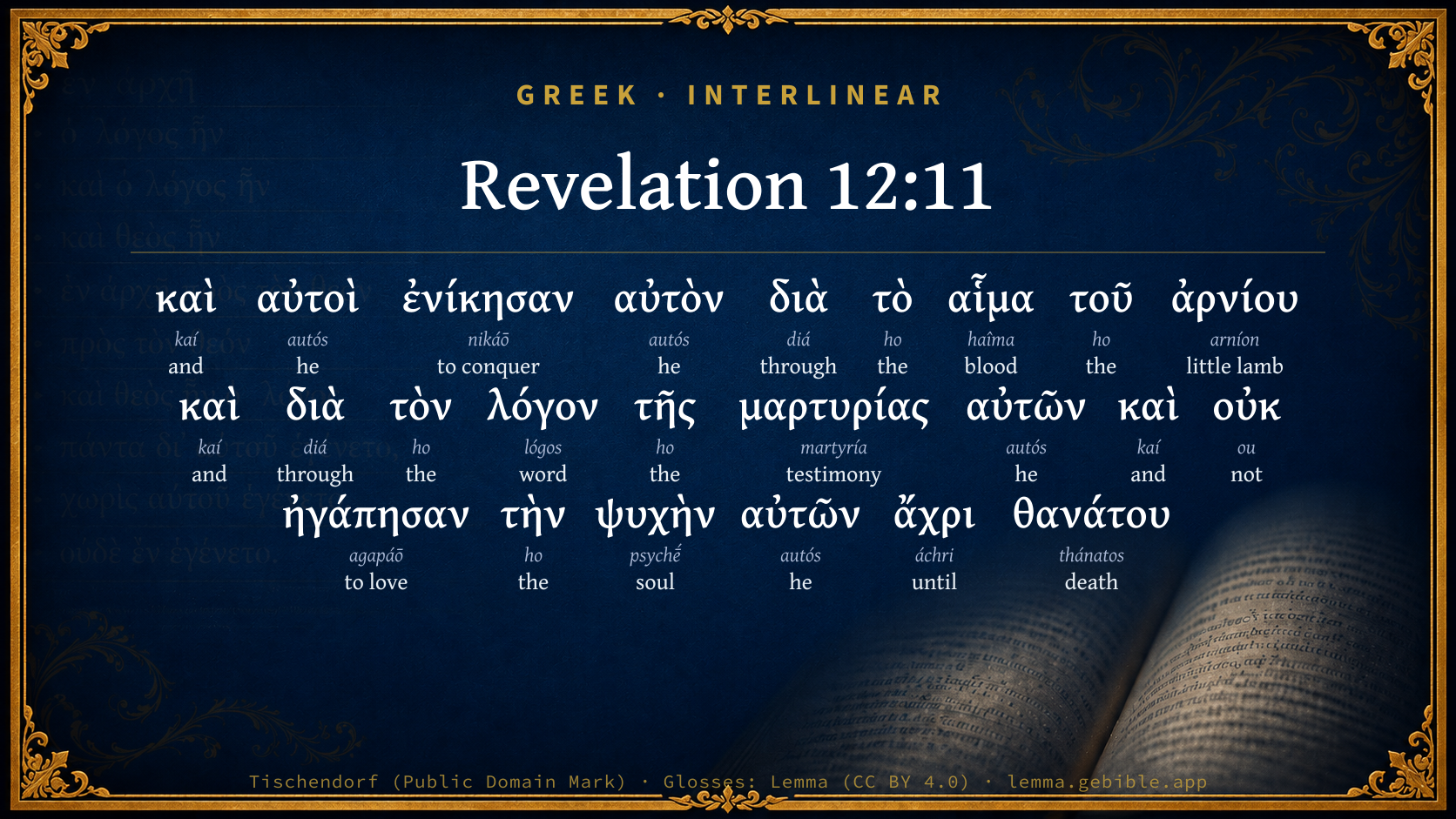
Download image
Cite this verse

Revelation 12:11 (World English Bible). Public Domain. Lemma interlinear Bible study tool, https://lemma.gebible.app/v/revelation/12/11.

Show BibTeX & RIS
BibTeX
RIS
English Translation
They overcame him because of the Lamb's blood, and because of the word of their testimony. They didn't love their life, even to death.
World English Bible · Public Domain
Download a study sheet

One document with this verse’s original text, its word-by-word gloss line, the meaning frame, cross-references with their text, attributed commentary, and full source and license credits — printable, and it pastes into notes with its structure intact.

This verse Autodidact and up

Study sheet (.html) Plain text (.txt)

A passage Seminary Student

Up to 50 verses in one chapter. A passage sheet keeps up to 6 commentary sources and 12 cross-references per verse, in the order this page ranks them, and says so on the sheet whenever that leaves anything out. Ask for a single verse and you get the Autodidact verse sheet above.

Everything on this page stays free to read, with no account — the sheet is a download of what is already on screen, not access to it.

Want to remove ads? Support Godless Engineer
Compare translations 3

The same verse in 3 English versions, stacked beneath the original-language interlinear above. Click any original word for its lexicon entry.

Each is an independent rendering of the whole verse — the interlinear is not word-aligned to these translations.

Highlighted words mark where these versions differ — a whole-verse word diff, not a word-by-word alignment.

  • World English Bible Public Domain
    They overcame him because of the Lamb's blood, and because of the word of their testimony. They didn't love their life, even to death.
  • King James Version Public Domain
    And they overcame him by the blood of the Lamb, and by the word of their testimony; and they loved not their lives unto the death.
  • unfoldingWord Literal Text CC BY-SA 4.0
    And they conquered him through the blood of the Lamb and by the word of their testimony, indeed, they did not love their lives unto death.

unfoldingWord Literal Text — © unfoldingWord, licensed CC BY-SA 4.0. Word-aligned USFM3 via Door43 (git.door43.org/unfoldingWord/en_ult).

Versions to compare (up to 4)

3 of 4 selected

Show all 19 translations

Every available English version of this verse, each an independent rendering of the whole verse.

  • World English Bible Public Domain
    They overcame him because of the Lamb's blood, and because of the word of their testimony. They didn't love their life, even to death.
  • Berean Standard Bible Public Domain
    They have conquered him by the blood of the Lamb and by the word of their testimony. And they did not love their lives so as to shy away from death.
  • Majority Standard Bible Public Domain
    They have conquered him by the blood of the Lamb and by the word of their testimony. And they did not love their lives so as to shy away from death.
  • King James Version Public Domain
    And they overcame him by the blood of the Lamb, and by the word of their testimony; and they loved not their lives unto the death.
  • American Standard Version (1901) Public Domain
    And they overcame him because of the blood of the Lamb, and because of the word of their testimony; and they loved not their life even unto death.
  • Revised Version (1885) Public Domain
    And they overcame him because of the blood of the Lamb, and because of the word of their testimony; and they loved not their life even unto death.
  • Geneva Bible (1599) Public Domain
    But they ouercame him by that blood of that Lambe, and by that worde of their testimonie, and they loued not their liues vnto the death.
  • Douay-Rheims (1899) Public Domain
    And they overcame him by the blood of the Lamb, and by the word of the testimony, and they loved not their lives unto death.
  • Young's Literal Translation Public Domain
    and they did overcome him because of the blood of the Lamb, and because of the word of their testimony, and they did not love their life -- unto death;
  • Literal Standard Version CC BY-SA 4.0
    and they overcame him because of the blood of the Lamb, and because of the word of their testimony, and they did not love their life—to death;
  • Unlocked Literal Bible CC BY-SA 4.0
    They conquered him by the blood of the Lamb and by the word of their testimony, for they did not love their lives even to death.
  • unfoldingWord Literal Text CC BY-SA 4.0
    And they conquered him through the blood of the Lamb and by the word of their testimony, indeed, they did not love their lives unto death.
  • Darby Bible Public Domain
    and *they* have overcome him by reason of the blood of the Lamb, and by reason of the word of their testimony, and have not loved their life even unto death.
  • World Messianic Bible Public Domain
    They overcame him because of the Lamb’s blood, and because of the word of their testimony. They didn’t love their life, even to death.
  • Webster's Bible Public Domain
    And they overcame him by the blood of the Lamb, and by the word of their testimony; and they loved not their lives to the death.
  • Free Bible Version CC BY-SA 4.0
    They conquered him through the blood of the Lamb and through their personal testimony—they did not love their lives so much that they were willing to die if necessary.
  • Bible in Basic English Public Domain
    And they overcame him through the blood of the Lamb and the word of their witness; and loving not their lives they freely gave themselves up to death.
  • Text-Critical English NT CC BY 4.0
    They overcame him by the blood of the Lamb and by the word of their testimony; they did not love their lives so as to shy away from death.
  • Tyndale New Testament (1534) Public Domain
    And they overcame him by the bloude of the lambe and by the worde of their testimony and they loved not their lyves vnto the deeth.

Literal Standard Version (2020), Covenant Press — licensed CC BY-SA 4.0. Text via the HelloAO Bible API (eBible.org). Unlocked Literal Bible (unfoldingWord) — licensed CC BY-SA 4.0. Text via the HelloAO Bible API (eBible.org). unfoldingWord Literal Text — © unfoldingWord, licensed CC BY-SA 4.0. Word-aligned USFM3 via Door43 (git.door43.org/unfoldingWord/en_ult). Free Bible Version, Dr. Jonathan Gallagher — licensed CC BY-SA 4.0. Text via the HelloAO Bible API (eBible.org).

Word by word

More ways to search: Search by grammar → Find every occurrence → Compare this word →

Practice this passage: Drill this verse → Learn its vocabulary →

ἐνίκησαν
nikáō
G3528
“to conquer”
Verb, Aorist, Active, Indicative, 3rd person, Plural
Part of Speech
Verb
Tense
Aorist
Voice
Active
Mood
Indicative
Person
3rd person
Number
Plural
Full Thayer's Definition

Origin: from G3529

TDNT: 19:42,6

1. to conquer a. to carry off the victory, come off victorious 1. of Christ, victorious over all His foes 2. of Christians, that hold fast their faith even unto death against the power of their foes, and temptations and persecutions 3. when one is arraigned or goes to law, to win the case, maintain one's cause
  1. καὶ kaí G2532 “and” Conjunction
  2. αὐτοὶ autós G846 “he” Personal pronoun, Nominative, Plural, Masculine
  3. αὐτὸν autós G846 “he” Personal pronoun, Accusative, Singular, Masculine
  4. διὰ diá G1223 “through” Preposition
  5. τὸ ho G3588 “the” Article, Accusative, Singular, Neuter
  6. αἷμα haîma G129 “blood” Noun, Accusative, Singular, Neuter
  7. τοῦ ho G3588 “the” Article, Genitive, Singular, Neuter
  8. ἀρνίου arníon G721 “little lamb” Noun, Genitive, Singular, Neuter
  9. καὶ kaí G2532 “and” Conjunction
  10. διὰ diá G1223 “through” Preposition
  11. τὸν ho G3588 “the” Article, Accusative, Singular, Masculine
  12. λόγον lógos G3056 “word” Noun, Accusative, Singular, Masculine
  13. τῆς ho G3588 “the” Article, Genitive, Singular, Feminine
  14. μαρτυρίας martyría G3141 “testimony” Noun, Genitive, Singular, Feminine
  15. αὐτῶν autós G846 “he” Personal pronoun, Genitive, Plural, Masculine
  16. καὶ kaí G2532 “and” Conjunction
  17. οὐκ ou G3756 “not” Particle, Negative
  18. ἠγάπησαν agapáō G25 “to love” Verb, Aorist, Active, Indicative, 3rd person, Plural
  19. τὴν ho G3588 “the” Article, Accusative, Singular, Feminine
  20. ψυχὴν psychḗ G5590 “soul” Noun, Accusative, Singular, Feminine
  21. αὐτῶν autós G846 “he” Personal pronoun, Genitive, Plural, Masculine
  22. ἄχρι áchri G891 “until” Adverb
  23. θανάτου thánatos G2288 “death” Noun, Genitive, Singular, Masculine

About this verse

These counts appear in no published source. They are computed here, from the morphology-tagged text and Lemma’s own curated glosses. What Lemma adds →

24
words
14
distinct lemmas
Revelation
section

Shared distinctive vocabulary

ἐνίκησαν to conquer G3528 occurs in 24 verses of the Greek New Testament. Also found in:
Repetition

Words recur within this verse:

Cross-references

33

Topical passages linked to Revelation 12:11 in the Treasury of Scripture Knowledge — connected by theme and wording, ordered by reader-vote popularity; previews shown in the World English Bible.

  • 2 Corinthians 10:3–5 For though we walk in the flesh, we don't wage war according to the flesh;
  • John 16:33 I have told you these things, that in me you may have peace. In the world you have oppression; but cheer up! I have overcome the world."
  • 1 John 5:5 Who is he who overcomes the world, but he who believes that Jesus is the Son of God?
  • Romans 16:20 And the God of peace will quickly crush Satan under your feet. The grace of our Lord Jesus Christ be with you.
  • 1 Corinthians 15:57 But thanks be to God, who gives us the victory through our Lord Jesus Christ.
  • Acts 20:24 But these things don't count; nor do I hold my life dear to myself, so that I may finish my race with joy, and the ministry which I received from the Lord Jesus, to fully testify to the Gospel of the grace of God.
  • Revelation 2:26 He who overcomes, and he who keeps my works to the end, to him I will give authority over the nations.
  • Hebrews 2:14–15 Since then the children have shared in flesh and blood, he also himself in like manner partook of the same, that through death he might bring to nothing him who had the power of death, that is, the devil,
  • Romans 8:33–39 Who could bring a charge against God's chosen ones? It is God who justifies.
  • 1 John 4:4 You are of God, little children, and have overcome them; because greater is he who is in you than he who is in the world.
  • 2 Timothy 4:7–8 I have fought the good fight. I have finished the course. I have kept the faith.
  • Revelation 3:5 He who overcomes will be arrayed in white garments, and I will in no way blot his name out of the book of life, and I will confess his name before my Father, and before his angels.
  • Revelation 2:7 He who has an ear, let him hear what the Spirit says to the assemblies. To him who overcomes I will give to eat of the tree of life, which is in the Paradise of my God.
  • Revelation 3:12 He who overcomes, I will make him a pillar in the temple of my God, and he will go out from there no more. I will write on him the name of my God, and the name of the city of my God, the new Jerusalem, which comes down out of heaven from my God, and my own new name.
  • Revelation 3:21 He who overcomes, I will give to him to sit down with me on my throne, as I also overcame, and sat down with my Father on his throne.
  • Ephesians 6:13–18 Therefore, put on the whole armor of God, that you may be able to withstand in the evil day, and, having done all, to stand.
  • Revelation 2:10–11 Don't be afraid of the things which you are about to suffer. Behold, the devil is about to throw some of you into prison, that you may be tested; and you will have oppression for ten days. Be faithful to death, and I will give you the crown of life.
  • Luke 14:26 "If anyone comes to me, and doesn't hate his own father, mother, wife, children, brothers, and sisters, yes, and his own life also, he can't be my disciple.
  • Revelation 20:4 I saw thrones, and they sat on them, and judgment was given to them. I saw the souls of those who had been beheaded for the testimony of Jesus, and for the word of God, and such as didn't worship the beast nor his image, and didn't receive the mark on their forehead and on their hand. They lived, and reigned with Christ for the thousand years.
  • Revelation 7:10–14 They cried with a loud voice, saying, "Salvation be to our God, who sits on the throne, and to the Lamb!"
  • 1 John 2:13–14 I write to you, fathers, because you know him who is from the beginning. I write to you, young men, because you have overcome the evil one. I write to you, little children, because you know the Father.
  • Revelation 14:1–4 I saw, and behold, the Lamb standing on Mount Zion, and with him a number, one hundred forty-four thousand, having his name, and the name of his Father, written on their foreheads.
  • Acts 21:13 Then Paul answered, "What are you doing, weeping and breaking my heart? For I am ready not only to be bound, but also to die at Jerusalem for the name of the Lord Jesus."
  • Revelation 1:2 who testified to God's word, and of the testimony of Jesus Christ, about everything that he saw.
  • Revelation 6:9 When he opened the fifth seal, I saw underneath the altar the souls of those who had been killed for the Word of God, and for the testimony of the Lamb which they had.
  • Revelation 11:7 When they have finished their testimony, the beast that comes up out of the abyss will make war with them, and overcome them, and kill them.
  • Revelation 15:2–3 I saw something like a sea of glass mixed with fire, and those who overcame the beast, his image, and the number of his name, standing on the sea of glass, having harps of God.
  • Revelation 1:9 I John, your brother and partner with you in oppression, Kingdom, and perseverance in Christ Jesus, was on the isle that is called Patmos because of God's Word and the testimony of Jesus Christ.
  • Revelation 2:13 "I know your works and where you dwell, where Satan's throne is. You hold firmly to my name, and didn't deny my faith in the days of Antipas my witness, my faithful one, who was killed among you, where Satan dwells.
  • Revelation 2:17 He who has an ear, let him hear what the Spirit says to the assemblies. To him who overcomes, to him I will give of the hidden manna, and I will give him a white stone, and on the stone a new name written, which no one knows but he who receives it.
  • Revelation 19:10 I fell down before his feet to worship him. He said to me, "Look! Don't do it! I am a fellow bondservant with you and with your brothers who hold the testimony of Jesus. Worship God, for the testimony of Jesus is the Spirit of Prophecy."
  • Hebrews 11:35–38 Women received their dead by resurrection. Others were tortured, not accepting their deliverance, that they might obtain a better resurrection.
  • Revelation 12:17 The dragon grew angry with the woman, and went away to make war with the rest of her seed, who keep God's commandments and hold Jesus' testimony.

Cross-references courtesy of OpenBible.info (CC BY 4.0).

Commentary

Notes on Revelation 12:11 from classic Christian and Jewish commentators (each source and its license shown beneath its notes). The classic Christian expositions comment on the surrounding passage and are grouped to its opening verse, so a note may address several verses; the Jewish commentaries on the Tanakh (Rashi and others) are per-verse, so they appear only where the commentator wrote on this verse.

Lemma curates 59 commentaries, every one of them public domain or Creative Commons licensed, each selected and text-cleaned for this edition rather than reprinted as found. About our sources →

Meyer's Critical & Exegetical Commentary

Heinrich August Wilhelm Meyer

Rev_12:11. Καὶ αὐτοὶ ἐνίκησαν αὐτὸν. That the αὐτοι refers to τ. ἀδελφῶν ἡμ., and, therefore, those accused by the dragon (ὁ κατηγ. αὐτούς, Rev_12:10), but not the angel Michael (Rev_12:7), are here represented as those who have conquered[3136] the dragon, results not only from the words in themselves, which do not allow an immediate reference of the αὐτοὶ to a subject in Rev_12:7, but also from the manner of the conflict and the victory indicated, which does not at all agree with what is described in Rev_12:7.[3137] From the identity of those accused in Rev_12:10, and contending in Rev_12:11, it does not follow, however, that the idea of ἐνίκησαν αὐτον is: They have won the case against him, as Beng.[3138] wishes; but the idea of the νικᾶν here is the same as everywhere in the Apoc., which regards every kind of temptation which Satan has prepared for believers as a mighty conflict,[3139] and therefore every confirmation of faith as a victory over the arch-enemy.[3140] On the fundamental conception, 1Jn_2:13-14, is to be compared, although, as the form, so also the reference there is different. The perf. ΝΕΝΙΚΉΚΑΤΕ ΤῸΝ ΠΟΝΗΡΌΝ describes the life of faith then existing in Christian young men, as having for its foundation the victory obtained over the wicked one by faith itself; the aor. ἘΝΊΚΗΣΑΝ ΑὐΤῸΝ, however, by placing the victory over Satan as a definite fact entirely in the past, is said by a prolepsis similar to that whereby, in Rev_7:9 sqq., believers are beheld in a proleptical vision after the victory has been won.[3141] In fact, the ἐνίκησαν is applicable not until the conflict lasting unto death, requiring the surrender of life in fidelity to the cause,[3142] is actually fought through, and the garment washed in the blood of the Lamb[3143] has been kept pure in spite of all the temptations and persecutions on the part of Satan. But although the worshippers know that the conflict against the dragon still in reality impends over their brethren on earth,[3144] yet they can celebrate the victory of believers as one already gained, because the victory won over Satan in heaven[3145] has rendered him an overcome enemy also to believers on earth. Since thus the victory still in fact to be won by believersto which properly all the consolatory language of the Apoc. refersis celebrated by these heavenly voices as already obtained, the strongest encouragement is given believers. Hence Rev_12:11 appears not as a digression,[3146] but is in every respect appropriate.

ΔΙᾺ ΤῸ ΑΊΜΑ ΤΟῦ ἈΡΝΊΟΥ, Κ.Τ.Λ. On account of the ΔΙΆ with the accus., the blood of the Lamb and the word of testimony of believers appears not as the means (ΔΙΆ with gen.), but as the reason or cause on account of which the victory is won. This form of the presentation is no less suitable than the former;[3147] but in the first member ΔΙᾺ ΤῸ ΑἸΜΑ Τ. ἈΡΝ., the latter corresponds much more accurately with the inner connection, sustained by Rev_12:11, to what precedes. Entirely analogous is the relation in Rev_3:21 between the Ὁ ΝΙΚῶΝ, Κ.Τ.Λ., and the Ὡς ΚἈΓῺ ἘΝΊΚΗΣΑ, Κ.Τ.Λ. The victory of believers on earth is based upon the victory won over Satan in heaven; the peculiar truth, however, in what is reported from Rev_12:7 on, and in the closest connection with Rev_12:5,that, viz., which, beneath the shell of the occurrences beheld, must be properly understood as the actual cause of the victory for believers on earth,is Christs victory over Satan. This victory the Lamb has won over the dragon by shedding his blood. The blood of the Lamb is therefore the cause of the victory of believers.[3148] In the same way the statement is added: καὶ δαὶ τὸν λόγον τῆς μαρτυρίας αὐτων. Here we would expect the gen., because the testimony given by believers presents itself most simply as the means whereby they conquer. De Wette is inclined to assume this mode of representation by a sort of zeugma, which he tries to maintain in the διά. But the διά with the accus. has its complete justification, because the word of the testimony of believers, like the blood of the Lamb, can appear as the objective ground of their victory, since it is the word of the testimony given by believers with all fidelity even unto death,[3149] yet, also, at the same time, the word of such testimony as believers have previously received, which they now have as the condition of their victory beyond and above themselves.[3150] Thus the word of testimony has also an objective side, according to which it appears, like the blood of the Lamb, as the ground, not as the means, of their victory; while, on the other hand, the blood of the Lamb can be considered the actual ground of the victory only when the subjective side, viz., the believing participation in this blood, or the being washed thereby,[3151] is kept in mind.

καὶ οὐκ ἠγάπησεν, κ.τ.λ. The not loving their souls, i.e., readiness to surrender life replacing ἄχρι θανάτου.[3152] As faithful witnesses, therefore, they suffered death, and just by this, like the Lord himself, won the victory.[3153]

[3136] Beng., Ew., De Wette, Hengstenb., Ebrard.

[3137] Cf. the closing words of Rev_12:11.

[3138] Cf. Rom_3:4.

[3139] Cf. Rev_12:17.

[3140] Rev_15:2. Cf., in general, the νικᾶν in the epistle, chs. 2, 3.

[3141] When Klief. here opposes a prolepsis, this must be taken together with the fact, that, understanding the woman (Rev_12:1) as Christianity of the last times, i.e., of believers mentioned in Rev_12:11, purified by suffering, he finds in the entire vision a representation of actual circumstances and events of the end. In this sense, he considers, e.g., the victory of Michael (Rev_12:7) as the execution of the moral victory previously gained by believers (Rev_12:11).

[3142] Cf. close of Rev_12:11.

[3143] Cf. Rev_7:4.

[3144] Cf. Rev_12:12, and, besides, Rev_12:17.

[3145] Rev_12:7 sqq.

[3146] De Wette.

[3147] Against De Wette.

[3148] Utterly preposterously Ew. rationalizes by remarking on the ἐνίκησαν αὐτ. διὰ τ. αἷμα τ. ἁρν.: By Christianity established by Christs death, which was also an example to them.

[3149] This is the meaning of the αὐτῶν with τ. λ. τ. μαρτ.

[3150] Cf. Rev_12:17.

[3151] Cf. Rev_7:14, Rev_1:5; Var. Lect.

[3152] Cf. Rev_2:10; Php_2:8.

[3153] Cf. Rev_3:21, Rev_1:18, Rev_5:5, Rev_6:9.

Meyer — Critical and Exegetical Commentary on the New Testament — English translation by Peter Christie, edited by Frederick Crombie (T&T Clark, 1880) — public domain. Text from a community e-Sword module.

Expositor's Greek Testament

ed. W. Robertson Nicoll

Rev 12:11 . This sentence, like Rev 12:7 , suggests that earth’s history is the reflex and outcome of transactions in heaven, on the common principle of Jalkut Rub. (on Exo 14:7 ): “there was war above in heaven) and war below (on earth), and sore was the war in heaven”. Satan’s dislodgment from heaven is another ( cf. on Rev 11:19 ) sign of messiah’s approaching victory ( cf. Yasna xxx. 8). What Jesus had already seen in his own victory over daemons (Mat 12:24 f.; cf. J. Weiss, Predigt Jesu , 28 f., 89 f.), John hails from another standpoint, as inaugurating the messianic age. Vexilla regis prodeunt. How readily the mythological trait could be moralised is evident from a passage like Rom 8:33 f., of which Rev 12:11 is a realistic variant. In the background lie conceptions like that of En. xl. 7 where the fourth angel of the Presence is heard “fending all the Satans and forbidding them to appear before the Lord of Spirits to accuse men” Rev 12:11 chronologically follows Rev 12:17 , but the author, by a characteristic and dramatic prolepsis, anticipates the triumph of the martyrs and confessors, who refute Satan’s calumnies and resist his wiles. In opposition to the contemporary Jewish tradition (Ap. Bar. ii. 2, xiv. 12; 4 Esd. 7:77, etc.), it is not reliance on works but the consciousness of redemption which enables them to bear witness and to bear the consequences of their witness. This victory on earth depends on Christ’s previous defeat of evil in the upper world (Col 2:15 ; cf. above on Rev 2:10 , also Rev 21:8 ) which formed its headquarters.

The Expositor's Greek Testament, edited by W. Robertson Nicoll (1897–1910) — public domain. Text from a community e-Sword module.

Geneva Bible (1599)

Geneva Bible translators

He is said in the Hebrew tongue, to love his life that esteemeth nothing more precious than his life: and on the other side, he is said not to love his life, who doubteth not to hazard it, wheresoever need requireth.

Geneva Bible (1599) marginal notes — public domain. Text via Bolls.life.

Jamieson, Fausset & Brown

Robert Jamieson, A. R. Fausset & David Brown

they--emphatic in the Greek. "They" in particular. They and they alone. They were the persons who overcame.

overcame-- (Rom 8:33-34, Rom 8:37; Rom 16:20).

him-- (Jo1 2:14-15). It is the same victory (a peculiarly Johannean phrase) over Satan and the world which the Gospel of John describes in the life of Jesus, his Epistle in the life of each believer, and his Apocalypse in the life of the Church.

by, &c.--Greek (dia to haima; accusative, not genitive case, as English Version would require, compare Heb 9:12), "on account of (on the ground of) the blood of the Lamb"; "because of"; on account of and by virtue of its having been shed. Had that blood not been shed, Satan's accusations would have been unanswerable; as it is, that blood meets every charge. SCHOTTGEN mentions the Rabbinical tradition that Satan accuses men all days of the year, except the day of atonement. TITTMANN takes the Greek "dia," as it often means, out of regard to the blood of the Lamb; this was the impelling cause which induced them to undertake the contest for the sake of it; but the view given above is good Greek, and more in accordance with the general sense of Scripture.

by the word of their testimony--Greek, "on account of the word of their testimony." On the ground of their faithful testimony, even unto death, they are constituted victors. Their testimony evinced their victory over him by virtue of the blood of the Lamb. Hereby they confess themselves worshippers of the slain Lamb and overcome the beast, Satan's representative; an anticipation of Rev 15:2, "them that had gotten the victory over the beast" (compare Rev 13:15-16).

unto--Greek, "achri," "even as far as." They carried their not-love of life as far as even unto death.

Jamieson, Fausset & Brown — Commentary Critical and Explanatory on the Whole Bible (1871) — public domain (CC PDM 1.0). Text via the HelloAO Bible API.

Adam Clarke's Commentary

NOTES ON CHAP. XII., BY J. E. C.

Verse 11. And they overcame him by the blood of the Lamb] Here is given the reason why the followers of Christ prevailed at this time against all their adversaries. It was because they fought against the dragon in the armour of God. They overcame him by the blood of the Lamb-by proclaiming salvation to sinners through Christ crucified, and by their continual intercession at the throne of grace for the conversion of the heathen world.

And by the word of their testimony] By constantly testifying against the errors and follies of mankind.

And they loved not their lives unto the death.] They regarded not their present temporal estate, but even gladly delivered up their lives to the fury of their persecutors, and thus sealed the truth of what they spake with their blood.

Adam Clarke's Commentary on the Bible (1810–1826) — public domain. Text from a community e-Sword/MySword module.

Ellicott's Commentary for English Readers

(11) And they overcame him . . .—Better, And they conquered him (not “by,” but) on account of the blood of the Lamb, and on account of the word of their testimony, &c. They overcame him—i.e., the accuser, the devil: their victory over him is “owing to” the blood of the Lamb. Who is he that condemneth, when Christ hath died? What power can the accusations of the adversary have when the Lamb of God hath taken away the sin of the world (Joh_1:29), and when we have boldness to enter into the holiest by the blood of Jesus? (Heb_10:19.) Dean Alford mentions the tradition that Satan accuses men all days of the year except on the Day of Atonement. But their victory is also in virtue of the word of their testimony: in virtue of the word to which they bore witness; not simply, I think, because they had a word of God to which they could bear witness, but because they had a word of God and did bear witness to it. The Christian victory is a victory of dependence and of obedience: of dependence on Him without whom they can do nothing; and of obedience to Him: it is in keeping of His commandments there is great reward: and in bearing testimony that the testimony becomes a power and a treasure. So it was the man who did Christ’s commandments who was like the man whose house was founded on the rock. Theoretical religion relaxes the energy of faith, even though it may brace the intellect; practical religion invigorates faith, gives it its force, and moulds the heroism of those who, in their love of Christ, “love not their lives even unto death.” It is thought that these last words imply that the martyred saints alone are spoken of. This seems to me a mistake. It is true that in the martyr we have the fullest practical token of that spirit of devotion to Christ which loves Him more than life itself; but the spirit of such devotion and such love has breathed in thousands who have never died the martyr’s death, but who have devoted their lives to Him they loved. The martyr spirit needs not death to show itself; many lose their lives for Christ’s sake who have never been called to lay down their lives for Him, and these, as truly as those who have passed away in the shroud of flame, have loved not their lives unto the death. “He may bid us die for Him: He does bid us live for Him. If we do not the one—the less—we may be quite sure that we shall never rise to the other—the higher and the more glorious” (Dr. Vaughan).

A Bible Commentary for English Readers, edited by Charles John Ellicott (1878–1897) — public domain. Text from a community e-Sword module.

The Cambridge Bible for Schools and Colleges

gen. ed. J. J. S. Perowne

11. by the blood] More literally because of the blood … and because of the word.

they loved not their lives] St Joh_12:25, St Luk_14:26 are the closest parallels among the similar sayings of our Lord. Here, as in all of them, the word for “life” is that elsewhere rendered “soul”—not the same as that used for “life eternal” in St John, l.c.

unto the death] They carried the temper of not loving life (not only to the renunciation of life’s joys, but) even to death.

The Cambridge Bible for Schools and Colleges (gen. ed. J. J. S. Perowne; Cambridge University Press, 1878–1918) — public domain. Text from a community e-Sword module.

John Gill's Exposition

And they overcame him by the blood of the Lamb,.... The Lord Jesus Christ, by whose blood they were redeemed and ransomed out of the hands of Satan, that was stronger than they; and by which they were justified from all sin, and so all charges and condemnation were of no avail against them, whether of Satan or the world; and by which they were cleansed from all pollution, both internal and external; and by which even their conversation garments were washed and made white; by this they also, drew nigh to God with boldness, as to their own God, notwithstanding the accusations of Satan; and this they could, and did make use of as a shield to defend them against all his charges; and this being sprinkled upon them, as it gave them an inward conscience peace amidst all, so it was their security from the destroying angel; and under this purple covering they went triumphantly to glory, having through it obtained an entire conquest over Satan: as also

and by the word of their testimony; either by Christ, the essential Word, they bore record of, who is sharper than any twoedged sword, and through whom they were made more than conquerors; or rather by the use they made of the Scriptures of truth, the sword of the Spirit, the word of God, to which they bore a faithful testimony, and to which they adhered, and by so doing gained the victory over Satan and his instruments, whether false teachers or persecutors; and particularly by the Gospel, which they embraced, professed, and preached with constancy and courage, and by their last testimony they bore to it at their death, on the account of it, as it follows:

and they loved not their lives unto the death; they did not value them; they made no account of them; they were not anxiously careful to preserve them; they chose to lose them; they ran to the stake, and willingly and cheerfully laid them down; they did not count them dear unto them, as said the Apostle Paul, that they might finish their course with joy, and testify the Gospel of the grace of God, or bear a testimony to it, Act 20:24; yea, as Christ has directed, Luk 14:26; they hated their lives in comparison of him, and when in competition with him and his Gospel; and by dying thus they conquered Satan; had they loved their lives, and saved them by denying Christ and his truths, Satan would have conquered them; but dying in the cause of Christ, and for it, they got the victory over him.

John Gill's Exposition of the Whole Bible (1746–1763) — public domain (CC PDM 1.0). Text via the HelloAO Bible API.

Trapp's Complete Commentary

John Trapp

11 And they overcame him by the blood of the Lamb, and by the word of their testimony; and they loved not their lives unto the death.

Ver. 11. By the blood of the Lamb] By his merit and spirit, Christ’s blood (as Pliny saith of Polium) is a preservative against serpents.

And they loved not their lives] When one said to a certain martyr, Take heed, it is a hard matter to burn; Indeed, said he, it is for him that hath his soul linked to his body, as a thief’s foot is in a pair of fetters. (Acts and Mon.) In the days of that bloody persecutor Diocletian, Certatim gloriosa in certamina ruebatur, saith Sulpitius, multoque avidius tum martyria gloriosis mortibus quaerebantur, quam nunc Episcopatus pravis ambitionibus appetuntur. Those ancient Christians showed as glorious power in the faith of martyrdom, as in the faith of miracles; the valour of the patients and the savageness of the persecutors striving together, till both, exceeding nature and belief, bred wonder and astonishment in beholders and readers. {a} One martyr said, Can I die but once for Christ? Another, Had I as many lives as I have hairs upon mine head, they should all go. Hanc animam in flammis offero, Christe, tibi, saith Jerome of Prague.

{a} Non maiori unquam triumpho vicimus quam cum decem annorum stragibus vinci non potuimus. Sulp.

John Trapp, A Commentary or Exposition upon All the Books of the Old and New Testament (1647–1656) — public domain. Text from a community e-Sword module.

Albert Barnes' Notes on the Bible

And they overcame him - That is, he was foiled in his attempt thus to destroy the church. The reference here, undoubtedly, is primarily to the martyr age and to the martyr spirit; and the meaning is, that religion had not become extinct by these accusations, as Satan hoped it would be, but lived and triumphed. By their holy lives, by their faithful testimony, by their patient sufferings, they showed that all these accusations were false, and that the religion which they professed Was from God, and thus in fact gained a victory over their accuser. Instead of being themselves subdued, Satan himself was vanquished, and the world was constrained to acknowledge that the persecuted religion had a heavenly origin. No design was ever more ineffectual than that of crushing the church by persecution, no victory was ever more signal than what was gained when it could be said that “the blood of the martyrs is the seed of the church.”

By the blood of the Lamb - The Lord Jesus - the Lamb of God. See the notes at Rev 5:6; compare the notes on Joh 1:29. The blood of Christ was that by which they were redeemed, and it was in virtue of the efficacy of the atonement that they were enabled to achieve the victory. Compare the notes on Phi 4:13. Christ himself achieved a victory over Satan by his death (see the Col 2:15 note; Heb 2:15 note), and it is in virtue of the victory which he thus achieved that we are now able to triumph over our great foe.

“I ask them whence their victory came.

They, with united breath,

Ascribe their conquest to the Lamb,

Their triumph to his death.”

And by the word of their testimony - The faithful testimony which they bore to the truth. That is, they adhered to the truth in their sufferings, they declared their belief in it, even in the pains of martyrdom; and it was by this that they overcame the great enemy - that is, by this that the belief in the gospel was established and maintained in the world. The reference here is to the effects of persecution and to the efforts of Satan to drive religion from the world by persecution. John says that the result as he saw it in vision was, that the persecuted church bore a faithful testimony to the truth, and that the great enemy was overcome.

And they loved not their lives unto the death - They did not so love their lives that they were unwilling to die as martyrs. They did not shrink back when threatened with death, but remained firm in their attachment to their Saviour, and left their dying testimony to the truth and power of religion. It was by these means that Christianity was established in the world, and John, in the scene before us, saw it thus triumphant, and saw the angels and the redeemed in heaven celebrating the triumph. The result of the attempts to destroy the Christian religion by persecution demonstrated that it was to triumph. No more mighty power could be employed to crush it than was employed by the Roman emperors; and when it was seen that Christianity could survive those efforts to crush it it was certain that it was destined to live forever.

Albert Barnes' Notes on the Bible (1834–1885) — public domain. Text from a community e-Sword/MySword module.

Matthew Poole's English Annotations

And they overcame him; Michael and his angels, mentioned Rev 12:7, overcame the dragon and his angels: the Christians overcame the pagans.

By the blood of the Lamb: some translate δια here, propter, because of, as denoting the meritorious cause, which is true; for Christ’s blood was both the meritorious and exemplary cause of their victory. But this will not agree with the usage of the term in the next words. Others therefore rather choose to translate it, by, as denoting the efficient cause, whether principal (as was the blood of the Lamb) or instrumental.

And by the word of their testimony; as was their preaching, and professing the gospel.

And they loved not their lives unto the death; and by their patient bearing the cross, not shunning the danger of death, that they might preach Christ, and own his truths, and live up to the holy rule of his gospel.

Matthew Poole's English Annotations on the Holy Bible (1683–1685) — public domain. Text from a community e-Sword/MySword module.

Whedon's Commentary on the Bible

Daniel D. Whedon

11. They overcame him—For Michael’s victory was their victory; since they are the literal of whom the woman was symbol. And this victory on earth Christians won by faith in the blood of the Lamb, as well as by their unshrinking testimony against the idols and for Christ. They loved not (or, as Alford well puts it, they carried their not-love of life) unto death— They so persisted in not loving life as to attain martyrdom.

Daniel D. Whedon (gen. ed.), Commentary on the Old and New Testaments (1874–1909) — public domain. Text from a community e-Sword module.

The Pulpit Commentary

And they overcame him. (cf. the frequent references to those who overcome, and the promises made to them, Rev_2:3:21:7, etc.) The reference "they" is to "our brethren," the accused ones of ver. 10. By the blood of the Lamb; because of the blood, etc. (Revised Version). That is, "the blood of the Lamb" is the ground or reason of their victory, not the instrument. So in Rev_1:9, "I John... was in the island called Patmos, because of the Word of God (dia togon)". (cf. Rev_6:9) Winer agrees with this view of the present passage, against Ewald and De Wette (p. 498 of Moulton"s translation). "The Lamb," who was seen "as it had been slain" (Rev_5:6) Christ.

And by the word of their testimony; and on account of the word, etc. The one phrase is the natural complement of the other. "The blood of the Lamb" would have been shed in vain without the testimony, the outcome of the faith of his followers; that testimony would have been impossible without the shedding of the blood. And they loved not their lives unto the death; their life even unto death. That is, they valued not their life in this world, even to the extent of meeting death for the sake of giving their testimony. There is no article in the Greek, merely acri yanaton ; so also in the same phrase in Act_22:4. The article of the Authorized Version in Act_22:4 is probably derived from Wickliffe"s Bible; that in the present passage, from Tyndale"s.

The holy war.

"They overcame him by the blood of the Lamb," etc. Without attempting to identify "Michael and his angels," or "the dragon and his angels," or the "heaven" where no longer "place" was "found any more" for them; nor attempting to explain exactly what is meant by the dragon being "cast out into the earth," or how he "accused" the "brethren... before our God day and night what all this means none know; but we may take the text as telling of that holy war which all Christians have to wage, and of the weapons whereby they overcome. Note

I THE PEOPLE WHO OVERCAME. Those spoken of:

1. Stand for the whole Church of God, the whole company of the redeemed. "There is no discharge in this war." Not one will be in glory by and by who has not waged, who has not won, this holy war. We, as they, must take our part. And:

2. They did as we must. We paint fancy pictures of the saints in glory, as if they were beings different from ourselves, and had never known the strain and stress of life as we know them. But they did know it all. Christ, our Lord, was "in all things made like unto his brethren," and therefore all of them have the common characteristics of this warfare upon them. Only:

3. The lot of those specially referred to here was harder than ours. Had St. John lived in our days of quiet ease, when persecution, much less death, for Christ"s sake is a thing unknown or most rare, he would hardly have used imagery of so tremendous a kind as he has here. But it was because the trial was so terrible for all those "who would live godly in Christ Jesus," the foe so fierce and cruel and strong in those dreadful days during which St. John wrote, that imagery so vivid, startling, and terrific is made use of. But it would be affectation if we were to say our lot today is as theirs was in St. John"s day. How much more, then, may God require from us than from them! Will he obtain it?

4. In this holy war they all fought. It was not merely appointed for all, but accepted by all of them. They did not refuse or retreat from it. That was not their way. Like as the brave little drummer-boy, when captured by the French army, was bidden sound the "retreat," he replied that he did not know how to, for the British army never retreated; so may it be said of every true soldier of Christ"s army they never retreat.

5. And they overcame. "Oh, remember the slaves of sin are not the children of God. If Satan has dominion over you, you are not in Christ Jesus. Where the ark of the Lord is, Dagon must fall upon his face and be broken. "That which is born of God overcometh the world." Are we, then, resisting? are we conquering? Do not let us deceive ourselves. If sin is our master, we perish. Grace must reign in us, or we are wretched indeed. Holiness is not a luxury for the few, it is a necessity for all.

II THE POWER IN VIRTUE OF WHICH THEY OVERCAME. It is said that this was:

1. By the blood of the Lamb, i.e. in virtue of, on account of, on the ground of, that blood. Now this is so because the blood of the Lamb is:

(1) The basis of our peace. There must be steady standing ground if a man is to fight. The engineer is very careful to have firm foundation for his work. And if we are to contend in this warfare, our souls must be at peace in regard to our acceptance with God. The torture of doubt and the torment of fear will be fatal to our accomplishing aught worthy of the name. We must have peace with God; and we have this only in virtue of Christ"s atoning sacrifice.

(2) The antidote of our sin. Many think the doctrine of full, free forgiveness through the blood of Christ a doctrine that encourages men in sin. They argue that what is so freely forgiven will be freely incurred. The elder son in the parable thought it was scandalous that his young ne"er do well of a brother should be so freely forgiven by his father, and so "he was angry, and would not go in." And there have ever been people who have thought this. But we appeal to the records of the Church. Who have been the most faithful, the most pure, the most Christ like? Has it not been they who have clung, like Paul did, to this blessed truth with all their hearts? And we appeal to experience. Is it not the memory of our crucified Lord that is mighty to the purification of the heart? Can the recollection of his love and the love of sin abide together? It is impossible. So does the blood of Christ cleanse us from all sin.

(3) Worketh in us patience. How this is needed, in such a warfare as that which the much tried believer has to wage, is evident. Blessed is he that endureth. But what an aid to such patient enduring is found in the example of our Lord! We think of him in all his holy meekness; how "as a sheep before her shearers is dumb," etc. And as we contemplate that perfect pattern of patient enduring of wrong, how our own trials and sorrows become little, and less and less in comparison with his!

(4) The inspiration of our love. "Alexander, Caesar, Charlemagne, and myself," said Napoleon, "founded great empires; but upon what did the creations of our genius depend? Upon force. Jesus alone founded his empire upon love, and to this very day millions would die for him." Thus does the blood of the Lamb become to us a power indeed, in virtue of which we overcome.

2. The word of their testimony. This is joined on to that which we have but now spoken of. For the blood of the Lamb, unseen, unbelieved, unaccepted, will do no one any good, will aid no one to overcome; but it is when that blood is seen, believed, accepted, and confessed by the word of their testimony, the open avowal, the good confession then, in virtue of this, the Father confesses them. In response to the word of their testimony goes forth the word of his power, and they become mighty through God. Committing ourselves to any course, breaking down the bridges, burning the ships that would help us to retreat such conduct greatly strengthens purpose and resolve. And so, when by spoken word of testimony for Christ we have committed ourselves to follow and serve him, the very fact that we have done this strengthens us and gives us fresh force for his service. Both by way of Divine reward, and by way of natural consequence such word of testimony Would help to overcome.

III THE PROOF OF THE OVERCOMING. "They loved not their lives unto the death." They went on resisting, when not only it involved much suffering and distress, but even when it involved death itself. That is the meaning. And what proof of overcoming is there comparable to this? As at Waterloo, when the English forces endured, all that long summer Sunday, the fierce and incessant cannonading of the French, together with their repeated charges, led as they were by the most famous of the marshals of France, what did such endurance show but that they were not to be conquered? And so the resistance told of in Christ"s holy war the loving "not our lives unto," etc. this shows that we are not to be conquered, but will conquer, will overcome. If we see a man swerve, and edge back, and shift his ground, and retreat, that is not a proof of victory, but vanquishment. But he who is steadfast, immovable, even though death threaten, neither sin nor Satan will ever conquer him. Are we giving this proof of our really belonging to the number of the overcoming ones? When the adversary assails us, as we know he does, do we or does he gain the victory which? Let us not think that there is any other proof of our being victors at last beside this one of our being, in the main, victors now. It will not do to rely on anything else, however specious, however plausible, however popular. It is in the overcoming now that we have the evidence that we shall be victors at the end. And that we may now overcome, let us draw near unto our crucified Lord, and come under the influence of his unspeakable love. And confess him. So shall our text then become true of us, as God grant it may be of us all! S. C.

Moral conquest won through Christ.

"They overcame him by the blood of the Lamb." It is trite, but ever solemnly true, to say that life is a combat. Moral antagonists of the soul meet us everywhere in all departments of life, circles of society, spheres of action. Nay, they rise up within us. These can be only overcome by the "blood of the Lamb," that is, by the self-sacrificing life of Christ.

I IT IS THROUGH HIS BLOOD (OR LIFE) THAT WE GET OUR ANTAGONISM TO MORAL EVIL ROUSED. Where do we learn the turpitude, the enormity, the ruinousness of sin, as we learn it in the cross? There, indeed, "sin appears exceeding sinful," When we are enabled to look upon it in the light of that cross, the whole soul rises in determined opposition to it.

II IT IS THROUGH HIS BLOOD (OR LIFE) THAT WE GET OUR WEAPONS SUPPLIED. What are the weapons with which evil is to be restored?

1. A clear knowledge of the right. It is by right alone that wrong can be put down. His life was the intelligible embodiment, and the all-convincing demonstration of moral right.

2. An inflexible love for the right. Right as an idea is no weapon. But right as a love becomes a triumphant implement in this warfare.

III IT IS THROUGH HIS BLOOD (OR LIFE) THAT WE GET OUR COURAGE INSPIRED. In this warfare we require a courage unflagging and invincible a courage impelling us to fight, even to the death. Whence cometh this? Only from Christ. His self-sacrificing spirit is the soul of all true courage. D.T.

The Pulpit Commentary (1880–1919), ed. H.D.M. Spence-Jones & Joseph S. Exell — public domain. Text from a community e-Sword module.

John Wesley's Explanatory Notes

And they have overcome him - Carried the cause against him. By the blood of the Lamb - Which cleanses the soul from all sin, and so leaves no room for accusing. And by the word of their testimony - The word of God, which they believed and testified, even unto death. So, for instance, died Olam, king of Sweden, in the year 900, whom his own subjects would have compelled to idolatry; and, upon his refusal, slew as a sacrifice to the idol which he would not worship. So did multitudes of Bohemian Christians, in the year 916, when queen Drahomire raised a severe persecution, wherein many "loved not their lives unto the death."

John Wesley, Explanatory Notes Upon the Whole Bible (1754–1765) — public domain. Text via the GEBible commentary corpus.

The People's New Testament

B. W. Johnson

11. And they overcame him by the blood of the Lamb. This shows how the victory indicated in verse 8 was won. It was won by the blood of Christ and the faithfulness of the saints. “They loved not their life even unto death.” They were willing to give their lives for Christ.

B. W. Johnson's The People's New Testament with Notes (1889–1891) — public domain. Electronic text from the Christian Classics Ethereal Library (CCEL) ThML edition.

unfoldingWord translationNotes

Door43 World Missions Community

Connecting Statement:

The loud voice from heaven continues to speak.

They conquered him

"They conquered the accuser"

by the blood of the Lamb

The blood refers to his death. AT: "because the lamb had shed his blood and died for them" (See: Metonymy)

by the word of their testimony

The word "testimony" can be expressed with the verb "testify." Also who they testified about can be stated clearly. AT: "by what they said when they testified to others about Jesus" (See: Abstract Nouns and Assumed Knowledge and Implicit Information)

even to death

The believers told the truth about Jesus, even though they knew that their enemies might try to kill them because of it. AT: "but they kept testifying even though they knew that they might die for it"

He is filled with terrible anger

The devil is spoken of as if he were a container, and anger is spoken of as if it were a liquid that could be in him. AT: "He is terribly angry" (See: Metaphor)

translationWords

blood

lamb

word

testimony

love

life

die

joy

heaven

woe

earth

Satan

anger

know

unfoldingWord translationNotes — © Distant Shores Media and the Door43 World Missions Community, licensed CC BY-SA 4.0. Source: git.door43.org/Door43/en_tn.

Cambridge Greek Testament for Schools and Colleges

11. αὐτοί. א cop[420] read οὗτοι.

[420] Coptic.

11. διὰ τὸ αἶμα … διὰ τὸν λόγον. These conquerors are the martyrs and confessors of Christ: though He is gone up, Satan is not at once cast down. The accusatives mark the cause, not the means of their victory: we might have expected the second to have been replaced by a genitive. The whole verse would be easier to understand after Rev 12:17.

οὐκ ἠγάπησαν τὴν ψυχὴν αὐτῶν. St Joh 12:25, St Luk 14:26 are the closest parallels among the similar sayings of our Lord. Here, as in all of them, the word for “life” is that elsewhere rendered “soul“—not the same as that used for “life eternal” in St John l.c.

ἄχρι θανάτου. They carried the temper of not loving life (not only to the renunciation of its joys, but) even to death.

Cambridge Greek Testament for Schools and Colleges (Cambridge University Press, 1896; 21 vols, various authors incl. Carr, Maclear, Plummer, Farrar, Lumby, Moule, M. R. James, Simcox) — public domain. Text from a community e-Sword module.

Alford’s Greek Testament

Henry Alford

11-18.] The second wild-beast, the reviver and the upholder of the first. It may be well to premise a few remarks, tending to the right understanding of this portion of the prophecy. 1) These two beasts are identical as to genus: they are both θηρία, ravaging powers, hostile to God’s flock and fold. 2) They are diverse in origin. The former came up out of the sea: that is, if we go back to the symbolism of Daniel, was an empire, rising up out of confusion into order and life: the latter comes out of the earth: i. e. we may not unreasonably say, arises out of human society and its progress: which as interpreted by the context, will import its origin and gradual development during the reign and progress of the secular empire denoted by the former beast. 3) The second beast is, in its zeal and action, entirely subsidiary to the first. It wields its authority, works miracles in its support, causes men to make and to worship its image; nay, itself is lost in the splendour and importance of the other. 4) An important distinction exists between the two beasts, in that this second one has two horns like a lamb. In other words, this second beast puts on a mild and lamb-like appearance, which the other did not. But it speaks as a dragon: its words, which carry its real character, are fierce and unrelenting: while it professes that which is gentle, its behests are cruel.

And now I may appeal to the reader, whether all these requisites do not meet in that great wasting Power which arose, not out of anarchy and conquest, but out of men’s daily life and habits, out of and in the presence of the last form of the secular power, which was the Empire of Pagan Rome; I mean, the sacerdotal persecuting power, which, gentle in its aspect and professions, was yet cruel in its actions; which did all the deeds of the Empire, in its presence, which kept up its image, its laws, its formulæ, its privileges; which, coming in as it did by a corrupt and ambitious priesthood, deceived by its miracles the dwellers on earth, and by them maintained the image of the despotic secular power? Surely it is this Latin Christianity, in its ecclesiastico-secular form, not identical with, but as preparing the way for, the great apostasy, helping, so to speak, to place the woman on the beast, as in ch. 17, that is here depicted before us. It is this which, owing its power in the main to imposture and unwarrantably assumed spiritual authority, deserves best the name of the false prophet, expressly given to this second beast in ch. 19:20. Nor would I limit the interpretation, as has generally been done, by dividing off Pagan from Christian. Primarily, this second beast plainly sets forth the Pagan sacerdotal power; this it was that made the image of the Emperors, that compelled Christians to worship that image, that wrought signs and wonders by its omens and magic. But as the first beast, still subsisting, has passed into a so-called Christian Roman Empire, so has the second beast into a so-called Christian priesthood, the veritable inheritor of pagan rites, images, and superstitions; actually the continuators, nomine mutato, of the same worship in the same places; that of the Virgin for that of Venus, Cosmas and Damian for Romulus and Remus, the image of Peter for that of Jupiter Tonans: lamb-like in profession, with the names and appearances of Christianity, but dragon-like in word and act. And this was surely never more strikingly shewn than at the time when I am writing (Jan. 1860), when the Papal priesthood is zealously combining in the suicidal act of upholding the temporal power as necessary to the spiritual pre-eminence of their “Lord God the Pope.” So that I believe the interpretation of the second beast to be, the sacerdotal persecuting power, pagan and Christian, as the first is the secular persecuting power, pagan or Christian. I conceive the view which would limit it to the priesthood of Paganism (Hammond, Grot., Ewald, De Wette, Hengstb., Düsterd.) quite insufficient for the importance of the prophecy; while that of Elliott, al., which would limit it to the priesthood of the Papacy, fails notably in giving a meaning to its acts as here described, the making an image to the beast and causing men to worship it. And I saw another beast coming up out of the earth (see the preceding note), and it had two horns like a Iamb (i. e. like the two horns of a lamb: see ref. It is quite true that the absence of the article before ἀρνίῳ forbids the idea that a direct comparison is intended between this lamb-like beast, and the Lamb on Mount Sion: but it does not follow from this that no reference is made to that Lamb in the choice of the animal to which this beast is compared. I believe the choice is made to set forth the hybrid character of this second beast: see more below. The number may perhaps be of no special import, but merely inserted to complete the similarity: it, as a lamb has, had two horns), and it spoke as a dragon (here again we cannot doubt that the term is chosen on account of the dragon which has been before mentioned. It is no objection to this, that we do not hear of that dragon speaking (Düsterd.): the character of the animal explains what kind of speech is meant, and the acts of the dragon were of that kind. And as to this second beast, though its appearance and profession are sacerdotal, its words and acts are devilish. The whole description strongly recalls to our mind our Lord’s προσέχετε ἀπὸ τῶν ψευδοπροφητῶν, οἵτινες ἔρχονται πρὸς ὑμᾶς ἐν ἐνδύμασιν προβάτων, ἔσωθεν δέ εἰσιν λύκοι ἅρπαγες, Mat 7:15). And it worketh all the power (performs all the acts of authority) of the first beast in his presence (while the first beast is subsisting and beholding; and as the expression seems to shew, being in a relation to it of serving and upholding), and maketh the earth and those that dwell in it to worship (construction, see reff.) the first beast, whose wound of death was healed (this was formerly, ver. 4, described as the reason why the world wondered after the former beast): and worketh great miracles, so that (ἵνα depends on μεγάλα: “miracula magna, tam magna, ut” &c. So that ἵνα ποιῇ = ὥστε ποιεῖν. See Winer, edn. 6, § 53. 6, who as well as Düsterd. finds fault with Bengel for recognizing here a feature of St. John’s style. But Bengel only remarks “ἵνα frequens Johanni particula: in omnibus suis libris non nisi semel, Joh 3:16. ὥστε posuit:” and this is true and applicable to the case here in hand, where ὥστε would naturally have stood,—whatever may be the minute shade of difference between the force of ἵνα as connected with the previous words in various passages. We know that the Apocalypse is written in a laxer style and more faulty Greek than either the Gospel or the Epistles: what wonder, if the use of ἵνα epexegetic be carried further in it, and from its meaning of ideal purpose be extended to detail of matter of fact? Granting the two meanings to be even as far apart as Düsterd. insists, may we not say that the Writer who so often uses the one is just the person who, when writing less strictly, was likely to use the other?

As to the fact described, it is notorious enough that the great arm of support of the sacerdotal power, pagan and papal, has ever been the claim to work miracles) he even maketh fire to come down from the heaven to the earth in the sight of men (“hæc magi per angelos refugas et hodie faciunt,” says Victorinus, writing in the beginning of the fourth century, before yet the Empire professed Christianity. But it is probable that this special miracle is mentioned to recall the spirit and power of Elias, and shew how the false prophet shall counterfeit the true). And he deceiveth those who dwell on the earth on account of (the prep. expresses not the instrument, but the ground of the deceit: the imposture succeeds, because of …) the miracles which it has been given to him to work in the presence of the beast, ordering those who dwell on the earth to make an image to the beast (dat. commodi) who hath the stroke of the sword and lived (this part of the prophecy seems to describe the acts of the pagan sacerdotal power then presently to follow. See more below). And it was given to him to give breath (or, spirit; by inference, life) to the image of the beast, that the image of the beast should even speak, and should cause (the regular subject to ποιήσῃ is the image, not the second beast) that as many as do not worship the image of the beast, shall be slain. The Seer is now describing facts which history substantiates to us in their literal fulfilment. The image of Cæsar was every where that which men were made to worship: it was before this that the Christian martyrs were brought to the test, and put to death if they refused the act of adoration. The words of Pliny’s letter to Trajan are express on the point: “cum præeunte me deos appellarent, et imagini tuæ, quam propter hoc jusseram cum simulacris numinum afferri, thure ac vino supplicarent, præterea maledicerent Christo, quorum nihil cogi posse dicuntur qui sunt revera Christian, dimittendos esse putavi.” Above he had said, “perseverantes duci jussi.” And if it be said as an objection to this, that it is not an image of the Emperor but of the beast itself which is spoken of, the answer is very simple, that as the Seer himself in ch. 17:11, does not hesitate to identify one of the ἑπτὰ βασιλεῖς with the beast itself, so we may fairly assume that the image of the beast for the time being would be the image of the reigning Emperor.

It is not so easy to assign a meaning to the giving life and speech to the image of the beast. Victorinus gives a curious explanation: “faciet etiam ut imago aurea Antichristo in templo Hierosolymis ponatur, et intret angelus refuga et inde voces et sortes reddat.” The allusion probably is to some lying wonders permitted to the Pagan priests to try the faith of God’s people. We cannot help, as we read, thinking of the moving images, and winking and speaking pictures, so often employed for purposes of imposture by their far less excusable Papal successors. And he (i. e. the second beast, more naturally than the image) maketh all men, the small and the great, and the rich and the poor, and the free and the bond, that they should give them (i. e. stamp on them. The subject to δῶσιν is left uncertain: it will naturally be understood to be, those whose office it is: see reff. It evidently is not as Düsterd., “that they impress on themselves:” nor does this at all follow from ch. 14:9, 11, 16:2, 19:20, 20:4, which he quotes to support it, but merely that they may refuse to receive it, and by receiving it become apostates from God) a mark (such a mark as masters set on their slaves, or monarchs on their soldiers, a brand, stamped or burnt in, στίγματα, see note on Gal 6:17, and Grotius and Wetst. here. We read in 3 Macc. 2:29, of Ptolemy Philopater, that he ordered the Jews in Alexandria to be forcibly enrolled, τούτους τε ἀπογραφομένους χαράσσεσθαι καὶ διὰ πυρὸς εἰς τὸ σῶμα παρασήμῳ Διονύσου κισσοφύλλῳ. And Philo, de Monarch. i. § 8, vol. ii. p. 221, mentions idolaters who confessed their idolatry by ἐν τοῖς σώμασι καταστίζοντες αὐτὴν σιδήρῳ πεπυρωμένῳ πρὸς ἀνεξάλειπτον διαμονήν, οὐδὲ γὰρ χρόνῳ ταῦτα διαμαυροῦνται) on their right hand (στίγματά ἐστι τῶν στρατευομένων ἐν ταῖς χερσίν, Ælian. in Grot.) or upon (before, the fact of the mark being visible on the hand was prominent, and the gen. was used: now, that of the act of impression is, and the accus. is used) their forehead (i. e. in some conspicuous part of the body, that all may see it: or as Aug. Civ. Dei, xx. 9. 3, vol. vii. p. 674, “in fronte, propter professionem: in manu, propter operationem”), [and] that no one should be able to buy or to sell, except he who has the mark, the name of the beast, or the number of his name (τὸ ὄνομα κ.τ.λ. is in apposition with τὸ χάραγμα: it is in this that the mark consists: either in the name stamped in letters, or in the number of the name thus stamped, i. e. the number which those letters make when added together according to their numerical value. The practice of thus calculating the numerical value of the letters in names was widely prevalent: see the instances collected by Mr. Elliott, vol. iii. pp. 220 ff.: and more below.

This particular in the prophetic description seems to point to the commercial and spiritual interdicts which have, both by Pagan and by Papal persecutors, been laid on nonconformity: from even before the interdict of Diocletian mentioned by in his hymn on Justin Martyr (“non illis emendi quidquam, Aut vendendi copia: nec ipsam haurire aquam Dabatur licentia, antequam sacrificarent Detestandis idolis.” Mede, p. 511) through those of the middle ages (of which Mr. Elliott gives an example from Harduin vi. ii. 1684, in a canon of the 3rd Lateran Council under Pope Alexander III., “ne quis eos—scil. hæreticos—in domibus vel in terra sua tenere vel fovere vel negotiationem cum eis exercere præsumat”), down to the last remaining civil disabilities imposed on nonconformity in modern Papal or Protestant countries. For these last have their share in the enormities of the first and second beast in as far as they adopt or continue their practices.

With regard to the circumstance of the imposition of the mark, I conceive that with the latitude here given, that it may be the name or the number, and having regard to the analogy of the mark inscribed on the saints (ch. 7:1 ff.: cf. ch. 13:1), we need not be anxious to find other than a general and figurative interpretation. As it is clear that in the case of the servants of God no actual visible mark is intended, so it may well be inferred here that the mark signifies rather conformity and addiction to the behests of the beast, than any actual stigma impressed. Certainly we fail to recognize any adequate exposition of such stigma in the sign of the Cross as propounded by Mr. Elliott (iii. 236), or in the monogram on the labarum as succeeded by the Papal cross-keys of Bp. Wordsworth (Apocalypse, Appendix G: see also his note in loc.)). Here is wisdom (these words serve to direct attention to the challenge which follows: see ver. 10, where ὧδέ ἐστιν is similarly used): let him who hath understanding calculate the number of the beast (the terms of the challenge serve at once to shew that the feat proposed is possible, and that it is difficult. Irenæus’s view, that if St. John had meant the number to be known he would have declared it, and that of Andreas, ὁ χρόνος ἀποκαλύψει, are, it seems to me, excluded by these considerations. The number may be calculated: and is intended to be known): for (gives a reason why the calculation may be made) it is the number of a man (i. e. is counted as men generally count: not, as Bede, Grot., al., and recently Hofmann, Schriftb. ii. 637, the number belonging to an individual man: see against this the reff. which are decisive as to usage), and the number of it (the beast) is six hundred sixty-six (of all the hundreds of attempts which have been made in answer to the challenge, there is but one which seems to approach near enough to an adequate solution to require serious consideration. And that one is the word mentioned, though not adopted, by Irenæus, v. 30. 3, p. 330 (the passage cited in the Prolegg. § i. par. 7), viz. λατεῖνος (the diphthong ει being, as all critical students of the Greek text know, not only an allowable way, but the usual way, of writing the long i by the Greeks of the time): (λ = 30) + (α = 1) + (τ = 300) + (ε = 5) + (ι = 10) + (ν = 50) + (ο =70) + (ς = 200) = 666. This name describes the common character of the rulers of the former Pagan Roman Empire,—“Latini sunt qui nunc regnant,” Iren.: and, which Irenæus could not foresee, unites under itself the character of the latter Papal Roman Empire also, as revived and kept up by the agency of its false prophet the priesthood. The Latin Empire, the Latin Church, Latin Christianity, have ever been its commonly current appellations: its language, civil and ecclesiastical, has ever been Latin: its public services, in defiance of the most obvious requisite for public worship, have ever been throughout the world conducted in Latin: there is no one word which could so completely describe its character, and at the same time unite the ancient and modern attributes of the two beasts, as this. Short of saying absolutely that this was the word in St. John’s mind, I have the strongest persuasion that no other can be found approaching so near to a complete solution. See however the remarks on this subject in the Prolegomena, § v. par. 32, where I have after all thought it best to leave the matter in doubt).

Henry Alford, The Greek Testament (1849–1861) — public domain. Text from a community e-Sword module.

Vincent's Word Studies in the New Testament

Marvin R. Vincent

Overcame [ενικησαν] . See on 1Jo 2:13.

By the blood of the Lamb [δια το αιμα του αρνιου] . The preposition dia with the accusative signifies on account of. Hence Rev., correctly, because of : in virtue of the shedding of that blood. Similarly in the succeeding clause, "because of the word of their testimony." For lamb, see on ch. Rev 5:6.

Testimony [μαρτυριας] . See on Joh 1:7.

They loved not their life even unto death. Alford, correctly, "they carried their not - love of their life even unto death."

Marvin R. Vincent, Word Studies in the New Testament (1887–1900) — public domain. Text from a community e-Sword/MySword module.

Lesson kit

Teaching starters — assembled from the data on this page, not authored interpretation. Every prompt links to the verse data it draws on. Edit before teaching.

Revelation, in the Revelation, opens this verse with 24 words (14 distinct Greek lemmas). Its most distinctive word is nikáō (“to conquer”). A historical commentator’s framing appears above. Read the whole chapter for the surrounding context.

Discussion questions

  1. What does “to conquer” (nikáō) contribute to the verse as a whole?
  2. Luke 11:22 shares the word «to conquer» with this verse. How do the two illuminate each other?
  3. “through” occurs 2× in this one verse. What is the effect of the repetition?
  4. The translations on this page render this verse differently — a whole-verse word diff, not a word-by-word alignment. What might account for the different wordings?
  5. Reading how Meyer's Critical & Exegetical Commentary and Expositor's Greek Testament read this verse, where do the two commentators agree and where do they part?

Things to notice

Reading settings

Reading text

Shown beneath each verse's original-language words.

Old Testament
Old Testament edition

Read the OT as the Masoretic Hebrew (MT) or the Greek Septuagint (LXX).

English shown for the Greek Septuagint (in the Hebrew ↔ Greek comparison).

Comparing translations? Open the Compare panel on any verse page to stack up to four side by side.