1 John 5:8

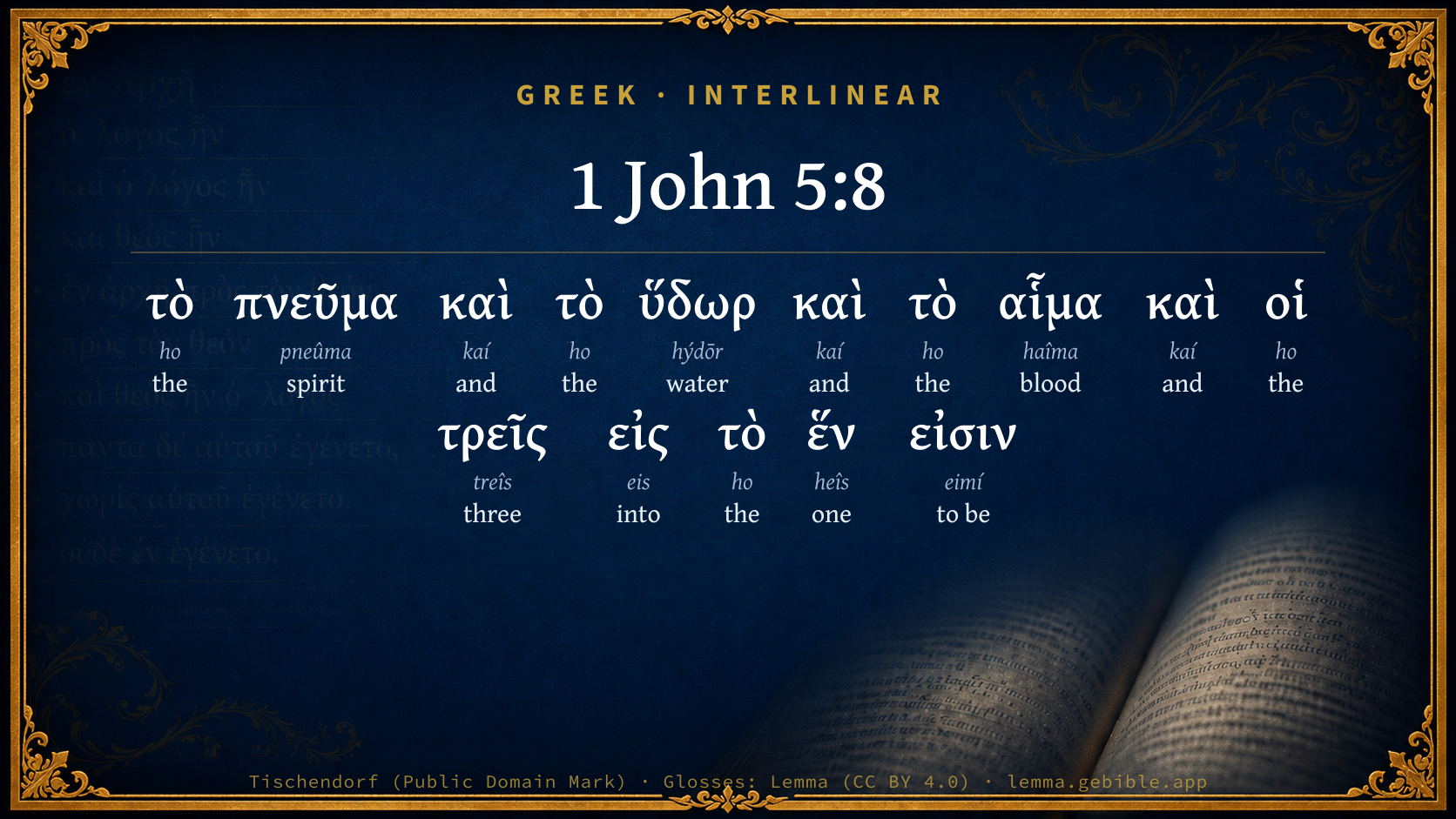
Greek (Tischendorf 8th ed.) 1 John 5:8 appears in the Greek New Testament. The text above is from the Tischendorf 8th edition. Each word links to its Strong’s number and a concise gloss. Click any word for its full Thayer’s Greek Lexicon entry.
Download image
Cite this verse

1 John 5:8 (World English Bible). Public Domain. Lemma interlinear Bible study tool, https://lemma.gebible.app/v/1-john/5/8.

Show BibTeX & RIS
BibTeX
RIS
English Translation
the Spirit, and the water, and the blood; and the three agree as one.
World English Bible · Public Domain
Download a study sheet

One document with this verse’s original text, its word-by-word gloss line, the meaning frame, cross-references with their text, attributed commentary, and full source and license credits — printable, and it pastes into notes with its structure intact.

This verse Autodidact and up

Study sheet (.html) Plain text (.txt)

A passage Seminary Student

Up to 50 verses in one chapter. A passage sheet keeps up to 6 commentary sources and 12 cross-references per verse, in the order this page ranks them, and says so on the sheet whenever that leaves anything out. Ask for a single verse and you get the Autodidact verse sheet above.

Everything on this page stays free to read, with no account — the sheet is a download of what is already on screen, not access to it.

Want to remove ads? Support Godless Engineer
Compare translations 3

The same verse in 3 English versions, stacked beneath the original-language interlinear above. Click any original word for its lexicon entry.

Each is an independent rendering of the whole verse — the interlinear is not word-aligned to these translations.

Highlighted words mark where these versions differ — a whole-verse word diff, not a word-by-word alignment.

  • World English Bible Public Domain
    the Spirit, and the water, and the blood; and the three agree as one.
  • King James Version Public Domain
    And there are three that bear witness in earth, the Spirit, and the water, and the blood: and these three agree in one.
  • unfoldingWord Literal Text CC BY-SA 4.0
    the Spirit and the water and the blood, and the three are unto the one.

unfoldingWord Literal Text — © unfoldingWord, licensed CC BY-SA 4.0. Word-aligned USFM3 via Door43 (git.door43.org/unfoldingWord/en_ult).

Versions to compare (up to 4)

3 of 4 selected

Show all 19 translations

Every available English version of this verse, each an independent rendering of the whole verse.

  • World English Bible Public Domain
    the Spirit, and the water, and the blood; and the three agree as one.
  • Berean Standard Bible Public Domain
    the Spirit, the water, and the blood—and these three are in agreement.
  • Majority Standard Bible Public Domain
    the Spirit, the water, and the blood—and these three are in agreement.
  • King James Version Public Domain
    And there are three that bear witness in earth, the Spirit, and the water, and the blood: and these three agree in one.
  • American Standard Version (1901) Public Domain
    For there are three who bear witness, the Spirit, and the water, and the blood: and the three agree in one.
  • Revised Version (1885) Public Domain
    For there are three who bear witness, the Spirit, and the water, and the blood: and the three agree in one.
  • Geneva Bible (1599) Public Domain
    And there are three, which beare record in the earth, the spirit, and the water and the blood: and these three agree in one.
  • Douay-Rheims (1899) Public Domain
    And there are three that give testimony on earth: the spirit, and the water, and the blood: and these three are one.
  • Young's Literal Translation Public Domain
    and three are who are testifying in the earth', the Spirit, and the water, and the blood, and the three are into the one.
  • Literal Standard Version CC BY-SA 4.0
    and [there] are three who are testifying in the earth]]: the Spirit, and the water, and the blood, and the three are into the one.
  • Unlocked Literal Bible CC BY-SA 4.0
    the Spirit, the water, and the blood. These three are in agreement.
  • unfoldingWord Literal Text CC BY-SA 4.0
    the Spirit and the water and the blood, and the three are unto the one.
  • Darby Bible Public Domain
    the Spirit, and the water, and the blood; and the three agree in one.
  • World Messianic Bible Public Domain
    the Spirit, the water, and the blood; and the three agree as one.
  • Webster's Bible Public Domain
    And there are three that bear testimony on earth, the spirit, and the water, and the blood: and these three agree in one.
  • Free Bible Version CC BY-SA 4.0
    the Spirit, the water, and the blood, and all three agree as one.
  • Bible in Basic English Public Domain
    There are three witnesses, the Spirit, the water, and the blood: and all three are in agreement.
  • Text-Critical English NT CC BY 4.0
    the Spirit, the water, and the blood; and these three are in agreement.
  • Tyndale New Testament (1534) Public Domain
    For there are thre which beare recorde (in erth:) the sprete and water and bloud: and these thre are one.

Literal Standard Version (2020), Covenant Press — licensed CC BY-SA 4.0. Text via the HelloAO Bible API (eBible.org). Unlocked Literal Bible (unfoldingWord) — licensed CC BY-SA 4.0. Text via the HelloAO Bible API (eBible.org). unfoldingWord Literal Text — © unfoldingWord, licensed CC BY-SA 4.0. Word-aligned USFM3 via Door43 (git.door43.org/unfoldingWord/en_ult). Free Bible Version, Dr. Jonathan Gallagher — licensed CC BY-SA 4.0. Text via the HelloAO Bible API (eBible.org).

Word by word

More ways to search: Search by grammar → Find every occurrence → Compare this word →

Practice this passage: Drill this verse → Learn its vocabulary →

About this verse

These counts appear in no published source. They are computed here, from the morphology-tagged text and Lemma’s own curated glosses. What Lemma adds →

15
words
9
distinct lemmas
General Epistles
section

Repetition

Words recur within this verse:

Cross-references

12

Topical passages linked to 1 John 5:8 in the Treasury of Scripture Knowledge — connected by theme and wording, ordered by reader-vote popularity; previews shown in the World English Bible.

  • 1 John 5:6–7 This is he who came by water and blood, Jesus Christ; not with the water only, but with the water and the blood. It is the Spirit who testifies, because the Spirit is the truth.
  • John 15:26 "When the Counselor has come, whom I will send to you from the Father, the Spirit of truth, who proceeds from the Father, he will testify about me.
  • 1 Peter 3:21 This is a symbol of baptism, which now saves you-- not the putting away of the filth of the flesh, but the answer of a good conscience toward God, through the resurrection of Jesus Christ,
  • Acts 2:2–4 Suddenly there came from the sky a sound like the rushing of a mighty wind, and it filled all the house where they were sitting.
  • Romans 8:16 The Spirit himself testifies with our spirit that we are children of God;
  • Matthew 26:26–28 As they were eating, Jesus took bread, gave thanks for it, and broke it. He gave to the disciples, and said, "Take, eat; this is my body."
  • Matthew 28:19 Therefore go, and make disciples of all nations, baptizing them in the name of the Father and of the Son and of the Holy Spirit,
  • 2 Corinthians 1:22 who also sealed us, and gave us the down payment of the Spirit in our hearts.
  • Mark 14:56 For many gave false testimony against him, and their testimony didn't agree with each other.
  • Hebrews 6:4 For concerning those who were once enlightened and tasted of the heavenly gift, and were made partakers of the Holy Spirit,
  • Hebrews 13:12 Therefore Jesus also, that he might sanctify the people through his own blood, suffered outside of the gate.
  • Acts 15:15 This agrees with the words of the prophets. As it is written,

Cross-references courtesy of OpenBible.info (CC BY 4.0).

Where the printed editions differ

1 variant

Places in this verse where the major printed Greek editions disagree on the wording in a way that affects the translation — a comparison of editions, not a manuscript-by-manuscript collation. The editions are the modern critical texts (Nestlé-Aland 28/27, SBL, Westcott-Hort, Tregelles, Tyndale House) and the traditional texts behind the KJV (the Textus Receptus and the Byzantine/Majority text). It is not a claim about which reading is original.

  1. Extra text
    καὶ τρεῖς εἰσιν οἱ μαρτυροῦντες ἕν τῇ γῇ,

    “and three are those bearing testimony in the earth:”

    In TR Not in NA28NA27TynSBLWHTregByz

    καὶ τρεῖς εἰσιν οἱ μαρτυροῦντες ἕν τῇ γῇ, (kai treis eisin hoi marturountes hen tēa gēa) 'and three are those bearing testimony in the earth: ' is only in traditional manuscripts (TR)

Textual data: Translators Amalgamated Greek New Testament (STEPBible TAGNT) · CC BY 4.0.

Commentary

Notes on 1 John 5:8 from classic Christian and Jewish commentators (each source and its license shown beneath its notes). The classic Christian expositions comment on the surrounding passage and are grouped to its opening verse, so a note may address several verses; the Jewish commentaries on the Tanakh (Rashi and others) are per-verse, so they appear only where the commentator wrote on this verse.

Lemma curates 59 commentaries, every one of them public domain or Creative Commons licensed, each selected and text-cleaned for this edition rather than reprinted as found. About our sources →

The Cambridge Bible for Schools and Colleges

gen. ed. J. J. S. Perowne

8. And there are three that bear witness in earth] These words also are part of the spurious insertion. The true text of 1Jn_5:7-8 runs: For those who bear witness are three, the Spirit, and the water, and the blood; and the three agree in one. S. John says ‘those who bear witness’, not simply ‘the witnesses’: they are not merely witnesses who might be called, or who have once been called, but who are perpetually delivering their testimony. The masculine (οἱ μαρτυροῦντες) is evidence of the personality of the Spirit. The Apostle is answering the misgivings of those who fancied that when he, the last of the Apostles, was taken from them, the Church would possess only second-hand evidence, and a tradition ever growing fainter, as to the Person and Mission of the Christ. ‘Nay’, says he, ‘evidence at first-hand is ever present, and each believer has it in himself’ (1Jn_5:10). Comp. Joh_15:26.

are three] It is very doubtful whether the Trinity is even remotely symbolized. Perhaps S. John wishes to give the full, complement of evidence recognized by law (Mat_18:16; 2Co_13:1; Deu_19:15; comp. Joh_8:17).

the water, and the blood] These of course have the same meaning as before; Christ’s Baptism and Death. “The real value of our Lord’s baptism and His death may be estimated by supposing that neither had taken place, and that our Lord had appeared on His mission without openly professing His mission from God in submitting to the baptism of John; or that He had died quietly, as other men die” (Jelf).

agree in one] Literally, are (united) into the one; or, are for the one object of establishing this truth. This may mean either that they are joined so as to become one witness, or that they co-operate in producing one result. “The trinity of witnesses furnish one testimony”. ‘To be one (ἓν εἶναι) occurs Joh_10:30; Joh_17:11; Joh_17:21-22; and (εἶς ἐστε) 1Co_3:23 : ‘into one’ (εἰς ἔν) occurs Joh_11:52; Joh_17:23 : but ‘to be into one’ or ‘to be into the one’ occurs nowhere else in N. T. ‘The one’ here has been made into an argument for the genuineness of 1Jn_5:7. It is said that ‘the one’ plainly implies that ‘one’ has preceded. But this lands us in absurdity by making ‘one’ in 1Jn_5:8 mean the same as ‘one’ in 1Jn_5:7. ‘One’ in 1Jn_5:7 means ‘one Substance’, the ‘Unity in Trinity’. But what sense can ‘The spirit, the water, and the blood agree m the Unity in Trinity’ yield?

The Cambridge Bible for Schools and Colleges (gen. ed. J. J. S. Perowne; Cambridge University Press, 1878–1918) — public domain. Text from a community e-Sword module.

Joseph Benson's Commentary

1Jn 5:8. And there are three that bear witness on earth — To the same important doctrine concerning Christ, the Son of God, and salvation through him; the Spirit, the water, and the blood — The Spirit here, distinguished from the Holy Ghost in the preceding verse, seems to mean, 1st, That influence of the Spirit, which, in a peculiar manner, attended the preaching of the gospel by the apostles and first ministers of the Word, in that early age of Christianity: together with the extraordinary gifts of the Spirit, which remained with the church for a considerable time. 2d, The inspired writers of the apostles and the evangelists, bearing witness to the doctrine of Christ, when they were deceased; including the predictions uttered by holy men of old, as they were moved by the Holy Spirit, concerning the coming and character of the Messiah, which had been punctually fulfilled in him; and including also the predictions uttered by Christ concerning the destruction of Jerusalem, and the calamities coming on the Jewish nation, with divers other predictions, particularly those concerning the coming of false Christs and false prophets, which were already in part accomplished when St. John wrote this epistle and the rest, he knew, soon would be accomplished. Certainly, the inspired Scriptures, including the predictions of the prophets, and of Christ and his apostles, sealed by their accomplishment, are one grand proof on earth of the truth of Christianity, and of the doctrine of salvation contained therein. And the water — Of baptism, emblematical of the washing of regeneration, and of that purity of life consequent thereon, to which we are obliged, and which we in effect promise when we devote ourselves to the Father, Son, and Holy Ghost in that ordinance: and which, when evidenced in our conduct, is a convincing proof of the truth of Christianity, and of our title to that eternal life which is revealed in it. And the blood — The Lord’s supper, appointed as a memorial of, and testimony to, the sacrifice of the death of Christ, till his second coming; and which exhibits the atoning blood of Christ, from age to age, as the procuring cause of the pardon of sin, and all the spiritual blessings consequent thereon, bestowed on true believers. It may be proper to observe here, that there is also another respect in which these two ordinances of baptism and the Lord’s supper may be considered as evidences of the truth of Christianity. It is certain that such ordinances are in use among Christians: now, how came this to be the case? When, and how were they introduced? What was their origin? The gospels inform us. If we admit the account they give, we must of necessity admit the truth of Christianity, with which that account is closely connected. If any do not admit that account, let them give another: but this they cannot do. That account therefore is just; and, of consequence, Christianity is not a forgery, but a divine institution. As the blood here implies the testimony which Christ bore to the truth of the gospel, especially of that most essential article of it, his being the Son of God, so it may also represent that testimony which is borne to the truth by the sufferings of those who, in different ages and nations, have sealed it with their blood; which is a strong proof of the conviction they had of its truth and importance, and of the virtue and excellence of that religion which enabled them so to do. And these three agree in one — In bearing one and the same testimony, namely, that Jesus Christ is the Son of God, the Messiah, the only Saviour of sinners; in and through whom alone the guilty, depraved, weak, and miserable children of men can obtain spiritual and eternal life; the testimony specified 1Jn 5:11-12.

Bengelius thinks there has been a transposition of these two verses, and that this latter, concerning the three that bear witness on earth, was placed by St. John before that which respects the witnesses in heaven; and that it must appear to every reasonable man how absolutely necessary the contested verse is. “St. John,” says he, “could not think of the testimony of the Spirit, and water, and blood, and subjoin, the testimony of God is greater, without thinking also of the testimony of the Son and Holy Ghost; yea, and mentioning it in so solemn an enumeration. Nor can any possible reason be devised why, without three testifying in heaven, he should enumerate three, and no more, who testify on earth. The testimony of all is given on earth, and not in heaven; but they who testify are part on earth, part in heaven. The witnesses who are on earth, testify chiefly concerning his abode on earth, though not excluding his state of exaltation. the witnesses who are in heaven testify chiefly concerning his glory at God’s right hand, though not excluding his state of humiliation. The former, therefore, concerning the witnesses on earth, with the 6th verse, contains a recapitulation of the whole economy of Christ, from his baptism to pentecost: that concerning the witnesses in heaven, contains the sum of the divine economy, from the time of his exaltation. Hence it further appears, that the position of the two verses, which places those who testify on earth before those who testify in heaven, is abundantly preferable to the other, and affords a gradation admirably suited to the subject.”

Joseph Benson's Commentary on the Old and New Testaments (1811–1818) — public domain. Text from a community e-Sword module.

Bengel's Gnomon

Johann Albrecht Bengel

1Jn 5:8. Καὶ τρεῖς εἰσιν οἱ μαρτυροῦντες, and there are three that bear witness) The testimony of the spirit, and the water, and the blood, by a remarkable gradation and addition of strength (Epitasis), is corroborated by the additional testimony of three who give greater testimony. Comp. altogether Joh 3:8; Joh 3:11.—ἐν τῷ οὐρανῷ, in heaven) See below.—ὁ Πατὴρ, the Father) Under this name the name of God is also understood; as under the name of the Word (respecting which, however, see what shortly follows), the Son is understood; according to the nature of the relatives. Comp. 1Co 15:28.—ὁ Λόγος, the Word) The name, Word, is remarkably adapted to the testimony. The Word testifies respecting Himself, as respecting the Son of God. Rev 1:5; Rev 19:13. Some of the Fathers in this place write Filius (the Son), according to the more frequent usage of Scripture. And even the Florentine and Reutlingensian Latin Manuscripts have this reading (Filius).—τὸ Πνεῦμα, the Spirit) In this passage, and everywhere throughout the Epistle, John, when speaking of the Holy Spirit, understands the epithet Holy. Jesus Christ, before His passion, spake openly of His own testimony and that of the Father: there is added, especially after His glorification, the testimony of the Holy Spirit: ch. 1Jn 2:27; Joh 15:26; Act 5:32; Rom 8:16. Wherefore, as before a pair of witnesses was urged, Joh 8:17-18, so now there is a Trinity.—καὶ οὗτοι οἱ τρεῖς ἓν εἰσι, and these three are one) The preceding verse has, and these three agree in one: now it is said, these three are one. There is a carefully weighed difference of expression, although in other places εἰς is either inserted or omitted indifferently. These three are one: just as the two, the Father and the Son, are one. The Spirit is inseparable from the Father and the Son: for unless the Spirit together with the Father and the Son were one, it would be right for us to say, that the Father and the Son, who are one, together with the Spirit, are two: but this would be opposed to the entire sum of the Divine revelation. They are one in essence, in knowledge, in will, and moreover in the agreement of their testimony: Joh 10:30; Joh 10:38; Joh 14:9-11. The three are not opposed conjointly to the other three, but separately, each to each, as though it were said, Not only does the Spirit testify, but the Father also, Joh 5:37: not only the water, but the Word also, Joh 3:11; Joh 10:41: not only the blood, but the Spirit also, Joh 15:26-27. Now it becomes evident how necessary is the reading of the 8th verse. It was impossible for John to think respecting the testimony of the spirit, and the water, and the blood, and add the testimony of God as greater, without thinking also of the testimony of the Son and of the Holy Spirit, and making mention of it in an enumeration so solemn; nor can any reason be imagined why, without the three who bear witness in heaven, he should mention those that bear witness on earth, and those as three. Enumerations of this kind are usually not single, but manifold, as Proverbs 30; how much more so in this place? The 7th verse, of whatever importance it is, has a respective force, and tends to this object, that there should be a progressive advance from the 6th verse to the 8th; and here lies the advantage of the complaint above noticed. Whether the 7th verse, respecting the three that bear witness on earth, be compared with the preceding or with the following verse, the 8th is necessary. For the 6th verse and the 7th have some things the same, and some different. Those which are the same, are only repeated on this account, that they may be adapted to the 8th verse: those which are different, and either vary the expression, or add something more to the sentiment, have a still plainer reference to the 8th verse. For instance, in the absolute expression, the Spirit only is said to be bearing witness: in the respective (relative) expression, the water also and the blood are spoken of. In like manner the 7th and 8th verses have some words in common; in others, when the expression is changed, the sentiment itself introduces something different, as in one, and one. The Trinity of heaven, archetypal, fundamental, unchangeable, plainly supports the triad of witnesses on earth, in an accommodated sense. The apostle might either have fixed the number of those who bear witness on earth as greater; comp. 1Jn 5:9; or he might have referred [reduced] them all to [under] one spirit; comp. 1Jn 5:6; but he reduces them to a triad, solely with reference to the three who bear witness in heaven. From the circumstance, that the Father, and the Word, and the Spirit, are properly three, and are bearing witness, and are one, the same things also are, by a trope, predicated of the spirit, and the water, and the blood; although, it is evident of itself, that the things thus predicated are of themselves less applicable to the subjects spoken of: and this has been perceived by those who, in the verse respecting the spirit, and the water, and the blood, have changed the masculine (tres) into the neuter (tria).[21] See Apparatus, pp. 750, 755. If there is any relation between those who bear witness on earth and those who bear witness in heaven, the arrangement of the words, the spirit, and the water, and the blood, requires, that the spirit be referred to the Father, the water to the Word, and the blood to the Spirit: but this is confirmed only by the express reading of the Father, and the Word, and the Spirit: in the absence of which reading a variously fluctuating allegory has changed the order of the words. See Appar., pp. 757, 764. The apostle, in asserting that the commandments of God are not grievous, deduces their observance not only from the sacraments, but chiefly also from faith in the Sacred Trinity, as the Lord Himself does, Mat 28:19-20. This whole paragraph shows, on the part of John, a perception derived from God, and a style worthy of this perception. They who do not admit the 8th verse, can give no suitable explanation of the 7th. They reduce the Metalepsis, which we noticed above, into an open Catachresis:[22] but the 8th verse being admitted, the Metalepsis is altogether softened down, and the order in which the spirit is placed, before the water and the blood, is explained, and an account is given of all the words. In short, there is an intimate connection between both verses, a complete rhythm, an inseparable parody (correspondence between the verses); and the one without the other is as a compound period, or a poetical strophe, where the half is wanting.

[21] Origen 4, 143c says, “The disciple John has described the spirit, the water, and the blood, τὰ τρία (neuter) εἰς ἓν γινόμενα, the three things, as concurring in one.”—E.

[22] See Append.

Bengel's Gnomon of the New Testament — English translation (T&T Clark, Edinburgh, 1860) — public domain. Text from a community e-Sword module.

Cambridge Greek Testament for Schools and Colleges

8. τὸ ὕδωρ καὶ τὸ αἶμα. These of course have the same meaning as before; Christ’s Baptism and Death. “The real value of our Lord’s baptism and His death may be estimated by supposing that neither had taken place, and that our Lord had appeared on His mission without openly confessing His mission from God in submitting to the baptism of John; or that He had died quietly, as other men die” (Jelf).

καὶ οἱ τρεῖς εἰς τὸ ἕν εἰσιν. Literally, and the three are (united) into the one; or, are for the one object of establishing this truth. This may mean either that they are joined so as to become one witness, or that they co-operate in producing one result. “The trinity of witnesses furnish one testimony”. ‘To be one’ (ἕν εἶναι) occurs Joh 10:30; Joh 17:11; Joh 17:21-22, and (εἶς ἐστε) Gal 3:28: ‘into one’ (εἰς ἕν) occurs Joh 11:52; Joh 17:23: but ‘to be into one’ or ‘to be into the one’ occurs nowhere else in N.T. Τὸ ἕν here has been made into an argument for the genuineness of 1Jn 5:7. It is said that ‘the one’ plainly implies that ‘one’ has preceded. But this lands us in absurdity by making ‘one’ in 1Jn 5:8 mean the same as ‘one’ in 1Jn 5:7. ‘One’ in 1Jn 5:7. means ‘one Substance’, the ‘Unity in Trinity’. But what sense can ‘The spirit, the water, and the blood agree in the Unity in Trinity’ yield?

Cambridge Greek Testament for Schools and Colleges (Cambridge University Press, 1896; 21 vols, various authors incl. Carr, Maclear, Plummer, Farrar, Lumby, Moule, M. R. James, Simcox) — public domain. Text from a community e-Sword module.

Jamieson, Fausset & Brown

Robert Jamieson, A. R. Fausset & David Brown

agree in one--"tend unto one result"; their agreeing testimony to Jesus' Sonship and Messiahship they give by the sacramental grace in the water of baptism, received by the penitent believer, by the atoning efficacy of His blood, and by the internal witness of His Spirit (Jo1 5:10): answering to the testimony given to Jesus' Sonship and Messiahship by His baptism, His crucifixion, and the Spirit's manifestations in Him (see on Jo1 5:6). It was by His coming by water (that is, His baptism in Jordan) that Jesus was solemnly inaugurated in office, and revealed Himself as Messiah; this must have been peculiarly important in John's estimation, who was first led to Christ by the testimony of the Baptist. By the baptism then received by Christ, and by His redeeming blood-shedding, and by that which the Spirit of God, whose witness is infallible, has effected, and still effects, by Him, the Spirit, the water, and the blood, unite, as the threefold witness, to verify His divine Messiahship [NEANDER].

Jamieson, Fausset & Brown — Commentary Critical and Explanatory on the Whole Bible (1871) — public domain (CC PDM 1.0). Text via the HelloAO Bible API.

Adam Clarke's Commentary

Verse 8. The Spirit, and the water, and the blood] This verse is supposed to mean "the Spirit-in the word confirmed by miracles; the water-in baptism, wherein we are dedicated to the Son, (with the Father and the Holy Spirit,) typifying his spotless purity, and the inward purifying of our nature; and the blood-represented in the Lord's Supper, and applied to the consciences of believers: and all these harmoniously agree in the same testimony, that Jesus Christ is the Divine, the complete, the only Saviour of the world."-Mr. Wesley's notes.

By the written word, which proceeded from the Holy Spirit, that Spirit is continually witnessing upon earth, that God hath given unto us eternal life.

By baptism, which points out our regeneration, and the renewing of the Holy Ghost, and which is still maintained as an initiatory rite in the Christian Church, we have another witness on earth of the truth, certainty, importance, and efficacy of the Christian religion. The same may be said of the blood, represented by the holy eucharist, which continues to show forth the death and atoning sacrifice of the Son of God till he comes. See the note on 1Jo 5:6.

Adam Clarke's Commentary on the Bible (1810–1826) — public domain. Text from a community e-Sword/MySword module.

John Calvin's Commentaries

8 There are three He applies what had been said of water and blood to it’s own purpose, in order that they who reject Christ might have no excuse; for by testimonies abundantly strong and clear, he proves that it is he who had been formerly promised, inasmuch as water and blood, being the pledges and the effects of salvation, really testify that he had been sent by God. He adds a third witness, the Holy Spirit, who yet holds the first place, for without him the water and blood would have flowed without any benefit; for it is he who seals on our hearts the testimony of the water and blood; it is he who by his power makes the fruit of Christ’s death to come to us; yea, he makes the blood shed for our redemption to penetrate into our hearts, or, to say all in one word, he makes Christ with all his blessings to become ours. So Paul, in Romans 1:4, after having said that Christ by his resurrection manifested himself to be the Son of God, immediately adds, “Through the sanctification of the Spirit.” For whatever signs of divine glory may shine forth in Christ, they would yet be obscure to us and escape our vision, were not the Holy Spirit to open for us the eyes of faith.

Readers may now understand why John adduced the Spirit as a witness together with the water and the blood, even because it is the peculiar office of the Spirit, to cleanse our consciences by the blood of Christ, to cause the cleansing effected by it to be efficacious. On this subject some remarks are made at the beginning of the Second Epistle of Peter, where he uses nearly the same mode of speaking, that is, that the Holy Spirit cleanses our hearts by the sprinkling of the blood of Christ.

But from these words we may learn, that faith does not lay hold on a bare or an empty Christ, but that his power is at the same time vivifying. For to what purpose has Christ been sent on the earth, except to reconcile God by the sacrifice of his death? except the office of washing had been allotted to him by the Father?

It may however be objected, that the distinction here mentioned is superfluous, because Christ cleansed us by expiating our sins; then the Apostle mentions the same thing twice. I indeed allow that cleansing is included in expiation; therefore I made no difference between the water and the blood, as though they were distinct; but if any one of us considers his own infirmity, he will readily acknowledge that it is not in vain or without reason that blood is distinguished from the water. Besides, the Apostle, as it has been stated, alludes to the rites of the law; and God, on account of human infirmity, had formerly appointed, not only sacrifices, but also washings. And the Apostle meant distinctly to show that the reality of both has been exhibited in Christ, and on this account he had said before, “Not by water only,” for he means, that not only some part of our salvation is found in Christ, but the whole of it, so that nothing is to be sought elsewhere.

John Calvin's Commentaries (1540-1563) — public domain. Text from the Calvin Translation Society English edition (1840s-50s) via the Christian Classics Ethereal Library (ccel.org). Calvin's coverage is partial (roughly two-thirds of the Bible); uncommented books and verses are honest gaps, never fabricated. The 19th-century editor's footnotes and remarks are omitted so the notes are faithfully Calvin's own voice.

John Gill's Exposition

And there are three that bear witness on earth,.... To the same truth of the sonship of Christ:

the Spirit, and the water, and the blood; by the "Spirit" is not meant the human Spirit or soul of Christ; for however that may be a witness of the truth of his human nature, yet not of his divine sonship: and moreover cannot be said to be a witness in earth; rather the Gospel, called the Spirit, which is a testimony of Christ's person, office, and graces and is preached by men on earth; or else the gifts of the Spirit bestowed on men on earth, both in an extraordinary and ordinary way, by which they have been qualified to bear witness to this truth; or it may be the Holy Spirit itself is intended, as he is in the hearts of his people here on earth, where he not only witnesses to the truth of their sonship, but also of the sonship of Christ, and is that witness a believer has within himself of it, mentioned in Jo1 5:10. By water is designed, not internal sanctification, which though an evidence of regeneration and adoption, yet not of Christ's sonship; but water baptism, as administered on earth in the name of the Father, and of the Son, and of the Holy Ghost; and which is a noble and standing testimony to the proper, natural, and eternal sonship of Christ: and by "blood" is intended, not justification by the blood of Christ, but rather the blood of the saints, the martyrs of Jesus, who have shed it on earth, in testimony of their faith in the Son of God, and thereby sealing the truth of it; or rather the ordinance of the Lord's supper, which is the communion of the blood of Christ; and represents that blood which was shed for the remission of sins, and has a continual virtue to cleanse from all sin, which is owing to his being the Son of God. The three witnesses on earth seem therefore to be the Gospel, attended with the Spirit and power of God, and the two ordinances of baptism, and the Lord's supper:

and these agree in one; in their testimony of Christ, the word and ordinances agree together; and the sum and substance of them is Christ; they come from him, and centre in him; they are like the cherubim over the mercy seat, that looked to one another, and to that; and the two ordinances are the church's two breasts, which are equal, and like to one another; there is a great agreement between them, they are like to two young roes that are twins.

John Gill's Exposition of the Whole Bible (1746–1763) — public domain (CC PDM 1.0). Text via the HelloAO Bible API.

Trapp's Complete Commentary

John Trapp

8 And there are three that bear witness in earth, the Spirit, and the water, and the blood: and these three agree in one.

Ver. 8. The Spirit and the water] The Spirit of sanctification testified by saving graces and new divine gifts, the water of repentance, and the blood of Christ applied by faith. These be the three witnesses of a man’s happiness here. When the waters of sanctification are troubled and muddy, let us run to the witness of blood.

John Trapp, A Commentary or Exposition upon All the Books of the Old and New Testament (1647–1656) — public domain. Text from a community e-Sword module.

Albert Barnes' Notes on the Bible

And there are three that bear witness in earth - This is a part of the text, which, if the reasoning above is correct, is to be omitted. The genuine passage reads, 1Jo 5:7, “For there are three that bear record (or witness, μαρτυροῦντες marturountes) - the Spirit, and the water, and the blood.” There is no reference to the fact that it is done “in earth.” The phrase was introduced to correspond with what was said in the interpolated passage, that there are three that bear record “in heaven.”

The Spirit - Evidently the Holy Spirit. The assertion here is, that that Spirit bears witness to the fact that Jesus is the Son of God, 1Jo 5:5. The testimony of the Holy Spirit to this fact is contained in the following things:

He did it at the baptism of Jesus. Notes, Mat 3:16-17. Christ was eminently endowed with the influences of the Holy Spirit; as it was predicted that the Messiah would be, and as it was appropriate he should be, Isa 11:2; Isa 61:1. Compare Luk 4:18; Notes, Joh 3:34.

(3)The Holy Spirit bore witness to his Messiahship, after his ascension, by descending, according to his promise, on his apostles, and by accompanying the message which they delivered with saving power to thousands in Jerusalem, Acts 2.

(4)He still bears the same testimony on every revival of religion, and in the conversion of every individual who becomes a Christian, convincing them that Jesus is the Son of God. Compare Joh 16:14-15.

(5)He does it in the hearts of all true Christians, for “no man can say that Jesus is Lord but by the Holy Ghost,” 1Co 12:3. See the notes at that passage.

The Spirit of God has thus always borne witness to the fact that Jesus is the Christ, and he will continue to do it to the end of time, convincing yet countless millions that he was sent from God to redeem and save lost people.

And the water - See the notes at 1Jo 5:6. That is, the baptism of Jesus, and the scenes which occurred when he was baptized, furnished evidence that he was the Messiah. This was done in these ways:

It was proper that the Messiah should be baptized when he entered on his work, and perhaps it was expected; and the fact that he was baptized showed that he had “in fact” entered on his work as Redeemer. See the notes at Mat 3:15.

(2)An undoubted attestation was then furnished to the fact that he was “the Son of God,” by the descent of the Holy Spirit in the form of a dove, and by the voice that addressed him from heaven, Mat 3:16-17.

(3)His baptism with water was an emblem of the purity of his own character, and of the nature of his religion.

(4)Perhaps it may be implied here, also, that water used in baptism now bears witness to the same thing,

(a)As it is the ordinance appointed by the Saviour;

(b)As it keeps up his religion in the world;

(c)As it is a public symbol of the purity of his religion;

(d)And as, in every case where it is administered, it is connected with the public expression of a belief that Jesus is the Son of God.

And the blood - There is undoubted allusion here to the blood shed on the cross; and the meaning is, that that blood bore witness also to the fact that he was the Son of God. This it did in the following respects:

The shedding of the blood showed that he was truly dead - that his work was complete - that he died in “reality,” and not in “appearance” only. See the notes at Joh 19:34-35.

(2)The remarkable circumstances that attended the shedding of this blood - the darkened sun, the earthquake, the rending of the veil of the temple - showed in a manner that convinced even the Roman centurion that he was the Son of God. See the notes at Mat 27:54.

(3)The fact that an “atonement” was thus made for sin was an important “witness” for the Saviour, showing that he had done that which the Son of God only could do, by disclosing a way by which the sinner may be pardoned, and the polluted soul be made pure.

(4)Perhaps, also, there may be here an allusion to the Lord’s Supper, as designed to set forth the shedding of this blood; and the apostle may mean to have it implied that the representation of the shedding of the blood in this ordinance is intended to keep up the conviction that Jesus is the Son of God. If so, then the general sense is, that that blood - however set before the eyes and the hearts of people - on the cross, or by the representation of its shedding in the Lord’s Supper - is a witness in the world to the truth that Jesus is the Son of God, and to the nature of his religion. Compare the notes at 1Co 11:26.

And these three agree in one - εἰς τὸ ἕν εἰσιν eis to hen eisin. They agree in one thing; they bear on one and the same point, to wit, the fact that Jesus is the Son of God. All are appointed by God as witnesses of this fact; and all harmonize in the testimony which is borne. The apostle does not say that there are no other witnesses to the same thing; nor does he even say that these are the most important or decisive which have been furnished; but he says that these are important witnesses, and are entirely harmonious in their testimony.

Albert Barnes' Notes on the Bible (1834–1885) — public domain. Text from a community e-Sword/MySword module.

Haydock's Catholic Bible Commentary

And there are three that give testimony on earth: the Spirit, the water, and the blood; and these three are one.[3] This is a repetition of what was before said, ver. 6, to be expounded in the same manner. But when it is added, these three are one, the sense is, that they witness one and the same truth. (Witham) --- As the Father, the Word, and the Holy Ghost, all bear witness to Christ’s divinity; so the spirit, which he yielded up, crying out with a loud voice upon the cross, and the water and blood that issued from his side, bearing witness to his humanity, and are one; that is, all agree in one testimony. (Challoner)

===============================

[BIBLIOGRAPHY]

Hi tres unum sunt. Divers Greek copies, Greek: eis en eisin, in unum sunt: and so the Protestant translation hath, and these three agree in one; though in the seventh verse they follow the manuscripts which there have, are one, Greek: kai oi treis en eisi.

George Leo Haydock (1774–1849), Haydock's Catholic Family Bible and Commentary, 1859 edition — public domain. Excludes Psalms (Douay-Rheims chapter numbering differs from Protestant) and Deuterocanonical books (Catholic canon only).

Matthew Poole's English Annotations

And for the three that are said to bear witness on earth; there is, first,

the Spirit, who, though the Holy Ghost were in the former triad, needs not here be taken for another Spirit, but may be the same, considered under another notion, and as testifying in another manner; not transiently and immediately from heaven, as there, but statedly, and as inacting instruments here on earth; extraordinarily, the man Christ Jesus, all his apostles and first disciples, in all the wonderful works which they did for the confirmation of the Christian doctrine; and ordinarily, the whole church of true Christians; for it animates the whole living body of Christ, and makes it, though in an imperfect measure, by a uniform course of actions, tending to God and heaven, an extant visible proof to the world of the truth of that religion which obtains in it, and of his Divine power and nature who is the Head of it. Next,

the water; i.e. the continual untainted, God-like purity of our Lord Jesus, through the whole course of his terrestrial state, manifestly showed him to be the Son of God, an incarnate Deity, inhabiting our world. And lastly,

the blood, his suffering of death, considered in the circumstances, was a most conspicuous, clear testimony and indication who he was; so exactly according to the predictions of the prophets, attended with wonderful amazing concomitants, ending in so glorious a resurrection. And in and with both these

the Spirit, complicating his testimony, did bear witness too, as is intimated (after the former mention of them both) in the latter part of 1Jo 5:6. It testified all along, both in his clear, immaculate life, and in the bloody death in which it assisted him, which it accompanied with so marvellous effects, and out of which at length it fetched him, Rom 1:4. And that part it took, as being the Spirit of truth, 1Jo 5:6, and, as it is there expressed, in the (more emphatical) abstract, truth itself.

Matthew Poole's English Annotations on the Holy Bible (1683–1685) — public domain. Text from a community e-Sword/MySword module.

Whedon's Commentary on the Bible

Daniel D. Whedon

8. And… witness—Literally, And three are they who bear witness. It is remarkable that the words three are masculine, implying persons, and one is neuter, implying thing or substance. It is not without a shadow of reason, therefore, that Augustine found an indication of the Trinity in the words. Very similar is the Greek in the words “I and my Father are one,” where “one” is neuter. The water represents the Father, the author of our regeneration; the blood represents the propititiating Son; and these, with the Spirit, ever witness in the world to the Messiahship of him that came. And as the Spirit, so the water and the blood are ever present witnesses in the Church through the sacraments of baptism and eucharist.

Agree in one—Literal Greek, these three are into one. The three persons converge into a unit.

It can hardly be doubted that there is an intended correspondence between these words and those in Joh_19:34-35. John there states, with great emphasis, that he beheld and bare record to the marvellous fact that blood and water came forth from the Saviour’s side. It is obvious that he viewed that water and blood as witnesses to the fact that the dying Jesus was truly a Saviour, both by atoning blood and by purifying water. Similarly striking are the Baptist’s words attesting the Spirit’s testimony of the divine Sonship. “I saw, and bare record that this is the Son of God.” Joh_1:34.

From all this we derive a solemn proof that the ordinances of baptism and the Lord’s supper are a perpetual institution of the Church, bearing record with the Spirit that Jesus is our permanent propitiation and sanctification. In the eucharist we “show forth the Lord’s death until he come.” And the baptismal commission extended “to the end of the world.” 1Co_11:26; Mat_28:19-20.

Daniel D. Whedon (gen. ed.), Commentary on the Old and New Testaments (1874–1909) — public domain. Text from a community e-Sword module.

The Pulpit Commentary

When all three witnesses are enumerated together, the Spirit naturally comes first. He is a living and a Divine witness, independent of the two facts of the baptism and the Passion, which concur with him in testifying that the Son of God is Jesus Christ.

The Pulpit Commentary (1880–1919), ed. H.D.M. Spence-Jones & Joseph S. Exell — public domain. Text from a community e-Sword module.

John Wesley's Explanatory Notes

And there are three that testify in heaven - The testimony of the Spirit, the water, and the blood, is by an eminent gradation corroborated by three, who give a still greater testimony. The Father - Who clearly testified of the Son, both at his baptism and at his transfiguration. The Word - Who testified of himself on many occasions, while he was on earth; and again, with still greater solemnity, after his ascension into heaven, Rev. i, 5; Rev. xix, 13. And the Spirit - Whose testimony was added chiefly after his glorification, chap. ii, 27; John xv, 26; Acts v, 32; Rom. viii, 16. And these three are one - Even as those two, the Father and the Son, are one, John x, 30. Nothing can separate the Spirit from the Father and the Son. If he were not one with the Father and the Son, the apostle ought to have said, The Father and the Word, who are one, and the Spirit, are two. But this is contrary to the whole tenor of Revelation. It remains that these three are one. They are one in essence, in knowledge, in will, and in their testimony. It is observable, the three in the one verse are opposed, not conjointly, but severally, to the three in the other: as if he had said, Not only the Spirit testifies, but also the Father, John v, 37; not only the water, but also the Word, John iii, 11, John x, 41; not only the blood, but also the Holy Ghost, John xv, 26, &c. It must now appear, to every reasonable man, how absolutely necessary the eighth verse is 1 John v, 8. St. John could not think of the testimony of the Spirit, and water, and blood, and subjoin, "The testimony of God is greater," without thinking also of the testimony of the Son and Holy Ghost; yea, and mentioning it in so solemn an enumeration. Nor can any possible reason be devised, why, without three testifying in heaven, he should enumerate three, and no more, who testify on earth. The testimony of all is given on earth, not in heaven; but they who testify are part on earth, part in heaven. The witnesses who are on earth testify chiefly concerning his abode on earth, though not excluding his state of exaltation: the witnesses who are in heaven testify chiefly concerning his glory at God's right hand, though not excluding his state of humiliation. The seventh verse, therefore, with the sixth, contains a recapitulation of the whole economy of Christ, from his baptism to pentecost; the eighth, the sum of the divine economy, from the time of his exaltation. Hence it further appears, that this position of the seventh 1 John v, 7, 8 and eighth verses, which places those who testify on earth before those who testify in heaven, is abundantly preferable to the other, and affords a gradation admirably suited to the subject.

John Wesley, Explanatory Notes Upon the Whole Bible (1754–1765) — public domain. Text via the GEBible commentary corpus.

Scofield Reference Notes

C. I. Scofield

in earth Omit "in earth."

agree Or, are to one point or purpose.

The Scofield Reference Bible (1917 edition), notes by C. I. Scofield — public domain. Text from a community e-Sword module.

Burkitt's Expository Notes on the New Testament

William Burkitt

As if the apostle had said, "As there are three in heaven who have given us their testimony to the divinity of Christ and his doctrine here on earth, so there are three witnesses here below testifying the same thing, namely, the Spirit, in the preaching of the gospel, and in the souls of believers: the water, or sacrament of baptism, wherein we are baptized in the name of the Son, as well as of the Father and the blood, that is, the death of Christ, and the sufferings of those who have sealed this truth with their blood; all these do give testimony on earth to Christ’s divinity from heaven."

Note here, That though much of these two verses be left out in many ancient copies of the Bible, as the learned Dr. Hammond takes notice, yet in copies more ancient they are found, and we have more reason to believe that the Arians left them out, that that the orthodox put them in, other texts that assert the truth being so abused. It has been the common course of heretics to disown the authority of such texts as do gall and pinch them.

Note farther, That the doctrine of the blessed Trinity stands built upon holy Scripture, as a firm basis, and impregnable rock, and the doctrine of the Anti-Trinitarians falls to the ground like Dagon before the ark.

Lord, let our understandings evermore stoop and yield to this divine revelation, though it contains such a doctrine as doth exceed the comprehension of human reason.

William Burkitt's Expository Notes on the New Testament (1700–1703) — public domain. Text from a community e-Sword module.

The People's New Testament

B. W. Johnson

8. There are three that bear witness. In notes on verse 6 I have shown how these three bear witness. These three agree in one. They bear testimony to the same end.

B. W. Johnson's The People's New Testament with Notes (1889–1891) — public domain. Electronic text from the Christian Classics Ethereal Library (CCEL) ThML edition.

International Critical Commentary

8. εἰ τὴν μαρτυρίαν κ.τ.λ.] Cf. Joh 5:36. If we accept the testimony of men when it satisfies the conditions of evidence required by the law, much more are we bound to accept the witness which we possess in this case, for it is witness borne by God Himself. Cf. also Joh 8:18, καὶ μαρτυρεῖ περὶ ἐμοῦ ὁ πέμψας με πατήρ, and 10:25, τὰ ἔργα ἃ ἐγὼ ποιῶ ἐν τῶ ὀνόματι τοῦ πατρός μου ταῦτα μαρτυρεῖ περὶ ἐμοῦ. Neither here nor in 4:11 does the εἰ indicate any doubt: it is known to every one that we do accept such testimony.ὅτι αὕτη κ.τ.λ.] Such witness is greater, and therefore more worthy of our acceptance, because it is Divine witness, and deals with a subject on which God, and God alone, is fully competent to speak. It concerns His Son. God has borne witness concerning His Son. In this case the Divine witness alone is ἀληθινή in the full sense of the term, though other kinds of witness may be true so far as they go.

ὅτι μεμαρτύρηκεν] The reading ὅτι is undoubtedly right. If the reading ἥν, of the Textus Receptus, be adopted, the αὕτη must refer back to the witness already described, i.e. that borne by the three witnesses, the Spirit, the water, and the blood, or by the one witness, the Spirit, who interprets the evidence of the historical facts. The witness meant must be the witness borne to the truth that Jesus is the Christ. If ὅτι is accepted, it may be taken in three ways: (1) Causal. In this case αὕτη must refer to what has preceded, the witness already described. Such is the witness, Divine and legally valid, for God really has borne witness to His Son. By laying the stress on the verb μεμαρτύρηκεν it is perhaps possible to make sense of the passage in this way. But such an interpretation is very harsh, and not in conformity with the author’s style.

(2) ὅ τι. This is the witness, i.e. that which He has borne concerning His Son. This use of ὅ τι in the Johannine writings is not certainly established, though perhaps we should compare Joh 8:25, τὴν ἀρχὴν ὅ τι καὶ λαλῶ ὑμῖν. In the present context it would be intolerably harsh.

(3) It is far more natural and in accordance with the author’s style (cf. Joh 3:19, αὕτη δέ ἐστιν ἡ κρίσις ὅτι τὸ φῶς ἐλήλυθεν κ.τ.λ.) to regard the ὅτι as declarative. The value of the witness consists in this, that He has given it concerning His Son. There can be no more trustworthy witness, so far as competence to speak is concerned, than that which a father bears to his own son. The essence of the witness is that it is the testimony of God to His Son. In the Gospel, μαρτυρεῖν περί is very frequent (1:7, 8, 15, 2:25, 5:31, 32, etc.), elsewhere very rare.

των ανθρωπων] του θεου א* | του θεου (? 1o)] των αν̄ων Ib δ602 (522) | om. οτι Io K arm. | η μαρτυρια 2o] post θεου 2o] Ia | οτι 2o א A B 5. 6. 13 27. 29. 34. 66** vg. sah. cop. arm-codd. Cyr. Aug.] ην K L P al. pler. cat. arm-codd. Thphyl. Oec.: qui arm-ed. | περι τον υιου αυτου] de filio suo Iesu Christo arm-codd.: + quem misit saluatorem super terram. Et filius testimonium perhibuit in terra scripturas perficiens; et nos testimonium perhibemus, quoniam uidimus cum, et annunciamus uobis ut credatis et ideo tol.

8. testimonium dant testificantur (suits better)

7 testimonium dicunt testinficantur

sunt in xpo ihu om. in 10:1. (certain)

International Critical Commentary — older volumes (1896–1929), various authors — public domain. Text from a community e-Sword module.

Vincent's Word Studies in the New Testament

Marvin R. Vincent

Agree in one [εις το εν εισιν] . Lit., are for the one. They converge upon the one truth, Jesus Christ, the Son of God, come in the flesh.

Marvin R. Vincent, Word Studies in the New Testament (1887–1900) — public domain. Text from a community e-Sword/MySword module.

Westcott on Hebrews & the Epistles of John

Brooke Foss Westcott

8. ro πνεῦμα] The Spirit has a twofold office, one corresponding with that of Christ (οὗτός ἐστιν 6 ἐλθών...

Son. * He that believeth on the Son of God hath the witness in himself: he that believeth not God hath made Him a liar, because he hath not believed on the witness which God hath borne concerning His Son. ** And this is the witness, that God gave us eternal life, and this life ie in His Son. * He that hath the Son hath the life: he that hath not the Son of God hath not the life.

Brooke Foss Westcott (1825–1901), The Epistle to the Hebrews (1889) and The Epistles of St John (1883) — public domain (pre-1929). Text recovered from Internet Archive / Google Books OCR scans. Westcott’s Gospel of John commentary is not included (its OCR lost the chapter running-heads required for reliable verse-keying). Some Greek quoted in the Hebrews volume is imperfectly rendered by the OCR.

Lesson kit

Teaching starters — assembled from the data on this page, not authored interpretation. Every prompt links to the verse data it draws on. Edit before teaching.

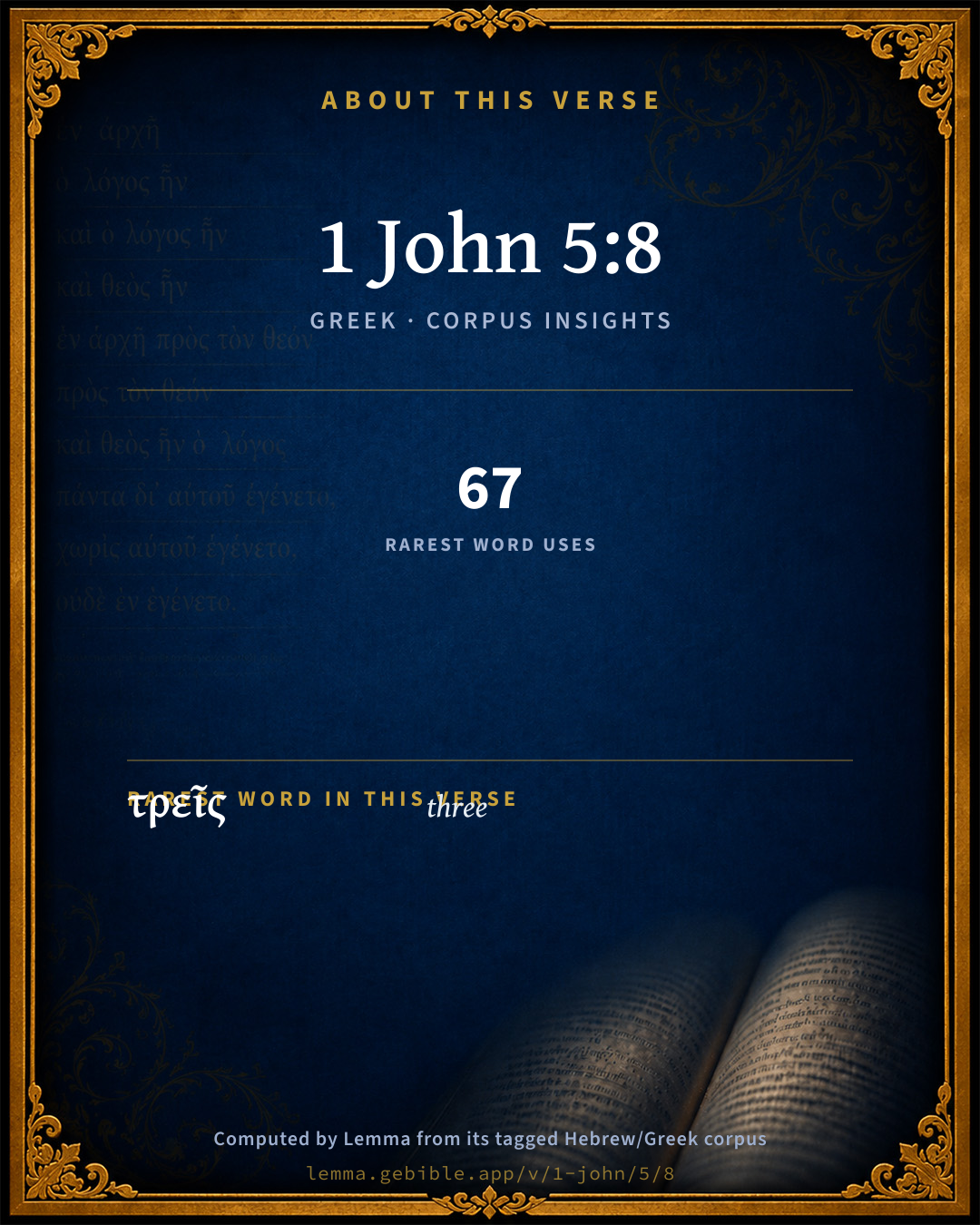
1 John, in the General Epistles, opens this verse with 15 words (9 distinct Greek lemmas). Its most distinctive word is treîs (“three”). A historical commentator’s framing appears above. Read the whole chapter for the surrounding context.

Discussion questions

  1. What does “three” (treîs) contribute to the verse as a whole?
  2. How does 1 John 5:6–7, which shares this passage’s theme, read alongside this verse?
  3. What does the repetition of “the” (5× in this one verse) do in this verse?
  4. These translations render this verse differently; the difference is in the English rendering, not the original. What questions does that raise?
  5. Compare how The Cambridge Bible for Schools and Colleges and Joseph Benson's Commentary read this verse. Where do they agree or differ?

Things to notice

  • These translations choose different wording for 5 words in this verse.
  • “the” occurs 5× in this single verse.
  • 9 distinct Greek lemmas span 15 words in this verse.

Reading settings

Reading text

Shown beneath each verse's original-language words.

Old Testament
Old Testament edition

Read the OT as the Masoretic Hebrew (MT) or the Greek Septuagint (LXX).

English shown for the Greek Septuagint (in the Hebrew ↔ Greek comparison).

Comparing translations? Open the Compare panel on any verse page to stack up to four side by side.