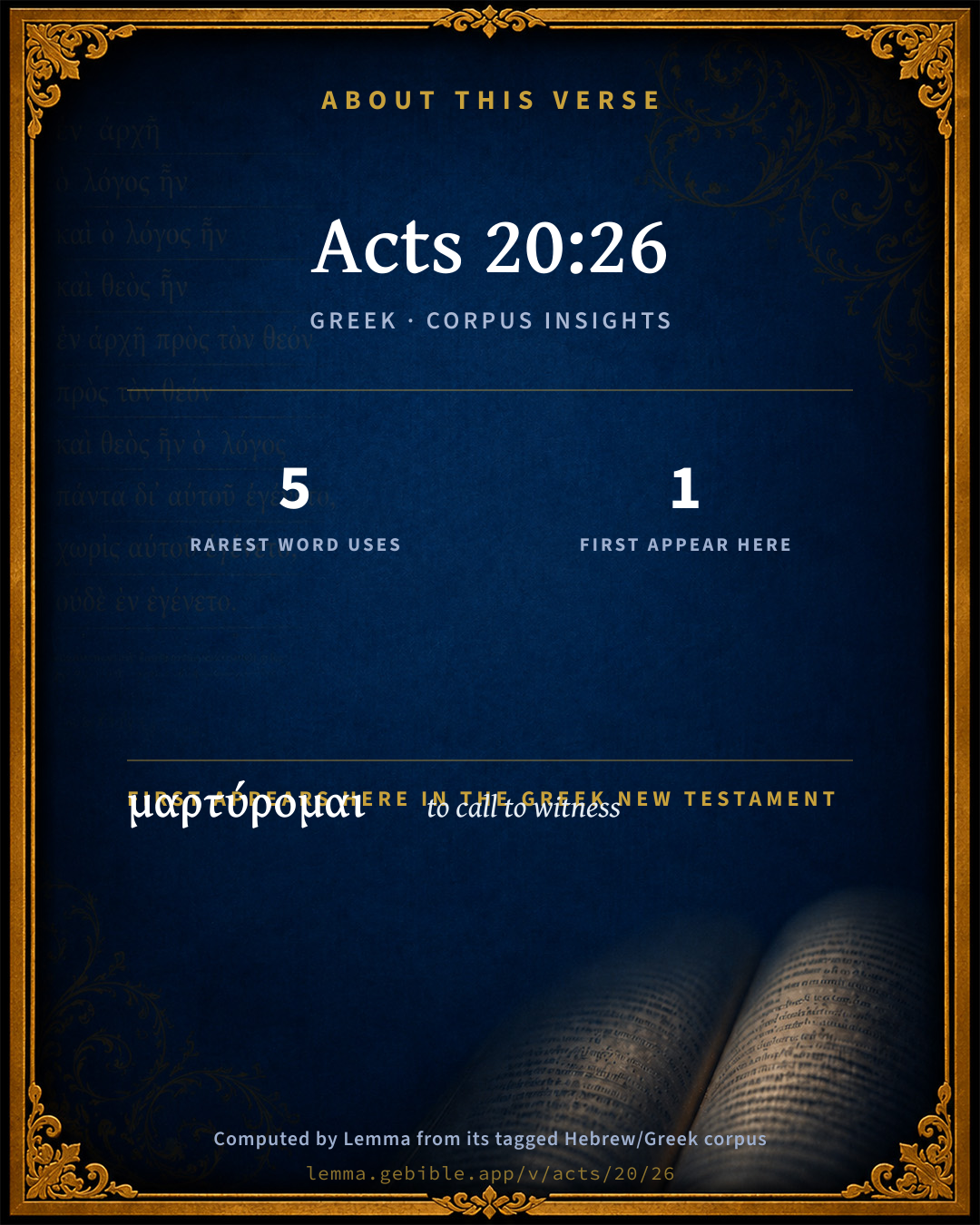
Acts 20:26

Greek (Tischendorf 8th ed.) Acts 20:26 appears in the Greek New Testament. The text above is from the Tischendorf 8th edition. Each word links to its Strong’s number and a concise gloss. Click any word for its full Thayer’s Greek Lexicon entry.
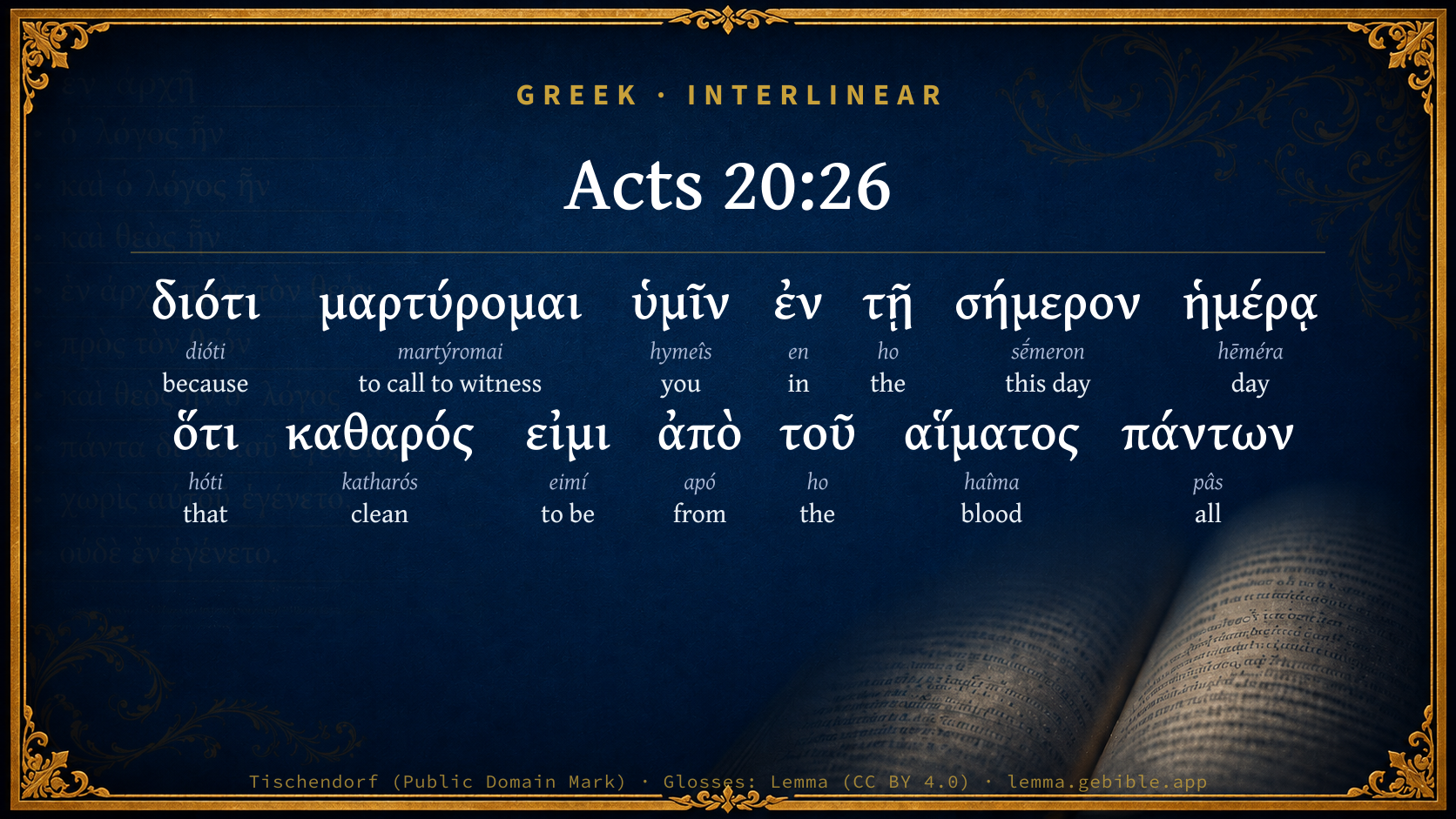
Download image
Cite this verse

Acts 20:26 (World English Bible). Public Domain. Lemma interlinear Bible study tool, https://lemma.gebible.app/v/acts/20/26.

Show BibTeX & RIS
BibTeX
RIS
English Translation
Therefore I testify to you this day that I am clean from the blood of all men,
World English Bible · Public Domain
Highlights
  • 1 first appearance in the Greek New Testament
Full analysis ↓
Download a study sheet

One document with this verse’s original text, its word-by-word gloss line, the meaning frame, cross-references with their text, attributed commentary, and full source and license credits — printable, and it pastes into notes with its structure intact.

This verse Autodidact and up

Study sheet (.html) Plain text (.txt)

A passage Seminary Student

Up to 50 verses in one chapter. A passage sheet keeps up to 6 commentary sources and 12 cross-references per verse, in the order this page ranks them, and says so on the sheet whenever that leaves anything out. Ask for a single verse and you get the Autodidact verse sheet above.

Everything on this page stays free to read, with no account — the sheet is a download of what is already on screen, not access to it.

Want to remove ads? Support Godless Engineer
Compare translations 3

The same verse in 3 English versions, stacked beneath the original-language interlinear above. Click any original word for its lexicon entry.

Each is an independent rendering of the whole verse — the interlinear is not word-aligned to these translations.

Highlighted words mark where these versions differ — a whole-verse word diff, not a word-by-word alignment.

  • World English Bible Public Domain
    Therefore I testify to you this day that I am clean from the blood of all men,
  • King James Version Public Domain
    Wherefore I take you to record this day, that I am pure from the blood of all men.
  • unfoldingWord Literal Text CC BY-SA 4.0
    Therefore I testify to you in the today day that I am innocent from the blood of all.

unfoldingWord Literal Text — © unfoldingWord, licensed CC BY-SA 4.0. Word-aligned USFM3 via Door43 (git.door43.org/unfoldingWord/en_ult).

Versions to compare (up to 4)

3 of 4 selected

Show all 19 translations

Every available English version of this verse, each an independent rendering of the whole verse.

  • World English Bible Public Domain
    Therefore I testify to you this day that I am clean from the blood of all men,
  • Berean Standard Bible Public Domain
    Therefore I testify to you this day that I am innocent of the blood of all men.
  • Majority Standard Bible Public Domain
    Therefore I testify to you this day that I am innocent of the blood of all men.
  • King James Version Public Domain
    Wherefore I take you to record this day, that I am pure from the blood of all men.
  • American Standard Version (1901) Public Domain
    Wherefore I testify unto you this day, that I am pure from the blood of all men.
  • Revised Version (1885) Public Domain
    Wherefore I testify unto you this day, that I am pure from the blood of all men.
  • Geneva Bible (1599) Public Domain
    Wherefore I take you to recorde this day, that I am pure from the blood of all men.
  • Douay-Rheims (1899) Public Domain
    Wherefore I take you to witness this day, that I am clear from the blood of all men;
  • Young's Literal Translation Public Domain
    wherefore I take you to witness this day, that I `am' clear from the blood of all,
  • Literal Standard Version CC BY-SA 4.0
    for this reason I take you to witness this day, that I [am] clear from the blood of all,
  • Unlocked Literal Bible CC BY-SA 4.0
    Therefore I testify to you this day, that I am innocent of the blood of any man.
  • unfoldingWord Literal Text CC BY-SA 4.0
    Therefore I testify to you in the today day that I am innocent from the blood of all.
  • Darby Bible Public Domain
    Wherefore I witness to you this day, that I am clean from the blood of all,
  • World Messianic Bible Public Domain
    Therefore I testify to you today that I am clean from the blood of all men,
  • Webster's Bible Public Domain
    Wherefore I call you to witness this day, that I am pure from the blood of all men.
  • Free Bible Version CC BY-SA 4.0
    So I declare to you today that I am not responsible if anyone is lost.
  • Bible in Basic English Public Domain
    And so I say to you this day that I am clean from the blood of all men.
  • Text-Critical English NT CC BY 4.0
    Therefore I testify to you this day that I am innocent of the blood of you all.
  • Tyndale New Testament (1534) Public Domain
    Wherfore I take you to recorde this same daye that I am pure from the bloude of all men.

Literal Standard Version (2020), Covenant Press — licensed CC BY-SA 4.0. Text via the HelloAO Bible API (eBible.org). Unlocked Literal Bible (unfoldingWord) — licensed CC BY-SA 4.0. Text via the HelloAO Bible API (eBible.org). unfoldingWord Literal Text — © unfoldingWord, licensed CC BY-SA 4.0. Word-aligned USFM3 via Door43 (git.door43.org/unfoldingWord/en_ult). Free Bible Version, Dr. Jonathan Gallagher — licensed CC BY-SA 4.0. Text via the HelloAO Bible API (eBible.org).

Word by word

More ways to search: Search by grammar → Find every occurrence → Compare this word →

Practice this passage: Drill this verse → Learn its vocabulary →

μαρτύρομαι
martýromai
G3143
“to call to witness”
Verb, Present, Middle or Passive deponent, Indicative, 1st person, Singular
Part of Speech
Verb
Tense
Present
Voice
Middle or Passive deponent
Mood
Indicative
Person
1st person
Number
Singular
Full Thayer's Definition

Origin: middle voice from G3144

TDNT: 12:30,6

1. to cite a witness, bring forward a witness, call to witness a. to affirm be appeal to God, to declare solemnly, protest 2. to conjure, beseech as in God's name, exhort solemnly
  1. διότι dióti G1360 “because” Conjunction
  2. ὑμῖν hymeîs G5210 “you” Personal pronoun, 2nd person, Dative, Plural
  3. ἐν en G1722 “in” Preposition
  4. τῇ ho G3588 “the” Article, Dative, Singular, Feminine
  5. σήμερον sḗmeron G4594 “this day” Adverb
  6. ἡμέρᾳ hēméra G2250 “day” Noun, Dative, Singular, Feminine
  7. ὅτι hóti G3754 “that” Conjunction
  8. καθαρός katharós G2513 “clean” Adjective, Nominative, Singular, Masculine
  9. εἰμι eimí G1510 “to be” Verb, Present, Active, Indicative, 1st person, Singular
  10. ἀπὸ apó G575 “from” Preposition
  11. τοῦ ho G3588 “the” Article, Genitive, Singular, Neuter
  12. αἵματος haîma G129 “blood” Noun, Genitive, Singular, Neuter
  13. πάντων pâs G3956 “all” Adjective, Genitive, Plural, Masculine

About this verse

These counts appear in no published source. They are computed here, from the morphology-tagged text and Lemma’s own curated glosses. What Lemma adds →

14
words
13
distinct lemmas
Acts
section

Notable vocabulary

The rarest word here is μαρτύρομαι to call to witness G3143 — appearing just 5 times in the whole Greek New Testament.

First appearance in Scripture

This word makes its first canonical appearance in the Greek New Testament here:

  • μαρτύρομαι to call to witness G3143

Shared distinctive vocabulary

μαρτύρομαι to call to witness G3143 occurs in 5 verses of the Greek New Testament. Also found in:

Repetition

A word recurs within this verse:

Cross-references

13

Topical passages linked to Acts 20:26 in the Treasury of Scripture Knowledge — connected by theme and wording, ordered by reader-vote popularity; previews shown in the World English Bible.

  • Acts 18:6 When they opposed him and blasphemed, he shook out his clothing and said to them, "Your blood be on your own heads! I am clean. From now on, I will go to the Gentiles!"
  • Ezekiel 3:18–21 When I tell the wicked, You shall surely die; and you give him no warning, nor speak to warn the wicked from his wicked way, to save his life; the same wicked man shall die in his iniquity; but his blood will I require at your hand.
  • Ezekiel 33:2–9 Son of man, speak to the children of your people, and tell them, When I bring the sword on a land, and the people of the land take a man from among them, and set him for their watchman;
  • John 12:17 The multitude therefore that was with him when he called Lazarus out of the tomb, and raised him from the dead, was testifying about it.
  • 2 Samuel 3:28 Afterward, when David heard it, he said, I and my kingdom are guiltless before Yahweh forever of the blood of Abner the son of Ner:
  • Job 16:19 Even now, behold, my witness is in heaven. He who vouches for me is on high.
  • John 19:35 He who has seen has testified, and his testimony is true. He knows that he tells the truth, that you may believe.
  • Romans 10:2 For I testify about them that they have a zeal for God, but not according to knowledge.
  • 2 Corinthians 1:23 But I call God for a witness to my soul, that I didn't come to Corinth to spare you.
  • 2 Corinthians 7:2 Open your hearts to us. We wronged no one. We corrupted no one. We took advantage of no one.
  • 2 Corinthians 8:3 For according to their power, I testify, yes and beyond their power, they gave of their own accord,
  • 1 Thessalonians 2:10–12 You are witnesses with God, how holy, righteously, and blamelessly we behaved ourselves toward you who believe.
  • 1 Timothy 5:22 Lay hands hastily on no one, neither be a participant in other men's sins. Keep yourself pure.

Cross-references courtesy of OpenBible.info (CC BY 4.0).

Commentary

Notes on Acts 20:26 from classic Christian and Jewish commentators (each source and its license shown beneath its notes). The classic Christian expositions comment on the surrounding passage and are grouped to its opening verse, so a note may address several verses; the Jewish commentaries on the Tanakh (Rashi and others) are per-verse, so they appear only where the commentator wrote on this verse.

Lemma curates 59 commentaries, every one of them public domain or Creative Commons licensed, each selected and text-cleaned for this edition rather than reprinted as found. About our sources →

Tyndale Open Study Notes

Tyndale Open Resources

20:26 I have been faithful. If anyone suffers eternal death, it’s not my fault: Cp. Ezek 3:16-21.

Tyndale Open Study Notes — © Tyndale Open Resources, licensed CC BY-SA 4.0. Text via the HelloAO Bible API.

Bengel's Gnomon

Johann Albrecht Bengel

Act 20:26. Διὀ, wherefore) This is deduced from Act 20:20.—μαρτύρομαι, I take you to record) Your conscience will be a witness to me. This is the force of the middle verb.—σήμερον, this day) This expression has a great explanatory power.—καθαρὸς, pure) This ought to be the chief care of one taking leave.

Bengel's Gnomon of the New Testament — English translation (T&T Clark, Edinburgh, 1860) — public domain. Text from a community e-Sword module.

Meyer's Critical & Exegetical Commentary

Heinrich August Wilhelm Meyer

Act_20:26-27. Διό] because, namely, this now impending separation makes such a reckoning for me a duty.

μαρτύρομαι] I testify, I affirm. See on Gal_5:3.

ἐν τῆ σήμ. ἡμέρᾳ] hoc magnam declarandi vim habet, Bengel: it was, in fact, the parting day.

ὅτι καθαρ. εἰμι (see the critical remarks): that I am pure from the blood of all (comp. on Act_18:6), i.e. that I am free of blame in reference to each one, if he (on account of unbelief) falls a prey to death, i.e. to the eternal ἀπώλεια. Each one is affected by his own fault; no one by mine. καθαρὸς ἀπό (Tob_3:14) is not a Hebraism, נָקִי מִדָּם; even with Greek writers καθαρ. is not merely, though commonly, joined with the genitive (Bernhardy, p. 174), but also sometimes with ἀπό (Kypke, II. p. 108 f.).

οὐ γὰρ ὑπεστειλ.] brought forward once more in accordance with Act_20:20; so extremely important was it to him, and that, indeed, as the decisive premiss of the καθαρός εἰμι κ.τ.λ.

τὴν βουλὴν τοῦ Θεοῦ] the divine counsel κατʼ ἐξοχήν, i.e. the counsel of redemption, whose complete realization is the βασίλεια τοῦ Θεοῦ, the Messianic kingdom; hence here ἀναγγ.… Θεοῦ, in Act_20:24 διαμαρτ.… Θεοῦ, and in Act_20:25 κηρύσσ. τ. βασιλ. τ. Θεοῦ, denote one and the same great contents of the gospel, although viewed according to different aspects of its nature.

πᾶσαν] the whole, without suppressing, explaining away, or concealing aught of it.

Meyer — Critical and Exegetical Commentary on the New Testament — English translation by Peter Christie, edited by Frederick Crombie (T&T Clark, 1880) — public domain. Text from a community e-Sword module.

Expositor's Greek Testament

ed. W. Robertson Nicoll

Act 20:26 . If we read διότι , critical note, we have a word which is not used by the other Evangelists, but three times in Luke’s Gospel and five times in Acts; in each passage in Acts it is referred to Paul, Act 13:35 , Act 18:10 (2), Act 20:26 , Act 22:18 , and it occurs nine or ten times in Paul’s Epistles. On account of the Apostle’s approaching departure, such a reckoning is demanded. μαρτύρομαι : only in Luke and Paul, and in both cases in Acts referred to Paul, here and in Act 26:22 , Gal 5:3 , Eph 4:17 , 1Th 2:12 , “I protest,” properly “I call to witness,” but never = μαρτυρῶ in classical Greek; in Jdt 7:28 we have the fuller construction, of which this use of the dative here is a remnant, Lightfoot, Gal 5:3 . The verb occurs once more in 1Ma 2:56 (but [337] [338] , al. ). ἐν τῇ σήμερον ἡμερᾷ : Attic, τήμερον , i.e. , ἡμ . with pronom. prefix ( cf. Mat 28:15 but ἡμέρας [W. H.]), the very day of my departure; the exact phrase occurs twice elsewhere, but both times in Paul’s writings, 2Co 3:14 , W. H., Rom 11:8 (quotation); “Hoc magnam declarandi vim habet,” Bengel. Several times in LXX, cf. Jos., Ant. , xiii., 2, 3, found frequently in classical Greek. καθαρὸς ἀπὸ , cf. Act 17:6 , where a similar phrase is used by St. Paul; the adjective is found seven times in. St. Paul’s Epistles, but only here and in Act 17:6 in Luke’s writings. In LXX, cf. Job 14:4 , Pro 20:9 , Tob 3:14 , Susannah, ver 46; in Psalms of Solomon , 17:41, and, for the thought, Eze 3:18-20 . In classics for the most part with genitive, but in later Greek with ἀπό , see however Blass, Gram. , p. 104, and instances from Demosthenes; and Deissmann for instances from papyri, Neue Bibelstudien , pp. 24, 48; Ramsay, “Greek of the Early Church,” etc.; Expository Times , December, 1898, p. 108. Only a Paul could say this with fitness; we could not dare to say it, Chrys., Hom. , xliv.

[337] Codex Alexandrinus (sæc. v.), at the British Museum, published in photographic facsimile by Sir E. M. Thompson (1879).

[338] Codex Cryptoferratensis (sæc. vii.), a palimpsest fragment containing chap. Act 11:9-19 , edited by Cozza in 1867, and cited by Tischendorf.

The Expositor's Greek Testament, edited by W. Robertson Nicoll (1897–1910) — public domain. Text from a community e-Sword module.

Geneva Bible (1599)

Geneva Bible translators

If you do perish, yet there shall be no fault in me, see Acts 18:6.

Geneva Bible (1599) marginal notes — public domain. Text via Bolls.life.

Jamieson, Fausset & Brown

Robert Jamieson, A. R. Fausset & David Brown

I am pure from the blood of all men-- (Act 18:6; and compare Sa1 12:3, Sa1 12:5; Eze 3:17-21; Eze 33:8-9).

Jamieson, Fausset & Brown — Commentary Critical and Explanatory on the Whole Bible (1871) — public domain (CC PDM 1.0). Text via the HelloAO Bible API.

Adam Clarke's Commentary

Verse 26. I am pure from the blood of all] If any man, Jew or Gentile, perish in his sins, his blood shall be upon him; he, alone, shall be accessary to his own perdition. I am blameless, because I have fully shown to both the way to escape from every evil.

Adam Clarke's Commentary on the Bible (1810–1826) — public domain. Text from a community e-Sword/MySword module.

John Calvin's Commentaries

26. Wherefore I take you to record. It is all one as if he had said, I call you to witness, or I call you to bear witness before God and his angels. And this doth he not so much for his own cause, as that he may prescribe unto them their duty with greater authority. Furthermore, this place containeth a brief sum of teaching rightly and well, and it exhorteth the teachers themselves, vehemently and sharply, that they be diligent in their function. What order must pastors then keep in teaching? First, let them not esteem at their pleasure what is profitable to be uttered and what to be omitted; but let them leave that to God alone to be ordered at his pleasure. So shall it come to pass that the inventions of men shall have none entrance into the Church of God. Again, mortal man shall not be so bold as to mangle the Scripture and to pull it in pieces, that he may diminish this or that at his pleasure, that he may obscure something and suppress many things; but shall deliver whatsoever is revealed in the Scripture, though wisely and seasonably for the edifying of the people, yet plainly and without guile, as becometh a faithful and true interpreter of God. I said that wisdom must be used, because we must always have respect unto profit, so there be no subtilty used, wherein many take too great delight, when as they turn and wrest the word of God unto their methods, and forge to us a certain kind of philosophy mixed of the gospel and their own inventions; namely, because this mixture is more delectable. Thence have we free will, thence the deserts of works, thence the denial of the providence and free election of God. And that which we said even now is to be noted, that the counsel of God, whereof Paul maketh mention, is included in his word, and that it is to he sought nowhere else.

For many things are kept from us in this life, the perfect and full manifestation whereof is deferred until that day, wherein we shall see God as he is, with new eyes, face to face (1 Corinthians 13:12). Therefore, those do set forth the will of God who interpret the Scriptures faithfully, and out of them instruct the people in the faith, in the fear of God, and in all exercises of godliness. And, as we said of late, that those are condemned by this sentence, who, disputing philosophically, lest they should teach anything which is removed from the common sense of men, and therefore odious, do corrupt with their leaven the purity of the Scripture; so, both sharply and sore, doth Paul thunder against them, who, for fear of the cross and persecution, do speak only doubtfully and darkly.

I am clean from the blood. I do not doubt but that he had respect unto the place of Ezekiel, where God denounceth that his prophet shall be guilty of the blood of the wicked unless he exhort them unto repentance (Ezekiel 3:18, 20). For upon this condition doth he appoint pastors over his Church, that if anything perish through their negligence, an account may be required at their hands; yea, that unless they show the way of salvation without guile and crooks, the destruction of those who go astray may be imputed unto them. Those men must needs be wonderful dull whom such a sharp threatening cannot awake. Wherefore the epicurish impiety of the Popish clergy doth the more bewray itself, where, though they craik and brag of their honorable titles, yet they think no more upon giving of an account for so many souls which perish, than if there sat no Judge in heaven, neither is their ungodliness any whit less filthy before the whole world, in that being given only to devour sheep, they usurp the name of pastors. Furthermore, the Lord showeth how dear souls be to him, seeing that he doth so sharply punish the pastor’s sluggishness for their destruction; but we see what small account many men make of their own salvation, for which even God himself doth vouchsafe to be careful.

John Calvin's Commentaries (1540-1563) — public domain. Text from the Calvin Translation Society English edition (1840s-50s) via the Christian Classics Ethereal Library (ccel.org). Calvin's coverage is partial (roughly two-thirds of the Bible); uncommented books and verses are honest gaps, never fabricated. The 19th-century editor's footnotes and remarks are omitted so the notes are faithfully Calvin's own voice.

Ellicott's Commentary for English Readers

(26) I am pure from the blood of all men.—The image was a familiar one in the Apostle’s lips (Act_18:6). It rested on the language of an older prophet (Eze_3:18; Eze_3:20). He had acted on the teaching of that prophet, and none could require the blood of any man at his hands.

A Bible Commentary for English Readers, edited by Charles John Ellicott (1878–1897) — public domain. Text from a community e-Sword module.

The Cambridge Bible for Schools and Colleges

gen. ed. J. J. S. Perowne

26. Wherefore I take you to record this day] The Rev. Ver., to explain the older English, gives “I testify unto you.” The sense seems a little more than this. The Apostle not only gives his own testimony, but challenges them to confirm or refute it.

that … all men] St Paul looks upon himself as one like the watchmen of the house of Israel (Eze_33:8) to each of whom God says, if he warn not the wicked from his way, “his blood will I require at thine hand.”

The Cambridge Bible for Schools and Colleges (gen. ed. J. J. S. Perowne; Cambridge University Press, 1878–1918) — public domain. Text from a community e-Sword module.

John Gill's Exposition

For I know this,.... By divine revelation:

that after my departing; either out of this world, or after his leaving them now, and proceeding on, his journey:

shall grievous wolves enter in among you; false teachers, comparable to wolves, for their craft and cunning, and for their greedy, covetous, and voracious dispositions; and who would be very grievous, troublesome, and even intolerable to them; these, he knew, would enter privily, at an unawares, into their churches, and set up themselves for preachers, without being called or sent:

not sparing the flock; fleecing it instead of feeding it, making merchandise of it, and like the Pharisees, under religious pretences, devour widows' houses, and drain the purses of men; and having as little compassion upon their souls, poisoning them with their errors and heresies, subverting their faith, and bringing them into swift ruin and destruction, as much as would in them lie.

John Gill's Exposition of the Whole Bible (1746–1763) — public domain (CC PDM 1.0). Text via the HelloAO Bible API.

Trapp's Complete Commentary

John Trapp

26 Wherefore I take you to record this day, that I am pure from the blood of all men.

Ver. 26. I take you to record] Happy is that man that can be acquitted by himself private, in public by others, in both by God.

I am pure from the blood of all men] The apostle hath an eye here (doubtless) to that flaming place of Eze 3:18; "His blood will I require at thine hands;" which words are fulmina, non verba, saith Erasmus, not words, but lighting bolts.

John Trapp, A Commentary or Exposition upon All the Books of the Old and New Testament (1647–1656) — public domain. Text from a community e-Sword module.

Albert Barnes' Notes on the Bible

Wherefore - In view of the past, of my ministry and labors among you, I appeal to your own selves to testify that I have been faithful.

I take you to record - Greek: I call you to witness. If any of you are lost; if you prove unfaithful to God, I appeal to yourselves that the fault is not mine. It is well when a minister can make this appeal, and call his hearers to bear testimony to his own faithfulness. Ministers who preach the gospel with fidelity may thus appeal to their hearers; and in the day of judgment may call on themselves to witness that the fault of the ruin of the soul is not to be charged to them.

That I am pure - I am not to be charged with the guilt of your condemnation, as owing to my unfaithfulness. This does not mean that he set up a claim to absolute perfection; but that, in the matter under consideration, he had a conscience void of offence.

The blood of all men - The word “blood” is often used in the sense of “death, of bloodshed”; and hence, of the “guilt or crime of putting one to death,” Mat 23:35; Mat 27:25; Act 5:28; Act 18:6. It here means that if they should die the second death; if they should be lost forever, he would not be to blame. He had discharged his duty in faithfully warning and teaching them; and now, if they were lost, the fault would be their own, not his.

All men - All classes of people - Jews and Gentiles. He had warned and instructed all alike. Ministers may have many fears that their hearers will be lost. Their aim, however, should be:

To save them, if possible; and, If they are lost, that it should be by no neglect or fault of theirs.

Albert Barnes' Notes on the Bible (1834–1885) — public domain. Text from a community e-Sword/MySword module.

Matthew Poole's English Annotations

I take you to record; I testify and affirm unto you; and I dare appeal unto yourselves concerning it.

I am pure from the blood of all men; from the guilt of destroying their souls; none of them have perished through my fault, having faithfully showed unto them the way of life, and earnestly persuaded them to walk in it. Thus, according as the Lord told Ezekiel, Eze 3:19, the prophet that hath warned the wicked man, hath delivered his own soul.

Matthew Poole's English Annotations on the Holy Bible (1683–1685) — public domain. Text from a community e-Sword/MySword module.

Whedon's Commentary on the Bible

Daniel D. Whedon

26. To record—To testify.

Blood—In its figurative application the death of the soul, the second death.

Daniel D. Whedon (gen. ed.), Commentary on the Old and New Testaments (1874–1909) — public domain. Text from a community e-Sword module.

The Pulpit Commentary

Testify unto you for take you to record, A.V. The solemnity of this address is dependent upon the speaker"s conviction that he was speaking to his hearers for the last time. Hence the force of the words, "this day" (ejn th shmeron hJmera); "my last opportunity." I am pure, etc.. (comp. Eze_3:17-21 Eze_33:2, Eze_33:9; Heb_13:17) Note the peril of hiding or watering God"s truth.

The Pulpit Commentary (1880–1919), ed. H.D.M. Spence-Jones & Joseph S. Exell — public domain. Text from a community e-Sword module.

Godbey's Commentary on the New Testament

William B. Godbey

MINISTERIAL RESPONSIBILITY

26, 27. Paul here certifies that he is “pure from the blood of all men,” and gives as a reason because he did not “shun to declare to them all the counsel of God.” Hence we see there is only one way for us to be pure from the blood of souls and ready to meet all the people at the Judgment bar; and that is to tell them the whole truth as we find it revealed in the Bible. If we fail to do this their blood will be found upon our hands when God Almighty shall make inquisition in the Judgment day. John Wesley’s best friends advised him to drop “sanctification” and “perfection” out of his ministerial vocabulary, preaching the same truth in other phraseology; hear his response: “Will you send the Holy Ghost to school and teach Him who made the tongue how to speak?” Verily, this is the only way we can be pure from the blood of all men, i. e., by declaring to them all the counsel of God.

“Watchman, what of the night?

The myriad foe come on to try thee with their might, And if thou shall fail one note that trump to sound, I will hang upon these battlements the watchman on hi round.”

This is a poetic versification of Ezekiel’s warning to Zion’s watchman. I trow many preachers lose their souls by faltering to meet this awful emergency, look people in the face and faithfully tell them the whole truth as God has revealed and committed it to them to proclaim to a dying world.

William B. Godbey, Commentary on the New Testament (1896–1900) — public domain. Text from a community e-Sword module.

McGarvey & Pendleton's Commentaries

J. W. McGarvey

See notes on verse 22

J. W. McGarvey (with Philip Y. Pendleton), Commentaries on the New Testament (The Fourfold Gospel, 1914; Acts; and the epistles) — public domain. Text from a community e-Sword/MySword module.

Cambridge Greek Testament for Schools and Colleges

26. καθαρός εἰμι with אBCDE. Vulg. has ‘mundus sum.’

26. διὰ μαρτύρομαι ὑμῖν, wherefore I take you to record. St Paul testifies unto his hearers, but he also challenges them to confirm or refute what he says.

ἐν τῇ σήμερον ἡμέρᾳ, this day. For this redundant expression, cf. LXX. Jos 22:29; 1Sa 26:21; Jer 1:18, &c. Joseph. Ant. XIII. 2. 3.

ὅτι καθαρός εἰμι ἀπὸ τοῦ αἵματος πάντων, that I am pure from the blood of all men. St Paul looks upon himself as one like the watchmen of the house of Israel (Eze 33:8) to each of whom God says, if he warn not the wicked from his way, ‘his blood will I require at thine hand.’

For the phrase καθαρὸς ἀπό cf. Tob 3:14, καθαρά εἰμι ἀπὸ πάσης ἁμαρτίας.

Cambridge Greek Testament for Schools and Colleges (Cambridge University Press, 1896; 21 vols, various authors incl. Carr, Maclear, Plummer, Farrar, Lumby, Moule, M. R. James, Simcox) — public domain. Text from a community e-Sword module.

Alford’s Greek Testament

Henry Alford

26.] The use of μαρτύρομαι is peculiar to Paul, see reff.

Henry Alford, The Greek Testament (1849–1861) — public domain. Text from a community e-Sword module.

Vincent's Word Studies in the New Testament

Marvin R. Vincent

This day [τη σημερον ημερα] . Very forcible. Lit., on today's day; this, our parting day.

Marvin R. Vincent, Word Studies in the New Testament (1887–1900) — public domain. Text from a community e-Sword/MySword module.

Lesson kit

Teaching starters — assembled from the data on this page, not authored interpretation. Every prompt links to the verse data it draws on. Edit before teaching.

Acts, in the Acts, opens this verse with 14 words (13 distinct Greek lemmas). Its most distinctive word is martýromai (“to call to witness”). A historical commentator’s framing appears above. Read the whole chapter for the surrounding context.

Discussion questions

  1. What does “to call to witness” (martýromai) contribute to the verse as a whole?
  2. This is the first place “to call to witness” appears in Scripture (first appears here). What does its debut here establish?
  3. How does Acts 26:22, which shares the word «to call to witness», read alongside this verse?
  4. What does the repetition of “the” (2× in this one verse) do in this verse?
  5. The translations on this page render this verse differently — a whole-verse word diff, not a word-by-word alignment. What might account for the different wordings?
  6. Compare how Tyndale Open Study Notes and Bengel's Gnomon read this verse. Where do they agree or differ?

Things to notice

  • 1 word makes its first canonical appearance in Scripture here.
  • These translations choose different wording for 10 words in this verse.
  • “the” occurs 2× in this single verse.
  • 13 distinct Greek lemmas span 14 words in this verse.

Reading settings

Reading text

Shown beneath each verse's original-language words.

Old Testament
Old Testament edition

Read the OT as the Masoretic Hebrew (MT) or the Greek Septuagint (LXX).

English shown for the Greek Septuagint (in the Hebrew ↔ Greek comparison).

Comparing translations? Open the Compare panel on any verse page to stack up to four side by side.