
Revelation 14:20

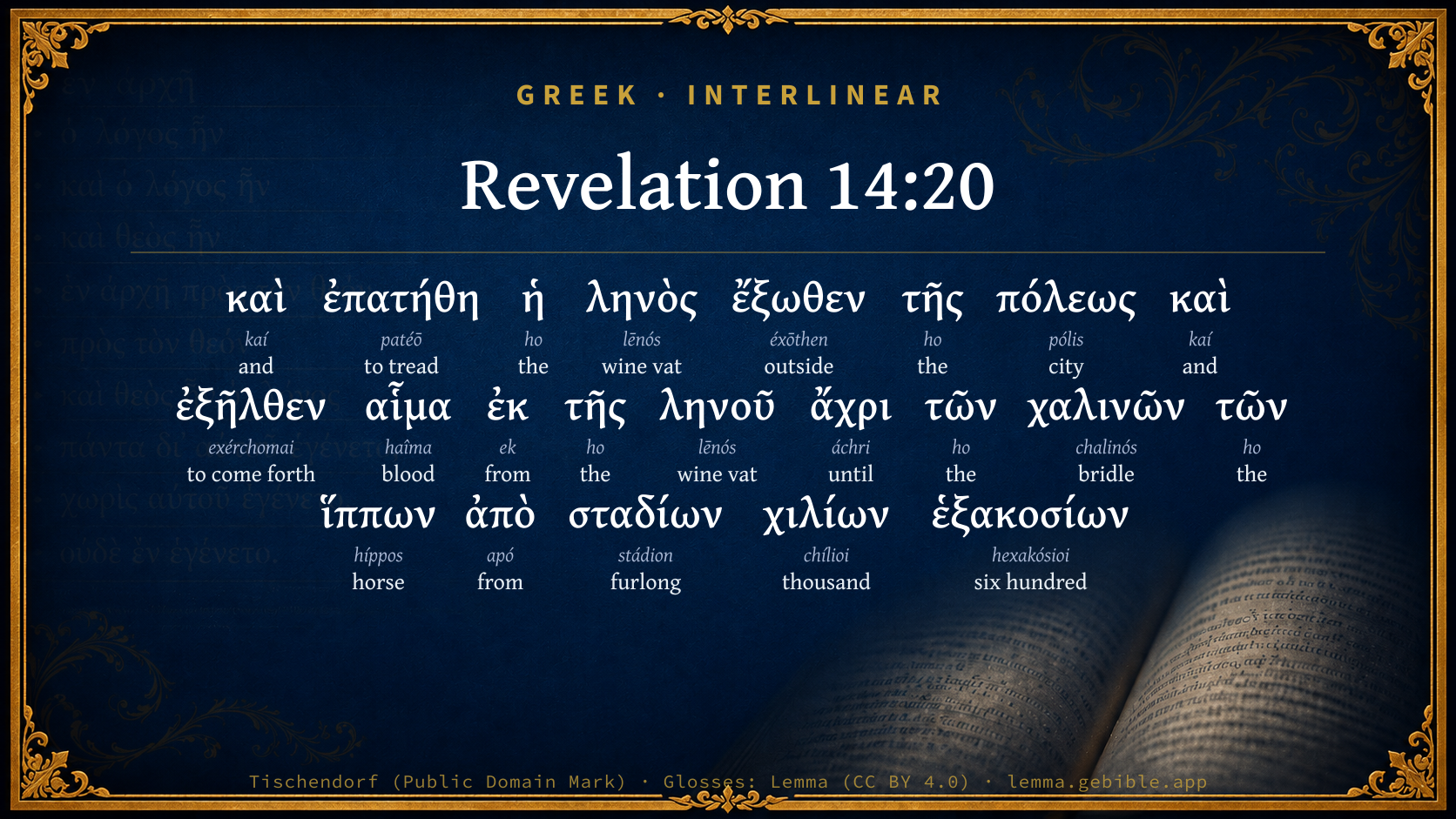
Greek (Tischendorf 8th ed.) Revelation 14:20 appears in the Greek New Testament. The text above is from the Tischendorf 8th edition. Each word links to its Strong’s number and a concise gloss. Click any word for its full Thayer’s Greek Lexicon entry.
Download image
Cite this verse

Revelation 14:20 (World English Bible). Public Domain. Lemma interlinear Bible study tool, https://lemma.gebible.app/v/revelation/14/20.

Show BibTeX & RIS
BibTeX
RIS
English Translation
The winepress was trodden outside of the city, and blood came out from the winepress, even to the bridles of the horses, as far as one thousand six hundred stadia.
World English Bible · Public Domain
Highlights
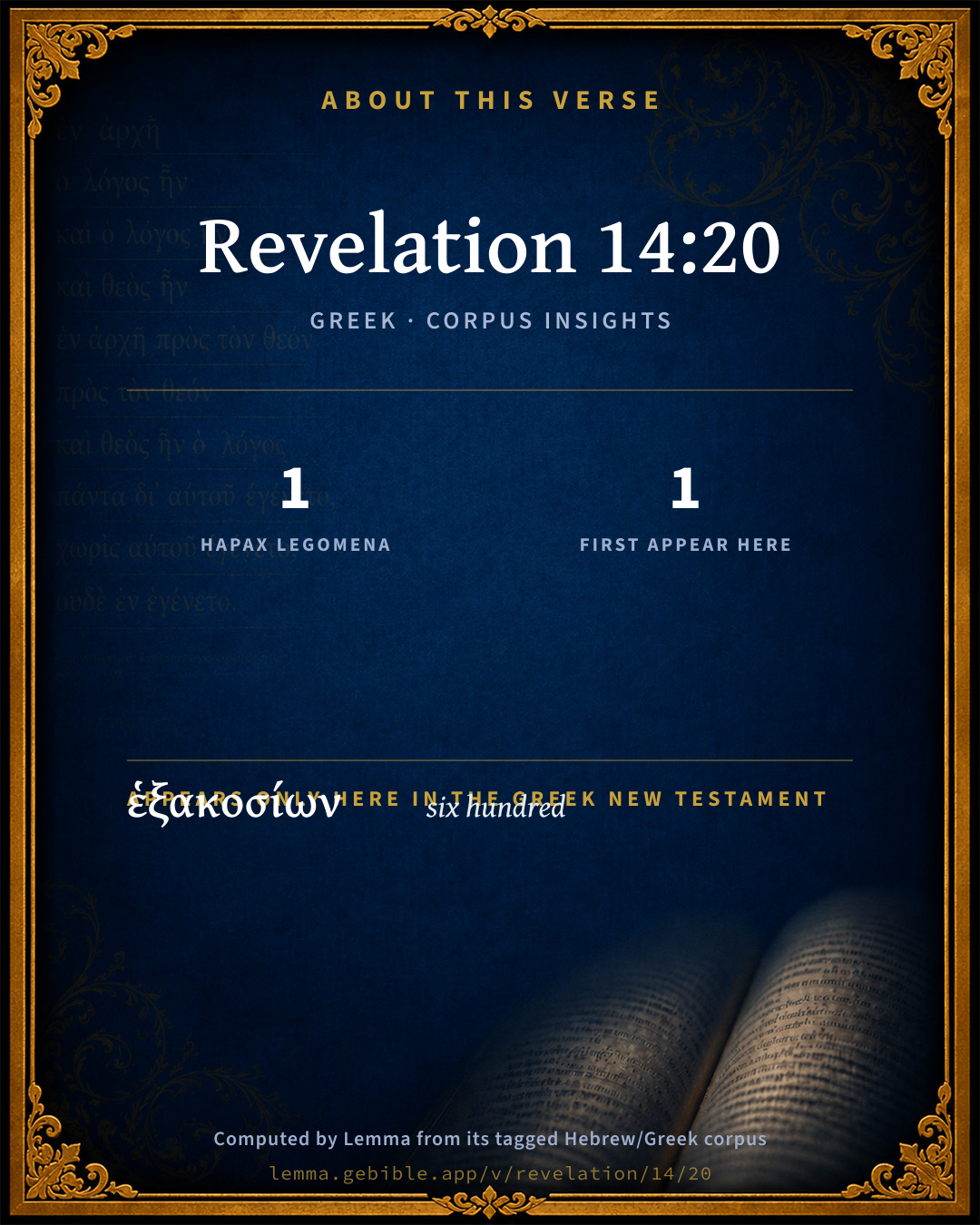
  • 1 hapax legomenon — only here in the Greek New Testament
  • 1 first appearance in the Greek New Testament
Full analysis ↓
Download a study sheet

One document with this verse’s original text, its word-by-word gloss line, the meaning frame, cross-references with their text, attributed commentary, and full source and license credits — printable, and it pastes into notes with its structure intact.

This verse Autodidact and up

Study sheet (.html) Plain text (.txt)

A passage Seminary Student

Up to 50 verses in one chapter. A passage sheet keeps up to 6 commentary sources and 12 cross-references per verse, in the order this page ranks them, and says so on the sheet whenever that leaves anything out. Ask for a single verse and you get the Autodidact verse sheet above.

Everything on this page stays free to read, with no account — the sheet is a download of what is already on screen, not access to it.

Want to remove ads? Support Godless Engineer
Compare translations 3

The same verse in 3 English versions, stacked beneath the original-language interlinear above. Click any original word for its lexicon entry.

Each is an independent rendering of the whole verse — the interlinear is not word-aligned to these translations.

Highlighted words mark where these versions differ — a whole-verse word diff, not a word-by-word alignment.

  • World English Bible Public Domain
    The winepress was trodden outside of the city, and blood came out from the winepress, even to the bridles of the horses, as far as one thousand six hundred stadia.
  • King James Version Public Domain
    And the winepress was trodden without the city, and blood came out of the winepress, even unto the horse bridles, by the space of a thousand and six hundred furlongs.
  • unfoldingWord Literal Text CC BY-SA 4.0
    And the winepress was trampled outside the city, and blood came out from the winepress up to the bridles of the horses for 1,600 stadia.

unfoldingWord Literal Text — © unfoldingWord, licensed CC BY-SA 4.0. Word-aligned USFM3 via Door43 (git.door43.org/unfoldingWord/en_ult).

Versions to compare (up to 4)

3 of 4 selected

Show all 19 translations

Every available English version of this verse, each an independent rendering of the whole verse.

  • World English Bible Public Domain
    The winepress was trodden outside of the city, and blood came out from the winepress, even to the bridles of the horses, as far as one thousand six hundred stadia.
  • Berean Standard Bible Public Domain
    And the winepress was trodden outside the city, and the blood that flowed from it rose as high as the bridles of the horses for a distance of 1,600 stadia.
  • Majority Standard Bible Public Domain
    And the winepress was trodden outside the city, and the blood that flowed from it rose as high as the bridles of the horses for a distance of 1,600 stadia.
  • King James Version Public Domain
    And the winepress was trodden without the city, and blood came out of the winepress, even unto the horse bridles, by the space of a thousand and six hundred furlongs.
  • American Standard Version (1901) Public Domain
    And the winepress are trodden without the city, and there came out blood from the winepress, even unto the bridles of the horses, as far as a thousand and six hundred furlongs.
  • Revised Version (1885) Public Domain
    And the winepress was trodden without the city, and there came out blood from the winepress, even unto the bridles of the horses, as far as a thousand and six hundred furlongs.
  • Geneva Bible (1599) Public Domain
    And the wine presse was troden without the citie, and blood came out of the wine presse, vnto the horse bridles, by the space of a thousand and sixe hundreth furlongs.
  • Douay-Rheims (1899) Public Domain
    And the press was trodden without the city, and blood came out of the press, up to the horses' bridles, for a thousand and six hundred furlongs.
  • Young's Literal Translation Public Domain
    and trodden was the wine-press outside of the city, and blood did come forth out of the wine-press -- unto the bridles of the horses, a thousand, six hundred furlongs.
  • Literal Standard Version CC BY-SA 4.0
    and the winepress was trodden outside of the city, and blood came forth out of the winepress—to the bridles of the horses, one thousand six hundred stadia.
  • Unlocked Literal Bible CC BY-SA 4.0
    The winepress was stomped outside the city, and blood poured out from it up to the height of a horse's bridle, for 1,600 stadia.
  • unfoldingWord Literal Text CC BY-SA 4.0
    And the winepress was trampled outside the city, and blood came out from the winepress up to the bridles of the horses for 1,600 stadia.
  • Darby Bible Public Domain
    and the wine-press was trodden without the city, and blood went out of the wine-press to the bits of the horses for a thousand six hundred stadia.
  • World Messianic Bible Public Domain
    The wine press was trodden outside of the city, and blood came out of the wine press, up to the bridles of the horses, as far as one thousand six hundred stadia.
  • Webster's Bible Public Domain
    And the wine-press was trodden without the city, and blood came out of the wine-press, even to the horses' bridles, by the space of a thousand and six hundred furlongs.
  • Free Bible Version CC BY-SA 4.0
    They were trampled in the winepress outside the city. Blood flowed out of the winepress to the height of a horse's bridle, and to a distance of 1,600 stadia.
  • Bible in Basic English Public Domain
    And the grapes were crushed under foot outside the town, and blood came out from them, even to the head-bands of the horses, two hundred miles.
  • Text-Critical English NT CC BY 4.0
    Then the winepress was trodden outside the city, and blood came out of the winepress, as high as a horse's bridle, for one thousand six hundred stadia.
  • Tyndale New Testament (1534) Public Domain
    and the wynefat was trodden with out the cite and bloud came oute of the fat even vnto the hors brydles by the space of a thowsande and.vi. C. furlonges.

Literal Standard Version (2020), Covenant Press — licensed CC BY-SA 4.0. Text via the HelloAO Bible API (eBible.org). Unlocked Literal Bible (unfoldingWord) — licensed CC BY-SA 4.0. Text via the HelloAO Bible API (eBible.org). unfoldingWord Literal Text — © unfoldingWord, licensed CC BY-SA 4.0. Word-aligned USFM3 via Door43 (git.door43.org/unfoldingWord/en_ult). Free Bible Version, Dr. Jonathan Gallagher — licensed CC BY-SA 4.0. Text via the HelloAO Bible API (eBible.org).

Word by word

More ways to search: Search by grammar → Find every occurrence → Compare this word →

Practice this passage: Drill this verse → Learn its vocabulary →

ἑξακοσίων
hexakósioi
G1812
“six hundred”
Adjective, Genitive, Plural, Masculine
Part of Speech
Adjective
Case
Genitive
Number
Plural
Gender
Masculine
Full Thayer's Definition

Origin: plural ordinal from G1803 and G1540

TDNT: None

1. six hundred
  1. καὶ kaí G2532 “and” Conjunction
  2. ἐπατήθη patéō G3961 “to tread” Verb, Aorist, Passive, Indicative, 3rd person, Singular
  3. ἡ ho G3588 “the” Article, Nominative, Singular, Feminine
  4. ληνὸς lēnós G3025 “wine vat” Noun, Nominative, Singular, Feminine
  5. ἔξωθεν éxōthen G1855 “outside” Adverb
  6. τῆς ho G3588 “the” Article, Genitive, Singular, Feminine
  7. πόλεως pólis G4172 “city” Noun, Genitive, Singular, Feminine
  8. καὶ kaí G2532 “and” Conjunction
  9. ἐξῆλθεν exérchomai G1831 “to come forth” Verb, Aorist, Active, Indicative, 3rd person, Singular
  10. αἷμα haîma G129 “blood” Noun, Nominative, Singular, Neuter
  11. ἐκ ek G1537 “from” Preposition
  12. τῆς ho G3588 “the” Article, Genitive, Singular, Feminine
  13. ληνοῦ lēnós G3025 “wine vat” Noun, Genitive, Singular, Feminine
  14. ἄχρι áchri G891 “until” Adverb
  15. τῶν ho G3588 “the” Article, Genitive, Plural, Masculine
  16. χαλινῶν chalinós G5469 “bridle” Noun, Genitive, Plural, Masculine
  17. τῶν ho G3588 “the” Article, Genitive, Plural, Masculine
  18. ἵππων híppos G2462 “horse” Noun, Genitive, Plural, Masculine
  19. ἀπὸ apó G575 “from” Preposition
  20. σταδίων stádion G4712 “furlong” Noun, Genitive, Plural, Masculine
  21. χιλίων chílioi G5507 “thousand” Adjective, Genitive, Plural, Masculine

About this verse

These counts appear in no published source. They are computed here, from the morphology-tagged text and Lemma’s own curated glosses. What Lemma adds →

22
words
16
distinct lemmas
Revelation
section

Notable vocabulary

1 hapax legomenon — a word that appears only here in the entire Greek New Testament:

  • ἑξακοσίων six hundred G1812

First appearance in Scripture

This word makes its first canonical appearance in the Greek New Testament here:

  • ἑξακοσίων six hundred G1812

Shared distinctive vocabulary

χαλινῶν bridle G5469 occurs in 2 verses of the Greek New Testament. Also found in:
Repetition

Words recur within this verse:

Cross-references

8

Topical passages linked to Revelation 14:20 in the Treasury of Scripture Knowledge — connected by theme and wording, ordered by reader-vote popularity; previews shown in the World English Bible.

  • Lamentations 1:15 The Lord has set at nothing all my mighty men in the midst of me; He has called a solemn assembly against me to crush my young men: The Lord has trodden as in a winepress the virgin daughter of Judah.
  • Hebrews 13:11–12 For the bodies of those animals, whose blood is brought into the holy place by the high priest as an offering for sin, are burned outside of the camp.
  • Isaiah 63:1–3 Who is this who comes from Edom, with dyed garments from Bozrah? this who is glorious in his clothing, marching in the greatness of his strength? I who speak in righteousness, mighty to save.
  • Revelation 19:14–21 The armies which are in heaven followed him on white horses, clothed in white, pure, fine linen.
  • Isaiah 66:24 They shall go forth, and look on the dead bodies of the men who have transgressed against me: for their worm shall not die, neither shall their fire be quenched; and they shall be an abhorring to all flesh.
  • Revelation 11:8 Their dead bodies will be in the street of the great city, which spiritually is called Sodom and Egypt, where also their Lord was crucified.
  • Isaiah 34:5–7 For my sword has drunk its fill in the sky: behold, it shall come down on Edom, and on the people of my curse, to judgment.
  • Ezekiel 39:17–21 You, son of man, thus says the Lord Yahweh: Speak to the birds of every sort, and to every animal of the field, Assemble yourselves, and come; gather yourselves on every side to my sacrifice that I do sacrifice for you, even a great sacrifice on the mountains of Israel, that you may eat flesh and drink blood.

Cross-references courtesy of OpenBible.info (CC BY 4.0).

Commentary

Notes on Revelation 14:20 from classic Christian and Jewish commentators (each source and its license shown beneath its notes). The classic Christian expositions comment on the surrounding passage and are grouped to its opening verse, so a note may address several verses; the Jewish commentaries on the Tanakh (Rashi and others) are per-verse, so they appear only where the commentator wrote on this verse.

Lemma curates 59 commentaries, every one of them public domain or Creative Commons licensed, each selected and text-cleaned for this edition rather than reprinted as found. About our sources →

Bengel's Gnomon

Johann Albrecht Bengel

Rev 14:20. Αἷμα, blood) the blood of clusters of grapes, red wine, that is, the blood of the wicked. The Figure Metalepsis. The slaughter of the wicked is intimated, not their eternal torture. Other enemies also afterwards fall into the wine-press: ch. Rev 19:15.—ἄχρι τῶν χαλινῶν τῶν ἵτπων, ἀπὸ σταδίων χιλίων ἑξακοσίων, unto the bridles of the horses, by the space of a thousand and six hundred furlongs) Each phrase denotes a deep and long torrent of blood. Comp. ch. 11 Ἀπὸ σταδίων, κ.τ.λ., is also used of an interval of space, Joh 11:18. Some followers of the Rabbinical school refer this to the circuit or to the length of Palestine. But its length, even if you include the districts which are lofty and secure from inundation, is much less: its circuit is much greater. What if the valley Kidron, which lies between the city Jerusalem and the Mount of Olives (Act 1:12), be meant? For the torrent in that valley, together with its windings, and in the sea itself, as far as it shall be stained with blood, may have a length of 1600 furlongs. Let us take the expression literally. [Comp. Eze 32:6.—V. g.]

Bengel's Gnomon of the New Testament — English translation (T&T Clark, Edinburgh, 1860) — public domain. Text from a community e-Sword module.

Expositor's Greek Testament

ed. W. Robertson Nicoll

Rev 14:20 . The heathen are stamped and crushed till their blood gushes out of the wine-press to the height of a horse’s bridle and to the extent of about two hundred miles. This ghastly hyperbole, borrowed partly from Egyptian (wine = the blood of those who fought against the gods) and partly from Jewish eschatology (En. c. 3: “and the horses will walk up to the breast in the blood of sinners, and the chariot will be submerged to its height”), happens to be used later by the Talmud in connexion with the carnage at Bether ( cf. Schlatter’s Die Tage Trajans , p. 37; also Sib. iii. 633 f.; 4 Esd. 15:35; Sil. Ital. iii. 704). The place is to be a veritable Senlac (sang lac). ἀπό κ . τ . λ ., probably a round number (see crit. note) compounded out 4 and its multiples (like 144,000 out of 12), to denote completeness (Vict. = per omnes mundi quattuor partes). After the fall of Rome (Rev 14:8 f.), the rest of the world ( ex hypothesi impenitent, Rev 14:6-8 ) is ripe for the traditional (Dan 9:26 ) judgment. The same sequence is reproduced roughly and on a larger scale in 17 18. (fall of Rome) and 19 20. (doom of other nations). This parallelism and the sense of the Joel passage militate against the attractive idea that Rev 14:14-16 is the ingathering of the saints (so Alford, Milligan, Bruston, Briggs, Titius, Gilbert, and Swete). ἔξωθεν κ . τ . λ . This fearful vengeance is located by Jewish tradition in some valley (of Jehoshaphat = Yah judges?) near Jerusalem (Joel), on the mount of Olives (Zec 14:4 ), or in Palestine generally (Dan 11:45 ; cf. below on Rev 16:16 ), i.e. , as a rule in close proximity to the sacred capital, where the messiah was to set up his kingdom.

The Expositor's Greek Testament, edited by W. Robertson Nicoll (1897–1910) — public domain. Text from a community e-Sword module.

Geneva Bible (1599)

Geneva Bible translators

That is, it overflowed very deep, and very far and wide: the speech is by hyperbole or excessive, to signify the greatness of the slaughter. And these be those pleasant fruits forsooth, of the contempt of Christ, and desiring of Antichrist rather than him, which the miserable, mad, and blind world doth at this time reap.

Geneva Bible (1599) marginal notes — public domain. Text via Bolls.life.

Jamieson, Fausset & Brown

Robert Jamieson, A. R. Fausset & David Brown

without the city--Jerusalem. The scene of the blood-shedding of Christ and His people shall be also the scene of God's vengeance on the Antichristian foe. Compare the "horsemen," Rev 9:16-17.

blood--answering to the red wine. The slaughter of the apostates is what is here spoken of, not their eternal punishment.

even unto the horse bridles--of the avenging "armies of heaven."

by the space of a thousand . . . six hundred furlongs--literally, "a thousand six hundred furlongs off" [W. KELLY]. Sixteen hundred is a square number; four by four by one hundred. The four quarters, north, south, east, and west, of the Holy Land, or else of the world (the completeness and universality of the world-wide destruction being hereby indicated). It does not exactly answer to the length of Palestine as given by JEROME, one hundred sixty Roman miles. BENGEL thinks the valley of Kedron, between Jerusalem and the Mount of Olives, is meant, the torrent in that valley being about to be discolored with blood to the extent of sixteen hundred furlongs. This view accords with Joel's prophecy that the valley of Jehoshaphat is to be the scene of the overthrow of the Antichristian foes.

Next: Revelation Chapter 15

Jamieson, Fausset & Brown — Commentary Critical and Explanatory on the Whole Bible (1871) — public domain (CC PDM 1.0). Text via the HelloAO Bible API.

Adam Clarke's Commentary

Verse 20. Even unto the horse bridles] A hyperbolical expression, to denote a great effusion of blood. The Jews said, "When Hadrian besieged the city called Bitter, he slew so many that the horses waded in blood up to their mouths." The same kind of hyperbole with that above. See Wetstein on this verse.

The space of a thousand and six hundred furlongs.] It is said that the state of the Church, or St. Peter's patrimony, extends from Rome to the Po, two hundred Italian miles, which make exactly one thousand six hundred furlongs! If this be really so, the coincidence is certainly surprising, and worthy of deep regard.

On these two last verses pious Quesnel thus speaks: "As the favourable sickle of Jesus Christ reaps his wheat when ripe for heaven, so that of the executioners of his justice cuts off from this life the tares which are only fit for the fire of hell. Then shall the blood of Christ cease to be trampled on by sinners; and that of the wicked shall be eternally trodden down in hell, which is the winepress of the wrath of God.

"And the winepress was trodden without the city, eternally without the city of the heavenly Jerusalem, and far from the presence of God; eternally crushed and trodden down by his justice; eternally tormented in body and soul, without any hope either of living or dying! This is the miserable lot and portion of those who shall have despised the law of God, and died in impenitence. My God, pierce my heart with a salutary dread of thy judgments!"

Whatever these passages may mean, this is a prudent and Christian use of them.

Adam Clarke's Commentary on the Bible (1810–1826) — public domain. Text from a community e-Sword/MySword module.

The Cambridge Bible for Schools and Colleges

gen. ed. J. J. S. Perowne

20. the city] Probably Jerusalem, see on Rev_14:1.

blood] Isa_63:3.

even unto the horse bridles] Literally, even unto the bridles of the horses—though no horses are mentioned in the context. Probably the A. V. is right—that it is meant as a mere measure, that any horseman riding there finds his horse bridle-deep in blood: but some think of the horsemen of God’s avenging army in Rev_19:14. There can hardly be a reference to the horses of chap. 6 or of Rev_9:17.

by the space of] Lit. from—perhaps best translated “from a distance of.”

a thousand and six hundred furlongs] 200 Roman miles, or about 183 English. It is hardly likely that it is meant, that the blood covered a space of 40 furlongs square—more probably, that it extended 1600 (or perhaps 800) in every direction from the city. It has been imagined that the distance specified stands for the length of Palestine, which is estimated by St Jerome at 160 Roman miles, by modern surveys at about 140 English.

The Cambridge Bible for Schools and Colleges (gen. ed. J. J. S. Perowne; Cambridge University Press, 1878–1918) — public domain. Text from a community e-Sword module.

John Gill's Exposition

And the winepress was trodden without the city,.... The beloved city, the new Jerusalem, into which none of the wicked will enter, and without which are dogs, &c. Rev 20:9. The allusion may be, as Dr. Lightfoot thinks, to the olive presses, which were without the city of Jerusalem, from whence Gethsemane had its name, whither our Lord went, and where his sorrows began the night he was betrayed: hell is sometimes expressed by outer darkness, and said to be far off from heaven, and between the one and the other a great gulf is fixed, the distance is considerable; hence men are said to go forth to behold the miseries of the wicked; see Mat 22:13.

and blood came out of the winepress; alluding to the juice squeezed out of grapes, called the blood of grapes, Gen 49:11.

Even unto the horses' bridles, for the space of a thousand and six hundred furlongs; which is only an hyperbolical expression, setting forth the largeness and universality of the destruction of the wicked, and the impossibility of their escaping it. In like manner the Jews express a great slaughter of men; so of the slaughter at Bither, by Adrian, they say (e), they went on slaying , "until a horse plunged in blood up to his nostrils", and the blood ran four miles into the sea; which is not to be understood literally, but as expressing a prodigious effusion of blood: and as to

the space of a thousand and six hundred furlongs, perhaps there may be an allusion to the measure of the land of Israel, and the common notion of it among the Jews, who make it to be the square of four hundred parsoe (f): hence they often speak of the land of Israel shaking and moving four hundred "parsoe", upon some extraordinary occasions (g); and a "parsa" contained four miles (h), so that four hundred "parsoe" made a thousand and six hundred miles; and if miles and furlongs are the same, in which sense only the land of Israel could be so large, here is the exact space; for Jerom (i), who was an inhabitant of it, says, it was scarce 160 miles in length, to which agrees R. Menachem (k); and it may be observed, that the Arabic version renders the words, "by the space of a thousand and six hundred miles". The Ethiopic version, very wrongly, reads, "sixteen furlongs".

(e) T. Hieros. Taanioth, fol. 69. 1. (f) T. Bab. Bava Metzia, fol. 28. 1. Gloss. in ib. (g) T. Bab. Megilla, fol. 3. 1. & Bava Kama, fol. 82. 2. & Menachot, fol. 64. 2. (h) T. Bab. Pesachim, fol. 92. 2. Gloss. in ib. (i) Ad Dardanum, fol. 22. 1. Tom. 3. (k) In Gen. fol. 60.

Next: Revelation Chapter 15

John Gill's Exposition of the Whole Bible (1746–1763) — public domain (CC PDM 1.0). Text via the HelloAO Bible API.

Trapp's Complete Commentary

John Trapp

20 And the winepress was trodden without the city, and blood came out of the winepress, even unto the horse bridles, by the space of a thousand and six hundred furlongs.

Ver. 20. And the winepress was trodden] viz. By Christ the King, with his heavenly horsemen, Rev 19:13-14.

Without the city] i.e. Without the Church, haply in Judea, whither the pope being driven from Rome, shall fly and sit, till Christ shall unroost him with the brightness of his coming, 2Th 2:8.

Even unto the horse bridles] To confute the pride and cruelty of those bloody Papists that threatened to ride their horses up to the saddleskirts in the blood of the Lutherans. (Flac. Illyr.) So Famesius, Minerius, Felix of Wurtemburg, Sir Charles Ellerker, Charles IX of France, that cruel Queen, who when she saw some of her Protestant subjects lying dead, and stripped upon the earth, cried out, The goodliest tapestry that ever she beheld. These and the like shall be one day glutted with blood, which they have so barbarously thirsted after. Satia te sanguine, quem sitiisti, &c., Satisty with your blood which you were so thirsty for, as she said of Cyrus. (Justin, lib. i.)

John Trapp, A Commentary or Exposition upon All the Books of the Old and New Testament (1647–1656) — public domain. Text from a community e-Sword module.

Albert Barnes' Notes on the Bible

And the wine-press was trodden without the city - The representation was made as if it were outside of the city - that is, the city of Jerusalem, for that is represented as the abode of the holy. The word “trodden” refers to the manner in which wine was usually prepared, by being trodden by the feet of people. See the notes on Isa 63:2. The wine-press was usually in the vineyard - not in the city - and this is the representation here. As appearing to the eye of John, it was not within the walls of any city, but standing without.

And blood came out of the wine-press - The representation is, that there would be a great destruction which would be well represented by the juice flowing from a wine-press.

Even unto the horse bridles - Deep, as blood would be in a field of slaughter where it would come up to the very bridles of the horses. The idea is, that there would be a great slaughter.

By the space of a thousand and six hundred furlongs - That is, two hundred miles; covering a space of two hundred miles square - a lake of blood. This is designed to represent a great slaughter; but why the space here employed to describe it was chosen is unknown. Some have supposed it was in allusion to the length of Palestine. Prof. Stuart supposes that it refers to the breadth of Italy, and that the allusion is to the attack made on the city of the beast. But it is impossible to determine why this space was chosen, and it is unnecessary. The idea is, that there would be a slaughter so great, as it were, as to produce a lake or sea of blood; that the enemies of the church would be completely and finally overthrown, and that the church, therefore, delivered from all its enemies, would be triumphant.

The “design” of this, as of the previous representations in this chapter, is to show that all the enemies of God will be destroyed, and that, therefore, the hearts of the friends of religion should be cheered and consoled in the trials and persecutions which were to come upon it. What could be better suited to sustain the church in the time of trial, than the assurance that every foe will be ultimately cut off? What is better suited to sustain the heart of the individual believer, than the assurance that all his foes will be quelled, and that he will ere long be safe in heaven?

Albert Barnes' Notes on the Bible (1834–1885) — public domain. Text from a community e-Sword/MySword module.

Matthew Poole's English Annotations

And the winepress was trodden without the city: by the city, Dr. More thinks Babylon is here meant, and that the meaning is, that the powerful convictions of the word before mentioned, shall not reach Babylon, the Romish hierarchy and polity, as being hardened against any such thing. But Mr. Mede and others think, that the city of Jerusalem is here meant, or the Holy Land, which comprehends exactly one thousand six hundred furlong, that is, two hundred Italian miles, or one hundred and sixty Grecian miles. But what that place shall be, where this slaughter shall be, is a great secret.

And blood came out of the winepress, even unto the horse bridles, by the space of a thousand and six hundred furlongs: it is plain it shall be a great slaughter, by the depth of the blood mentioned, and the length of the ground which it should to that depth overflow. It is very probable, that great battle is meant, mentioned Rev 19:20,21, in the place called Armageddon, upon the pouring out of the sixth vial, Rev 16:16. In so difficult a business nothing can be positively determined.

Matthew Poole's English Annotations on the Holy Bible (1683–1685) — public domain. Text from a community e-Sword/MySword module.

Whedon's Commentary on the Bible

Daniel D. Whedon

20. Without the city—As grapes and vintage are usually rural matters, so this symbolic picture, 14-20, reaches not to the complete downfall of the city, but to the adjacent slaughters. But what city? The bewildered Alford, with many others, replies Jerusalem! But throughout this whole chapter Jerusalem is the place of the menace, and Babylon is its object.

Even unto the horses’ bridles—The visional sky-horses waded in blood so deep that their bridles were visionally bathed in its crimson.

A thousand and six hundred—The root of this number is the creational four, intimating that this battle is no local event, but world-wide. This view is intensified by the squaring of the four and the multiplying of that square, sixteen, by the square of ten, one hundred. This brief menacing cloud-picture of the coming contest predicts that the destruction from the city will spread over the earth; or rather, perhaps, indicates that the real city is itself earthwide in locality.

Daniel D. Whedon (gen. ed.), Commentary on the Old and New Testaments (1874–1909) — public domain. Text from a community e-Sword module.

The Pulpit Commentary

And the wine press was trodden without the city. "The city" is Jerusalem (cf. ver. 1), that is, the Church of God; the idea thus being either

(1) that the wicked are punished in a place apart from the just; (cf. Rev_22:15) or

(2) that no unclean thing (e.g. the blood) can enter the city of the saints. (cf. Rev_21:27) And blood came out of the wine press, even unto the horse bridles, by the space of a thousand and six hundred furlongs; as far as sixteen hundred stadia. The Greek stadium is rather less than an English furlong, being about six hundred and six English feet; it was the length of the race course at Olympia, and the eighth part of the Roman mile. The "blood," of which the juice of the grape is a type, depicts the punishment inflicted. Horses seem to be mentioned by proleipsis, in anticipation of Rev_19:14. The description, of course, implies the terrific nature of the punishment probably nothing more. In the same way the distance mentioned is no doubt intended to denote the extensive nature of the punishment, though why that particular number is chosen is not absolutely clear. Possibly it is derived from the square of 4 multiplied by the square of 10; four being significant of the created world, (see on Rev_4:6) and ten being the sign of completeness; (see on Rev_13:1) the number thus portraying completeness as regards the created world, and the inability of any one to escape God"s judgment.

The Pulpit Commentary (1880–1919), ed. H.D.M. Spence-Jones & Joseph S. Exell — public domain. Text from a community e-Sword module.

John Wesley's Explanatory Notes

And the winepress was trodden - By the Son of God, chap. xix, 15. Without the city - Jerusalem. They to whom St. John writes, when a man said, "The city," immediately understood this. And blood came out of the winepress, even to the horses' bridles - So deep at its first flowing from the winepress! One thousand six hundred furlongs - So far! at least two hundred miles, through the whole land of Palestine.

John Wesley, Explanatory Notes Upon the Whole Bible (1754–1765) — public domain. Text via the GEBible commentary corpus.

The People's New Testament

B. W. Johnson

20. And the winepress was trodden without the city. The city, whenever it is not shown to be a wicked city, is Jerusalem, the Apocalyptic symbol of the Church. These judgments are without the church, judgments upon the world. And blood came out of the winepress. This is what John saw. The pressed juice of the grapes ran out red like blood, and ran in a mighty stream, deep as the bridle bits of the horses, 1600 furlongs; about 200 miles. There has been much discussion concerning what this distance signifies. Some have cited the fact that Palestine is about 200 miles long, and held that a fearful carnage in that country is predicted. Others have noted the fact that Italy is about 200 miles wide, and held that this country is to be the scene of a terrible conflict. In my opinion, the whole is symbolic of the terrible judgments of the wicked in that day. The figures, 40x40, or 4x4, multiplied by 10x10, imply the universality of the judgment. The four quarters, the four winds, the four corners of the earth are often mentioned, and four is held to be an Apocalyptical symbol of the earth, while ten, like seven, is a perfect, or sacred number.

B. W. Johnson's The People's New Testament with Notes (1889–1891) — public domain. Electronic text from the Christian Classics Ethereal Library (CCEL) ThML edition.

Cambridge Greek Testament for Schools and Colleges

20. ἔξωθεν. Text. Rec[497] has ἔξω with א 1.

[497] Rec. Textus Receptus as printed by Scrivener.

20. τῆς πόλεως. Probably Jerusalem, see on Rev 14:1.

αἷμα. Isa 63:3.

ἄχρι τῶν χαλινῶν τῶν ἵππων. Literally, “even unto the bridles of the horses”—though no horses are mentioned in the context. Probably the A. V[502] rendering “even unto the horse bridles,” which implies that the words are meant as a mere measure, that any horseman riding there finds his horse bridle-deep in blood, is right: but some think of the horsemen of God’s avenging army in Rev 19:14. There can hardly be a reference to the horses of chap. 6 or of Rev 9:17.

[502] Authorised Version.

ἀπό, i.e. at a distance of: the construction is common in late Greek, e.g. Diodorus and Plutarch, but only found in the New Testament here, and in the fourth Gospel, Rev 11:18, Rev 21:8.

σταδίων χιλίων ἑξακοσίων. 200 Roman miles, or about 183 English. It is hardly likely that it is meant that the blood covered a space of 40 furlongs square—more probably, that it extended 1600 (or perhaps 800) in every direction from the city, or perhaps the river of blood flows to that distance. It has been imagined that the distance specified stands for the length of Palestine, which is estimated by St Jerome at 160 Roman miles, by modern surveys at about 140 English.

Cambridge Greek Testament for Schools and Colleges (Cambridge University Press, 1896; 21 vols, various authors incl. Carr, Maclear, Plummer, Farrar, Lumby, Moule, M. R. James, Simcox) — public domain. Text from a community e-Sword module.

Vincent's Word Studies in the New Testament

Marvin R. Vincent

Furlong [σταδιων] . The furlong or stadium was 606 3/4 English feet.

Marvin R. Vincent, Word Studies in the New Testament (1887–1900) — public domain. Text from a community e-Sword/MySword module.

Lesson kit

Teaching starters — assembled from the data on this page, not authored interpretation. Every prompt links to the verse data it draws on. Edit before teaching.

Revelation, in the Revelation, opens this verse with 22 words (16 distinct Greek lemmas). Its most distinctive word is hexakósioi (“six hundred”). A historical commentator’s framing appears above. Read the whole chapter for the surrounding context.

Discussion questions

  1. How does “six hundred” (hexakósioi) shape what this verse is saying?
  2. This verse holds 1 word here found nowhere else in the Greek New Testament. What might the rare word draw attention to?
  3. The word “six hundred” first appears here in Scripture. What is being introduced at this debut?
  4. James 3:3 shares the word «bridle» with this verse. How do the two illuminate each other?
  5. “wine vat” occurs 2× in this one verse. What is the effect of the repetition?
  6. These translations render this verse differently; the difference is in the English rendering, not the original. What questions does that raise?
  7. Reading how Bengel's Gnomon and Expositor's Greek Testament read this verse, where do the two commentators agree and where do they part?

Things to notice

  • 1 word in this verse appears nowhere else in the Greek New Testament.
  • 1 word makes its first canonical appearance in Scripture here.
  • These translations choose different wording for 17 words in this verse.
  • “wine vat” occurs 2× in this single verse.
  • 16 distinct Greek lemmas span 22 words in this verse.

Reading settings

Reading text

Shown beneath each verse's original-language words.

Old Testament
Old Testament edition

Read the OT as the Masoretic Hebrew (MT) or the Greek Septuagint (LXX).

English shown for the Greek Septuagint (in the Hebrew ↔ Greek comparison).

Comparing translations? Open the Compare panel on any verse page to stack up to four side by side.