

Acts 15:20
Greek (Tischendorf 8th ed.) Acts 15:20 appears in the Greek New Testament. The text above is from the Tischendorf 8th edition. Each word links to its Strong’s number and a concise gloss. Click any word for its full Thayer’s Greek Lexicon entry.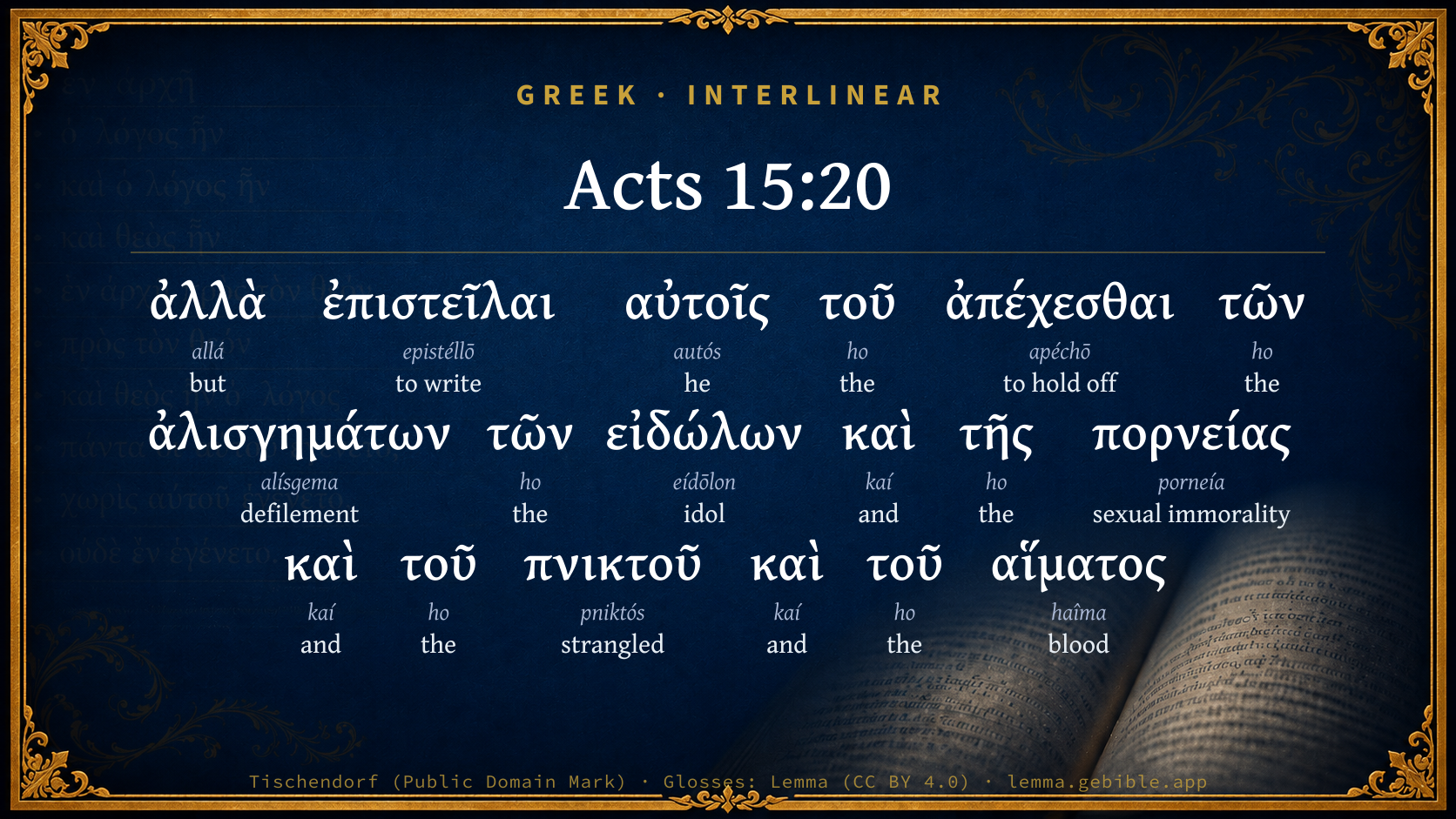
but that we write to them that they abstain from the pollution of idols, from sexual immorality, from what is strangled, and from blood.
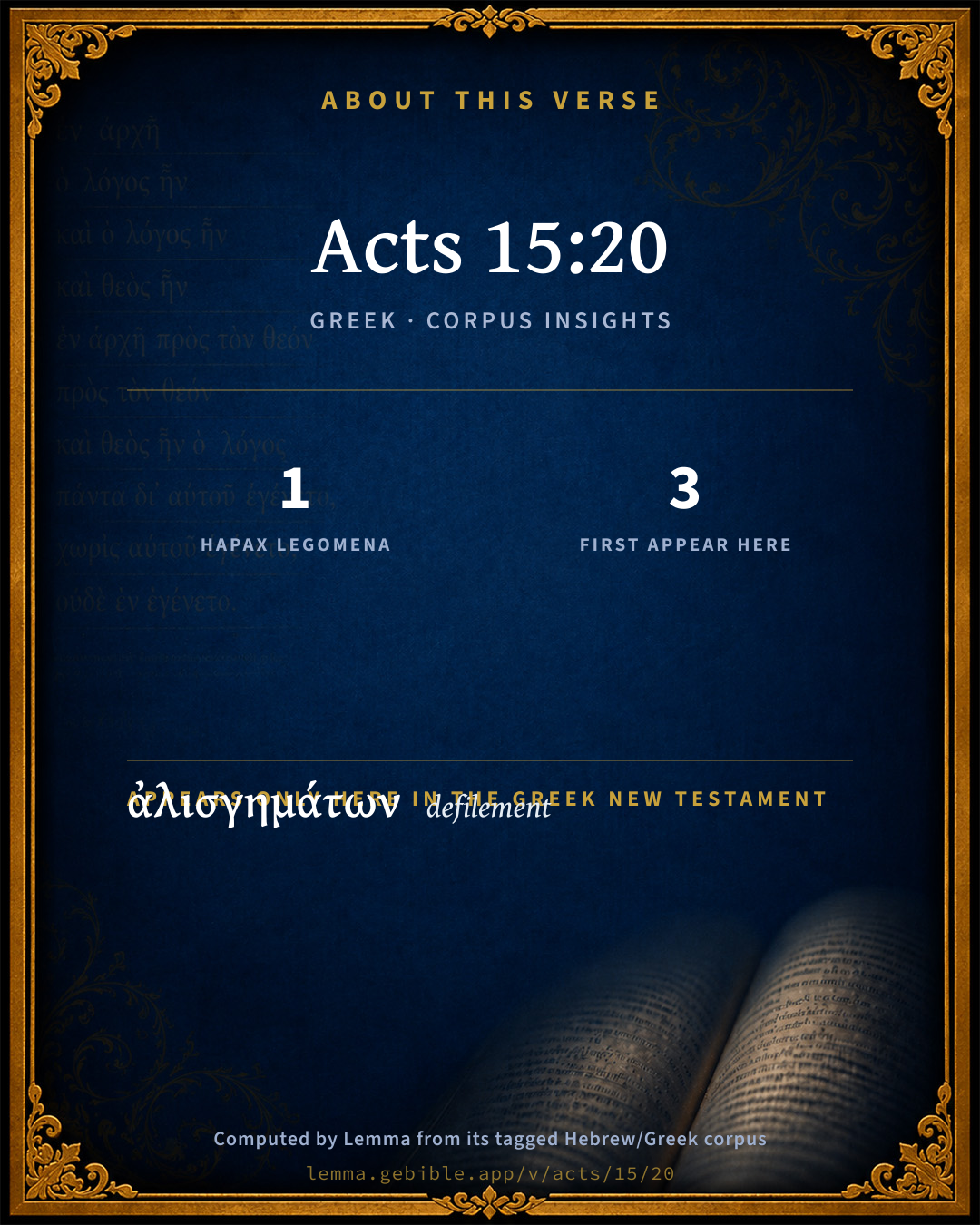
- 1 hapax legomenon — only here in the Greek New Testament
- 3 first appearances in the Greek New Testament
Download a study sheet
One document with this verse’s original text, its word-by-word gloss line, the meaning frame, cross-references with their text, attributed commentary, and full source and license credits — printable, and it pastes into notes with its structure intact.
This verse Autodidact and up
A passage Seminary Student
Up to 50 verses in one chapter. A passage sheet keeps up to 6 commentary sources and 12 cross-references per verse, in the order this page ranks them, and says so on the sheet whenever that leaves anything out. Ask for a single verse and you get the Autodidact verse sheet above.
Everything on this page stays free to read, with no account — the sheet is a download of what is already on screen, not access to it.
Compare translations 3
The same verse in 3 English versions, stacked beneath the original-language interlinear above. Click any original word for its lexicon entry.
Each is an independent rendering of the whole verse — the interlinear is not word-aligned to these translations.
Highlighted words mark where these versions differ — a whole-verse word diff, not a word-by-word alignment.
-
World English Bible Public Domain
but that we write to them that they abstain from the pollution of idols, from sexual immorality, from what is strangled, and from blood.
-
King James Version Public Domain
But that we write unto them, that they abstain from pollutions of idols, and from fornication, and from things strangled, and from blood.
-
unfoldingWord Literal Text CC BY-SA 4.0
but to write to them to abstain from the pollution of idols and sexual immorality and the strangled and blood.
unfoldingWord Literal Text — © unfoldingWord, licensed CC BY-SA 4.0. Word-aligned USFM3 via Door43 (git.door43.org/unfoldingWord/en_ult).
Show all 19 translations
Every available English version of this verse, each an independent rendering of the whole verse.
-
World English Bible Public Domain
but that we write to them that they abstain from the pollution of idols, from sexual immorality, from what is strangled, and from blood.
-
Berean Standard Bible Public Domain
Instead, we should write and tell them to abstain from food polluted by idols, from sexual immorality, from the meat of strangled animals, and from blood.
-
Majority Standard Bible Public Domain
Instead, we should write and tell them to abstain from food polluted by idols, from sexual immorality, from the meat of strangled animals, and from blood.
-
King James Version Public Domain
But that we write unto them, that they abstain from pollutions of idols, and from fornication, and from things strangled, and from blood.
-
American Standard Version (1901) Public Domain
but that we write unto them, that they abstain from the pollutions of idols, and from fornication, and from what is strangled, and from blood.
-
Revised Version (1885) Public Domain
but that we write unto them, that they abstain from the pollutions of idols, and from fornication, and from what is strangled, and from blood.
-
Geneva Bible (1599) Public Domain
But that we send vnto them, that they abstaine themselues from filthinesse of idoles, and fornication, and that that is strangled, and from blood.
-
Douay-Rheims (1899) Public Domain
But that we write unto them, that they refrain themselves from the pollutions of idols, and from fornication, and from things strangled, and from blood.
-
Young's Literal Translation Public Domain
but to write to them to abstain from the pollutions of the idols, and the whoredom, and the strangled thing; and the blood;
-
Literal Standard Version CC BY-SA 4.0
but to write to them to abstain from the defilements of the idols, and the whoredom, and the strangled thing, and the blood;
-
Unlocked Literal Bible CC BY-SA 4.0
But we will write to them that they must keep away from the pollution of idols, from sexual immorality, and from the meat of strangled animals, and from blood.
-
unfoldingWord Literal Text CC BY-SA 4.0
but to write to them to abstain from the pollution of idols and sexual immorality and the strangled and blood.
-
Darby Bible Public Domain
but to write to them to abstain from pollutions of idols, and from fornication, and from what is strangled, and from blood.
-
World Messianic Bible Public Domain
but that we write to them that they abstain from the pollution of idols, from sexual immorality, from what is strangled, and from blood.
-
Webster's Bible Public Domain
But that we write to them that they abstain from pollutions of idols, and from lewdness, and from things strangled, and from blood.
-
Free Bible Version CC BY-SA 4.0
We should write to them and tell them to avoid food sacrificed to idols, sexual immorality, meat of animals that have been strangled, and from consuming blood.
-
Bible in Basic English Public Domain
But that we give them orders to keep themselves from things offered to false gods, and from the evil desires of the body, and from the flesh of animals put to death in ways against the law, and from blood.
-
Text-Critical English NT CC BY 4.0
but that we write to them, telling them to abstain from things defiled by idols, from fornication, from what has been strangled, and from blood.
-
Tyndale New Testament (1534) Public Domain
but that we write vnto them that they abstayne them selves from filthynes of ymages from fornicacion from straglyd and from bloude.
Literal Standard Version (2020), Covenant Press — licensed CC BY-SA 4.0. Text via the HelloAO Bible API (eBible.org). Unlocked Literal Bible (unfoldingWord) — licensed CC BY-SA 4.0. Text via the HelloAO Bible API (eBible.org). unfoldingWord Literal Text — © unfoldingWord, licensed CC BY-SA 4.0. Word-aligned USFM3 via Door43 (git.door43.org/unfoldingWord/en_ult). Free Bible Version, Dr. Jonathan Gallagher — licensed CC BY-SA 4.0. Text via the HelloAO Bible API (eBible.org).
Word by word
More ways to search: Search by grammar → Find every occurrence → Compare this word →
Practice this passage: Drill this verse → Learn its vocabulary →
- Appears 1× in the Greek New Testament
- First appears here
- Part of Speech
- Noun
- Case
- Genitive
- Number
- Plural
- Gender
- Neuter
Full Thayer's Definition
- ἀλλὰ allá G235 “but” Conjunction
- ἐπιστεῖλαι epistéllō G1989 “to write” Verb, Aorist, Active, Infinitive
- αὐτοῖς autós G846 “he” Personal pronoun, Dative, Plural, Masculine
- τοῦ ho G3588 “the” Article, Genitive, Singular, Neuter
- ἀπέχεσθαι apéchō G568 “to hold off” Verb, Present, Middle, Infinitive
- τῶν ho G3588 “the” Article, Genitive, Plural, Neuter
- ἀλισγημάτων alísgema G234 “defilement” Noun, Genitive, Plural, Neuter
- τῶν ho G3588 “the” Article, Genitive, Plural, Neuter
- εἰδώλων eídōlon G1497 “idol” Noun, Genitive, Plural, Neuter
- καὶ kaí G2532 “and” Conjunction
- τῆς ho G3588 “the” Article, Genitive, Singular, Feminine
- πορνείας porneía G4202 “sexual immorality” Noun, Genitive, Singular, Feminine
- καὶ kaí G2532 “and” Conjunction
- τοῦ ho G3588 “the” Article, Genitive, Singular, Neuter
- πνικτοῦ pniktós G4156 “strangled” Adjective, Genitive, Singular, Neuter
- καὶ kaí G2532 “and” Conjunction
- τοῦ ho G3588 “the” Article, Genitive, Singular, Neuter
- αἵματος haîma G129 “blood” Noun, Genitive, Singular, Neuter
About this verse
These counts appear in no published source. They are computed here, from the morphology-tagged text and Lemma’s own curated glosses. What Lemma adds →
- 18
- words
- 11
- distinct lemmas
- Acts
- section
Notable vocabulary
1 hapax legomenon — a word that appears only here in the entire Greek New Testament:
- ἀλισγημάτων defilement G234
First appearance in Scripture
These words make their first canonical appearance in the Greek New Testament here:
Shared distinctive vocabulary
ἐπιστεῖλαι to write G1989 occurs in 3 verses of the Greek New Testament. Also found in:
Cross-references
44Topical passages linked to Acts 15:20 in the Treasury of Scripture Knowledge — connected by theme and wording, ordered by reader-vote popularity; previews shown in the World English Bible.
- Acts 15:29 that you abstain from things sacrificed to idols, from blood, from things strangled, and from sexual immorality, from which if you keep yourselves, it will be well with you. Farewell."
- Revelation 2:20 But I have this against you, that you tolerate your woman, Jezebel, who calls herself a prophetess. She teaches and seduces my servants to commit sexual immorality, and to eat things sacrificed to idols.
- Revelation 2:14 But I have a few things against you, because you have there some who hold the teaching of Balaam, who taught Balak to throw a stumbling block before the children of Israel, to eat things sacrificed to idols, and to commit sexual immorality.
- Genesis 9:4 But flesh with the life of it, the blood of it, you shall not eat.
- Leviticus 3:17 "'It shall be a perpetual statute throughout your generations in all your dwellings, that you shall eat neither fat nor blood.'"
- Acts 21:25 But concerning the Gentiles who believe, we have written our decision that they should observe no such thing, except that they should keep themselves from food offered to idols, from blood, from strangled things, and from sexual immorality."
- 1 Corinthians 8:4–13 Therefore concerning the eating of things sacrificed to idols, we know that no idol is anything in the world, and that there is no other God but one.
- Leviticus 17:10–14 "'Any man of the house of Israel, or of the strangers who live as foreigners among them, who eats any kind of blood, I will set my face against that soul who eats blood, and will cut him off from among his people.
- 1 Corinthians 6:9 Or don't you know that the unrighteous will not inherit the Kingdom of God? Don't be deceived. Neither the sexually immoral, nor idolaters, nor adulterers, nor male prostitutes, nor homosexuals,
- 1 Corinthians 6:18 Flee sexual immorality! "Every sin that a man does is outside the body," but he who commits sexual immorality sins against his own body.
- 1 Corinthians 10:7–8 Neither be idolaters, as some of them were. As it is written, "The people sat down to eat and drink, and rose up to play."
- Exodus 34:15–16 Don't make a covenant with the inhabitants of the land, lest they play the prostitute after their gods, and sacrifice to their gods, and one call you and you eat of his sacrifice;
- Deuteronomy 12:16 Only you shall not eat the blood; you shall pour it out on the earth as water.
- Deuteronomy 15:23 Only you shall not eat its blood; you shall pour it out on the ground as water.
- Ezekiel 4:14 Then said I, Ah Lord Yahweh! behold, my soul has not been polluted; for from my youth up even until now have I not eaten of that which dies of itself, or is torn of animals; neither came there abominable flesh into my mouth.
- 1 Corinthians 5:11 But as it is, I wrote to you not to associate with anyone who is called a brother who is a sexual sinner, or covetous, or an idolater, or a slanderer, or a drunkard, or an extortioner. Don't even eat with such a person.
- 1 Corinthians 7:2 But, because of sexual immoralities, let each man have his own wife, and let each woman have her own husband.
- 1 Corinthians 8:1 Now concerning things sacrificed to idols: We know that we all have knowledge. Knowledge puffs up, but love builds up.
- Galatians 5:19 Now the works of the flesh are obvious, which are: adultery, sexual immorality, uncleanness, lustfulness,
- Ephesians 5:3 But sexual immorality, and all uncleanness, or covetousness, let it not even be mentioned among you, as becomes saints;
- Colossians 3:5 Put to death therefore your members which are on the earth: sexual immorality, uncleanness, depraved passion, evil desire, and covetousness, which is idolatry;
- 1 Thessalonians 4:3 For this is the will of God: your sanctification, that you abstain from sexual immorality,
- Hebrews 13:4 Let marriage be held in honor among all, and let the bed be undefiled: but God will judge the sexually immoral and adulterers.
- 1 Peter 4:3 For we have spent enough of our past time doing the desire of the Gentiles, and having walked in lewdness, lusts, drunken binges, orgies, carousings, and abominable idolatries.
- Revelation 9:20 The rest of mankind, who were not killed with these plagues, didn't repent of the works of their hands, that they wouldn't worship demons, and the idols of gold, and of silver, and of brass, and of stone, and of wood; which can neither see, nor hear, nor walk.
- Genesis 35:2 Then Jacob said to his household, and to all who were with him, "Put away the foreign gods that are among you, purify yourselves, change your garments.
- Exodus 20:3–5 You shall have no other gods before me.
- Exodus 20:23 You shall most certainly not make alongside of me gods of silver, or gods of gold for yourselves.
- Leviticus 7:23–27 "Speak to the children of Israel, saying, 'You shall eat no fat, of ox, or sheep, or goat.
- Numbers 25:2 for they called the people to the sacrifices of their gods; and the people ate, and bowed down to their gods.
- Deuteronomy 12:23–25 Only be sure that you don't eat the blood: for the blood is the life; and you shall not eat the life with the flesh.
- Deuteronomy 14:21 You shall not eat of anything that dies of itself: you may give it to the foreigner living among you who is within your gates, that he may eat it; or you may sell it to a foreigner: for you are a holy people to Yahweh your God. You shall not boil a kid in its mother's milk.
- 1 Samuel 14:32 and the people flew on the spoil, and took sheep, and oxen, and calves, and killed them on the ground; and the people ate them with the blood.
- Psalms 106:37–39 Yes, they sacrificed their sons and their daughters to demons.
- Ezekiel 20:30–31 Therefore tell the house of Israel, Thus says the Lord Yahweh: Do you pollute yourselves after the manner of your fathers? and play you the prostitute after their abominations?
- Ezekiel 33:25 Therefore tell them, Thus says the Lord Yahweh: You eat with the blood, and lift up your eyes to your idols, and shed blood: and shall you possess the land?
- Daniel 1:8 But Daniel purposed in his heart that he would not defile himself with the king's dainties, nor with the wine which he drank: therefore he requested of the prince of the eunuchs that he might not defile himself.
- 1 Corinthians 6:13 "Foods for the belly, and the belly for foods," but God will bring to nothing both it and them. But the body is not for sexual immorality, but for the Lord; and the Lord for the body.
- 1 Corinthians 10:14–28 Therefore, my beloved, flee from idolatry.
- 2 Corinthians 12:21 that again when I come my God would humble me before you, and I would mourn for many of those who have sinned before now, and not repented of the uncleanness and sexual immorality and lustfulness which they committed.
- 1 Timothy 4:4–5 For every creature of God is good, and nothing is to be rejected, if it is received with thanksgiving.
- Hebrews 12:16 lest there be any sexually immoral person, or profane person, as Esau, who sold his birthright for one meal.
- Revelation 10:2 He had in his hand a little open book. He set his right foot on the sea, and his left on the land.
- Revelation 10:8 The voice which I heard from heaven, again speaking with me, said, "Go, take the book which is open in the hand of the angel who stands on the sea and on the land."
Cross-references courtesy of OpenBible.info (CC BY 4.0).
Lesson kit
Teaching starters — assembled from the data on this page, not authored interpretation. Every prompt links to the verse data it draws on. Edit before teaching.
Acts, in the Acts, opens this verse with 18 words (11 distinct Greek lemmas). Its most distinctive word is alísgema (“defilement”). A historical commentator’s framing appears above. Read the whole chapter for the surrounding context.
Discussion questions
- How does “defilement” (alísgema) shape what this verse is saying?
- 1 word here appears nowhere else in the Greek New Testament. Why might the author reach for such rare wording?
- 3 words make their first appearance in Scripture here. What does this debut establish?
- How does Acts 21:25, which shares the word «to write», read alongside this verse?
- What does the repetition of “the” (6× in this one verse) do in this verse?
- The translations on this page render this verse differently — a whole-verse word diff, not a word-by-word alignment. What might account for the different wordings?
- Compare how Tyndale Open Study Notes and Bengel's Gnomon read this verse. Where do they agree or differ?
Things to notice
- 1 word in this verse appears nowhere else in the Greek New Testament.
- 3 words make their first canonical appearance in Scripture here.
- These translations choose different wording for 8 words in this verse.
- “the” occurs 6× in this single verse.
- 11 distinct Greek lemmas span 18 words in this verse.
Commentary
Notes on Acts 15:20 from classic Christian and Jewish commentators (each source and its license shown beneath its notes). The classic Christian expositions comment on the surrounding passage and are grouped to its opening verse, so a note may address several verses; the Jewish commentaries on the Tanakh (Rashi and others) are per-verse, so they appear only where the commentator wrote on this verse.
Lemma curates 59 commentaries, every one of them public domain or Creative Commons licensed, each selected and text-cleaned for this edition rather than reprinted as found. About our sources →
Tyndale Open Study Notes
Tyndale Open Resources
Tyndale Open Study Notes — © Tyndale Open Resources, licensed CC BY-SA 4.0. Text via the HelloAO Bible API.
Bengel's Gnomon
Johann Albrecht Bengel
Bengel's Gnomon of the New Testament — English translation (T&T Clark, Edinburgh, 1860) — public domain. Text from a community e-Sword module.
Expositor's Greek Testament
ed. W. Robertson Nicoll
The Expositor's Greek Testament, edited by W. Robertson Nicoll (1897–1910) — public domain. Text from a community e-Sword module.
Geneva Bible (1599)
Geneva Bible translators
Geneva Bible (1599) marginal notes — public domain. Text via Bolls.life.
Jamieson, Fausset & Brown
Robert Jamieson, A. R. Fausset & David Brown
Jamieson, Fausset & Brown — Commentary Critical and Explanatory on the Whole Bible (1871) — public domain (CC PDM 1.0). Text via the HelloAO Bible API.
Adam Clarke's Commentary
Adam Clarke's Commentary on the Bible (1810–1826) — public domain. Text from a community e-Sword/MySword module.
John Calvin's Commentaries
John Calvin's Commentaries (1540-1563) — public domain. Text from the Calvin Translation Society English edition (1840s-50s) via the Christian Classics Ethereal Library (ccel.org). Calvin's coverage is partial (roughly two-thirds of the Bible); uncommented books and verses are honest gaps, never fabricated. The 19th-century editor's footnotes and remarks are omitted so the notes are faithfully Calvin's own voice.
Ellicott's Commentary for English Readers
A Bible Commentary for English Readers, edited by Charles John Ellicott (1878–1897) — public domain. Text from a community e-Sword module.
The Cambridge Bible for Schools and Colleges
gen. ed. J. J. S. Perowne
The Cambridge Bible for Schools and Colleges (gen. ed. J. J. S. Perowne; Cambridge University Press, 1878–1918) — public domain. Text from a community e-Sword module.
John Gill's Exposition
John Gill's Exposition of the Whole Bible (1746–1763) — public domain (CC PDM 1.0). Text via the HelloAO Bible API.
Trapp's Complete Commentary
John Trapp
John Trapp, A Commentary or Exposition upon All the Books of the Old and New Testament (1647–1656) — public domain. Text from a community e-Sword module.
Albert Barnes' Notes on the Bible
Albert Barnes' Notes on the Bible (1834–1885) — public domain. Text from a community e-Sword/MySword module.
Haydock's Catholic Bible Commentary
George Leo Haydock (1774–1849), Haydock's Catholic Family Bible and Commentary, 1859 edition — public domain. Excludes Psalms (Douay-Rheims chapter numbering differs from Protestant) and Deuterocanonical books (Catholic canon only).
Matthew Poole's English Annotations
Matthew Poole's English Annotations on the Holy Bible (1683–1685) — public domain. Text from a community e-Sword/MySword module.
Whedon's Commentary on the Bible
Daniel D. Whedon
Daniel D. Whedon (gen. ed.), Commentary on the Old and New Testaments (1874–1909) — public domain. Text from a community e-Sword module.
The Pulpit Commentary
The Pulpit Commentary (1880–1919), ed. H.D.M. Spence-Jones & Joseph S. Exell — public domain. Text from a community e-Sword module.
John Wesley's Explanatory Notes
John Wesley, Explanatory Notes Upon the Whole Bible (1754–1765) — public domain. Text via the GEBible commentary corpus.
Godbey's Commentary on the New Testament
William B. Godbey
William B. Godbey, Commentary on the New Testament (1896–1900) — public domain. Text from a community e-Sword module.
McGarvey & Pendleton's Commentaries
J. W. McGarvey
J. W. McGarvey (with Philip Y. Pendleton), Commentaries on the New Testament (The Fourfold Gospel, 1914; Acts; and the epistles) — public domain. Text from a community e-Sword/MySword module.
Cambridge Greek Testament for Schools and Colleges
Cambridge Greek Testament for Schools and Colleges (Cambridge University Press, 1896; 21 vols, various authors incl. Carr, Maclear, Plummer, Farrar, Lumby, Moule, M. R. James, Simcox) — public domain. Text from a community e-Sword module.
Alford’s Greek Testament
Henry Alford
Henry Alford, The Greek Testament (1849–1861) — public domain. Text from a community e-Sword module.
Vincent's Word Studies in the New Testament
Marvin R. Vincent
Marvin R. Vincent, Word Studies in the New Testament (1887–1900) — public domain. Text from a community e-Sword/MySword module.