
Acts 2:20

Greek (Tischendorf 8th ed.) Acts 2:20 appears in the Greek New Testament. The text above is from the Tischendorf 8th edition. Each word links to its Strong’s number and a concise gloss. Click any word for its full Thayer’s Greek Lexicon entry.
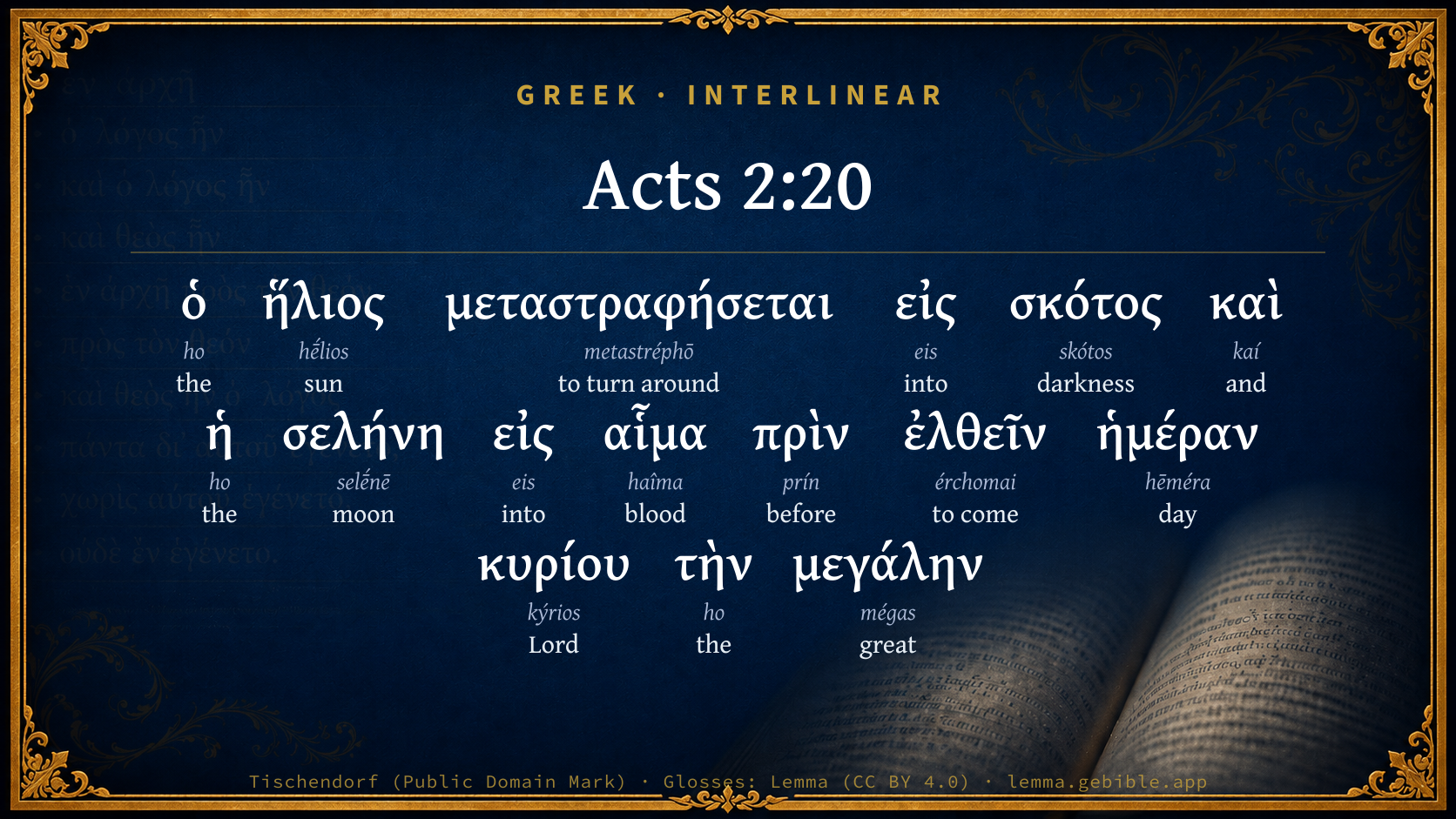
Download image
Cite this verse

Acts 2:20 (World English Bible). Public Domain. Lemma interlinear Bible study tool, https://lemma.gebible.app/v/acts/2/20.

Show BibTeX & RIS
BibTeX
RIS
English Translation
The sun will be turned into darkness, And the moon into blood, Before the great and glorious day of the Lord comes.
World English Bible · Public Domain
Highlights
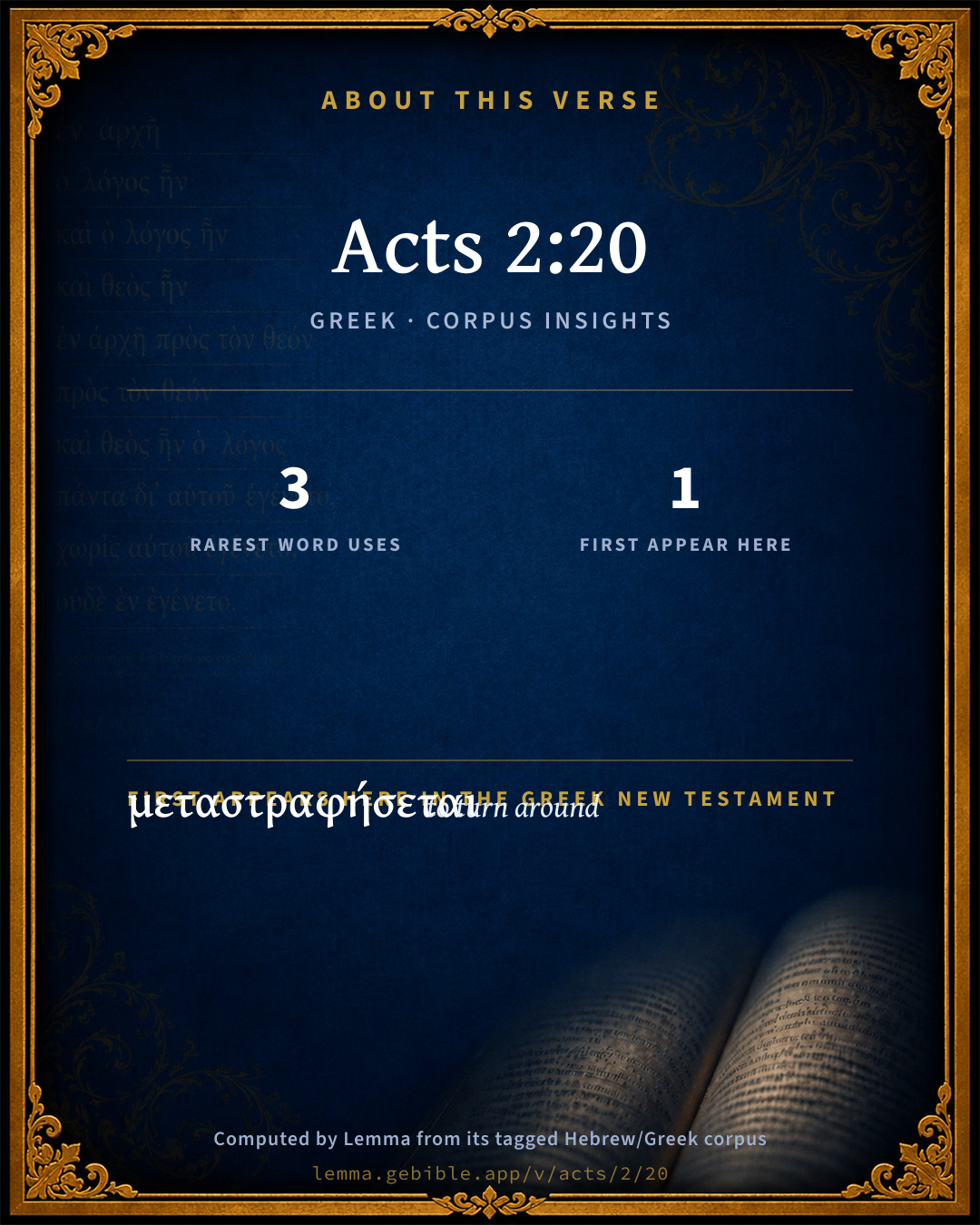
  • 1 first appearance in the Greek New Testament
Full analysis ↓
Download a study sheet

One document with this verse’s original text, its word-by-word gloss line, the meaning frame, cross-references with their text, attributed commentary, and full source and license credits — printable, and it pastes into notes with its structure intact.

This verse Autodidact and up

Study sheet (.html) Plain text (.txt)

A passage Seminary Student

Up to 50 verses in one chapter. A passage sheet keeps up to 6 commentary sources and 12 cross-references per verse, in the order this page ranks them, and says so on the sheet whenever that leaves anything out. Ask for a single verse and you get the Autodidact verse sheet above.

Everything on this page stays free to read, with no account — the sheet is a download of what is already on screen, not access to it.

Want to remove ads? Support Godless Engineer
Compare translations 3

The same verse in 3 English versions, stacked beneath the original-language interlinear above. Click any original word for its lexicon entry.

Each is an independent rendering of the whole verse — the interlinear is not word-aligned to these translations.

Highlighted words mark where these versions differ — a whole-verse word diff, not a word-by-word alignment.

  • World English Bible Public Domain
    The sun will be turned into darkness, And the moon into blood, Before the great and glorious day of the Lord comes.
  • King James Version Public Domain
    The sun shall be turned into darkness, and the moon into blood, before the great and notable day of the Lord come:
  • unfoldingWord Literal Text CC BY-SA 4.0
    The sun will be turned to darkness, and the moon to blood before the great and remarkable day of the Lord comes.

unfoldingWord Literal Text — © unfoldingWord, licensed CC BY-SA 4.0. Word-aligned USFM3 via Door43 (git.door43.org/unfoldingWord/en_ult).

Versions to compare (up to 4)

3 of 4 selected

Show all 19 translations

Every available English version of this verse, each an independent rendering of the whole verse.

  • World English Bible Public Domain
    The sun will be turned into darkness, And the moon into blood, Before the great and glorious day of the Lord comes.
  • Berean Standard Bible Public Domain
    The sun will be turned to darkness, and the moon to blood, before the coming of the great and glorious Day of the Lord.
  • Majority Standard Bible Public Domain
    The sun will be turned to darkness, and the moon to blood, before the coming of the great and glorious Day of the Lord.
  • King James Version Public Domain
    The sun shall be turned into darkness, and the moon into blood, before the great and notable day of the Lord come:
  • American Standard Version (1901) Public Domain
    The sun shall be turned into darkness, And the moon into blood, Before the day of the Lord come, That great and notable `day'.
  • Revised Version (1885) Public Domain
    The sun shall be turned into darkness, And the moon into blood, Before the day of the Lord come, That great and notable day:
  • Geneva Bible (1599) Public Domain
    The Sunne shalbe turned into darkenesse, and the moone into blood, before that great and notable day of the Lord come.
  • Douay-Rheims (1899) Public Domain
    The sun shall be turned into darkness, and the moon into blood, before the great and manifest day of the Lord come.
  • Young's Literal Translation Public Domain
    the sun shall be turned to darkness, and the moon to blood, before the coming of the day of the Lord -- the great and illustrious;
  • Literal Standard Version CC BY-SA 4.0
    The sun will be turned to darkness, || And the moon to blood, || Before the coming of the Day of the LORD—the great and conspicuous;
  • Unlocked Literal Bible CC BY-SA 4.0
    The sun will be turned to darkness and the moon to blood, before the great and remarkable day of the Lord comes.
  • unfoldingWord Literal Text CC BY-SA 4.0
    The sun will be turned to darkness, and the moon to blood before the great and remarkable day of the Lord comes.
  • Darby Bible Public Domain
    the sun shall be changed to darkness and the moon to blood, before the great and gloriously appearing day of [the] Lord come.
  • World Messianic Bible Public Domain
    The sun will be turned into darkness, and the moon into blood, before the great and glorious day of the Lord comes.
  • Webster's Bible Public Domain
    The sun shall be turned into darkness, and the moon into blood, before that great and notable day of the Lord come.
  • Free Bible Version CC BY-SA 4.0
    The sun will become dark, and the moon will become red like blood before the great and glorious day of the Lord.
  • Bible in Basic English Public Domain
    The sun will become dark and the moon will be turned to blood, before that great day of the Lord comes in glory:
  • Text-Critical English NT CC BY 4.0
    The sun will be turned to darkness and the moon to blood, before the coming of the great and glorious day of the Lord.
  • Tyndale New Testament (1534) Public Domain
    The sunne shalbe turned into darknes and the mone into bloud before that greate and notable daye of the Lorde come.

Literal Standard Version (2020), Covenant Press — licensed CC BY-SA 4.0. Text via the HelloAO Bible API (eBible.org). Unlocked Literal Bible (unfoldingWord) — licensed CC BY-SA 4.0. Text via the HelloAO Bible API (eBible.org). unfoldingWord Literal Text — © unfoldingWord, licensed CC BY-SA 4.0. Word-aligned USFM3 via Door43 (git.door43.org/unfoldingWord/en_ult). Free Bible Version, Dr. Jonathan Gallagher — licensed CC BY-SA 4.0. Text via the HelloAO Bible API (eBible.org).

Word by word

More ways to search: Search by grammar → Find every occurrence → Compare this word →

Practice this passage: Drill this verse → Learn its vocabulary →

μεταστραφήσεται
metastréphō
G3344
“to turn around”
Verb, Future, Passive, Indicative, 3rd person, Singular
Part of Speech
Verb
Tense
Future
Voice
Passive
Mood
Indicative
Person
3rd person
Number
Singular
Full Thayer's Definition

Origin: from G3326 and G4762

TDNT: 19:09,1

1. to turn around, turn around
  1. ὁ ho G3588 “the” Article, Nominative, Singular, Masculine
  2. ἥλιος hḗlios G2246 “sun” Noun, Nominative, Singular, Masculine
  3. εἰς eis G1519 “into” Preposition
  4. σκότος skótos G4655 “darkness” Noun, Accusative, Singular, Neuter
  5. καὶ kaí G2532 “and” Conjunction
  6. ἡ ho G3588 “the” Article, Nominative, Singular, Feminine
  7. σελήνη selḗnē G4582 “moon” Noun, Nominative, Singular, Feminine
  8. εἰς eis G1519 “into” Preposition
  9. αἷμα haîma G129 “blood” Noun, Accusative, Singular, Neuter
  10. πρὶν prín G4250 “before” Adverb
  11. ἐλθεῖν érchomai G2064 “to come” Verb, Aorist, Active, Infinitive
  12. ἡμέραν hēméra G2250 “day” Noun, Accusative, Singular, Feminine
  13. κυρίου kýrios G2962 “Lord” Noun, Genitive, Singular, Masculine
  14. τὴν ho G3588 “the” Article, Accusative, Singular, Feminine
  15. μεγάλην mégas G3173 “great” Adjective, Accusative, Singular, Feminine

About this verse

These counts appear in no published source. They are computed here, from the morphology-tagged text and Lemma’s own curated glosses. What Lemma adds →

16
words
13
distinct lemmas
Acts
section

Notable vocabulary

The rarest word here is μεταστραφήσεται to turn around G3344 — appearing just 3 times in the whole Greek New Testament.

First appearance in Scripture

This word makes its first canonical appearance in the Greek New Testament here:

  • μεταστραφήσεται to turn around G3344

Shared distinctive vocabulary

μεταστραφήσεται to turn around G3344 occurs in 3 verses of the Greek New Testament. Also found in:
Repetition

Words recur within this verse:

Cross-references

21

Topical passages linked to Acts 2:20 in the Treasury of Scripture Knowledge — connected by theme and wording, ordered by reader-vote popularity; previews shown in the World English Bible.

  • 2 Peter 3:10 But the day of the Lord will come as a thief in the night; in which the heavens will pass away with a great noise, and the elements will be dissolved with fervent heat, and the earth and the works that are in it will be burned up.
  • Amos 8:9 "It will happen in that day," says the Lord Yahweh, "That I will cause the sun to go down at noon, And I will darken the earth in the clear day.
  • Matthew 24:29 But immediately after the oppression of those days, the sun will be darkened, the moon will not give its light, the stars will fall from the sky, and the powers of the heavens will be shaken;
  • Malachi 4:5 Behold, I will send you Elijah the prophet before the great and terrible day of Yahweh comes.
  • 1 Thessalonians 5:2 For you yourselves know well that the day of the Lord comes like a thief in the night.
  • Joel 2:1 Blow you the trumpet in Zion, And sound an alarm in my holy mountain! Let all the inhabitants of the land tremble, For the day of Yahweh comes, For it is close at hand:
  • Joel 3:14 Multitudes, multitudes in the valley of decision! For the day of Yahweh is near, in the valley of decision.
  • Mark 13:24 But in those days, after that oppression, the sun will be darkened, the moon will not give its light,
  • Luke 21:25 There will be signs in the sun, moon, and stars; and on the earth anxiety of nations, in perplexity for the roaring of the sea and the waves;
  • 2 Peter 3:7 But the heavens that now are, and the earth, by the same word have been stored up for fire, being reserved against the day of judgment and destruction of ungodly men.
  • Isaiah 2:12–21 For there will be a day of Yahweh of Hosts for all that is proud and haughty, And for all that is lifted up; And it shall be brought low:
  • Revelation 6:12 I saw when he opened the sixth seal, and there was a great earthquake. The sun became black as sackcloth made of hair, and the whole moon became as blood.
  • Revelation 16:8 The fourth poured out his bowl on the sun, and it was given to him to scorch men with fire.
  • Isaiah 13:9 Behold, the day of Yahweh comes, cruel, with wrath and fierce anger; to make the land a desolation, and to destroy the sinners of it out of it.
  • Isaiah 13:15 Everyone who is found shall be thrust through; and everyone who is taken shall fall by the sword.
  • Isaiah 24:23 Then the moon shall be confounded, and the sun ashamed; for Yahweh of Hosts will reign on Mount Zion, and in Jerusalem; and before his elders shall be glory.
  • Isaiah 34:8 For Yahweh has a day of vengeance, a year of recompense for the cause of Zion.
  • Jeremiah 4:23 I saw the earth, and, behold, it was waste and void; and the heavens, and they had no light.
  • Zephaniah 2:2–3 before the appointed time when the day passes as the chaff, before the fierce anger of Yahweh comes on you, before the day of Yahweh's anger comes on you.
  • Matthew 27:45 Now from the sixth hour there was darkness over all the land until the ninth hour.
  • 1 Corinthians 5:5 are to deliver such a one to Satan for the destruction of the flesh, that the spirit may be saved in the day of the Lord Jesus.

Cross-references courtesy of OpenBible.info (CC BY 4.0).

Commentary

Notes on Acts 2:20 from classic Christian and Jewish commentators (each source and its license shown beneath its notes). The classic Christian expositions comment on the surrounding passage and are grouped to its opening verse, so a note may address several verses; the Jewish commentaries on the Tanakh (Rashi and others) are per-verse, so they appear only where the commentator wrote on this verse.

Lemma curates 59 commentaries, every one of them public domain or Creative Commons licensed, each selected and text-cleaned for this edition rather than reprinted as found. About our sources →

The Biblical Illustrator

Joseph S. Exell

Act_2:20

The sun shall be turned into darkness.

Downfall of Christianity

Solar eclipse is here prophesied to take place about the time of the destruction of ancient Jerusalem. Josephus says that the prophecy was literally fulfilled. Christianity is the sun of our time, and men bare tried, with the vapours of scepticism and the smoke of blasphemy, to turn this sun into darkness. Suppose the archangels of malice and horror should be allowed to extinguish and destroy the sun in the natural heavens. They would take the oceans from other worlds and pour them on this luminary, and the waters go hissing down among the ravines and the caverns, and there is explosion after explosion until there are only a few peaks of fire left in the sun, and these are cooling down and going out until the vast continents of flame are reduced to a small acreage of fire, and that whitens and cools off until there are only a few coals left, and these are whitening and going out until there is not a spark left in all the mountains and valleys and chasms of ashes. An extinguished sun. A dead sun. Let all worlds wail at the stupendous obsequies. Of course, this withdrawal of the solar light and heat throws our earth into a universal chill, and the tropics become the temperate, and the temperate becomes the arctic, and there are frozen rivers, lakes, and oceans. From the arctic and antarctic regions the inhabitants gather in towards the centre and find the equator as the poles. The slain forests are piled up into great bonfires, and around them gather the shivering villages and cities. The wealth of the coal mines is hastily poured into the furnaces and stirred into rage of combustion, but soon the bonfires begin to lower and the furnaces begin to go out, and the natives begin to die. The great volcanoes cease to smoke, and the ice of hailstorms remains unmelted in their craters. All the flowers have breathed their last breath. Child frosted and dead in the cradle. Octogenarian frosted and dead at the hearth. Workman with frozen hands at the hammer or frozen foot on the shuttle. Winter from sea to sea. The earth an ice-floe, grinding against other ice-floes. The archangels of malice and horror have done their work, and now they may take their thrones of glacier and look down upon the ruin they have wrought. What the destruction of the sun in the natural heavens would be to our physical earth, the destruction of Christianity would be to the moral world. The sun turned into darkness. Infidelity in our time is considered a great joke. I propose to take infidelity out of the realm of jocularity into one of tragedy, and show you what these men, if they are successful, will accomplish. It will be--

I. The complete and unutterable degradation of womanhood. In all communities where Christianity has been dominant, womans condition has been ameliorated and improved, and she is honoured in a thousand things, and every gentleman takes off his hat before her. You know that while woman may suffer injustices, she has more of her rights in Christendom than she has anywhere else. Now compare this with womans condition in lands where Christianity has made little or no advance. The Burmese sell their wives and daughters as so many sheep. The Hindoo Bible makes it an outrage for a woman to listen to music, or look out of the window in the absence of her husband, and gives as a lawful ground for divorce a womans beginning to eat before her husband has finished his meal! Her birth a misfortune. Her life a torture. Her death a horror. Now compare those two conditions. How far toward this latter condition would woman go if Christian influences were withdrawn? If an object be lifted to a certain point and not fastened there, and the lifting power be withdrawn, how long before that object will fall down to the point from which it started? Christianity has lifted woman up from the very depths of degradation almost to the skies. If that lifting power be withdrawn she falls back to the depth from which she was raised, not going any lower because there is no lower depth. And yet I have read that notwithstanding all that, there were women present at a meeting in a Brooklyn theatre at which Christianity was outrageously assailed and our Lord blasphemously maligned.

II. The demoralisation of society. The one idea in the Bible that infidels most hate is the idea of retribution. Take away that idea from society, and it will begin very soon to disintegrate, and take away from the minds of men the fear of hell, and there are a great many of them who would very soon turn this world into a hell. I have heard this brave talk about people fearing nothing of the consequences of sin in the next, world, and I have made up my mind it is merely a cowards whistling to keep his courage up; for when they came to die they shrieked until you could hear them far enough. The mightiest restraints to-day against crime of all sorts are the retributions of eternity. Men know that they can escape the law, but down in the offenders soul there is the realisation of the fact that he cannot escape God. Take this out of the hearts and minds of men, and it would not be long before our great cities became Sodoms.

III. Suppose now these generals of infidelity got the victory, they will first attack the churches. Away with those houses of worship. They have been standing there so long deluding the people with consolation in their bereavements and sorrows. Turn the St. Peters and St. Pauls and the temples and tabernacles into club-houses.

IV. Next they scatter the sabbath-schools, filled with bright-eyed, bright-cheeked little ones who are singing songs on Sunday afternoon and getting instruction when they ought to be on the street corners playing marbles or swearing on the commons.

V. They destroy Christian asylums, the institutions of mercy supported by Christian philanthropies. Never mind the blind eyes and the deaf ears and the crippled limbs and the weakened intellects. Let paralysed old age pick up its own food, and orphans fight their own way, and the half-reformed go back to their evil habits.

VI. They come to the great picture galleries, and tear down the pictures, for they are Bible pictures--Claudes Burning Bush, and Rembrandts Christ in the Temple, and Paul Veroneses Marriage in Cana, and Michael Angelos Last Judgment. Down with the pictures; they are Bible pictures. And away with the oratorios of Handel and Haydn and Beethoven, for they speak of the Messiah and the Creation, and of Jephthah, and of Samson, and of other Bible heroes.

VII. Now they come to the graveyards. Pull down the sculpture, for it means the resurrection. On, ye great army of infidels where you see Asleep in Jesus, cut it away, and where you find a marble story of heaven blast it; and where you find over a little childs grave, Suffer little children to come unto Me, substitute the words delusion and sham; and where you find an angel in marble strike off the wing; and when you come to a family vault chisel on the door: Dead and dead for ever. The place of Christian burial turned into a place for the burial of the whole family of Christian graces. Prayer dead. Faith dead. Hope dead. Charity dead. Self-denial dead. Honesty dead. Happiness dead.

VIII. They will attempt to scale heaven. On and on until they blow up the foundations of jasper and the gates of pearl. They charge up the steep. Now they aim for the throne of Him who liveth for ever and ever.

IX. There is only one more height to scale. They assail the Eternal Father and they want Him to feel the combined force of human and Satanic spite. A world without a head, a universe without a king. Orphan constellations. Fatherless galaxies. Anarchy supreme. A dethroned Jehovah. An assassinated God. Patricide, Regicide, Deicide. That is what they mean, and what they will have, if they can. Civilisation hurled back into semi-barbarism, and semi-barbarism driven back into Hottentot savagery. The wheel of progress turned the other way, and turned towards the Dark Ages. The sun turned into darkness. Has Christianity received its death-blow? Yes, when the smoke of the city chimney arrests and destroys the noonday sun. Josephus says about the time of the destruction of Jerusalem the sun was turned into darkness; but only clouds rolled between the sun and the earth. The sun went right on. At the beginning God said, Let there be light, and light was, and light is, and light shall be. So Christianity is rolling on, and it is going to warm all nations, and all nations are to bask in its light, and all nations are to be kindled with its joy. Men may shut the window-blinds so they cannot see out, or they may smoke the pipe of speculation until they are shadowed under their own vapouring; but God is a sun. (T. De Witt Talmage, D. D.)

The Biblical Illustrator, edited by Joseph S. Exell (c. 1880s–1900s) — public domain. Text from a community e-Sword module.

Bengel's Gnomon

Johann Albrecht Bengel

Act 2:20. Ὁ ἥλιος, the sun) These words must be taken literally. See note, Mat 24:29. [The darkening of the sun must be literal, as distinguished from the calamities which precede, described in the previous verses.]—αἷμα, blood) A bloody colour, somewhat black. Comp. Gen 49:11, “Washing His clothes in the blood of grapes.”—τὴν ἡμέραν Κυρίου, the day of the Lord) the day of the last judgment, not excluding the other revelations of the Divine glory which precede it.—ἐπιφανῆ) נורא, bright shining, notable, is translated by the LXX., ἐπιφανὴς, more than once.

Bengel's Gnomon of the New Testament — English translation (T&T Clark, Edinburgh, 1860) — public domain. Text from a community e-Sword module.

Expositor's Greek Testament

ed. W. Robertson Nicoll

Act 2:20 . For similar prophetic imagery taken from the startling phenomena of an eclipse in Palestine, cf. Isa 13:10 , Eze 32:7 , Amo 8:9 . πρὶν ἢ ἐλθεῖν . The LXX omit ἤ , and Weiss contends that this is the reason of its omission here in so many MSS. Weiss retains it as in Act 7:2 , Act 25:16 ; cf. also Luk 2:26 (but doubtful). Blass omits it here, but retains it in the other two passages cited from Acts: “Ionicum est non Atticum”; cf. Viteau, Le Grec du N. T. , p. 130 (1893). τὴν ἡμέραν Κυρίον . It is most significant that in the Epistles of the N.T. this O.T. phrase used of Jehovah is constantly applied to the Coming of Jesus Christ to judgment; cf. 1Th 5:2 , 1Co 1:8 , 2Co 1:14 , Phi 1:10 ; Sabatier, L’Apôtre Paul , p. 104. καὶ ἐπιφανῆ : if the word is to be retained, it means a day manifest to all as being what it claims to be, Vulgate manifestus , “clearly visible”; Luk 17:24 ; also 1Ti 6:14 , 2Th 2:8 , where the word ἐπιφάνεια is used of the Parousia ( cf. Prayer-Book, “the Epiphany or Manifestation of Christ to the Gentiles”). But in the Hebrew the word הַנּוֹרָא = “terrible,” not “clearly visible,” and the LXX here, as elsewhere, Hab 1:7 , Mal 1:14 (Jdg 13:6 , A.), etc., has failed to give a right derivation of the word which it connects with רָאָה , to see, instead of with יָרֵא , to fear (Niph. נוֹרָא and Part [125] , as here, “terrible”). Zöckler holds that the LXX read not הַנּוֹרָא , but הָנּוֹדָא .

[125]art. grammatical particle.

The Expositor's Greek Testament, edited by W. Robertson Nicoll (1897–1910) — public domain. Text from a community e-Sword module.

Adam Clarke's Commentary

Verse 20. The sun shall be turned into darkness, and the moon into blood] These are figurative representations of eclipses, intended most probably to point out the fall of the civil and ecclesiastical state in Judea: See Clarke on Mt 24:29. That the SUN is darkened when a total eclipse takes place, and that the MOON appears of a bloody hue in such circumstances, every person knows.

Adam Clarke's Commentary on the Bible (1810–1826) — public domain. Text from a community e-Sword/MySword module.

Ellicott's Commentary for English Readers

(20) The sun shall be turned into darkness.—Both clauses bring before us the phenomena of an eclipse: the total darkness of the sun, the dusky copper hue of the moon. Signs, of which these were but faint images, had been predicted by our Lord, echoing, as it were, the words of Joel, as among the preludes of His Advent (Mat_24:29).

That great and notable day.—St. Luke follows the LXX. version. The Hebrew gives, as in our version, “the great and terrible day.” As seen by the prophet, the day was terrible to the enemies of God; a day of blessing to “the remnant whom the Lord should call” (Joe_2:32). The Greek word for “notable” (epiphanès) lent itself readily to the thought of the great Epiphany or manifestation of Christ as the Judge of all.

A Bible Commentary for English Readers, edited by Charles John Ellicott (1878–1897) — public domain. Text from a community e-Sword module.

The Cambridge Bible for Schools and Colleges

gen. ed. J. J. S. Perowne

20. that great and notable day] Instead of notable we have in Joel terrible. The words of the N. T. are those of the LXX. The Hebrew verbs to fear and to see have often been confounded in that version. On the various senses of this expression cp. Lightfoot, Hor. Hebr. Mar_9:1. The prophecy of Joel was primarily and partially fulfilled in the destruction of Jerusalem by Nebuchadnezzar, but also looked onward to its destruction by the Romans.

The Cambridge Bible for Schools and Colleges (gen. ed. J. J. S. Perowne; Cambridge University Press, 1878–1918) — public domain. Text from a community e-Sword module.

John Gill's Exposition

The sun shall be turned into darkness,.... As at the death of Christ, by a total eclipse of it:

and the moon into blood; as at the opening of the sixth seal, Rev 6:12.

before that great and notable day of the Lord come; when he shall come in power and great glory, as he did in a few years after this, to take vengeance on the Jews, and destroy their nation, city, and temple; in which there was a display of his greatness, and power, and which was awful and "terrible" to them, as in Joel it is called; see Gill on Mat 24:29.

John Gill's Exposition of the Whole Bible (1746–1763) — public domain (CC PDM 1.0). Text via the HelloAO Bible API.

Trapp's Complete Commentary

John Trapp

20 The sun shall be turned into darkness, and the moon into blood, before that great and notable day of the Lord come:

Ver. 20. The sun shall be turned] He seems to set forth the great troubles of the world under the gospel.

John Trapp, A Commentary or Exposition upon All the Books of the Old and New Testament (1647–1656) — public domain. Text from a community e-Sword module.

Albert Barnes' Notes on the Bible

The sun shall be turned into darkness - See the notes on Mat 24:29. The same images used here with reference to the sun and moon are used also there: They occur not infrequently, Mar 13:24; 2Pe 3:7-10. The shining of the sun is an emblem of prosperity; the withdrawing, the eclipse, or the setting of the sun is an emblem of calamity, and is often thus need in the Scriptures, Isa 60:20; Jer 15:9; Eze 32:7; Amo 8:9; Rev 6:12; Rev 8:12; Rev 9:2; Rev 16:8. To say that the sun is darkened, or turned into darkness, is an image of calamity, and especially of the calamities of war, when the smoke of burning cities rises to heaven and obscures his light. This is not, therefore, to be taken literally, nor does it afford any indication of what will be at the end of the world in regard to the sun.

The moon into blood - The word “blood” here means that obscure, sanguinary color which the moon has when the atmosphere is filled with smoke and vapor, and especially the lurid and alarming appearance which it assumes when smoke and flames are thrown up by earthquakes and fiery eruptions, Rev 6:12, “And I beheld when he had opened the sixth seal, and lo, there was a great earthquake, and the sun became black as sackcloth of hair, and the moon became as blood,” Rev 8:8. In this place it denotes great calamities. The figures used are indicative of wars, and conflagrations, and earthquakes. As these things are Matt. 24 applied to the destruction of Jerusalem; as they actually occurred previous to that event (see the notes on Matt. 24), it may be supposed that the prophecy in Joel had an immediate reference to that. The meaning of the quotation by Peter in this place therefore is, that what occurred on the day of Pentecost was the beginning of the serges of wonders that was to take place during the times of the Messiah. It is not intimated that those scenes were to close or to be exhausted in that age. They may precede that great day of the Lord which is yet to come in view of the whole earth.

That great and notable day of the Lord - This is called the great day of the Lord, because on that day he will be signally manifested, more impressively and strikingly than on other times. The word “notable,” ἐπιφανῆ epiphanē, means “signal, illustrious, distinguished.” In Joel the word is “terrible or fearful”; a word applicable to days of calamity, and trial, and judgment. The Greek word here rendered notable is also in the Septuagint frequently used to denote “calamity” or “times of judgment,” Deu 10:21; 2Sa 7:23. This will apply to any day in which God signally manifests himself, but particularly to a day when he shall come forth to punish people, as at the destruction of Jerusalem, or at the day of judgment. The meaning is, that those wonders would take place before that distinguished day should arrive when God would come forth in judgment.

Albert Barnes' Notes on the Bible (1834–1885) — public domain. Text from a community e-Sword/MySword module.

Matthew Poole's English Annotations

The sun shall be turned into darkness, and the moon into blood; this agrees with the other words in the forecited prophecy, Joe 2:31. How these amazing signs shall be fulfilled, whether literally, and by what means; or whether only that the consternation and dread upon men shall be so great, as expecting the change of the whole frame of nature, is not so material for us to know, as it is to be always prepared for it.

Great and notable day; epifanh, manifest and illustrious day; and it may be taken in a comfortable sense, and will be a comfortable day indeed, to all that preparedly wait for it; for it is the day of the Lord, it is Christ’s day, in which he will be magnified over his enemies, and in his friends, children, and servants.

Matthew Poole's English Annotations on the Holy Bible (1683–1685) — public domain. Text from a community e-Sword/MySword module.

Whedon's Commentary on the Bible

Daniel D. Whedon

20. Sun… darkness—At the Saviour’s death.

Moon… blood—The optical effect of the miracle of darkness. Yet physical wonders are but the visible signs and indexes of the spiritual and moral movements in the kingdom of God. And all these wonders had their type in the manifestations at Sinai. Again, Sinai and Pentecost are antithesis to each other.

Notable day—Illustrious day, according to the Septuagint. The Hebrew may mean terrible day. Both were true. The same day has a bright and a dark side to it; the stern old prophet gives the dark side as for God’s enemies; the serene apostle gives to these Pentecostal hearers the side of brightness and promise. Nevertheless, for the persistent mockers (Act_2:13) the dark side remains true.

Day—The prophetic passage quoted by Peter comes to a point upon this very day; and the question (Act_2:12) What meaneth this? is answered.

Daniel D. Whedon (gen. ed.), Commentary on the Old and New Testaments (1874–1909) — public domain. Text from a community e-Sword module.

The Pulpit Commentary

The day of the Lord come, that great and notable day for that great and notable day of the Lord come, A.V. and T.R.

The Pulpit Commentary (1880–1919), ed. H.D.M. Spence-Jones & Joseph S. Exell — public domain. Text from a community e-Sword module.

John Wesley's Explanatory Notes

The moon shall be turned into blood - A bloody colour: before the day of the Lord - Eminently the last day; though not excluding any other day or season, wherein the Lord shall manifest his glory, in taking vengeance of his adversaries.

John Wesley, Explanatory Notes Upon the Whole Bible (1754–1765) — public domain. Text via the GEBible commentary corpus.

McGarvey & Pendleton's Commentaries

J. W. McGarvey

See notes on verse 19

J. W. McGarvey (with Philip Y. Pendleton), Commentaries on the New Testament (The Fourfold Gospel, 1914; Acts; and the epistles) — public domain. Text from a community e-Sword/MySword module.

The People's New Testament

B. W. Johnson

20. The sun shall be turned into darkness. See notes on Matt. 24:29.

B. W. Johnson's The People's New Testament with Notes (1889–1891) — public domain. Electronic text from the Christian Classics Ethereal Library (CCEL) ThML edition.

unfoldingWord translationNotes

Door43 World Missions Community

Connecting Statement:

Peter finishes quoting the prophet Joel.

The sun will be turned to darkness

This means that the sun will appear to be dark instead of light. AT: "The sun will become dark" (See: Active or Passive)

the moon to blood

This means that the moon will appear to be red like blood. AT: "the moon will appear to be red" (See: Metaphor and Ellipsis)

the great and remarkable day

The words "great" and "remarkable" share similar meanings and emphasize the intensity of greatness. AT: "the very great day" (See: Doublet)

remarkable

great and beautiful

everyone who calls on the name of the Lord will be saved

This can be stated in active form. AT: "the Lord will save everyone who calls on him" (See: Active or Passive and Metonymy)

translationWords

darkness

blood

day of the Lord

call

name

lord

save

unfoldingWord translationNotes — © Distant Shores Media and the Door43 World Missions Community, licensed CC BY-SA 4.0. Source: git.door43.org/Door43/en_tn.

Cambridge Greek Testament for Schools and Colleges

20. ἐπιφανῆ, notable. The Hebrew word in Joel means terrible. But the Hebrew verbs to fear and to see are often confounded in the LXX. version, with which the quotation in the text agrees. The prophecy of Joel had a partial fulfilment in the destruction of Jerusalem by Nebuchadnezzar, but it also looked onward to its later destruction by the Romans.

Cambridge Greek Testament for Schools and Colleges (Cambridge University Press, 1896; 21 vols, various authors incl. Carr, Maclear, Plummer, Farrar, Lumby, Moule, M. R. James, Simcox) — public domain. Text from a community e-Sword module.

Alford’s Greek Testament

Henry Alford

20.] See Mat 24:29.

ἡμ. κυρ.] Not the first coming of Christ,—which interpretation would run counter to the whole tenor of the Apostle’s application of the prophecy:—but clearly, His second coming; regarded in prophetic language as following close upon the outpouring of the Spirit, because it is the next great event in the divine arrangements.

The Apostles probably expected this coming very soon (see note on Rom 13:11); but this did not at all affect the accuracy of their expressions respecting it. Their days witnessed the Pentecostal effusion, which was the beginning of the signs of the end: then follows the period, known to the Father only, of waiting—the Church for her Lord,—the Lord Himself till all things shall have been put under His feet,—and then the signs shall be renewed, and the day of the Lord shall come. Meantime, and in the midst of these signs, the covenant of the spiritual dispensation is, ver. 21—‘Whosoever shall call on the name of the Lord, shall be saved.’ The gates of God’s mercy are thrown open in Christ to all people:—no barrier is placed,—no union with any external association or succession required: the promise is to individuals, as individuals: πᾶς ὃς ἐάν: which individual universality, though here by the nature of the circumstances spoken within the limits of the outward Israel, is afterwards as expressly asserted of Jew and Gentile, Rom 1:17, where see note.

Henry Alford, The Greek Testament (1849–1861) — public domain. Text from a community e-Sword module.

Vincent's Word Studies in the New Testament

Marvin R. Vincent

That great and notable day of the Lord come. The Rev. heightens the emphasis by following the Greek order, the day of the Lord, that great and notable day. Notable [επιφανη] only here in New Testament. The kindred noun ejpifaneia, appearing (compare our word Epiphany), is often used of the second coming of the Lord. See 1Ti 6:14; 2Ti 4:1; Tit 2:13.

Marvin R. Vincent, Word Studies in the New Testament (1887–1900) — public domain. Text from a community e-Sword/MySword module.

Lesson kit

Teaching starters — assembled from the data on this page, not authored interpretation. Every prompt links to the verse data it draws on. Edit before teaching.

Acts, in the Acts, opens this verse with 16 words (13 distinct Greek lemmas). Its most distinctive word is metastréphō (“to turn around”). A historical commentator’s framing appears above. Read the whole chapter for the surrounding context.

Discussion questions

  1. How does “to turn around” (metastréphō) shape what this verse is saying?
  2. This is the first place “to turn around” appears in Scripture (first appears here). What does its debut here establish?
  3. How does Galatians 1:7, which shares the word «to turn around», read alongside this verse?
  4. What does the repetition of “into” (2× in this one verse) do in this verse?
  5. These translations render this verse differently; the difference is in the English rendering, not the original. What questions does that raise?
  6. Compare how The Biblical Illustrator and Bengel's Gnomon read this verse. Where do they agree or differ?

Things to notice

  • 1 word makes its first canonical appearance in Scripture here.
  • These translations choose different wording for 8 words in this verse.
  • “into” occurs 2× in this single verse.
  • 13 distinct Greek lemmas span 16 words in this verse.

Reading settings

Reading text

Shown beneath each verse's original-language words.

Old Testament
Old Testament edition

Read the OT as the Masoretic Hebrew (MT) or the Greek Septuagint (LXX).

English shown for the Greek Septuagint (in the Hebrew ↔ Greek comparison).

Comparing translations? Open the Compare panel on any verse page to stack up to four side by side.