1 Peter 1:19

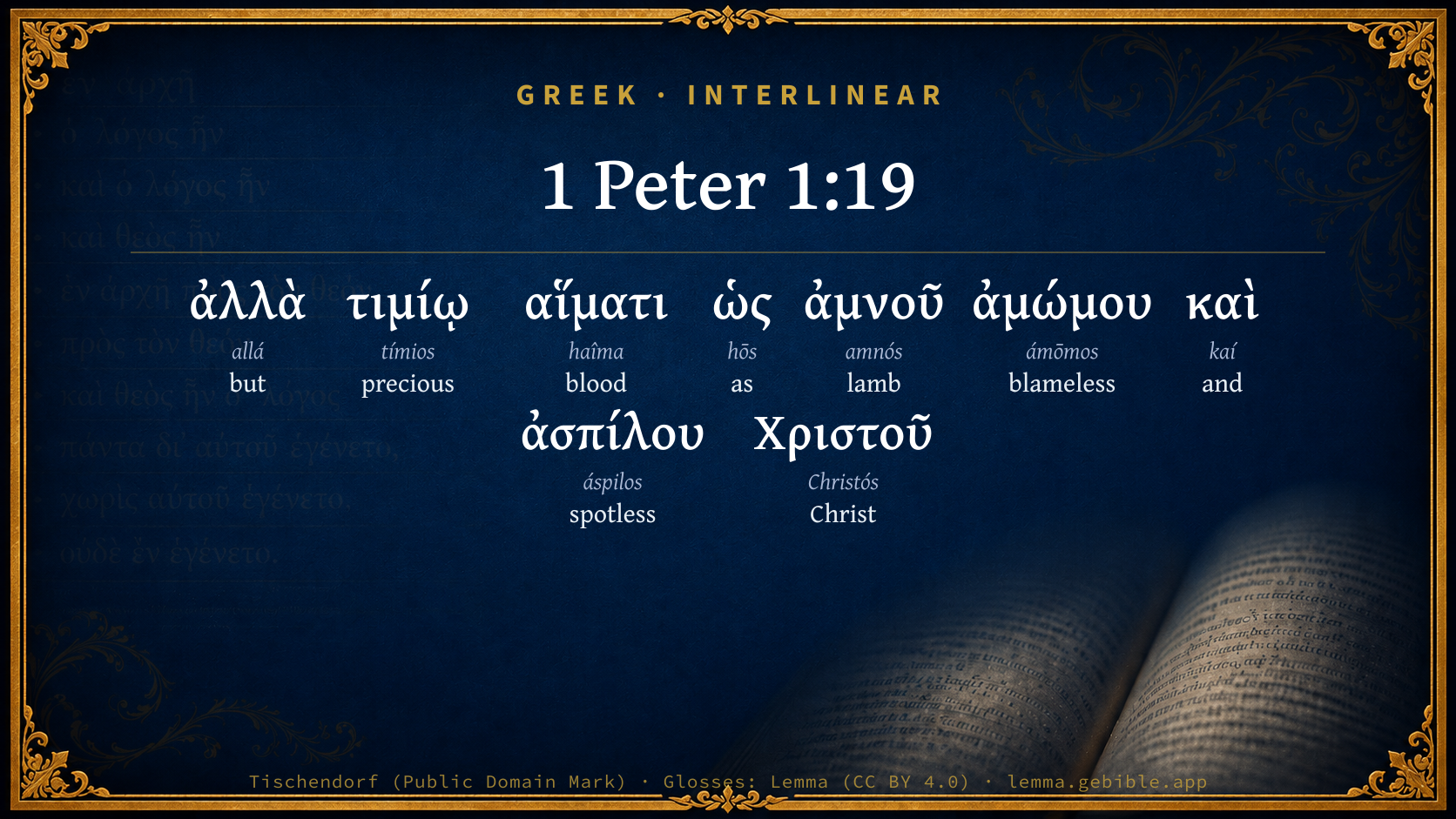
Greek (Tischendorf 8th ed.) 1 Peter 1:19 appears in the Greek New Testament. The text above is from the Tischendorf 8th edition. Each word links to its Strong’s number and a concise gloss. Click any word for its full Thayer’s Greek Lexicon entry.
Download image
Cite this verse

1 Peter 1:19 (World English Bible). Public Domain. Lemma interlinear Bible study tool, https://lemma.gebible.app/v/1-peter/1/19.

Show BibTeX & RIS
BibTeX
RIS
English Translation
but with precious blood, as of a lamb without spot, the blood of Christ;
World English Bible · Public Domain
Download a study sheet

One document with this verse’s original text, its word-by-word gloss line, the meaning frame, cross-references with their text, attributed commentary, and full source and license credits — printable, and it pastes into notes with its structure intact.

This verse Autodidact and up

Study sheet (.html) Plain text (.txt)

A passage Seminary Student

Up to 50 verses in one chapter. A passage sheet keeps up to 6 commentary sources and 12 cross-references per verse, in the order this page ranks them, and says so on the sheet whenever that leaves anything out. Ask for a single verse and you get the Autodidact verse sheet above.

Everything on this page stays free to read, with no account — the sheet is a download of what is already on screen, not access to it.

Want to remove ads? Support Godless Engineer
Compare translations 3

The same verse in 3 English versions, stacked beneath the original-language interlinear above. Click any original word for its lexicon entry.

Each is an independent rendering of the whole verse — the interlinear is not word-aligned to these translations.

Highlighted words mark where these versions differ — a whole-verse word diff, not a word-by-word alignment.

  • World English Bible Public Domain
    but with precious blood, as of a lamb without spot, the blood of Christ;
  • King James Version Public Domain
    But with the precious blood of Christ, as of a lamb without blemish and without spot:
  • unfoldingWord Literal Text CC BY-SA 4.0
    but with the precious blood of Christ, as of an unblemished and spotless lamb,

unfoldingWord Literal Text — © unfoldingWord, licensed CC BY-SA 4.0. Word-aligned USFM3 via Door43 (git.door43.org/unfoldingWord/en_ult).

Versions to compare (up to 4)

3 of 4 selected

Show all 19 translations

Every available English version of this verse, each an independent rendering of the whole verse.

  • World English Bible Public Domain
    but with precious blood, as of a lamb without spot, the blood of Christ;
  • Berean Standard Bible Public Domain
    but with the precious blood of Christ, a lamb without blemish or spot.
  • Majority Standard Bible Public Domain
    but with the precious blood of Christ, a lamb without blemish or spot.
  • King James Version Public Domain
    But with the precious blood of Christ, as of a lamb without blemish and without spot:
  • American Standard Version (1901) Public Domain
    but with precious blood, as of a lamb without spot, `even the blood' of Christ:
  • Revised Version (1885) Public Domain
    but with precious blood, as of a lamb without blemish and without spot, even the blood of Christ:
  • Geneva Bible (1599) Public Domain
    But with the precious blood of Christ, as of a Lambe vndefiled, and without spot.
  • Douay-Rheims (1899) Public Domain
    But with the precious blood of Christ, as of a lamb unspotted and undefiled,
  • Young's Literal Translation Public Domain
    but with precious blood, as of a lamb unblemished and unspotted -- Christ's --
  • Literal Standard Version CC BY-SA 4.0
    but with precious blood, as of a lamb unblemished and unspotted—Christ’s—
  • Unlocked Literal Bible CC BY-SA 4.0
    Instead, you have been redeemed with the precious blood of Christ, who was like a lamb without blemish or spot.
  • unfoldingWord Literal Text CC BY-SA 4.0
    but with the precious blood of Christ, as of an unblemished and spotless lamb,
  • Darby Bible Public Domain
    but by precious blood, as of a lamb without blemish and without spot, [the blood] of Christ,
  • World Messianic Bible Public Domain
    but with precious blood, as of a lamb without blemish or spot, the blood of Messiah,
  • Webster's Bible Public Domain
    But with the precious blood of Christ, as of a lamb without blemish and without spot:
  • Free Bible Version CC BY-SA 4.0
    You were set free by the costly blood of Christ, who was like a lamb with no flaw or defect.
  • Bible in Basic English Public Domain
    But through holy blood, like that of a clean and unmarked lamb, even the blood of Christ:
  • Text-Critical English NT CC BY 4.0
    but with the precious blood of Christ, a lamb without blemish or spot.
  • Tyndale New Testament (1534) Public Domain
    but with the precious bloud of Christ as of a lambe vndefiled and withouten spot

Literal Standard Version (2020), Covenant Press — licensed CC BY-SA 4.0. Text via the HelloAO Bible API (eBible.org). Unlocked Literal Bible (unfoldingWord) — licensed CC BY-SA 4.0. Text via the HelloAO Bible API (eBible.org). unfoldingWord Literal Text — © unfoldingWord, licensed CC BY-SA 4.0. Word-aligned USFM3 via Door43 (git.door43.org/unfoldingWord/en_ult). Free Bible Version, Dr. Jonathan Gallagher — licensed CC BY-SA 4.0. Text via the HelloAO Bible API (eBible.org).

Word by word

More ways to search: Search by grammar → Find every occurrence → Compare this word →

Practice this passage: Drill this verse → Learn its vocabulary →

About this verse

These counts appear in no published source. They are computed here, from the morphology-tagged text and Lemma’s own curated glosses. What Lemma adds →

9
words
9
distinct lemmas
General Epistles
section

Notable vocabulary

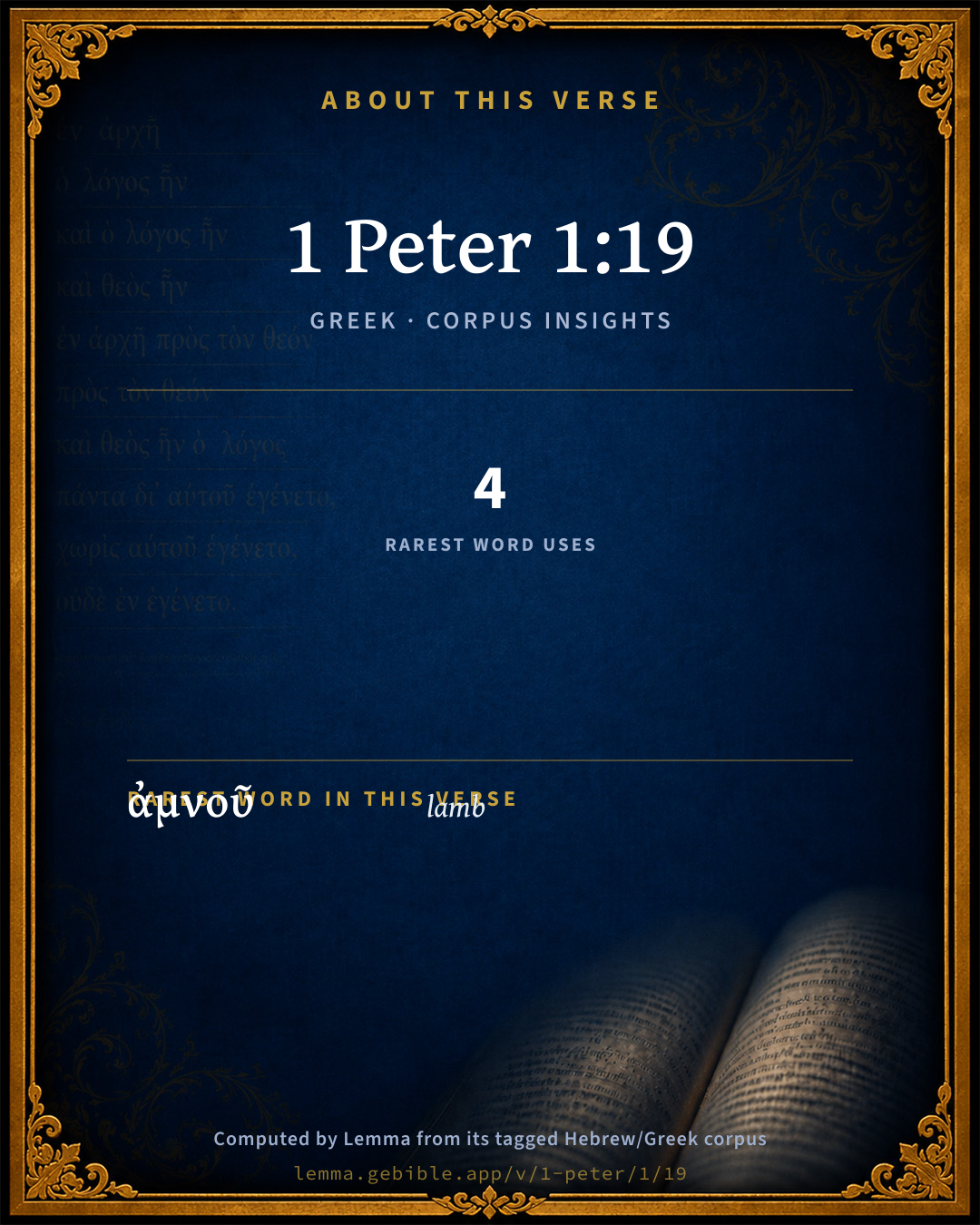
The rarest word here is ἀμνοῦ lamb G286 — appearing just 4 times in the whole Greek New Testament.

Shared distinctive vocabulary

ἀμνοῦ lamb G286 occurs in 4 verses of the Greek New Testament. Also found in:

Cross-references

23

Topical passages linked to 1 Peter 1:19 in the Treasury of Scripture Knowledge — connected by theme and wording, ordered by reader-vote popularity; previews shown in the World English Bible.

  • 1 John 1:7 But if we walk in the light, as he is in the light, we have fellowship with one another, and the blood of Jesus Christ, his Son, cleanses us from all sin.
  • 1 Peter 2:22–24 who did not sin, "neither was deceit found in his mouth."
  • John 1:29 The next day, he saw Jesus coming to him, and said, "Behold, the Lamb of God, who takes away the sin of the world!
  • Hebrews 9:12–14 nor yet through the blood of goats and calves, but through his own blood, entered in once for all into the Holy Place, having obtained eternal redemption.
  • Revelation 5:9 They sang a new song, saying, "You are worthy to take the book, And to open its seals: For you were killed, And bought us for God with your blood, Out of every tribe, language, people, and nation,
  • Exodus 12:5 Your lamb shall be without blemish, a male a year old. You shall take it from the sheep, or from the goats:
  • John 1:36 and he looked at Jesus as he walked, and said, "Behold, the Lamb of God!"
  • Colossians 1:14 in whom we have our redemption, the forgiveness of our sins;
  • Ephesians 1:7 in whom we have our redemption through his blood, the forgiveness of our trespasses, according to the riches of his grace,
  • Revelation 1:5 and from Jesus Christ, the faithful witness, the firstborn of the dead, and the ruler of the kings of the earth. To him who loves us, and washed us from our sins by his blood;
  • Isaiah 53:7 He was oppressed, yet when he was afflicted he didn't open his mouth; as a lamb that is led to the slaughter, and as a sheep that before its shearers is mute, so he didn't open his mouth.
  • Matthew 20:28 even as the Son of Man came not to be served, but to serve, and to give his life as a ransom for many."
  • 1 John 2:2 And he is the atoning sacrifice for our sins, and not for ours only, but also for the whole world.
  • Acts 20:28 Take heed, therefore, to yourselves, and to all the flock, in which the Holy Spirit has made you overseers, to shepherd the assembly of the Lord and God which he purchased with his own blood.
  • Revelation 7:14 I told him, "My lord, you know." He said to me, "These are those who came out of the great tribulation. They washed their robes, and made them white in the Lamb's blood.
  • Matthew 26:28 for this is my blood of the new covenant, which is poured out for many for the remission of sins.
  • 1 Peter 3:18 Because Christ also suffered for sins once, the righteous for the unrighteous, that he might bring you to God; being put to death in the flesh, but made alive in the spirit;
  • Daniel 9:24 Seventy weeks are decreed on your people and on your holy city, to finish disobedience, and to make an end of sins, and to make reconciliation for iniquity, and to bring in everlasting righteousness, and to seal up vision and prophecy, and to anoint the most holy.
  • 1 Corinthians 5:7–8 Purge out the old yeast, that you may be a new lump, even as you are unleavened. For indeed Christ, our Passover, has been sacrificed in our place.
  • Acts 8:32–35 Now the passage of the Scripture which he was reading was this, "He was led as a sheep to the slaughter. As a lamb before his shearer is silent, So he doesn't open his mouth.
  • Zechariah 13:7 "Awake, sword, against my shepherd, And against the man who is close to me," says Yahweh of Hosts. Strike the shepherd, and the sheep will be scattered; And I will turn my hand against the little ones.
  • Revelation 5:6 I saw in the midst of the throne and of the four living creatures, and in the midst of the elders, a Lamb standing, as though it had been slain, having seven horns, and seven eyes, which are the seven Spirits of God, sent out into all the earth.
  • Revelation 14:1 I saw, and behold, the Lamb standing on Mount Zion, and with him a number, one hundred forty-four thousand, having his name, and the name of his Father, written on their foreheads.

Cross-references courtesy of OpenBible.info (CC BY 4.0).

Commentary

Notes on 1 Peter 1:19 from classic Christian and Jewish commentators (each source and its license shown beneath its notes). The classic Christian expositions comment on the surrounding passage and are grouped to its opening verse, so a note may address several verses; the Jewish commentaries on the Tanakh (Rashi and others) are per-verse, so they appear only where the commentator wrote on this verse.

Lemma curates 59 commentaries, every one of them public domain or Creative Commons licensed, each selected and text-cleaned for this edition rather than reprinted as found. About our sources →

Tyndale Open Study Notes

Tyndale Open Resources

1:19 the sinless, spotless Lamb of God: The Passover Lamb had to be without defect (Exod 12:5); Christ, who fulfills the meaning of the Passover, was without defect or sin (cp. Heb 4:14-16; 7:26-28).

Tyndale Open Study Notes — © Tyndale Open Resources, licensed CC BY-SA 4.0. Text via the HelloAO Bible API.

Bengel's Gnomon

Johann Albrecht Bengel

1Pe 1:19. Τιμίῳ, precious) The blood of Christ is incorruptible, 1Pe 1:18.—ὡς, as) This explains the reason[11] for his use of the word precious.—ἀμώμου, without blemish) Jesus Christ had in Himself (ἀμώμου) no taint of evil.—ἀσπίλου, without spot) Nor did He contract any stain from without (ἀσπίλου).

[11] This is an instance of the figure Ætiologia, which is used to express the reason why we make use of any particular proposition or assertion.

Bengel's Gnomon of the New Testament — English translation (T&T Clark, Edinburgh, 1860) — public domain. Text from a community e-Sword module.

Meyer's Critical & Exegetical Commentary

Heinrich August Wilhelm Meyer

1Pe_1:19. ἀλλὰ τιμίῳ αἵματι] τιμίῳ forms the antithesis to φθαρτοῖς, in so far as the perishable is destitute of true worth.

αἵματι] refers not only to the death, but to the bloody death of Christ; cf. Heb_9:22.

ὡς … ἀμνοῦ ἀμώμου καὶ ἀσπίλου Χριστοῦ] ὡς … ἀσπίλου is in antecedent apposition to Χριστοῦ (Wiesinger, de Wette-Brückner), as in chap. 1Pe_2:7, where likewise ὡς ἀσθενεστέρῳ σκεύει is in similar apposition to τῷ γυναικείῳ (sc. σκεύει). It is incorrect to supply, with Steiger, Schott, and others, αἵματι before ἀμνοῦ, taking Χριστοῦ either as an explanatory adjunct (Steiger), or connecting it directly with αἵματι (Schott, Hofmann).

ὡς] is also here not merely comparative, as, among others, Schott and Hofmann hold, maintaining that by ἀμνοῦ only an actual lamb is meant, but it emphasizes that Christ is a blameless and spotless lamb (Gerhard, de Wette-Brückner).[91]

ἈΜΝΌς is, as Brückner also assumes, to be understood of a sacrificial lamb. This is clear both from the connectionsince the ransom by the αἷμα of Christ (Lev_17:11) is here in questionand from the attributes ἌΜΩΜΟς and ἌΣΠΙΛΟς, of which the former is used in the O. T. expressly to denote the faultlessness of animals taken for sacrifice (תָּמִים, LXX.: ἌΜΩΜΟς),to this class lambs also belonged. The precise designation: a lamb, was probably suggested to Peter by Isa_53:7 (cf. chap. 1Pe_2:22 ff.); from this it must not, however, be inferred, with Weiss (p. 227 ff.) and Schott, that there is nowhere here any reference to the idea of sacrifice. For although the passage in Isaiah compares the servant of God to a lamb simply on account of the patience he exhibited in the midst of his sufferings, still it is based so wholly on the idea of sacrifice, and the sufferings of Christ are so expressly presented as propitiatory, that it is easily explainable how, with this passage applied to Him, Christ could have been thought of precisely as a sacrificial lamb. Doubtless it is not Peters intention to give special prominence to the fact that Christ is the sacrificial lamb designated by Isaiahs prophecy; for in that case the definite article would not have been wanting (cf. Joh_1:29, and Meyer in loc.); but alluding to the above passage, Peter styles Him generally a lamb,which, however, he conceives as a sacrificial lamb. There is no direct allusion (Wiesinger) here to the paschal lamb (de Wette-Brückner, Schott); the want of the article forbids it. Hofmann, though he has justly recognised this, still firmly holds by the reference to the paschal lamb;only in thus far, however, that he terms the slaying of it the occurrence which was here present to the apostles mind.[92] But the fact that the blood of this lamb did not serve to ransom Israel out of Egypt, but to preserve them from the destroying angel, is opposed to any such allusion. Further, it must not be left unnoticed that in the N. T. the paschal lamb is always styled ΤῸ ΠΆΣΧΑ; and in the passage treating of it in Exodus 12 in the LXX., the expression ΠΡΌΒΑΤΟΝ only, and never ἈΜΝΌς, is employed.

The adjunct: Ὡς … ἈΣΠΊΛΟΥ, serves to specify particularly the blood of Christ as sacrificial, and not merely to give a nearer definition of its preciousness (the τίμιον), inasmuch as, according to Petrine conceptions, it is precisely the innocence (denoted here by the two attributes) and the patience (conveyed by ἀμνός) which give to the suffering its ΤΙΜΉ (as opposed to Weiss, p. 281 f.). The preciousness of the blood lies in this, that it is the blood of Christ; its redemptive power in this, that He shed it as a sacrificial lamb without blemish and fault.[93]

With ἄμωμος, cf. in addition to Lev_22:18 ff., especially Heb_9:14.

ἄσπιλος] is not to be found in the LXX. and in the N. T. only metaphorically; the two expressions here conjoined are a reproduction of the חָּמִים כָּל־מוּם לֹא יִהְיֶה־בּוֹ, Lev_22:18 ff. (Wiesinger). All the commentators construe Χριστοῦ with what precedes, Hofmann only excepted, who separates it therefrom, and connects it with what follows, taking Χριστοῦ προεγνωσμένου κ.τ.λ. as an absolute genitive (i.e. in that … Christ … was foreordained, etc.). But this construction does not specify by whose blood the redemption was accomplished, nor does it give a clear logical connection between the thought of the participial and that of the principal clause.

[91] If ὡς be taken as instituting a comparison, there then arises the singular thought, that the blood of Christ is as precious as that of a lamb without blemish. Hofmann, indeed, avoids this conclusion by supplying to ὡς not τιμίῳ αἵματι, but αἵματι only, and observes that the shedding of blood alone (not the shedding of precious blood) is compared to the slaying of a spotless lamb; but there is not the slightest justification for thus separating τιμίῳ from αἵματι. The apostle would in some way hare indicated it by prefixing at least a simple αἵματι to ἀμνοῦ.

[92] Hofmann says: The meaning is not, that the same was done to Christ as to the paschal lamb, but the recollection of the paschal lamb explains only how Peter came to compare the shedding of Christs blood with the shedding of the blood of a spotless lamb.As to whether the paschal lamb should be considered as a sacrificial lamb (Keil on Genesis 12.) or not, is a matter of dispute, which cannot be decided here.

[93] Schott, in opposition to this, asserts: this blood can redeem because it is that of the divine Mediator (Χριστός), but it is valuable in that it is the blood of an innocent Saint. This is, however, erroneous, since this blood has power to redeem only, because Christ shed it as a sacrifice for propitiation. But it is not clear why this blood should not even have its full worth from the fact that it is the blood of the Mediator.

REMARK.

It must be observed that whilst the power of propitiation, i.e. of blotting out sin, is attributed to the blood of the sacrifice, Lev_16:11, the blood of Christ is here specified as the means by which we are redeemed from the ματαία ἀναστροφή. From this it must not be concluded, with Weiss (p. 279), that the blood of Christ is not regarded here as the blood of offering, inasmuch as the sacrifice can have an expiatory, but not a redemptory worth;for the two are in no way opposed to each other. The expiation is nothing different from the redemption, i.e. ransom from the guilt by the blood freely shed. The redemption, however, which is here spoken of, though doubtless not identical with expiation, is yet a necessary condition of it,a circumstance which Pfleiderer also fails to observe, when he says that the passage has reference only to the putting away of a life of sin, to moral improvement, not to expiation of the guilt of sin.

Meyer — Critical and Exegetical Commentary on the New Testament — English translation by Peter Christie, edited by Frederick Crombie (T&T Clark, 1880) — public domain. Text from a community e-Sword module.

Expositor's Greek Testament

ed. W. Robertson Nicoll

1Pe 1:19 . The blood of Christ, the true paschal lamb, was the (means or) agent of your redemption. The type contemplated is composite; the lamb is the yearling sheep ( שה πρόβατον , but Targum-Onkelos has אמר lamb and שה is rendered ἀμνός in Lev 12:8 ; Num 15:11 ; Deu 14:4 ) prescribed for the Passover (Exo 12:5 ). But the description perfect ( τέλειον תמים ) is glossed by ἀμώμου ( cf. Heb 12:14 ), which is the common translation of תמים in this connection, and ἀσπίλου which summarises the description of sacrificial victims generally ( v. Lev 22:22 , etc.). ἀμωμος would be unintelligible to the Gentile, because it has acquired a peculiar meaning from the Hebrew מום blemish . ἄσπιλος is used by Symmachus in Job 15:15 , for זכך . Hesychius treats ἄσπιλος . ἄμωμος and καθαρός as synonyms. τιμίῳ is set over against φθαρτοῖς as πολυτιμ . against ἀπολλυμένου ; cf. Psa 116:15 , τίμιος ἐναντίον Κυρίου ὁ θάνατος τῶν ὁσίων and λίθος … ἔντιμον (1Pe 2:4 ).

The Expositor's Greek Testament, edited by W. Robertson Nicoll (1897–1910) — public domain. Text from a community e-Sword module.

Jamieson, Fausset & Brown

Robert Jamieson, A. R. Fausset & David Brown

precious--of inestimable value. The Greek order is, "With precious blood, as of a lamb without blemish (in itself) and without spot (contracted by contact with others), (even the blood) of Christ." Though very man, He remained pure in Himself ("without blemish"), and uninfected by any impression of sin from without ("without spot"), which would have unfitted Him for being our atoning Redeemer: so the passover lamb, and every sacrificial victim; so too, the Church, the Bride, by her union with Him. As Israel's redemption from Egypt required the blood of the paschal lamb, so our redemption from sin and the curse required the blood of Christ; "foreordained" (Pe1 1:20) from eternity, as the passover lamb was taken up on the tenth day of the month.

Jamieson, Fausset & Brown — Commentary Critical and Explanatory on the Whole Bible (1871) — public domain (CC PDM 1.0). Text via the HelloAO Bible API.

Adam Clarke's Commentary

Verse 19. The precious blood of Christ] τιμιω αιματι. The valuable blood; how valuable neither is nor could be stated.

As of a lamb] Such as was required for a sin-offering to God; and THE Lamb of God that takes away the sin of the world.

Without blemish] In himself, and without spot from the world; being perfectly pure in his soul, and righteous in his life.

Adam Clarke's Commentary on the Bible (1810–1826) — public domain. Text from a community e-Sword/MySword module.

John Calvin's Commentaries

19 As of a lamb He means by this similitude, that we have in Christ whatever had been shadowed forth by the ancient sacrifices, though he especially alludes to the Paschal lamb. But let us hence learn what benefit the reading of the Law brings us in this respect; for, though the rite of sacrificing is abolished, yet it assists our faith not a little, to compare the reality with the type, so that we may seek in the former what the latter contains. Moses ordered a whole or perfect lamb, without blemish, to be chosen for the Passover. The same thing is often repeated as to the sacrifices, as in Leviticus 23; in Numbers 28; and in other places. Peter, by applying this to Christ, teaches us that he was a suitable victim, and approved by God, for he was perfect, without any blemish; had he had any defect in him, he could not have been rightly offered to God, nor could he pacify his wrath.

John Calvin's Commentaries (1540-1563) — public domain. Text from the Calvin Translation Society English edition (1840s-50s) via the Christian Classics Ethereal Library (ccel.org). Calvin's coverage is partial (roughly two-thirds of the Bible); uncommented books and verses are honest gaps, never fabricated. The 19th-century editor's footnotes and remarks are omitted so the notes are faithfully Calvin's own voice.

Ellicott's Commentary for English Readers

(19) With the precious blood of Christ.—“Precious” means, not “much prized by us,” but costly, precious in itself; opposed to the perishableness of gold and silver. Notice that it is not “Jesus,” but “Christ,” i.e., the Messiah. No price short of the “blood,” i.e., the death, of the Messiah could free the Jews from the thraldom of their “vain conversation.” (Comp. 1Pe_1:2 and Note.) How Christ’s death freed them from it is not explained here; but we may give a twofold explanation, as we did of His resurrection being our regeneration, in 1Pe_1:3. Historically it did so, because when they came to realise that their Messiah could only reach His glories through suffering it gave them a new insight into the whole meaning of the system under which they had been brought up. It did also, however, doubtless, in a more mysterious way, such as we cannot imagine, procure in God’s sight their emancipation; and the following verses show that again St. Peter is thinking more of the theological than of the phenomenal side of the occurrence.

As of a lamb without blemish and without spot.—We might roughly paraphrase it by, “as of a sacrificial victim, to the sufficiency of whose offering no exception can be taken.” The word “as” shows that in St. Peter’s mind the notion of a “sacrifice,” in reference to the atonement, was only a simile, or metaphor, just as it was with the notion of “ransom.” Once more observe that the sacrifice was offered to effect a redemption which for the readers had already taken place. (Comp. Heb_9:14.) The primary thought in mentioning a “lamb” is, of course, that of sacrifice; but when we come to consider why that particular sacrificial animal was named rather than another, it is, no doubt, for two reasons. First, because of the whiteness, the helplessness, the youth, the innocence, and patience, which make it a natural symbol of our Lord. (Comp. Ecce Homo, p. 6, ed. 3.) The second reason is to be found in St. Peter’s own life. The first thing that we know in his history was a putting together of those two words—Messiah, and the Lamb (Joh_1:36; Joh_1:40-41). Neither he nor St. John (see Rev_5:6, et al.) ever forgot that cry of the Baptist. They, no doubt, understood that cry to refer, not primarily to the Paschal, or any other sacrifice, but to Isa_53:7, and perhaps to Gen_22:8. A word in the next verse will make it clearer that St. Peter really had the Baptist consciously before his mind when he thus wrote.

A Bible Commentary for English Readers, edited by Charles John Ellicott (1878–1897) — public domain. Text from a community e-Sword module.

The Cambridge Bible for Schools and Colleges

gen. ed. J. J. S. Perowne

19. but with the precious blood of Christ] The order of the Greek, and the absence of the article before “blood,” somewhat modify the meaning. Better, with precious blood, as of a lamb without blemish and without spot, [even that] of Christ. That blood, the life which it represented, poured out upon the cross, took its place among the things that were not corruptible, and is contrasted accordingly with the “silver” and the “gold.” With the exception of the substitution of the “blood which is the life” for the life itself, the thought is identical with that of the two passages (Mat_20:28, Mar_10:45) already referred to. The minds of the disciples had been directed to the “blood” thus understood, as connected with remission of sins, in what we know as the words of institution at the Last Supper (Mat_26:28, Mar_14:24, Luk_22:20). In the blood being that of a “lamb,” we trace the impression made on the mind of the Apostle by the words which the Baptist had spoken in the hearing of St John (Joh_1:29), and which are reproduced with so much vividness in the Apocalypse (Rev_5:6; Rev_5:12). The question meets us, and is not easy to answer, To what special sacrifice ordained in the law of Moses do they refer? The epithet “without blemish” seems to point to the Paschal lamb (Exo_12:5), but neither of the adjectives which St Peter uses is found in the LXX. version in connexion with the Passover. As connected with the deliverance of Israel both from the angel of death and from their bondage in Egypt, the blood so shed might well come to be thought of as the instrument of redemption. Had a lamb been sacrificed on the day of Atonement, that would have seemed the natural type of the death of Christ, but there the victim was a goat (Lev_16:7); the daily morning and evening sacrifice of a lamb (Exo_29:38) fails as being unconnected with any special act of redeeming love. On the whole, perhaps, it is best to think of the comparison, suggested originally by the Baptist’s words, as pointing to the fact that whatever typical significance had attached to the lamb in any part of the complex ritual of the law had now been realised in Christ.

The Cambridge Bible for Schools and Colleges (gen. ed. J. J. S. Perowne; Cambridge University Press, 1878–1918) — public domain. Text from a community e-Sword module.

John Gill's Exposition

But with the precious blood of Christ,.... Christ was prophesied of as a Redeemer under the Old Testament, Isa 59:20 and the Jews frequently ascribe redemption to the word of the Lord God (f); and which the apostle here attributes to the blood of Christ; whose blood is the same with ours, only not tainted with sin; the blood of an innocent person, and of one who is God, as well as man, and was freely shed in the room and stead of his people, and so a sufficient price for their redemption: and it may truly be said to be "precious": as it is to God, to whom it is a sweet smelling sacrifice, and with which he is well pleased; not that he takes delight in the mere effusion of his blood, but as this is the ransom price, and the atonement of his chosen ones; and so it is to all them that believe, since by it they are justified; through it they have the forgiveness of their sins; their peace and reconciliation with God is made by it; and by it they are sanctified, and have boldness to enter into the holiest of all: and this blood of Christ, by which they are redeemed,

is of a lamb without spot and blemish; Christ is comparable to any lamb, for the innocence of his nature, the meekness of his disposition and deportment, and for his patience under sufferings and in death; and to the lambs of the daily sacrifice, which were typical of the continual and constant virtue and efficacy of his sacrifice to take away sin; and particularly to the paschal lamb, he being the true passover sacrificed for us; and which, as also the lambs of the daily sacrifice, and all others, were to be without spot and blemish: and in which they prefigured Christ, who is without the stain of original, and the spot and blemish of actual sin; and so was a very fit person to be a sacrifice for sin, and a Redeemer of his people. The Jews have a notion, that the redemption of the Israelites out of Egypt, when a lamb without blemish was taken, and sacrificed and eaten, had a respect to the future redemption by the Messiah; and which, they say (g), was to be in the same time of the year; that as they were redeemed in Nisan, the month in which the passover was kept, so they were to be redeemed in the same month: and indeed at that time, and in that month, was redemption obtained by the blood of Christ. Of the former, the Targumist in Hos 3:2 says,

"I have redeemed them by my word, on the fifteenth day of the month Nisan, and have given silver shekels, the atonement of their souls.

It is observable that the Hebrew word signifies both "blood" and "money", or price; whether some reference may not be had to this here, since both are included here, may be considered,

(f) Targum in Hos. i. 7. & iii. 2. & in Joel ii. 17. (g) Zohar in Numb. fol. 102. 3.

John Gill's Exposition of the Whole Bible (1746–1763) — public domain (CC PDM 1.0). Text via the HelloAO Bible API.

Trapp's Complete Commentary

John Trapp

19 But with the precious blood of Christ, as of a lamb without blemish and without spot:

Ver. 19. Without blemish] Of original pollution.

And without spot] Of actual sin: or thus, without blemish, that is, sound within; and without spot, right in the outward parts. A lamb may be fair without that is rotten within. Christ was none such, but a complete sacrifice for sin.

John Trapp, A Commentary or Exposition upon All the Books of the Old and New Testament (1647–1656) — public domain. Text from a community e-Sword module.

Albert Barnes' Notes on the Bible

But with the precious blood of Christ - On the use of the word blood, and the reason why the efficacy of the atonement is said to be in the blood, see the notes at Rom 3:25. The word “precious” (τίμιος timios) is a word which would be applied to that which is worth much; which is costly. Compare for the use of the noun (τιμή timē) in this sense, Mat 27:6, “The price of blood;” Act 4:34; Act 5:2-3; Act 7:16. See also for the use of the adjective, (τίμιος timios,) Rev 17:4, “gold and precious stones” Rev 18:12, “vessels of most precious wood.” Rev 21:11, “a stone most precious.” The meaning here is, that the blood of Christ had a value above silver and gold; it was worth more, to wit:

(1)In itself - being a more valuable thing - and,

(2)In effecting our redemption. It accomplished what silver and gold could not do. The universe had nothing more valuable to offer, of which we can conceive, than the blood of the Son of God.

As of a lamb - That is, of Christ regarded as a lamb offered for sacrifice. See the notes at Joh 1:29.

Without blemish and without spot - Such a lamb only was allowed to be offered in sacrifice, Lev 22:20-24; Mal 1:8. This was required:

(1)Because it was proper that man should offer that which was regarded as perfect in its kind; and,

(2)Because only that would be a proper symbol of the great sacrifice which was to be made by the Son of God. The idea was thus kept up from age to age that he, of whom all these victims were the emblems, would be perfectly pure.

Albert Barnes' Notes on the Bible (1834–1885) — public domain. Text from a community e-Sword/MySword module.

Matthew Poole's English Annotations

Precious; because the blood not only of an innocent person, but of the Son of God, Act 20:28.

As of a lamb; i.e. who was a Lamb.

A lamb; the Lamb of God, that taketh away the sin of the world, Joh 1:29; not only like a lamb, for his innocence and gentleness, Isa 53:7, but the Antitype of the lambs which under the law were offered in the daily sacrifices, and more especially of the paschal lamb; whatever was shadowed out in that, and those other sacrifices, having its accomplishment in Christ.

Without blemish; without fault, without defect, in which nothing was wanting that was requisite to its perfection; or, in which nothing could be blamed. The Greek word seems to be derived from the Hebrew Mum, so often used for a blemish; see Lev 24:19,20.

And without spot; without any other deformity. The lamb might have no defect, but yet might have some spot; and it was to be perfect, Exo 12:5, which implied its having neither the one nor the other. Christ was such a Lamb, perfect in holiness, and free from all sin, Joh 8:29,46; Heb 7:26; 1Pe 2:22.

Matthew Poole's English Annotations on the Holy Bible (1683–1685) — public domain. Text from a community e-Sword/MySword module.

Whedon's Commentary on the Bible

Daniel D. Whedon

19. Precious blood—The order of the Greek words is, but with precious blood, as of a lamb without blemish and without spot, even of Christ.

Precious—Of great value, in contrast with the corruptible things that for this purpose had no worth.

Blood—Shed in expiation.

Lamb—The lamb of sacrifice must be without blemish, that is, not blind, maimed, lame, or in any way defective, (Lev_22:20-24; Mal_1:8;) and also without spot, or external defilement. Only such a lamb could be legally offered. Add, now, that this blood which redeems is the blood of Christ, God’s own sinless Son, and the very costliness of redemption becomes a weighty reason for fear lest its benefits be lost.

Daniel D. Whedon (gen. ed.), Commentary on the Old and New Testaments (1874–1909) — public domain. Text from a community e-Sword module.

The Pulpit Commentary

But with the precious blood of Christ, as of a lamb without blemish and without spot; rather, as in the Revised Version, but with precious blood, as of a lamb without blemish and without spot, (even the blood) of Christ. Precious, as opposed to the "corruptible things" of ver. 18; it is precious, because it is the blood of Christ. Christ"s holy body saw not corruption; gold and silver must perish at last; the precious blood in its virtue and efficacy abideth evermore. The blood of Christ is compared with that of a lamb. The lambs and other animals offered as sacrifices were to be without blemish (Exo_12:5; Lev_22:19, Lev_22:20, Lev_22:21) Christ was without sin, pure, harmless, undefiled. The blood of animals could never take away sin; yet it is written, "The life of the flesh is in the blood: and I have given it to you upon the altar to make an atonement for your souls: for it is the blood that maketh atonement for the soul". (Lev_17:11) That blood prefigured the precious blood of Christ, which cleanseth from all sin. The sacrifices of the Law directed the faith of the pious Israelite to the one great Sacrifice, the Propitiation for the sins of the whole world. Probably St. Peter derived the comparison from the wellremembered words of the Baptist, reported by his brother Andrew, "Behold the Lamb of God!" The reference may be to the Paschal lamb ("Christ our Passover is sacrificed for us," 1Co_5:7) the blood of that lamb cannot, indeed, be regarded as a ransom from Egyptian bondage, but it saved the Israelites from the destroying angel or to any sacrificial lamb. The apostle seems to be passing from the idea of ransom or price to that of expiation. The verb "ye were redeemed," the silver and gold, direct the thoughts to price; the blood and the lamb, to expiation. The two ideas are closely connected; the two illustrations combined give a fuller view of the blessed meaning of the Savior"s death than either of them alone could do.

The Pulpit Commentary (1880–1919), ed. H.D.M. Spence-Jones & Joseph S. Exell — public domain. Text from a community e-Sword module.

John Wesley's Explanatory Notes

Without blemish - In himself. Without spot - From the world.

John Wesley, Explanatory Notes Upon the Whole Bible (1754–1765) — public domain. Text via the GEBible commentary corpus.

The People's New Testament

B. W. Johnson

19. But with the precious blood. The New Testament writers with one accord refer to Christ as “the Lamb of God, who taketh away the sin of the world.” See John 1:29; Eph. 1:4; 5:27; Col. 1:22; Heb. 9:14.

B. W. Johnson's The People's New Testament with Notes (1889–1891) — public domain. Electronic text from the Christian Classics Ethereal Library (CCEL) ThML edition.

Cambridge Greek Testament for Schools and Colleges

19. ἀμνοῦ. Cf. Joh 1:29. The reference is most probably to the passover lamb, which, though not actually the ransom paid for deliverance from Egypt, was closely connected with that deliverance and did redeem the firstborn of Israel from the destroying angel. So the regulation about the paschal lamb, “Not a bone of him shall be broken,” was applied to our Lord in Joh 19:36, and in 1Co 5:7 St Paul says Christ our Passover (i.e. paschal lamb) is sacrificed for us, and in Rev 15:3 the Song of the Lamb is associated with the Song of Moses.

ἄμωμος, without blemish. There was an old Greek word μῶμος, meaning blame, from which a poetical word, ἄμωμος, blameless, was derived, but this is not the meaning in the Bible. The word μῶμος in the LXX. was borrowed to translate the Hebrew word מוּם (mûm) = blemish. So when an adjective was needed to translate the word תָּמִים = perfect, free from blemish, an adjective ἄμωμος was formed from μῶμος. The word is used again of Christ as an unblemished sacrifice in Heb 9:14; of Christians in Eph 1:4, Col 1:22, Php 2:15 v.l., Jud 1:24; of the Church, Eph 5:27; and of those that follow the Lamb, Rev 14:5.

ἄσπιλος = without spot; cf. 1Ti 6:14; 2Pe 3:14; Jas 1:27. Christ was free alike from inherent blemish and from external defilement.

Cambridge Greek Testament for Schools and Colleges (Cambridge University Press, 1896; 21 vols, various authors incl. Carr, Maclear, Plummer, Farrar, Lumby, Moule, M. R. James, Simcox) — public domain. Text from a community e-Sword module.

Alford’s Greek Testament

Henry Alford

19.] but with precious (τιμίῳ is not, as Huther, In opposition to φθαρτοῖς; nor does it signify “imperishable,” but simply and generally ‘precious,’ ‘of worth’) blood, as of a lamb blameless and spotless (see Exo 12:5: Lev 22:20), (even the blood) of Christ (this I believe to be the more natural construction. The other, adopted by E. V., De Wette, Huther, Wiesinger, and many Commentators, “but with the precious blood of Christ, as of a lamb” &c., is of course legitimate; and in that case τιμίῳ being prefixed for emphasis, is explained by the ὡς ἀμνοῦ clause inserted between it and χριστοῦ. We have a somewhat similar arrangement in Heb 12:27, δηλοῖ τῶν σαλευομένων τὴν μετάθεσιν, ὡς πεποιημένων. But I prefer the other, as bringing forward the τιμίῳ αἵματι in contrast to the φθαρτοῖς, ἀργ. ἢ χρυς. and then explaining the τιμίῳ by a climax finding its highest point in χριστοῦ.

The question, with what particular lamb Christ is here compared, will be found discussed in the main on Joh 1:29. Our reply here however will be somewhat modified by the consideration, that the figure of buying out of the ματαία ἀναστροφή seems to contain an allusion to the bringing up out of Egypt, and the προεγνωσμένου following, to the taking up of the paschal lamb beforehand, cf. Exo 12:3, Exo 12:6. And thus I believe Wiesinger and Hofmann are right in maintaining here the reference to the paschal lamb. “As Israel’s redemption from Egypt required the blood of the paschal lamb, so the redemption of those brought out of heathendom required the blood of Christ, the predestination of whom from eternity is compared with the taking up of the lamb on the tenth day of the month.” Hofmann, Schriftb. ii. 1. 326. See, for a further discussion of this point, Wiesinger’s note here: and Hofmann, Schriftb. ii. 1. 194 ff.):

Henry Alford, The Greek Testament (1849–1861) — public domain. Text from a community e-Sword module.

Vincent's Word Studies in the New Testament

Marvin R. Vincent

But with the precious blood of Christ. The word Cristou, of Christ, stands at the end of the sentence, and is emphatic. Render, as Rev., with precious blood as of a lamb, etc., even the blood of Christ. Lamb. Peculiarly appropriate from Peter. See Joh 1:35 - 42. The reference is to a sacrificial lamb.

Without blemish [αμωμου] . Representing the Old - Testament phrase for absence of physical defect (Exo 12:5; Lev 22:20. Compare Heb 9:14).

Without spot [ασπιλου] . Compare 1Ti 6:14; Jas 1:27; 2Pe 3:14. In each case in a moral sense.

Marvin R. Vincent, Word Studies in the New Testament (1887–1900) — public domain. Text from a community e-Sword/MySword module.

Lesson kit

Teaching starters — assembled from the data on this page, not authored interpretation. Every prompt links to the verse data it draws on. Edit before teaching.

1 Peter, in the General Epistles, opens this verse with 9 words (9 distinct Greek lemmas). Its most distinctive word is amnós (“lamb”). A historical commentator’s framing appears above. Read the whole chapter for the surrounding context.

Discussion questions

  1. The word amnós carries the sense “lamb.” How does it shape the verse?
  2. John 1:29 shares the word «lamb» with this verse. How do the two illuminate each other?
  3. These translations render this verse differently; the difference is in the English rendering, not the original. What questions does that raise?
  4. Reading how Tyndale Open Study Notes and Bengel's Gnomon read this verse, where do the two commentators agree and where do they part?

Things to notice

Reading settings

Reading text

Shown beneath each verse's original-language words.

Old Testament
Old Testament edition

Read the OT as the Masoretic Hebrew (MT) or the Greek Septuagint (LXX).

English shown for the Greek Septuagint (in the Hebrew ↔ Greek comparison).

Comparing translations? Open the Compare panel on any verse page to stack up to four side by side.