Revelation 16:4

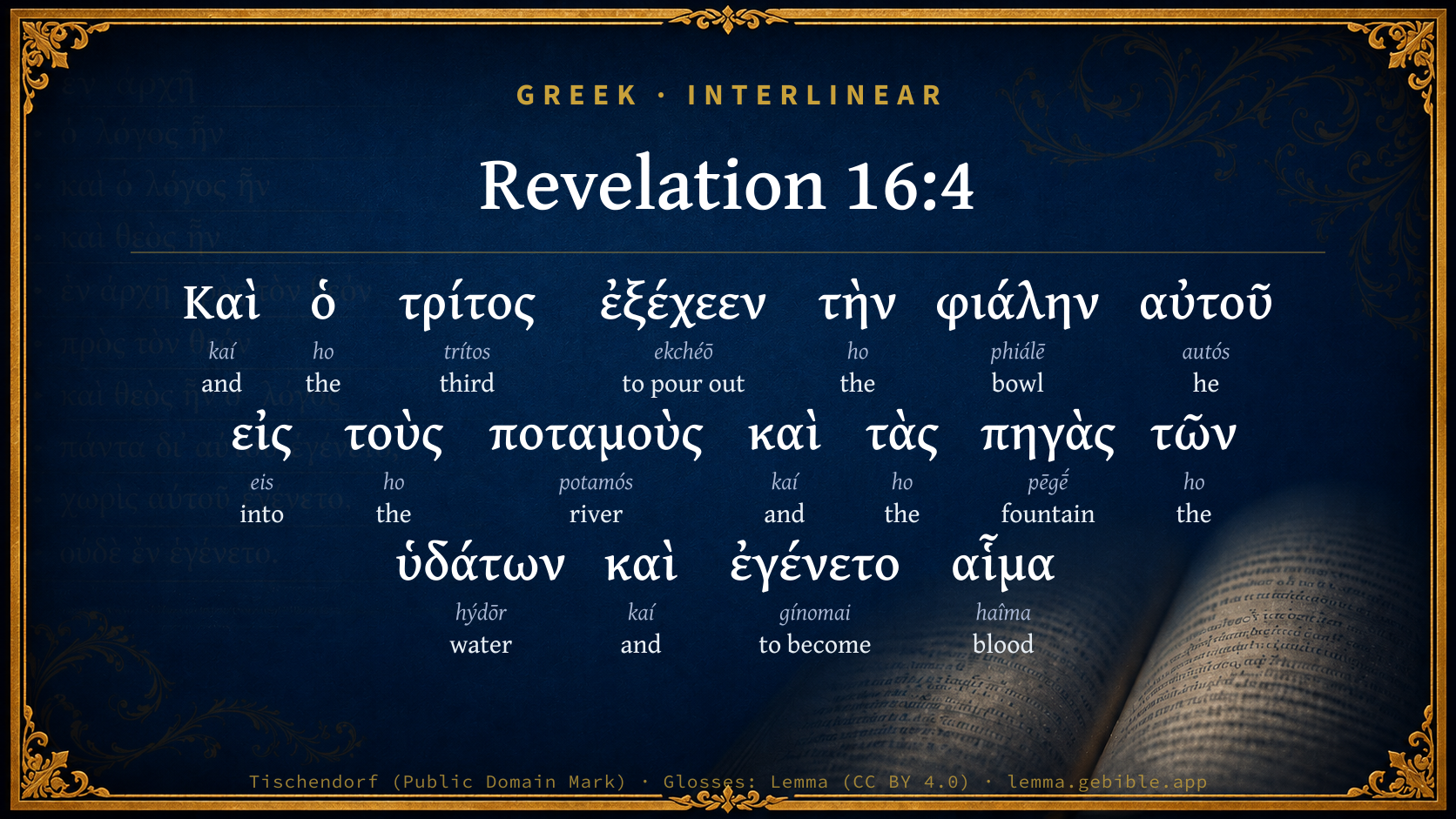
Greek (Tischendorf 8th ed.) Revelation 16:4 appears in the Greek New Testament. The text above is from the Tischendorf 8th edition. Each word links to its Strong’s number and a concise gloss. Click any word for its full Thayer’s Greek Lexicon entry.
Download image
Cite this verse

Revelation 16:4 (World English Bible). Public Domain. Lemma interlinear Bible study tool, https://lemma.gebible.app/v/revelation/16/4.

Show BibTeX & RIS
BibTeX
RIS
English Translation
The third poured out his bowl into the rivers and springs of water, and they became blood.
World English Bible · Public Domain
Download a study sheet

One document with this verse’s original text, its word-by-word gloss line, the meaning frame, cross-references with their text, attributed commentary, and full source and license credits — printable, and it pastes into notes with its structure intact.

This verse Autodidact and up

Study sheet (.html) Plain text (.txt)

A passage Seminary Student

Up to 50 verses in one chapter. A passage sheet keeps up to 6 commentary sources and 12 cross-references per verse, in the order this page ranks them, and says so on the sheet whenever that leaves anything out. Ask for a single verse and you get the Autodidact verse sheet above.

Everything on this page stays free to read, with no account — the sheet is a download of what is already on screen, not access to it.

Want to remove ads? Support Godless Engineer
Compare translations 3

The same verse in 3 English versions, stacked beneath the original-language interlinear above. Click any original word for its lexicon entry.

Each is an independent rendering of the whole verse — the interlinear is not word-aligned to these translations.

Highlighted words mark where these versions differ — a whole-verse word diff, not a word-by-word alignment.

  • World English Bible Public Domain
    The third poured out his bowl into the rivers and springs of water, and they became blood.
  • King James Version Public Domain
    And the third angel poured out his vial upon the rivers and fountains of waters; and they became blood.
  • unfoldingWord Literal Text CC BY-SA 4.0
    And the third poured out his bowl into the rivers and the springs of water, and it became blood.

unfoldingWord Literal Text — © unfoldingWord, licensed CC BY-SA 4.0. Word-aligned USFM3 via Door43 (git.door43.org/unfoldingWord/en_ult).

Versions to compare (up to 4)

3 of 4 selected

Show all 19 translations

Every available English version of this verse, each an independent rendering of the whole verse.

  • World English Bible Public Domain
    The third poured out his bowl into the rivers and springs of water, and they became blood.
  • Berean Standard Bible Public Domain
    And the third angel poured out his bowl into the rivers and springs of water, and they turned to blood.
  • Majority Standard Bible Public Domain
    And the third angel poured out his bowl into the rivers and springs of water, and they turned to blood.
  • King James Version Public Domain
    And the third angel poured out his vial upon the rivers and fountains of waters; and they became blood.
  • American Standard Version (1901) Public Domain
    And the third poured out his bowl into the rivers and the fountains of the waters; and it became blood.
  • Revised Version (1885) Public Domain
    And the third poured out his bowl into the rivers and the fountains of the waters; and it became blood.
  • Geneva Bible (1599) Public Domain
    And the third Angel powred out his viall vpon the riuers and fountaines of waters, and they became blood.
  • Douay-Rheims (1899) Public Domain
    And the third poured out his vial upon the rivers and the fountains of waters; and there was made blood.
  • Young's Literal Translation Public Domain
    And the third messenger did pour out his vial to the rivers, and to the fountains of the waters, and there came blood,
  • Literal Standard Version CC BY-SA 4.0
    And the third messenger poured out his bowl into the rivers, and into the fountains of the waters, and there came blood,
  • Unlocked Literal Bible CC BY-SA 4.0
    The third angel poured out his bowl into the rivers and the springs of water, and they became blood.
  • unfoldingWord Literal Text CC BY-SA 4.0
    And the third poured out his bowl into the rivers and the springs of water, and it became blood.
  • Darby Bible Public Domain
    And the third poured out his bowl on the rivers, and [on] the fountains of waters; and they became blood.
  • World Messianic Bible Public Domain
    The third poured out his bowl into the rivers and springs of water, and they became blood.
  • Webster's Bible Public Domain
    And the third angel poured out his vial upon the rivers and fountains of waters; and they became blood.
  • Free Bible Version CC BY-SA 4.0
    The third poured out his bowl on the rivers and springs of water, and the water turned into blood.
  • Bible in Basic English Public Domain
    And the third let what was in his vessel come out into the rivers and the fountains of water; and they became blood.
  • Text-Critical English NT CC BY 4.0
    The third poured out his bowl into the rivers and the springs of water, and they became blood.
  • Tyndale New Testament (1534) Public Domain
    And the thyrde angell shed out his vyall apon the ryvers and fountaynes of waters and they turned to bloud.

Literal Standard Version (2020), Covenant Press — licensed CC BY-SA 4.0. Text via the HelloAO Bible API (eBible.org). Unlocked Literal Bible (unfoldingWord) — licensed CC BY-SA 4.0. Text via the HelloAO Bible API (eBible.org). unfoldingWord Literal Text — © unfoldingWord, licensed CC BY-SA 4.0. Word-aligned USFM3 via Door43 (git.door43.org/unfoldingWord/en_ult). Free Bible Version, Dr. Jonathan Gallagher — licensed CC BY-SA 4.0. Text via the HelloAO Bible API (eBible.org).

Word by word

More ways to search: Search by grammar → Find every occurrence → Compare this word →

Practice this passage: Drill this verse → Learn its vocabulary →

πηγὰς
pēgḗ
G4077
“fountain”
Noun, Accusative, Plural, Feminine
Part of Speech
Noun
Case
Accusative
Number
Plural
Gender
Feminine
Full Thayer's Definition

Origin: probably from G4078 (through the idea of gushing plumply)

TDNT: 07:52,8

1. fountain, spring 2. a well fed by a spring
  1. Καὶ kaí G2532 “and” Conjunction
  2. ὁ ho G3588 “the” Article, Nominative, Singular, Masculine
  3. τρίτος trítos G5154 “third” Adjective, Nominative, Singular, Masculine
  4. ἐξέχεεν ekchéō G1632 “to pour out” Verb, Aorist, Active, Indicative, 3rd person, Singular
  5. τὴν ho G3588 “the” Article, Accusative, Singular, Feminine
  6. φιάλην phiálē G5357 “bowl” Noun, Accusative, Singular, Feminine
  7. αὐτοῦ autós G846 “he” Personal pronoun, Genitive, Singular, Masculine
  8. εἰς eis G1519 “into” Preposition
  9. τοὺς ho G3588 “the” Article, Accusative, Plural, Masculine
  10. ποταμοὺς potamós G4215 “river” Noun, Accusative, Plural, Masculine
  11. καὶ kaí G2532 “and” Conjunction
  12. τὰς ho G3588 “the” Article, Accusative, Plural, Feminine
  13. τῶν ho G3588 “the” Article, Genitive, Plural, Neuter
  14. ὑδάτων hýdōr G5204 “water” Noun, Genitive, Plural, Neuter
  15. καὶ kaí G2532 “and” Conjunction
  16. ἐγένετο gínomai G1096 “to become” Verb, Aorist, Middle deponent, Indicative, 3rd person, Singular
  17. αἷμα haîma G129 “blood” Noun, Nominative, Singular, Neuter

About this verse

These counts appear in no published source. They are computed here, from the morphology-tagged text and Lemma’s own curated glosses. What Lemma adds →

18
words
12
distinct lemmas
Revelation
section

Notable vocabulary

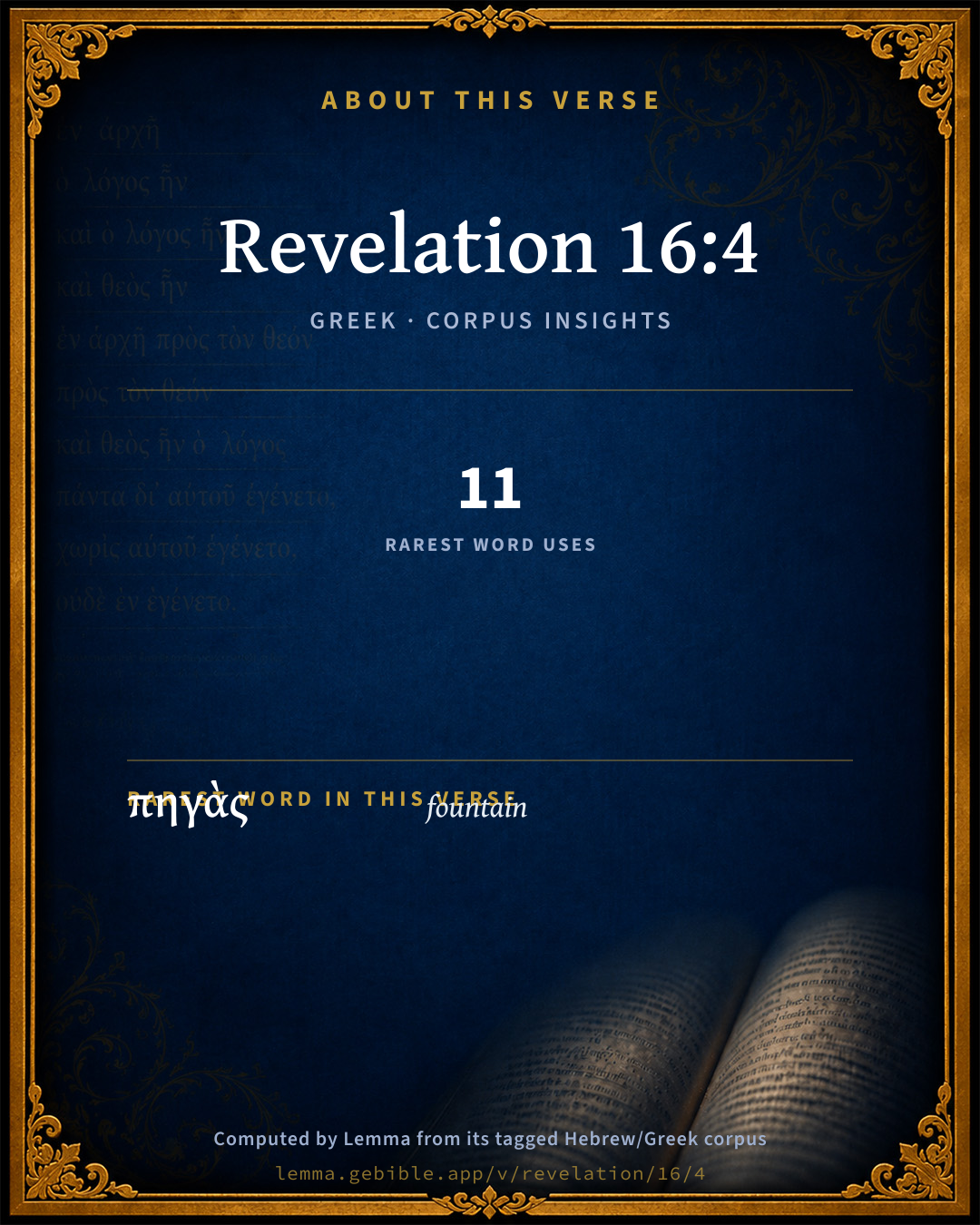
The rarest word here is πηγὰς fountain G4077 — appearing just 11 times in the whole Greek New Testament.

Shared distinctive vocabulary

πηγὰς fountain G4077 occurs in 10 verses of the Greek New Testament. Also found in:

Repetition

Words recur within this verse:

Cross-references

8

Topical passages linked to Revelation 16:4 in the Treasury of Scripture Knowledge — connected by theme and wording, ordered by reader-vote popularity; previews shown in the World English Bible.

  • Exodus 7:17–20 Thus says Yahweh, "In this you shall know that I am Yahweh. Behold, I will strike with the rod that is in my hand on the waters which are in the river, and they shall be turned to blood.
  • Revelation 8:10–11 The third angel sounded, and a great star fell from the sky, burning like a torch, and it fell on one third of the rivers, and on the springs of the waters.
  • Hosea 13:15 Though he is fruitful among his brothers, an east wind will come, The breath of Yahweh coming up from the wilderness; And his spring will become dry, And his fountain will be dried up. He will plunder the storehouse of treasure.
  • Revelation 14:7 He said with a loud voice, "Fear the Lord, and give him glory; for the hour of his judgment has come. Worship him who made the heaven, the earth, the sea, and the springs of waters!"
  • Isaiah 50:2 Why, when I came, was there no man? when I called, was there none to answer? Is my hand shortened at all, that it can't redeem? or have I no power to deliver? Behold, at my rebuke I dry up the sea, I make the rivers a wilderness: their fish stink, because there is no water, and die for thirst.
  • Revelation 16:5 I heard the angel of the waters saying, "You are righteous, who are and who were, you Holy One, because you have judged these things.
  • Exodus 8:5 Yahweh said to Moses, "Tell Aaron, 'Stretch forth your hand with your rod over the rivers, over the streams, and over the pools, and cause frogs to come up on the land of Egypt.'"
  • Ezekiel 35:8 I will fill its mountains with its slain: in your hills and in your valleys and in all your watercourses shall they fall who are slain with the sword.

Cross-references courtesy of OpenBible.info (CC BY 4.0).

Where the printed editions differ

1 variant

Places in this verse where the major printed Greek editions disagree on the wording in a way that affects the translation — a comparison of editions, not a manuscript-by-manuscript collation. The editions are the modern critical texts (Nestlé-Aland 28/27, SBL, Westcott-Hort, Tregelles, Tyndale House) and the traditional texts behind the KJV (the Textus Receptus and the Byzantine/Majority text). It is not a claim about which reading is original.

  1. Extra text
    ἄγγελος

    “angel”

    In TR Not in NA28NA27TynSBLWHTregByz

    ἄγγελος (angelos) 'angel' is only in traditional manuscripts (TR)

Textual data: Translators Amalgamated Greek New Testament (STEPBible TAGNT) · CC BY 4.0.

Commentary

Notes on Revelation 16:4 from classic Christian and Jewish commentators (each source and its license shown beneath its notes). The classic Christian expositions comment on the surrounding passage and are grouped to its opening verse, so a note may address several verses; the Jewish commentaries on the Tanakh (Rashi and others) are per-verse, so they appear only where the commentator wrote on this verse.

Lemma curates 59 commentaries, every one of them public domain or Creative Commons licensed, each selected and text-cleaned for this edition rather than reprinted as found. About our sources →

The Cambridge Bible for Schools and Colleges

gen. ed. J. J. S. Perowne

The Third Vial, Rev_16:4-7

4. the rivers … waters] Rev_8:10; see on Rev_14:7.

The Cambridge Bible for Schools and Colleges (gen. ed. J. J. S. Perowne; Cambridge University Press, 1878–1918) — public domain. Text from a community e-Sword module.

Joseph Benson's Commentary

Rev 16:4-7. And the third angel poured out his vial upon the rivers a fountains of waters, &c. — Or those territories of the Papacy which were as necessary to it as rivers and fountains are to a country: the kind of plague under this vial being the same as that of the former. For, as the former destroyed the living creatures, or living souls, that were in or upon the sea, namely, the Spaniards, the great mariners of the world at that time, as to their maritime power, who after the year 1588 lost their former sovereignty of the seas, it being transferred to the English and Dutch; so this latter plague makes it difficult for the Popish party to subsist and maintain their ground, even in the inland countries, particularly in the several dominions of Germany and the neighbouring countries. For in the year 1617, Ferdinand being forced upon the Bohemians by the Emperor Matthias, and crowned king, the foundation of new quarrels was thus laid. For, a little while after, another most bloody religious war ensued, which shook all the empire, and excited the terror of all Europe. And, though the Protestants lost Bohemia, the Palatinate in part, and were driven out of Moravia, Austria, and Silesia, at this time, and were not only persecuted in many places, but were in danger of being extirpated and rooted out universally; yet the tide turned all on a sudden. For after the emperor had ruled Germany with a veteran army for a considerable time, Gustavus Adolphus entered it in the year 1630, and conquered everywhere. And though he was killed about two years afterward, yet his army continued to be victorious; until at length all things were settled at the peace of Munster, A.D. 1648; with which therefore the period of this vial, consisting of thirty- one years, must be supposed to end. Now, as this began with persecutions against, and cruelties upon the Protestants; so at length the angel of the waters is heard to give thanks to God for causing the enemies of his people at last to drink of their own blood. To which song of praise another angel says, Amen: all which seems to denote the joy of the Protestant states and churches on the success of the Swedish arms against the emperor.

Joseph Benson's Commentary on the Old and New Testaments (1811–1818) — public domain. Text from a community e-Sword module.

Meyer's Critical & Exegetical Commentary

Heinrich August Wilhelm Meyer

Rev_16:4-7. The third vial changes all other streams into blood. The angel of the waters and the heavenly altar praises the righteousness of Gods judgments.

καὶ ἐγένετο αίμα. And it became blood, i.e., blood came forth. It is true, indeed, that, as to the form of the expression, it is not said that the streams became blood; the reading is not ἐγένοντο. But the analogy with Rev_8:11[3682] suggests that the blood entered into the streams into which the vials were poured.[3683]

Since the streams are thus affected by the plague, the angel who presides over the waters is the first to recognize adoringly the righteousness of this Divine manifestation of wrath.

ΤΟῪ ἈΓΓΈΛΟΥ ΤῶΝ ὙΔΆΤΩΝ. Incorrectly, Grotius: Because he emptied the vial into the waters. A definite angel is meant, who is placed over the streams as a special sphere.[3684] There is an analogy not so much in what is presented in Rev_7:1 and Rev_14:18,for what is said there of the angels of wind and fire[3685] is not meant in the same sense,as rather in the idea of the four beings who appear in Rev_4:6 sqq. as representatives of earthly creatures.[3686] Precisely similar[3687] is Daniels representation of angelic princes who belong to particular nations.[3688] Cf. also Schöttgen, Hor. Hebr., on this passage; and Eisenmenger, Entd. Judenth., ii. 377 sq., where a large number of rabbinical expressions concerning earth-, sea-, fire-, and other angels, and their special names, are collected. In Bava Bathra, p. 72, 2,[3689] the prince of the sea is called רתב, after Job_26:12; in another book,[3690] he is called Michael, and seven less important angels stand beneath him.

ὍΣΙΟς. Cf. Rev_15:4. As the solemn formula Ὁ ὪΝ ΚΑῚ Ὁ ἩΝ[3691] does not allow an immediate combination with ὅσιος,[3692] and as before ὅσιος, neither ὁ, nor καὶ, nor καὶ ὁ, dare be read,[3693] and consequently the translation of Hengstenb. (the godly) is false, we can only, in the sense adopted by Luther, who, however, interpolates an and, regard the ὅσιος as placed with δίκαιος by asyndeton, as a predicate belonging to εἰ: Righteous art thou, which art, and which wast, holy [art thou], because thou hast ordained such judgments: ὅτι ταῦτα ἔκρ. The ταῦτα refers to Rev_16:4, not to Rev_16:3; for that which is the subject of treatment (Rev_16:6) is drinking-water that is changed into blood, so that the inhabitants of the earth who have shed the blood of saints and prophets[3694] must drink blood.[3695] The closing words of the angelic discourse, ἌΞΙΟΙ ΕἸΣΙΝ, whose force is not destroyed by the absence of a connective, expressly designate that the enemies have merited this judgment.

Upon the angels ascription of praise, there follows yet, in Rev_16:7, another from the side of the altar, which, responding to the former and confirming it (ΝΑΊ, Κ.Τ.Λ.), makes a further reference in general to the judgments of God, and thus brings the entire ascription of praise from Rev_16:5 to a conclusion.[3696]

ΤΟῦ-G0- ΘΥΣΙΑΣΤΗΡΊΟΥ-G0- ΛΈΓΟΝΤΟς-G0-. An attempt has been made to evade the idea of the text that the words of praise proceed from the altar itself, by the interpolation of ἌΛΛΟΥ (sc. ΑΓΓΈΛΟΥ), ἘΚ before ΘΥΣ.,[3697] or by allegorizing,[3698] or by the supply of a personality.[3699] But De Wette correctly acknowledges[3700] the significant personification of the altar itself. This is in some measure prepared for already by Rev_9:13; but the idea embodied therein is to be recognized from Rev_6:10 sqq., Rev_8:3, Rev_9:13, Rev_14:18. From the same place whence the prayers for vengeance had arisen, and already special manifestations of Gods wrath had proceeded, the righteousness of all the judgments of God, whereby the longing of the saints is fully satisfied, is proclaimed.

[3682] Cf. also Rev_16:3.

[3683] Against De Wette.

[3684] Andr., C. a Lap., Ewald, Züll., De Wette, Hengstenb.

[3685] De Wette.

[3686] Cf. also Rev_8:2, where seven angels of special rank are mentioned.

[3687] Hengstenb. compares Joh_5:4. Although he considers the water in this passage, as also Rev_8:10, as an allegorical designation of prosperity; although, further, the passage Joh_5:4 is spurious, and nothing whatever is said of an angel placed over the water in general, but only of one sent for a particular service to a single pool,yet he would have us find here a delicate and inner bond between the Apoc. and the Gospel.

[3688] Dan_10:13; Dan_10:21; Dan_12:1.

[3689] Schöttg.

[3690] Eisenmenger, p. 379.

[3691] The καὶ ὁ ἐρχόμενος is absent here, as in Rev_11:17, because the coming to judgment is already in process of execution.

[3692] Against De Wette: Thou who art and wast holy.

[3693] See Critical Notes, p. 414.

[3694] Cf. Rev_13:7; Rev_13:10, Rev_6:10, Rev_11:7, Rev_17:6, Rev_19:2.

[3695] πεῖν. On this form, see Winer, p. 84.

[3696] Cf. Rev_5:8, Rev_11:13-14.

[3697] Luther, Züll., etc.

[3698] Beda: The inner affection of saints, angels, or men, who by teaching rule the people. Andr.: The angelic powers as bearers of our prayers.

[3699] Grot.: viz., the angel who guards the spirits of the martyrs. Cf. Rev_6:10. Ewald: A voice proceeding from an inhabitant of heaven standing by the divine altar. Cf. also Züll., Ebrard, etc.

[3700] Cf. also Beng. and Hengstenb., who nevertheless speak indefinitely of an angel of the altar.

Meyer — Critical and Exegetical Commentary on the New Testament — English translation by Peter Christie, edited by Frederick Crombie (T&T Clark, 1880) — public domain. Text from a community e-Sword module.

Expositor's Greek Testament

ed. W. Robertson Nicoll

Rev 16:4-7 . No more drinking water. The justice of this particular plague is acknowledged by (Rev 16:5-6 ) the angel of the element in question and by (7) the altar (personified here, in line of Rev 6:9-10 , and Rev 8:3 , or of Rev 14:18 ), which echoes the angel’s cry.

The Expositor's Greek Testament, edited by W. Robertson Nicoll (1897–1910) — public domain. Text from a community e-Sword module.

Geneva Bible (1599)

Geneva Bible translators

The history of the third Angel striking the rivers, in this verse who proclaiming the justice of God, commendeth the same by a most grave comparison of the sins of men with the punishment of God: which is common to this place and that which went before. Wherefore also this praising is attributed to the Angel of the waters, a name common to the second and third Angels according as both of them are said to be sent against the waters, albeit, the one of the sea the other of the rivers, in two verses.

Geneva Bible (1599) marginal notes — public domain. Text via Bolls.life.

Jamieson, Fausset & Brown

Robert Jamieson, A. R. Fausset & David Brown

(Exo 7:20.)

angel--so Syriac, Coptic, and ANDREAS. But A, B, C, and Vulgate omit it.

Jamieson, Fausset & Brown — Commentary Critical and Explanatory on the Whole Bible (1871) — public domain (CC PDM 1.0). Text via the HelloAO Bible API.

Adam Clarke's Commentary

Verse 4. Upon the rivers and fountains of waters] This is an allusion to the first Egyptian plague, Ex 7:20; and to those plagues in general there are allusions throughout this chapter. It is a sentiment of the rabbins that "whatever plagues God inflicted on the Egyptians in former times, he will inflict on the enemies of his people in all later times." See a long quotation on this subject from Rabbi Tanchum in Schoettgen.

Adam Clarke's Commentary on the Bible (1810–1826) — public domain. Text from a community e-Sword/MySword module.

Ellicott's Commentary for English Readers

(4) And the third angel . . .—The third vial resembles the second in its effects. As it is poured out on the rivers and springs of waters, they become blood. It is not only the great sea which becomes blood, but all the merry streams and babbling brooks which carry their tribute of water seawards also turn corrupt. And this plague is acknowledged by heavenly voices as a just retribution (Rev_16:5-7). The streams and rivers feed the sea; they are the powers and influences which go to the making up of the great popular sentiment; these are smitten by the same corruption. Men cannot worship worldliness or earthliness without degrading even those who contribute to their instruction, their recreations, and their joys, to the same level. When the public taste grows corrupt, the literature will, for example, become so in a more or less degree; the up-flowing tide will colour the down-coming stream. “The morality of a nation’s art,” writes a modern critic. “always rises to the level of morality in a nation’s manners. Morality takes care of itself, and always revenges any outrage which art may put upon its laws by either lowering the art that so offends, or extinguishing it” (Dallas, Gay Science, Vol. II., 16). It is true in even a wider sense. The loftier powers of imagination, the range of poetical elevation, are cramped and killed in a base, world-worshipping age. The streams of life grow putrid, the fresh and bright gifts of God are polluted, when the ocean of public thought is unwholesome.

A Bible Commentary for English Readers, edited by Charles John Ellicott (1878–1897) — public domain. Text from a community e-Sword module.

John Gill's Exposition

And the third angel poured his vial upon the rivers and fountains of waters,.... Which also is not to be literally understood of a stagnation of them, before the burning of the world; nor of the destruction of Popish fleets and navies, such as the Spanish armada in 1588, and others since; but rather of Popish writings, of the most learned and subtle men among them, who like rivers and fountains, which supply and fill the sea, support and keep up the Romish jurisdiction and hierarchy; and of the confutation of them by Protestant writers; and of the utter destruction of their principal orders, and chief men among them, as cardinals, archbishops, bishops, priests, Jesuits, &c. though it seems chiefly to design the places near to Rome, such as Italy and Savoy; for as the third trumpet affects the rivers and fountains, Rev 8:10 and brings in the Huns into Italy, and issued in the destruction of the empire; so the third vial affects the same, and brings terrible wars, and great effusion of blood, where so much of the blood of the saints have been shed: hence it follows, and they became blood; these countries will be covered with blood, and a reformation will ensue upon it; the allusion is to Exo 7:19.

.

Revelation 16:5

rev 16:5

rev 16:5

rev 16:5And I heard the angel of the waters say,.... So we read in Jewish writings (t) of an angel that was , "the prince of the sea", and of angels that were over the waters, and others over fire (u); though here is designed not one of the "angels of the water", that presided ove the waters, as another over fire; See Gill on Rev 14:18, but the third angel that poured out his vial upon the waters; when he had so done, he said as follows. Dr. Lightfoot thinks, and that not without reason, that since these angels appeared in the garb of priests, Rev 15:6 and since there was a priest appointed to take care of the wells, and fountains, and ditches about Jerusalem, that the people might have water at the feasts (w), there is an allusion to him; and certain it is that there was such an officer; there was one Nechoniah, who was over the fountains and ditches (x); and in the same office was Nicodemon ben Gorion (y), thought to be the Nicodemus mentioned in the New Testament.

Thou art righteous, O Lord, which art, and wast, and shall be: which may be understood either of God the Father, who had power over these plagues, Rev 16:9 and sent them; or of the Lord Jesus Christ, who is Lord of all, and is righteous in all his ways and works, in all his judgments on antichrist, and is the eternal "I AM", which is, and was, and shall be; see Rev 1:8. The Alexandrian copy, and most others, and the Vulgate Latin and Syriac versions, read "holy", instead of "shalt be"; for the purity and holiness of Christ will be seen in the judgments which he will exercise, as follows:

because thou hast judged thus; or "these things"; or "them", as the Ethiopic version reads; that is, has brought these judgments upon the men signified by rivers and fountains, and made great havoc and slaughter of them, expressed by their becoming blood; the justice of which appears from the following reason.

(t) T. Bab. Gittin, fol. 68. 3. (u) Yalkut Simeoni, par. 2. fol. 58. 4. par. 2. fol. 167. 4. (w) Maimon, Cele Hamikdash, c. 7. sect. 15. (x) Misn. Shekalim, c. 5. sect. 1. (y) Abot R. Nathan, c. 5. fol. 3. 2.

John Gill's Exposition of the Whole Bible (1746–1763) — public domain (CC PDM 1.0). Text via the HelloAO Bible API.

Trapp's Complete Commentary

John Trapp

4 And the third angel poured out his vial upon the rivers and fountains of waters; and they became blood.

Ver. 4. Upon the rivers, &c.] The persecutors and impostors, the Jesuits especially, who have lately added twelve new articles (by the authority of Pope Pius IV) raised out of the Council of Trent, and added to the Nicene Creed, to be received with others as the true catholic faith, to be believed by as many as shall be saved. And those that receive them not, are not suffered to live among them. This is worse than the six articles in Henry VIII’s time, that whip with six cords, as they called it. See these twelve articles in the Epist. prefixed to Bishop Jewel’s works.

John Trapp, A Commentary or Exposition upon All the Books of the Old and New Testament (1647–1656) — public domain. Text from a community e-Sword module.

Albert Barnes' Notes on the Bible

And the third angel poured out his vial upon the rivers and fountains of waters - This coincides also with the account of the sounding of the third trumpet Rev 8:10-11; “And the third angel sounded, and there fell a great star from heaven, burning as a lamp, and it fell upon the third part of the rivers, and upon the fountains of waters.” As to the meaning of the phrase, “rivers and fountains of waters,” see the notes on that passage. We found, it was supposed, in the application of that passage, that the invasion of the Roman empire by Attila, king of the Huns, was referred to, affecting mainly those parts of the empire where the rivers and streams had their origin. The analogy would lead us, in the fulfillment of the passage before us, to look for some similar desolations on those portions of Europe. See the notes at the close of Rev 16:7.

And they became blood - This would properly mean that they became as blood; or became red with blood; and it would be fulfilled if bloody battles were fought near them, so that they seemed to run blood.

Albert Barnes' Notes on the Bible (1834–1885) — public domain. Text from a community e-Sword/MySword module.

Haydock's Catholic Bible Commentary

Upon the rivers. That is, on the Roman provinces in Italy, and Rome itself. This is the last stroke employed by the Almighty for the total destruction of Rome. The divine judgment being executed, the Angel of the waters, that is, the Angel that presided over the Roman states, cries out, (ver. 5. 6.) thou art just, &c. (Pastorini)

George Leo Haydock (1774–1849), Haydock's Catholic Family Bible and Commentary, 1859 edition — public domain. Excludes Psalms (Douay-Rheims chapter numbering differs from Protestant) and Deuterocanonical books (Catholic canon only).

Matthew Poole's English Annotations

Mr. Mede and Dr. More both agree in interpreting this of the Jesuits and other popish emissaries, and the laws made for the execution of them in England in the time of Queen Elizabeth, not excluding those civil powers which are the upholders and maintainers of antichrist, as the Spaniard, who also within these last hundred years hath had blood enough given him to drink, both in 1588, and in the Low Countries. It seemeth a little hard to interpret a prophecy relating to the whole church, by what is done in so small a part of it. We know in what credit these emissaries are at this day, both in the empire, and in Spain, and in France, and Venice, from whence they sometime were expelled. We have, indeed, laws against them in England, but principally relating to those of them who, being native subjects of England, have apostatized. So as I had rather think this vial is not yet poured out, or that interpreters mistake the meaning of these

rivers and fountains, than agree with them in that interpretation of this prophecy. I am much disposed to believe that we are not further than the pouring out of the second vial. God, indeed, hath made the Romish clergy contemptible enough, and hath vexed and enraged them sufficiently. He hath also made their scenical religion as contemptible to, and justly abhorred by, a great part of the Christian world; but how far he hath proceeded further to the ruin of antichrist, I do not understand.

Matthew Poole's English Annotations on the Holy Bible (1683–1685) — public domain. Text from a community e-Sword/MySword module.

Whedon's Commentary on the Bible

Daniel D. Whedon

4. Rivers and fountains—Like the first plague of Egypt which ensanguined “the waters of Egypt,” “their streams,” and “their rivers, and their ponds.” Exo_7:19. This blood was a vivid image of the slaughter of the martyrs.

Daniel D. Whedon (gen. ed.), Commentary on the Old and New Testaments (1874–1909) — public domain. Text from a community e-Sword module.

The Pulpit Commentary

And the third angel poured out his vial upon the rivers and fountains of waters; and they became blood. Omit "angel" (see on ver. 3). "Into the rivers," etc., as in the previous cases. The singular egeneto , probably on account of the neuter qdata being understood. The idea of the second vial is carried on here (cf. on ver. 3). Note the corresponding judgment of the third trumpet. In addition to the interpretation of the second vial given above, it is probable that the blood signifies the slaughter and death which is part of God"s vengeance on the wicked (cf. ver. 6). The divisions adopted in the first four vials correspond to those in Revelation 14, which designate the whole of God"s created world, "heaven, and earth, and the sea, and the fountains of waters."

The Pulpit Commentary (1880–1919), ed. H.D.M. Spence-Jones & Joseph S. Exell — public domain. Text from a community e-Sword module.

John Wesley's Explanatory Notes

The third poured out his phial on the rivers and fountains of water - Which were over all the earth. And they became blood - So that none could drink thereof.

John Wesley, Explanatory Notes Upon the Whole Bible (1754–1765) — public domain. Text via the GEBible commentary corpus.

Scofield Reference Notes

C. I. Scofield

angel

(See Scofield Heb 1:4).

The Scofield Reference Bible (1917 edition), notes by C. I. Scofield — public domain. Text from a community e-Sword module.

The People's New Testament

B. W. Johnson

4–7. And the third poured out his vial upon the rivers and the fountains of the waters. John sees the third “vial poured upon the rivers and fountain of waters; and they become blood.” This vial will symbolize another event calamitous to Rome. The seat of the disasters is described as the rivers, and we may expect some historical events, connected in some way with rivers, that result in the injury of the Papacy. There are two marks given which help us to locate the seat where the plague of the third vial is poured. 1. It must be a region of rivers and fountains of waters. 2. It has evidently been the scene of terrible persecutions of the people of God. When the judgment is inflicted the angel of the waters exclaimed, “Thou art righteous, O Lord, who art and wast and shall be, because thou hast judged thus. For they have shed the blood of saints and prophets and thou hast given them blood to drink, for they are worthy.” A land of persecution is to become the scene of calamities which are justly visited upon it for its sins. (1) The river system of northern Italy, we have seen, was indicated under the third trumpet. If the reader will look upon the map he will find it crowded with rivers. The streams rush down from the Alps and haste away to the sea. The river region of Italy has always been a battle ground where the fate of Italy has been decided. Here Attila the Hun, the “blazing Star,” the wormwood of the rivers, laid Rome prostrate at his feet. See 8:10, 11. This vial seems to point to the same locality by the use of the same language. (2) But the locality marked must have been the scene of persecutions (verse 6); none more terrible, more bloody or more continued, have been known in the dark history of Rome. This very region was the home of the Albigenses. Against them the Papacy had hurled its fanatical legions from generation to generation. The blood of the Protestants of the Alps had for centuries dyed the rocks and streams with crimson. (3) In the year 1796, a general, aged 27, led a French army across the Alps. On the river system of Italy, on the Rhone, the Po and its tributaries, he battled with the Austrians and their allies. It is remarkable that every one of his great conflicts were fought upon the rivers. The battle of Lodi was fought on the Adda, Arcola on the Adige, Marengo on the Bromida. I will briefly give the results of the struggle. In 1796 Bonaparte entered Italy. The next year his armies took the city of Rome and proclaimed an Italian Republic. Previously an armistice had been granted, for which the Pope paid 21,000,000 francs and gave up a hundred masterpieces of art to be carried to Paris. In 1798 Pope Pius VI. was carried as a prisoner into France to die. His successor was not elected in Rome, which was still in the hands of the spoiler, but in Venice. Other results that follow from this invasion will be given under the fourth vial. Ah! how triumphantly the long persecuted Waldenses, as they saw the Pope carried a prisoner into exile, must have joined in the voice from behind the altar: “Yes, O Lord God Almighty, true and righteous are thy judgments!”

B. W. Johnson's The People's New Testament with Notes (1889–1891) — public domain. Electronic text from the Christian Classics Ethereal Library (CCEL) ThML edition.

unfoldingWord translationNotes

Door43 World Missions Community

poured out his bowl

The word "bowl" refers to what is in it. See how you translated this in Revelation 16:2. AT: "poured out the wine from his bowl" or "poured out God's wrath from his bowl" (See: Metonymy)

rivers and the springs of water

This refers to all bodies of fresh water. (See: Synecdoche)

the angel of the waters

Possible meanings are 1) this refers to the third angel who was in charge of pouring out God's wrath on the rivers and springs of water or 2) this was another angel who was in charge of all the waters.

You are righteous

"You" refers to God. (See: Forms of You)

the one who is and who was

"God who is and who was." See how you translated a similar phrase in Revelation 1:4.

they poured out the blood of the saints and prophets

Here "poured out the blood" means killed. AT: "they murdered God's holy people and the prophets" (See: Metonymy)

you have given them blood to drink

God will make the evil people drink the waters that he turned to blood.

I heard the altar reply

The word "altar" here refers perhaps to someone at the altar. "I heard someone at the altar reply" (See: Metonymy)

translationWords

angel

fountain

water

blood

righteous

Holy One

judge

saint

prophet

altar

lord

Almighty

true

unfoldingWord translationNotes — © Distant Shores Media and the Door43 World Missions Community, licensed CC BY-SA 4.0. Source: git.door43.org/Door43/en_tn.

Cambridge Greek Testament for Schools and Colleges

4–7. THE THIRD VIAL

4. εἰς τοὺς ποταμοὺς καὶ τὰς πηγὰς τῶν ὑδάτων, Rev 8:10, see on Rev 14:7.

Cambridge Greek Testament for Schools and Colleges (Cambridge University Press, 1896; 21 vols, various authors incl. Carr, Maclear, Plummer, Farrar, Lumby, Moule, M. R. James, Simcox) — public domain. Text from a community e-Sword module.

Alford’s Greek Testament

Henry Alford

4-7.] And the third poured out his vial into the rivers and the fountains of the waters: and they became (it is quite impossible, in the lax construction of the Apocalyptic Greek, to maintain here a distinction, as Düsterd. has done, from the previous ἐγένετο, and to render here, “there came blood.” Analogy must be our guide: and the account to be given of the singular is either that it belongs to τὰ ὕδατα, or that the rivers and fountains are taken together, and regarded as neuter in sense though not in construction) blood (that the fact was so, is testified by what follows, in which it is assumed that the sources of ordinary drink have become blood). And I heard the angel of the waters (i. e. the angel who was set over the waters; see reff.: not as Grot., “vocatur angelus aquarum quia in aquas immisit phialam.” Schöttgen, h. l., p. 1131 f., gives examples of angels of the earth and of the sea: see also Wolf, h. l. This is more probable than Düsterd.’s idea that the analogy to be followed is that of the four living-beings, and that the angel symbolized the waters) saying, Thou art righteous who art and wast (as in ch. 11:17, the καὶ ὁ ἐρχόμενος is omitted. For the construction, see reff.) holy (I incline against Düsterd., to the usual connexion, viz. the making ὅσιος belong to ὁ ὢν κ. ὁ ἦν, and not in apposition with δικαιος. And that which moves me to it is, 1) the extreme improbability of two epithets, δίκαιος and ὅσιος, both being predicated in such an acknowledgment of an act of justice: and 2) that as I have taken it, it best agrees with the ὅσιος in ch. 15:4, where it is predicated of God not as the result of any manifested acts of His, but as an essential attribute confined to Him alone), because Thou didst judge thus (lit., “these things:” viz. the issue mentioned in ver. 4; the turning the drinking-water into blood: “Thou didst inflict this judgment”): because (this ὅτι repeats the former ὅτι, καί (following being “and:” not, as it might be taken, “because they, &c., Thou hast also”) they shed the blood of saints and prophets, and Thou hast given them blood to drink (on the form of the inf., πεῖν, see Winer, edn. 6, § 15, and Anthol. xi. 140. 3, οἷς οὐ σκῶμμα λέγειν, οὐ πεῖν φίλον): they are worthy (these words are made stronger by their asyndetous character). And I heard the altar saying (certainly the simplest understanding of these words is, that they involve a personification of the altar. On the altar are the prayers of the saints, offered before God: beneath the altar are the souls of the martyrs crying for vengeance: when therefore the altar speaks, it is the concentrated testimony of these which speaks by it), Even so, Lord God Almighty: true (reff.) and just are Thy judgments.

8,

Henry Alford, The Greek Testament (1849–1861) — public domain. Text from a community e-Sword module.

Vincent's Word Studies in the New Testament

Marvin R. Vincent

The third angel. Omit angel.

They became [εγενετο] . There is no necessity for rendering the singular verb in the plural. We may say either it became or there came.

Marvin R. Vincent, Word Studies in the New Testament (1887–1900) — public domain. Text from a community e-Sword/MySword module.

Lesson kit

Teaching starters — assembled from the data on this page, not authored interpretation. Every prompt links to the verse data it draws on. Edit before teaching.

Revelation, in the Revelation, opens this verse with 18 words (12 distinct Greek lemmas). Its most distinctive word is pēgḗ (“fountain”). A historical commentator’s framing appears above. Read the whole chapter for the surrounding context.

Discussion questions

  1. The word pēgḗ carries the sense “fountain.” How does it shape the verse?
  2. Mark 5:29 shares the word «fountain» with this verse. How do the two illuminate each other?
  3. “the” occurs 5× in this one verse. What is the effect of the repetition?
  4. These translations render this verse differently. What is at stake in choosing one wording over another?
  5. Reading how The Cambridge Bible for Schools and Colleges and Joseph Benson's Commentary read this verse, where do the two commentators agree and where do they part?

Things to notice

Reading settings

Reading text

Shown beneath each verse's original-language words.

Old Testament
Old Testament edition

Read the OT as the Masoretic Hebrew (MT) or the Greek Septuagint (LXX).

English shown for the Greek Septuagint (in the Hebrew ↔ Greek comparison).

Comparing translations? Open the Compare panel on any verse page to stack up to four side by side.