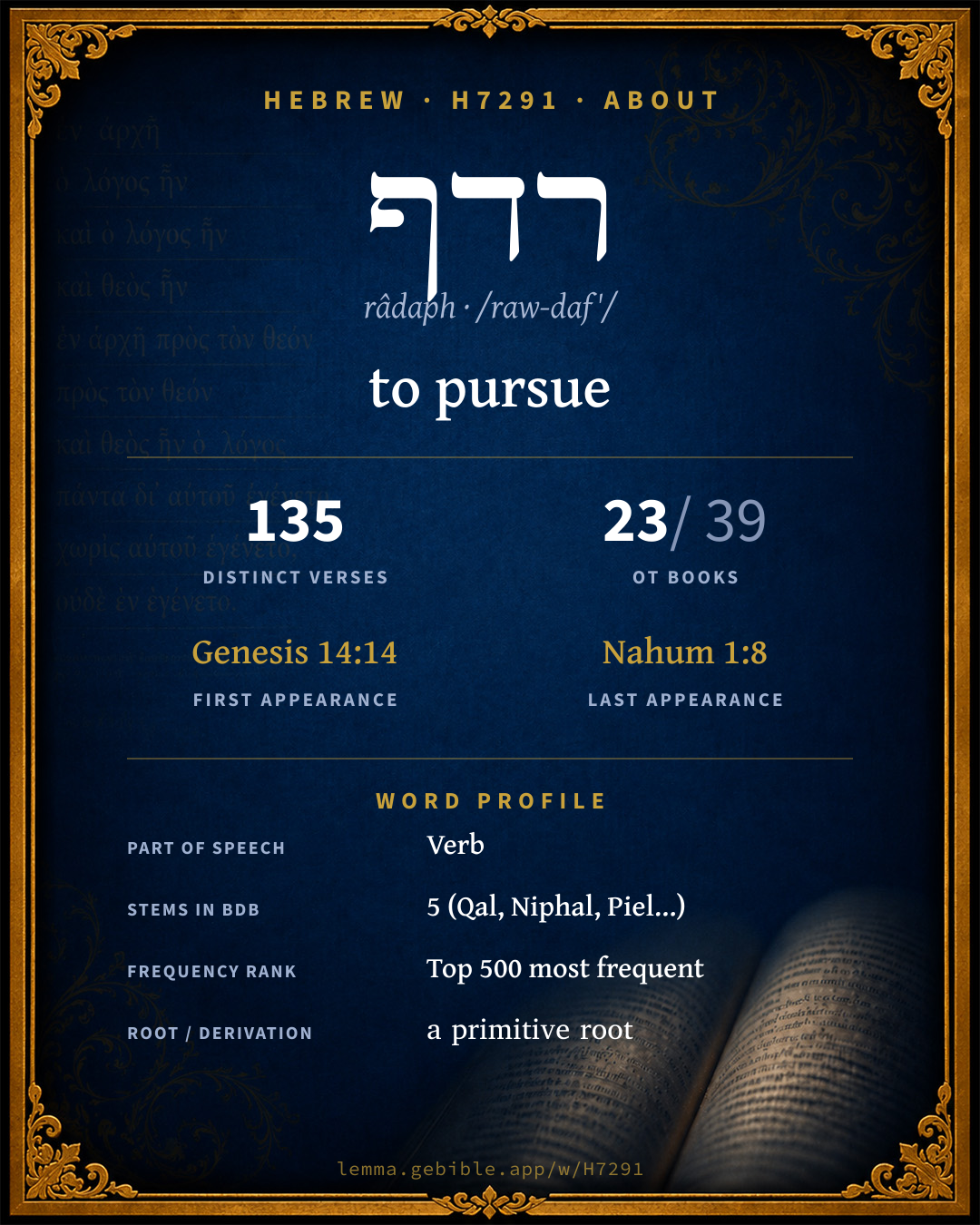
רָדַף
to pursue
‘to pursue’ is one of 4 main senses fuller range ↓
Full lexicon entry — Brown-Driver-Briggs (BDB)
From Brown-Driver-Briggs (BDB)
Where this word appears
See every Qal verb in the Hebrew Bible →
Grammar key — what these labels mean
Part of speech
- Verb
- An action or state-of-being word.
Stem
- Qal
- The basic, simple active stem — the plain form of the verb (“he wrote”). Here: ‘pursue’
- Piel
- An intensive or resultative active stem.
- Pual
- The passive counterpart of the Piel.
- Niphal
- Usually the simple passive or reflexive of the Qal (“he was written”). Here: ‘pass.’
- Hiphil
- The causative active stem (“he caused / brought about”).
Form
- Sequential Imperfect
- An imperfect with prefixed waw — the standard past-narrative form (waw-consecutive imperfect).
- Participle Active
- A verbal adjective expressing ongoing or characteristic action (“writing / one who writes”).
- Imperfect
- An incomplete, ongoing, or future action (“he will / would write”).
- Infinitive Construct
- A bound verbal noun, frequently with prepositions (“to write / in writing”).
- Imperative
- A direct command (“write!”).
- Perfect
- A completed action or state — Hebrew marks aspect (completeness) more than strict tense (“he wrote”).
- Sequential Perfect
- A perfect with prefixed waw continuing a preceding imperfect or command (waw-consecutive perfect).
- Cohortative
- A first-person volitional form expressing wish or resolve (“let me / let us write”).
- Participle Passive
- A verbal adjective expressing action received (“written”).
State
- Absolute
- The independent form of a noun, not bound to a following word.
- Construct
- A noun bound to a following noun in a possessive / “of” relationship (the construct chain).
Person
- 3rd Person
- The one spoken about (“he / she / it / they”).
- 2nd Person
- The one addressed (“you”).
- 1st Person
- The speaker (“I / we”).
Gender
- Masculine
- Grammatically masculine.
- Common
- Either gender — not distinguished for this form.
- Feminine
- Grammatically feminine.
Number
- Plural
- More than one (in Hebrew, generally three or more).
- Singular
- One.
Grammatical forms 33 distinct
- Verb, Qal, Sequential Imperfect, 3rd Person, Masculine, Plural 17 times (12%)
- Verb, Qal, Sequential Imperfect, 3rd Person, Masculine, Singular 16 times (11%)
- Verb, Qal, Participle Active, Masculine, Plural, Construct 15 times (10%)
- Verb, Qal, Participle Active, Masculine, Singular, Absolute 13 times (9%)
- Verb, Qal, Imperfect, 3rd Person, Masculine, Singular 10 times (7%)
- Verb, Qal, Infinitive Construct 10 times (7%)
- Verb, Qal, Perfect, 3rd Person, Common, Plural 7 times (5%)
- Verb, Qal, Participle Active, Masculine, Plural, Absolute 6 times (4%)
+25 more forms (50 occurrences)
Parsed forms decoded from the imported morphology (morphhb / Westminster Leningrad Codex — WLC text public domain, morphhb tagging CC BY 4.0), counted across 144 parsed occurrences — not distinct verses.
Every verse where H7291 appears — 135 distinct verses across 23 books. Click any verse to open its interlinear word-by-word view. Verse text shown in the World English Bible for context — . Each verse’s Hebrew form is shown with its reference; the English is not keyword-highlighted, since the data carries no word-level English alignment. Use “Compare translations” on any verse to read it across multiple English versions. This concordance covers the Hebrew Bible; Septuagint (Greek Old Testament) occurrences are not indexed here.
Genesis 5 verses
- Genesis 14:14 וַ/יִּרְדֹּ֖ף conj + Qal wimpf 3ms When Abram heard that his relative was taken captive, he led forth his trained men, born in his house, three hundred and eighteen, and pursued as far as Dan.
- Genesis 14:15 וַֽ/יִּרְדְּפֵ/ם֙ conj + Qal wimpf 3ms + sfx pers 3mp He divided himself against them by night, he and his servants, and struck them, and pursued them to Hobah, which is on the left hand of Damascus.
- Genesis 31:23 וַ/יִּרְדֹּ֣ף conj + Qal wimpf 3ms He took his relatives with him, and pursued after him seven days' journey. He overtook him in the mountain of Gilead.
- Genesis 35:5 רָֽדְפ֔וּ Qal pf 3cp They traveled: and a terror of God was on the cities that were round about them, and they didn't pursue the sons of Jacob.
- Genesis 44:4 רְדֹ֖ף Qal impv 2ms When they had gone out of the city, and were not yet far off, Joseph said to his steward, "Up, follow after the men. When you overtake them, ask them, 'Why have you rewarded evil for good?
Exodus 5 verses
- Exodus 14:4 וְ/רָדַ֣ף conj + Qal wpf 3ms I will harden Pharaoh's heart, and he will follow after them; and I will get honor over Pharaoh, and over all his host; and the Egyptians shall know that I am Yahweh." They did so.
- Exodus 14:8 וַ/יִּרְדֹּ֕ף conj + Qal wimpf 3ms Yahweh hardened the heart of Pharaoh king of Egypt, and he pursued after the children of Israel; for the children of Israel went out with a high hand.
- Exodus 14:9 וַ/יִּרְדְּפ֨וּ conj + Qal wimpf 3mp The Egyptians pursued after them: all the horses and chariots of Pharaoh, his horsemen, and his army; and overtook them encamping by the sea, beside Pihahiroth, before Baal Zephon.
- Exodus 14:23 וַ/יִּרְדְּפ֤וּ conj + Qal wimpf 3mp The Egyptians pursued, and went in after them into the midst of the sea: all of Pharaoh's horses, his chariots, and his horsemen.
- Exodus 15:9 אֶרְדֹּ֥ף Qal impf 1cs The enemy said, 'I will pursue, I will overtake, I will divide the spoil. My desire shall be satisfied on them. I will draw my sword, my hand shall destroy them.'
Leviticus 5 verses
- Leviticus 26:7 וּ/רְדַפְתֶּ֖ם conj + Qal wpf 2mp You shall chase your enemies, and they shall fall before you by the sword.
- Leviticus 26:8 וְ/רָדְפ֨וּ יִרְדֹּ֑פוּ conj + Qal wpf 3cp Qal impf 3mp Five of you shall chase a hundred, and a hundred of you shall chase ten thousand; and your enemies shall fall before you by the sword.
- Leviticus 26:17 רֹדֵ֥ף Qal ptcp.act ms I will set my face against you, and you will be struck before your enemies. Those who hate you will rule over you; and you will flee when no one pursues you.
- Leviticus 26:36 וְ/רָדַ֣ף רֹדֵֽף conj + Qal wpf 3ms Qal ptcp.act ms "'As for those of you who are left, I will send a faintness into their hearts in the lands of their enemies: and the sound of a driven leaf will put them to flight; and they shall flee, as one flees from the sword; and they will fall when no one pursues.
- Leviticus 26:37 וְ/רֹדֵ֣ף conj + Qal ptcp.act ms They will stumble over one another, as it were before the sword, when no one pursues: and you will have no power to stand before your enemies.
Deuteronomy 8 verses
- Deuteronomy 1:44 וַ/יִּרְדְּפ֣וּ conj + Qal wimpf 3mp The Amorites, who lived in that hill-country, came out against you, and chased you, as bees do, and beat you down in Seir, even to Hormah.
- Deuteronomy 11:4 בְּ/רָדְפָ֖/ם prep + Qal inf.cs + sfx pers 3mp and what he did to the army of Egypt, to their horses, and to their chariots; how he made the water of the Red Sea to overflow them as they pursued after you, and how Yahweh has destroyed them to this day;
- Deuteronomy 16:20 תִּרְדֹּ֑ף Qal impf 2ms That which is altogether just shall you follow, that you may live, and inherit the land which Yahweh your God gives you.
- Deuteronomy 19:6 יִרְדֹּף֩ Qal impf 3ms lest the avenger of blood pursue the manslayer, while his heart is hot, and overtake him, because the way is long, and strike him mortally; whereas he was not worthy of death, inasmuch as he didn't hate him in time past.
- Deuteronomy 28:22 וּ/רְדָפ֖וּ/ךָ conj + Qal wpf 3cp + sfx pers 2ms Yahweh will strike you with consumption, and with fever, and with inflammation, and with fiery heat, and with the sword, and with blasting, and with mildew; and they shall pursue you until you perish.
- Deuteronomy 28:45 וּ/רְדָפ֨וּ/ךָ֙ conj + Qal wpf 3cp + sfx pers 2ms All these curses shall come on you, and shall pursue you, and overtake you, until you are destroyed; because you didn't listen to the voice of Yahweh your God, to keep his commandments and his statutes which he commanded you:
- Deuteronomy 30:7 רְדָפֽוּ/ךָ Qal pf 3cp + sfx pers 2ms Yahweh your God will put all these curses on your enemies, and on those who hate you, who persecuted you.
- Deuteronomy 32:30 יִרְדֹּ֤ף Qal impf 3ms How should one chase a thousand, Two put ten thousand to flight, Except their Rock had sold them, Yahweh had delivered them up?
Joshua 15 verses
- Joshua 2:5 רִדְפ֥וּ Qal impv 2mp and it happened about the time of the shutting of the gate, when it was dark, that the men went out; where the men went I don't know: pursue after them quickly; for you will overtake them.
- Joshua 2:7 רָדְפ֤וּ הָ/רֹדְפִ֖ים Qal pf 3cp ptcl def.art + Qal ptcp.act mp The men pursued after them the way to the Jordan to the fords: and as soon as those who pursued after them were gone out, they shut the gate.
- Joshua 2:16 הָ/רֹדְפִ֑ים הָ/רֹֽדְפִ֔ים ptcl def.art + Qal ptcp.act mp ptcl def.art + Qal ptcp.act mp She said to them, Get you to the mountain, lest the pursuers light on you; and hide yourselves there three days, until the pursuers be returned: and afterward may you go your way.
- Joshua 2:22 הָ/רֹדְפִ֑ים הָ/רֹדְפִ֛ים ptcl def.art + Qal ptcp.act mp ptcl def.art + Qal ptcp.act mp They went, and came to the mountain, and abode there three days, until the pursuers were returned: and the pursuers sought them throughout all the way, but didn't find them.
- Joshua 7:5 וַֽ/יִּרְדְּפ֞וּ/ם conj + Qal wimpf 3mp + sfx pers 3mp The men of Ai struck of them about thirty-six men; and they chased them [from] before the gate even to Shebarim, and struck them at the descent; and the hearts of the people melted, and became as water.
- Joshua 8:16 לִ/רְדֹּ֖ף וַֽ/יִּרְדְּפוּ֙ prep + Qal inf.cs conj + Qal wimpf 3mp All the people who were in the city were called together to pursue after them: and they pursued after Joshua, and were drawn away from the city.
- Joshua 8:17 וַֽ/יִּרְדְּפ֖וּ conj + Qal wimpf 3mp There was not a man left in Ai or Beth El, who didn't go out after Israel: and they left the city open, and pursued after Israel.
- Joshua 8:20 הָ/רוֹדֵֽף ptcl def.art + Qal ptcp.act ms When the men of Ai looked behind them, they saw, and, behold, the smoke of the city ascended up to heaven, and they had no power to flee this way or that way: and the people who fled to the wilderness turned back on the pursuers.
- Joshua 8:24 רְדָפ֣וּ/ם Qal pf 3cp + sfx pers 3mp It happened, when Israel had made an end of killing all the inhabitants of Ai in the field, in the wilderness in which they pursued them, and they were all fallen by the edge of the sword, until they were consumed, that all Israel returned to Ai, and struck it with the edge of the sword.
- Joshua 10:10 וַֽ/יִּרְדְּפֵ֗/ם conj + Qal wimpf 3ms + sfx pers 3mp Yahweh confused them before Israel, and he killed them with a great slaughter at Gibeon, and chased them by the way of the ascent of Beth Horon, and struck them to Azekah, and to Makkedah.
- Joshua 10:19 רִדְפוּ֙ Qal impv 2mp but don't stay; pursue after your enemies, and strike the hindmost of them; don't allow them to enter into their cities: for Yahweh your God has delivered them into your hand.
- Joshua 11:8 וַֽ/יִּרְדְּפ֞וּ/ם conj + Qal wimpf 3mp + sfx pers 3mp Yahweh delivered them into the hand of Israel, and they struck them, and chased them to great Sidon, and to Misrephoth Maim, and to the valley of Mizpeh eastward; and they struck them, until they left them none remaining.
- Joshua 20:5 יִרְדֹּ֜ף Qal impf 3ms If the avenger of blood pursue after him, then they shall not deliver up the manslayer into his hand; because he struck his neighbor unawares, and didn't hate him before.
- Joshua 23:10 יִרְדָּף Qal impf 3ms One man of you shall chase a thousand; for Yahweh your God, he it is who fights for you, as he spoke to you.
- Joshua 24:6 וַ/יִּרְדְּפ֨וּ conj + Qal wimpf 3mp I brought your fathers out of Egypt: and you came to the sea; and the Egyptians pursued after your fathers with chariots and with horsemen to the Red Sea.
Judges 11 verses
- Judges 1:6 וַֽ/יִּרְדְּפ֖וּ conj + Qal wimpf 3mp But Adoni-bezek fled; and they pursued after him, and caught him, and cut off his thumbs and his great toes.
- Judges 3:28 רִדְפ֣וּ Qal impv 2mp He said to them, Follow after me; for Yahweh has delivered your enemies the Moabites into your hand. They went down after him, and took the fords of the Jordan against the Moabites, and didn't allow a man to pass over.
- Judges 4:16 רָדַ֞ף Qal pf 3ms But Barak pursued after the chariots, and after the host, to Harosheth of the Gentiles: and all the host of Sisera fell by the edge of the sword; there was not a man left.
- Judges 4:22 רֹדֵ֣ף Qal ptcp.act ms Behold, as Barak pursued Sisera, Jael came out to meet him, and said to him, Come, and I will show you the man whom you seek. He came to her; and, behold, Sisera lay dead, and the tent-pin was in his temples.
- Judges 7:23 וַֽ/יִּרְדְּפ֖וּ conj + Qal wimpf 3mp The men of Israel were gathered together out of Naphtali, and out of Asher, and out of all Manasseh, and pursued after Midian.
- Judges 7:25 וַֽ/יִּרְדְּפ֖וּ conj + Qal wimpf 3mp They took the two princes of Midian, Oreb and Zeeb; and they killed Oreb at the rock of Oreb, and Zeeb they killed at the winepress of Zeeb, and pursued Midian: and they brought the heads of Oreb and Zeeb to Gideon beyond the Jordan.
- Judges 8:4 וְ/רֹדְפִֽים conj + Qal ptcp.act mp Gideon came to the Jordan, [and] passed over, he, and the three hundred men who were with him, faint, yet pursuing.
- Judges 8:5 רֹדֵ֛ף Qal ptcp.act ms He said to the men of Succoth, Please give loaves of bread to the people who follow me; for they are faint, and I am pursuing after Zebah and Zalmunna, the kings of Midian.
- Judges 8:12 וַ/יִּרְדֹּ֖ף conj + Qal wimpf 3ms Zebah and Zalmunna fled; and he pursued after them; and he took the two kings of Midian, Zebah and Zalmunna, and confused all the host.
- Judges 9:40 וַ/יִּרְדְּפֵ֣/הוּ conj + Qal wimpf 3ms + sfx pers 3ms Abimelech chased him, and he fled before him, and there fell many wounded, even to the entrance of the gate.
- Judges 20:43 הִרְדִיפֻ֔/הוּ Hiphil pf 3cp + sfx pers 3ms They enclosed the Benjamites round about, [and] chased them, [and] trod them down at [their] resting-place, as far as over against Gibeah toward the sunrise.
1 Samuel 10 verses
- 1 Samuel 7:11 וַֽ/יִּרְדְּפ֖וּ conj + Qal wimpf 3mp The men of Israel went out of Mizpah, and pursued the Philistines, and struck them, until they came under Beth Kar.
- 1 Samuel 17:52 וַֽ/יִּרְדְּפוּ֙ conj + Qal wimpf 3mp The men of Israel and of Judah arose, and shouted, and pursued the Philistines, until you come to Gai, and to the gates of Ekron. The wounded of the Philistines fell down by the way to Shaaraim, even to Gath, and to Ekron.
- 1 Samuel 23:25 וַ/יִּרְדֹּ֥ף conj + Qal wimpf 3ms Saul and his men went to seek him. They told David: why he came down to the rock, and abode in the wilderness of Maon. When Saul heard [that], he pursued after David in the wilderness of Maon.
- 1 Samuel 23:28 מִ/רְדֹף֙ prep + Qal inf.cs So Saul returned from pursuing after David, and went against the Philistines: therefore they called that place Sela Hammahlekoth.
- 1 Samuel 24:14 רֹדֵ֑ף Qal ptcp.act ms After whom is the king of Israel come out? after whom do you pursue? after a dead dog, after a flea.
- 1 Samuel 25:29 לִ/רְדָפְ/ךָ֔ prep + Qal inf.cs + sfx pers 2ms Though men be risen up to pursue you, and to seek your soul, yet the soul of my lord shall be bound in the bundle of life with Yahweh your God; and the souls of your enemies, them shall he sling out, as from the hollow of a sling.
- 1 Samuel 26:18 רֹדֵ֖ף Qal ptcp.act ms He said, Why does my lord pursue after his servant? for what have I done? or what evil is in my hand?
- 1 Samuel 26:20 יִרְדֹּ֥ף Qal impf 3ms Now therefore, don't let my blood fall to the earth away from the presence of Yahweh: for the king of Israel is come out to seek a flea, as when one does hunt a partridge in the mountains.
- 1 Samuel 30:8 אֶרְדֹּ֛ף רְדֹ֔ף Qal impf 1cs Qal impv 2ms David inquired of Yahweh, saying, If I pursue after this troop, shall I overtake them? He answered him, Pursue; for you shall surely overtake [them], and shall without fail recover [all].
- 1 Samuel 30:10 וַ/יִּרְדֹּ֣ף conj + Qal wimpf 3ms But David pursued, he and four hundred men; for two hundred stayed behind, who were so faint that they couldn't go over the brook Besor.
2 Samuel 11 verses
- 2 Samuel 2:19 וַ/יִּרְדֹּ֥ף conj + Qal wimpf 3ms Asahel pursued after Abner; and in going he didn't turn to the right hand nor to the left from following Abner.
- 2 Samuel 2:24 וַֽ/יִּרְדְּפ֛וּ conj + Qal wimpf 3mp But Joab and Abishai pursued after Abner: and the sun went down when they were come to the hill of Ammah, that lies before Giah by the way of the wilderness of Gibeon.
- 2 Samuel 2:28 יִרְדְּפ֥וּ Qal impf 3mp So Joab blew the trumpet; and all the people stood still, and pursued after Israel no more, neither fought they any more.
- 2 Samuel 17:1 וְ/אֶרְדְּפָ֥ה conj + Qal coh 1cs Moreover Ahithophel said to Absalom, Let me now choose out twelve thousand men, and I will arise and pursue after David this night:
- 2 Samuel 18:16 מִ/רְדֹ֖ף prep + Qal inf.cs Joab blew the trumpet, and the people returned from pursuing after Israel; for Joab held back the people.
- 2 Samuel 20:6 וּ/רְדֹ֣ף conj + Qal impv 2ms David said to Abishai, Now will Sheba the son of Bichri do us more harm than did Absalom: take your lord's servants, and pursue after him, lest he get him fortified cities, and escape out of our sight.
- 2 Samuel 20:7 לִ/רְדֹּ֕ף prep + Qal inf.cs There went out after him Joab's men, and the Cherethites and the Pelethites, and all the mighty men; and they went out of Jerusalem, to pursue after Sheba the son of Bichri.
- 2 Samuel 20:10 רָדַ֕ף Qal pf 3ms But Amasa took no heed to the sword that was in Joab's hand: so he struck him therewith in the body, and shed out his bowels to the ground, and didn't strike him again; and he died. Joab and Abishai his brother pursued after Sheba the son of Bichri.
- 2 Samuel 20:13 לִ/רְדֹּ֕ף prep + Qal inf.cs When he was removed out of the highway, all the people went on after Joab, to pursue after Sheba the son of Bichri.
- 2 Samuel 22:38 אֶרְדְּפָ֥ה Qal coh 1cs I have pursued my enemies, and destroyed them; Neither did I turn again until they were consumed.
- 2 Samuel 24:13 רֹדְפֶ֗/ךָ Qal ptcp.act ms cs + sfx pers 2ms So Gad came to David, and told him, and said to him, Shall seven years of famine come to you in your land? or will you flee three months before your foes while they pursue you? or shall there be three days' pestilence in your land? now advise you, and consider what answer I shall return to him who sent me.
1 Kings 1 verse
2 Kings 3 verses
- 2 Kings 5:21 וַ/יִּרְדֹּ֥ף conj + Qal wimpf 3ms So Gehazi followed after Naaman. When Naaman saw one running after him, he alighted from the chariot to meet him, and said, Is all well?
- 2 Kings 9:27 וַ/יִּרְדֹּ֨ף conj + Qal wimpf 3ms But when Ahaziah the king of Judah saw this, he fled by the way of the garden-house. Jehu followed after him, and said, Smite him also in the chariot: [and they struck him] at the ascent of Gur, which is by Ibleam. He fled to Megiddo, and died there.
- 2 Kings 25:5 וַ/יִּרְדְּפ֤וּ conj + Qal wimpf 3mp But the army of the Chaldeans pursued after the king, and overtook him in the plains of Jericho; and all his army was scattered from him.
2 Chronicles 2 verses
- 2 Chronicles 13:19 וַ/יִּרְדֹּ֣ף conj + Qal wimpf 3ms Abijah pursued after Jeroboam, and took cities from him, Bethel with the towns of it, and Jeshanah with the towns of it, and Ephron with the towns of it.
- 2 Chronicles 14:13 וַ/יִּרְדְּפֵ֨/ם conj + Qal wimpf 3ms + sfx pers 3mp Asa and the people who were with him pursued them to Gerar: and there fell of the Ethiopians so many that they could not recover themselves; for they were destroyed before Yahweh, and before his host; and they carried away very much booty.
Nehemiah 1 verse
Job 4 verses
- Job 13:25 תִּרְדֹּֽף Qal impf 2ms Will you harass a driven leaf? Will you pursue the dry stubble?
- Job 19:22 תִּרְדְּפֻ֣/נִי Qal impf 2mp + sfx pers 1cs Why do you persecute me as God, And are not satisfied with my flesh?
- Job 19:28 נִּרְדָּף Qal impf 1cp If you say, 'How we will persecute him!' Because the root of the matter is found in me,
- Job 30:15 תִּרְדֹּ֣ף Qal impf 3fs Terrors are turned on me. They chase my honor as the wind. My welfare has passed away as a cloud.
Psalms 20 verses
- Psalms 7:1 רֹ֝דְפַ֗/י Qal ptcp.act mp cs + sfx pers 1cs Yahweh, my God, I take refuge in you. Save me from all those who pursue me, and deliver me,
- Psalms 7:5 יִֽרַדֹּ֥ף Qal impf 3ms Let the enemy pursue my soul, and overtake it; Yes, let him tread my life down to the earth, And lay my glory in the dust. Selah.
- Psalms 18:37 אֶרְדּ֣וֹף Qal impf 1cs I will pursue my enemies, and overtake them. Neither will I turn again until they are consumed.
- Psalms 23:6 יִ֭רְדְּפוּ/נִי Piel impf 3mp + sfx pers 1cs Surely goodness and loving kindness shall follow me all the days of my life, And I shall dwell in Yahweh's house forever.
- Psalms 31:15 וּ/מֵ/רֹדְפָֽ/י conj + prep + Qal ptcp.act mp cs + sfx pers 1cs My times are in your hand. Deliver me from the hand of my enemies, and from those who persecute me.
- Psalms 34:14 וְ/רָדְפֵֽ/הוּ conj + Qal impv 2ms + sfx pers 3ms Depart from evil, and do good. Seek peace, and pursue it.
- Psalms 35:3 רֹדְפָ֑/י Qal ptcp.act mp cs + sfx pers 1cs Brandish the spear and block those who pursue me. Tell my soul, "I am your salvation."
- Psalms 35:6 רֹדְפָֽ/ם Qal ptcp.act ms cs + sfx pers 3mp Let their way be dark and slippery, Yahweh's angel pursuing them.
- Psalms 38:20 רדופ/י רָֽדְפִ/י Qal inf.cs + sfx pers 1cs Qal inf.cs + sfx pers 1cs They who also render evil for good are adversaries to me, Because I follow what is good.
- Psalms 69:26 רָדָ֑פוּ Qal pf 3cp For they persecute him whom you have wounded. They tell of the sorrow of those whom you have hurt.
- Psalms 71:11 רִֽדְפ֥וּ Qal impv 2mp Saying, "God has forsaken him. Pursue and take him, for no one will rescue him."
- Psalms 83:15 תִּרְדְּפֵ֣/ם Qal impf 2ms + sfx pers 3mp So pursue them with your tempest, And terrify them with your storm.
- Psalms 109:16 וַ/יִּרְדֹּ֡ף conj + Qal wimpf 3ms Because he didn't remember to show kindness, But persecuted the poor and needy man, The broken in heart, to kill them.
- Psalms 119:84 בְ/רֹדְפַ֣/י prep + Qal ptcp.act mp cs + sfx pers 1cs How many are the days of your servant? When will you execute judgment on those who persecute me?
- Psalms 119:86 רְדָפ֣וּ/נִי Qal pf 3cp + sfx pers 1cs All of your commandments are faithful. They persecute me wrongfully. Help me!
- Psalms 119:150 רֹדְפֵ֣י Qal ptcp.act mp cs They draw near who follow after wickedness. They are far from your law.
- Psalms 119:157 רֹדְפַ֣/י Qal ptcp.act mp cs + sfx pers 1cs Many are my persecutors and my adversaries. I haven't swerved from your testimonies.
- Psalms 119:161 רְדָפ֣וּ/נִי Qal pf 3cp + sfx pers 1cs Princes have persecuted me without a cause, But my heart stands in awe of your words.
- Psalms 142:6 מֵ/רֹדְפַ֑/י prep + Qal ptcp.act mp cs + sfx pers 1cs Listen to my cry, For I am in desperate need. Deliver me from my persecutors, For they are stronger than me.
- Psalms 143:3 רָ֘דַ֤ף Qal pf 3ms For the enemy pursues my soul. He has struck my life down to the ground. He has made me live in dark places, as those who have been long dead.
Proverbs 8 verses
- Proverbs 11:19 וּ/מְרַדֵּ֖ף conj + Piel ptcp.act ms He who is truly righteous gets life. He who pursues evil gets death.
- Proverbs 12:11 וּ/מְרַדֵּ֖ף conj + Piel ptcp.act ms He who tills his land shall have plenty of bread, But he who chases fantasies is void of understanding.
- Proverbs 13:21 תְּרַדֵּ֣ף Piel impf 3fs Misfortune pursues sinners, But prosperity rewards the righteous.
- Proverbs 15:9 וּ/מְרַדֵּ֖ף conj + Piel ptcp.act ms The way of the wicked is an abomination to Yahweh, But he loves him who follows after righteousness.
- Proverbs 19:7 מְרַדֵּ֖ף Piel ptcp.act ms All the relatives of the poor shun him: How much more do his friends avoid him! He pursues them with pleas, but they are gone.
- Proverbs 21:21 רֹ֭דֵף Qal ptcp.act ms He who follows after righteousness and kindness Finds life, righteousness, and honor.
- Proverbs 28:1 רֹדֵ֣ף Qal ptcp.act ms The wicked flee when no one pursues; But the righteous are as bold as a lion.
- Proverbs 28:19 וּ/מְרַדֵּ֥ף conj + Piel ptcp.act ms One who works his land will have an abundance of food; But one who chases fantasies will have his fill of poverty.
Ecclesiastes 1 verse
Isaiah 6 verses
- Isaiah 1:23 וְ/רֹדֵ֖ף conj + Qal ptcp.act ms Your princes are rebellious, and companions of thieves. Everyone loves bribes, and follows after rewards. They don't judge the fatherless, Neither does the cause of the widow come to them.
- Isaiah 5:11 יִרְדֹּ֑פוּ Qal impf 3mp Woe to those who rise up early in the morning, that they may follow strong drink; Who stay late into the night, until wine inflames them!
- Isaiah 17:13 וְ/רֻדַּ֗ף conj + Pual wpf 3ms The nations shall rush like the rushing of many waters: but he shall rebuke them, and they shall flee far off, and shall be chased as the chaff of the mountains before the wind, and like the whirling dust before the storm.
- Isaiah 30:16 רֹדְפֵי/כֶֽם Qal ptcp.act mp cs + sfx pers 2mp but you said, No, for we will flee on horses; therefore shall you flee: and, We will ride on the swift; therefore shall those who pursue you be swift.
- Isaiah 41:3 יִרְדְּפֵ֖/ם Qal impf 3ms + sfx pers 3mp He pursues them, and passes on safely, even by a way that he had not gone with his feet.
- Isaiah 51:1 רֹ֥דְפֵי Qal ptcp.act mp cs Listen to me, you who follow after righteousness, you who seek Yahweh: look to the rock whence you were hewn, and to the hold of the pit whence you were dug.
Jeremiah 6 verses
- Jeremiah 15:15 מֵ/רֹ֣דְפַ֔/י prep + Qal ptcp.act mp cs + sfx pers 1cs Yahweh, you know; remember me, and visit me, and avenge me of my persecutors; don't take me away in your longsuffering: know that for your sake I have suffered reproach.
- Jeremiah 17:18 רֹדְפַ/י֙ Qal ptcp.act mp cs + sfx pers 1cs Let them be disappointed who persecute me, but let not me be disappointed; let them be dismayed, but don't let me be dismayed; bring on them the day of evil, and destroy them with double destruction.
- Jeremiah 20:11 רֹדְפַ֥/י Qal ptcp.act mp cs + sfx pers 1cs But Yahweh is with me as an awesome mighty one: therefore my persecutors shall stumble, and they shall not prevail; they shall be utterly disappointed, because they have not dealt wisely, even with an everlasting dishonor which shall never be forgotten.
- Jeremiah 29:18 וְ/רָֽדַפְתִּי֙ conj + Qal wpf 1cs I will pursue after them with the sword, with the famine, and with the pestilence, and will deliver them to be tossed back and forth among all the kingdoms of the earth, to be an object of horror, and an astonishment, and a hissing, and a reproach, among all the nations where I have driven them;
- Jeremiah 39:5 וַ/יִּרְדְּפ֨וּ conj + Qal wimpf 3mp But the army of the Chaldeans pursued after them, and overtook Zedekiah in the plains of Jericho: and when they had taken him, they brought him up to Nebuchadrezzar king of Babylon to Riblah in the land of Hamath; and he gave judgment on him.
- Jeremiah 52:8 וַ/יִּרְדְּפ֤וּ conj + Qal wimpf 3mp But the army of the Chaldeans pursued after the king, and overtook Zedekiah in the plains of Jericho; and all his army was scattered from him.
Lamentations 6 verses
- Lamentations 1:3 רֹדְפֶ֥י/הָ Qal ptcp.act mp cs + sfx pers 3fs Judah is gone into captivity because of affliction, and because of great servitude; She dwells among the nations, she finds no rest: All her persecutors overtook her within the straits.
- Lamentations 1:6 רוֹדֵֽף Qal ptcp.act ms From the daughter of Zion all her majesty is departed: Her princes are become like harts that find no pasture, They are gone without strength before the pursuer.
- Lamentations 3:43 וַֽ/תִּרְדְּפֵ֔/נוּ conj + Qal wimpf 2ms + sfx pers 1cp You have covered with anger and pursued us; you have killed, you have not pitied.
- Lamentations 3:66 תִּרְדֹּ֤ף Qal impf 2ms You will pursue them in anger, and destroy them from under the heavens of Yahweh.
- Lamentations 4:19 רֹדְפֵ֔י/נוּ Qal ptcp.act mp cs + sfx pers 1cp Our pursuers were swifter than the eagles of the sky: They chased us on the mountains, they laid wait for us in the wilderness.
- Lamentations 5:5 נִרְדָּ֔פְנוּ Niphal pf 1cp Our pursuers are on our necks: We are weary, and have no rest.
Ezekiel 1 verse
Hosea 4 verses
- Hosea 2:7 וְ/רִדְּפָ֤ה conj + Piel wpf 3fs She will follow after her lovers, But she won't overtake them; And she will seek them, But won't find them. Then she will say, 'I will go and return to my first husband; For then was it better with me than now.'
- Hosea 6:3 נִרְדְּפָ֗ה Qal impf 1cp Let us acknowledge Yahweh. Let us press on to know Yahweh. As surely as the sun rises, Yahweh will appear. He will come to us like the rain, Like the spring rain that waters the earth."
- Hosea 8:3 יִרְדְּֽפ/וֹ Qal impf 3ms + sfx pers 3ms Israel has cast off that which is good. The enemy will pursue him.
- Hosea 12:1 וְ/רֹדֵ֣ף conj + Qal ptcp.act ms Ephraim feeds on wind, And chases the east wind. He continually multiplies lies and desolation. They make a covenant with Assyria, And oil is carried into Egypt.
Amos 1 verse
Nahum 1 verse
About this entry
At a glance — auto-summarized from this page’s data, not written by a person. Every figure links to its source below. This summary describes the numbers; it doesn’t interpret them.
At its core, רדף (râdaph) means “to pursue.” Across 5 stems, its meaning turns on the binyan (Qal, Niphal). It appears 135 verses across 23 books of the Hebrew Bible, among its common vocabulary. First canonically at Genesis 14:14, it enters the text early. It shares a root with מרדף. Each statement above links to its evidence; the full detail follows below.
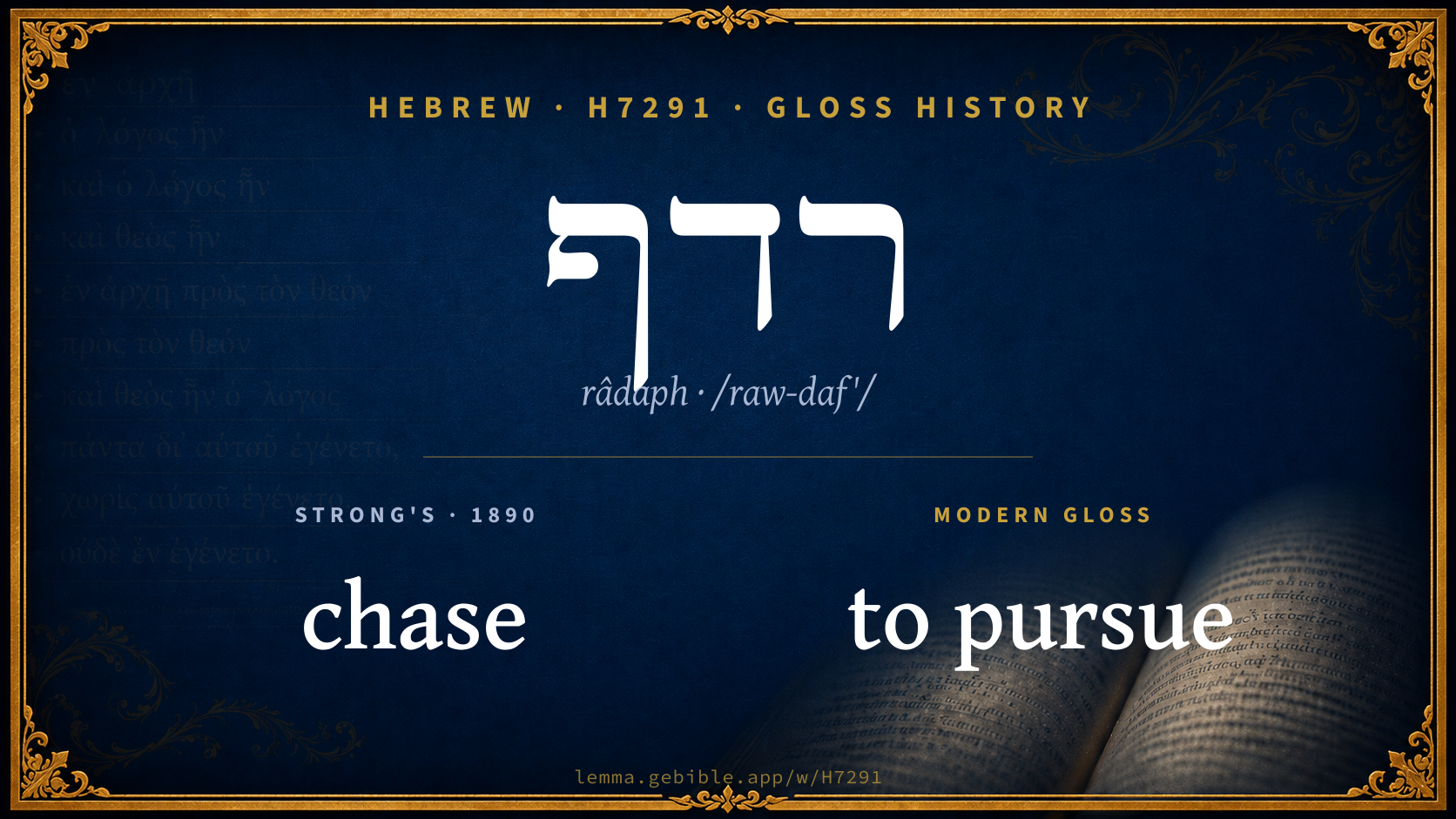
Gloss history
Strong's 1890 vs modern scholarship
About this word
Strong's H7291 catalogs a Hebrew word from the Hebrew Old Testament.
These counts are not copied from any lexicon or concordance. They are computed here, from the morphology-tagged Hebrew Old Testament. What Lemma adds →
- 135
- distinct verses
- The word appears in 135 distinct verses.
- 23 / 39
- OT books
- The word appears in 23 of 39 Old Testament books.
- #312
- by frequency
- Top 500 most frequent Hebrew words (rank 312 of 8,640 Hebrew words by occurrence).
View all 135 occurrences in the concordance →
By section of the Old Testament
By traditional corpus
Conventional, traditional groupings — biblical authorship is debated, so this is a traditional corpus grouping, not an authorship claim. Each share is this word’s portion of its verses in that division of the Hebrew canon. Each figure is a share of the word’s 135 distinct verses.
- Prophets (Nevi'im) 70 verses · 52%
- Writings (Ketuvim) 42 verses · 31%
- Torah (Pentateuch) 23 verses · 17%
How translations render this word
Counts come from each version’s own published word-to-Strong’s tagging or interlinear alignment — an approximate guide to how each version renders this word, not a word-level alignment the data otherwise carries. Because each total is that version’s own tagged count, the per-version totals vary from one another and need not match the appearance or distinct-verse counts above. These counts may also differ from a printed concordance because Lemma counts each distinctly tagged rendering and does not collapse phrase taggings into a single head-word total. This is a fixed set of word-tagged versions (KJV, ASV, BSB, ULT) and does not change with the reading translation you choose elsewhere. Each version’s license is shown beside its name below (and on Sources).
- King James Version: Pursued 24×, Pursue 11×, Persecute 9×
- American Standard Version: Pursued 22×, Pursue 10×, Pursuers 5×
- Berean Standard Bible: Pursued 17×, Pursue 9×, Pursuers 9×
- unfoldingWord Literal Text: Pursued 15×, Pursuers 14×, Pursue 13×
King James Version Public Domain
Renders H7291 across 143 tagged occurrences — most commonly:
Plus other, less common renderings. Plus 49 renderings that appear only once — usually multi-word phrases or single function words the recovered tagging swept in, not distinct renderings.
American Standard Version Public Domain
Renders H7291 across 143 tagged occurrences — most commonly:
Plus other, less common renderings. Plus 60 renderings that appear only once — usually multi-word phrases or single function words the recovered tagging swept in, not distinct renderings.
Berean Standard Bible Public Domain
Renders H7291 across 142 tagged occurrences — most commonly:
Plus other, less common renderings. Plus 53 renderings that appear only once — usually multi-word phrases or single function words the recovered tagging swept in, not distinct renderings. Not rendered by a distinct English word in 1 further occurrence.
unfoldingWord Literal Text CC BY-SA 4.0
Renders H7291 across 162 tagged occurrences — most commonly:
Plus other, less common renderings. Plus 44 renderings that appear only once — usually multi-word phrases or single function words the recovered tagging swept in, not distinct renderings.
13 senses and sub-senses in the full BDB
Hebrew verbs can shift meaning by stem (binyan): Qal is the basic action, Niphal is often passive or reflexive, Piel often intensifies or makes it factitive, and Hiphil is typically causative. The senses below are grouped under the stem BDB assigns to each. This entry also uses Pual (the passive of Piel).
What do BDB’s symbols mean?
BDB uses these scholarly abbreviations:
| Symbol | Meaning |
|---|---|
| 𝔊 | the Septuagint (the ancient Greek translation, LXX) |
| 𝔙 | the Vulgate (the Latin translation) |
| 𝔖 | the Syriac version (the Peshitta) |
| 𝔗 | the Targum (the Aramaic translation) |
| ψ | the Psalms |
| √ | root (the underlying root or stem) |
| ‖ | parallel passage (a synonymous or contrasted parallel) |
| † | the dagger: every passage where the word occurs is cited |
The 13 senses and sub-senses the full Brown-Driver-Briggs lexicon distinguishes for this word, in lexicon order (not ranked by frequency), with BDB’s own verbatim wording and sub-sense lettering. Shown in Hebrew script with BDB’s own scholarly abbreviations. The condensed entry is in the Lexicon Entry tab. See also the Forms in the corpus table below.
Qal
- Pf. 3 ms. ר׳ Ju 4:16 +; 1 s. וְרָדַפְתִּ֫י Je 29:18, etc.; Impf. יִרְדֹּף Dt 19:6 +, יִֽרַדֹּף ψ 7:6 (appar. to give choice of Qal or Pi, Ki JHMich Bae al.; Ges§ 63 n expl. as developed from יִרֲדֹף, cf. Ol § 236 e, and, further, Köi. 160), sf. יִרְדָּפֶ֑ךָ Ez 35:6(×2), etc.; Imv. ms. רְדֹף Gn 44:4 +, sf. רָדְפֵהוּ ψ 34:15; mpl. רִדְפוּ Ju 3:28 +;, Inf. cstr. לִרְדֹּף Jos 8:16 +, מִרְדֹף 1 S 23:28; 2 S 18:16, sf. רָדְפִי ψ 38:21 Qr, רדופי Kt, etc.; Pt. רֹדֵף Ju 4:22 +, pl. רֹדְפִים 8:4 +;— e.g. Judges 4:16
- 1.
- a. pursue (sometimes + הִשִּׂיג): lit. c. אַהֲרֵי pers., in order to overtake Gn 44:4 (J), 2 K 5:21; especially with hostile purpose Gn 31:23 (+ הִדְבִּיק), 35:5; Jos 24:6 (all E), 2:5, 7(×2); 8:16(×2), 17; 10:19 (JE), Dt 11:4; 19:6; Jos 20:5 (all D), Ex 14:4, 8, 9 (P), Ju 1:6; 2 S 20:6, 7, 10, 13; 2 K 9:27 + 17 times, + 2 K 25:5 (אַהַר), + Ju 4:16 (אַהֲרֵי הָרֶכֶב); + רִדְפוּ אַהֲרַי Ju 3:28 = follow me (as leader; but this meaning not elsewhere; read רְדוּ 𝔊 Kit GFM). e.g. Genesis 44:4
- b. lit., c. acc. pers., put to flight, chase (defeated foe; sometimes c. הִשִּׂיג): Am 1:11; Ho 8:3; Dt 32:30 (poem; ‖ הֵנִיס), 28:22, 45; Jos 23:10 (D), Lv 26:8(×2) (H); וְרָדַף אֹתָם קוֹל עָלֶה נִדָּף v 36a (H); Jos 7:5; 8:24; 10:10; 11:8 (all JE), Gn 14:15; Dt 1:44; Ju 4:22; Is 41:3 + 13 times + Ju 7:25 (read אֶת־ for אֶל־, 𝔊 𝔙 𝔗 GFM Bu Now). e.g. Amos 1:11
- c. lit., acc. om. Ju 8:4; 1 S 30:8 (+ הִשִּׂיג), v 10; Gn 14:14; Ex 14:23 (P), 15:9 (poem; + הִשִּׂיג), Lv 26:36b, 37 (H), Pr 28:1; especially pt. pl. הָר׳ the pursuers Jos 2:16(×2), 22(×2;) Ne 9:11; Is 30:16, so הָרֹדֵף Jos 8:20; La 1:6. e.g. Judges 8:4
- d. chase, hunt, partridge (קֹרֵא) 1 S 26:20 (in sim.; ‖ בִּקֵּשׁ). e.g. 1 Samuel 26:20
- e. pursue, in fig., Je 20:11; La 4:19, רִדְפוּ וְתִפְשׂוּהוּ ψ 71:11, cf. La 1:3; ψ 7:6 (+ הִשִּׂיג; v. supr.); especially subj. י׳, pursue (fig. of punishment, judgment), c. אחרי Je 29:18 (בַּהֶרֶב), acc. pers. La 3:43 (om. v 66), ψ 83:16 (בְּסַעֲרֶ֑ךָ); אֶת־קַשׁ יָבֵשׁ תִּרְדֹּף Jb 13:25 (‖ תַּעֲרוֹץ); רֹדְכָּם, of מַלְאַךְ י׳, ψ 35:6. e.g. Jeremiah 20:11
- f. fig. persecute, harass, c. acc. pers. Dt 30:7; Jb 19:22 (כְּמוֹ־אֵל), ψ 69:27; 109:16; 119:86, 161; c. acc. נַפְשִׁי 143:3, c. acc. נְדִבָתִי Jb 30:15 (but subj. obscure; read perhaps תֵּרָדֵף Bu; Du תִּנָּדֵף); c. ל pers. Jb 19:28; pt. as subst. Je 15:15; 17:18 ψ 7:2; 31:16 (‖ אוֹיְבַי; We מְרַדְּפָ֑י for מֵרֹדְפָ֑י), 35:3; 119:84, 157 (+ צָרַי), 142:7. e.g. Deuteronomy 30:7
- g. pursue, dog, subj. דָּם, c. acc. pers. Ez 35:6(×2) (del v a 𝔊 Co Toy Krae); in good sense, attend closely upon, טוֹב וָחֶסֶד יִרְדְּפוּנִי ψ 23:6. e.g. Ezekiel 35:6
- 2. fig. follow after, aim to secure: in bad sense, c. acc. שַׁלְמֹנִים Is 1:23, שֵׁכָר 5:11, ר׳ קָדִים Ho 12:2, רֹדְפֵי זִמָּה ψ 119:150; good sense, c. inf. לְדַעַת אֶת־י׳ Ho 6:3, c. acc. צֶדֶק Dt 16:20 Is 51:1 (‖ מְבַקְשֵׁי י׳), צְדָקָה וָהָ֑סֶד Pr 21:21, שָׁלוֹם ψ 34:15 (‖ בַּקֵּשׁ), טוֹב 38:21. e.g. Isaiah 1:23
Niphal
- pass.: Pf. 1 pl. עַל־צַוָּארֵנוּ נִרְדָּ֑פְנוּ La 5:5 upon our neck (i.e. closely) we are pursued (improb., cf. Bu); perhaps Impf. 3 fs. תֵּרָדֵף Jb 30:15 Bu (for תִּרְדֹּף); Pt. א׳ יְבַקֵּשׁ אֶת־נִרְדָּ֑ף Ec 3:15 God seeketh the pursued, (i.e. what has disappeared, is past, but dub.). e.g. Lamentations 5:5
Piel
- Pf. 3 fs. consec. וְּרִדְּפָה Ho 2:9; Impf. 3 ms. יְרַדֶּף־ Na 1:8 (ψ 7:6 v. Qal); 3 fs. תְּדַדֵּף Pr 13:21; Pt. מְרַדֵּף 11:19 +;—pursue ardently, c. acc. pers. Ho 2:9 (in fig.); fig. also וְאֹיְבָיו יְר׳ הֹשֶׁךְ Na 1:8 (GunkZAW xiii (1893), 230, plausibly, רֶהְדֹּף), cf. Pr 13:21; elsewhere pt., in Pr: aim (eagerly) to secure, c. acc. רָעָה 11:19, רֵיקִים 12:11; 28:19, אֲמָרִים 19:7 (meaning dub., v. Toy); in good sense, צְדָקָה 15:9. e.g. Hosea 2:9
Pual
- Pf. 3 ms. consec. וְרֻדַּף כְמֹץ הָרִים Is 17:13 it shall be chased away like chaff of the mountains (‖ וְנָס). e.g. Isaiah 17:13
Hiphil
- Pf. 3 ms. sf. הִרְּדִיפֻהוּ Ju 20:43 usually they chased him (Benj., coll.), but strange after כִּתְּרוּ surrounded (still stranger after כתתו or כרתו 𝔊), and why Hiph.? GFM conj. dittogr. of הִדְרִיכֻהוּ foll.; the reverse conjectured by Bu Now. e.g. Judges 20:43
Senses from the full Brown-Driver-Briggs lexicon (Brown, Driver, Briggs; Oxford 1906 — public domain), digitized via Sefaria, supplemented by the OpenScriptures HebrewLexicon (CC BY 4.0). Full attribution on Sources.
Word origin
vb. pursue, chase, persecute (NH id., Aramaic רְדַף, ܪܕܰܦ; Arabic رَدَفَ; Sab. רדף id., SabDenkm No. 7, 1, 2);—
— Brown-Driver-Briggs (Oxford 1906, public domain), digitized via Sefaria, supplemented by the OpenScriptures HebrewLexicon (CC BY 4.0). See Sources.
Origin: a primitive root
Jastrow Dictionary
A second Hebrew/Aramaic lexicon for comparison, covering Aramaic and post-biblical (Talmudic, Targumic, Midrashic) usage that the biblical-Hebrew BDB does not. Matched by lemma rather than by Strong’s number, so a lemma may carry more than one Jastrow headword (shown separately below), and the entries cover usage well beyond the Bible.
רָדַף
- (b. h.) to run: to pursue. Gen. R. s. 44 רָדַפְתִּי מלכים וכ׳ I pursued the kings to Damascus. Ab. Zar. 75ᵃ שמימיו רוֹדְפִין (Ms. M. רדופין), v. infra. Snh. VIII, 7 הרוֹדֵף אחר חבירו וכ׳ he that runs after his fellowman with murderous intention. Ib. 74ᵃ רודף שהיה רודף אחר רודף וכ׳ a pursuer who runs after a pursuer in order to save him (prevent him from murder); a. fr.—Pes. 114ᵃ אכול בצל … ולבך רודף עליך Ms. M. 1 (ed. ויהא לבך וכ׳, Ms. M. 2 רדוף) eat onion and sit in the shade (v. צֵל), rather than eat goose and chicken with thy heart within thee running (being restless and greedy).—Part. pass. רָדוּף; f. רְדוּפָה &c. a) quick, rapid. Ab. Zar. 75ᵃ מעיין שמימיו רְדוּפִין Ms. M. (ed. רודפין) a spring whose waters run rapidly; (Y. ib. V, end, 45ᵇ נהר שמימיו מהלכין).—b) anxious, longing. Tosef. Yeb. VI, 6 הרי שהיתה ר׳ לילך וכ׳ if the wife (at the time of her husband’s death) has been following her desire to go on a visit to her parental home; Yeb. 42ᵇ. Keth. 71ᵇ כאן בר׳ וכ׳ in the one case it means when she is anxious to go home (during her first year of married life) &c. Ib. ככלה … ור׳ לילך וכ׳ like a bride that has been found perfect in her husband’s paternal home, and is anxious to go home and tell &c.; Pes. 87ᵃ.—רגל (ה)רְדוּפִין the first festival after marriage. Y. ib. VIII, 35ᵈ top איזהו רגל הר׳ … שאביה רוֹדְפָהּ וכ׳ which festival is ‘the festival of the anxious’?… The first festival after marriage, when her father urges her to go back to her husband’s house. Ib. לא הלכה … רגל ר׳ if she did not go home for the first festival, may the second festival be considered ‘the festival of the anxious’ (with regard to her partaking of the father’s Passover meal)? Cant. R. to VIII, 9 בת מלכים … ר׳ ר׳ a princess that went to observe the first festival at her father’s house; a. e.
- to be pursued, chased, persecuted. Snh. l. c. בין של רודף בין של נִרְדָּף וכ׳ whether he broke the vessels of the pursuer (in his attempt to prevent him from murder) or those of the pursued. Lev. R. s. 27 (ref. to Koh. III, 15) לעולם … הנִרְדָּפִין מן הרודפין at all times the Lord requires the blood of the pursued at the hands of the pursuers; הבל נ׳ מפני קין וכ׳ Abel was pursued by Cain, and the Lord chose Abel &c.; ib. לא תקריבו … אלא מן הנרדפין bring me no offerings from among the pursuers (beasts of prey), but from among the pursued; Pesik. Shor, p. 76ᵃ, sq.; a. fr. e.g. Ecclesiastes 3:15
- to pursue, strive after. Y. Snh. III, beg. 21ᵃ מתוך שביררו מְרַדֵּף זכותו because he has chosen him as arbiter, he will advocate his (client’s) claim.
רְדַף
- Targ. I Sam. XXIII, 28. Targ. Prov. XIII, 21 (ed. Wil. Pa.); a. fr.—Part. רָדִיף. Targ. Deut. XVI, 20 (O. ed. Berl. תרדוף). Targ. Koh. III, 15; a. e.—Part. pass. רְדִיף quick, rapid. Yoma 77ᵇ שאני נחל דרְדִיפֵי מיא it is different with a brook, because its waters are rapid. B. Bath. 73ᵇ לאו משום … דרדיפי מיא (not דרדפי) not because the water is very deep, but because it is so rapid; a. e.
- same. Targ. Prov. l. c., v. supra.
A Dictionary of the Targumim, the Talmud Babli and Yerushalmi, and the Midrashic Literature (Marcus Jastrow; London, Luzac, 1903) — Public Domain. Digitized via Sefaria. Digitized via Sefaria. Full attribution on Sources.
Forms in the corpus
The 120 distinct written forms H7291 takes in the Hebrew Bible, most frequent first — each parse links to that stem’s occurrences in the concordance. Hebrew forms include their vowel points and cantillation, so a single lemma takes many written forms.
The 60 most common forms are shown; 60 rarer forms follow in the full concordance.
Same root — word family
Other BDB entries built from the same root as H7291, grouped by Strong’s listed origin. These share a root / origin per the lexicon — not necessarily a shared meaning. Each links to that word’s own entry.
Derived from this word
Compare all same-root words → They share a root, not necessarily a meaning.
Septuagint verse parallels
This word appears in 121 verses that also exist in the Greek Old Testament (Septuagint), out of the 135 Hebrew verses it occurs in. You can read those verses in Greek by switching the Old Testament edition to the Septuagint.
Read these verses in the Septuagint
- Genesis 14:14
- Exodus 14:4
- Leviticus 26:7
- Deuteronomy 1:44
- Joshua 2:5
- Judges 1:6
- 1 Samuel 7:11
- 2 Samuel 2:19
- 1 Kings 20:20
- 2 Kings 5:21
- 2 Chronicles 13:19
- Job 13:25
This is a verse-level parallel only — the same verses exist in both the Hebrew and Greek Old Testaments. No word-level Hebrew↔Greek correspondence is claimed: the data carries no such alignment, so no Greek word is shown as this Hebrew word’s translation. Coverage is not total — the Septuagint omits the deuterocanon and renumbers the Psalms, so some Hebrew verses have no direct Greek parallel.