

Proverbs 13:21

Hebrew (Westminster Leningrad Codex) Proverbs 13:21 appears in the Hebrew Old Testament. The text above is from the Westminster Leningrad Codex. Each word links to its Strong’s number, a concise gloss, and parsing drawn from the Open Scriptures Hebrew Bible morphology. Click any word for its full Brown-Driver-Briggs (BDB) entry.
Download image
Cite this verse

Proverbs 13:21 (World English Bible). Public Domain. Lemma interlinear Bible study tool, https://lemma.gebible.app/v/proverbs/13/21.

Show BibTeX & RIS
BibTeX
RIS
English Translation
Misfortune pursues sinners, But prosperity rewards the righteous.
World English Bible · Public Domain
Download a study sheet

One document with this verse’s original text, its word-by-word gloss line, the meaning frame, cross-references with their text, attributed commentary, and full source and license credits — printable, and it pastes into notes with its structure intact.

This verse Autodidact and up

Study sheet (.html) Plain text (.txt)

A passage Seminary Student

Up to 50 verses in one chapter. A passage sheet keeps up to 6 commentary sources and 12 cross-references per verse, in the order this page ranks them, and says so on the sheet whenever that leaves anything out. Ask for a single verse and you get the Autodidact verse sheet above.

Everything on this page stays free to read, with no account — the sheet is a download of what is already on screen, not access to it.

Want to remove ads? Support Godless Engineer
Compare translations 3

The same verse in 3 English versions, stacked beneath the original-language interlinear above. Click any original word for its lexicon entry.

Each is an independent rendering of the whole verse — the interlinear is not word-aligned to these translations.

Highlighted words mark where these versions differ — a whole-verse word diff, not a word-by-word alignment.

  • World English Bible Public Domain
    Misfortune pursues sinners, But prosperity rewards the righteous.
  • King James Version Public Domain
    Evil pursueth sinners: but to the righteous good shall be repayed.
  • unfoldingWord Literal Text CC BY-SA 4.0
    Evil will pursue the sinful, but goodness will reward the righteous.

unfoldingWord Literal Text — © unfoldingWord, licensed CC BY-SA 4.0. Word-aligned USFM3 via Door43 (git.door43.org/unfoldingWord/en_ult).

Versions to compare (up to 4)

3 of 4 selected

Show all 18 translations

Every available English version of this verse, each an independent rendering of the whole verse.

  • World English Bible Public Domain
    Misfortune pursues sinners, But prosperity rewards the righteous.
  • Berean Standard Bible Public Domain
    Disaster pursues sinners, but prosperity is the reward of the righteous.
  • Majority Standard Bible Public Domain
    Disaster pursues sinners, but prosperity is the reward of the righteous.
  • King James Version Public Domain
    Evil pursueth sinners: but to the righteous good shall be repayed.
  • American Standard Version (1901) Public Domain
    Evil pursueth sinners; But the righteous shall be recompensed with good.
  • Revised Version (1885) Public Domain
    Evil pursueth sinners: but the righteous shall be recompensed with good.
  • Geneva Bible (1599) Public Domain
    Affliction followeth sinners: but vnto the righteous God will recompense good.
  • Douay-Rheims (1899) Public Domain
    ,21Evil pursueth sinners: and to the just good shall be repaid.
  • Young's Literal Translation Public Domain
    Evil pursueth sinners, And good recompenseth the righteous.
  • Literal Standard Version CC BY-SA 4.0
    Evil pursues sinners, || And good repays the righteous.
  • Unlocked Literal Bible CC BY-SA 4.0
    Disaster runs after sinners, but righteous people are rewarded with good.
  • unfoldingWord Literal Text CC BY-SA 4.0
    Evil will pursue the sinful, but goodness will reward the righteous.
  • Darby Bible Public Domain
    Evil pursueth sinners; but to the righteous good shall be repaid.
  • World Messianic Bible Public Domain
    Misfortune pursues sinners, but prosperity rewards the righteous.
  • Webster's Bible Public Domain
    Evil pursueth sinners: but to the righteous good shall be repaid.
  • Free Bible Version CC BY-SA 4.0
    Tragedy chases after the sinner, but prosperity rewards the good.
  • Bible in Basic English Public Domain
    Evil will overtake sinners, but the upright will be rewarded with good.
  • JPS Tanakh (1917) Public Domain
    Evil pursueth sinners; but to the righteous good shall be repaid.

Literal Standard Version (2020), Covenant Press — licensed CC BY-SA 4.0. Text via the HelloAO Bible API (eBible.org). Unlocked Literal Bible (unfoldingWord) — licensed CC BY-SA 4.0. Text via the HelloAO Bible API (eBible.org). unfoldingWord Literal Text — © unfoldingWord, licensed CC BY-SA 4.0. Word-aligned USFM3 via Door43 (git.door43.org/unfoldingWord/en_ult). Free Bible Version, Dr. Jonathan Gallagher — licensed CC BY-SA 4.0. Text via the HelloAO Bible API (eBible.org).

Word by word

More ways to search: Search by grammar → Find every occurrence → Compare this word →

Practice this passage: Drill this verse → Learn its vocabulary →

About this verse

These counts appear in no published source. They are computed here, from the morphology-tagged text and Lemma’s own curated glosses. What Lemma adds →

7
words
7
distinct lemmas
Wisdom
section

Notable vocabulary

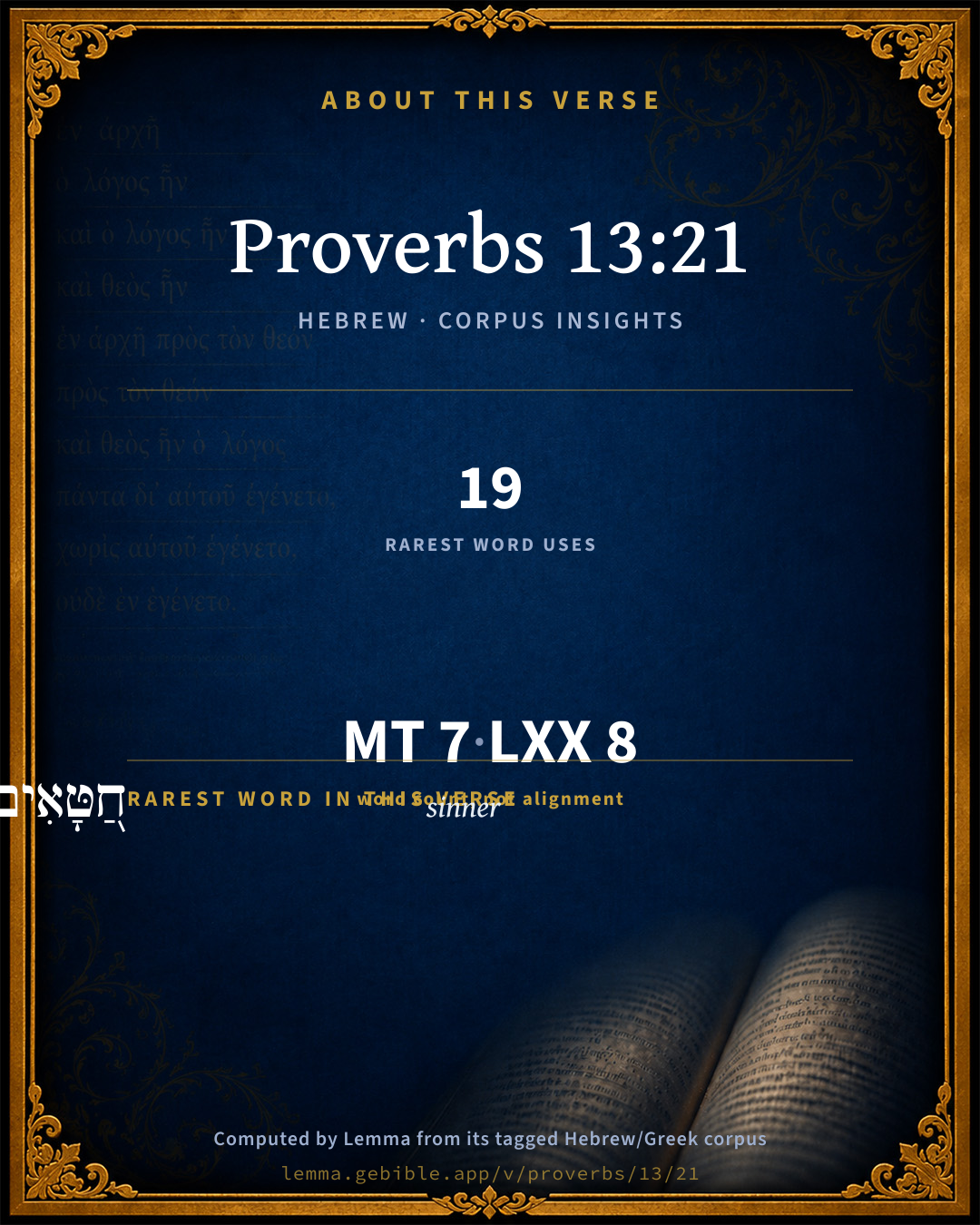
The rarest word here is חַ֭טָּאִים sinner H2400 — appearing just 19 times in the whole Hebrew Bible.

Shared distinctive vocabulary

חַ֭טָּאִים sinner H2400 occurs in 19 verses of the Hebrew Bible. Also found in:

Grammatical profile

  • 2 verbs
  • 1 noun
  • 3 adjectives
  • 1 particle

Verb forms

  • תְּרַדֵּ֣ף Piel · Imperfect
  • יְשַׁלֶּם Piel · Imperfect

Hebrew & Septuagint length

In English translation the verse runs 8 words from the Hebrew and 10 from the Septuagint (LXX English) — closely comparable.

A rough comparison of the two English renderings, which tokenize alike — not a word-level alignment.

Word counts can differ between the Hebrew and the Greek without any difference in meaning — e.g. the Hebrew direct-object marker אֵת has no separate Greek word, and Greek often adds the article ὁ.

In the original languages it is 7 Hebrew tokens and 8 Greek tokens — but the two are counted differently (Hebrew bundles its prefixes and suffixes into one token; the Greek is in lemma form), so that isn’t a like-for-like length.

Cross-references

8

Topical passages linked to Proverbs 13:21 in the Treasury of Scripture Knowledge — connected by theme and wording, ordered by reader-vote popularity; previews shown in the World English Bible.

  • Psalms 32:10 Many sorrows shall be to the wicked, But he who trusts in Yahweh, loving kindness shall surround him.
  • Isaiah 3:10–11 Tell the righteous "Good!" For they shall eat the fruit of their deeds.
  • Proverbs 13:13 Whoever despises instruction will pay for it, But he who respects a command will be rewarded.
  • Romans 2:7–10 to those who by patience in well-doing seek for glory and honor and incorruptibility, eternal life;
  • Genesis 4:7 If you do well, will it not be lifted up? If you don't do well, sin crouches at the door. Its desire is for you, but you are to rule over it."
  • Psalms 140:11 An evil speaker won't be established in the earth. Evil will hunt the violent man to overthrow him.
  • Numbers 32:23 But if you will not do so, behold, you have sinned against Yahweh; and be sure your sin will find you out.
  • Acts 28:4 When the natives saw the creature hanging from his hand, they said one to another, "No doubt this man is a murderer, whom, though he has escaped from the sea, yet Justice has not allowed to live."

Cross-references courtesy of OpenBible.info (CC BY 4.0).

Hebrew and Greek witnesses Masoretic Hebrew ↔ Greek Septuagint

The same verse in the two great witnesses to the Old Testament, shown verse-for-verse.

These are two independent witnesses, not word-aligned to each other, and the Septuagint is shown in lemma (dictionary) form.

Hebrew Proverbs 13:21 Masoretic · Westminster Leningrad Codex

חַ֭טָּאִים תְּרַדֵּ֣ף רָעָ֑ה וְאֶת צַ֝דִּיקִ֗ים יְשַׁלֶּם טֽוֹב

Misfortune pursues sinners, But prosperity rewards the righteous.

World English Bible · Public Domain

Greek LXX Proverbs 13:21 Septuagint · lemma form

ἁμαρτάνω καταδιώκω κακός ὁ δέ δίκαιος καταλαμβάνω ἀγαθός

Evil shall pursue sinners; but good shall overtake the righteous.

LXX2012 (modern English Septuagint) · Public Domain

On this verse, The Pulpit Commentary discusses the Septuagint’s reading. Read the note in Commentary ↓

Hebrew: Westminster Leningrad Codex (CC BY 4.0). Greek: Septuagint (public domain); English from LXX2012 (modern English Septuagint) (Public Domain). How the Septuagint differs from the Hebrew →

Commentary

Notes on Proverbs 13:21 from classic Christian and Jewish commentators (each source and its license shown beneath its notes). The classic Christian expositions comment on the surrounding passage and are grouped to its opening verse, so a note may address several verses; the Jewish commentaries on the Tanakh (Rashi and others) are per-verse, so they appear only where the commentator wrote on this verse.

Lemma curates 59 commentaries, every one of them public domain or Creative Commons licensed, each selected and text-cleaned for this edition rather than reprinted as found. About our sources →

Trapp's Complete Commentary

John Trapp

Pro 13:21 Evil pursueth sinners: but to the righteous good shall be repayed.

Ver. 21. Evil pursueth sinners.] Hard at heels. Flagitium et flagellum, ut acus et filum. Sin and punishment are linked together with chains of adamant. Of sin we may say as Isidore doth of the serpent, Tot dolores, quot colores; so many colours, so many dolours. "The wages of sin is death, but the gift of God is eternal life." {Rom 6:23} The same in effect with this sentence of Solomon.

But to the righteous good shall be repaid.] Or, He, that is, God, shall repay good. Now he is a liberal paymaster, and all his retributions are more than bountiful. Never did any yet do or suffer aught for God, that complained of a hard bargain. God will recompense your losses, - saith that thrice noble Lord Brook, {a} who lost his precious life in the recent unhappy wars at Litchfield, - as the king of Poland did his noble servant Zelislaus, having lost his hand in his wars, he sent him a golden hand. Caligula - Agrippa having suffered imprisomnent for wishing him emperor - when he came afterwards to the empire, the first thing he did was to prefer Agrippa, and gave him a chain of gold as heavy as the chain of iron that was upon him in prison. Those that lose anything for God, he seals them a bill of exchange of a double return; nay, a hundredfold here, and eternal life hereafter.

{a} Lord Brook’s Discourse of Episcop.

John Trapp, A Commentary or Exposition upon All the Books of the Old and New Testament (1647–1656) — public domain. Text from a community e-Sword module.

The Biblical Illustrator

Joseph S. Exell

Pro_13:21

Evil pursueth sinners:but to the righteous good shall be repaid.

The practice of wickedness generally attended with great evil

The practice of righteousness is mens true interest, even in this present life. Wickedness is generally attended with great misery, even here as well as hereafter. Exceptions must, of course, be made in cases of persecution for truth and righteousness sake.

1. Consider mankind in general, under the notion of one universal community. Then the only thing which distinguishes men from wild beasts, with regard to any true happiness of life, is religion, or a sense of the just and right, and of the difference between moral good and evil. Reason, dissociated from moral obligation, only makes men more effectually destroy one another. Reason implying a sense of moral obligation is the secret of happiness in human life.

2. Take a less general view of mankind, in their more restrained political capacity, as formed into particular distinct nations and governments. In this view the only true and lasting happiness depends on the practice of righteousness and true virtue. In proportion as justice, and order, and truth, and fidelity prevail, the happiness of society is secured.

3. Consider men singly, every one in his mere private and personal capacity. Still the only possibility of lasting happiness is the practice of righteousness, charity, temperance, and universal virtue. Illustrate in relation to health; riches, honour, and reputation; inward peace and satisfaction in a mans own mind. Here virtue triumphs absolutely without control, and has no competitor. (S. Clarke.)

Sin and its punishment

The pursuit is a successful pursuit. The evil not only follows the transgressor, but it lays hold of him at last, and wrings out its penalties. Much sin is committed in spite of the remonstrance of conscience, and with the secret acknowledgments, on the part of the perpetrator, that he is doing wrong, and exposing himself to punishment. These men must have some specific with which they quiet their apprehensions, and procure for themselves an ease in the doing of what they know to be wrong. Direct attention to one form of deceit--the expectation of concealment, and therefore of impunity. It is unquestionably thus in regard of those offences of which human laws take cognisance. And much sin is committed with the secret hope that God will not observe it, or that He will not be extreme to take vengeance. It is false to suppose that any sin will pass without recompense just because Christianity is a system which provides in full measure for its forgiveness. Our redemption through Christ does not at all exempt from the temporal penalties of sin. It so makes future happiness dependent on present holiness that every pardoned sin may be punished with the loss of something glorious in eternity. It is a mistaken objection to Christianity that the arrangements of the Christian system secure a certain class of men against the being pursued and overtaken in their sins, because it takes for granted that forgiven sin must go wholly unpunished. Evil pursueth; that is, hunts the sinner with the greatest pertinacity, tracking him through the various scenes of life, and then, when the man fancies he is safe, suddenly darting upon him, and exacting all the punishment. Illustrate by the vices and follies of youth-time, or by the mere idling away of the early years of life. No sin can ever be committed which is not, in one way or another, punished by God. This is true of sins committed after conversion, as well as before conversion. Then let no man depart and think that he may sin yet one more sin and not eventually be a sufferer. (Henry Melvill, B. D.)

Destiny following character

That retributory justice tracks our footsteps, is a doctrine as old as the race. It grows out of the conscience, and is confirmed by the experience of mankind. The Nemesis of the heathen, which was a mysterious pursuer of character, was only a personification of the doctrine. Misery grows out of sin, and happiness out of goodness.

I. The law of moral causation shows this. Mans character is not the creation of a day or an hour, it is the result of past actions. When no change has taken place, like that of regeneration, the mans character to-day is the result of the whole of his past life, and will be, without such a renovation, the cause of the whole of his future. Character is a fruitful tree, it never ceases bearing, every branch is clustered, but the fruit is either misery or happiness, according to its own vital essence.

II. The constitution of moral mind shows this. Moral mind has at least two faculties.

1. One to recall the past. The law of memory compels us to re-live our past lives.

2. One to feel the past. The past does not flit before us as shadows on the wall, as images on the glass, making no impression; it falls on conscience, it stirs it into feeling. The soul is compelled to shudder at a wicked past, whilst a virtuous past fills it with a quiet and ineffable delight.

III. The teaching of holy writ shows this. The Bible assures us that God will render to every man according to his deeds (Jos_7:20-26; Rom_2:6-10). (D. Thomas, D. D.)

The Biblical Illustrator, edited by Joseph S. Exell (c. 1880s–1900s) — public domain. Text from a community e-Sword module.

The Preacher's Complete Homiletical Commentary

Joseph S. Exell (gen. ed.)

MAIN HOMILETICS OF Pro_13:21

PURSUIT AND REPAYMENT

I. Evil pursues sinners because sinners pursue evil. The huntsman who pursues the hare in the direction of a precipice is pursuing a course which, if continued, must be followed by evil. It is an evil thing for him to follow such a trifle at such a risk. There is evil before him in the form of the precipice, and evil will follow if he continues to pursue his present course. Should he try his strength against the law of gravitation by leaping over the precipice, he will find that that law will exact its penalty. There are but two things that will prevent evil from pursuing him, either he must desist from his present course or a great law of nature must be suspended. The first alternative rests with himself, the second does not. He will find that this “battle is to the strong,” and that “this race is to the swift,” even to the mighty law which holds together the material universe. So with sinners against the moral law. “Evil be to him who evil thinks” is a wish that is always fulfilled. It is a law in constant operation. The consequence of pursuing evil in the form of evil thinking is evil thinking, the consequence of evil feeling is evil feeling, the consequence of evil doing is evil doing, for it is the tendency of evil to repeat itself, and this in itself is a punishment. Peter speaks of sinners who “cannot cease from sin” (2Pe_2:14). They have sinned until they have bound themselves in fetters of sinful habit. Evil, in this sense, pursues them, and will pursue them so long as they pursue it. Then there is, of course, the positive retribution, which both in time and beyond time visits pursuers of evil. Of this we have several times treated.

II. Good men are repaid with good because their characters are righteous. The law of repayment runs through nature. He who sows seed is repaid by a harvest. All her forces—rain, sunlight, heat and cold—combine to give back to the husbandman that which he has entrusted to her care. And she repays of the same kind, wheat for the sowing of wheat, thistles for the planting of thistles. She also repays with liberal interest. One head of thistledown scattered over a field will reproduce a hundred heads in a few months. One grain of corn will produce an ear of thirty or forty grains. The law in the kingdom of nature is also the law of the kingdom of grace. Evil sown, as we have just seen under another metaphor, necessitates a reaping of evil. Good sown ensures a reaping of good. And grace is not behind nature in liberal repayment. He who sows handfuls shall reap armfuls. He that goes forth with the seed basket returns with sheaves (Psa_126:6). The one “corn of wheat bears much fruit” (Joh_12:24). This repayment begins in time, and extends beyond it. Righteousness as well as sin is its own present reward, and is the present first fruits. But the righteous man must wait for the “resurrection of the just” for the abundant harvest.

OUTLINES AND SUGGESTIVE COMMENTS

“Evil” is rapacious in its gains. Each inch “evil” holds. It never lets back any advance. It is versatile to tempt, and ruins with many instruments, while the good, however, have just the opposite lot. They gain by every advance. Each act that is holy in their lives is rewarded by better acts and higher holiness on through their whole probation,—nay, eternally! The pit is bottomless. But evil never ceases to hound sinners and make them worse.—Miller.

The representation here is very striking. “Evil pursueth sinners.” It follows them every step. It keeps pace with the progress of time. Each moment it comes nearer. Silent and unperceived it tracks them through their whole course. Insensibly it gains upon them; and at last—it may be suddenly and when least expected—it seizes and destroys them.—Wardlaw.

Not the smallest good, even “a cup of cold water to a disciple” (Mat_10:42), or honour shown to his servants (Mat_10:41; 1Ki_17:16-23) shall “lose its reward” (Heb_6:10). And if a single act is thus remembered much more “a course, a fight held out to the end” (2Ti_4:7-8). How manifestly is this the constitution of grace; that when perfect obedience can claim no recompense (Luk_17:10), such unworthy, such defiled work should be so honoured with an infinite overwhelming acceptance.—Bridges.

To be out of the hands of evil is not to be free from it; for it still pursueth sinners, and it ceaseth not until it be gotten to the place where they are.… For, as St. Augustine saith, that God doth not forthwith avenge sinners is His patience, not His negligence. Wherefore it is to be feared lest by how much He stays the longer that we may repent, by so much He will punish us the more, if that we will not amend.—Jermin.

Caius—Agrippa having suffered imprisonment for wishing him emperor—when he came afterwards to the empire, the first thing he did was to prefer Agrippa, and give him a chain of gold as heavy as the chain of iron that was on him in prison. Those that lose anything for God He seals them a bill of exchange of a double return.—Trapp.

The Preacher's Complete Homiletical Commentary (gen. ed. Joseph S. Exell; Funk & Wagnalls, c. 1892) — public domain (pre-1929). A full-Bible homiletical/sermon-outline anthology covering 65 of 66 books (2 John is absent from the source module). Text from a community e-Sword module.

Matthew Henry's Commentary

Here see, 1. How unavoidable the destruction of sinners is; the wrath of God pursues them, and all the terrors of that wrath: Evil pursues them closely wherever they go, as the avenger of blood pursued the manslayer, and they have no city of refuge to flee to; they attempt an escape, but in vain. Whom God pursues he is sure to overtake. They may prosper for a while and grow very secure, but their damnation slumbers not, though they do. 2. How indefeasible the happiness of the saints is; the God that cannot lie has engaged that to the righteous good shall be repaid. They shall be abundantly recompensed for all the good they have done, and all the ill they have suffered, in this world; so that, though many have been losers for their righteousness, they shall not be losers by it. Though the recompence do not come quickly, it will come in the day of payment, in the world of retribution; and it will be an abundant recompence.

Matthew Henry's Commentary on the Whole Bible (1708–1710) — public domain (CC PDM 1.0). Text via the HelloAO Bible API.

Jamieson, Fausset & Brown

Robert Jamieson, A. R. Fausset & David Brown

(Compare Pro 11:31).

good . . . repaid--or, "He (God) will repay good."

Jamieson, Fausset & Brown — Commentary Critical and Explanatory on the Whole Bible (1871) — public domain (CC PDM 1.0). Text via the HelloAO Bible API.

Ellicott's Commentary for English Readers

(21) Evil pursueth sinners.—The “snares, fire, and brimstone,” of Psa_11:6; while the “good measure, pressed down, shaken together, and running over” (Luk_6:38), awaits the righteous.

A Bible Commentary for English Readers, edited by Charles John Ellicott (1878–1897) — public domain. Text from a community e-Sword module.

John Gill's Exposition

Evil pursueth sinners,.... They pursue the evil of sin, and the evil of punishment pursues them, and at last overtakes them; their damnation, though it may seem to slumber and linger, it does not; it is upon the full speed after them, and will quickly seize upon them. Some understand this of the evil of sin in the conscience, which pursues the sinner, and fills him with terror;

but to the righteous good shall be repaid; or, "he shall recompense the righteous with good" (u), or "good to the righteous"; that is, God shall do it; for all the good things they have done, from a right principle, and to a right end; which good works of theirs will pursue and follow them; and for all the ill things they have suffered for righteousness's sake, a reward of grace, though not of debt, will be given them; as they have had their evil things here, they shall have their good things hereafter; as well as are often recompensed in this life, either in themselves or in their posterity, as follows.

(u) "et justis reddet bonum", Pagninus, Montanus, Mercerus, Gejerus; "justes remunerabit Deus bono", Michaelis; "justis autem bonum rependet", Tigurine version, Piscator, so Cocceius.

John Gill's Exposition of the Whole Bible (1746–1763) — public domain (CC PDM 1.0). Text via the HelloAO Bible API.

Matthew Poole's English Annotations

Evil; evil of punishment proportionable to their evil of sin, as appears from the next clause.

Pursueth; and sooner or later shall certainly overtake them, albeit they please themselves with hopes of impunity.

Sinners; obstinate and incorrigible sinners.

Good; God’s blessings and true happiness.

Matthew Poole's English Annotations on the Holy Bible (1683–1685) — public domain. Text from a community e-Sword/MySword module.

Whedon's Commentary on the Bible

Daniel D. Whedon

21. Evil pursueth sinners — The natural effects of their own wickedness follow them, as a hunter does his prey. Comp. Gen_4:7; Num_32:23; Psa_32:10; Psa_140:11; Act_28:4. Good shall be repaid — The good they do shall be returned to them, oft-times a hundred fold. Compare Pro_10:25; Pro_11:3; Pro_11:5; Pro_11:15.

Daniel D. Whedon (gen. ed.), Commentary on the Old and New Testaments (1874–1909) — public domain. Text from a community e-Sword module.

The Pulpit Commentary

Evil pursueth sinners. Sinners suffer not only the natural consequences of crime in external evil, injury to body, estate, reputation, etc., (Psa_11:6) but also stings of conscience and remorse; even seeming prosperity is often a chastisement, and long impunity is only augmenting the coming retribution. As the shadow attends the substance, so guilt is attached to sin, and brings with it punishment. To the righteous good shall be repaid ; or, he, Jehovah, shall repay good; (comp. Pro_12:14) Revised Version, "The righteous shall be recompensed with good." They shall have the answer of a good conscience, happiness here and hereafter. Septuagint, "Good shall take possession of (or, overtake) the righteous.

Penalty pursuing sin.

These are striking words, and they give us a graphic picture of penalty in pursuit of the guilt which is seeking and hoping to escape, but which is certain to be overtaken.

I SIN AND SUFFERING ARE INSEPARABLY ASSOCIATED IN THOUGHT, In our judgment and in our feeling they go together; they belong to one another. There is no need to go beyond this point; it is ultimate. If we sin, we deserve to suffer, and must expect to suffer. It is right that we should, and the hand that brings it about is a righteous hand.

II THEY OFTEN SEEM TO BE DIVIDED IN FACT. As we observe human life, we see that the murderer sometimes escapes the reach of law, that the swindler sometimes flourishes upon the losses of his victims, that the tyrant sometimes reigns long over the nation he has defrauded of its freedom, that sometimes the man who lives in the practice of vice continues to enjoy health for many years, that the dishonest author may reap a considerable reputation and may long remain unexposed, etc. but in this case

III PENALTY IS PURSUING SIN AND WILL OVERTAKE IT. "Evil pursueth sinners" Justice is on the track, and sooner or later will lay its hand upon its victim.

1. It will most likely do so here. Very frequently, indeed almost always, some penalty immediately overtakes guilt; if not in bodily loss or suffering, yet in spiritual injury. And if not at once, penalty soon follows crime, vice, wrong doing. Or if not soon, yet after many years, the "evil" comes and lays its stern hand upon the shoulder. The man may not, probably does not, see or even believe in its approach. Its step is silent, and it may be slow, but it is constant and certain. The "evil" may be physical, and very of, on it is so; or it may be mental, intellectual; or it may be circumstantial; or it may be in reputation; or it may be in character, and this last, though least seen and often least regarded, is in truth the saddest and the most serious of all, for it affects the man himself he "loses his own soul." Thus, "though leaden-footed," penalty is "iron-handed.

2. It will surely do so hereafter. (See Mat_25:31, 32 2Co_5:10, etc.) Yet not inconsistent with all this,

IV THERE IS ONE MERCIFUL INTERCEPTION. If we truly repent of our sin, we shall be freely and abundantly forgiven.

1. God will change his condemnation into acceptance and parental favour, so that we shall walk thenceforward in the light of his countenance.

2. He will avert the heavier consequences of our sin by introducing into our heart and life all the remedial and restorative influences of righteousness. And there must be considered

V THE CONVERSE BENEFICENT LAW AFFECTING THE RIGHTEOUS. "To the righteous good shall be repaid.

1. All right acts are immediately followed by an inner and spiritual blessing; we must be something the better in soul forevery really right thing we do.

2. All right actions, done in a reverent and filial spirit, will bring God"s blessing down further on. He is "not unrighteous to forget our work of faith and our labour of love." Such blessings come in many forms, and at various intervals; but they do come; they are following the upright, and they will overtake them and cream them.

3. The reward of integrity and faithfulness only comes in part below; God holds great things in reserve for us. C. (Mat_25:21 1Co_4:5)

The Pulpit Commentary (1880–1919), ed. H.D.M. Spence-Jones & Joseph S. Exell — public domain. Text from a community e-Sword module.

John Wesley's Explanatory Notes

Evil - Punishment proportionable to their sin.

John Wesley, Explanatory Notes Upon the Whole Bible (1754–1765) — public domain. Text via the GEBible commentary corpus.

Keil & Delitzsch

C. F. Keil & F. Delitzsch

21 Evil pursueth sinners,

And the righteous is repaid with good.

To תּרדּף of the punishment which follows after sinners at their heels, cf. Nah 1:8. Greek art gives wings to Nemesis in this sense. To translate 21b, with Lwenstein, "The pious, the good rewards them," is untenable, for טוב, the good (e.g., Pro 11:27), never appears personified, only טוב, goodness, Psa 23:6, according to which the lxx τοὺς δὲ δικαίους καταλήψεται (ישׂיג) ἀγαθά. Still less is טוב meant personally, as the Venet. τὰ δὲ δίκαια ἀποδώσει χρηστός, which probably means: righteous conduct will a good one, viz., God, reward. טוב .dr is an attribute of God, but never the name of God. So the verb שׁלּם, after the manner of verbs of educating and leading (גמל, עשׂה, עבד), is connected with a double accusative. The Syr., Targum, and Jerome translate passively, and so also do we; for while we must think of God in the retribuet, yet the proverb does not name Him any more than at Pro 12:14, cf. Pro 10:24; it is designedly constructed, placing Him in the background, with vague generality: the righteous will one, will they, reward with good - this expression, with the most general personal subject, almost coincides with one altogether passive.

Keil & Delitzsch — Biblical Commentary on the Old Testament (1861–1891) — public domain (CC PDM 1.0). Text via the HelloAO Bible API. (Old Testament only.)

Bridges on Proverbs

Charles Bridges

’Sinners are sure to find evil at last; the righteous good.’†1 The histories of sin from the beginning — Cain,†2 Achan,†3 Abimelech,†4 Ahab,†5 and his wicked wife,†6 with many others — are solemn demonstrations, that evil pursueth sinners, even when they seem to have found a refuge. (1Ki 2:28-31 .) The delay even of centuries does not weaken the certainty. (Exo 17:14 . 1Sa 15:3-7 .) As sure as the shadow follows the substance, as the avenger of blood pursued "the manslayer" (Num 35:19 ), "evil shall hunt the violent man to overthrow him." (Psa 140:11 .) Yet often the sinner goes on in his blinded infatuation. ’No one has been witness to his sin. Or no one will make account of it. Or his accusers, being as guilty as himself, will hold their peace; or, should he be discovered, prudence or pleading will secure him from punishment.’†7 And then, though "the iniquity of his heels compasseth him about" (Psa 49:5 ), he thinks only of present gratification, never looks back, and therefore sees not the evil pursuing him. His blindness thus makes his ruin more certain. (Deu 29:19-20 . Job 11:20 . 1Th 5:3 .) And how dearly are his momentary pleasures purchased at the cost of eternity! (Ecc 11:9 .)

Not less sure is the good, which shall be repaid to the righteous. (Isa 3:10-11 . Rom 2:6-10 .) The evil follows in just retribution. The other is the reward of grace. Not the smallest good — even "a cup of cold water to a disciple" (Mat 10:42 ), or honour shewn to his servants (Mat 10:41 . 1Ki 17:16-23 ) — shall "lose its reward." (Heb 6:10 .) And if a single act is thus remembered, much more "a course, a fight," held out to the end. (2Ti 4:7-8 .) How manifestly is this the constitution of grace; that when perfect obedience can claim no recompense (Luk 17:10 ), such unworthy, such defiled, work should be so honoured with an infinite, overwhelming acceptance!

Footnotes:

†1 Jermin in loco.

†2 Gen 4:10-13.

†3 Jos 7:20-26.

†4 Jdg 9:24, Jdg 9:56-57 .

†5 1Ki 21:19 ; 1Ki 22:38 . 2Ki 9:26 .

†6 1Ki 21:23 . 2Ki 9:30-36 .

†7 Lavater in loco.

Charles Bridges, An Exposition of the Book of Proverbs (1846) — public domain. Text from a community e-Sword module.

Kretzmann's Popular Commentary

Paul E. Kretzmann

v. 21. Evil pursueth sinners, as their well-merited punishment; but to the righteous good shall be repaid, that is, God rewards him in mercy for his efforts on the way of sanctification.

Paul E. Kretzmann, Popular Commentary of the Bible (1921–1924) — public domain. Text from a community e-Sword module.

unfoldingWord translationNotes

Door43 World Missions Community

Disaster runs after sinners

"Disaster" is given human characteristics like the ability to run. AT: "Sinners have trouble wherever they go" (See: Personification)

righteous people are rewarded with good

This can be stated in active form. AT: "God rewards righteous people with good" (See: Active or Passive)

his grandchildren

"the sons of his sons" or "the children of his children" or "his descendants"

a sinner's wealth is stored up for the righteous person

This can be stated in active form. AT: "the one who does right will receive the wealth that a sinner has stored up" (See: Active or Passive)

translationWords

sin

reward

good

inherit

unfoldingWord translationNotes — © Distant Shores Media and the Door43 World Missions Community, licensed CC BY-SA 4.0. Source: git.door43.org/Door43/en_tn.

Rashi

Rabbi Shlomo Yitzchaki (Rashi)

Evil will pursue the sinners As for a wicked man, his wickedness pursues him to his destruction.

Rashi on the Tanakh — English translations: “The Judaica Press complete Tanach with Rashi, translated by A. J. Rosenberg” (CC BY 4.0); “Pentateuch with Rashi's commentary by M. Rosenbaum and A.M. Silbermann, 1929-1934” (public domain); “The Metsudah Tanach series, Lakewood, N.J” (CC BY 4.0); and “The Book of Joshua, Metsudah Publications, 1997” (CC BY 4.0). Text via Sefaria.

Lesson kit

Teaching starters — assembled from the data on this page, not authored interpretation. Every prompt links to the verse data it draws on. Edit before teaching.

Proverbs, in the Wisdom, opens this verse with 7 words (7 distinct Hebrew lemmas). Its most distinctive word is chaṭṭâʼ (“sinner”). A historical commentator’s framing appears above. Read the whole chapter for the surrounding context.

Discussion questions

  1. What does “sinner” (chaṭṭâʼ) contribute to the verse as a whole?
  2. Genesis 13:13 shares the word «sinner» with this verse. How do the two illuminate each other?
  3. The translations on this page render this verse differently — a whole-verse word diff, not a word-by-word alignment. What might account for the different wordings?
  4. The verb «תְּרַדֵּ֣ף» is Piel Imperfect. How does its form color the action?
  5. Reading how Trapp's Complete Commentary and The Biblical Illustrator read this verse, where do the two commentators agree and where do they part?

Things to notice

Reading settings

Reading text

Shown beneath each verse's original-language words.

Old Testament
Old Testament edition

Read the OT as the Masoretic Hebrew (MT) or the Greek Septuagint (LXX).

English shown for the Greek Septuagint (in the Hebrew ↔ Greek comparison).

Comparing translations? Open the Compare panel on any verse page to stack up to four side by side.