
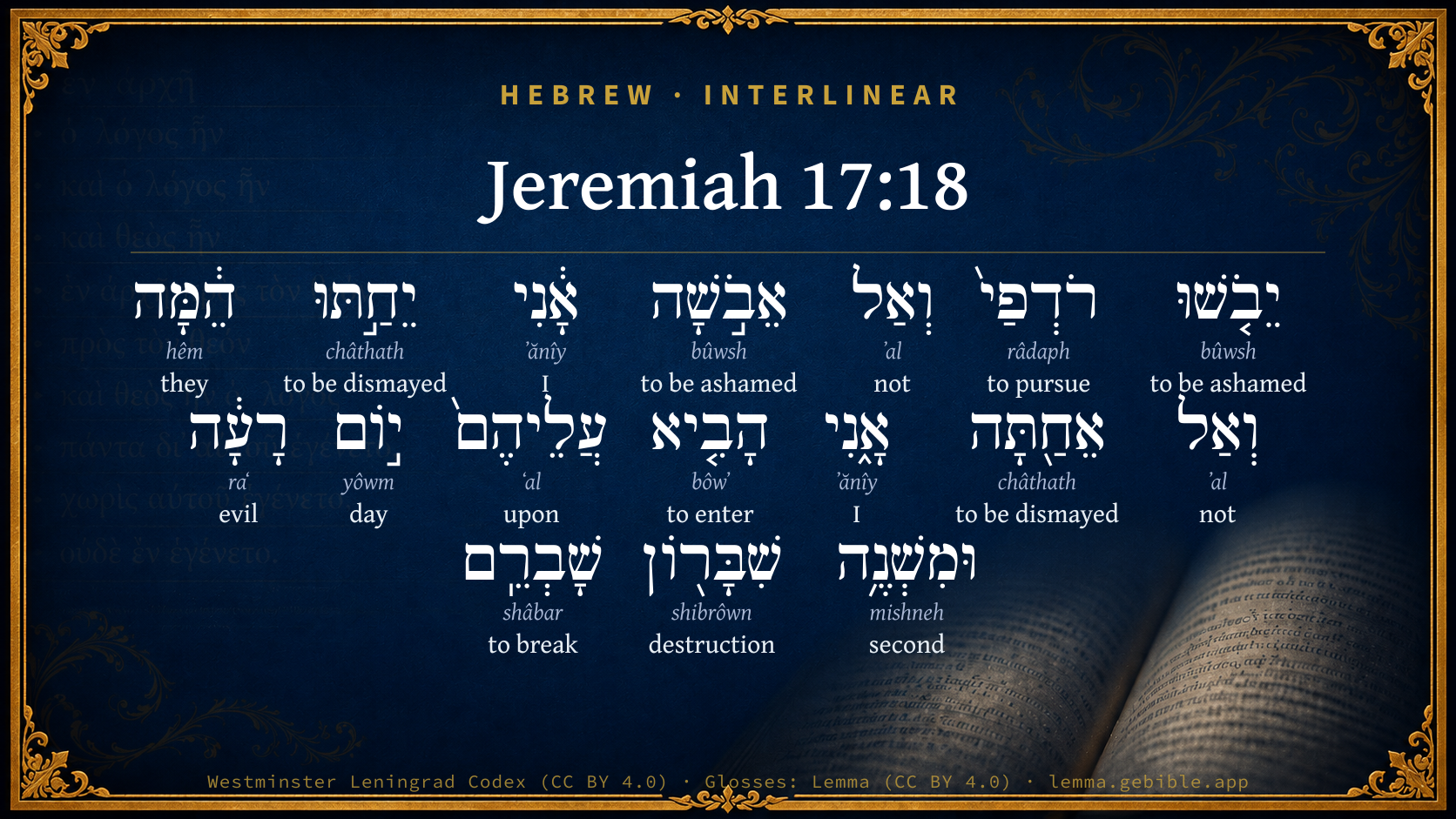
Jeremiah 17:18

Hebrew (Westminster Leningrad Codex) Jeremiah 17:18 appears in the Hebrew Old Testament. The text above is from the Westminster Leningrad Codex. Each word links to its Strong’s number, a concise gloss, and parsing drawn from the Open Scriptures Hebrew Bible morphology. Click any word for its full Brown-Driver-Briggs (BDB) entry.
Download image
Cite this verse

Jeremiah 17:18 (World English Bible). Public Domain. Lemma interlinear Bible study tool, https://lemma.gebible.app/v/jeremiah/17/18.

Show BibTeX & RIS
BibTeX
RIS
English Translation
Let them be disappointed who persecute me, but let not me be disappointed; let them be dismayed, but don't let me be dismayed; bring on them the day of evil, and destroy them with double destruction.
World English Bible · Public Domain
Highlights
  • 1 first appearance in the Hebrew Bible
Full analysis ↓
Download a study sheet

One document with this verse’s original text, its word-by-word gloss line, the meaning frame, cross-references with their text, attributed commentary, and full source and license credits — printable, and it pastes into notes with its structure intact.

This verse Autodidact and up

Study sheet (.html) Plain text (.txt)

A passage Seminary Student

Up to 50 verses in one chapter. A passage sheet keeps up to 6 commentary sources and 12 cross-references per verse, in the order this page ranks them, and says so on the sheet whenever that leaves anything out. Ask for a single verse and you get the Autodidact verse sheet above.

Everything on this page stays free to read, with no account — the sheet is a download of what is already on screen, not access to it.

Want to remove ads? Support Godless Engineer
Compare translations 3

The same verse in 3 English versions, stacked beneath the original-language interlinear above. Click any original word for its lexicon entry.

Each is an independent rendering of the whole verse — the interlinear is not word-aligned to these translations.

Highlighted words mark where these versions differ — a whole-verse word diff, not a word-by-word alignment.

  • World English Bible Public Domain
    Let them be disappointed who persecute me, but let not me be disappointed; let them be dismayed, but don't let me be dismayed; bring on them the day of evil, and destroy them with double destruction.
  • King James Version Public Domain
    Let them be confounded that persecute me, but let not me be confounded: let them be dismayed, but let not me be dismayed: bring upon them the day of evil, and destroy them with double destruction.
  • unfoldingWord Literal Text CC BY-SA 4.0
    Let the ones persecuting me be put to shame, but do not let me be put to shame. Let them be dismayed, but do not let me be dismayed. Bring the day of disaster on them and destroy them with double destruction.

unfoldingWord Literal Text — © unfoldingWord, licensed CC BY-SA 4.0. Word-aligned USFM3 via Door43 (git.door43.org/unfoldingWord/en_ult).

Versions to compare (up to 4)

3 of 4 selected

Show all 18 translations

Every available English version of this verse, each an independent rendering of the whole verse.

  • World English Bible Public Domain
    Let them be disappointed who persecute me, but let not me be disappointed; let them be dismayed, but don't let me be dismayed; bring on them the day of evil, and destroy them with double destruction.
  • Berean Standard Bible Public Domain
    Let my persecutors be put to shame, but do not let me be put to shame. Let them be terrified, but do not let me be terrified. Bring upon them the day of disaster and shatter them with double destruction.
  • Majority Standard Bible Public Domain
    Let my persecutors be put to shame, but do not let me be put to shame. Let them be terrified, but do not let me be terrified. Bring upon them the day of disaster and shatter them with double destruction.
  • King James Version Public Domain
    Let them be confounded that persecute me, but let not me be confounded: let them be dismayed, but let not me be dismayed: bring upon them the day of evil, and destroy them with double destruction.
  • American Standard Version (1901) Public Domain
    Let them be put to shame that persecute me, but let not me be put to shame; let them be dismayed, but let not me be dismayed; bring upon them the day of evil, and destroy them with double destruction.
  • Revised Version (1885) Public Domain
    Let them be ashamed that persecute me, but let not me be ashamed; let them be dismayed, but let not me be dismayed: bring upon them the day of evil, and destroy them with double destruction.
  • Geneva Bible (1599) Public Domain
    Let them bee confounded, that persecute me, but let not me be confounded: let them be afraide, but let not me be afraide: bring vpon them the day of aduersitie, and destroy them with double destruction.
  • Douay-Rheims (1899) Public Domain
    Let them be confounded that persecute me, and let not me be confounded: let them be afraid, and let not me be afraid: bring upon them the day of affliction, and with a double destruction, destroy them.
  • Young's Literal Translation Public Domain
    Let my pursuers be ashamed, and let not me be ashamed -- me! Let them be affrighted, and let not me be affrighted -- me! Bring in on them a day of evil, And a second time `with' destruction destroy them.
  • Literal Standard Version CC BY-SA 4.0
    Let my pursuers be ashamed, || And do not let me be ashamed—me! Let them be frightened, || And do not let me be frightened—me! Bring in on them a day of calamity, || And destroy them a second time [with] destruction.
  • Unlocked Literal Bible CC BY-SA 4.0
    May my pursuers be ashamed, but do not let me be ashamed. May they be dismayed, but do not let me be dismayed. Send the day of disaster against them and shatter them with a double share of destruction.”
  • unfoldingWord Literal Text CC BY-SA 4.0
    Let the ones persecuting me be put to shame, but do not let me be put to shame. Let them be dismayed, but do not let me be dismayed. Bring the day of disaster on them and destroy them with double destruction.
  • Darby Bible Public Domain
    Let them be ashamed that persecute me, but let not me be ashamed; let them be dismayed, but let not me be dismayed; bring upon them the day of evil, and break them with a double breaking.
  • World Messianic Bible Public Domain
    Let them be disappointed who persecute me, but don’t let me be disappointed. Let them be dismayed, but don’t let me be dismayed. Bring on them the day of evil, and destroy them with double destruction.
  • Webster's Bible Public Domain
    Let them be confounded that persecute me, but let not me be confounded: let them be dismayed, but let not me be dismayed: bring upon them the day of evil, and destroy them with double destruction.
  • Free Bible Version CC BY-SA 4.0
    Bring shame on my persecutors, but not on me. Terrify them, but not me, Let them experience the time of trouble, and smash them to pieces.
  • Bible in Basic English Public Domain
    Let them be put to shame who are attacking me, but let me not be shamed; let them be overcome with fear, but let me not be overcome: send on them the day of evil, and put them to destruction twice over.
  • JPS Tanakh (1917) Public Domain
    Let them be ashamed that persecute me, but let not me be ashamed; Let them be dismayed, but let not me be dismayed; Bring upon them the day of evil, and destroy them with double destruction.

Literal Standard Version (2020), Covenant Press — licensed CC BY-SA 4.0. Text via the HelloAO Bible API (eBible.org). Unlocked Literal Bible (unfoldingWord) — licensed CC BY-SA 4.0. Text via the HelloAO Bible API (eBible.org). unfoldingWord Literal Text — © unfoldingWord, licensed CC BY-SA 4.0. Word-aligned USFM3 via Door43 (git.door43.org/unfoldingWord/en_ult). Free Bible Version, Dr. Jonathan Gallagher — licensed CC BY-SA 4.0. Text via the HelloAO Bible API (eBible.org).

Word by word

More ways to search: Search by grammar → Find every occurrence → Compare this word →

Practice this passage: Drill this verse → Learn its vocabulary →

שִׁבָּר֖וֹן
shibrôwn
H7670
“destruction”
Noun, Common, Masculine, Singular, Absolute
Part of Speech
Noun
Type
Common
Gender
Masculine
Number
Singular
State
Absolute
Full BDB Definition

Origin: from H7665

TWOT: 2321b

destruction, breaking, shattering, crushing
  1. יֵבֹ֤שׁוּ bûwsh H954 “to be ashamed” Verb, Qal, Jussive, 3rd Person, Masculine, Plural
  2. רֹדְפַי֙ râdaph H7291 “pursuing · me” Verb, Qal, Participle Active, Masculine, Plural, Construct + Suffix, Personal, 1st Person, Common, Singular
  3. וְאַל ʼal H408 “and · not” Conjunction + Particle, Negative
  4. אֵבֹ֣שָׁה bûwsh H954 “to be ashamed” Verb, Qal, Cohortative, 1st Person, Common, Singular
  5. אָ֔נִי ʼănîy H589 “I” Pronoun, Personal, 1st Person, Common, Singular
  6. יֵחַ֣תּוּ châthath H2865 “to be dismayed” Verb, Niphal, Jussive, 3rd Person, Masculine, Plural
  7. הֵ֔מָּה hêm H1992 “they” Pronoun, Personal, 3rd Person, Masculine, Plural
  8. וְאַל ʼal H408 “and · not” Conjunction + Particle, Negative
  9. אֵחַ֖תָּה châthath H2865 “to be dismayed” Verb, Niphal, Cohortative, 1st Person, Common, Singular
  10. אָ֑נִי ʼănîy H589 “I” Pronoun, Personal, 1st Person, Common, Singular
  11. הָבִ֤יא bôwʼ H935 “enter” Verb, Hiphil, Imperative, 2nd Person, Masculine, Singular
  12. עֲלֵיהֶם֙ ʻal H5921 “upon · them” Preposition + Suffix, Personal, 3rd Person, Masculine, Plural
  13. י֣וֹם yôwm H3117 “day of” Noun, Common, Masculine, Singular, Construct
  14. רָעָ֔ה raʻ H7451 “evil” Noun, Common, Feminine, Singular, Absolute
  15. וּמִשְׁנֶ֥ה mishneh H4932 “and · second” Conjunction + Noun, Common, Masculine, Singular, Absolute
  16. שָׁבְרֵֽם shâbar H7665 “break · them” Verb, Qal, Imperative, 2nd Person, Masculine, Singular + Suffix, Personal, 3rd Person, Masculine, Plural

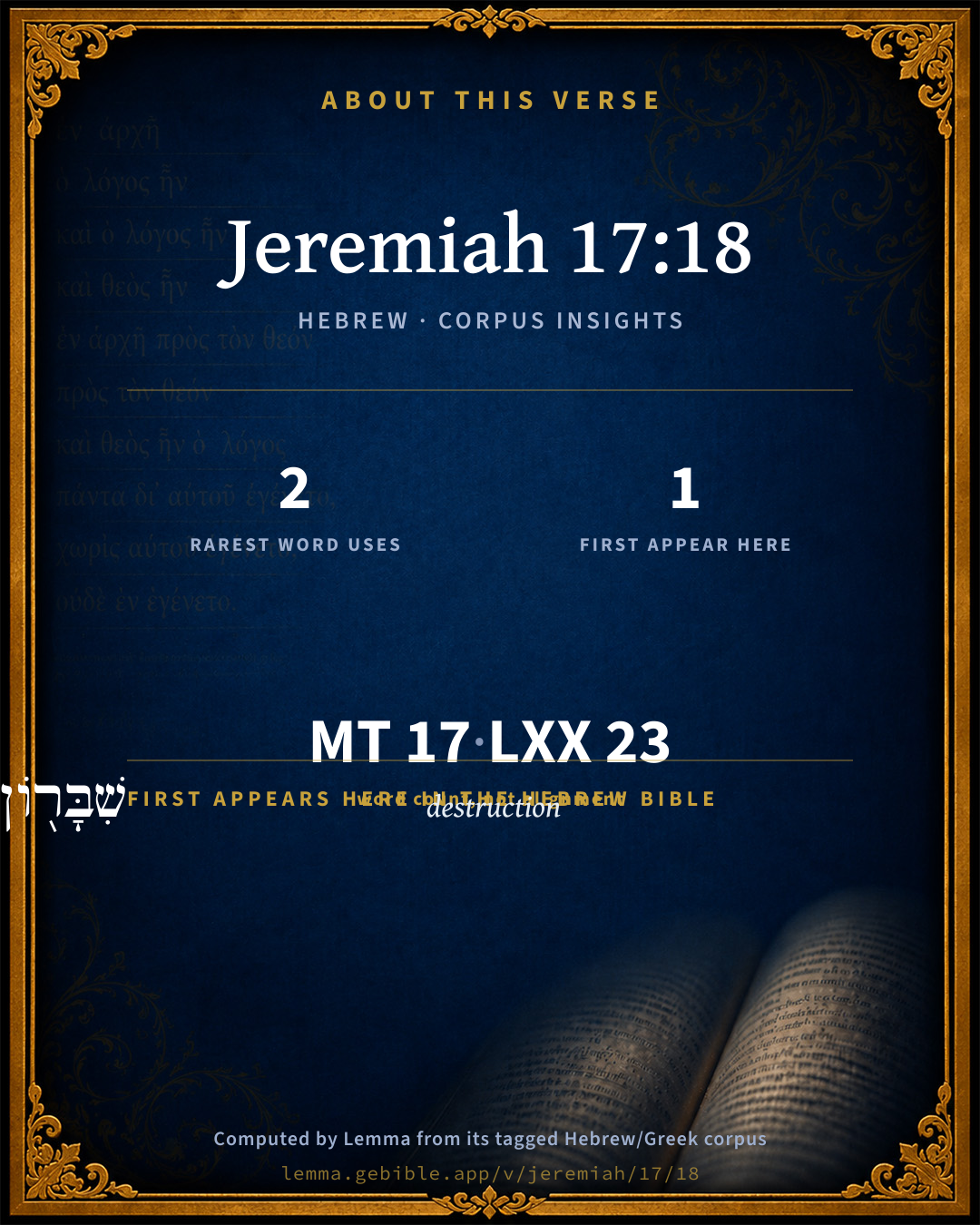
About this verse

These counts appear in no published source. They are computed here, from the morphology-tagged text and Lemma’s own curated glosses. What Lemma adds →

17
words
13
distinct lemmas
Prophets
section

Notable vocabulary

The rarest word here is שִׁבָּר֖וֹן destruction H7670 — appearing just 2 times in the whole Hebrew Bible.

First appearance in Scripture

This word makes its first canonical appearance in the Hebrew Bible here:

  • שִׁבָּר֖וֹן destruction H7670

Shared distinctive vocabulary

שִׁבָּר֖וֹן destruction H7670 occurs in 2 verses of the Hebrew Bible. Also found in:

Grammatical profile

  • 7 verbs
  • 4 nouns
  • 3 pronouns
  • 1 preposition
  • 2 particles

Verb forms

  • יֵבֹ֤שׁוּ Qal · Jussive
  • רֹדְפַי֙ Qal · Participle Active
  • אֵבֹ֣שָׁה Qal · Cohortative
  • יֵחַ֣תּוּ Niphal · Jussive
  • אֵחַ֖תָּה Niphal · Cohortative
  • הָבִ֤יא Hiphil · Imperative
  • שָׁבְרֵֽם Qal · Imperative

Repetition

Words recur within this verse — often emphatic in Hebrew:

  • יֵבֹ֤שׁוּ to be ashamed H954 ×2
  • יֵחַ֣תּוּ to be dismayed H2865 ×2
  • וְאַל not H408 ×2
  • אָ֔נִי I H589 ×2

Hebrew & Septuagint length

In the original languages it is 17 Hebrew tokens and 23 Greek tokens — but the two are counted differently (Hebrew bundles its prefixes and suffixes into one token; the Greek is in lemma form), so that isn’t a like-for-like length.

Cross-references

16

Topical passages linked to Jeremiah 17:18 in the Treasury of Scripture Knowledge — connected by theme and wording, ordered by reader-vote popularity; previews shown in the World English Bible.

  • Psalms 35:4 Let those who seek after my soul be disappointed and brought to dishonor. Let those who plot my ruin be turned back and confounded.
  • Psalms 40:14 Let them be disappointed and confounded together who seek after my soul to destroy it. Let them be turned backward and brought to dishonor who delight in my hurt.
  • Psalms 25:2–3 My God, I have trusted in you, Don't let me be shamed. Don't let my enemies triumph over me.
  • Psalms 83:17–18 Let them be disappointed and dismayed forever. Yes, let them be confounded and perish;
  • Jeremiah 11:20 But, Yahweh of Hosts, who judge righteously, who try the heart and the mind, I shall see your vengeance on them; for to you have I revealed my cause.
  • Jeremiah 20:11 But Yahweh is with me as an awesome mighty one: therefore my persecutors shall stumble, and they shall not prevail; they shall be utterly disappointed, because they have not dealt wisely, even with an everlasting dishonor which shall never be forgotten.
  • Psalms 35:8 Let destruction come on him unawares. Let his net that he has hidden catch himself. Let him fall into that destruction.
  • Psalms 70:2 Let them be disappointed and confounded who seek my soul. Let those who desire my ruin be turned back in disgrace.
  • Psalms 71:1 In you, Yahweh, I take refuge. Never let me be disappointed.
  • Jeremiah 16:18 First I will recompense their iniquity and their sin double, because they have polluted my land with the carcasses of their detestable things, and have filled my inheritance with their abominations.
  • Jeremiah 17:16 As for me, I have not hurried from being a shepherd after you; neither have I desired the woeful day; you know: that which came out of my lips was before your face.
  • Jeremiah 18:19–23 Give heed to me, Yahweh, and listen to the voice of those who contend with me.
  • Revelation 18:6 Return to her just as she returned, and repay her double as she did, and according to her works. In the cup which she mixed, mix to her double.
  • Job 16:14 He breaks me with breach on breach. He runs on me like a giant.
  • Psalms 35:26–27 Let them be disappointed and confounded together who rejoice at my calamity. Let them be clothed with shame and dishonor who magnify themselves against me.
  • Jeremiah 14:17 You shall say this word to them, Let my eyes run down with tears night and day, and let them not cease; for the virgin daughter of my people is broken with a great breach, with a very grievous wound.

Cross-references courtesy of OpenBible.info (CC BY 4.0).

Hebrew and Greek witnesses Masoretic Hebrew ↔ Greek Septuagint

The same verse in the two great witnesses to the Old Testament, shown verse-for-verse.

These are two independent witnesses, not word-aligned to each other, and the Septuagint is shown in lemma (dictionary) form.

Hebrew Jeremiah 17:18 Masoretic · Westminster Leningrad Codex

יֵבֹ֤שׁוּ רֹדְפַי֙ וְאַל אֵבֹ֣שָׁה אָ֔נִי יֵחַ֣תּוּ הֵ֔מָּה וְאַל אֵחַ֖תָּה אָ֑נִי הָבִ֤יא עֲלֵיהֶם֙ י֣וֹם רָעָ֔ה וּמִשְׁנֶ֥ה שִׁבָּר֖וֹן שָׁבְרֵֽם

Let them be disappointed who persecute me, but let not me be disappointed; let them be dismayed, but don't let me be dismayed; bring on them the day of evil, and destroy them with double destruction.

World English Bible · Public Domain

Greek LXX Structure differs

In the Septuagint, Jeremiah is about an eighth shorter than the Hebrew and arranges its material differently — the Oracles Against the Nations (Hebrew chapters 46–51) appear in the middle of the Greek book, after 25:13. Because the chapter and verse boundaries do not line up, a verse-for-verse comparison with the Hebrew is not shown.

A verse-for-verse comparison isn’t shown here because the chapters and verses don’t line up. Switch to the LXX edition with the MT / LXX toggle above to read the Greek directly.

Hebrew: Westminster Leningrad Codex (CC BY 4.0). Greek: Septuagint (public domain); English from a public-domain English Septuagint. How the Septuagint differs from the Hebrew →

Targum (Aramaic paraphrase)

1

The Targum is the ancient Jewish Aramaic paraphrase of the Hebrew Scriptures — an interpretive translation, not the Hebrew text itself. Onkelos (literal) and Pseudo-Jonathan (expansive) render the Torah, and Jonathan the Prophets. Coverage is partial: where no permissively-licensed English translation exists for a verse, only the Aramaic is shown. This is verse-level text, not a word-by-word alignment to the Hebrew.

  1. Targum Jonathan Prophets (Joshua–Malachi)
    יִבְהֲתוּן רָדְפַי וְלָא אֶבָּהֵית אֲנָא יִתְכָּלְמוּן אִינוּן וְלָא אִתְכַּלֵם אֲנָא אַיְתֵי עֲלֵיהוֹן יוֹם בִּישׁ וְעַל חַד תְּרֵין תְּבָרָא תַּבְּרִינוּן:

    (no public-domain English translation for this verse)

    Targum Jonathan — Aramaic: “Mikraot Gedolot” (public domain). English: “Sefaria Community Translation” (CC0 1.0 (public-domain dedication)); “London "Chaldee Paraphrase," 1871” (public domain). Text via Sefaria.

Commentary

Notes on Jeremiah 17:18 from classic Christian and Jewish commentators (each source and its license shown beneath its notes). The classic Christian expositions comment on the surrounding passage and are grouped to its opening verse, so a note may address several verses; the Jewish commentaries on the Tanakh (Rashi and others) are per-verse, so they appear only where the commentator wrote on this verse.

Lemma curates 59 commentaries, every one of them public domain or Creative Commons licensed, each selected and text-cleaned for this edition rather than reprinted as found. About our sources →

Trapp's Complete Commentary

John Trapp

Jer 17:18 Let them be confounded that persecute me, but let not me be confounded: let them be dismayed, but let not me be dismayed: bring upon them the day of evil, and destroy them with double destruction.

Ver. 18. Let them be confounded.] A heavy imprecation. Let persecutors take heed how they move ministers to make intercession to God against them, as Elias did against Israel; {Rom 11:2} as Jeremiah here and elsewhere doth against the Jews; as the Christian churches did against Julian the apostate. God will set to his fiat.

Let them be dismayed, but let not me be dismayed.] Paveant illi et non paveam ego, so the Vulgate Latin hath it. But what a stupid Latin dolt was that Popish priest who alleged to his parishioners this text, to prove, that not he, but they, were to pave the church way! So another of them, finding it written in the end of Paul’s epistles, Missa est, &c., bragged he had found the mass in his Bible. So another, reading Joh 1:44, Invenimus Messiam, we have found the Messiah, made the same conclusion.

John Trapp, A Commentary or Exposition upon All the Books of the Old and New Testament (1647–1656) — public domain. Text from a community e-Sword module.

Tyndale Open Study Notes

Tyndale Open Resources

17:18 Jeremiah wanted his persecutors to experience the shame and dismay they deserved, the very feelings that he was experiencing (17:15).

Tyndale Open Study Notes — © Tyndale Open Resources, licensed CC BY-SA 4.0. Text via the HelloAO Bible API.

Geneva Bible (1599)

Geneva Bible translators

Read Jer. 11:20.

Geneva Bible (1599) marginal notes — public domain. Text via Bolls.life.

Jamieson, Fausset & Brown

Robert Jamieson, A. R. Fausset & David Brown

destroy . . . destruction--"break them with a double breach," Hebrew (Jer 14:17). On "double," see on Jer 16:18.

Jamieson, Fausset & Brown — Commentary Critical and Explanatory on the Whole Bible (1871) — public domain (CC PDM 1.0). Text via the HelloAO Bible API.

Adam Clarke's Commentary

Verse 18. Let them be confounded] They shall be confounded. These words are to be understood as simple predictions, rather than prayers.

Adam Clarke's Commentary on the Bible (1810–1826) — public domain. Text from a community e-Sword/MySword module.

John Calvin's Commentaries

The Prophet, as we have seen, had a hard contest, not only with one man or with a few, but with the whole people, and then it is probable that there were many sects, for when he cried against the avaricious, there was a commotion instantly made by all those who lived on plunder, when he spoke against the indulgence of lust, there was a second conspiracy against him; when he condemned drunkenness and intemperance, there was a new combination formed to oppose him. We hence see how all the ungodly in all parts and for various reasons assailed the Prophet, he was therefore constrained to pray, as he now does, Ashamed let them be who persecute me, even because they now testified that they were evidently the enemies of God, for he had no private concern with them, but faithfully obeyed the command of God. As then he knew them to be God’s avowed enemies, he hesitated not to ask God himself to oppose them.

We must yet notice what we have said in other places, that the Prophet was not only influenced by a holy and pious zeal, but was also governed by the wisdom of the Spirit. This I again repeat, for there are many foolish imitators, who always appeal to the vehemence which the Prophets shewed, while they themselves are carried away by a violent rather than by a vehement impulse. But we must first see whether the Holy Spirit guides us, lest we should utter imprecations against the very elect; and then we must beware of being influenced by the feelings of our flesh, and intemperate zeal is ever to be feared, for it is a rare gift so to burn with zeal as to join with it the moderation that is required. As then there is always something turbulent in our zeal, we must remember that the Prophets never uttered a word but as the Spirit guided their tongues, and then that they had no regard to themselves, and, thirdly, that they were so calm and composed in their ardor that they were not, guilty of excess.

The Prophet no doubt fully knew that all those were reprobate on whom he imprecated God’s vengeance, but as it does not belong to us to distinguish between the elect and the reprobate, let us learn to suspend and check our zeal, so that it may not be too fervid, for we may often mistake, if we follow generally what the Prophet says here, Bring on them the day of evil, and with a double breach break them. Were we thus to speak indiscriminately of all, our zeal would often hit the very children of God. We must therefore bear in mind, that before the Prophet uttered this imprecation he was taught by the Spirit of God that he had to do with reprobate and irreclaimable men. Now a new discourse follows —

John Calvin's Commentaries (1540-1563) — public domain. Text from the Calvin Translation Society English edition (1840s-50s) via the Christian Classics Ethereal Library (ccel.org). Calvin's coverage is partial (roughly two-thirds of the Bible); uncommented books and verses are honest gaps, never fabricated. The 19th-century editor's footnotes and remarks are omitted so the notes are faithfully Calvin's own voice.

Ellicott's Commentary for English Readers

(18) Let them be confounded . . .—The prayer reminds us of that of the Psalmist (Psa_35:4; Psa_40:14).

Double destruction.—Literally, break them with a two-fold breaking—i.e., the “double recompense” of Jer_16:18. (See Note there.)

A Bible Commentary for English Readers, edited by Charles John Ellicott (1878–1897) — public domain. Text from a community e-Sword module.

The Cambridge Bible for Schools and Colleges

gen. ed. J. J. S. Perowne

18. destroy them with double destruction] lit. as mg. break them with a double breach. Cp. Jer_4:6. This may mean a literally twofold punishment, the one part for their apostasy as a nation, the other for their treatment of Jeremiah. It seems more likely however that double is merely equivalent to utter, complete.

Co. with Du. holds that the imprecation, as in direct opposition to Jer_17:16, stamps this part of the v., or according to him, the whole v. as unauthentic (but see Jer_11:20). For metrical reasons also he rejects the v., but considers that it has taken the place of a genuine ending to the passage, now lost.

The Cambridge Bible for Schools and Colleges (gen. ed. J. J. S. Perowne; Cambridge University Press, 1878–1918) — public domain. Text from a community e-Sword module.

John Gill's Exposition

Let them be confounded that persecute me,.... With words with reproaches, with scoffs and jeers, saying, "where is the word of the Lord?" Jer 17:14; let such be ashamed that scoffingly put such a question, by seeing the accomplishment of it:

but let not me be confounded; who have delivered it out as the word of the Lord, that should be surely fulfilled; let not me be brought to shame by the failure of it and be reckoned as a false prophet:

let them be dismayed; terrified and affrighted when they shall see the judgments of God coming upon them, which they have jeeringly called for:

but let not me be dismayed; by their not coming, or when they shall come; but preserve and protect me:

bring upon them the day of evil; of punishment; which they put far away, and scoff at; though the prophet did not desire the woeful day to come upon the people in general, yet upon his persecutors in particular. Jarchi interprets it of the men of Anathoth alone; and which desire of his did not arise from malice towards them, but from indignation at their sin and for the glory of the divine Being, whose name was blasphemed by them:

and destroy them with double destruction; not with two sorts of judgments, sword and famine, as Jerom; but with an utter destruction, with breach after breach, destruction after destruction, until they were entirely destroyed; unless it should have regard to the two times of destruction, first by the Chaldeans, and then by the Romans.

John Gill's Exposition of the Whole Bible (1746–1763) — public domain (CC PDM 1.0). Text via the HelloAO Bible API.

Haydock's Catholic Bible Commentary

Let them be confounded, &c. Such expressions as these in the writings of the prophets, are not to be understood as imprecations proceeding from malice or desire of revenge, but as prophetic predictions of evils that were about to fall upon impenitent sinners, and approbations of the ways of the divine justice. (Challoner) --- The prophet has already prevented this objection, ver. 16. (Haydock)

George Leo Haydock (1774–1849), Haydock's Catholic Family Bible and Commentary, 1859 edition — public domain. Excludes Psalms (Douay-Rheims chapter numbering differs from Protestant) and Deuterocanonical books (Catholic canon only).

Matthew Poole's English Annotations

That is, with abundant destruction. Concerning these prayers of the prophet against his enemies, See Poole "Jer 11:20".

Matthew Poole's English Annotations on the Holy Bible (1683–1685) — public domain. Text from a community e-Sword/MySword module.

Whedon's Commentary on the Bible

Daniel D. Whedon

18. Let not me be confounded — This prayer for himself becomes here a prayer against his enemies, and yet not so much foes of Jeremiah as of Jehovah. It is not personal hate and vindictiveness which breathes through these words, but love for God and jealousy for his honour.

Daniel D. Whedon (gen. ed.), Commentary on the Old and New Testaments (1874–1909) — public domain. Text from a community e-Sword module.

The Pulpit Commentary

(On this terrible execration, with reference to Jeremiah"s character, see the general Introduction.) Destroy them with double destruction. "Double" here means "amply sufficient". (comp. Rev_18:6, and see on Jer_16:18)

The Pulpit Commentary (1880–1919), ed. H.D.M. Spence-Jones & Joseph S. Exell — public domain. Text from a community e-Sword module.

Rashi

Rabbi Shlomo Yitzchaki (Rashi)

May my pursuers be shamed i.e., the men of Anathoth alone.

Rashi on the Tanakh — English translations: “The Judaica Press complete Tanach with Rashi, translated by A. J. Rosenberg” (CC BY 4.0); “Pentateuch with Rashi's commentary by M. Rosenbaum and A.M. Silbermann, 1929-1934” (public domain); “The Metsudah Tanach series, Lakewood, N.J” (CC BY 4.0); and “The Book of Joshua, Metsudah Publications, 1997” (CC BY 4.0). Text via Sefaria.

Lesson kit

Teaching starters — assembled from the data on this page, not authored interpretation. Every prompt links to the verse data it draws on. Edit before teaching.

Jeremiah, in the Prophets, opens this verse with 17 words (13 distinct Hebrew lemmas). Its most distinctive word is shibrôwn (“destruction”). A historical commentator’s framing appears above. Read the whole chapter for the surrounding context.

Discussion questions

  1. What does “destruction” (shibrôwn) contribute to the verse as a whole?
  2. The word “destruction” first appears here in Scripture. What is being introduced at this debut?
  3. Ezekiel 21:6 shares the word «destruction» with this verse. How do the two illuminate each other?
  4. “to be ashamed” occurs 2× in this one verse. What is the effect of the repetition?
  5. The translations on this page render this verse differently — a whole-verse word diff, not a word-by-word alignment. What might account for the different wordings?
  6. The verb «יֵבֹ֤שׁוּ» is Qal Jussive. How does its form color the action?
  7. Reading how Trapp's Complete Commentary and Tyndale Open Study Notes read this verse, where do the two commentators agree and where do they part?

Things to notice

Reading settings

Reading text

Shown beneath each verse's original-language words.

Old Testament
Old Testament edition

Read the OT as the Masoretic Hebrew (MT) or the Greek Septuagint (LXX).

English shown for the Greek Septuagint (in the Hebrew ↔ Greek comparison).

Comparing translations? Open the Compare panel on any verse page to stack up to four side by side.