
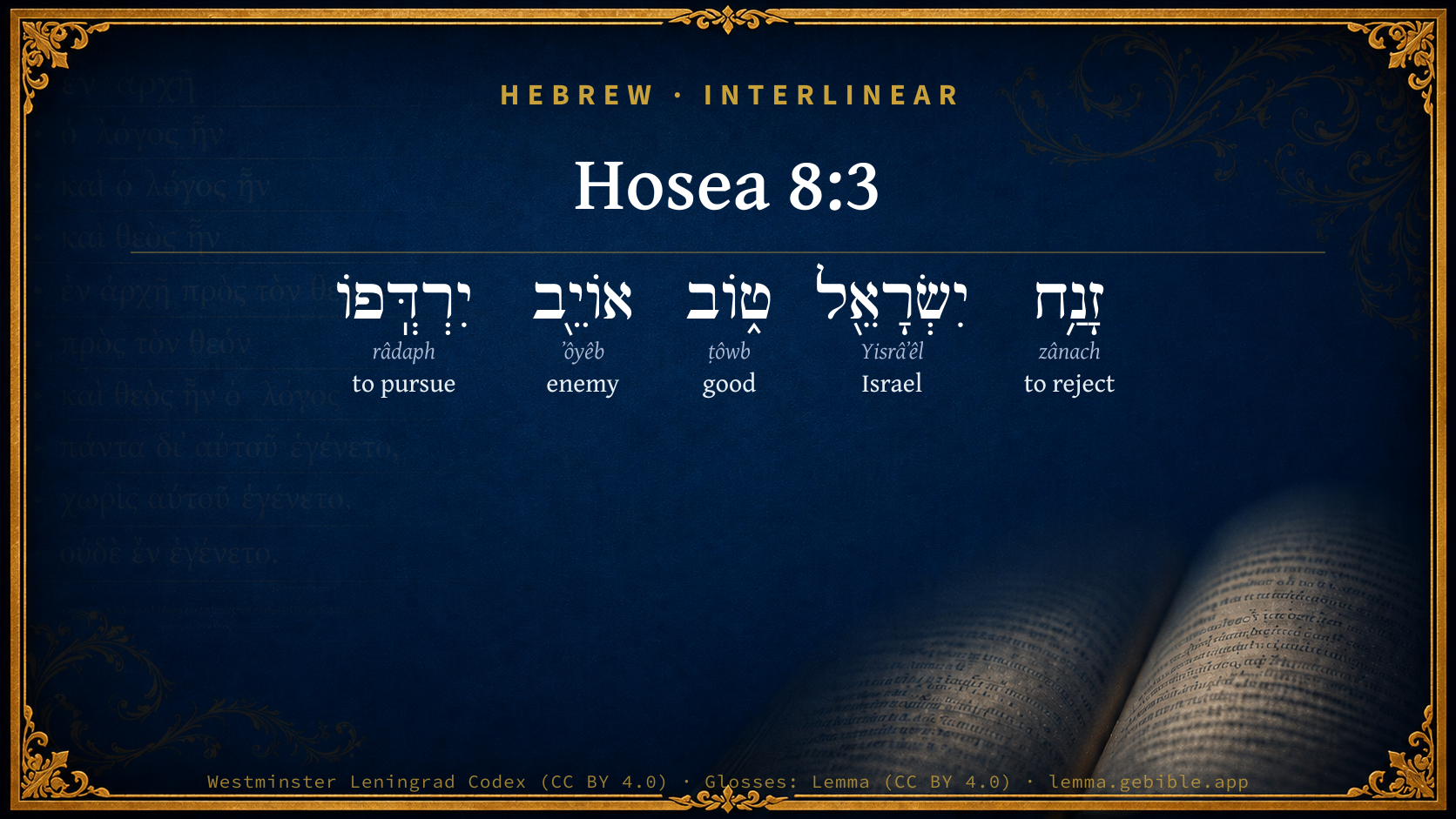
Hosea 8:3

Hebrew (Westminster Leningrad Codex) Hosea 8:3 appears in the Hebrew Old Testament. The text above is from the Westminster Leningrad Codex. Each word links to its Strong’s number, a concise gloss, and parsing drawn from the Open Scriptures Hebrew Bible morphology. Click any word for its full Brown-Driver-Briggs (BDB) entry.
Download image
Cite this verse

Hosea 8:3 (World English Bible). Public Domain. Lemma interlinear Bible study tool, https://lemma.gebible.app/v/hosea/8/3.

Show BibTeX & RIS
BibTeX
RIS
English Translation
Israel has cast off that which is good. The enemy will pursue him.
World English Bible · Public Domain
Download a study sheet

One document with this verse’s original text, its word-by-word gloss line, the meaning frame, cross-references with their text, attributed commentary, and full source and license credits — printable, and it pastes into notes with its structure intact.

This verse Autodidact and up

Study sheet (.html) Plain text (.txt)

A passage Seminary Student

Up to 50 verses in one chapter. A passage sheet keeps up to 6 commentary sources and 12 cross-references per verse, in the order this page ranks them, and says so on the sheet whenever that leaves anything out. Ask for a single verse and you get the Autodidact verse sheet above.

Everything on this page stays free to read, with no account — the sheet is a download of what is already on screen, not access to it.

Want to remove ads? Support Godless Engineer
Compare translations 3

The same verse in 3 English versions, stacked beneath the original-language interlinear above. Click any original word for its lexicon entry.

Each is an independent rendering of the whole verse — the interlinear is not word-aligned to these translations.

Highlighted words mark where these versions differ — a whole-verse word diff, not a word-by-word alignment.

  • World English Bible Public Domain
    Israel has cast off that which is good. The enemy will pursue him.
  • King James Version Public Domain
    Israel hath cast off the thing that is good: the enemy shall pursue him.
  • unfoldingWord Literal Text CC BY-SA 4.0
    Israel has rejected the good; an enemy will pursue him.

unfoldingWord Literal Text — © unfoldingWord, licensed CC BY-SA 4.0. Word-aligned USFM3 via Door43 (git.door43.org/unfoldingWord/en_ult).

Versions to compare (up to 4)

3 of 4 selected

Show all 18 translations

Every available English version of this verse, each an independent rendering of the whole verse.

  • World English Bible Public Domain
    Israel has cast off that which is good. The enemy will pursue him.
  • Berean Standard Bible Public Domain
    But Israel has rejected good; an enemy will pursue him.
  • Majority Standard Bible Public Domain
    But Israel has rejected good; an enemy will pursue him.
  • King James Version Public Domain
    Israel hath cast off the thing that is good: the enemy shall pursue him.
  • American Standard Version (1901) Public Domain
    Israel hath cast off that which is good: the enemy shall pursue him.
  • Revised Version (1885) Public Domain
    Israel hath cast off that which is good: the enemy shall pursue him.
  • Geneva Bible (1599) Public Domain
    Israel hath cast off ye thing that is good: the enemie shall pursue him.
  • Douay-Rheims (1899) Public Domain
    Israel hath cast off the thing that is good, the enemy shall pursue him.
  • Young's Literal Translation Public Domain
    Cast off good hath Israel, an enemy pursueth him.
  • Literal Standard Version CC BY-SA 4.0
    Israel has cast off good, an enemy pursues him.
  • Unlocked Literal Bible CC BY-SA 4.0
    But Israel has rejected what is good, and the enemy will pursue him.
  • unfoldingWord Literal Text CC BY-SA 4.0
    Israel has rejected the good; an enemy will pursue him.
  • Darby Bible Public Domain
    Israel hath cast off good: the enemy shall pursue him.
  • World Messianic Bible Public Domain
    Israel has cast off that which is good. The enemy will pursue him.
  • Webster's Bible Public Domain
    Israel hath cast off the thing that is good: the enemy shall pursue him.
  • Free Bible Version CC BY-SA 4.0
    But Israel has rejected what is good. An enemy will chase after them.
  • Bible in Basic English Public Domain
    Israel has given up what is good; his haters will go after him.
  • JPS Tanakh (1917) Public Domain
    Israel hath cast off that which is good; the enemy shall pursue him.

Literal Standard Version (2020), Covenant Press — licensed CC BY-SA 4.0. Text via the HelloAO Bible API (eBible.org). Unlocked Literal Bible (unfoldingWord) — licensed CC BY-SA 4.0. Text via the HelloAO Bible API (eBible.org). unfoldingWord Literal Text — © unfoldingWord, licensed CC BY-SA 4.0. Word-aligned USFM3 via Door43 (git.door43.org/unfoldingWord/en_ult). Free Bible Version, Dr. Jonathan Gallagher — licensed CC BY-SA 4.0. Text via the HelloAO Bible API (eBible.org).

Word by word

More ways to search: Search by grammar → Find every occurrence → Compare this word →

Practice this passage: Drill this verse → Learn its vocabulary →

About this verse

These counts appear in no published source. They are computed here, from the morphology-tagged text and Lemma’s own curated glosses. What Lemma adds →

5
words
5
distinct lemmas
Prophets
section

Notable vocabulary

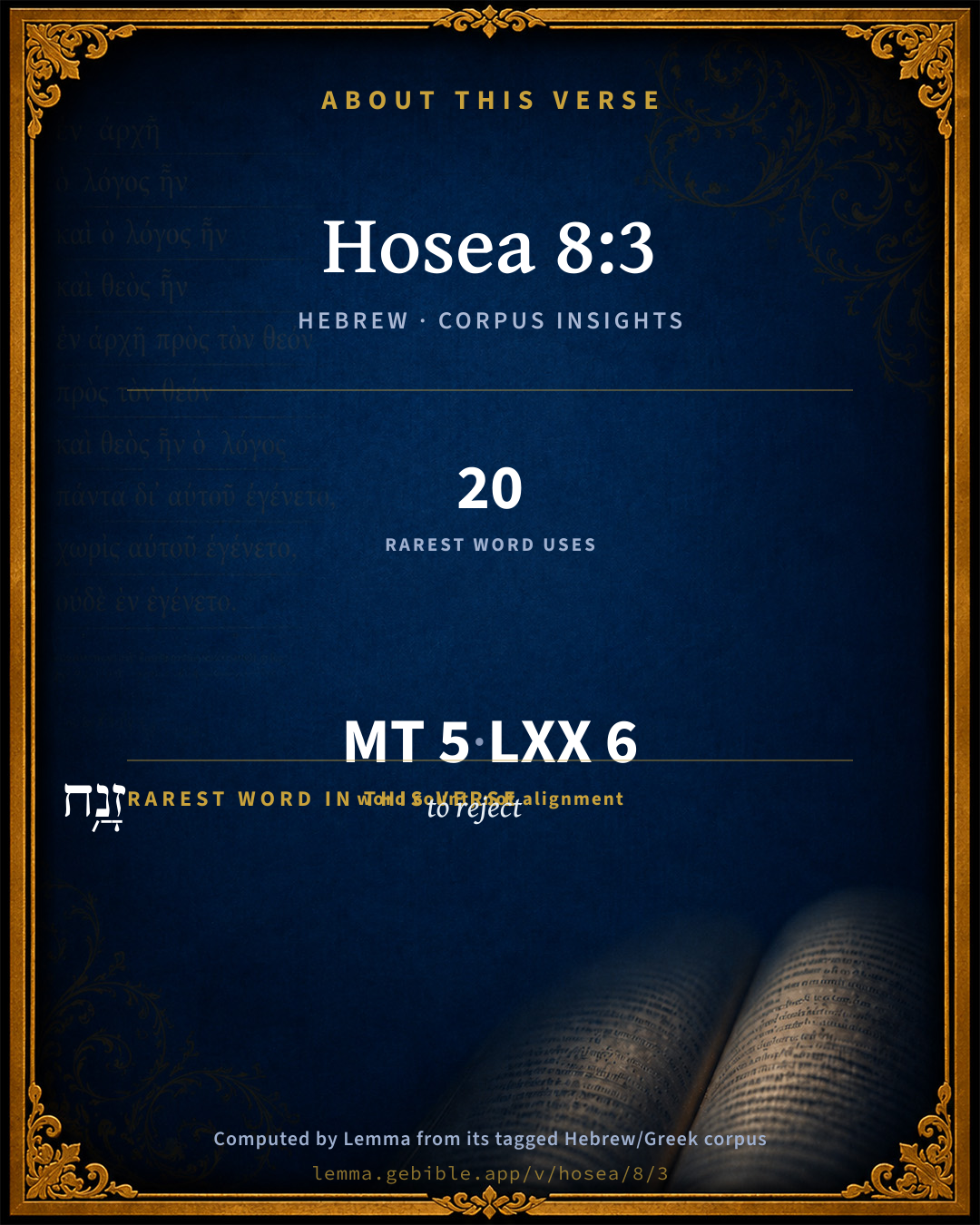
The rarest word here is זָנַ֥ח to reject H2186 — appearing just 20 times in the whole Hebrew Bible.

Shared distinctive vocabulary

זָנַ֥ח to reject H2186 occurs in 20 verses of the Hebrew Bible. Also found in:

Grammatical profile

  • 3 verbs
  • 1 noun
  • 1 adjective

Verb forms

  • זָנַ֥ח Qal · Perfect
  • אוֹיֵ֖ב Qal · Participle Active
  • יִרְדְּֽפוֹ Qal · Imperfect

Hebrew & Septuagint length

In English translation the verse runs 13 words from the Hebrew and 13 from the Septuagint (LXX English) — the same length.

A rough comparison of the two English renderings, which tokenize alike — not a word-level alignment.

Word counts can differ between the Hebrew and the Greek without any difference in meaning — e.g. the Hebrew direct-object marker אֵת has no separate Greek word, and Greek often adds the article ὁ.

In the original languages it is 5 Hebrew tokens and 6 Greek tokens — but the two are counted differently (Hebrew bundles its prefixes and suffixes into one token; the Greek is in lemma form), so that isn’t a like-for-like length.

Cross-references

8

Topical passages linked to Hosea 8:3 in the Treasury of Scripture Knowledge — connected by theme and wording, ordered by reader-vote popularity; previews shown in the World English Bible.

  • Psalms 81:10–11 I am Yahweh, your God, Who brought you up out of the land of Egypt. Open your mouth wide, and I will fill it.
  • Lamentations 3:66 You will pursue them in anger, and destroy them from under the heavens of Yahweh.
  • Amos 1:11 Thus says Yahweh: "For three transgressions of Edom, yes, for four, I will not turn away its punishment; Because he pursued his brother with the sword, And cast off all pity, And his anger raged continually, And he kept his wrath forever;
  • Leviticus 26:36 "'As for those of you who are left, I will send a faintness into their hearts in the lands of their enemies: and the sound of a driven leaf will put them to flight; and they shall flee, as one flees from the sword; and they will fall when no one pursues.
  • Deuteronomy 28:25 Yahweh will cause you to be struck before your enemies; you shall go out one way against them, and shall flee seven ways before them: and you shall be tossed back and forth among all the kingdoms of the earth.
  • Psalms 36:3 The words of his mouth are iniquity and deceit. He has ceased to be wise and to do good.
  • Lamentations 4:19 Our pursuers were swifter than the eagles of the sky: They chased us on the mountains, they laid wait for us in the wilderness.
  • 1 Timothy 5:12 having condemnation, because they have rejected their first pledge.

Cross-references courtesy of OpenBible.info (CC BY 4.0).

Hebrew and Greek witnesses Masoretic Hebrew ↔ Greek Septuagint

The same verse in the two great witnesses to the Old Testament, shown verse-for-verse.

These are two independent witnesses, not word-aligned to each other, and the Septuagint is shown in lemma (dictionary) form.

Hebrew Hosea 8:3 Masoretic · Westminster Leningrad Codex

זָנַ֥ח יִשְׂרָאֵ֖ל ט֑וֹב אוֹיֵ֖ב יִרְדְּֽפוֹ

Israel has cast off that which is good. The enemy will pursue him.

World English Bible · Public Domain

Greek LXX Hosea 8:3 Septuagint · lemma form

ὅτι ἰσραήλ ἀποστρέφω ἀγαθός ἐχθρός καταδιώκω

For Israel has turned away from good things; they have pursued an enemy.

LXX2012 (modern English Septuagint) · Public Domain

On this verse, Haydock's Catholic Bible Commentary discusses the Septuagint’s reading. Read the note in Commentary ↓

Hebrew: Westminster Leningrad Codex (CC BY 4.0). Greek: Septuagint (public domain); English from LXX2012 (modern English Septuagint) (Public Domain). How the Septuagint differs from the Hebrew →

Targum (Aramaic paraphrase)

1

The Targum is the ancient Jewish Aramaic paraphrase of the Hebrew Scriptures — an interpretive translation, not the Hebrew text itself. Onkelos (literal) and Pseudo-Jonathan (expansive) render the Torah, and Jonathan the Prophets. Coverage is partial: where no permissively-licensed English translation exists for a verse, only the Aramaic is shown. This is verse-level text, not a word-by-word alignment to the Hebrew.

  1. Targum Jonathan Prophets (Joshua–Malachi)
    טָעוּ בֵית יִשְׂרָאֵל מִבָּתַר פּוּלְחָנִי דִי בְדִילֵיהּ אֲנָא מַיְתֵי עֲלֵיהוֹן טוּבָא מִכְּעַן סַנְאָה יִרְדְפִינוּן:

    (no public-domain English translation for this verse)

    Targum Jonathan — Aramaic: “Mikraot Gedolot” (public domain). English: “Sefaria Community Translation” (CC0 1.0 (public-domain dedication)); “London "Chaldee Paraphrase," 1871” (public domain). Text via Sefaria.

Commentary

Notes on Hosea 8:3 from classic Christian and Jewish commentators (each source and its license shown beneath its notes). The classic Christian expositions comment on the surrounding passage and are grouped to its opening verse, so a note may address several verses; the Jewish commentaries on the Tanakh (Rashi and others) are per-verse, so they appear only where the commentator wrote on this verse.

Lemma curates 59 commentaries, every one of them public domain or Creative Commons licensed, each selected and text-cleaned for this edition rather than reprinted as found. About our sources →

Trapp's Complete Commentary

John Trapp

Hos 8:3 Israel hath cast off [the thing that is] good: the enemy shall pursue him.

Ver. 3. Israel hath cast off the thing that is good] Heb. the good: as, first, the good God, who is good, original, universal, all-sufficient, and satisfactory, proportionable and fitting to our soul. He both is good and doeth good, Psa 119:68, and that both naturally, abundantly, freely, and constantly. "Good thou art, O Lord, and ready to forgive," saith David, Psa 86:5. And, the good Lord be merciful, saith Hezekiah in his prayer for the people, 2Ch 30:9; 2Ch 30:18. To speak properly, there is none good but God, saith our Saviour, Mat 19:17, but Israel cast him, or rather kicked him, off ( procul a se reiecit), as the word signifieth. So do all gross hypocrites; they are rank atheists, practical atheists, though professional Christians. Secondly, they reject Christ as a sovereign, thongh they could be content to have him as a Saviour; they send messages after him, saying, We will not have this man to rule ever us; they will not submit to the laws of his kingdom, nor receive him in all his offices and efficacies; they are Christless creatures, as without God, so without Christ in the world. Thirdly, hypocrites reject the good Spirit of God (as David calleth him, Psa 143:10), the fruit whereof is in all goodness, and righteousness, and truth, Eph 5:9. When God striveth with them by his good Spirit, {as Neh 9:20} they, by yielding to Satan’s suggestions, grieve that Holy Spirit, and by grieving resist him, and by resisting quench him, and by quenching maliciously oppose him, and offer despite unto him; and so cast themselves into the punishing hands of the living God, Heb 10:29; Heb 10:31. Lastly, they cast off the good word and true worship of God; those "right judgments, true laws, good statutes and commandments," Neh 9:13; they put the promises from them, and judge themselves unworthy of everlasting life, Act 13:46; they hate instruction, and cast God’s words behind them, Psa 50:17. In a word, "he hath left off to be wise, and to do good: he setteth himself in a way that is not good; he abhorreth not evil," Psa 36:3-4. The words may be read thus, The good (God) hath rejected Israel; the enemy, shall pursue him according to that in the Psalm, "God hath forsaken him: persecute and take him; for there is none to deliver him," Psa 71:11. Sure it is that the Lord is with us while we are with him; and if we seek him he will be found of us. But if we forsake him he will forsake us. And if he forsake us woe be to us, Hos 9:12, we are in danger to be caught up by every paltry enemy, as young lapwings are to be snatched up by every buzzard. If Israel cast away the thing that is good, 2Ch 15:2, what marvel if evil hunt him to overthrow him, Psa 140:11, and if he find himself in all evil in the midst of the congregation and the assembly, Pro 5:14. Hence Cain’s fear, when cast out by God; and Saul’s complaint, that the Philistines were upon him, and God had forsaken him.

John Trapp, A Commentary or Exposition upon All the Books of the Old and New Testament (1647–1656) — public domain. Text from a community e-Sword module.

The Biblical Illustrator

Joseph S. Exell

Hos_8:3

Israel hath cast off the thing that is good: the enemy shall pursue him.

The chastening of them that forsake God

In this short sentence we have at once the sin of Israel and his punishment. Consider the various ways in which Israel may be said to have cast off the thing that is good.

I. By their murmurings. So long as they trusted Gods Word, they continued to walk safely. When they began to murmur, Amalek came upon them.

II. By their idolatries. When God was arranging for their worship, they made and worshipped the golden calves.

III. By their rebellion. As in their response to the message of the returned spies. Referring to Israel in their later history, we may say--

IV. By their rejection of Christ. Because, when Messiah did come, He did not suit their expectations, they despised and rejected Him. And the enemy was not slow in pursuing them. Their city was destroyed, and they were scattered over the earth. This threat is not confined to Israel. It is equally applicable to nations and to individuals now. (N. Ashby.)

Good rejected

Him who is good, That which is good. The word tob includes both. They rejected good in rejecting God, who is simply, supremely, wholly, universally good, and good to all, the Author and Fountain of all good, so that there is nothing simply good but God, nothing worthy of that title, except in respect of its relation to him who is good and doing good. (E. B. Pusey, D. D.)

The abandonment of good, and consequent pursuit of evil

I. The abandonment of good. Israel hath rejected what is good. The good here is the true worship of the true God.

1. True, Worship is the good thing for man. It is good not only because God requires it, but because it is the necessary condition of spiritual life, growth, harmony, and blessedness.

2. This good thing man sometimes abandons. Moral mind has the power of abandoning the highest good.

3. The abandonment of this good thing imperils the soul. Moral good is the only effective safeguard of the spirit; when this is given up, or cast off, all the gates of the soul are thrown open to tormenting fiends.

II. The consequent pursuit of evil. Set up kings, but not by Me. Reference is to Jeroboam and his successors. From kings of their own making came the setting up of the idolatrous calf-worship. So they went wrong in their politics and in their religion. Let a man go wrong in his relations to God, and he will go wrong in all his relations, secular and spiritual, There is nothing in connection with the human race of such transcendent importance as worship. The religious element is the strongest of all elements, and men must have a god of some sort, and their god will fashion their character and determine their destiny. (Homilist.)

The Biblical Illustrator, edited by Joseph S. Exell (c. 1880s–1900s) — public domain. Text from a community e-Sword module.

Keil & Delitzsch

C. F. Keil & F. Delitzsch

But this knowledge of God, regarded simply as a historical acquaintance with Him, cannot possibly bring salvation. Hos 8:3. "Israel dislikes good; let the enemy pursue it." This is the answer that God will give to those who cry to Him. טוב denotes neither "Jehovah as the highest good" (Jerome) or as "the good One" (Sims.), nor "the good law of God" (Schmieder), but the good or salvation which Jehovah has guaranteed to the nation through His covenant of grace, and which He bestowed upon those who kept His covenant. Because Israel has despised this good, let the enemy pursue it.

Keil & Delitzsch — Biblical Commentary on the Old Testament (1861–1891) — public domain (CC PDM 1.0). Text via the HelloAO Bible API. (Old Testament only.)

Tyndale Open Study Notes

Tyndale Open Resources

8:3 Jesus tells us that God alone is good (Mark 10:18). God is the source of every good thing, yet Israel rejected him.

Tyndale Open Study Notes — © Tyndale Open Resources, licensed CC BY-SA 4.0. Text via the HelloAO Bible API.

Jamieson, Fausset & Brown

Robert Jamieson, A. R. Fausset & David Brown

Israel--God repeats the name in opposition to their use of it (Hos 8:2).

the thing that is good--JEROME translates, "God" who is good and doing good (Psa 119:68). He is the chief object rejected, but with Him also all that is good.

the enemy shall pursue him--in just retribution from God.

Jamieson, Fausset & Brown — Commentary Critical and Explanatory on the Whole Bible (1871) — public domain (CC PDM 1.0). Text via the HelloAO Bible API.

John Calvin's Commentaries

The verb זנח, zanech, means “to remove far off,” and “to throw to a distance;” and sometimes, as some think, “to detest.” There is here, I doubt not, an implied contrast between the rejection of good and the pursuing of which the Prophet speaks afterwards, Israel has driven good far from himself; some expound טוב, thub, of God himself, as if it was of the masculine gender: but the Prophet, I have no doubt, simply accuses the Israelites of having receded from all justice and uprightness; yea, of having driven far off every thing right and just. Israel, then, has repelled good; the enemy, he says, will pursue him There is a contrast between repelling and pursuing, as though the prophet said, that the Israelites had by their defection obtained this, that the enemy would now seize them. There is then no better defense for us against all harms than attention to piety and justice; but when integrity is banished from us, then we are exposed to all evils, for we are deprived of the aid of God. We then see how beautifully the Prophet compares these two things — the rejection of good by Israel — and their pursuit by their enemies. He then adds —

John Calvin's Commentaries (1540-1563) — public domain. Text from the Calvin Translation Society English edition (1840s-50s) via the Christian Classics Ethereal Library (ccel.org). Calvin's coverage is partial (roughly two-thirds of the Bible); uncommented books and verses are honest gaps, never fabricated. The 19th-century editor's footnotes and remarks are omitted so the notes are faithfully Calvin's own voice.

Ellicott's Commentary for English Readers

(3) Cast off.—Jehovah’s reply to Israel’s hollow repentance. The word “cast off” means a scornful loathing of what is putrescent or obscene. “The thing that is good” is the name of God, which is the salvation of Israel (Aben Ezra).

A Bible Commentary for English Readers, edited by Charles John Ellicott (1878–1897) — public domain. Text from a community e-Sword module.

The Cambridge Bible for Schools and Colleges

gen. ed. J. J. S. Perowne

3. The appeal is dismissed; Israel’s piety is but superficial (comp.Hos_6:1-4); his ‘knowledge of God’ is not that which Jehovah expects.

hath cast off] Not merely put aside out of caprice, but (as the word implies) cast off with loathing (see Hos_8:5).

The Cambridge Bible for Schools and Colleges (gen. ed. J. J. S. Perowne; Cambridge University Press, 1878–1918) — public domain. Text from a community e-Sword module.

John Gill's Exposition

Israel hath cast off the thing that is good,.... Or "rejected him that is good" (y); that is, God, as Kimchi observes; for there is none good but him, Mat 19:17; he is the "summum bonum", "the chiefest good" to men, and is essentially, originally, and infinitely good in himself, and the fountain of all goodness to his creatures; and yet Israel has rejected him with detestation and contempt, as the word (z) signifies, though they pretended to know him, which shows their hypocrisy; and therefore it is no wonder that their prayers were rejected by him: or they rejected the good word of God, the law, or doctrine contained in it, and the good worship, service, and fear of God, and indeed everything that was good, just, and right. Cocceius renders it, "the good One", or he that is God, the good God, "hath cast off Israel". This reading of the words Drusius also mentions, and seems to like best, and as agreeing with what follows; so Rivet; but the position of the words in the Hebrew text, and the accents, do not favour it;

the enemy shall pursue him; who is before compared to an eagle, which flies swiftly, and pursues its prey with eagerness and fierceness: Shalmaneser is meant, who should invade the land, come up to Samaria, besiege and take it; nothing should stop him, nor should Israel escape from him, since they had cast off the Lord, and everything that was good. The Targum is,

"the house of Israel have erred from my worship, for the sake of which I brought good things upon them; henceforward the enemy shall pursue them.''

(y) "deseruit Israel bonum, i. e. Deum", Vatablus, Munster, Tarnovius, Zanchius. (z) "Abominatus est", Calvin, Zanchius.

John Gill's Exposition of the Whole Bible (1746–1763) — public domain (CC PDM 1.0). Text via the HelloAO Bible API.

Albert Barnes' Notes on the Bible

Israel has cast off the thing that is good - Or (since the word means “to cast off with abhorrence” “Israel hath east off and abhorred Good,” both “Him who is Good” and “that which is good.” The word “tob” includes both. They rejected good in rejecting God , “Who is simply, supremely, wholly, universally good, and good to all, the Author and Fountain of all good, so that there is nothing simply good but God; nothing worthy of that title, except in respect of its relation to Him who is “good and doining good” Psa 119:68. So then whatsoever any man hath or enjoys of good, is from his relation to Him, his nearness to Him, his congruity with Him. “The drawing near to God is good to me” Psa 73:28. All that any man hath of good, is from his being near to God, and his being, as far as human condition is capable of, like unto Him. So that they who are far from Him, and put Him far from them, necessarily “cast off” all that is “good.”

The enemy shall pursue him - “Forsaking God, and forsaken by Him, they must needs be laid open to all evils.” The “enemy,” i. e., the Assyrian, “shall pursue him.” This is according to the curse, denounced against them in the law, if they should forsake the Lord, and break His covenant, and “not hearken to His voice to observe to do His commandments” Deu 28:15-25.

Albert Barnes' Notes on the Bible (1834–1885) — public domain. Text from a community e-Sword/MySword module.

Haydock's Catholic Bible Commentary

Him. Septuagint, "they have pursued the enemy." But the former sense is better. (Haydock) --- The Assyrians prevailed. (St. Jerome) --- They carried Israel into captivity, before Juda, ver. 9. (Worthington)

George Leo Haydock (1774–1849), Haydock's Catholic Family Bible and Commentary, 1859 edition — public domain. Excludes Psalms (Douay-Rheims chapter numbering differs from Protestant) and Deuterocanonical books (Catholic canon only).

Matthew Poole's English Annotations

This seems to be the answer God by his prophet gives to Israel; in the first part of the verse he doth refute their pretence of a peculiar relation and interest in God, in the latter he tells them what they must expect.

Israel, the whole house of Israel, hath. east off, with an abhorrence, as an adulterous wife puts away her husband.

Good; moral good to be done, all virtue and goodness; and the supreme good to be enjoyed, God, true religion and virtue; all cast off for idols, false religion, and debaucheries. Such a nation cannot be my people, nor do they know me.

The enemy shall pursue him; that enemy he would be delivered from, the Assyrian army, shall overthrow, and then pursue, till he have cooped him up in Samaria, and till he have brought them captives out of their own land into Chalah, Chabor, and Gozan, &c. By this they shall know that I know them, their transgressions and hypocrisy.

Matthew Poole's English Annotations on the Holy Bible (1683–1685) — public domain. Text from a community e-Sword/MySword module.

Whedon's Commentary on the Bible

Daniel D. Whedon

3. Israel hath cast off the thing that [“that which”] is good — Everything for which Jehovah stands; yea, Jehovah himself (compare Amo_5:4; Amo_5:6; Amo_5:14).

Cast off — A strong word, to cast off with loathing. Now they must suffer the consequences; the enemy will execute judgment.

The enemy shall pursue him — May also be rendered, let the enemy pursue him, expressing the decision of Jehovah that the enemy is to be allowed to proceed unhindered.

Daniel D. Whedon (gen. ed.), Commentary on the Old and New Testaments (1874–1909) — public domain. Text from a community e-Sword module.

The Pulpit Commentary

Israel hath cast off the thing that is good: the enemy shall pursue him. This is the reply of Jehovah. The good which Israel rejected is not exactly God the One Good, nor Jehovah the greatest Good, nor the Law, which was good; but all the goodness which he bestows on such as keep his covenant. This Israel rejected, and in turn is rejected of God and delivered up into the hands of his pursuers.

Vers. 3, 5 (parts). Sin"s mockery of the sinner.

"Israel hath cast off the thing that is good.... Thy calf, O Samaria, hath cast thee off." The power of the human will to choose good or evil. This evidenced by the representation Hoses gives of a people resolved on iniquity, whom God was longing to save. Refer to the teaching of our Lord upon this subject; e.g. "Ye will not come to me that ye might have life;" or, "How often would I have gathered thy children together as a hen doth gather her brood under her wings, but ye would not!" Appeal to experience for proof of our power to receive or reject good. Our text describes a fallacious, sinful, and fatal choice. The sin for which sacrifice was made ultimately sacrificed the sinner. Look at the two sides of this moral picture.

I THE CASTING OFF OF THE GOOD. "Israel hath cast off the thing that is good." Illustrate this by a delineation of the depraved condition of Israel at this period. Show that what they cast off is still being cast off by multitudes in modern life; e.g.:

1. Faith in the nearness of God. It was the loss of this which led Israel to form fatal alliances with the heathen. In our day materialism and Positivism are enervating, and sometimes destroying faith. The symbol of the spiritual is becoming the substitute for it, This may be traced both in the teachings of a school of philosophy, and in the sensuousness of ritualistic worship. Many have cast off the old faith thing that is good instead of believing where they cannot prove.

2. Fidelity in witnessing for God. It had been the glory of Israel to proclaim, both by its worship and in its history, the unity, the invisibility, and the holiness of God. By turning to the worship of visible idols, diverse in their attributes, yet all hideous in their impurity, they had deliberately repudiated this Divine commission. Still it is man"s peculiar dignity to appear as the witness and the worshipper of God, in whose image he was created, and over whose works he rules. Pre-eminently he may be the Divine witness by the moral character and the spiritual life inwrought in him by the Divine Spirit, who conforms us to the image of God"s Son. Falling short of this, man fails (as Israel failed) to fulfill his destiny. Hence, in proportion as a man refuses the grace of God, he casts off the thing that is good.

3. Obedience to the Law of God. Show from pagan history, and from the condition of modern heathen, as well as from the growing degradation of those to whom Hoses spoke, that idolatry brings with it moral deterioration. The man who ignores the first table of the Law will of necessity ignore the second also. Religious faith and moral rightness stand or fall together. When Israel turned from Jehovah to Baal and Astarte, the nation gradually but surely became false, self-seeking, ambitious in its political alliances, and hideously corrupt in its inward social condition. Israel had cast off the thing that was good.

4. Loyalty to sacred resolves. The people often appeared about to repent, but their goodness was transient as the morning cloud. How frequently now right impressions and even holy vows are cast off! How jealously all should guard themselves against the subtle influence of a busy life, or of an alluring pleasure, or of an ill-chosen companionship! There are many whose hearts are hard, and whose lives are godless, respecting whom, in memory of their early promise, it may be truly and sadly said, "They have cast off the thing that is good.

II THE CASTING OFF OF THE SINNER. "Thy calf, O Samaria, hath cast thee off"." History shows that Israel was ruined by trusting to Egypt and to its own martial prowess, instead of confiding In God and simply doing righteousness. Jeremiah"s words were fulfilled, "Cursed is the man that trusteth in man, and maketh flesh his arm, and whose heart departeth from the Lord." Casting off good, Israel was cast off by evil. See how often this principle is exemplified in the broader sphere of human life. That which men put in the place of God sooner or later fails them.

1. Pleasures fail to give satisfaction. When the soul tries to quench its thirst with these the words of Isaiah are fulfilled, "It shall even be as when a hungry man dreameth, and, behold, he eateth; but he awaketh, and his soul is empty." The awakening comes ultimately to every man, and it is well when it does not come too late.

2. Intellect fails to find spiritual truth. Spiritual things are spiritually discerned, and the unrest of many arise from the fact that they have cast off the yoke of him who alone was able to say, "I am the...Truth.

3. Self-righteousness fails to bring salvation. See our Lord"s words respecting the Pharisees. The house built on the sand stands side by side with the house founded upon the rock; but the testing-time comes to both.

4. The world fails to afford a home. Whether we will or not, the world must fail us at last. If we make it our servant, we shall rule like kings; if we make it our god, in our hour of helplessness it will cast us off.

CONCLUSION. "There be many that say, Who will show us any good? Lord, lift thou up the light of thy countenance upon us. A.R.

Vers. 3, 4. The abandonment of good, and the consequent pursuit of evil.

"Israel hath cast off the thing that is good." Two things are contained in these verses.

I THE ABANDONMENT OF GOOD. "Israel hath rejected what is good" (Elzas). The good here undoubtedly refers to the true worship of the true God. Observe:

1. That true worship is the "good thing" for man. It is good not only because God requires it, but because it is the necessary condition of spiritual life, growth, harmony, and blessedness. True worship is the soul"s only heaven.

2. That this "good thing" man sometimes abandons. Israel was once a true worshipper, but the true worship it had now "cast off." Fallen angels were once true worshipers, and many a human spirit once inspired with true devotion has fallen into worldliness and idolatry. Moral mind has the power of abandoning the highest good.

3. That the abandonment of this "good thing" imperils the soul. "The enemy shall pursue them." Moral good is the only effective safeguard of the spirit; when this is given up or "cast off," all the gates of the soul are thrown open to tormenting fiends. The walls of the vineyard axe broken down, and it lies exposed to the tread and ravages of every moral beast.

II THE CONSEQUENT PURSUIT OF EVIL. "They have set up kings, but not by me," etc. The setting up of kings here refers to the founding of the kingdom by Jeroboam, and to the entire series of Israelitish kings. The kings of Israel were not according to Divine ordination. (1Ki_11:27-40) "Their silver and their gold have they made them idols, that they may be out off." From these kings of their own making came the setting up of the idolatrous calf-worship which was started by Jeroboam. Though silver was not used in the construction of the golden calves, it was employed to support the idolatrous worship. Thus, because they abandoned the "good thing," they went wrong in their politics and religion. They made their own kings and their own gods. When once men give up the right they rush into the wrong. Let a man go wrong in relation to God, and he will go wrong in all his relations, secular and spiritual.

CONCLUSION. There is nothing in connection with the human race of such transcendent importance as worship. The religious element is the strongest of all elements; and men must have a god of some sort or other, and their god will fashion their character and determine their destiny. And yet from him we turn away, And fill our hearts with worthless things; And fires of avarice melt the clay, And forth the idol springs. Ambition"s flame and passion"s heat. By wondrous alchemy, transmute Earth"s dross, to raise some gilded brute To fill Jehovah"s seat. (J. H. Clinch.)

The Pulpit Commentary (1880–1919), ed. H.D.M. Spence-Jones & Joseph S. Exell — public domain. Text from a community e-Sword module.

Rashi

Rabbi Shlomo Yitzchaki (Rashi)

Israel has cast off the Good One Therefore, the enemy shall pursue him.

Rashi on the Tanakh — English translations: “The Judaica Press complete Tanach with Rashi, translated by A. J. Rosenberg” (CC BY 4.0); “Pentateuch with Rashi's commentary by M. Rosenbaum and A.M. Silbermann, 1929-1934” (public domain); “The Metsudah Tanach series, Lakewood, N.J” (CC BY 4.0); and “The Book of Joshua, Metsudah Publications, 1997” (CC BY 4.0). Text via Sefaria.

Lesson kit

Teaching starters — assembled from the data on this page, not authored interpretation. Every prompt links to the verse data it draws on. Edit before teaching.

Hosea, in the Prophets, opens this verse with 5 words (5 distinct Hebrew lemmas). Its most distinctive word is zânach (“to reject”). A historical commentator’s framing appears above. Read the whole chapter for the surrounding context.

Discussion questions

  1. What does “to reject” (zânach) contribute to the verse as a whole?
  2. How does 1 Chronicles 28:9, which shares the word «to reject», read alongside this verse?
  3. These translations render this verse differently. What is at stake in choosing one wording over another?
  4. «זָנַ֥ח» is a Qal Perfect verb. How does that grammatical form shape the action described?
  5. Compare how Trapp's Complete Commentary and The Biblical Illustrator read this verse. Where do they agree or differ?

Things to notice

Reading settings

Reading text

Shown beneath each verse's original-language words.

Old Testament
Old Testament edition

Read the OT as the Masoretic Hebrew (MT) or the Greek Septuagint (LXX).

English shown for the Greek Septuagint (in the Hebrew ↔ Greek comparison).

Comparing translations? Open the Compare panel on any verse page to stack up to four side by side.