Lamentations 4:19

Hebrew (Westminster Leningrad Codex) Lamentations 4:19 appears in the Hebrew Old Testament. The text above is from the Westminster Leningrad Codex. Each word links to its Strong’s number, a concise gloss, and parsing drawn from the Open Scriptures Hebrew Bible morphology. Click any word for its full Brown-Driver-Briggs (BDB) entry.
Download image
Cite this verse

Lamentations 4:19 (World English Bible). Public Domain. Lemma interlinear Bible study tool, https://lemma.gebible.app/v/lamentations/4/19.

Show BibTeX & RIS
BibTeX
RIS
English Translation
Our pursuers were swifter than the eagles of the sky: They chased us on the mountains, they laid wait for us in the wilderness.
World English Bible · Public Domain
Download a study sheet

One document with this verse’s original text, its word-by-word gloss line, the meaning frame, cross-references with their text, attributed commentary, and full source and license credits — printable, and it pastes into notes with its structure intact.

This verse Autodidact and up

Study sheet (.html) Plain text (.txt)

A passage Seminary Student

Up to 50 verses in one chapter. A passage sheet keeps up to 6 commentary sources and 12 cross-references per verse, in the order this page ranks them, and says so on the sheet whenever that leaves anything out. Ask for a single verse and you get the Autodidact verse sheet above.

Everything on this page stays free to read, with no account — the sheet is a download of what is already on screen, not access to it.

Want to remove ads? Support Godless Engineer
Compare translations 3

The same verse in 3 English versions, stacked beneath the original-language interlinear above. Click any original word for its lexicon entry.

Each is an independent rendering of the whole verse — the interlinear is not word-aligned to these translations.

Highlighted words mark where these versions differ — a whole-verse word diff, not a word-by-word alignment.

  • World English Bible Public Domain
    Our pursuers were swifter than the eagles of the sky: They chased us on the mountains, they laid wait for us in the wilderness.
  • King James Version Public Domain
    Our persecutors are swifter than the eagles of the heaven: they pursued us upon the mountains, they laid wait for us in the wilderness.
  • unfoldingWord Literal Text CC BY-SA 4.0
    Our pursuers were swifter than the eagles of the heavens. On the mountains they chased us; in the wilderness they lay in wait for us. RESH

unfoldingWord Literal Text — © unfoldingWord, licensed CC BY-SA 4.0. Word-aligned USFM3 via Door43 (git.door43.org/unfoldingWord/en_ult).

Versions to compare (up to 4)

3 of 4 selected

Show all 18 translations

Every available English version of this verse, each an independent rendering of the whole verse.

  • World English Bible Public Domain
    Our pursuers were swifter than the eagles of the sky: They chased us on the mountains, they laid wait for us in the wilderness.
  • Berean Standard Bible Public Domain
    Those who chased us were swifter than the eagles in the sky; they pursued us over the mountains and ambushed us in the wilderness.
  • Majority Standard Bible Public Domain
    Those who chased us were swifter than the eagles in the sky; they pursued us over the mountains and ambushed us in the wilderness.
  • King James Version Public Domain
    Our persecutors are swifter than the eagles of the heaven: they pursued us upon the mountains, they laid wait for us in the wilderness.
  • American Standard Version (1901) Public Domain
    Our pursuers were swifter than the eagles of the heavens: They chased us upon the mountains, they laid wait for us in the wilderness.
  • Revised Version (1885) Public Domain
    Our pursuers were swifter than the eagles of the heaven: they chased us upon the mountains, they laid wait for us in the wilderness.
  • Geneva Bible (1599) Public Domain
    Our persecuters are swifter then the eagles of the heauen: they pursued vs vpon the mountaines, and layed waite for vs in the wildernes.
  • Douay-Rheims (1899) Public Domain
    Coph. Our persecutors were swifter than the eagles of the air: they pursued us upon the mountains, they lay in wait for us in the wilderness.
  • Young's Literal Translation Public Domain
    Swifter have been our pursuers, Than the eagles of the heavens, On the mountains they have burned `after' us, In the wilderness they have laid wait for us.
  • Literal Standard Version CC BY-SA 4.0
    Swifter have been our pursuers, || Than the eagles of the heavens, || On the mountains they have burned [after] us, || In the wilderness they have laid wait for us.
  • Unlocked Literal Bible CC BY-SA 4.0
    Our pursuers were swifter than the eagles in the sky. They chased us to the mountains and lay in wait for us in the wilderness.
  • unfoldingWord Literal Text CC BY-SA 4.0
    Our pursuers were swifter than the eagles of the heavens. On the mountains they chased us; in the wilderness they lay in wait for us. RESH
  • Darby Bible Public Domain
    Our pursuers were swifter than the eagles of the heavens; they chased us hotly upon the mountains, they laid wait for us in the wilderness.
  • World Messianic Bible Public Domain
    Our pursuers were swifter than the eagles of the sky. They chased us on the mountains. They set an ambush for us in the wilderness.
  • Webster's Bible Public Domain
    Our persecutors are swifter than the eagles of heaven: they pursued us upon the mountains, they laid wait for us in the wilderness.
  • Free Bible Version CC BY-SA 4.0
    Our pursuers were faster than eagles in the sky. They chased us across the mountains and ambushed us in the desert.
  • Bible in Basic English Public Domain
    Those who went after us were quicker than the eagles of the heaven, driving us before them on the mountains, waiting secretly for us in the waste land.
  • JPS Tanakh (1917) Public Domain
    Our pursuers were swifter than the eagles of the heaven; they chased us upon the mountains, they lay in wait for us in the wilderness.

Literal Standard Version (2020), Covenant Press — licensed CC BY-SA 4.0. Text via the HelloAO Bible API (eBible.org). Unlocked Literal Bible (unfoldingWord) — licensed CC BY-SA 4.0. Text via the HelloAO Bible API (eBible.org). unfoldingWord Literal Text — © unfoldingWord, licensed CC BY-SA 4.0. Word-aligned USFM3 via Door43 (git.door43.org/unfoldingWord/en_ult). Free Bible Version, Dr. Jonathan Gallagher — licensed CC BY-SA 4.0. Text via the HelloAO Bible API (eBible.org).

Word by word

More ways to search: Search by grammar → Find every occurrence → Compare this word →

Practice this passage: Drill this verse → Learn its vocabulary →

דְּלָקֻ֔נוּ
dâlaq
H1814
“to burn · us”
Verb, Qal, Perfect, 3rd Person, Common, Plural + Suffix, Personal, 1st Person, Common, Plural
Part of Speech
Verb
Stem
Qal
Form
Perfect
Person
3rd Person
Gender
Common
Number
Plural
Full BDB Definition

Origin: a primitive root

TWOT: 435

to burn, hotly pursue - (Qal) - to burn - to hotly pursue - (Hiphil) - to kindle - to inflame
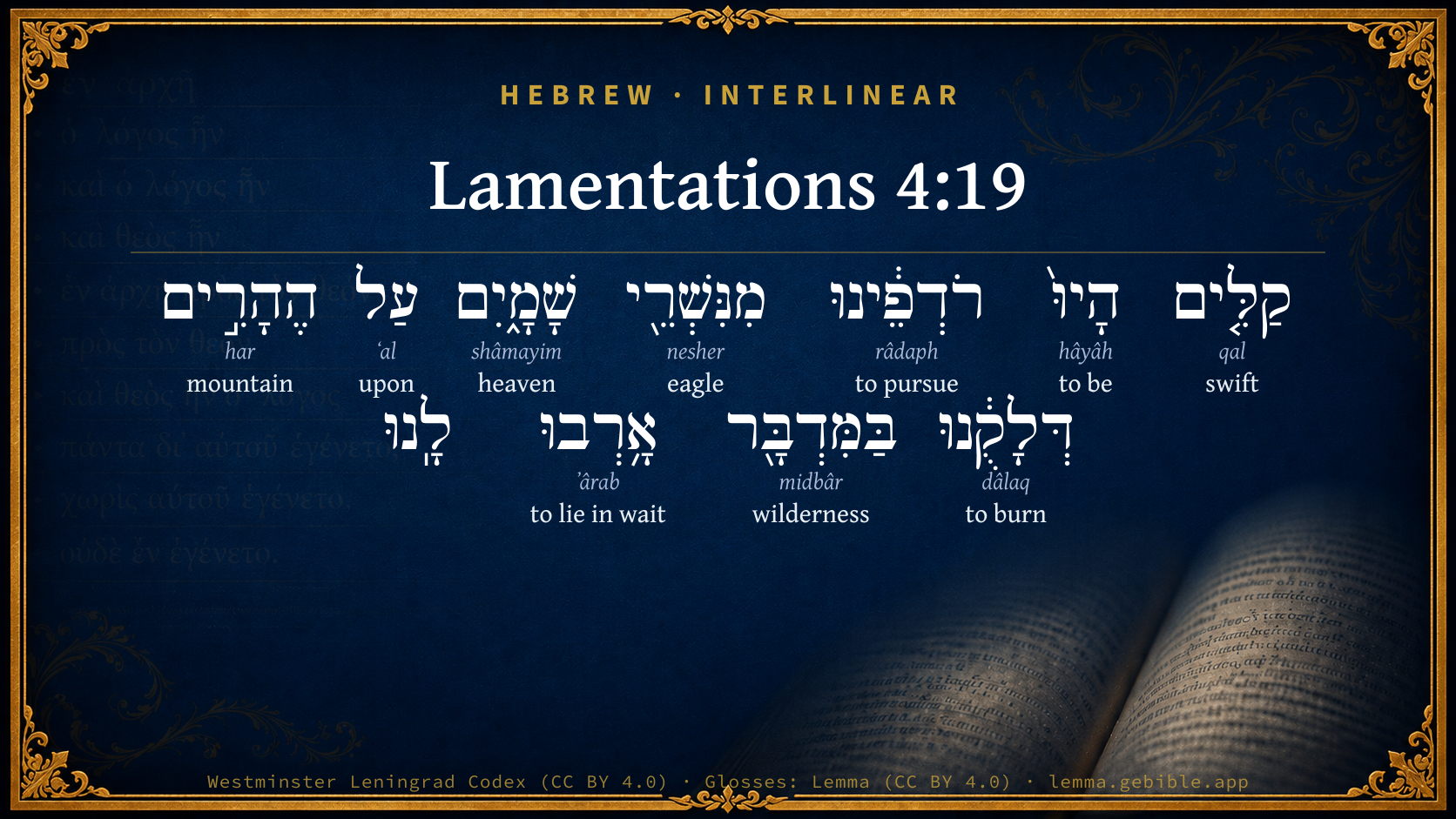
  1. קַלִּ֤ים qal H7031 “swift” Adjective, Adjective, Masculine, Plural, Absolute
  2. הָיוּ֙ hâyâh H1961 “to be” Verb, Qal, Perfect, 3rd Person, Common, Plural
  3. רֹדְפֵ֔ינוּ râdaph H7291 “pursuing · us” Verb, Qal, Participle Active, Masculine, Plural, Construct + Suffix, Personal, 1st Person, Common, Plural
  4. מִנִּשְׁרֵ֖י nesher H5404 “from · eagles of” Preposition + Noun, Common, Masculine, Plural, Construct
  5. שָׁמָ֑יִם shâmayim H8064 “heaven(s)” Noun, Common, Masculine, Plural, Absolute
  6. עַל ʻal H5921 “upon” Preposition
  7. הֶהָרִ֣ים har H2022 “the · mountains” Particle, Definite Article + Noun, Common, Masculine, Plural, Absolute
  8. בַּמִּדְבָּ֖ר midbâr H4057 “in/at the · wilderness” Preposition, Determined + Noun, Common, Masculine, Singular, Absolute
  9. אָ֥רְבוּ ʼârab H693 “to lie in wait” Verb, Qal, Perfect, 3rd Person, Common, Plural

About this verse

These counts appear in no published source. They are computed here, from the morphology-tagged text and Lemma’s own curated glosses. What Lemma adds →

11
words
10
distinct lemmas
Prophets
section

Notable vocabulary

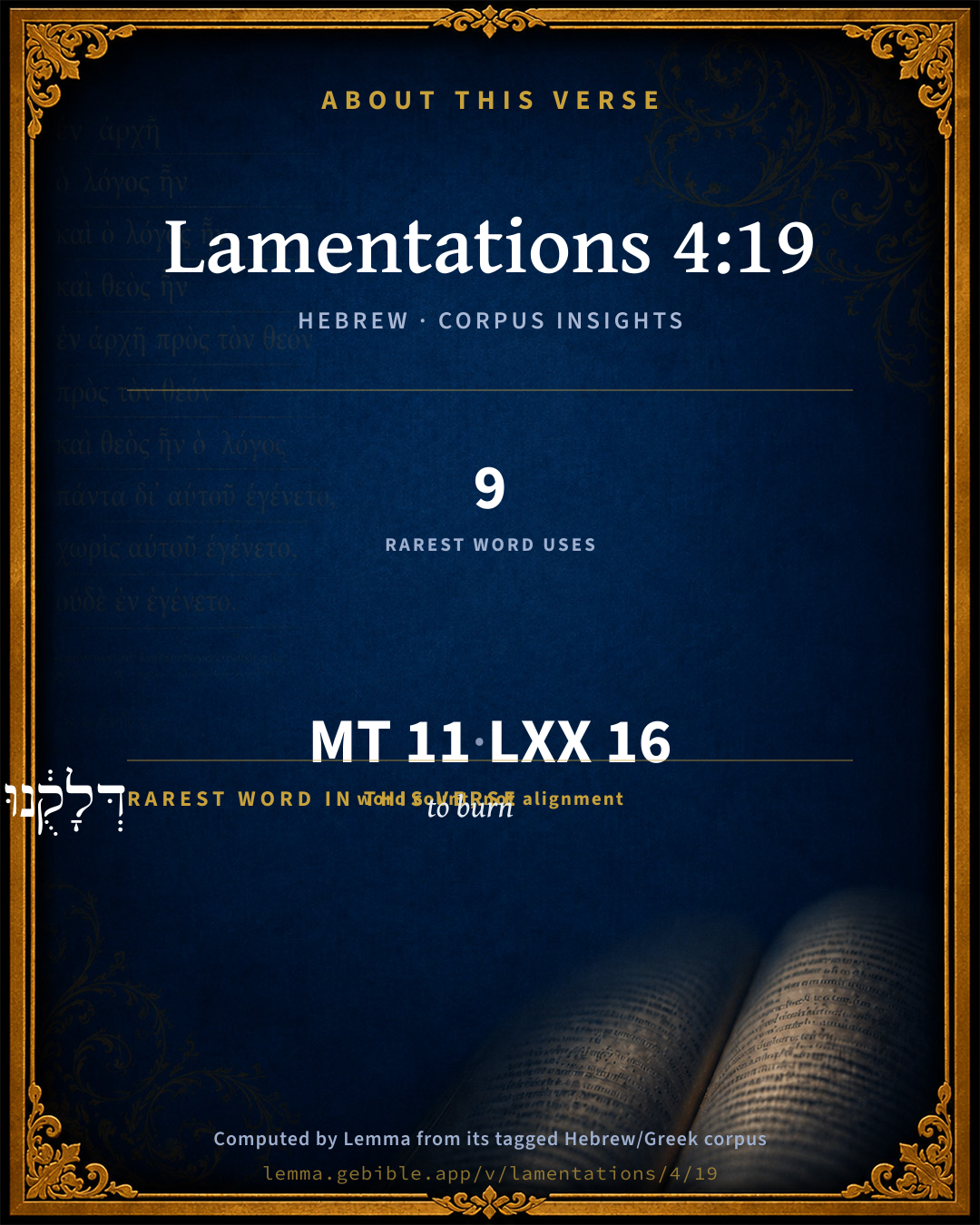
The rarest word here is דְּלָקֻ֔נוּ to burn H1814 — appearing just 9 times in the whole Hebrew Bible.

Shared distinctive vocabulary

דְּלָקֻ֔נוּ to burn H1814 occurs in 9 verses of the Hebrew Bible. Also found in:

Grammatical profile

  • 4 verbs
  • 4 nouns
  • 1 adjective
  • 2 prepositions

Verb forms

  • הָיוּ֙ Qal · Perfect
  • רֹדְפֵ֔ינוּ Qal · Participle Active
  • דְּלָקֻ֔נוּ Qal · Perfect
  • אָ֥רְבוּ Qal · Perfect

Hebrew & Septuagint length

In English translation the verse runs 24 words from the Hebrew and 23 from the Septuagint (LXX English) — closely comparable.

A rough comparison of the two English renderings, which tokenize alike — not a word-level alignment.

Word counts can differ between the Hebrew and the Greek without any difference in meaning — e.g. the Hebrew direct-object marker אֵת has no separate Greek word, and Greek often adds the article ὁ.

In the original languages it is 11 Hebrew tokens and 16 Greek tokens — but the two are counted differently (Hebrew bundles its prefixes and suffixes into one token; the Greek is in lemma form), so that isn’t a like-for-like length.

Cross-references

9

Topical passages linked to Lamentations 4:19 in the Treasury of Scripture Knowledge — connected by theme and wording, ordered by reader-vote popularity; previews shown in the World English Bible.

  • Jeremiah 4:13 Behold, he shall come up as clouds, and his chariots [shall be] as the whirlwind: his horses are swifter than eagles. Woe to us! for we are ruined.
  • Habakkuk 1:8 Their horses also are swifter than leopards, and are more fierce than the evening wolves. Their horsemen press proudly on. Yes, their horsemen come from afar. They fly as an eagle that hurries to devour.
  • Isaiah 5:26–28 He will lift up a banner to the nations from far, And he will whistle for them from the end of the earth. Behold, they will come speedily and swiftly.
  • Deuteronomy 28:49 Yahweh will bring a nation against you from far, from the end of the earth, as the eagle flies; a nation whose language you shall not understand;
  • Isaiah 30:16–17 but you said, No, for we will flee on horses; therefore shall you flee: and, We will ride on the swift; therefore shall those who pursue you be swift.
  • Hosea 8:1 "Put the trumpet to your lips! Something like an eagle is over Yahweh's house, Because they have broken my covenant, And rebelled against my law.
  • Amos 2:14 Flight will perish from the swift; And the strong won't strengthen his force; Neither shall the mighty deliver himself;
  • Amos 9:1–3 I saw the Lord standing beside the altar, and he said, "Strike the tops of the pillars, that the thresholds may shake; and break them in pieces on the head of all of them; and I will kill the last of them with the sword: there shall not one of them flee away, and there shall not one of them escape.
  • Matthew 24:27–28 For as the lightning comes forth from the east, and is seen even to the west, so will be the coming of the Son of Man.

Cross-references courtesy of OpenBible.info (CC BY 4.0).

Hebrew and Greek witnesses Masoretic Hebrew ↔ Greek Septuagint

The same verse in the two great witnesses to the Old Testament, shown verse-for-verse.

These are two independent witnesses, not word-aligned to each other, and the Septuagint is shown in lemma (dictionary) form.

Hebrew Lamentations 4:19 Masoretic · Westminster Leningrad Codex

קַלִּ֤ים הָיוּ֙ רֹדְפֵ֔ינוּ מִנִּשְׁרֵ֖י שָׁמָ֑יִם עַל הֶהָרִ֣ים דְּלָקֻ֔נוּ בַּמִּדְבָּ֖ר אָ֥רְבוּ לָֽנוּ

Our pursuers were swifter than the eagles of the sky: They chased us on the mountains, they laid wait for us in the wilderness.

World English Bible · Public Domain

Greek LXX Lamentations 4:19 Septuagint · lemma form

κοῦφος γίγνομαι ὁ διώκω ἐγώ ὑπέρ ἀετός οὐρανός ἐπί ὁ ὄρος ἐκἅπτω ἐν ἐρῆμος ἐνήδρευσαν ἐγώ

Our pursuers were swifter than the eagles of the sky, they flew on the mountains, in the wilderness they laid wait for us.

LXX2012 (modern English Septuagint) · Public Domain

Hebrew: Westminster Leningrad Codex (CC BY 4.0). Greek: Septuagint (public domain); English from LXX2012 (modern English Septuagint) (Public Domain). How the Septuagint differs from the Hebrew →

Commentary

Notes on Lamentations 4:19 from classic Christian and Jewish commentators (each source and its license shown beneath its notes). The classic Christian expositions comment on the surrounding passage and are grouped to its opening verse, so a note may address several verses; the Jewish commentaries on the Tanakh (Rashi and others) are per-verse, so they appear only where the commentator wrote on this verse.

Lemma curates 59 commentaries, every one of them public domain or Creative Commons licensed, each selected and text-cleaned for this edition rather than reprinted as found. About our sources →

Trapp's Complete Commentary

John Trapp

Lam 4:19 Our persecutors are swifter than the eagles of the heaven: they pursued us upon the mountains, they laid wait for us in the wilderness.

Ver. 19. Our persecutors are swifter than the eagles.] Those swiftest of all fowl, whom Pindarus therefore calleth the queen of birds as the dolphin of fishes, for like swiftness. The Egyptians, their pretended helpers, were slow as snails; the Chaldees swifter than eagles.

They pursued us.] Or, They chased us, or traced us, like bloodhounds.

They laid wait for us in the wilderness.] They met us at every turn, and left us no means of escape.

John Trapp, A Commentary or Exposition upon All the Books of the Old and New Testament (1647–1656) — public domain. Text from a community e-Sword module.

Jamieson, Fausset & Brown

Robert Jamieson, A. R. Fausset & David Brown

The last times just before the taking of the city. There was no place of escape; the foe intercepted those wishing to escape from the famine-stricken city, "on the mountains and in the wilderness."

swifter . . . than . . . eagles--the Chaldean cavalry (Jer 4:13).

pursued--literally, "to be hot"; then, "to pursue hotly" (Gen 31:36). Thus they pursued and overtook Zedekiah (Jer 52:8-9).

Jamieson, Fausset & Brown — Commentary Critical and Explanatory on the Whole Bible (1871) — public domain (CC PDM 1.0). Text via the HelloAO Bible API.

Adam Clarke's Commentary

Verse 19. They pursued us upon the mountains] They hunted down the poor Jews like wild beasts in every part of the country by their marauding parties, whilst the great army besieged Jerusalem. But this may apply to the pursuit of Zedekiah. See what follows.

Adam Clarke's Commentary on the Bible (1810–1826) — public domain. Text from a community e-Sword/MySword module.

John Calvin's Commentaries

Here, then, the Prophet means, that the Jews were so straitened, that there was no escape for them, because their steps were observed by their enemies, and also because the Chaldeans had recourse to the greatest celerity, that they might take them.

He then, says, first, that their enemies were like hunters, for the Jews could not go even through the streets of their own city. We know that they were reduced to the greatest straits; but how hard the siege was is better expressed by this similitude, even that they dared not walk through the city; for there is an implied comparison, as though he had said, “We had no liberty in the very city, much less were we allowed to go out and ramble through the open fields.” he, in the second place, adds what corresponds with the first clause, Approach did our end, fulfilled were our days; surely come did our end He concludes, that no hope remained since their enemies were thus oppressing them. He, then, infers that the end was at hand, by which he means final ruin or destruction; and he adds, that the days were fulfilled, where, he seems to compare the state of Jerusalem with the life of man; for he is said to have fulfilled his day who leaves the world — for a certain time for cur sojourn has been prefixed. God, when it pleases him, calls us to himself. Hence, our time is then fulfilled, as our course is said to be finished; for, as the life of man is compared in Scripture to a race, so death is like the goal. So now, speaking of the city, the Prophet says that its time was fulfilled, for it was not God’s will that it should remain any longer. In the third place, he says, that the end had come. He said before, that it was nigh, but he says now, that it had come. he, in short, shows that God, having long spared the Jews, when he saw that they made no end of sinning, at length had recourse to rigor, for they had shamefully abused his forbearance; for he had long suspended his judgment, and had often tried whether they were healable. The Prophet, then, reproves now their obstinacy, when he says that their end had come, and that their time was fulfilled.

He afterwards, for the same purpose, adds, that swifter than eagles had been their persecutors or pursuers. The Prophet, no doubt;, continues the same subject. As, then, he had made the Chaldeans to be like hunters, so he says now, that in flying they exceeded the eagles. It is, indeed. a hyperbolical expression, but the Prophet could not otherwise express the incredible celerity with which the Chaldeans hastened in pursuing the Jews. Nor is there a doubt but that he indirectly derided the security of the foolish people; for we know, that whenever the prophets threatened them, this false opinion ever prevailed, that the Chaldeans would not come, because they were far away, the journey was long and difficult, time were many hinderances. The Prophet, then, now taunts them for this confidence, by which they had been deceived, when he says, that swifter titan the eagles of the heavens were their enemies.

He mentions the ways they adopted, Through the mountains they pursued, and laid in wait in the desert. He means that every way of escape was closed up. For when enemies come, many hide themselves on mountains and thus escape; and others, betaking themselves to the desert, find there some hiding-places. But the Prophet says that such was the velocity of the Chaldeans, that the Jews in vain looked to the mountains or to deserts, for snares were everywhere prepared, and they were present everywhere to pursue them. Thus he confirms what he had said, that the time was fulfilled, for the Lord kept them shut up on every side.

Now, though the Prophet speaks here of the ruin of the city, yet we may gather a useful doctrine: When the hand of God is against us, we in vain look around in all directions, for there will be no safety for us on mountains, nor will solitude protect us in the desert. As, then, we see that the Jews were closed up by God’s hand, so when we contend with him, we in vain turn our eyes here and there; for, however we may for a time entertain good hopes, yet God will surely at last disappoint us. It follows, —

John Calvin's Commentaries (1540-1563) — public domain. Text from the Calvin Translation Society English edition (1840s-50s) via the Christian Classics Ethereal Library (ccel.org). Calvin's coverage is partial (roughly two-thirds of the Bible); uncommented books and verses are honest gaps, never fabricated. The 19th-century editor's footnotes and remarks are omitted so the notes are faithfully Calvin's own voice.

Ellicott's Commentary for English Readers

(19) Our persecutors.—Better, Our pursuers, the words referring to the Chaldæan enemies rather than to persecutors in the modern sense of the word. The comparison with eagles has a parallel in Deu_28:49. If we take the second clause as referring to the flight of Zedekiah, mentioned in the next verse, the mountains would be the heights east of Jerusalem, beginning with the Mount of Olives, and the wilderness that of the Ghor, or Jordan Valley (Jer_39:5).

A Bible Commentary for English Readers, edited by Charles John Ellicott (1878–1897) — public domain. Text from a community e-Sword module.

The Cambridge Bible for Schools and Colleges

gen. ed. J. J. S. Perowne

19. swifter than the eagles] Cp. Deu_28:49, and see on Jer_4:13.

They chased us upon the mountains] The metaphor in this and the following v. is taken from hunting. The reference is either to the circumstances attendant on the capture of Zedekiah (Jer_39:5 f., Jer_52:8) who is referred to more distinctly in the following v., or in general to the condition of the fugitives at the taking of the city.

The Cambridge Bible for Schools and Colleges (gen. ed. J. J. S. Perowne; Cambridge University Press, 1878–1918) — public domain. Text from a community e-Sword module.

John Gill's Exposition

Our persecutors are swifter than the eagles of the heavens,.... That fly in the heavens; and which, as they have a quick sight to discern their prey afar off, are very swift to pursue it; they are the swiftest of birds, and are so to a proverb. Apuleius (i) represents the swift pursuit of their prey, and sudden falling upon it, to be like thunder and lightning. Cicero (k) relates of a certain racer, that came to an interpreter of dreams, and told him, that in his dream he seemed to become an eagle; upon which, says the interpreter, thou wilt be the conqueror; for no bird flies with such force and swiftness as that. And this bird is also remarkable for its constancy in flying: it is never weary, but keeps on flying to places the most remote. The poets have a fiction, that Jupiter, being desirous of knowing which was the middle of the world, sent out two eagles of equal swiftness, the one from the east, and the other from the west, at the same moment; which stopped not till they came to Delphos, where they met, which showed that to be the spot; in memory of which, two golden eagles were placed in the temple there (l). The swiftness and constancy of these creatures in flying are here intended to set forth the speed and assiduity of the enemies of the Jews, in their pursuit after them; who followed them closely, and never ceased till they had overtaken them. The Chaldeans are designed, who pursued the Jews very hotly and eagerly, such as fled when the city was broken up; though not so much they themselves, as being thus swift of foot, as their horses on which they rode; see Jer 4:13.

they pursued us upon the mountains, they laid wait for us in the wilderness: or "plain" (m); there was no safety in either; such as fled to the mountains were pursued and overtaken there; and such who attempted to make their escape through the valleys were intercepted there: the reference is to the flight of Zedekiah, his nobles, and his army with him, who were pursued by the Chaldeans, and taken in the plains of Jericho, Jer 52:7; hence it follows:

(i) Florida, l. 2. (k) De Divinatione, l. 2. p. 2001. (l) Vid. Strabo Geograph. l. 9. p. 289. & Pindar. Pythia, Ode 4. l. 7, 8. & Schmidt in ib. p. 174, 175. (m) "in plano", Gataker.

John Gill's Exposition of the Whole Bible (1746–1763) — public domain (CC PDM 1.0). Text via the HelloAO Bible API.

Matthew Poole's English Annotations

Our enemies who pursued us to destroy us were very swift in their pursuit of us, (As swift as an eagle, was a proverbial expression,) we could no where be safe: if we sought refuge in the mountains, they followed us thither; if we fled from them into the wilderness, they laid wait for us there.

Matthew Poole's English Annotations on the Holy Bible (1683–1685) — public domain. Text from a community e-Sword/MySword module.

Whedon's Commentary on the Bible

Daniel D. Whedon

19. And even those who did succeed in escaping from the city were not materially better off. The enemy pursued us upon the mountains, they laid wait for us in the wilderness — So was Zedekiah captured, Jer_39:5, as the following verse narrates.

Daniel D. Whedon (gen. ed.), Commentary on the Old and New Testaments (1874–1909) — public domain. Text from a community e-Sword module.

The Pulpit Commentary

Swifter than the eagles of the heaven. Jeremiah, or his imitator, repeats the figure which occurs in Jer_4:13. There is probably no special reference to the circumstances of the capture of Zedekiah; (Jer_39:4, Jer_39:5) the escape of many fugitives would be similarly cut off.

The Pulpit Commentary (1880–1919), ed. H.D.M. Spence-Jones & Joseph S. Exell — public domain. Text from a community e-Sword module.

unfoldingWord translationNotes

Door43 World Missions Community

Our pursuers were swifter than the eagles in the sky

The author compares the speed of their pursuers to the speed of eagles flying. Eagles fly very quickly to catch other animals. AT: "Those who were chasing us were faster than eagles" (See: Simile)

lay in wait for us

"waited to attack us"

The breath in our nostrils

This phrase refers to the king. He is spoken of as if he were breath; the breath keeps the body alive, and the king keeps his people alive by ruling them well and protecting them from their enemies. AT: "The one who is like breath in our nostrils" or "The one who protects our lives" (See: Metaphor)

Yahweh's anointed one

Here being "anointed" represents being the king. God had told people to anoint whomever he had chosen to be king. AT: "the one whom Yahweh had chosen to be anointed as king" or "the king Yahweh chose" (See: Metonymy)

he was the one who was captured in their pits

Here "pits" refers to the enemies' plans to capture him. This can be stated in active form. AT: "he was the one whom our enemies captured by their plans" or "our enemies made plans to capture our king, and they did capture him" (See: Metaphor and Active or Passive)

of whom it was said

This phrase with the quote following it gives us more information about the king. The quote shows what the people had hoped the king would do for them before he was trapped. It can be expressed in active form. AT: "even though we had said about him" (See: Distinguishing versus Informing or Reminding and Active or Passive)

Under his shadow we will live among the nations

Here "his shadow" represents him protecting them. AT: "Under his protection we will live among the nations" or "Though we may have to live in other nations, he will protect us" (See: Metaphor)

translationWords

eagle

desert

breath

Yahweh

anoint

pit

nation

unfoldingWord translationNotes — © Distant Shores Media and the Door43 World Missions Community, licensed CC BY-SA 4.0. Source: git.door43.org/Door43/en_tn.

Lesson kit

Teaching starters — assembled from the data on this page, not authored interpretation. Every prompt links to the verse data it draws on. Edit before teaching.

Lamentations, in the Prophets, opens this verse with 11 words (10 distinct Hebrew lemmas). Its most distinctive word is dâlaq (“to burn”). A historical commentator’s framing appears above. Read the whole chapter for the surrounding context.

Discussion questions

  1. What does “to burn” (dâlaq) contribute to the verse as a whole?
  2. How does Genesis 31:36, which shares the word «to burn», read alongside this verse?
  3. These translations render this verse differently. What is at stake in choosing one wording over another?
  4. «הָיוּ֙» is a Qal Perfect verb. How does that grammatical form shape the action described?
  5. Compare how Trapp's Complete Commentary and Jamieson, Fausset & Brown read this verse. Where do they agree or differ?

Things to notice

Reading settings

Reading text

Shown beneath each verse's original-language words.

Old Testament
Old Testament edition

Read the OT as the Masoretic Hebrew (MT) or the Greek Septuagint (LXX).

English shown for the Greek Septuagint (in the Hebrew ↔ Greek comparison).

Comparing translations? Open the Compare panel on any verse page to stack up to four side by side.