1 Samuel 7:11

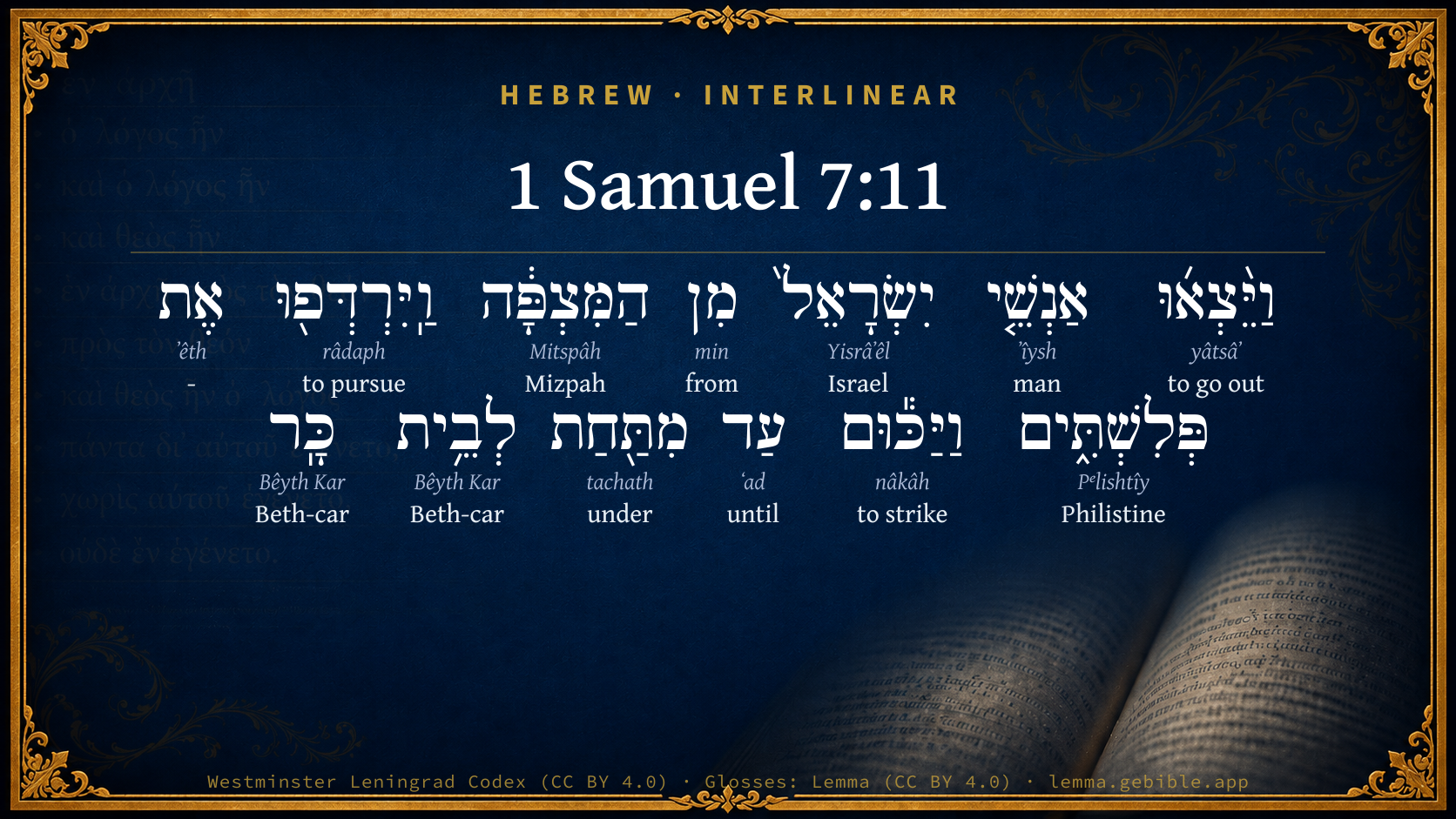
Hebrew (Westminster Leningrad Codex) 1 Samuel 7:11 appears in the Hebrew Old Testament. The text above is from the Westminster Leningrad Codex. Each word links to its Strong’s number, a concise gloss, and parsing drawn from the Open Scriptures Hebrew Bible morphology. Click any word for its full Brown-Driver-Briggs (BDB) entry.
Download image
Cite this verse

1 Samuel 7:11 (World English Bible). Public Domain. Lemma interlinear Bible study tool, https://lemma.gebible.app/v/1-samuel/7/11.

Show BibTeX & RIS
BibTeX
RIS
English Translation
The men of Israel went out of Mizpah, and pursued the Philistines, and struck them, until they came under Beth Kar.
World English Bible · Public Domain
Highlights
  • 1 first appearance in the Hebrew Bible
Full analysis ↓
Download a study sheet

One document with this verse’s original text, its word-by-word gloss line, the meaning frame, cross-references with their text, attributed commentary, and full source and license credits — printable, and it pastes into notes with its structure intact.

This verse Autodidact and up

Study sheet (.html) Plain text (.txt)

A passage Seminary Student

Up to 50 verses in one chapter. A passage sheet keeps up to 6 commentary sources and 12 cross-references per verse, in the order this page ranks them, and says so on the sheet whenever that leaves anything out. Ask for a single verse and you get the Autodidact verse sheet above.

Everything on this page stays free to read, with no account — the sheet is a download of what is already on screen, not access to it.

Want to remove ads? Support Godless Engineer
Compare translations 3

The same verse in 3 English versions, stacked beneath the original-language interlinear above. Click any original word for its lexicon entry.

Each is an independent rendering of the whole verse — the interlinear is not word-aligned to these translations.

Highlighted words mark where these versions differ — a whole-verse word diff, not a word-by-word alignment.

  • World English Bible Public Domain
    The men of Israel went out of Mizpah, and pursued the Philistines, and struck them, until they came under Beth Kar.
  • King James Version Public Domain
    And the men of Israel went out of Mizpeh, and pursued the Philistines, and smote them, until they came under Bethcar.
  • unfoldingWord Literal Text CC BY-SA 4.0
    For the men of Israel went out from Mizpah, and they pursued the Philistines, and they struck them unto below Beth Kar.

unfoldingWord Literal Text — © unfoldingWord, licensed CC BY-SA 4.0. Word-aligned USFM3 via Door43 (git.door43.org/unfoldingWord/en_ult).

Versions to compare (up to 4)

3 of 4 selected

Show all 18 translations

Every available English version of this verse, each an independent rendering of the whole verse.

  • World English Bible Public Domain
    The men of Israel went out of Mizpah, and pursued the Philistines, and struck them, until they came under Beth Kar.
  • Berean Standard Bible Public Domain
    Then the men of Israel charged out of Mizpah and pursued the Philistines, striking them down all the way to an area below Beth-car.
  • Majority Standard Bible Public Domain
    Then the men of Israel charged out of Mizpah and pursued the Philistines, striking them down all the way to an area below Beth-car.
  • King James Version Public Domain
    And the men of Israel went out of Mizpeh, and pursued the Philistines, and smote them, until they came under Bethcar.
  • American Standard Version (1901) Public Domain
    And the men of Israel went out of Mizpah, and pursued the Philistines, and smote them, until they came under Beth-car.
  • Revised Version (1885) Public Domain
    And the men of Israel went out of Mizpah, and pursued the Philistines, and smote them, until they came under Beth-car.
  • Geneva Bible (1599) Public Domain
    And the men of Israel went from Mizpeh and pursued the Philistims, and smote them vntill they came vnder Beth-car.
  • Douay-Rheims (1899) Public Domain
    And the men of Israel going out of Masphath pursued after the Philistines, and made slaughter of them till they came under Bethchar.
  • Young's Literal Translation Public Domain
    And the men of Israel go out from Mizpeh, and pursue the Philistines, and smite them unto the place of Beth-Car.
  • Literal Standard Version CC BY-SA 4.0
    And the men of Israel go out from Mizpeh, and pursue the Philistines, and strike them to the place of Beth-Car.
  • Unlocked Literal Bible CC BY-SA 4.0
    The men of Israel went from Mizpah, and they pursued the Philistines and killed them as far as below Beth Kar.
  • unfoldingWord Literal Text CC BY-SA 4.0
    For the men of Israel went out from Mizpah, and they pursued the Philistines, and they struck them unto below Beth Kar.
  • Darby Bible Public Domain
    And the men of Israel went out of Mizpah, and pursued the Philistines, and smote them, as far as below Beth-car.
  • World Messianic Bible Public Domain
    The men of Israel went out of Mizpah and pursued the Philistines, and struck them until they came under Beth Kar.
  • Webster's Bible Public Domain
    And the men of Israel went out of Mizpeh, and pursued the Philistines, and smote them, until they came under Beth-car.
  • Free Bible Version CC BY-SA 4.0
    Then the men of Israel ran out from Mizpah and chased them, killing them all the way to a place near Beth-car.
  • Bible in Basic English Public Domain
    And the men of Israel went out from Mizpah and went after the Philistines, attacking them till they came under Beth-car.
  • JPS Tanakh (1917) Public Domain
    And the men of Israel went out of Mizpah, and pursued the Philistines, and smote them, until they came under Beth-car.

Literal Standard Version (2020), Covenant Press — licensed CC BY-SA 4.0. Text via the HelloAO Bible API (eBible.org). Unlocked Literal Bible (unfoldingWord) — licensed CC BY-SA 4.0. Text via the HelloAO Bible API (eBible.org). unfoldingWord Literal Text — © unfoldingWord, licensed CC BY-SA 4.0. Word-aligned USFM3 via Door43 (git.door43.org/unfoldingWord/en_ult). Free Bible Version, Dr. Jonathan Gallagher — licensed CC BY-SA 4.0. Text via the HelloAO Bible API (eBible.org).

Word by word

More ways to search: Search by grammar → Find every occurrence → Compare this word →

Practice this passage: Drill this verse → Learn its vocabulary →

לְבֵ֥ית
Bêyth Kar
H1033
“to/for · Beth-car”
Preposition + Noun, Proper
Part of Speech
Preposition + Noun
Type
Proper
Full BDB Definition

Origin: from H1004 and H3733

TWOT: None

Beth-car = "house of the ram" or " place of the lamb" - a place apparently belonging to the Philistines
  1. וַיֵּ֨צְא֜וּ yâtsâʼ H3318 “and · to go out” Conjunction + Verb, Qal, Sequential Imperfect, 3rd Person, Masculine, Plural
  2. אַנְשֵׁ֤י ʼîysh H376 “men of” Noun, Common, Masculine, Plural, Construct
  3. יִשְׂרָאֵל֙ Yisrâʼêl H3478 “Israel” Noun, Proper
  4. מִן min H4480 “from” Preposition
  5. הַמִּצְפָּ֔ה Mitspâh H4709 “the · Mizpah” Particle, Definite Article + Noun, Proper
  6. וַֽיִּרְדְּפ֖וּ râdaph H7291 “and · to pursue” Conjunction + Verb, Qal, Sequential Imperfect, 3rd Person, Masculine, Plural
  7. אֶת ʼêth H853 “-” Particle, Direct Object
  8. פְּלִשְׁתִּ֑ים Pᵉlishtîy H6430 “Philistines” Noun, Gentilic, Masculine, Plural, Absolute
  9. וַיַּכּ֕וּם nâkâh H5221 “and · to strike · them” Conjunction + Verb, Hiphil, Sequential Imperfect, 3rd Person, Masculine, Plural + Suffix, Personal, 3rd Person, Masculine, Plural
  10. עַד ʻad H5704 “until” Preposition
  11. מִתַּ֖חַת tachath H8478 “from · under” Preposition + Preposition
  12. כָּֽר Bêyth Kar H1033 “Beth-car” Noun, Proper

About this verse

These counts appear in no published source. They are computed here, from the morphology-tagged text and Lemma’s own curated glosses. What Lemma adds →

13
words
12
distinct lemmas
Historical
section

Notable vocabulary

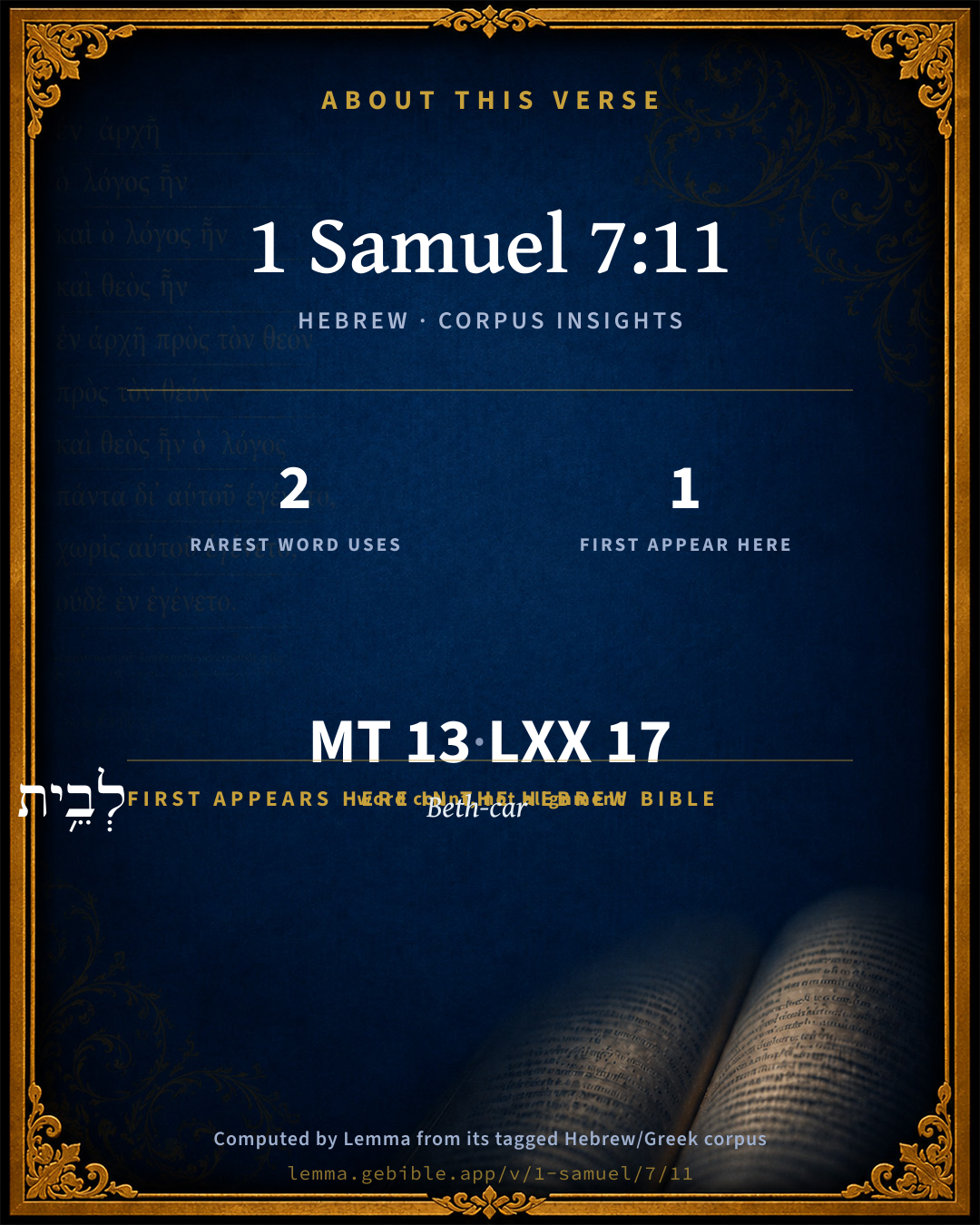
The rarest word here is לְבֵ֥ית Beth-car H1033 — appearing just 2 times in the whole Hebrew Bible.

First appearance in Scripture

This word makes its first canonical appearance in the Hebrew Bible here:

  • לְבֵ֥ית Beth-car H1033

Grammatical profile

  • 3 verbs
  • 6 nouns
  • 3 prepositions
  • 1 particle

Verb forms

  • וַיֵּ֨צְא֜וּ Qal · Sequential Imperfect
  • וַֽיִּרְדְּפ֖וּ Qal · Sequential Imperfect
  • וַיַּכּ֕וּם Hiphil · Sequential Imperfect

Repetition

A word recurs within this verse — often emphatic in Hebrew:

  • לְבֵ֥ית Beth-car H1033 ×2

Hebrew & Septuagint length

In English translation the verse runs 21 words from the Hebrew and 22 from the Septuagint (LXX English) — closely comparable.

A rough comparison of the two English renderings, which tokenize alike — not a word-level alignment.

Word counts can differ between the Hebrew and the Greek without any difference in meaning — e.g. the Hebrew direct-object marker אֵת has no separate Greek word, and Greek often adds the article ὁ.

In the original languages it is 13 Hebrew tokens and 17 Greek tokens — but the two are counted differently (Hebrew bundles its prefixes and suffixes into one token; the Greek is in lemma form), so that isn’t a like-for-like length.

Hebrew and Greek witnesses Masoretic Hebrew ↔ Greek Septuagint

The same verse in the two great witnesses to the Old Testament, shown verse-for-verse.

These are two independent witnesses, not word-aligned to each other, and the Septuagint is shown in lemma (dictionary) form.

Hebrew 1 Samuel 7:11 Masoretic · Westminster Leningrad Codex

וַיֵּ֨צְא֜וּ אַנְשֵׁ֤י יִשְׂרָאֵל֙ מִן הַמִּצְפָּ֔ה וַֽיִּרְדְּפ֖וּ אֶת פְּלִשְׁתִּ֑ים וַיַּכּ֕וּם עַד מִתַּ֖חַת לְבֵ֥ית כָּֽר

The men of Israel went out of Mizpah, and pursued the Philistines, and struck them, until they came under Beth Kar.

World English Bible · Public Domain

Greek LXX 1 Samuel 7:11 Septuagint · lemma form

καί ἐκἔρχομαι ἀνήρ ἰσραήλ ἐκ μασσηφαθ καί καταδιώκω ὁ ἀλλόφυλος καί πατάσσω αὐτός ἕως ὑποκάτω ὁ βαιθχορ

And the men of Israel went forth out of Massephath, and pursued the Philistines, and struck them to the parts under Baethchor.

LXX2012 (modern English Septuagint) · Public Domain

On this verse, Adam Clarke's Commentary discusses the Septuagint’s reading. Read the note in Commentary ↓

Hebrew: Westminster Leningrad Codex (CC BY 4.0). Greek: Septuagint (public domain); English from LXX2012 (modern English Septuagint) (Public Domain). How the Septuagint differs from the Hebrew →

Targum (Aramaic paraphrase)

1

The Targum is the ancient Jewish Aramaic paraphrase of the Hebrew Scriptures — an interpretive translation, not the Hebrew text itself. Onkelos (literal) and Pseudo-Jonathan (expansive) render the Torah, and Jonathan the Prophets. Coverage is partial: where no permissively-licensed English translation exists for a verse, only the Aramaic is shown. This is verse-level text, not a word-by-word alignment to the Hebrew.

  1. Targum Jonathan Prophets (Joshua–Malachi)
    וּנְפַקוּ אֱנָשֵׁי יִשְׂרָאֵל מִן מִצְפַּיָא וּרְדָפוּ יַת פְּלִשְׁתָּאֵי וּמְחוֹנוֹן עַד מִלְרַע לְבֵית שָׁרוֹן:

    (no public-domain English translation for this verse)

    Targum Jonathan — Aramaic: “Mikraot Gedolot” (public domain). English: “Sefaria Community Translation” (CC0 1.0 (public-domain dedication)); “London "Chaldee Paraphrase," 1871” (public domain). Text via Sefaria.

Commentary

Notes on 1 Samuel 7:11 from classic Christian and Jewish commentators (each source and its license shown beneath its notes). The classic Christian expositions comment on the surrounding passage and are grouped to its opening verse, so a note may address several verses; the Jewish commentaries on the Tanakh (Rashi and others) are per-verse, so they appear only where the commentator wrote on this verse.

Lemma curates 59 commentaries, every one of them public domain or Creative Commons licensed, each selected and text-cleaned for this edition rather than reprinted as found. About our sources →

Trapp's Complete Commentary

John Trapp

1Sa 7:11 And the men of Israel went out of Mizpeh, and pursued the Philistines, and smote them, until [they came] under Bethcar.

Ver. 11. Until they came under Bethcar.] The name of that rock, saith Junius, which in the next verse is called Shen. Bethcar signifieth the house of a lamb, and might have its name from the lamb offered by Samuel.

John Trapp, A Commentary or Exposition upon All the Books of the Old and New Testament (1647–1656) — public domain. Text from a community e-Sword module.

Joseph Benson's Commentary

1Sa 7:11. The men of Israel pursued the Philistines, &c. — This victory was the more wonderful, since it does not appear that the Israelites came provided with any weapons to Mizpeh, but probably smote the Philistines with their own weapons, which they threw away when they fled, affrighted by this uncommon tempest, or which were found among those that were slain by the lightning.

Joseph Benson's Commentary on the Old and New Testaments (1811–1818) — public domain. Text from a community e-Sword module.

Adam Clarke's Commentary

Verse 11. Under Beth-car.] We know not where this place was; the Septuagint have Beth-chor; the Targum, Beth-saron; and the Syriac and Arabic, Beth-jasan.

Adam Clarke's Commentary on the Bible (1810–1826) — public domain. Text from a community e-Sword/MySword module.

Ellicott's Commentary for English Readers

(11) Until they came under Beth-car.—“House of the Lamb,” or, as some would render it, House of the Field. Of this place we know nothing; it was, no doubt, a Philistine fortress, where the scattered remains of the beaten host were able to rally and defend themselves.

A Bible Commentary for English Readers, edited by Charles John Ellicott (1878–1897) — public domain. Text from a community e-Sword module.

The Cambridge Bible for Schools and Colleges

gen. ed. J. J. S. Perowne

11. until they came under Beth-car] Beth-car (= “house of a lamb,” or “house of pasture,”) was apparently on high ground overhanging the road back to Philistia.

The Cambridge Bible for Schools and Colleges (gen. ed. J. J. S. Perowne; Cambridge University Press, 1878–1918) — public domain. Text from a community e-Sword module.

John Gill's Exposition

And the men of Israel went out of Mizpeh,.... To which they were encouraged by hearing or perceiving that the army of the Philistines was discomfited by the thunder, and lightning, and earthquake:

and pursued the Philistines; who, when they came out, were fleeing from the opening earth, and frightened with thunder and lightning, and many were killed, and all put in disorder; so that they stayed not to engage in battle with Israel, and who had nothing to do but to pursue their enemy:

and smote them: with what weapons of war they could get at Mizpeh, and with what some might have with them for private use, and in common wear; but more especially with the weapons of the Philistines, which they in their confusion and fright had thrown away:

until they came under Bethcar; a place so called; "car" signifies a lamb; here might be formerly a temple dedicated to the lamb, unless it had its name in memory of the lamb Samuel now offered, which was followed with such success. Josephus (o) calls this place Corraea; and in the Targum it is Bethsaron, which signifies a fruitful field or champaign country.

(o) Antiqu. l. 6. c. 2. sect. 2.

John Gill's Exposition of the Whole Bible (1746–1763) — public domain (CC PDM 1.0). Text via the HelloAO Bible API.

Albert Barnes' Notes on the Bible

Beth-car - This place is nowhere else mentioned. It seems to have stood on a hill overhanging the road from the Philistine territory to Mizpeh, and close to Ebenezer, 1Sa 4:1.

Albert Barnes' Notes on the Bible (1834–1885) — public domain. Text from a community e-Sword/MySword module.

Haydock's Catholic Bible Commentary

Bethchar, "the house of the penetrator." Cor denotes the celestial fluid, which the Philistines probably supposed was discharged by the heavens, independently of the great Creator. Hence their punishment was very appropriate. (Parkhurst) --- The latter heathens always represented their Jupiter armed with thunder and lightning--- "The thunder roared aloud---

Th’ affrighted hills from their foundation nod,

And blaze beneath the lightning of the God;

At one regard of his all-seeing eye,

The vanquish’d triumph, and the victors fly." (Pope, Iliad xvii. 596.)

George Leo Haydock (1774–1849), Haydock's Catholic Family Bible and Commentary, 1859 edition — public domain. Excludes Psalms (Douay-Rheims chapter numbering differs from Protestant) and Deuterocanonical books (Catholic canon only).

Matthew Poole's English Annotations

Quest. Whence had they weapons wherewith to smite them?

Answ. Divers of them probably brought them to the assembly; others borrowed them at Mizpeh, or the neighbouring places; and the rest might be the arms of the Philistines, which they threw away to hasten their flight, as is usual in such cases.

Matthew Poole's English Annotations on the Holy Bible (1683–1685) — public domain. Text from a community e-Sword/MySword module.

Whedon's Commentary on the Bible

Daniel D. Whedon

11. Israel… pursued the Philistines — The Israelites followed up this victory which the Lord had gained for them, and thus mightily profited by the Divine interposition.

Until… under Beth-car — The site of Beth-car is unknown, but must have been off to the west or southwest of Mizpeh, perhaps as far as the great plain of Philistia. Under Beth-car may imply that this place was situated on some eminence; or the meaning may be below, that is, beyond, Beth-car. We may reasonably suppose that the men of Israel continued their pursuit for several days, not giving it over until they had gained from the Philistines all that they had lost through them aforetime.

Daniel D. Whedon (gen. ed.), Commentary on the Old and New Testaments (1874–1909) — public domain. Text from a community e-Sword module.

Rashi

Rabbi Shlomo Yitzchaki (Rashi)

Until below Beis Kor. Below Beis Sharon.

Rashi on the Tanakh — English translations: “The Judaica Press complete Tanach with Rashi, translated by A. J. Rosenberg” (CC BY 4.0); “Pentateuch with Rashi's commentary by M. Rosenbaum and A.M. Silbermann, 1929-1934” (public domain); “The Metsudah Tanach series, Lakewood, N.J” (CC BY 4.0); and “The Book of Joshua, Metsudah Publications, 1997” (CC BY 4.0). Text via Sefaria.

Lesson kit

Teaching starters — assembled from the data on this page, not authored interpretation. Every prompt links to the verse data it draws on. Edit before teaching.

1 Samuel, in the Historical, opens this verse with 13 words (12 distinct Hebrew lemmas). Its most distinctive word is Bêyth Kar (“Beth-car”). A historical commentator’s framing appears above. Read the whole chapter for the surrounding context.

Discussion questions

  1. How does “Beth-car” (Bêyth Kar) shape what this verse is saying?
  2. This is the first place “Beth-car” appears in Scripture (first appears here). What does its debut here establish?
  3. What does the repetition of “Beth-car” (2× in this one verse) do in this verse?
  4. The translations on this page render this verse differently — a whole-verse word diff, not a word-by-word alignment. What might account for the different wordings?
  5. «וַיֵּ֨צְא֜וּ» is a Qal Sequential Imperfect verb. How does that grammatical form shape the action described?
  6. Compare how Trapp's Complete Commentary and Joseph Benson's Commentary read this verse. Where do they agree or differ?

Things to notice

Reading settings

Reading text

Shown beneath each verse's original-language words.

Old Testament
Old Testament edition

Read the OT as the Masoretic Hebrew (MT) or the Greek Septuagint (LXX).

English shown for the Greek Septuagint (in the Hebrew ↔ Greek comparison).

Comparing translations? Open the Compare panel on any verse page to stack up to four side by side.