Psalms 143:3

Hebrew (Westminster Leningrad Codex) Psalms 143:3 appears in the Hebrew Old Testament. The text above is from the Westminster Leningrad Codex. Each word links to its Strong’s number, a concise gloss, and parsing drawn from the Open Scriptures Hebrew Bible morphology. Click any word for its full Brown-Driver-Briggs (BDB) entry.
Download image
Cite this verse

Psalms 143:3 (World English Bible). Public Domain. Lemma interlinear Bible study tool, https://lemma.gebible.app/v/psalms/143/3.

Show BibTeX & RIS
BibTeX
RIS
English Translation
For the enemy pursues my soul. He has struck my life down to the ground. He has made me live in dark places, as those who have been long dead.
World English Bible · Public Domain
Download a study sheet

One document with this verse’s original text, its word-by-word gloss line, the meaning frame, cross-references with their text, attributed commentary, and full source and license credits — printable, and it pastes into notes with its structure intact.

This verse Autodidact and up

Study sheet (.html) Plain text (.txt)

A passage Seminary Student

Up to 50 verses in one chapter. A passage sheet keeps up to 6 commentary sources and 12 cross-references per verse, in the order this page ranks them, and says so on the sheet whenever that leaves anything out. Ask for a single verse and you get the Autodidact verse sheet above.

Everything on this page stays free to read, with no account — the sheet is a download of what is already on screen, not access to it.

Want to remove ads? Support Godless Engineer
Compare translations 3

The same verse in 3 English versions, stacked beneath the original-language interlinear above. Click any original word for its lexicon entry.

Each is an independent rendering of the whole verse — the interlinear is not word-aligned to these translations.

Highlighted words mark where these versions differ — a whole-verse word diff, not a word-by-word alignment.

  • World English Bible Public Domain
    For the enemy pursues my soul. He has struck my life down to the ground. He has made me live in dark places, as those who have been long dead.
  • King James Version Public Domain
    For the enemy hath persecuted my soul; he hath smitten my life down to the ground; he hath made me to dwell in darkness, as those that have been long dead.
  • unfoldingWord Literal Text CC BY-SA 4.0
    For the enemy has pursued my soul; he has crushed my life to the ground; he has made me to live in dark places like the dead of ages.

unfoldingWord Literal Text — © unfoldingWord, licensed CC BY-SA 4.0. Word-aligned USFM3 via Door43 (git.door43.org/unfoldingWord/en_ult).

Versions to compare (up to 4)

3 of 4 selected

Show all 18 translations

Every available English version of this verse, each an independent rendering of the whole verse.

  • World English Bible Public Domain
    For the enemy pursues my soul. He has struck my life down to the ground. He has made me live in dark places, as those who have been long dead.
  • Berean Standard Bible Public Domain
    For the enemy has pursued my soul, crushing my life to the ground, making me dwell in darkness like those long since dead.
  • Majority Standard Bible Public Domain
    For the enemy has pursued my soul, crushing my life to the ground, making me dwell in darkness like those long since dead.
  • King James Version Public Domain
    For the enemy hath persecuted my soul; he hath smitten my life down to the ground; he hath made me to dwell in darkness, as those that have been long dead.
  • American Standard Version (1901) Public Domain
    For the enemy hath persecuted my soul; He hath smitten my life down to the ground: He hath made me to dwell in dark places, as those that have been long dead.
  • Revised Version (1885) Public Domain
    For the enemy hath persecuted my soul; he hath smitten my life down to the ground: he hath made me to dwell in dark places, as those that have been long dead.
  • Geneva Bible (1599) Public Domain
    For the enemie hath persecuted my soule: he hath smitten my life downe to the earth: he hath layde me in the darkenes, as they that haue bene dead long agoe:
  • Douay-Rheims (1899) Public Domain
    In his sight I pour out my prayer, and before him I declare my trouble:
  • Young's Literal Translation Public Domain
    For an enemy hath pursued my soul, He hath bruised to the earth my life, He hath caused me to dwell in dark places, As the dead of old.
  • Literal Standard Version CC BY-SA 4.0
    For an enemy has pursued my soul, || He has bruised my life to the earth, || He has caused me to dwell in dark places, || As the dead of old.
  • Unlocked Literal Bible CC BY-SA 4.0
    The enemy has pursued my soul; he has crushed me to the ground; he has made me to live in darkness like those who have been dead a long time.
  • unfoldingWord Literal Text CC BY-SA 4.0
    For the enemy has pursued my soul; he has crushed my life to the ground; he has made me to live in dark places like the dead of ages.
  • Darby Bible Public Domain
    For the enemy persecuteth my soul: he hath crushed my life down to the earth; he hath made me to dwell in dark places, as those that have been long dead.
  • World Messianic Bible Public Domain
    For the enemy pursues my soul. He has struck my life down to the ground. He has made me live in dark places, as those who have been long dead.
  • Webster's Bible Public Domain
    For the enemy hath persecuted my soul; he hath smitten my life down to the ground; he hath made me to dwell in darkness, as those that have been long dead.
  • Free Bible Version CC BY-SA 4.0
    The enemy has chased me down. He crushes me to the ground. He makes me live in darkness like those who died a long time ago.
  • Bible in Basic English Public Domain
    The evil man has gone after my soul; my life is crushed down to the earth: he has put me in the dark, like those who have long been dead.
  • JPS Tanakh (1917) Public Domain
    For the enemy hath persecuted my soul; he hath crushed my life down to the ground; he hath made me to dwell in darkness, as those that have been long dead.

Literal Standard Version (2020), Covenant Press — licensed CC BY-SA 4.0. Text via the HelloAO Bible API (eBible.org). Unlocked Literal Bible (unfoldingWord) — licensed CC BY-SA 4.0. Text via the HelloAO Bible API (eBible.org). unfoldingWord Literal Text — © unfoldingWord, licensed CC BY-SA 4.0. Word-aligned USFM3 via Door43 (git.door43.org/unfoldingWord/en_ult). Free Bible Version, Dr. Jonathan Gallagher — licensed CC BY-SA 4.0. Text via the HelloAO Bible API (eBible.org).

Word by word

More ways to search: Search by grammar → Find every occurrence → Compare this word →

Practice this passage: Drill this verse → Learn its vocabulary →

בְ֝מַחֲשַׁכִּ֗ים
machshâk
H4285
“in/at · dark places”
Preposition + Noun, Common, Masculine, Plural, Absolute
Part of Speech
Preposition + Noun
Type
Common
Gender
Masculine
Number
Plural
State
Absolute
Full BDB Definition

Origin: from H2821

TWOT: 769d

dark place, darkness, secrecy - hiding-place - dark region - grave
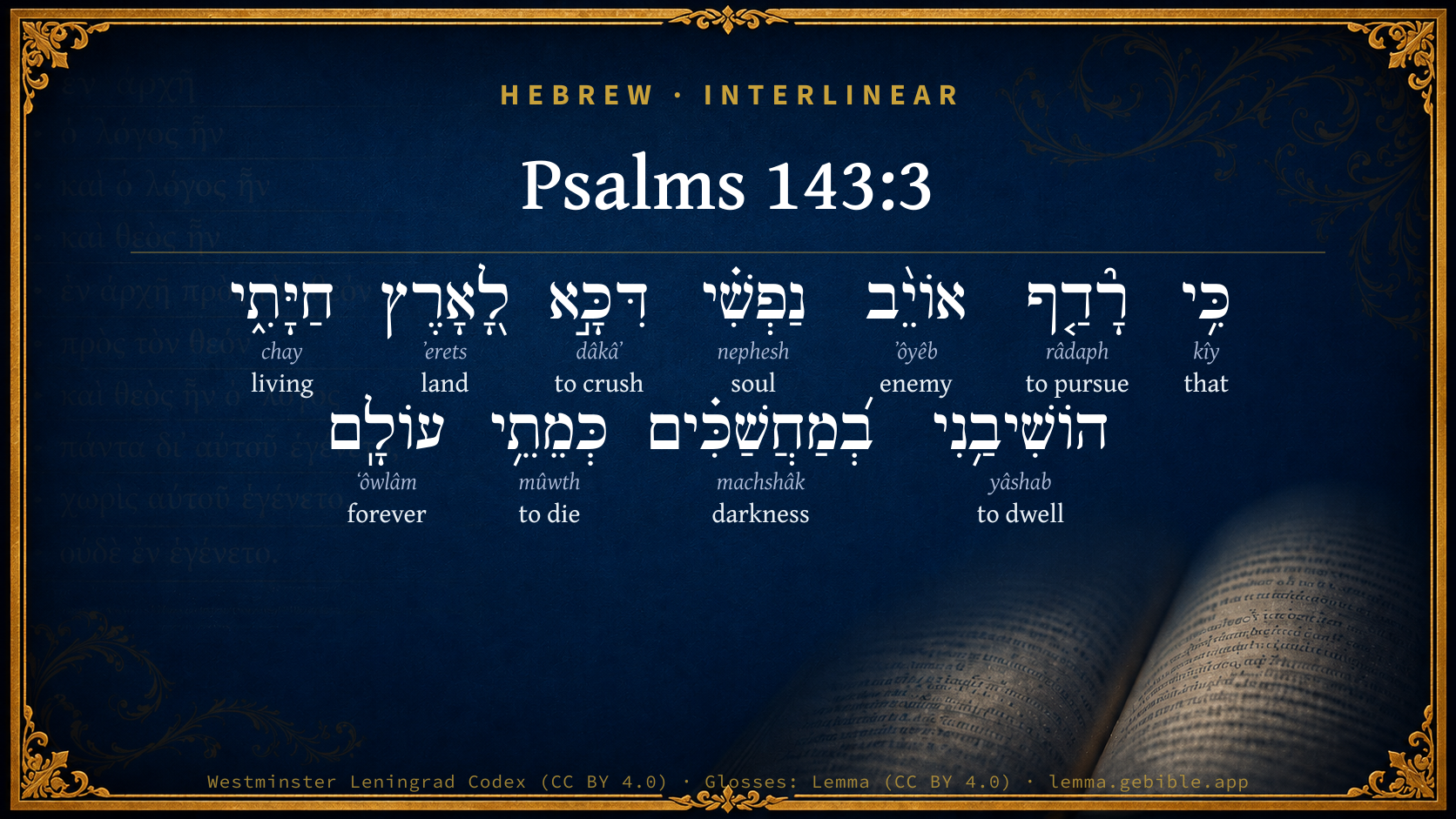
  1. כִּ֥י kîy H3588 “that” Conjunction
  2. רָ֘דַ֤ף râdaph H7291 “to pursue” Verb, Qal, Perfect, 3rd Person, Masculine, Singular
  3. אוֹיֵ֨ב ʼôyêb H341 “enemy” Verb, Qal, Participle Active, Masculine, Singular, Absolute
  4. נַפְשִׁ֗י nephesh H5315 “soul · my” Noun, Common, Both, Singular, Construct + Suffix, Personal, 1st Person, Common, Singular
  5. דִּכָּ֣א dâkâʼ H1792 “to crush” Verb, Piel, Perfect, 3rd Person, Masculine, Singular
  6. לָ֭אָרֶץ ʼerets H776 “to/for the · land” Preposition, Determined + Noun, Common, Both, Singular, Absolute
  7. חַיָּתִ֑י chay H2416 “living · my” Noun, Common, Feminine, Singular, Construct + Suffix, Personal, 1st Person, Common, Singular
  8. הוֹשִׁיבַ֥נִי yâshab H3427 “to dwell · me” Verb, Hiphil, Perfect, 3rd Person, Masculine, Singular + Suffix, Personal, 1st Person, Common, Singular
  9. כְּמֵתֵ֥י mûwth H4191 “like/as · dying” Preposition + Verb, Qal, Participle Active, Masculine, Plural, Construct
  10. עוֹלָֽם ʻôwlâm H5769 “forever” Noun, Common, Masculine, Singular, Absolute

About this verse

These counts appear in no published source. They are computed here, from the morphology-tagged text and Lemma’s own curated glosses. What Lemma adds →

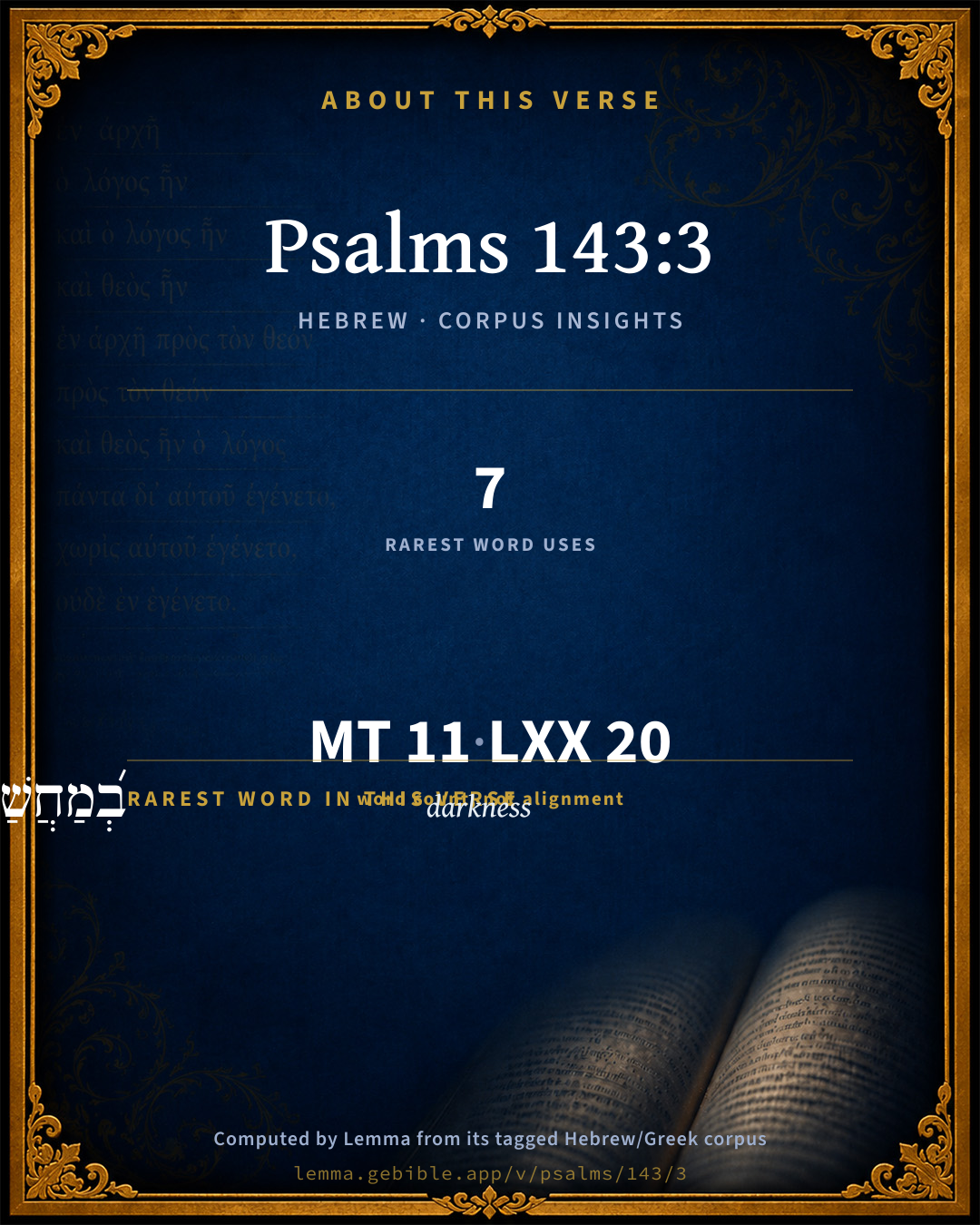
11
words
11
distinct lemmas
Wisdom
section

Notable vocabulary

The rarest word here is בְ֝מַחֲשַׁכִּ֗ים darkness H4285 — appearing just 7 times in the whole Hebrew Bible.

Shared distinctive vocabulary

בְ֝מַחֲשַׁכִּ֗ים darkness H4285 occurs in 7 verses of the Hebrew Bible. Also found in:

Grammatical profile

  • 5 verbs
  • 5 nouns
  • 1 conjunction

Verb forms

  • רָ֘דַ֤ף Qal · Perfect
  • אוֹיֵ֨ב Qal · Participle Active
  • דִּכָּ֣א Piel · Perfect
  • הוֹשִׁיבַ֥נִי Hiphil · Perfect
  • כְּמֵתֵ֥י Qal · Participle Active

Hebrew & Septuagint length

In English translation the verse runs 30 words from the Hebrew and 33 from the Septuagint (LXX English) — closely comparable.

A rough comparison of the two English renderings, which tokenize alike — not a word-level alignment.

Word counts can differ between the Hebrew and the Greek without any difference in meaning — e.g. the Hebrew direct-object marker אֵת has no separate Greek word, and Greek often adds the article ὁ.

In the original languages it is 11 Hebrew tokens and 20 Greek tokens — but the two are counted differently (Hebrew bundles its prefixes and suffixes into one token; the Greek is in lemma form), so that isn’t a like-for-like length.

Cross-references

12

Topical passages linked to Psalms 143:3 in the Treasury of Scripture Knowledge — connected by theme and wording, ordered by reader-vote popularity; previews shown in the World English Bible.

  • Lamentations 3:6 He has made me to dwell in dark places, as those that have been long dead.
  • Psalms 7:1–2 Yahweh, my God, I take refuge in you. Save me from all those who pursue me, and deliver me,
  • Psalms 7:5 Let the enemy pursue my soul, and overtake it; Yes, let him tread my life down to the earth, And lay my glory in the dust. Selah.
  • 2 Samuel 2:22 Abner said again to Asahel, Turn you aside from following me: why should I strike you to the ground? how then should I hold up my face to Joab your brother?
  • Psalms 17:9–13 From the wicked who oppress me, My deadly enemies, who surround me.
  • Psalms 88:4–6 I am counted among those who go down into the pit. I am like a man who has no help,
  • Psalms 142:6 Listen to my cry, For I am in desperate need. Deliver me from my persecutors, For they are stronger than me.
  • 2 Samuel 18:11 Joab said to the man who told him, Behold, you saw it, and why didn't you strike him there to the ground? and I would have given you ten [pieces of] silver, and a sash.
  • Psalms 35:4 Let those who seek after my soul be disappointed and brought to dishonor. Let those who plot my ruin be turned back and confounded.
  • Psalms 54:3 For strangers have risen up against me. Violent men have sought after my soul. They haven't set God before them. Selah.
  • Psalms 31:12–13 I am forgotten from their hearts like a dead man. I am like broken pottery.
  • Ezekiel 37:11 Then he said to me, Son of man, these bones are the whole house of Israel: behold, they say, Our bones are dried up, and our hope is lost; we are clean cut off.

Cross-references courtesy of OpenBible.info (CC BY 4.0).

Hebrew and Greek witnesses Masoretic Hebrew ↔ Greek Septuagint

The same verse in the two great witnesses to the Old Testament, shown verse-for-verse.

You’re reading Greek Psalm 142 (Hebrew Psalm 143). The Septuagint counts the superscription, so verse numbers can differ from the Hebrew — chapter-level alignment, not verse-by-verse. Numbering follows Rahlfs.

These are two independent witnesses, not word-aligned to each other, and the Septuagint is shown in lemma (dictionary) form.

Hebrew Psalms 143:3 Masoretic · Westminster Leningrad Codex

כִּ֥י רָ֘דַ֤ף אוֹיֵ֨ב נַפְשִׁ֗י דִּכָּ֣א לָ֭אָרֶץ חַיָּתִ֑י הוֹשִׁיבַ֥נִי בְ֝מַחֲשַׁכִּ֗ים כְּמֵתֵ֥י עוֹלָֽם

For the enemy pursues my soul. He has struck my life down to the ground. He has made me live in dark places, as those who have been long dead.

World English Bible · Public Domain

Greek LXX Greek Psalm 142:3 Septuagint · lemma form

ὅτι καταδιώκω ὁ ἐχθρός ὁ ψυχή ἐγώ ταπεινόω εἰς γῆ ὁ ζωή ἐγώ καταἵζω ἐγώ ἐν σκοτεινός ὡς νεκρός αἰών

For the enemy has persecuted my soul; he has brought my life down to the ground; he has made me to dwell in a dark place, as those that have been long dead.

LXX2012 (modern English Septuagint) · Public Domain

On this verse, John Calvin's Commentaries discusses the Septuagint’s reading. Read the note in Commentary ↓

Hebrew: Westminster Leningrad Codex (CC BY 4.0). Greek: Septuagint (public domain); English from LXX2012 (modern English Septuagint) (Public Domain). How the Septuagint differs from the Hebrew →

Commentary

Notes on Psalms 143:3 from classic Christian and Jewish commentators (each source and its license shown beneath its notes). The classic Christian expositions comment on the surrounding passage and are grouped to its opening verse, so a note may address several verses; the Jewish commentaries on the Tanakh (Rashi and others) are per-verse, so they appear only where the commentator wrote on this verse.

Lemma curates 59 commentaries, every one of them public domain or Creative Commons licensed, each selected and text-cleaned for this edition rather than reprinted as found. About our sources →

Trapp's Complete Commentary

John Trapp

Psa 143:3 For the enemy hath persecuted my soul; he hath smitten my life down to the ground; he hath made me to dwell in darkness, as those that have been long dead.

Ver. 3. For the enemy hath persecuted my soul] Quasi rabie ferali percitus, he hath raged unreasonably. The utmost of a danger is to be related before the Lord in prayer, and to be acknowledged after we are delivered out of it, by way of thankfulness.

John Trapp, A Commentary or Exposition upon All the Books of the Old and New Testament (1647–1656) — public domain. Text from a community e-Sword module.

The Treasury of David

Charles H. Spurgeon

Ver. 3. For the enemy hath persecuted my soul. He has followed me up with malicious perseverance, and has worried me as often as I have been within his reach. The attack was upon the soul or life of the Psalmist: our adversaries mean us the worst possible evil, their attacks are no child's play, they hunt for the precious life. He hath smitten my life down to the ground. The existence of David was made bitter by the cruelty of his enemy; he was as one who was hurled down and made to lie upon the ground, where he could be trampled on by his assailant. Slander has a very depressing effect upon the spirits; it is a blow which overthrows the mind as though it were knocked clown with the fist. He hath made me to dwell in darkness, as those that have been long dead. The enemy was not content with felling his life to the groundhe would lay him lower still, even in the grave; and lower than that, if possible, for the enemy would shut up the saint in the darkness of hell if he could. David was driven by Saul's animosity to haunt caverns and holes, like an unquiet ghost; he wandered out by night, and lay hid by day like an uneasy spirit which had long been denied the repose of the grave. Good men began to forget him, as though he had been long dead; and bad men made ridicule of his rueful visage as though it belonged not to a living man, but was dark with the shadow of the sepulchre. Poor David! He was qualified to bless the house of the living, but he was driven to consort with the dead! Such may be our case, and yet we may be very dear to the Lord. One thing is certain, the Lord who permits us to dwell in darkness among the dead, will surely bring us into light, and cause us to dwell with those who enjoy life eternal.

Ver. 3. For the enemy, etc. If ever trouble be just cause for calling upon thee, how can mine be more just, when the enemy hath persecuted my soul, hath smitten my life down to the ground, and hath made me to dwell in darkness, as those that have been long dead? All this "the enemy" hath done unto me: but what enemy? Is it not the enemy of all mankind, who hath singled me out, as it were to a duel? And can I resist him myself alone, whom the whole army of mankind cannot? But is it not the enemy of thyself, O God, who is but my enemy because I am thy servant? And wilt thou see thy servants persecutedin thy cause persecutedand not protect them? Shall I suffer, grievously suffer, for thy sake, and wilt thou forsake me? Alas, O Lord; if they were but some light evils that are inflicted upon me I would bear them without complaining, and never make my moan to thee about them; but they are the three greatest miseries that can be thought of; the greatest persecution, the greatest overthrow, and the greatest captivity. For what persecution so grievous as to be persecuted in my soul? for he plays no less a game than for souls: he casts indeed at the body sometimes, and sometimes at goods, yet these are but the bye; the main of his aim is at the soul; for if he can otherwise win the soul he cares not much for either body or goods, but rather makes use of them to keep men in security; for whatsoever he doth, whatsoever he leaves undone, it is all done but in persecution of the soul; and he can persecute as well with prosperity as with adversity, and knows how to fit their several application. It seems as if he takes me for another Job; he sees he can do no good upon me with fawning and clawing, and therefore falls now to quarrelling and striking, and he strikes no light blows; for "he hath stricken my life down to the ground"; and lower would have struck it, if thou, God, hadst nut broken his blow. He strikes me downward, to keep me from heaven, as much as he can: and now that he sees me down, he lets not me rest so neither; but seizes upon me, and being himself the prince of darkness, hath kept me in darkness; not for a night or two, as men stay at their inn, but for a much longer time, as at their dwelling; and it is no ordinary darkness that he hath made me to dwell in, but even the darkness of dead men; and that in the highest degree, as those that have been long dead. They that have been dead but a while are yet remembered sometimes, and sometimes talked of; but they that have been long dead are as quite forgotten as if they had never been; and such, alas, am I. So long have I been made to dwell in darkness, as if I had been dead many years ago, that he that would seek to find me out must be fain to look for me amongst the tombs and monuments. Indeed, to dwell in darkness is no better than the house of death: for as long as we are in life, if we want sometimes the light of the sun, yet the light of a candle will serve to supply it; but I, alas, am kept in such darkness that neither the sunshine of thy gospel nor the lantern of thy law gives any light unto me. I cannot with confidence say, as once I did, "Thou, O Lord, shalt light my candle for me"; and as a body being dead grows cold and stiff, and is not to be bowed, so my soul with continuance in sinning is grown hardened, and, as it were, stiff in sin; that it is as hard a matter to make me flexible to any goodness as to bring a body long dead to life again. Sir Richard Baker.

Ver. 3. To dwell in darkness. To seek my safety in holes and obscure places in the wilderness. See 2Sa 17:16. As those that have been long dead. That is, where I seem to be buried alive, and to have no more hopes of being restored to a happy condition in this world than those that have been long dead have of living again in it. Thomas Fenton.

Ver. 3-6. Consider,

1. The great lengths God may sometimes permit the enemy to go, Ps 143:3. The case of Job a good illustration.

2. The deep depression of spirit he may even permit his saints to experience, Ps 143:4.

3. The good things he has provided for their meditation when even at their worst, Ps 143:5.

4. The two things his grace will never suffer to die, whose existence is a pledge of near approaching joy,

a) The thirsting after himself.

b) The practice of prayer. The whole is a good text for a lecture on the life and experience of Job. J. F.

Psalms 143:4*

Charles H. Spurgeon's The Treasury of David (1869–1885) — public domain. Psalms only. Text from a community e-Sword/MySword module.

Joseph Benson's Commentary

Psa 143:3-4. For the enemy hath persecuted my soul — This is not a reason of what he said last, Psa 143:2, but an argument to enforce his petition, delivered Psa 143:1, and repeated Psa 143:7. He hath smitten my life down to the ground — He hath beaten me down to the earth, where I lie struggling for life. He hath made me to dwell in darkness — Not only in dark caves, but under dark apprehensions, and clouds of trouble and distress, out of which I see no way of deliverance, except from thy power and mercy; as those that have been long dead — In as hopeless a condition in the eye of man, as those that have lain long in the grave. Therefore is my spirit overwhelmed — See on Psa 142:3. My heart within me is desolate — Deprived of all hope and comfort, except from thee; or, is astonished, as ישׁתומם may be properly rendered.

Joseph Benson's Commentary on the Old and New Testaments (1811–1818) — public domain. Text from a community e-Sword module.

J. A. Alexander on Psalms

Joseph Addison Alexander

3. (Psa 143:3) For the enemy persecutes my soul, crushes to the earth my life, makes me dwell in dark places like the dead of old. This verse assigns a reason for the preceding prayers, a connection indicated by the for. He prays that God will deal with him in mercy, not in justice, by abandoning him to the fate here described. Compare Psa 7:5, but especially Psa 88:3-6. See also Lam 3:6. The last words some understand to mean for ever dead.

Joseph Addison Alexander, The Psalms Translated and Explained (1850) — public domain. Text from a community e-Sword module.

Tyndale Open Study Notes

Tyndale Open Resources

143:3-4 I am losing all hope: The psalmist confesses his desperation as his life slips away under oppressive and ruthless foes.

Tyndale Open Study Notes — © Tyndale Open Resources, licensed CC BY-SA 4.0. Text via the HelloAO Bible API.

Geneva Bible (1599)

Geneva Bible translators

He acknowledgeth that God is the only and true physician and heal him: and that he is able to raise him to life, though he were dead long ago, and turned to ashes.

Geneva Bible (1599) marginal notes — public domain. Text via Bolls.life.

Adam Clarke's Commentary

Verse 3. He hath made me to dwell in darkness] Literally, in dark places. This may be understood of David's taking refuge in caves and dens of the earth, to escape from his persecuting son; yea, even to take refuge in the tombs, or repositories of the dead.

Adam Clarke's Commentary on the Bible (1810–1826) — public domain. Text from a community e-Sword/MySword module.

John Calvin's Commentaries

3. For the enemy hath persecuted my soul. Having acknowledged that he only suffered the just punishment of his sins, David comes now to speak of his enemies; for to have begun by speaking of them would have been a preposterous order. Their cruelty was shown in their not resting satisfied but with the destruction of one who was a saint of God; he declares that he must even now perish unless God should help him speedily. The comparison is not merely to a dead man, but a putrid corpse; for by the dead of an age כמתי עולם. These words are differently rendered in the ancient versions. The Septuagint has ὡς νεκροὺς αἰωνος, as the dead of the age; the Syriac, forever; the Chaldee, as they that lie down of that age. The real sense of the expression is, as they who have been dead a long time. The Psalmist employs hyperbolical language in this verse; he says, the enemy hath beaten his life to the ground, hath made him dwell in dark places, and for such a length of time, that there remained no remembrance of him, and that he had become like those persons who had long since been in their graves. The design of all this is to express emphatically great sorrow and oppression.” — Phillips.

John Calvin's Commentaries (1540-1563) — public domain. Text from the Calvin Translation Society English edition (1840s-50s) via the Christian Classics Ethereal Library (ccel.org). Calvin's coverage is partial (roughly two-thirds of the Bible); uncommented books and verses are honest gaps, never fabricated. The 19th-century editor's footnotes and remarks are omitted so the notes are faithfully Calvin's own voice.

Ellicott's Commentary for English Readers

(3) This verse explains the last. The affliction under which the psalmist suffers is evidence that God is visiting for sin.

He hath made . . .—See Lam_3:6; and comp. Psa_88:5-6.

Long dead.—Literally, either dead of old, or dead for ever, according as we take ‘ôlam of past or future time. LXX., νεκροὺς αἰῶνος; Vulg., mortuos sæculi.

A Bible Commentary for English Readers, edited by Charles John Ellicott (1878–1897) — public domain. Text from a community e-Sword module.

The Cambridge Bible for Schools and Colleges

gen. ed. J. J. S. Perowne

3. Cp. Psa_7:5; Psa_88:3-6. The last line agrees verbatim with Lam_3:6.

in darkness] In dark places, as Psa_88:6, probably a figure for calamity, in which he is as it were buried alive. But it is possible (cp. Psa_142:7) that he was actually a prisoner.

as those that have been long dead] And so are forgotten alike by God and man (Psa_88:5). But the meaning may be those who are dead for ever, who will never return to life; lit. dead of eternity, cp. Jer_51:39, ‘sleep of eternity’ = perpetual sleep; Ecc_12:5, ‘house of eternity’ = perpetual abode.

3, 4. The reason for his prayer. The extremity of his present sufferings seems to be a proof that God is calling him to account and punishing him for his sins with strict severity.

The Cambridge Bible for Schools and Colleges (gen. ed. J. J. S. Perowne; Cambridge University Press, 1878–1918) — public domain. Text from a community e-Sword module.

John Gill's Exposition

For the enemy hath persecuted my soul,.... Which is to be connected with Psa 143:1; and is a reason why he desires his prayer might be answered, seeing his enemy, either Saul, or Absalom his own son, persecuted him, or pursued him in order to take away his soul, or life; or Satan, the enemy and avenger, who goes about like a roaring lion, seeking whom he may devour; or persecuting men, who are his emissaries and instruments, whom he instigates to persecute the Lord's people, and employs them therein;

he hath smitten my life down to the ground: brought him into a low, mean, and abject state, and near to death; had with a blow struck him to the ground, and left him wallowing in the mire and dirt, just ready to expire. The phrase is expressive of a very distressing state and condition. Some render it "my company" (r); meaning the men that were with him, his soldiers, who were reduced to a low condition with him, and greatly enfeebled and dispirited;

he hath made me to dwell in darkness: in the sides of the cave, as Kimchi; see Sa2 24:3; or in great affliction of body and mind, frequently signified by darkness, as prosperity is by light; he was not only obliged by his enemy to hide himself in woods and wildernesses, and in caves and dens, but was filled with gloomy apprehensions of things, Psa 88:6;

as those that have been long dead; or "of old" (s), an age or two ago, who are out of mind and forgotten, and of whom there is no hope of their coming to life again until the resurrection; or who are "dead for ever" (t); will remain so till that time comes; signifying hereby his hopeless, helpless, and forlorn state and condition; see Psa 31:12.

(r) "catervam meam", Junius & Tremellius, Piscator. (s) "olim", Tigurine version, Vatablus, Junius & Tremellius, Piscator, Cocceius. (t) So Syriac and Arabic versions.

John Gill's Exposition of the Whole Bible (1746–1763) — public domain (CC PDM 1.0). Text via the HelloAO Bible API.

Albert Barnes' Notes on the Bible

For the enemy hath persecuted my soul - Has persecuted me; has sought my life.

He hath smitten my life down to the ground - He has, as it were, trampled me down to the earth. The word rendered “smitten” means to break in pieces, to beat small, to crush. See Psa 72:4; Psa 89:10; Job 6:9. His very life seemed to be crushed out as one that is trodden down to the ground.

He hath made me to dwell in darkness - He has made my life like that of one who dwells in darkness; he has made it a life of sorrow, so that I have no comfort - no light.

As those that have been long dead - A similar expression occurs in Lam 3:6 : “He hath set me in dark places, as they that be dead of old.” The same Hebrew words are used. The word rendered “long” means, age, duration, eternity: Psa 139:24. The idea here is, that his condition was like that of those who had been long in their graves; who had long since ceased to see any light; whose abode was utter and absolute gloom.

Albert Barnes' Notes on the Bible (1834–1885) — public domain. Text from a community e-Sword/MySword module.

Matthew Poole's English Annotations

This is not a reason of what he last said, Psa 143:2, but an argument to enforce his petition delivered Psa 143:1, and repeated Psa 143:7, &c. For though I am not faultless, if thou shouldst make an exact search into me, yet mine enemies are more culpable and highly unjust, and therefore I hope for thy help against them, from thy justice as well as mercy.

My soul, i.e. my life; for nothing less will satisfy him.

He hath smitten my life down to the ground; he hath beaten me down to the ground, where I lie struggling for life.

He hath made me to dwell in darkness; he hath forced me to have mine abode in dark vaults and caves, where I am out of sight and memory, and in as forlorn and hopeless a condition in the eye of man as those that have lain long rotting in the grave.

Matthew Poole's English Annotations on the Holy Bible (1683–1685) — public domain. Text from a community e-Sword/MySword module.

Whedon's Commentary on the Bible

Daniel D. Whedon

3. Have been long dead—Or, have been “dead” from immemorial time, or, more literally, those that are for ever dead, who cannot rise from the grave, but are hopelessly bound in its chains of darkness. But in this sense it is simply hypothetical.

Daniel D. Whedon (gen. ed.), Commentary on the Old and New Testaments (1874–1909) — public domain. Text from a community e-Sword module.

The Pulpit Commentary

For the enemy hath persecuted my soul. "The enemy" may be Saul, but is more probably an abstract expression for "my enemies" generally. He hath smitten my life down to the ground; or, "crushed my life to the ground brought me, i.e., very low. (comp. Psa_42:6) He hath made me to dwell in darkness. (comp. Psa_88:6) As those that have been long dead. I have dwelt in a darkness like that of Shell; i.e. in gloom and unhappiness. (comp. Lam_3:6)

The Pulpit Commentary (1880–1919), ed. H.D.M. Spence-Jones & Joseph S. Exell — public domain. Text from a community e-Sword module.

John Wesley's Explanatory Notes

For - This is not a reason of what he last said, but an argument to enforce his petition delivered, ver. 1. Soul - My life; nothing less will satisfy him. Dead - I am in as hopeless a condition in the eye of man, as those that have lain long in the grave.

John Wesley, Explanatory Notes Upon the Whole Bible (1754–1765) — public domain. Text via the GEBible commentary corpus.

unfoldingWord translationNotes

Door43 World Missions Community

pursued my soul

Here the word "soul" represents the person. AT: "pursued me" (See: Synecdoche)

has crushed me to the ground

Defeating an enemy is spoken of as a heavy object crushing a lighter object on the ground. AT: "has completely defeated me"

My spirit is overwhelmed within me

"I am weak" or "I am extremely discouraged"

my heart despairs

"I no longer have any hope"

translationWords

adversary

soul

life

darkness

die

spirit

heart

unfoldingWord translationNotes — © Distant Shores Media and the Door43 World Missions Community, licensed CC BY-SA 4.0. Source: git.door43.org/Door43/en_tn.

Rashi

Rabbi Shlomo Yitzchaki (Rashi)

For an enemy pursued my soul That is to say: If I have sinned before You, behold, I have suffered. This psalm was recited as referring to all of Israel in Babylon.

Rashi on the Tanakh — English translations: “The Judaica Press complete Tanach with Rashi, translated by A. J. Rosenberg” (CC BY 4.0); “Pentateuch with Rashi's commentary by M. Rosenbaum and A.M. Silbermann, 1929-1934” (public domain); “The Metsudah Tanach series, Lakewood, N.J” (CC BY 4.0); and “The Book of Joshua, Metsudah Publications, 1997” (CC BY 4.0). Text via Sefaria.

Lesson kit

Teaching starters — assembled from the data on this page, not authored interpretation. Every prompt links to the verse data it draws on. Edit before teaching.

Psalms, in the Wisdom, opens this verse with 11 words (11 distinct Hebrew lemmas). Its most distinctive word is machshâk (“darkness”). A historical commentator’s framing appears above. Read the whole chapter for the surrounding context.

Discussion questions

  1. The word machshâk carries the sense “darkness.” How does it shape the verse?
  2. How does Psalms 74:20, which shares the word «darkness», read alongside this verse?
  3. These translations render this verse differently; the difference is in the English rendering, not the original. What questions does that raise?
  4. «רָ֘דַ֤ף» is a Qal Perfect verb. How does that grammatical form shape the action described?
  5. Compare how Trapp's Complete Commentary and The Treasury of David read this verse. Where do they agree or differ?

Things to notice

Reading settings

Reading text

Shown beneath each verse's original-language words.

Old Testament
Old Testament edition

Read the OT as the Masoretic Hebrew (MT) or the Greek Septuagint (LXX).

English shown for the Greek Septuagint (in the Hebrew ↔ Greek comparison).

Comparing translations? Open the Compare panel on any verse page to stack up to four side by side.