Judges 20:43

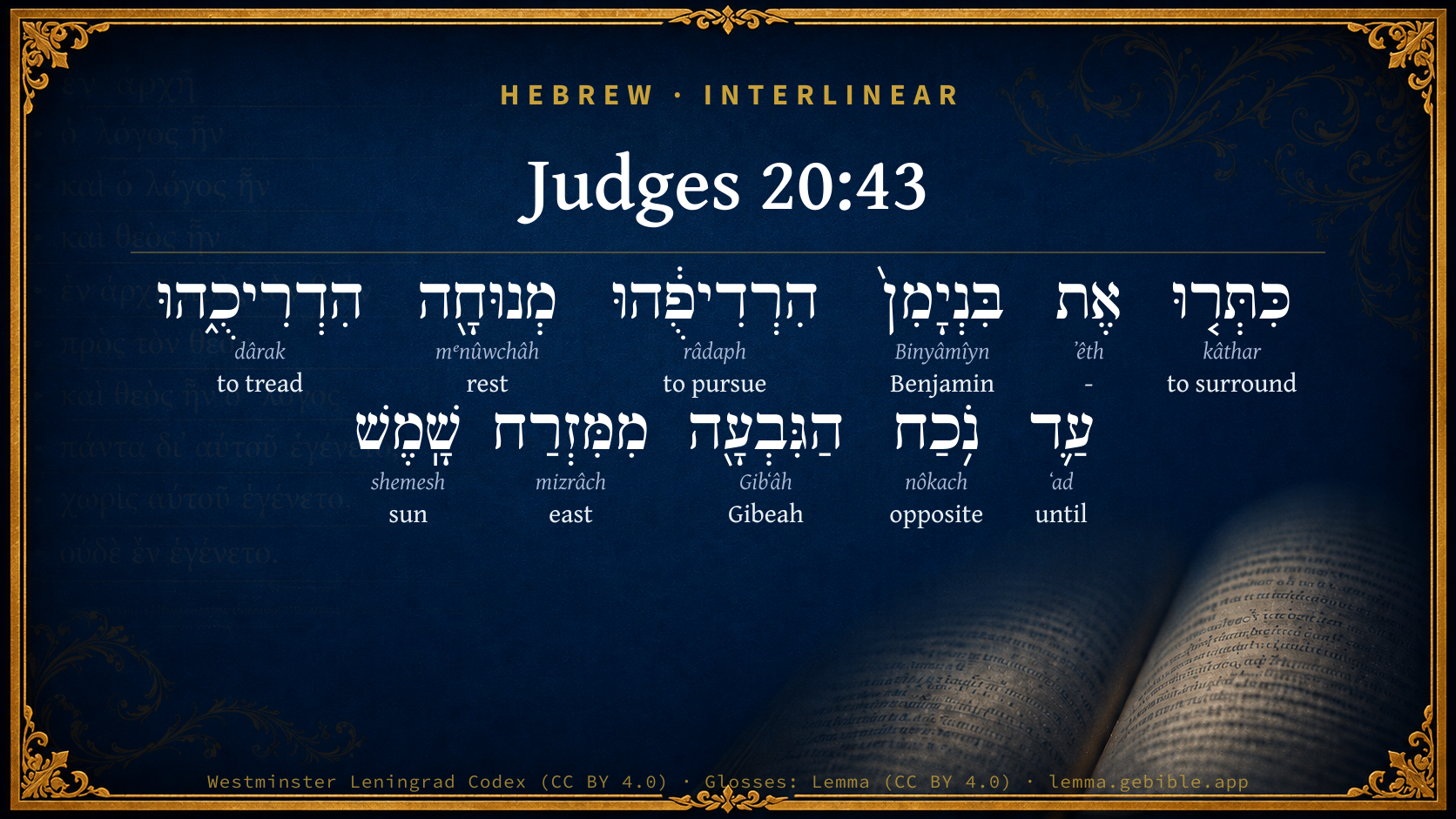
Hebrew (Westminster Leningrad Codex) Judges 20:43 appears in the Hebrew Old Testament. The text above is from the Westminster Leningrad Codex. Each word links to its Strong’s number, a concise gloss, and parsing drawn from the Open Scriptures Hebrew Bible morphology. Click any word for its full Brown-Driver-Briggs (BDB) entry.
Download image
Cite this verse

Judges 20:43 (World English Bible). Public Domain. Lemma interlinear Bible study tool, https://lemma.gebible.app/v/judges/20/43.

Show BibTeX & RIS
BibTeX
RIS
English Translation
They enclosed the Benjamites round about, [and] chased them, [and] trod them down at [their] resting-place, as far as over against Gibeah toward the sunrise.
World English Bible · Public Domain
Highlights
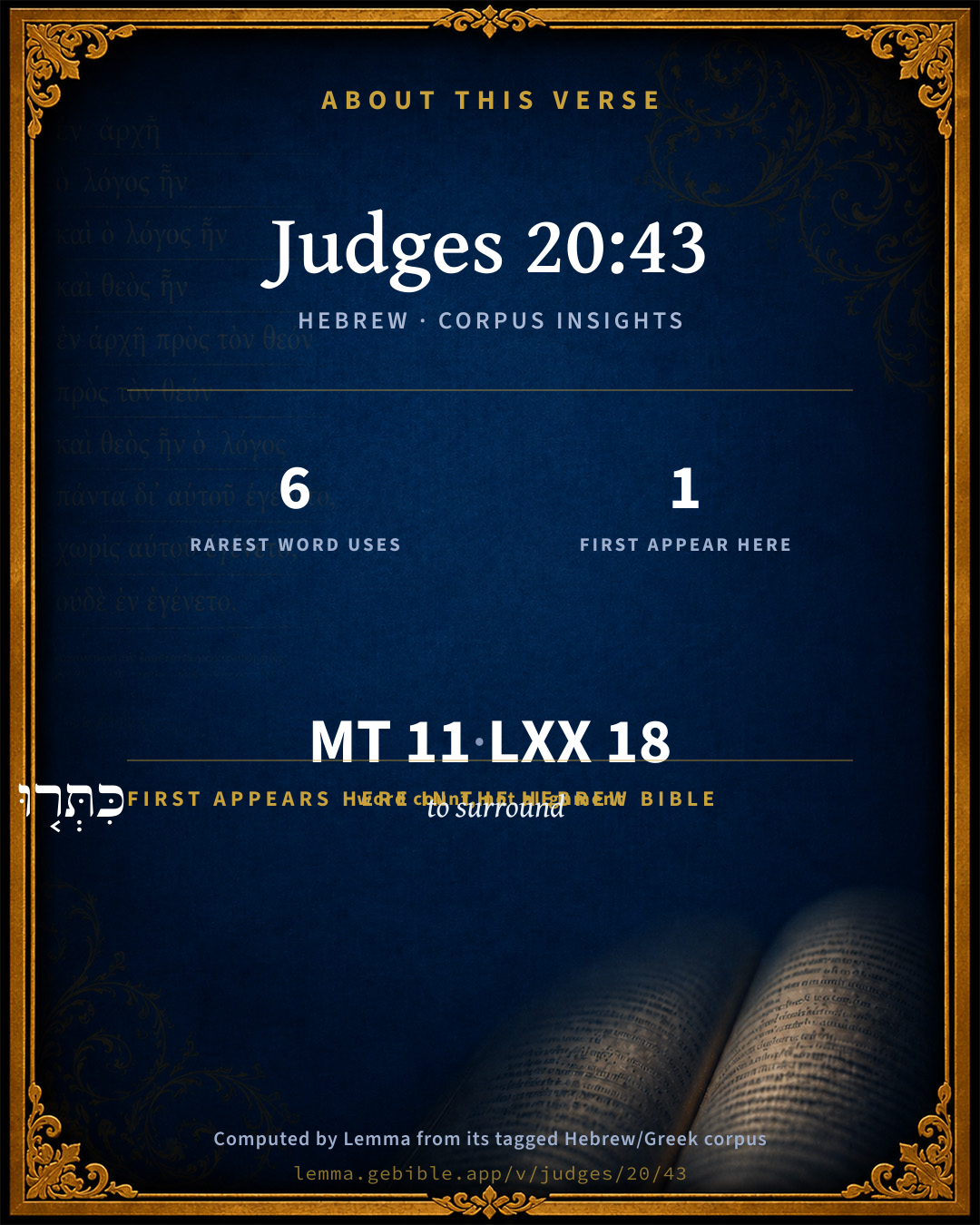
  • 1 first appearance in the Hebrew Bible
Full analysis ↓
Download a study sheet

One document with this verse’s original text, its word-by-word gloss line, the meaning frame, cross-references with their text, attributed commentary, and full source and license credits — printable, and it pastes into notes with its structure intact.

This verse Autodidact and up

Study sheet (.html) Plain text (.txt)

A passage Seminary Student

Up to 50 verses in one chapter. A passage sheet keeps up to 6 commentary sources and 12 cross-references per verse, in the order this page ranks them, and says so on the sheet whenever that leaves anything out. Ask for a single verse and you get the Autodidact verse sheet above.

Everything on this page stays free to read, with no account — the sheet is a download of what is already on screen, not access to it.

Want to remove ads? Support Godless Engineer
Compare translations 3

The same verse in 3 English versions, stacked beneath the original-language interlinear above. Click any original word for its lexicon entry.

Each is an independent rendering of the whole verse — the interlinear is not word-aligned to these translations.

Highlighted words mark where these versions differ — a whole-verse word diff, not a word-by-word alignment.

  • World English Bible Public Domain
    They enclosed the Benjamites round about, [and] chased them, [and] trod them down at [their] resting-place, as far as over against Gibeah toward the sunrise.
  • King James Version Public Domain
    Thus they inclosed the Benjamites round about, and chased them, and trode them down with ease over against Gibeah toward the sunrising.
  • unfoldingWord Literal Text CC BY-SA 4.0
    They surrounded Benjamin, they caused to pursue, ease they trampled him unto before Gibeah, from the rising of the sun.

unfoldingWord Literal Text — © unfoldingWord, licensed CC BY-SA 4.0. Word-aligned USFM3 via Door43 (git.door43.org/unfoldingWord/en_ult).

Versions to compare (up to 4)

3 of 4 selected

Show all 18 translations

Every available English version of this verse, each an independent rendering of the whole verse.

  • World English Bible Public Domain
    They enclosed the Benjamites round about, [and] chased them, [and] trod them down at [their] resting-place, as far as over against Gibeah toward the sunrise.
  • Berean Standard Bible Public Domain
    They surrounded the Benjamites, pursued them, and easily overtook them in the vicinity of Gibeah on the east.
  • Majority Standard Bible Public Domain
    They surrounded the Benjamites, pursued them, and easily overtook them in the vicinity of Gibeah on the east.
  • King James Version Public Domain
    Thus they inclosed the Benjamites round about, and chased them, and trode them down with ease over against Gibeah toward the sunrising.
  • American Standard Version (1901) Public Domain
    They inclosed the Benjamites round about, `and' chased them, `and' trod them down at `their' resting-place, as far as over against Gibeah toward the sunrising.
  • Revised Version (1885) Public Domain
    They enclosed the Benjamites round about, and chased them, and trode them down at their resting place, as far as over against Gibeah toward the sunrising.
  • Geneva Bible (1599) Public Domain
    Thus they compassed the Beniamites about, and chased them at ease, and ouerranne them, euen ouer against Gibeah on the Eastside.
  • Douay-Rheims (1899) Public Domain
    And so it was, that they were slain on both sides by the enemies, and there was no rest of their men dying. They fell and were beaten down on the east side of the city Gabaa.
  • Young's Literal Translation Public Domain
    they have compassed the Benjamites -- they have pursued them -- with ease they have trodden them down till over-against Gibeah, at the sun-rising.
  • Literal Standard Version CC BY-SA 4.0
    they have surrounded the Benjamites—they have pursued them—they have trodden them down with ease as far as the front of Gibeah, at the sun-rising.
  • Unlocked Literal Bible CC BY-SA 4.0
    They surrounded the Benjamites, chased them and trampled them down at Nohah, all the way to the east side of Gibeah.
  • unfoldingWord Literal Text CC BY-SA 4.0
    They surrounded Benjamin, they caused to pursue, ease they trampled him unto before Gibeah, from the rising of the sun.
  • Darby Bible Public Domain
    Cutting down the Benjaminites, they pursued them and trod them down from Nohah as far as opposite Gib'e-ah on the east.
  • World Messianic Bible Public Domain
    They surrounded the Benjamites, chased them, and trod them down at their resting place, as far as near Gibeah toward the sunrise.
  • Webster's Bible Public Domain
    Thus they inclosed the Benjaminites on all sides, and chased them, and trod them down with ease over against Gibeah towards the sun-rising.
  • Free Bible Version CC BY-SA 4.0
    Chasing after the Benjamites, the Israelites surrounded them, easily overtaking them east of Gibeah.
  • Bible in Basic English Public Domain
    And crushing Benjamin down, they went after them, driving them from Nohah as far as the east side of Gibeah.
  • JPS Tanakh (1917) Public Domain
    They inclosed the Benjamites round about, and chased them, and overtook them at their resting-place, as far as over against Gibeah toward the sunrising.

Literal Standard Version (2020), Covenant Press — licensed CC BY-SA 4.0. Text via the HelloAO Bible API (eBible.org). Unlocked Literal Bible (unfoldingWord) — licensed CC BY-SA 4.0. Text via the HelloAO Bible API (eBible.org). unfoldingWord Literal Text — © unfoldingWord, licensed CC BY-SA 4.0. Word-aligned USFM3 via Door43 (git.door43.org/unfoldingWord/en_ult). Free Bible Version, Dr. Jonathan Gallagher — licensed CC BY-SA 4.0. Text via the HelloAO Bible API (eBible.org).

Word by word

More ways to search: Search by grammar → Find every occurrence → Compare this word →

Practice this passage: Drill this verse → Learn its vocabulary →

כִּתְּר֤וּ
kâthar
H3803
“to surround”
Verb, Piel, Perfect, 3rd Person, Common, Plural
Part of Speech
Verb
Stem
Piel
Form
Perfect
Person
3rd Person
Gender
Common
Number
Plural
Full BDB Definition

Origin: a primitive root

TWOT: 1060

to surround - (Piel) to surround - (Hiphil) to surround, encircle
  1. אֶת ʼêth H853 “-” Particle, Direct Object
  2. בִּנְיָמִן֙ Binyâmîyn H1144 “Benjamin” Noun, Proper
  3. הִרְדִיפֻ֔הוּ râdaph H7291 “to pursue · him” Verb, Hiphil, Perfect, 3rd Person, Common, Plural + Suffix, Personal, 3rd Person, Masculine, Singular
  4. מְנוּחָ֖ה mᵉnûwchâh H4496 “rest” Noun, Common, Both, Singular, Absolute
  5. הִדְרִיכֻ֑הוּ dârak H1869 “to tread · him” Verb, Hiphil, Perfect, 3rd Person, Common, Plural + Suffix, Personal, 3rd Person, Masculine, Singular
  6. עַ֛ד ʻad H5704 “until” Preposition
  7. נֹ֥כַח nôkach H5227 “opposite” Preposition
  8. הַגִּבְעָ֖ה Gibʻâh H1390 “the · Gibeah” Particle, Definite Article + Noun, Proper
  9. מִמִּזְרַח mizrâch H4217 “from · east of” Preposition + Noun, Common, Masculine, Singular, Construct
  10. שָֽׁמֶשׁ shemesh H8121 “sun” Noun, Common, Both, Singular, Absolute

About this verse

These counts appear in no published source. They are computed here, from the morphology-tagged text and Lemma’s own curated glosses. What Lemma adds →

11
words
11
distinct lemmas
Historical
section

Notable vocabulary

The rarest word here is כִּתְּר֤וּ to surround H3803 — appearing just 6 times in the whole Hebrew Bible.

First appearance in Scripture

This word makes its first canonical appearance in the Hebrew Bible here:

  • כִּתְּר֤וּ to surround H3803

Shared distinctive vocabulary

כִּתְּר֤וּ to surround H3803 occurs in 6 verses of the Hebrew Bible. Also found in:

Grammatical profile

  • 3 verbs
  • 5 nouns
  • 2 prepositions
  • 1 particle

Verb forms

  • כִּתְּר֤וּ Piel · Perfect
  • הִרְדִיפֻ֔הוּ Hiphil · Perfect
  • הִדְרִיכֻ֑הוּ Hiphil · Perfect

Hebrew & Septuagint length

In English translation the verse runs 25 words from the Hebrew and 19 from the Septuagint (LXX English) — closely comparable.

A rough comparison of the two English renderings, which tokenize alike — not a word-level alignment.

Word counts can differ between the Hebrew and the Greek without any difference in meaning — e.g. the Hebrew direct-object marker אֵת has no separate Greek word, and Greek often adds the article ὁ.

In the original languages it is 11 Hebrew tokens and 18 Greek tokens — but the two are counted differently (Hebrew bundles its prefixes and suffixes into one token; the Greek is in lemma form), so that isn’t a like-for-like length.

Cross-references

1

Topical passages linked to Judges 20:43 in the Treasury of Scripture Knowledge — connected by theme and wording, ordered by reader-vote popularity; previews shown in the World English Bible.

  • Joshua 8:20–22 When the men of Ai looked behind them, they saw, and, behold, the smoke of the city ascended up to heaven, and they had no power to flee this way or that way: and the people who fled to the wilderness turned back on the pursuers.

Cross-references courtesy of OpenBible.info (CC BY 4.0).

Hebrew and Greek witnesses Masoretic Hebrew ↔ Greek Septuagint

The same verse in the two great witnesses to the Old Testament, shown verse-for-verse.

These are two independent witnesses, not word-aligned to each other, and the Septuagint is shown in lemma (dictionary) form.

Hebrew Judges 20:43 Masoretic · Westminster Leningrad Codex

כִּתְּר֤וּ אֶת בִּנְיָמִן֙ הִרְדִיפֻ֔הוּ מְנוּחָ֖ה הִדְרִיכֻ֑הוּ עַ֛ד נֹ֥כַח הַגִּבְעָ֖ה מִמִּזְרַח שָֽׁמֶשׁ

They enclosed the Benjamites round about, [and] chased them, [and] trod them down at [their] resting-place, as far as over against Gibeah toward the sunrise.

World English Bible · Public Domain

Greek LXX Judges 20:43 Septuagint · lemma form

καί κατακόπτω ὁ βενιαμίν καί διώκω αὐτός ἀπό νουα κατά πούς αὐτός ἕως ἀπέναντι γαβαα πρός ἀνατολή ἥλιος

And they cut down Benjamin, and pursued him from Nua closely till they came opposite Gabaa on the east.

LXX2012 (modern English Septuagint) · Public Domain

On this verse, Ellicott's Commentary for English Readers discusses the Septuagint’s reading. Read the note in Commentary ↓

Hebrew: Westminster Leningrad Codex (CC BY 4.0). Greek: Septuagint (public domain); English from LXX2012 (modern English Septuagint) (Public Domain). How the Septuagint differs from the Hebrew →

Targum (Aramaic paraphrase)

1

The Targum is the ancient Jewish Aramaic paraphrase of the Hebrew Scriptures — an interpretive translation, not the Hebrew text itself. Onkelos (literal) and Pseudo-Jonathan (expansive) render the Torah, and Jonathan the Prophets. Coverage is partial: where no permissively-licensed English translation exists for a verse, only the Aramaic is shown. This is verse-level text, not a word-by-word alignment to the Hebrew.

  1. Targum Jonathan Prophets (Joshua–Malachi)
    טַלְטִילוּ יַת דְבֵית בִּנְיָמִין רְדָפוּנוּן מִבֵּית נְיַחֲהוֹן טְרָדוּנוּן עַד לָקֳבֵיל גִבְעֲתָא מִמַדְנַח שִׁמְשָׁא:

    (no public-domain English translation for this verse)

    Targum Jonathan — Aramaic: “Mikraot Gedolot” (public domain). English: “Sefaria Community Translation” (CC0 1.0 (public-domain dedication)); “London "Chaldee Paraphrase," 1871” (public domain). Text via Sefaria.

Commentary

Notes on Judges 20:43 from classic Christian and Jewish commentators (each source and its license shown beneath its notes). The classic Christian expositions comment on the surrounding passage and are grouped to its opening verse, so a note may address several verses; the Jewish commentaries on the Tanakh (Rashi and others) are per-verse, so they appear only where the commentator wrote on this verse.

Lemma curates 59 commentaries, every one of them public domain or Creative Commons licensed, each selected and text-cleaned for this edition rather than reprinted as found. About our sources →

Trapp's Complete Commentary

John Trapp

Jdg 20:43 [Thus] they inclosed the Benjamites round about, [and] chased them, [and] trode them down with ease over against Gibeah toward the sunrising.

Ver. 43. And chased them, and trode them.] These things are recorded, that people may see the woe of war, and take heed of sin, the cause of it.

John Trapp, A Commentary or Exposition upon All the Books of the Old and New Testament (1647–1656) — public domain. Text from a community e-Sword module.

Geneva Bible (1599)

Geneva Bible translators

Or, drove them from their rest.

Geneva Bible (1599) marginal notes — public domain. Text via Bolls.life.

Ellicott's Commentary for English Readers

(43) A strong and poetic description of the total rout and massacre which ensued.

With ease.—There is no “with” in the Hebrew, but perhaps it may be understood. The LXX. and Luther make it mean “from Noria.” Others render it “in their rest,” i.e., in the places to which they fled for refuge. The Vulg. paraphrases it: “Nor was there any repose of the dying.” But the whole verse is obscure.

A Bible Commentary for English Readers, edited by Charles John Ellicott (1878–1897) — public domain. Text from a community e-Sword module.

The Cambridge Bible for Schools and Colleges

gen. ed. J. J. S. Perowne

43. The unidiomatic style (and … and are not in the original), together with the obscurity of the sense, prove that the text is corrupt. Of the various attempts to emend it, the following is as plausible as any: taking the two Hebr. words for the Benjamites … chased them as a doublet of the next two at their resting place, trode them down, and omitting the latter, we may read they cut down (LXX. cod. B) Benjamin and pursued him as far as over against Geba toward the sunrising. The Gibeah of the text was not E. of the flying Benjamites; as elsewhere it is confused with Geba = Jeba‘, 3 m. N.E. of Tell el-Fûl. Jeba‘ lies on the way to Rammôn; but before the fugitives could reach their place of refuge (Rimmon Jdg_20:45), the narrow defile of the Wadi Suwçnît (1Sa_14:4 ff.), between Jeba‘ and Machmâs, would stop further pursuit: accordingly over against Geba they were cut down.

The Cambridge Bible for Schools and Colleges (gen. ed. J. J. S. Perowne; Cambridge University Press, 1878–1918) — public domain. Text from a community e-Sword module.

John Gill's Exposition

And there fell of Benjamin eighteen thousand men,.... Just the number they had slain of Israel in the second battle. This is the number of them that were slain when Israel turned upon them, and by that time they got to the east of Gibeah; afterwards 5000 more were slain on the highways, and 2000 near Gidom, as after related:

all these were men of valour; as appears by three times facing and engaging with the army of Israel, so vastly superior to them, and twice beating them.

John Gill's Exposition of the Whole Bible (1746–1763) — public domain (CC PDM 1.0). Text via the HelloAO Bible API.

Albert Barnes' Notes on the Bible

The language and construction of this verse is poetical; it seems to be an extract from a song, and to describe, in the language of poetry, the same event which the preceding verse described in that of prose.

With ease - Or “rest” Num 10:33; Psa 95:11. The expression is very obscure. The margin takes it as the name of a place.

Albert Barnes' Notes on the Bible (1834–1885) — public domain. Text from a community e-Sword/MySword module.

Haydock's Catholic Bible Commentary

Rest. Hebrew, "with ease, or at leisure they crushed them," &c. Others translate, (Calmet) Monvee, from Nucha, Noua, (Septuagint Roman; Haydock) Menucha," &c. We read of a place in the tribe of Juda, called Menuchta, 1 Paralipomenon ii. 52. (Calmet) --- The same word may be taken as a proper name, or may signify rest. (Menochius)

George Leo Haydock (1774–1849), Haydock's Catholic Family Bible and Commentary, 1859 edition — public domain. Excludes Psalms (Douay-Rheims chapter numbering differs from Protestant) and Deuterocanonical books (Catholic canon only).

Matthew Poole's English Annotations

With ease; without great difficulty. Now that God gave them his presence and assistance, they easily did that which before they found too hard for them. Or, unto Menuchah; or, as far as Menuchah; a place so called. See 1Ch 2:52; Jer 51:59.

Matthew Poole's English Annotations on the Holy Bible (1683–1685) — public domain. Text from a community e-Sword/MySword module.

Whedon's Commentary on the Bible

Daniel D. Whedon

43. With ease — The Hebrew word thus rendered is better taken as a proper name, Menuchah, as in the margin. Translate the verse thus: They enclosed Benjamin, pursued him, trod him down at Menuchah unto the place over against Gibeah eastward. The sense is, that Menuchah itself was over against Gibeah on the east, so that the battle was fought principally on the east of the city. Menuchah was probably the same as Manahath, (1Ch_8:6,) and lay somewhere to the east or northeast of Gibeah.

Daniel D. Whedon (gen. ed.), Commentary on the Old and New Testaments (1874–1909) — public domain. Text from a community e-Sword module.

The Pulpit Commentary

Thus they inclosed, etc. Another difficult passage, having all the appearance of being a quotation from some poetical description of the battle. The tenses of the verbs and the absence of any conjunctions in the Hebrew makes the diction like that of Jud_1:5:19. The italic words thus and the two ands ought to be omitted, to give the stately march of the original. "They inclosed, etc.; they chased them; they trod them down," etc. They inclosed seems to refer to the stratagem by which the Benjamites were surrounded by the ambush in their rear and the Israelites in front. Then came the pursuit chased them;" then the massacre trod them down." The three verbs describe the three stages of the battle. With ease. It does not seem possible that the Hebrew word menuchah can have this meaning. It means sometimes a place of rest, and sometimes a state of rest. Taking the latter meaning, the words they trod them into rest may mean they quieted them by crushing them to death under their feet, or in rest may mean unresisting. Some render it unto Menuchah, as if Menuchah was the name of a place, or from Nochah, as the Septuagint does. Others, at the place of rest, i.e. at every place where they halted to rest the enemy was upon them.

The Pulpit Commentary (1880–1919), ed. H.D.M. Spence-Jones & Joseph S. Exell — public domain. Text from a community e-Sword module.

unfoldingWord translationNotes

Door43 World Missions Community

Nohah

This is the name of a place. (See: How to Translate Names)

trampled them down

The completed destruction of the Benjamites is spoken of as if the Israelites stomped on their bodies. AT: "they completely destroyed them" (See: Metaphor)

eighteen thousand

"18,000" (See: Numbers)

were distinguished in battle

"had fought bravely in the battle"

translationWords

Benjamin

unfoldingWord translationNotes — © Distant Shores Media and the Door43 World Missions Community, licensed CC BY-SA 4.0. Source: git.door43.org/Door43/en_tn.

Rashi

Rabbi Shlomo Yitzchaki (Rashi)

They [lit. crowned] Binyomin. They encircled Binyomin the way a crown encircles the head. Similarly, "The mighty of Bashan encircled me," and, "For the villain encircles the saint." Also, the word "wreath" connotes encirclement, as in, "Shaul and his troops encircled [lit. wreathed] David and his troops in order to seize them"

Called for their pursuit. They called for pursuit behind them—they shouted to each other to pursue.

And intercepted them at rest. At the cities, where they generally rested, they intercepted them.

Intercepted them. Caught them. There is a similar term in the Talmud, "He pursued him a parsa in the sand, but did not catch him."

Up to the area facing Givoh. East of Givoh.

Rashi on the Tanakh — English translations: “The Judaica Press complete Tanach with Rashi, translated by A. J. Rosenberg” (CC BY 4.0); “Pentateuch with Rashi's commentary by M. Rosenbaum and A.M. Silbermann, 1929-1934” (public domain); “The Metsudah Tanach series, Lakewood, N.J” (CC BY 4.0); and “The Book of Joshua, Metsudah Publications, 1997” (CC BY 4.0). Text via Sefaria.

Lesson kit

Teaching starters — assembled from the data on this page, not authored interpretation. Every prompt links to the verse data it draws on. Edit before teaching.

Judges, in the Historical, opens this verse with 11 words (11 distinct Hebrew lemmas). Its most distinctive word is kâthar (“to surround”). A historical commentator’s framing appears above. Read the whole chapter for the surrounding context.

Discussion questions

  1. How does “to surround” (kâthar) shape what this verse is saying?
  2. This is the first place “to surround” appears in Scripture (first appears here). What does its debut here establish?
  3. How does Job 36:2, which shares the word «to surround», read alongside this verse?
  4. These translations render this verse differently; the difference is in the English rendering, not the original. What questions does that raise?
  5. «כִּתְּר֤וּ» is a Piel Perfect verb. How does that grammatical form shape the action described?
  6. Compare how Trapp's Complete Commentary and Geneva Bible (1599) read this verse. Where do they agree or differ?

Things to notice

Reading settings

Reading text

Shown beneath each verse's original-language words.

Old Testament
Old Testament edition

Read the OT as the Masoretic Hebrew (MT) or the Greek Septuagint (LXX).

English shown for the Greek Septuagint (in the Hebrew ↔ Greek comparison).

Comparing translations? Open the Compare panel on any verse page to stack up to four side by side.