
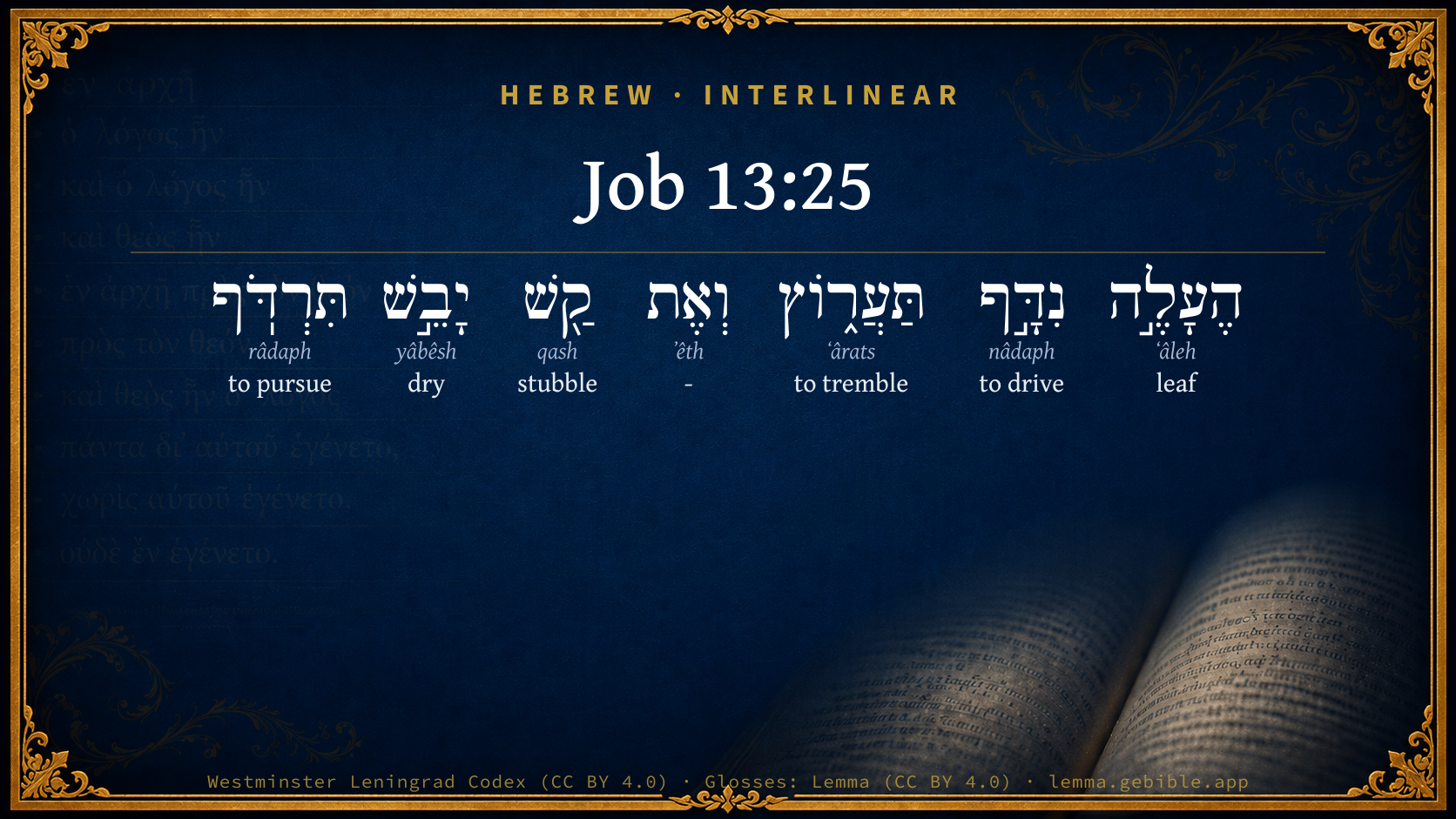
Job 13:25

Hebrew (Westminster Leningrad Codex) Job 13:25 appears in the Hebrew Old Testament. The text above is from the Westminster Leningrad Codex. Each word links to its Strong’s number, a concise gloss, and parsing drawn from the Open Scriptures Hebrew Bible morphology. Click any word for its full Brown-Driver-Briggs (BDB) entry.
Download image
Cite this verse

Job 13:25 (World English Bible). Public Domain. Lemma interlinear Bible study tool, https://lemma.gebible.app/v/job/13/25.

Show BibTeX & RIS
BibTeX
RIS
English Translation
Will you harass a driven leaf? Will you pursue the dry stubble?
World English Bible · Public Domain
Download a study sheet

One document with this verse’s original text, its word-by-word gloss line, the meaning frame, cross-references with their text, attributed commentary, and full source and license credits — printable, and it pastes into notes with its structure intact.

This verse Autodidact and up

Study sheet (.html) Plain text (.txt)

A passage Seminary Student

Up to 50 verses in one chapter. A passage sheet keeps up to 6 commentary sources and 12 cross-references per verse, in the order this page ranks them, and says so on the sheet whenever that leaves anything out. Ask for a single verse and you get the Autodidact verse sheet above.

Everything on this page stays free to read, with no account — the sheet is a download of what is already on screen, not access to it.

Want to remove ads? Support Godless Engineer
Compare translations 3

The same verse in 3 English versions, stacked beneath the original-language interlinear above. Click any original word for its lexicon entry.

Each is an independent rendering of the whole verse — the interlinear is not word-aligned to these translations.

Highlighted words mark where these versions differ — a whole-verse word diff, not a word-by-word alignment.

  • World English Bible Public Domain
    Will you harass a driven leaf? Will you pursue the dry stubble?
  • King James Version Public Domain
    Wilt thou break a leaf driven to and fro? and wilt thou pursue the dry stubble?
  • unfoldingWord Literal Text CC BY-SA 4.0
    Will you terrify a driven leaf? Or will you pursue dry stubble?

unfoldingWord Literal Text — © unfoldingWord, licensed CC BY-SA 4.0. Word-aligned USFM3 via Door43 (git.door43.org/unfoldingWord/en_ult).

Versions to compare (up to 4)

3 of 4 selected

Show all 18 translations

Every available English version of this verse, each an independent rendering of the whole verse.

  • World English Bible Public Domain
    Will you harass a driven leaf? Will you pursue the dry stubble?
  • Berean Standard Bible Public Domain
    Would You frighten a windblown leaf? Would You chase after dry chaff?
  • Majority Standard Bible Public Domain
    Would You frighten a windblown leaf? Would You chase after dry chaff?
  • King James Version Public Domain
    Wilt thou break a leaf driven to and fro? and wilt thou pursue the dry stubble?
  • American Standard Version (1901) Public Domain
    Wilt thou harass a driven leaf? And wilt thou pursue the dry stubble?
  • Revised Version (1885) Public Domain
    Wilt thou harass a driven leaf? and wilt thou pursue the dry stubble?
  • Geneva Bible (1599) Public Domain
    Wilt thou breake a leafe driuen to and from? and wilt thou pursue the drie stubble?
  • Douay-Rheims (1899) Public Domain
    Against a leaf, that is carried away with the wind, thou shewest thy power, and thou pursuest a dry straw.
  • Young's Literal Translation Public Domain
    A leaf driven away dost Thou terrify? And the dry stubble dost Thou pursue?
  • Literal Standard Version CC BY-SA 4.0
    Do You terrify a leaf driven away? And do You pursue the dry stubble?
  • Unlocked Literal Bible CC BY-SA 4.0
    Will you persecute a driven leaf? Will you pursue dry stubble?
  • unfoldingWord Literal Text CC BY-SA 4.0
    Will you terrify a driven leaf? Or will you pursue dry stubble?
  • Darby Bible Public Domain
    Wilt thou terrify a driven leaf? and wilt thou pursue dry stubble?
  • World Messianic Bible Public Domain
    Will you harass a driven leaf? Will you pursue the dry stubble?
  • Webster's Bible Public Domain
    Wilt thou break a leaf driven to and fro? and wilt thou pursue the dry stubble?
  • Free Bible Version CC BY-SA 4.0
    Would you frighten a leaf blown by the wind or hunt down a piece of straw?
  • Bible in Basic English Public Domain
    Will you be hard on a leaf in flight before the wind? will you make a dry stem go more quickly on its way?
  • JPS Tanakh (1917) Public Domain
    Wilt Thou harass a driven leaf? And wilt Thou pursue the dry stubble?

Literal Standard Version (2020), Covenant Press — licensed CC BY-SA 4.0. Text via the HelloAO Bible API (eBible.org). Unlocked Literal Bible (unfoldingWord) — licensed CC BY-SA 4.0. Text via the HelloAO Bible API (eBible.org). unfoldingWord Literal Text — © unfoldingWord, licensed CC BY-SA 4.0. Word-aligned USFM3 via Door43 (git.door43.org/unfoldingWord/en_ult). Free Bible Version, Dr. Jonathan Gallagher — licensed CC BY-SA 4.0. Text via the HelloAO Bible API (eBible.org).

Word by word

More ways to search: Search by grammar → Find every occurrence → Compare this word →

Practice this passage: Drill this verse → Learn its vocabulary →

About this verse

These counts appear in no published source. They are computed here, from the morphology-tagged text and Lemma’s own curated glosses. What Lemma adds →

7
words
7
distinct lemmas
Wisdom
section

Notable vocabulary

The rarest word here is נִדָּ֣ף to drive H5086 — appearing just 9 times in the whole Hebrew Bible.

Shared distinctive vocabulary

נִדָּ֣ף to drive H5086 occurs in 8 verses of the Hebrew Bible. Also found in:

Grammatical profile

  • 3 verbs
  • 2 nouns
  • 1 adjective
  • 1 particle

Verb forms

  • נִדָּ֣ף Niphal · Participle Active
  • תַּעֲר֑וֹץ Qal · Imperfect
  • תִּרְדֹּֽף Qal · Imperfect

Hebrew & Septuagint length

In English translation the verse runs 12 words from the Hebrew and 28 from the Septuagint (LXX English) — the Septuagint runs noticeably longer here. See the side-by-side →

A rough comparison of the two English renderings, which tokenize alike — not a word-level alignment.

Word counts can differ between the Hebrew and the Greek without any difference in meaning — e.g. the Hebrew direct-object marker אֵת has no separate Greek word, and Greek often adds the article ὁ.

Cross-references

6

Topical passages linked to Job 13:25 in the Treasury of Scripture Knowledge — connected by theme and wording, ordered by reader-vote popularity; previews shown in the World English Bible.

  • Leviticus 26:36 "'As for those of you who are left, I will send a faintness into their hearts in the lands of their enemies: and the sound of a driven leaf will put them to flight; and they shall flee, as one flees from the sword; and they will fall when no one pursues.
  • Job 21:18 That they are as stubble before the wind, As chaff that the storm carries away?
  • 1 Samuel 24:14 After whom is the king of Israel come out? after whom do you pursue? after a dead dog, after a flea.
  • Job 14:3 Do you open your eyes on such a one, And bring me into judgment with you?
  • Isaiah 17:13 The nations shall rush like the rushing of many waters: but he shall rebuke them, and they shall flee far off, and shall be chased as the chaff of the mountains before the wind, and like the whirling dust before the storm.
  • Matthew 12:20 He won't break a bruised reed. He won't quench a smoking flax, Until he leads justice to victory.

Cross-references courtesy of OpenBible.info (CC BY 4.0).

Hebrew and Greek witnesses Masoretic Hebrew ↔ Greek Septuagint

The same verse in the two great witnesses to the Old Testament, shown verse-for-verse.

Here the Septuagint runs noticeably longer than the Hebrew — LXX2012 (modern English Septuagint) 28 words vs World English Bible 12. A rough length comparison of the two English translations, not a word-level alignment — read both below.

These are two independent witnesses, not word-aligned to each other, and the Septuagint is shown in lemma (dictionary) form.

Hebrew Job 13:25 Masoretic · Westminster Leningrad Codex

הֶעָלֶ֣ה נִדָּ֣ף תַּעֲר֑וֹץ וְאֶת קַ֖שׁ יָבֵ֣שׁ תִּרְדֹּֽף

Will you harass a driven leaf? Will you pursue the dry stubble?

World English Bible · Public Domain

Greek LXX Job 13:25 Septuagint · lemma form

ἦ ὡς φύλλον κινέω ὑπό ἄνεμος εὐλαβέομαι ἤ ὡς χόρτος φέρω ὑπό πνεῦμα ἀντικεῖμαι ἐγώ

Will you be startled at me, as at a leaf shaken by the wind? or will you set yourself against me as against grass borne upon the breeze?

LXX2012 (modern English Septuagint) · Public Domain

Hebrew: Westminster Leningrad Codex (CC BY 4.0). Greek: Septuagint (public domain); English from LXX2012 (modern English Septuagint) (Public Domain). How the Septuagint differs from the Hebrew →

Commentary

Notes on Job 13:25 from classic Christian and Jewish commentators (each source and its license shown beneath its notes). The classic Christian expositions comment on the surrounding passage and are grouped to its opening verse, so a note may address several verses; the Jewish commentaries on the Tanakh (Rashi and others) are per-verse, so they appear only where the commentator wrote on this verse.

Lemma curates 59 commentaries, every one of them public domain or Creative Commons licensed, each selected and text-cleaned for this edition rather than reprinted as found. About our sources →

Trapp's Complete Commentary

John Trapp

Job 13:25 Wilt thou break a leaf driven to and fro? and wilt thou pursue the dry stubble?

Ver. 25. Wilt thou break a leaf driven to and fro? &c.] q.d. Egregiam vero laudem, Thinkest thou to get any honour by encountering and overturning me, who was at my best but as a leaf, or as stubble, weak and worthless; and am now, by reason of mine afflictions, but as a leaf blown off, and whirled up and down, Indignum est maiestate tua, ut misellum homuncionem, &c. (Jan.); or as stubble fully dried, which is soon scattered by the wind, Psa 1:4, or quickly burnt by the fire, Nah 1:10. David reasoneth in this manner with Saul, 1Sa 24:14, "After whom is the king of Israel come forth? after whom dost thou pursue? After a dead dog, after a flea." A great purchase surely! a great victory!

- An gloria tanta est

Insidias homini supposuisse Deum? (Tibul.)

The truth is, God doth not afflict any man (whom he knows to be a thing of nothing) on purpose to try his strength, or to show his power; but either to exercise his justice upon the wicked, or to prove the faith of his people, and to promote their salvation.

John Trapp, A Commentary or Exposition upon All the Books of the Old and New Testament (1647–1656) — public domain. Text from a community e-Sword module.

The Biblical Illustrator

Joseph S. Exell

Job_13:25

Wilt Thou break a leaf driven to and fro?

A pitiful plea

Poor Job! Who could have been brought lower? In his deep distress he turns to God, and finding no other plea so near at hand he makes a plea of his own distress. He compares himself to the weakest thing he could think of. He draws an argument out of his weakness. It is a common figure he uses, that of a leaf driven to and fro. To this Job likens himself--a helpless, hopeless, worthless, weak, despised, perishing thing. And he appeals to God. Out of pity upon my utter weakness and nothingness, turn away Thy hand, and break not a leaf that is driven to and fro. The apprehension is so startling, the appeal is so forcible, that the argument may be employed in a great many ways. How often have the sick used it, when they have been brought to so low an ebb with physical pain that life itself seemed worthless. Not less applicable the plea to those who are plunged into the depths of poverty. So too with those who are in trouble through bereavement. Perhaps it is even more harassing in eases of mental distress, for, after all, the sharpest pangs we feel are not those of the body, nor those of the estate, but those of the mind. When the iron enters into the soul, the rust thereof is poison. Many a child of God may have used this plea, or may yet use it.

I. The plea is such as arises from inward consciousness. What plea is more powerful to ourselves than that which we draw from ourselves? In this case Job was quite certain about his own weakness. How could he doubt that? I trust many of us have been brought into such a humble frame of mind as to feel that, in a certain sense, this is true of us. What a great blessing it is to be made to know our weakness! But while it is a confession of weakness, the plea is also an acknowledgment of Gods power to push that weakness to a direful conclusion.

II. This is also a very pitiful plea. Though there is weakness, yet there is also power, for weakness is, for the most part, a prevalent plea with those who are strong and good. The plea gathers force when the weakness is confessed. How a confession of weakness touches your heart when it comes from your child!

III. This plea is rightly addressed. It is addressed to God. It can be used to each person of the Blessed Trinity in Unity. Oh, the depths of Thy loving kindness! Is it possible that Thou canst east away a poor, broken-hearted trembler, a poor, fearing, doubting one, who would fain be saved, but who trembles lest he should be cast away?

IV. The plea is backed up by many cases of success. Give one illustration. The case of Hannah, the mother of Samuel; or the case of King Manasseh. Or our Lords dealing with sinful women.

V. The text is a faint plea which invites full succour. It meant this. Instead of breaking it, Thou wilt spare it; Thou wilt gather it up; Thou wilt give it life again. Oh, you who are brought to the very lowest of weakness! use that weakness in pleading with God, and He will return unto you with such a fulness of blessing that you shall receive pardon and favour.

VI. We may use this plea--many of us who have long known the saviour. Perhaps our faith has got to be very low. O Lord, wilt Thou destroy my little faith? It is weal: and trembling, but it is faith of Thine own giving. Oh, break not the poor leaf that is driven to and fro! It may be your hope is not very bright. You cannot see the golden gates, though they are very near. Well, but your hope shall not be destroyed because it is clouded. Perhaps you are conscious that you have not been so useful lately as you were. Bring your little graces to Christ, as the mothers brought their little children, and ask Him to put His hands upon them and to bless them. Bring your mustard seed to Christ, and ask Him to make it grow into a tree, and He will do it; but never think that He will destroy you, or that He will destroy the work of His hands in you. (C. H. Spurgeon.)

God and human frailty

The thin, frail leaf--would God break that? God, the all-powerful, dealing with the feeble life of Job! God, perhaps, would bruise the leaf, but He would not break it.

I. A leaf is the frailest among frail things. A leaf is, in many ways, a type of man. Physically, mentally, humanly, morally. We have come into this world with constitutions tainted by sin, surrounded by temptations to evil.

II. A leaf is the fittest emblem of mans mortality. Will the eternal God act harshly with the ephemeral man? What is it to break a leaf? To treat it as a thing of insignificance, to leave it to the sport of circumstances, to let it be hurried out of sight as a mean and mortal thing. How delicate is man, physically considered; how surrounded is he by the majestic forces of nature! Yet God has plainly said, I care for this leaf more than for all the works of My hands. Mortal though man is, he enshrines within him an everlasting being.

III. A leaf is subject to a variety of dangers. Blight may settle on it; the tornado might tear it from the parent stem; the rain and the dew may be withheld; the scorching sun may wither; the birds of the heaven may devour it. We look at man, and we say, How subject is he to manifold forms of danger!

1. The hand of trial might break us. The difference between what we can bear and what we cannot may be a very slight degree. God will not lay upon us more than we are able to bear.

2. The hand of temptation may break us. Our reserves are soon used up. There is a kind of omnipresence of temptation. Yet no temptation hath overtaken us, but such as we are able to bear. The resisting power has been given us.

3. The hand of transition might break us. The leaf has to endure the most sudden and severe changes of temperature; but these minister to its strength and life. Think of the changes of human life--from affluence to poverty, from companionship to solitude, from one estate to another. Then comes the great change. But all the changes of our life are ordered by God, and leave us sometimes saddened, but not broken or destroyed.

IV. A leaf is the wonderful work of God. And a most wonderful work it is. And God made man. From the first His care has been for His lost child, His voice has been to the sons of men, and the great atonement has been a sacrifice for the world. We believe in Gods care for every leaf in the great forest of humanity.

V. A leaf is often broken by man. Gods tender mercies are over all His works. He will not break a leaf. Man will. There are those who come near the secrets of human lives, and could write interesting volumes, if they dared, on broken human leaves. Close with reflections--

1. Think of the strength of God.

2. Think of the possibilities of life.

3. Think of the position we occupy.

4. Think of the end that is coming. (W. M. Statham.)

A picture and a problem of life

I. A picture of life. It is a leaf driven to and fro. The words suggest four ideas.

1. Insignificance. A leaf, not a tree.

2. Frailty. A leaf. How fragile. The tree strikes its roots into the earth and often grows on for many years. But the leaf is only for a season. From spring to autumn is the period that measures its longest duration.

3. Restlessness. Driven to and fro. How unsettled is human life! Man is never at rest.

4. Worthlessness. A leaf that has fallen from the stem and tossed by the winds is a worthless thing. On its stem it was a thing of beauty and a thing of service to the tree, but now its value is gone. Job felt that his life was worthless, as worthless as a withered leaf and dry stubble.

II. A problem of life. Wilt Thou break a leaf driven to and fro? This question may be looked upon in two aspects.

1. As expressing error in sentiment. The idea in the mind of Job seems to have been that God was infinitely too great to notice such a creature as he, that it was unworthy of the Infinite to pay any attention whatever to a creature so insignificant and worthless. Two thoughts expose this error.

(1) To God there is nothing great or small.

(2) Man, however worthless, is infinitely influential.

2. As capable of receiving a glorious answer. Wilt Thou break a leaf driven to and fro? Wilt Thou torment me forever? Writ Thou quench my existence? Take this as the question of suffering humanity, and here is the answer, The Son of Man has come to seek and to save the lost. I have come that ye might have life, and that ye might have it more abundantly. (Homilist.)

The Biblical Illustrator, edited by Joseph S. Exell (c. 1880s–1900s) — public domain. Text from a community e-Sword module.

Joseph Benson's Commentary

Job 13:25. Wilt thou break a leaf? &c. — Doth it become thy infinite and excellent majesty to use thy might to crush such a poor, impotent, and frail creature as I am, that can no more resist thy power than a leaf or a little dry straw can resist the fury of the wind or fire? Thus, whatever was irreverent or unbecoming in Job’s expressions, as recorded in Job 13:22, is greatly alleviated, as Dr. Dodd has observed, from Peters, by the humility and self- abasement manifested in these last three verses. Scarcely ever were the feelings of the human heart, burdened with an extraordinary load of grief, expressed in a more natural, or less blameable way. He first wishes that God would discover to him the particular sins, if there were any, for which he thus afflicted him, intimating his readiness to deplore them, and to correct his errors for the future. Secondly, he accounts it the greatest of his calamities, that God should hide his face from him, and deal with him as an enemy; on whose friendship and favour he had always set the highest value; had endeavoured to preserve it by the integrity of his life, and was resolved never to depart from that integrity. Lastly, he confesses his own meanness, or rather nothingness, in comparison of God; and that in a manner so ingenuous and simple, as to show that his complaints, however passionate and moving, did not proceed from pride or stubbornness of spirit.

Joseph Benson's Commentary on the Old and New Testaments (1811–1818) — public domain. Text from a community e-Sword module.

Tyndale Open Study Notes

Tyndale Open Resources

13:25 In the Old Testament, dry straw is a common image for what can be blown away (“chaff,” Ps 83:13; Isa 40:24; Jer 13:24) or burned (Exod 15:7; Isa 47:14; Mal 4:1; see also “dry grass,” Isa 5:24; 33:11), or for what is weak (Job 41:20-21) and trifling (Isa 41:2).

Tyndale Open Study Notes — © Tyndale Open Resources, licensed CC BY-SA 4.0. Text via the HelloAO Bible API.

Jamieson, Fausset & Brown

Robert Jamieson, A. R. Fausset & David Brown

(Lev 26:36; Psa 1:4). Job compares himself to a leaf already fallen, which the storm still chases hither and thither.

break--literally, "shake with (Thy) terrors." Jesus Christ does not "break the bruised reed" (Isa 42:3, Isa 27:8).

Jamieson, Fausset & Brown — Commentary Critical and Explanatory on the Whole Bible (1871) — public domain (CC PDM 1.0). Text via the HelloAO Bible API.

Adam Clarke's Commentary

Verse 25. Wilt thou break a leaf] Is it becoming thy dignity to concern thyself with a creature so contemptible?

Adam Clarke's Commentary on the Bible (1810–1826) — public domain. Text from a community e-Sword/MySword module.

Ellicott's Commentary for English Readers

(25) Wilt thou break a leaf.—His confession of sin here approaches even to what the Psalmist describes as the condition of the ungodly (Psa_1:4).

A Bible Commentary for English Readers, edited by Charles John Ellicott (1878–1897) — public domain. Text from a community e-Sword module.

The Cambridge Bible for Schools and Colleges

gen. ed. J. J. S. Perowne

25. Wilt thou break] Or, Wilt thou affright, that is, chase. The “driven leaf” and the “dry stubble” are figures for that which is so light and unsubstantial that it is the sport of every wind of circumstance. So Job describes himself, in contrast with God, and asks, Is thy determination to assail this kind of foe the explanation of my afflictions?

The Cambridge Bible for Schools and Colleges (gen. ed. J. J. S. Perowne; Cambridge University Press, 1878–1918) — public domain. Text from a community e-Sword module.

John Gill's Exposition

Wilt thou break a leaf driven to and fro?.... A leaf that falls from a tree in autumn, and withers and is rolled up, and driven about by the wind, which it cannot resist, to which Job here compares himself; but it is not to be understood of him with respect to his spiritual estate; for being a good man, and one that trusted in the Lord, and made him his hope, he was, as every good man is, like to a tree planted by rivers of water, whose leaf withers not, but is always green, and does not fall off, as is the case of carnal professors, who are compared to trees in autumn, which cast their leaves and rotten fruit; see Psa 1:3; but in respect to his outward estate, his frailty, weakness, and feebleness, especially as now under the afflicting hand of God; see Isa 64:6; so John the Baptist, on account of his being a frail mortal man, a weak feeble creature, compares himself to a reed shaken with the wind, Mat 11:7; now to break such an one was to add affliction to affliction, and which could not well be borne; and the like is signified by the next clause,

and wilt thou pursue the dry stubble? which cannot stand before the wind, or the force of devouring fire; this also respects not Job in his spiritual estate, with regard to which he was not like to dry stubble or chaff, to which wicked men are compared, Psa 1:4; but to standing corn and wheat in the full ear; and not only to green grass, which is flourishing, but to palm trees, and cedar trees of the Lord, which are full of sap, to which good men are like; but he describes him in his weak and afflicted state, tossed to and fro like dry stubble; and no more able to contend and grapple with an incensed God than dry stubble can withstand devouring flames; this he says, partly to suggest that it was below the Divine Being to set his strength against his weakness; as David said to Saul, "after whom is the king of Israel come out? after a dead dog, after a flea?" Sa1 24:14; which words Bar Tzemach compares with these; and partly to move the divine pity and commiseration towards him, who uses not to "break the bruised reed, nor quench the smoking flax", Isa 42:3.

John Gill's Exposition of the Whole Bible (1746–1763) — public domain (CC PDM 1.0). Text via the HelloAO Bible API.

Albert Barnes' Notes on the Bible

Wilt thou break a leaf driven to and fro? - Job here means to say that the treatment of God in regard to him was like treading down a leaf that was driven about by the wind - an insigni ficant, unsettled, and worthless thing. “Wouldst thou show thy power against such an object?” - The sense is, that it was not worthy of God thus to pursue one so unimportant, and so incapable of offering any resistance.

And wilt thou pursue the dry stubble? - Is it worthy of God thus to contend with the driven straw and stubble of the field? To such a leaf, and to such stubble, he compares himself; and he asks whether God could be employed in a work such as that would be, of pursuing such a flying leaf or driven stubble with a desire to overtake it, and wreak his vengeance on it.

Albert Barnes' Notes on the Bible (1834–1885) — public domain. Text from a community e-Sword/MySword module.

Matthew Poole's English Annotations

Doth it become thy infinite and excellent majesty to use all thy might to crush such a poor, impotent, frail creature as I am, that can no more resist thy power than a leaf, or a little loose and dry straw can resist the fury of the wind or fire.

Matthew Poole's English Annotations on the Holy Bible (1683–1685) — public domain. Text from a community e-Sword/MySword module.

Whedon's Commentary on the Bible

Daniel D. Whedon

25. Break — Terrify, agitate, (chase) — Gesenius. A fallen leaf chased hither and thither by omnipotence: such was fallen Job. The figure is one of simplicity and yet one of power. “A glimmering wick shall He not quench.”

Isa_42:3. “I have heard divines say, that those virtues that were but sparks upon earth shall become great and glorious flames in heaven.” — Izaak Walton.

Daniel D. Whedon (gen. ed.), Commentary on the Old and New Testaments (1874–1909) — public domain. Text from a community e-Sword module.

The Pulpit Commentary

Wilt thou break a leaf driven to and fro? and wilt thou pursue the dry stubble? Job compares himself to two of the weakest things in nature a withered leaf, and a morsel of dry stubble. He cannot believe that God will employ his almighty strength in crushing and destroying what is so slight and feeble. A deep sense of God"s goodness and compassion underlies the thought.

The Pulpit Commentary (1880–1919), ed. H.D.M. Spence-Jones & Joseph S. Exell — public domain. Text from a community e-Sword module.

John Wesley's Explanatory Notes

Leaf - One that can no more resist thy power, than a leaf, or a little dry straw can resist the wind or fire.

John Wesley, Explanatory Notes Upon the Whole Bible (1754–1765) — public domain. Text via the GEBible commentary corpus.

Rashi

Rabbi Shlomo Yitzchaki (Rashi)

Will You frighten Heb. תערוץ, will You scare?

Rashi on the Tanakh — English translations: “The Judaica Press complete Tanach with Rashi, translated by A. J. Rosenberg” (CC BY 4.0); “Pentateuch with Rashi's commentary by M. Rosenbaum and A.M. Silbermann, 1929-1934” (public domain); “The Metsudah Tanach series, Lakewood, N.J” (CC BY 4.0); and “The Book of Joshua, Metsudah Publications, 1997” (CC BY 4.0). Text via Sefaria.

Lesson kit

Teaching starters — assembled from the data on this page, not authored interpretation. Every prompt links to the verse data it draws on. Edit before teaching.

Job, in the Wisdom, opens this verse with 7 words (7 distinct Hebrew lemmas). Its most distinctive word is nâdaph (“to drive”). The Greek Septuagint runs longer here. A historical commentator’s framing appears above. Read the whole chapter for the surrounding context.

Discussion questions

  1. The word nâdaph carries the sense “to drive.” How does it shape the verse?
  2. Leviticus 26:36 shares the word «to drive» with this verse. How do the two illuminate each other?
  3. Compared with the Hebrew, the Septuagint runs longer here. What questions does that raise?
  4. These translations render this verse differently. What is at stake in choosing one wording over another?
  5. The verb «נִדָּ֣ף» is Niphal Participle Active. How does its form color the action?
  6. Reading how Trapp's Complete Commentary and The Biblical Illustrator read this verse, where do the two commentators agree and where do they part?

Things to notice

Reading settings

Reading text

Shown beneath each verse's original-language words.

Old Testament
Old Testament edition

Read the OT as the Masoretic Hebrew (MT) or the Greek Septuagint (LXX).

English shown for the Greek Septuagint (in the Hebrew ↔ Greek comparison).

Comparing translations? Open the Compare panel on any verse page to stack up to four side by side.