1 Samuel 26:18

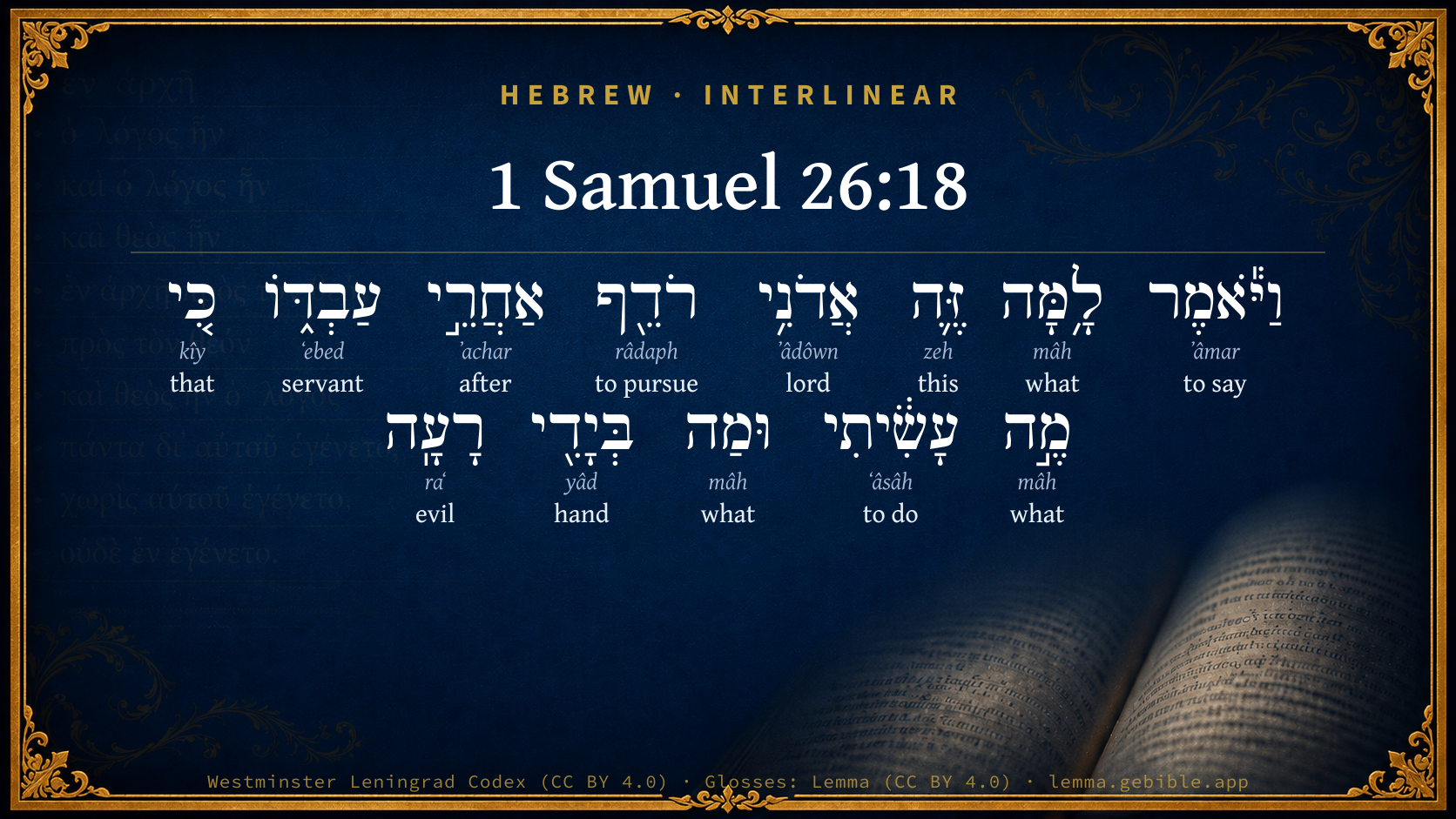
Hebrew (Westminster Leningrad Codex) 1 Samuel 26:18 appears in the Hebrew Old Testament. The text above is from the Westminster Leningrad Codex. Each word links to its Strong’s number, a concise gloss, and parsing drawn from the Open Scriptures Hebrew Bible morphology. Click any word for its full Brown-Driver-Briggs (BDB) entry.
Download image
Cite this verse

1 Samuel 26:18 (World English Bible). Public Domain. Lemma interlinear Bible study tool, https://lemma.gebible.app/v/1-samuel/26/18.

Show BibTeX & RIS
BibTeX
RIS
English Translation
He said, Why does my lord pursue after his servant? for what have I done? or what evil is in my hand?
World English Bible · Public Domain
Download a study sheet

One document with this verse’s original text, its word-by-word gloss line, the meaning frame, cross-references with their text, attributed commentary, and full source and license credits — printable, and it pastes into notes with its structure intact.

This verse Autodidact and up

Study sheet (.html) Plain text (.txt)

A passage Seminary Student

Up to 50 verses in one chapter. A passage sheet keeps up to 6 commentary sources and 12 cross-references per verse, in the order this page ranks them, and says so on the sheet whenever that leaves anything out. Ask for a single verse and you get the Autodidact verse sheet above.

Everything on this page stays free to read, with no account — the sheet is a download of what is already on screen, not access to it.

Want to remove ads? Support Godless Engineer
Compare translations 3

The same verse in 3 English versions, stacked beneath the original-language interlinear above. Click any original word for its lexicon entry.

Each is an independent rendering of the whole verse — the interlinear is not word-aligned to these translations.

Highlighted words mark where these versions differ — a whole-verse word diff, not a word-by-word alignment.

  • World English Bible Public Domain
    He said, Why does my lord pursue after his servant? for what have I done? or what evil is in my hand?
  • King James Version Public Domain
    And he said, Wherefore doth my lord thus pursue after his servant? for what have I done? or what evil is in mine hand?
  • unfoldingWord Literal Text CC BY-SA 4.0
    And he said, “Why this, my master pursuing after his servant? For what have I done, and what evil in my hand?

unfoldingWord Literal Text — © unfoldingWord, licensed CC BY-SA 4.0. Word-aligned USFM3 via Door43 (git.door43.org/unfoldingWord/en_ult).

Versions to compare (up to 4)

3 of 4 selected

Show all 18 translations

Every available English version of this verse, each an independent rendering of the whole verse.

  • World English Bible Public Domain
    He said, Why does my lord pursue after his servant? for what have I done? or what evil is in my hand?
  • Berean Standard Bible Public Domain
    And he continued, “Why is my lord pursuing his servant? What have I done? What evil is in my hand?
  • Majority Standard Bible Public Domain
    And he continued, “Why is my lord pursuing his servant? What have I done? What evil is in my hand?
  • King James Version Public Domain
    And he said, Wherefore doth my lord thus pursue after his servant? for what have I done? or what evil is in mine hand?
  • American Standard Version (1901) Public Domain
    And he said, Wherefore doth my lord pursue after his servant? for what have I done? or what evil is in my hand?
  • Revised Version (1885) Public Domain
    And he said, Wherefore doth my lord pursue after his servant? for what have I done? or what evil is in mine hand?
  • Geneva Bible (1599) Public Domain
    And he sayde, Wherefore doeth my lorde thus persecute his seruant? for what haue I done? or what euill is in mine hand?
  • Douay-Rheims (1899) Public Domain
    And he said: Wherefore doth my lord persecute his servant? What have I done? or what evil is there in my hand?
  • Young's Literal Translation Public Domain
    and he saith, `Why `is' this -- my lord is pursuing after his servant? for what have I done, and what `is' in my hand evil?
  • Literal Standard Version CC BY-SA 4.0
    And he says, “Why [is] this—my lord is pursuing after his servant? For what have I done, and what evil [is] in my hand?
  • Unlocked Literal Bible CC BY-SA 4.0
    He said, “Why does my master pursue his servant? What have I done? What evil is in my hand?
  • unfoldingWord Literal Text CC BY-SA 4.0
    And he said, “Why this, my master pursuing after his servant? For what have I done, and what evil in my hand?
  • Darby Bible Public Domain
    And he said, Why does my lord thus pursue after his servant? for what have I done? or what evil is in my hand?
  • World Messianic Bible Public Domain
    He said, “Why does my lord pursue his servant? For what have I done? What evil is in my hand?
  • Webster's Bible Public Domain
    And he said, Why doth my lord thus pursue his servant? for what have I done? or what evil is in my hand?
  • Free Bible Version CC BY-SA 4.0
    “Why is my lord hunting me, his servant? What is it that I've done? What crime am I guilty of?” he continued.
  • Bible in Basic English Public Domain
    And he said, Why does my lord go armed against his servant? what have I done? or what evil is there in me?
  • JPS Tanakh (1917) Public Domain
    And he said: 'Wherefore doth my lord pursue after his servant? for what have I done? or what evil is in my hand?

Literal Standard Version (2020), Covenant Press — licensed CC BY-SA 4.0. Text via the HelloAO Bible API (eBible.org). Unlocked Literal Bible (unfoldingWord) — licensed CC BY-SA 4.0. Text via the HelloAO Bible API (eBible.org). unfoldingWord Literal Text — © unfoldingWord, licensed CC BY-SA 4.0. Word-aligned USFM3 via Door43 (git.door43.org/unfoldingWord/en_ult). Free Bible Version, Dr. Jonathan Gallagher — licensed CC BY-SA 4.0. Text via the HelloAO Bible API (eBible.org).

Word by word

More ways to search: Search by grammar → Find every occurrence → Compare this word →

Practice this passage: Drill this verse → Learn its vocabulary →

רֹדֵ֖ף
râdaph
H7291
“pursuing”
Verb, Qal, Participle Active, Masculine, Singular, Absolute
Part of Speech
Verb
Stem
Qal
Form
Participle Active
Gender
Masculine
Number
Singular
State
Absolute
Full BDB Definition

Origin: a primitive root

TWOT: 2124

to be behind, follow after, pursue, persecute, run after - (Qal) - to pursue, put to flight, chase, dog, attend closely upon - to persecute, harass (figuratively) - to follow after, aim to secure (figuratively) - to run after (a bribe) (figuratively) - (Niphal) - to be pursued - one pursued (participle) - (Piel) to pursue ardently, aim eagerly to secure, pursue - (Pual) to be pursued, be chased away - (Hiphil) to pursue, chase
  1. וַיֹּ֕אמֶר ʼâmar H559 “and · to say” Conjunction + Verb, Qal, Sequential Imperfect, 3rd Person, Masculine, Singular
  2. לָ֥מָּה mâh H4100 “to/for · what” Preposition + Particle, Interrogative
  3. זֶּ֛ה zeh H2088 “this” Pronoun, Demonstrative, Masculine, Singular
  4. אֲדֹנִ֥י ʼâdôwn H113 “lord · my” Noun, Common, Masculine, Singular, Construct + Suffix, Personal, 1st Person, Common, Singular
  5. אַחֲרֵ֣י ʼachar H310 “after” Preposition
  6. עַבְדּ֑וֹ ʻebed H5650 “servant · his” Noun, Common, Masculine, Singular, Construct + Suffix, Personal, 3rd Person, Masculine, Singular
  7. כִּ֚י kîy H3588 “that” Conjunction
  8. מֶ֣ה mâh H4100 “what” Particle, Interrogative
  9. עָשִׂ֔יתִי ʻâsâh H6213 “to do” Verb, Qal, Perfect, 1st Person, Common, Singular
  10. וּמַה mâh H4100 “and · what” Conjunction + Particle, Interrogative
  11. בְּיָדִ֖י yâd H3027 “in/at · hand · my” Preposition + Noun, Common, Both, Singular, Construct + Suffix, Personal, 1st Person, Common, Singular
  12. רָעָֽה raʻ H7451 “evil” Noun, Common, Feminine, Singular, Absolute

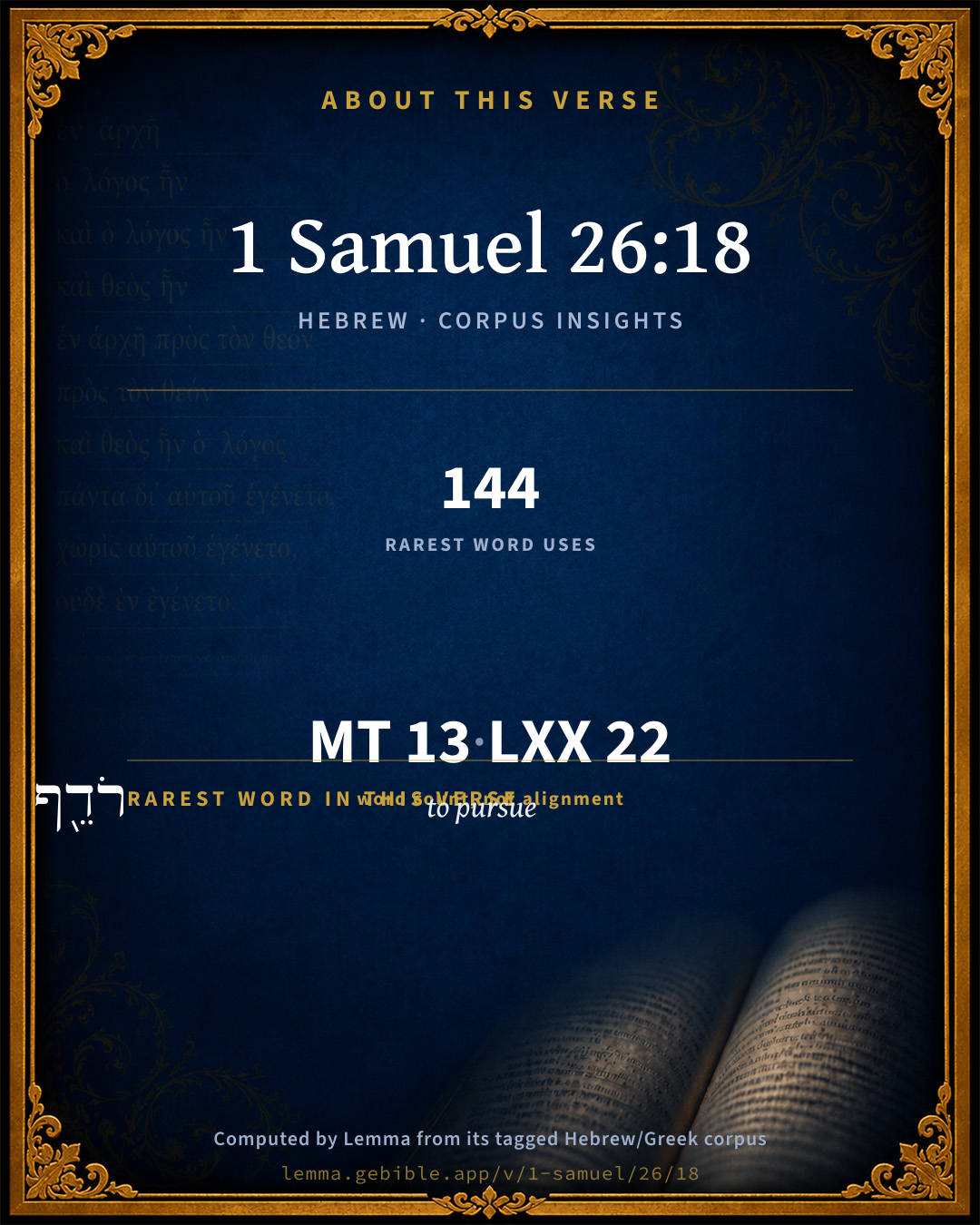
About this verse

These counts appear in no published source. They are computed here, from the morphology-tagged text and Lemma’s own curated glosses. What Lemma adds →

13
words
11
distinct lemmas
Historical
section

Grammatical profile

  • 3 verbs
  • 4 nouns
  • 1 pronoun
  • 1 preposition
  • 1 conjunction
  • 3 particles

Verb forms

  • וַיֹּ֕אמֶר Qal · Sequential Imperfect
  • רֹדֵ֖ף Qal · Participle Active
  • עָשִׂ֔יתִי Qal · Perfect

Repetition

A word recurs within this verse — often emphatic in Hebrew:

  • לָ֥מָּה what H4100 ×3

Hebrew & Septuagint length

In English translation the verse runs 22 words from the Hebrew and 26 from the Septuagint (LXX English) — closely comparable.

A rough comparison of the two English renderings, which tokenize alike — not a word-level alignment.

Word counts can differ between the Hebrew and the Greek without any difference in meaning — e.g. the Hebrew direct-object marker אֵת has no separate Greek word, and Greek often adds the article ὁ.

In the original languages it is 13 Hebrew tokens and 22 Greek tokens — but the two are counted differently (Hebrew bundles its prefixes and suffixes into one token; the Greek is in lemma form), so that isn’t a like-for-like length.

Cross-references

9

Topical passages linked to 1 Samuel 26:18 in the Treasury of Scripture Knowledge — connected by theme and wording, ordered by reader-vote popularity; previews shown in the World English Bible.

  • 1 Samuel 24:9 David said to Saul, Why listen you to men's words, saying, Behold, David seeks your hurt?
  • 1 Samuel 24:11–14 Moreover, my father, behold, yes, see the skirt of your robe in my hand; for in that I cut off the skirt of your robe, and didn't kill you, know you and see that there is neither evil nor disobedience in my hand, and I have not sinned against you, though you hunt after my life to take it.
  • Psalms 7:3–5 Yahweh, my God, if I have done this, If there is iniquity in my hands,
  • Psalms 35:7 For without cause they have hidden their net in a pit for me. Without cause they have dug a pit for my soul.
  • Psalms 69:4 Those who hate me without a cause are more than the hairs of my head. Those who want to cut me off, being my enemies wrongfully, are mighty. I have to restore what I didn't take away.
  • John 8:46 Which of you convicts me of sin? If I tell the truth, why do you not believe me?
  • John 10:32 Jesus answered them, "I have shown you many good works from my Father. For which of those works do you stone me?"
  • John 18:23 Jesus answered him, "If I have spoken evil, testify of the evil; but if well, why do you beat me?"
  • 1 Samuel 17:29 David said, What have I now done? Is there not a cause?

Cross-references courtesy of OpenBible.info (CC BY 4.0).

Hebrew and Greek witnesses Masoretic Hebrew ↔ Greek Septuagint

The same verse in the two great witnesses to the Old Testament, shown verse-for-verse.

These are two independent witnesses, not word-aligned to each other, and the Septuagint is shown in lemma (dictionary) form.

Hebrew 1 Samuel 26:18 Masoretic · Westminster Leningrad Codex

וַיֹּ֕אמֶר לָ֥מָּה זֶּ֛ה אֲדֹנִ֥י רֹדֵ֖ף אַחֲרֵ֣י עַבְדּ֑וֹ כִּ֚י מֶ֣ה עָשִׂ֔יתִי וּמַה בְּיָדִ֖י רָעָֽה

He said, Why does my lord pursue after his servant? for what have I done? or what evil is in my hand?

World English Bible · Public Domain

Greek LXX 1 Samuel 26:18 Septuagint · lemma form

καί εἶπον ἵνα τίς οὗτος καταδιώκω ὁ κύριος ἐγώ ὀπίσω ὁ δοῦλος αὐτός ὅτι τίς ἁμαρτάνω καί τίς εὑρίσκω ἐν ἐγώ ἀδίκημα

And he said, Why does my lord thus pursue after his servant? for in what have I sinned? and what unrighteousness has been found in me?

LXX2012 (modern English Septuagint) · Public Domain

Hebrew: Westminster Leningrad Codex (CC BY 4.0). Greek: Septuagint (public domain); English from LXX2012 (modern English Septuagint) (Public Domain). How the Septuagint differs from the Hebrew →

Targum (Aramaic paraphrase)

1

The Targum is the ancient Jewish Aramaic paraphrase of the Hebrew Scriptures — an interpretive translation, not the Hebrew text itself. Onkelos (literal) and Pseudo-Jonathan (expansive) render the Torah, and Jonathan the Prophets. Coverage is partial: where no permissively-licensed English translation exists for a verse, only the Aramaic is shown. This is verse-level text, not a word-by-word alignment to the Hebrew.

  1. Targum Jonathan Prophets (Joshua–Malachi)
    וַאֲמַר לְמָא דְנַן רִבּוֹנִי רָדִיף בָּתַר עַבְדֵיהּ אֲרֵי מֶה עֲבָדִית וּמַה בְּיָדִי חוֹבָא:

    (no public-domain English translation for this verse)

    Targum Jonathan — Aramaic: “Mikraot Gedolot” (public domain). English: “Sefaria Community Translation” (CC0 1.0 (public-domain dedication)); “London "Chaldee Paraphrase," 1871” (public domain). Text via Sefaria.

Commentary

Notes on 1 Samuel 26:18 from classic Christian and Jewish commentators (each source and its license shown beneath its notes). The classic Christian expositions comment on the surrounding passage and are grouped to its opening verse, so a note may address several verses; the Jewish commentaries on the Tanakh (Rashi and others) are per-verse, so they appear only where the commentator wrote on this verse.

Lemma curates 59 commentaries, every one of them public domain or Creative Commons licensed, each selected and text-cleaned for this edition rather than reprinted as found. About our sources →

Trapp's Complete Commentary

John Trapp

1Sa 26:18 And he said, Wherefore doth my lord thus pursue after his servant? for what have I done? or what evil [is] in mine hand?

Ver. 18. Wherefore doth my lord.] Nothing is more irrational than irreligion. Would wicked persons but consider their ways, as they are oft advised, {Hag 1:5; Hag 1:7} they would see them compact of mere incongruities and absurdities. But their lusts do so hang in their light that they think they have reason to be mad; and that there is no small sense in sinning.

John Trapp, A Commentary or Exposition upon All the Books of the Old and New Testament (1647–1656) — public domain. Text from a community e-Sword module.

Ellicott's Commentary for English Readers

(18) What have I done?—The whole address of David to Saul is intensely reverent, even loving. The conspicuous trophy of his late “night raid” was in his hand; we can imagine the first rays of the morning sun lighting up the glittering royal spear grasped by David. Saul could not help recognising that at least the son of Jesse sought not his life.

A Bible Commentary for English Readers, edited by Charles John Ellicott (1878–1897) — public domain. Text from a community e-Sword module.

The Cambridge Bible for Schools and Colleges

gen. ed. J. J. S. Perowne

18. And he said, &c.] With David’s speech here compare that in 1Sa_24:9 ff. Here he affirms his innocence indirectly by challenging Saul to give his reasons for persecuting him: there he appeals directly to his having spared Saul’s life as a proof of his loyalty.

The Cambridge Bible for Schools and Colleges (gen. ed. J. J. S. Perowne; Cambridge University Press, 1878–1918) — public domain. Text from a community e-Sword module.

John Gill's Exposition

And he said, wherefore doth my lord thus pursue after his servant?.... Suggesting that it was both below him to do it, and against his interest; for David was his servant, and he would gladly have continued in his service, and done his business, but he drove him from it, and pursued him as a traitor, when he had not been guilty of any offence to his knowledge: and therefore puts the following questions:

for what have I done? or what evil is in mine hand? what crime had he committed, that he was pursued after this manner, and his life sought for? what had he done worthy of death? having a clear conscience, he could boldly ask these questions.

John Gill's Exposition of the Whole Bible (1746–1763) — public domain (CC PDM 1.0). Text via the HelloAO Bible API.

Lesson kit

Teaching starters — assembled from the data on this page, not authored interpretation. Every prompt links to the verse data it draws on. Edit before teaching.

1 Samuel, in the Historical, opens this verse with 13 words (11 distinct Hebrew lemmas). Its most distinctive word is râdaph (“to pursue”). A historical commentator’s framing appears above. Read the whole chapter for the surrounding context.

Discussion questions

  1. What does “to pursue” (râdaph) contribute to the verse as a whole?
  2. How does 1 Samuel 24:9, which shares this passage’s theme, read alongside this verse?
  3. What does the repetition of “what” (3× in this one verse) do in this verse?
  4. The translations on this page render this verse differently — a whole-verse word diff, not a word-by-word alignment. What might account for the different wordings?
  5. «וַיֹּ֕אמֶר» is a Qal Sequential Imperfect verb. How does that grammatical form shape the action described?
  6. Compare how Trapp's Complete Commentary and Ellicott's Commentary for English Readers read this verse. Where do they agree or differ?

Things to notice

Reading settings

Reading text

Shown beneath each verse's original-language words.

Old Testament
Old Testament edition

Read the OT as the Masoretic Hebrew (MT) or the Greek Septuagint (LXX).

English shown for the Greek Septuagint (in the Hebrew ↔ Greek comparison).

Comparing translations? Open the Compare panel on any verse page to stack up to four side by side.