
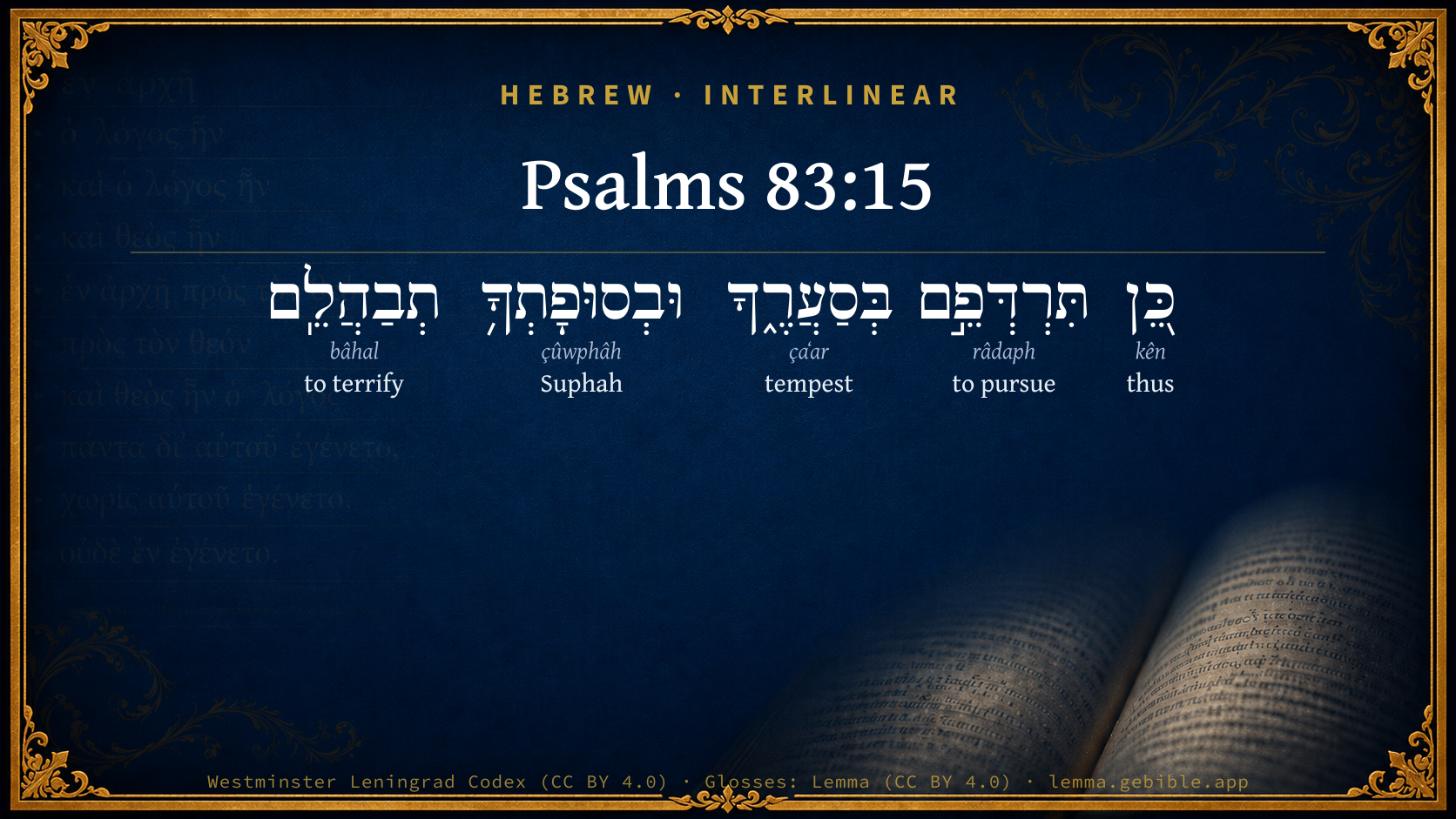
Psalms 83:15

Hebrew (Westminster Leningrad Codex) Psalms 83:15 appears in the Hebrew Old Testament. The text above is from the Westminster Leningrad Codex. Each word links to its Strong’s number, a concise gloss, and parsing drawn from the Open Scriptures Hebrew Bible morphology. Click any word for its full Brown-Driver-Briggs (BDB) entry.
Download image
Cite this verse

Psalms 83:15 (World English Bible). Public Domain. Lemma interlinear Bible study tool, https://lemma.gebible.app/v/psalms/83/15.

Show BibTeX & RIS
BibTeX
RIS
English Translation
So pursue them with your tempest, And terrify them with your storm.
World English Bible · Public Domain
Download a study sheet

One document with this verse’s original text, its word-by-word gloss line, the meaning frame, cross-references with their text, attributed commentary, and full source and license credits — printable, and it pastes into notes with its structure intact.

This verse Autodidact and up

Study sheet (.html) Plain text (.txt)

A passage Seminary Student

Up to 50 verses in one chapter. A passage sheet keeps up to 6 commentary sources and 12 cross-references per verse, in the order this page ranks them, and says so on the sheet whenever that leaves anything out. Ask for a single verse and you get the Autodidact verse sheet above.

Everything on this page stays free to read, with no account — the sheet is a download of what is already on screen, not access to it.

Want to remove ads? Support Godless Engineer
Compare translations 3

The same verse in 3 English versions, stacked beneath the original-language interlinear above. Click any original word for its lexicon entry.

Each is an independent rendering of the whole verse — the interlinear is not word-aligned to these translations.

Highlighted words mark where these versions differ — a whole-verse word diff, not a word-by-word alignment.

  • World English Bible Public Domain
    So pursue them with your tempest, And terrify them with your storm.
  • King James Version Public Domain
    So persecute them with thy tempest, and make them afraid with thy storm.
  • unfoldingWord Literal Text CC BY-SA 4.0
    thus pursue them with your tempest, and terrify them with your whirlwind.

unfoldingWord Literal Text — © unfoldingWord, licensed CC BY-SA 4.0. Word-aligned USFM3 via Door43 (git.door43.org/unfoldingWord/en_ult).

Versions to compare (up to 4)

3 of 4 selected

Show all 18 translations

Every available English version of this verse, each an independent rendering of the whole verse.

  • World English Bible Public Domain
    So pursue them with your tempest, And terrify them with your storm.
  • Berean Standard Bible Public Domain
    so pursue them with Your tempest, and terrify them with Your storm.
  • Majority Standard Bible Public Domain
    so pursue them with Your tempest, and terrify them with Your storm.
  • King James Version Public Domain
    So persecute them with thy tempest, and make them afraid with thy storm.
  • American Standard Version (1901) Public Domain
    So pursue them with thy tempest, And terrify them with thy storm.
  • Revised Version (1885) Public Domain
    So pursue them with thy tempest, and terrify them with thy storm.
  • Geneva Bible (1599) Public Domain
    So persecute them with thy tempest, and make them afraide with thy storme.
  • Douay-Rheims (1899) Public Domain
    As fire which burneth the wood: and as a flame burning mountains:
  • Young's Literal Translation Public Domain
    So dost Thou pursue them with Thy whirlwind, And with Thy hurricane troublest them.
  • Literal Standard Version CC BY-SA 4.0
    So You pursue them with Your whirlwind, || And trouble them with Your windstorm.
  • Unlocked Literal Bible CC BY-SA 4.0
    Chase them with your strong wind, and terrify them with your windstorm.
  • unfoldingWord Literal Text CC BY-SA 4.0
    thus pursue them with your tempest, and terrify them with your whirlwind.
  • Darby Bible Public Domain
    So pursue them with thy tempest, and terrify them with thy whirlwind.
  • World Messianic Bible Public Domain
    so pursue them with your tempest, and terrify them with your storm.
  • Webster's Bible Public Domain
    \\83:14\\As the fire burneth a wood, and as the flame setteth the mountains on fire;
  • Free Bible Version CC BY-SA 4.0
    in the same way chase them down with your storm, terrify them with your whirlwind.
  • Bible in Basic English Public Domain
    So go after them with your strong wind, and let them be full of fear because of your storm.
  • JPS Tanakh (1917) Public Domain
    (83-16) So pursue them with Thy tempest, and affright them with Thy storm.

Literal Standard Version (2020), Covenant Press — licensed CC BY-SA 4.0. Text via the HelloAO Bible API (eBible.org). Unlocked Literal Bible (unfoldingWord) — licensed CC BY-SA 4.0. Text via the HelloAO Bible API (eBible.org). unfoldingWord Literal Text — © unfoldingWord, licensed CC BY-SA 4.0. Word-aligned USFM3 via Door43 (git.door43.org/unfoldingWord/en_ult). Free Bible Version, Dr. Jonathan Gallagher — licensed CC BY-SA 4.0. Text via the HelloAO Bible API (eBible.org).

Word by word

More ways to search: Search by grammar → Find every occurrence → Compare this word →

Practice this passage: Drill this verse → Learn its vocabulary →

וּבְסוּפָתְךָ֥
çûwphâh
H5492
“and · in/at · Suphah · your”
Conjunction + Preposition + Noun, Common, Feminine, Singular, Construct + Suffix, Personal, 2nd Person, Masculine, Singular
Part of Speech
Conjunction + Preposition + Noun
Type
Common
Gender
Feminine
Number
Singular
State
Construct
Full BDB Definition

Origin: from H5486

TWOT: 1478b

Suphah = "honeycomb: overflow" - storm-wind (noun feminine) - a place east of the Jordan (noun proper locative)
  1. כֵּ֭ן kên H3651 “thus” Particle, Demonstrative
  2. תִּרְדְּפֵ֣ם râdaph H7291 “to pursue · them” Verb, Qal, Imperfect, 2nd Person, Masculine, Singular + Suffix, Personal, 3rd Person, Masculine, Plural
  3. בְּסַעֲרֶ֑ךָ çaʻar H5591 “in/at · tempest · your” Preposition + Noun, Common, Masculine, Singular, Construct + Suffix, Personal, 2nd Person, Masculine, Singular
  4. תְבַהֲלֵֽם bâhal H926 “to terrify · them” Verb, Piel, Imperfect, 2nd Person, Masculine, Singular + Suffix, Personal, 3rd Person, Masculine, Plural

About this verse

These counts appear in no published source. They are computed here, from the morphology-tagged text and Lemma’s own curated glosses. What Lemma adds →

5
words
5
distinct lemmas
Wisdom
section

Notable vocabulary

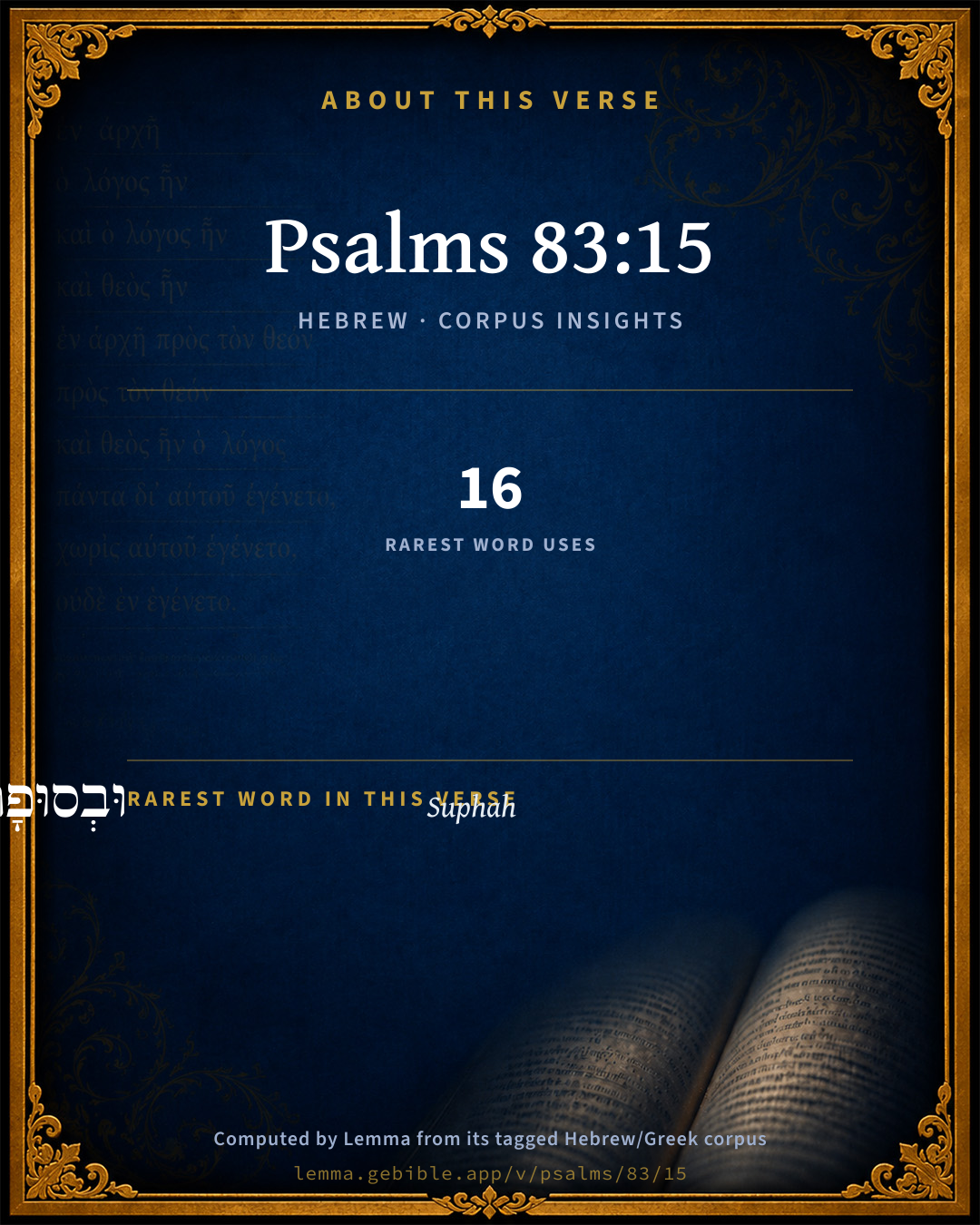
The rarest word here is וּבְסוּפָתְךָ֥ Suphah H5492 — appearing just 16 times in the whole Hebrew Bible.

Shared distinctive vocabulary

וּבְסוּפָתְךָ֥ Suphah H5492 occurs in 16 verses of the Hebrew Bible. Also found in:

Grammatical profile

  • 2 verbs
  • 2 nouns
  • 1 particle

Verb forms

  • תִּרְדְּפֵ֣ם Qal · Imperfect
  • תְבַהֲלֵֽם Piel · Imperfect

Hebrew & Septuagint length

In English translation the verse runs 12 words from the Hebrew and 14 from the Septuagint (LXX English) — closely comparable.

A rough comparison of the two English renderings, which tokenize alike — not a word-level alignment.

Word counts can differ between the Hebrew and the Greek without any difference in meaning — e.g. the Hebrew direct-object marker אֵת has no separate Greek word, and Greek often adds the article ὁ.

Cross-references

10

Topical passages linked to Psalms 83:15 in the Treasury of Scripture Knowledge — connected by theme and wording, ordered by reader-vote popularity; previews shown in the World English Bible.

  • Job 9:17 For he breaks me with a tempest, Multiplies my wounds without cause.
  • Psalms 50:3 Our God comes, and does not keep silent. A fire devours before him. It is very tempestuous around him.
  • Psalms 58:9 Before your pots can feel the heat of the thorns, He will sweep away the green and the burning alike.
  • Isaiah 28:17 I will make justice the line, and righteousness the plummet; and the hail shall sweep away the refuge of lies, and the waters shall overflow the hiding-place.
  • Job 27:20–23 Terrors overtake him like waters; A tempest steals him away in the night.
  • Psalms 11:6 On the wicked he will rain blazing coals; Fire, sulfur, and scorching wind shall be the portion of their cup.
  • Matthew 7:27 The rain came down, the floods came, and the winds blew, and beat on that house; and it fell--and great was its fall."
  • Hebrews 12:18 For you have not come to a mountain that might be touched, and that burned with fire, and to blackness, darkness, tempest,
  • Isaiah 30:30 Yahweh will cause his glorious voice to be heard, and will show the lighting down of his arm, with the indignation of [his] anger, and the flame of a devouring fire, with a blast, and tempest, and hailstones.
  • Ezekiel 13:11–14 tell those who daub it with whitewash, that it shall fall: there shall be an overflowing shower; and you, great hailstones, shall fall; and a stormy wind shall tear it.

Cross-references courtesy of OpenBible.info (CC BY 4.0).

Hebrew and Greek witnesses Masoretic Hebrew ↔ Greek Septuagint

The same verse in the two great witnesses to the Old Testament, shown verse-for-verse.

You’re reading Greek Psalm 82 (Hebrew Psalm 83). The Septuagint counts the superscription, so verse numbers can differ from the Hebrew — chapter-level alignment, not verse-by-verse. Numbering follows Rahlfs.

These are two independent witnesses, not word-aligned to each other, and the Septuagint is shown in lemma (dictionary) form.

Hebrew Psalms 83:15 Masoretic · Westminster Leningrad Codex

כֵּ֭ן תִּרְדְּפֵ֣ם בְּסַעֲרֶ֑ךָ וּבְסוּפָתְךָ֥ תְבַהֲלֵֽם

So pursue them with your tempest, And terrify them with your storm.

World English Bible · Public Domain

Greek LXX Greek Psalm 82:15 Septuagint · lemma form

ὡσεί πῦρ ὅς διαφλέγω δρυμός ὡς εἰ φλόξ κατακαίω ὄρος

so shall you persecute them with your tempest, and trouble them in your anger.

LXX2012 (modern English Septuagint) · Public Domain

Hebrew: Westminster Leningrad Codex (CC BY 4.0). Greek: Septuagint (public domain); English from LXX2012 (modern English Septuagint) (Public Domain). How the Septuagint differs from the Hebrew →

Commentary

Notes on Psalms 83:15 from classic Christian and Jewish commentators (each source and its license shown beneath its notes). The classic Christian expositions comment on the surrounding passage and are grouped to its opening verse, so a note may address several verses; the Jewish commentaries on the Tanakh (Rashi and others) are per-verse, so they appear only where the commentator wrote on this verse.

Lemma curates 59 commentaries, every one of them public domain or Creative Commons licensed, each selected and text-cleaned for this edition rather than reprinted as found. About our sources →

Trapp's Complete Commentary

John Trapp

Psa 83:15 So persecute them with thy tempest, and make them afraid with thy storm.

Ver. 15. So persecute them with thy tempest] Turbina eos , that they may stand or stay nowhere.

And make them afraid, &c.] So fright them with thy heavy judgments that all their wit and courage wherewith they should help themselves may be expectorated.

John Trapp, A Commentary or Exposition upon All the Books of the Old and New Testament (1647–1656) — public domain. Text from a community e-Sword module.

J. A. Alexander on Psalms

Joseph Addison Alexander

16. (Psa 83:15). So wilt thou pursue them with thy storm, and with thy tempest scare them. There is no need of translating these futures as imperatives. It is one of those cases, so frequent in Hebrew, and especially in this book, where the form of direct petition alternates with that of confident anticipation.

Joseph Addison Alexander, The Psalms Translated and Explained (1850) — public domain. Text from a community e-Sword module.

Adam Clarke's Commentary

Verse 15. So persecute them] In this and the two following verses we find several awful execrations; and all this seems to be done in reference to that ancient custom, "pouring execrations on an enemy previously to battle." Of this I have already given specimens in this work; and the reader is particularly requested to refer to the case of Balaam being hired by the king of Moab to curse Israel previously to his intended attack: see the note on Nu 22:6, where the subject is treated at large.

This custom prevailed much among the Romans, and the ancient Druids of Britain. In all cases the priests were employed to utter the execrations, as they were supposed to have the greatest influence with the gods, in whose name the curses were uttered.

Adam Clarke's Commentary on the Bible (1810–1826) — public domain. Text from a community e-Sword/MySword module.

John Gill's Exposition

So persecute them with thy tempest,.... Pursue them with thy fury, follow them with thy vengeance; cause it to fall upon them like a mighty tempest:

and make them afraid with thy storm; God has his storms and tempests of wrath and vengeance, which he sometimes causes to fall upon wicked men in this life, to their inexpressible terror, and with which he takes them out of this world; and he has still more horrible ones to rain upon them hereafter: see Job 27:20.

John Gill's Exposition of the Whole Bible (1746–1763) — public domain (CC PDM 1.0). Text via the HelloAO Bible API.

Albert Barnes' Notes on the Bible

So persecute them - So pursue them; so follow them up. The word “persecute” is now used in a somewhat different sense, as denoting pain or suffering inflicted on account of religious opinion. It means here simply to pursue.

With thy tempest - With the expressions of thy displeasure; with punishment which may be compared with the fury of a storm.

And make them afraid with thy storm - Or, Make them afraid, terrify them, so that they will flee away. As all that is here sought by prayer is what people endeavor to do when an enemy invades their country - as they make arrangements for repelling those enemies, and overthrowing them, and as they feel that it is right to do so - there is no impropriety in making this the subject of prayer to God. What it is right for men to attempt, it is right to pray for; what it would be right for them to do if they had the power, it is right to ask God to accomplish; what is free from malignity in the act, and in the design, may be free from malignity in the desire and the prayer; and if men can carry with them the idea that what they are endeavoring to do is right, whether as magistrates, judges, rulers, defenders of their country, or as private men, they will have very little difficulty in regard to the so-called “imprecatory psalms.” See this subject treated in the General Introduction

Albert Barnes' Notes on the Bible (1834–1885) — public domain. Text from a community e-Sword/MySword module.

The Treasury of David

Charles H. Spurgeon

Ver. 15. So persecute them with thy tempest, and make them afraid with thy storm. The Lord will follow up his enemies, alarm them, and chase them till they are put to a hopeless rout. He did this, according to the prayer of the present Psalm, for his servant Jehoshaphat; and in like manner will he come to the rescue of any or all of his chosen.

None.

Charles H. Spurgeon's The Treasury of David (1869–1885) — public domain. Psalms only. Text from a community e-Sword/MySword module.

Whedon's Commentary on the Bible

Daniel D. Whedon

15. So persecute them—So pursue them, chase them away with thy tempest, and terrify them with thy whirlwind. On last word, see Isa_5:28; Pro_1:27

Daniel D. Whedon (gen. ed.), Commentary on the Old and New Testaments (1874–1909) — public domain. Text from a community e-Sword module.

The Pulpit Commentary

So persecute them with thy tempest, and make them afraid with thy storm. There is some confusion of metaphors; but the general meaning is clear. God is called upon to execute vengeance upon Israel"s enemies by sweeping them away with the storm and tempest of his wrath. (comp. Job_9:17 Isa_29:6)

The Pulpit Commentary (1880–1919), ed. H.D.M. Spence-Jones & Joseph S. Exell — public domain. Text from a community e-Sword module.

Lesson kit

Teaching starters — assembled from the data on this page, not authored interpretation. Every prompt links to the verse data it draws on. Edit before teaching.

Psalms, in the Wisdom, opens this verse with 5 words (5 distinct Hebrew lemmas). Its most distinctive word is çûwphâh (“Suphah”). A historical commentator’s framing appears above. Read the whole chapter for the surrounding context.

Discussion questions

  1. What does “Suphah” (çûwphâh) contribute to the verse as a whole?
  2. How does Numbers 21:14, which shares the word «Suphah», read alongside this verse?
  3. These translations render this verse differently; the difference is in the English rendering, not the original. What questions does that raise?
  4. «תִּרְדְּפֵ֣ם» is a Qal Imperfect verb. How does that grammatical form shape the action described?
  5. Compare how Trapp's Complete Commentary and J. A. Alexander on Psalms read this verse. Where do they agree or differ?

Things to notice

Reading settings

Reading text

Shown beneath each verse's original-language words.

Old Testament
Old Testament edition

Read the OT as the Masoretic Hebrew (MT) or the Greek Septuagint (LXX).

English shown for the Greek Septuagint (in the Hebrew ↔ Greek comparison).

Comparing translations? Open the Compare panel on any verse page to stack up to four side by side.