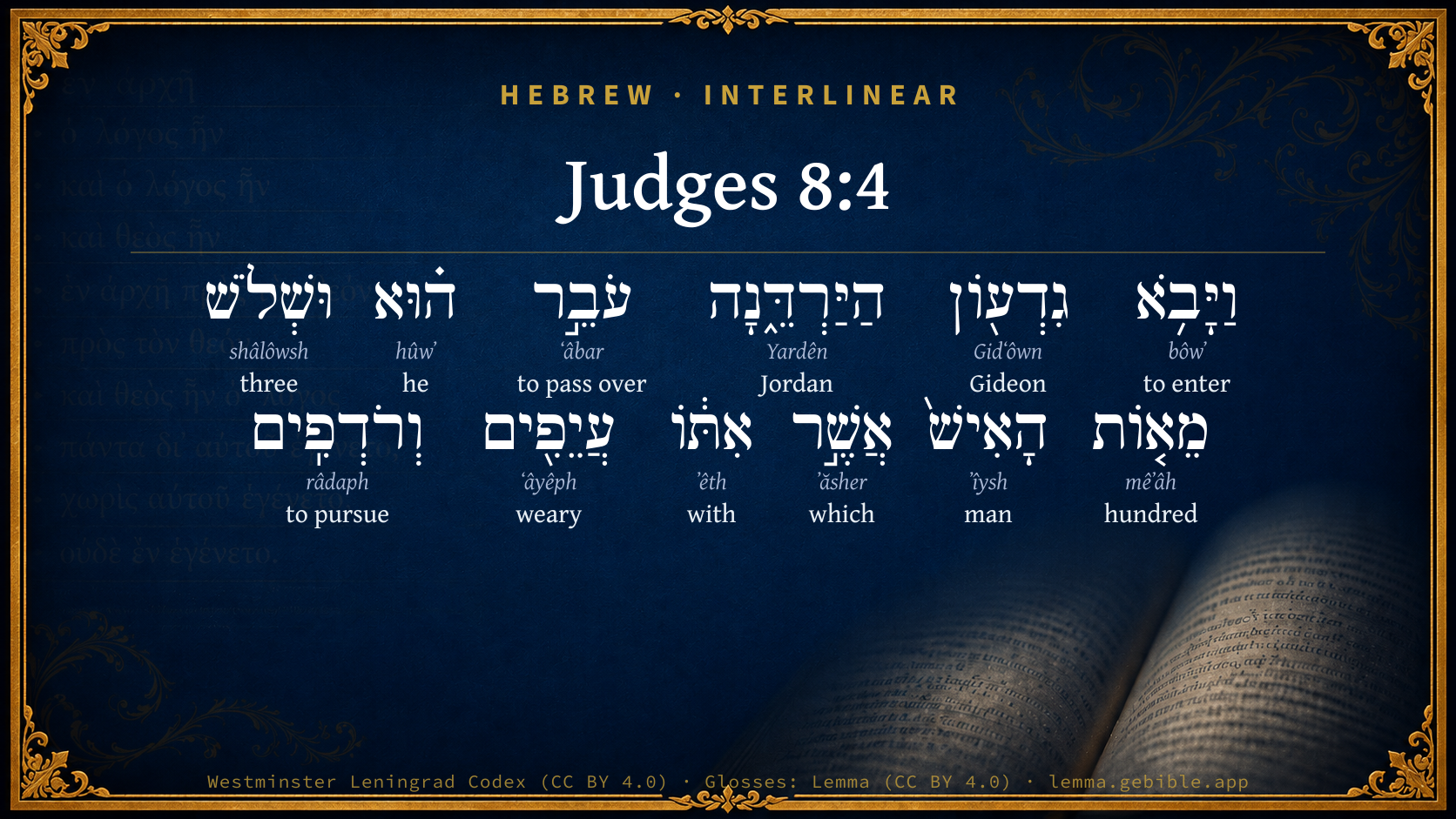
Judges 8:4

Hebrew (Westminster Leningrad Codex) Judges 8:4 appears in the Hebrew Old Testament. The text above is from the Westminster Leningrad Codex. Each word links to its Strong’s number, a concise gloss, and parsing drawn from the Open Scriptures Hebrew Bible morphology. Click any word for its full Brown-Driver-Briggs (BDB) entry.
Download image
Cite this verse

Judges 8:4 (World English Bible). Public Domain. Lemma interlinear Bible study tool, https://lemma.gebible.app/v/judges/8/4.

Show BibTeX & RIS
BibTeX
RIS
English Translation
Gideon came to the Jordan, [and] passed over, he, and the three hundred men who were with him, faint, yet pursuing.
World English Bible · Public Domain
Download a study sheet

One document with this verse’s original text, its word-by-word gloss line, the meaning frame, cross-references with their text, attributed commentary, and full source and license credits — printable, and it pastes into notes with its structure intact.

This verse Autodidact and up

Study sheet (.html) Plain text (.txt)

A passage Seminary Student

Up to 50 verses in one chapter. A passage sheet keeps up to 6 commentary sources and 12 cross-references per verse, in the order this page ranks them, and says so on the sheet whenever that leaves anything out. Ask for a single verse and you get the Autodidact verse sheet above.

Everything on this page stays free to read, with no account — the sheet is a download of what is already on screen, not access to it.

Want to remove ads? Support Godless Engineer
Compare translations 3

The same verse in 3 English versions, stacked beneath the original-language interlinear above. Click any original word for its lexicon entry.

Each is an independent rendering of the whole verse — the interlinear is not word-aligned to these translations.

Highlighted words mark where these versions differ — a whole-verse word diff, not a word-by-word alignment.

  • World English Bible Public Domain
    Gideon came to the Jordan, [and] passed over, he, and the three hundred men who were with him, faint, yet pursuing.
  • King James Version Public Domain
    And Gideon came to Jordan, and passed over, he, and the three hundred men that were with him, faint, yet pursuing them.
  • unfoldingWord Literal Text CC BY-SA 4.0
    Then Gideon came to the Jordan. Crossing over, he and the 300 men who with him weary, but pursuing.

unfoldingWord Literal Text — © unfoldingWord, licensed CC BY-SA 4.0. Word-aligned USFM3 via Door43 (git.door43.org/unfoldingWord/en_ult).

Versions to compare (up to 4)

3 of 4 selected

Show all 18 translations

Every available English version of this verse, each an independent rendering of the whole verse.

  • World English Bible Public Domain
    Gideon came to the Jordan, [and] passed over, he, and the three hundred men who were with him, faint, yet pursuing.
  • Berean Standard Bible Public Domain
    Then Gideon and his three hundred men came to the Jordan and crossed it, exhausted yet still in pursuit.
  • Majority Standard Bible Public Domain
    Then Gideon and his three hundred men came to the Jordan and crossed it, exhausted yet still in pursuit.
  • King James Version Public Domain
    And Gideon came to Jordan, and passed over, he, and the three hundred men that were with him, faint, yet pursuing them.
  • American Standard Version (1901) Public Domain
    And Gideon came to the Jordan, `and' passed over, he, and the three hundred men that were with him, faint, yet pursuing.
  • Revised Version (1885) Public Domain
    And Gideon came to Jordan, and passed over, he, and the three hundred men that were with him, faint, yet pursuing.
  • Geneva Bible (1599) Public Domain
    And Gideon came to Iorden to passe ouer, hee, and the three hundreth men that were with him, weary, yet pursuing them.
  • Douay-Rheims (1899) Public Domain
    And when Gedeon was come to the Jordan, he passed over it with the three hundred men, that were with him: who were so weary that they could not pursue after them that fled.
  • Young's Literal Translation Public Domain
    And Gideon cometh in unto the Jordan, passing over, he and the three hundred men who `are' with him -- wearied, and pursuing,
  • Literal Standard Version CC BY-SA 4.0
    And Gideon comes to the Jordan, passing over, he and the three hundred men who [are] with him—wearied, yet pursuing—
  • Unlocked Literal Bible CC BY-SA 4.0
    Gideon came to the Jordan and crossed over it, he and the three hundred men who were with him. They were exhausted, yet they still kept up the pursuit.
  • unfoldingWord Literal Text CC BY-SA 4.0
    Then Gideon came to the Jordan. Crossing over, he and the 300 men who with him weary, but pursuing.
  • Darby Bible Public Domain
    And Gideon came to the Jordan and passed over, he and the three hundred men who were with him, faint yet pursuing.
  • World Messianic Bible Public Domain
    Gideon came to the Jordan and passed over, he and the three hundred men who were with him, faint, yet pursuing.
  • Webster's Bible Public Domain
    And Gideon came to Jordan, and passed over, he, and the three hundred men that were with him, faint, yet pursuing them.
  • Free Bible Version CC BY-SA 4.0
    Then Gideon crossed the Jordan with his three hundred men. Even though they were exhausted they continued the chase.
  • Bible in Basic English Public Domain
    Then Gideon came to Jordan and went over it with his three hundred, overcome with weariness and in need of food.
  • JPS Tanakh (1917) Public Domain
    And Gideon came to the Jordan, and passed over, he, and the three hundred men that were with him, faint, yet pursuing.

Literal Standard Version (2020), Covenant Press — licensed CC BY-SA 4.0. Text via the HelloAO Bible API (eBible.org). Unlocked Literal Bible (unfoldingWord) — licensed CC BY-SA 4.0. Text via the HelloAO Bible API (eBible.org). unfoldingWord Literal Text — © unfoldingWord, licensed CC BY-SA 4.0. Word-aligned USFM3 via Door43 (git.door43.org/unfoldingWord/en_ult). Free Bible Version, Dr. Jonathan Gallagher — licensed CC BY-SA 4.0. Text via the HelloAO Bible API (eBible.org).

Word by word

More ways to search: Search by grammar → Find every occurrence → Compare this word →

Practice this passage: Drill this verse → Learn its vocabulary →

עֲיֵפִ֖ים
ʻâyêph
H5889
“weary”
Adjective, Adjective, Masculine, Plural, Absolute
Part of Speech
Adjective
Type
Adjective
Gender
Masculine
Number
Plural
State
Absolute
Full BDB Definition

Origin: from H5888

TWOT: 1614a

faint, exhausted, weary
  1. וַיָּבֹ֥א bôwʼ H935 “and · to enter” Conjunction + Verb, Qal, Sequential Imperfect, 3rd Person, Masculine, Singular
  2. גִדְע֖וֹן Gidʻôwn H1439 “Gideon” Noun, Proper
  3. הַיַּרְדֵּ֑נָה Yardên H3383 “the · Jordan · toward” Particle, Definite Article + Noun, Proper + Suffix, Demonstrative
  4. עֹבֵ֣ר ʻâbar H5674 “passing over” Verb, Qal, Participle Active, Masculine, Singular, Absolute
  5. ה֗וּא hûwʼ H1931 “he” Pronoun, Personal, 3rd Person, Masculine, Singular
  6. וּשְׁלֹשׁ shâlôwsh H7969 “and · three” Conjunction + Adjective, Cardinal number, Feminine, Singular, Absolute
  7. מֵא֤וֹת mêʼâh H3967 “hundred” Adjective, Cardinal number, Both, Plural, Absolute
  8. הָאִישׁ֙ ʼîysh H376 “the · man” Particle, Definite Article + Noun, Common, Masculine, Singular, Absolute
  9. אֲשֶׁ֣ר ʼăsher H834 “which” Particle, Relative
  10. אִתּ֔וֹ ʼêth H854 “with · him” Preposition + Suffix, Personal, 3rd Person, Masculine, Singular
  11. וְרֹדְפִֽים râdaph H7291 “and · pursuing” Conjunction + Verb, Qal, Participle Active, Masculine, Plural, Absolute

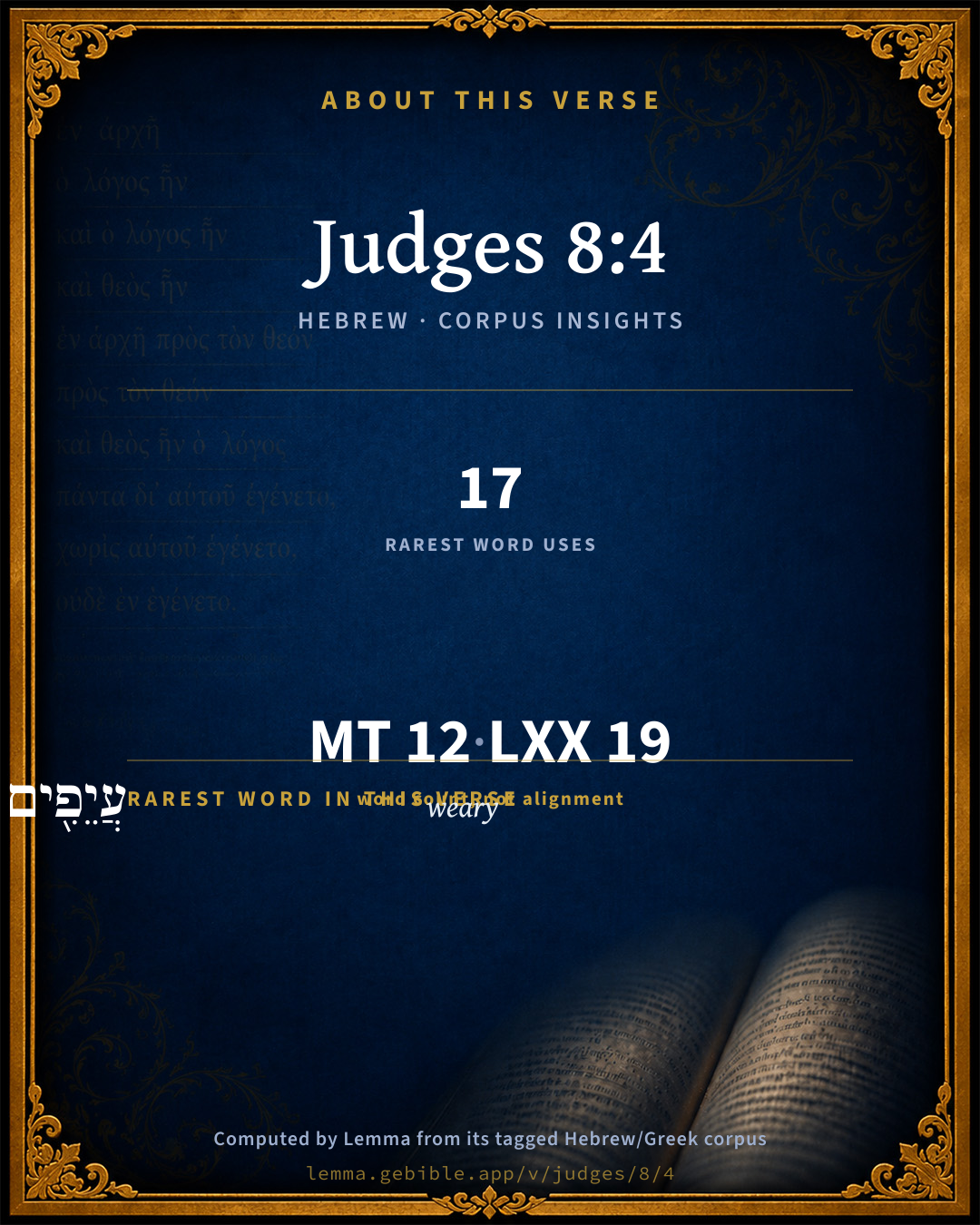
About this verse

These counts appear in no published source. They are computed here, from the morphology-tagged text and Lemma’s own curated glosses. What Lemma adds →

12
words
12
distinct lemmas
Historical
section

Notable vocabulary

The rarest word here is עֲיֵפִ֖ים weary H5889 — appearing just 17 times in the whole Hebrew Bible.

Shared distinctive vocabulary

עֲיֵפִ֖ים weary H5889 occurs in 17 verses of the Hebrew Bible. Also found in:

Grammatical profile

  • 3 verbs
  • 3 nouns
  • 3 adjectives
  • 1 pronoun
  • 1 preposition
  • 1 particle

Verb forms

  • וַיָּבֹ֥א Qal · Sequential Imperfect
  • עֹבֵ֣ר Qal · Participle Active
  • וְרֹדְפִֽים Qal · Participle Active

Hebrew & Septuagint length

In English translation the verse runs 21 words from the Hebrew and 18 from the Septuagint (LXX English) — closely comparable.

A rough comparison of the two English renderings, which tokenize alike — not a word-level alignment.

Word counts can differ between the Hebrew and the Greek without any difference in meaning — e.g. the Hebrew direct-object marker אֵת has no separate Greek word, and Greek often adds the article ὁ.

In the original languages it is 12 Hebrew tokens and 19 Greek tokens — but the two are counted differently (Hebrew bundles its prefixes and suffixes into one token; the Greek is in lemma form), so that isn’t a like-for-like length.

Cross-references

8

Topical passages linked to Judges 8:4 in the Treasury of Scripture Knowledge — connected by theme and wording, ordered by reader-vote popularity; previews shown in the World English Bible.

  • 2 Corinthians 4:16 Therefore we don't faint, but though our outward man is decaying, yet our inward man is renewed day by day.
  • Galatians 6:9 Let us not be weary in doing good, for we will reap in due season, if we don't give up.
  • 1 Samuel 14:28–29 Then answered one of the people, and said, Your father directly charged the people with an oath, saying, Cursed be the man who eats food this day. The people were faint.
  • 1 Samuel 30:10 But David pursued, he and four hundred men; for two hundred stayed behind, who were so faint that they couldn't go over the brook Besor.
  • Hebrews 12:1–4 Therefore let us also, seeing we are surrounded by so great a cloud of witnesses, lay aside every weight and the sin which so easily entangles us, and let us run with patience the race that is set before us,
  • 2 Corinthians 4:8–9 We are pressed on every side, yet not crushed; perplexed, yet not to despair;
  • Judges 7:25 They took the two princes of Midian, Oreb and Zeeb; and they killed Oreb at the rock of Oreb, and Zeeb they killed at the winepress of Zeeb, and pursued Midian: and they brought the heads of Oreb and Zeeb to Gideon beyond the Jordan.
  • 1 Samuel 14:31–32 They struck of the Philistines that day from Michmash to Aijalon. The people were very faint;

Cross-references courtesy of OpenBible.info (CC BY 4.0).

Hebrew and Greek witnesses Masoretic Hebrew ↔ Greek Septuagint

The same verse in the two great witnesses to the Old Testament, shown verse-for-verse.

These are two independent witnesses, not word-aligned to each other, and the Septuagint is shown in lemma (dictionary) form.

Hebrew Judges 8:4 Masoretic · Westminster Leningrad Codex

וַיָּבֹ֥א גִדְע֖וֹן הַיַּרְדֵּ֑נָה עֹבֵ֣ר ה֗וּא וּשְׁלֹשׁ מֵא֤וֹת הָאִישׁ֙ אֲשֶׁ֣ר אִתּ֔וֹ עֲיֵפִ֖ים וְרֹדְפִֽים

Gideon came to the Jordan, [and] passed over, he, and the three hundred men who were with him, faint, yet pursuing.

World English Bible · Public Domain

Greek LXX Judges 8:4 Septuagint · lemma form

καί ἔρχομαι γεδεων ἐπί ὁ ἰορδάνης καί διαβαίνω αὐτός καί ὁ τριακόσιοι ἀνήρ ὁ μετά αὐτός πεινάω καί διώκω

And Gedeon came to Jordan, and went over, himself and the three hundred with him, hungry, yet pursuing.

LXX2012 (modern English Septuagint) · Public Domain

On this verse, Keil & Delitzsch discusses the Septuagint’s reading. Read the note in Commentary ↓

Hebrew: Westminster Leningrad Codex (CC BY 4.0). Greek: Septuagint (public domain); English from LXX2012 (modern English Septuagint) (Public Domain). How the Septuagint differs from the Hebrew →

Targum (Aramaic paraphrase)

1

The Targum is the ancient Jewish Aramaic paraphrase of the Hebrew Scriptures — an interpretive translation, not the Hebrew text itself. Onkelos (literal) and Pseudo-Jonathan (expansive) render the Torah, and Jonathan the Prophets. Coverage is partial: where no permissively-licensed English translation exists for a verse, only the Aramaic is shown. This is verse-level text, not a word-by-word alignment to the Hebrew.

  1. Targum Jonathan Prophets (Joshua–Malachi)
    וַאֲתָא גִדְעוֹן לְיַרְדְנָא עֲבַר הוּא וּתְלַת מְאָה גַבְרַיָא דְעִמֵיהּ כַּד מְשַׁלְהֵן וְרָדְפִין:

    (no public-domain English translation for this verse)

    Targum Jonathan — Aramaic: “Mikraot Gedolot” (public domain). English: “Sefaria Community Translation” (CC0 1.0 (public-domain dedication)); “London "Chaldee Paraphrase," 1871” (public domain). Text via Sefaria.

Commentary

Notes on Judges 8:4 from classic Christian and Jewish commentators (each source and its license shown beneath its notes). The classic Christian expositions comment on the surrounding passage and are grouped to its opening verse, so a note may address several verses; the Jewish commentaries on the Tanakh (Rashi and others) are per-verse, so they appear only where the commentator wrote on this verse.

Lemma curates 59 commentaries, every one of them public domain or Creative Commons licensed, each selected and text-cleaned for this edition rather than reprinted as found. About our sources →

Matthew Henry's Commentary

In these verses we have,

I. Gideon, as a valiant general, pursuing the remaining Midianites, and bravely following his blow. A very great slaughter was made of the enemy at first: 120,000 men that drew the sword, Jdg 8:10. Such a terrible execution did they make among themselves, and so easy a prey were they to Israel. But, it seems, the two kings of Midian, being better provided than the rest for an escape, with 15,000 men got over Jordan before the passes could be secured by the Ephraimites, and made towards their own country. Gideon thinks he does not fully execute his commission to save Israel if he let them escape. He is not content to chase them out of the country, but he will chase them out of the world, Job 18:18. This resolution is here pushed on with great firmness, and crowned with great success.

1. His firmness was very exemplary. He effected his purpose under the greatest disadvantages and discouragements that could be. (1.) He took none with him but his 300 men, who now laid aside their trumpets and torches, and betook themselves to their swords and spears. God had said, By these 300 men will I save you (Jdg 7:7); and, confiding in that promise, Gideon kept to them only, Jdg 8:4. He expected more from 300 men, supported by a particular promise, than from so many thousands supported only by their own valour. (2.) They were faint, and yet pursuing, much fatigued with what they had done, and yet eager to do more against the enemies of their country. Our spiritual warfare must thus be prosecuted with what strength we have, though we have but little; it is many a time the true Christina's case, fainting and yet pursuing. (3.) Though he met with discouragement from those of his own people, was jeered for what he was doing, as going about what he could never accomplish, yet he went on with it. If those that should be our helpers in the way of our duty prove hindrances to us, let not this drive us off from it. Those know not how to value God's acceptance that know not how to despise the reproaches and contempts of men. (4.) He made a very long march by the way of those that dwelt in tents (Jdg 8:11), either because he hoped to find them kinder to him than the men of Succoth and Penuel, that dwelt in walled towns (sometimes there is more generosity and charity found in country tents than in city palaces), or because that was a road in which he would be least expected, and therefore that way it would be the greater surprise to them. It is evident he spared no pains to complete his victory. Now he found it an advantage to have his 300 men such as could bear hunger, and thirst, and toil. It should seem, he set upon the enemy by night, as he had done before, for the host was secure. The security of sinners often proves their ruin, and dangers are most fatal when least feared.

2. His success was very encouraging to resolution and industry in a good cause. He routed the army (Jdg 8:11), and took the two kings prisoners, Jdg 8:12. Note, The fear of the wicked shall come upon him. Those that think to run from the sword of the Lord and of Gideon do but run upon it. If he flee from the iron weapon, yet the bow of steel shall strike him through; for evil pursueth sinners.

II. Here is Gideon, as a righteous judge, chastising the insolence of the disaffected Israelites, the men of Succoth and the men of Penuel, both in the tribe of Gad, on the other side Jordan.

1. Their crime was great. Gideon, with a handful of feeble folk was pursuing the common enemy, to complete the deliverance of Israel. His way led him through the city of Succoth first and afterwards of Penuel. He expected not that the magistrates should meet him in their formalities, congratulate him upon his victory, present him with the keys of their city, and give him a treat, much less that they should send forces in to his assistance, though he was entitled to all this; but he only begs some necessary food for his soldiers that were ready to faint for want, and he does it very humbly and importunately: Give, I pray you, loaves of bread unto the people that follow me, Jdg 8:5. The request would have been reasonable if they had been but poor travellers in distress; but considering that they were soldiers, called, and chose, and faithful (Rev 17:14), men whom God had greatly honoured and to whom Israel was highly obliged, who had done great service to their country and were now doing more, - that they were conquerors, and had power to put them under contribution, - and that they were fighting God's battles and Israel's, - nothing could be more just than that their brethren should furnish them with the best provisions their city afforded. But the princes of Succoth neither feared God nor regarded man. For, (1.) In contempt of God, they refused to answer the just demands of him whom God had raised up to save them, affronted him, bantered him, despised the success he had already been honoured with, despaired of the success of his present undertaking, did what they could to discourage him in prosecuting the war, and were very willing to believe that the remaining forces of Midian, which they had now seen march through their country, would be too hard for him: Are the hands of Zebah and Zalmunna now in thy hand? "No, nor ever will be," so they conclude, judging by the disproportion of numbers. (2.) The bowels of their compassion were shut up against their brethren; they were as destitute of love as they were of faith, would not give morsels of bread (so some read it) to those that were ready to perish. Were these princes? were these Israelites? unworthy either title, base and degenerate men! Surely they were worshippers of Baal, or in the interests of Midian. The men of Penuel gave the same answer to the same request, defying the sword of the Lord and of Gideon, Jdg 8:8.

2. The warning he gave them of the punishment of their crime was very fair. (1.) He did not punish it immediately, because he would not lose so much time from the pursuit of the enemy that were flying from him, because he would not seem to do it in a neat of passion, and because he would do it more to their shame and confusion when he had completed his undertaking, which they thought impracticable. But, (2.) He told them how he would punish it (Jdg 8:7, Jdg 8:9), to show the confidence he had of success in the strength of God, and that, if they had the least grain of grace and consideration left, they might upon second thoughts repent of their folly, humble themselves, and contrive how to atone for it, by sending after him succours and supplies, which if they had done, no doubt, Gideon would have pardoned them. God gives notice of danger, and space to repent, that sinners may flee from the wrath to come.

3. The warning being slighted, the punishment, though very severe, was really very just.

(1.) The princes of Succoth were first made examples. Gideon got intelligence of their number, seventy-seven men, their names, and places of abode, which were described in writing to him, Jdg 8:14. And, to their great surprise, when they thought he had scarcely overtaken the Midianites, he returned a conqueror. His 300 men were now the ministers of his justice; they secured all these princes, and brought them before Gideon, who showed them his royal captives in chains. "These are the men you thought me an unequal match for, and would give me no assistance in the pursuit of," Jdg 8:15. And he punished them with thorns and briers, but, it should seem, not unto death. With these, [1.] He tormented their bodies, either by scourging or by rolling them in the thorns and briers; some way or other he tore their flesh, Jdg 8:7. Those shall have judgment without mercy that have shown no mercy. Perhaps he observed them to be soft and delicate men, who despised him and his company for their roughness and hardiness, and therefore Gideon thus mortified them for their effeminacy. [2.] He instructed their minds: With these he taught the men of Succoth, Jdg 8:16. The correction he gave them was intended, not for destruction, but wholesome discipline, to make them wiser and better for the future. He made them know (so the word is), made them know themselves and their folly, God and their duty, made them know who Gideon was, since they would not know by the success wherewith God had crowned him. Note, Many are taught with the briers and thorns of affliction that would not learn otherwise. God gives wisdom by the rod and reproof, chastens and teaches, and by correction opens the ear to discipline. Our blessed Saviour, though he was a Son, yet learnt obedience by the things which he suffered, Heb 5:8. Let every pricking brier, and grieving thorn, especially when it becomes a thorn in the flesh, be thus interpreted, thus improved. "By this God designs to teach me; what good lesson shall I learn?"

(2.) The doom of the men of Penuel comes next, and it should seem he used them more severely than the other, for good reason, no doubt, Jdg 8:17. [1.] He beat down their tower, of which they gloried, in which they trusted, perhaps scornfully advising Gideon and his men rather to secure themselves in that than to pursue the Midianites. What men make their pride is justly by its ruin made their shame. [2.] He slew the men of the city, not all, perhaps not the elders or princes, but those that had affronted him, and those only. He slew some of the men of the city that were most insolent and abusive, for terror to the rest, and so he taught the men of Penuel.

Matthew Henry's Commentary on the Whole Bible (1708–1710) — public domain (CC PDM 1.0). Text via the HelloAO Bible API.

Trapp's Complete Commentary

John Trapp

Jdg 8:4 And Gideon came to Jordan, [and] passed over, he, and the three hundred men that [were] with him, faint, yet pursuing [them].

Ver. 4. And Gideon came to Jordan.] This was before that bickering he had with the Ephraimites, though set down after it.

Faint, yet pursuing.] So Daniel, though sick, did the king’s business. "Continue instant in prayer." {Rom 12:12}

John Trapp, A Commentary or Exposition upon All the Books of the Old and New Testament (1647–1656) — public domain. Text from a community e-Sword module.

The Biblical Illustrator

Joseph S. Exell

Jdg_8:4

Faint, yet pursuing.

Gideon and his three hundred

I. The army. Merely three hundred devoted warriors, under command of a trusted leader. But no unreliable material in their midst. Each true as steel.

1. The leader was a man thoroughly equipped for his work. Many good causes have languished or been lost for want of an efficient chief. Gideon had boldness to strike, and enthusiasm to follow up. Also a heart thoroughly loyal to God.

2. The men composing this army were specially chosen. They were men who knew no fear in the hour of danger nor alarm at the force of the foe.

3. The men composing this army were devoted to their work. Not to be caught unawares: ever on the alert for the foe.

II. The victory.

1. Divine help. The history of battlefields tells us that the victorious armies have not always been the best equipped; that Providence is not always on the side of the strongest artillery. There is a moral influence at work in all struggles for the right which will make itself felt, whatever be the opposing odds. The greatest exploits are sometimes achieved by the feeblest instrumentality. It is not so much mechanical organisation we want--it is life.

2. Human instrumentality. To those who go out at Gods command the way is wonderfully opened up, the insurmountable barriers vanish. In every Christian enterprise the work is virtually done when the first advance is made in Gods name.

III. The pursuit: Faint, yet pursuing. We cannot read this without feeling rebuked for half-heartedness in our Christian work. Many a time we seem to have made inroads on Satans dominion, souls seem to have been rescued from the oppressor, but the advantage thus gained was not followed up; the old foe, driven out only for a time, returned, and the last state became worse than the first. And what is the reason? Why do we stop short of full success? Because we give way to weariness. We are like Gideons men in being faint; but we fail to imitate them in pursuing. (D. Merson, B. D.)

Gideon and his men

I. The facts.

1. Who and what were they who were faint, yet pursuing? The victorious three hundred, who had previously cried to the Lord. Victorious by Divine power, through faith, which produced works; they went forth, trusting in the Lord. Gideons plan, like Abrahams, an instance of inspired judgment and energy, of Divine influence, not superseding, but exalting and invigorating, the natural faculties; not excluding, but producing consummate generalship.

2. The victors--weak in themselves--felt their bodily wants and infirmities.

II. Principles which the facts exemplify.

1. The preceding events in the context show the connection of sin and misery; the intention of Divine chastisements; the necessity and benefit of repentance; the required instrumentality of faith and obedience; Gods care to exclude boasting.

2. The text, as a comment on the events, suggests that all Gods people indeed are called to be conquerors like Gideon and his men--on the same principles.

3. Like Gideon and his men, they are called, and able, notwithstanding their weakness, to be still pursuing.

4. While thus pursuing, they are liable to be tried like Gideon and his men, with foolish, jealous, testy brethren, like the Ephraimites; to be disappointed of expected help by selfish or churlish brethren--as at Succoth and Penuel.

5. In the case of the Christians spiritual warfare, as in Gideons case, there is a disproportion of forces. Enemies--numerous, insolent, oppressive. Friends--some faint-hearted, some foolish, some selfish and churlish. The faithful weak and faint in themselves. But God is among His people--their sufficiency is of Him.

6. Not only converted individuals, but all true Churches, exemplify the same principles. (Isaac Keeling.)

The victor in pursuit

I. Account for the exhaustion.

1. The greatness of the work.

2. The fewness of the hands.

3. The lack of material supplies.

4. The want of sympathy.

II. Account for the perseverance.

1. Because he takes the past as a pledge for the future.

2. He considers that things half-done are not well done.

3. He accounts Him faithful who had promised.

4. He has a great work in hand.

5. He looks onward.

Fainting will give place to renewal of strength. Pursuit leads to complete victory. (W. Burrows, B. A.)

Faint, yet pursuing

I. Faintness comes to the body by long travel. Every step we take is waste. It is so with the soul. There is a mysterious spending of its substance and vitality, day by day, in thought, emotion, will, effort. A Christian soul spends more than another because it has more to spend. It has higher thoughts, and more passionate emotions, and nobler efforts, and more fervent willing. And if, through long travel, the waste is more than the recruiting, then comes faintness.

II. Faintness comes to the body by rapid movement. A man shall walk leisurely over some miles of road or up the slope of a mountain and be quite cool and comparatively fresh, while a racer shall bound away over the same distance, and at the end be panting with exhaustion. It is so in this respect also with the soul. If a man will contend with all his spiritual energy--with aspiring affections, and in the full fervours of a living will, against Gods kingdom of heaven, against moral perfection; if he will match himself for that attainment, run in that race, climb that awful steep, he need not be surprised if now and again he is fain to pause and cry with one who ran eagerly long ago, I have seen an end of all perfection, but Thy commandment is exceeding broad. All earnest natures tend to go by rapid movements, and are in consequence subject to sudden exhaustion. The fainting is the natural fruit of the effort. Intellectual difficulties will not melt away. Moral mysteries will not disappear. The law of sin in the members will not die. The law of the spirit of life will not grow so fast, will not bloom so fair, as was hoped; and the panting, eager spirit, after many ineffectual endeavours, is sometimes almost benighted with the gloom of such disappointments, and sinks down fainting, almost ceasing to pursue. There is nothing very alarming in this weariness. It will soon pass away. You have not lost your ideal, nor your love for it, nor your purpose to realise it, nor that Divine hope which kindles itself always by the side of a holy purpose, nor that prophetic faith which counts the thing that is not yet as though it were. And if you have lost none of these things, you have lost no real strength. It will recover and revive ere long, and bear you on again to moral victory.

III. Faintness comes to the body by the difficulty of the ground that has been trodden, or of the work that has been done. A mile through tangled thickets or thorny brakes, over rough rocks or in sinking sand, may be more exhausting than seven or ten over the smooth greensward or along the level way. Some Christians go to heaven by the way of the plain and some by the mountain roads. Who can tell why one is sent by the mountain and another by the plain? why one smiles and sings all the way while another smiles and weeps?

IV. Faintness comes to the body through lack of sustenance. The soul, like the body, will faint if it is famished.

V. Faintness may come to the body by sickness, by disease. If there be an overtasking of the physical energies, or an exposure to malign influences, weakness will certainly creep in. If a man works in an unwholesome place, if he breathes in tainted, poisoned air, the whole head will soon be sick, the whole heart faint. It is even so with the soul. It sickens and grows faint when in any way, in any place, it inhales the poison of sin. (A. Raleigh, D. D.)

Faint, yet pursuing

I. The Christian is apt to faint in the time of temptation, when sin assails and troubles him.

II. The Christian is apt to faint in time of affliction. Call faith to your help; trust Gods goodness, power, and love.

III. The Christian is apt to faint in his endeavours to do good.

IV. The Christian is apt to faint in prayer, whether praying for himself or for others. (E. Blencowe, M. A.)

The Christians twofold experience

I. The difficulties and hardships of the Christians way sometimes make him faint.

1. He is buffeted by the world.

2. He meets also with many a source of trouble in himself.

3. He is tempted by Satan. He is often disappointed of his hopes and expectations.

II. Though the difficulties and trials of his way make the Christian faint, yet the principle of faith still keeps him pursuing.

1. A strong sense of duty is impressed upon his thoughts, and impels him still to hold on his way.

2. A fear of consequences also operates. Should the Christian give up his pursuit, what will ensue? Will he thereby become happier than he is now? Will all his trials cease? He feels that greater apprehensions will then arise. (R. Maguire, M. A.)

Strength to fainting hearts

Faint, yet pursuing. Why are believers faint? They are so because of sin. Even the Christian is still considerably under its power. And often, through getting a clear view of his own corruption, he becomes desponding. He fears that the day of complete deliverance from sinning and from sin will never come. Then, springing from this great root of bitterness, many other things arise to produce faintness. Suffering is one of them. For religion does not free from suffering. Many are the afflictions of the righteous. And often, under his troubles, the believer gets sorely dispirited. His patience gives way; his fortitude fails; he loses heart. Another saddening thing is bereavement. Gideons heart was sore because of the death of his brothers at Tabor, and many of his fellow Israelites were similarly distressed. The mourners we have always with us. Another cause of depression is worldly loss. The Israelites suffered much in this way. Man does not live by bread alone, but man lives by bread. One other cause of faintness is anxiety about the future. Bunyans Mr. Fearing has left behind him a very numerous family. But from the causes of faintness turn now to the things by the help of which the faint may continue pursuing. One of these remedies is repentance. Another cure for faintness is faith--a persistent trustful clinging to Christ, and to God in Him. When Gideon grasped the truth which the angel spake to him, that the Lord was with him as his strength, he became like another man. Another remedy is gratitude. Gods gracious answer to his request for a succession of signs filled Gideons heart with devout gratitude, which in turn was a rich solace to him in his grief. And so, still, if fainting hearts would but meditate more on Gods kindnesses to them, they would be mightily strengthened to bear their trials. And here you have another cure for faintness--hope. Not Gideons faith only, but also his hope springing from it, made him the mighty man of valour that he was. And still Gods afflicted ones are saved by hope. Say, I will hope continually, and will yet praise Thee more and more. And then, having so vowed, act accordingly. Praise is comely. But more, this your praising of God will give you a still fuller mastery over your faintness. (William Miller.)

Faint, yet pursuing

Neither in the Bible, nor in any other book, is there a more beautiful motto than this. There could not be a more honourable description, and it is one that is deserved by many warriors in the battle of life. That man hates the profession or business by which he earns his living. He has drifted into it or been forced into it by circumstances, but now he finds that it is uncongenial and unsuited to him. He is the round man in the square hole, and is therefore faint and weary with his lifes work, but he deserves the well done, good and faithful servant, because he does his best. A business is sometimes so laborious and monotonous that it is almost unbearable. That half of the world which does not know how the other half lives can scarcely realise the faintness and weariness of the dim millions who work themselves to death in order to live honestly. Why does that woman, who might earn three pounds a week by a life of sin, make shirts for six shillings? Because, though faint, she has determined by the grace of God to pursue the good and the right way. Some are faint and weary with struggling against inherited disease, or tendencies to evil, but they fight their enemy to the last. Others find that their domestic relations are incompatible with happiness; but they continue to do what is right, and to suffer without murmuring. One of these meek souls said to a friend, You know not the joy of an accepted sorrow. Of life itself many are faint and weary; but they will not leave the post where God has placed them. Of course, when applied to brave men and women like these, the description Faint, yet pursuing, is a most honourable one; but there are many cases where it would be anything but an expression of praise. Take the case of the selfish man. He has discovered that the result of having no high purpose in life, and of caring for no one but himself, is misery. He is seized with ennui, that awful yawn which sleep cannot dispel, and is generally sick of himself through very selfishness. But though faint and weary, he pursues his course still. Is there on earth a more pitiable sight than that of a man who has grown to hate some sinful indulgence which he continues to pursue merely from force of habit? But we desire to use the motto for our encouragement. None of us are overcoming sin fast enough, but we must never despair. Let us take for our motto, Faint, yet pursuing. It is only pride that tells us that we are not making the progress we ought to make. And if we do not see results, why then it is braver to continue the struggle when the tide of war is against us than to be only able to fight when shouts of triumph are in our ears. Oh, that it might be said of us in our warfare against evil passions and desires, what was said by a historian of a celebrated Cameronian regiment--They prayed as they fought, and fought as they prayed; they might be slain, never conquered; they were ready whenever their duty or their religion called them, with undaunted spirit and with great vivacity of mind, to encounter hardships, attempt great enterprises, despise dangers, and bravely rush to death or victory. Many people are faint who would not be if they would only accept the invitation of their heavenly Father, and cast all their anxiety upon Him. The prophet Joel tells the weak to say, I am strong; and it was St. Pauls experience that when he was weak then he was strong. Our faintness and weakness, instead of hindering us from pursuing the right way, may help us to do so. There is an old story in Greek annals of a soldier under Antigonus, who had a disease, an extremely painful one, likely to bring him soon to the grave. Always first in the charge was this soldier, rushing into the hottest part of the fray. His pain prompted him to fight, that he might forget it; and he feared not death, because he knew that in any case he had not long to live. Antigonus, who greatly admired the valour of his soldier, discovering his malady, had him cured by one of the most eminent physicians of the day; but from that moment the warrior was absent from the front of the battle. He now sought his ease; for, as he remarked to his companions, he had something worth living for--health, home, and other comforts. Might not our faintness, weakness, and disappointments, like this soldiers disease, stimulate to distinguished service? We must remember that it is not the strong and the successful, but the weary and the heavy laden, who are especially invited by Christ. (E. J. Hardy, M. A.)

The Biblical Illustrator, edited by Joseph S. Exell (c. 1880s–1900s) — public domain. Text from a community e-Sword module.

Joseph Benson's Commentary

Jdg 8:4. Gideon came to Jordan and passed over — Or rather, had passed over, for he went over Jordan before Oreb and Zeeb were taken; but this is not mentioned till now, that what concerned the Ephraimites might be related all together, without interruption. And the three hundred men — with him — Who here show the same noble spirit, fortitude, contempt of ease, and regard to what they were engaged in, which Gideon manifested; for though they were faint with hunger, and much fatigued through what they had done, yet they were eager to do still more against the enemies of their country, and therefore persisted to pursue them. Thus our spiritual warfare must be prosecuted with what strength we have, though we may have but little. This is frequently the true Christian’s case: like Gideon and his men, he is faint, yet pursuing.

Joseph Benson's Commentary on the Old and New Testaments (1811–1818) — public domain. Text from a community e-Sword module.

Whedon's Commentary on the Bible

Daniel D. Whedon

PURSUIT AND DEFEAT OF ZEBAH AND ZALMUNNA, Jdg_8:4-12.

4. Gideon came to Jordan — This in point of time, was before the heads of the captured princes had been brought to him. Note, Jdg_7:25.

Faint, yet pursuing — “An expressive description of the union of exhaustion and energy, which has given the words a place in the religious feelings of mankind.” — Stanley.

Daniel D. Whedon (gen. ed.), Commentary on the Old and New Testaments (1874–1909) — public domain. Text from a community e-Sword module.

Keil & Delitzsch

C. F. Keil & F. Delitzsch

Pursuit and Complete Overthrow of the Midianites. - That the Midianites whom God had delivered into his hand might be utterly destroyed, Gideon pursued those who had escaped across the Jordan, till he overtook them on the eastern boundary of Gilead and smote them there.

Jdg 8:4-5

When he came to the Jordan with his three hundred men, who were exhausted with the pursuit, he asked the inhabitants of Succoth for loaves of bread for the people in his train. So far as the construction is concerned, the words from עבר to ורדפים form a circumstantial clause inserted as a parenthesis into the principal sentence, and subordinate to it: "When Gideon came to the Jordan, passing over he and the three hundred men ... then he said to the men of Succoth." "Exhausted and pursuing," i.e., exhausted with pursuing. The vav is explanatory, lit. "and indeed pursuing," for "because he pursued." The rendering πεινῶντες adopted by the lxx in the Cod. Alex. is merely an arbitrary rendering of the word רדפים, and without any critical worth. Gideon had crossed the Jordan, therefore, somewhere in the neighbourhood of Succoth. Succoth was upon the eastern side of the valley of the Jordan (Jos 13:27), not opposite to Bethshean, but, according to Gen 33:17, on the south side of the Jabbok (Zerka).

Jdg 8:6

The princes of Succoth, however, showed so little sympathy and nationality of feeling, that instead of taking part of the attack upon the enemies of Israel, they even refused to supply bread to refresh their brethren of the western tribes who were exhausted with the pursuit of the foe. They said (the sing. ויּאמר may be explained on the ground that one spoke in the name of all: see Ewald, 319, a.), "Is the fist of Zebah and Zalmunna already in thy hand (power), that we should give thine army bread?" In these words there is not only an expression of cowardice, or fear of the vengeance which the Midianites might take when they returned upon those who had supported Gideon and his host, but contempt of the small force which Gideon had, as if it were impossible for him to accomplish anything at all against the foe; and in this contempt they manifested their utter want of confidence in God.

Jdg 8:7

Gideon threatened them, therefore, with severe chastisement in the event of a victorious return. "If Jehovah give Zebah and Zalmunna into my hand, I will thresh your flesh (your body) with desert thorns and thistles." The verb דּוּשׁ, constructed with a double accusative (see Ewald, 283, _.), is used in a figurative sense: "to thresh," in other words, to punish severely. "Thorns of the desert" as strong thorns, as the desert is the natural soil for thorn-bushes. The ἁπ. λεγ. בּרקנים also signifies prickly plants, according to the early versions and the Rabbins, probably "such as grow upon stony ground" (Bertheau). The explanation "threshing machines with stones or flints underneath them," which was suggested by J. D. Michaelis and Celsius, and adopted by Gesenius, cannot be sustained.

Jdg 8:8-9

The inhabitants of Pnuel on the north bank of the Jabbok (see at Gen 32:24.) behaved in the same churlish manner to Gideon, and for this he also threatened them: "If I return in peace," i.e., unhurt, "I will destroy this tower" (probably the castle of Pnuel).

Jdg 8:10-12

The Midianitish kings were at Karkor with all the remnant of their army, about fifteen thousand men, a hundred and twenty thousand having already fallen. Gideon followed them thither by the road of the dwellers in tents on the east of Nobah and Jogbeha; and falling upon them unawares, smote the whole camp, which thought itself quite secure, and took the two kings prisoners, after discomfiting all the camp. The situation of Karkor, which is only mentioned here, cannot be determined with certainty. The statement of Eusebius and Jerome (Onom. s. v. Καρκὰ, Carcar), that it was the castle of Carcaria, a day's journey from Petra, is decidedly wrong, since this castle is much too far to the south, as Gesenius (Thes. p. 1210) has shown. Karkor cannot have been very far from Nobah and Jogbeha. These two places are probably preserved in the ruins of Nowakis and Jebeiha, on the north-west of Ammn (Rabbath-ammon; see at Num 21:31). Now, as Burckhardt (Syr. p. 612) also mentions a ruin in the neighbourhood, called Karkagheisch, on the left of the road from Szalt to Ammn, and at the most an hour and a half to the north-west of Ammn, Knobel (on Num 32:42) is inclined to regard this ruin as Karkor. If this supposition could be proved to be correct, Gideon would have fallen upon the camp of the enemy from the north-east. For "the way of the dwellers in tents on the east of Nobah and Jogbeha" cannot well be any other than the way which ran to the east of Nobah and Jogbeha, past the most easterly frontier city of the Gadites, to the nomads who dwelt in the desert. באללים השּׁכוּני has the article attached to the governing noun, which may easily be explained in this instance from the intervening preposition. The passive participle שׁכוּן has an intransitive force (see Ewald, 149, a.). The verb החריד in the circumstantial clause acquires the force of the pluperfect from the context. When he had startled the camp out of its security, having alarmed it by his unexpected attack, he succeeded in taking the two kings prisoners.

Keil & Delitzsch — Biblical Commentary on the Old Testament (1861–1891) — public domain (CC PDM 1.0). Text via the HelloAO Bible API. (Old Testament only.)

Lange's Commentary on the Holy Scriptures

Succoth and Penuel refuse supplies to Gideon while in pursuit of the Midianitish kings. The kings surprised and captured. The punishment of the traitorous cities and the captured kings

Jdg_8:4-21.

4And Gideon came to [the] Jordan, and passed over, he, and the three hundred men that were with him, faint [hungry], yet pursuing them [omit: them]. 5And he said unto the men of Succoth, Give, I pray you, loaves of bread unto the people that follow me: for they be faint [hungry], and I am pursuing after Zebah and Zalmunna, kings of Midian. 6And the princes of Succoth said, Are the hands of Zebah and Zalmunna now [already] in thine hand,4 that we should give bread unto thine army? 7And Gideon said, Therefore when the Lord [Jehovah] hath delivered Zebah and Zalmunna into mine hand, then I will tear [thresh] your flesh with the 8[omit: the] thorns of the wilderness and with briers. And he went up thence to Penuel, and spake unto them likewise: and the men of Penuel answered him as the men of Succoth had answered him. 9And he spake also unto the men of Penuel, saying, When I come again [return] in peace, I will break [tear] down this tower. 10Now Zebah and Zalmunna were in Karkor, and their hosts [host]5 with them, about fifteen thousand men, all that were left of all the hosts [host] of the children [sons] of the east: for [and] there fell [had fallen] an hundred and twenty thousand men that drew sword. 11And Gideon went up by the way of them that dwelt [dwell] in tents on the east of Nobah and Jogbehah, and smote the host: 12for [while] the host was [thought itself] secure. And when [omit: when] Zebah and Zalmunna fled, [and] he pursued after them, and took the two kings of Midian, Zebah and Zalmunna, and discomfited [terrified] all the host. 13And Gideon the son of Joash returned from [the] battle [war] before the sun was up [from the Ascent 14of the Sun].6 And [he] caught a young man [a boy] of the men of Succoth, and inquired of him: and he described unto [wrote down for] him the princes of Succoth, and the elders thereof, even threescore and seventeen men. 15And he came unto the men of Succoth, and said, Behold Zebah and Zalmunna, with [as to] whom ye did upbraid [mock] me, saying, Are the hands of Zebah and Zalmunna now [already] in thine hand, that we should give bread unto thy men that areweary [hungry]? 16And he took the elders of the city, and thorns of the wilderness, 17and briers, and with them he taught [gave a lesson to] the men of Succoth. And he beat [tore] down the tower of Penuel, and slew the men of the city. 18Then said he [And he said] unto Zebah and Zalmunna, What manner of men were they whom ye slew at Tabor? And they answered, As thou art, so were they; each one resembled [looked like] the children [sons] of a king. 19And he said, They were my brethren, even the sons of my mother: as the Lord [Jehovah] liveth, if ye had saved them alive, I would not slay you. 20And he said unto Jether his first-born, Up, and slay them. But the youth [boy] drew not his sword: for he feared, because [for] he was yet a youth [boy]. 21Then Zebah and Zalmunna said, Rise thou, and fall upon [strike] us: for as the man is, so is his strength. And Gideon arose, and slew Zebah and Zalmunna, and took away the ornaments [moons] that were on their camels’ necks.

TEXTUAL AND GRAMMATICAL

[1 Jdg_8:6.—Dr. Cassel: “Hast thou the fist of Zebah and Zalmunna already in thy hand,” etc. Bertheau and Keil, in their commentaries, have the same rendering, merely changing Luther’s plural, Sind die Faüste, to the singular. כַּף is properly the hollow hand, the palm; accordingly the Dutch Version renders, rather awkwardly to be sure, “Is dan the handpalm tan Zebah en Tsalmuna alreede in uwe hand,” etc. The word “fist,” even if it did not somewhat alter the metaphor involved, lacks dignity in modern English, although it avoids the tameness of using “hand” twice. For an independent version, De Wette’s would be better: “Hast thou then Zebah and Zalmunna already in thy hand,” etc.—Tr.]

[2 Jdg_8:10.—מַחֲנֵיהֶם: singular, with plural suffix. Cf. Ges. Gram. Sect. 93, 9.—Tr.]

[3 Jdg_8:13.—מִלְמַעֲלֵה הֶחָרֶס. The above rendering takes no account of the לְ. “At” would be better than “from.” It is literally, “from at” the ascent of the sun. It indicates the point to which Gideon came, and at which he turned back.—Tr.]

EXEGETICAL AND DOCTRINAL

Jdg_8:4-9. And Gideon came to the Jordan. The pride of Ephraim was not the only incident by which Gideon was taught that the liberation of his people required more than victory over its enemies: that its servitude consisted not merely in external subjection, but much more in the internal bondage of sin and unbelief. Gideon also experiences the truth, which the political history of all ages demonstrates, that the friends of the people and its true interests, do not always find their natural supporters in the people itself. Instead of confederates, they find obstructors and opponents. Was not Gideon’s a national achievement, for the freedom and happiness of all? Is it not for all that he risks his life? For whom does he wage war even to extermination with Midian, but for all Israel? Was it anything unreasonable, that he asked Succoth, a considerable city, for some bread for the men who, notwithstanding the many hardships endured, had not ceased to follow their enthusiastic leader?—The Septuagint justly puts πεινῶντες, hungry, for עֲיֵפִים. The same word (עָיֵף) is used by Esau, when he returns from the chase, and sees the dish of lentiles (Gen_25:30). Had the men been wearied, they could not have prosecuted the pursuit. But nutritious food would strengthen them. For that they longed. The term is not specific, like רָעֵב, but signifies need of physical nourishment. It includes thirst as well as hunger (cf. Job_22:7).—But what did Succoth? Instead of compassion and patriotic sympathy, it consulted its own petty interests. Succoth believed not; nor, consequently, saw God’s hand in Gideon’s victories. Materialism, which rather than risk a loss, will serve a foreign tyrant, is here depicted to the life. The magistracy of Succoth consider, not the duty to assist, but the danger which may result from such a siding with Gideon as would be implied in rendering him aid. For, not to mention that a quantity of bread costs something—and it is noticeable that while Gideon modestly intercedes for his “followers” (בְּרַנְלָי) they talk of his band as a host (לִצְבָאֲךָ),—there is a chance that Gideon may fail in his expedition. Zebah and Zalmunna may possibly conquer and take vengeance. So do slaves speculate. Not so thought the German cities in 1813, when, driven by the hand of God, Napoleon fled from Russia; a, disposition which, in spite of Davoust and Van-damme; brought victory to those cities. “Hast; thou,” they ask mockingly, “the fist of the kings already in thy hand?” The full hand, כַּף, must be seized, in order to apply the fetters to captives.

This is the second time that Gideon encounters such folly among his people. But he instantly perceives that humility and gentleness like those shown towards Ephraim, would here be out of place. Ephraim had at all events done something, and had not refused assistance. Here were cowardice and treason combined. He does not, however, chastise them at once. Therein also he shows a soul penetrated by spiritual strength. He will not manifest personal resentment; he will show them that they have offended against the cause of God. He is sure of victory; but before he punishes them, they shall see that finished, the accomplishment of which they now doubt. When he shall appear before Succoth with Zebah and Zalmunna in fetters, they will no doubt be glad to give him bread; but then he will give them that to which now on his king-chase through the desert they refer him—he will thresh them with “thorns of the desert and with barkanim”. Owing to the brevity of the narrative, which only gives the leading speeches, while it omits all transitions, it is not altogether clear why Gideon’s threat against the inhabitants of Succoth takes the precise form of “thorns.” The ingenious Kimchi thought that it was a play on the name of the city, since שֻׂכָּה (by the constant Chaldee substitution of ס for שׂ, סֻכָּה, plur. סֻכּוֹת) means a thorn (Job_31:40; cf. שֵׂדְ, plural שִׂכִּים). He even thinks that the name of the city may perhaps have been derived from this word. But, though such a word-play might not have been altogether at variance with the spirit of antiquity, it can scarcely be supposed to have such controlling influence in our passage. For then why is not the word שֻׂכָּה used by Gideon? But instead of it, other and rather remote terms are chosen. The choice of the punishment denounced seems to have a deeper reason. The magistracy of Succoth refuses bread: is not that of itself a mocking reference to the food which the desert affords? But what does Gideon find there? That which can nourish, not men, but at best only the camel, that marvel of the desert—acaciathorns, thistles, tarfa-needles, springing up amid sand and rock. Shall he thresh these like grain, in order to bake bread? He requites their mockery, by promising with such thorns to belabor their flesh. Hence, the most probable explanation of בַּרְקָנִים will continue to be that, which, after the constant exegetical tradition of the Jews, makes it thistles or thorns (Raschi explains it by the French ronces, briers), and the same as those already indicated by “thorns of the desert.” The idea suggests itself that kotse hamidbar may only precede barkanim by way of explanation; in which case וִאֵת would have the sense of “namely:” “thorns of the desert, namely barkanim.”7 For that Barka (Barca) designates stony syrtes, may be considered as made out (see on Jdg_1:4). The thorns meant are probably those of the acacia, called talh by the Arabs, which cover the ground to such an extent, that many Arabs are accustomed to carry thorn-extractors about them (cf. Ritter, xiv. 207, 336).

That the threatened chastisement corresponds to the expressions made use of by the ungrateful citizens in reply to Gideon’s request, is evident from the fact that, though he receives the same treatment from the inhabitants of Penuel, he does not threaten them with the same punishment. These, who deemed themselves secure in their tower, he promises to tear down that bulwark of their pride. בְּשׁוּבִי בְשָׁלוֹם: not exactly, when I return in peace; but, when I return prosperously, with success and victory.

Jdg_8:10-12. And Zebah and Zalmunna were in Karkor. We are yet to trace the course of Gideon’s pursuit. Succoth lay beyond the Jordan, for he came to it after crossing the river (Jdg_8:4; cf. Jos_13:27). It was, moreover, south of the Jabbok (Zerka), for the scene of Jacob’s wrestling was north of that stream, he alone having remained behind, while his people had crossed over (Gen_32:23-24). The place of the wrestling was afterwards occupied by Penuel. When morning had come, Jacob passed over the stream at Penuel (Gen_32:31), joined his family, met Esau, and afterwards came to Succoth, which was therefore south of the Jabbok. This position of Succoth agrees with that in which we left Gideon at his meeting with Ephraim. That tribe had guarded the Wady el Faria and the fords in its neighborhood. It was in the vicinity of this Wady that they met with Gideon, prosecuting the pursuit, and brought him the heads of the captured princes. Now, if he passed over at this point, he would land south of the Jabbok, and reach Succoth first. He then crossed the Jabbok, and came to Penuel: The hiding-place of the terrified enemy was no secret to him. There is in Haurân an almost unassailable place of refuge for the robber tribes—the volcanic rock-desert of Sâfa (both in the wider and narrower sense), concerning which some very valuable information is given by Wetzstein. It embraces a fertile district, “a Ruhbeh, Paradise,” for some months of the year, which is almost as inaccessible as Paradise. Says Wetzstein (Hauran, p. 15, etc.): “Here is the stronghold of the Gêjât, and Stâye, and all the tribes of the eastern slope of the Haurân mountains.” The people of Syria have a proverbial expression which says, “he fled into the Wa’r of the Sâfa,” i. e., into an unassailable refuge. The Ruhbeh can only be reached by two roads, from the north and the south. The northern is especially dangerous; even in our own days hostile tribes have made inroads at Rigin el Mara. The Sâfa, and the whole of this terrible, rock-walled asylum, is what we are here to understand by the term קַרְקֹר, Karkor For this word signifies ruins, destruction: cf. Num_24:17 : “he destroys—וְקַרְקַר—all the sons of Sheth.” The same verb is used, Isa_22:5, of the destruction of walls; and in Talmudic as well as modern Hebrew קַרְקוּרָא means destruction.8Such being the situation and topography of the place, the significance of the brief statement that the kings were in Karkor, becomes manifest. It not only explains the sense of security felt by the enemy, but also and especially displays the boldness, endurance, wisdom, and energy, with which Gideon followed them into their hiding-place. We can still trace his route; for it passed to the east of Nobah and Jogbehah. Nobah is the same as Kenath (Num_32:42), which again is the Kanatha of Roman times, and the Kanvât of the present. He who is north of the Jabbok, and passes east of Kanvât, if he be in search of an enemy retired to his hiding-place, must be bound for the Sâfa. But Jogbehah also can be identified. Since Gideon’s way is said to have gone to the east of “Nobah and Jogbehah,”9 the latter must have lain farther north than the other, and there is thus the more reason for regarding it as the same with Johbah, the Shôbah of Seetzen, Shuhubah of Buckingham (cf. Ritter, xv. 881), and Shubbah of Wetzstein.

Gideon’s attack was so unexpected and sudden, that a renewed attempt at flight fails (Jdg_8:12). The host, it is said, הֶחֶרִיד: terror seized it, so that no resistance was offered, and the army surrendered. The celerity of this victorious career, and its results, finds many parallels in the history of the desert tribes. When Mehemet Ali, in 1815, fought against Asyr in Arabia, he pursued the defeated enemy with such haste, that all his stores of subsistence had to be left behind, and he himself was at last reduced to a diet of dates. But he was rewarded for this by the capture of the chiefs of his adversaries, and many others went over to him (cf. Ritter, xii. 932). But that for which no parallels can be adduced, is Gideon’s aim, his cause for war, and the fewness of his enthusiastic warriors compared with the overwhelming numbers arrayed against him to the last. Even if the 120,000, lost by Midian in the course of their defeat, from the Hill of Moreh to Karkor, were a round number, a stream of blood nevertheless marked the track of the smitten tyrants, as it marked that of Napoleon’s retreat from Russia. It was probably from prisoners and wounded left behind, at Stations of Death, that Gideon learned the secret way into the rocky asylum, called “hell” by Arabic poets, on account of its volcanic formations, and now become a place of judgment for a seven years’ oppression (Jdg_6:1; compare the period of 1806–1813 in German history).

Jdg_8:13-17. And Gideon, the son of Joash, returned from the war from the Ascent of the Sun. The addition Son of Joash, is here put to Gideon’s name for the first time since his rising against idolatry. The glory of having finished the conflict, accrues to the family and name of Joash, because in the hour of danger he had sided with his son. For that the conflict is ended, was already Indicated by Jdg_8:10, which said that “all that were left” of the “whole host” were in Karkor. The victory over this remnant ended, not merely a battle, but הַמִּלְחָמה, the war. The hero can now turn back, but not yet to his own house. He must first settle accounts with Succoth and Penuel. He comes to Succoth first. Had he returned the way he went, he must have reached Penuel first. His design was evidently to surprise both places, but chiefly Succoth, so that when he came to punish, the scourge might fall only on the persons who had deserved it. Bearing this in mind, the connection makes it clear that מִלְמַעְלֵה הֶחָרֶכ is not to be taken as a note of time,10 sunrise, but of locality. It is designed to explain how Gideon comes to reach Succoth first, and from a direction from which the inhabitants did not expect him. Gideon everywhere displays that great quality of a general, the skill to baffle the calculations of his adversary. What sort of a locality “Maaleh Hacheres” was, the following hypothesis may perhaps indicate with some degree of probability. Succoth lay in the valley of the Jordan, the Ghor, בָּעֵמֶק (Jos_13:27). The expression מַעֲלֶה can only be used in connection with mountains (cf. “Maaleh Akrabbim,” Jdg_1:36). The heights from which Gideon descended in order to reach Succoth, were the mountains east of the Jordan, which unfortunately are yet too little known. About the names, also, which in earlier and later periods they bore, we are very much in the dark. Now, in the territory of Reuben, we find (Jos_13:19) a “Tsereth Hashachar on the Mountain of the Valley.” The name חֶרֶס signifies the sun. “Sunrise” (מִזְרָח) always indicates the east side. Accordingly, in the passage just cited, we have a Tsereth Hashachar, i. e., “Splendor of the Dawn,” on the mountains of the Ghor, in the east. It may therefore be assumed with great probability that the name “Ascent of the Sun” also was borne by the heights of the mountains east of the Jordan, whether those mountains were named “Sun” or “Sunrise” on local, or what is more probable on religious grounds.

As Gideon appeared quite unexpectedly, he succeeded in laying hold, unnoticed, of a boy, who wrote down for him the names of those who composed the magistracy of the city. It is not without interest to observe that the boy (נַעַר) could write, that he knew the names of the authorities, and that these numbered seven and seventy, of whom seven or five may be regarded as שָׂרִים, princes, and seventy or seventy-two as elders. if the government of the city was in the hands of certain families, the boy would not find it difficult to give their names. The astonishment and terror of the inhabitants were doubtless great. The more haughty they had formerly been, the more terrified were they now. It is to be carefully noted that Gideon’s purpose is to punish only the rulers of Succoth, and that after he has done it, the remark is made: 11וַיֹּדַע אֵת אַנְשֵׁי סֻכּוֹת—“he taught the men of Succoth a lesson.” This alone shows that the reading וַיָּדָשׁ “he threshed,” already proposed by Serarius, and again by Bertheau, is not to be approved. For the fact that “he took the elders of the city and the thorns,” makes it clear that he cannot have chastised the people of Succoth. But he “made them—the whole people,—to know;” gave them a lesson which showed how badly their rulers had acted, and what penalties such distrust and selfishness entail (which has been well apprehended by the Jewish expositors). At Penuel, however, which, having heard of the visitation of Succoth, had the folly to defend itself, the traitors lost their lives. It is truly admirable, how finely the narrative, with all its plainness, brings out the specially decisive points of view. Gideon went first to Succoth, because he did not wish to punish all the inhabitants, and it became necessary therefore to surprise the city, lest the guilty should escape, and to “catch a boy,” who unreservedly gives him their names. His purpose as to Penuel requires no surprise—the tower cannot run away; and it is the folly of the inhabitants, that in defending it, they lose their lives as well as their tower.

Jdg_8:18-21. And he said to Zebah and Zalmunna. This took place on his arrival at home, i. e. in Israel, for his son Jether was present, who, being but a boy, cannot have shared in the heroic expedition. The place cannot, however, be definitely determined; perhaps it was his old battlefield, the plain of Jezreel, where the people came flocking together, in order to behold the terrible kings in fetters.

The closing scene of Gideon’s dealings with these robber-kings, like every other in his history, is worthy of a hero who has been raised up to battle with the sword and mete out punishment. To spare the lives of enemies, especially of enemies so barbarous and cruel as these, was not the custom of antiquity, least of all in the east. Pyrrhus (in Seneca) says:12Lex nulla capto parcit aut pœnam impedit; and even Josephus (Ant. ix. 4, 3) makes Elisha say—what, however, he never did say—that it is right to kill captives taken in a just war. But Gideon, who respects the royalty of his captives, enemies though they be, would gladly spare them, and believes himself obliged at least to show them why he cannot do it. Through this circumstance, we hear of an occurrence otherwise unknown—a fact which may suggest and cause us to regret how much other information has perhaps failed to reach us. The kings, it seems, had caught and slain on Mount Tabor the brothers of Gideon, sons of the same mother13 as well as father with himself. If is probable that this took place after some earlier battle, engaged in by Manasseh—but without God’s help—against the invaders. They were put to death, though only engaged in defending their native land, and though—as Zebah and Zalmunna flatteringly say—they looked like Gideon, like men of royal blood. In their persons, therefore, “kingly bearing,” stately presence and chivalrous valor, had not been respected; and shall Gideon spare those who were robbers and murderers of seven years’ standing? Impossible! Gideon’s sword has been whetted for the very purpose of administering righteous judgment. When Turnus entreated Æneas for his life, the latter, remembering that the former had slain Pallas, the son of Evander, and “furiis accensus et ira terribilis,” exclaimed, “Pallas te immolat,” etc., and thrust the spear into his heart (Æneid, xii. 949). And yet Turnus was a native of the country, and fought against aliens, and Pallas was neither son nor brother of Æneas. The intimation that the family of Joash had previously already bled for Israel, throws a new light on the question why of all men Gideon was selected to be the conqueror. However, notwithstanding their ill deserts, he does not treat his captives cruelly. He neither makes them objects of taunt or insult, nor uses them for purposes of ostentation and self-glorification. He does not load them with ignominy, as Sapor is said to have done to the Roman Emperor Valerian, and, according to the legend in Eutychius, Galerius to a Sapor, and Tamerlane to Bajazet.14 The honor of the captives was sufficiently consulted, even when Gideon wished to make his eldest son the executor of his sentence. But he, a boy, and apparently of timid bearing, shrinks from drawing his sword against the mighty foemen, still distinguished by royal state and show. And truly, they must have been terrible warriors; they ask not for life, as Turnus and Homeric warriors do, but desire to be slain by the hand of an equal, and not to be hacked and hewn by the sword of a boy; for, say they, “as the man, so is his strength.” They have no other request to make than that Gideon will kill them himself; and he complies with it—they fall by his sword. The “moons” which have hitherto ornamented their camels’ necks, he now takes off; an evidence that even in captivity they have experienced kingly treatment. That he does not take them off until after the kings are dead, indicates that they are the special insignia of royalty, and crescent-shaped. Thus, according to Philostratus (lib. ii. cap. 1), Apollonius of Tyana received the convoy of a camel from the Persian king, which headed the train, and by a golden ornament on its face indicated its royal ownership. In the poem of Statius (cf. Bochart, Hierozoicon, i. 17) the horse of Parthenopæus, the fabled assailant of Thebes, wears crescent-shaped ornaments (lunata monilia). Mention is made of an Arabic expression, which speaks of “moon-shaped camel ornaments” (Ritter, xii. 486). The ornament, in its peculiar shape, was evidently an escutcheon of the ancient Ishmaelites, who were worshippers of the moon (Herod. iii. 8), as Scripture also speaks of a son of Joktan, the progenitor of many Arab tribes, whose name was Jerah, moon (Gen_10:26). The crescent of the Arabizing Ottomans of modern times may be referred to it as to its original For the lunulœ also, which adorned the shoes of ancient Roman senators and nobles, and whose significance was obscure even to antiquity (Plut. Quest. Rom., 73), had only the shape of the half-moon.

HOMILETICAL AND PRACTICAL

[Henry: “Faint and yet pursuing;” much fatigued with what they had done, yet eager to do more. Our spiritual warfare must thus be prosecuted with what strength we have, though but little; it is many a time the true Christian’s case, fainting, yet pursuing.—Bp. Hall: It is hard if those who fight the wars of God may not have necessary relief; that whilst the enemy dies by them, they should die by famine. If they had labored for God at home in peace, they had been worthy of maintenance; how much more now that danger is added to their toil?—The same: Those that fight for our souls against spiritual powers, may challenge bread from us; and it is shameless unthankfulness to deny it.

The same (on the punishment of Succoth): I know not whether more to commend Gideon’s wisdom and moderation in the proceedings, than his resolution and justice in the execution of this business. I do not see him run furiously into the city, and kill the next; his sword has not been so drunken with blood, that it should know no difference; but he writes down the names of the princes, and singles them forth for revenge.—The same: It is like, the citizens of Succoth would have been glad to succor Gideon, if their rulers had not forbidden. They must therefore escape, while their princes perish.—The same (on Penuel): The place where Jacob wrestled with God and prevailed, now hath wrestled against God and takes a fall; they see God avenged, which would not believe Him delivering.—Wordsworth: They who now despise the mercy of Christ as the Lamb, will hereafter feel the wrath of Christ as the Lion (Rev_5:5).—Bush: The whole of this remarkable transaction tends to inspire us with confidence in God, and to encourage our exertions in his cause; but there are two lessons especially which we shall do well to learn from it: 1. To prosecute our spiritual warfare under all discouragements ourselves; and 2. To be careful to put no discouragements in the way of others. God is indignant with those who would weaken the hands of his people.

Bp. Hall: The slaughter of Gideon’s brethren was not the greatest sin of the Midianitish kings; [yet] this alone shall kill them, when the rest [of their sins] expected an unjust remission. How many lewd men hath God paid with some one sin for all the rest!—Scott: Sins long forgotten must be accounted for to God.—Tr.]

Footnotes:

[4][Jdg_8:6.—Dr. Cassel: “Hast thou the fist of Zebah and Zalmunna already in thy hand,” etc. Bertheau and Keil, in their commentaries, have the same rendering, merely changing Luther’s plural, Sind die Faüste, to the singular. כַּף is properly the hollow hand, the palm; accordingly the Dutch Version renders, rather awkwardly to be sure, “Is dan the handpalm tan Zebah en Tsalmuna alreede in uwe hand,” etc. The word “fist,” even if it did not somewhat alter the metaphor involved, lacks dignity in modern English, although it avoids the tameness of using “hand” twice. For an independent version, De Wette’s would be better: “Hast thou then Zebah and Zalmunna already in thy hand,” etc.—Tr.]

[5][Jdg_8:10.—מַחֲנֵיהֶם: singular, with plural suffix. Cf. Ges. Gram. Sect. 93, 9.—Tr.]

[6][Jdg_8:13.—מִלְמַעֲלֵה הֶחָרֶס. The above rendering takes no account of the לְ. “At” would be better than “from.” It is literally, “from at” the ascent of the sun. It indicates the point to which Gideon came, and at which he turned back.—Tr.]

[7]Analogies to this word, such as ῥάχος, thorn = βράχος (cf. ῥαδινός and βραδινός, ῥῖγος, and frigus), cannot here be further investigated. In Scandinavian dialects, rhamnus, thornbush, is called getbark or geitbark.

[8]Eusebius (Onomast., Perthey, p. 252) does not say that this Karkor and Carcaria near Petra are one and the same place. Nor can they be the same. although the names may be similarly explained.

[9]Greek texts have a corrupt form ̓Ιεγεβάλ. The Syrian version of Paul of Tela does not have the name at all (Rördam, p. 169).

[10]For which the Jewish expositors decide, because they assign the previous expedition to the night-time.

[11]That ויֹּדַע need not necessarily be written וַיּוֹדַע (Bertheau), and is found elsewhere, has already been justly remarked by Keil, who refers to Num_16:5, and Job_32:7.

[12]Cf. Grotius, De Jure Pacis et Belli, lib. iii. 4, 10.

[13][Bush: “In countries where polygamy is tolerated, the ties of brotherhood are, as might be expected, much more close and tender between those who are born of the same mother, than those who are connected only as the children of the same father. This explains why ‘son of my mother’ was among the Hebrews, as now among the Arabs and others, a far more endearing expression than that of ‘my brother,’ in the general sense” The same remarks hold also of the tribes of Western Africa. Speaking of polygamy and family life among them, the Rev. J. G. Auer observes (Spirit of Missions for 1867, p. 729): “Children cleave to their mother more than to their father, and a full brother or sister is called ‘my mother’s child.’ ”—Tr.]

[14][On the first of these stories, see Gibbon’s Decline, etc., Milman’s ed., Boston, i. 319; on the second, vol. vi. 271 note 58; on the third, vi. 267–71, with Milman’s note on p. 271.—Tr.]

Lange's Commentary on the Holy Scriptures (Critical, Doctrinal, and Homiletical), ed. John Peter Lange, English translation edited by Philip Schaff (1864–1880) — public domain. Text from a community e-Sword module.

Jamieson, Fausset & Brown

Robert Jamieson, A. R. Fausset & David Brown

Gideon came to Jordan, and passed over--much exhausted, but eager to continue the pursuit till the victory was consummated.

Jamieson, Fausset & Brown — Commentary Critical and Explanatory on the Whole Bible (1871) — public domain (CC PDM 1.0). Text via the HelloAO Bible API.

Adam Clarke's Commentary

Verse 4. Faint, yet pursuing] The Vulgate paraphrases this, et prae lassitudine, fugientes persequi non poterant; "and, through fatigue, unable to pursue the fugitives."

Adam Clarke's Commentary on the Bible (1810–1826) — public domain. Text from a community e-Sword/MySword module.

Ellicott's Commentary for English Readers

(4) And Gideon came to Jordan.—This verse resumes the narrative of Jdg_7:23. The intermediate verses are an episode, and they are only here introduced by anticipation, in order to close the notice about the tribe of Ephraim.

And passed over.—Literally, passing over; but the English Version is correct as to the meaning, and it may be regarded as certain that Succoth was to the east of Jordan.

Faint, yet pursuing.—It may be doubted whether the usual application of these words is accurate. The LXX. render them, “fainting and hungry,” and the Vulg., “and for weariness they could not overtake the fugitives.” Literally it is, faint and pursuing, where the and is explanatory. “Exhausted and pursuing,” 1 e., exhausted with pursuing (Keil). “In 1815 Mehemet All pursued the Arabs with such haste as to find himself without provisions, and had to be content with a few dates; but the result was a great success” (Ritter xii. 932).

A Bible Commentary for English Readers, edited by Charles John Ellicott (1878–1897) — public domain. Text from a community e-Sword module.

The Cambridge Bible for Schools and Colleges

gen. ed. J. J. S. Perowne

4. and passed over] To obtain this sense the text, which lit. = passing over, must be altered; the marg. may be disregarded.

the three hundred] So in the other document Jdg_7:2-8; the number was evidently a fixed element in the tradition.

faint and pursuing] LXX. A and Luc. faint and hungry, perhaps a correction in view of the demand for bread in Jdg_8:5.

4–21. The pursuit on the east of Jordan

This section is clearly not the continuation of the verses which immediately precede (see p. 68); if its antecedents are to be found in the foregoing narrative at all, we may suppose that after the panic and flight described in Jdg_7:16-22, the main body of the Midianites escaped across the Jordan, and with their camels (Jdg_8:21; Jdg_8:26) easily outstripped their pursuers, insomuch that the men of Succoth and Penuel (Jdg_8:6; Jdg_8:8), and they themselves (Jdg_8:11), believed that they were safely out of Gideon’s reach. On the other hand, it must be admitted that the section itself presupposes a raid into Gideon’s own district, where his brothers were murdered (Jdg_8:18), rather than the panic and flight described in Jdg_7:16-22; possibly, therefore, we have here a fragment from some independent source. In Jdg_8:10 b there seems to be an attempt made to harmonize the narrative with what has gone before.

The Cambridge Bible for Schools and Colleges (gen. ed. J. J. S. Perowne; Cambridge University Press, 1878–1918) — public domain. Text from a community e-Sword module.

John Gill's Exposition

And Gideon came to Jordan, and passed over..... That river; See Gill on Jdg 7:25 he and three hundred men that were with him, at the defeat of the Midianites in the valley of Jezreel; so that neither at that nor in the pursuit of them hitherto, had he lost one man:

faint, yet pursuing them: they were faint with being up all night, and continually blowing their trumpets; and had been upon the pursuit of their enemies ever since the defeat; and yet, though they were so faint, they did not leave off the pursuit, but were eager at it.

John Gill's Exposition of the Whole Bible (1746–1763) — public domain (CC PDM 1.0). Text via the HelloAO Bible API.

Haydock's Catholic Bible Commentary

Jordan. Notwithstanding the precautions of Gedeon, some had got over the river, whom he resolves to follow at Bethsan. This city was about 15 miles from Mount Thabor. His men had been in motion a great part of the night, and had not taken provisions (Calmet) for so long a journey; so that he was obliged to apply for some when he had crossed the Jordan. (Haydock)

George Leo Haydock (1774–1849), Haydock's Catholic Family Bible and Commentary, 1859 edition — public domain. Excludes Psalms (Douay-Rheims chapter numbering differs from Protestant) and Deuterocanonical books (Catholic canon only).

Matthew Poole's English Annotations

Passed over, or, had passed over: when he passed over, See Poole "Jdg 7:25".

Matthew Poole's English Annotations on the Holy Bible (1683–1685) — public domain. Text from a community e-Sword/MySword module.

The Pulpit Commentary

Came to Jordan. The narrative goes back to Jud_1:7:24, to follow up the personal history of Gideon, from which the writer had been diverted to relate the result of Gideon"s message to the Ephraimites, which is told in vers. 24 and 25, and Jud 8:1-3. (see Jud_1:7:25 Jud 2:1-6, note)

Vers. 4-12. "Faint, yet pursuing.

We do wrong in looking to the Scriptures only for spiritual lessons; they teach us also lessons of conduct in the affairs of this life. And it is a matter of great moment that we should conduct ourselves well and wisely in all the business of life. That lessons of worldly wisdom are not beneath the scope of Holy Scripture the whole Book of Proverbs teaches us, as does Solomon"s prayer (2Ch_1:10) for wisdom to rule well and judge rightly, and the whole body of the law of Moses. The biographies of remarkable men given in the historical books teach us the same thing if we would use them rightly. But the exaggerated habit of allegorising and spiritualising the Old Testament has somewhat interfered with their usefulness in this respect.

I The lesson which this portion of Gideon"s history seems to teach us is THE VALUE OF PERSEVERANCE; of doing thoroughly whatever we take in hand, of going through with it to the end, and not leaving off till it is completed. Joash king of Israel was rebuked by Elisha the prophet on his death-bed because he only smote upon the ground thrice, and then stayed, satisfied with an imperfect result. The example of Gideon shows us one who was not satisfied with imperfect results, who had formed a complete conception of what he had to do, and did it. He was not stopped in his career by either successes or difficulties. True, he had driven the children of the east across the Jordan. There had been a great slaughter at the rock Oreb, the kings were fugitives; the power of Midian was broken. Some might think enough had been done. But Gideon no doubt had the future as well as the present moment in view. The wrongs and misery of his country during the Midianite oppression, seven long years of grinding, cruel servitude, were fresh in his memory. He would not have the plain of Jezreel again the prey to those locusts from the east. And so Midian must be crushed. But could his strength and the strength of his 300 hold out any longer? The long and hurried march, the hand-to-hand fights, the heat, their hunger and thirst, the weight of their arms, which they had doubtless taken in lieu of the pitchers and trumpets, had nearly exhausted their powers; even their own countrymen would not help them; they were weary and faint; might they not now stop and rest? No, their work was not complete; so, though faint, they must still pursue. Methinks that as we read this stirring tale of energy and perseverance we must feel ashamed of our own faint-heartedness; we must feel rebuked at our own readiness to succumb to hindrances, or to be content with half successes; we must resolve that we will put a little more energy into our own daily work, or extraordinary tasks, and that, in spite of weariness and discouragement, in the face of hindrances and opposition, we will persevere and carry through to the end whatever work we have in hand, of which we are convinced that it is right to do it. This is the first lesson given to us by Gideon faint, yet pursuing.

II But we may no doubt also spiritualise the lesson, AND APPLY IT TO OUR SPIRITUAL WARFARE, AND TO THE STRUGGLES OF THE SOUL FOR THE MASTERY OVER SIN. Here the importance of doing our work thoroughly, and persevering, in spite of successes and hindrances alike, till our task is complete, is certainly not less than in the affairs of this life. In resisting temptations, in resolutely subduing fleshly lusts and unruly appetites which war against the soul, in determined self-conquests, in perfecting holiness in the fear of God, in encountering the opposition of the world, and the contradictions of sinners, and the wiles and assaults of the devil, we must expect to be often faint. It is so easy to give up the struggle, to be content with imperfect results, to seek for rest and ease in giving up the close pursuit which we had begun. But this is not the spirit of Gideon. If we would be in our spiritual warfare such as he was in his conflict against his earthly foes, even when we are faint and weary we must be still pursuing; we must persevere to the end, and never slack our hands nor rest our feet till we have gained a complete and final victory through the grace of our Lord Jesus Christ. To him be glory for ever.

HOMILIES BY A.F. MUIR. Ver. 4. "Faint, yet pursuing.

A splendid and really forced march. Humanly speaking, it was the real battle. The grandest qualities were called forth, and the greatest results secured. A picture of the Christian life.

I GOD OFTEN SUFFERS HIS SERVANTS TO ENDURE HARDSHIP IN DOING HIS WILL.

II THOSE WHO ARE DOING IMPORTANT SERVICE UNDER CIRCUMSTANCES OF HARDSHIP OUGHT TO BE ENCOURAGED AND SUPPORTED.

III DUTY AND THE HIGH CALLING OF CHRISTIANS OUGHT TO TRIUMPH OVER WEAKNESS, HARDSHIP, AND OPPOSITION.

IV THE GREATEST RESULTS OFTEN DEPEND UPON PERSISTENCY EVEN AMIDST DISADVANTAGES. M.

HOMILIES BY W.F. ADENEY Ver. 4. "Faint, yet pursuing.

The faintness, of Gideon"s troops may illustrate the spiritual faintness of Christians, and the influence of this on their conduct in life.

I FAINTNESS MAY OVERTAKE US WHILE PURSUING THE CHRISTIAN COURSE.

1. Note the characteristics of this faintness. It is

(1) loss of strength, so that we are not able to attain so much nor to progress so fast as we should otherwise do;

(2) a sense of distress, making every movement a pain, and robbing the Christian life of its bright hopefulness and cheerful enthusiasm.

2. Note the existence of this faintness in the pursuit of the Christian course. Though still pursuing the right way, we may experience faintness. It is not the deviation to bye-path meadow alone which brings distress. We may grow weary in well doing. (Gal_6:9) Therefore

(1) let us not be over confident because we are in the right, and

(2) let us not be dismayed at the experience of faintness, as though this were a sign of spiritual defection.

3. Note the causes of this faintness.

(1) These may be observed in the circumstances of life: in the length of the course; the great difficulty being not to nerve ourselves for a few heroic actions, but to continue pressing on through the long hot day, through the long weary night: in the speed of the pursuit; life is a race swift and stern, and the difficulty often is to overtake the duties which accumulate so fast that those who, so to say, "take things easily" must always find themselves behindhand:-in the impediments of the way, leading through tangled thickets of prejudice and rotor, and up craggy heights of noble attainments.

(2) The causes of faintness may also be traced to our own habit and condition: such as want of nourishment the soul which is always working, and does not seek renewed strength in spiritual feeding upon the bread of life, in prayer, in the reading of Scripture, in meditation, in communion with Christ, will surely grow faint; want of rest there is a spiritual insomnia, a habit of restless activity, which invariably results in faintness. Christ required rest, and called his disciples apart to rest. (Mar_6:31)

II FAINTNESS NEED NOT STAY US IN THE PURSUIT OF THE CHRISTIAN COURSE. Though the troops of Gideon were faint, they still pursued.

1. Faintness is not death. If our strength is slight, this is a good reason for making the best use of it. If faintness reduce our talents to one, we have no excuse to bury that one.

2. God expects our attainments to be no more than proportionate to our strength. He knows our weakness. (Psa_103:14) He is no hard taskmaster, expecting us to make bricks without straw; so we need not despair of pleasing God because our faintness permits of but slight service.

3. The real source of victory is not our strength, but God"s might. When we are most faint, God"s strength made perfect in our weakness may be most effective. (2Co_12:9) The little one may chase a thousand, because God is with him. When we are most faint we are least self-confident, and in our humility and helplessness driven to the mighty for strength, so that our faintness may be the means of leading us to the real strength which alone can accomplish great things.

4. Faintness can be overcome. Faintness is not necessarily the precursor of death. It may be but temporary. We may find in God a sure remedy for spiritual faintness, because "they that wait on the Lord shall renew their strength". (Isa_40:31)

5. If we are faithfully pressing on in spite of present faintness, we shall be rewarded with future rest and triumph. Gideon"s troops were well recompensed for their brave pursuit. The short race of life will end in a haven of rest, in a home of honour. Let us then be brave and true, remembering that in proportion to the weariness of present toil will be the sweetness of future rest. A. (2Co_4:16-18)

The Pulpit Commentary (1880–1919), ed. H.D.M. Spence-Jones & Joseph S. Exell — public domain. Text from a community e-Sword module.

John Wesley's Explanatory Notes

Passed over - Or, had passed over. 6. Are the hands, &c. - Art thou so foolish, to think with thy three hundred faint and weary soldiers, to conquer and destroy an host of fifteen thousand Men? Thus the bowels of their compassion were shut up against their brethren. Were these Israelites! Surely they were worshippers of Baal, or in the interest of Midian.

John Wesley, Explanatory Notes Upon the Whole Bible (1754–1765) — public domain. Text via the GEBible commentary corpus.

unfoldingWord translationNotes

Door43 World Missions Community

the three hundred men

"the 300 men" (See: Numbers)

kept up the pursuit

The word "pursuit," an abstract noun, can be expressed as a verb. AT: "continued to chase their enemies" (See: Abstract Nouns)

Zebah and Zalmunna

These are the names of men. (See: How to Translate Names)

translationWords

Jordan River

Succoth

bread

king

Midian

unfoldingWord translationNotes — © Distant Shores Media and the Door43 World Missions Community, licensed CC BY-SA 4.0. Source: git.door43.org/Door43/en_tn.

Rashi

Rabbi Shlomo Yitzchaki (Rashi)

He crossed with the three hundred men. They crossed the Yardein after Zevach and Tzalmuna, who had crossed previously and wreaked destruction across the Yardein, in the territory of Reuven, Gad, and Menashe. He crossed to take revenge against them as well.

Rashi on the Tanakh — English translations: “The Judaica Press complete Tanach with Rashi, translated by A. J. Rosenberg” (CC BY 4.0); “Pentateuch with Rashi's commentary by M. Rosenbaum and A.M. Silbermann, 1929-1934” (public domain); “The Metsudah Tanach series, Lakewood, N.J” (CC BY 4.0); and “The Book of Joshua, Metsudah Publications, 1997” (CC BY 4.0). Text via Sefaria.

Lesson kit

Teaching starters — assembled from the data on this page, not authored interpretation. Every prompt links to the verse data it draws on. Edit before teaching.

Judges, in the Historical, opens this verse with 12 words (12 distinct Hebrew lemmas). Its most distinctive word is ʻâyêph (“weary”). A historical commentator’s framing appears above. Read the whole chapter for the surrounding context.

Discussion questions

  1. How does “weary” (ʻâyêph) shape what this verse is saying?
  2. Genesis 25:29 shares the word «weary» with this verse. How do the two illuminate each other?
  3. These translations render this verse differently. What is at stake in choosing one wording over another?
  4. The verb «וַיָּבֹ֥א» is Qal Sequential Imperfect. How does its form color the action?
  5. Reading how Matthew Henry's Commentary and Trapp's Complete Commentary read this verse, where do the two commentators agree and where do they part?

Things to notice

Reading settings

Reading text

Shown beneath each verse's original-language words.

Old Testament
Old Testament edition

Read the OT as the Masoretic Hebrew (MT) or the Greek Septuagint (LXX).

English shown for the Greek Septuagint (in the Hebrew ↔ Greek comparison).

Comparing translations? Open the Compare panel on any verse page to stack up to four side by side.