
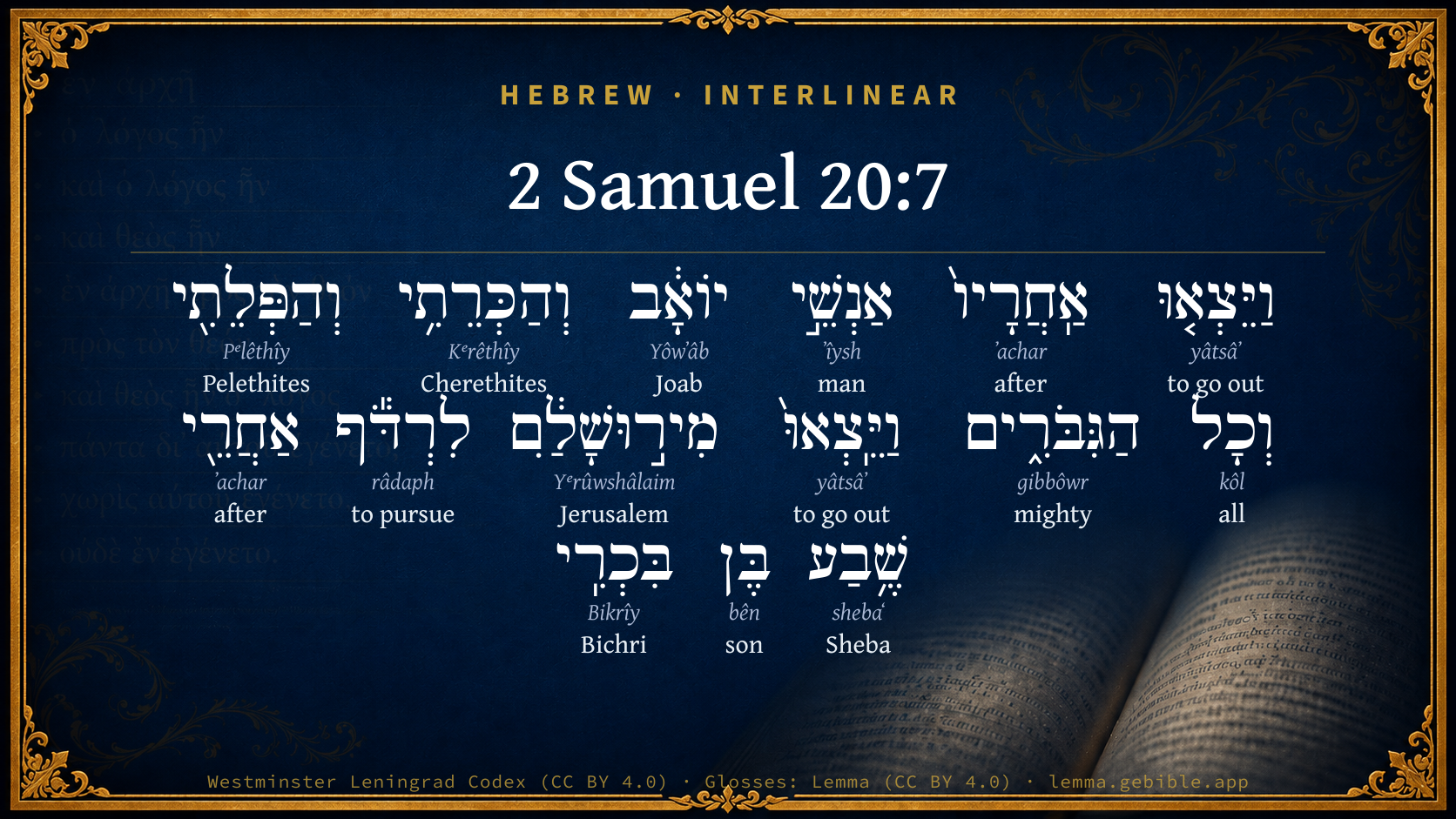
2 Samuel 20:7

Hebrew (Westminster Leningrad Codex) 2 Samuel 20:7 appears in the Hebrew Old Testament. The text above is from the Westminster Leningrad Codex. Each word links to its Strong’s number, a concise gloss, and parsing drawn from the Open Scriptures Hebrew Bible morphology. Click any word for its full Brown-Driver-Briggs (BDB) entry.
Download image
Cite this verse

2 Samuel 20:7 (World English Bible). Public Domain. Lemma interlinear Bible study tool, https://lemma.gebible.app/v/2-samuel/20/7.

Show BibTeX & RIS
BibTeX
RIS
English Translation
There went out after him Joab's men, and the Cherethites and the Pelethites, and all the mighty men; and they went out of Jerusalem, to pursue after Sheba the son of Bichri.
World English Bible · Public Domain
Download a study sheet

One document with this verse’s original text, its word-by-word gloss line, the meaning frame, cross-references with their text, attributed commentary, and full source and license credits — printable, and it pastes into notes with its structure intact.

This verse Autodidact and up

Study sheet (.html) Plain text (.txt)

A passage Seminary Student

Up to 50 verses in one chapter. A passage sheet keeps up to 6 commentary sources and 12 cross-references per verse, in the order this page ranks them, and says so on the sheet whenever that leaves anything out. Ask for a single verse and you get the Autodidact verse sheet above.

Everything on this page stays free to read, with no account — the sheet is a download of what is already on screen, not access to it.

Want to remove ads? Support Godless Engineer
Compare translations 3

The same verse in 3 English versions, stacked beneath the original-language interlinear above. Click any original word for its lexicon entry.

Each is an independent rendering of the whole verse — the interlinear is not word-aligned to these translations.

Highlighted words mark where these versions differ — a whole-verse word diff, not a word-by-word alignment.

  • World English Bible Public Domain
    There went out after him Joab's men, and the Cherethites and the Pelethites, and all the mighty men; and they went out of Jerusalem, to pursue after Sheba the son of Bichri.
  • King James Version Public Domain
    And there went out after him Joab's men, and the Cherethites, and the Pelethites, and all the mighty men: and they went out of Jerusalem, to pursue after Sheba the son of Bichri.
  • unfoldingWord Literal Text CC BY-SA 4.0
    And the men of Joab and the Cherethites and the Pelethites and all of the warriors went out after him. And they went out from Jerusalem to pursue after Sheba, the son of Bichri.

unfoldingWord Literal Text — © unfoldingWord, licensed CC BY-SA 4.0. Word-aligned USFM3 via Door43 (git.door43.org/unfoldingWord/en_ult).

Versions to compare (up to 4)

3 of 4 selected

Show all 18 translations

Every available English version of this verse, each an independent rendering of the whole verse.

  • World English Bible Public Domain
    There went out after him Joab's men, and the Cherethites and the Pelethites, and all the mighty men; and they went out of Jerusalem, to pursue after Sheba the son of Bichri.
  • Berean Standard Bible Public Domain
    So Joab’s men, along with the Cherethites, the Pelethites, and all the mighty men, marched out of Jerusalem in pursuit of Sheba son of Bichri.
  • Majority Standard Bible Public Domain
    So Joab’s men, along with the Cherethites, the Pelethites, and all the mighty men, marched out of Jerusalem in pursuit of Sheba son of Bichri.
  • King James Version Public Domain
    And there went out after him Joab's men, and the Cherethites, and the Pelethites, and all the mighty men: and they went out of Jerusalem, to pursue after Sheba the son of Bichri.
  • American Standard Version (1901) Public Domain
    And there went out after him Joab's men, and the Cherethites and the Pelethites, and all the mighty men; and they went out of Jerusalem, to pursue after Sheba the son of Bichri.
  • Revised Version (1885) Public Domain
    And there went out after him Joab’s men, and the Cherethites and the Pelethites, and all the mighty men: and they went out of Jerusalem, to pursue after Sheba the son of Bichri.
  • Geneva Bible (1599) Public Domain
    And there went out after him Ioabs men, and the Cherethites and the Pelethites, and all the mightie men: and they departed out of Ierusalem, to follow after Sheba the sonne of Bichri.
  • Douay-Rheims (1899) Public Domain
    So Joab's men went out with him, and the Cerethi and the Phelethi: and all the valiant men went out of Jerusalem to pursue after Seba the son of Bochri.
  • Young's Literal Translation Public Domain
    And the men of Joab go out after him, and the Cherethite, and the Pelethite, and all the mighty men, and they go out from Jerusalem to pursue after Sheba son of Bichri;
  • Literal Standard Version CC BY-SA 4.0
    And the men of Joab go out after him, and the Cherethite, and the Pelethite, and all the mighty men, and they go out from Jerusalem to pursue after Sheba son of Bichri;
  • Unlocked Literal Bible CC BY-SA 4.0
    Then Joab's men went out after him, along with the Kerethites and the Pelethites and all the mighty warriors. They left Jerusalem to pursue Sheba son of Bikri.
  • unfoldingWord Literal Text CC BY-SA 4.0
    And the men of Joab and the Cherethites and the Pelethites and all of the warriors went out after him. And they went out from Jerusalem to pursue after Sheba, the son of Bichri.
  • Darby Bible Public Domain
    And there went out after him Joab's men, and the Cherethites, and the Pelethites, and all the mighty men; and they went out of Jerusalem, to pursue after Sheba the son of Bichri.
  • World Messianic Bible Public Domain
    Joab’s men went out after him with the Cherethites, the Pelethites, and all the mighty men; and they went out of Jerusalem to pursue Sheba the son of Bichri.
  • Webster's Bible Public Domain
    And there went out after him Joab's men, and the Cherethites, and the Pelethites, and all the mighty men: and they went out of Jerusalem, to pursue after Sheba the son of Bichri.
  • Free Bible Version CC BY-SA 4.0
    So Joab's men, along with the Cherethites, the Pelethites, and all the experienced fighters, marched out of Jerusalem to chase down Sheba, son of Bichri.
  • Bible in Basic English Public Domain
    So there went after Abishai, Joab and the Cherethites and the Pelethites and all the fighting-men; they went out of Jerusalem to overtake Sheba, the son of Bichri.
  • JPS Tanakh (1917) Public Domain
    And there went out after him Joab's men, and the Cherethites and the Pelethites, and all the mighty men; and they went out of Jerusalem, to pursue after Sheba the son of Bichri.

Literal Standard Version (2020), Covenant Press — licensed CC BY-SA 4.0. Text via the HelloAO Bible API (eBible.org). Unlocked Literal Bible (unfoldingWord) — licensed CC BY-SA 4.0. Text via the HelloAO Bible API (eBible.org). unfoldingWord Literal Text — © unfoldingWord, licensed CC BY-SA 4.0. Word-aligned USFM3 via Door43 (git.door43.org/unfoldingWord/en_ult). Free Bible Version, Dr. Jonathan Gallagher — licensed CC BY-SA 4.0. Text via the HelloAO Bible API (eBible.org).

Word by word

More ways to search: Search by grammar → Find every occurrence → Compare this word →

Practice this passage: Drill this verse → Learn its vocabulary →

וְהַפְּלֵתִ֖י
Pᵉlêthîy
H6432
“and · the · Pelethites”
Conjunction + Particle, Definite Article + Noun, Gentilic, Masculine, Singular, Absolute
Part of Speech
Conjunction + Particle + Noun
Type
Gentilic
Gender
Masculine
Number
Singular
State
Absolute
Full BDB Definition

Origin: from the same form as H6431

TWOT: None

Pelethites = "couriers" - a collective name for the guardsmen of David - probably descendants of an unknown person, perhaps Philistine mercenaries
  1. וַיֵּצְא֤וּ yâtsâʼ H3318 “and · to go out” Conjunction + Verb, Qal, Sequential Imperfect, 3rd Person, Masculine, Plural
  2. אַֽחֲרָיו֙ ʼachar H310 “after · him” Preposition + Suffix, Personal, 3rd Person, Masculine, Singular
  3. אַנְשֵׁ֣י ʼîysh H376 “men of” Noun, Common, Masculine, Plural, Construct
  4. יוֹאָ֔ב Yôwʼâb H3097 “Joab” Noun, Proper
  5. וְהַכְּרֵתִ֥י Kᵉrêthîy H3774 “and · the · Cherethites” Conjunction + Particle, Definite Article + Noun, Gentilic, Masculine, Singular, Absolute
  6. וְכָל kôl H3605 “and · all of” Conjunction + Noun, Common, Masculine, Singular, Construct
  7. הַגִּבֹּרִ֑ים gibbôwr H1368 “the · mighty” Particle, Definite Article + Adjective, Adjective, Masculine, Plural, Absolute
  8. וַיֵּֽצְאוּ֙ yâtsâʼ H3318 “and · to go out” Conjunction + Verb, Qal, Sequential Imperfect, 3rd Person, Masculine, Plural
  9. מִיר֣וּשָׁלִַ֔ם Yᵉrûwshâlaim H3389 “from · Jerusalem” Preposition + Noun, Proper
  10. לִרְדֹּ֕ף râdaph H7291 “to pursue” Preposition + Verb, Qal, Infinitive Construct
  11. אַחֲרֵ֖י ʼachar H310 “after” Preposition
  12. שֶׁ֥בַע shebaʻ H7652 “Sheba” Adjective, Cardinal number, Feminine, Singular, Absolute
  13. בֶּן bên H1121 “son of” Noun, Common, Masculine, Singular, Construct
  14. בִּכְרִֽי Bikrîy H1075 “Bichri” Noun, Proper

About this verse

These counts appear in no published source. They are computed here, from the morphology-tagged text and Lemma’s own curated glosses. What Lemma adds →

15
words
13
distinct lemmas
Historical
section

Notable vocabulary

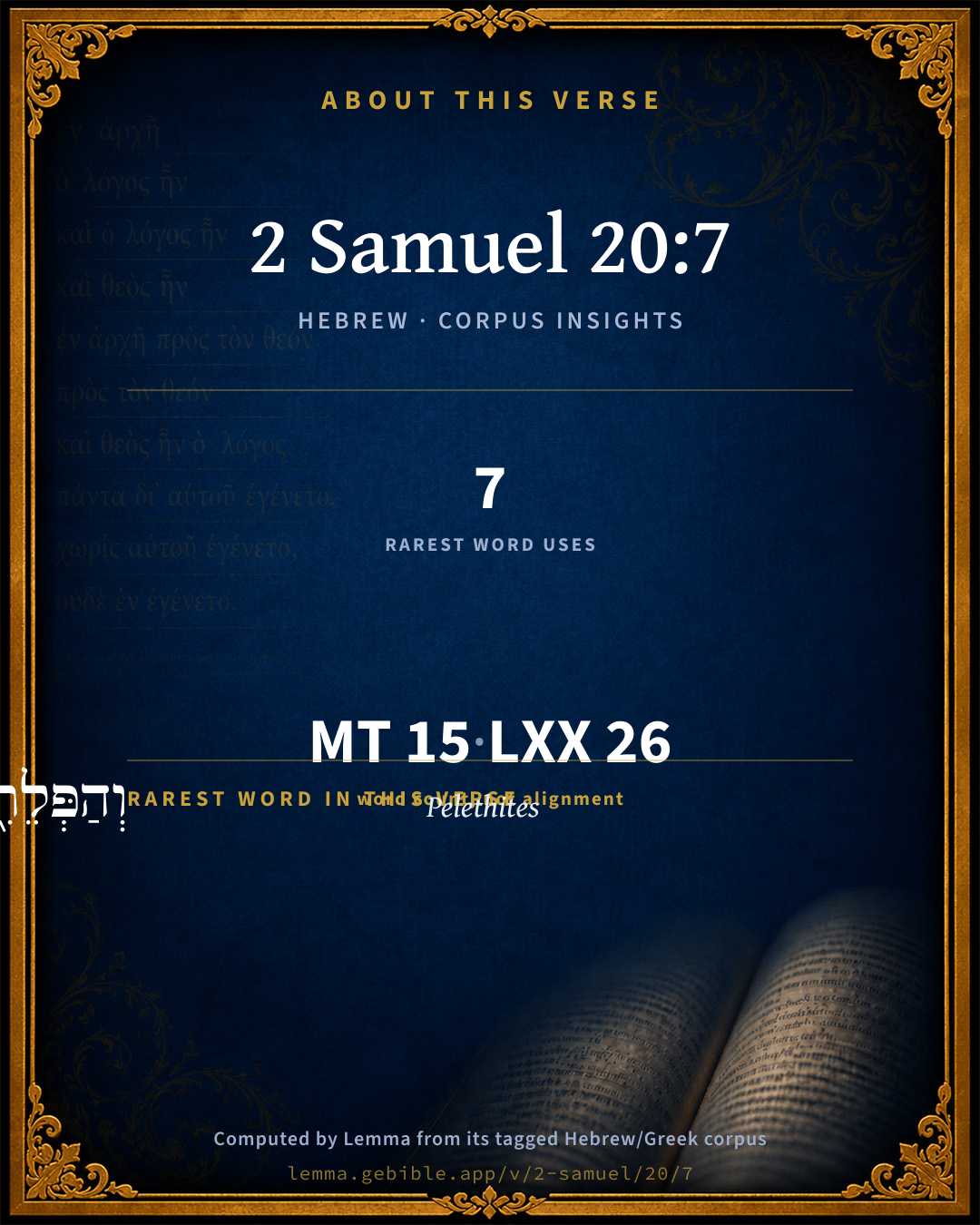
The rarest word here is וְהַפְּלֵתִ֖י Pelethites H6432 — appearing just 7 times in the whole Hebrew Bible.

Shared distinctive vocabulary

וְהַפְּלֵתִ֖י Pelethites H6432 occurs in 7 verses of the Hebrew Bible. Also found in:

Grammatical profile

  • 3 verbs
  • 8 nouns
  • 2 adjectives
  • 2 prepositions

Verb forms

  • וַיֵּצְא֤וּ Qal · Sequential Imperfect
  • וַיֵּֽצְאוּ֙ Qal · Sequential Imperfect
  • לִרְדֹּ֕ף Qal · Infinitive Construct

Repetition

Words recur within this verse — often emphatic in Hebrew:

  • וַיֵּצְא֤וּ to go out H3318 ×2
  • אַֽחֲרָיו֙ after H310 ×2

Hebrew & Septuagint length

In English translation the verse runs 32 words from the Hebrew and 37 from the Septuagint (LXX English) — closely comparable.

A rough comparison of the two English renderings, which tokenize alike — not a word-level alignment.

Word counts can differ between the Hebrew and the Greek without any difference in meaning — e.g. the Hebrew direct-object marker אֵת has no separate Greek word, and Greek often adds the article ὁ.

In the original languages it is 15 Hebrew tokens and 26 Greek tokens — but the two are counted differently (Hebrew bundles its prefixes and suffixes into one token; the Greek is in lemma form), so that isn’t a like-for-like length.

Cross-references

7

Topical passages linked to 2 Samuel 20:7 in the Treasury of Scripture Knowledge — connected by theme and wording, ordered by reader-vote popularity; previews shown in the World English Bible.

  • 2 Samuel 8:18 and Benaiah the son of Jehoiada [was over] the Cherethites and the Pelethites; and David's sons were chief ministers.
  • 1 Kings 1:38 So Zadok the priest, and Nathan the prophet, and Benaiah the son of Jehoiada, and the Cherethites and the Pelethites, went down, and caused Solomon to ride on king David's mule, and brought him to Gihon.
  • 2 Samuel 15:18 All his servants passed on beside him; and all the Cherethites, and all the Pelethites, and all the Gittites, six hundred men who came after him from Gath, passed on before the king.
  • 2 Samuel 20:23 Now Joab was over all the host of Israel; and Benaiah the son of Jehoiada was over the Cherethites and over the Pelethites;
  • 2 Samuel 8:16 Joab the son of Zeruiah was over the host; and Jehoshaphat the son of Ahilud was recorder;
  • 2 Samuel 23:22–23 These things did Benaiah the son of Jehoiada, and had a name among the three mighty men.
  • 1 Kings 1:44 and the king has sent with him Zadok the priest, and Nathan the prophet, and Benaiah the son of Jehoiada, and the Cherethites and the Pelethites; and they have caused him to ride on the king's mule;

Cross-references courtesy of OpenBible.info (CC BY 4.0).

Hebrew and Greek witnesses Masoretic Hebrew ↔ Greek Septuagint

The same verse in the two great witnesses to the Old Testament, shown verse-for-verse.

These are two independent witnesses, not word-aligned to each other, and the Septuagint is shown in lemma (dictionary) form.

Hebrew 2 Samuel 20:7 Masoretic · Westminster Leningrad Codex

וַיֵּצְא֤וּ אַֽחֲרָיו֙ אַנְשֵׁ֣י יוֹאָ֔ב וְהַכְּרֵתִ֥י וְהַפְּלֵתִ֖י וְכָל הַגִּבֹּרִ֑ים וַיֵּֽצְאוּ֙ מִיר֣וּשָׁלִַ֔ם לִרְדֹּ֕ף אַחֲרֵ֖י שֶׁ֥בַע בֶּן בִּכְרִֽי

There went out after him Joab's men, and the Cherethites and the Pelethites, and all the mighty men; and they went out of Jerusalem, to pursue after Sheba the son of Bichri.

World English Bible · Public Domain

Greek LXX 2 Samuel 20:7 Septuagint · lemma form

καί ἐκἔρχομαι ὀπίσω αὐτός ὁ ἀνήρ ιωαβ καί ὁ χερεθθι καί ὁ φελεθθι καί πᾶς ὁ δυνατός καί ἔρχομαι ἐκ ἰερουσαλήμ διώκω ὀπίσω σαβεε υἱός βοχορι

And there went out after him Amessai and the men of Joab, and the Cherethites, and the Phelethites, and all the mighty men: and they went out from Jerusalem to pursue after Sabee the son of Bochori.

LXX2012 (modern English Septuagint) · Public Domain

Hebrew: Westminster Leningrad Codex (CC BY 4.0). Greek: Septuagint (public domain); English from LXX2012 (modern English Septuagint) (Public Domain). How the Septuagint differs from the Hebrew →

Targum (Aramaic paraphrase)

1

The Targum is the ancient Jewish Aramaic paraphrase of the Hebrew Scriptures — an interpretive translation, not the Hebrew text itself. Onkelos (literal) and Pseudo-Jonathan (expansive) render the Torah, and Jonathan the Prophets. Coverage is partial: where no permissively-licensed English translation exists for a verse, only the Aramaic is shown. This is verse-level text, not a word-by-word alignment to the Hebrew.

  1. Targum Jonathan Prophets (Joshua–Malachi)
    וּנְפַקוּ בַּתְרוֹהִי גַבְרֵי יוֹאָב וְקַשָׁתַיָא וְקַלְעֲיָא וְכָל גִבָּרַיָא וּנְפַקוּ מִירוּשְׁלֵם לְמִרְדַף בָּתַר שֶׁבַע בַּר בִּכְרִי:

    (no public-domain English translation for this verse)

    Targum Jonathan — Aramaic: “Mikraot Gedolot” (public domain). English: “Sefaria Community Translation” (CC0 1.0 (public-domain dedication)); “London "Chaldee Paraphrase," 1871” (public domain). Text via Sefaria.

Commentary

Notes on 2 Samuel 20:7 from classic Christian and Jewish commentators (each source and its license shown beneath its notes). The classic Christian expositions comment on the surrounding passage and are grouped to its opening verse, so a note may address several verses; the Jewish commentaries on the Tanakh (Rashi and others) are per-verse, so they appear only where the commentator wrote on this verse.

Lemma curates 59 commentaries, every one of them public domain or Creative Commons licensed, each selected and text-cleaned for this edition rather than reprinted as found. About our sources →

Trapp's Complete Commentary

John Trapp

2Sa 20:7 And there went out after him Joab’s men, and the Cherethites, and the Pelethites, and all the mighty men: and they went out of Jerusalem, to pursue after Sheba the son of Bichri.

Ver. 7. Joab’s men.] Those that had lately been commanded by him: but he was now Officiperda, which yet held not long, for he would not be ousted.

John Trapp, A Commentary or Exposition upon All the Books of the Old and New Testament (1647–1656) — public domain. Text from a community e-Sword module.

Tyndale Open Study Notes

Tyndale Open Resources

20:7 the king’s bodyguard: See study note on 8:18.

Tyndale Open Study Notes — © Tyndale Open Resources, licensed CC BY-SA 4.0. Text via the HelloAO Bible API.

Ellicott's Commentary for English Readers

(7) Joab’s men.—The body of men who were usually under Joab’s immediate command, and who would readily follow his brother, whom they had been accustomed to see associated with him. On “the Che-rethites and the Pelethites,” see Note on 2Sa_8:18. “The mighty men” (see 2Sa_23:8) appear to have been an especial body of heroes, probably made up chiefly of those who had been with David in his life as an outlaw.

A Bible Commentary for English Readers, edited by Charles John Ellicott (1878–1897) — public domain. Text from a community e-Sword module.

The Cambridge Bible for Schools and Colleges

gen. ed. J. J. S. Perowne

7. the Cherethites, and the Pelethites] See note on ch. 2Sa_8:18. the mighty men] Or Gibbôrîm. See note on ch. 2Sa_15:18.

The Cambridge Bible for Schools and Colleges (gen. ed. J. J. S. Perowne; Cambridge University Press, 1878–1918) — public domain. Text from a community e-Sword module.

John Gill's Exposition

And there went out after him Joab's men,.... Who though he was removed from his post as general, yet might still have the command of a regiment:

and the Cherethites, and the Pelethites; over whom Benaiah was, Sa2 20:23; these attended David in his flight, and had now returned with him, Sa2 15:18,

and all the mighty men; the military men that were at Jerusalem as many as could be spared:

and they went out of Jerusalem to pursue after Sheba the son of Bichri; with Abishai at the head of them; Josephus (q) says there were six hundred, besides the soldiers at Jerusalem that went on this pursuit.

(q) Antiqu. l. 7. c. 11. sect. 7.

John Gill's Exposition of the Whole Bible (1746–1763) — public domain (CC PDM 1.0). Text via the HelloAO Bible API.

Haydock's Catholic Bible Commentary

Men. It seems Joab accompanied them, though in a manner divested of his command, by the king’s appointing Amasa, and then Abisai, to his exclusion. After the slaughter of the former, he resumed his authority; (ver. 10) and David was forced to acquiesce, for fear of another civil war, reserving his punishment for more peaceable times. (Haydock)

George Leo Haydock (1774–1849), Haydock's Catholic Family Bible and Commentary, 1859 edition — public domain. Excludes Psalms (Douay-Rheims chapter numbering differs from Protestant) and Deuterocanonical books (Catholic canon only).

Matthew Poole's English Annotations

Joab’s men; the remainders of Joab’s army who were there present, with whom also Joab might go as a reformade, watching an opportunity to do what he designed. Of the Cherethites and the Pelethites, See Poole on "2Sa 8:18".

Matthew Poole's English Annotations on the Holy Bible (1683–1685) — public domain. Text from a community e-Sword/MySword module.

Whedon's Commentary on the Bible

Daniel D. Whedon

7. Joab’s men — The body of soldiers that usually fought under Joab’s immediate command. From what follows we see that Joab also went with them, probably in command of his own body of men, but not as captain of the host. He cherished a terrible purpose of revenge on the man who had taken his office in the army, but he kept his purpose to himself until the proper time for its accomplishment.

Cherethites… Pelethites — Executioners and runners of foreign origin. See on 2Sa_8:18.

Daniel D. Whedon (gen. ed.), Commentary on the Old and New Testaments (1874–1909) — public domain. Text from a community e-Sword module.

The Pulpit Commentary

There went out after him that is, under Abishai"s command (comp. ver. 2)Joab"s men. The men who formed his regular attendants, and to whose number belonged the ten armour bearers who slew Absalom. (2Sa_18:15) Joab retained their command, and probably they would not have served under any other person. It is evident from the enumeration in this verse that the "men of Judah," after escorting David to Jerusalem, had all dispersed to their own homes.

The Pulpit Commentary (1880–1919), ed. H.D.M. Spence-Jones & Joseph S. Exell — public domain. Text from a community e-Sword module.

John Wesley's Explanatory Notes

Joab's men - The remainders of Joab's army who were there present, with whom also Joab might go as a reformade, watching an opportunity to do what he designed.

John Wesley, Explanatory Notes Upon the Whole Bible (1754–1765) — public domain. Text via the GEBible commentary corpus.

Lesson kit

Teaching starters — assembled from the data on this page, not authored interpretation. Every prompt links to the verse data it draws on. Edit before teaching.

2 Samuel, in the Historical, opens this verse with 15 words (13 distinct Hebrew lemmas). Its most distinctive word is Pᵉlêthîy (“Pelethites”). A historical commentator’s framing appears above. Read the whole chapter for the surrounding context.

Discussion questions

  1. What does “Pelethites” (Pᵉlêthîy) contribute to the verse as a whole?
  2. 2 Samuel 8:18 shares the word «Pelethites» with this verse. How do the two illuminate each other?
  3. “to go out” occurs 2× in this one verse. What is the effect of the repetition?
  4. The translations on this page render this verse differently — a whole-verse word diff, not a word-by-word alignment. What might account for the different wordings?
  5. The verb «וַיֵּצְא֤וּ» is Qal Sequential Imperfect. How does its form color the action?
  6. Reading how Trapp's Complete Commentary and Tyndale Open Study Notes read this verse, where do the two commentators agree and where do they part?

Things to notice

Reading settings

Reading text

Shown beneath each verse's original-language words.

Old Testament
Old Testament edition

Read the OT as the Masoretic Hebrew (MT) or the Greek Septuagint (LXX).

English shown for the Greek Septuagint (in the Hebrew ↔ Greek comparison).

Comparing translations? Open the Compare panel on any verse page to stack up to four side by side.