
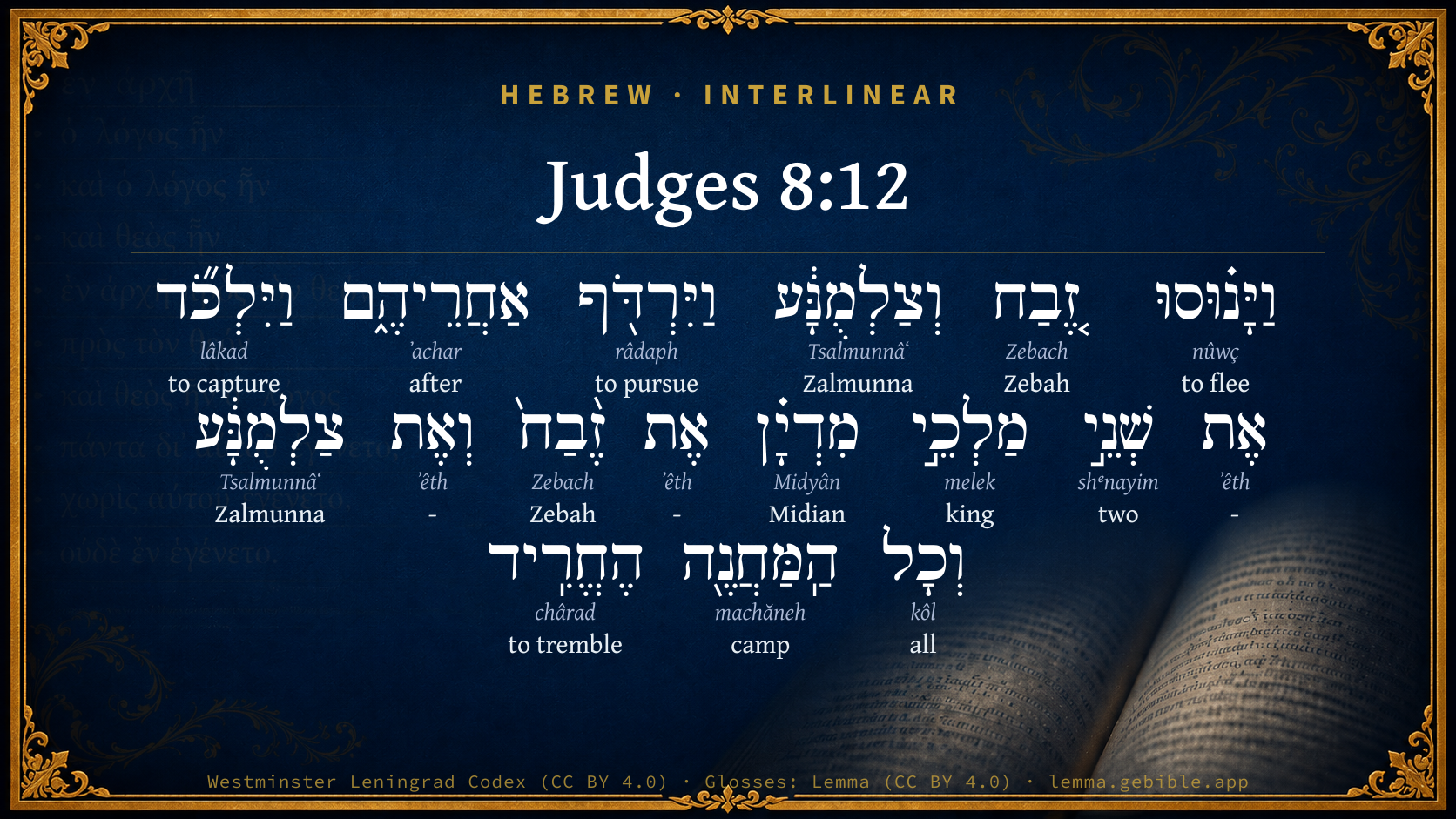
Judges 8:12

Hebrew (Westminster Leningrad Codex) Judges 8:12 appears in the Hebrew Old Testament. The text above is from the Westminster Leningrad Codex. Each word links to its Strong’s number, a concise gloss, and parsing drawn from the Open Scriptures Hebrew Bible morphology. Click any word for its full Brown-Driver-Briggs (BDB) entry.
Download image
Cite this verse

Judges 8:12 (World English Bible). Public Domain. Lemma interlinear Bible study tool, https://lemma.gebible.app/v/judges/8/12.

Show BibTeX & RIS
BibTeX
RIS
English Translation
Zebah and Zalmunna fled; and he pursued after them; and he took the two kings of Midian, Zebah and Zalmunna, and confused all the host.
World English Bible · Public Domain
Download a study sheet

One document with this verse’s original text, its word-by-word gloss line, the meaning frame, cross-references with their text, attributed commentary, and full source and license credits — printable, and it pastes into notes with its structure intact.

This verse Autodidact and up

Study sheet (.html) Plain text (.txt)

A passage Seminary Student

Up to 50 verses in one chapter. A passage sheet keeps up to 6 commentary sources and 12 cross-references per verse, in the order this page ranks them, and says so on the sheet whenever that leaves anything out. Ask for a single verse and you get the Autodidact verse sheet above.

Everything on this page stays free to read, with no account — the sheet is a download of what is already on screen, not access to it.

Want to remove ads? Support Godless Engineer
Compare translations 3

The same verse in 3 English versions, stacked beneath the original-language interlinear above. Click any original word for its lexicon entry.

Each is an independent rendering of the whole verse — the interlinear is not word-aligned to these translations.

Highlighted words mark where these versions differ — a whole-verse word diff, not a word-by-word alignment.

  • World English Bible Public Domain
    Zebah and Zalmunna fled; and he pursued after them; and he took the two kings of Midian, Zebah and Zalmunna, and confused all the host.
  • King James Version Public Domain
    And when Zebah and Zalmunna fled, he pursued after them, and took the two kings of Midian, Zebah and Zalmunna, and discomfited all the host.
  • unfoldingWord Literal Text CC BY-SA 4.0
    Then Zebah and Zalmunna fled, but he pursued after them, and he captured the two kings of Midian, Zebah and Zalmunna. And he made all of the camp tremble.

unfoldingWord Literal Text — © unfoldingWord, licensed CC BY-SA 4.0. Word-aligned USFM3 via Door43 (git.door43.org/unfoldingWord/en_ult).

Versions to compare (up to 4)

3 of 4 selected

Show all 18 translations

Every available English version of this verse, each an independent rendering of the whole verse.

  • World English Bible Public Domain
    Zebah and Zalmunna fled; and he pursued after them; and he took the two kings of Midian, Zebah and Zalmunna, and confused all the host.
  • Berean Standard Bible Public Domain
    When Zebah and Zalmunna fled, Gideon pursued and captured these two kings of Midian, routing their entire army.
  • Majority Standard Bible Public Domain
    When Zebah and Zalmunna fled, Gideon pursued and captured these two kings of Midian, routing their entire army.
  • King James Version Public Domain
    And when Zebah and Zalmunna fled, he pursued after them, and took the two kings of Midian, Zebah and Zalmunna, and discomfited all the host.
  • American Standard Version (1901) Public Domain
    And Zebah and Zalmunna fled; and he pursued after them; and he took the two kings of Midian, Zebah and Zalmunna, and discomfited all the host.
  • Revised Version (1885) Public Domain
    And Zebah and Zalmunna fled; and he pursued after them; and he took the two kings of Midian, Zebah and Zalmunna, and discomfited all the host.
  • Geneva Bible (1599) Public Domain
    And when Zebah and Zalmunna fled, hee followed after them, and tooke the two kings of Midian, Zebah and Zalmunna, and discomfited all the hoste.
  • Douay-Rheims (1899) Public Domain
    And Zebee and Salmana fled, and Gedeon pursued and took them, all their host being put in confusion.
  • Young's Literal Translation Public Domain
    and Zebab and Zalmunna flee, and he pursueth after them, and captureth the two kings of Midian, Zebah and Zalmunna, and all the camp he hath caused to tremble.
  • Literal Standard Version CC BY-SA 4.0
    and Zebab and Zalmunna flee, and he pursues after them, and captures the two kings of Midian, Zebah and Zalmunna, and he has caused all the camp to tremble.
  • Unlocked Literal Bible CC BY-SA 4.0
    Zebah and Zalmunna fled, and as Gideon pursued them, he captured the two kings of Midian—Zebah and Zalmunna—and set their whole army into a panic.
  • unfoldingWord Literal Text CC BY-SA 4.0
    Then Zebah and Zalmunna fled, but he pursued after them, and he captured the two kings of Midian, Zebah and Zalmunna. And he made all of the camp tremble.
  • Darby Bible Public Domain
    And Zebah and Zalmun'na fled; and he pursued them and took the two kings of Mid'ian, Zebah and Zalmun'na, and he threw all the army into a panic.
  • World Messianic Bible Public Domain
    Zebah and Zalmunna fled and he pursued them. He took the two kings of Midian, Zebah and Zalmunna, and confused all the army.
  • Webster's Bible Public Domain
    And when Zebah and Zalmunna fled, he pursued them, and took the two kings of Midian, Zebah and Zalmunna, and discomfited all the host.
  • Free Bible Version CC BY-SA 4.0
    Zebah and Zalmunna ran away, but he chased after the two Midianite kings and captured them, defeating the whole of their terrified army.
  • Bible in Basic English Public Domain
    And Zebah and Zalmunna went in flight; and he went after them, and took the two kings of Midian, Zebah and Zalmunna, and put all the army to the curse.
  • JPS Tanakh (1917) Public Domain
    And Zebah and Zalmunna fled; and he pursued after them; and he took the two kings of Midian, Zebah and Zalmunna, and discomfited all the host.

Literal Standard Version (2020), Covenant Press — licensed CC BY-SA 4.0. Text via the HelloAO Bible API (eBible.org). Unlocked Literal Bible (unfoldingWord) — licensed CC BY-SA 4.0. Text via the HelloAO Bible API (eBible.org). unfoldingWord Literal Text — © unfoldingWord, licensed CC BY-SA 4.0. Word-aligned USFM3 via Door43 (git.door43.org/unfoldingWord/en_ult). Free Bible Version, Dr. Jonathan Gallagher — licensed CC BY-SA 4.0. Text via the HelloAO Bible API (eBible.org).

Word by word

More ways to search: Search by grammar → Find every occurrence → Compare this word →

Practice this passage: Drill this verse → Learn its vocabulary →

זֶ֚בַח
Zebach
H2078
“Zebah”
Noun, Proper
Part of Speech
Noun
Type
Proper
Full BDB Definition

Origin: the same as H2077

TWOT: None

Zebah = "deprived of protection" - one of the two kings of Midian who commanded the great invasion of Palestine and finally were defeated by Gideon
  1. וַיָּנ֗וּסוּ nûwç H5127 “and · to flee” Conjunction + Verb, Qal, Sequential Imperfect, 3rd Person, Masculine, Plural
  2. וְצַלְמֻנָּ֔ע Tsalmunnâʻ H6759 “and · Zalmunna” Conjunction + Noun, Proper
  3. וַיִּרְדֹּ֖ף râdaph H7291 “and · to pursue” Conjunction + Verb, Qal, Sequential Imperfect, 3rd Person, Masculine, Singular
  4. אַחֲרֵיהֶ֑ם ʼachar H310 “after · them” Preposition + Suffix, Personal, 3rd Person, Masculine, Plural
  5. וַיִּלְכֹּ֞ד lâkad H3920 “and · to capture” Conjunction + Verb, Qal, Sequential Imperfect, 3rd Person, Masculine, Singular
  6. אֶת ʼêth H853 “-” Particle, Direct Object
  7. שְׁנֵ֣י shᵉnayim H8147 “two” Adjective, Cardinal number, Masculine, Dual, Construct
  8. מַלְכֵ֣י melek H4428 “kings of” Noun, Common, Masculine, Plural, Construct
  9. מִדְיָ֗ן Midyân H4080 “Midian” Noun, Proper
  10. אֶת ʼêth H853 “-” Particle, Direct Object
  11. זֶ֨בַח֙ Zebach H2078 “Zebah” Noun, Proper
  12. וְאֶת ʼêth H853 “and · -” Conjunction + Particle, Direct Object
  13. צַלְמֻנָּ֔ע Tsalmunnâʻ H6759 “Zalmunna” Noun, Proper
  14. וְכָל kôl H3605 “and · all of” Conjunction + Noun, Common, Masculine, Singular, Construct
  15. הַֽמַּחֲנֶ֖ה machăneh H4264 “the · camp” Particle, Definite Article + Noun, Common, Both, Singular, Absolute
  16. הֶחֱרִֽיד chârad H2729 “to tremble” Verb, Hiphil, Perfect, 3rd Person, Masculine, Singular

About this verse

These counts appear in no published source. They are computed here, from the morphology-tagged text and Lemma’s own curated glosses. What Lemma adds →

17
words
13
distinct lemmas
Historical
section

Notable vocabulary

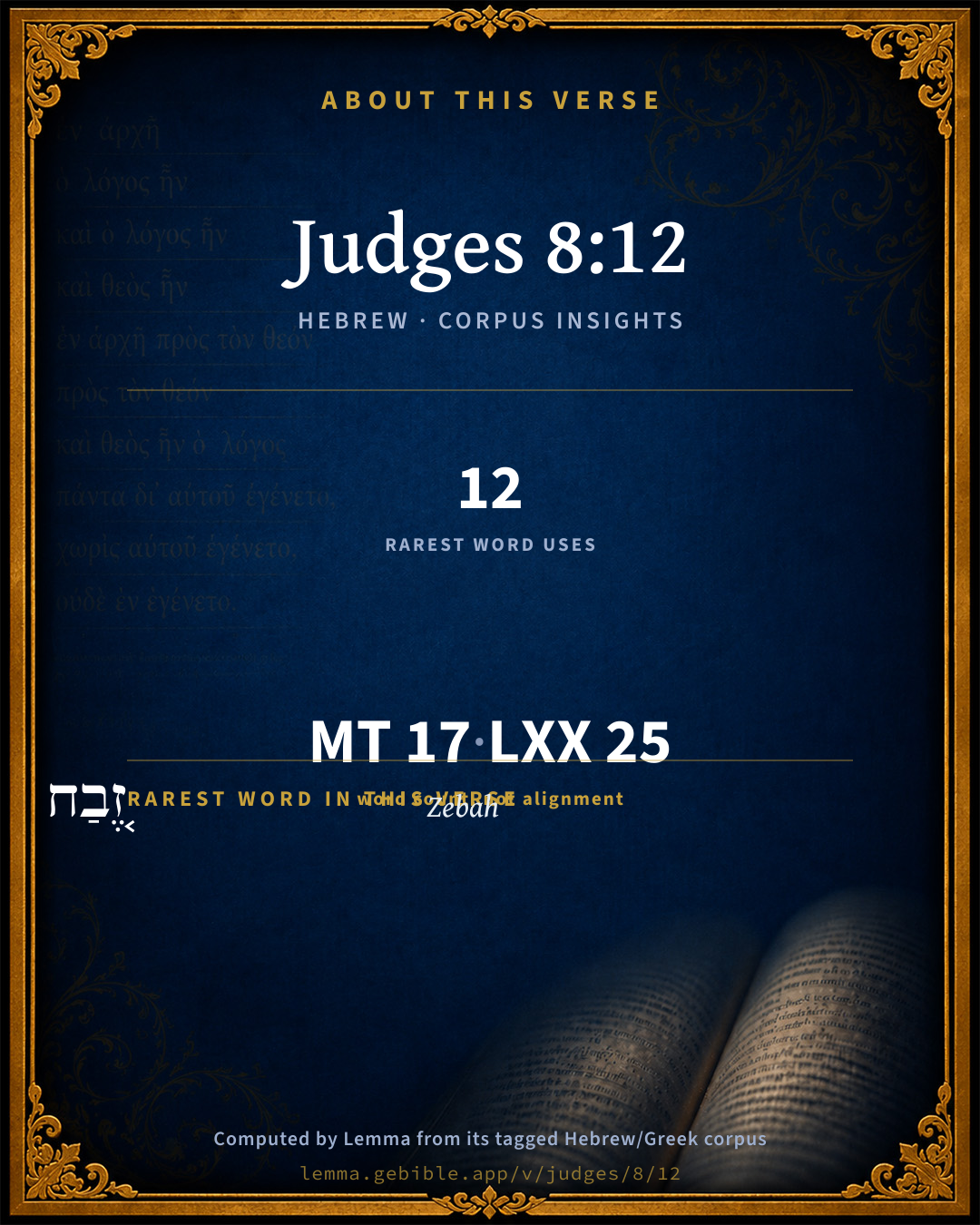
The rarest word here is זֶ֚בַח Zebah H2078 — appearing just 12 times in the whole Hebrew Bible.

Shared distinctive vocabulary

זֶ֚בַח Zebah H2078 occurs in 9 verses of the Hebrew Bible. Also found in:

Grammatical profile

  • 4 verbs
  • 8 nouns
  • 1 adjective
  • 1 preposition
  • 3 particles

Verb forms

  • וַיָּנ֗וּסוּ Qal · Sequential Imperfect
  • וַיִּרְדֹּ֖ף Qal · Sequential Imperfect
  • וַיִּלְכֹּ֞ד Qal · Sequential Imperfect
  • הֶחֱרִֽיד Hiphil · Perfect

Repetition

Words recur within this verse — often emphatic in Hebrew:

  • זֶ֚בַח Zebah H2078 ×2
  • וְצַלְמֻנָּ֔ע Zalmunna H6759 ×2

Hebrew & Septuagint length

In English translation the verse runs 25 words from the Hebrew and 25 from the Septuagint (LXX English) — the same length.

A rough comparison of the two English renderings, which tokenize alike — not a word-level alignment.

Word counts can differ between the Hebrew and the Greek without any difference in meaning — e.g. the Hebrew direct-object marker אֵת has no separate Greek word, and Greek often adds the article ὁ.

In the original languages it is 17 Hebrew tokens and 25 Greek tokens — but the two are counted differently (Hebrew bundles its prefixes and suffixes into one token; the Greek is in lemma form), so that isn’t a like-for-like length.

Cross-references

8

Topical passages linked to Judges 8:12 in the Treasury of Scripture Knowledge — connected by theme and wording, ordered by reader-vote popularity; previews shown in the World English Bible.

  • Psalms 83:11 Make their nobles like Oreb and Zeeb; Yes, all their princes like Zebah and Zalmunna;
  • Joshua 10:16–18 These five kings fled, and hid themselves in the cave at Makkedah.
  • Joshua 10:22–25 Then said Joshua, Open the mouth of the cave, and bring forth those five kings to me out of the cave.
  • Job 12:16–21 With him is strength and wisdom; The deceived and the deceiver are his.
  • Job 34:19 Who doesn't respect the persons of princes, Nor regards the rich more than the poor; For they all are the work of his hands.
  • Amos 2:14 Flight will perish from the swift; And the strong won't strengthen his force; Neither shall the mighty deliver himself;
  • Revelation 6:15–16 The kings of the earth, the princes, the commanding officers, the rich, the strong, and every slave and free person, hid themselves in the caves and in the rocks of the mountains.
  • Revelation 19:19–21 I saw the beast, and the kings of the earth, and their armies, gathered together to make war against him who sat on the horse, and against his army.

Cross-references courtesy of OpenBible.info (CC BY 4.0).

Hebrew and Greek witnesses Masoretic Hebrew ↔ Greek Septuagint

The same verse in the two great witnesses to the Old Testament, shown verse-for-verse.

These are two independent witnesses, not word-aligned to each other, and the Septuagint is shown in lemma (dictionary) form.

Hebrew Judges 8:12 Masoretic · Westminster Leningrad Codex

וַיָּנ֗וּסוּ זֶ֚בַח וְצַלְמֻנָּ֔ע וַיִּרְדֹּ֖ף אַחֲרֵיהֶ֑ם וַיִּלְכֹּ֞ד אֶת שְׁנֵ֣י מַלְכֵ֣י מִדְיָ֗ן אֶת זֶ֨בַח֙ וְאֶת צַלְמֻנָּ֔ע וְכָל הַֽמַּחֲנֶ֖ה הֶחֱרִֽיד

Zebah and Zalmunna fled; and he pursued after them; and he took the two kings of Midian, Zebah and Zalmunna, and confused all the host.

World English Bible · Public Domain

Greek LXX Judges 8:12 Septuagint · lemma form

καί φεύγω ζεβεε καί σελμανα καί διώκω ὀπίσω αὐτός καί κρατέω ὁ δύο βασιλεύς μαδιαμ ὁ ζεβεε καί ὁ σελμανα καί πᾶς ὁ παρεμβολή ἐκἵστημι

And Zebee and Salmana fled; and he pursued after them, and took the two kings of Madiam, Zebee and Salmana, and discomfited all the army.

LXX2012 (modern English Septuagint) · Public Domain

On this verse, The Cambridge Bible for Schools and Colleges discusses the Septuagint’s reading. Read the note in Commentary ↓

Hebrew: Westminster Leningrad Codex (CC BY 4.0). Greek: Septuagint (public domain); English from LXX2012 (modern English Septuagint) (Public Domain). How the Septuagint differs from the Hebrew →

Targum (Aramaic paraphrase)

1

The Targum is the ancient Jewish Aramaic paraphrase of the Hebrew Scriptures — an interpretive translation, not the Hebrew text itself. Onkelos (literal) and Pseudo-Jonathan (expansive) render the Torah, and Jonathan the Prophets. Coverage is partial: where no permissively-licensed English translation exists for a verse, only the Aramaic is shown. This is verse-level text, not a word-by-word alignment to the Hebrew.

  1. Targum Jonathan Prophets (Joshua–Malachi)
    וְאַפָכוּ זֶבַח וְצַלְמֻנָע וּרְדַף בַּתְרֵיהוֹן וַאֲחַד יַת תְּרֵין מַלְכֵי מִדְיָן יַת זֶבַח וְיַת צַלְמֻנָע וְכָל מַשְׁרִיתָא אָזִיעַ:

    (no public-domain English translation for this verse)

    Targum Jonathan — Aramaic: “Mikraot Gedolot” (public domain). English: “Sefaria Community Translation” (CC0 1.0 (public-domain dedication)); “London "Chaldee Paraphrase," 1871” (public domain). Text via Sefaria.

Commentary

Notes on Judges 8:12 from classic Christian and Jewish commentators (each source and its license shown beneath its notes). The classic Christian expositions comment on the surrounding passage and are grouped to its opening verse, so a note may address several verses; the Jewish commentaries on the Tanakh (Rashi and others) are per-verse, so they appear only where the commentator wrote on this verse.

Lemma curates 59 commentaries, every one of them public domain or Creative Commons licensed, each selected and text-cleaned for this edition rather than reprinted as found. About our sources →

Trapp's Complete Commentary

John Trapp

Jdg 8:12 And when Zebah and Zalmunna fled, he pursued after them, and took the two kings of Midian, Zebah and Zalmunna, and discomfited all the host.

Ver. 12. He pursued after them.] Now was his time, and he took it, to complete his victory: -

“ Nil actum credens dum quid superesset agendum. ” - Lucan. {a}

{a} De J. Caes.

John Trapp, A Commentary or Exposition upon All the Books of the Old and New Testament (1647–1656) — public domain. Text from a community e-Sword module.

Jamieson, Fausset & Brown

Robert Jamieson, A. R. Fausset & David Brown

when Zebah and Zalmunna fled, he pursued after them--A third conflict took place. His arrival at their last quarters, which was by an unwonted path, took the fugitives by surprise, and the conquest of the Midianite horde was there completed.

Jamieson, Fausset & Brown — Commentary Critical and Explanatory on the Whole Bible (1871) — public domain (CC PDM 1.0). Text via the HelloAO Bible API.

Ellicott's Commentary for English Readers

(12) When Zebah and Zalmunna fled.—In Psa_83:13-14, we, perhaps, find a reminiscence of the precipitancy of their flight, “like a wheel,” i.e., like a winged, rolling seed, and like stubble before a hurricane, and like a conflagration leaping through a mountain forest. (Dict. of Bible, s. v. Oreb; Stanley, i. 347.)

Discomfited.—Rather, as in the margin, terrified. It was the infliction of a second panic which enabled him to seize the two principal Emîrs.

A Bible Commentary for English Readers, edited by Charles John Ellicott (1878–1897) — public domain. Text from a community e-Sword module.

The Cambridge Bible for Schools and Colleges

gen. ed. J. J. S. Perowne

12. discomfited] Marg. terrified; the combination of careless security and terror occurs again in Eze_30:9. The LXX. A and Lucian suggests a stronger word, such as destroyed, cf. Jos., Ant. Jdg_8:6; Jdg_8:5; but it is hardly necessary to alter the text. The two kings were the first to fly; Gideon contented himself with capturing them, and letting the rest break away in panic. He did not kill the kings at once; he had promised to shew them to Succoth and Penuel.

The Cambridge Bible for Schools and Colleges (gen. ed. J. J. S. Perowne; Cambridge University Press, 1878–1918) — public domain. Text from a community e-Sword module.

John Gill's Exposition

And when Zebah and Zalmunna fled,.... Their host being smitten and thrown into confusion by the sudden approach of Gideon's army; and who probably attacked them in somewhat like manner as before, blowing their trumpets, and calling out the sword of the Lord and of Gideon; which were such terrifying sounds to them, that they fled at once:

he pursued after them, and took the two kings of Midian, Zebah and Zalmunna, and discomfited all the host; or terrified them, so that they fled some one way and some another, and the kings being left alone were easily taken.

John Gill's Exposition of the Whole Bible (1746–1763) — public domain (CC PDM 1.0). Text via the HelloAO Bible API.

The Pulpit Commentary

He discomfited. Rather, as in the margin, he terrified. Those who were not killed in the first onslaught, when "he smote the host," were so terrified that they fled without further resistance, and many probably escaped, as all Gideon"s efforts were directed to the capture of the two kings.

The Pulpit Commentary (1880–1919), ed. H.D.M. Spence-Jones & Joseph S. Exell — public domain. Text from a community e-Sword module.

Lesson kit

Teaching starters — assembled from the data on this page, not authored interpretation. Every prompt links to the verse data it draws on. Edit before teaching.

Judges, in the Historical, opens this verse with 17 words (13 distinct Hebrew lemmas). Its most distinctive word is Zebach (“Zebah”). A historical commentator’s framing appears above. Read the whole chapter for the surrounding context.

Discussion questions

  1. What does “Zebah” (Zebach) contribute to the verse as a whole?
  2. How does Judges 8:5, which shares the word «Zebah», read alongside this verse?
  3. What does the repetition of “Zebah” (2× in this one verse) do in this verse?
  4. These translations render this verse differently. What is at stake in choosing one wording over another?
  5. «וַיָּנ֗וּסוּ» is a Qal Sequential Imperfect verb. How does that grammatical form shape the action described?
  6. Compare how Trapp's Complete Commentary and Jamieson, Fausset & Brown read this verse. Where do they agree or differ?

Things to notice

Reading settings

Reading text

Shown beneath each verse's original-language words.

Old Testament
Old Testament edition

Read the OT as the Masoretic Hebrew (MT) or the Greek Septuagint (LXX).

English shown for the Greek Septuagint (in the Hebrew ↔ Greek comparison).

Comparing translations? Open the Compare panel on any verse page to stack up to four side by side.