Judges 1:6

Hebrew (Westminster Leningrad Codex) Judges 1:6 appears in the Hebrew Old Testament. The text above is from the Westminster Leningrad Codex. Each word links to its Strong’s number, a concise gloss, and parsing drawn from the Open Scriptures Hebrew Bible morphology. Click any word for its full Brown-Driver-Briggs (BDB) entry.
Download image
Cite this verse

Judges 1:6 (World English Bible). Public Domain. Lemma interlinear Bible study tool, https://lemma.gebible.app/v/judges/1/6.

Show BibTeX & RIS
BibTeX
RIS
English Translation
But Adoni-bezek fled; and they pursued after him, and caught him, and cut off his thumbs and his great toes.
World English Bible · Public Domain
Download a study sheet

One document with this verse’s original text, its word-by-word gloss line, the meaning frame, cross-references with their text, attributed commentary, and full source and license credits — printable, and it pastes into notes with its structure intact.

This verse Autodidact and up

Study sheet (.html) Plain text (.txt)

A passage Seminary Student

Up to 50 verses in one chapter. A passage sheet keeps up to 6 commentary sources and 12 cross-references per verse, in the order this page ranks them, and says so on the sheet whenever that leaves anything out. Ask for a single verse and you get the Autodidact verse sheet above.

Everything on this page stays free to read, with no account — the sheet is a download of what is already on screen, not access to it.

Want to remove ads? Support Godless Engineer
Compare translations 3

The same verse in 3 English versions, stacked beneath the original-language interlinear above. Click any original word for its lexicon entry.

Each is an independent rendering of the whole verse — the interlinear is not word-aligned to these translations.

Highlighted words mark where these versions differ — a whole-verse word diff, not a word-by-word alignment.

  • World English Bible Public Domain
    But Adoni-bezek fled; and they pursued after him, and caught him, and cut off his thumbs and his great toes.
  • King James Version Public Domain
    But Adonibezek fled; and they pursued after him, and caught him, and cut off his thumbs and his great toes.
  • unfoldingWord Literal Text CC BY-SA 4.0
    Then Adoni-Bezek fled, but they pursued after him, and they seized him, and they cut off the thumbs of his hands and his feet.

unfoldingWord Literal Text — © unfoldingWord, licensed CC BY-SA 4.0. Word-aligned USFM3 via Door43 (git.door43.org/unfoldingWord/en_ult).

Versions to compare (up to 4)

3 of 4 selected

Show all 18 translations

Every available English version of this verse, each an independent rendering of the whole verse.

  • World English Bible Public Domain
    But Adoni-bezek fled; and they pursued after him, and caught him, and cut off his thumbs and his great toes.
  • Berean Standard Bible Public Domain
    As Adoni-bezek fled, they pursued him, seized him, and cut off his thumbs and big toes.
  • Majority Standard Bible Public Domain
    As Adoni-bezek fled, they pursued him, seized him, and cut off his thumbs and big toes.
  • King James Version Public Domain
    But Adonibezek fled; and they pursued after him, and caught him, and cut off his thumbs and his great toes.
  • American Standard Version (1901) Public Domain
    But Adoni-bezek fled; and they pursued after him, and caught him, and cut off his thumbs and his great toes.
  • Revised Version (1885) Public Domain
    But Adoni-bezek fled; and they pursued after him, and caught him, and cut off his thumbs and his great toes.
  • Geneva Bible (1599) Public Domain
    But Adoni-bezek fled, and they pursued after him, and caught him, and cut off the thumbes of his hands and of his feete.
  • Douay-Rheims (1899) Public Domain
    And Adonibezec fled: and they pursued after him and took him, and cut off his fingers and toes.
  • Young's Literal Translation Public Domain
    And Adoni-Bezek fleeth, and they pursue after him, and seize him, and cut off his thumbs and his great toes,
  • Literal Standard Version CC BY-SA 4.0
    And Adoni-Bezek flees, and they pursue after him, and seize him, and cut off his thumbs and his great toes,
  • Unlocked Literal Bible CC BY-SA 4.0
    But Adoni-Bezek fled, and they pursued him and caught him, and they cut off his thumbs and his big toes.
  • unfoldingWord Literal Text CC BY-SA 4.0
    Then Adoni-Bezek fled, but they pursued after him, and they seized him, and they cut off the thumbs of his hands and his feet.
  • Darby Bible Public Domain
    Ado'ni-be'zek fled; but they pursued him, and caught him, and cut off his thumbs and his great toes.
  • World Messianic Bible Public Domain
    But Adoni-Bezek fled. They pursued him, caught him, and cut off his thumbs and his big toes.
  • Webster's Bible Public Domain
    But Adoni-bezek fled; and they pursued him, and caught him, and cut off his thumbs and his great toes.
  • Free Bible Version CC BY-SA 4.0
    Adoni-bezek ran away, but they chased after him and captured him, and then cut off his thumbs and big toes.
  • Bible in Basic English Public Domain
    But Adoni-zedek went in flight; and they went after him and overtook him, and had his thumbs and his great toes cut off.
  • JPS Tanakh (1917) Public Domain
    But Adoni-bezek fled; and they pursued after him, and caught him, and cut off his thumbs and his great toes.

Literal Standard Version (2020), Covenant Press — licensed CC BY-SA 4.0. Text via the HelloAO Bible API (eBible.org). Unlocked Literal Bible (unfoldingWord) — licensed CC BY-SA 4.0. Text via the HelloAO Bible API (eBible.org). unfoldingWord Literal Text — © unfoldingWord, licensed CC BY-SA 4.0. Word-aligned USFM3 via Door43 (git.door43.org/unfoldingWord/en_ult). Free Bible Version, Dr. Jonathan Gallagher — licensed CC BY-SA 4.0. Text via the HelloAO Bible API (eBible.org).

Word by word

More ways to search: Search by grammar → Find every occurrence → Compare this word →

Practice this passage: Drill this verse → Learn its vocabulary →

אֲדֹ֣נִי
ʼĂdônîy-Bezeq
H137
“Adoni-Bezek”
Noun, Proper
Part of Speech
Noun
Type
Proper
Full BDB Definition

Origin: from H113 and H966

TWOT: None

Adoni-Bezek = "my lord is Besek" - king of the Canaanite city of Bezek, killed by Israelites
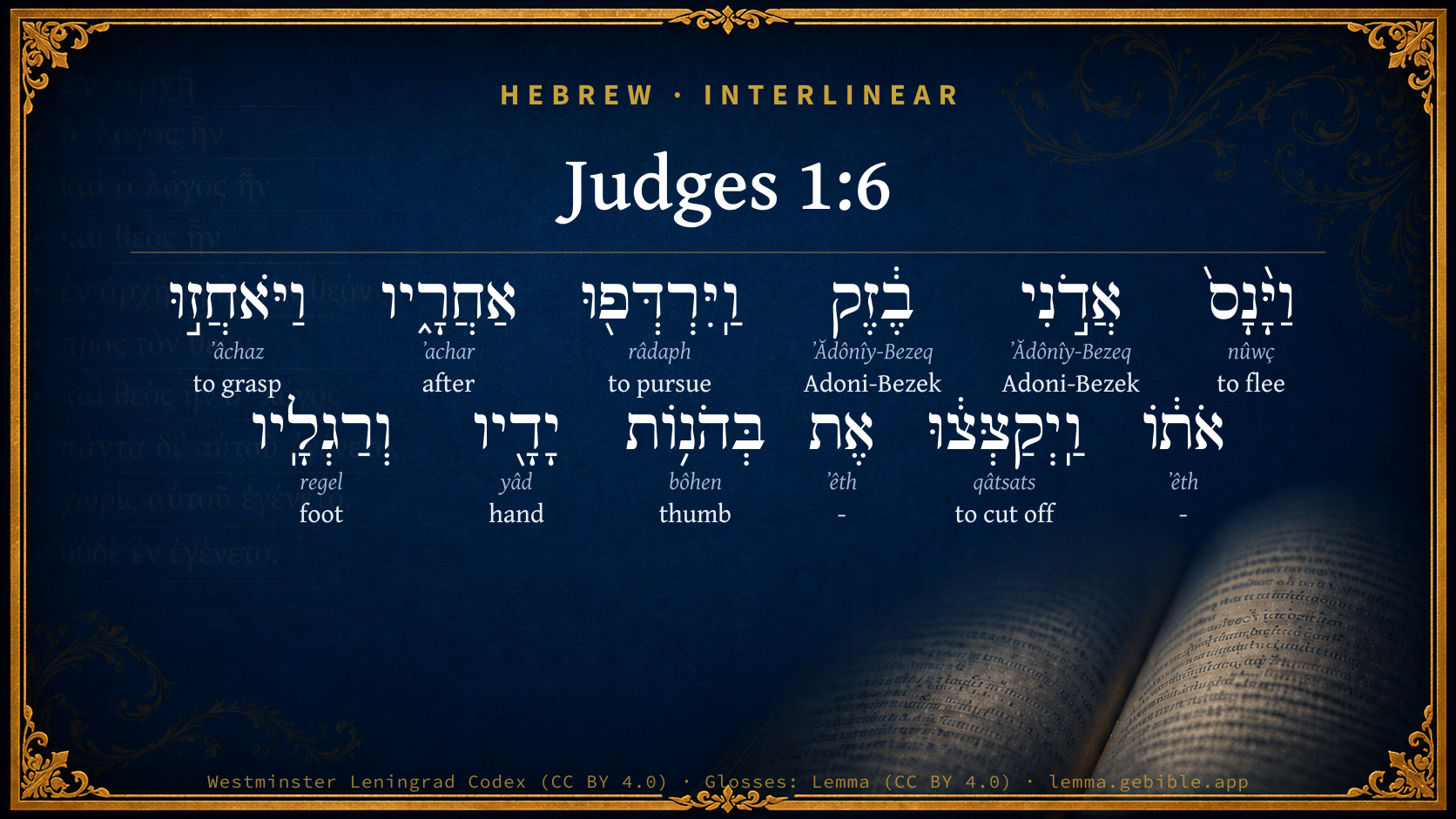
  1. וַיָּ֨נָס֙ nûwç H5127 “and · to flee” Conjunction + Verb, Qal, Sequential Imperfect, 3rd Person, Masculine, Singular
  2. בֶ֔זֶק ʼĂdônîy-Bezeq H137 “Adoni-Bezek” Noun, Proper
  3. וַֽיִּרְדְּפ֖וּ râdaph H7291 “and · to pursue” Conjunction + Verb, Qal, Sequential Imperfect, 3rd Person, Masculine, Plural
  4. אַחֲרָ֑יו ʼachar H310 “after · him” Preposition + Suffix, Personal, 3rd Person, Masculine, Singular
  5. וַיֹּאחֲז֣וּ ʼâchaz H270 “and · to grasp” Conjunction + Verb, Qal, Sequential Imperfect, 3rd Person, Masculine, Plural
  6. אֹת֔וֹ ʼêth H853 “- · him” Particle, Direct Object + Suffix, Personal, 3rd Person, Masculine, Singular
  7. וַֽיְקַצְּצ֔וּ qâtsats H7112 “and · to cut off” Conjunction + Verb, Piel, Sequential Imperfect, 3rd Person, Masculine, Plural
  8. אֶת ʼêth H853 “-” Particle, Direct Object
  9. בְּהֹנ֥וֹת bôhen H931 “thumbs of” Noun, Common, Feminine, Plural, Construct
  10. יָדָ֖יו yâd H3027 “hands · his” Noun, Common, Both, Dual, Construct + Suffix, Personal, 3rd Person, Masculine, Singular
  11. וְרַגְלָֽיו regel H7272 “and · feet · his” Conjunction + Noun, Common, Feminine, Dual, Construct + Suffix, Personal, 3rd Person, Masculine, Singular

About this verse

These counts appear in no published source. They are computed here, from the morphology-tagged text and Lemma’s own curated glosses. What Lemma adds →

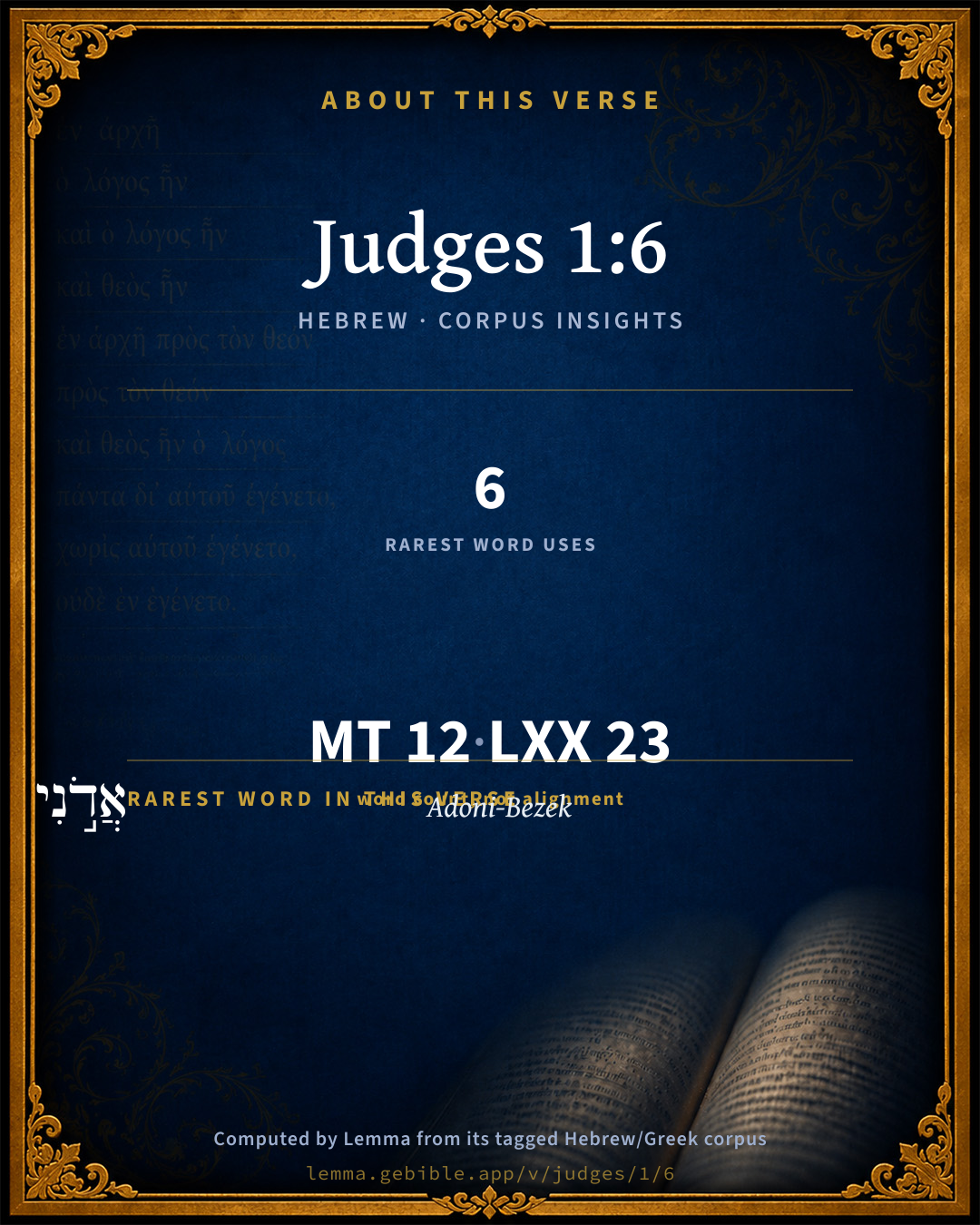
12
words
10
distinct lemmas
Historical
section

Notable vocabulary

The rarest word here is אֲדֹ֣נִי Adoni-Bezek H137 — appearing just 6 times in the whole Hebrew Bible.

Shared distinctive vocabulary

אֲדֹ֣נִי Adoni-Bezek H137 occurs in 3 verses of the Hebrew Bible. Also found in:

Grammatical profile

  • 4 verbs
  • 5 nouns
  • 1 preposition
  • 2 particles

Verb forms

  • וַיָּ֨נָס֙ Qal · Sequential Imperfect
  • וַֽיִּרְדְּפ֖וּ Qal · Sequential Imperfect
  • וַיֹּאחֲז֣וּ Qal · Sequential Imperfect
  • וַֽיְקַצְּצ֔וּ Piel · Sequential Imperfect

Repetition

A word recurs within this verse — often emphatic in Hebrew:

  • אֲדֹ֣נִי Adoni-Bezek H137 ×2

Hebrew & Septuagint length

In English translation the verse runs 20 words from the Hebrew and 20 from the Septuagint (LXX English) — the same length.

A rough comparison of the two English renderings, which tokenize alike — not a word-level alignment.

Word counts can differ between the Hebrew and the Greek without any difference in meaning — e.g. the Hebrew direct-object marker אֵת has no separate Greek word, and Greek often adds the article ὁ.

In the original languages it is 12 Hebrew tokens and 23 Greek tokens — but the two are counted differently (Hebrew bundles its prefixes and suffixes into one token; the Greek is in lemma form), so that isn’t a like-for-like length.

Hebrew and Greek witnesses Masoretic Hebrew ↔ Greek Septuagint

The same verse in the two great witnesses to the Old Testament, shown verse-for-verse.

These are two independent witnesses, not word-aligned to each other, and the Septuagint is shown in lemma (dictionary) form.

Hebrew Judges 1:6 Masoretic · Westminster Leningrad Codex

וַיָּ֨נָס֙ אֲדֹ֣נִי בֶ֔זֶק וַֽיִּרְדְּפ֖וּ אַחֲרָ֑יו וַיֹּאחֲז֣וּ אֹת֔וֹ וַֽיְקַצְּצ֔וּ אֶת בְּהֹנ֥וֹת יָדָ֖יו וְרַגְלָֽיו

But Adoni-bezek fled; and they pursued after him, and caught him, and cut off his thumbs and his great toes.

World English Bible · Public Domain

Greek LXX Judges 1:6 Septuagint · lemma form

καί φεύγω αδωνιβεζεκ καί κατατρέχω ὀπίσω αὐτός καί καταλαμβάνω αὐτός καί ἀποκόπτω ὁ ἄκρος ὁ χείρ αὐτός καί ὁ ἄκρος ὁ πούς αὐτός

And Adonibezek fled, and they pursued after him, and took him, and cut off his thumbs and his great toes.

LXX2012 (modern English Septuagint) · Public Domain

Hebrew: Westminster Leningrad Codex (CC BY 4.0). Greek: Septuagint (public domain); English from LXX2012 (modern English Septuagint) (Public Domain). How the Septuagint differs from the Hebrew →

Targum (Aramaic paraphrase)

1

The Targum is the ancient Jewish Aramaic paraphrase of the Hebrew Scriptures — an interpretive translation, not the Hebrew text itself. Onkelos (literal) and Pseudo-Jonathan (expansive) render the Torah, and Jonathan the Prophets. Coverage is partial: where no permissively-licensed English translation exists for a verse, only the Aramaic is shown. This is verse-level text, not a word-by-word alignment to the Hebrew.

  1. Targum Jonathan Prophets (Joshua–Malachi)
    וַעֲרַק אֲדֹנִי בֶזֶק וּרְדָפוּ בַּתְרוֹהִי וַאֲחַדוּ יָתֵיהּ וְקַצִיצוּ יַת קַרְסֻלֵי יְדוֹהִי וְרַגְלוֹהִי:

    (no public-domain English translation for this verse)

    Targum Jonathan — Aramaic: “Mikraot Gedolot” (public domain). English: “Sefaria Community Translation” (CC0 1.0 (public-domain dedication)); “London "Chaldee Paraphrase," 1871” (public domain). Text via Sefaria.

Commentary

Notes on Judges 1:6 from classic Christian and Jewish commentators (each source and its license shown beneath its notes). The classic Christian expositions comment on the surrounding passage and are grouped to its opening verse, so a note may address several verses; the Jewish commentaries on the Tanakh (Rashi and others) are per-verse, so they appear only where the commentator wrote on this verse.

Lemma curates 59 commentaries, every one of them public domain or Creative Commons licensed, each selected and text-cleaned for this edition rather than reprinted as found. About our sources →

Trapp's Complete Commentary

John Trapp

Jdg 1:6 But Adonibezek fled; and they pursued after him, and caught him, and cut off his thumbs and his great toes.

Ver. 6. But Adonibezek fled.] Excusing his flight, perhaps, as afterwards Demosthenes did. Vir fugiens denuo pugnabit; He that now fleeth, may fight another time.

And caught him.] Fugere quidem hic tyrannus potuit, sed non effugere; fly he might, but not escape, because divine vengeance pursued him for his cruelty. And the like befell Manasseh, Zedekiah, Muleasses (discovered by his perfumes), and many others.

And cut off his thumbs and his great toes.] So Tamerlane shackled Bajazet the great Turk whom he had taken in battle, and shut him up in an iron cage made like a grate, that he might be seen and derided of all men. He used him also on festival days as a footstool to tread upon when he mounted to horse, and at other times scornfully fed him like a dog with crumbs fallen from his table. All which Tamerlane did, not so much for hatred to the man, as to manifest the just judgment of God against the arrogant folly of the proud, saith the historian. {a}

{a} Turk. Hist., 220.

6 And the angels which kept not their first estate, but left their own habitation, he hath reserved in everlasting chains under darkness unto the judgment of the great day.

Ver. 6. Kept not their first estate] Their original integrity or principality. Of this sin of the angels, the cause was the will of the angels, good in itself (but mutable and free), not by working either, but by not working, saith a divine.

But left their own habitation] Being driven thence and hurried into hell.

He hath reserved in everlasting chains, &c.] There are two sorts of chains, saith Mr Leigh. First, those which torment the devil, God’s wrath, and his own conscience. Secondly, those which restrain him, his own finiteness, and God’s providence.

John Trapp, A Commentary or Exposition upon All the Books of the Old and New Testament (1647–1656) — public domain. Text from a community e-Sword module.

Geneva Bible (1599)

Geneva Bible translators

This was God’s just judgment, as the tyrant himself confesseth, that as he had done, so did he receive, Lev. 24:19,20.

Geneva Bible (1599) marginal notes — public domain. Text via Bolls.life.

Adam Clarke's Commentary

Verse 6. Cut off his thumbs] That he might never be able to draw his bow or handle his sword, and great toes, that he might never be able to pursue or escape from an adversary.

Adam Clarke's Commentary on the Bible (1810–1826) — public domain. Text from a community e-Sword/MySword module.

Ellicott's Commentary for English Readers

(6) Cut off his thumbs and his great toes.—The cutting off of his thumbs would prevent him from ever again drawing a bow or wielding a sword. Romans who desired to escape conscription cut off their thumbs (Suet. Aug. 24). The cutting off of his great toes would deprive him of that speed which was so essential for an ancient warrior, that “swift-footed” is in Homer the normal epithet of Achilles. Either of these mutilations would be sufficient to rob him of his throne, since ancient races never tolerated a king who had any personal defects. This kind of punishment was not uncommon in ancient days, and it was with the same general object that the Athenians inflicted it on the conquered Æginetans. Mohammed (Koran, Sur. 8:12) ordered the enemies of Islam to be thus punished; and it used to be the ancient German method of punishing poachers (Ælian, Var. Hist. ii. 9). The peculiar appropriateness of the punishment in this instance arose from the Lex talionis, or “law of equivalent punishment,” which Moses had tolerated as the best means to limit the intensity of those blood-feuds (Lev_24:19-20; Deu_19:21; comp. Jdg_15:10-11). which, “because of the hardness of their hearts,” he was unable entirely to abolish.

A Bible Commentary for English Readers, edited by Charles John Ellicott (1878–1897) — public domain. Text from a community e-Sword module.

The Cambridge Bible for Schools and Colleges

gen. ed. J. J. S. Perowne

6. and cut off] A barbarity frequently practised in ancient warfare to mark the humiliation of the captives and prevent them from further mischief. Thus the Athenians are said to have decreed that the right thumb of every Aeginetan taken prisoner should be cut off ‘that they may be incapable of carrying a spear, but not incapable of working an oar,’ Aelian, Var. Hist. ii. 9.

The Cambridge Bible for Schools and Colleges (gen. ed. J. J. S. Perowne; Cambridge University Press, 1878–1918) — public domain. Text from a community e-Sword module.

John Gill's Exposition

But Adonibezek fled, and they pursued after him, and caught him,.... It is very probable his view was to get to Jebus or Jerusalem, a strong and fortified city and he made his way thither as fast as he could, but was pursued and overtaken by some of the forces of Judah and Simeon; and the rather it may seem he took this course, since when he was taken by them, they brought him thither, as follows:

and cut off his thumbs and his great toes; whereby he was disabled both for fighting and for fleeing. So the Athenians cut off the thumbs of the right hand of the Aeginetae, the inhabitants of the island of Aegina, to disable them from holding a spear, as various writers (f) relate. Whether the Israelites did this, as knowing this king had used others in like manner, and so, according to their law of retaliation, "eye for eye", &c. Exo 21:23, required it; or whether, ignorant of it, were so moved and directed by the providence of God to do this, that the same measure might be measured to him which he had measured to others, is not certain; the latter seems most probable, since the Israelites did not usually inflict such sort of punishments; and besides, according to the command of God, they should have put him to death, as they were to do to all Canaanites.

(f) Valerius Maximus, l. 9. c. 2. Aelian, Var. Hist. l. 2. c. 9. Cicero de Officiis, l. 3. c. 11.

John Gill's Exposition of the Whole Bible (1746–1763) — public domain (CC PDM 1.0). Text via the HelloAO Bible API.

Matthew Poole's English Annotations

That he might be disenabled to fight with his hands, or to run away upon his feet. And this they did, either by the secret instinct and direction of God, or upon notice of his former tyranny and cruelty expressed upon others, in this manner, as it follows: either way it was a just requital.

Matthew Poole's English Annotations on the Holy Bible (1683–1685) — public domain. Text from a community e-Sword/MySword module.

Whedon's Commentary on the Bible

Daniel D. Whedon

6. Cut off his thumbs and… great toes — This barbarous mutilation, unusual with the Jews, was designed to incapacitate for military service. The victim of this cruelty could neither march nor fight. In this instance the Israelites exercised this cruelty according to that barbaric style of justice called the lex talionis. In modern warfare it is usual to release prisoners “on parole,” that is, on their word of honour not to fight again; but among some barbarians such mutilation or disabling was the only security against their fighting again. And modern civilized states, when called to war with certain barbarous or half-civilized tribes, have sometimes been obliged to resort to some terrible form of the law of retaliation. See note on Jos_10:26.

Daniel D. Whedon (gen. ed.), Commentary on the Old and New Testaments (1874–1909) — public domain. Text from a community e-Sword module.

The Pulpit Commentary

Cut off his thumbs, etc. These cruel mutilations, like the still more cruel one of putting out the eyes, (Jud_1:16:21 Num_16:14 1Sa_11:2 2Ki_25:7) were intended to cripple the warrior in his speed, and to incapacitate hint from the use of the bow, or sword, or spear, while yet sparing his life, either in mercy, or for the purpose of retaining his services for the conqueror.

Vers. 6, 7. Retribution.

I THERE IS A LAW OF RETRIBUTION.

1. The desire for retribution is instinctive. It is one of the elementary ideas of justice. To those who have no vision of a higher law, the execution of this is not a cruel crime of vengeance, but a righteous exercise of justice.

2. The fitness of retribution is not affected by the motive of those who accomplish it. It is possible that the Israelites were ignorant of the old crimes of Adoni-bezek, and may have been guilty of wanton cruelty in treating him as they did. If so, his wickedness was no excuse for their barbarity. But then their harsh intentions did not affect the justice of the king"s sufferings. God often uses the crime of one man as a means of punishing the crime of another. He does not originate or sanction the retributive crime, but he overrules it, and so turns the wrath of man to the praise of his righteous government. Thus Nebuchadnezzar was no better than an ambitious tyrant in his conquest of Jerusalem; yet he was the unconscious agent of a Divine decree of justice.

3. Sin will surely bring retribution.

(1) No rank will secure us against this. The sufferer in this case was a king.

(2) No time will wear out guilt. It is likely that Adoni-bezek had committed his crimes in bygone years, as he referred to them in a way which suggests that the memory of them was suddenly aroused by his own experience.

1. Retribution often bears a resemblance to the crimes it follows. The lex talionis seems to be mysteriously embedded in the very constitution of nature. The intemperate slave of bodily pleasures brings on himself bodily disease; cruelty provokes cruelty; suspicion arouses distrust. As a man sows so will be reap. (Gal_6:7, Gal_6:8)

2. One of the most fearful elements of future retribution will be found in an evil memory. Men bury their old sins out of sight. They will be exhumed in all their corruption. The justice of the retribution will then increase the sting of it. (Luk_16:25)

II THE HIGHER CHRISTIAN LAW OF LOVE. Christianity does not abolish the terrible natural laws of retributive justice, but it reveals higher principles which can counteract the disastrous effects of "those stern laws, and a more excellent way than that of zealously advocating the execution of them.

1. The Christian is bound not to desire vengeance. He is called to forgive his enemies. (Mat_5:38, Mat_5:39) If retribution must fall, let us leave it to the supreme Judge. (Rom_12:19)

2. The highest purpose of punishment is seen to consist in the preservation and the restoration of righteousness not in the mere balancing of sin with pain. Punishment is not an end in itself. The vengeance which seeks satisfaction to outraged honour in the humiliation of its victim is as unworthy of the character of God as it is foreign to the principles of Christian duty. Punishment is a means to an end, and that end is not mere revenge, but the deterring of others from evil, and, where possible, the restoration of the fallen. (Heb_12:5, Heb_12:6, Heb_12:11)

3. In the gospel forgiveness is offered for all sin. The law is not evaded; it is honoured in the sacrifice of Christ. Now he has borne the sin of the world he can also release the world from its fatal effects. Therefore, though the thunder-cloud of retribution may seem as dark as ever, if we only look high enough we shall see the rainbow of God"s mercy above it promising peace and forgiveness to all who repent and trust in his grace. A. (Act_13:38, Act_13:39)

The Pulpit Commentary (1880–1919), ed. H.D.M. Spence-Jones & Joseph S. Exell — public domain. Text from a community e-Sword module.

John Wesley's Explanatory Notes

Great toes - And this they did, either by the direction of God, or upon notice of his former tyranny and cruelty.

John Wesley, Explanatory Notes Upon the Whole Bible (1754–1765) — public domain. Text via the GEBible commentary corpus.

unfoldingWord translationNotes

Door43 World Missions Community

pursued him

"chased him"

Seventy kings

"70 kings" (See: Numbers)

who had their thumbs and their big toes cut off

This can be stated in active form. AT: "whose thumbs and big toes I told my men to cut off" or "whose thumbs and big toes we cut off" (See: Active or Passive)

gathered their food from under my table

Forcing these kings to eat scraps of food represents all the ways that Adoni-Bezek humiliated these kings. Here "gathering" food represents eating it. AT: "ate scraps of food from under my table" (See: Metonymy)

translationWords

king

God

Jerusalem

unfoldingWord translationNotes — © Distant Shores Media and the Door43 World Missions Community, licensed CC BY-SA 4.0. Source: git.door43.org/Door43/en_tn.

Lesson kit

Teaching starters — assembled from the data on this page, not authored interpretation. Every prompt links to the verse data it draws on. Edit before teaching.

Judges, in the Historical, opens this verse with 12 words (10 distinct Hebrew lemmas). Its most distinctive word is ʼĂdônîy-Bezeq (“Adoni-Bezek”). A historical commentator’s framing appears above. Read the whole chapter for the surrounding context.

Discussion questions

  1. How does “Adoni-Bezek” (ʼĂdônîy-Bezeq) shape what this verse is saying?
  2. How does Judges 1:5, which shares the word «Adoni-Bezek», read alongside this verse?
  3. What does the repetition of “Adoni-Bezek” (2× in this one verse) do in this verse?
  4. These translations render this verse differently. What is at stake in choosing one wording over another?
  5. «וַיָּ֨נָס֙» is a Qal Sequential Imperfect verb. How does that grammatical form shape the action described?
  6. Compare how Trapp's Complete Commentary and Geneva Bible (1599) read this verse. Where do they agree or differ?

Things to notice

Reading settings

Reading text

Shown beneath each verse's original-language words.

Old Testament
Old Testament edition

Read the OT as the Masoretic Hebrew (MT) or the Greek Septuagint (LXX).

English shown for the Greek Septuagint (in the Hebrew ↔ Greek comparison).

Comparing translations? Open the Compare panel on any verse page to stack up to four side by side.