Judges 7:23

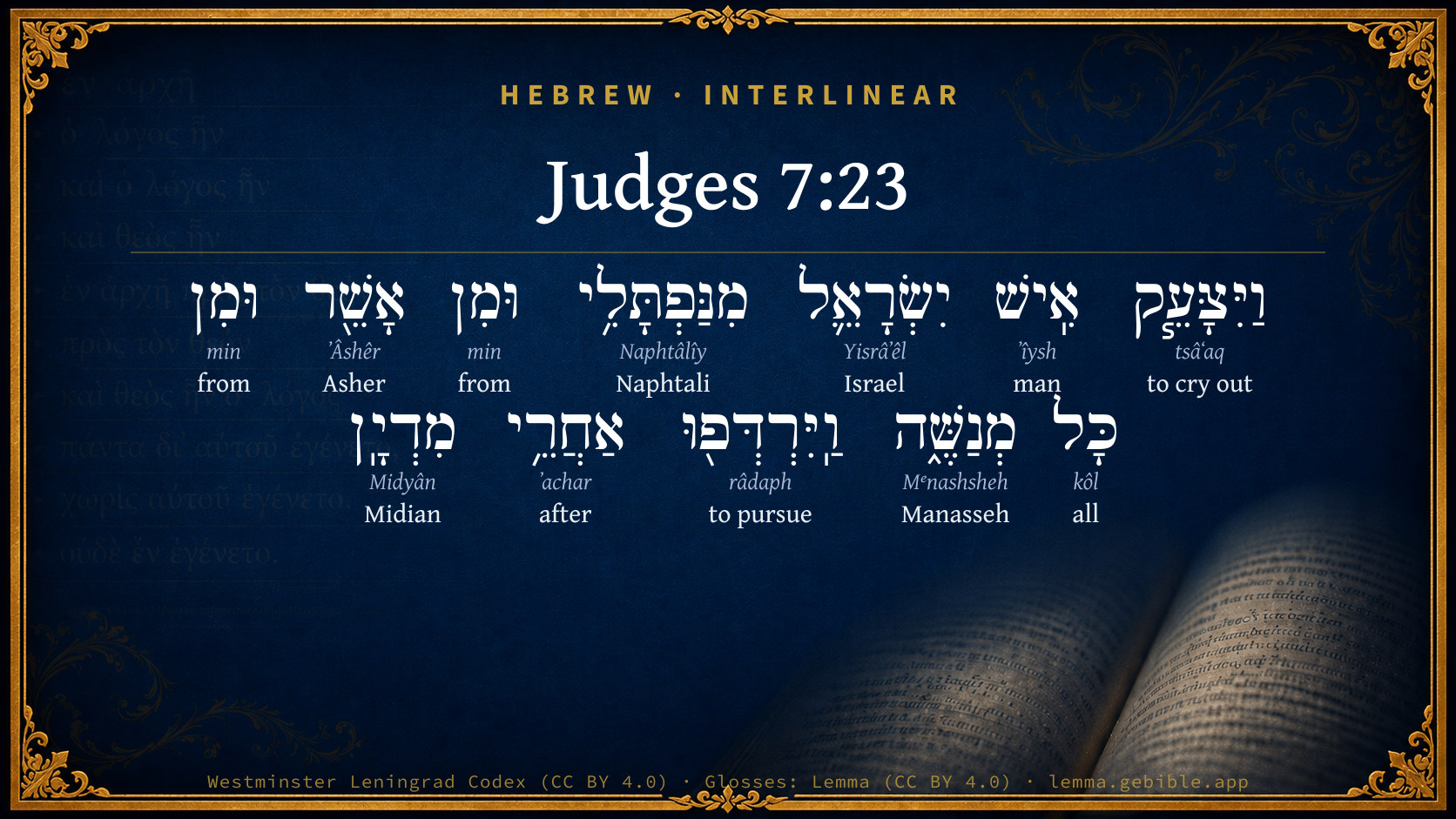
Hebrew (Westminster Leningrad Codex) Judges 7:23 appears in the Hebrew Old Testament. The text above is from the Westminster Leningrad Codex. Each word links to its Strong’s number, a concise gloss, and parsing drawn from the Open Scriptures Hebrew Bible morphology. Click any word for its full Brown-Driver-Briggs (BDB) entry.
Download image
Cite this verse

Judges 7:23 (World English Bible). Public Domain. Lemma interlinear Bible study tool, https://lemma.gebible.app/v/judges/7/23.

Show BibTeX & RIS
BibTeX
RIS
English Translation
The men of Israel were gathered together out of Naphtali, and out of Asher, and out of all Manasseh, and pursued after Midian.
World English Bible · Public Domain
Download a study sheet

One document with this verse’s original text, its word-by-word gloss line, the meaning frame, cross-references with their text, attributed commentary, and full source and license credits — printable, and it pastes into notes with its structure intact.

This verse Autodidact and up

Study sheet (.html) Plain text (.txt)

A passage Seminary Student

Up to 50 verses in one chapter. A passage sheet keeps up to 6 commentary sources and 12 cross-references per verse, in the order this page ranks them, and says so on the sheet whenever that leaves anything out. Ask for a single verse and you get the Autodidact verse sheet above.

Everything on this page stays free to read, with no account — the sheet is a download of what is already on screen, not access to it.

Want to remove ads? Support Godless Engineer
Compare translations 3

The same verse in 3 English versions, stacked beneath the original-language interlinear above. Click any original word for its lexicon entry.

Each is an independent rendering of the whole verse — the interlinear is not word-aligned to these translations.

Highlighted words mark where these versions differ — a whole-verse word diff, not a word-by-word alignment.

  • World English Bible Public Domain
    The men of Israel were gathered together out of Naphtali, and out of Asher, and out of all Manasseh, and pursued after Midian.
  • King James Version Public Domain
    And the men of Israel gathered themselves together out of Naphtali, and out of Asher, and out of all Manasseh, and pursued after the Midianites.
  • unfoldingWord Literal Text CC BY-SA 4.0
    Then a man of Israel from Naphtali and from Asher and from all of Manasseh was summoned, and they pursued after Midian.

unfoldingWord Literal Text — © unfoldingWord, licensed CC BY-SA 4.0. Word-aligned USFM3 via Door43 (git.door43.org/unfoldingWord/en_ult).

Versions to compare (up to 4)

3 of 4 selected

Show all 18 translations

Every available English version of this verse, each an independent rendering of the whole verse.

  • World English Bible Public Domain
    The men of Israel were gathered together out of Naphtali, and out of Asher, and out of all Manasseh, and pursued after Midian.
  • Berean Standard Bible Public Domain
    Then the men of Israel were called out from Naphtali, Asher, and all Manasseh, and they pursued the Midianites.
  • Majority Standard Bible Public Domain
    Then the men of Israel were called out from Naphtali, Asher, and all Manasseh, and they pursued the Midianites.
  • King James Version Public Domain
    And the men of Israel gathered themselves together out of Naphtali, and out of Asher, and out of all Manasseh, and pursued after the Midianites.
  • American Standard Version (1901) Public Domain
    And the men of Israel were gathered together out of Naphtali, and out of Asher, and out of all Manasseh, and pursued after Midian.
  • Revised Version (1885) Public Domain
    And the men of Israel were gathered together out of Naphtali, and out of Asher, and out of all Manasseh, and pursued after Midian.
  • Geneva Bible (1599) Public Domain
    Then the men of Israel being gathered together out of Naphtali, and out of Asher, and out of all Manasseh, pursued after the Midianites.
  • Douay-Rheims (1899) Public Domain
    Fleeing as far as Bethsetta, and the border of Abelmahula in Tebbath. But the men of Israel shouting from Nephtali and Aser, and from all Manasses pursued after Madian.
  • Young's Literal Translation Public Domain
    And the men of Israel are called from Naphtali, and from Asher, and from all Manasseh, and pursue after Midian.
  • Literal Standard Version CC BY-SA 4.0
    And the men of Israel are called from Naphtali, and from Asher, and from all Manasseh, and pursue after Midian.
  • Unlocked Literal Bible CC BY-SA 4.0
    The men of Israel from Naphtali, Asher, and all Manasseh were called out, and they went after Midian.
  • unfoldingWord Literal Text CC BY-SA 4.0
    Then a man of Israel from Naphtali and from Asher and from all of Manasseh was summoned, and they pursued after Midian.
  • Darby Bible Public Domain
    And the men of Israel were called out from Naph'tali and from Asher and from all Manas'seh, and they pursued after Mid'ian.
  • World Messianic Bible Public Domain
    The men of Israel were gathered together out of Naphtali, out of Asher, and out of all Manasseh, and pursued Midian.
  • Webster's Bible Public Domain
    And the men of Israel assembled out of Naphtali, and out of Asher, and out of all Manasseh, and pursued the Midianites.
  • Free Bible Version CC BY-SA 4.0
    The Israelite soldiers were summoned from Naphtali, Asher, and all of Manasseh, and they chased after the Midianites.
  • Bible in Basic English Public Domain
    And the men of Israel came together from Naphtali and from Asher and all Manasseh, and went after Midian.
  • JPS Tanakh (1917) Public Domain
    And the men of Israel were gathered together out of Naphtali, and out of Asher, and out of all Manasseh, and pursued after Midian.

Literal Standard Version (2020), Covenant Press — licensed CC BY-SA 4.0. Text via the HelloAO Bible API (eBible.org). Unlocked Literal Bible (unfoldingWord) — licensed CC BY-SA 4.0. Text via the HelloAO Bible API (eBible.org). unfoldingWord Literal Text — © unfoldingWord, licensed CC BY-SA 4.0. Word-aligned USFM3 via Door43 (git.door43.org/unfoldingWord/en_ult). Free Bible Version, Dr. Jonathan Gallagher — licensed CC BY-SA 4.0. Text via the HelloAO Bible API (eBible.org).

Word by word

More ways to search: Search by grammar → Find every occurrence → Compare this word →

Practice this passage: Drill this verse → Learn its vocabulary →

About this verse

These counts appear in no published source. They are computed here, from the morphology-tagged text and Lemma’s own curated glosses. What Lemma adds →

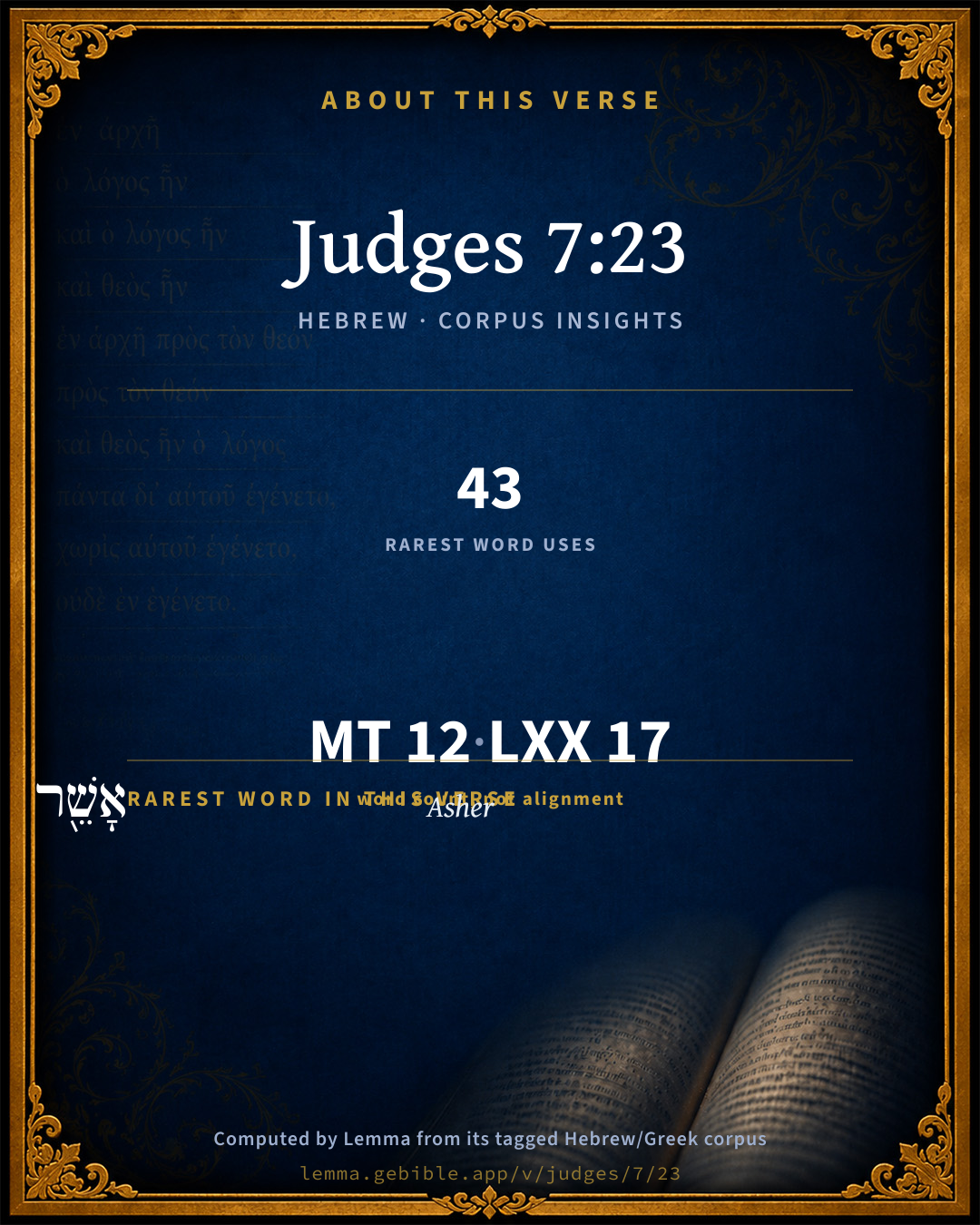
12
words
11
distinct lemmas
Historical
section

Shared distinctive vocabulary

אָשֵׁ֖ר Asher H836 occurs in 41 verses of the Hebrew Bible. Also found in:

Grammatical profile

  • 2 verbs
  • 7 nouns
  • 3 prepositions

Verb forms

  • וַיִּצָּעֵ֧ק Niphal · Sequential Imperfect
  • וַֽיִּרְדְּפ֖וּ Qal · Sequential Imperfect

Repetition

A word recurs within this verse — often emphatic in Hebrew:

  • וּמִן from H4480 ×2

Hebrew & Septuagint length

In English translation the verse runs 23 words from the Hebrew and 33 from the Septuagint (LXX English) — the Septuagint runs noticeably longer here. See the side-by-side →

A rough comparison of the two English renderings, which tokenize alike — not a word-level alignment.

Word counts can differ between the Hebrew and the Greek without any difference in meaning — e.g. the Hebrew direct-object marker אֵת has no separate Greek word, and Greek often adds the article ὁ.

In the original languages it is 12 Hebrew tokens and 17 Greek tokens — but the two are counted differently (Hebrew bundles its prefixes and suffixes into one token; the Greek is in lemma form), so that isn’t a like-for-like length.

Cross-references

2

Topical passages linked to Judges 7:23 in the Treasury of Scripture Knowledge — connected by theme and wording, ordered by reader-vote popularity; previews shown in the World English Bible.

  • Judges 6:35 He sent messengers throughout all Manasseh; and they also were gathered together after him: and he sent messengers to Asher, and to Zebulun, and to Naphtali; and they came up to meet them.
  • 1 Samuel 14:21–22 Now the Hebrews who were with the Philistines as before, and who went up with them into the camp, [from the country] round about, even they also [turned] to be with the Israelites who were with Saul and Jonathan.

Cross-references courtesy of OpenBible.info (CC BY 4.0).

Hebrew and Greek witnesses Masoretic Hebrew ↔ Greek Septuagint

The same verse in the two great witnesses to the Old Testament, shown verse-for-verse.

Here the Septuagint runs noticeably longer than the Hebrew — LXX2012 (modern English Septuagint) 33 words vs World English Bible 23. A rough length comparison of the two English translations, not a word-level alignment — read both below.

These are two independent witnesses, not word-aligned to each other, and the Septuagint is shown in lemma (dictionary) form.

Hebrew Judges 7:23 Masoretic · Westminster Leningrad Codex

וַיִּצָּעֵ֧ק אִֽישׁ יִשְׂרָאֵ֛ל מִנַּפְתָּלִ֥י וּמִן אָשֵׁ֖ר וּמִן כָּל מְנַשֶּׁ֑ה וַֽיִּרְדְּפ֖וּ אַחֲרֵ֥י מִדְיָֽן

The men of Israel were gathered together out of Naphtali, and out of Asher, and out of all Manasseh, and pursued after Midian.

World English Bible · Public Domain

Greek LXX Judges 7:23 Septuagint · lemma form

καί βοάω ἀνήρ ἰσραήλ ἀπό νεφθαλι καί ἀπό ασηρ καί ἀπό πᾶς μανασσή καί διώκω ὀπίσω μαδιαμ

And the host fled as far as Bethseed Tagaragatha Abel-meula to Tabath; and the men of Israel from Nephthali, and from Aser, and from all Manasse, came to help, and followed after Madiam.

LXX2012 (modern English Septuagint) · Public Domain

Hebrew: Westminster Leningrad Codex (CC BY 4.0). Greek: Septuagint (public domain); English from LXX2012 (modern English Septuagint) (Public Domain). How the Septuagint differs from the Hebrew →

Targum (Aramaic paraphrase)

1

The Targum is the ancient Jewish Aramaic paraphrase of the Hebrew Scriptures — an interpretive translation, not the Hebrew text itself. Onkelos (literal) and Pseudo-Jonathan (expansive) render the Torah, and Jonathan the Prophets. Coverage is partial: where no permissively-licensed English translation exists for a verse, only the Aramaic is shown. This is verse-level text, not a word-by-word alignment to the Hebrew.

  1. Targum Jonathan Prophets (Joshua–Malachi)
    וְאִתְכְּנִישׁ אֱנַשׁ יִשְׂרָאֵל מִנַפְתָּלִי וּמִן שִׁבְטָא דְאָשֵׁר וּמִן כָּל שִׁבְטָא דִמְנַשֶׁה וּרְדָפוּ בָּתַר מִדְיָנָאֵי:

    (no public-domain English translation for this verse)

    Targum Jonathan — Aramaic: “Mikraot Gedolot” (public domain). English: “Sefaria Community Translation” (CC0 1.0 (public-domain dedication)); “London "Chaldee Paraphrase," 1871” (public domain). Text via Sefaria.

Commentary

Notes on Judges 7:23 from classic Christian and Jewish commentators (each source and its license shown beneath its notes). The classic Christian expositions comment on the surrounding passage and are grouped to its opening verse, so a note may address several verses; the Jewish commentaries on the Tanakh (Rashi and others) are per-verse, so they appear only where the commentator wrote on this verse.

Lemma curates 59 commentaries, every one of them public domain or Creative Commons licensed, each selected and text-cleaned for this edition rather than reprinted as found. About our sources →

Matthew Henry's Commentary

We have here the prosecution of this glorious victory. 1. Gideon's soldiers that had been dismissed, and perhaps had begun to disperse themselves, upon notice of the enemies' flight got together again, and vigorously pursued those whom they had not courage to face. The men of Israel out of Naphtali and Asher who did this (Jdg 7:23) were not such as now came from those distant countries, but the same that had enlisted themselves (Jdg 6:35), but had been cashiered. Those who were fearful and afraid to fight (Jdg 7:3) now took heart, when the worst was over, and were ready enough to divide the spoil, though backward to make the onset. Those also that might not fight though they had a mind to it, and were disbanded by order from God, did not as those, Ch2 25:10, Ch2 25:13, return in great anger, but waited for an opportunity of doing service in pursuing the victory, though they were denied the honour of helping to force the lines. 2. The Ephraimites, upon a summons from Gideon, came in unanimously, and secured the passes over Jordan, by the several fords, to cut off the enemies' retreat into their own country, that they might be entirely destroyed, to prevent the like mischief to Israel another time. Now that they had begun to fall, it was easy to say, Down with them, Est 6:13. They took the waters (Jdg 7:24), that is, posted themselves along the river side, so that the Midianites, who fled from those who pursued them, fell into the hands of those that waited to intercept them. Here were fear, and the pit, and the snare, Isa 24:17. 3. Two of the chief commanders of the host of Midian were taken and slain by the Ephraimites on this side Jordan, Jdg 7:25. Their names perhaps signified their nature, Oreb signifies a raven, and Zeeb a wolf (corvus and lupus). These in their flight had taken shelter, one in a rock (Isa 2:21; Rev 6:15), the other by a wine-press, as Gideon for fear of them had lately hid his corn by a wine-press, Jdg 6:11. But the places of their shelter were made the places of their slaughter, and the memory of it was preserved to posterity in the names of the places, to their perpetual infamy: Here fell the princes of Midian.

Matthew Henry's Commentary on the Whole Bible (1708–1710) — public domain (CC PDM 1.0). Text via the HelloAO Bible API.

Trapp's Complete Commentary

John Trapp

Jdg 7:23 And the men of Israel gathered themselves together out of Naphtali, and out of Asher, and out of all Manasseh, and pursued after the Midianites.

Ver. 23. And the men of Israel gathered themselves together.] Various of those doubtless that, as white livered soldiers, had deserted the army; and others that, for their sloth and intemperance, were not honoured so far by God as to break a pitcher or to bear a torch, are now got together to pursue a flying enemy, and to share in the spoil.

John Trapp, A Commentary or Exposition upon All the Books of the Old and New Testament (1647–1656) — public domain. Text from a community e-Sword module.

Joseph Benson's Commentary

Jdg 7:23-24. The men of Israel gathered themselves together — Upon advice of this flight of the Midianites, by swift messengers sent on purpose, the Israelites immediately poured down from all parts, to intercept them in their flight. Take before them the waters — That is, the passes over those waters to which they are likely to come; unto Beth-barah and Jordan — The fords of Jordan, which they must pass over into their own country.

Joseph Benson's Commentary on the Old and New Testaments (1811–1818) — public domain. Text from a community e-Sword module.

Keil & Delitzsch

C. F. Keil & F. Delitzsch

Pursuit of the Enemy as far as the Jordan. - Jdg 7:23. As soon as the Midianites had been put to flight, the Israelitish men of Naphtali, Asher, and Manasseh, let themselves be convened for the purpose of pursuing them: i.e., the men of these tribes, whom Gideon had sent away before the battle, and who were on their way home, could be summoned back again in a very short time to join in the pursuit of the flying foe. The omission of Zebulun (Jdg 6:35) is, in all probability, simply to be attributed to the brevity of the account.

Keil & Delitzsch — Biblical Commentary on the Old Testament (1861–1891) — public domain (CC PDM 1.0). Text via the HelloAO Bible API. (Old Testament only.)

Jamieson, Fausset & Brown

Robert Jamieson, A. R. Fausset & David Brown

the men of Israel gathered themselves together--These were evidently the parties dismissed, who having lingered at a little distance from the scene of contest, now eagerly joined in the pursuit southwestward through the valley.

Jamieson, Fausset & Brown — Commentary Critical and Explanatory on the Whole Bible (1871) — public domain (CC PDM 1.0). Text via the HelloAO Bible API.

Adam Clarke's Commentary

Verse 23. The men of Israel gathered] It is very likely that these were some persons whom Gideon had sent home the day before, who now hearing that the Midianites were routed, went immediately in pursuit.

Adam Clarke's Commentary on the Bible (1810–1826) — public domain. Text from a community e-Sword/MySword module.

Ellicott's Commentary for English Readers

(23) Out of Naphtali.—Doubtless these pursuers were some of those who had left Gideon’s camp before the victory. Those of Naphtali and Asher might pursue the flying Midianites northwards (if Beth-shittah is the same Shultah), and those of Manasseh might pursue those who fled southwards to the lower fords.

A Bible Commentary for English Readers, edited by Charles John Ellicott (1878–1897) — public domain. Text from a community e-Sword module.

The Cambridge Bible for Schools and Colleges

gen. ed. J. J. S. Perowne

23–25. The pursuit

23. out of Naphtali etc.] The same tribes, with the addition of Zebulun, were summoned before the battle, Jdg_6:35; they must have formed the bulk of the host dismissed in Jdg_7:3-8. They returned to their homes; but now hearing of Midian’s disaster, they assemble again, this time independently of Gideon, and pursue the enemy. Such must be the general sense intended by this verse, which, however, can hardly have belonged to the narrative originally.

The Cambridge Bible for Schools and Colleges (gen. ed. J. J. S. Perowne; Cambridge University Press, 1878–1918) — public domain. Text from a community e-Sword module.

John Gill's Exposition

And the men of Israel gathered themselves together,.... Not out of all the tribes, but out of those which lay nearest, and which are particularly mentioned:

out of Naphtali, and out of Asher, and out of all Manasseh: and these seem to be the same persons out of those tribes who first joined Gideon, but were separated from his army; both those that were fearful, and those that bowed their knees to drink, and who perhaps had not gone far before they heard of the defeat and flight of the Midianites; and therefore though they had not courage to face the enemy, at least most of them, yet had spirit enough to pursue a flying enemy; wherefore they returned, or however directed their course the nearest way, where they supposed they fled:

and pursued after the Midianites; and those that were with them.

John Gill's Exposition of the Whole Bible (1746–1763) — public domain (CC PDM 1.0). Text via the HelloAO Bible API.

Haydock's Catholic Bible Commentary

Bethsetta. These cities seem to have been near Bethsan. --- And the border. Hebrew, "in Zererath," (Haydock) which Junius takes to be Sarthan. --- Abelmehula gave birth to Eliseus, and was 12 miles from Scythopolis. (St. Jerome) --- Tebbath occurs no where else. But we read of Thebes, three miles from the last mentioned city, famous for the death of Abimelech, chap. xi. 50. --- Men. Probably those who had been sent home the preceding night. Upon hearing of the success which attended Gedeon, all the tribes began to be in motion.

George Leo Haydock (1774–1849), Haydock's Catholic Family Bible and Commentary, 1859 edition — public domain. Excludes Psalms (Douay-Rheims chapter numbering differs from Protestant) and Deuterocanonical books (Catholic canon only).

Whedon's Commentary on the Bible

Daniel D. Whedon

23. Gathered… out of Naphtali… Asher… Manasseh — Men out of these tribes might have been quickly summoned to the pursuit of the flying foe. Many of them, if not all, were probably the same as those whom Gideon had so recently sent to their homes. Jdg_7:8. “The cities given to Manasseh, on the west of the Jordan, were along the southern margin of Esdraelon, and on the hills above. Asher came up to Carmel, at the bottom of this plain, and a swift runner could reach them in an hour. A portion of Naphtali occupied the western shore of the lake of Tiberias, and could be reached in the same way and about the same time. It was possible, therefore, for them to receive the summons and respond to it.” — Thomson.

Daniel D. Whedon (gen. ed.), Commentary on the Old and New Testaments (1874–1909) — public domain. Text from a community e-Sword module.

Lesson kit

Teaching starters — assembled from the data on this page, not authored interpretation. Every prompt links to the verse data it draws on. Edit before teaching.

Judges, in the Historical, opens this verse with 12 words (11 distinct Hebrew lemmas). Its most distinctive word is ʼÂshêr (“Asher”). The Greek Septuagint runs longer here. A historical commentator’s framing appears above. Read the whole chapter for the surrounding context.

Discussion questions

  1. The word ʼÂshêr carries the sense “Asher.” How does it shape the verse?
  2. Genesis 30:13 shares the word «Asher» with this verse. How do the two illuminate each other?
  3. “from” occurs 2× in this one verse. What is the effect of the repetition?
  4. Compared with the Hebrew, the Septuagint runs longer here. What questions does that raise?
  5. These translations render this verse differently; the difference is in the English rendering, not the original. What questions does that raise?
  6. The verb «וַיִּצָּעֵ֧ק» is Niphal Sequential Imperfect. How does its form color the action?
  7. Reading how Matthew Henry's Commentary and Trapp's Complete Commentary read this verse, where do the two commentators agree and where do they part?

Things to notice

Reading settings

Reading text

Shown beneath each verse's original-language words.

Old Testament
Old Testament edition

Read the OT as the Masoretic Hebrew (MT) or the Greek Septuagint (LXX).

English shown for the Greek Septuagint (in the Hebrew ↔ Greek comparison).

Comparing translations? Open the Compare panel on any verse page to stack up to four side by side.