
Joshua 8:20

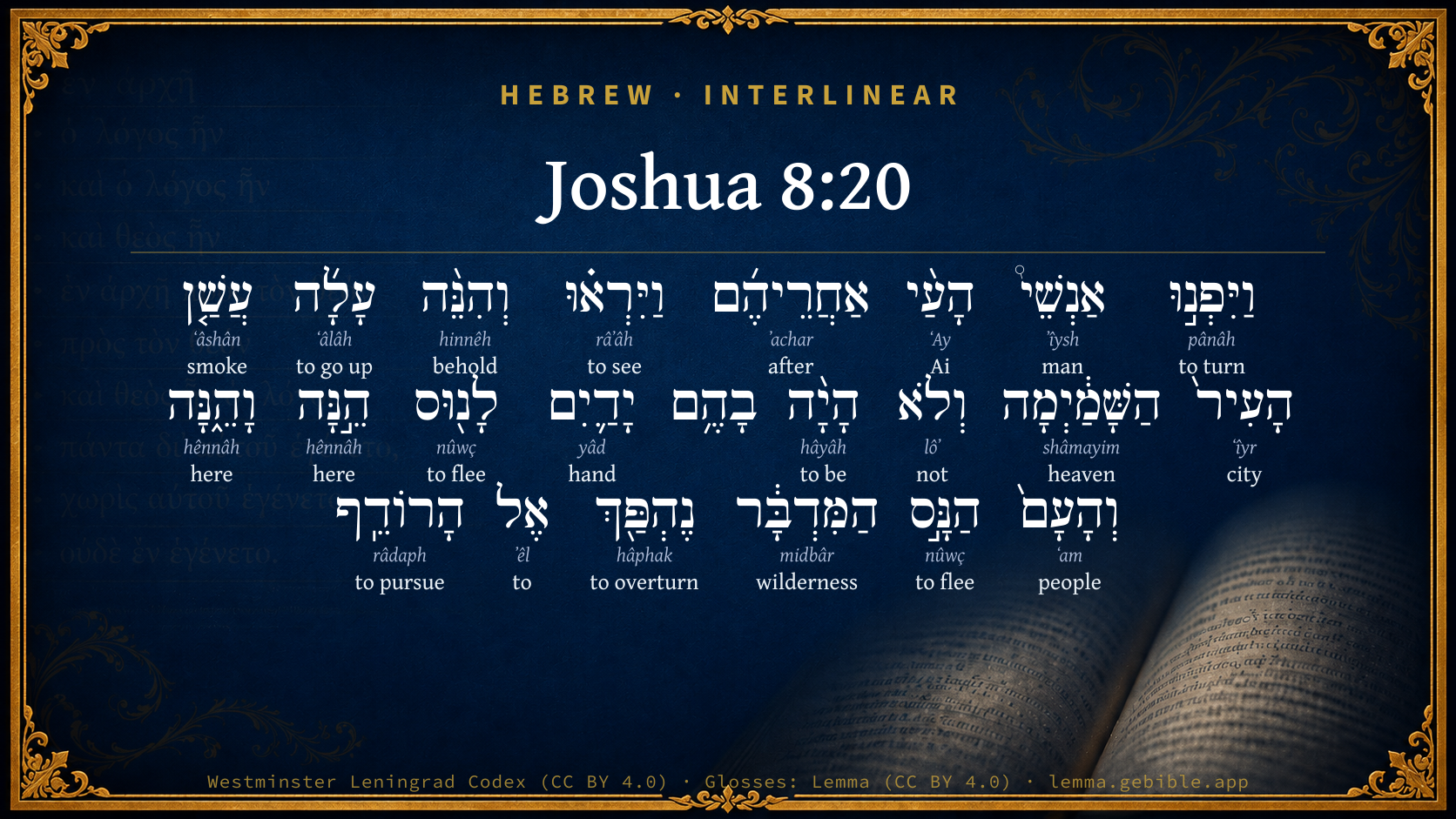
Hebrew (Westminster Leningrad Codex) Joshua 8:20 appears in the Hebrew Old Testament. The text above is from the Westminster Leningrad Codex. Each word links to its Strong’s number, a concise gloss, and parsing drawn from the Open Scriptures Hebrew Bible morphology. Click any word for its full Brown-Driver-Briggs (BDB) entry.
Download image
Cite this verse

Joshua 8:20 (World English Bible). Public Domain. Lemma interlinear Bible study tool, https://lemma.gebible.app/v/joshua/8/20.

Show BibTeX & RIS
BibTeX
RIS
English Translation
When the men of Ai looked behind them, they saw, and, behold, the smoke of the city ascended up to heaven, and they had no power to flee this way or that way: and the people who fled to the wilderness turned back on the pursuers.
World English Bible · Public Domain
Download a study sheet

One document with this verse’s original text, its word-by-word gloss line, the meaning frame, cross-references with their text, attributed commentary, and full source and license credits — printable, and it pastes into notes with its structure intact.

This verse Autodidact and up

Study sheet (.html) Plain text (.txt)

A passage Seminary Student

Up to 50 verses in one chapter. A passage sheet keeps up to 6 commentary sources and 12 cross-references per verse, in the order this page ranks them, and says so on the sheet whenever that leaves anything out. Ask for a single verse and you get the Autodidact verse sheet above.

Everything on this page stays free to read, with no account — the sheet is a download of what is already on screen, not access to it.

Want to remove ads? Support Godless Engineer
Compare translations 3

The same verse in 3 English versions, stacked beneath the original-language interlinear above. Click any original word for its lexicon entry.

Each is an independent rendering of the whole verse — the interlinear is not word-aligned to these translations.

Highlighted words mark where these versions differ — a whole-verse word diff, not a word-by-word alignment.

  • World English Bible Public Domain
    When the men of Ai looked behind them, they saw, and, behold, the smoke of the city ascended up to heaven, and they had no power to flee this way or that way: and the people who fled to the wilderness turned back on the pursuers.
  • King James Version Public Domain
    And when the men of Ai looked behind them, they saw, and, behold, the smoke of the city ascended up to heaven, and they had no power to flee this way or that way: and the people that fled to the wilderness turned back upon the pursuers.
  • unfoldingWord Literal Text CC BY-SA 4.0
    And the men of Ai turned behind them and looked, and behold, the smoke of the city went up to the heavens! And it was not in their hands to flee here or there, for the people having fled the wilderness turned themselves toward the pursuers.

unfoldingWord Literal Text — © unfoldingWord, licensed CC BY-SA 4.0. Word-aligned USFM3 via Door43 (git.door43.org/unfoldingWord/en_ult).

Versions to compare (up to 4)

3 of 4 selected

Show all 18 translations

Every available English version of this verse, each an independent rendering of the whole verse.

  • World English Bible Public Domain
    When the men of Ai looked behind them, they saw, and, behold, the smoke of the city ascended up to heaven, and they had no power to flee this way or that way: and the people who fled to the wilderness turned back on the pursuers.
  • Berean Standard Bible Public Domain
    When the men of Ai turned and looked back, the smoke of the city was rising into the sky. They could not escape in any direction, and the troops who had fled to the wilderness now became the pursuers.
  • Majority Standard Bible Public Domain
    When the men of Ai turned and looked back, the smoke of the city was rising into the sky. They could not escape in any direction, and the troops who had fled to the wilderness now turned against their pursuers.
  • King James Version Public Domain
    And when the men of Ai looked behind them, they saw, and, behold, the smoke of the city ascended up to heaven, and they had no power to flee this way or that way: and the people that fled to the wilderness turned back upon the pursuers.
  • American Standard Version (1901) Public Domain
    And when the men of Ai looked behind them, they saw, and, behold, the smoke of the city ascended up to heaven, and they had no power to flee this way or that way: and the people that fled to the wilderness turned back upon the pursuers.
  • Revised Version (1885) Public Domain
    And when the men of Ai looked behind them, they saw, and, behold, the smoke of the city ascended up to heaven, and they had no power to flee this way or that way: and the people that fled to the wilderness turned back upon the pursuers.
  • Geneva Bible (1599) Public Domain
    And the men of Ai looked behinde them, and sawe it: for loe, the smoke of the citie ascended vp to heauen, and they had no power to flee this way or that way: for the people that fled to the wildernesse, turned backe vpon the pursuers.
  • Douay-Rheims (1899) Public Domain
    And the men of the city, that pursued after Josue, looking back and seeing the smoke of the city rise up to heaven, had no more power to flee this way or that way: especially as they that had counterfeited flight, end were going toward the wilderness, turned back most valiantly against them that pursued.
  • Young's Literal Translation Public Domain
    And the men of Ai look behind them, and see, and lo, the smoke of the city hath gone up unto the heavens, and there hath not been in them power to flee hither and thither -- and the people who are fleeing to the wilderness have turned against the pursuer, --
  • Literal Standard Version CC BY-SA 4.0
    And the men of Ai look behind them, and see, and behold, the smoke of the city has gone up to the heavens, and there has not been power in them to flee here and there—and the people who are fleeing to the wilderness have turned against the pursuer—
  • Unlocked Literal Bible CC BY-SA 4.0
    The men of Ai turned and looked back. They saw the smoke from the city rising into the sky, and they could not escape this way or that. For the Israelite soldiers who had fled into the wilderness now turned back to face those who were pursuing them.
  • unfoldingWord Literal Text CC BY-SA 4.0
    And the men of Ai turned behind them and looked, and behold, the smoke of the city went up to the heavens! And it was not in their hands to flee here or there, for the people having fled the wilderness turned themselves toward the pursuers.
  • Darby Bible Public Domain
    And the men of Ai turned and saw, and behold, the smoke of the city went up to heaven, and they had no power to flee this way or that way; and the people that fled to the wilderness turned upon the pursuers.
  • World Messianic Bible Public Domain
    When the men of Ai looked behind them, they saw, and behold, the smoke of the city ascended up to heaven, and they had no power to flee this way or that way. The people who fled to the wilderness turned back on the pursuers.
  • Webster's Bible Public Domain
    And when the men of Ai looked behind them, they saw, and behold, the smoke of the city ascended to heaven, and they had no power to flee this way or that way: and the people that fled to the wilderness turned back upon the pursuers.
  • Free Bible Version CC BY-SA 4.0
    When the men of Ai looked back they saw the smoke rising up into the sky from the town. They had nowhere to run to, because the Israelites who had been running away towards the wilderness now turned on their pursuers.
  • Bible in Basic English Public Domain
    Then the men of Ai, looking back, saw the smoke of the town going up to heaven, and were unable to go this way or that: and the people who had gone in flight to the waste land were turned back on those who were coming after them.
  • JPS Tanakh (1917) Public Domain
    And when the men of Ai looked behind them, they saw, and, behold, the smoke of the city ascended up to heaven, and they had no power to flee this way or that way; and the people that fled to the wilderness turned back upon the pursuers.

Literal Standard Version (2020), Covenant Press — licensed CC BY-SA 4.0. Text via the HelloAO Bible API (eBible.org). Unlocked Literal Bible (unfoldingWord) — licensed CC BY-SA 4.0. Text via the HelloAO Bible API (eBible.org). unfoldingWord Literal Text — © unfoldingWord, licensed CC BY-SA 4.0. Word-aligned USFM3 via Door43 (git.door43.org/unfoldingWord/en_ult). Free Bible Version, Dr. Jonathan Gallagher — licensed CC BY-SA 4.0. Text via the HelloAO Bible API (eBible.org).

Word by word

More ways to search: Search by grammar → Find every occurrence → Compare this word →

Practice this passage: Drill this verse → Learn its vocabulary →

עֲשַׁ֤ן
ʻâshân
H6227
“smoke of”
Noun, Common, Masculine, Singular, Construct
Part of Speech
Noun
Type
Common
Gender
Masculine
Number
Singular
State
Construct
Full BDB Definition

Origin: from H6225

TWOT: 1712a

smoke - smoke - in metaphor, simile - smoke (figuratively)
  1. וַיִּפְנ֣וּ pânâh H6437 “and · to turn” Conjunction + Verb, Qal, Sequential Imperfect, 3rd Person, Masculine, Plural
  2. אַנְשֵׁי֩ ʼîysh H376 “men of” Noun, Common, Masculine, Plural, Construct
  3. הָעַ֨י ʻAy H5857 “the · Ai” Particle, Definite Article + Noun, Proper
  4. אַחֲרֵיהֶ֜ם ʼachar H310 “after · them” Preposition + Suffix, Personal, 3rd Person, Masculine, Plural
  5. וַיִּרְא֗וּ râʼâh H7200 “and · to see” Conjunction + Verb, Qal, Sequential Imperfect, 3rd Person, Masculine, Plural
  6. וְהִנֵּ֨ה hinnêh H2009 “and · behold” Conjunction + Particle, Demonstrative
  7. עָלָ֜ה ʻâlâh H5927 “to go up” Verb, Qal, Perfect, 3rd Person, Masculine, Singular
  8. הָעִיר֙ ʻîyr H5892 “the · city” Particle, Definite Article + Noun, Common, Feminine, Singular, Absolute
  9. הַשָּׁמַ֔יְמָה shâmayim H8064 “the · heaven(s) · toward” Particle, Definite Article + Noun, Common, Masculine, Plural, Absolute + Suffix, Demonstrative
  10. וְלֹא lôʼ H3808 “and · not” Conjunction + Particle, Negative
  11. הָיָ֨ה hâyâh H1961 “to be” Verb, Qal, Perfect, 3rd Person, Masculine, Singular
  12. יָדַ֛יִם yâd H3027 “hands” Noun, Common, Both, Dual, Absolute
  13. לָנ֖וּס nûwç H5127 “to flee” Preposition + Verb, Qal, Infinitive Construct
  14. הֵ֣נָּה hênnâh H2008 “here” Adverb
  15. וָהֵ֑נָּה hênnâh H2008 “and · here” Conjunction + Adverb
  16. וְהָעָם֙ ʻam H5971 “and · the · people” Conjunction + Particle, Definite Article + Noun, Common, Masculine, Singular, Absolute
  17. הַנָּ֣ס nûwç H5127 “the · fleeing” Particle, Definite Article + Verb, Qal, Participle Active, Masculine, Singular, Absolute
  18. הַמִּדְבָּ֔ר midbâr H4057 “the · wilderness” Particle, Definite Article + Noun, Common, Masculine, Singular, Absolute
  19. נֶהְפַּ֖ךְ hâphak H2015 “to overturn” Verb, Niphal, Perfect, 3rd Person, Masculine, Singular
  20. אֶל ʼêl H413 “to” Preposition
  21. הָרוֹדֵֽף râdaph H7291 “the · pursuing” Particle, Definite Article + Verb, Qal, Participle Active, Masculine, Singular, Absolute

About this verse

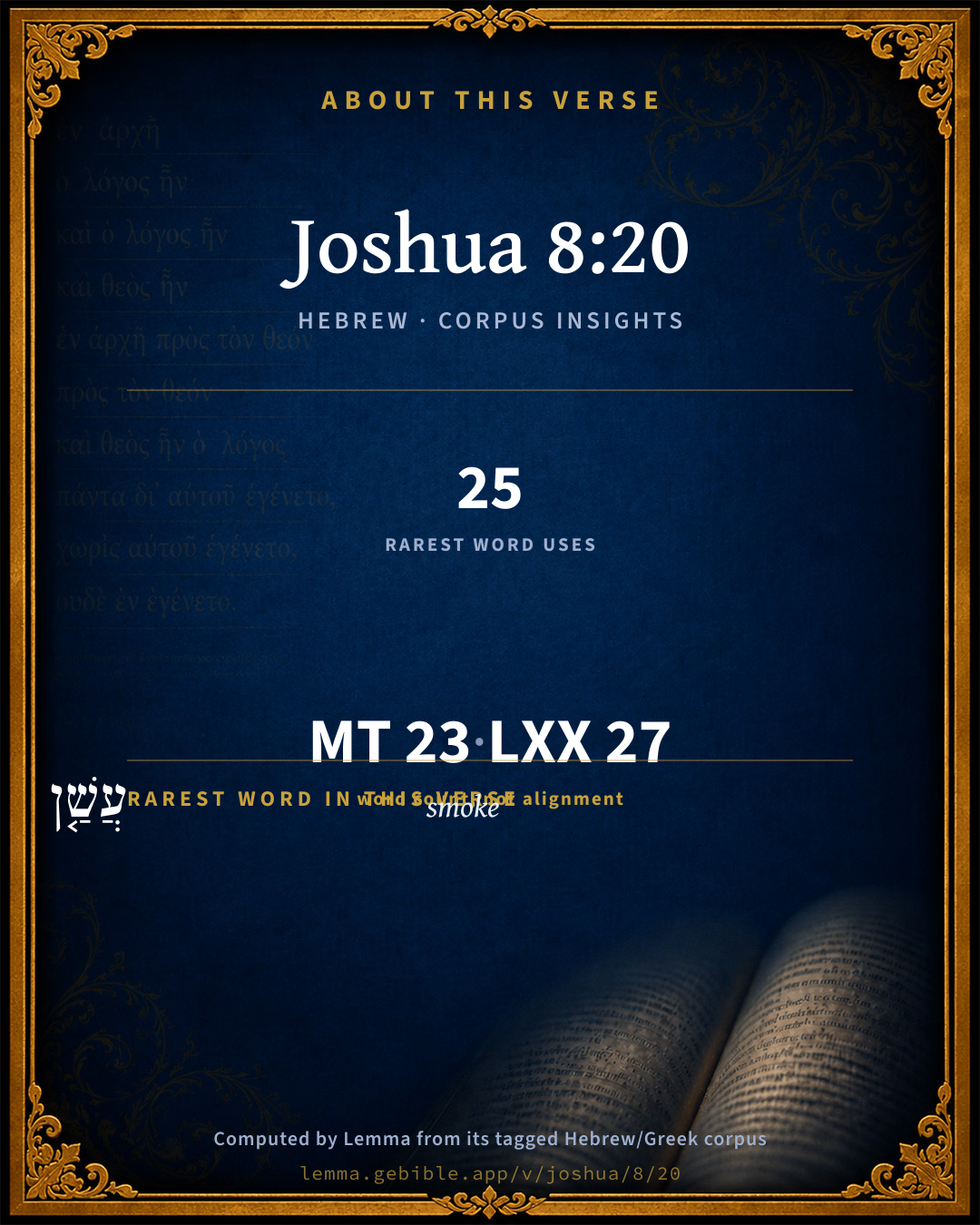
These counts appear in no published source. They are computed here, from the morphology-tagged text and Lemma’s own curated glosses. What Lemma adds →

23
words
20
distinct lemmas
Historical
section

Notable vocabulary

The rarest word here is עֲשַׁ֤ן smoke H6227 — appearing just 25 times in the whole Hebrew Bible.

Shared distinctive vocabulary

עֲשַׁ֤ן smoke H6227 occurs in 24 verses of the Hebrew Bible. Also found in:

Grammatical profile

  • 8 verbs
  • 8 nouns
  • 3 prepositions
  • 2 adverbs
  • 2 particles

Verb forms

  • וַיִּפְנ֣וּ Qal · Sequential Imperfect
  • וַיִּרְא֗וּ Qal · Sequential Imperfect
  • עָלָ֜ה Qal · Perfect
  • הָיָ֨ה Qal · Perfect
  • לָנ֖וּס Qal · Infinitive Construct
  • הַנָּ֣ס Qal · Participle Active
  • נֶהְפַּ֖ךְ Niphal · Perfect
  • הָרוֹדֵֽף Qal · Participle Active

Repetition

Words recur within this verse — often emphatic in Hebrew:

  • לָנ֖וּס to flee H5127 ×2
  • הֵ֣נָּה here H2008 ×2

Hebrew & Septuagint length

In English translation the verse runs 46 words from the Hebrew and 36 from the Septuagint (LXX English) — closely comparable.

A rough comparison of the two English renderings, which tokenize alike — not a word-level alignment.

Word counts can differ between the Hebrew and the Greek without any difference in meaning — e.g. the Hebrew direct-object marker אֵת has no separate Greek word, and Greek often adds the article ὁ.

In the original languages it is 23 Hebrew tokens and 27 Greek tokens — but the two are counted differently (Hebrew bundles its prefixes and suffixes into one token; the Greek is in lemma form), so that isn’t a like-for-like length.

Cross-references

9

Topical passages linked to Joshua 8:20 in the Treasury of Scripture Knowledge — connected by theme and wording, ordered by reader-vote popularity; previews shown in the World English Bible.

  • Genesis 19:28 He looked toward Sodom and Gomorrah, and toward all the land of the plain, and looked, and saw that the smoke of the land went up as the smoke of a furnace.
  • Job 11:20 But the eyes of the wicked shall fail, They shall have no way to flee; Their hope shall be the giving up of the spirit."
  • Psalms 48:5–6 They saw it, then they were amazed. They were dismayed, They hurried away.
  • Psalms 76:5 Valiant men lie plundered, They have slept their last sleep. None of the men of war can lift their hands.
  • Isaiah 34:10 It shall not be quenched night nor day; the smoke of it shall go up for ever; from generation to generation it shall lie waste; none shall pass through it forever and ever.
  • Amos 2:14–16 Flight will perish from the swift; And the strong won't strengthen his force; Neither shall the mighty deliver himself;
  • Revelation 6:15–17 The kings of the earth, the princes, the commanding officers, the rich, the strong, and every slave and free person, hid themselves in the caves and in the rocks of the mountains.
  • Revelation 18:9 The kings of the earth, who committed sexual immorality and lived wantonly with her, will weep and wail over her, when they look at the smoke of her burning,
  • Revelation 19:3 A second said, "Hallelujah! Her smoke goes up forever and ever."

Cross-references courtesy of OpenBible.info (CC BY 4.0).

Hebrew and Greek witnesses Masoretic Hebrew ↔ Greek Septuagint

The same verse in the two great witnesses to the Old Testament, shown verse-for-verse.

These are two independent witnesses, not word-aligned to each other, and the Septuagint is shown in lemma (dictionary) form.

Hebrew Joshua 8:20 Masoretic · Westminster Leningrad Codex

וַיִּפְנ֣וּ אַנְשֵׁי֩ הָעַ֨י אַחֲרֵיהֶ֜ם וַיִּרְא֗וּ וְהִנֵּ֨ה עָלָ֜ה עֲשַׁ֤ן הָעִיר֙ הַשָּׁמַ֔יְמָה וְלֹא הָיָ֨ה בָהֶ֥ם יָדַ֛יִם לָנ֖וּס הֵ֣נָּה וָהֵ֑נָּה וְהָעָם֙ הַנָּ֣ס הַמִּדְבָּ֔ר נֶהְפַּ֖ךְ אֶל הָרוֹדֵֽף

When the men of Ai looked behind them, they saw, and, behold, the smoke of the city ascended up to heaven, and they had no power to flee this way or that way: and the people who fled to the wilderness turned back on the pursuers.

World English Bible · Public Domain

Greek LXX Joshua 8:20 Septuagint · lemma form

καί περιβλέπω ὁ κάτοικος γαι εἰς ὁ ὀπίσω αὐτός καί θεωρέω καπνός ἀναβαίνω ἐκ ὁ πόλις εἰς ὁ οὐρανός καί οὐκέτι ἔχω ποῦ φεύγω ὧδε ἤ ὧδε

And when the inhabitants of Gai looked round behind them, then they saw the smoke going up out of the city to heaven, and they were no longer able to flee this way or that way.

LXX2012 (modern English Septuagint) · Public Domain

On this verse, The Pulpit Commentary discusses the Septuagint’s reading. Read the note in Commentary ↓

Hebrew: Westminster Leningrad Codex (CC BY 4.0). Greek: Septuagint (public domain); English from LXX2012 (modern English Septuagint) (Public Domain). How the Septuagint differs from the Hebrew →

Targum (Aramaic paraphrase)

1

The Targum is the ancient Jewish Aramaic paraphrase of the Hebrew Scriptures — an interpretive translation, not the Hebrew text itself. Onkelos (literal) and Pseudo-Jonathan (expansive) render the Torah, and Jonathan the Prophets. Coverage is partial: where no permissively-licensed English translation exists for a verse, only the Aramaic is shown. This is verse-level text, not a word-by-word alignment to the Hebrew.

  1. Targum Jonathan Prophets (Joshua–Malachi)
    וְאִתְפְּנִיאוּ אֱנָשֵׁי עַי לַאֲחוֹרֵיהֶן וַחֲזוֹ וְהָא סְלִיק תְּנָנָא דְקַרְתָּא לְצֵית שְׁמַיָא וְלָא הֲוָה בְהוֹן חֵילָא לְמַעֲרָק לְכָא וּלְכָא וְעַמָא דְאַפֵיךְ לְמַדְבְּרָא אִתְחֲזַר עַל רָדְפָא:

    (no public-domain English translation for this verse)

    Targum Jonathan — Aramaic: “Mikraot Gedolot” (public domain). English: “Sefaria Community Translation” (CC0 1.0 (public-domain dedication)); “London "Chaldee Paraphrase," 1871” (public domain). Text via Sefaria.

Commentary

Notes on Joshua 8:20 from classic Christian and Jewish commentators (each source and its license shown beneath its notes). The classic Christian expositions comment on the surrounding passage and are grouped to its opening verse, so a note may address several verses; the Jewish commentaries on the Tanakh (Rashi and others) are per-verse, so they appear only where the commentator wrote on this verse.

Lemma curates 59 commentaries, every one of them public domain or Creative Commons licensed, each selected and text-cleaned for this edition rather than reprinted as found. About our sources →

Trapp's Complete Commentary

John Trapp

Jos 8:20 And when the men of Ai looked behind them, they saw, and, behold, the smoke of the city ascended up to heaven, and they had no power to flee this way or that way: and the people that fled to the wilderness turned back upon the pursuers.

Ver. 20. And when the men of Ai looked behind them.] They should have looked before προσσω και οπισσω. But now it was Sero inquit Nero. Sin casteth wicked men into straits inextricable, and filleth their souls with sorrows unmedicinable.

John Trapp, A Commentary or Exposition upon All the Books of the Old and New Testament (1647–1656) — public domain. Text from a community e-Sword module.

Geneva Bible (1599)

Geneva Bible translators

Or, toward the heavens.

Or, place.

Geneva Bible (1599) marginal notes — public domain. Text via Bolls.life.

Adam Clarke's Commentary

Verse 20. They had no power to flee this way or that way] They were in utter consternation; they saw that the city was taken, they found themselves in the midst of their foes; that their wives, children, and property, had fallen a prey to their enemies, in consequence of which they were so utterly panic-struck as to be incapable of making any resistance.

Adam Clarke's Commentary on the Bible (1810–1826) — public domain. Text from a community e-Sword/MySword module.

The Cambridge Bible for Schools and Colleges

gen. ed. J. J. S. Perowne

20. they had no power] no hand. Comp. Jdg_18:10 (Heb.).

that fled to the wilderness] See above, Jos_8:15, and below, Jos_8:24.

The Cambridge Bible for Schools and Colleges (gen. ed. J. J. S. Perowne; Cambridge University Press, 1878–1918) — public domain. Text from a community e-Sword module.

John Gill's Exposition

And when the men of Ai looked behind them,.... On some account or another, perhaps observing that the army of Israel made a full stop and was gazing at the city:

they saw, and, behold, the smoke of the city ascended up to heaven; from whence they concluded an enemy was there, and had set fire to it:

and they had no power to flee this way or that way; for if they turned back to their city there was an enemy, how powerful they knew not, possessed of it, and whom they might expect would meet them; and if they pushed forward, there was the whole army of Israel against them, which now turned and faced them, showing no fear of them:

and the people that fled to the wilderness turned back upon the pursuers; the people of Israel, that fled by the way of the wilderness, Jos 8:15, turned about, and fell upon the men of Ai that pursued them.

John Gill's Exposition of the Whole Bible (1746–1763) — public domain (CC PDM 1.0). Text via the HelloAO Bible API.

Matthew Poole's English Annotations

No power, or, place; for so the Hebrew word is oft used, as Num 2:17; Neh 7:4; Job 37:7; Psa 104:25; Isa 22:18; 56:5.

Matthew Poole's English Annotations on the Holy Bible (1683–1685) — public domain. Text from a community e-Sword/MySword module.

Whedon's Commentary on the Bible

Daniel D. Whedon

20. And they had no power to flee — [Literally, there was not in them two hands to fly. Keil makes the word rendered two hands mean on both sides, that is, it was not in them to flee on either side, or in either direction. But this explanation hardly holds good in connection with the expression בהם, in them. We prefer, therefore, the common version, which takes hands metaphorically for capability, power for action or flight.] They were appalled by the revelation of the plot, and stupified by sudden terror. Their wives, children, houses, and possessions were in the hands of a merciless foe, and they themselves were in a ravine completely shut in before and behind by Joshua’s army.

Daniel D. Whedon (gen. ed.), Commentary on the Old and New Testaments (1874–1909) — public domain. Text from a community e-Sword module.

The Pulpit Commentary

And they had no power. Literally, no hands. Our version here follows the Arabic, Syriac, and Chaldee versions. The LXX and Vulgate render no direction in which to fly. But in this case would seem preferable to The Vulgate translates the last clause of the verse, "Praesertim cum hi, qui simulaverint fugam... fortissime restitissent." They could not flee back to the city, for it was in flames. They could not advance northward, because the Israelites had faced about and were coming to meet them. To flee in any other direction would be to cut off the last hope of saving the city. For dy in the sense of side or direction, however, see Exo_2:5 Deu_2:37, and especially the dual, as here, in Gen_34:21 Isa_33:21.

The Pulpit Commentary (1880–1919), ed. H.D.M. Spence-Jones & Joseph S. Exell — public domain. Text from a community e-Sword module.

unfoldingWord translationNotes

Door43 World Missions Community

translationWords

Ai

desert

face

Joshua

Israel

unfoldingWord translationNotes — © Distant Shores Media and the Door43 World Missions Community, licensed CC BY-SA 4.0. Source: git.door43.org/Door43/en_tn.

Rashi

Rabbi Shlomo Yitzchaki (Rashi)

יָדַיִם hands, here refers to strength.

The people who fled to the desert. The Bnei Yisroel who had fled to the desert, as stated above (v.15) turned back to battle the pursuers.

Rashi on the Tanakh — English translations: “The Judaica Press complete Tanach with Rashi, translated by A. J. Rosenberg” (CC BY 4.0); “Pentateuch with Rashi's commentary by M. Rosenbaum and A.M. Silbermann, 1929-1934” (public domain); “The Metsudah Tanach series, Lakewood, N.J” (CC BY 4.0); and “The Book of Joshua, Metsudah Publications, 1997” (CC BY 4.0). Text via Sefaria.

Lesson kit

Teaching starters — assembled from the data on this page, not authored interpretation. Every prompt links to the verse data it draws on. Edit before teaching.

Joshua, in the Historical, opens this verse with 23 words (20 distinct Hebrew lemmas). Its most distinctive word is ʻâshân (“smoke”). A historical commentator’s framing appears above. Read the whole chapter for the surrounding context.

Discussion questions

  1. How does “smoke” (ʻâshân) shape what this verse is saying?
  2. Genesis 15:17 shares the word «smoke» with this verse. How do the two illuminate each other?
  3. “to flee” occurs 2× in this one verse. What is the effect of the repetition?
  4. The translations on this page render this verse differently — a whole-verse word diff, not a word-by-word alignment. What might account for the different wordings?
  5. The verb «וַיִּפְנ֣וּ» is Qal Sequential Imperfect. How does its form color the action?
  6. Reading how Trapp's Complete Commentary and Geneva Bible (1599) read this verse, where do the two commentators agree and where do they part?

Things to notice

Reading settings

Reading text

Shown beneath each verse's original-language words.

Old Testament
Old Testament edition

Read the OT as the Masoretic Hebrew (MT) or the Greek Septuagint (LXX).

English shown for the Greek Septuagint (in the Hebrew ↔ Greek comparison).

Comparing translations? Open the Compare panel on any verse page to stack up to four side by side.