
Psalms 38:20

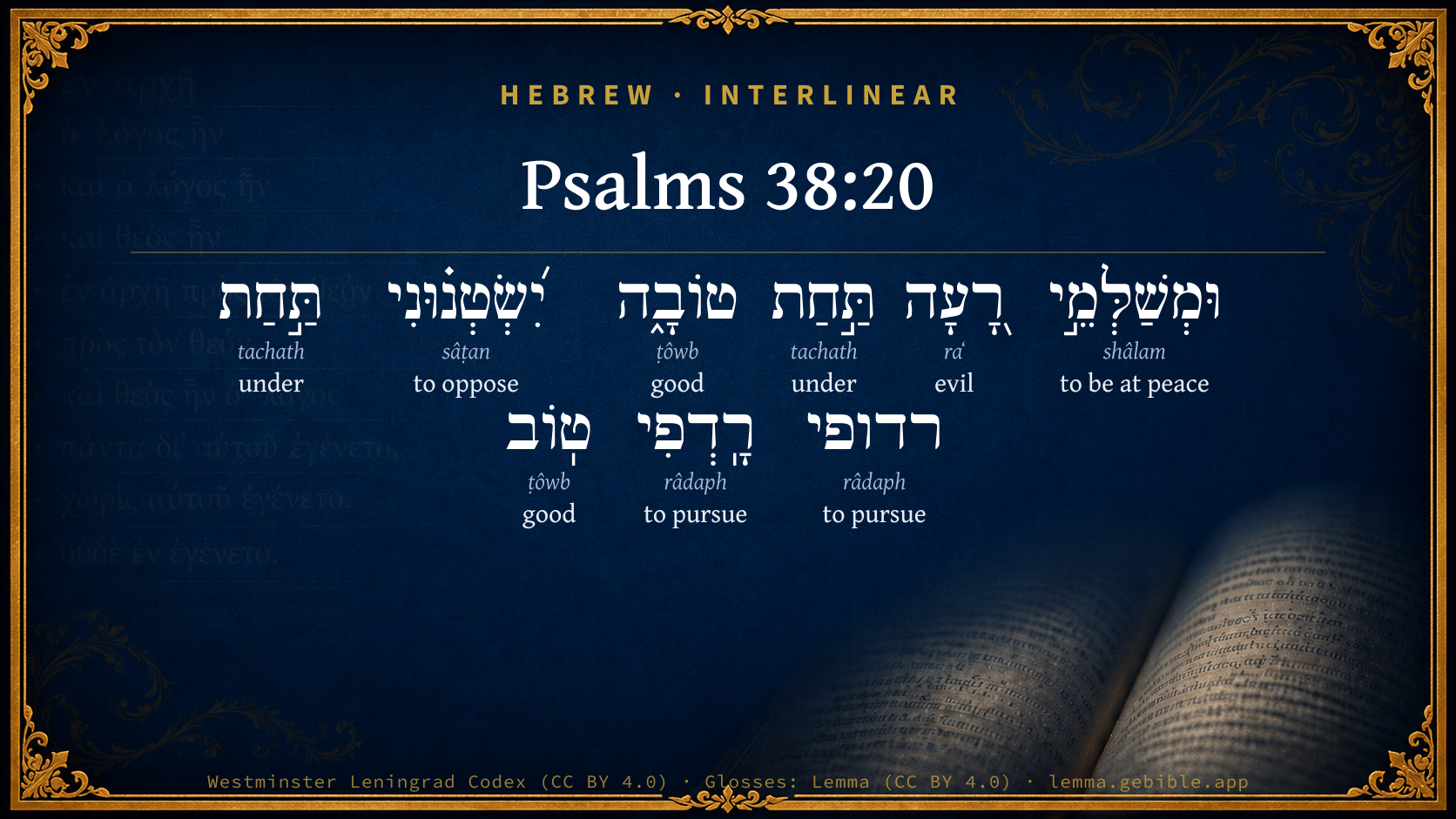
Hebrew (Westminster Leningrad Codex) Psalms 38:20 appears in the Hebrew Old Testament. The text above is from the Westminster Leningrad Codex. Each word links to its Strong’s number, a concise gloss, and parsing drawn from the Open Scriptures Hebrew Bible morphology. Click any word for its full Brown-Driver-Briggs (BDB) entry.
Download image
Cite this verse

Psalms 38:20 (World English Bible). Public Domain. Lemma interlinear Bible study tool, https://lemma.gebible.app/v/psalms/38/20.

Show BibTeX & RIS
BibTeX
RIS
English Translation
They who also render evil for good are adversaries to me, Because I follow what is good.
World English Bible · Public Domain
Highlights
  • 1 first appearance in the Hebrew Bible
Full analysis ↓
Download a study sheet

One document with this verse’s original text, its word-by-word gloss line, the meaning frame, cross-references with their text, attributed commentary, and full source and license credits — printable, and it pastes into notes with its structure intact.

This verse Autodidact and up

Study sheet (.html) Plain text (.txt)

A passage Seminary Student

Up to 50 verses in one chapter. A passage sheet keeps up to 6 commentary sources and 12 cross-references per verse, in the order this page ranks them, and says so on the sheet whenever that leaves anything out. Ask for a single verse and you get the Autodidact verse sheet above.

Everything on this page stays free to read, with no account — the sheet is a download of what is already on screen, not access to it.

Want to remove ads? Support Godless Engineer
Compare translations 3

The same verse in 3 English versions, stacked beneath the original-language interlinear above. Click any original word for its lexicon entry.

Each is an independent rendering of the whole verse — the interlinear is not word-aligned to these translations.

Highlighted words mark where these versions differ — a whole-verse word diff, not a word-by-word alignment.

  • World English Bible Public Domain
    They who also render evil for good are adversaries to me, Because I follow what is good.
  • King James Version Public Domain
    They also that render evil for good are mine adversaries; because I follow the thing that good is.
  • unfoldingWord Literal Text CC BY-SA 4.0
    And the repayers of evil in exchange for good accuse me in exchange for my pursuing of good.

unfoldingWord Literal Text — © unfoldingWord, licensed CC BY-SA 4.0. Word-aligned USFM3 via Door43 (git.door43.org/unfoldingWord/en_ult).

Versions to compare (up to 4)

3 of 4 selected

Show all 18 translations

Every available English version of this verse, each an independent rendering of the whole verse.

  • World English Bible Public Domain
    They who also render evil for good are adversaries to me, Because I follow what is good.
  • Berean Standard Bible Public Domain
    Those who repay my good with evil attack me for pursuing the good.
  • Majority Standard Bible Public Domain
    Those who repay my good with evil attack me for pursuing the good.
  • King James Version Public Domain
    They also that render evil for good are mine adversaries; because I follow the thing that good is.
  • American Standard Version (1901) Public Domain
    They also that render evil for good Are adversaries unto me, because I follow the thing that is good.
  • Revised Version (1885) Public Domain
    They also that render evil for good are adversaries unto me, because I follow the thing that is good.
  • Geneva Bible (1599) Public Domain
    They also, that rewarde euill for good, are mine aduersaries, because I follow goodnesse.
  • Douay-Rheims (1899) Public Domain
    But my enemies live, and are stronger that I: and they hate me wrongfully are multiplied.
  • Young's Literal Translation Public Domain
    And those paying evil for good accuse me, Because of my pursuing good.
  • Literal Standard Version CC BY-SA 4.0
    And those paying evil for good accuse me, || Because of my pursuing good.
  • Unlocked Literal Bible CC BY-SA 4.0
    They repay me evil for good; they hurl accusations at me although I have pursued what is good.
  • unfoldingWord Literal Text CC BY-SA 4.0
    And the repayers of evil in exchange for good accuse me in exchange for my pursuing of good.
  • Darby Bible Public Domain
    And they that render evil for good are adversaries unto me; because I pursue what is good.
  • World Messianic Bible Public Domain
    They who give evil for good are also adversaries to me, because I follow what is good.
  • Webster's Bible Public Domain
    \\38:19\\But my enemies are lively, and they are strong: and they that hate me wrongfully are multiplied.
  • Free Bible Version CC BY-SA 4.0
    They pay me back evil for good; they accuse me for the good I try to do.
  • Bible in Basic English Public Domain
    They give me back evil for good; they are my haters because I go after the thing which is right.
  • JPS Tanakh (1917) Public Domain
    (38-21) They also that repay evil for good are adversaries unto me, because I follow the thing that is good.

Literal Standard Version (2020), Covenant Press — licensed CC BY-SA 4.0. Text via the HelloAO Bible API (eBible.org). Unlocked Literal Bible (unfoldingWord) — licensed CC BY-SA 4.0. Text via the HelloAO Bible API (eBible.org). unfoldingWord Literal Text — © unfoldingWord, licensed CC BY-SA 4.0. Word-aligned USFM3 via Door43 (git.door43.org/unfoldingWord/en_ult). Free Bible Version, Dr. Jonathan Gallagher — licensed CC BY-SA 4.0. Text via the HelloAO Bible API (eBible.org).

Word by word

More ways to search: Search by grammar → Find every occurrence → Compare this word →

Practice this passage: Drill this verse → Learn its vocabulary →

יִ֝שְׂטְנ֗וּנִי
sâṭan
H7853
“to oppose · me”
Verb, Qal, Imperfect, 3rd Person, Masculine, Plural + Suffix, Personal, 1st Person, Common, Singular
Part of Speech
Verb
Stem
Qal
Form
Imperfect
Person
3rd Person
Gender
Masculine
Number
Plural
Full BDB Definition

Origin: a primitive root

TWOT: 2252

(Qal) to be or act as an adversary, resist, oppose
  1. וּמְשַׁלְּמֵ֣י shâlam H7999 “and · being at peace” Conjunction + Verb, Piel, Participle Active, Masculine, Plural, Construct
  2. רָ֭עָה raʻ H7451 “evil” Noun, Common, Feminine, Singular, Absolute
  3. תַּ֣חַת tachath H8478 “under” Preposition
  4. טוֹבָ֑ה ṭôwb H2896 “good” Adjective, Adjective, Feminine, Singular, Absolute
  5. תַּ֣חַת tachath H8478 “under” Preposition
  6. רדופי râdaph H7291 “to pursue · me” Verb, Qal, Infinitive Construct + Suffix, Personal, 1st Person, Common, Singular
  7. רָֽדְפִי râdaph H7291 “to pursue · me” Verb, Qal, Infinitive Construct + Suffix, Personal, 1st Person, Common, Singular
  8. טֽוֹב ṭôwb H2896 “good” Adjective, Adjective, Masculine, Singular, Absolute

About this verse

These counts appear in no published source. They are computed here, from the morphology-tagged text and Lemma’s own curated glosses. What Lemma adds →

9
words
6
distinct lemmas
Wisdom
section

Notable vocabulary

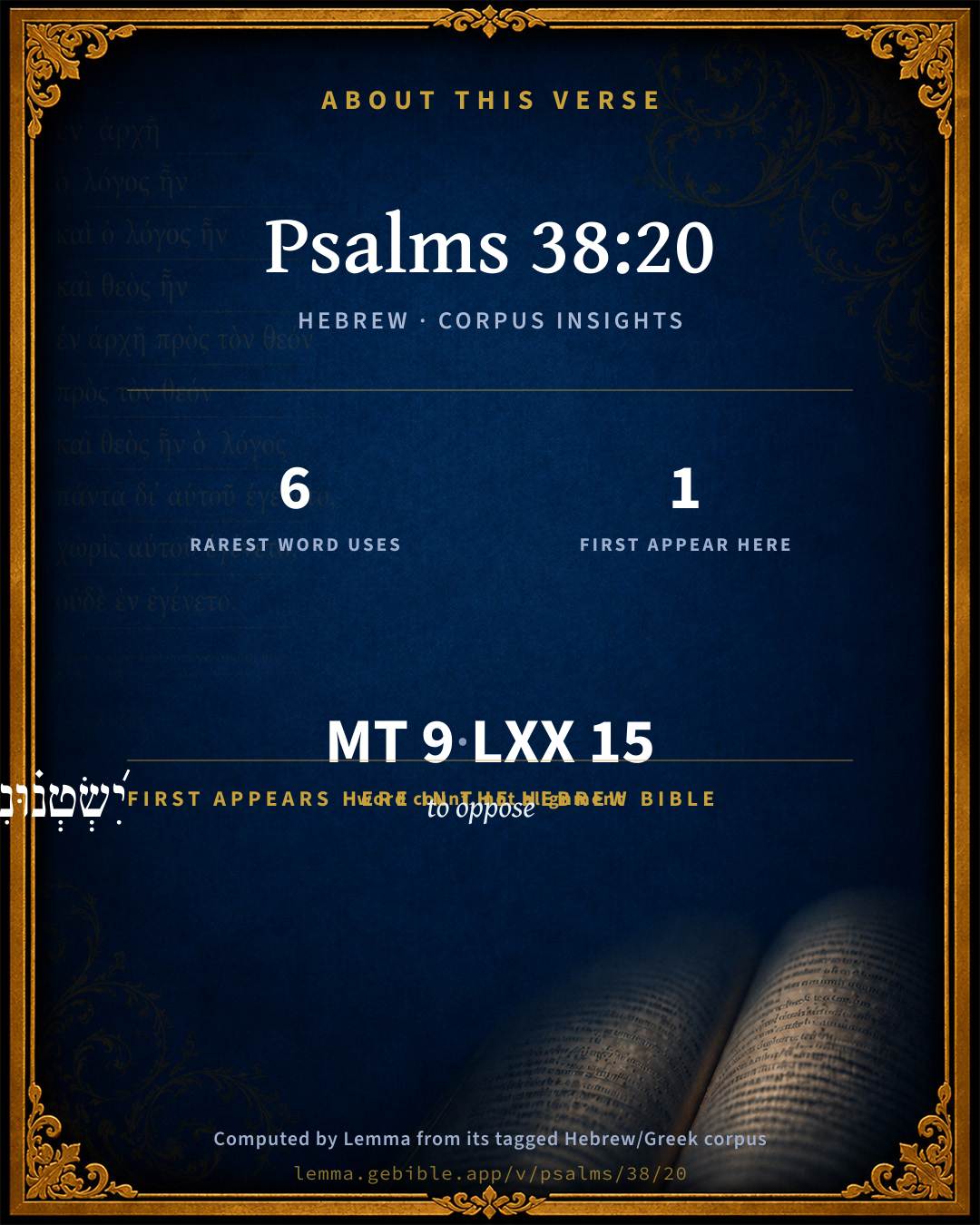
The rarest word here is יִ֝שְׂטְנ֗וּנִי to oppose H7853 — appearing just 6 times in the whole Hebrew Bible.

First appearance in Scripture

This word makes its first canonical appearance in the Hebrew Bible here:

  • יִ֝שְׂטְנ֗וּנִי to oppose H7853

Shared distinctive vocabulary

יִ֝שְׂטְנ֗וּנִי to oppose H7853 occurs in 6 verses of the Hebrew Bible. Also found in:

Grammatical profile

  • 4 verbs
  • 1 noun
  • 2 adjectives
  • 2 prepositions

Verb forms

  • וּמְשַׁלְּמֵ֣י Piel · Participle Active
  • יִ֝שְׂטְנ֗וּנִי Qal · Imperfect
  • רדופי Qal · Infinitive Construct
  • רָֽדְפִי Qal · Infinitive Construct

Repetition

Words recur within this verse — often emphatic in Hebrew:

  • תַּ֣חַת under H8478 ×2
  • טוֹבָ֑ה good H2896 ×2
  • רדופי to pursue H7291 ×2

Hebrew & Septuagint length

In English translation the verse runs 17 words from the Hebrew and 12 from the Septuagint (LXX English) — closely comparable.

A rough comparison of the two English renderings, which tokenize alike — not a word-level alignment.

Word counts can differ between the Hebrew and the Greek without any difference in meaning — e.g. the Hebrew direct-object marker אֵת has no separate Greek word, and Greek often adds the article ὁ.

In the original languages it is 9 Hebrew tokens and 15 Greek tokens — but the two are counted differently (Hebrew bundles its prefixes and suffixes into one token; the Greek is in lemma form), so that isn’t a like-for-like length.

Cross-references

15

Topical passages linked to Psalms 38:20 in the Treasury of Scripture Knowledge — connected by theme and wording, ordered by reader-vote popularity; previews shown in the World English Bible.

  • Psalms 35:12 They reward me evil for good, To the bereaving of my soul.
  • Jeremiah 18:20 Shall evil be recompensed for good? for they have dug a pit for my soul. Remember how I stood before you to speak good for them, to turn away your wrath from them.
  • 1 John 3:12 unlike Cain, who was of the evil one, and killed his brother. Why did he kill him? Because his works were evil, and his brother's righteous.
  • John 10:32 Jesus answered them, "I have shown you many good works from my Father. For which of those works do you stone me?"
  • 1 Peter 4:14–16 If you are insulted for the name of Christ, blessed are you; because the Spirit of glory and of God rests on you. On their part he is blasphemed, but on your part he is glorified.
  • 1 Samuel 25:21 Now David had said, Surely in vain have I kept all that this fellow has in the wilderness, so that nothing was missed of all that pertained to him: and he has returned me evil for good.
  • Psalms 109:3–5 They have also surrounded me with words of hatred, And fought against me without a cause.
  • 1 Samuel 19:4–6 Jonathan spoke good of David to Saul his father, and said to him, Don't let the king sin against his servant, against David; because he has not sinned against you, and because his works have been very good toward you:
  • 1 Samuel 23:5 David and his men went to Keilah, and fought with the Philistines, and brought away their cattle, and killed them with a great slaughter. So David saved the inhabitants of Keilah.
  • 1 Samuel 23:12 Then said David, Will the men of Keilah deliver up to me and my men into the hand of Saul? Yahweh said, They will deliver you up.
  • Psalms 7:4 If I have rewarded evil to him who was at peace with me (Yes, I have delivered him who without cause was my adversary),
  • Matthew 5:10 Blessed are those who have been persecuted for righteousness' sake, For theirs is the Kingdom of Heaven.
  • 1 Peter 3:13 Now who is he who will harm you, if you become imitators of that which is good?
  • 1 Peter 3:17–18 For it is better, if the will of God should so will, that you suffer for doing well than for doing evil.
  • 1 Samuel 25:16 they were a wall to us both by night and by day, all the while we were with them keeping the sheep.

Cross-references courtesy of OpenBible.info (CC BY 4.0).

Hebrew and Greek witnesses Masoretic Hebrew ↔ Greek Septuagint

The same verse in the two great witnesses to the Old Testament, shown verse-for-verse.

You’re reading Greek Psalm 37 (Hebrew Psalm 38). The Septuagint counts the superscription, so verse numbers can differ from the Hebrew — chapter-level alignment, not verse-by-verse. Numbering follows Rahlfs.

These are two independent witnesses, not word-aligned to each other, and the Septuagint is shown in lemma (dictionary) form.

Hebrew Psalms 38:20 Masoretic · Westminster Leningrad Codex

וּמְשַׁלְּמֵ֣י רָ֭עָה תַּ֣חַת טוֹבָ֑ה יִ֝שְׂטְנ֗וּנִי תַּ֣חַת רדופי רָֽדְפִי טֽוֹב

They who also render evil for good are adversaries to me, Because I follow what is good.

World English Bible · Public Domain

Greek LXX Greek Psalm 37:20 Septuagint · lemma form

ὁ δέ ἐχθρός ἐγώ ζάω καί κραταιόω ὑπέρ ἐγώ καί πληθύνω ὁ μισέω ἐγώ ἀδίκως

They that reward evil for good slandered me; because I followed righteousness.

LXX2012 (modern English Septuagint) · Public Domain

Hebrew: Westminster Leningrad Codex (CC BY 4.0). Greek: Septuagint (public domain); English from LXX2012 (modern English Septuagint) (Public Domain). How the Septuagint differs from the Hebrew →

Commentary

Notes on Psalms 38:20 from classic Christian and Jewish commentators (each source and its license shown beneath its notes). The classic Christian expositions comment on the surrounding passage and are grouped to its opening verse, so a note may address several verses; the Jewish commentaries on the Tanakh (Rashi and others) are per-verse, so they appear only where the commentator wrote on this verse.

Lemma curates 59 commentaries, every one of them public domain or Creative Commons licensed, each selected and text-cleaned for this edition rather than reprinted as found. About our sources →

Trapp's Complete Commentary

John Trapp

Psa 38:20 They also that render evil for good are mine adversaries; because I follow [the thing that] good [is].

Ver. 20. They also that render evil for good] While they rejoice at my misery, who fasted for them in their adversity, Psa 35:15.

Are mine adversaries] Heb. They satanically hate me, as if they were transformed into so many breathing devils.

Because I follow the thing that good is] This was devil-like indeed; this was to hate and persecute God in David (Tertul.). Thus Cain, the devil’s patriarch, hated his brother Abel, and slew him. And why? "Because his own works were evil, and his brother’s righteous," 1Jn 3:12. For like cause Moab fretted at Israel, Num 22:3-4, and the courtiers at Daniel, Psa 6:5.

John Trapp, A Commentary or Exposition upon All the Books of the Old and New Testament (1647–1656) — public domain. Text from a community e-Sword module.

J. A. Alexander on Psalms

Joseph Addison Alexander

21. (Psa 38:20). And (those) repaying evil for good they will oppose me for pursuing good. The first clause seems to belong to the preceding sentence, and to complete the description of his enemies, "those hating me without cause, and repaying evil for good." Compare Psa 35:12-16. Oppose me, be my enemies. The Hebrew verb is the root of the name Satan, the enemy or adversary of God and man. From its etymology, the verb for oppose would seem to denote specifically treacherous hostility.—The preposition in the last clause properly means under, then instead of, and more rarely in return for, which is the sense here. In return for my pursuing good, i.e. earnestly and eagerly endeavouring to be good and to do right. This was of itself sufficient to provoke their enmity.

Joseph Addison Alexander, The Psalms Translated and Explained (1850) — public domain. Text from a community e-Sword module.

Geneva Bible (1599)

Geneva Bible translators

He had rather have the hatred of all the world, than to fail in any part of his duty to Godward.

Geneva Bible (1599) marginal notes — public domain. Text via Bolls.life.

Adam Clarke's Commentary

Verse 20. Because l follow the thing that good is.] The translation is as bad as the sentence is awkward. תחת רדפי טוב tachath rodpi tob, because I follow goodness. There is a remarkable addition to this verse in the Arabic: "They have rejected me, the beloved one, as an abominable dead carcass; they have pierced my body with nails." I suppose the Arabic translator meant to refer this to Christ.

None of the other Versions have any thing like this addition; only the AEthiopic adds, "They rejected their brethren as an unclean carcass." St. Ambrose says this reading was found in some Greek and Latin copies in his time; and Theodoret has nearly the same reading with the Arabic: Και απερῥιψαν με τον αγαπητον, ῳς νεκρον εβδελυγμενον· "And they cast me, the beloved, out, as an abominable dead carcass." Whence this reading came I cannot conjecture.

Adam Clarke's Commentary on the Bible (1810–1826) — public domain. Text from a community e-Sword/MySword module.

John Calvin's Commentaries

This is more fully confirmed in the following verse, in which he declares that they requited him evil for the good which he had done them. More than this, however, is implied in the language of David. It implies that he not only abstained from all hurtful dealing towards his enemies, but that he had done them all the good which was in his power; and on this account the rage of the wicked is the less excusable, which not only moves them to do harm to others without cause, but which likewise cannot be appeased by any marks of kindness exercised towards them. It is indeed true, that there is nothing which wounds those of an ingenuous disposition of mind more than when wicked and ungodly men recompense them in a manner so dishonorable and unjust; but when they reflect upon this consolatory consideration, that God is no less offended with such ingratitude than those to whom the injury is done, they have no reason to be troubled beyond measure. To mitigate their sorrow, let this doctrine be the subject of their frequent meditation, That whenever the wicked, to whom we have endeavored to do good, shall requite us evil for good, God will certainly be their judge. In the last place, it is added, as the highest degree of their desperate wickedness, that they hated David because he studied to practice uprightness: They are opposed to me, because I follow that which is good It must be admitted, that those are froward and wicked in the extreme, nay, even of a devilish disposition, who hold uprightness in such abhorrence that they deliberately make war upon those who follow after it. It is, indeed, a very sore temptation, that the people of God, the more sincerely they endeavor to serve him, should procure to themselves so much the more trouble and sorrow; but this consideration ought to prove a sufficient ground of consolation to them, that they are not only supported by the testimony of a good conscience, but that they also know that God is ever ready, and that, too, for this very reason, to manifest his mercy towards them. On the ground of this assurance, they dare to appear in the presence of God, and entreat him, as it is his cause as well as theirs, that he would maintain and defend it. There can be no doubt that David, by his own example, has prescribed this as a common rule to all the faithful, rather to incur the hatred and ill-will of the world, than in the least degree to swerve from the path of duty, and without any hesitation to regard those as their enemies whom they know to be opposed to that which is just and righteous.

John Calvin's Commentaries (1540-1563) — public domain. Text from the Calvin Translation Society English edition (1840s-50s) via the Christian Classics Ethereal Library (ccel.org). Calvin's coverage is partial (roughly two-thirds of the Bible); uncommented books and verses are honest gaps, never fabricated. The 19th-century editor's footnotes and remarks are omitted so the notes are faithfully Calvin's own voice.

The Cambridge Bible for Schools and Colleges

gen. ed. J. J. S. Perowne

20. Yea, and rewarding evil for good

They are adversaries unto me, for my following of good.

Not, in return for my pursuit of good in general, but, in return for the good I have striven to do for them. The point is their base ingratitude. Cp. Psa_35:12-13, note.

The Cambridge Bible for Schools and Colleges (gen. ed. J. J. S. Perowne; Cambridge University Press, 1878–1918) — public domain. Text from a community e-Sword module.

John Gill's Exposition

Forsake me not, O Lord,.... Or continue not to forsake; for he seems to have been under divine desertion, and might be under apprehensions that God had utterly forsaken him; which he entreats he would not, though his friends had forsook him, and his own strength had failed and left him, Psa 38:10;

O my God, be not far from me; as to his gracious presence, and with respect to help and deliverance, otherwise God is not far from any of his creatures, being omnipresent.

John Gill's Exposition of the Whole Bible (1746–1763) — public domain (CC PDM 1.0). Text via the HelloAO Bible API.

Albert Barnes' Notes on the Bible

They also that render evil for good - They whose characteristic it is to return evil for good, are opposed to me. This implies that those who were now seeking his ruin had been formerly benefitted by him. They were persons who cherished no grateful recollection of favors bestowed on them, but who found a pleasure in persecuting and wronging their benefactor. Compare Psa 35:12-16. “Are my adversaries.” Are now opposed to me; have become my enemies.

Because I follow the thing that good is - This properly means, Because I follow the good. The Hebrew word rendered “because” - תחת tachath - means properly the lower part; what is underneath; then, below; beneath. The idea here is, that the “underlying reason” of what they did was that he followed good, or that he was a righteous man; or, as we say, This was “at the bottom” of all their dealings with him. Sinner as he felt he was (and as he acknowledged he was) before God, and true as it was that his “sickness” was brought upon him by God for his sinfulness, yet the reason why “men” treated him as they did, was that he was a friend of God - a religious man; and their conduct, therefore, was sheer persecution. We may, with entire consistency, be very humble before God, and acknowledge that we deserve all that He brings upon us; and yet, at the same time, we may be sensible that we have not wronged men, and that their conduct toward us is wholly undeserved, is most ungrateful, is sheer malignity against us.

Albert Barnes' Notes on the Bible (1834–1885) — public domain. Text from a community e-Sword/MySword module.

Matthew Poole's English Annotations

They render evil for good; they hate and persecute me, not only without any injury or provocation on my part, but as it were in requital of the good which I have done to them.

Because I follow the thing that good is; because I love and diligently practise justice and godliness, which they hate, and which they take to be a reproach to them, and which I did exercise, as I had opportunity, in the punishment of such as they are. Compare Joh 15:19; 1Jo 3:12.

Matthew Poole's English Annotations on the Holy Bible (1683–1685) — public domain. Text from a community e-Sword/MySword module.

The Treasury of David

Charles H. Spurgeon

Ver. 20. They also that render evil for good are mine adversaries. Such would a wise man wish his enemies to be. Why should we seek to be beloved of such graceless souls? It is a fine plea against our enemies when we can without injustice declare them to be like the devil, whose nature it is to render evil for good. Because I follow the thing that good is. If men hate us for this reason we may rejoice to bear it: their wrath is the unconscious homage which vice renders to virtue. This verse is not inconsistent with the writer's previous confession; we may feel equally guilty before God, and yet be entirely innocent of any wrong to our fellow men. It is one sin to acknowledge the truth, quite another thing to submit to be belied. The Lord may smite me justly, and yet I may be able to say to my fellow man, "Why smitest thou me?"

Ver. 20. They are mine enemies because I follow the thing that good is. It is a bold attempt to ding Satan out of his nest. If we conform us to the men of this world we find peace with them; they will not discord with us so long as we go their way; but to shame them by a godly life is an affront they cannot digest; and to rebuke their sin, findeth at their hand all that Satan disappointed or corruption provoked can devise. A sleeping dog is quiet, but being stirred, turneth all in barking and biting. Not to do as they do is matter enough of anger, but a reproof is the highest degree of disgrace in their account. All that hatred which they ought to bear to Satan and his instruments, is turned upon God in his rebuking and reclaiming servants. That anger that in remorse should burn against their own sin is set against their reprovers. William Struther.

None.

Psalms 38:21*

Charles H. Spurgeon's The Treasury of David (1869–1885) — public domain. Psalms only. Text from a community e-Sword/MySword module.

Whedon's Commentary on the Bible

Daniel D. Whedon

20. Render evil for good—This, as well as wrongfully, in Psa_38:19, defines their character, (see Psa_35:12,) and shows that David’s sin did not lie against his subjects, beyond the moral influence of example, but against God. To his enemies he had been a faithful king and liberal patron.

Because I follow… good—This he speaks as a king towards his people. He had sought their good, and religiously he had developed the highest idea of the theocracy. The highly religious character of his government was, indeed, a secret cause of their disaffection. The two closing verses are an earnest prayer for instant help.

Daniel D. Whedon (gen. ed.), Commentary on the Old and New Testaments (1874–1909) — public domain. Text from a community e-Sword module.

The Pulpit Commentary

They also that render evil for good are mine adversaries. (comp. Psa_35:12) Because I follow the thing that good is; literally, because I follow good.

The Pulpit Commentary (1880–1919), ed. H.D.M. Spence-Jones & Joseph S. Exell — public domain. Text from a community e-Sword module.

Rashi

Rabbi Shlomo Yitzchaki (Rashi)

are in the vigor of life They are in the vigor of life with tranquility and goodness.

have become great And those who hate me because of false words have become exalted.

Rashi on the Tanakh — English translations: “The Judaica Press complete Tanach with Rashi, translated by A. J. Rosenberg” (CC BY 4.0); “Pentateuch with Rashi's commentary by M. Rosenbaum and A.M. Silbermann, 1929-1934” (public domain); “The Metsudah Tanach series, Lakewood, N.J” (CC BY 4.0); and “The Book of Joshua, Metsudah Publications, 1997” (CC BY 4.0). Text via Sefaria.

Lesson kit

Teaching starters — assembled from the data on this page, not authored interpretation. Every prompt links to the verse data it draws on. Edit before teaching.

Psalms, in the Wisdom, opens this verse with 9 words (6 distinct Hebrew lemmas). Its most distinctive word is sâṭan (“to oppose”). A historical commentator’s framing appears above. Read the whole chapter for the surrounding context.

Discussion questions

  1. The word sâṭan carries the sense “to oppose.” How does it shape the verse?
  2. This is the first place “to oppose” appears in Scripture (first appears here). What does its debut here establish?
  3. How does Psalms 71:13, which shares the word «to oppose», read alongside this verse?
  4. What does the repetition of “under” (2× in this one verse) do in this verse?
  5. The translations on this page render this verse differently — a whole-verse word diff, not a word-by-word alignment. What might account for the different wordings?
  6. «וּמְשַׁלְּמֵ֣י» is a Piel Participle Active verb. How does that grammatical form shape the action described?
  7. Compare how Trapp's Complete Commentary and J. A. Alexander on Psalms read this verse. Where do they agree or differ?

Things to notice

Reading settings

Reading text

Shown beneath each verse's original-language words.

Old Testament
Old Testament edition

Read the OT as the Masoretic Hebrew (MT) or the Greek Septuagint (LXX).

English shown for the Greek Septuagint (in the Hebrew ↔ Greek comparison).

Comparing translations? Open the Compare panel on any verse page to stack up to four side by side.