
Lamentations 3:66

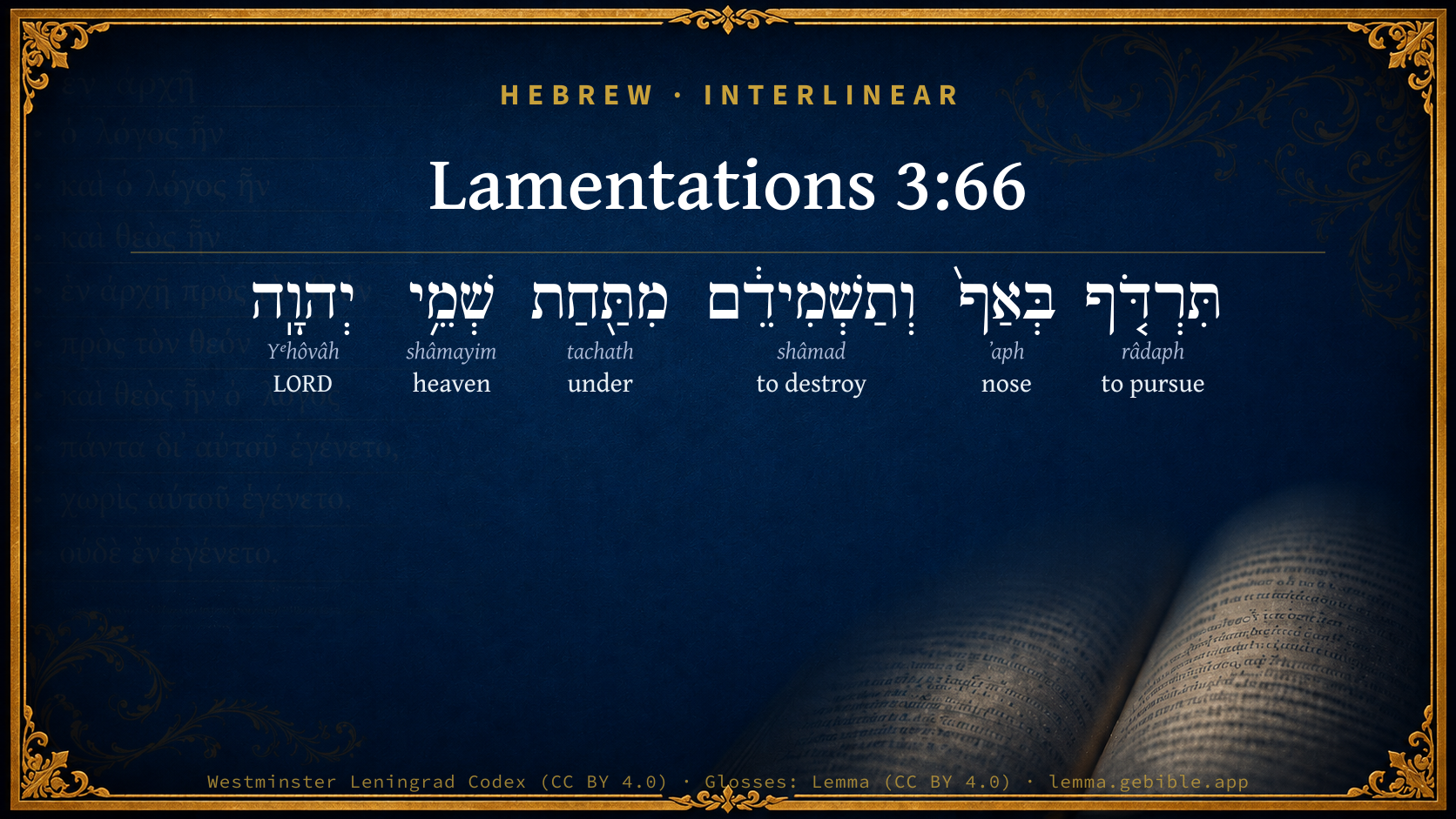
Hebrew (Westminster Leningrad Codex) Lamentations 3:66 appears in the Hebrew Old Testament. The text above is from the Westminster Leningrad Codex. Each word links to its Strong’s number, a concise gloss, and parsing drawn from the Open Scriptures Hebrew Bible morphology. Click any word for its full Brown-Driver-Briggs (BDB) entry.
Download image
Cite this verse

Lamentations 3:66 (World English Bible). Public Domain. Lemma interlinear Bible study tool, https://lemma.gebible.app/v/lamentations/3/66.

Show BibTeX & RIS
BibTeX
RIS
English Translation
You will pursue them in anger, and destroy them from under the heavens of Yahweh.
World English Bible · Public Domain
Download a study sheet

One document with this verse’s original text, its word-by-word gloss line, the meaning frame, cross-references with their text, attributed commentary, and full source and license credits — printable, and it pastes into notes with its structure intact.

This verse Autodidact and up

Study sheet (.html) Plain text (.txt)

A passage Seminary Student

Up to 50 verses in one chapter. A passage sheet keeps up to 6 commentary sources and 12 cross-references per verse, in the order this page ranks them, and says so on the sheet whenever that leaves anything out. Ask for a single verse and you get the Autodidact verse sheet above.

Everything on this page stays free to read, with no account — the sheet is a download of what is already on screen, not access to it.

Want to remove ads? Support Godless Engineer
Compare translations 3

The same verse in 3 English versions, stacked beneath the original-language interlinear above. Click any original word for its lexicon entry.

Each is an independent rendering of the whole verse — the interlinear is not word-aligned to these translations.

Highlighted words mark where these versions differ — a whole-verse word diff, not a word-by-word alignment.

  • World English Bible Public Domain
    You will pursue them in anger, and destroy them from under the heavens of Yahweh.
  • King James Version Public Domain
    Persecute and destroy them in anger from under the heavens of the LORD.
  • unfoldingWord Literal Text CC BY-SA 4.0
    You will pursue in nose and destroy them from under the heavens of Yahweh.

unfoldingWord Literal Text — © unfoldingWord, licensed CC BY-SA 4.0. Word-aligned USFM3 via Door43 (git.door43.org/unfoldingWord/en_ult).

Versions to compare (up to 4)

3 of 4 selected

Show all 18 translations

Every available English version of this verse, each an independent rendering of the whole verse.

  • World English Bible Public Domain
    You will pursue them in anger, and destroy them from under the heavens of Yahweh.
  • Berean Standard Bible Public Domain
    You will pursue them in anger and exterminate them from under Your heavens, O LORD.
  • Majority Standard Bible Public Domain
    You will pursue them in anger and exterminate them from under Your heavens, O LORD.
  • King James Version Public Domain
    Persecute and destroy them in anger from under the heavens of the LORD.
  • American Standard Version (1901) Public Domain
    Thou wilt pursue them in anger, and destroy them from under the heavens of Jehovah.
  • Revised Version (1885) Public Domain
    Thou wilt pursue them in anger, and destroy them from under the heavens of the LORD.
  • Geneva Bible (1599) Public Domain
    Persecute with wrath and destroy them from vnder the heauen, O Lord.
  • Douay-Rheims (1899) Public Domain
    Thau. Thou shalt persecute them in anger, and shalt destroy them from under the heavens, O Lord.
  • Young's Literal Translation Public Domain
    Thou pursuest in anger, and destroyest them, From under the heavens of Jehovah!
  • Literal Standard Version CC BY-SA 4.0
    You pursue in anger, and destroy them, || From under the heavens of YHWH!
  • Unlocked Literal Bible CC BY-SA 4.0
    You pursue them in anger and destroy them from under the heavens, Yahweh!”
  • unfoldingWord Literal Text CC BY-SA 4.0
    You will pursue in nose and destroy them from under the heavens of Yahweh.
  • Darby Bible Public Domain
    pursue them in anger, and destroy them from under the heavens of Jehovah.
  • World Messianic Bible Public Domain
    You will pursue them in anger, and destroy them from under the heavens of the LORD.
  • Webster's Bible Public Domain
    Persecute and destroy them in anger from under the heavens of the LORD.
  • Free Bible Version CC BY-SA 4.0
    Chase them down in your anger, Lord, and get rid of them from the earth!
  • Bible in Basic English Public Domain
    You will go after them in wrath, and put an end to them from under the heavens of the Lord.
  • JPS Tanakh (1917) Public Domain
    Thou wilt pursue them in anger, and destroy them from under the heavens of the LORD.

Literal Standard Version (2020), Covenant Press — licensed CC BY-SA 4.0. Text via the HelloAO Bible API (eBible.org). Unlocked Literal Bible (unfoldingWord) — licensed CC BY-SA 4.0. Text via the HelloAO Bible API (eBible.org). unfoldingWord Literal Text — © unfoldingWord, licensed CC BY-SA 4.0. Word-aligned USFM3 via Door43 (git.door43.org/unfoldingWord/en_ult). Free Bible Version, Dr. Jonathan Gallagher — licensed CC BY-SA 4.0. Text via the HelloAO Bible API (eBible.org).

Word by word

More ways to search: Search by grammar → Find every occurrence → Compare this word →

Practice this passage: Drill this verse → Learn its vocabulary →

וְתַשְׁמִידֵ֔ם
shâmad
H8045
“and · to destroy · them”
Conjunction + Verb, Hiphil, Imperfect, 2nd Person, Masculine, Singular + Suffix, Personal, 3rd Person, Masculine, Plural
Part of Speech
Conjunction + Verb
Stem
Hiphil
Form
Imperfect
Person
2nd Person
Gender
Masculine
Number
Singular
Full BDB Definition

Origin: a primitive root

TWOT: 2406

to destroy, exterminate, be destroyed, be exterminated - (Niphal) - to be annihilated, be exterminated - to be destroyed, be devastated - (Hiphil) - to annihilate, exterminate - to destroy
  1. תִּרְדֹּ֤ף râdaph H7291 “to pursue” Verb, Qal, Imperfect, 2nd Person, Masculine, Singular
  2. בְּאַף֙ ʼaph H639 “in/at · nose” Preposition + Noun, Common, Masculine, Singular, Absolute
  3. מִתַּ֖חַת tachath H8478 “from · under” Preposition + Preposition
  4. שְׁמֵ֥י shâmayim H8064 “heaven(s) of” Noun, Common, Masculine, Plural, Construct
  5. יְהוָֽה Yᵉhôvâh H3068 “LORD” Noun, Proper

About this verse

These counts appear in no published source. They are computed here, from the morphology-tagged text and Lemma’s own curated glosses. What Lemma adds →

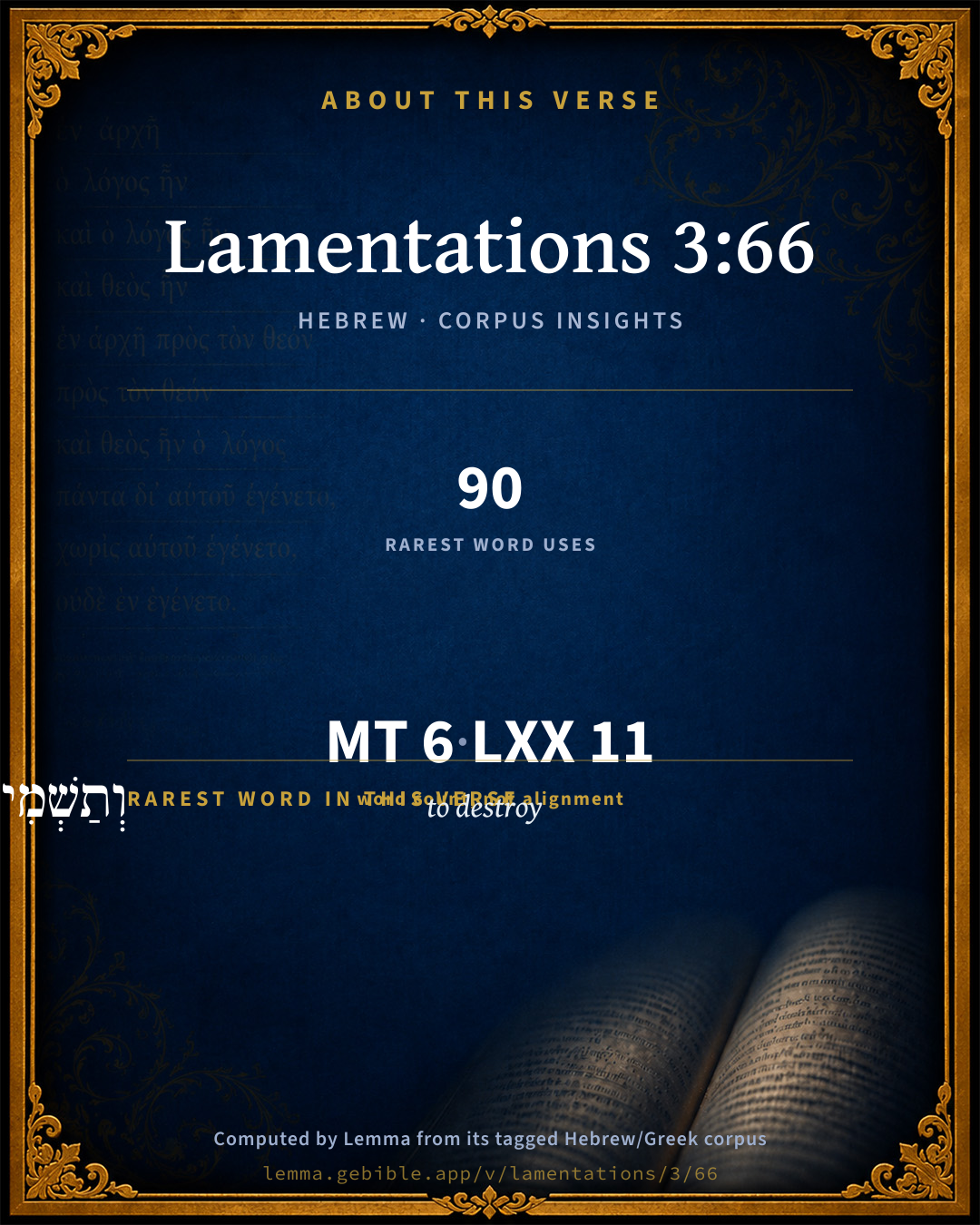
6
words
6
distinct lemmas
Prophets
section

Grammatical profile

  • 2 verbs
  • 3 nouns
  • 1 preposition

Verb forms

  • תִּרְדֹּ֤ף Qal · Imperfect
  • וְתַשְׁמִידֵ֔ם Hiphil · Imperfect

Hebrew & Septuagint length

In English translation the verse runs 15 words from the Hebrew and 16 from the Septuagint (LXX English) — closely comparable.

A rough comparison of the two English renderings, which tokenize alike — not a word-level alignment.

Word counts can differ between the Hebrew and the Greek without any difference in meaning — e.g. the Hebrew direct-object marker אֵת has no separate Greek word, and Greek often adds the article ὁ.

In the original languages it is 6 Hebrew tokens and 11 Greek tokens — but the two are counted differently (Hebrew bundles its prefixes and suffixes into one token; the Greek is in lemma form), so that isn’t a like-for-like length.

Cross-references

11

Topical passages linked to Lamentations 3:66 in the Treasury of Scripture Knowledge — connected by theme and wording, ordered by reader-vote popularity; previews shown in the World English Bible.

  • Psalms 8:3 When I consider your heavens, the work of your fingers, The moon and the stars, which you have ordained;
  • Deuteronomy 25:19 Therefore it shall be, when Yahweh your God has given you rest from all your enemies round about, in the land which Yahweh your God gives you for an inheritance to possess it, that you shall blot out the memory of Amalek from under the sky; you shall not forget.
  • Psalms 115:16 The heavens are the heavens of Yahweh; But the earth has he given to the children of men.
  • Jeremiah 10:11 Thus shall you say to them, The gods that have not made the heavens and the earth, these shall perish from the earth, and from under the heavens.
  • Lamentations 3:43 You have covered with anger and pursued us; you have killed, you have not pitied.
  • Deuteronomy 7:24 He will deliver their kings into your hand, and you shall make their name to perish from under the sky: there shall no man be able to stand before you, until you have destroyed them.
  • Deuteronomy 29:20 Yahweh will not pardon him, but then the anger of Yahweh and his jealousy will smoke against that man, and all the curse that is written in this book shall lie on him, and Yahweh will blot out his name from under the sky.
  • 2 Kings 14:27 Yahweh didn't say that he would blot out the name of Israel from under the sky; but he saved them by the hand of Jeroboam the son of Joash.
  • Psalms 35:6 Let their way be dark and slippery, Yahweh's angel pursuing them.
  • Psalms 73:15 If I had said, "I will speak thus;" Behold, I would have betrayed the generation of your children.
  • Isaiah 66:1 Thus says Yahweh, heaven is my throne, and the earth is my footstool: what manner of house will you build to me? and what place shall be my rest?

Cross-references courtesy of OpenBible.info (CC BY 4.0).

Hebrew and Greek witnesses Masoretic Hebrew ↔ Greek Septuagint

The same verse in the two great witnesses to the Old Testament, shown verse-for-verse.

These are two independent witnesses, not word-aligned to each other, and the Septuagint is shown in lemma (dictionary) form.

Hebrew Lamentations 3:66 Masoretic · Westminster Leningrad Codex

תִּרְדֹּ֤ף בְּאַף֙ וְתַשְׁמִידֵ֔ם מִתַּ֖חַת שְׁמֵ֥י יְהוָֽה

You will pursue them in anger, and destroy them from under the heavens of Yahweh.

World English Bible · Public Domain

Greek LXX Lamentations 3:66 Septuagint · lemma form

καταδιώκω ἐν ὀργή καί ἐκ ἀναἁλίσκω αὐτός ὑποκάτω ὁ οὐρανός κύριος

You will persecute them in anger, and will consume them from under the heaven, O Lord.

LXX2012 (modern English Septuagint) · Public Domain

On this verse, Adam Clarke's Commentary discusses the Septuagint’s reading. Read the note in Commentary ↓

Hebrew: Westminster Leningrad Codex (CC BY 4.0). Greek: Septuagint (public domain); English from LXX2012 (modern English Septuagint) (Public Domain). How the Septuagint differs from the Hebrew →

Commentary

Notes on Lamentations 3:66 from classic Christian and Jewish commentators (each source and its license shown beneath its notes). The classic Christian expositions comment on the surrounding passage and are grouped to its opening verse, so a note may address several verses; the Jewish commentaries on the Tanakh (Rashi and others) are per-verse, so they appear only where the commentator wrote on this verse.

Lemma curates 59 commentaries, every one of them public domain or Creative Commons licensed, each selected and text-cleaned for this edition rather than reprinted as found. About our sources →

Trapp's Complete Commentary

John Trapp

Lam 3:66 Persecute and destroy them in anger from under the heavens of the LORD.

Ver. 66. Persecute and destroy them in anger.] Since they are thine and our implacable and irreformable enemies, be thou, Lord, implacably bent against them, to their utter destruction; and since they think us not worthy to breathe in the common air - whom thou hast made heirs of the world together with faithful Abraham our progenitor - destroy them from under these heavens of thine, in the compass and cope whereof thou reignest and rulest all.

From under the heavens of the Lord.] Do thou, O Christ - to whom the Father hath committed all judgment - root them out from under the heavens of thy heavenly Father. Thus some paraphrase the words, and observe therehence the mystery of the Trinity; like as they do from Gen 19:24.

John Trapp, A Commentary or Exposition upon All the Books of the Old and New Testament (1647–1656) — public domain. Text from a community e-Sword module.

Jamieson, Fausset & Brown

Robert Jamieson, A. R. Fausset & David Brown

from under . . . heavens of . . . Lord--destroy them so that it may be seen everywhere under heaven that thou sittest above as Judge of the world.

Next: Lamentations Chapter 4

Jamieson, Fausset & Brown — Commentary Critical and Explanatory on the Whole Bible (1871) — public domain (CC PDM 1.0). Text via the HelloAO Bible API.

Adam Clarke's Commentary

Verse 66. Persecute and destroy them] Thou wilt pursue them with destruction. These are all declaratory, not imprecatory.

From under the heavens of the Lord.] This verse seems to allude to the Chaldaic prediction, in Jer 10:11. By their conduct they will bring on themselves the curse denounced against their enemies.

The Septuagint and Vulgate seem to have read "From under heaven, O Jehovah:" and the Syriac reads, "Thy heavens, O Jehovah!" None of these makes any material change in the meaning of the words.

It has already been noticed in the introduction, that this chapter contains a triple acrostic, three lines always beginning with the same letter; so that the Hebrew alphabet is thrice repeated in this chapter, twenty-two multiplied by three being equal to sixty-six.

Adam Clarke's Commentary on the Bible (1810–1826) — public domain. Text from a community e-Sword/MySword module.

John Calvin's Commentaries

He first asks God to persecute them in wrath, that is, to be implacable to them; for persecution is, when God not only chastises the wicked for a short time, but when he adds evils to evils, and accumulates them until they perish. He then adds, and prays God to destroy them from under the heavens of Jehovah This phrase is emphatical; and they extenuate the weightiness of the sentence, who thus render it, “that God himself would destroy the ungodly from the earth.” For the Prophet does not without a design mention the heavens of Jehovah, as though he had said, that though God is hidden from us while we sojourn in the world, he yet dwells in heaven, for heaven is often called the throne of God, —

“The heaven is my throne.” (Isaiah 66:1.)

“O God, who dwellest in the sanctuary.” (Psalm 22:4; Psalm 77:14.)

By God’s sanctuary is often meant heaven. For this reason, then, the Prophet asked here that the ungodly should be destroyed from under the heaven of Jehovah, that is, that their destruction might testify that he sits in heaven, and is the judge of the world, and that things are not in such a confusion, but that the ungodly must at length render an account before the celestial judge, whom they have yet long neglected. This is the end of the chapter.

John Calvin's Commentaries (1540-1563) — public domain. Text from the Calvin Translation Society English edition (1840s-50s) via the Christian Classics Ethereal Library (ccel.org). Calvin's coverage is partial (roughly two-thirds of the Bible); uncommented books and verses are honest gaps, never fabricated. The 19th-century editor's footnotes and remarks are omitted so the notes are faithfully Calvin's own voice.

Ellicott's Commentary for English Readers

(66) From under the heavens of the Lord.—The phrase is exceptional, but it is obviously equivalent to the whole world, considered as God’s kingdom.

A Bible Commentary for English Readers, edited by Charles John Ellicott (1878–1897) — public domain. Text from a community e-Sword module.

Matthew Poole's English Annotations

Bring them to a temporal ruin and destruction. How far such petitions are lawful we have before showed, in our notes on Psa 69:22-24, &c.; Psa 119:6-10, &c.; Jer 11:20; 15:15; see also Lam 1:22. It is hard to interpret all passages of this nature which we meet with as prophecies, though some of them are so, and others may be both prophecies and prayers.

Matthew Poole's English Annotations on the Holy Bible (1683–1685) — public domain. Text from a community e-Sword/MySword module.

John Wesley's Explanatory Notes

Persecute - Many passages of this nature which we meet with are prophecies, some of them may be both prophecies and prayers.

John Wesley, Explanatory Notes Upon the Whole Bible (1754–1765) — public domain. Text via the GEBible commentary corpus.

Lesson kit

Teaching starters — assembled from the data on this page, not authored interpretation. Every prompt links to the verse data it draws on. Edit before teaching.

Lamentations, in the Prophets, opens this verse with 6 words (6 distinct Hebrew lemmas). Its most distinctive word is shâmad (“to destroy”). A historical commentator’s framing appears above. Read the whole chapter for the surrounding context.

Discussion questions

  1. How does “to destroy” (shâmad) shape what this verse is saying?
  2. Psalms 8:3 shares this passage’s theme. How do the two illuminate each other?
  3. The translations on this page render this verse differently — a whole-verse word diff, not a word-by-word alignment. What might account for the different wordings?
  4. The verb «תִּרְדֹּ֤ף» is Qal Imperfect. How does its form color the action?
  5. Reading how Trapp's Complete Commentary and Jamieson, Fausset & Brown read this verse, where do the two commentators agree and where do they part?

Things to notice

Reading settings

Reading text

Shown beneath each verse's original-language words.

Old Testament
Old Testament edition

Read the OT as the Masoretic Hebrew (MT) or the Greek Septuagint (LXX).

English shown for the Greek Septuagint (in the Hebrew ↔ Greek comparison).

Comparing translations? Open the Compare panel on any verse page to stack up to four side by side.