
Psalms 119:161

Hebrew (Westminster Leningrad Codex) Psalms 119:161 appears in the Hebrew Old Testament. The text above is from the Westminster Leningrad Codex. Each word links to its Strong’s number, a concise gloss, and parsing drawn from the Open Scriptures Hebrew Bible morphology. Click any word for its full Brown-Driver-Briggs (BDB) entry.
Download image
Cite this verse

Psalms 119:161 (World English Bible). Public Domain. Lemma interlinear Bible study tool, https://lemma.gebible.app/v/psalms/119/161.

Show BibTeX & RIS
BibTeX
RIS
English Translation
Princes have persecuted me without a cause, But my heart stands in awe of your words.
World English Bible · Public Domain
Download a study sheet

One document with this verse’s original text, its word-by-word gloss line, the meaning frame, cross-references with their text, attributed commentary, and full source and license credits — printable, and it pastes into notes with its structure intact.

This verse Autodidact and up

Study sheet (.html) Plain text (.txt)

A passage Seminary Student

Up to 50 verses in one chapter. A passage sheet keeps up to 6 commentary sources and 12 cross-references per verse, in the order this page ranks them, and says so on the sheet whenever that leaves anything out. Ask for a single verse and you get the Autodidact verse sheet above.

Everything on this page stays free to read, with no account — the sheet is a download of what is already on screen, not access to it.

Want to remove ads? Support Godless Engineer
Compare translations 3

The same verse in 3 English versions, stacked beneath the original-language interlinear above. Click any original word for its lexicon entry.

Each is an independent rendering of the whole verse — the interlinear is not word-aligned to these translations.

Highlighted words mark where these versions differ — a whole-verse word diff, not a word-by-word alignment.

  • World English Bible Public Domain
    Princes have persecuted me without a cause, But my heart stands in awe of your words.
  • King James Version Public Domain
    Princes have persecuted me without a cause: but my heart standeth in awe of thy word.
  • unfoldingWord Literal Text CC BY-SA 4.0
    Princes pursue me without cause, and my heart trembles from your words.

unfoldingWord Literal Text — © unfoldingWord, licensed CC BY-SA 4.0. Word-aligned USFM3 via Door43 (git.door43.org/unfoldingWord/en_ult).

Versions to compare (up to 4)

3 of 4 selected

Show all 17 translations

Every available English version of this verse, each an independent rendering of the whole verse.

  • World English Bible Public Domain
    Princes have persecuted me without a cause, But my heart stands in awe of your words.
  • Berean Standard Bible Public Domain
    Rulers persecute me without cause, but my heart fears only Your word.
  • Majority Standard Bible Public Domain
    Rulers persecute me without cause, but my heart fears only Your word.
  • King James Version Public Domain
    Princes have persecuted me without a cause: but my heart standeth in awe of thy word.
  • American Standard Version (1901) Public Domain
    SHIN. Princes have persecuted me without a cause; But my heart standeth in awe of thy words.
  • Revised Version (1885) Public Domain
    Princes have persecuted me without a cause; but my heart standeth in awe of thy words.
  • Geneva Bible (1599) Public Domain
    SCHIN. Princes haue persecuted mee without cause, but mine heart stood in awe of thy wordes.
  • Young's Literal Translation Public Domain
    `Shin.' Princes have pursued me without cause, And because of Thy words was my heart afraid.
  • Literal Standard Version CC BY-SA 4.0
    [SHIN] Princes have pursued me without cause, || And my heart was afraid because of Your words.
  • Unlocked Literal Bible CC BY-SA 4.0
    Princes persecute me without cause, but my heart stands in awe of your word.
  • unfoldingWord Literal Text CC BY-SA 4.0
    Princes pursue me without cause, and my heart trembles from your words.
  • Darby Bible Public Domain
    SHIN. Princes have persecuted me without a cause; but my heart standeth in awe of thy word.
  • World Messianic Bible Public Domain
    Princes have persecuted me without a cause, but my heart stands in awe of your words.
  • Webster's Bible Public Domain
    SCHIN. Princes have persecuted me without a cause; but my heart standeth in awe of thy word.
  • Free Bible Version CC BY-SA 4.0
    Leaders persecute me for no reason, but I am in awe only of your word.
  • Bible in Basic English Public Domain
    SHIN Rulers have been cruel to me without cause; but I have the fear of your word in my heart.
  • JPS Tanakh (1917) Public Domain
    SCHIN. Princes have persecuted me without a cause; but my heart standeth in awe of Thy words.

Literal Standard Version (2020), Covenant Press — licensed CC BY-SA 4.0. Text via the HelloAO Bible API (eBible.org). Unlocked Literal Bible (unfoldingWord) — licensed CC BY-SA 4.0. Text via the HelloAO Bible API (eBible.org). unfoldingWord Literal Text — © unfoldingWord, licensed CC BY-SA 4.0. Word-aligned USFM3 via Door43 (git.door43.org/unfoldingWord/en_ult). Free Bible Version, Dr. Jonathan Gallagher — licensed CC BY-SA 4.0. Text via the HelloAO Bible API (eBible.org).

Word by word

More ways to search: Search by grammar → Find every occurrence → Compare this word →

Practice this passage: Drill this verse → Learn its vocabulary →

פָּחַ֥ד
pâchad
H6342
“to fear”
Verb, Qal, Perfect, 3rd Person, Masculine, Singular
Part of Speech
Verb
Stem
Qal
Form
Perfect
Person
3rd Person
Gender
Masculine
Number
Singular
Full BDB Definition

Origin: a primitive root

TWOT: 1756

to fear, tremble, revere, dread, be in awe or dread - (Qal) - to be in dread - to be in awe - (Piel) to be in great dread - (Hiphil) to cause to dread
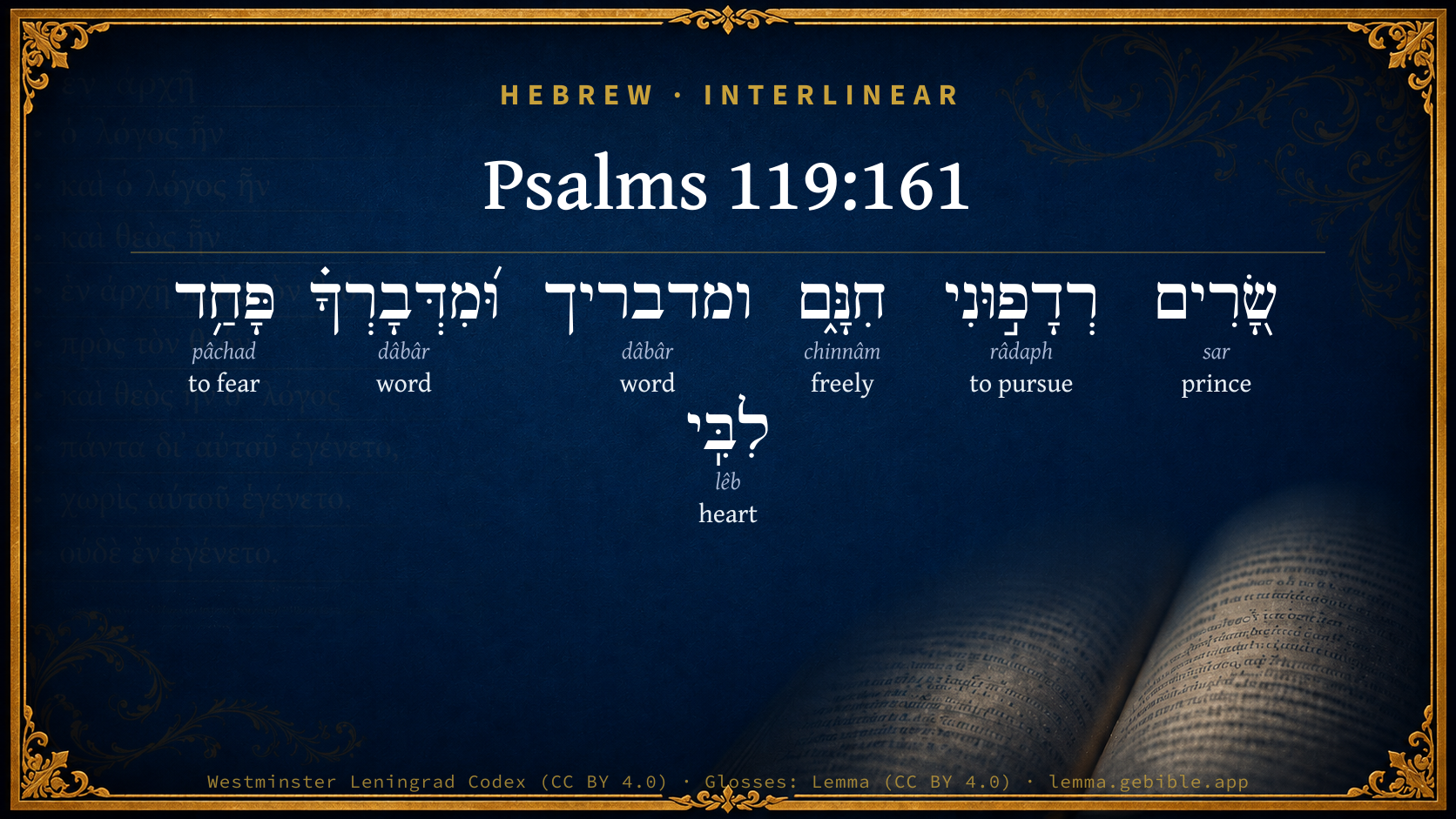
  1. שָׂ֭רִים sar H8269 “princes” Noun, Common, Masculine, Plural, Absolute
  2. רְדָפ֣וּנִי râdaph H7291 “to pursue · me” Verb, Qal, Perfect, 3rd Person, Common, Plural + Suffix, Personal, 1st Person, Common, Singular
  3. חִנָּ֑ם chinnâm H2600 “freely” Adverb
  4. ומדבריך dâbâr H1697 “and · from · words · your” Conjunction + Preposition + Noun, Common, Masculine, Plural, Construct + Suffix, Personal, 2nd Person, Masculine, Singular
  5. וּ֝מִדְּבָרְךָ֗ dâbâr H1697 “and · from · word · your” Conjunction + Preposition + Noun, Common, Masculine, Singular, Construct + Suffix, Personal, 2nd Person, Masculine, Singular
  6. לִבִּֽי lêb H3820 “heart · my” Noun, Common, Masculine, Singular, Construct + Suffix, Personal, 1st Person, Common, Singular

About this verse

These counts appear in no published source. They are computed here, from the morphology-tagged text and Lemma’s own curated glosses. What Lemma adds →

7
words
6
distinct lemmas
Wisdom
section

Notable vocabulary

The rarest word here is פָּחַ֥ד to fear H6342 — appearing just 25 times in the whole Hebrew Bible.

Shared distinctive vocabulary

פָּחַ֥ד to fear H6342 occurs in 25 verses of the Hebrew Bible. Also found in:

Grammatical profile

  • 2 verbs
  • 4 nouns
  • 1 adverb

Verb forms

  • רְדָפ֣וּנִי Qal · Perfect
  • פָּחַ֥ד Qal · Perfect

Repetition

A word recurs within this verse — often emphatic in Hebrew:

  • ומדבריך word H1697 ×2

Hebrew & Septuagint length

In English translation the verse runs 16 words from the Hebrew and 14 from the Septuagint (LXX English) — closely comparable.

A rough comparison of the two English renderings, which tokenize alike — not a word-level alignment.

Word counts can differ between the Hebrew and the Greek without any difference in meaning — e.g. the Hebrew direct-object marker אֵת has no separate Greek word, and Greek often adds the article ὁ.

Cross-references

14

Topical passages linked to Psalms 119:161 in the Treasury of Scripture Knowledge — connected by theme and wording, ordered by reader-vote popularity; previews shown in the World English Bible.

  • 1 Samuel 24:9–15 David said to Saul, Why listen you to men's words, saying, Behold, David seeks your hurt?
  • 1 Samuel 26:18 He said, Why does my lord pursue after his servant? for what have I done? or what evil is in my hand?
  • Psalms 119:157 Many are my persecutors and my adversaries. I haven't swerved from your testimonies.
  • Isaiah 66:2 For all these things has my hand made, and [so] all these things came to be, says Yahweh: but to this man will I look, even to him who is poor and of a contrite spirit, and who trembles at my word.
  • Psalms 4:4 Stand in awe, and don't sin. Search your own heart on your bed, and be still. Selah.
  • Psalms 119:23 Though princes sit and slander me, Your servant will meditate on your statutes.
  • John 15:25 But this happened so that the word may be fulfilled which was written in their law, 'They hated me without a cause.'
  • Genesis 39:9 He isn't greater in this house than I, neither has he kept back anything from me but you, because you are his wife. How then can I do this great wickedness, and sin against God?"
  • Job 31:23 For calamity from God is a terror to me, By reason of his majesty I can do nothing.
  • Jeremiah 36:23–25 It happened, when Jehudi had read three or four leaves, that [the king] cut it with the penknife, and cast it into the fire that was in the brazier, until all the scroll was consumed in the fire that was in the brazier.
  • Genesis 42:18 Joseph said to them the third day, "Do this, and live, for I fear God.
  • 1 Samuel 21:15 Do I lack madmen, that you have brought this fellow to play the madman in my presence? shall this fellow come into my house?
  • 2 Kings 22:19 because your heart was tender, and you did humble yourself before Yahweh, when you heard what I spoke against this place, and against the inhabitants of it, that they should become a desolation and a curse, and have torn your clothes, and wept before me; I also have heard you, says Yahweh.
  • Nehemiah 5:15 But the former governors who were before me were chargeable to the people, and took of them bread and wine, besides forty shekels of silver; yes, even their servants bore rule over the people: but I didn't do so, because of the fear of God.

Cross-references courtesy of OpenBible.info (CC BY 4.0).

Hebrew and Greek witnesses Masoretic Hebrew ↔ Greek Septuagint

The same verse in the two great witnesses to the Old Testament, shown verse-for-verse.

You’re reading Greek Psalm 118 (Hebrew Psalm 119). The Septuagint counts the superscription, so verse numbers can differ from the Hebrew — chapter-level alignment, not verse-by-verse. Numbering follows Rahlfs.

These are two independent witnesses, not word-aligned to each other, and the Septuagint is shown in lemma (dictionary) form.

Hebrew Psalms 119:161 Masoretic · Westminster Leningrad Codex

שָׂ֭רִים רְדָפ֣וּנִי חִנָּ֑ם ומדבריך וּ֝מִדְּבָרְךָ֗ פָּחַ֥ד לִבִּֽי

Princes have persecuted me without a cause, But my heart stands in awe of your words.

World English Bible · Public Domain

Greek LXX Greek Psalm 118:161 Septuagint · lemma form

σεν ἄρχων καταδιώκω ἐγώ δωρεά καί ἀπό ὁ λόγος σύ δειλιάω ὁ καρδία ἐγώ

Princes persecuted me without a cause, but my heart feared because of your words.

LXX2012 (modern English Septuagint) · Public Domain

On this verse, The Cambridge Bible for Schools and Colleges discusses the Septuagint’s reading. Read the note in Commentary ↓

Hebrew: Westminster Leningrad Codex (CC BY 4.0). Greek: Septuagint (public domain); English from LXX2012 (modern English Septuagint) (Public Domain). How the Septuagint differs from the Hebrew →

Commentary

Notes on Psalms 119:161 from classic Christian and Jewish commentators (each source and its license shown beneath its notes). The classic Christian expositions comment on the surrounding passage and are grouped to its opening verse, so a note may address several verses; the Jewish commentaries on the Tanakh (Rashi and others) are per-verse, so they appear only where the commentator wrote on this verse.

Lemma curates 59 commentaries, every one of them public domain or Creative Commons licensed, each selected and text-cleaned for this edition rather than reprinted as found. About our sources →

Trapp's Complete Commentary

John Trapp

Psa 119:161 SCHIN. Princes have persecuted me without a cause: but my heart standeth in awe of thy word.

Ver. 161. Princes have persecuted me without a cause] And

Quae venit indigne poena, dolenda venit.

But better without a cause than for evil-doing, 1Pe 4:12-19 David suffered by these potentates, because he was small and despised, Psa 119:141, as a little dog is worried by the bigger, as the lesser fishes are devoured by the greater.

But my heart standeth in awe of thy word] The fear of God driveth out the fear of the creature, Isa 8:12-13.

John Trapp, A Commentary or Exposition upon All the Books of the Old and New Testament (1647–1656) — public domain. Text from a community e-Sword module.

The Biblical Illustrator

Joseph S. Exell

Psa_119:161

Princes have persecuted me without a cause: but my heart standeth in awe of Thy Word.

A common fact and a rare experience

I. A common fact. The history of persecution and martyrdom has been, if not always inspired, sanctioned and enforced by princes. Their conduct in this respect is--

1. In direct antagonism to the Divine intention.

2. Gradually alienating the hearts of people from their class.

II. A rare experience.

1. Reverence for Gods Word. The meaning of this, perhaps, is, I have a greater dread of violating Thy law than I have of all the persecuting powers of princes or potentates. This is right, this is sublimely noble.

2. Delight in Gods Word (verse 162).

3. Loyalty to Gods Word (verse 163).

4. Gratitude for Gods Word (verse 164). (Homilist.)

The Biblical Illustrator, edited by Joseph S. Exell (c. 1880s–1900s) — public domain. Text from a community e-Sword module.

Joseph Benson's Commentary

SCHIN.

Psa 119:161-164. Princes — The rulers and prime ministers of thy kingdom; have persecuted me — Whom they ought to have used their authority to protect, knowing me to be innocent and injured; but my heart standeth in awe, &c. — I fear thy displeasure more than their wrath, and therefore do nothing contrary to thy word in my own vindication. I hate and abhor lying — Or falsehood, in my speech and actions; all hypocrisy, deceit, and fraud; even to the degree of abhorrence and abomination; but thy law do I love — I most heartily love those honest courses to which thy law directs me. Seven times a day do I praise thee — That is, many times, a certain number being put for an uncertain. Because of thy righteous judgments — Because I have the happiness to be acquainted with the justice and goodness of those laws whereby thou governest us.

Joseph Benson's Commentary on the Old and New Testaments (1811–1818) — public domain. Text from a community e-Sword module.

J. A. Alexander on Psalms

Joseph Addison Alexander

161. (Psa 119:161) Princes persecute me without cause—and at thy words my heart is awed. Both Hebrew verbs are in the past tense. The first verb, like its representative, originally means to follow after, to pursue, but is commonly employed in a hostile sense. Without cause answers to a single Hebrew word, an adverb related to the noun favour, as gratis is to gratia in Latin. So in modern English, the idea here might be expressed by the one word gratuitously. At thy words, literally from them, i. e. because or on account of them. The last verb is not a passive in Hebrew, but a less usual synonym of to fear, correctly paraphrased in the English versions (stand eth in awe). The masoretic reading is thy word in the singular, but, as in most other cases, the best critics now prefer the reading in the text.

Joseph Addison Alexander, The Psalms Translated and Explained (1850) — public domain. Text from a community e-Sword module.

Tyndale Open Study Notes

Tyndale Open Resources

119:161-168 Shin (ש): The psalmist looks beyond his adversaries to the peace of God. This perspective allows him to praise God throughout the day.

119:161-164 my heart trembles . . . I rejoice: Fear, trembling, and joy mark the psalmist’s devotion to God. • God’s word is a treasure. • In the Old Testament, seven signifies wholeness.

Tyndale Open Study Notes — © Tyndale Open Resources, licensed CC BY-SA 4.0. Text via the HelloAO Bible API.

Geneva Bible (1599)

Geneva Bible translators

The threatenings and persecutions of princes could not cause me to shrink to confess thee whom I more fear than men.

Geneva Bible (1599) marginal notes — public domain. Text via Bolls.life.

Matthew Henry's Commentary

David here lets us know, 1. How he was discouraged in his duty by the fear of man: Princes persecuted him. They looked upon him as a traitor and an enemy to the government, and under that notion sought his life, and bade him go serve other gods, Sa1 26:19. It has been the common lot of the best men to be persecuted; and the case is the worse if princes be the persecutors, for they have not only the sword in their hand, and therefore can do the more hurt, but they have the law on their side, and can do it with reputation and a colour of justice. It is sad that the power which magistrates have from God, and should use for him, should ever be employed against him. But marvel not at the matter, Ecc 5:8. It was a comfort to David that when princes persecuted him he could truly say it was without cause, he never gave them any provocation. 2. How he was kept to his duty, notwithstanding, by the fear of God: "They would make me stand in awe of them and their word, and do as they bid me; but my heart stands in awe of thy word, and I am resolved to please God, and keep in with him, whoever is displeased and falls out with me." Every gracious soul stands in awe of the word of God, of the authority of its precepts and the terror of its threatenings; and to those that do so nothing appears, in the power and wrath of man, at all formidable. We ought to obey God rather than men, and to make sure of God's favour, though we throw ourselves under the frowns of all the world, Luk 12:4, Luk 12:5. The heart that stands in awe of God's word is armed against the temptations that arise from persecution.

Matthew Henry's Commentary on the Whole Bible (1708–1710) — public domain (CC PDM 1.0). Text via the HelloAO Bible API.

Adam Clarke's Commentary

LETTER ש SCHIN. - Twenty-first Division

Verse 161. Princes have persecuted me] This may refer to what was done by prime ministers, and the rulers of provinces, to sour the king against the unfortunate Jews, in order still to detain them in bondage. In reference to David, the plotting against him in Saul's court, and the dangers he ran in consequence of the jealousies of the Philistine lords while he sojourned among them, are well known.

My heart standeth in awe] They had probably offers made them of enlargement or melioration of condition, providing they submitted to some idolatrous conditions; but they knew they had to do with a jealous God; their hearts stood in awe, and they were thereby kept from sin.

Adam Clarke's Commentary on the Bible (1810–1826) — public domain. Text from a community e-Sword/MySword module.

John Calvin's Commentaries

161 Princes have persecuted me without a cause. “David was persecuted by Saul and his associates ‘without a cause.’” — Warner on the Psalter.

“Fear not them who kill the body, but are not able to kill the soul, but rather fear him who is able to destroy both soul and body in hell;”

a sentiment which although it had not as yet been uttered by Christ’s mouth, ought nevertheless to have been fixed in the hearts of all the godly. The sense, then, in their opinion is, that the Prophet had not been turned aside from the fear of God by any of the threatening or terrors of his enemies. But his commendation of his own constancy is to be understood in a more extended sense than this. The exhortation of Isaiah is well known,

“Neither fear ye their fear, nor be afraid; sanctify the Lord of hosts himself; and let him be your fear, and let him be your dread.” (Isaiah 8:12,13)

The Prophet in that place shows in general what the weapons are, with which the faithful being armed will succeed in vanquishing all the assaults of the world — he shows that they will do so, provided they not only stand in awe of God, but also rest assured that he will always be the guardian of their welfare, so that they may cast all their cares upon him. Thus it will come to pass that, resting contented with his protection, they will not turn aside to practice whatever may be sinful to secure their safety. In like manner the Prophet, in the passage before us, affirms that although being oppressed by the wrongful violence of princes, he presented a sad spectacle, yet he did not succumb, but considered what was lawful for him to do, and did not attempt to rival their wicked practices, by repelling craft with craft and violence with violence. In this text, as is evident from the connection, to be afraid at God’s word, is to restrain one’s self and to attempt nothing which is unlawful. I have already said that the adverb חנם, hinnam, without a cause, is added for the sake of amplification; for the temptation was so much the harder from the fact, that the tyrants, without cause and merely to gratify their own wicked inclination, assaulted an innocent individual. Men of a good disposition and of a noble mind, it is well known, are more easily excited to anger when the object assaulted is one who has done wrong to nobody. It was therefore a signal proof of self-control for the Prophet to bridle himself by the word of God, that he might not vie with others in evil doing, or, overcome with temptation, go out of the place which had been assigned him in the social body. Let us then learn to remain peaceable, although princes tyrannically abuse the power which God has committed to them, lest by creating insurrection we break in upon the peace and order of society.

John Calvin's Commentaries (1540-1563) — public domain. Text from the Calvin Translation Society English edition (1840s-50s) via the Christian Classics Ethereal Library (ccel.org). Calvin's coverage is partial (roughly two-thirds of the Bible); uncommented books and verses are honest gaps, never fabricated. The 19th-century editor's footnotes and remarks are omitted so the notes are faithfully Calvin's own voice.

Ellicott's Commentary for English Readers

SCHIN.

(161) Princes.—Here again we have an indication of the national character of the psalm. It was the whole community which suffered from the intrigues and violence of princes.

A Bible Commentary for English Readers, edited by Charles John Ellicott (1878–1897) — public domain. Text from a community e-Sword module.

The Cambridge Bible for Schools and Colleges

gen. ed. J. J. S. Perowne

161. His loyalty to the law has not been shaken by the gratuitous hostility of the civil authorities; rather has he feared to offend God. By princes are probably meant Israelite nobles, who exercised judicial and administrative functions. Cp. Psa_119:23; Jer_26:10 ff.; Ezr_9:1-2; Ezr_10:8; Ezr_10:14; Neh_9:32; Neh_9:34; Neh_9:38.

thy word] So the Q’rç, with Syr., Targ.; R.V. thy words, with K’thîbh, LXX, Jer.

161–168. Shîn (and Sîn). God’s law fills the Psalmist’s heart with awe, joy, love, and gratitude; he has been diligent in its observance. It is not the boasting of the Pharisee, but the honest profession of a good conscience. This stanza and that of Mçm (Psa_119:97 ff.) contain no petition.

The Cambridge Bible for Schools and Colleges (gen. ed. J. J. S. Perowne; Cambridge University Press, 1878–1918) — public domain. Text from a community e-Sword module.

John Gill's Exposition

Lord, I have hoped for thy salvation,.... Either temporal salvation and deliverance from enemies, and from afflictions, which God had promised, and therefore he had reason to hope for; or spiritual and eternal salvation, resolved on in the mind of God, provided in covenant, promised to be wrought out by Christ, and which since has been accomplished; and therefore there is a sufficient foundation to hope for it;

and done thy commandments: this was not the cause, ground, and foundation of his hope; for then it would not have been like an anchor, sure and steadfast, but as the hope of the hypocrite, which is as the spider's web; but this was the effect of his hope; because he had a good hope of salvation, therefore he was studiously concerned to do the commandments of God; his hope prompted him to it, and encouraged him in it; see Jo1 3:2. Kimchi's note here is a good one; "and done thy commandments", not for hope of reward; but I have done them as thy commandments are with me and I know that I shall have salvation, and I have hoped for it.

John Gill's Exposition of the Whole Bible (1746–1763) — public domain (CC PDM 1.0). Text via the HelloAO Bible API.

Albert Barnes' Notes on the Bible

Princes have persecuted me without a cause - This commences a new division of the psalm, indicated by the Hebrew letter Schin (שׂ ś, and שׁ sh) - corresponding to our “s,” or “sh.” On the meaning of the expression here, see Psa 119:23, note; Psa 119:76, note.

But my heart standeth in awe of thy word - I still reverence thy word. I am not deterred from keeping thy law by any threats or intimidations. This is in accordance with the uniform statements in the psalm, that nothing deterred him from manifesting his adherence to the law of God.

Albert Barnes' Notes on the Bible (1834–1885) — public domain. Text from a community e-Sword/MySword module.

Matthew Poole's English Annotations

SCHIN

Princes; who had power to do it, and who ought to have used their authority to protect me, whom they knew to be innocent and injured.

But my heart standeth in awe of thy word; but I feared thine offence and displeasure more than their wrath.

Matthew Poole's English Annotations on the Holy Bible (1683–1685) — public domain. Text from a community e-Sword/MySword module.

The Treasury of David

Charles H. Spurgeon

Ver. 161. Princes have persecuted me without a cause. Such persons ought to have known better; they should have had sympathy with one of their own rank. A man expects a fair trial at the hand of his peers: it is ignoble to be prejudiced. Moreover, if honour be banished from all other breasts it should remain in the bosom of kings, and honour forbids the persecution of the innocent. Princes are appointed to protect the innocent and avenge the oppressed, and it is a shame when they themselves become the assailants of the righteous. It was a sad case when the man of God found himself attacked by the judges of the earth, for eminent position added weight and venom to their enmity. It was well that the sufferer could truthfully assert that this persecution was without cause. He had not broken their laws, he had not injured them, he had not even desired to see them injured, he had not been an advocate of rebellion or anarchy, he had neither openly nor secretly opposed their power, and therefore, while this made their oppression the more inexcusable, it took away a part of its sting, and helped the brave hearted servant of God to bear up.

But my heart standeth in awe of thy word. He might have been overcome by awe of the princes had it not been that a greater fear drove out the less, and he was swayed by awe of God's word. How little do crowns and sceptres become in the judgment of that man who perceives a more majestic royalty in the commands of his God. We are not likely to be disheartened by persecution, or driven by it into sin, if the word of God continually has supreme power over our minds.

Ver. 161. Princes have persecuted me. The evil is aggravated from the consideration that it is the very persons who ought to be as bucklers to defend us, who employ their strength in hurting us. Yea, when the afflicted are stricken by those in high places, they in a manner think that the hand of God is against them. There was also this peculiarity in the case of the prophet, that he had to encounter the grandees of the chosen people men whom God had placed in such honourable stations, to the end they might be the pillars of the Church. John Calvin.

Ver. 161. Without a cause. I settle it as an established point with me, that the more diligently and faithfully I serve Christ, the greater reproach and the more injury I must expect. I have drank deep of the cup of slander and reproach of late, but I am in no Wise discouraged; no, nor by, what is much harder to bear, the unsuccessfulness of my endeavours to mend this bad world. Philip Doddridge.

Ver. 161. Without a cause. We know what persecutions the body of Christ, that is, the holy Church, suffered from the kings of the earth. Let us therefore here also recognize the words of the Church: "Princes have persecuted me without a cause." For how had the Christians injured the kingdoms of the earth? Although their King promised them the kingdom of heaven, how, I ask, had they injured the kingdoms of earth? Did their King forbid his soldiers to pay and to render due service to the kings of the earth? Saith he not to the Jews who were striving to calumniate him, "Render therefore unto Caesar the things which are Caesar's; and unto God the things that are God's"? Mt 22:21. Did he not even in his own person pay tribute from the mouth of a fish? Did not his forerunner, when the soldiers of this kingdom were seeking what they ought to do for their everlasting salvation, instead of replying." Loose your belts, throw away your arms, desert your king, that ye may wage war for the Lord, "answer, "Do violence to no man, neither accuse any falsely; and be content with wages?" Lu 3:14. Did not one of his soldiers, his most beloved your companion, say to his fellow soldiers, the provincials, so to speak, of Christ, "Let every soul be subject unto the higher powers"? and a little lower he addeth, "Render therefore to all their dues: tribute to whom tribute is due; custom to whom custom; fear to whom fear; honour to whom honour. Owe no man anything, but to love one another." Ro 13:1, 7, 8. Does he not enjoin the Church to pray even for kings themselves? How, then, have the Christians offended against them? What due have they not rendered? In what have not Christians obeyed the monarchs of earth? The kings of the earth therefore have persecuted the Christians without a cause. Augustine.

Ver. 161. But my heart standeth in awe of thy word. If there remains any qualm of fear on thy heart, fear from the wrath of bloody men threatening thee for thy profession of the truth, then to a heart inflamed with the love of truth, labour to add a heart filled with the fear of that wrath which God hath in store for all that apostatize from the truth. When you chance to burn your finger, you hold it to the fire, which being a greater fire draws out the other. Thus, when thy thoughts are scorched, and thy heart scared with the fire of man's wrath, hold them a while to hell fire, which God hath prepared for the fearful (Re 21:8), and all that run away from truth's colours (Heb 10:39), and thou wilt lose the sense of the one for fear of the other. Ignosee imperator, saith the holy man, tu carcerem, Dens gehennam minatur;"Pardon me, O Emperor, if I obey not thy command; thou threatenest a prison, but God a hell." Observable is that of David: "Princes have persecuted me without a cause: but my heart standeth in awe of thy word." He had no cause to fear them that had no cause to persecute him. One threatening out of the word, that sets the point of God's wrath to his heart, scares him more than the worst that the greatest on earth can do to him. Man's wrath, when hottest, is but a temperate climate to the wrath of the living God. They who have felt both have testified as much. Man's wrath cannot hinder the access of God's love to the creature, which hath made the saints sing in the fire, in spite of their enemies' teeth. But the creature under God's wrath is like one shut up in a close oven, no crevice is open to let any of the heat out, or any refreshing in to him. William Gurnall.

Ver. 161. My heart standeth in awe of thy word. There is an awe of the word, not that maketh us shy of it, but tender of violating it, or doing anything contrary to it. This is not the fruit of slavish fear, but of holy love; it is not afraid of the word, but delighteth in it, as it discovereth the mind of God to us; as in the next verse it is written, "I rejoice at thy word." This awe is called by a proper name, reverence, or godly fear; when we consider whose word it is, namely, the word of the Lord, who is our God, and hath a right to command what he pleaseth; to whose will and word we have already yielded obedience, and devoted ourselves to walk worthy of him in all well pleasing; who can find us out in all our failings, as knowing our very thoughts afar of (Ps 139:2), and having all our ways before him, and being one of whom we read, "He is a holy God; he is a jealous God; he will not forgive your transgressions nor your sins" (Jos 24:19), that is to say, if we impenitently continue in them. Considering these things we receive the word with that trembling of heart which God so much respects. Thomas Manton.

Ver. 161. In awe of thy word. I would advise you all, that come to the reading or hearing of this book, which is the word of God, the most precious jewel, and most holy relic that remaineth upon earth, that ye bring with you the fear of God, and that ye do it with all due reverence, and use your knowledge thereof, not to vain glory of frivolous disputation, but to the honour of God, increase of virtue, and edification both of yourselves and others. Thomas Cranmer, 1489-1555.

Ver. 161. Awe of thy word. They that tremble at the convictions of the word may triumph in the consolations of it. Matthew Henry.

Outlines Upon Keywords of the Psalm, By Pastor C. A. Davis.

Verses 161-168. What the word is to the believer. The object of (ver. 161), joy (ver. 162), love (ver. 163), praise (ver. 164), the producer peace (ver. 165), and hope (ver. 166); therefore exceedingly loved (ver. 167), faithfully kept (ver. 168).

Ver. 161,162. God's word, the object of godly fear and godly joy.

1. It makes the heart quake by its purity and power.

2. It makes the heart rejoice by its grace and truth.

W.H.J.P.

Ver. 161.

1. Wrong without cause.

2. Right with abundant cause.

Ver. 161 (second clause). Awe of God's word its propriety, its hallowed influence, the evil of its absence.

Ver. 161. Restrained by awe.

1. The causelessness of persecution.

2. The temptations to evil occasioned thereby to revenge: to apostasy.

3. The safeguard against falling: awe of God's word. 1Sa 24:6 Da 3:16-18 Ac 4:19 5:29 C.A.D.

Psalms 119:162*

Charles H. Spurgeon's The Treasury of David (1869–1885) — public domain. Psalms only. Text from a community e-Sword/MySword module.

Whedon's Commentary on the Bible

Daniel D. Whedon

שׁ, Shin.

161-168. Princes have persecuted me—Persecutions still return, yet “the joy of the Lord” is his strength. Princes who sat and spake against him now persecute him without cause, yet the fear of God kills out the fear of man. The result of the struggle is like the spoil after a victory. Seven times is the same as many times, the use of “seven” for an indefinite number being very ancient. The division ends with an humble, but confident, appeal to the Searcher of hearts that he has steadily kept his testimonies, an appeal which only the purest conscience can venture to make.

Daniel D. Whedon (gen. ed.), Commentary on the Old and New Testaments (1874–1909) — public domain. Text from a community e-Sword module.

The Pulpit Commentary

SHIIN.

Princes have persecuted me without a cause. The "princes" may be either foreign or native; but from ver. 23 it would rather appear that native princes are intended. But my heart standeth in awe of thy Word. Yet I do not fear them, or heed what they say. Of nothing do I stand in awe, except "thy Word.

Vers. 161-168. True things.

Here we have

I THE TRUE DREAD. (Ver. 161)

1. Not the displeasure or the opposition of man; though this may be incurred without cause, and we may feel that the suspicion, or the ill feeling, or the attack is altogether wanton and unprovoked.

2. But the displeasure of God. Undisturbed by human ill will or intrigue, we "stand in awe" of Divine disapproval; we shrink from thinking the thought, cherishing the feeling, taking the course, which Christ would condemn; we are afraid of leaving undone or unattempted that to which he is calling us with his sovereign voice.

II THE TRUE TREASURE. (Ver. 162)

1. Not the "spoils" of wealth, or rank, or power, or learning, or a round of pleasurable excitements; these soon lose their relish, and they too often leave a bitter taste behind.

2. But the revelation of God"s grace, of his mind, of his purpose and promise, as made known in his Word.

III THE TRUE WORD. (Ver. 163) Falsehood is utterly offensive to God, and it is most hurtful to ourselves; it spells spiritual ruin to him that indulges in it; it is an evil weed that grows with saddening rapidity. Truthfulness in utterance is a large and essential part of all spiritual worth.

IV THE TRUE SPIRIT. That of thankfulness. (Ver. 164) It is not, of course, the number of times we offer praise that is acceptable; for mere mechanical thanksgiving is worthless, though rendered a hundred times a day. It is the spirit of gratitude which is everything the recognition by the mind that it is by God"s grace we are what we are, and the feeling of thankfulness dwelling in the soul; it is the inner sense of God"s goodness, carried with us everywhere, uttering itself simply and unaffectedly.

V THE TRUE SECURITY. (Ver. 165) In the ordering of our life, we want these two things among others peace and integrity. The love and the practice of Divine truth will yield both of these.

1. It will save us from stumbling (nothing will "offend" us); we shall not fall into the vices or faults which lead down to shame and self-reproach; we shall not give way to the contentiousness which ends in feuds and separations.

2. Hence we shall have peace the approval of our own conscience, the good will of men, the "well done" of God.

VI THE TRUE HOPE. (Ver. 166) The final "salvation" for which we hope (see Rom_13:11) is the true hope for man. The "peace of the grave" is not a true peace, but a false one. Mere unbroken unconsciousness is not a thing to be desired by us. But the hope of eternal life, based on the firm promises of God, and secured by "doing his commandments," by fidelity to the end, (see Heb_4:1 2Pe_1:10, 11 Rev_3:11) by being "faithful unto death.

VII THE TRUE SOURCE OF SANCTITY. (Ver. 168) If we would maintain our obedience everywhere and always, we must realize the truth that "all our ways are before God." We must "stand before God," must "walk with God," as the saints of olden time did. We must take with us everywhere the truth that we think our thoughts, speak our words, live our life, in the near presence and under the approving or disapproving eye of our Lord himself.

Vers. 161-168. The ever-blessed Word.

Here, again, there seems to be the joyful acknowledgment of answered prayer. The longing cry of the former section was for God"s quickening grace; here there seems to be the proof and evidence that that cry had been heard. And the answer of God had come through his Word, that ever-blessed Word which he here so lauds and magnifies. For

I BY IT HE HAD BEEN DELIVERED FROM THE FEAR OF MAN. (Ver. 161) Princes, with "the awe and majesty of kings," had persecuted him, innocent though he was; but instead of being abashed and afraid, the greater holier fear, the awe of God"s Word, came to his help and drove out all other fear. It is ever so; but only by the fear of God is it so.

II HIS JOY IN IT WAS THAT OF ONE WHO FINDETH GREAT SPOIL. Sometimes spoil is found unexpectedly, as by the lepers in the Syrian camp; (2Ki 7) or as by the man who found the treasure hid in the field (Matthew 13). But the finding here spoken of seems to be that of the warrior who, after stern struggle and the hard conflict of battle, has at length conquered, and is rewarded by the great spoil which he now takes possession of. And it is in such way that the great spoils of the Scriptures are won. Doubt, indolence, distraction, love of sin, the world"s clamor, and much beside, have to be met and overcome by faith and earnestness, toil of brain and heart, and by persevering prayer. To those who will thus strive, the Scriptures will open up to them its reachest treasure, and they shall rejoice therein, as is here said.

III IMPARTS A HOLY AND DEEP DETESTATION OF ALL DECEIT. (Ver. 163) He who loves God"s Law must hate and abhor lying. As the one comes in, the other goes out, and vice versa. And what a blessing this holy hatred of lying is! All society and commerce of man must be based on truth and honesty. Lying is destructive of all good both in the liar and those lied to; but truth, the sure product of the love of God"s Law, is for the blessing of us all.

IV ITS PRAISE IS NEVER WEARISOME TO HIM. (Ver. 164) He means that he is always, on all possible occasions, to praise God because of his Word, so great is his delight in it. And the reason is not far to seek. The sense of God"s loving-kindness is the highest and purest joy of the soul. (Psa_63:3) But that is given only to the pure in heart and life. This purity, however, is the product of the Law of God loved and obeyed, and of this only. What wonder, then, that the instrument of such blessedness should be prized by him so highly?

V IMPARTS A PEACE WHICH NOTHING CAN DESTROY. (Ver. 165) For such peace has its anchor in God, and that anchor holds. Experience has proved this perpetually.

VI SUSTAINS GOOD HOPE OF SALVATION. (Ver. 166; cf. Gen_49:18) The commandments of God obeyed create sunshine in the soul, part of which is this hope of salvation. The unfaithful and disobedient have it not.

VII THE MORE IT IS KEPT THE MORE IT IS LOVED. (Ver. 167) When not alone, there is external obedience; but that which is inward, of the soul, the love which led to this obedience, now becomes exceeding great. But all such keeping of God"s Word is owing to his having set the Lord always before him. (ver. 168; cf. Psa_16:8) S.C.

The Pulpit Commentary (1880–1919), ed. H.D.M. Spence-Jones & Joseph S. Exell — public domain. Text from a community e-Sword module.

John Wesley's Explanatory Notes

But - But I feared thine offense and displeasure more than their wrath.

John Wesley, Explanatory Notes Upon the Whole Bible (1754–1765) — public domain. Text via the GEBible commentary corpus.

Keil & Delitzsch

C. F. Keil & F. Delitzsch

The eightfold ש (both Shin and Sin)

(Note: Whilst even in the oldest alphabetical Pijutim the Sin perhaps represents the Samech as well, but never the Shin, it is the reverse in the Biblical alphabetical pieces. Here Sin and Shin coincide, and Samech is specially represented.)).

In the midst of persecution God's word was still his fear, his joy, and his love, the object of his thanksgiving, and the ground of his hope. Princes persecute him without adequate cause, but his heart does not fear before them, but before God's words (the Ker likes the singular, as in Psa 119:147), to deny which would be to him the greatest possible evil. It is, however, a fear that is associated with heartfelt joy (Psa 119:111). It is the joy of a conflict that is rewarded by rich spoil (Jdg 5:30, Isa 9:3). Not merely morning and evening, not merely three times a day (Psa 55:18), but seven times (שׁבע as in Lev 26:18; Pro 24:16), i.e., ever again and again, availing himself of every prayerful impulse, he gives thanks to God for His word, which so righteously decides and so correctly guides, is a source of transcendent peace to all who love it, and beside which one is not exposed to any danger of stumbling (מכשׁול, lxx σκάνδαλον, cf. Jo1 2:10) without some effectual counter-working. In Psa 119:166 he speaks like Jacob in Gen 49:18, and can speak thus, inasmuch as he has followed earnestly and untiringly after sanctification. He endeavours to keep God's law most conscientiously, in proof of which he is able to appeal to God the Omniscient One. שׁמרה is here the 3rd praet., whereas in Psa 86:2 it is imperat. The future of אהב is both אהב and אהב, just as of אחז both אחז and אאחז.

Keil & Delitzsch — Biblical Commentary on the Old Testament (1861–1891) — public domain (CC PDM 1.0). Text via the HelloAO Bible API. (Old Testament only.)

Kretzmann's Popular Commentary

Paul E. Kretzmann

Schin (and Sin) The Believer’s Fellowship with God in Prayer. —

v. 161. Princes, the mighty and influential ones of the earth, have persecuted me without a cause, although he had done nothing which might justly have provoked their hatred; but my heart standeth in awe of Thy Word, in reverential fear of its marvelous strength and beauty:

v. 162. I rejoice at Thy Word, instead of currying the favor of the wicked princes, he finds his greatest joy in the Word of his Lord, as one that findeth great spoil, being enriched by its possession beyond the dreams of avarice.

v. 163. I hate and abhor lying, unfaithfulness to the covenant of God in any form; but Thy Law do I love.

v. 164. Seven times a day do I praise Thee, in a continued course of devotional exercises, because of Thy righteous judgments. The hearts of the believers are temples of the Holy Spirit, in them the incense of their praise rises in continual adoration.

v. 165. Great peace have they which love Thy Law, for in the midst of all the battles of life they have the assurance of the grace of God promised in the Word; and nothing shall offend them, causing the believers to stumble and fall, since they are upheld by the strength of God.

v. 166. Lord, I have hoped for Thy salvation, longing for it as Jacob did of old, Gen 49:18, and done Thy commandments, obedient to the holy will of God, as laid down in His Word.

v. 167. My soul hath kept Thy testimonies, observing them carefully, and I love them exceedingly.

v. 168. I have kept Thy precepts and Thy testimonies, in an earnest effort to follow the way of sanctification; for all my ways are before Thee. All believers should strive to reach this level of calm assurance in urging the sincerity of their lives before the face of God.

Paul E. Kretzmann, Popular Commentary of the Bible (1921–1924) — public domain. Text from a community e-Sword module.

unfoldingWord translationNotes

Door43 World Missions Community

SHIN

This is the name of the twenty-first letter of the Hebrew alphabet. In the Hebrew language, each line of verses 161-168 begins with this letter.

my heart stands in awe of your word

The psalmist speaks of the heart as if it could be amazed. The heart is a synecdoche for the whole person. AT: "I am amazed at your word" (See: Synecdoche and Personification)

plunder

Possible meanings are 1) things that soldiers and robbers take from those they have defeated in battle or 2) things of great value or "treasure."

translationWords

prince

persecute

heart

fear

disobey

word of God

joy

unfoldingWord translationNotes — © Distant Shores Media and the Door43 World Missions Community, licensed CC BY-SA 4.0. Source: git.door43.org/Door43/en_tn.

Lesson kit

Teaching starters — assembled from the data on this page, not authored interpretation. Every prompt links to the verse data it draws on. Edit before teaching.

Psalms, in the Wisdom, opens this verse with 7 words (6 distinct Hebrew lemmas). Its most distinctive word is pâchad (“to fear”). A historical commentator’s framing appears above. Read the whole chapter for the surrounding context.

Discussion questions

  1. How does “to fear” (pâchad) shape what this verse is saying?
  2. How does Deuteronomy 28:66, which shares the word «to fear», read alongside this verse?
  3. What does the repetition of “word” (2× in this one verse) do in this verse?
  4. These translations render this verse differently. What is at stake in choosing one wording over another?
  5. «רְדָפ֣וּנִי» is a Qal Perfect verb. How does that grammatical form shape the action described?
  6. Compare how Trapp's Complete Commentary and The Biblical Illustrator read this verse. Where do they agree or differ?

Things to notice

Reading settings

Reading text

Shown beneath each verse's original-language words.

Old Testament
Old Testament edition

Read the OT as the Masoretic Hebrew (MT) or the Greek Septuagint (LXX).

English shown for the Greek Septuagint (in the Hebrew ↔ Greek comparison).

Comparing translations? Open the Compare panel on any verse page to stack up to four side by side.