
Joshua 2:16

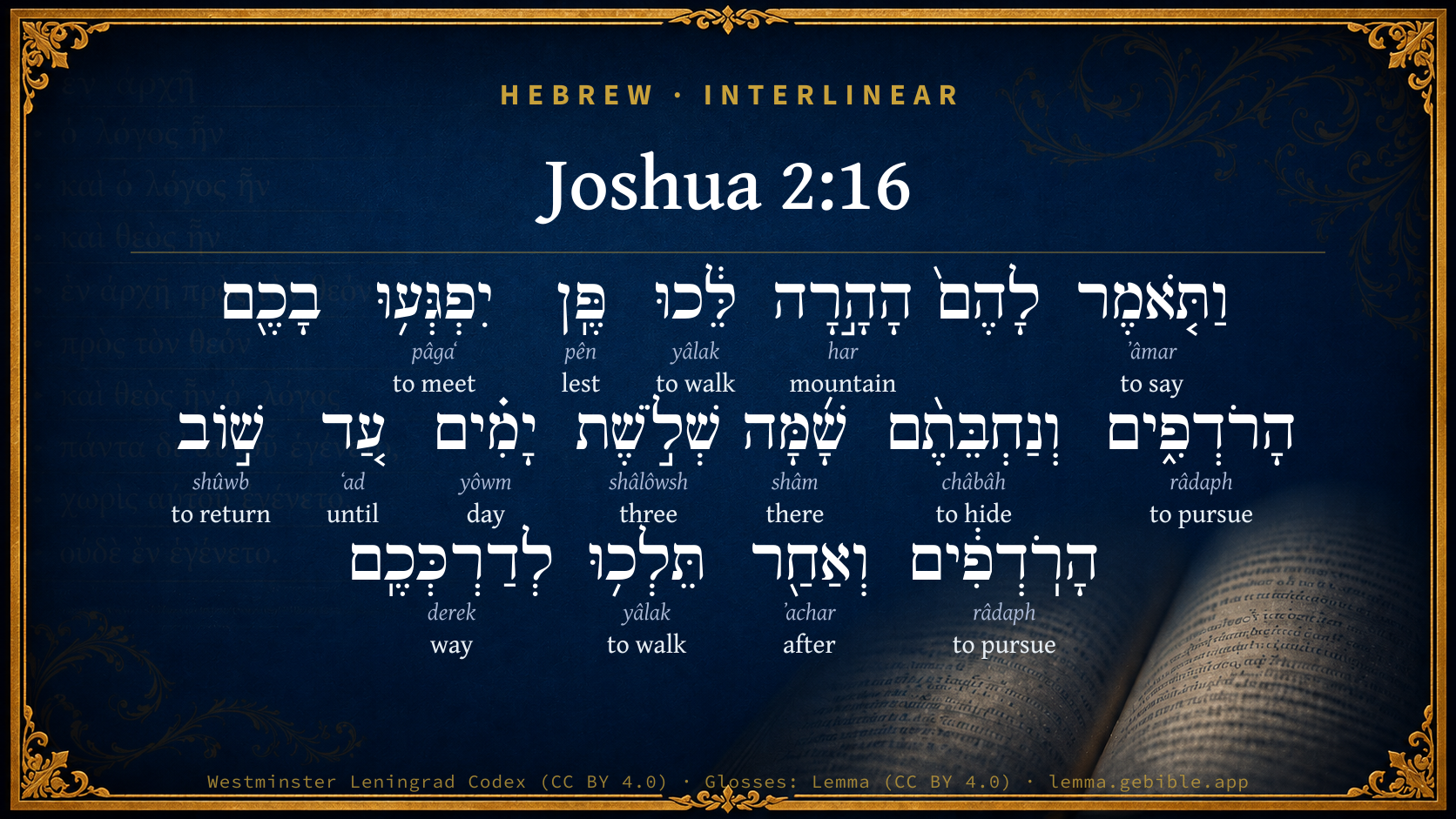
Hebrew (Westminster Leningrad Codex) Joshua 2:16 appears in the Hebrew Old Testament. The text above is from the Westminster Leningrad Codex. Each word links to its Strong’s number, a concise gloss, and parsing drawn from the Open Scriptures Hebrew Bible morphology. Click any word for its full Brown-Driver-Briggs (BDB) entry.
Download image
Cite this verse

Joshua 2:16 (World English Bible). Public Domain. Lemma interlinear Bible study tool, https://lemma.gebible.app/v/joshua/2/16.

Show BibTeX & RIS
BibTeX
RIS
English Translation
She said to them, Get you to the mountain, lest the pursuers light on you; and hide yourselves there three days, until the pursuers be returned: and afterward may you go your way.
World English Bible · Public Domain
Highlights
  • 1 first appearance in the Hebrew Bible
Full analysis ↓
Download a study sheet

One document with this verse’s original text, its word-by-word gloss line, the meaning frame, cross-references with their text, attributed commentary, and full source and license credits — printable, and it pastes into notes with its structure intact.

This verse Autodidact and up

Study sheet (.html) Plain text (.txt)

A passage Seminary Student

Up to 50 verses in one chapter. A passage sheet keeps up to 6 commentary sources and 12 cross-references per verse, in the order this page ranks them, and says so on the sheet whenever that leaves anything out. Ask for a single verse and you get the Autodidact verse sheet above.

Everything on this page stays free to read, with no account — the sheet is a download of what is already on screen, not access to it.

Want to remove ads? Support Godless Engineer
Compare translations 3

The same verse in 3 English versions, stacked beneath the original-language interlinear above. Click any original word for its lexicon entry.

Each is an independent rendering of the whole verse — the interlinear is not word-aligned to these translations.

Highlighted words mark where these versions differ — a whole-verse word diff, not a word-by-word alignment.

  • World English Bible Public Domain
    She said to them, Get you to the mountain, lest the pursuers light on you; and hide yourselves there three days, until the pursuers be returned: and afterward may you go your way.
  • King James Version Public Domain
    And she said unto them, Get you to the mountain, lest the pursuers meet you; and hide yourselves there three days, until the pursuers be returned: and afterward may ye go your way.
  • unfoldingWord Literal Text CC BY-SA 4.0
    And she said to them, “Go to the hill country, lest the pursuers meet you. And hide there three days, until the pursuers have returned. And afterwards you may go your way.”

unfoldingWord Literal Text — © unfoldingWord, licensed CC BY-SA 4.0. Word-aligned USFM3 via Door43 (git.door43.org/unfoldingWord/en_ult).

Versions to compare (up to 4)

3 of 4 selected

Show all 18 translations

Every available English version of this verse, each an independent rendering of the whole verse.

  • World English Bible Public Domain
    She said to them, Get you to the mountain, lest the pursuers light on you; and hide yourselves there three days, until the pursuers be returned: and afterward may you go your way.
  • Berean Standard Bible Public Domain
    “Go to the hill country,” she said, “so that your pursuers will not find you. Hide yourselves there for three days until they have returned; then go on your way.”
  • Majority Standard Bible Public Domain
    “Go to the hill country,” she said, “so that your pursuers will not find you. Hide yourselves there for three days until they have returned; then go on your way.”
  • King James Version Public Domain
    And she said unto them, Get you to the mountain, lest the pursuers meet you; and hide yourselves there three days, until the pursuers be returned: and afterward may ye go your way.
  • American Standard Version (1901) Public Domain
    And she said unto them, Get you to the mountain, lest the pursuers light upon you; and hide yourselves there three days, until the pursuers be returned: and afterward may ye go your way.
  • Revised Version (1885) Public Domain
    And she said unto them, Get you to the mountain, lest the pursuers light upon you; and hide yourselves there three days, until the pursuers be returned: and afterward may ye go your way.
  • Geneva Bible (1599) Public Domain
    And she said vnto them, Goe you into the mountaine, least the pursuers meete with you, and hide your selues there three dayes, vntill the pursuers be returned: then afterwarde may yee goe your way.
  • Douay-Rheims (1899) Public Domain
    They answered her: Be our lives for you unto death, only if thou betray us not. And when the Lord shall have delivered us the land, we will shew thee mercy and truth.
  • Young's Literal Translation Public Domain
    and she saith to them, `To the mountain go, lest the pursuers come upon you; and ye have been hidden there three days till the turning back of the pursuers, and afterwards ye go on your way.'
  • Literal Standard Version CC BY-SA 4.0
    and she says to them, “Go to the mountain, lest the pursuers come on you; and you have been hidden there three days until the turning back of the pursuers, and afterward you go on your way.”
  • Unlocked Literal Bible CC BY-SA 4.0
    She said to them, “Go in the hills and hide or the pursuers will find you. Hide there for three days until the pursuers have returned. Then go on your way.”
  • unfoldingWord Literal Text CC BY-SA 4.0
    And she said to them, “Go to the hill country, lest the pursuers meet you. And hide there three days, until the pursuers have returned. And afterwards you may go your way.”
  • Darby Bible Public Domain
    And she said to them, Go to the mountain, that the pursuers may not meet with you; and hide yourselves there three days, until the pursuers have returned; and afterwards go your way.
  • World Messianic Bible Public Domain
    She said to them, “Go to the mountain, lest the pursuers find you. Hide yourselves there three days, until the pursuers have returned. Afterward, you may go your way.”
  • Webster's Bible Public Domain
    And she said to them, Depart to the mountain, lest the pursuers meet you; and hide yourselves there three days, until the pursuers have returned: and afterward ye may go your way.
  • Free Bible Version CC BY-SA 4.0
    “Run to the hills,” she told them. “That way those searching for you won't find you. Stay there three days until they've gone home, and then you can be on your way.”
  • Bible in Basic English Public Domain
    And she said to them, Get away into the hill-country, or the men who have gone after you will overtake you; keep yourselves safe there for three days, till the searchers have come back, and then go on your way.
  • JPS Tanakh (1917) Public Domain
    And she said unto them: 'Get you to the mountain, lest the pursuers light upon you; and hide yourselves there three days, until the pursuers be returned; and afterward may ye go your way.'

Literal Standard Version (2020), Covenant Press — licensed CC BY-SA 4.0. Text via the HelloAO Bible API (eBible.org). Unlocked Literal Bible (unfoldingWord) — licensed CC BY-SA 4.0. Text via the HelloAO Bible API (eBible.org). unfoldingWord Literal Text — © unfoldingWord, licensed CC BY-SA 4.0. Word-aligned USFM3 via Door43 (git.door43.org/unfoldingWord/en_ult). Free Bible Version, Dr. Jonathan Gallagher — licensed CC BY-SA 4.0. Text via the HelloAO Bible API (eBible.org).

Word by word

More ways to search: Search by grammar → Find every occurrence → Compare this word →

Practice this passage: Drill this verse → Learn its vocabulary →

וְנַחְבֵּתֶ֨ם
châbâh
H2247
“and · to hide”
Conjunction + Verb, Niphal, Sequential Perfect, 2nd Person, Masculine, Plural
Part of Speech
Conjunction + Verb
Stem
Niphal
Form
Sequential Perfect
Person
2nd Person
Gender
Masculine
Number
Plural
Full BDB Definition

Origin: a primitive root [compare H2245 ]

TWOT: 590

to withdraw, hide, hide oneself - (Qal) to withdraw - (Niphal) to hide oneself, remain hidden, withdraw
  1. וַתֹּ֤אמֶר ʼâmar H559 “and · to say” Conjunction + Verb, Qal, Sequential Imperfect, 3rd Person, Feminine, Singular
  2. הָהָ֣רָה har H2022 “the · mountain · toward” Particle, Definite Article + Noun, Common, Masculine, Singular, Absolute + Suffix, Demonstrative
  3. לֵּ֔כוּ yâlak H3212 “walk” Verb, Qal, Imperative, 2nd Person, Masculine, Plural
  4. פֶּֽן pên H6435 “lest” Conjunction
  5. יִפְגְּע֥וּ pâgaʻ H6293 “to meet” Verb, Qal, Imperfect, 3rd Person, Masculine, Plural
  6. הָרֹדְפִ֑ים râdaph H7291 “the · pursuing” Particle, Definite Article + Verb, Qal, Participle Active, Masculine, Plural, Absolute
  7. שָׁ֜מָּה shâm H8033 “there · toward” Adverb + Suffix, Demonstrative
  8. שְׁלֹ֣שֶׁת shâlôwsh H7969 “three” Adjective, Cardinal number, Masculine, Singular, Construct
  9. יָמִ֗ים yôwm H3117 “days” Noun, Common, Masculine, Plural, Absolute
  10. עַ֚ד ʻad H5704 “until” Preposition
  11. שׁ֣וֹב shûwb H7725 “to return” Verb, Qal, Infinitive Absolute
  12. הָרֹֽדְפִ֔ים râdaph H7291 “the · pursuing” Particle, Definite Article + Verb, Qal, Participle Active, Masculine, Plural, Absolute
  13. וְאַחַ֖ר ʼachar H310 “and · after” Conjunction + Adverb
  14. תֵּלְכ֥וּ yâlak H3212 “to walk” Verb, Qal, Jussive, 2nd Person, Masculine, Plural
  15. לְדַרְכְּכֶֽם derek H1870 “to/for · way · your” Preposition + Noun, Common, Both, Singular, Construct + Suffix, Personal, 2nd Person, Masculine, Plural

About this verse

These counts appear in no published source. They are computed here, from the morphology-tagged text and Lemma’s own curated glosses. What Lemma adds →

18
words
14
distinct lemmas
Historical
section

Notable vocabulary

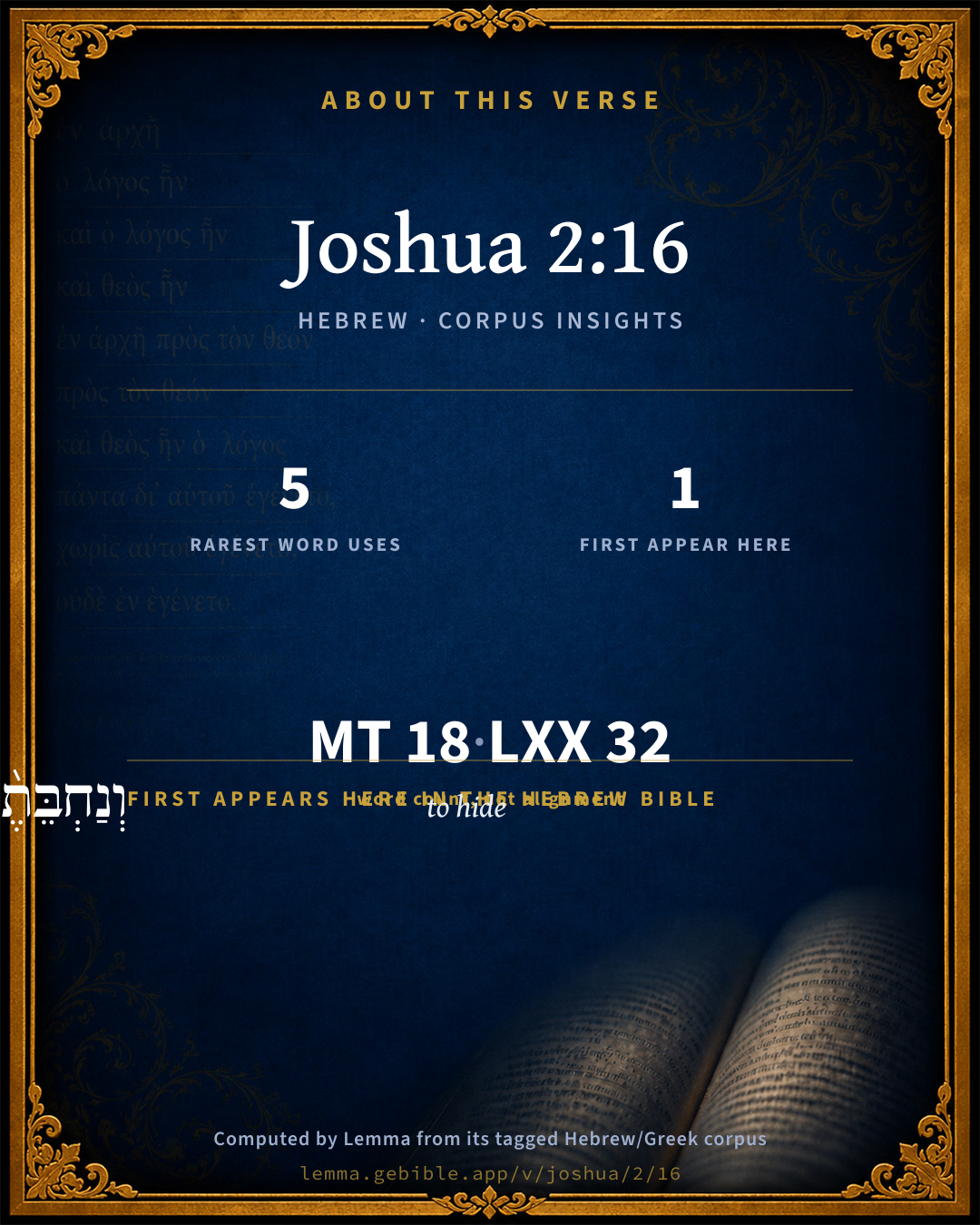
The rarest word here is וְנַחְבֵּתֶ֨ם to hide H2247 — appearing just 5 times in the whole Hebrew Bible.

First appearance in Scripture

This word makes its first canonical appearance in the Hebrew Bible here:

  • וְנַחְבֵּתֶ֨ם to hide H2247

Shared distinctive vocabulary

וְנַחְבֵּתֶ֨ם to hide H2247 occurs in 5 verses of the Hebrew Bible. Also found in:

Grammatical profile

  • 8 verbs
  • 3 nouns
  • 1 adjective
  • 3 prepositions
  • 1 conjunction
  • 2 adverbs

Verb forms

  • וַתֹּ֤אמֶר Qal · Sequential Imperfect
  • לֵּ֔כוּ Qal · Imperative
  • יִפְגְּע֥וּ Qal · Imperfect
  • הָרֹדְפִ֑ים Qal · Participle Active
  • וְנַחְבֵּתֶ֨ם Niphal · Sequential Perfect
  • שׁ֣וֹב Qal · Infinitive Absolute
  • הָרֹֽדְפִ֔ים Qal · Participle Active
  • תֵּלְכ֥וּ Qal · Jussive

Repetition

Words recur within this verse — often emphatic in Hebrew:

  • לֵּ֔כוּ to walk H3212 ×2
  • הָרֹדְפִ֑ים to pursue H7291 ×2

Hebrew & Septuagint length

In English translation the verse runs 33 words from the Hebrew and 37 from the Septuagint (LXX English) — closely comparable.

A rough comparison of the two English renderings, which tokenize alike — not a word-level alignment.

Word counts can differ between the Hebrew and the Greek without any difference in meaning — e.g. the Hebrew direct-object marker אֵת has no separate Greek word, and Greek often adds the article ὁ.

In the original languages it is 18 Hebrew tokens and 32 Greek tokens — but the two are counted differently (Hebrew bundles its prefixes and suffixes into one token; the Greek is in lemma form), so that isn’t a like-for-like length.

Cross-references

5

Topical passages linked to Joshua 2:16 in the Treasury of Scripture Knowledge — connected by theme and wording, ordered by reader-vote popularity; previews shown in the World English Bible.

  • 1 Samuel 23:14 David abode in the wilderness in the strongholds, and remained in the hill-country in the wilderness of Ziph. Saul sought him every day, but God didn't deliver him into his hand.
  • James 2:25 In like manner wasn't Rahab the prostitute also justified by works, in that she received the messengers, and sent them out another way?
  • Joshua 2:22 They went, and came to the mountain, and abode there three days, until the pursuers were returned: and the pursuers sought them throughout all the way, but didn't find them.
  • 1 Samuel 23:29 David went up from there, and lived in the strongholds of En Gedi.
  • Psalms 11:1 In Yahweh, I take refuge. How can you say to my soul, "Flee as a bird to your mountain!"

Cross-references courtesy of OpenBible.info (CC BY 4.0).

Hebrew and Greek witnesses Masoretic Hebrew ↔ Greek Septuagint

The same verse in the two great witnesses to the Old Testament, shown verse-for-verse.

These are two independent witnesses, not word-aligned to each other, and the Septuagint is shown in lemma (dictionary) form.

Hebrew Joshua 2:16 Masoretic · Westminster Leningrad Codex

וַתֹּ֤אמֶר לָהֶם֙ הָהָ֣רָה לֵּ֔כוּ פֶּֽן יִפְגְּע֥וּ בָכֶ֖ם הָרֹדְפִ֑ים וְנַחְבֵּתֶ֨ם שָׁ֜מָּה שְׁלֹ֣שֶׁת יָמִ֗ים עַ֚ד שׁ֣וֹב הָרֹֽדְפִ֔ים וְאַחַ֖ר תֵּלְכ֥וּ לְדַרְכְּכֶֽם

She said to them, Get you to the mountain, lest the pursuers light on you; and hide yourselves there three days, until the pursuers be returned: and afterward may you go your way.

World English Bible · Public Domain

Greek LXX Joshua 2:16 Septuagint · lemma form

καί εἶπον αὐτός εἰς ὁ ὀρεινή ἀποἔρχομαι μή συνἀντάω σύ ὁ καταδιώκω καί κρύπτω ἐκεῖ τρεῖς ἡμέρα ἕως ἄν ἀποστρέφω ὁ καταδιώκω ὀπίσω σύ καί μετά οὗτος ἀποἔρχομαι εἰς ὁ ὁδός σύ

and she said to them, Depart into the hill-country, lest the pursuers meet you, and you⌃ shall be hidden there three days until your pursuers return from after you, and afterwards you⌃ shall depart on your way.

LXX2012 (modern English Septuagint) · Public Domain

Hebrew: Westminster Leningrad Codex (CC BY 4.0). Greek: Septuagint (public domain); English from LXX2012 (modern English Septuagint) (Public Domain). How the Septuagint differs from the Hebrew →

Targum (Aramaic paraphrase)

1

The Targum is the ancient Jewish Aramaic paraphrase of the Hebrew Scriptures — an interpretive translation, not the Hebrew text itself. Onkelos (literal) and Pseudo-Jonathan (expansive) render the Torah, and Jonathan the Prophets. Coverage is partial: where no permissively-licensed English translation exists for a verse, only the Aramaic is shown. This is verse-level text, not a word-by-word alignment to the Hebrew.

  1. Targum Jonathan Prophets (Joshua–Malachi)
    וַאֲמַרַת לְהוֹן לְטוּרָא אֱזִילוּ דִלְמָא יְעַרְעוּן בְּכוֹן רָדְפַיָא וְתִטַמְרוּן תַּמָן תְּלָתָא יוֹמִין עַד דִיתוּבוּן רָדְפַיָא וּבָתַר כֵּן תְּהָכוּן לְאוֹרְחַתְכוֹן:

    (no public-domain English translation for this verse)

    Targum Jonathan — Aramaic: “Mikraot Gedolot” (public domain). English: “Sefaria Community Translation” (CC0 1.0 (public-domain dedication)); “London "Chaldee Paraphrase," 1871” (public domain). Text via Sefaria.

Commentary

Notes on Joshua 2:16 from classic Christian and Jewish commentators (each source and its license shown beneath its notes). The classic Christian expositions comment on the surrounding passage and are grouped to its opening verse, so a note may address several verses; the Jewish commentaries on the Tanakh (Rashi and others) are per-verse, so they appear only where the commentator wrote on this verse.

Lemma curates 59 commentaries, every one of them public domain or Creative Commons licensed, each selected and text-cleaned for this edition rather than reprinted as found. About our sources →

John Gill's Exposition

And she said unto them, get ye unto the mountain,.... Which was near to the city, and is supposed to be the same which is now called Quarantania: Dr. Shaw, a late traveller in those parts, says (m), from the mountain Quarantania, the very same perhaps where the two spies concealed themselves, Jos 2:16, we have a distinct view of the land of the Amorites, of Gilead, and of Bashan, the inheritance of the tribes of Reuben and Gad, and of the half tribe of Manasseh--to it joins the mountain of Adummim, and through it the road is cut that leads from Jerusalem to Jericho, where probably it was from the very nature of the situation that the man fell among thieves, Luk 10:30; which very probably is the same mountain which Josephus (n) says hung over the city, and was a very barren one; though the singular may be put for the plural, since, as Strabo says (o), it was surrounded with mountains:

lest the pursuers meet you; on their return from the fords of Jordan, being disappointed:

and hide yourselves there three days: some of the Jewish Rabbins, as Jarchi and Kimchi, observe that she had this by the revelation of the Holy Ghost, that the pursuers would return at the end of three days; but the latter more truly remarks, that this was said by conjecture; that Jericho being, as he says, one day from Jordan, and a little more, by going, returning, and searching for the spies, they would be three days in doing it:

until the pursuers be returned; into the city; for until they were they could not be in safety, but must be in danger of being met by them and taken up:

and afterward may ye go your way: to Jordan, and so to the camp of Israel, and that without fear.

(m) Travels, p. 276. Ed. 2. (n) De Bello Jud. l. 4. c. 8. sect. 2. (o) Geograph. l. 16. p. 525.

John Gill's Exposition of the Whole Bible (1746–1763) — public domain (CC PDM 1.0). Text via the HelloAO Bible API.

Trapp's Complete Commentary

John Trapp

Jos 2:16 And she said unto them, Get you to the mountain, lest the pursuers meet you; and hide yourselves there three days, until the pursuers be returned: and afterward may ye go your way.

Ver. 16. Get you to the mountain.] This, say some, was spoken after the men were down, in the still of the night, without the wall. {Jos 2:18} But what a fool was he who said, Mισω σοφην γυναικα, I hate a discreet woman!

John Trapp, A Commentary or Exposition upon All the Books of the Old and New Testament (1647–1656) — public domain. Text from a community e-Sword module.

Tyndale Open Study Notes

Tyndale Open Resources

2:16 The hill country of central Canaan began its steep rise just west of Jericho. Thinking that the two spies would head directly to Israel’s camp across the Jordan, the pursuers from Jericho would naturally head eastward. When the pursuers gave up, the spies could slip across the Jordan unhindered.

Tyndale Open Study Notes — © Tyndale Open Resources, licensed CC BY-SA 4.0. Text via the HelloAO Bible API.

Geneva Bible (1599)

Geneva Bible translators

Which was near unto the city.

Geneva Bible (1599) marginal notes — public domain. Text via Bolls.life.

Jamieson, Fausset & Brown

Robert Jamieson, A. R. Fausset & David Brown

she said--rather "she had said," for what follows must have been part of the previous conversation.

Get you to the mountain--A range of white limestone hills extends on the north, called Quarantania (now Jebel Karantu), rising to a height of from twelve hundred to fifteen hundred feet, and the sides of which are perforated with caves. Some one peak adjoining was familiarly known to the inhabitants as "the mountain." The prudence and propriety of the advice to flee in that direction rather than to the ford, were made apparent by the sequel.

Jamieson, Fausset & Brown — Commentary Critical and Explanatory on the Whole Bible (1871) — public domain (CC PDM 1.0). Text via the HelloAO Bible API.

Adam Clarke's Commentary

Verse 16. Hide yourselves there three days] They were to travel by night, and hide themselves in the day-time; otherwise they might have been discovered by the pursuers who were in search of them.

Adam Clarke's Commentary on the Bible (1810–1826) — public domain. Text from a community e-Sword/MySword module.

Ellicott's Commentary for English Readers

(16) Get you to the mountain.—The mountains between Jerusalem and Jericho have often been a refuge for worse characters than Joshua’s two spies (Luk_10:30).

A Bible Commentary for English Readers, edited by Charles John Ellicott (1878–1897) — public domain. Text from a community e-Sword module.

The Cambridge Bible for Schools and Colleges

gen. ed. J. J. S. Perowne

16. Get you to the mountain] i.e. probably the caverns in “the jagged range of the white limestone mountains” (of Judæa) which rise to the north of the city, “the same which in later ages afforded shelter to the hermits who there took up their abode, in the belief that this was the mountain of the Forty Days’ Fast of the Temptation—the ‘Quarantania,’ from which it still derives its name.” Stanley, Sinai and Palestine, p. 308.

The Cambridge Bible for Schools and Colleges (gen. ed. J. J. S. Perowne; Cambridge University Press, 1878–1918) — public domain. Text from a community e-Sword module.

Haydock's Catholic Bible Commentary

Days; the remainder of this night, and the day and night following. It is probable that they would travel only in the night time. (Calmet) --- If they had gone by the high road, they might easily have been discovered by the messengers, who would be on their return. (Haydock) --- But retiring to the mountains south of Jericho, till they had re-entered the city, the spies made their escape. (Calmet)

George Leo Haydock (1774–1849), Haydock's Catholic Family Bible and Commentary, 1859 edition — public domain. Excludes Psalms (Douay-Rheims chapter numbering differs from Protestant) and Deuterocanonical books (Catholic canon only).

Matthew Poole's English Annotations

To the mountain, i.e. to some of the mountains wherewith Jericho was encompassed, in which also there were many caves where they might lurk.

Three days; not three whole days, but one whole day, and parts of two days: See Poole "Jos 1:11".

Matthew Poole's English Annotations on the Holy Bible (1683–1685) — public domain. Text from a community e-Sword/MySword module.

Whedon's Commentary on the Bible

Daniel D. Whedon

16. Get you to the mountain — Hebrews Mountainwards go ye. By the device of going westward to the mountains behind the city, instead of eastward toward the Jordan, they would avoid pursuit, and secure a hiding place in some of their caverns till the pursuers had returned.

Daniel D. Whedon (gen. ed.), Commentary on the Old and New Testaments (1874–1909) — public domain. Text from a community e-Sword module.

The Pulpit Commentary

Get you to the mountains. No hint is given why the mountains were to be so safe a refuge. But a reference to the geography of the district will supply the reason. Any mountain district is usually less accessible and less thickly inhabited than the plains. But within five miles of Jericho lay the remarkable range called Quarantania, or Kuruntul, which is literally honeycombed with caves, so that a man might be concealed for months in the immediate neighbourhood of Jericho with a very slight risk of discovery. It is obvious how strongly this fact confirms the accuracy of the narrative. An inventor would have been certain in some way or other to draw attention to a statement intended to give an air of probability to his narrative. But there is nothing of the kind here, and yet the narrative displays a thorough acquaintance with the geographical features of the neighbourhood. Canon Tristram ("Land of Israel," p. 207, sqq.) carefully explored the caverns. On one face of the rock, which is perpendicular, he found "some thirty or forty habitable caves," and on the southern face, towards Jericho, he supposed there were a good many more than this. The scouts of the king of Jericho might be excused a very diligent search, for we are told that the "foot hold was hazardous and the height dizzy." From the days of the spies till long after the Christian era, these caves have been in existence. They have been tenanted by Greek, Syrian, and even Abyssinian monks, and Canon Tristram found many Greek and Ethiopic inscriptions, as well as figures of our Lord and the saints. The Abyssinian Christians make a yearly pilgrimage there even now. The reason of the reverence in which the place is held, is the tradition (not, however, eight hundred years old, see Bitter, 3:37) that, as the name Quarantania implies, the forty days" fast of our Lord took place there. As a specimen of the mystical interpretations in which the Fathers indulged, we find Origen expounding the advice, "Get you to the mountains," as follows: "Humilia et dejecta refugite, quae excelsa sunt et sublimia, praedicate."

The Pulpit Commentary (1880–1919), ed. H.D.M. Spence-Jones & Joseph S. Exell — public domain. Text from a community e-Sword module.

John Wesley's Explanatory Notes

The mountain - That is, to some of the mountains wherewith Jericho was encompassed, in which also there were many caves where they might lurk. Three days - Not three whole days, but one whole day, and part of two days.

John Wesley, Explanatory Notes Upon the Whole Bible (1754–1765) — public domain. Text via the GEBible commentary corpus.

Rashi

Rabbi Shlomo Yitzchaki (Rashi)

Until the pursuers return. She must have had Divine inspiration to know they would return after three days. maintains that she reasoned that it was a day’s journey from Yericho to the Jordan. They would spend a day searching for the spies and then return to Yericho making a total of three days.

Rashi on the Tanakh — English translations: “The Judaica Press complete Tanach with Rashi, translated by A. J. Rosenberg” (CC BY 4.0); “Pentateuch with Rashi's commentary by M. Rosenbaum and A.M. Silbermann, 1929-1934” (public domain); “The Metsudah Tanach series, Lakewood, N.J” (CC BY 4.0); and “The Book of Joshua, Metsudah Publications, 1997” (CC BY 4.0). Text via Sefaria.

Lesson kit

Teaching starters — assembled from the data on this page, not authored interpretation. Every prompt links to the verse data it draws on. Edit before teaching.

Joshua, in the Historical, opens this verse with 18 words (14 distinct Hebrew lemmas). Its most distinctive word is châbâh (“to hide”). A historical commentator’s framing appears above. Read the whole chapter for the surrounding context.

Discussion questions

  1. The word châbâh carries the sense “to hide.” How does it shape the verse?
  2. This is the first place “to hide” appears in Scripture (first appears here). What does its debut here establish?
  3. How does 1 Kings 22:25, which shares the word «to hide», read alongside this verse?
  4. What does the repetition of “to walk” (2× in this one verse) do in this verse?
  5. These translations render this verse differently; the difference is in the English rendering, not the original. What questions does that raise?
  6. «וַתֹּ֤אמֶר» is a Qal Sequential Imperfect verb. How does that grammatical form shape the action described?
  7. Compare how John Gill's Exposition and Trapp's Complete Commentary read this verse. Where do they agree or differ?

Things to notice

Reading settings

Reading text

Shown beneath each verse's original-language words.

Old Testament
Old Testament edition

Read the OT as the Masoretic Hebrew (MT) or the Greek Septuagint (LXX).

English shown for the Greek Septuagint (in the Hebrew ↔ Greek comparison).

Comparing translations? Open the Compare panel on any verse page to stack up to four side by side.