2 Samuel 20:13

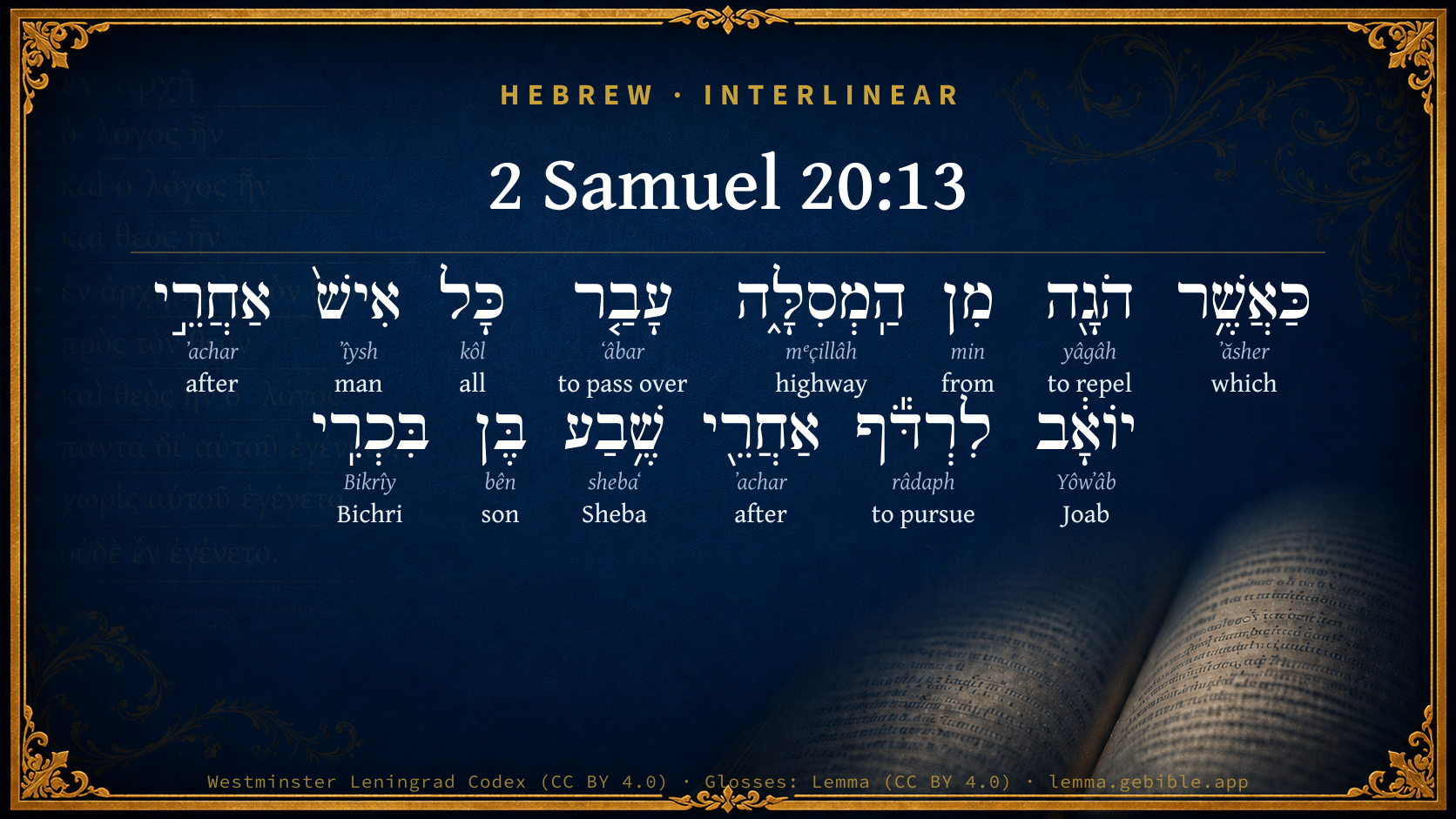
Hebrew (Westminster Leningrad Codex) 2 Samuel 20:13 appears in the Hebrew Old Testament. The text above is from the Westminster Leningrad Codex. Each word links to its Strong’s number, a concise gloss, and parsing drawn from the Open Scriptures Hebrew Bible morphology. Click any word for its full Brown-Driver-Briggs (BDB) entry.
Download image
Cite this verse

2 Samuel 20:13 (World English Bible). Public Domain. Lemma interlinear Bible study tool, https://lemma.gebible.app/v/2-samuel/20/13.

Show BibTeX & RIS
BibTeX
RIS
English Translation
When he was removed out of the highway, all the people went on after Joab, to pursue after Sheba the son of Bichri.
World English Bible · Public Domain
Highlights
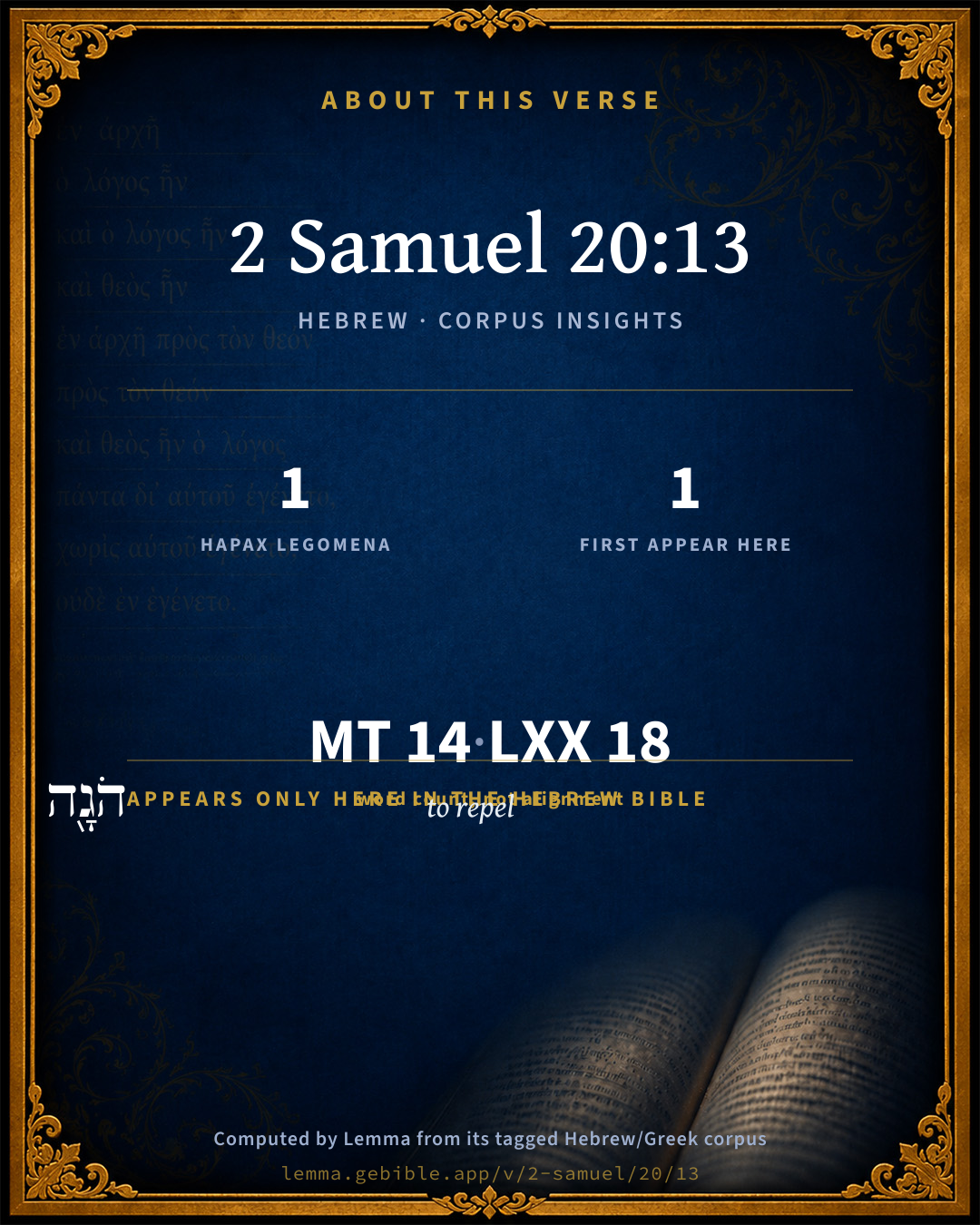
  • 1 hapax legomenon — only here in the Hebrew Bible
  • 1 first appearance in the Hebrew Bible
Full analysis ↓
Download a study sheet

One document with this verse’s original text, its word-by-word gloss line, the meaning frame, cross-references with their text, attributed commentary, and full source and license credits — printable, and it pastes into notes with its structure intact.

This verse Autodidact and up

Study sheet (.html) Plain text (.txt)

A passage Seminary Student

Up to 50 verses in one chapter. A passage sheet keeps up to 6 commentary sources and 12 cross-references per verse, in the order this page ranks them, and says so on the sheet whenever that leaves anything out. Ask for a single verse and you get the Autodidact verse sheet above.

Everything on this page stays free to read, with no account — the sheet is a download of what is already on screen, not access to it.

Want to remove ads? Support Godless Engineer
Compare translations 3

The same verse in 3 English versions, stacked beneath the original-language interlinear above. Click any original word for its lexicon entry.

Each is an independent rendering of the whole verse — the interlinear is not word-aligned to these translations.

Highlighted words mark where these versions differ — a whole-verse word diff, not a word-by-word alignment.

  • World English Bible Public Domain
    When he was removed out of the highway, all the people went on after Joab, to pursue after Sheba the son of Bichri.
  • King James Version Public Domain
    When he was removed out of the highway, all the people went on after Joab, to pursue after Sheba the son of Bichri.
  • unfoldingWord Literal Text CC BY-SA 4.0
    When he had pushed from the road, each man passed on after Joab to pursue after Sheba, the son of Bichri.

unfoldingWord Literal Text — © unfoldingWord, licensed CC BY-SA 4.0. Word-aligned USFM3 via Door43 (git.door43.org/unfoldingWord/en_ult).

Versions to compare (up to 4)

3 of 4 selected

Show all 18 translations

Every available English version of this verse, each an independent rendering of the whole verse.

  • World English Bible Public Domain
    When he was removed out of the highway, all the people went on after Joab, to pursue after Sheba the son of Bichri.
  • Berean Standard Bible Public Domain
    As soon as Amasa’s body was removed from the road, all the men went on with Joab to pursue Sheba son of Bichri.
  • Majority Standard Bible Public Domain
    As soon as Amasa’s body was removed from the road, all the men went on with Joab to pursue Sheba son of Bichri.
  • King James Version Public Domain
    When he was removed out of the highway, all the people went on after Joab, to pursue after Sheba the son of Bichri.
  • American Standard Version (1901) Public Domain
    When he was removed out of the highway, all the people went on after Joab, to pursue after Sheba the son of Bichri.
  • Revised Version (1885) Public Domain
    When he was removed out of the highway, all the people went on after Joab, to pursue after Sheba the son of Bichri.
  • Geneva Bible (1599) Public Domain
    When hee was remoued out of the way, euerie man went after Ioab, to follow after Sheba the sonne of Bichri.
  • Douay-Rheims (1899) Public Domain
    And when he was removed out of the way, all the people went on following Joab to pursue after Seba the son of Bochri.
  • Young's Literal Translation Public Domain
    When he hath been removed out of the highway, every man hath passed on after Joab, to pursue after Sheba son of Bichri.
  • Literal Standard Version CC BY-SA 4.0
    When he has been removed out of the highway, every man has passed on after Joab, to pursue after Sheba son of Bichri.
  • Unlocked Literal Bible CC BY-SA 4.0
    After Amasa was taken off the road, all the men followed on after Joab in pursuit of Sheba son of Bikri.
  • unfoldingWord Literal Text CC BY-SA 4.0
    When he had pushed from the road, each man passed on after Joab to pursue after Sheba, the son of Bichri.
  • Darby Bible Public Domain
    When he was removed out of the highway, all the people went on after Joab, to pursue after Sheba the son of Bichri,
  • World Messianic Bible Public Domain
    When he was removed out of the highway, all the people went on after Joab to pursue Sheba the son of Bichri.
  • Webster's Bible Public Domain
    When he was removed out of the highway, all the people went on after Joab, to pursue after Sheba the son of Bichri.
  • Free Bible Version CC BY-SA 4.0
    Once Amasa's body was off the road, all the men followed Joab in pursuit of Sheba.
  • Bible in Basic English Public Domain
    When he had been taken off the road, all the people went on after Joab in search of Sheba, the son of Bichri.
  • JPS Tanakh (1917) Public Domain
    When he was removed out of the highway, all the people went on after Joab, to pursue after Sheba the son of Bichri.

Literal Standard Version (2020), Covenant Press — licensed CC BY-SA 4.0. Text via the HelloAO Bible API (eBible.org). Unlocked Literal Bible (unfoldingWord) — licensed CC BY-SA 4.0. Text via the HelloAO Bible API (eBible.org). unfoldingWord Literal Text — © unfoldingWord, licensed CC BY-SA 4.0. Word-aligned USFM3 via Door43 (git.door43.org/unfoldingWord/en_ult). Free Bible Version, Dr. Jonathan Gallagher — licensed CC BY-SA 4.0. Text via the HelloAO Bible API (eBible.org).

Word by word

More ways to search: Search by grammar → Find every occurrence → Compare this word →

Practice this passage: Drill this verse → Learn its vocabulary →

הֹגָ֖ה
yâgâh
H3014
“to repel”
Verb, Hiphil, Perfect, 3rd Person, Masculine, Singular
Part of Speech
Verb
Stem
Hiphil
Form
Perfect
Person
3rd Person
Gender
Masculine
Number
Singular
Full BDB Definition

Origin: a primitive root [probably rather the same as H3013 through thecommon idea of dissatisfaction]

TWOT: 840

(Hiphil) to repel, thrust away, push away
  1. כַּאֲשֶׁ֥ר ʼăsher H834 “like/as · which” Preposition + Particle, Relative
  2. מִן min H4480 “from” Preposition
  3. הַֽמְסִלָּ֑ה mᵉçillâh H4546 “the · highway” Particle, Definite Article + Noun, Common, Feminine, Singular, Absolute
  4. עָבַ֤ר ʻâbar H5674 “to pass over” Verb, Qal, Perfect, 3rd Person, Masculine, Singular
  5. כָּל kôl H3605 “all of” Noun, Common, Masculine, Singular, Construct
  6. אִישׁ֙ ʼîysh H376 “man” Noun, Common, Masculine, Singular, Absolute
  7. אַחֲרֵ֣י ʼachar H310 “after” Preposition
  8. יוֹאָ֔ב Yôwʼâb H3097 “Joab” Noun, Proper
  9. לִרְדֹּ֕ף râdaph H7291 “to pursue” Preposition + Verb, Qal, Infinitive Construct
  10. אַחֲרֵ֖י ʼachar H310 “after” Preposition
  11. שֶׁ֥בַע shebaʻ H7652 “Sheba” Adjective, Cardinal number, Feminine, Singular, Absolute
  12. בֶּן bên H1121 “son of” Noun, Common, Masculine, Singular, Construct
  13. בִּכְרִֽי Bikrîy H1075 “Bichri” Noun, Proper

About this verse

These counts appear in no published source. They are computed here, from the morphology-tagged text and Lemma’s own curated glosses. What Lemma adds →

14
words
13
distinct lemmas
Historical
section

Notable vocabulary

1 hapax legomenon — a word that appears only here in the entire Hebrew Bible:

  • הֹגָ֖ה to repel H3014

First appearance in Scripture

This word makes its first canonical appearance in the Hebrew Bible here:

  • הֹגָ֖ה to repel H3014

Shared distinctive vocabulary

בִּכְרִֽי Bichri H1075 occurs in 8 verses of the Hebrew Bible. Also found in:

Grammatical profile

  • 3 verbs
  • 6 nouns
  • 1 adjective
  • 3 prepositions
  • 1 particle

Verb forms

  • הֹגָ֖ה Hiphil · Perfect
  • עָבַ֤ר Qal · Perfect
  • לִרְדֹּ֕ף Qal · Infinitive Construct

Repetition

A word recurs within this verse — often emphatic in Hebrew:

  • אַחֲרֵ֣י after H310 ×2

Hebrew & Septuagint length

In English translation the verse runs 23 words from the Hebrew and 24 from the Septuagint (LXX English) — closely comparable.

A rough comparison of the two English renderings, which tokenize alike — not a word-level alignment.

Word counts can differ between the Hebrew and the Greek without any difference in meaning — e.g. the Hebrew direct-object marker אֵת has no separate Greek word, and Greek often adds the article ὁ.

In the original languages it is 14 Hebrew tokens and 18 Greek tokens — but the two are counted differently (Hebrew bundles its prefixes and suffixes into one token; the Greek is in lemma form), so that isn’t a like-for-like length.

Cross-references

11

Topical passages linked to 2 Samuel 20:13 in the Treasury of Scripture Knowledge — connected by theme and wording, ordered by reader-vote popularity; previews shown in the World English Bible.

  • Numbers 20:19 The children of Israel said to him, We will go up by the highway; and if we drink of your water, I and my cattle, then will I give the price of it: let me only, without [doing] anything [else], pass through on my feet.
  • Judges 21:19 They said, Behold, there is a feast of Yahweh from year to year in Shiloh, which is on the north of Bethel, on the east side of the highway that goes up from Bethel to Shechem, and on the south of Lebonah.
  • 1 Samuel 6:12 The cattle took the straight way by the way to Beth-shemesh; they went along the highway, lowing as they went, and didn't turn aside to the right hand or to the left; and the lords of the Philistines went after them to the border of Beth-shemesh.
  • 2 Samuel 20:12–13 Amasa lay wallowing in his blood in the midst of the highway. When the man saw that all the people stood still, he carried Amasa out of the highway into the field, and cast a garment over him, when he saw that everyone who came by him stood still.
  • 2 Kings 18:17 The king of Assyria sent Tartan and Rabsaris and Rabshakeh from Lachish to king Hezekiah with a great army to Jerusalem. They went up and came to Jerusalem. When they were come up, they came and stood by the conduit of the upper pool, which is in the highway of the fuller's field.
  • Proverbs 16:17 The highway of the upright is to depart from evil. He who keeps his way preserves his soul.
  • Isaiah 7:3 Then Yahweh said to Isaiah, "Go out now to meet Ahaz, you, and Shearjashub your son, at the end of the conduit of the upper pool, on the highway of the fuller's field.
  • Isaiah 36:2 The king of Assyria sent Rabshakeh from Lachish to Jerusalem to king Hezekiah with a great army. He stood by the conduit of the upper pool in the highway of the fuller's field.
  • Isaiah 62:10 Go through, go through the gates; prepare you the way of the people; cast up, cast up the highway; gather out the stones; lift up an ensign for the peoples.
  • Jeremiah 31:21 Set up road signs, make guideposts; set your heart toward the highway, even the way by which you went: turn again, virgin of Israel, turn again to these your cities.
  • Mark 10:46 They came to Jericho. As he went out from Jericho, with his disciples and a great multitude, the son of Timaeus, Bartimaeus, a blind beggar, was sitting by the road.

Cross-references courtesy of OpenBible.info (CC BY 4.0).

Hebrew and Greek witnesses Masoretic Hebrew ↔ Greek Septuagint

The same verse in the two great witnesses to the Old Testament, shown verse-for-verse.

These are two independent witnesses, not word-aligned to each other, and the Septuagint is shown in lemma (dictionary) form.

Hebrew 2 Samuel 20:13 Masoretic · Westminster Leningrad Codex

כַּאֲשֶׁ֥ר הֹגָ֖ה מִן הַֽמְסִלָּ֑ה עָבַ֤ר כָּל אִישׁ֙ אַחֲרֵ֣י יוֹאָ֔ב לִרְדֹּ֕ף אַחֲרֵ֖י שֶׁ֥בַע בֶּן בִּכְרִֽי

When he was removed out of the highway, all the people went on after Joab, to pursue after Sheba the son of Bichri.

World English Bible · Public Domain

Greek LXX 2 Samuel 20:13 Septuagint · lemma form

ἡνίκα δέ φθάνω ἐκ ὁ τρίβος παραἔρχομαι πᾶς ἀνήρ ἰσραήλ ὀπίσω ιωαβ ὁ διώκω ὀπίσω σαβεε υἱός βοχορι

And when he was quickly removed from the road, every man of Israel passed after Joab to pursue after Sabee the son of Bochori.

LXX2012 (modern English Septuagint) · Public Domain

Hebrew: Westminster Leningrad Codex (CC BY 4.0). Greek: Septuagint (public domain); English from LXX2012 (modern English Septuagint) (Public Domain). How the Septuagint differs from the Hebrew →

Targum (Aramaic paraphrase)

1

The Targum is the ancient Jewish Aramaic paraphrase of the Hebrew Scriptures — an interpretive translation, not the Hebrew text itself. Onkelos (literal) and Pseudo-Jonathan (expansive) render the Torah, and Jonathan the Prophets. Coverage is partial: where no permissively-licensed English translation exists for a verse, only the Aramaic is shown. This is verse-level text, not a word-by-word alignment to the Hebrew.

  1. Targum Jonathan Prophets (Joshua–Malachi)
    כַּד אַפְנֵיהּ מִן כַּבְשָׁא עֲבַר כָּל גַבְרָא בָּתַר יוֹאָב לְמִרְדַף בָּתַר שֶׁבַע בַּר בִּכְרִי:

    (no public-domain English translation for this verse)

    Targum Jonathan — Aramaic: “Mikraot Gedolot” (public domain). English: “Sefaria Community Translation” (CC0 1.0 (public-domain dedication)); “London "Chaldee Paraphrase," 1871” (public domain). Text via Sefaria.

Commentary

Notes on 2 Samuel 20:13 from classic Christian and Jewish commentators (each source and its license shown beneath its notes). The classic Christian expositions comment on the surrounding passage and are grouped to its opening verse, so a note may address several verses; the Jewish commentaries on the Tanakh (Rashi and others) are per-verse, so they appear only where the commentator wrote on this verse.

Lemma curates 59 commentaries, every one of them public domain or Creative Commons licensed, each selected and text-cleaned for this edition rather than reprinted as found. About our sources →

Trapp's Complete Commentary

John Trapp

2Sa 20:13 When he was removed out of the highway, all the people went on after Joab, to pursue after Sheba the son of Bichri.

Ver. 13. All the people went on after Joab.] So fast affected they were to him, notwithstanding these foul miscarriages and David’s displeasure to boot.

John Trapp, A Commentary or Exposition upon All the Books of the Old and New Testament (1647–1656) — public domain. Text from a community e-Sword module.

John Gill's Exposition

When he was removed out of the highway,.... Into the field, and covered over with a cloth, that he could not be seen:

all the people went on after Joab; made no stop at all, knowing nothing of the matter, or what had happened:

to pursue after Sheba the son of Bichri; these were the troops that Amasa had been assembling, which followed one another after him; for Joab and Abishai, with their men, were at Gibeon first.

John Gill's Exposition of the Whole Bible (1746–1763) — public domain (CC PDM 1.0). Text via the HelloAO Bible API.

Rashi

Rabbi Shlomo Yitzchaki (Rashi)

When it was withdrawn. When it was removed as we find. "When the impurities are removed from silver", and as find "When the wicked are removed from before the king".

Rashi on the Tanakh — English translations: “The Judaica Press complete Tanach with Rashi, translated by A. J. Rosenberg” (CC BY 4.0); “Pentateuch with Rashi's commentary by M. Rosenbaum and A.M. Silbermann, 1929-1934” (public domain); “The Metsudah Tanach series, Lakewood, N.J” (CC BY 4.0); and “The Book of Joshua, Metsudah Publications, 1997” (CC BY 4.0). Text via Sefaria.

Lesson kit

Teaching starters — assembled from the data on this page, not authored interpretation. Every prompt links to the verse data it draws on. Edit before teaching.

2 Samuel, in the Historical, opens this verse with 14 words (13 distinct Hebrew lemmas). Its most distinctive word is yâgâh (“to repel”). A historical commentator’s framing appears above. Read the whole chapter for the surrounding context.

Discussion questions

  1. How does “to repel” (yâgâh) shape what this verse is saying?
  2. 1 word here appears nowhere else in the Hebrew Bible. Why might the author reach for such rare wording?
  3. This is the first place “to repel” appears in Scripture (first appears here). What does its debut here establish?
  4. How does 2 Samuel 20:1, which shares the word «Bichri», read alongside this verse?
  5. What does the repetition of “after” (2× in this one verse) do in this verse?
  6. The translations on this page render this verse differently — a whole-verse word diff, not a word-by-word alignment. What might account for the different wordings?
  7. «הֹגָ֖ה» is a Hiphil Perfect verb. How does that grammatical form shape the action described?
  8. Compare how Trapp's Complete Commentary and John Gill's Exposition read this verse. Where do they agree or differ?

Things to notice

  • 1 word in this verse appears nowhere else in the Hebrew Bible.
  • 1 word makes its first canonical appearance in Scripture here.
  • This verse counts 14 Hebrew ↔ 18 Greek words.
  • These translations choose different wording for 12 words in this verse.
  • “after” occurs 2× in this single verse.

Reading settings

Reading text

Shown beneath each verse's original-language words.

Old Testament
Old Testament edition

Read the OT as the Masoretic Hebrew (MT) or the Greek Septuagint (LXX).

English shown for the Greek Septuagint (in the Hebrew ↔ Greek comparison).

Comparing translations? Open the Compare panel on any verse page to stack up to four side by side.