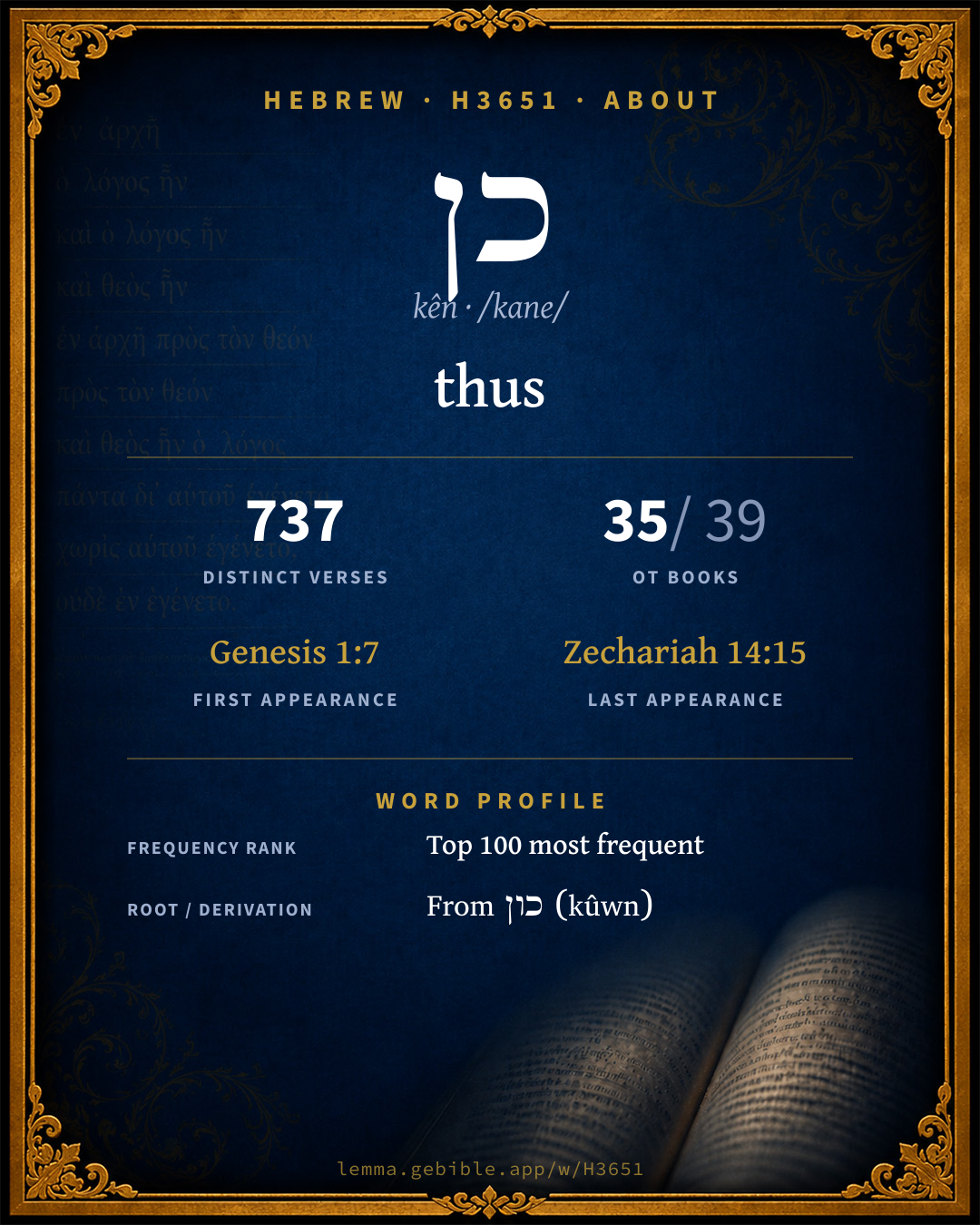
כֵּן
thus
also: so, therefore fuller range ↓
Full lexicon entry — Brown-Driver-Briggs (BDB)
From Brown-Driver-Briggs (BDB)
Where this word appears
Grammar key — what these labels mean
Part of speech
- Particle
- A short function word — article, negation, interrogative, the sign of the direct object, and the like.
- Adverb
- A word that modifies a verb, adjective, or other adverb.
- Adjective
- A word that describes or qualifies a noun.
State
- Absolute
- The independent form of a noun, not bound to a following word.
Gender
- Masculine
- Grammatically masculine.
Number
- Singular
- One.
- Plural
- More than one (in Hebrew, generally three or more).
Every verse where H3651 appears in the Book of Exodus — 49 distinct verses. Click any verse to open its interlinear word-by-word view. Verse text shown in the World English Bible for context — . Each verse’s Hebrew form is shown with its reference; the English is not keyword-highlighted, since the data carries no word-level English alignment. Use “Compare translations” on any verse to read it across multiple English versions. This concordance covers the Hebrew Bible; Septuagint (Greek Old Testament) occurrences are not indexed here.
Exodus
- Exodus 1:12 כֵּ֥ן וְ/כֵ֣ן ptcl dem conj + ptcl dem But the more they afflicted them, the more they multiplied and the more they spread out. They were grieved because of the children of Israel.
- Exodus 3:20 כֵ֖ן adv I will put forth my hand and strike Egypt with all my wonders which I will do in the midst of it, and after that he will let you go.
- Exodus 5:8 כֵּ֗ן ptcl dem The number of the bricks, which they made before, you require from them. You shall not diminish anything of it, for they are idle; therefore they cry, saying, 'Let us go and sacrifice to our God.'
- Exodus 5:17 כֵּן֙ ptcl dem But he said, "You are idle! You are idle! Therefore you say, 'Let us go and sacrifice to Yahweh.'
- Exodus 6:6 לָ/כֵ֞ן prep + adv Therefore tell the children of Israel, 'I am Yahweh, and I will bring you out from under the burdens of the Egyptians, and I will rid you out of their bondage, and I will redeem you with an outstretched arm, and with great judgments:
- Exodus 6:9 כֵּ֖ן ptcl dem Moses spoke so to the children of Israel, but they didn't listen to Moses for anguish of spirit, and for cruel bondage.
- Exodus 7:6 כֵּ֥ן ptcl dem Moses and Aaron did so. As Yahweh commanded them, so they did.
- Exodus 7:10 כֵ֔ן adv Moses and Aaron went in to Pharaoh, and they did so, as Yahweh had commanded: and Aaron cast down his rod before Pharaoh and before his servants, and it became a serpent.
- Exodus 7:11 כֵּֽן ptcl dem Then Pharaoh also called for the wise men and the sorcerers. They also, the magicians of Egypt, did in like manner with their enchantments.
- Exodus 7:20 כֵן֩ adv Moses and Aaron did so, as Yahweh commanded; and he lifted up the rod, and struck the waters that were in the river, in the sight of Pharaoh, and in the sight of his servants; and all the waters that were in the river were turned to blood.
- Exodus 7:22 כֵ֛ן adv The magicians of Egypt did in like manner with their enchantments; and Pharaoh's heart was hardened, and he didn't listen to them; as Yahweh had spoken.
- Exodus 8:7 כֵ֥ן adv The magicians did in like manner with their enchantments, and brought up frogs on the land of Egypt.
- Exodus 8:17 כֵ֗ן adv They did so; and Aaron stretched out his hand with his rod, and struck the dust of the earth, and there were lice on man, and on animal; all the dust of the earth became lice throughout all the land of Egypt.
- Exodus 8:18 כֵ֨ן adv The magicians tried with their enchantments to bring forth lice, but they couldn't. There were lice on man, and on animal.
- Exodus 8:24 כֵּ֔ן ptcl dem Yahweh did so; and there came grievous swarms of flies into the house of Pharaoh, and into his servants' houses: and in all the land of Egypt the land was corrupted by reason of the swarms of flies.
- Exodus 8:26 כֵּ֔ן ptcl dem Moses said, "It isn't appropriate to do so; for we shall sacrifice the abomination of the Egyptians to Yahweh our God. Behold, shall we sacrifice the abomination of the Egyptians before their eyes, and won't they stone us?
- Exodus 10:10 כֵ֤ן adv He said to them, "Yahweh be with you if I will let you go with your little ones! See, evil is clearly before your faces.
- Exodus 10:11 כֵ֗ן adv Not so! Go now you who are men, and serve Yahweh; for that is what you desire!" They were driven out from Pharaoh's presence.
- Exodus 10:14 כֵ֤ן כֵּֽן adv ptcl dem The locusts went up over all the land of Egypt, and rested in all the borders of Egypt. They were very grievous. Before them there were no such locusts as they, neither after them shall be such.
- Exodus 10:29 כֵּ֣ן ptcl dem Moses said, "You have spoken well. I will see your face again no more."
- Exodus 11:1 כֵ֕ן adv Yahweh said to Moses, "Yet one plague more will I bring on Pharaoh, and on Egypt; afterwards he will let you go. When he lets you go, he will surely thrust you out altogether.
- Exodus 11:8 כֵ֖ן adv All these your servants shall come down to me, and bow down themselves to me, saying, 'Get out, and all the people who follow you; and after that I will go out.'" He went out from Pharaoh in hot anger.
- Exodus 12:28 כֵּ֥ן ptcl dem The children of Israel went and did so; as Yahweh had commanded Moses and Aaron, so they did.
- Exodus 12:50 כֵּ֥ן ptcl dem Thus did all the children of Israel. As Yahweh commanded Moses and Aaron, so they did.
- Exodus 13:15 כֵּן֩ ptcl dem and it happened, when Pharaoh would hardly let us go, that Yahweh killed all the firstborn in the land of Egypt, both the firstborn of man, and the firstborn of animal. Therefore I sacrifice to Yahweh all that opens the womb, being males; but all the firstborn of my sons I redeem.'
- Exodus 14:4 כֵֽן adv I will harden Pharaoh's heart, and he will follow after them; and I will get honor over Pharaoh, and over all his host; and the Egyptians shall know that I am Yahweh." They did so.
- Exodus 15:23 כֵּ֥ן ptcl dem When they came to Marah, they couldn't drink from the waters of Marah, for they were bitter. Therefore the name of it was called Marah.
- Exodus 16:17 כֵ֖ן adv The children of Israel did so, and gathered some more, some less.
- Exodus 16:29 כֵּ֠ן ptcl dem Behold, because Yahweh has given you the Sabbath, therefore he gives you on the sixth day the bread of two days. Everyone stay in his place. Let no one go out of his place on the seventh day."
- Exodus 17:6 כֵּן֙ ptcl dem Behold, I will stand before you there on the rock in Horeb. You shall strike the rock, and water will come out of it, that the people may drink." Moses did so in the sight of the elders of Israel.
- Exodus 20:11 כֵּ֗ן ptcl dem for in six days Yahweh made heaven and earth, the sea, and all that is in them, and rested the seventh day; therefore Yahweh blessed the Sabbath day, and made it holy.
- Exodus 22:30 כֵּֽן ptcl dem You shall do likewise with your oxen and with your sheep. Seven days it shall be with its mother, then on the eighth day you shall give it me.
- Exodus 23:11 כֵּֽן ptcl dem but the seventh year you shall let it rest and lie fallow, that the poor of your people may eat; and what they leave the animal of the field shall eat. In like manner you shall deal with your vineyard and with your olive grove.
- Exodus 25:9 וְ/כֵ֖ן conj + ptcl dem According to all that I show you, the pattern of the tent, and the pattern of all of its furniture, even so you shall make it.
- Exodus 25:33 כֵּ֚ן ptcl dem three cups made like almond blossoms in one branch, a bud and a flower; and three cups made like almond blossoms in the other branch, a bud and a flower, so for the six branches going out of the lampstand;
- Exodus 26:4 וְ/כֵ֤ן conj + ptcl dem You shall make loops of blue on the edge of the one curtain from the edge in the coupling; and likewise shall you make in the edge of the curtain that is outmost in the second coupling.
- Exodus 26:17 כֵּ֣ן ptcl dem There shall be two tenons in each board, joined to one another: thus shall you make for all the boards of the tent.
- Exodus 26:24 כֵּ֚ן ptcl dem They shall be double beneath, and in like manner they shall be entire to the top of it to one ring: thus shall it be for them both; they shall be for the two corners.
- Exodus 27:8 כֵּ֥ן ptcl dem Hollow with planks shall you make it: as it has been shown you on the mountain, so shall they make it.
- Exodus 27:11 וְ/כֵ֨ן conj + ptcl dem Likewise for the north side in length there shall be hangings one hundred cubits long, and the pillars of it twenty, and their sockets twenty, of brass; the hooks of the pillars, and their fillets, of silver.
- Exodus 34:32 כֵ֥ן adv Afterward all the children of Israel came near, and he gave them all of the commandments that Yahweh had spoken with him on Mount Sinai.
- Exodus 36:11 כֵּ֤ן ptcl dem He made loops of blue on the edge of the one curtain from the edge in the coupling. Likewise he made in the edge of the curtain that was outmost in the second coupling.
- Exodus 36:22 כֵּ֣ן ptcl dem Each board had two tenons, joined one to another. He made all the boards of the tent this way.
- Exodus 36:29 כֵּ֚ן ptcl dem They were double beneath, and in like manner they were all the way to the top of it to one ring. He did thus to both of them in the two corners.
- Exodus 37:19 כֵּ֚ן ptcl dem three cups made like almond-blossoms in one branch, a bud and a flower, and three cups made like almond-blossoms in the other branch, a bud and a flower: so for the six branches going out of the lampstand.
- Exodus 39:32 כֵּ֥ן ptcl dem Thus all the work of the tent of the tent of meeting was finished. The children of Israel did according to all that Yahweh commanded Moses; so they did.
- Exodus 39:42 כֵּ֤ן ptcl dem According to all that Yahweh commanded Moses, so the children of Israel did all the work.
- Exodus 39:43 כֵּ֣ן ptcl dem Moses saw all the work, and, behold, they had done it as Yahweh had commanded, even so had they done it: and Moses blessed them.
- Exodus 40:16 כֵּ֥ן ptcl dem Thus did Moses: according to all that Yahweh commanded him, so he did.
About this entry
At a glance — auto-summarized from this page’s data, not written by a person. Every figure links to its source below. This summary describes the numbers; it doesn’t interpret them.
At its core, כן (kên) means “thus.” Scripture first uses it in Genesis 1:7. It appears 737 verses across 35 books of the Hebrew Bible, among its most common vocabulary. Beyond its headline sense, its full sense range takes in “so” and “therefore”. It clusters with כון, אכן and כון under a shared root. Each statement above links to its evidence; the full detail follows below.
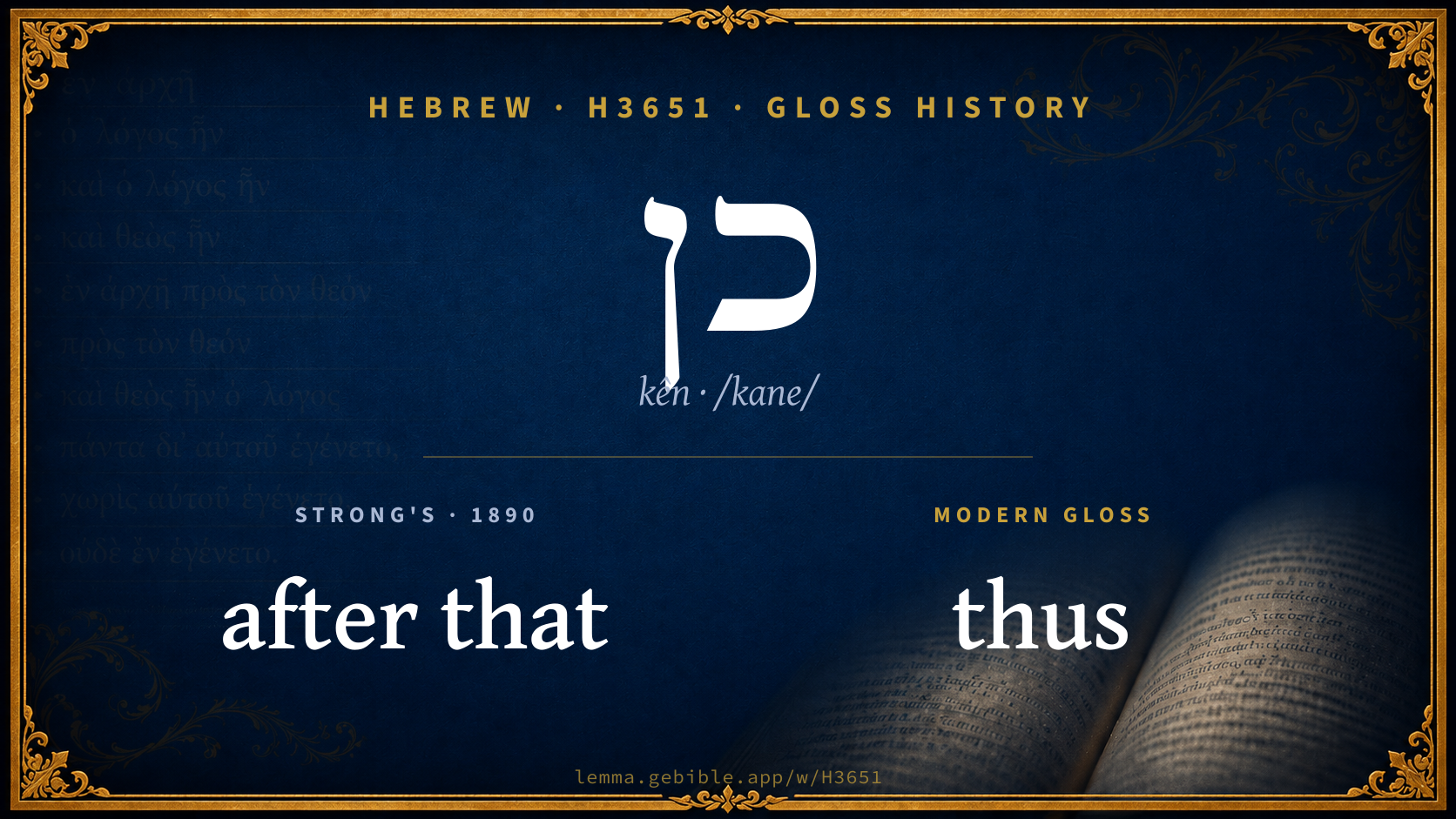
Gloss history
Strong's 1890 vs modern scholarship
About this word
Strong's H3651 catalogs a Hebrew word from the Hebrew Old Testament.
These counts are not copied from any lexicon or concordance. They are computed here, from the morphology-tagged Hebrew Old Testament. What Lemma adds →
- 737
- distinct verses
- The word appears in 737 distinct verses.
- 35 / 39
- OT books
- The word appears in 35 of 39 Old Testament books.
- #61
- by frequency
- Top 100 most frequent Hebrew words (rank 61 of 8,640 Hebrew words by occurrence).
View all 737 occurrences in the concordance →
By section of the Old Testament
By traditional corpus
Conventional, traditional groupings — biblical authorship is debated, so this is a traditional corpus grouping, not an authorship claim. Each share is this word’s portion of its verses in that division of the Hebrew canon. Each figure is a share of the word’s 737 distinct verses.
- Prophets (Nevi'im) 427 verses · 58%
- Torah (Pentateuch) 174 verses · 24%
- Writings (Ketuvim) 136 verses · 18%
How translations render this word
Counts come from each version’s own published word-to-Strong’s tagging or interlinear alignment — an approximate guide to how each version renders this word, not a word-level alignment the data otherwise carries. Because each total is that version’s own tagged count, the per-version totals vary from one another and need not match the appearance or distinct-verse counts above. These counts may also differ from a printed concordance because Lemma counts each distinctly tagged rendering and does not collapse phrase taggings into a single head-word total. This is a fixed set of word-tagged versions (KJV, ASV, BSB, ULT) and does not change with the reading translation you choose elsewhere. Each version’s license is shown beside its name below (and on Sources).
BDB lists this Strong’s number as 5 distinct words (homographs). Each count above pools all of them and is not split by sense — see the Senses section below. A low-frequency rendering may belong to a different one of those words, not the primary meaning.
- King James Version†: Cause 2×, Like manner 2×, Therefore 2×
- American Standard Version†: Therefore 3×, Him 2×, Like manner 2×
- Berean Standard Bible†: Therefore 159×, So 117×, This 27×
- unfoldingWord Literal Text†: Therefore 274×, Thus 181×, So 117×
King James Version Public Domain
Renders H3651 across 38† tagged occurrences — most commonly:
Plus 22 renderings that appear only once — usually multi-word phrases or single function words the recovered tagging swept in, not distinct renderings. Not rendered by a distinct English word in 4 further occurrences.
American Standard Version Public Domain
Renders H3651 across 39† tagged occurrences — most commonly:
Plus 26 renderings that appear only once — usually multi-word phrases or single function words the recovered tagging swept in, not distinct renderings.
Berean Standard Bible Public Domain
Renders H3651 across 461† tagged occurrences — most commonly:
Plus other, less common renderings. Plus 38 renderings that appear only once — usually multi-word phrases or single function words the recovered tagging swept in, not distinct renderings. Not rendered by a distinct English word in 298 further occurrences.
unfoldingWord Literal Text CC BY-SA 4.0
Renders H3651 across 753† tagged occurrences — most commonly:
Plus other, less common renderings. Plus 33 renderings that appear only once — usually multi-word phrases or single function words the recovered tagging swept in, not distinct renderings.
20 senses and sub-senses in the full BDB
What do BDB’s symbols mean?
BDB uses these scholarly abbreviations:
| Symbol | Meaning |
|---|---|
| 𝔊 | the Septuagint (the ancient Greek translation, LXX) |
| 𝔙 | the Vulgate (the Latin translation) |
| 𝔖 | the Syriac version (the Peshitta) |
| 𝔗 | the Targum (the Aramaic translation) |
| ψ | the Psalms |
| √ | root (the underlying root or stem) |
| ‖ | parallel passage (a synonymous or contrasted parallel) |
| † | the dagger: every passage where the word occurs is cited |
The 20 senses and sub-senses the full Brown-Driver-Briggs lexicon distinguishes for this word, in lexicon order (not ranked by frequency), with BDB’s own verbatim wording and sub-sense lettering. Shown in Hebrew script with BDB’s own scholarly abbreviations. The condensed entry is in the Lexicon Entry tab. See also the Forms in the corpus table below.
כן I right, veritable, honest (proposes firm, upright
- 1. right, usually indecl., often as subst. a right thing, especially c. vbb. dicendi Ex 10:29 (J) כֵּן דִּבַּרְתָּ, Nu 27:7 כֵּן דֹּבְרֹת, 36:5 (both P); כֵּן יַאֲרִיךְ Pr 28:2 (the) right (i.e. order and justice) shall last long (v. De Now VB); = adv. aright, of pronunciation Ju 12:6; also c. vb. agendi Ec 8:10 (on Is 33:23 v. iii. כֵּן sub כנן); right well ψ 65:10; (Che; al. = so); c. לֹא, as adj., not right דְּבָרִים אֲשֶׁר לֹא־כֵן 2 K 17:9 things which were not right (vb. agendi); of heart of a fool Pr 15:7; Je 23:10; as subst. = what is not right, upright Je 8:6; c. vb. agendi לֹא־כֵן 2 K 7:9 that which is not right we are doing, Je 48:30b. e.g. Exodus 10:29
- 2. veritable, true, כֵּן־צְדָקָה Pr 11:19 the veritable of righteousness = true righteousness; Is 16:6 = Je 48:30a may be either their boastings are not true or (Thes Che Di Du Gr Gie al.) the untruth of their boastings (לֹא־כֵן as cpd. cstr.); abs., in assent to something already said, Right! Correct! True! Jos 2:4. e.g. Proverbs 11:19
- 3. pl. concr. honest (men) Gn 42:11, 19, 31, 33, 34 (all E).—i. כֵּן thus, so, v. p. 485 infr.; iii. כֵּן place, base, v. sub i. כנן; iv. כֵּן, כִּנִּם, כִּנָּם, v. sub כנן. e.g. Genesis 42:11
כן II so, thus (Ph. NH 𝔗 id.
- 1.
- a. Ju 5:31 כן יאבדו so perish thy enemies, Jb 5:27 כֶּן־הִיא, 8:13 כן ארחות כל שׁכחי אל, Pr 6:29; 8:13; 2 S 16:23 Is 36:6; 47:15 כן היו לך, Nu 13:33 וכן היינו בעיניהם; Nu 9:16 כן יהיה תמיד; Ex 10:14, 14 לא היה כן ארבה כמהו וג׳ (i.e. in such numbers), 1 K 10:12 לא בא כן עצי אלמגים, v 20 2 Ch 1:12, 12, Ju 21:14 ולא מצאו להם כן and they did not suffice for them so (viz. in such numbers of them as there were); 1 K 6:26 וכן הכרוב השׁני, Ez 41:7 (?); וכן ל׳ Ex 27:11 1 K 10:29 Ez 40:16 2 Ch 35:12, cf. 1 Ch 23:30; כן ל׳ Ex 25:33 (cf. 26:24), Jos 21:40. e.g. Judges 5:31
- b. the force of כֵּן has sometimes to be elicited from the context: 1 K 2:7 כי כן קרבו אלי (sc. with kindness such as that enjoined in v a), 20:40 כן משׁפטך, Je 14:10 כן אהבו לנוע (i.e. not less than י׳ has withdrawn from them v 9, Gf Ke; Gie proposes אָכֵן), ψ 61:9 כֵּן אֲוַמְּרָה שִׁמְךָ (Hi כְּצִדְקְךָ, implied in v 6–8), 63:3 כֵּן בַּקֹּדֶשׁ חֲזִיתִךָ (sc. with the longings of v 2), v 5 כֵּן אֲבָרֶכְךָ בְחַיָּי (sc. כִּי־טוֹב חַסְדְּךָ v 4), 65:10 כִּי כֵן תְּכִינֶהָ (i.e. so generously, v 10), 90:12 לִמְנוֹת יָמֵינוּ כֵּן הוֹדַע (Hi כְּיִרְאַת י׳ v 11), 127:2 כֵּן יִּתֵּן לִידִידוֹ שֵׁנָא (sc. as abundantly; but Che אָכֵן), Pr 24:14 (see v 13), Is 52:14 כֵּן מִשְׁחַת מֵאִישׁ מַרְאֵהוּ (sufficiently to justify שׁממו עליך רבים). e.g. 1 Kings 2:7
- c. כן occurs freq. in partic. phrases, as (a) with הָיָה, especially ויהי כן and it was so Gn 1:7, 9, 11 +, 2 K 2:10 if thou seest me taken from thee יהי־לך כן let it be to thee so (sc. as thou desirest), 7:20, with עשׂה (especially וַיַּעַשׂ, וַיַּעֲשׂוּ) Gn 29:28; 42:20; 45:21 + often, Ju 7:16 מִמֶּנִּי תִרְאוּ וְכֵן תַּעֲשׂוּ, + ל׳ Gn 42:25 ויעשׂ להם כן, Ex 22:29; 23:11 כן תעשׂה ל׳, Dt 22:3 2 S 12:31 1 K 11:8 (cf. 6:33; 7:18); Gn 29:26 לא יֵעָשֶׂה כן במקומנו, 34:7 2 S 13:12; rarer usages, דִּבֶּר כֵּן Ex 6:9, אמר כן 1 K 22:8 כֵּן אמרתם Ez 11:5; 33:10, אָמֵן כֵּן יֹאמַר י׳ 1 K 1:36 (cf. Je 28:6), וגם שׁאול אבי יֹדֵעַ כֵּן 1 S 23:17; אָהֵב כֵּן (idiom.) to love (it) so, †Je 5:31 Am 4:5; (b) Gn 50:3 כי כן ימלאו ימי החנֻטים (cf. Ju 14:10 2 S 13:18 Est 2:12); (c) alone, אִם כֵּן if it be so †Gn 25:22; 43:11; †וַיִּרְאוּ כִּי־כֵן 1 S 5:7, יָדַעְתִּי כִּי־כֵן Jb 9:2; (d) לא כן not so (viz. as has been described or implied), with a subst. Nu 12:7 לא כן עבדי משׁה, 2 S 20:21; 23:5 ψ 1:4 Jb 9:35 b כי־לא־כן אנכי עמדי not so am I with myself (i. e. I am not conscious of being one who would fear him, v a), with a vb. Dt 18:14 ואתה לא כן נתן לך י׳ (not so,—viz. as implied in v a), 2 S 18:14 Is 10:7 לא כן יְדַמֶּה, לא כן יחשׁב, absol. Gn 48:18 לא כן אבי, Ex 10:11. e.g. Genesis 1:7
- 2. Often, to emphasize the agreement, in answer to כְּ, and כַּאֲשֶׁר: viz.
- a. כְּ … כֵּן, (a) Gn 44:10 = Jos 2:21 כדבריכם כֶּן־הוּא, according to your words, so be it, 1 S 25:25 כי כשׁמו כֶּן־הוּא, ψ 48:11 Pr 23:7 כֶּן־הוּא (after conj. כְּמוֹ), Ez 42:11 כְּאָרְכָּן כֵּן רָחְבָּן; (b) Lv 27:12 כְּעֶרְכְּךָ כֵּן יִהְיֶה, 2 S 13:35 Nu 8:4; 9:14; 15:20 Dt 8:20 Ju 11:10, so after כְּפִי Nu 6:21; (c) כְּכֹל … כֵּן … 1 S 8:8 2 S 7:17 Je 42:5; (d) in similes, (α) 2 S 14:17 כמלאך הא׳ כן אדני המלך, Je 18:6 ψ 123:2; 127:4 Pr 10:26; 26:8, 19; 27:8, 19 Ct 2:2, 3; (β) Jo 2:4 כְּפָרָשִׁים כֵּן יְרוּצוּן, Is 31:5 38:14 ψ 103:15 Pr 26:1, 2; (γ) ψ 42:2 כאיל תערג … כן נפשׁי וג׳ like the hind which etc., 83:16 Is 61:11; 63:14 Jb 7:3, so after כמו Is 26:17; (δ) Je 2:26 כְּבשֶׁת גַּנָּב … כֵּן הוֹבִישׁוּ 6:7; 34:5 (read כְּמשׂרפות), Ez 22:22 (cf. v 20), 23:44; 34:12; cf. (of degree) 35:15 (om. 𝔊 Co), Ho 4:7 כְּרֻכָּם כֵּן חָֽטְאוּ לִי. Of time (rare) Ho 6:3 (?), 1 S 9:13 כְּבֹאֲכֶם הָעִיר כֵּן תִּמְצְאוּן אֹתוֹ. e.g. Genesis 44:10
- b. †Ezr 10:12 כן כדבריך עלינו לעשׂות. e.g. Ezra 10:12
- c. כַּאֲשֶׁר … כֵּן …, (a) Ex 7:6 כאשׁר צוה י׳ כן עשׂו, 12:28, 50; 39:43 (cf. 27:8), Nu 8:22 (cf. 5:4), 17:26; 36:10 Jos 14:5 (all P); Gn 41:13 כאשׁר פתר כן היה, Jos 10:1, 39; 11:15 Ju 1:7; 15:11 b ψ 48:9; (b) (freq.) Nu 2:17 כאשׁר יַחֲנוּ כֵּן יִסָּ֑עוּ, Ex 1:12 (of degree = the more … the more) כַּאֲשֶׁר יְעַנּוּ אֹתוֹ כֵּן יִרְבֶּה וְכֵן יִפְרֹץ; (c) Gn 6:22 ככל אשׁר צוה אתו אלהים כן עשׂה, Ex 39:32, 42; 40:16 Nu 1:54; 2:34; 8:20; 9:5 (all P), cf. Ex 25:9 (וְכֵן), simil. 2 S 9:11 2 K 16:11, cf. Jos 1:17 Je 42:20; (d) Ex 27:8 כאשׁר הֶרְאָה אתך כן יעשׂו, 2 S 16:19 1 K 2:38 Is 20:4; 52:14f.; with the same vb. repeated Lv 24:19, 20 Dt 28:63 כאשׁר שׂשׂ … כן ישׂישׂ, Jos 23:15; 1 S 15:33; 26:24 1 K 1:37 Is 10:11 Je 5:19; 31:28; 32:42; 42:18 Ez 12:11; 20:36 Zc 7:13 Pr 24:29; Nu 14:28 אם לא כאשׁר דברתם כן אעשׂה, Is 14:24, so after הלא 10:11, after asseverative כי 2 S 3:9 1 K 1:30; so כָּל־עֻמַּת שֶׁ׳ … כֵּן † Ec 5:15; (e) Ju 7:17 b כאשׁר אעשׂה כן תעשׂון, Lv 27:14 Nu 15:14, cf. Je 39:12; (f) in similes, Dt 12:22; 22:26 Am 3:12 Is 65:8 Je 13:11. e.g. Exodus 7:6
- d. כן כאשׁר …, (a) Ex 7:10 ויעשׂו כן כאשׁר צוה י׳, v 20 Jos 4:8 2 S 5:25 Ez 12:7, cf. Gn 50:12 Nu 8:3; iron. Am 5:14 יהי כן י׳ אתּכם כאשׁר אמרתם, Ex 10:10; (b) Gn 18:5 כן תעשׂה כאשׁר דברת, Ne 5;12.—Occasionally in poetry כאשׁר is not expressed: Is 54:9 (De), 55:9 Je 3;20 Jb 7:9 Ho 11:2 קראו להם כן הלכו מפניהם (of degree: so = in the same proportion), ψ 48:6 המה ראו כן תמהו (i.e. in the same measure that they saw); Je 33:22 (according to many, but dub.; read prob. כאשׁר Gie) it is represented by אשׁר (so Is 54:9 Hi Ew Di): Ju 5:15 Ez 22:20 כ is not expressed. Na 1:12 is prob. corrupt; Zc 11:11 for כן עניי read כְּנַעֲנֵי.—כֹּה, כָּכָה, כָּזֹאת are syn., but differ considerably in usage. e.g. Exodus 7:10
- 3. With prepositions:—
- a. אַחַר־כֵּן, אַחֲרֵי־כֵן, מֵאַחֲרֵי־כֵן, lit. after so, i. e. afterwards: v. אַחַר.
- b. †בְּכֵן (late), lit. in such circumstances, i.e. thereupon, then, Ec 8;10 Est 4:16 (𝔗 בְּכֵין often for אָז; e.g. Ex 15:1; SyriacJerus. ܒܟܢ = τότε). e.g. Esther 4:16
- c. †כְּמוֹ־כֵן Is 51:6, according to some, like so, i.e. (Vrss Rabb) in like manner, or (De) like this (accompanied by a contemptuous gesture) = like a mere nothing: but v. iv. כֵּן. e.g. Isaiah 51:6
- d. לָכֵן200 according to such conditions, that being so, therefore Nu 16:11 1 S 27:6 ψ 16:9; 73:6, 10; especially in proph., where it often introduces, after statement of the grounds, a divine declaration or command: Ju 10:13 2 K 1:6 Am 4:12 Is 5:13, 14, 24; 7:14; 10:16; 16:7; 27:9 Je 6:15; 8:10 etc.; לכן כה אמר י׳ 2 K 21:12 Is 10:24; 28:16; 29:22; 30:12; 37:33 Je 5:14; 6:21 + often; sq. נאם האדון Is 1:24; נאם י׳ 1 S 2:30 Je 2:9; לכן הנה ימים באים נאם י׳ Je 7:32; 16:14; 19:6 +; לכן חי אני נאם י׳ Ez 5:11; 35:6, 11 Zp 2:9; לכן הנני … 1 K 14:10 Ho 2:8, 16 Is 29:14 Je 16:21 Ez 16:37; 22:19 b; 25:4, 7, 9 +; לכן אֱמֹר †Ex 6:6 Nu 25:12 (both P), Ez 11:16, 17; 14:6; 20:30; 33:25; 36:22; לָכֵן דַּבֵּר † Ez 14:4; 20:27; לָכֵן הִנָּבֵא †Ez 11:4; 36:3, 6; 37:12; 38:14; לָכֵן שִׁמְעוּ … Is 28:14; 51:21 Je 6:18; 44:26 +. In answer to יען, Nu 20:12 (P), 1 K 14:10 2 K 1:16; 21:12; 22:20 Is 29:14; 30:13 Je 19:6 +, Ez 5:8 13:23 +; so, once, וְלָכֵן Is 8:7; to כי Is 28:16 Je 35:17; על Je 9:14; אם 23:38; 42:15. Special usages:—(a) idiom., in conversation, in reply to an objection, to state the ground upon which the answer is made; Gn 4:15 therefore—this being so—whoso killeth Cain, etc., 30:15 Ju 8:7; 11:8 1 S 28:2 1 K 22:19 Jb 20:2 (𝔊 in Gn K Jb, not perceiving the idiom, renders οὐχ οὕτως (as though לא־כן): so also strangely, elsewhere, as 1 S 3:14 2 K 1:4, 6; 21:12). (b) inferring the cause from the effect, or developing what is logically involved in a statement, Is 26:14 b (cf. De) therefore thou hast visited and destroyed them (not a consequence of v a ‘the dead rise not,’ but the development of what is implicit in it), 61:7 Je 2:33; 5:2 (because viz. אין אמונה v 1), Jb 34:25; 42:3.—Zc 11:7 read לִכְנַעֲנֵי הַצֹּאן. e.g. Numbers 16:11
- e. †עַד־כֵּן hitherto (of time), as yet Ne 2:16. e.g. Nehemiah 2:16
- f. עַל־כֵּן145 upon ground of such conditions, therefore (introducing, more generally than לָכֵן, the statement of a fact, rather than a declaration: never used in the phrases noted under לָכֵן), Gn 20:6; 42:21 Ex 5:8, 17; 16:29; 20:11 1 S 20:29; 28:18 2 S 7:22, 27 1 K 20:23 Is 5:25; 9:16; 13:7, 13; 15:4, 7; 16:9, 11; 17:10; 21:3 Je 5:6, 27; 10:21; 12:8; 20:11; 31:3, 20 Ez 7:20; 22:4; 31:5 etc., ψ 1:5; 42:7; 45:3 c (the poet’s inference from v a. b), v 8 110:7 Jb 6:3; 9:22; 17:4; 20:21 etc., Ct 1:3; and regularly where the origin of a name, or custom, or proverb is assigned, Gn 2:24 על־כן יעזב אישׁ וג׳, 10:9 על־כן יֵאָמַ֔ר, 11:9 על־כן קרא שׁמה בבל, 16:14; 19:22; 21:31; 25:30; 26:33; 29:34, 35; 30:6; 32:33; 47:22 Ex 13:15; 15:23 Nu 18:24; 21:14, 27 Dt 10:9 (cf. 15:11, 15; 19:7; 24:18, 22), Jos 7:26; 14:14 Ju 15:19; 18:12 1 S 5:5; 10:12; 23:28 (? read so 27:6) 2 S 5:8, 20 etc.; הַעַל־כֵּן †Hb 1:17.—Est 9:26 the 2nd על כן (unless dittogr.) points unusually onwards to על כל דברי האגרת on this account, on account, viz., etc. e.g. Genesis 20:6
כן III base, pedestal, office (NH כַּנָּה
- 1. lit. base, pedestal, 1 K 7:31 (like) the work of a pedestal (Th VB), according to StaZAW iii, 1883, 161, 162 מַעֲשֵׂה־כֵן is in wrong place, being orig. part of a gloss to v 35;—כ׳ in v 29 = thus, or is textual error;—כֵּן־תָּרְנָם Is 33:23 the base (support or socket) of their mast (so Thes and most); especially of base of laver of tabernacle Ex 30:18, 28; 31:9; 35:16; 38:8; 39:39; 40:11 Lv 8:11 (all P). e.g. 1 Kings 7:31
- 2. office, place Gn 40:13; 41:13 (both E); hence (late) עַל־כַּנּוֹ in his place Dn 11:20, 21, 38 (i.e. in his stead, as his successor, cf. Germ. an seiner Stelle); עַל om. v 7. e.g. Genesis 40:13
כן IV (?), כִּנִּם, כִּנָּם n.[m.], meaning dub.
Senses from the full Brown-Driver-Briggs lexicon (Brown, Driver, Briggs; Oxford 1906 — public domain), digitized via Sefaria, supplemented by the OpenScriptures HebrewLexicon (CC BY 4.0). Full attribution on Sources.
Word origin
I. adj. right, veritable, honest (proposes firm, upright; Syriac ܟܻܐܢ recte PS1662)—abs. כֵּן Ex 10:29 + (on poss. cstr. v. 2 ad fin.); pl. כֵּנִים Gn 42:11, 19, 31, 33, 34;—
II. adv. so, thus (Ph. NH 𝔗 id.; Syriac ܟܶܢ is then, Arabic لٰكِنْ, لٰكِنَّ, but: prob. from the demonstr. √ ka, found in כִּי etc., Köii 1, 254); (הִיא) כֶּן־הוּא Gn 44:10 + 4 times: so thus (i.e. usually, as has been described or commanded, with ref. to what has preceded), mostly of manner, but sometimes also of quantity, quality, or degree:
VI. n.m. base, pedestal, office (NH כַּנָּה; Aramaic כַּנְתָּא, ܟܰܢܳܐ )—abs. כ׳ Is 33:23 1 K 7:31 (but v. infr.); sf. כַּנּוֹ Ex 30:18 + 11 times; כַּנֶּ֑ךָ Gn 40:13; כַּנִּי 41:13;—
VII. (?), כִּנִּם, כִּנָּם n.[m.], meaning dub.; either gnat, gnats, gnat-swarm (so 𝔊 𝔙 PhiloVita Mos. i, p. 97, OrigenHom 4, 6 in Ex., and most moderns), or [louse,] lice (so 𝔖 𝔗 JosAnt. ii, 14, 13 BochHieroz. II, ii, 572 f., as NH כִּנָּה, pl. כִּנִּים = maggots, and especially lice)—abs. perh. כֵּן Is 51:6 (v. infr.); pl. כִּנִּים Ex 8:13, 14 ψ 105:31, כִּנִּם Ex 8:12; Ex 8:13, 14 has, also, כִּנָּם prob. a mere Mas. device for כִּנִּם (cf. Di), on account of preceding וַתְּהִי (on which see Ges§ 145. 4 DaSynt. § 116); Sam. has כנים throughout:—of Egyptian plague Ex 8:12, 13(×2), 14(×2) (all P), hence ψ 105:31; כְּמוֹ־כֵן יְמוּתוּן Is 51:6 like a gnat-swarm (?) shall they die (cf. Di Du; Weir Che read כנים, cf. Buhlp. 355; > Brd De like this). Note.—NöM 54 BaNB § 15, ES 53 BuhlGes HWB ed. 12 connect this word etymol. with Aramaic כלמתא vermin, Ba and Buhl also with Assyrian kalmatu, id. [DlHWB 333], and even with Aramaic קלמתא, ܩܰܠܡܬܳܐ, Arabic قَمْلٌ, etc., Ethiopic ቍማl louse; but these connexions, as well as that with NH כְּנִימָה, all involving radical מ, are most improb.
— Brown-Driver-Briggs (Oxford 1906, public domain), digitized via Sefaria, supplemented by the OpenScriptures HebrewLexicon (CC BY 4.0). See Sources.
Derived from כון (kûwn) (H3559) — to be established.
Jastrow Dictionary
A second Hebrew/Aramaic lexicon for comparison, covering Aramaic and post-biblical (Talmudic, Targumic, Midrashic) usage that the biblical-Hebrew BDB does not. Matched by lemma rather than by Strong’s number, so a lemma may carry more than one Jastrow headword (shown separately below), and the entries cover usage well beyond the Bible.
כַּן
- here, v. כַּאַן.
כֵּן I
- v. כִּי, so, thus. Ber. 11ᵇ וכן הוא אומר and so we read; a. v. fr.—אם כן, אלא אם כן, v. אִם.—לָכֵן for such a purpose. Y. Maas. Sh. II, 53ᵇ bot. דרכו ל׳ it is usually employed for such a purpose. Y. Erub. VII, beg. 24ᵇ ייחדו ל׳ he devoted it to such &c.—יתר על כן, יתר מִכֵּן, v. יֶתֶר I.
כֵּן
- , ch. same. Targ. Is. LI, 6. Targ. O. Ex. I, 12; a. fr.—Ber. 11ᵇ וכן אורי ליה וכ׳ and so taught R. El. &c.; a. v. fr.—בתר כן, contr. בְּכֵן, after this; therefore. Targ. II Sam. II, 1; a. fr.—Ib. XXII, 47; a. e.—וּלְהָלָא מִבְּכֵן, וּלְהָלָה מִבְּכֵין from now and further on = h. מכאן ואילך. Targ. I Kings XIV, 14.—Y. Sabb. XIV, 14ᵈ ר"י מטתיה כן such (disease) befell R. J.; Y. Ab. Zar. II, 40ᵈ הוה ליה כן. Ib. bot. ימות ולא כן let him rather die than do this (idolatrous cure); a. fr.—Y. Ber. III, 6ᵇ top לָכֵן דאתינן (v. preced.) it is for this purpose that we came here (to be reminded of death).—דִּל כֵּן, דִּלָכֵן, v. דִּל.—כל דכן, v. כּוֹל.—כֵּינִי = כין הי it is so; (interrog.) is it so, indeed? Y. Peah II, 17ᵃ bot. וכ׳ אלא כ׳ is that so? (No,) but it is thus. Ib. III, 17ᶜ top כ׳ (insert מתניתא); ib. II, beg. 16ᵈ כ׳ מתניתא (not ב׳) so is the Mishnah to be read. Y. B. Mets. III, beg. 9ᵃ וְאִין כ׳ but if this be so; a. fr.
כֵּן II
- , with suff. כַּנּ־, m. (b. h.; כּוּן or כָּנַן)
- 1. base, stand, rest. Cant. R. to I, 1 (ref. to והנה חלום, I Kings III, 15) החלום … על כַּנּוֹ the dream (after he awoke) remained standing on its firm stand (was realized); Yalk. Kings 175. Yoma V, 3, sq. הניחו על כ׳ וכ׳ he set it down on the stand. Tosef. Kel. B. Mets. II, 17 מחוסרין כן vessels that have lost their rest; a. fr.—Pl. כַּנִּים, constr. כַּנֵּי. Kel. XI, 3.— Trnsf. social status. Yeb. 77ᵇ גיורת מכַּנָּהּ a proselyte of her own status, i.e. born after the conversion of her parents both of whom were of the same nation. e.g. 1 Kings 3:15
- 2. (cmp. כּוּן Pi.) ruler. Ib. XII, 8; Tosef. Kel. B. Bath. VII, 12 הכן והכַּנָּה (Var. והכַּנָּא) the ruler and that which is ruled (the writing material); oth. opin.: the ruled material and the ruler; [oth. opin.: (cmp. σταθμός) the base of the scales and the scales; oth. opin. the strike and the measure.]
A Dictionary of the Targumim, the Talmud Babli and Yerushalmi, and the Midrashic Literature (Marcus Jastrow; London, Luzac, 1903) — Public Domain. Digitized via Sefaria. Digitized via Sefaria. Full attribution on Sources.
Forms in the corpus
The 76 distinct written forms H3651 takes in the Hebrew Bible, most frequent first — each parse links to that state’s occurrences in the concordance. Hebrew forms include their vowel points and cantillation, so a single lemma takes many written forms.
| Form | Parsing | Example | Uses |
|---|---|---|---|
| לָ/כֵ֗ן | Adverb | Amos 3:11 | 64 |
| כֵּ֥ן | Particle, Demonstrative | Esther 2:12 | 63 |
| כֵּ֣ן | Particle, Demonstrative | Amos 3:12 | 58 |
| כֵּ֖ן | Particle, Demonstrative | Deuteronomy 8:20 | 48 |
| לָ/כֵ֞ן | Adverb | Amos 7:17 | 34 |
| כֵּ֤ן | Particle, Demonstrative | Deuteronomy 20:15 | 33 |
| כֵּ֗ן | Particle, Demonstrative | Deuteronomy 5:15 | 31 |
| כֵּן֙ | Particle, Demonstrative | Amos 3:2 | 27 |
| כֵּֽן | Particle, Demonstrative | Deuteronomy 3:21 | 25 |
| כֵ֔ן | Adverb | Deuteronomy 12:31 | 22 |
| כֵּ֛ן | Particle, Demonstrative | Deuteronomy 19:7 | 22 |
| לָ/כֵן֙ | Adverb | Ezekiel 13:8 | 19 |
| כֵ֖ן | Adverb | Esther 3:2 | 18 |
| כֵֽן | Adverb | Exodus 14:4 | 16 |
| כֵּ֚ן | Particle, Demonstrative | Exodus 25:33 | 16 |
| כֵ֗ן | Adverb | Exodus 8:17 | 15 |
| לָ/כֵ֣ן | Adverb | Ezekiel 5:11 | 15 |
| לָ/כֵ֛ן | Adverb | Amos 6:7 | 14 |
| כֵּ֞ן | Particle, Demonstrative | Deuteronomy 10:9 | 13 |
| כֵּ֔ן | Particle, Demonstrative | Deuteronomy 4:5 | 12 |
| כֵ֣ן | Adverb | Esther 1:8 | 10 |
| כֵּן | Particle, Demonstrative | Ecclesiastes 8:10 | 10 |
| לָ֠/כֵן | Adverb | Amos 5:11 | 10 |
| כֵ֥ן | Adverb | Exodus 8:7 | 9 |
| וְ/כֵ֣ן | Particle, Demonstrative | Deuteronomy 22:3 | 9 |
| כֵן֙ | Adverb | Esther 1:13 | 9 |
| כֵּ֡ן | Particle, Demonstrative | Ecclesiastes 8:11 | 9 |
| לָ/כֵן֩ | Adverb | Ezekiel 18:30 | 9 |
| כֵּ֭ן | Particle, Demonstrative | Job 22:10 | 8 |
| וְ/כֵ֖ן | Particle, Demonstrative | Exodus 25:9 | 7 |
| כֵּ֝֗ן | Particle, Demonstrative | Job 6:3 | 7 |
| לָ/כֵ֖ן | Adverb | Ezekiel 11:4 | 7 |
| לָ/כֵ֤ן | Adverb | Isaiah 26:14 | 7 |
| כֵ֑ן | Adverb | Genesis 41:31 | 6 |
| כֵ֞ן | Adverb | Amos 5:14 | 5 |
| לָ/כֵ֕ן | Adverb | Amos 4:12 | 5 |
| וְ/כֵ֥ן | Particle, Demonstrative | 1 Kings 6:33 | 4 |
| כֵּ֑ן | Particle, Demonstrative | Esther 4:16 | 4 |
| כֵּן֩ | Particle, Demonstrative | Exodus 13:15 | 4 |
| וְ/כֵ֤ן | Particle, Demonstrative | Exodus 26:4 | 3 |
| וְ/כֵ֨ן | Particle, Demonstrative | Exodus 27:11 | 3 |
| כֵ֤ן | Adverb | Amos 4:5 | 3 |
| כֵ֨ן | Adverb | Exodus 8:18 | 3 |
| כֵּ֠ן | Particle, Demonstrative | Exodus 16:29 | 3 |
| כֵּנִ֣ים | Adjective, Adjective, Masculine, Plural, Absolute | Genesis 42:11 | 3 |
| כֶּן | Adverb | Genesis 44:10 | 3 |
| לָ/כֵ֡ן | Adverb | Ezekiel 25:4 | 3 |
| לָ/כֵ֥ן | Adverb | Ezekiel 23:9 | 3 |
| לָ֭/כֵן | Adverb | Job 20:2 | 3 |
| וְ/כֵ֧ן | Particle, Demonstrative | Deuteronomy 22:3 | 2 |
| וְ/כֵן֙ | Particle, Demonstrative | 1 Chronicles 20:3 | 2 |
| וְ/לָ/כֵ֥ן | Adverb | 1 Samuel 3:14 | 2 |
| וְ֠/כֵן | Particle, Demonstrative | 1 Kings 10:29 | 2 |
| כֵ֕ן | Adverb | Exodus 11:1 | 2 |
| כֵ֛ן | Adverb | Exodus 7:22 | 2 |
| כֵ֡ן | Adverb | 2 Chronicles 20:1 | 2 |
| כֵן֩ | Adverb | Exodus 7:20 | 2 |
| כֵנִ֖ים | Adjective, Adjective, Masculine, Plural, Absolute | Genesis 42:33 | 2 |
| כֵּ֕ן | Particle, Demonstrative | Esther 9:26 | 2 |
| וְ/כֵ֞ן | Particle, Demonstrative | 2 Chronicles 32:31 | 1 |
The 60 most common forms are shown; 16 rarer forms follow in the full concordance.
Same root — word family
Other BDB entries built from the same root as H3651, grouped by Strong’s listed origin. These share a root / origin per the lexicon — not necessarily a shared meaning. Each links to that word’s own entry.
Derives from
Shares the same root
Derived from this word
Proper names from this root
People and places named from this root — a name, not an additional meaning of the word.
- יכין Yâkîyn H3199 Jachin
- יכניה Yᵉkonyâh H3204 Jeconiah
- כון Kûwn H3560 Chun
- כונניהו Kôwnanyâhûw H3562 Cononiah
- כיון Kîyûwn H3594 Chiun
- נכון Nâkôwn H5225 Nachon
Compare all same-root words → Showing 4 of 14 — not the complete family. 6 of the same-root words are proper names (people or places). They share a root, not necessarily a meaning.
Septuagint verse parallels
This word appears in 688 verses that also exist in the Greek Old Testament (Septuagint), out of the 737 Hebrew verses it occurs in. You can read those verses in Greek by switching the Old Testament edition to the Septuagint.
Read these verses in the Septuagint
- Genesis 1:7
- Exodus 1:12
- Leviticus 4:20
- Numbers 1:54
- Deuteronomy 3:21
- Joshua 1:17
- Judges 1:7
- 1 Samuel 1:7
- 2 Samuel 2:1
- 1 Kings 1:30
- 2 Kings 1:4
- 1 Chronicles 11:7
This is a verse-level parallel only — the same verses exist in both the Hebrew and Greek Old Testaments. No word-level Hebrew↔Greek correspondence is claimed: the data carries no such alignment, so no Greek word is shown as this Hebrew word’s translation. Coverage is not total — the Septuagint omits the deuterocanon and renumbers the Psalms, so some Hebrew verses have no direct Greek parallel.