
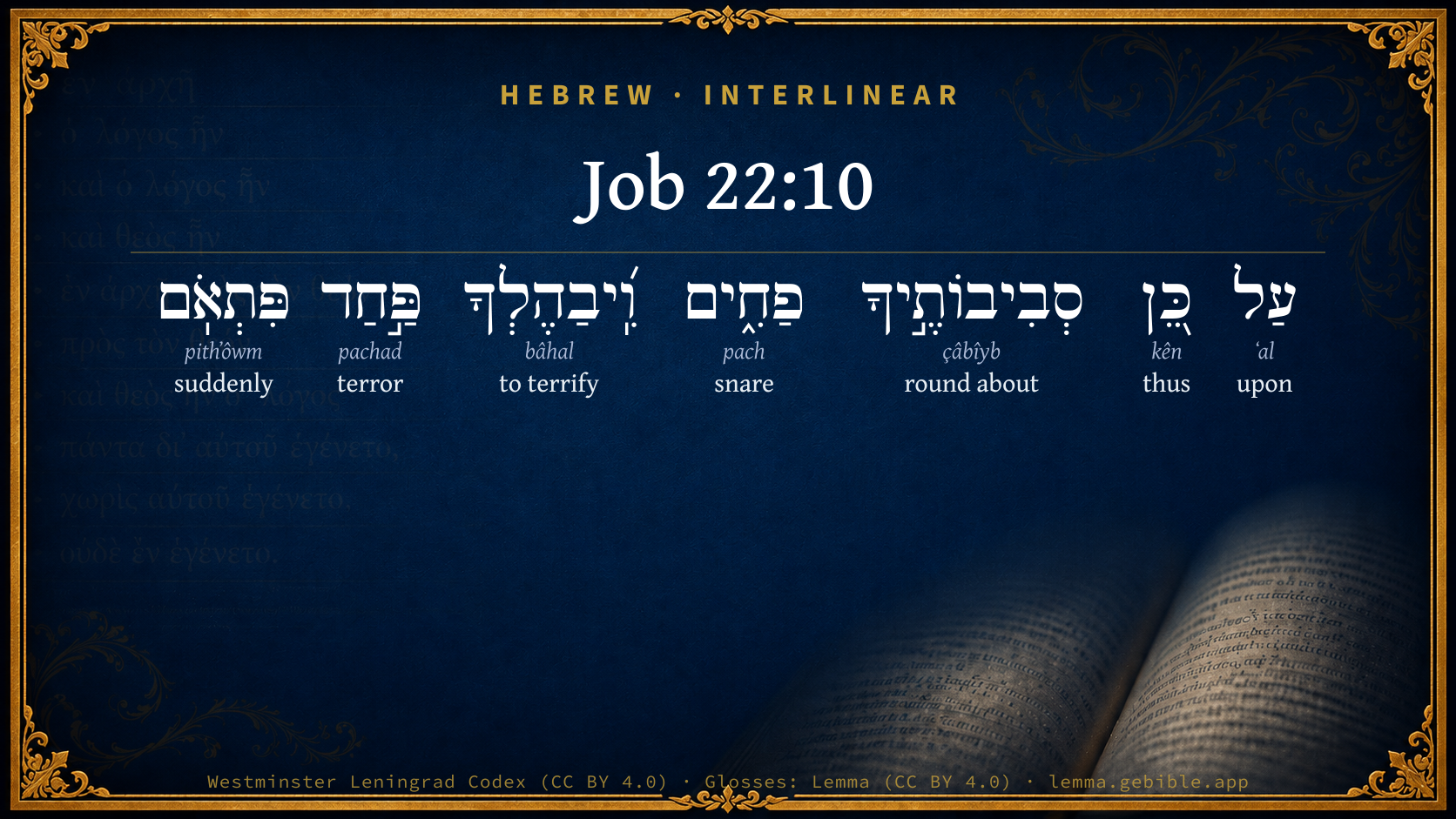
Job 22:10

Hebrew (Westminster Leningrad Codex) Job 22:10 appears in the Hebrew Old Testament. The text above is from the Westminster Leningrad Codex. Each word links to its Strong’s number, a concise gloss, and parsing drawn from the Open Scriptures Hebrew Bible morphology. Click any word for its full Brown-Driver-Briggs (BDB) entry.
Download image
Cite this verse

Job 22:10 (World English Bible). Public Domain. Lemma interlinear Bible study tool, https://lemma.gebible.app/v/job/22/10.

Show BibTeX & RIS
BibTeX
RIS
English Translation
Therefore snares are round about you. Sudden fear troubles you,
World English Bible · Public Domain
Download a study sheet

One document with this verse’s original text, its word-by-word gloss line, the meaning frame, cross-references with their text, attributed commentary, and full source and license credits — printable, and it pastes into notes with its structure intact.

This verse Autodidact and up

Study sheet (.html) Plain text (.txt)

A passage Seminary Student

Up to 50 verses in one chapter. A passage sheet keeps up to 6 commentary sources and 12 cross-references per verse, in the order this page ranks them, and says so on the sheet whenever that leaves anything out. Ask for a single verse and you get the Autodidact verse sheet above.

Everything on this page stays free to read, with no account — the sheet is a download of what is already on screen, not access to it.

Want to remove ads? Support Godless Engineer
Compare translations 3

The same verse in 3 English versions, stacked beneath the original-language interlinear above. Click any original word for its lexicon entry.

Each is an independent rendering of the whole verse — the interlinear is not word-aligned to these translations.

Highlighted words mark where these versions differ — a whole-verse word diff, not a word-by-word alignment.

  • World English Bible Public Domain
    Therefore snares are round about you. Sudden fear troubles you,
  • King James Version Public Domain
    Therefore snares are round about thee, and sudden fear troubleth thee;
  • unfoldingWord Literal Text CC BY-SA 4.0
    Therefore snares around you and fear suddenly terrifies you.

unfoldingWord Literal Text — © unfoldingWord, licensed CC BY-SA 4.0. Word-aligned USFM3 via Door43 (git.door43.org/unfoldingWord/en_ult).

Versions to compare (up to 4)

3 of 4 selected

Show all 18 translations

Every available English version of this verse, each an independent rendering of the whole verse.

  • World English Bible Public Domain
    Therefore snares are round about you. Sudden fear troubles you,
  • Berean Standard Bible Public Domain
    Therefore snares surround you, and sudden peril terrifies you;
  • Majority Standard Bible Public Domain
    Therefore snares surround you, and sudden peril terrifies you;
  • King James Version Public Domain
    Therefore snares are round about thee, and sudden fear troubleth thee;
  • American Standard Version (1901) Public Domain
    Therefore snares are round about thee, And sudden fear troubleth thee,
  • Revised Version (1885) Public Domain
    Therefore snares are round about thee, and sudden fear troubleth thee,
  • Geneva Bible (1599) Public Domain
    Therefore snares are round about thee, and feare shall suddenly trouble thee:
  • Douay-Rheims (1899) Public Domain
    Therefore art thou surrounded with snares, and sudden fear troubleth thee.
  • Young's Literal Translation Public Domain
    Therefore round about thee `are' snares, And trouble thee doth fear suddenly.
  • Literal Standard Version CC BY-SA 4.0
    Therefore snares [are] all around you, || And sudden fear troubles you.
  • Unlocked Literal Bible CC BY-SA 4.0
    Therefore, snares are all around you, and sudden fear troubles you.
  • unfoldingWord Literal Text CC BY-SA 4.0
    Therefore snares around you and fear suddenly terrifies you.
  • Darby Bible Public Domain
    Therefore snares are round about thee, and sudden fear troubleth thee;
  • World Messianic Bible Public Domain
    Therefore snares are around you. Sudden fear troubles you,
  • Webster's Bible Public Domain
    Therefore snares are around thee, and sudden fear troubleth thee;
  • Free Bible Version CC BY-SA 4.0
    That's why you're surrounded by traps to catch you, and why you suddenly panic in terror.
  • Bible in Basic English Public Domain
    For this cause nets are round your feet, and you are overcome with sudden fear.
  • JPS Tanakh (1917) Public Domain
    Therefore snares are round about thee, and sudden dread affrighted thee,

Literal Standard Version (2020), Covenant Press — licensed CC BY-SA 4.0. Text via the HelloAO Bible API (eBible.org). Unlocked Literal Bible (unfoldingWord) — licensed CC BY-SA 4.0. Text via the HelloAO Bible API (eBible.org). unfoldingWord Literal Text — © unfoldingWord, licensed CC BY-SA 4.0. Word-aligned USFM3 via Door43 (git.door43.org/unfoldingWord/en_ult). Free Bible Version, Dr. Jonathan Gallagher — licensed CC BY-SA 4.0. Text via the HelloAO Bible API (eBible.org).

Word by word

More ways to search: Search by grammar → Find every occurrence → Compare this word →

Practice this passage: Drill this verse → Learn its vocabulary →

About this verse

These counts appear in no published source. They are computed here, from the morphology-tagged text and Lemma’s own curated glosses. What Lemma adds →

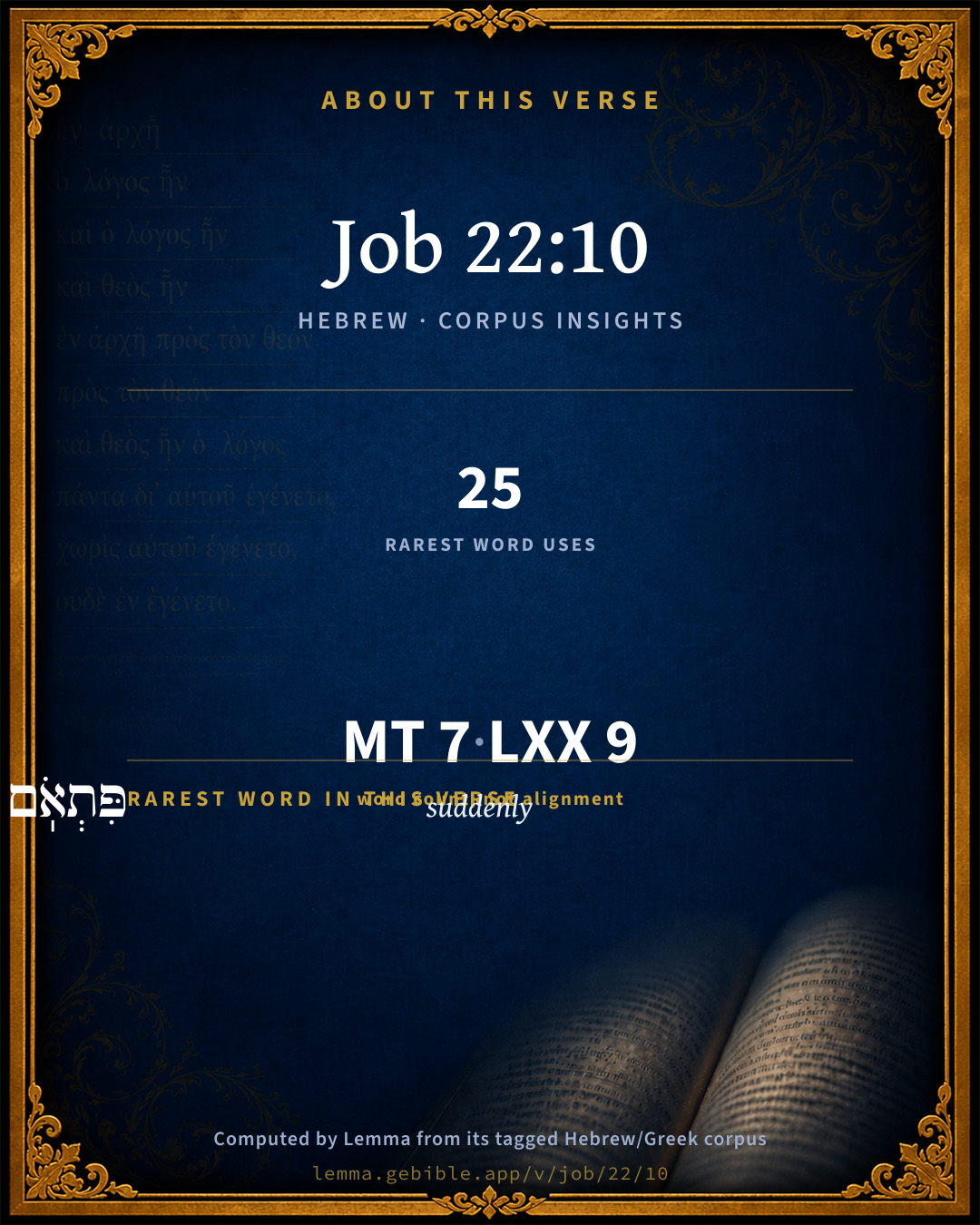
7
words
7
distinct lemmas
Wisdom
section

Notable vocabulary

The rarest word here is פִּתְאֹֽם suddenly H6597 — appearing just 25 times in the whole Hebrew Bible.

Shared distinctive vocabulary

פִּתְאֹֽם suddenly H6597 occurs in 25 verses of the Hebrew Bible. Also found in:

Grammatical profile

  • 1 verb
  • 3 nouns
  • 1 preposition
  • 1 adverb
  • 1 particle

Verb forms

  • וִֽ֝יבַהֶלְךָ Piel · Imperfect

Hebrew & Septuagint length

In English translation the verse runs 10 words from the Hebrew and 11 from the Septuagint (LXX English) — closely comparable.

A rough comparison of the two English renderings, which tokenize alike — not a word-level alignment.

Word counts can differ between the Hebrew and the Greek without any difference in meaning — e.g. the Hebrew direct-object marker אֵת has no separate Greek word, and Greek often adds the article ὁ.

In the original languages it is 7 Hebrew tokens and 9 Greek tokens — but the two are counted differently (Hebrew bundles its prefixes and suffixes into one token; the Greek is in lemma form), so that isn’t a like-for-like length.

Cross-references

8

Topical passages linked to Job 22:10 in the Treasury of Scripture Knowledge — connected by theme and wording, ordered by reader-vote popularity; previews shown in the World English Bible.

  • Job 6:4 For the arrows of the Almighty are within me, My spirit drinks up their poison. The terrors of God set themselves in array against me.
  • Job 13:21 Withdraw your hand far from me; And don't let your terror make me afraid.
  • Job 18:8–10 For he is cast into a net by his own feet, And he wanders into its mesh.
  • Job 19:6 Know now that God has subverted me, And has surrounded me with his net.
  • Psalms 11:6 On the wicked he will rain blazing coals; Fire, sulfur, and scorching wind shall be the portion of their cup.
  • Proverbs 1:27 When calamity overtakes you like a storm, When your disaster comes on like a whirlwind; When distress and anguish come on you.
  • 1 Thessalonians 5:3 For when they are saying, "Peace and safety," then sudden destruction will come on them, like birth pains on a pregnant woman; and they will in no way escape.
  • Proverbs 3:25–26 Don't be afraid of sudden fear, Neither of the desolation of the wicked, when it comes:

Cross-references courtesy of OpenBible.info (CC BY 4.0).

Hebrew and Greek witnesses Masoretic Hebrew ↔ Greek Septuagint

The same verse in the two great witnesses to the Old Testament, shown verse-for-verse.

These are two independent witnesses, not word-aligned to each other, and the Septuagint is shown in lemma (dictionary) form.

Hebrew Job 22:10 Masoretic · Westminster Leningrad Codex

עַל כֵּ֭ן סְבִיבוֹתֶ֣יךָ פַחִ֑ים וִֽ֝יבַהֶלְךָ פַּ֣חַד פִּתְאֹֽם

Therefore snares are round about you. Sudden fear troubles you,

World English Bible · Public Domain

Greek LXX Job 22:10 Septuagint · lemma form

τοιγαροῦν κυκλόω σύ παγίς καί σπουδάζω σύ πόλεμος ἐξαίσιος

Therefore snares have compassed you, and disastrous war has troubled you.

LXX2012 (modern English Septuagint) · Public Domain

Hebrew: Westminster Leningrad Codex (CC BY 4.0). Greek: Septuagint (public domain); English from LXX2012 (modern English Septuagint) (Public Domain). How the Septuagint differs from the Hebrew →

Commentary

Notes on Job 22:10 from classic Christian and Jewish commentators (each source and its license shown beneath its notes). The classic Christian expositions comment on the surrounding passage and are grouped to its opening verse, so a note may address several verses; the Jewish commentaries on the Tanakh (Rashi and others) are per-verse, so they appear only where the commentator wrote on this verse.

Lemma curates 59 commentaries, every one of them public domain or Creative Commons licensed, each selected and text-cleaned for this edition rather than reprinted as found. About our sources →

Trapp's Complete Commentary

John Trapp

Job 22:10 Therefore snares [are] round about thee, and sudden fear troubleth thee;

Ver. 10. Therefore snares are round about thee] Flagitium et flagellum sunt sicut acus et filum, Sin and punishment are tied together with chains of adamant. Eliphaz having with more earnestness than truth set forth Job’s sins, now discourseth about his snares. Four punishments he assureth him of, and every one worse than the other. 1. He shall be ensnared; 2. Frightened; 3. Benighted; 4. Overwhelmed, if repentance step not in and take up the matter, as Job 22:22. And it is as if he should say, Seek not after any other cause of thy calamities than thy before mentioned wickedness; neither seek any other way to get off than by confessing and forsaking them, that thou mayest have mercy.

And sudden fear troubleth thee] Fear is a troublesome passion; and sudden evils are very terrible, because they expectorate a man’s abilities, and render him helpless, shiftless, comfortless. See this in Saul, who, surprised with sudden horror at his destiny read him by the devil, fell straightway all along on the earth like an ox, and was sore afraid, and there was no strength in him, 1Sa 28:20. Job also had his fears, but then he had his cordials too, that kept him from falling under them.

John Trapp, A Commentary or Exposition upon All the Books of the Old and New Testament (1647–1656) — public domain. Text from a community e-Sword module.

Joseph Benson's Commentary

Job 22:10-11. Therefore snares are round about thee — For these and the like crimes thou art encompassed with dangers and calamities. And sudden fear troubleth thee — Besides thy present miseries, thou art tormented with the dread of further and greater judgments. Or darkness, that thou canst not see — Such confusion and perplexity of mind that thou canst not discern the true cause and use of thy sufferings; or grievous calamities, often called darkness, which are such that thou canst see no way or possibility of escaping; and abundance of waters cover thee — That is, a variety of sore afflictions, frequently compared to waters.

Joseph Benson's Commentary on the Old and New Testaments (1811–1818) — public domain. Text from a community e-Sword module.

Jamieson, Fausset & Brown

Robert Jamieson, A. R. Fausset & David Brown

snares--alluding to Job's admission (Job 19:6; compare Job 18:10; Pro 22:5).

Jamieson, Fausset & Brown — Commentary Critical and Explanatory on the Whole Bible (1871) — public domain (CC PDM 1.0). Text via the HelloAO Bible API.

Adam Clarke's Commentary

Verse 10. Therefore snares] As thou hast dealt with others, so has God, in his retributive providence, dealt with thee. As thou hast spoiled, so art thou spoiled. Thou art taken in a net from which thou canst not escape. There is an allusion here to the hunting of the elephant: he is driven into an inclosure in the woods, passing from strait to strait, till brought into a narrow point, from which he cannot escape; and then his consternation is great, and his roaring terrible. God hath hunted thee down, as men hunt down those wild and dangerous beasts. See on Job 18:21

Adam Clarke's Commentary on the Bible (1810–1826) — public domain. Text from a community e-Sword/MySword module.

Ellicott's Commentary for English Readers

(10, 11) Snares . . . about thee.—That is, Fear troubleth thee, or darkness, &c. “If darkness and abundance of waters cover thee so that thou canst not see, is not God in the high heavens, though thou canst not see Him. God is too great to take note of the affairs of men, their sin or their good deeds. He is so far off that He cannot see what goes on in the earth, for His dwelling-place is in heaven.” Eliphaz attributes to Job the kind of sentiments that he had himself attributed to the wicked man in the last chapter, Job_22:14, &c.

A Bible Commentary for English Readers, edited by Charles John Ellicott (1878–1897) — public domain. Text from a community e-Sword module.

The Cambridge Bible for Schools and Colleges

gen. ed. J. J. S. Perowne

10, 11. The consequence of this inhumanity and injustice is seen in the snares and terrors from God that surround Job.

11. This verse should probably be read,

Or seest thou not the darkness,

And the floods of waters that cover thee?

i. e. dost thou not perceive the true meaning of the darkness and the overwhelming calamities that have come on thee? On the figures comp. ch. Job_18:18; Job_11:16; Job_27:20. See Job’s reply, ch. Job_23:16-17.

The Cambridge Bible for Schools and Colleges (gen. ed. J. J. S. Perowne; Cambridge University Press, 1878–1918) — public domain. Text from a community e-Sword module.

John Gill's Exposition

Or darkness, that thou canst not see,.... Or darkness is round about thee, thou art enveloped in it; meaning either judicial blindness, and darkness, and stupidity of mind, which must be his case, if he could not see the hand of God upon him, or the snares that were about him, or was not troubled with sudden fear; or else the darkness of affliction and calamity, which is often signified hereby, see Isa 8:22; afflictive dispensations of Providence are sometimes so dark, that a man cannot see the cause and reason of them, or why it is he is brought into them; which was Job's case, and therefore desires God would show him wherefore he contended with him, Job 10:9; nor can he see, perceive, or enjoy any light of comfort; he is in inward darkness of soul, deprived of the light of God's countenance, as well as he is in the outward darkness of adversity, which is a most uncomfortable case, as it was this good man's; nor can he see any end of the affliction, or any way to escape out of it, and which were the present circumstances Job was in:

and abundance of waters cover thee; afflictions, which are frequently compared to many waters, and floods of them, because of the multitude of them, their force and strength, the power and rapidity with which they come; and because overflowing, overbearing, and overwhelming, and threaten with utter ruin and destruction, unless stopped by the mighty hand of God, who only can resist and restrain them; Eliphaz represents Job like a man drowning, overflowed with a flood of water, and covered with its waves, and in the most desperate condition, see Psa 69:1.

John Gill's Exposition of the Whole Bible (1746–1763) — public domain (CC PDM 1.0). Text via the HelloAO Bible API.

Albert Barnes' Notes on the Bible

Therefore snares are round about thee - “Snares” were used for catching wild animals and birds, and the word then came to denote any sudden calamity; see Job 18:8-10. Eliphaz here says, that it “must be” that these calamities came upon Job in consequence of such sins as he had specified. About that he took it for granted there could be no dispute.

And sudden fear - The calamities of Job came upon him suddenly Job 1. It was to this, doubtless, that Eliphaz alluded.

Albert Barnes' Notes on the Bible (1834–1885) — public domain. Text from a community e-Sword/MySword module.

Matthew Poole's English Annotations

For these and the like crimes. The cause of thy ruin is not secret from God’s sovereign power, and unsearchable judgments, (as thou pretendest,) but plain and manifest, even thy own crying sins.

Snares are round about thee; thou art encompassed with dangers and calamities.

Sudden fear: beside thy present miseries, thou art tormented with the dread and expectation of further and sorer judgments.

Matthew Poole's English Annotations on the Holy Bible (1683–1685) — public domain. Text from a community e-Sword/MySword module.

The Pulpit Commentary

Therefore snares are round about thee. As Bildad had threatened, (Job_18:8-10) and as Job himself had acknowledged. (Job_19:6) And sudden fear troubleth thee. (comp. Job_3:25 Job_7:14 Job_13:21, etc.)

The Pulpit Commentary (1880–1919), ed. H.D.M. Spence-Jones & Joseph S. Exell — public domain. Text from a community e-Sword module.

Keil & Delitzsch

C. F. Keil & F. Delitzsch

10 Therefore snares are round about thee,

And fear terrifieth thee suddenly;

11 Or percievest thou not the darkness,

And the overflow of waters, which covereth thee?

On account of this inhuman mode of action by which he has challenged the punishment of justice, snares are round about him (comp. Bildad's picture of this fate of the evil-doer, Job 18:8-10), destruction encompasses him on every side, so that he sees no way out, and must without any escape succumb to it. And the approaching ruin makes itself known to him time after time by terrors which come suddenly upon him and disconcert him; so that his outward circumstances being deranged and his mind discomposed, he has already in anticipation to taste that which is before him. In Job 22:11, לא תראה is by no means to be taken as an eventual circumstantial clause, whether it is translated affirmatively: or darkness (covers thee), that thou canst not see; or interrogatively: or does darkness (surround thee), that thou seest not? In both cases the verb in the principal clause is wanting; apart from the new turn, which או introduces, being none, it would then have to be explained with Lwenthal: or has the habit of sinning already so dulled thy feeling and darkened thine eye, that thou canst not perceive the enormity of thy transgression? But this is a meaning forced from the words which they are not capable of; it must have been at least או חשׁך בּעדך, or something similar. Since או חשׁך (to be accented without Makkeph with Mnach, Dech) cannot form a principal clause of itself, תראה is without doubt the verb belonging to it: or (או as Job 16:3) seest thou not darkness? Because, according to his preceding speeches, Job does not question the magnitude of his sufferings, but acknowledges them in all their fearfulness; therefore Hahn believes it must be explained: or shouldst thou really not be willing to see thy sins, which encompass thee as thick dark clouds, which cover thee as floods of water? The two figures, however, can only be understood of the destruction which entirely shrouds Job in darkness, and threatens to drown him. But destruction, in the sense in which Eliphaz asks if Job does not see it, is certainly intended differently to what it was in Job's complaints. Job complains of it as being unmerited, and therefore mysterious; Eliphaz, on the other hand, is desirous that he should open his eyes that he may perceive in this darkness of sorrow, this flood of suffering, the well-deserved punishment of his heinous sins, and anticipate the worst by penitence. לא תכסּךּ is a relative clause, and belongs logically also to חשׁך, comp. Isa 60:2, where שׁפעת is also found in Job 22:6 (from שׁפע, abundare; comp. Arab. šf‛, ספק, Job 20:22). Eliphaz now insinuates that Job denies the special providence of God, because he doubts the exceptionless, just government of God. In the second strophe he has explained his affliction as the result of his uncharitableness; now he explains it as the result of his unbelief, which is now become manifest.

Keil & Delitzsch — Biblical Commentary on the Old Testament (1861–1891) — public domain (CC PDM 1.0). Text via the HelloAO Bible API. (Old Testament only.)

Lesson kit

Teaching starters — assembled from the data on this page, not authored interpretation. Every prompt links to the verse data it draws on. Edit before teaching.

Job, in the Wisdom, opens this verse with 7 words (7 distinct Hebrew lemmas). Its most distinctive word is pithʼôwm (“suddenly”). A historical commentator’s framing appears above. Read the whole chapter for the surrounding context.

Discussion questions

  1. What does “suddenly” (pithʼôwm) contribute to the verse as a whole?
  2. Numbers 6:9 shares the word «suddenly» with this verse. How do the two illuminate each other?
  3. The translations on this page render this verse differently — a whole-verse word diff, not a word-by-word alignment. What might account for the different wordings?
  4. The verb «וִֽ֝יבַהֶלְךָ» is Piel Imperfect. How does its form color the action?
  5. Reading how Trapp's Complete Commentary and Joseph Benson's Commentary read this verse, where do the two commentators agree and where do they part?

Things to notice

Reading settings

Reading text

Shown beneath each verse's original-language words.

Old Testament
Old Testament edition

Read the OT as the Masoretic Hebrew (MT) or the Greek Septuagint (LXX).

English shown for the Greek Septuagint (in the Hebrew ↔ Greek comparison).

Comparing translations? Open the Compare panel on any verse page to stack up to four side by side.