
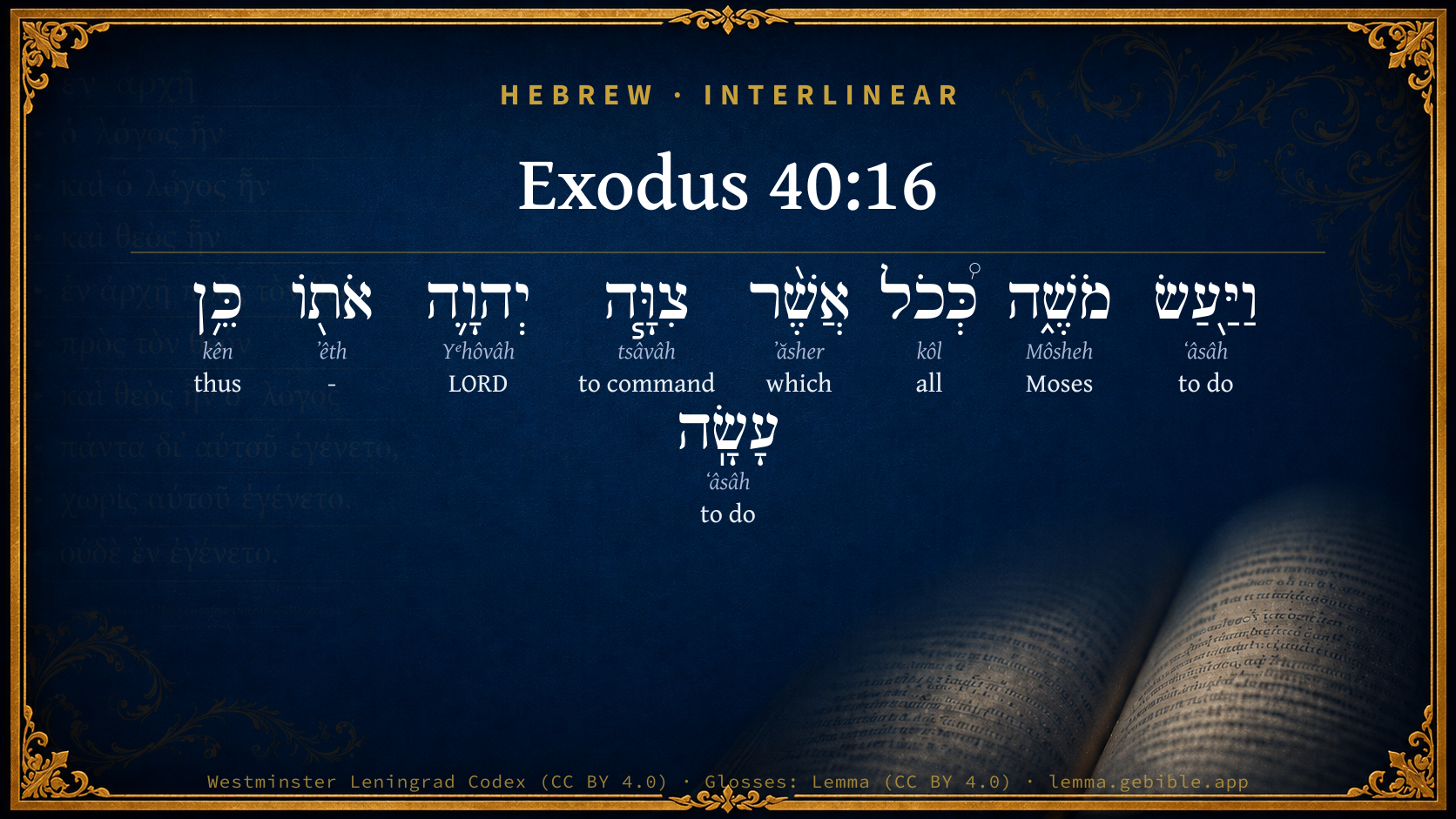
Exodus 40:16

Hebrew (Westminster Leningrad Codex) Exodus 40:16 appears in the Hebrew Old Testament. The text above is from the Westminster Leningrad Codex. Each word links to its Strong’s number, a concise gloss, and parsing drawn from the Open Scriptures Hebrew Bible morphology. Click any word for its full Brown-Driver-Briggs (BDB) entry.
Download image
Cite this verse

Exodus 40:16 (World English Bible). Public Domain. Lemma interlinear Bible study tool, https://lemma.gebible.app/v/exodus/40/16.

Show BibTeX & RIS
BibTeX
RIS
English Translation
Thus did Moses: according to all that Yahweh commanded him, so he did.
World English Bible · Public Domain
Download a study sheet

One document with this verse’s original text, its word-by-word gloss line, the meaning frame, cross-references with their text, attributed commentary, and full source and license credits — printable, and it pastes into notes with its structure intact.

This verse Autodidact and up

Study sheet (.html) Plain text (.txt)

A passage Seminary Student

Up to 50 verses in one chapter. A passage sheet keeps up to 6 commentary sources and 12 cross-references per verse, in the order this page ranks them, and says so on the sheet whenever that leaves anything out. Ask for a single verse and you get the Autodidact verse sheet above.

Everything on this page stays free to read, with no account — the sheet is a download of what is already on screen, not access to it.

Want to remove ads? Support Godless Engineer
Compare translations 3

The same verse in 3 English versions, stacked beneath the original-language interlinear above. Click any original word for its lexicon entry.

Each is an independent rendering of the whole verse — the interlinear is not word-aligned to these translations.

Highlighted words mark where these versions differ — a whole-verse word diff, not a word-by-word alignment.

  • World English Bible Public Domain
    Thus did Moses: according to all that Yahweh commanded him, so he did.
  • King James Version Public Domain
    Thus did Moses: according to all that the LORD commanded him, so did he.
  • unfoldingWord Literal Text CC BY-SA 4.0
    And Moses did according to all that Yahweh had commanded him. Thus he did.

unfoldingWord Literal Text — © unfoldingWord, licensed CC BY-SA 4.0. Word-aligned USFM3 via Door43 (git.door43.org/unfoldingWord/en_ult).

Versions to compare (up to 4)

3 of 4 selected

Show all 18 translations

Every available English version of this verse, each an independent rendering of the whole verse.

  • World English Bible Public Domain
    Thus did Moses: according to all that Yahweh commanded him, so he did.
  • Berean Standard Bible Public Domain
    Moses did everything just as the LORD had commanded him.
  • Majority Standard Bible Public Domain
    Moses did everything just as the LORD had commanded him.
  • King James Version Public Domain
    Thus did Moses: according to all that the LORD commanded him, so did he.
  • American Standard Version (1901) Public Domain
    Thus did Moses: according to all that Jehovah commanded him, so did he.
  • Revised Version (1885) Public Domain
    Thus did Moses: according to all that the LORD commanded him, so did he.
  • Geneva Bible (1599) Public Domain
    So Moses did according to all that ye Lord had commanded him: so did he.
  • Douay-Rheims (1899) Public Domain
    And Moses reared it up, and placed the boards and the sockets and the bars, and set up the pillars,
  • Young's Literal Translation Public Domain
    And Moses doth according to all that Jehovah hath commanded him; so he hath done.
  • Literal Standard Version CC BY-SA 4.0
    And Moses does according to all that YHWH has commanded him; so he has done.
  • Unlocked Literal Bible CC BY-SA 4.0
    This is what Moses did; he followed all that Yahweh had commanded him. He did all these things.
  • unfoldingWord Literal Text CC BY-SA 4.0
    And Moses did according to all that Yahweh had commanded him. Thus he did.
  • Darby Bible Public Domain
    And Moses did so: as Jehovah had commanded him, so did he.
  • World Messianic Bible Public Domain
    Moses did so. According to all that the LORD commanded him, so he did.
  • Webster's Bible Public Domain
    Thus did Moses; according to all that the LORD commanded him, so did he.
  • Free Bible Version CC BY-SA 4.0
    Moses carried out all the Lord's instructions.
  • Bible in Basic English Public Domain
    And Moses did this; as the Lord gave him orders, so he did.
  • JPS Tanakh (1917) Public Domain
    Thus did Moses; according to all that the LORD commanded him, so did he.

Literal Standard Version (2020), Covenant Press — licensed CC BY-SA 4.0. Text via the HelloAO Bible API (eBible.org). Unlocked Literal Bible (unfoldingWord) — licensed CC BY-SA 4.0. Text via the HelloAO Bible API (eBible.org). unfoldingWord Literal Text — © unfoldingWord, licensed CC BY-SA 4.0. Word-aligned USFM3 via Door43 (git.door43.org/unfoldingWord/en_ult). Free Bible Version, Dr. Jonathan Gallagher — licensed CC BY-SA 4.0. Text via the HelloAO Bible API (eBible.org).

Word by word

More ways to search: Search by grammar → Find every occurrence → Compare this word →

Practice this passage: Drill this verse → Learn its vocabulary →

צִוָּ֧ה
tsâvâh
H6680
“to command”
Verb, Piel, Perfect, 3rd Person, Masculine, Singular
Part of Speech
Verb
Stem
Piel
Form
Perfect
Person
3rd Person
Gender
Masculine
Number
Singular
Full BDB Definition

Origin: a primitive root

TWOT: 1887

to command, charge, give orders, lay charge, give charge to, order - (Piel) - to lay charge upon - to give charge to, give command to - to give charge unto - to give charge over, appoint - to give charge, command - to charge, command - to charge, commission - to command, appoint, ordain (of divine act) - (Pual) to be commanded
  1. וַיַּ֖עַשׂ ʻâsâh H6213 “and · to do” Conjunction + Verb, Qal, Sequential Imperfect, 3rd Person, Masculine, Singular
  2. מֹשֶׁ֑ה Môsheh H4872 “Moses” Noun, Proper
  3. כְּ֠כֹל kôl H3605 “like/as · all” Preposition + Noun, Common, Masculine, Singular, Absolute
  4. אֲשֶׁ֨ר ʼăsher H834 “which” Particle, Relative
  5. יְהוָ֛ה Yᵉhôvâh H3068 “LORD” Noun, Proper
  6. אֹת֖וֹ ʼêth H853 “- · him” Particle, Direct Object + Suffix, Personal, 3rd Person, Masculine, Singular
  7. כֵּ֥ן kên H3651 “thus” Particle, Demonstrative
  8. עָשָֽׂה ʻâsâh H6213 “to do” Verb, Qal, Perfect, 3rd Person, Masculine, Singular

About this verse

These counts appear in no published source. They are computed here, from the morphology-tagged text and Lemma’s own curated glosses. What Lemma adds →

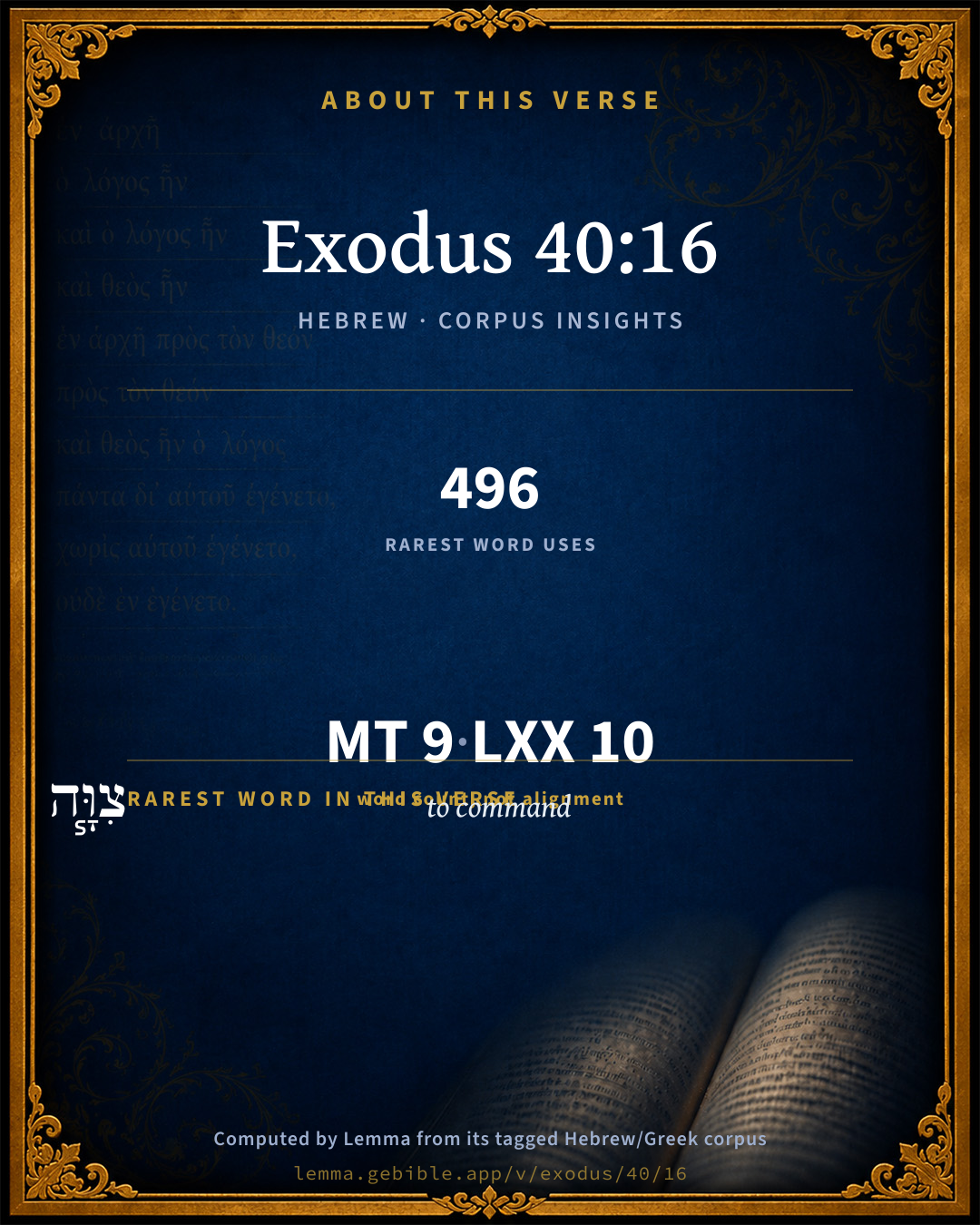
9
words
8
distinct lemmas
Pentateuch
section

Grammatical profile

  • 3 verbs
  • 3 nouns
  • 3 particles

Verb forms

  • וַיַּ֖עַשׂ Qal · Sequential Imperfect
  • צִוָּ֧ה Piel · Perfect
  • עָשָֽׂה Qal · Perfect

Repetition

A word recurs within this verse — often emphatic in Hebrew:

  • וַיַּ֖עַשׂ to do H6213 ×2

Hebrew & Septuagint length

In English translation the verse runs 13 words from the Hebrew and 13 from the Septuagint (LXX English) — the same length.

A rough comparison of the two English renderings, which tokenize alike — not a word-level alignment.

Word counts can differ between the Hebrew and the Greek without any difference in meaning — e.g. the Hebrew direct-object marker אֵת has no separate Greek word, and Greek often adds the article ὁ.

In the original languages it is 9 Hebrew tokens and 10 Greek tokens — but the two are counted differently (Hebrew bundles its prefixes and suffixes into one token; the Greek is in lemma form), so that isn’t a like-for-like length.

Cross-references

8

Topical passages linked to Exodus 40:16 in the Treasury of Scripture Knowledge — connected by theme and wording, ordered by reader-vote popularity; previews shown in the World English Bible.

  • Exodus 40:17–32 It happened in the first month in the second year, on the first day of the month, that the tent was raised up.
  • Deuteronomy 4:1 Now, Israel, listen to the statutes and to the ordinances, which I teach you, to do them; that you may live, and go in and possess the land which Yahweh, the God of your fathers, gives you.
  • 1 Corinthians 4:2 Here, moreover, it is required of stewards, that they be found faithful.
  • Exodus 23:21–22 Pay attention to him, and listen to his voice. Don't provoke him, for he will not pardon your disobedience, for my name is in him.
  • Exodus 39:42–43 According to all that Yahweh commanded Moses, so the children of Israel did all the work.
  • Deuteronomy 12:32 Whatever thing I command you, that shall you observe to do: you shall not add thereto, nor diminish from it.
  • Isaiah 8:20 To the law and to the testimony! if they don't speak according to this word, surely there is no morning for them.
  • Matthew 28:20 teaching them to observe all things that I commanded you. Behold, I am with you always, even to the end of the age." Amen.

Cross-references courtesy of OpenBible.info (CC BY 4.0).

Hebrew and Greek witnesses Masoretic Hebrew ↔ Greek Septuagint

The same verse in the two great witnesses to the Old Testament, shown verse-for-verse.

These are two independent witnesses, not word-aligned to each other, and the Septuagint is shown in lemma (dictionary) form.

Hebrew Exodus 40:16 Masoretic · Westminster Leningrad Codex

וַיַּ֖עַשׂ מֹשֶׁ֑ה כְּ֠כֹל אֲשֶׁ֨ר צִוָּ֧ה יְהוָ֛ה אֹת֖וֹ כֵּ֥ן עָשָֽׂה

Thus did Moses: according to all that Yahweh commanded him, so he did.

World English Bible · Public Domain

Greek LXX Exodus 40:16 Septuagint · lemma form

καί ποιέω μωυσῆς πᾶς ὅσος ἐντέλλομαι αὐτός κύριος οὕτως ποιέω

And Moses did all things whatever the Lord commanded him, so did he.

LXX2012 (modern English Septuagint) · Public Domain

Hebrew: Westminster Leningrad Codex (CC BY 4.0). Greek: Septuagint (public domain); English from LXX2012 (modern English Septuagint) (Public Domain). How the Septuagint differs from the Hebrew →

Targum (Aramaic paraphrase)

2

The Targum is the ancient Jewish Aramaic paraphrase of the Hebrew Scriptures — an interpretive translation, not the Hebrew text itself. Onkelos (literal) and Pseudo-Jonathan (expansive) render the Torah, and Jonathan the Prophets. Coverage is partial: where no permissively-licensed English translation exists for a verse, only the Aramaic is shown. This is verse-level text, not a word-by-word alignment to the Hebrew.

  1. Targum Onkelos Torah (Genesis–Deuteronomy)
    וַעֲבַד משֶׁה כְּכֹל דִי פַקִיד יְיָ יָתֵהּ כֵּן עֲבָד:

    (no public-domain English translation for this verse)

    Targum Onkelos — Aramaic: “Onkelos Genesis” (public domain); “Onkelos Exodus” (public domain); “Onkelos Leviticus” (public domain); “Onkelos Numbers” (public domain); “Onkelos Deuteronomy” (public domain). English: “Sefaria Community Translation” (CC0 1.0 (public-domain dedication)); “J.W. Etheridge. The Targums of Onkelos and Jonathan Ben Uzziel on the Pentateuch. London: Longmans, Green, 1862” (public domain). Text via Sefaria.

  2. Targum Pseudo-Jonathan Torah (Genesis–Deuteronomy)
    וְעָבַד משֶׁה הֵי כְּכָל מַה דְּפַקֵּיד יְיָ יָתֵיהּ הֵיכְדֵין עֲבָד

    And Mosheh did all that the Lord commanded, so did he.

    Targum Pseudo-Jonathan — Aramaic: “Targum Jonathan on Genesis” (public domain); “Targum Jonathan on Exodus” (public domain); “Targum Jonathan on Leviticus” (public domain); “Targum Jonathan on Numbers” (public domain); “Targum Jonathan on Deuteronomy” (public domain). English: “The Targum of Jonathan ben Uzziel, trans. J. W. Etheridge, London, 1862” (public domain). Text via Sefaria.

Commentary

Notes on Exodus 40:16 from classic Christian and Jewish commentators (each source and its license shown beneath its notes). The classic Christian expositions comment on the surrounding passage and are grouped to its opening verse, so a note may address several verses; the Jewish commentaries on the Tanakh (Rashi and others) are per-verse, so they appear only where the commentator wrote on this verse.

Lemma curates 59 commentaries, every one of them public domain or Creative Commons licensed, each selected and text-cleaned for this edition rather than reprinted as found. About our sources →

Matthew Henry's Commentary

When the tabernacle and the furniture of it were prepared, they did not put off the rearing of it till they came to Canaan, though they now hoped to be there very shortly; but, in obedience to the will of God, they set it up in the midst of their camp, while they were in the wilderness. Those that are unsettled in the world must not think that this will excuse them in their continued irreligion; as if it were enough to begin to serve God when they begin to be settled in the world. No; a tabernacle for God is a very needful and profitable companion even in a wilderness, especially considering that our carcases may fall in that wilderness, and we may be fixed in another world before we come to fix in this.

The rearing of the tabernacle was a good day's work; the consecrating of it, and of the priests, was attended to some days after. Here we have an account only of that new-year's-day's work. 1. Moses not only did all that God directed him to do, but in the order that God appointed; for God will be sought in the due order. 2. To each particular there is added an express reference to the divine appointment, which Moses governed himself by as carefully and conscientiously as the workmen did; and therefore, as before, so here it is repeated, as the Lord commanded Moses, seven times in less than fourteen verses. Moses himself, as great a man as he was, would not pretend to vary from the institution, neither to add to it nor diminish from it, in the least punctilio. Those that command others must remember that their Master also is in heaven, and they must do as they are commanded. 3. That which was to be veiled be veiled (Exo 40:21), and that which was to be used he used immediately, for the instruction of the priests, that by seeing him do the several offices they might learn to do them the more dexterously. Though Moses was not properly a priest, yet he is numbered among the priests (Psa 99:6), and the Jewish writers call him the priest of the priests; what he did he did by special warrant and direction from God, rather as a prophet, or law-giver, than as a priest. He set the wheels a going, and then left the work in the hands of the appointed ministry. (1.) When he had placed the table, he set the show-bread in order upon it (Exo 40:23); for God will never have his table unfurnished. (2.) As soon as he had fixed the candlestick, he lighted the lamps before the Lord, Exo 40:25. Even that dark dispensation would not admit of unlighted candles. (3.) The golden altar being put in its place, immediately he burnt sweet incense thereon (Exo 40:27); for God's altar must be a smoking altar. (4.) The altar of the burnt-offering was no sooner set up in the court of the tabernacle than he had a burnt-offering, and a meat-offering, ready to offer upon it, Exo 40:29. Some think, though this is mentioned here, it was not done till some time after; but it seems to me that he immediately began the ceremony of its consecration, though it was not completed for seven days. (5.) At the laver likewise, when he had fixed that, Moses himself washed his hands and feet. Thus, in all these instances, he not only showed the priests how to do their duty, but has taught us that God's gifts are intended for use, and not barely for show. Though the altars, and table, and candlestick, were fresh and new, he did not say it was a pity to sully them; no, he handselled them immediately. Talents were given to be occupied, not to be buried.

Matthew Henry's Commentary on the Whole Bible (1708–1710) — public domain (CC PDM 1.0). Text via the HelloAO Bible API.

Jamieson, Fausset & Brown

Robert Jamieson, A. R. Fausset & David Brown

Thus did Moses: according to all that the Lord commanded him--On his part, the same scrupulous fidelity was shown in conforming to the "pattern" in the disposition of the furniture, as had been displayed by the workmen in the erection of the edifice.

Jamieson, Fausset & Brown — Commentary Critical and Explanatory on the Whole Bible (1871) — public domain (CC PDM 1.0). Text via the HelloAO Bible API.

Ellicott's Commentary for English Readers

(16) Thus did Moses.—This verse states generally the fact that Moses carried out the entire series of instructions given him in Exo_40:2-15, but tells us nothing as to the time at which he carried them out. The passage which follows (Exo_40:17-33) fixes the performance of the first set of instructions (Exo_40:2-8) to “the first day of the second year.” The narrative of Leviticus 8 shows that the remainder (Exo_40:9-15) were not put into execution till later.

A Bible Commentary for English Readers, edited by Charles John Ellicott (1878–1897) — public domain. Text from a community e-Sword module.

The Cambridge Bible for Schools and Colleges

gen. ed. J. J. S. Perowne

16. Thus did Moses] And Moses did (so),—leading on to the enumeration of particulars in v. 17 ff.: for the form of sentence, see on Exo_7:6. The verse, so far as vv. 9–14 are concerned, anticipates Lev_8:10-11; Lev_8:6-9; Lev_8:12-13 : the execution of the command in v. 15 is nowhere recorded (cf. on Exo_30:30).

The Cambridge Bible for Schools and Colleges (gen. ed. J. J. S. Perowne; Cambridge University Press, 1878–1918) — public domain. Text from a community e-Sword module.

John Gill's Exposition

And Moses reared up the tabernacle,.... Not of himself, but with the help of others:

and fastened the sockets, and set up the boards thereof; fixed the silver sockets all around, which were the foundation of the building, and placed and established the shittim boards in them:

and put in the bars thereof; to keep the boards close and tight:

and reared up his pillars; the pillars that supported the vail between the holy and holy of holies, and those on which the hanging for the door of the tabernacle was put, as well as the several pillars all around the court of the tabernacle for the hangings of that.

John Gill's Exposition of the Whole Bible (1746–1763) — public domain (CC PDM 1.0). Text via the HelloAO Bible API.

Lesson kit

Teaching starters — assembled from the data on this page, not authored interpretation. Every prompt links to the verse data it draws on. Edit before teaching.

Exodus, in the Pentateuch, opens this verse with 9 words (8 distinct Hebrew lemmas). Its most distinctive word is tsâvâh (“to command”). A historical commentator’s framing appears above. Read the whole chapter for the surrounding context.

Discussion questions

  1. The word tsâvâh carries the sense “to command.” How does it shape the verse?
  2. How does Exodus 40:17–32, which shares this passage’s theme, read alongside this verse?
  3. What does the repetition of “to do” (2× in this one verse) do in this verse?
  4. The translations on this page render this verse differently — a whole-verse word diff, not a word-by-word alignment. What might account for the different wordings?
  5. «וַיַּ֖עַשׂ» is a Qal Sequential Imperfect verb. How does that grammatical form shape the action described?
  6. Compare how Matthew Henry's Commentary and Jamieson, Fausset & Brown read this verse. Where do they agree or differ?

Things to notice

Reading settings

Reading text

Shown beneath each verse's original-language words.

Old Testament
Old Testament edition

Read the OT as the Masoretic Hebrew (MT) or the Greek Septuagint (LXX).

English shown for the Greek Septuagint (in the Hebrew ↔ Greek comparison).

Comparing translations? Open the Compare panel on any verse page to stack up to four side by side.