
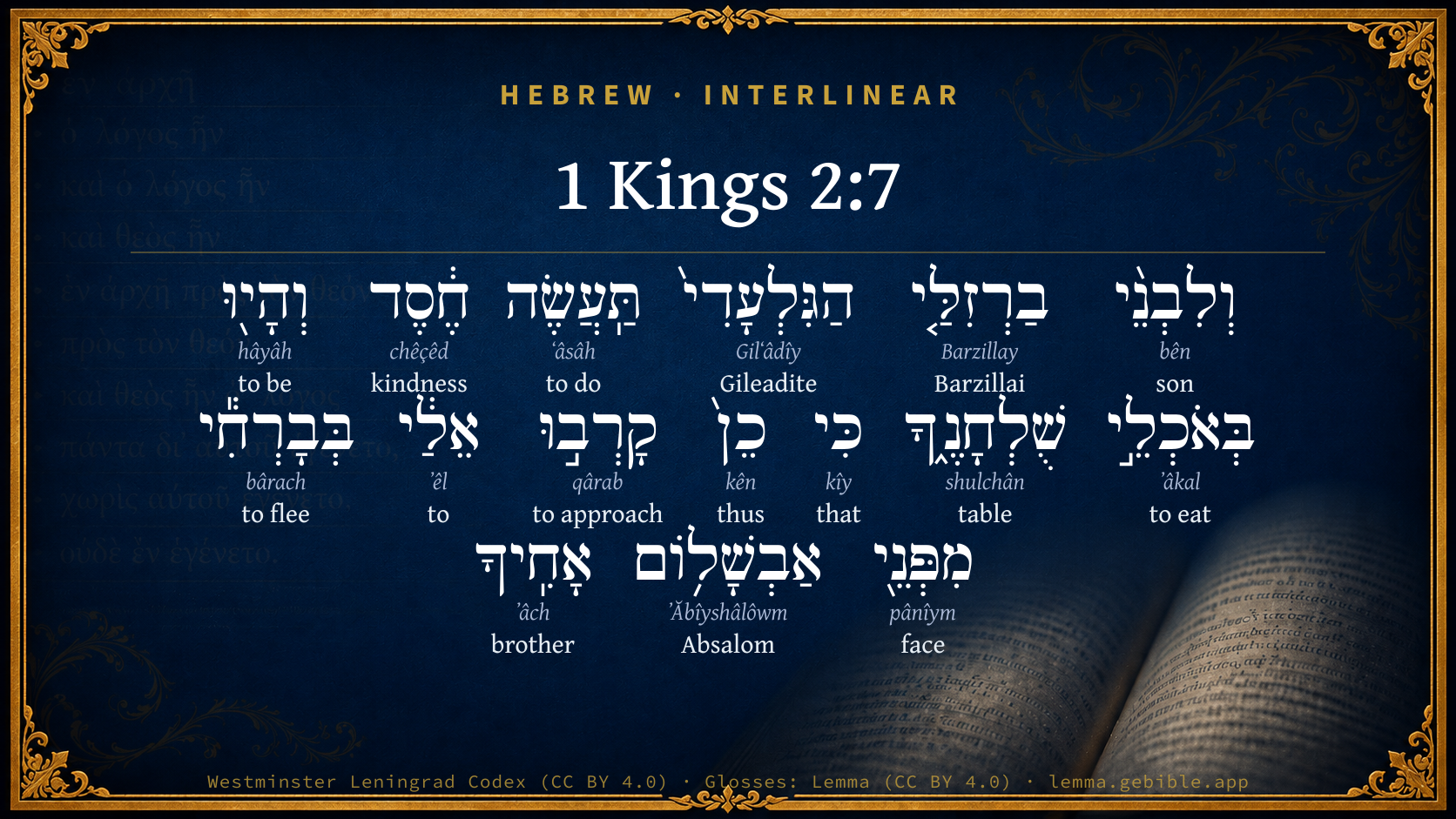
1 Kings 2:7

Hebrew (Westminster Leningrad Codex) 1 Kings 2:7 appears in the Hebrew Old Testament. The text above is from the Westminster Leningrad Codex. Each word links to its Strong’s number, a concise gloss, and parsing drawn from the Open Scriptures Hebrew Bible morphology. Click any word for its full Brown-Driver-Briggs (BDB) entry.
Download image
Cite this verse

1 Kings 2:7 (World English Bible). Public Domain. Lemma interlinear Bible study tool, https://lemma.gebible.app/v/1-kings/2/7.

Show BibTeX & RIS
BibTeX
RIS
English Translation
But show kindness to the sons of Barzillai the Gileadite, and let them be of those who eat at your table; for so they came to me when I fled from Absalom your brother.
World English Bible · Public Domain
Download a study sheet

One document with this verse’s original text, its word-by-word gloss line, the meaning frame, cross-references with their text, attributed commentary, and full source and license credits — printable, and it pastes into notes with its structure intact.

This verse Autodidact and up

Study sheet (.html) Plain text (.txt)

A passage Seminary Student

Up to 50 verses in one chapter. A passage sheet keeps up to 6 commentary sources and 12 cross-references per verse, in the order this page ranks them, and says so on the sheet whenever that leaves anything out. Ask for a single verse and you get the Autodidact verse sheet above.

Everything on this page stays free to read, with no account — the sheet is a download of what is already on screen, not access to it.

Want to remove ads? Support Godless Engineer
Compare translations 3

The same verse in 3 English versions, stacked beneath the original-language interlinear above. Click any original word for its lexicon entry.

Each is an independent rendering of the whole verse — the interlinear is not word-aligned to these translations.

Highlighted words mark where these versions differ — a whole-verse word diff, not a word-by-word alignment.

  • World English Bible Public Domain
    But show kindness to the sons of Barzillai the Gileadite, and let them be of those who eat at your table; for so they came to me when I fled from Absalom your brother.
  • King James Version Public Domain
    But show kindness unto the sons of Barzillai the Gileadite, and let them be of those that eat at thy table: for so they came to me when I fled because of Absalom thy brother.
  • unfoldingWord Literal Text CC BY-SA 4.0
    But to the sons of Barzillai the Gileadite do covenant faithfulness, and let them be among the eaters at your table. For thus they came near to me, when I fled from the face of Absalom your brother.

unfoldingWord Literal Text — © unfoldingWord, licensed CC BY-SA 4.0. Word-aligned USFM3 via Door43 (git.door43.org/unfoldingWord/en_ult).

Versions to compare (up to 4)

3 of 4 selected

Show all 18 translations

Every available English version of this verse, each an independent rendering of the whole verse.

  • World English Bible Public Domain
    But show kindness to the sons of Barzillai the Gileadite, and let them be of those who eat at your table; for so they came to me when I fled from Absalom your brother.
  • Berean Standard Bible Public Domain
    But show loving devotion to the sons of Barzillai the Gileadite, and let them be among those who eat at your table, because they stood by me when I fled from your brother Absalom.
  • Majority Standard Bible Public Domain
    But show loving devotion to the sons of Barzillai the Gileadite, and let them be among those who eat at your table, because they stood by me when I fled from your brother Absalom.
  • King James Version Public Domain
    But show kindness unto the sons of Barzillai the Gileadite, and let them be of those that eat at thy table: for so they came to me when I fled because of Absalom thy brother.
  • American Standard Version (1901) Public Domain
    But show kindness unto the sons of Barzillai the Gileadite, and let them be of those that eat at thy table; for so they came to me when I fled from Absalom thy brother.
  • Revised Version (1885) Public Domain
    But shew kindness unto the sons of Barzillai the Gileadite, and let them be of those that eat at thy table: for so they came to me when I fled from Absalom thy brother.
  • Geneva Bible (1599) Public Domain
    But shew kindnes vnto the sonnes of Barzillai the Gileadite, and let them be among them that eate at thy table: for so they came to me when I fled from Absalom thy brother.
  • Douay-Rheims (1899) Public Domain
    But shew kindness to the sons of Berzellai the Galaadite, and let them eat at thy table: t for they met me when I fled from the face of Absalom thy brother.
  • Young's Literal Translation Public Domain
    `And to the sons of Barzillai the Gileadite thou dost do kindness, and they have been among those eating at thy table, for so they drew near unto me in my fleeing from the face of Absalom thy brother.
  • Literal Standard Version CC BY-SA 4.0
    And you do kindness to the sons of Barzillai the Gileadite, and they have been among those eating at your table, for so they drew near to me in my fleeing from the face of your brother Absalom.
  • Unlocked Literal Bible CC BY-SA 4.0
    However, show kindness to the sons of Barzillai the Gileadite, and let them be among those who eat at your table, for they came to me when I fled from Absalom your brother.
  • unfoldingWord Literal Text CC BY-SA 4.0
    But to the sons of Barzillai the Gileadite do covenant faithfulness, and let them be among the eaters at your table. For thus they came near to me, when I fled from the face of Absalom your brother.
  • Darby Bible Public Domain
    But shew kindness to the sons of Barzillai the Gileadite, and let them be of those that eat at thy table; for so they came up to me when I fled because of Absalom thy brother.
  • World Messianic Bible Public Domain
    But show kindness to the sons of Barzillai the Gileadite, and let them be among those who eat at your table; for so they came to me when I fled from Absalom your brother.
  • Webster's Bible Public Domain
    But show kindness to the sons of Barzillai the Gileadite, and let them be of those that eat at thy table: for so they came to me when I fled because of Absalom thy brother.
  • Free Bible Version CC BY-SA 4.0
    But be kind to the sons of Barzillai of Gilead. Bring them into your royal court, for they helped me when I ran from your brother Absalom.
  • Bible in Basic English Public Domain
    But be good to the sons of Barzillai the Gileadite, and let them be guests at your table; for so they came to me when I went in flight from Absalom your brother.
  • JPS Tanakh (1917) Public Domain
    But show kindness unto the sons of Barzillai the Gileadite, and let them be of those that eat at thy table; for so they drew nigh unto me when I fled from Absalom thy brother.

Literal Standard Version (2020), Covenant Press — licensed CC BY-SA 4.0. Text via the HelloAO Bible API (eBible.org). Unlocked Literal Bible (unfoldingWord) — licensed CC BY-SA 4.0. Text via the HelloAO Bible API (eBible.org). unfoldingWord Literal Text — © unfoldingWord, licensed CC BY-SA 4.0. Word-aligned USFM3 via Door43 (git.door43.org/unfoldingWord/en_ult). Free Bible Version, Dr. Jonathan Gallagher — licensed CC BY-SA 4.0. Text via the HelloAO Bible API (eBible.org).

Word by word

More ways to search: Search by grammar → Find every occurrence → Compare this word →

Practice this passage: Drill this verse → Learn its vocabulary →

הַגִּלְעָדִי֙
Gilʻâdîy
H1569
“the · Gileadite”
Particle, Definite Article + Noun, Gentilic, Masculine, Singular, Absolute
Part of Speech
Particle + Noun
Type
Gentilic
Gender
Masculine
Number
Singular
State
Absolute
Full BDB Definition

Origin: patronymically from H1568

TWOT: 356a

Gileadite = "rocky region" - an inhabitant of Gilead - a branch of the tribe of Manasseh, descended of Gilead - of Jephthah as the son of Gilead
  1. וְלִבְנֵ֨י bên H1121 “and · to/for · sons of” Conjunction + Preposition + Noun, Common, Masculine, Plural, Construct
  2. בַרְזִלַּ֤י Barzillay H1271 “Barzillai” Noun, Proper
  3. תַּֽעֲשֶׂה ʻâsâh H6213 “to do” Verb, Qal, Imperfect, 2nd Person, Masculine, Singular
  4. חֶ֔סֶד chêçêd H2617 “kindness” Noun, Common, Masculine, Singular, Absolute
  5. וְהָי֖וּ hâyâh H1961 “and · to be” Conjunction + Verb, Qal, Sequential Perfect, 3rd Person, Common, Plural
  6. בְּאֹכְלֵ֣י ʼâkal H398 “in/at · eating” Preposition + Verb, Qal, Participle Active, Masculine, Plural, Construct
  7. שֻׁלְחָנֶ֑ךָ shulchân H7979 “table · your” Noun, Common, Masculine, Singular, Construct + Suffix, Personal, 2nd Person, Masculine, Singular
  8. כִּי kîy H3588 “that” Conjunction
  9. כֵן֙ kên H3651 “thus” Adverb
  10. קָרְב֣וּ qârab H7126 “to approach” Verb, Qal, Perfect, 3rd Person, Common, Plural
  11. אֵלַ֔י ʼêl H413 “to · me” Preposition + Suffix, Personal, 1st Person, Common, Singular
  12. בְּבָרְחִ֕י bârach H1272 “in/at · to flee · me” Preposition + Verb, Qal, Infinitive Construct + Suffix, Personal, 1st Person, Common, Singular
  13. מִפְּנֵ֖י pânîym H6440 “from · face(s) of” Preposition + Noun, Common, Both, Plural, Construct
  14. אַבְשָׁל֥וֹם ʼĂbîyshâlôwm H53 “Absalom” Noun, Proper
  15. אָחִֽיךָ ʼâch H251 “brother · your” Noun, Common, Masculine, Singular, Construct + Suffix, Personal, 2nd Person, Masculine, Singular

About this verse

These counts appear in no published source. They are computed here, from the morphology-tagged text and Lemma’s own curated glosses. What Lemma adds →

16
words
16
distinct lemmas
Historical
section

Notable vocabulary

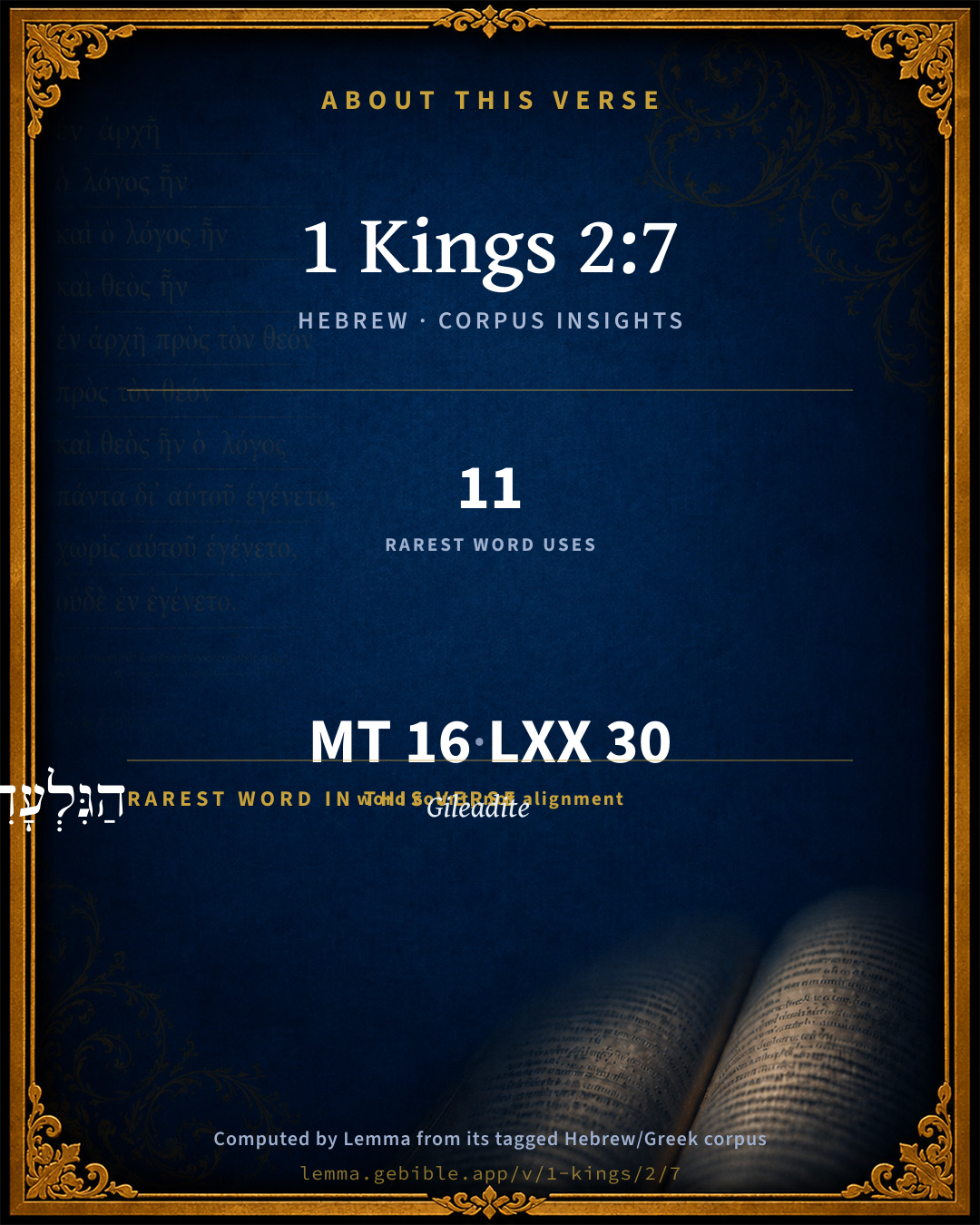
The rarest word here is הַגִּלְעָדִי֙ Gileadite H1569 — appearing just 11 times in the whole Hebrew Bible.

Shared distinctive vocabulary

הַגִּלְעָדִי֙ Gileadite H1569 occurs in 11 verses of the Hebrew Bible. Also found in:

Grammatical profile

  • 5 verbs
  • 8 nouns
  • 1 preposition
  • 1 conjunction
  • 1 adverb

Verb forms

  • תַּֽעֲשֶׂה Qal · Imperfect
  • וְהָי֖וּ Qal · Sequential Perfect
  • בְּאֹכְלֵ֣י Qal · Participle Active
  • קָרְב֣וּ Qal · Perfect
  • בְּבָרְחִ֕י Qal · Infinitive Construct

Hebrew & Septuagint length

In English translation the verse runs 34 words from the Hebrew and 40 from the Septuagint (LXX English) — closely comparable.

A rough comparison of the two English renderings, which tokenize alike — not a word-level alignment.

Word counts can differ between the Hebrew and the Greek without any difference in meaning — e.g. the Hebrew direct-object marker אֵת has no separate Greek word, and Greek often adds the article ὁ.

In the original languages it is 16 Hebrew tokens and 30 Greek tokens — but the two are counted differently (Hebrew bundles its prefixes and suffixes into one token; the Greek is in lemma form), so that isn’t a like-for-like length.

Cross-references

10

Topical passages linked to 1 Kings 2:7 in the Treasury of Scripture Knowledge — connected by theme and wording, ordered by reader-vote popularity; previews shown in the World English Bible.

  • 2 Samuel 17:27–29 It happened, when David was come to Mahanaim, that Shobi the son of Nahash of Rabbah of the children of Ammon, and Machir the son of Ammiel of Lodebar, and Barzillai the Gileadite of Rogelim,
  • 2 Samuel 9:7 David said to him, "Don't be afraid of him; for I will surely show you kindness for Jonathan your father's sake, and will restore you all the land of Saul your father; and you shall eat bread at my table continually."
  • 2 Samuel 9:10 You shall till the land for him, you, and your sons, and your servants; and you shall bring in [the fruits], that your master's son may have bread to eat: but Mephibosheth your master's son shall eat bread always at my table." Now Ziba had fifteen sons and twenty servants.
  • 2 Samuel 19:31–40 Barzillai the Gileadite came down from Rogelim; and he went over the Jordan with the king, to conduct him over the Jordan.
  • 2 Samuel 15:13–15 There came a messenger to David, saying, The hearts of the men of Israel are after Absalom.
  • 2 Samuel 19:28 For all my father's house were but dead men before my lord the king; yet you set your servant among those who ate at your own table. What right therefore have I yet that I should cry any more to the king?
  • Proverbs 27:10 Don't forsake your friend and your father's friend. Don't go to your brother's house in the day of your disaster: Better is a neighbor who is near than a distant brother.
  • Luke 12:37 Blessed are those servants, whom the lord will find watching when he comes. Most assuredly I tell you, that he will dress himself, and make them recline, and will come and serve them.
  • Luke 22:28–30 But you are those who have continued with me in my trials.
  • Revelation 3:20–21 Behold, I stand at the door and knock. If anyone hears my voice and opens the door, then I will come in to him, and will dine with him, and he with me.

Cross-references courtesy of OpenBible.info (CC BY 4.0).

Hebrew and Greek witnesses Masoretic Hebrew ↔ Greek Septuagint

The same verse in the two great witnesses to the Old Testament, shown verse-for-verse.

These are two independent witnesses, not word-aligned to each other, and the Septuagint is shown in lemma (dictionary) form.

Hebrew 1 Kings 2:7 Masoretic · Westminster Leningrad Codex

וְלִבְנֵ֨י בַרְזִלַּ֤י הַגִּלְעָדִי֙ תַּֽעֲשֶׂה חֶ֔סֶד וְהָי֖וּ בְּאֹכְלֵ֣י שֻׁלְחָנֶ֑ךָ כִּי כֵן֙ קָרְב֣וּ אֵלַ֔י בְּבָרְחִ֕י מִפְּנֵ֖י אַבְשָׁל֥וֹם אָחִֽיךָ

But show kindness to the sons of Barzillai the Gileadite, and let them be of those who eat at your table; for so they came to me when I fled from Absalom your brother.

World English Bible · Public Domain

Greek LXX 1 Kings 2:7 Septuagint · lemma form

καί ὁ υἱός βερζελλι ὁ γαλααδίτης ποιέω ἔλεος καί εἰμί ἐν ὁ ἐσθίω ὁ τράπεζα σύ ὅτι οὕτως ἐγγίζω ἐγώ ἐν ὁ ἐγώ ἀποδιδράσκω ἀπό πρόσωπον αβεσσαλωμ ὁ ἀδελφός σύ

But you shall deal kindly with the sons of Berzelli the Galaadite, and they shall be among those that eat at your table; for thus they drew near to me when I fled from the face of your brother Abessalom.

LXX2012 (modern English Septuagint) · Public Domain

Hebrew: Westminster Leningrad Codex (CC BY 4.0). Greek: Septuagint (public domain); English from LXX2012 (modern English Septuagint) (Public Domain). How the Septuagint differs from the Hebrew →

Targum (Aramaic paraphrase)

1

The Targum is the ancient Jewish Aramaic paraphrase of the Hebrew Scriptures — an interpretive translation, not the Hebrew text itself. Onkelos (literal) and Pseudo-Jonathan (expansive) render the Torah, and Jonathan the Prophets. Coverage is partial: where no permissively-licensed English translation exists for a verse, only the Aramaic is shown. This is verse-level text, not a word-by-word alignment to the Hebrew.

  1. Targum Jonathan Prophets (Joshua–Malachi)
    וְלִבְנֵי בַרְזִילַי גִלְעָדָאָה תַּעְבֵּיד טִיבוּ וִיהוֹן בְּאוֹכְלֵי פָתוֹרָךְ אֲרֵי אִינוּן סַפִיקוּ צָרְכַי בְּמֶעֶרְקִי מִן קֳדָם אַבְשָׁלוֹם אֲחוּךְ:

    (no public-domain English translation for this verse)

    Targum Jonathan — Aramaic: “Mikraot Gedolot” (public domain). English: “Sefaria Community Translation” (CC0 1.0 (public-domain dedication)); “London "Chaldee Paraphrase," 1871” (public domain). Text via Sefaria.

Commentary

Notes on 1 Kings 2:7 from classic Christian and Jewish commentators (each source and its license shown beneath its notes). The classic Christian expositions comment on the surrounding passage and are grouped to its opening verse, so a note may address several verses; the Jewish commentaries on the Tanakh (Rashi and others) are per-verse, so they appear only where the commentator wrote on this verse.

Lemma curates 59 commentaries, every one of them public domain or Creative Commons licensed, each selected and text-cleaned for this edition rather than reprinted as found. About our sources →

Trapp's Complete Commentary

John Trapp

1Ki 2:7 But shew kindness unto the sons of Barzillai the Gileadite, and let them be of those that eat at thy table: for so they came to me when I fled because of Absalom thy brother.

Ver. 7. For so they came to me.] So as I now desire thee to do to them, as did they to me when I was in distress - viz., they fed and relieved me, for which I hold myself their perpetual debtor. Eaten bread, we say, is soon forgotten; but not with the thankful. Agesilaus, king of Sparta, was always very grateful for any courtesies that he received; and used to say, that it was not only an unjust thing not to be thankful, but if a man did not return greater kindness than he received. {a} How bountifully dealt the Lord Cromwell with Francis Frescobald, the Florentine, who had sometime relieved him in his great necessity, furnishing him with a horse, clothes, and money to bear his charges from Italy to England. {b}

{a} Plut.

{b} Act. and Mon.

John Trapp, A Commentary or Exposition upon All the Books of the Old and New Testament (1647–1656) — public domain. Text from a community e-Sword module.

The Biblical Illustrator

Joseph S. Exell

1Ki_2:7

Shew kindness unto the sons of Barzillai.

Gratitude for kindnesses repaid

An old English story tells of Frescobald, an Italian merchant who showed great kindness to Thomas Cromwell when he was in sore distress far from home. The stranger was welcomed to the merchants dwelling, and sent back safely to England. Years passed, and reverses came to Frescobald. He lost wealth and friends, and wandered as a beggar to this country. One day he saw a great crowd moving along the streets of London. The Lord Chancellor was going in state to open the courts. To Frescobalds delight, the central figure of the procession was his old friend Thomas Cromwell The Italian merchant soon reaped the fruit of his generous kindness in other days. Cromwells hospitality and munificence quickly made him forget all his care and sorrow. (J. Telford, B. A.)

Sympathy with monarch appreciated

Sympathy for those who are stronger, wealthier, healthier, more influential, and higher in authority than ourselves, is not so easily rendered. It does not often occur to us to extend the sympathetic hand or word to those whom we look upon as in any way our superiors, and yet none need our sympathy more than such as these. The minister is expected to feel for and with his parishioners, but the truth is that the minister needs sympathetic encouragement from them quite as much. So, too, of the physician and his patient. One of Tennysons biographers quotes the Queen as saying of the Laureate, When I took leave of him I thanked him for his kindness, and said I needed it, for I had gone through much, and he said, You are so alone on that terrible height; it is terrible. The sovereign appreciated kindness, consideration, and sympathy from her subjects, and the poet had a full realisation of what it meant to be so high up as to be practically alone in the world. We easily give our pity, our sympathy, and even our helping hand, to those who seem to us in sore stress, but we are not so thoughtful about what consolation and strength we might give to those who need it because their very elevation isolates them, and cuts them off from those human relations to which we all look for sympathetic aid. (Great Thoughts.)

Barzillai

Barzillais truly Highland courtesy, also, is abundantly conspicuous in the too-short glimpse we get of the lord of Rogelim. For, how he anticipated all Davids possible wants! How he put himself into all Davids distressed place! How he did to David as David would have done to him! How he came down from his high seat, with all his years on his head, in order with his own hand to conduct the king over Jordan! And, then, with what sweetness and music of manner and of speech he excused himself out of all the royal rewards and honours and promotions David had designed and decreed to put upon him!

The service and the loyalty I owe,

In doing, pays itself. Your Highness part

Is to receive our duties; and our duties

Are to your throne and state children and servants,

Which do but what they should, by doing everything

Safe towards your love and honour.

The rest is labour which is not used for you.

The humility, also, of that Old Testament hero is already our New Testament humility in its depth and sweetness and beauty. In my spare hours this winter I have been delighting myself with Plutarchs Lives in Thomas Norths Bible English. But how often as I read one noble name after another have I exclaimed, Oh, if some of those great men of old had only been among the Greeks who came to Philip, saying, Sir, we would see Jesus! Had they only seen Jesus, or even heard or read Paul! Then what ornaments would they have been in all New Testament nobleness and courtesy and humility. (Alex. Whyte, D. D.)

The Biblical Illustrator, edited by Joseph S. Exell (c. 1880s–1900s) — public domain. Text from a community e-Sword module.

Joseph Benson's Commentary

1Ki 2:7. Show kindness to the sons of Barzillai — David’s gratitude here expressed is remarkable. Barzillai only desired him to show kindness to Chimham, 2Sa 19:37; but he extends it to all his sons. Let them be of those that eat at thy table — As Mephibosheth had done at David’s table. It is probable Mephibosheth was now dead, for otherwise David would not have forgotten him. For so they came to me — Such kindness they showed me; inviting him to Barzillai’s house, who sustained him in his great distress, 2Sa 19:32.

Joseph Benson's Commentary on the Old and New Testaments (1811–1818) — public domain. Text from a community e-Sword module.

Tyndale Open Study Notes

Tyndale Open Resources

2:7-9 Barzillai unwaveringly supported David during his trouble with Absalom, while Shimei openly opposed David (2 Sam 16:5-13; 19:6-23).

2:7 at your table: As he had done for Mephibosheth (2 Sam 9:6-13), David provided for Barzillai and his family. This privilege assured their continued loyalty.

Tyndale Open Study Notes — © Tyndale Open Resources, licensed CC BY-SA 4.0. Text via the HelloAO Bible API.

Geneva Bible (1599)

Geneva Bible translators

That is, they dealt mercifully with me.

Geneva Bible (1599) marginal notes — public domain. Text via Bolls.life.

Adam Clarke's Commentary

Verse 7. But show kindness unto the sons of Barzillai] 2Sa 19:31, &c.

Adam Clarke's Commentary on the Bible (1810–1826) — public domain. Text from a community e-Sword/MySword module.

Ellicott's Commentary for English Readers

(7) Shew kindness.—The charge of favour to the sons of Barzillai (see 2Sa_19:37-40) stands out in pleasant contrast. It has been noted that in Jer_41:17 there is a reference to “the habitation of Chimham,” as being “by Bethlehem,” David’s own birthplace; as if David had given him inheritance there, out of what was especially his own.

A Bible Commentary for English Readers, edited by Charles John Ellicott (1878–1897) — public domain. Text from a community e-Sword module.

The Cambridge Bible for Schools and Colleges

gen. ed. J. J. S. Perowne

7. sons of Barzillai the Gileadite] The deserving conduct of Barzillai, during David’s flight from Absalom, is narrated 2Sa_19:31 seqq. The Chimham there mentioned was probably a son of Barzillai, though we are not expressly told so. No other son is anywhere spoken of, but we find that Barzillai had daughters (Ezr_2:61; Neh_7:63) and he probably was father of a large family. Barzillai, at his advanced age, would not come alone to conduct David over Jordan, and though he only commends one person to the king’s attention there may have been several sons in his retinue.

of those that eat at thy table] A common mode in Eastern countries of shewing regard. Thus Mephibosheth, Jonathan’s son, was provided for at David’s table (2Sa_9:7; 2Sa_9:10-11), and such treatment put the recipient in a position like that of the king’s sons.

for so they came to me] i.e. With kind acts and generous supplies of food when I was in great need. Let their reward be of a similar nature.

The Cambridge Bible for Schools and Colleges (gen. ed. J. J. S. Perowne; Cambridge University Press, 1878–1918) — public domain. Text from a community e-Sword module.

John Gill's Exposition

But show kindness to the sons of Barzillai the Gileadite,.... Who perhaps was now dead, and therefore he would have kindness shown to his posterity for his sake:

and let them be of those that eat of thy table; as Mephibosheth had at his, who also perhaps was dead, since no notice is taken of him; and as David would have had Barzillai, but he desired to be excused on account of his age:

for so they came to me, when I fled because of thy brother, Absalom; that is, they came to him, not only Barzillai, but his sons it seems; and fed him or furnished him with provisions, when he was obliged to fly to the other side Jordan, because of the rebellion of his son Absalom.

John Gill's Exposition of the Whole Bible (1746–1763) — public domain (CC PDM 1.0). Text via the HelloAO Bible API.

Albert Barnes' Notes on the Bible

One of the sons of Barzillai here intended was probably Chimham (see the margin reference). Who the others were is not known. The family continued down to the return from the captivity, and still held property in Israel (compare Ezr 2:61 and Neh 7:63).

Albert Barnes' Notes on the Bible (1834–1885) — public domain. Text from a community e-Sword/MySword module.

Haydock's Catholic Bible Commentary

Table, or of the meat, which had been served upon it; as was the custom at the court of Persia, Daniel i. 5. --- Brother. See 2 Kings xix. 31. (Calmet)

George Leo Haydock (1774–1849), Haydock's Catholic Family Bible and Commentary, 1859 edition — public domain. Excludes Psalms (Douay-Rheims chapter numbering differs from Protestant) and Deuterocanonical books (Catholic canon only).

Matthew Poole's English Annotations

Quest. Why doth he not require the like kindness to Mephibosheth the son of his dear Jonathan?

Answ. Either he and his were now extinct, or by their after-miscarriages had forfeited his favour.

For so, i.e. with such kindness either as I cannot express, (as the particle so is elsewhere used,) or as I command thee to show to them.

They, i.e. Barzillai and his sons; for though Barzillai only be mentioned, 2Sa 17:27, yet his sons doubtless were instrumental in the business, especially Chimham, 2Sa 19:37,38.

Matthew Poole's English Annotations on the Holy Bible (1683–1685) — public domain. Text from a community e-Sword/MySword module.

Whedon's Commentary on the Bible

Daniel D. Whedon

7. Barzillai the Gileadite — See marginal references, and notes on 2Sa_19:31-39.

Daniel D. Whedon (gen. ed.), Commentary on the Old and New Testaments (1874–1909) — public domain. Text from a community e-Sword module.

The Pulpit Commentary

And to the sons of Barzillai the "Beni-Barzillai" would include son, or sons, and all other descendants. It is highly probable, though it is not expressly stated, that Chimham was the son of Bar-zillai. (2Sa_19:37) Rawlinson says, "Who the other sons were is not known." It would be more correct to say that we do not know whether there were any other sons. The family was still existing temp. Ezra, (Ezr_2:61) where, it is worth noticing, we read of the daughters of Barzillai. (cf. Neh_7:63) In Jer_41:17, we read of the "habitation (tWdGe), caravanserai, khan of Chemoham," where the Keri has Chimham. It has been argued from the mention of this name, and the fact that their khan was near Bethlehem, that David or Solomon gave the family land there, and let them be of those that eat at thy table i.e., of those who have their sustenance from the royal table, not necessarily at it (Keil); Dan_1:5; cu 2Ki_25:29. Presence at the table is expressed by jl l. (2Sa 11, 12) It was esteemed an essential part of royal munificence throughout the East that the king should feed a large number of retainers and dependants. Cf. the account of Solomon"s daffy provision 1Ki_4:22, 1Ki_4:23; also 2Sa_19:28; Jud_1:7 for so i.e., in like manner, with food; they came to me lit., came near. The Hebrew br"q; often includes, as here, the idea of succour. Cf. Psalm Lam_3:57. Barzillai certainly came, (2Sa_17:27) and probably Chimham, but the Speaker"s Commentary is mistaken when it says that "Chimham is mentioned as present." He was present at the return of David (2Sa_19:31, 2Sa_19:38, but not necessarily before when I fled because of lit., "from the face of" Absalom thy brother.

The mention of Absalom, and those terrible days of revolt and anarchy, when he was constrained to flee for his life, seems to have reminded the dying king of one of the bitterest ingredients of that bitter cup of shame and suffering the cruel curses of Shimei. He remembers that the sin of Shimei, which was nothing else than treason and blasphemy, has so far escaped punishment. In a moment of generous enthusiasm, he had included Shimei in the general amnesty which he proclaimed on his return. (2Sa_19:23) He had thought, no doubt, at the time only of the offence against himself; he had forgotten his sacred and representative character as "the Lord"s anointed;" or if he had remembered it (ver. 21) the emotions of that memorable day had obscured or perverted his sense of justice and duty. But he has since realized and the thought weighs upon his conscience in the chamber of death that he then pardoned what he had no power to pardon, viz., a sin to which the Mosaic law attached the penalty of death. For blasphemy, as for murder, there was no expiation short of the death of the blasphemer (Lev_24:14-16; cf.; 1Ki_21:10, 1Ki_21:13) and blasphemy, like murder, though not perhaps to the same extent, involved those who heard it in its guilt, until they had discharged themselves of their sin upon the head of the guilty (Lev_14:14; cf. Lev_5:1) But Shimei, so far from having suffered the penalty of the law, had been twice protected against it; twice preserved alive, in defiance of law, by the supreme magistrate, the executor of law. And David, who has been charging his son to keep the law, now realizes that he himself has been a law breaker. He has kept his oath, sworn to his own or his people"s hurt, and he will keep it to the end. But Solomon is under no such obligation. He can demand the long arrears of justice, none the less due because of the time that has elapsed and the royal laches ("nullum tempus occurrit regi"); he can deal with the blasphemer as the law directs, and this David now charges him to do.

The Pulpit Commentary (1880–1919), ed. H.D.M. Spence-Jones & Joseph S. Exell — public domain. Text from a community e-Sword module.

John Wesley's Explanatory Notes

For so - With such kindness.

John Wesley, Explanatory Notes Upon the Whole Bible (1754–1765) — public domain. Text via the GEBible commentary corpus.

unfoldingWord translationNotes

Door43 World Missions Community

General Information:

King David continues to tell Solomon how to lead Israel.

Barzillai

a man's name (See: How to Translate Names)

let them be among those who eat at your table

The table is a metonym for the home where the table is. AT: "welcome them to eat at your home" (See: Metonymy)

translationWords

Gilead

Absalom

brother

unfoldingWord translationNotes — © Distant Shores Media and the Door43 World Missions Community, licensed CC BY-SA 4.0. Source: git.door43.org/Door43/en_tn.

Lesson kit

Teaching starters — assembled from the data on this page, not authored interpretation. Every prompt links to the verse data it draws on. Edit before teaching.

1 Kings, in the Historical, opens this verse with 16 words (16 distinct Hebrew lemmas). Its most distinctive word is Gilʻâdîy (“Gileadite”). A historical commentator’s framing appears above. Read the whole chapter for the surrounding context.

Discussion questions

  1. What does “Gileadite” (Gilʻâdîy) contribute to the verse as a whole?
  2. Numbers 26:29 shares the word «Gileadite» with this verse. How do the two illuminate each other?
  3. These translations render this verse differently; the difference is in the English rendering, not the original. What questions does that raise?
  4. The verb «תַּֽעֲשֶׂה» is Qal Imperfect. How does its form color the action?
  5. Reading how Trapp's Complete Commentary and The Biblical Illustrator read this verse, where do the two commentators agree and where do they part?

Things to notice

Reading settings

Reading text

Shown beneath each verse's original-language words.

Old Testament
Old Testament edition

Read the OT as the Masoretic Hebrew (MT) or the Greek Septuagint (LXX).

English shown for the Greek Septuagint (in the Hebrew ↔ Greek comparison).

Comparing translations? Open the Compare panel on any verse page to stack up to four side by side.