
Job 20:2

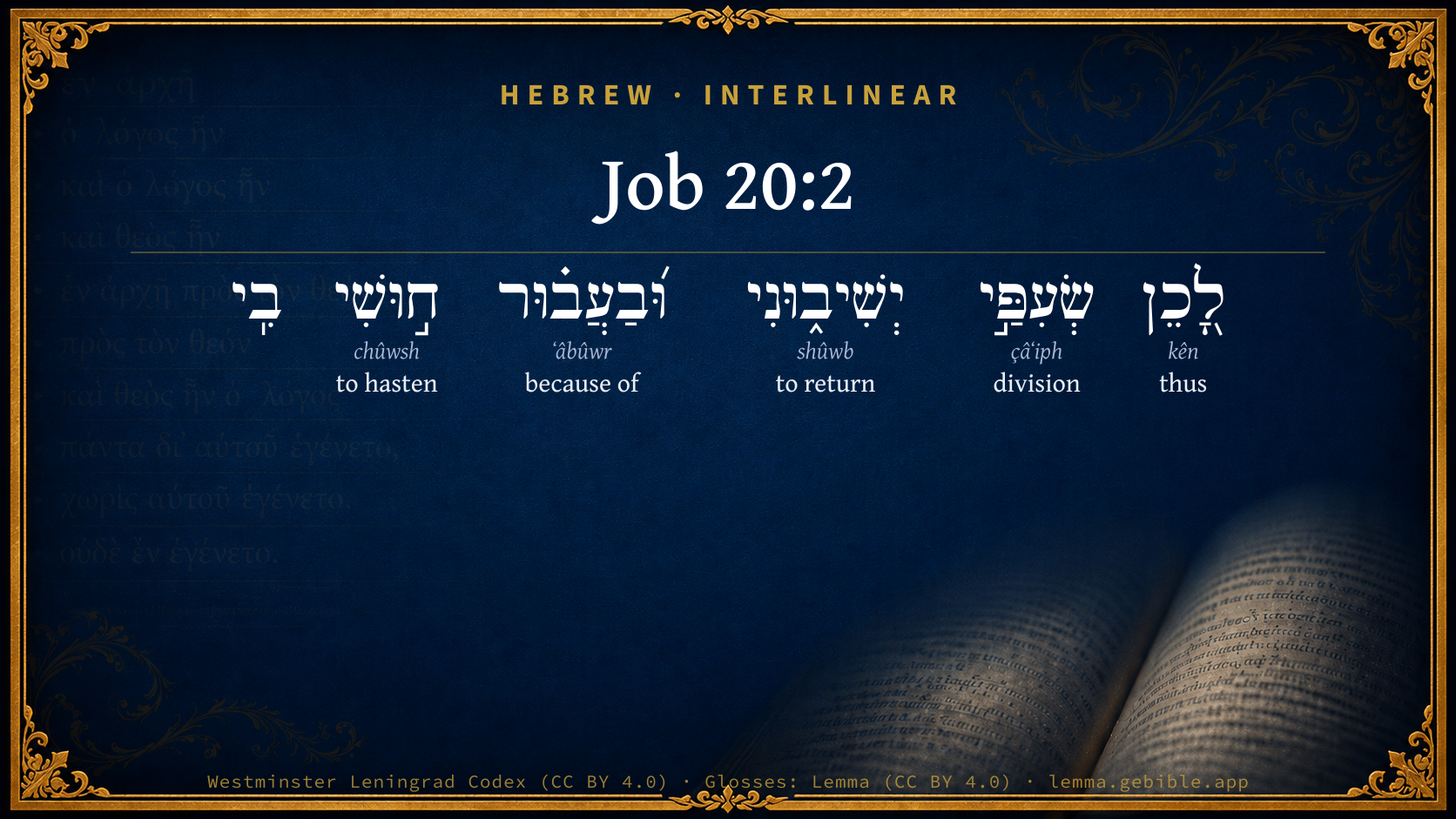
Hebrew (Westminster Leningrad Codex) Job 20:2 appears in the Hebrew Old Testament. The text above is from the Westminster Leningrad Codex. Each word links to its Strong’s number, a concise gloss, and parsing drawn from the Open Scriptures Hebrew Bible morphology. Click any word for its full Brown-Driver-Briggs (BDB) entry.
Download image
Cite this verse

Job 20:2 (World English Bible). Public Domain. Lemma interlinear Bible study tool, https://lemma.gebible.app/v/job/20/2.

Show BibTeX & RIS
BibTeX
RIS
English Translation
"Therefore do my thoughts give answer to me, Even by reason of my haste that is in me.
World English Bible · Public Domain
Download a study sheet

One document with this verse’s original text, its word-by-word gloss line, the meaning frame, cross-references with their text, attributed commentary, and full source and license credits — printable, and it pastes into notes with its structure intact.

This verse Autodidact and up

Study sheet (.html) Plain text (.txt)

A passage Seminary Student

Up to 50 verses in one chapter. A passage sheet keeps up to 6 commentary sources and 12 cross-references per verse, in the order this page ranks them, and says so on the sheet whenever that leaves anything out. Ask for a single verse and you get the Autodidact verse sheet above.

Everything on this page stays free to read, with no account — the sheet is a download of what is already on screen, not access to it.

Want to remove ads? Support Godless Engineer
Compare translations 3

The same verse in 3 English versions, stacked beneath the original-language interlinear above. Click any original word for its lexicon entry.

Each is an independent rendering of the whole verse — the interlinear is not word-aligned to these translations.

Highlighted words mark where these versions differ — a whole-verse word diff, not a word-by-word alignment.

  • World English Bible Public Domain
    "Therefore do my thoughts give answer to me, Even by reason of my haste that is in me.
  • King James Version Public Domain
    Therefore do my thoughts cause me to answer, and for this I make haste.
  • unfoldingWord Literal Text CC BY-SA 4.0
    “Therefore my thoughts turn me back, because of my urgency in me.

unfoldingWord Literal Text — © unfoldingWord, licensed CC BY-SA 4.0. Word-aligned USFM3 via Door43 (git.door43.org/unfoldingWord/en_ult).

Versions to compare (up to 4)

3 of 4 selected

Show all 18 translations

Every available English version of this verse, each an independent rendering of the whole verse.

  • World English Bible Public Domain
    "Therefore do my thoughts give answer to me, Even by reason of my haste that is in me.
  • Berean Standard Bible Public Domain
    “So my anxious thoughts compel me to answer, because of the turmoil within me.
  • Majority Standard Bible Public Domain
    “So my anxious thoughts compel me to answer, because of the turmoil within me.
  • King James Version Public Domain
    Therefore do my thoughts cause me to answer, and for this I make haste.
  • American Standard Version (1901) Public Domain
    Therefore do my thoughts give answer to me, Even by reason of my haste that is in me.
  • Revised Version (1885) Public Domain
    Therefore do my thoughts give answer to me, even by reason of my haste that is in me.
  • Geneva Bible (1599) Public Domain
    Doubtlesse my thoughts cause me to answere, and therefore I make haste.
  • Douay-Rheims (1899) Public Domain
    Therefore various thoughts succeed one another in me, and my mind is hurried away to different things.
  • Young's Literal Translation Public Domain
    Therefore my thoughts cause me to answer, And because of my sensations in me.
  • Literal Standard Version CC BY-SA 4.0
    “Therefore my thoughts cause me to answer, || And because of my sensations in me.
  • Unlocked Literal Bible CC BY-SA 4.0
    “My thoughts make me answer quickly because of the worry that is in me.
  • unfoldingWord Literal Text CC BY-SA 4.0
    “Therefore my thoughts turn me back, because of my urgency in me.
  • Darby Bible Public Domain
    Therefore do my thoughts give me an answer, and for this is my haste within me.
  • World Messianic Bible Public Domain
    “Therefore my thoughts answer me, even by reason of my haste that is in me.
  • Webster's Bible Public Domain
    Therefore do my thoughts cause me to answer, and for this I make haste.
  • Free Bible Version CC BY-SA 4.0
    “I'm forced to reply because I'm really upset!
  • Bible in Basic English Public Domain
    For this cause my thoughts are troubling me and driving me on.
  • JPS Tanakh (1917) Public Domain
    Therefore do my thoughts give answer to me, even by reason of mine agitation that is in me.

Literal Standard Version (2020), Covenant Press — licensed CC BY-SA 4.0. Text via the HelloAO Bible API (eBible.org). Unlocked Literal Bible (unfoldingWord) — licensed CC BY-SA 4.0. Text via the HelloAO Bible API (eBible.org). unfoldingWord Literal Text — © unfoldingWord, licensed CC BY-SA 4.0. Word-aligned USFM3 via Door43 (git.door43.org/unfoldingWord/en_ult). Free Bible Version, Dr. Jonathan Gallagher — licensed CC BY-SA 4.0. Text via the HelloAO Bible API (eBible.org).

Word by word

More ways to search: Search by grammar → Find every occurrence → Compare this word →

Practice this passage: Drill this verse → Learn its vocabulary →

About this verse

These counts appear in no published source. They are computed here, from the morphology-tagged text and Lemma’s own curated glosses. What Lemma adds →

6
words
5
distinct lemmas
Wisdom
section

Notable vocabulary

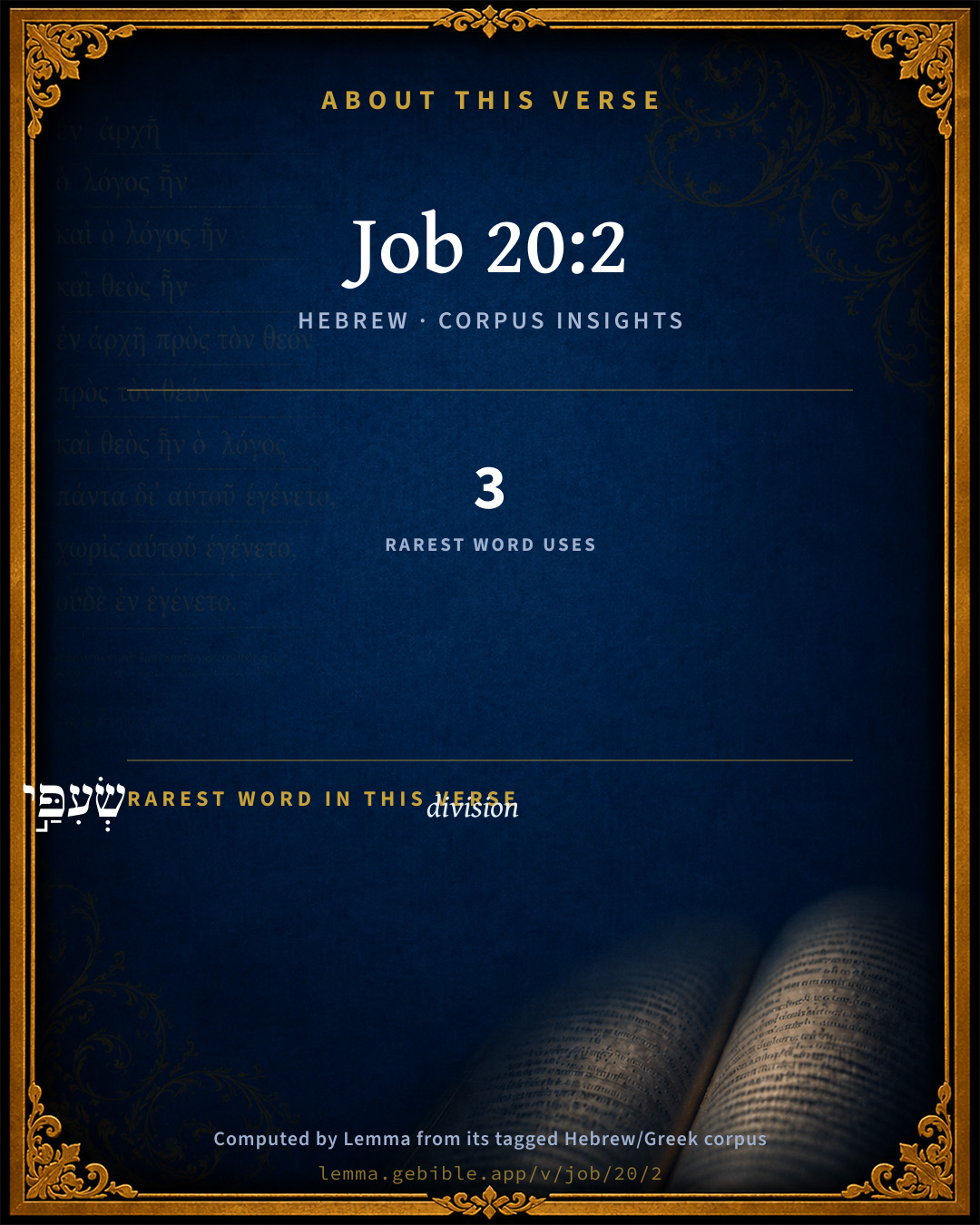
The rarest word here is שְׂעִפַּ֣י division H5587 — appearing just 3 times in the whole Hebrew Bible.

Shared distinctive vocabulary

שְׂעִפַּ֣י division H5587 occurs in 3 verses of the Hebrew Bible. Also found in:

Grammatical profile

  • 2 verbs
  • 1 noun
  • 2 prepositions
  • 1 adverb

Verb forms

  • יְשִׁיב֑וּנִי Hiphil · Imperfect
  • ח֣וּשִׁי Qal · Infinitive Construct

Hebrew & Septuagint length

In English translation the verse runs 18 words from the Hebrew and 16 from the Septuagint (LXX English) — closely comparable.

A rough comparison of the two English renderings, which tokenize alike — not a word-level alignment.

Word counts can differ between the Hebrew and the Greek without any difference in meaning — e.g. the Hebrew direct-object marker אֵת has no separate Greek word, and Greek often adds the article ὁ.

Cross-references

14

Topical passages linked to Job 20:2 in the Treasury of Scripture Knowledge — connected by theme and wording, ordered by reader-vote popularity; previews shown in the World English Bible.

  • Psalms 31:22 As for me, I said in my haste, "I am cut off from before your eyes." Nevertheless you heard the voice of my petitions when I cried to you.
  • Proverbs 14:29 He who is slow to anger has great understanding, But he who has a quick temper displays folly.
  • Job 4:2 "If someone ventures to talk with you, will you be grieved? But who can withhold himself from speaking?
  • Job 13:19 Who is he who will contend with me? For then would I hold my peace and give up the spirit.
  • Job 20:3 I have heard the reproof which puts me to shame; The spirit of my understanding answers me.
  • Job 32:13–20 Beware lest you say, 'We have found wisdom, God may refute him, not man:'
  • Psalms 39:2–3 I was mute with silence. I held my peace, even from good. My sorrow was stirred.
  • Psalms 116:11 I said in my haste, "All men are liars."
  • Proverbs 29:20 Do you see a man who is hasty in his words? There is more hope for a fool than for him.
  • Ecclesiastes 7:9 Don't be hasty in your spirit to be angry, for anger rests in the bosom of fools.
  • Jeremiah 20:9 If I say, I will not make mention of him, nor speak any more in his name, then there is in my heart as it were a burning fire shut up in my bones, and I am weary with forbearing, and I can't [contain].
  • Mark 6:25 She came in immediately with haste to the king, and asked, "I want you to give me right now the head of John the Baptizer on a platter."
  • Romans 10:2 For I testify about them that they have a zeal for God, but not according to knowledge.
  • James 1:19 So, then, my beloved brothers, let every man be swift to hear, slow to speak, and slow to anger;

Cross-references courtesy of OpenBible.info (CC BY 4.0).

Hebrew and Greek witnesses Masoretic Hebrew ↔ Greek Septuagint

The same verse in the two great witnesses to the Old Testament, shown verse-for-verse.

These are two independent witnesses, not word-aligned to each other, and the Septuagint is shown in lemma (dictionary) form.

Hebrew Job 20:2 Masoretic · Westminster Leningrad Codex

לָ֭כֵן שְׂעִפַּ֣י יְשִׁיב֑וּנִי וּ֝בַעֲב֗וּר ח֣וּשִׁי בִֽי

"Therefore do my thoughts give answer to me, Even by reason of my haste that is in me.

World English Bible · Public Domain

Greek LXX Job 20:2 Septuagint · lemma form

οὐ οὕτως ὑπολαμβάνω ἀντιεἶπον σύ οὗτος καί οὐ συνἵημι μᾶλλον ἤ καί ἐγώ

I did not suppose that you would answer thus: neither do you⌃ understand more than I.

LXX2012 (modern English Septuagint) · Public Domain

On this verse, Albert Barnes' Notes on the Bible discusses the Septuagint’s reading. Read the note in Commentary ↓

Hebrew: Westminster Leningrad Codex (CC BY 4.0). Greek: Septuagint (public domain); English from LXX2012 (modern English Septuagint) (Public Domain). How the Septuagint differs from the Hebrew →

Commentary

Notes on Job 20:2 from classic Christian and Jewish commentators (each source and its license shown beneath its notes). The classic Christian expositions comment on the surrounding passage and are grouped to its opening verse, so a note may address several verses; the Jewish commentaries on the Tanakh (Rashi and others) are per-verse, so they appear only where the commentator wrote on this verse.

Lemma curates 59 commentaries, every one of them public domain or Creative Commons licensed, each selected and text-cleaned for this edition rather than reprinted as found. About our sources →

The Cambridge Bible for Schools and Colleges

gen. ed. J. J. S. Perowne

2, 3. Zophar is roused to indignation by Job’s perverse blindness to unalterable principles experienced since the world was. The verses should perhaps read,

2. Therefore do my thoughts make answer to me,

And because of this have I haste within me:

3. I hear the rebuke that putteth me to shame—

But the spirit out of my understanding answereth me.

The words “therefore” and “because of this” refer to the first clause of Job_20:3.—I hear the rebuke that puts me to shame (i. e. Job’s last words), therefore do my thoughts make answer to me, and because of this have I inward haste, i. e. strong feeling. The speaker means that he feels driven to answer Job by the exasperating words of the latter, but he distinguishes between himself and his thoughts and speaks of them answering him. So (Job_20:3) his “spirit” answers him, drawing the answer out of his “understanding.” The answer furnished to Zophar by his spirit follows Job_20:4 seq. The last words of Job_20:2 are lit. “is my haste within me;” cf. their cord in them, Job_4:21, my help within me, Job_6:13. The word “check” in A. V. Job_20:3 means reproof;

“Now, by my life,

Old fools are babes again; and must be used

With checks, as flatteries.” Lear, 1. 3.

“Check’d like a bondman; all his faults observed.”

J. Caesar, IV. 3.

The Cambridge Bible for Schools and Colleges (gen. ed. J. J. S. Perowne; Cambridge University Press, 1878–1918) — public domain. Text from a community e-Sword module.

Trapp's Complete Commentary

John Trapp

Job 20:2 Therefore do my thoughts cause me to answer, and for [this] I make haste.

Ver. 2. Therefore do my thoughts cause me to answer] q.d. Whereas I had thought, O Job, to have spoke no more to thee (for I see I do but lose my sweet words), thy last comminatory expressions have altered my resolution. So nettled I am that I must needs interrupt thee. And yet think not that I shall speak whatsoever lieth uppermost; for I have dipped and dyed my words in my thoughts, which do now prompt me what to answer, and bid me make haste.

And for this I make haste] Lest I should forget the particulars of thy speech, whereto I am to answer. Munster rendereth it thus, Et ob id promptitudo mea est intra me, as if Zophar had boasted of his ready elocution, as in the next verse of his ripe understanding. Some render it, For this I delight in answering (Lavat.).

John Trapp, A Commentary or Exposition upon All the Books of the Old and New Testament (1647–1656) — public domain. Text from a community e-Sword module.

Joseph Benson's Commentary

Job 20:2. Therefore — For this thy severe sentence; do my thoughts cause me to answer — I thought to have troubled myself and thee with no further discourses, but these words of thine make my former thoughts to return again, and so provoke me, that I am not able any longer to forbear speaking.

Joseph Benson's Commentary on the Old and New Testaments (1811–1818) — public domain. Text from a community e-Sword module.

Whedon's Commentary on the Bible

Daniel D. Whedon

The Introduction announces the theme of the following discourse. THE JUBILEE OF THE WICKED IS ONLY OF SHORT DURATION, Job_20:2-5.

2. Therefore — The threatened judgment with which Job closes rouses Zophar’s fiery indignation, and colours his entire reply; the judgment Job threatens, lies in wait for himself. For this, etc. — Literally, because of my fervour (also, haste) within me. The cognate word in the Arabic, “boil with heat,” furnishes the true meaning of חושׁ, fervour, heat.

Daniel D. Whedon (gen. ed.), Commentary on the Old and New Testaments (1874–1909) — public domain. Text from a community e-Sword module.

Adam Clarke's Commentary

Verse 2. Therefore do my thoughts] It has already been observed that Zophar was the most inveterate of all Job's enemies, for we really must cease to call them friends. He sets no bounds to his invective, and outrages every rule of charity. A man of such a bitter spirit must have been, in general, very unhappy. With him Job is, by insinuation, every thing that is base, vile, and hypocritical. Mr. Good translates this verse thus: "Whither would my tumult transport me? And how far my agitation within me?" This is all the modesty that appears in Zophar's discourse. He acknowledges that he is pressed by the impetuosity of his spirit to reply to Job's self-vindication. The original is variously translated, but the sense is as above.

For this I make haste.] ובעבור חושי בי ubaabur chushi bi, there is sensibility in me, and my feelings provoke me to reply.

Adam Clarke's Commentary on the Bible (1810–1826) — public domain. Text from a community e-Sword/MySword module.

Ellicott's Commentary for English Readers

(2) Therefore.—That is, because of the eagerness that is in him. His spirit is stirred in him, and impels him to reply.

A Bible Commentary for English Readers, edited by Charles John Ellicott (1878–1897) — public domain. Text from a community e-Sword module.

John Gill's Exposition

Therefore do my thoughts cause me to answer,.... Or "to return" (a) and appear upon the stage again, and enter the lists once more with his antagonist; he suggests as if he had intended to have said no more in this controversy, but observing what Job had said last, could not forbear replying: "therefore" because he had represented him and his friends as cruel persecutors of him, as men devoid of all humanity, pity, and compassion, and endeavoured to terrify them with the punishments of the sword, and the judgment of God to come; these occasioned many "thoughts" in him, and those thoughts obliged him to give an answer; they came in so thick and fast upon him, that out of the abundance, his heart suggested to him he could not but speak, he was full of matter, and the spirit within him, the impulse upon his mind, constrained him to make a reply; and he seems desirous of having it understood that his answer proceeded from thought; that he did not speak without thinking, but had well weighed things in his mind; and what he was about to say was the fruit of close thinking and mature deliberation:

and for this I make haste; because his thoughts crowded in upon him, he had a fulness of matter, an impulse of mind, promptitude and readiness to speak on this occasion, and for fear of losing what was suggested to him, he made haste to give in his answer, perhaps observing some other of his friends rising up before him. The Targum is,

"because my sense is in me;''

and so other Jewish writers (b); be apprehended he had a right sense of things, and understood the matter in controversy full well, and therefore thought it incumbent on him to speak once more in it: Gussetius (c) renders it, "because of my disquietude"; the uneasiness of his mind raised by what Job had said, that he would have them know and consider there was a judgment; and he intimates he had considered it, and was fearful that should he be silent, and make no reply, God would condemn him in judgment for his silence; and therefore he was in a hurry to make answer, and could not be easy without it; and for his reasons for so doing he further explains himself in Job 20:3.

(a) "reducunt me, q. d. in scenam"; Cocceius, Junius & Tremellius, Piscator, Drusius. (b) Ben Gersom, Bar Tzemach, Sephorno; and so Montanus. (c) Ebr. Comment. p. 246.

John Gill's Exposition of the Whole Bible (1746–1763) — public domain (CC PDM 1.0). Text via the HelloAO Bible API.

Albert Barnes' Notes on the Bible

Therefore - לכן lākên, “certainly, truly.” In view of what has been just said. Or perhaps the word means merely certainly, truly.

Do my thoughts cause me to answer - This is variously rendered. The Vulgate renders it, Idcirco cogitationes meae variae succedunt sibi, et mens in diversa rapitur - “Therefore my various thoughts follow in succession, and the mind is distracted.” The Septuagint, “I did not suppose that thou wouldst speak against these things, and you do not understand more than I.” How this was ever made from the Hebrew it is impossible to say. On the word “thoughts,” see the notes at Job 4:13. The word denotes thoughts which divide and distract the mind; not calm and collected reflections, but those which disturb, disconcert, and trouble. He acknowledges that it was not calm reflection which induced him to reply, but the agitating emotions produced by the speech of Job. The word rendered “cause me to answer” (ישׁיבוּני yeshı̂ybûnı̂y), “cause me to return” - and Jerome understood it as meaning that his thoughts returned upon him in quick and troublesome succession, and says in his Commentary on Job, that the meaning is, “I am troubled and agitated because you say that you sustain these evils from God without cause, when nothing evil ought to be suspected of God.”

And for this I make haste - Margin, “my haste is in me.” The meaning is, “the impetuosity of my feelings urges me on. I reply on account of the agitation of my soul, which will admit of no delay.” His heart was full, and he hastened to give vent to his feelings in impassioned and earnest language.

Albert Barnes' Notes on the Bible (1834–1885) — public domain. Text from a community e-Sword/MySword module.

Haydock's Catholic Bible Commentary

Therefore. From this concession which thou hast just made. (Menochius) --- Various. Hebrew, "Hence do my thoughts cause me to answer, and for this I hasten." Septuagint, "I did not thus suspect that thou wouldst contradict these things," &c. (Haydock) --- Sophar only speaks this second time; and he produces little new, but begins with an air of more moderation, as if the arguments of Job had made some impression upon him. (Calmet) --- He attempts to prove that the wicked have no comfort long; which is true in one sense, as all time is short, though they may prosper all their lives, as Job corrects his observation, chap. xxi. 13. (Worthington)

George Leo Haydock (1774–1849), Haydock's Catholic Family Bible and Commentary, 1859 edition — public domain. Excludes Psalms (Douay-Rheims chapter numbering differs from Protestant) and Deuterocanonical books (Catholic canon only).

Matthew Poole's English Annotations

Therefore; for this thy severe sentence and denunciation of God’s judgments against us, Job 19:29, which much more justly belongs to thyself and is actually executed upon thee; and because of thy reproaches, as it followeth, Job 20:3.

My thoughts cause me to answer: I thought to have troubled myself and thee with no further discourses, considering how exceptious and incorrigible thou art; but my thoughts or consideration of thy reproachful words force me to break silence, and to answer thee as the matter requires.

For this I make haste; I speak sooner than I intended, because I am not able to contain myself longer, and fear lest I should forget what is in my mind. Possibly he interrupted Job when he was proceeding further in his discourse; or he prevented some of his brethren who made an offer to speak.

Matthew Poole's English Annotations on the Holy Bible (1683–1685) — public domain. Text from a community e-Sword/MySword module.

John Wesley's Explanatory Notes

Therefore - For this thy severe sentence. Make haste - I speak sooner than I intended. And possibly interrupted Job, when he was proceeding in his discourse.

John Wesley, Explanatory Notes Upon the Whole Bible (1754–1765) — public domain. Text via the GEBible commentary corpus.

Rashi

Rabbi Shlomo Yitzchaki (Rashi)

Zophar’s answermy thoughts will cause me to answer My thoughts will answer me with an answer in my mouth, and because I keep my peace and remain silent, and I put my silence within me, my thoughts will give me an answer to reply. The chastisement of my disgrace I hear from you the chastisement of my disgrace, that you disgrace me. Therefore, a word of spirit shall answer me out of my understanding, to reply to you.

my silence Heb. חושי, my silence, like (Ecc. 3:7), “a time to be silent (לחשות).”

Rashi on the Tanakh — English translations: “The Judaica Press complete Tanach with Rashi, translated by A. J. Rosenberg” (CC BY 4.0); “Pentateuch with Rashi's commentary by M. Rosenbaum and A.M. Silbermann, 1929-1934” (public domain); “The Metsudah Tanach series, Lakewood, N.J” (CC BY 4.0); and “The Book of Joshua, Metsudah Publications, 1997” (CC BY 4.0). Text via Sefaria.

Lesson kit

Teaching starters — assembled from the data on this page, not authored interpretation. Every prompt links to the verse data it draws on. Edit before teaching.

Job, in the Wisdom, opens this verse with 6 words (5 distinct Hebrew lemmas). Its most distinctive word is çâʻiph (“division”). A historical commentator’s framing appears above. Read the whole chapter for the surrounding context.

Discussion questions

  1. The word çâʻiph carries the sense “division.” How does it shape the verse?
  2. How does 1 Kings 18:21, which shares the word «division», read alongside this verse?
  3. The translations on this page render this verse differently — a whole-verse word diff, not a word-by-word alignment. What might account for the different wordings?
  4. «יְשִׁיב֑וּנִי» is a Hiphil Imperfect verb. How does that grammatical form shape the action described?
  5. Compare how The Cambridge Bible for Schools and Colleges and Trapp's Complete Commentary read this verse. Where do they agree or differ?

Things to notice

Reading settings

Reading text

Shown beneath each verse's original-language words.

Old Testament
Old Testament edition

Read the OT as the Masoretic Hebrew (MT) or the Greek Septuagint (LXX).

English shown for the Greek Septuagint (in the Hebrew ↔ Greek comparison).

Comparing translations? Open the Compare panel on any verse page to stack up to four side by side.