Numbers 16:11

Hebrew (Westminster Leningrad Codex) Numbers 16:11 appears in the Hebrew Old Testament. The text above is from the Westminster Leningrad Codex. Each word links to its Strong’s number, a concise gloss, and parsing drawn from the Open Scriptures Hebrew Bible morphology. Click any word for its full Brown-Driver-Briggs (BDB) entry.
Download image
Cite this verse

Numbers 16:11 (World English Bible). Public Domain. Lemma interlinear Bible study tool, https://lemma.gebible.app/v/numbers/16/11.

Show BibTeX & RIS
BibTeX
RIS
English Translation
Therefore you and all your company are gathered together against Yahweh: and Aaron, what is he who you murmur against him?
World English Bible · Public Domain
Download a study sheet

One document with this verse’s original text, its word-by-word gloss line, the meaning frame, cross-references with their text, attributed commentary, and full source and license credits — printable, and it pastes into notes with its structure intact.

This verse Autodidact and up

Study sheet (.html) Plain text (.txt)

A passage Seminary Student

Up to 50 verses in one chapter. A passage sheet keeps up to 6 commentary sources and 12 cross-references per verse, in the order this page ranks them, and says so on the sheet whenever that leaves anything out. Ask for a single verse and you get the Autodidact verse sheet above.

Everything on this page stays free to read, with no account — the sheet is a download of what is already on screen, not access to it.

Want to remove ads? Support Godless Engineer
Compare translations 3

The same verse in 3 English versions, stacked beneath the original-language interlinear above. Click any original word for its lexicon entry.

Each is an independent rendering of the whole verse — the interlinear is not word-aligned to these translations.

Highlighted words mark where these versions differ — a whole-verse word diff, not a word-by-word alignment.

  • World English Bible Public Domain
    Therefore you and all your company are gathered together against Yahweh: and Aaron, what is he who you murmur against him?
  • King James Version Public Domain
    For which cause both thou and all thy company are gathered together against the LORD: and what is Aaron, that ye murmur against him?
  • unfoldingWord Literal Text CC BY-SA 4.0
    Therefore, you and all your congregation the ones congregating against Yahweh, and Aaron, what is he that you murmur against him?”

unfoldingWord Literal Text — © unfoldingWord, licensed CC BY-SA 4.0. Word-aligned USFM3 via Door43 (git.door43.org/unfoldingWord/en_ult).

Versions to compare (up to 4)

3 of 4 selected

Show all 18 translations

Every available English version of this verse, each an independent rendering of the whole verse.

  • World English Bible Public Domain
    Therefore you and all your company are gathered together against Yahweh: and Aaron, what is he who you murmur against him?
  • Berean Standard Bible Public Domain
    Therefore, it is you and all your followers who have conspired against the LORD! As for Aaron, who is he that you should grumble against him?”
  • Majority Standard Bible Public Domain
    Therefore, it is you and all your followers who have conspired against the LORD! As for Aaron, who is he that you should grumble against him?”
  • King James Version Public Domain
    For which cause both thou and all thy company are gathered together against the LORD: and what is Aaron, that ye murmur against him?
  • American Standard Version (1901) Public Domain
    Therefore thou and all thy company are gathered together against Jehovah: and Aaron, what is he that ye murmur against him?
  • Revised Version (1885) Public Domain
    Therefore thou and all thy company are gathered together against the LORD: and Aaron, what is he that ye murmur against him?
  • Geneva Bible (1599) Public Domain
    For which cause, thou, and all thy companie are gathered together against the Lord: and what is Aaron, that ye murmure against him?
  • Douay-Rheims (1899) Public Domain
    And that all thy company should stand against the Lord? for what is Aaron that you murmur against him?
  • Young's Literal Translation Public Domain
    Therefore, thou and all thy company who are met `are' against Jehovah; and Aaron, what `is' he, that ye murmur against him?'
  • Literal Standard Version CC BY-SA 4.0
    Therefore, you and all your congregation are meeting against YHWH; and Aaron, what [is] he, that you murmur against him?”
  • Unlocked Literal Bible CC BY-SA 4.0
    That is why you and all your group have gathered together against Yahweh. So why are you complaining about Aaron, who obeys Yahweh?”
  • unfoldingWord Literal Text CC BY-SA 4.0
    Therefore, you and all your congregation the ones congregating against Yahweh, and Aaron, what is he that you murmur against him?”
  • Darby Bible Public Domain
    For which cause thou and all thy band are banded together against Jehovah; and Aaron, who is he that ye murmur against him?
  • World Messianic Bible Public Domain
    Therefore you and all your company have gathered together against the LORD! What is Aaron that you complain against him?”
  • Webster's Bible Public Domain
    For which cause both thou and all thy company are assembled against the LORD: and what is Aaron, that ye murmur against him?
  • Free Bible Version CC BY-SA 4.0
    So in reality you and those who have joined you are fighting against the Lord—because who is Aaron that you should complain about him?”
  • Bible in Basic English Public Domain
    So you and all your band have come together against the Lord; and Aaron, who is he, that you are crying out against him?
  • JPS Tanakh (1917) Public Domain
    Therefore thou and all thy company that are gathered together against the LORD —; and as to Aaron, what is he that ye murmur against him?'

Literal Standard Version (2020), Covenant Press — licensed CC BY-SA 4.0. Text via the HelloAO Bible API (eBible.org). Unlocked Literal Bible (unfoldingWord) — licensed CC BY-SA 4.0. Text via the HelloAO Bible API (eBible.org). unfoldingWord Literal Text — © unfoldingWord, licensed CC BY-SA 4.0. Word-aligned USFM3 via Door43 (git.door43.org/unfoldingWord/en_ult). Free Bible Version, Dr. Jonathan Gallagher — licensed CC BY-SA 4.0. Text via the HelloAO Bible API (eBible.org).

Word by word

More ways to search: Search by grammar → Find every occurrence → Compare this word →

Practice this passage: Drill this verse → Learn its vocabulary →

הַנֹּעָדִ֖ים
yâʻad
H3259
“the · appointing”
Particle, Definite Article + Verb, Niphal, Participle Active, Masculine, Plural, Absolute
Part of Speech
Particle + Verb
Stem
Niphal
Form
Participle Active
Gender
Masculine
Number
Plural
State
Absolute
Full BDB Definition

Origin: a primitive root

TWOT: 878

to fix, appoint, assemble, meet, set, betroth - (Qal) to appoint, assign, designate - (Niphal) - to meet - to meet by appointment - to gather, assemble by appointment - (Hiphil) to cause to meet - (Hophal) to be set, be placed before, be fixed
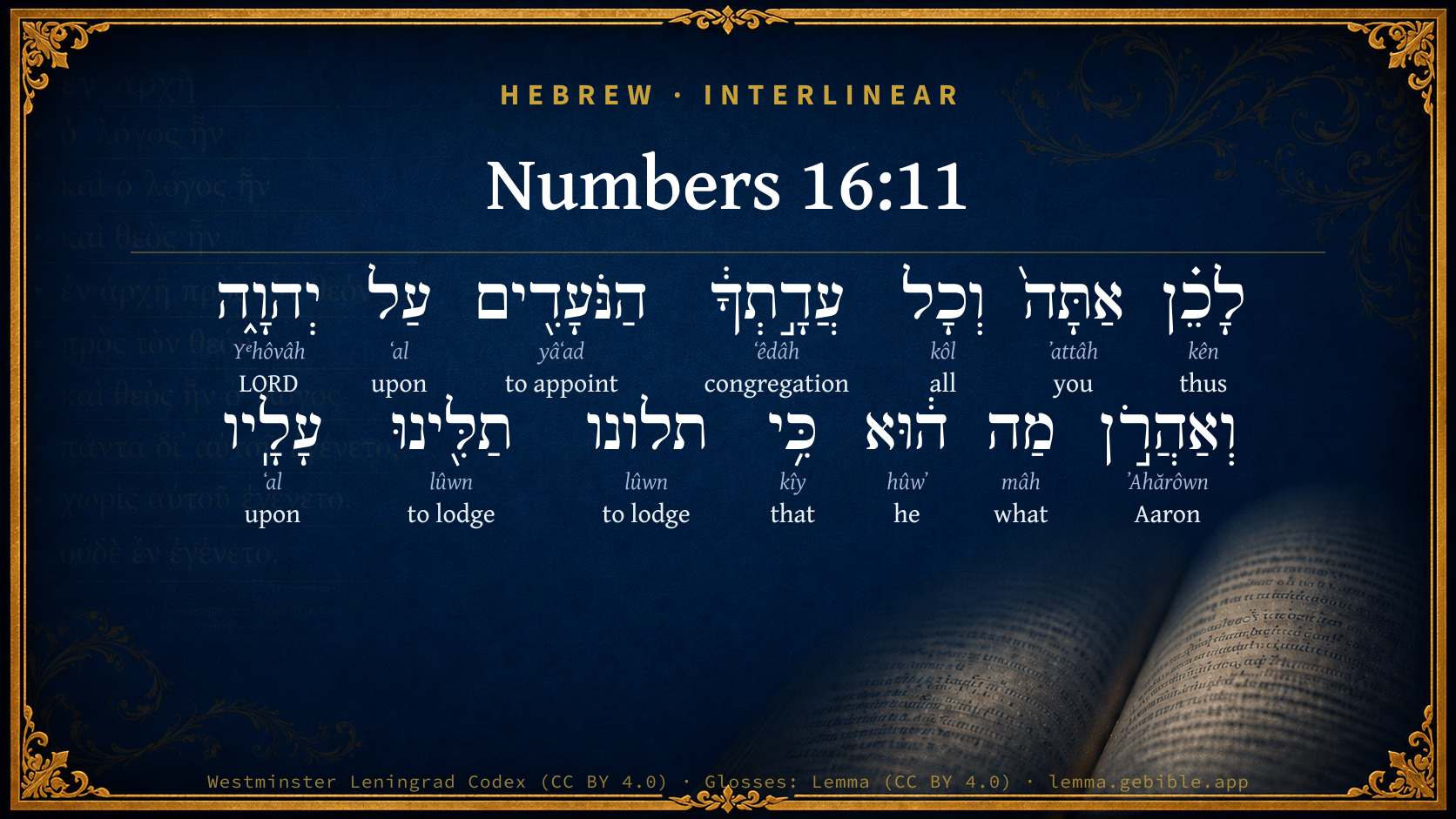
  1. לָכֵ֗ן kên H3651 “to/for · thus” Preposition + Adverb
  2. אַתָּה֙ ʼattâh H859 “you” Pronoun, Personal, 2nd Person, Masculine, Singular
  3. וְכָל kôl H3605 “and · all of” Conjunction + Noun, Common, Masculine, Singular, Construct
  4. עֲדָ֣תְךָ֔ ʻêdâh H5712 “congregation · your” Noun, Common, Feminine, Singular, Construct + Suffix, Personal, 2nd Person, Masculine, Singular
  5. עַל ʻal H5921 “upon” Preposition
  6. יְהוָ֑ה Yᵉhôvâh H3068 “LORD” Noun, Proper
  7. וְאַהֲרֹ֣ן ʼAhărôwn H175 “and · Aaron” Conjunction + Noun, Proper
  8. מַה mâh H4100 “what” Particle, Interrogative
  9. ה֔וּא hûwʼ H1931 “he” Pronoun, Personal, 3rd Person, Masculine, Singular
  10. כִּ֥י kîy H3588 “that” Conjunction
  11. תלונו lûwn H3885 “to lodge” Verb, Hiphil, Imperfect, 2nd Person, Masculine, Plural
  12. תַלִּ֖ינוּ lûwn H3885 “to lodge” Verb, Hiphil, Imperfect, 2nd Person, Masculine, Plural
  13. עָלָֽיו ʻal H5921 “upon · him” Preposition + Suffix, Personal, 3rd Person, Masculine, Singular

About this verse

These counts appear in no published source. They are computed here, from the morphology-tagged text and Lemma’s own curated glosses. What Lemma adds →

14
words
12
distinct lemmas
Pentateuch
section

Shared distinctive vocabulary

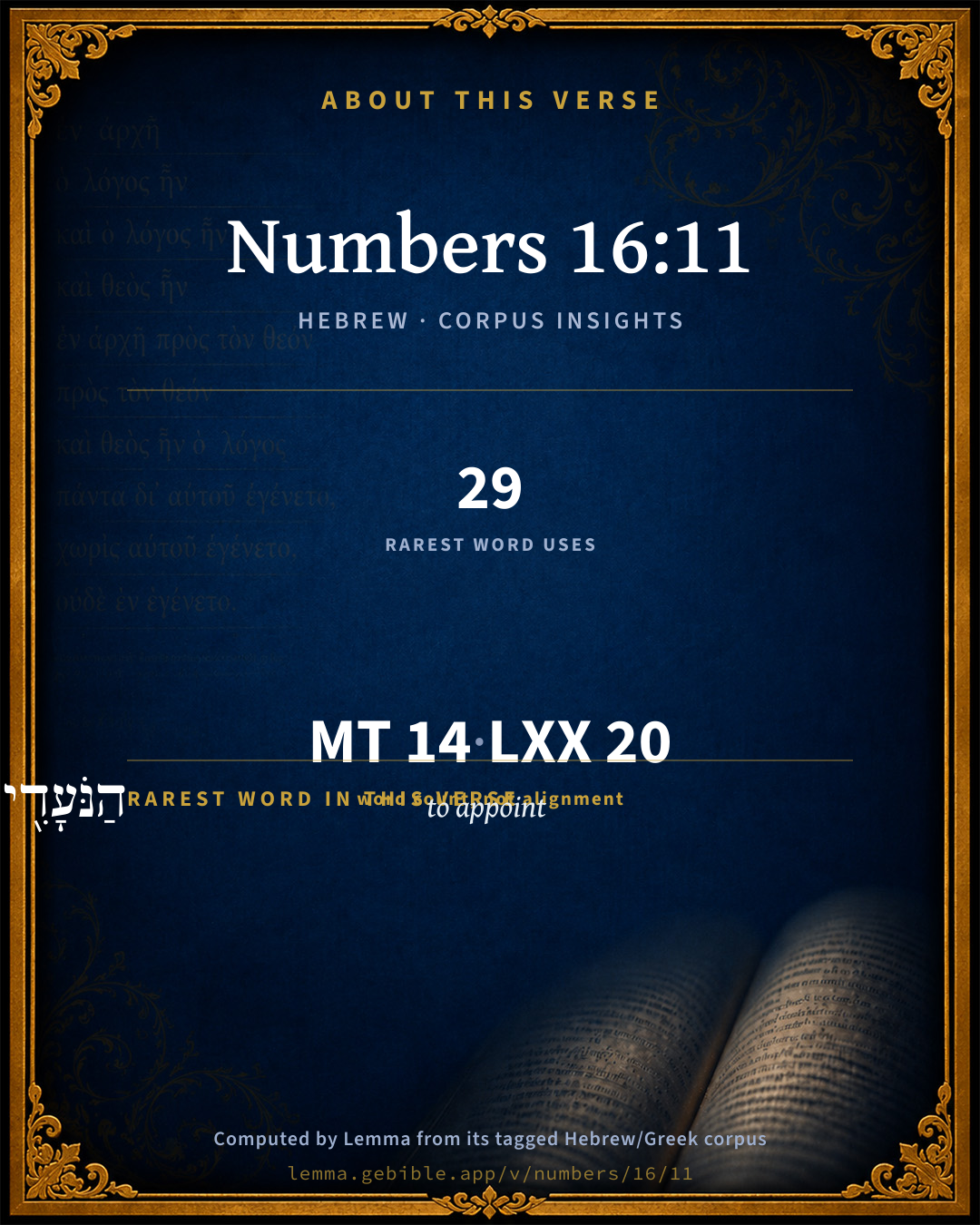
הַנֹּעָדִ֖ים to appoint H3259 occurs in 29 verses of the Hebrew Bible. Also found in:

Grammatical profile

  • 3 verbs
  • 4 nouns
  • 2 pronouns
  • 2 prepositions
  • 1 conjunction
  • 1 adverb
  • 1 particle

Verb forms

  • הַנֹּעָדִ֖ים Niphal · Participle Active
  • תלונו Hiphil · Imperfect
  • תַלִּ֖ינוּ Hiphil · Imperfect

Repetition

Words recur within this verse — often emphatic in Hebrew:

  • עַל upon H5921 ×2
  • תלונו to lodge H3885 ×2

Hebrew & Septuagint length

In English translation the verse runs 21 words from the Hebrew and 24 from the Septuagint (LXX English) — closely comparable.

A rough comparison of the two English renderings, which tokenize alike — not a word-level alignment.

Word counts can differ between the Hebrew and the Greek without any difference in meaning — e.g. the Hebrew direct-object marker אֵת has no separate Greek word, and Greek often adds the article ὁ.

In the original languages it is 14 Hebrew tokens and 20 Greek tokens — but the two are counted differently (Hebrew bundles its prefixes and suffixes into one token; the Greek is in lemma form), so that isn’t a like-for-like length.

Cross-references

10

Topical passages linked to Numbers 16:11 in the Treasury of Scripture Knowledge — connected by theme and wording, ordered by reader-vote popularity; previews shown in the World English Bible.

  • Exodus 16:7–8 and in the morning, then you shall see the glory of Yahweh; because he hears your murmurings against Yahweh. Who are we, that you murmur against us?"
  • Exodus 17:2 Therefore the people quarreled with Moses, and said, "Give us water to drink." Moses said to them, "Why do you quarrel with me? Why do you test Yahweh?"
  • Numbers 16:3 and they assembled themselves together against Moses and against Aaron, and said to them, You take too much on you, seeing all the congregation are holy, everyone of them, and Yahweh is among them: why then lift yourselves up above the assembly of Yahweh?
  • 1 Corinthians 3:5 Who then is Apollos, and who is Paul, but servants through whom you believed; and each as the Lord gave to him?
  • 1 Samuel 8:7 Yahweh said to Samuel, Listen to the voice of the people in all that they tell you; for they have not rejected you, but they have rejected me, that I should not be king over them.
  • Luke 10:16 Whoever listens to you listens to me, and whoever rejects you rejects me. Whoever rejects me rejects him who sent me."
  • John 13:20 Most assuredly I tell you, he who receives whomever I send, receives me; and he who receives me, receives him who sent me."
  • Acts 5:4 While you kept it, didn't it remain your own? After it was sold, wasn't it in your power? How is it that you have conceived this thing in your heart? You haven't lied to men, but to God."
  • Romans 13:2 Therefore he who resists the authority, withstands the ordinance of God; and those who withstand will receive to themselves judgment.
  • 1 Corinthians 10:10 Neither grumble, as some of them also grumbled, and perished by the destroyer.

Cross-references courtesy of OpenBible.info (CC BY 4.0).

Hebrew and Greek witnesses Masoretic Hebrew ↔ Greek Septuagint

The same verse in the two great witnesses to the Old Testament, shown verse-for-verse.

These are two independent witnesses, not word-aligned to each other, and the Septuagint is shown in lemma (dictionary) form.

Hebrew Numbers 16:11 Masoretic · Westminster Leningrad Codex

לָכֵ֗ן אַתָּה֙ וְכָל עֲדָ֣תְךָ֔ הַנֹּעָדִ֖ים עַל יְהוָ֑ה וְאַהֲרֹ֣ן מַה ה֔וּא כִּ֥י תלונו תַלִּ֖ינוּ עָלָֽיו

Therefore you and all your company are gathered together against Yahweh: and Aaron, what is he who you murmur against him?

World English Bible · Public Domain

Greek LXX Numbers 16:11 Septuagint · lemma form

οὕτως σύ καί πᾶς ὁ συναγωγή σύ ὁ συνἀθροίζω πρός ὁ θεός καί ἀαρών τίς εἰμί ὅτι διαγογγύζω κατά αὐτός

Thus it is with you and all your congregation which is gathered together against God: and who is Aaron, that you⌃ murmur against him?

LXX2012 (modern English Septuagint) · Public Domain

Hebrew: Westminster Leningrad Codex (CC BY 4.0). Greek: Septuagint (public domain); English from LXX2012 (modern English Septuagint) (Public Domain). How the Septuagint differs from the Hebrew →

Targum (Aramaic paraphrase)

2

The Targum is the ancient Jewish Aramaic paraphrase of the Hebrew Scriptures — an interpretive translation, not the Hebrew text itself. Onkelos (literal) and Pseudo-Jonathan (expansive) render the Torah, and Jonathan the Prophets. Coverage is partial: where no permissively-licensed English translation exists for a verse, only the Aramaic is shown. This is verse-level text, not a word-by-word alignment to the Hebrew.

  1. Targum Onkelos Torah (Genesis–Deuteronomy)
    בְּכֵן אַתְּ וְכָל כְּנִשְׁתָּךְ דְאִזְדַמַנְתּוּן עַל יְיָ וְאַהֲרֹן מַה הוּא אֲרֵי אִתְרַעַמְתּוּן עֲלוֹהִי

    (no public-domain English translation for this verse)

    Targum Onkelos — Aramaic: “Onkelos Genesis” (public domain); “Onkelos Exodus” (public domain); “Onkelos Leviticus” (public domain); “Onkelos Numbers” (public domain); “Onkelos Deuteronomy” (public domain). English: “Sefaria Community Translation” (CC0 1.0 (public-domain dedication)); “J.W. Etheridge. The Targums of Onkelos and Jonathan Ben Uzziel on the Pentateuch. London: Longmans, Green, 1862” (public domain). Text via Sefaria.

  2. Targum Pseudo-Jonathan Torah (Genesis–Deuteronomy)
    בְּגִין כֵּן אַנְתְּ וְכָל כְּנִישַׁת סַעֲדָךְ דְאִזְדַמַנְתּוּן עַל מֵימְרָא דַיְיָ וְאַהֲרן מַה הוּא אֲרוּם מִתְרַעֲמִין אַתּוּן עֲלוֹי

    Therefore art thou and all the company of thy helpers gathered together against the Word of the Lord: and Aharon, what is he, that you murmur against him?

    Targum Pseudo-Jonathan — Aramaic: “Targum Jonathan on Genesis” (public domain); “Targum Jonathan on Exodus” (public domain); “Targum Jonathan on Leviticus” (public domain); “Targum Jonathan on Numbers” (public domain); “Targum Jonathan on Deuteronomy” (public domain). English: “The Targum of Jonathan ben Uzziel, trans. J. W. Etheridge, London, 1862” (public domain). Text via Sefaria.

Commentary

Notes on Numbers 16:11 from classic Christian and Jewish commentators (each source and its license shown beneath its notes). The classic Christian expositions comment on the surrounding passage and are grouped to its opening verse, so a note may address several verses; the Jewish commentaries on the Tanakh (Rashi and others) are per-verse, so they appear only where the commentator wrote on this verse.

Lemma curates 59 commentaries, every one of them public domain or Creative Commons licensed, each selected and text-cleaned for this edition rather than reprinted as found. About our sources →

Trapp's Complete Commentary

John Trapp

Num 16:11 For which cause [both] thou and all thy company [are] gathered together against the LORD: and what [is] Aaron, that ye murmur against him?

Ver. 11. And what is Aaron?] q.d., Is it not God whom ye wound through Aaron’s sides? "Saul, Saul, why persecutest thou me?" {Act 9:4}

John Trapp, A Commentary or Exposition upon All the Books of the Old and New Testament (1647–1656) — public domain. Text from a community e-Sword module.

The Cambridge Bible for Schools and Colleges

gen. ed. J. J. S. Perowne

11. and Aaron, what is he &c.] i.e. What has he done to cause your murmuring? God, and not Aaron, is responsible for the superiority in which the priests stand to the Levites; cf. Exo_16:8 b.

The Cambridge Bible for Schools and Colleges (gen. ed. J. J. S. Perowne; Cambridge University Press, 1878–1918) — public domain. Text from a community e-Sword module.

John Gill's Exposition

For which cause, both thou and all thy company are gathered together against the Lord,.... For gathering together against his ministers, whom he had put into office to act under him, and endeavouring to overturn a constitution of his erecting, and resisting and not submitting to an ordinance of his, is interpreted gathering against him, and acting in opposition to him; see Rom 13:1,

and what is Aaron, that ye murmur against him? what is his transgression? what has he done? as Aben Ezra paraphrases it; he is not chargeable with any fault, he did not take upon him the office of high priest of himself, God called him to it, and put him in it; he is only his minister, and by no means to be blamed, and therefore it is unreasonable to envy him, or murmur against him; and, indeed, murmuring against him is murmuring against the Lord.

John Gill's Exposition of the Whole Bible (1746–1763) — public domain (CC PDM 1.0). Text via the HelloAO Bible API.

Albert Barnes' Notes on the Bible

The words of Moses in his wrath are broken. The Aaronic priesthood was of divine appointment; and thus in rejecting it, the conspirators were really rebelling against God.

Albert Barnes' Notes on the Bible (1834–1885) — public domain. Text from a community e-Sword/MySword module.

Haydock's Catholic Bible Commentary

Him. The injury is offered to God, who made choice of Aaron freely.

George Leo Haydock (1774–1849), Haydock's Catholic Family Bible and Commentary, 1859 edition — public domain. Excludes Psalms (Douay-Rheims chapter numbering differs from Protestant) and Deuterocanonical books (Catholic canon only).

Matthew Poole's English Annotations

Against the Lord, whoso minister and chosen servant Aaron is. You strike at God through Aaron’s sides. Compare 1Sa 8:7; Luk 10:16; Joh 13:20.

Matthew Poole's English Annotations on the Holy Bible (1683–1685) — public domain. Text from a community e-Sword/MySword module.

Whedon's Commentary on the Bible

Daniel D. Whedon

11. Against the Lord — To resist divinely constituted authority is to resist the Lord. Rom_13:2, note.

What is Aaron — Doubtless Moses had been accused of nepotism in selecting the priestly family. The question implies that Aaron was blameless.

Daniel D. Whedon (gen. ed.), Commentary on the Old and New Testaments (1874–1909) — public domain. Text from a community e-Sword module.

The Pulpit Commentary

For which cause both thou and all thy company are gathered together. It does not follow that Korah was seeking an exclusive dignity for himself; or for his tribe. His "company" apparently included representative men from all the tribes, or at least from many (see on verse 2). They were seeking the priesthood because they affirmed it to be the common possession of all Israelites. Against the Lord. It was in his name that they appeared, and to some extent no doubt sincerely; but since they appeared to dispute an ordinance actually and historically made by God himself, it was indeed against him that they were gathered. And what is Aaron, that ye murmur against him? The construction is broken, as so often when we have the ipsissima verba of Moses, whose meekness did not enable him to speak calmly under provocation. The sentence runs, "For which cause thou and all thy company who arc gathered against the Lord, and Aaron, who is he, that ye murmur against him?" It was easy to represent the position of Aaron in an invidious light, as though they were assailing some personal sacerdotal pretensions; but in truth he was only a poor servant of God doing what he was bid.

The Pulpit Commentary (1880–1919), ed. H.D.M. Spence-Jones & Joseph S. Exell — public domain. Text from a community e-Sword module.

John Wesley's Explanatory Notes

Against the Lord - Whose chosen servant Aaron is. You strike at God through Aaron's sides.

John Wesley, Explanatory Notes Upon the Whole Bible (1754–1765) — public domain. Text via the GEBible commentary corpus.

Rashi

Rabbi Shlomo Yitzchaki (Rashi)

לכן means because of this — because of all this that I have mentioned, אתה וכל עדתך הנועדים BOTH YOU AND ALL YOUR CONGREGATION WHO ARE GATHERED with you, על ה׳ are AGAINST THE LORD, for it is by His commission that I am acting in giving the Priesthood to Aaron; and this rebellion is therefore not against “us” (Midrash Tanchuma, Korach 6).

Rashi on the Tanakh — English translations: “The Judaica Press complete Tanach with Rashi, translated by A. J. Rosenberg” (CC BY 4.0); “Pentateuch with Rashi's commentary by M. Rosenbaum and A.M. Silbermann, 1929-1934” (public domain); “The Metsudah Tanach series, Lakewood, N.J” (CC BY 4.0); and “The Book of Joshua, Metsudah Publications, 1997” (CC BY 4.0). Text via Sefaria.

Ramban (Nachmanides)

Rabbi Moshe ben Nachman (Ramban / Nachmanides)

THEREFORE THOU AND ALL THY COMPANY. “Therefore, because of this [i.e., because of what I have previously said: Hear now, ye sons of Levi: is it but a small thing etc.] thou and all thy company that are gathered together [are] against the Eternal, for I acted as His agent in giving the priesthood to Aaron, and this controversy is [therefore] not directed against us.” This is Rashi’s language. And if so, the verse is saying: “thou and all thy company — it is ye that are gathered together against G-d, and not against Aaron.” And Rabbi Abraham ibn Ezra commented that the letter hei in the word hano’adim (‘that’ are gathered together) is redundant [thus the verse means: “thou and all thy company ‘are gathered together not against us but against G-d”]. It is possible that the verse is stating: “Therefore thou and all thy company that are gathered together against G-d — for it is not against Aaron [that you are gathered together] — be ye before G-d with Aaron tomorrow,” and the verse is elliptic with respect to the conditions that Moses mentioned. The purport of the verses is thus as follows: At first he [Moses] spoke unto Korach and unto all his company, saying: ‘In the morning the Eternal will make known etc.,’ ] Moses spoke only to Korach. This is made necessary because, as Ramban has stated above, among the assembled were people from all tribes. and afterwards he continued speaking to Korach, saying: ye take too much upon you, ye sons of Levi, and told Korach alone, Hear now, ye sons of Levi. Therefore he repeated himself saying, thou and all thy company that are gathered together against G-d, meaning that the punishment would not be directed against Korach alone, but against his whole company, for they are all gathered together against G-d.

Ramban (Nachmanides) on the Tanakh — English translation: “Commentary on the Torah by Ramban (Nachmanides). Translated and annotated by Charles B. Chavel. New York, Shilo Pub. House, 1971-1976” (CC BY 4.0). Text via Sefaria.

Lesson kit

Teaching starters — assembled from the data on this page, not authored interpretation. Every prompt links to the verse data it draws on. Edit before teaching.

Numbers, in the Pentateuch, opens this verse with 14 words (12 distinct Hebrew lemmas). Its most distinctive word is yâʻad (“to appoint”). A historical commentator’s framing appears above. Read the whole chapter for the surrounding context.

Discussion questions

  1. The word yâʻad carries the sense “to appoint.” How does it shape the verse?
  2. How does Exodus 21:8, which shares the word «to appoint», read alongside this verse?
  3. What does the repetition of “upon” (2× in this one verse) do in this verse?
  4. These translations render this verse differently. What is at stake in choosing one wording over another?
  5. «הַנֹּעָדִ֖ים» is a Niphal Participle Active verb. How does that grammatical form shape the action described?
  6. Compare how Trapp's Complete Commentary and The Cambridge Bible for Schools and Colleges read this verse. Where do they agree or differ?

Things to notice

Reading settings

Reading text

Shown beneath each verse's original-language words.

Old Testament
Old Testament edition

Read the OT as the Masoretic Hebrew (MT) or the Greek Septuagint (LXX).

English shown for the Greek Septuagint (in the Hebrew ↔ Greek comparison).

Comparing translations? Open the Compare panel on any verse page to stack up to four side by side.