
Zechariah 14:15

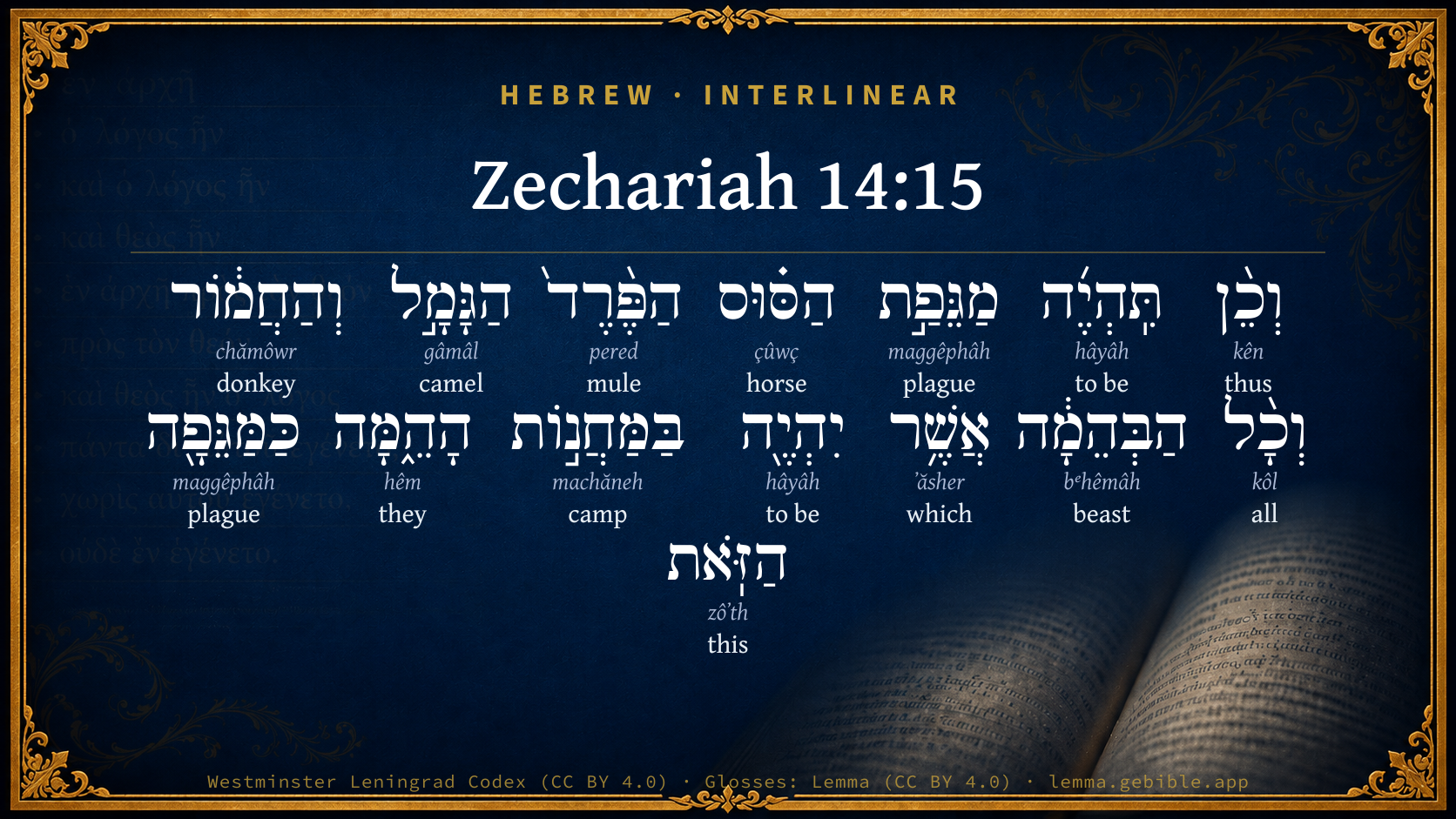
Hebrew (Westminster Leningrad Codex) Zechariah 14:15 appears in the Hebrew Old Testament. The text above is from the Westminster Leningrad Codex. Each word links to its Strong’s number, a concise gloss, and parsing drawn from the Open Scriptures Hebrew Bible morphology. Click any word for its full Brown-Driver-Briggs (BDB) entry.
Download image
Cite this verse

Zechariah 14:15 (World English Bible). Public Domain. Lemma interlinear Bible study tool, https://lemma.gebible.app/v/zechariah/14/15.

Show BibTeX & RIS
BibTeX
RIS
English Translation
So will be the plague of the horse, of the mule, of the camel, and of the donkey, and of all the animals that will be in those camps, as that plague.
World English Bible · Public Domain
Download a study sheet

One document with this verse’s original text, its word-by-word gloss line, the meaning frame, cross-references with their text, attributed commentary, and full source and license credits — printable, and it pastes into notes with its structure intact.

This verse Autodidact and up

Study sheet (.html) Plain text (.txt)

A passage Seminary Student

Up to 50 verses in one chapter. A passage sheet keeps up to 6 commentary sources and 12 cross-references per verse, in the order this page ranks them, and says so on the sheet whenever that leaves anything out. Ask for a single verse and you get the Autodidact verse sheet above.

Everything on this page stays free to read, with no account — the sheet is a download of what is already on screen, not access to it.

Want to remove ads? Support Godless Engineer
Compare translations 3

The same verse in 3 English versions, stacked beneath the original-language interlinear above. Click any original word for its lexicon entry.

Each is an independent rendering of the whole verse — the interlinear is not word-aligned to these translations.

Highlighted words mark where these versions differ — a whole-verse word diff, not a word-by-word alignment.

  • World English Bible Public Domain
    So will be the plague of the horse, of the mule, of the camel, and of the donkey, and of all the animals that will be in those camps, as that plague.
  • King James Version Public Domain
    And so shall be the plague of the horse, of the mule, of the camel, and of the ass, and of all the beasts that shall be in these tents, as this plague.
  • unfoldingWord Literal Text CC BY-SA 4.0
    A plague will also be on the horses the mules, the camels and the donkeys, and on every animal in those camps will also suffer that same plague.

unfoldingWord Literal Text — © unfoldingWord, licensed CC BY-SA 4.0. Word-aligned USFM3 via Door43 (git.door43.org/unfoldingWord/en_ult).

Versions to compare (up to 4)

3 of 4 selected

Show all 18 translations

Every available English version of this verse, each an independent rendering of the whole verse.

  • World English Bible Public Domain
    So will be the plague of the horse, of the mule, of the camel, and of the donkey, and of all the animals that will be in those camps, as that plague.
  • Berean Standard Bible Public Domain
    And a similar plague will strike the horses and mules, camels and donkeys, and all the animals in those camps.
  • Majority Standard Bible Public Domain
    And a similar plague will strike the horses and mules, camels and donkeys, and all the animals in those camps.
  • King James Version Public Domain
    And so shall be the plague of the horse, of the mule, of the camel, and of the ass, and of all the beasts that shall be in these tents, as this plague.
  • American Standard Version (1901) Public Domain
    And so shall be the plague of the horse, of the mule, of the camel, and of the ass, and of all the beasts that shall be in those camps, as that plague.
  • Revised Version (1885) Public Domain
    And so shall be the plague of the horse, of the mule, of the camel, and of the ass, and of all the beasts that shall be in those camps, as this plague.
  • Geneva Bible (1599) Public Domain
    Yet this shall be the plague of the horse, of the mule, of the camell and of the asse and of all the beasts that be in these tents as this plague.
  • Douay-Rheims (1899) Public Domain
    And the destruction of the horse, and of the mule, and of the camel, and of the ass, and of all the beasts, that shall be in those tents, shall be like this destruction.
  • Young's Literal Translation Public Domain
    And so is the plague of the horse, of the mule, Of the camel, and of the ass, And of all the cattle that are in these camps, As this plague.
  • Literal Standard Version CC BY-SA 4.0
    And so is the plague of the horse, of the mule, || Of the camel, and of the donkey, || And of all the livestock that are in these camps, || As this plague.
  • Unlocked Literal Bible CC BY-SA 4.0
    A plague will also be on the horses and the mules, the camels and the donkeys, and on every animal in those camps will also suffer that same plague.
  • unfoldingWord Literal Text CC BY-SA 4.0
    A plague will also be on the horses the mules, the camels and the donkeys, and on every animal in those camps will also suffer that same plague.
  • Darby Bible Public Domain
    And so shall be the plague of the horse, of the mule, of the camel, and of the ass, and of all the beasts that shall be in those camps, as this plague.
  • World Messianic Bible Public Domain
    A plague like this will fall on the horse, on the mule, on the camel, on the donkey, and on all the animals that will be in those camps.
  • Webster's Bible Public Domain
    And so shall be the plague of the horse, of the mule, of the camel, and of the ass, and of all the beasts that shall be in these tents, as this plague.
  • Free Bible Version CC BY-SA 4.0
    A similar plague will strike the horses, mules, camels, donkeys, and all other animals that may be in their camps.
  • Bible in Basic English Public Domain
    And the horses and the transport beasts, the camels and the asses and all the beasts in those tents will be attacked by the same disease.
  • JPS Tanakh (1917) Public Domain
    And so shall be the plague of the horse, of the mule, of the camel, and of the ass, and of all the beasts that shall be in those camps, as this plague.

Literal Standard Version (2020), Covenant Press — licensed CC BY-SA 4.0. Text via the HelloAO Bible API (eBible.org). Unlocked Literal Bible (unfoldingWord) — licensed CC BY-SA 4.0. Text via the HelloAO Bible API (eBible.org). unfoldingWord Literal Text — © unfoldingWord, licensed CC BY-SA 4.0. Word-aligned USFM3 via Door43 (git.door43.org/unfoldingWord/en_ult). Free Bible Version, Dr. Jonathan Gallagher — licensed CC BY-SA 4.0. Text via the HelloAO Bible API (eBible.org).

Word by word

More ways to search: Search by grammar → Find every occurrence → Compare this word →

Practice this passage: Drill this verse → Learn its vocabulary →

הַפֶּ֨רֶד֙
pered
H6505
“the · mule”
Particle, Definite Article + Noun, Common, Masculine, Singular, Absolute
Part of Speech
Particle + Noun
Type
Common
Gender
Masculine
Number
Singular
State
Absolute
Full BDB Definition

Origin: from H6504

TWOT: 1807a

mule
  1. וְכֵ֨ן kên H3651 “and · thus” Conjunction + Particle, Demonstrative
  2. תִּֽהְיֶ֜ה hâyâh H1961 “to be” Verb, Qal, Imperfect, 3rd Person, Feminine, Singular
  3. מַגֵּפַ֣ת maggêphâh H4046 “plague of” Noun, Common, Feminine, Singular, Construct
  4. הַסּ֗וּס çûwç H5483 “the · horse” Particle, Definite Article + Noun, Common, Masculine, Singular, Absolute
  5. הַגָּמָ֣ל gâmâl H1581 “the · camel” Particle, Definite Article + Noun, Common, Masculine, Singular, Absolute
  6. וְהַחֲמ֔וֹר chămôwr H2543 “and · the · donkey” Conjunction + Particle, Definite Article + Noun, Common, Both, Singular, Absolute
  7. וְכָ֨ל kôl H3605 “and · all of” Conjunction + Noun, Common, Masculine, Singular, Construct
  8. הַבְּהֵמָ֔ה bᵉhêmâh H929 “the · beast” Particle, Definite Article + Noun, Common, Feminine, Singular, Absolute
  9. אֲשֶׁ֥ר ʼăsher H834 “which” Particle, Relative
  10. יִהְיֶ֖ה hâyâh H1961 “to be” Verb, Qal, Imperfect, 3rd Person, Masculine, Singular
  11. בַּמַּחֲנ֣וֹת machăneh H4264 “in/at the · camps” Preposition, Determined + Noun, Common, Both, Plural, Absolute
  12. הָהֵ֑מָּה hêm H1992 “the · they” Particle, Definite Article + Pronoun, Personal, 3rd Person, Masculine, Plural
  13. כַּמַּגֵּפָ֖ה maggêphâh H4046 “like/as the · plague” Preposition, Determined + Noun, Common, Feminine, Singular, Absolute
  14. הַזֹּֽאת zôʼth H2063 “the · this” Particle, Definite Article + Pronoun, Demonstrative, Feminine, Singular

About this verse

These counts appear in no published source. They are computed here, from the morphology-tagged text and Lemma’s own curated glosses. What Lemma adds →

15
words
13
distinct lemmas
Prophets
section

Notable vocabulary

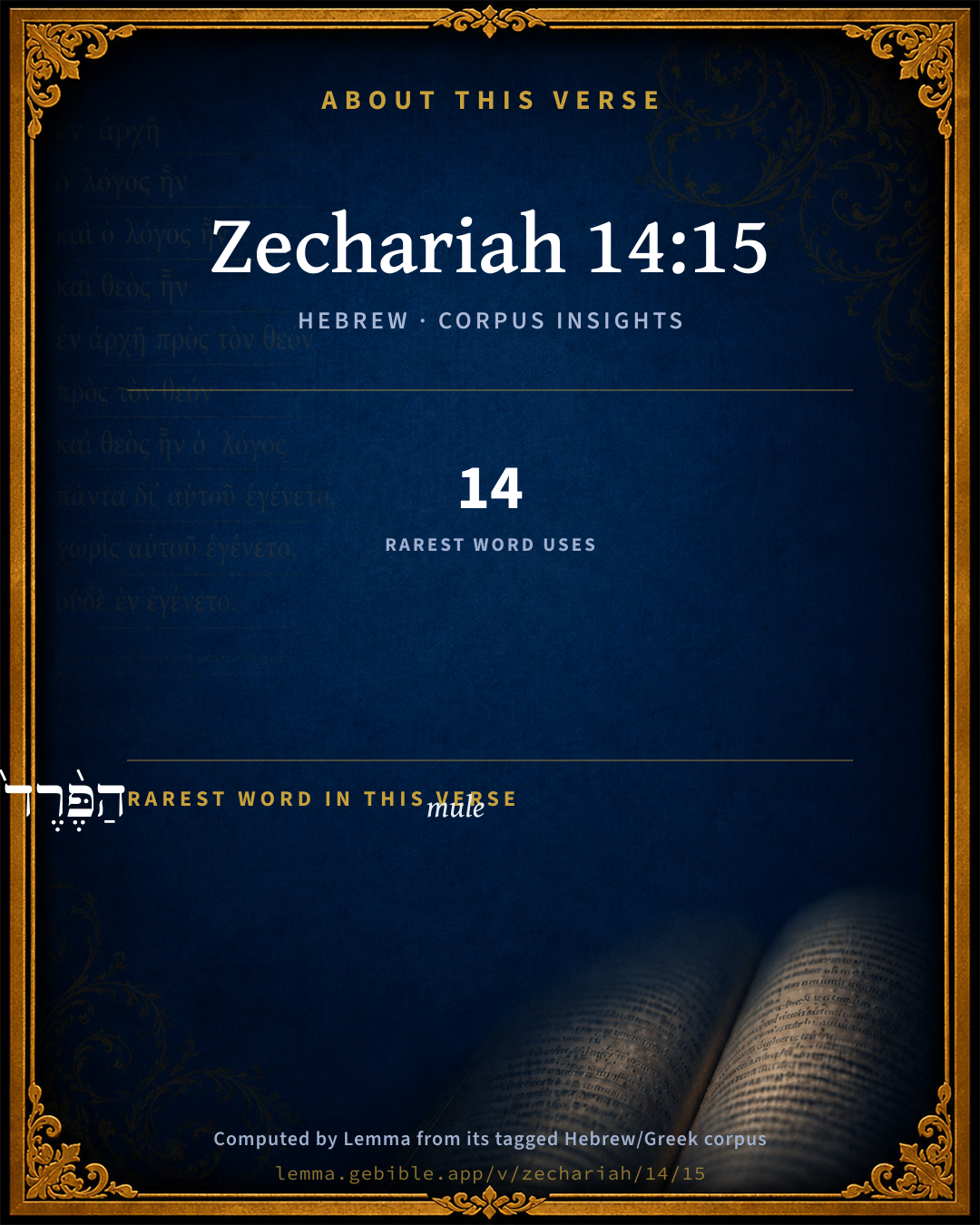
The rarest word here is הַפֶּ֨רֶד֙ mule H6505 — appearing just 14 times in the whole Hebrew Bible.

Shared distinctive vocabulary

הַפֶּ֨רֶד֙ mule H6505 occurs in 12 verses of the Hebrew Bible. Also found in:

Grammatical profile

  • 2 verbs
  • 9 nouns
  • 2 pronouns
  • 2 particles

Verb forms

  • תִּֽהְיֶ֜ה Qal · Imperfect
  • יִהְיֶ֖ה Qal · Imperfect

Repetition

Words recur within this verse — often emphatic in Hebrew:

  • תִּֽהְיֶ֜ה to be H1961 ×2
  • מַגֵּפַ֣ת plague H4046 ×2

Hebrew & Septuagint length

In English translation the verse runs 32 words from the Hebrew and 28 from the Septuagint (LXX English) — closely comparable.

A rough comparison of the two English renderings, which tokenize alike — not a word-level alignment.

Word counts can differ between the Hebrew and the Greek without any difference in meaning — e.g. the Hebrew direct-object marker אֵת has no separate Greek word, and Greek often adds the article ὁ.

Cross-references

1

Topical passages linked to Zechariah 14:15 in the Treasury of Scripture Knowledge — connected by theme and wording, ordered by reader-vote popularity; previews shown in the World English Bible.

  • Zechariah 14:12 This will be the plague with which Yahweh will strike all the peoples who have warred against Jerusalem: their flesh will consume away while they stand on their feet, and their eyes will consume away in their sockets, and their tongue will consume away in their mouth.

Cross-references courtesy of OpenBible.info (CC BY 4.0).

Hebrew and Greek witnesses Masoretic Hebrew ↔ Greek Septuagint

The same verse in the two great witnesses to the Old Testament, shown verse-for-verse.

These are two independent witnesses, not word-aligned to each other, and the Septuagint is shown in lemma (dictionary) form.

Hebrew Zechariah 14:15 Masoretic · Westminster Leningrad Codex

וְכֵ֨ן תִּֽהְיֶ֜ה מַגֵּפַ֣ת הַסּ֗וּס הַפֶּ֨רֶד֙ הַגָּמָ֣ל וְהַחֲמ֔וֹר וְכָ֨ל הַבְּהֵמָ֔ה אֲשֶׁ֥ר יִהְיֶ֖ה בַּמַּחֲנ֣וֹת הָהֵ֑מָּה כַּמַּגֵּפָ֖ה הַזֹּֽאת

So will be the plague of the horse, of the mule, of the camel, and of the donkey, and of all the animals that will be in those camps, as that plague.

World English Bible · Public Domain

Greek LXX Zechariah 14:15 Septuagint · lemma form

καί οὗτος εἰμί ὁ πτῶσις ὁ ἵππος καί ὁ ἡμίονος καί ὁ κάμηλος καί ὁ ὄνος καί πᾶς ὁ κτῆνος ὁ εἰμί ἐν ὁ παρεμβολή ἐκεῖνος κατά ὁ πτῶσις οὗτος

And this shall be the overthrow of the horses, and mules, and camels, and asses, and all the beasts that are in those camps, according to this overthrow.

LXX2012 (modern English Septuagint) · Public Domain

On this verse, The Pulpit Commentary discusses the Septuagint’s reading. Read the note in Commentary ↓

Hebrew: Westminster Leningrad Codex (CC BY 4.0). Greek: Septuagint (public domain); English from LXX2012 (modern English Septuagint) (Public Domain). How the Septuagint differs from the Hebrew →

Targum (Aramaic paraphrase)

1

The Targum is the ancient Jewish Aramaic paraphrase of the Hebrew Scriptures — an interpretive translation, not the Hebrew text itself. Onkelos (literal) and Pseudo-Jonathan (expansive) render the Torah, and Jonathan the Prophets. Coverage is partial: where no permissively-licensed English translation exists for a verse, only the Aramaic is shown. This is verse-level text, not a word-by-word alignment to the Hebrew.

  1. Targum Jonathan Prophets (Joshua–Malachi)
    וְכֵן תְּהֵי מְחַת סוּסַיָא כּוּדְנַיָא גַמְלָא וַחֲמָרָא וְכָל בְּעִירָא דִיהֵי בְּמַשִׁרְיָתָא הָאִינוּן כְּמַחֲתָא הָדָא:

    (no public-domain English translation for this verse)

    Targum Jonathan — Aramaic: “Mikraot Gedolot” (public domain). English: “Sefaria Community Translation” (CC0 1.0 (public-domain dedication)); “London "Chaldee Paraphrase," 1871” (public domain). Text via Sefaria.

Commentary

Notes on Zechariah 14:15 from classic Christian and Jewish commentators (each source and its license shown beneath its notes). The classic Christian expositions comment on the surrounding passage and are grouped to its opening verse, so a note may address several verses; the Jewish commentaries on the Tanakh (Rashi and others) are per-verse, so they appear only where the commentator wrote on this verse.

Lemma curates 59 commentaries, every one of them public domain or Creative Commons licensed, each selected and text-cleaned for this edition rather than reprinted as found. About our sources →

Trapp's Complete Commentary

John Trapp

Zec 14:15 And so shall be the plague of the horse, of the mule, of the camel, and of the ass, and of all the beasts that shall be in these tents, as this plague.

Ver. 15. And so shall be the plague of the horse, of the mule, of the camel] All the beasts of service, made use of by the enemy, shall consume in like sort as their masters. First, for a punishment to their owners, who must needs suffer loss thereby: hence Saul was so sedulous in seeking the lost asses. Secondly, to show how God is displeased with, and will severely punish, all that are instrumental to the Church’s calamities or serviceable to their sin. The serpent is cursed, cut shorter by the feet, and made to wriggle upon his belly, yea, confined to the dust for his diet. So God curseth and abhorreth all instruments of idolatry, Isa 30:22 Num 31:22-23 Deu 7:25 "The graven images of their gods shall ye burn with fire"; the very visible heavens, because defiled with man’s sin, are to be purged by the fire of the last day.

John Trapp, A Commentary or Exposition upon All the Books of the Old and New Testament (1647–1656) — public domain. Text from a community e-Sword module.

Geneva Bible (1599)

Geneva Bible translators

As the men should be destroyed, verse 12.

Geneva Bible (1599) marginal notes — public domain. Text via Bolls.life.

Jamieson, Fausset & Brown

Robert Jamieson, A. R. Fausset & David Brown

The plague shall affect the very beasts belonging to the foe. A typical foretaste of all this befell Antiochus Epiphanes and his host at Jerusalem (I Maccabees 13:49; II Maccabees 9:5).

Jamieson, Fausset & Brown — Commentary Critical and Explanatory on the Whole Bible (1871) — public domain (CC PDM 1.0). Text via the HelloAO Bible API.

Adam Clarke's Commentary

Verse 15. So shall be the plague of the horse, and the mule] There shall be plagues on the substance of the enemies of the Church, as there were on the cattle and goods of the Egyptians.

Adam Clarke's Commentary on the Bible (1810–1826) — public domain. Text from a community e-Sword/MySword module.

John Calvin's Commentaries

Zechariah in this verse raises up the minds of the godly, so that they might know that their energies would effect nothing, but that after having tried every thing they would be put to flight by the power of God. And hence appears more evident what has been twice repeated, — that the Prophet does not simply denounce calamities to terrify the Jews, but to animate them to constancy, that they might boldly exult, even when nearly overwhelmed by a vast heap of evils.

The meaning then is, — that after Satan had tried every thing to effect the ruin of the Church, and the ungodly had left nothing undone, there would yet be a successful issue to the faithful; for God would execute his vengeance, not only on men, but also on horses and camels, and on all cattle: and since God’s wrath would burn against all animals, which are in themselves innocent, it may with certainty be concluded, that those enemies who had provoked him by their cruelty, could not escape his judgment, and the punishment described here by the Prophet. He then subjoins -

John Calvin's Commentaries (1540-1563) — public domain. Text from the Calvin Translation Society English edition (1840s-50s) via the Christian Classics Ethereal Library (ccel.org). Calvin's coverage is partial (roughly two-thirds of the Bible); uncommented books and verses are honest gaps, never fabricated. The 19th-century editor's footnotes and remarks are omitted so the notes are faithfully Calvin's own voice.

Ellicott's Commentary for English Readers

(15) The war-horse (see Note on Zec_9:9) and beasts of burden (see Note on Zec_9:9) are to be included in the destruction, even as were the cattle of Achan (Jos_7:24).

A Bible Commentary for English Readers, edited by Charles John Ellicott (1878–1897) — public domain. Text from a community e-Sword module.

The Cambridge Bible for Schools and Colleges

gen. ed. J. J. S. Perowne

15. tents] camps, R.V.

as this plague] viz. that described in Zec_14:13. Comp. for this including the cattle in the curse, Deu_13:15; Jos_7:24.

The Cambridge Bible for Schools and Colleges (gen. ed. J. J. S. Perowne; Cambridge University Press, 1878–1918) — public domain. Text from a community e-Sword module.

John Gill's Exposition

And so shall be the plague of the horse, of the mule, of the camel, and of the ass,.... The flesh of the horse is said to be eaten, Rev 19:18,

and of all the beasts that shall be in these tents, as this plague, their beasts shall perish in like manner as themselves.

John Gill's Exposition of the Whole Bible (1746–1763) — public domain (CC PDM 1.0). Text via the HelloAO Bible API.

Albert Barnes' Notes on the Bible

And so shall be the plague of the Lord ... - Dionysius: “So, when God sendeth the plague, all the irrational animals of antichrist and his satellites shall perish as the aforesaid men, who used them, perished. For, for the sins of men, God, to their greater confusion, sometimes slays their beasts, sometimes also for their loving correction.” “The imagery is from the Mosaic law of the ban. If a whole city became guilty of idolatry, not the inhabitants only, but the beasts were to be destroyed Deu 13:15, so that here, in miniature, should be repeated the relation of the irrational to the rational part of the creation, according to which, for the sins of men, ‘the creature is,’ against its will, ‘made subject to vanity.’ Analogous is it also, that on the offence of Achan Jos 7:24-25, beside him and his children, his oxen, asses and sheep were (stoned and) burned with him.”

Albert Barnes' Notes on the Bible (1834–1885) — public domain. Text from a community e-Sword/MySword module.

Haydock's Catholic Bible Commentary

Shall be like this destruction. That is, the beasts shall be destroyed as well as the men; the common soldiers as well as their leaders. (Challoner) --- History does not specify the death of cattle, (Calmet) though in plagues this would inevitably follow; and the pagans complained that they were become more common since the propagation of the gospel. (Haydock) --- The reverses which the troops of Dioclesian, &c., sustained, were to punish their enmity to religion. (Calmet)

George Leo Haydock (1774–1849), Haydock's Catholic Family Bible and Commentary, 1859 edition — public domain. Excludes Psalms (Douay-Rheims chapter numbering differs from Protestant) and Deuterocanonical books (Catholic canon only).

Matthew Poole's English Annotations

Those creatures which the enemy in the wars made use of against the church, shall by the hand of God be suddenly and strangely either destroyed or made useless, neither fit to annoy the church nor to benefit their owners. As God destroyed much of the cattle of the Egyptians by hail, and murrain, &c.; so now shall it be with the cattle of these persecutors, they shall perish with their masters. The horses, as the horsemen, were drowned in the Red Sea.

Matthew Poole's English Annotations on the Holy Bible (1683–1685) — public domain. Text from a community e-Sword/MySword module.

The Pulpit Commentary

So shall be the plague of the horse, etc. As was the plague that came on men (ver. 12), so shall be tide plague that falls on their beasts and cattle. The brute animals suffer for their owners" sin according to the ban under the old Law. (Deu_13:15; comp. Num_16:32, 33Jo 7:24, 25) Tents; camps; Septuagint, parembolaiv . The verse illustrates the utter destruction which shall befall the enemies of God"s Church.

The Pulpit Commentary (1880–1919), ed. H.D.M. Spence-Jones & Joseph S. Exell — public domain. Text from a community e-Sword module.

John Wesley's Explanatory Notes

The horse - Those creatures which the enemy in the wars made use of, shall by the hand of God be suddenly and strangely destroyed.

John Wesley, Explanatory Notes Upon the Whole Bible (1754–1765) — public domain. Text via the GEBible commentary corpus.

Rashi

Rabbi Shlomo Yitzchaki (Rashi)

similar to this plague which is delineated above, that his flesh shall waste away.

Rashi on the Tanakh — English translations: “The Judaica Press complete Tanach with Rashi, translated by A. J. Rosenberg” (CC BY 4.0); “Pentateuch with Rashi's commentary by M. Rosenbaum and A.M. Silbermann, 1929-1934” (public domain); “The Metsudah Tanach series, Lakewood, N.J” (CC BY 4.0); and “The Book of Joshua, Metsudah Publications, 1997” (CC BY 4.0). Text via Sefaria.

Lesson kit

Teaching starters — assembled from the data on this page, not authored interpretation. Every prompt links to the verse data it draws on. Edit before teaching.

Zechariah, in the Prophets, opens this verse with 15 words (13 distinct Hebrew lemmas). Its most distinctive word is pered (“mule”). A historical commentator’s framing appears above. Read the whole chapter for the surrounding context.

Discussion questions

  1. The word pered carries the sense “mule.” How does it shape the verse?
  2. 2 Samuel 13:29 shares the word «mule» with this verse. How do the two illuminate each other?
  3. “to be” occurs 2× in this one verse. What is the effect of the repetition?
  4. The translations on this page render this verse differently — a whole-verse word diff, not a word-by-word alignment. What might account for the different wordings?
  5. The verb «תִּֽהְיֶ֜ה» is Qal Imperfect. How does its form color the action?
  6. Reading how Trapp's Complete Commentary and Geneva Bible (1599) read this verse, where do the two commentators agree and where do they part?

Things to notice

Reading settings

Reading text

Shown beneath each verse's original-language words.

Old Testament
Old Testament edition

Read the OT as the Masoretic Hebrew (MT) or the Greek Septuagint (LXX).

English shown for the Greek Septuagint (in the Hebrew ↔ Greek comparison).

Comparing translations? Open the Compare panel on any verse page to stack up to four side by side.