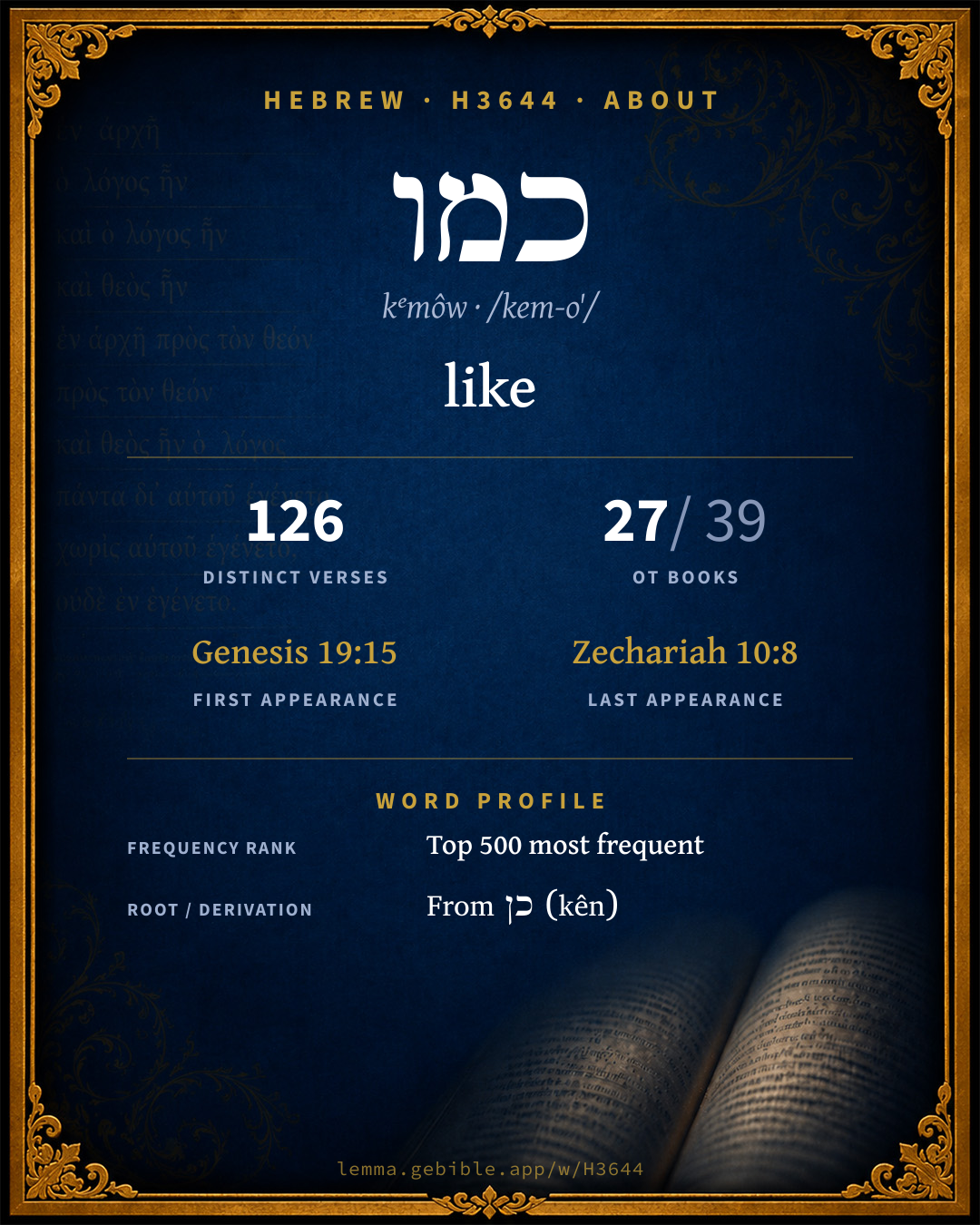
כְּמוֹ
like
‘like’ is one of 2 main senses fuller range ↓
Full lexicon entry — Brown-Driver-Briggs (BDB)
From Brown-Driver-Briggs (BDB)
Where this word appears
Grammar key — what these labels mean
Part of speech
- Preposition
- A relational word (e.g. “in,” “to,” “from”) governing a noun.
Grammatical forms
- Preposition 141 times (99%)
- Pronoun, Indefinite 1 time (1%)
Parsed forms decoded from the imported morphology (morphhb / Westminster Leningrad Codex — WLC text public domain, morphhb tagging CC BY 4.0), counted across 142 parsed occurrences — not distinct verses.
Every verse where H3644 appears — 126 distinct verses across 27 books. Click any verse to open its interlinear word-by-word view. Verse text shown in the World English Bible for context — . Each verse’s Hebrew form is shown with its reference; the English is not keyword-highlighted, since the data carries no word-level English alignment. Use “Compare translations” on any verse to read it across multiple English versions. This concordance covers the Hebrew Bible; Septuagint (Greek Old Testament) occurrences are not indexed here.
Genesis 5 verses
- Genesis 19:15 וּ/כְמוֹ֙ conj + prep When the morning arose, then the angels hurried Lot, saying, "Arise, take your wife, and your two daughters who are here, lest you be consumed in the iniquity of the city."
- Genesis 34:15 כָמֹ֔/נוּ prep + sfx pers 1cp Only on this condition will we consent to you. If you will be as we are, that every male of you be circumcised;
- Genesis 41:39 כָּמֽוֹ/ךָ prep + sfx pers 2ms Pharaoh said to Joseph, "Because God has shown you all of this, there is none so discreet and wise as you.
- Genesis 44:15 כָּמֹֽ/נִי prep + sfx pers 1cs Joseph said to them, "What deed is this that you have done? Don't you know that such a man as I can indeed divine?"
- Genesis 44:18 כָמ֖וֹ/ךָ prep + sfx pers 2ms Then Judah came near to him, and said, "Oh, my lord, please let your servant speak a word in my lord's ears, and don't let your anger burn against your servant; for you are even as Pharaoh.
Exodus 11 verses
- Exodus 9:14 כָּמֹ֖/נִי prep + sfx pers 1cs For this time I will send all my plagues against your heart, against your officials, and against your people; that you may know that there is none like me in all the earth.
- Exodus 9:18 כָמֹ֨/הוּ֙ prep + sfx pers 3ms Behold, tomorrow about this time I will cause it to rain a very grievous hail, such as has not been in Egypt since the day it was founded even until now.
- Exodus 9:24 כָמֹ֨/הוּ֙ prep + sfx pers 3ms So there was very severe hail, and lightning mixed with the hail, such as had not been in all the land of Egypt since it became a nation.
- Exodus 10:14 כָּמֹ֔/הוּ prep + sfx pers 3ms The locusts went up over all the land of Egypt, and rested in all the borders of Egypt. They were very grievous. Before them there were no such locusts as they, neither after them shall be such.
- Exodus 11:6 כָּמֹ֨/הוּ֙ וְ/כָמֹ֖/הוּ prep + sfx pers 3ms conj + prep + sfx pers 3ms There shall be a great cry throughout all the land of Egypt, such as there has not been, nor shall be any more.
- Exodus 15:5 כְּמוֹ prep The deeps cover them. They went down into the depths like a stone.
- Exodus 15:8 כְמוֹ prep With the blast of your nostrils the waters were piled up. The floods stood upright as a heap. The deeps were congealed in the heart of the sea.
- Exodus 15:11 כָמֹ֤/כָה כָּמֹ֖/כָה prep + sfx pers 2ms prep + sfx pers 2ms Who is like you, Yahweh, among the gods? Who is like you, glorious in holiness, Fearful in praises, doing wonders?
- Exodus 30:32 כָּמֹ֑/הוּ prep + sfx pers 3ms It shall not be poured on man's flesh, neither shall you make any like it, according to its composition: it is holy. It shall be holy to you.
- Exodus 30:33 כָּמֹ֔/הוּ prep + sfx pers 3ms Whoever compounds any like it, or whoever puts any of it on a stranger, he shall be cut off from his people.'"
- Exodus 30:38 כָמ֖וֹ/הָ prep + sfx pers 3fs Whoever shall make any like that, to smell of it, he shall be cut off from his people."
Leviticus 2 verses
- Leviticus 19:18 כָּמ֑וֹ/ךָ prep + sfx pers 2ms You shall not take vengeance, nor bear any grudge against the children of your people; but you shall love your neighbor as yourself. I am Yahweh.
- Leviticus 19:34 כָּמ֔וֹ/ךָ prep + sfx pers 2ms The stranger who lives as a foreigner with you shall be to you as the native-born among you, and you shall love him as yourself; for you lived as foreigners in the land of Egypt. I am Yahweh your God.
Numbers 1 verse
Deuteronomy 7 verses
- Deuteronomy 4:32 כָּמֹֽ/הוּ prep + sfx pers 3ms For ask now of the days that are past, which were before you, since the day that God created man on the earth, and from the one end of the sky to the other, whether there has been [any such thing] as this great thing is, or has been heard like it?
- Deuteronomy 5:14 כָּמֽוֹ/ךָ prep + sfx pers 2ms but the seventh day is a Sabbath to Yahweh your God: [in it] you shall not do any work, you, nor your son, nor your daughter, nor your man-servant, nor your maid-servant, nor your ox, nor your donkey, nor any of your cattle, nor your stranger who is within your gates; that your man-servant and your maid-servant may rest as well as you.
- Deuteronomy 5:26 כָּמֹ֖/נוּ prep + sfx pers 1cp For who is there of all flesh, that has heard the voice of the living God speaking out of the midst of the fire, as we have, and lived?
- Deuteronomy 7:26 כָּמֹ֑/הוּ prep + sfx pers 3ms You shall not bring an abomination into your house, and become a devoted thing like it: you shall utterly detest it, and you shall utterly abhor it; for it is a devoted thing.
- Deuteronomy 18:15 כָּמֹ֔/נִי prep + sfx pers 1cs Yahweh your God will raise up to you a prophet from the midst of you, of your brothers, like me; to him you shall listen;
- Deuteronomy 18:18 כָּמ֑וֹ/ךָ prep + sfx pers 2ms I will raise them up a prophet from among their brothers, like you; and I will put my words in his mouth, and he shall speak to them all that I shall command him.
- Deuteronomy 33:29 כָמ֗וֹ/ךָ prep + sfx pers 2ms Happy are you, Israel: Who is like you, a people saved by Yahweh, The shield of your help, The sword of your excellency! Your enemies shall submit themselves to you; You shall tread on their high places.
Judges 2 verses
- Judges 8:18 כָּמ֣וֹ/ךָ כְמוֹ/הֶ֔ם prep + sfx pers 2ms prep + sfx pers 3mp Then said he to Zebah and Zalmunna, What manner of men were they whom you killed at Tabor? They answered, As you are, so were they; each one resembled the children of a king.
- Judges 9:48 כָמֽוֹ/נִי prep + sfx pers 1cs Abimelech got him up to Mount Zalmon, he and all the people who were with him; and Abimelech took an axe in his hand, and cut down a bough from the trees, and took it up, and laid it on his shoulder: and he said to the people who were with him, What you have seen me do, make haste, and do as I have done.
1 Samuel 3 verses
- 1 Samuel 10:24 כָּמֹ֖/הוּ prep + sfx pers 3ms Samuel said to all the people, "You see him whom Yahweh has chosen, that there is none like him among all the people?" All the people shouted, and said, [Long] live the king.
- 1 Samuel 21:9 כָּמ֖וֹ/הָ prep + sfx pers 3fs The priest said, The sword of Goliath the Philistine, whom you killed in the valley of Elah, behold, it is here wrapped in a cloth behind the ephod: if you will take that, take it; for there is no other except that here. David said, There is none like that; give it me.
- 1 Samuel 26:15 כָמ֨וֹ/ךָ֙ prep + sfx pers 2ms David said to Abner, Aren't you a [valiant] man? and who is like you in Israel? why then have you not kept watch over your lord, the king? for there came one of the people in to destroy the king your lord.
2 Samuel 3 verses
- 2 Samuel 7:22 כָּמ֗וֹ/ךָ prep + sfx pers 2ms Therefore you are great, Yahweh God: for there is none like you, neither is there any God besides you, according to all that we have heard with our ears.
- 2 Samuel 9:8 כָּמֽוֹ/נִי prep + sfx pers 1cs He did obeisance, and said, "What is your servant, that you should look on such a dead dog as I am?"
- 2 Samuel 18:3 כָמֹ֖/נוּ prep + sfx pers 1cp But the people said, You shall not go forth: for if we flee away, they will not care for us; neither if half of us die, will they care for us: but you are worth ten thousand of us; therefore now it is better that you are ready to help us out of the city.
1 Kings 5 verses
- 1 Kings 3:12 כָּמ֨וֹ/ךָ֙ כָּמֽוֹ/ךָ prep + sfx pers 2ms prep + sfx pers 2ms behold, I have done according to your word: behold, I have given you a wise and an understanding heart; so that there has been none like you before you, neither after you shall any arise like you.
- 1 Kings 3:13 כָמ֥וֹ/ךָ prep + sfx pers 2ms I have also given you that which you have not asked, both riches and honor, so that there shall not be any among the kings like you, all your days.
- 1 Kings 8:23 כָּמ֣וֹ/ךָ prep + sfx pers 2ms and he said, Yahweh, the God of Israel, there is no God like you, in heaven above, or on earth beneath; who keep covenant and loving kindness with your servants, who walk before you with all their heart;
- 1 Kings 13:18 כָּמוֹ/ךָ֒ prep + sfx pers 2ms He said to him, I also am a prophet as you are; and an angel spoke to me by the word of Yahweh, saying, Bring him back with you into your house, that he may eat bread and drink water. [But] he lied to him.
- 1 Kings 22:4 כָּמ֧וֹ/נִי כָמ֛וֹ/ךָ prep + sfx pers 1cs prep + sfx pers 2ms He said to Jehoshaphat, Will you go with me to battle to Ramoth-gilead? Jehoshaphat said to the king of Israel, I am as you are, my people as your people, my horses as your horses.
2 Kings 3 verses
- 2 Kings 3:7 כָּמ֧וֹ/נִי כָמ֛וֹ/ךָ prep + sfx pers 1cs prep + sfx pers 2ms He went and sent to Jehoshaphat the king of Judah, saying, The king of Moab has rebelled against me: will you go with me against Moab to battle? He said, I will go up: I am as you are, my people as your people, my horses as your horses.
- 2 Kings 18:5 כָמֹ֗/הוּ prep + sfx pers 3ms He trusted in Yahweh, the God of Israel; so that after him was none like him among all the kings of Judah, nor [among them] that were before him.
- 2 Kings 23:25 וְ/כָמֹ/הוּ֩ כָּמֹֽ/הוּ conj + prep + sfx pers 3ms prep + sfx pers 3ms Like him was there no king before him, who turned to Yahweh with all his heart, and with all his soul, and with all his might, according to all the law of Moses; neither after him arose there any like him.
1 Chronicles 1 verse
2 Chronicles 3 verses
- 2 Chronicles 6:14 כָּמ֣וֹ/ךָ prep + sfx pers 2ms and he said, Yahweh, the God of Israel, there is no God like you, in heaven, or on earth; who keep covenant and loving kindness with your servants, who walk before you with all their heart;
- 2 Chronicles 18:3 כָּמ֤וֹ/נִי כָמ֨וֹ/ךָ֙ prep + sfx pers 1cs prep + sfx pers 2ms Ahab king of Israel said to Jehoshaphat king of Judah, Will you go with me to Ramoth-gilead? He answered him, I am as you are, and my people as your people; and [we will be] with you in the war.
- 2 Chronicles 35:18 כָּמֹ֨/הוּ֙ prep + sfx pers 3ms There was no Passover like that kept in Israel from the days of Samuel the prophet; neither did any of the kings of Israel keep such a Passover as Josiah kept, and the priests, and the Levites, and all Judah and Israel who were present, and the inhabitants of Jerusalem.
Nehemiah 3 verses
- Nehemiah 6:11 כָּמ֨וֹ/נִי֙ כָמ֛וֹ/נִי prep + sfx pers 1cs prep + sfx pers 1cs I said, Should such a man as I flee? and who is there that, being such as I, would go into the temple to save his life? I will not go in.
- Nehemiah 9:11 כְּמוֹ prep You divided the sea before them, so that they went through the midst of the sea on the dry land; and their pursuers you did cast into the depths, as a stone into the mighty waters.
- Nehemiah 13:26 כָּמֹ֗/הוּ prep + sfx pers 3ms Did not Solomon king of Israel sin by these things? yet among many nations was there no king like him, and he was beloved of his God, and God made him king over all Israel: nevertheless even him did foreign women cause to sin.
Job 16 verses
- Job 1:8 כָּמֹ֨/הוּ֙ prep + sfx pers 3ms Yahweh said to Satan, "Have you considered my servant, Job? For there is none like him in the earth, a blameless and an upright man, one who fears God, and turns away from evil."
- Job 2:3 כָּמֹ֜/הוּ prep + sfx pers 3ms Yahweh said to Satan, "Have you considered my servant Job? For there is none like him in the earth, a blameless and an upright man, one who fears God, and turns away from evil. He still maintains his integrity, although you incited me against him, to ruin him without cause."
- Job 6:15 כְמוֹ prep My brothers have dealt deceitfully as a brook, As the channel of brooks that pass away;
- Job 9:32 כָּמֹ֣/נִי prep + sfx pers 1cs For he is not a man, as I am, that I should answer him, That we should come together in judgment.
- Job 10:22 כְּמ֥וֹ כְּמוֹ prep prep The land dark as midnight, Of the shadow of death, without any order, Where the light is as midnight.'"
- Job 12:3 כְּֽמוֹ/כֶ֗ם כְּמוֹ prep + sfx pers 2mp prep But I have understanding as well as you; I am not inferior to you: Yes, who doesn't know such things as these?
- Job 14:9 כְּמוֹ prep Yet through the scent of water it will bud, And put forth boughs like a plant.
- Job 19:22 כְמוֹ prep Why do you persecute me as God, And are not satisfied with my flesh?
- Job 28:5 כְּמוֹ prep As for the earth, out of it comes bread; Underneath it is turned up as it were by fire.
- Job 31:37 כְּמוֹ prep I would declare to him the number of my steps. As a prince would I go near to him.
- Job 35:8 כָּמ֥וֹ/ךָ prep + sfx pers 2ms Your wickedness may hurt a man as you are; And your righteousness may profit a son of man.
- Job 36:22 כָמֹ֣/הוּ prep + sfx pers 3ms Behold, God is exalted in his power. Who is a teacher like him?
- Job 38:14 כְּמ֣וֹ prep It is changed as clay under the seal, And stands forth as a garment.
- Job 40:9 כָּמֹ֥/הוּ prep + sfx pers 3ms Or have you an arm like God? Can you thunder with a voice like him?
- Job 40:17 כְמוֹ prep He moves his tail like a cedar: The sinews of his thighs are knit together.
- Job 41:24 כְּמוֹ prep His heart is as firm as a stone, Yes, firm as the lower millstone.
Psalms 25 verses
- Psalms 29:6 כְּמוֹ כְּמ֣וֹ prep prep He makes them also to skip like a calf; Lebanon and Sirion like a young, wild ox.
- Psalms 35:10 כָ֫מ֥וֹ/ךָ prep + sfx pers 2ms All my bones shall say, "Yahweh, who is like you, Who delivers the poor from him who is too strong for him, Yes, the poor and the needy from him who robs him?"
- Psalms 50:21 כָמ֑וֹ/ךָ prep + sfx pers 2ms You have done these things, and I kept silent. You thought that the "I AM" was just like you. I will rebuke you, and accuse you in front of your eyes.
- Psalms 58:4 כְּמוֹ prep Their poison is like the poison of a snake; Like a deaf cobra that stops its ear,
- Psalms 58:7 כְמוֹ כְּמ֣וֹ prep prep Let them vanish as water that flows away. When they draw the bow, let their arrows be made blunt.
- Psalms 58:8 כְּמ֣וֹ prep Let them be like a snail which melts and passes away, Like the stillborn child, who has not seen the sun.
- Psalms 58:9 כְּמוֹ כְּמוֹ prep prep Before your pots can feel the heat of the thorns, He will sweep away the green and the burning alike.
- Psalms 61:6 כְּמוֹ prep You will prolong the king's life; His years shall be for generations.
- Psalms 63:5 כְּמ֤וֹ prep My soul shall be satisfied as with the richest food. My mouth shall praise you with joyful lips,
- Psalms 71:19 כָמֽוֹ/ךָ prep + sfx pers 2ms Your righteousness also, God, reaches to the heavens; You have done great things. God, who is like you?
- Psalms 73:15 כְמ֑וֹ prep If I had said, "I will speak thus;" Behold, I would have betrayed the generation of your children.
- Psalms 78:13 כְּמוֹ prep He split the sea, and caused them to pass through; He made the waters stand as a heap.
- Psalms 78:69 כְּמוֹ prep He built his sanctuary like the heights, Like the earth which he has established forever.
- Psalms 79:5 כְּמוֹ prep How long, Yahweh? Will you be angry forever? Will your jealousy burn like fire?
- Psalms 86:8 כָּמ֖וֹ/ךָ prep + sfx pers 2ms There is no one like you among the gods, Lord, Nor any deeds like your deeds.
- Psalms 88:5 כְּמ֤וֹ prep Set apart among the dead, Like the slain who lie in the grave, Whom you remember no more. They are cut off from your hand.
- Psalms 89:8 כָֽמ֖וֹ/ךָ prep + sfx pers 2ms Yahweh, God of hosts, who is a mighty one, like you? Yah, your faithfulness is around you.
- Psalms 89:46 כְּמוֹ prep How long, Yahweh? Will you hide yourself forever? Will your wrath burn like fire?
- Psalms 90:9 כְמוֹ prep For all our days have passed away in your wrath. We bring our years to an end as a sigh.
- Psalms 92:7 כְּמ֥וֹ prep Though the wicked spring up as the grass, And all the evil-doers flourish, They will be destroyed forever.
- Psalms 102:3 כְּ/מוֹ prep + pron indef For my days consume away like smoke. My bones are burned as a firebrand.
- Psalms 115:8 כְּ֭מוֹ/הֶם prep + sfx pers 3mp Those who make them will be like them; Yes, everyone who trusts in them.
- Psalms 135:18 כְּ֭מוֹ/הֶם prep + sfx pers 3mp Those who make them will be like them; Yes, everyone who trusts in them.
- Psalms 140:3 כְּֽמוֹ prep They have sharpened their tongues like a serpent. Viper's poison is under their lips. Selah.
- Psalms 141:7 כְּמ֤וֹ prep "As when one plows and breaks up the earth, Our bones are scattered at the mouth of Sheol."
Proverbs 1 verse
Song of Solomon 2 verses
- Song of Solomon 6:10 כְּמוֹ prep Who is she who looks forth as the morning, Beautiful as the moon, Clear as the sun, Awesome as an army with banners?
- Song of Solomon 7:1 כְּמ֣וֹ prep How beautiful are your feet in sandals, prince's daughter! Your rounded thighs are like jewels, The work of the hands of a skillful workman.
Isaiah 9 verses
- Isaiah 14:10 כָמ֖וֹ/נוּ prep + sfx pers 1cp All they shall answer and tell you, Are you also become weak as we? are you become like us?
- Isaiah 26:17 כְּמ֤וֹ prep Like as a woman with child, who draws near the time of her delivery, is in pain and cries out in her pangs; so we have been before you, Yahweh.
- Isaiah 26:18 כְּמ֖וֹ prep We have been with child, we have been in pain, we have as it were brought forth wind; we have not worked any deliverance in the earth; neither have the inhabitants of the world fallen.
- Isaiah 30:22 כְּמ֣וֹ prep You shall defile the overlaying of your engraved images of silver, and the plating of your molten images of gold: you shall cast them away as an unclean thing; you shall tell it, Get you hence.
- Isaiah 38:19 כָּמ֣וֹ/נִי prep + sfx pers 1cs The living, the living, he shall praise you, as I do this day: The father to the children shall make known your truth.
- Isaiah 41:25 כְּמוֹ וּ/כְמ֥וֹ prep conj + prep I have raised up one from the north, and he has come; from the rising of the sun one who calls on my name: and he shall come on rulers as on mortar, and as the potter treads clay.
- Isaiah 44:7 כָמ֣וֹ/נִי prep + sfx pers 1cs Who, as I, shall call, and shall declare it, and set it in order for me, since I established the ancient people? and the things that are coming, and that shall happen, let them declare.
- Isaiah 46:9 כָּמֽוֹ/נִי prep + sfx pers 1cs Remember the former things of old: for I am God, and there is none else; [I am] God, and there is none like me;
- Isaiah 51:6 כְּמוֹ prep Lift up your eyes to the heavens, and look on the earth beneath; for the heavens shall vanish away like smoke, and the earth shall wax old like a garment; and those who dwell therein shall die in like manner: but my salvation shall be forever, and my righteousness shall not be abolished.
Jeremiah 8 verses
- Jeremiah 10:6 כָּמ֖וֹ/ךָ prep + sfx pers 2ms There is none like you, Yahweh; you are great, and your name is great in might.
- Jeremiah 10:7 כָּמֽוֹ/ךָ prep + sfx pers 2ms Who should not fear you, King of the nations? for to you does it appertain; because among all the wise men of the nations, and in all their royal estate, there is none like you.
- Jeremiah 13:21 כְּמ֖וֹ prep What will you say, when he shall set over you as head those whom you have yourself taught to be friends to you? shall not sorrows take hold of you, as of a woman in travail?
- Jeremiah 15:18 כְּמ֣וֹ prep Why is my pain perpetual, and my wound incurable, which refuses to be healed? will you indeed be to me as a deceitful [brook], as waters that fail?
- Jeremiah 30:7 כָּמֹ֑/הוּ prep + sfx pers 3ms Alas! for that day is great, so that none is like it: it is even the time of Jacob's trouble; but he shall be saved out of it.
- Jeremiah 49:19 כָמ֨וֹ/נִי֙ prep + sfx pers 1cs Behold, he shall come up like a lion from the pride of the Jordan against the strong habitation: for I will suddenly make them run away from it; and whoever is chosen, him will I appoint over it: for who is like me? and who will appoint me a time? and who is the shepherd who will stand before me?
- Jeremiah 50:26 כְמוֹ prep Come against her from the utmost border; open her store-houses; cast her up as heaps, and destroy her utterly; let nothing of her be left.
- Jeremiah 50:44 כָמ֨וֹ/נִי֙ prep + sfx pers 1cs Behold, [the enemy] shall come up like a lion from the pride of the Jordan against the strong habitation: for I will suddenly make them run away from it; and whoever is chosen, him will I appoint over it: for who is like me? and who will appoint me a time? and who is the shepherd who can stand before me?
Lamentations 2 verses
- Lamentations 1:21 כָמֽוֹ/נִי prep + sfx pers 1cs They have heard that I sigh; there is none to comfort me; All my enemies have heard of my trouble; they are glad that you have done it: You will bring the day that you have proclaimed, and they shall be like me.
- Lamentations 4:6 כְמוֹ prep For the iniquity of the daughter of my people is greater than the sin of Sodom, That was overthrown as in a moment, and no hands were laid on her.
Ezekiel 2 verses
- Ezekiel 5:9 כָמֹ֖/הוּ prep + sfx pers 3ms I will do in you that which I have not done, and whereunto I will not do any more the like, because of all your abominations.
- Ezekiel 16:57 כְּמ֗וֹ prep before your wickedness was uncovered, as at the time of the reproach of the daughters of Syria, and of all who are round about her, the daughters of the Philistines, who do despite to you round about.
Hosea 3 verses
- Hosea 7:4 כְּמ֣וֹ prep They are all adulterers. They are burning like an oven that the baker stops stirring, From the kneading of the dough, until it is leavened.
- Hosea 8:12 כְּמוֹ prep I wrote for him the many things of my law; But they were regarded as a strange thing.
- Hosea 13:7 כְּמוֹ prep Therefore am I to them like a lion; Like a leopard I will lurk by the path.
Joel 1 verse
Micah 1 verse
Habakkuk 1 verse
Haggai 1 verse
Zechariah 5 verses
- Zechariah 5:3 כָּמ֣וֹ/הָ כָּמ֥וֹ/הָ prep + sfx pers 3fs prep + sfx pers 3fs Then he said to me, "This is the curse that goes out over the surface of the whole land; for everyone who steals shall be cut off according to it on the one side; and everyone who swears falsely shall be cut off according to it on the other side.
- Zechariah 9:15 כְּמוֹ prep Yahweh of Hosts will defend them; And they will destroy and overcome with sling-stones; And they will drink, and roar as through wine; And they will be filled like bowls, Like the corners of the altar.
- Zechariah 10:2 כְמוֹ prep For the teraphim have spoken vanity, and the diviners have seen a lie; And they have told false dreams. They comfort in vain. Therefore they go their way like sheep. They are oppressed, because there is no shepherd.
- Zechariah 10:7 כְּמוֹ prep Ephraim will be like a mighty man, And their heart will rejoice as through wine; Yes, their children will see it, and rejoice. Their heart will be glad in Yahweh.
- Zechariah 10:8 כְּמ֥וֹ prep I will signal for them, and gather them; For I have redeemed them; And they will increase as they have increased.
About this entry
At a glance — auto-summarized from this page’s data, not written by a person. Every figure links to its source below. This summary describes the numbers; it doesn’t interpret them.
כמו (kᵉmôw) is a Hebrew word most often rendered “like.” It first appears in Genesis 19:15. Spanning 126 verses in 27 books, it ranks among the common words of the Hebrew Bible. It is not a single-sense word — see its full sense range. Related forms include כן, כן and כן. For the data behind this summary, explore the sense tree and the renderings breakdown below.
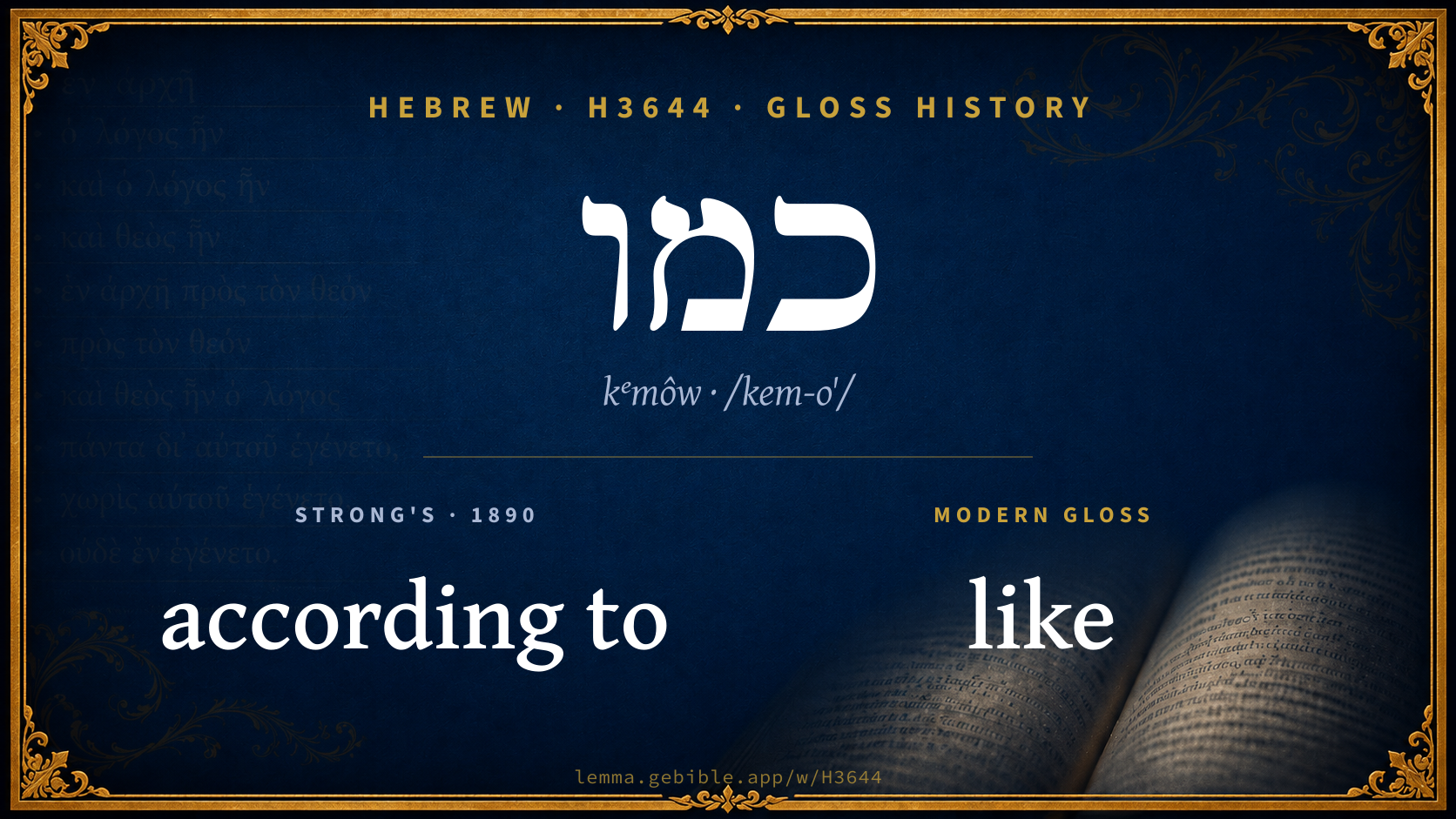
Gloss history
Strong's 1890 vs modern scholarship
About this word
Strong's H3644 catalogs a Hebrew word from the Hebrew Old Testament.
These counts are not copied from any lexicon or concordance. They are computed here, from the morphology-tagged Hebrew Old Testament. What Lemma adds →
- 126
- distinct verses
- The word appears in 126 distinct verses.
- 27 / 39
- OT books
- The word appears in 27 of 39 Old Testament books.
- #316
- by frequency
- Top 500 most frequent Hebrew words (rank 316 of 8,640 Hebrew words by occurrence).
View all 126 occurrences in the concordance →
By section of the Old Testament
By traditional corpus
Conventional, traditional groupings — biblical authorship is debated, so this is a traditional corpus grouping, not an authorship claim. Each share is this word’s portion of its verses in that division of the Hebrew canon. Each figure is a share of the word’s 126 distinct verses.
- Writings (Ketuvim) 53 verses · 42%
- Prophets (Nevi'im) 47 verses · 37%
- Torah (Pentateuch) 26 verses · 21%
How translations render this word
Counts come from each version’s own published word-to-Strong’s tagging or interlinear alignment — an approximate guide to how each version renders this word, not a word-level alignment the data otherwise carries. Because each total is that version’s own tagged count, the per-version totals vary from one another and need not match the appearance or distinct-verse counts above. These counts may also differ from a printed concordance because Lemma counts each distinctly tagged rendering and does not collapse phrase taggings into a single head-word total. This is a fixed set of word-tagged versions (KJV, ASV, BSB, ULT) and does not change with the reading translation you choose elsewhere. Each version’s license is shown beside its name below (and on Sources).
- King James Version: Like 4×, Side according 2×
- American Standard Version: Like 4×
- Berean Standard Bible: Like 28×, As 12×, Like you 11×
- unfoldingWord Literal Text: Like 37×, Like you 18×, Like him 9×
King James Version Public Domain
Renders H3644 across 20 tagged occurrences — most commonly:
Plus 14 renderings that appear only once — usually multi-word phrases or single function words the recovered tagging swept in, not distinct renderings.
American Standard Version Public Domain
Renders H3644 across 20 tagged occurrences — most commonly:
Plus 16 renderings that appear only once — usually multi-word phrases or single function words the recovered tagging swept in, not distinct renderings.
Berean Standard Bible Public Domain
Renders H3644 across 127 tagged occurrences — most commonly:
Plus other, less common renderings. Plus 34 renderings that appear only once — usually multi-word phrases or single function words the recovered tagging swept in, not distinct renderings. Not rendered by a distinct English word in 16 further occurrences.
unfoldingWord Literal Text CC BY-SA 4.0
Renders H3644 across 147 tagged occurrences — most commonly:
Plus other, less common renderings. Plus 27 renderings that appear only once — usually multi-word phrases or single function words the recovered tagging swept in, not distinct renderings.
Senses in the full BDB
What do BDB’s symbols mean?
BDB uses these scholarly abbreviations:
| Symbol | Meaning |
|---|---|
| 𝔊 | the Septuagint (the ancient Greek translation, LXX) |
| 𝔙 | the Vulgate (the Latin translation) |
| 𝔖 | the Syriac version (the Peshitta) |
| 𝔗 | the Targum (the Aramaic translation) |
| ψ | the Psalms |
| √ | root (the underlying root or stem) |
| ‖ | parallel passage (a synonymous or contrasted parallel) |
| † | the dagger: every passage where the word occurs is cited |
The 3 senses and sub-senses the full Brown-Driver-Briggs lexicon distinguishes for this word, in lexicon order (not ranked by frequency), with BDB’s own verbatim wording and sub-sense lettering. Shown in Hebrew script with BDB’s own scholarly abbreviations. The condensed entry is in the Lexicon Entry tab. See also the Forms in the corpus table below.
- 1.
- a. prep., as poet. syn. of כְּ, like, as, Ex 15:5 they went down כמו־אבן like a stone (hence in prose Ne 9:11), v 8 (ψ 78:13), Is 30:22; 51:6 (v. כֵּן), 26:17 כְּמוֹ הָרָה תַּקְרִיב לָלֶרֶת (see כְּ 1 c (2), on the constr.: so 41:25 ψ 58:5, 8a. 9), v 18 we have brought forth the like of, as it were, wind, Je 13;21; 15:18; 50:26 Ez 16:57 (כמו עת as at the time of: v. כְּ Note), Ho 7:4; 8:12; 13:7 Hb 3:14 (as it were), Zc 9:15; 10:2, 7 (as with wine: v. ib.) Elsewhere chiefly in ψψ (19 times) and Jb (11 times), as ψ 29:6; 61:7; 63:6; 78:69; 79:5; 88:6; 90:9, Jb 6:15; 10:22(×2); 12:3 כמו אלה the like of these things, 14:9 Ct 6:10; 7:2 La 4:6 כמו רגע (in prose כרגע). Repeated, like כְּ … כְּ, †ψ 58:10 and answered by כֵּן Is 26:17.—ψ 58:8 b כמו יתמוללו, as it were is against usage of כמו (with a vb.), and yields a lame sense: read perhaps ית׳ [חָצִיר] כמו (Lag Che); ψ 73:15 if I said, אֲסַפְּרָה כְמ֑וֹ, the text is untranslateable, the rendering thus for כמו being indefensible: prob. הֵנָּה has dropped out before the following הִנֵּה: for כְּמוֹ הֵנָּה the like of these things, cf. Jb 23:14 כָּהֵנָּה, and 12:3 supr. e.g. Exodus 15:5
- b. conj. = כַּאֲשֶׁר: (α) of time, once, †Gn 19:15 כְּמוֹ עָלָה הַשַּׁחַר when the dawn arose; (β) of mode, according as, †Zc 10:8 וְרָבוּ כְּמוֹ רָבוּ Pr 23:7 (answered by כֵּן).— e.g. Genesis 19:15
- 2. (before sfs.), see כְּ.
Senses from the full Brown-Driver-Briggs lexicon (Brown, Driver, Briggs; Oxford 1906 — public domain), digitized via Sefaria, supplemented by the OpenScriptures HebrewLexicon (CC BY 4.0). Full attribution on Sources.
Word origin
adv. and conj. like, as, when (lit. the like of what (viz.) …, a pleon. form of כְּ (v. מוֹ), and, like it, proposes a subst.: cf. Aramaic כְּמָא like ψ 78:68 Levy, usually כְּמָא דְּ like as; ܐܰܟ݂ܡܳܐ (i.e. ܐܰܝܟ݂ ܡܳܐ) like what, like, usually sq. ܕ ? like as; Sam. ࠊࠌࠄ; Arabic كَمَا; Ethiopic ከመ kama, like as, DiGr § 63 a Sab. כמו ZMG 1883, 394)—used 1. (56 times) as an indep. word (except Gn 19:15 Ne 9:11, only in poetry); 2. as an equivalent for כְּ before sfs., always before light ones, and occasionally before heavy ones (v. כְּ ad init.):—
— Brown-Driver-Briggs (Oxford 1906, public domain), digitized via Sefaria, supplemented by the OpenScriptures HebrewLexicon (CC BY 4.0). See Sources.
Derived from כן (kên) (H3651) — thus.
Jastrow Dictionary
A second Hebrew/Aramaic lexicon for comparison, covering Aramaic and post-biblical (Talmudic, Targumic, Midrashic) usage that the biblical-Hebrew BDB does not. Matched by lemma rather than by Strong’s number, so a lemma may carry more than one Jastrow headword (shown separately below), and the entries cover usage well beyond the Bible.
כְּמוֹ
- v. כְּמָה) as, like. Yalk. Ex. 246 הקשו לבם כ׳ אבן they made their hearts hard like stones (Mekh. B’shall., Shirah, s. 5 כאבן). With suffixes: כָּמוֹנִי, כָּמוֹךָ &c. like me, like thee &c. Ned. 9ᵇ, v. כְּמוֹת. Mekh. l. c., s. 8; a. fr.—V. כְּמוֹת.
A Dictionary of the Targumim, the Talmud Babli and Yerushalmi, and the Midrashic Literature (Marcus Jastrow; London, Luzac, 1903) — Public Domain. Digitized via Sefaria. Digitized via Sefaria. Full attribution on Sources.
Forms in the corpus
The 71 distinct written forms H3644 takes in the Hebrew Bible, most frequent first — each parse links to that state’s occurrences in the concordance. Hebrew forms include their vowel points and cantillation, so a single lemma takes many written forms.
| Form | Parsing | Example | Uses |
|---|---|---|---|
| כְּמוֹ | Preposition | Exodus 15:5 | 26 |
| כְמוֹ | Preposition | Exodus 15:8 | 9 |
| כְּמ֣וֹ | Preposition | Hosea 7:4 | 8 |
| כְּמ֤וֹ | Preposition | Isaiah 26:17 | 4 |
| כָּמֽוֹ/ךָ | Preposition | Deuteronomy 5:14 | 4 |
| כְּמ֥וֹ | Preposition | Job 10:22 | 3 |
| כָּמ֣וֹ/ךָ | Preposition | 1 Kings 8:23 | 3 |
| כָּמֹ֑/הוּ | Preposition | Deuteronomy 7:26 | 3 |
| כָּמֹ֨/הוּ֙ | Preposition | Exodus 11:6 | 3 |
| כָּמֹֽ/הוּ | Preposition | Deuteronomy 4:32 | 3 |
| כָמ֛וֹ/ךָ | Preposition | 1 Kings 22:4 | 2 |
| כָמ֨וֹ/ךָ֙ | Preposition | 1 Samuel 26:15 | 2 |
| כָמ֨וֹ/נִי֙ | Preposition | Jeremiah 49:19 | 2 |
| כָמֹ֨/הוּ֙ | Preposition | Exodus 9:18 | 2 |
| כָמֽוֹ/נִי | Preposition | Judges 9:48 | 2 |
| כְּ֭מוֹ/הֶם | Preposition | Psalms 115:8 | 2 |
| כְּמ֖וֹ | Preposition | Isaiah 26:18 | 2 |
| כָּמ֑וֹ/ךָ | Preposition | Deuteronomy 18:18 | 2 |
| כָּמ֔וֹ/ךָ | Preposition | 1 Chronicles 17:20 | 2 |
| כָּמ֖וֹ/ךָ | Preposition | Jeremiah 10:6 | 2 |
| כָּמ֗וֹ/ךָ | Preposition | 2 Samuel 7:22 | 2 |
| כָּמ֧וֹ/נִי | Preposition | 1 Kings 22:4 | 2 |
| כָּמֹ֔/הוּ | Preposition | Exodus 10:14 | 2 |
| כָּמֹ֗/הוּ | Preposition | Joel 2:2 | 2 |
| כָּמֽוֹ/נִי | Preposition | 2 Samuel 9:8 | 2 |
| וְ/כָמֹ/הוּ֩ | Preposition | 2 Kings 23:25 | 1 |
| וְ/כָמֹ֖/הוּ | Preposition | Exodus 11:6 | 1 |
| וּ/כְמ֥וֹ | Preposition | Isaiah 41:25 | 1 |
| וּ/כְמוֹ֙ | Preposition | Genesis 19:15 | 1 |
| כְמ֑וֹ | Preposition | Psalms 73:15 | 1 |
| כְמוֹ/הֶ֔ם | Preposition | Judges 8:18 | 1 |
| כָ֫מ֥וֹ/ךָ | Preposition | Psalms 35:10 | 1 |
| כָֽמ֖וֹ/ךָ | Preposition | Psalms 89:8 | 1 |
| כָמ֑וֹ/ךָ | Preposition | Psalms 50:21 | 1 |
| כָמ֖וֹ/הָ | Preposition | Exodus 30:38 | 1 |
| כָמ֖וֹ/ךָ | Preposition | Genesis 44:18 | 1 |
| כָמ֖וֹ/נוּ | Preposition | Isaiah 14:10 | 1 |
| כָמ֗וֹ/ךָ | Preposition | Deuteronomy 33:29 | 1 |
| כָמ֛וֹ/נִי | Preposition | Nehemiah 6:11 | 1 |
| כָמ֣וֹ/נִי | Preposition | Isaiah 44:7 | 1 |
| כָמ֥וֹ/ךָ | Preposition | 1 Kings 3:13 | 1 |
| כָמֹ֔/נוּ | Preposition | Genesis 34:15 | 1 |
| כָמֹ֖/הוּ | Preposition | Ezekiel 5:9 | 1 |
| כָמֹ֖/נוּ | Preposition | 2 Samuel 18:3 | 1 |
| כָמֹ֗/הוּ | Preposition | 2 Kings 18:5 | 1 |
| כָמֹ֛/הוּ | Preposition | Haggai 2:3 | 1 |
| כָמֹ֣/הוּ | Preposition | Job 36:22 | 1 |
| כָמֹ֤/כָה | Preposition | Exodus 15:11 | 1 |
| כָמֽוֹ/ךָ | Preposition | Psalms 71:19 | 1 |
| כְּ/מוֹ | Pronoun, Indefinite | Psalms 102:3 | 1 |
| כְּֽמוֹ | Preposition | Psalms 140:3 | 1 |
| כְּֽמוֹ/כֶ֗ם | Preposition | Job 12:3 | 1 |
| כְּמ֗וֹ | Preposition | Ezekiel 16:57 | 1 |
| כָּמ֖וֹ/הָ | Preposition | 1 Samuel 21:9 | 1 |
| כָּמ֣וֹ/הָ | Preposition | Zechariah 5:3 | 1 |
| כָּמ֣וֹ/נִי | Preposition | Isaiah 38:19 | 1 |
| כָּמ֤וֹ/נִי | Preposition | 2 Chronicles 18:3 | 1 |
| כָּמ֥וֹ/הָ | Preposition | Zechariah 5:3 | 1 |
| כָּמ֥וֹ/ךָ | Preposition | Job 35:8 | 1 |
| כָּמ֨וֹ/ךָ֙ | Preposition | 1 Kings 3:12 | 1 |
The 60 most common forms are shown; 11 rarer forms follow in the full concordance.
Same root — word family
Other BDB entries built from the same root as H3644, grouped by Strong’s listed origin. These share a root / origin per the lexicon — not necessarily a shared meaning. Each links to that word’s own entry.
Derives from
Shares the same root
Derived from this word
Compare all same-root words → Showing 4 of 5 — not the complete family. They share a root, not necessarily a meaning.
Septuagint verse parallels
This word appears in 115 verses that also exist in the Greek Old Testament (Septuagint), out of the 126 Hebrew verses it occurs in. You can read those verses in Greek by switching the Old Testament edition to the Septuagint.
Read these verses in the Septuagint
- Genesis 19:15
- Exodus 9:14
- Leviticus 19:18
- Numbers 23:10
- Deuteronomy 4:32
- Judges 8:18
- 1 Samuel 10:24
- 2 Samuel 7:22
- 1 Kings 3:12
- 2 Kings 3:7
- 1 Chronicles 17:20
- 2 Chronicles 6:14
This is a verse-level parallel only — the same verses exist in both the Hebrew and Greek Old Testaments. No word-level Hebrew↔Greek correspondence is claimed: the data carries no such alignment, so no Greek word is shown as this Hebrew word’s translation. Coverage is not total — the Septuagint omits the deuterocanon and renumbers the Psalms, so some Hebrew verses have no direct Greek parallel.