
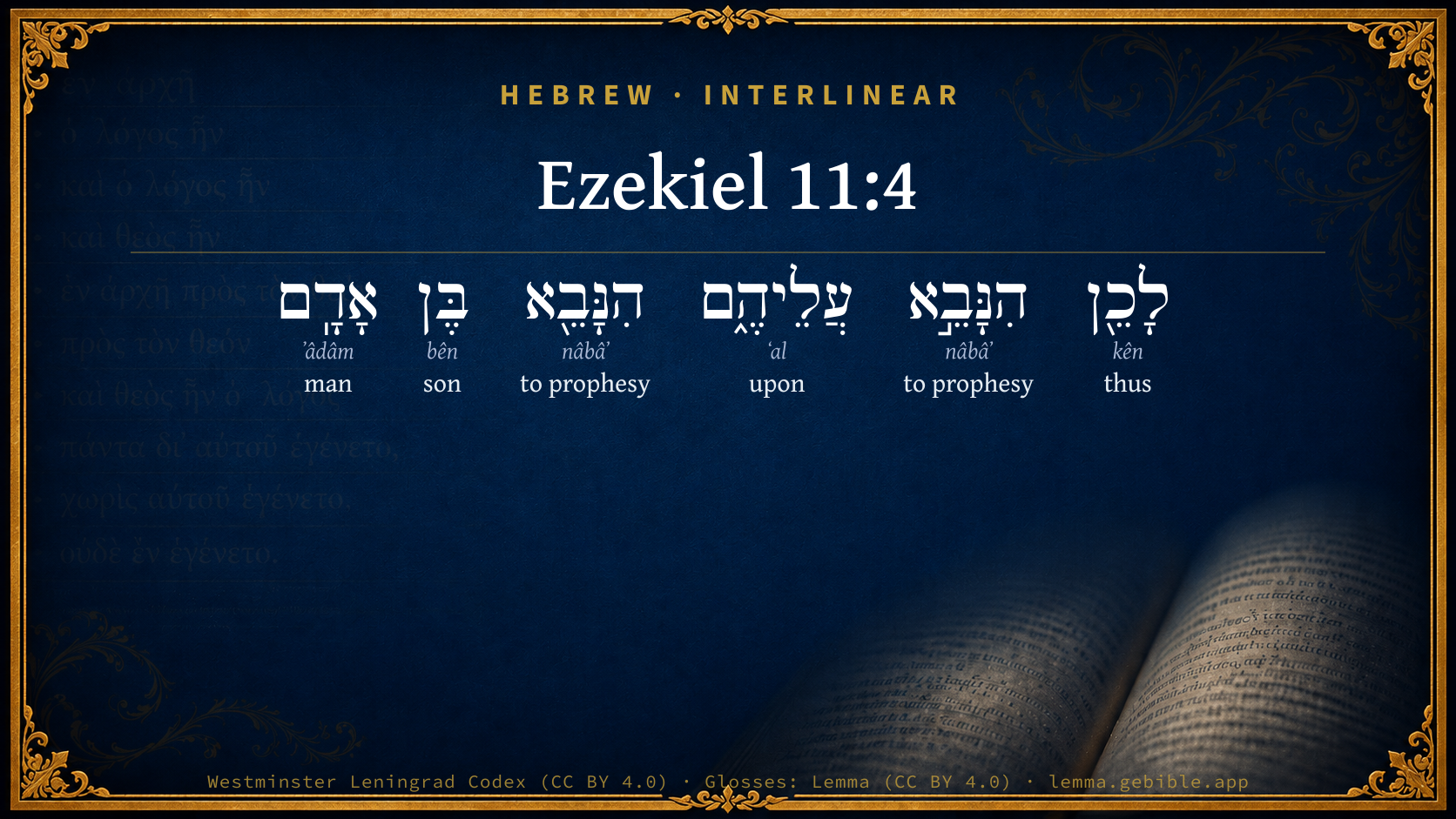
Ezekiel 11:4

Hebrew (Westminster Leningrad Codex) Ezekiel 11:4 appears in the Hebrew Old Testament. The text above is from the Westminster Leningrad Codex. Each word links to its Strong’s number, a concise gloss, and parsing drawn from the Open Scriptures Hebrew Bible morphology. Click any word for its full Brown-Driver-Briggs (BDB) entry.
Download image
Cite this verse

Ezekiel 11:4 (World English Bible). Public Domain. Lemma interlinear Bible study tool, https://lemma.gebible.app/v/ezekiel/11/4.

Show BibTeX & RIS
BibTeX
RIS
English Translation
Therefore prophesy against them, prophesy, son of man.
World English Bible · Public Domain
Download a study sheet

One document with this verse’s original text, its word-by-word gloss line, the meaning frame, cross-references with their text, attributed commentary, and full source and license credits — printable, and it pastes into notes with its structure intact.

This verse Autodidact and up

Study sheet (.html) Plain text (.txt)

A passage Seminary Student

Up to 50 verses in one chapter. A passage sheet keeps up to 6 commentary sources and 12 cross-references per verse, in the order this page ranks them, and says so on the sheet whenever that leaves anything out. Ask for a single verse and you get the Autodidact verse sheet above.

Everything on this page stays free to read, with no account — the sheet is a download of what is already on screen, not access to it.

Want to remove ads? Support Godless Engineer
Compare translations 3

The same verse in 3 English versions, stacked beneath the original-language interlinear above. Click any original word for its lexicon entry.

Each is an independent rendering of the whole verse — the interlinear is not word-aligned to these translations.

Highlighted words mark where these versions differ — a whole-verse word diff, not a word-by-word alignment.

  • World English Bible Public Domain
    Therefore prophesy against them, prophesy, son of man.
  • King James Version Public Domain
    Therefore prophesy against them, prophesy, O son of man.
  • unfoldingWord Literal Text CC BY-SA 4.0
    Therefore prophesy against them. Prophesy, son of man.”

unfoldingWord Literal Text — © unfoldingWord, licensed CC BY-SA 4.0. Word-aligned USFM3 via Door43 (git.door43.org/unfoldingWord/en_ult).

Versions to compare (up to 4)

3 of 4 selected

Show all 18 translations

Every available English version of this verse, each an independent rendering of the whole verse.

  • World English Bible Public Domain
    Therefore prophesy against them, prophesy, son of man.
  • Berean Standard Bible Public Domain
    Therefore prophesy against them; prophesy, O son of man!”
  • Majority Standard Bible Public Domain
    Therefore prophesy against them; prophesy, O son of man!”
  • King James Version Public Domain
    Therefore prophesy against them, prophesy, O son of man.
  • American Standard Version (1901) Public Domain
    Therefore prophesy against them, prophesy, O son of man.
  • Revised Version (1885) Public Domain
    Therefore prophesy against them, prophesy, O son of man.
  • Geneva Bible (1599) Public Domain
    Therefore prophesie against them, sonne of man, prophesie.
  • Douay-Rheims (1899) Public Domain
    Therefore prophesy against them, prophesy, thou son of man.
  • Young's Literal Translation Public Domain
    Therefore prophesy concerning them, prophesy, son of man.'
  • Literal Standard Version CC BY-SA 4.0
    Therefore prophesy concerning them, prophesy, son of man.”
  • Unlocked Literal Bible CC BY-SA 4.0
    Therefore prophesy against them. Prophesy, son of man.”
  • unfoldingWord Literal Text CC BY-SA 4.0
    Therefore prophesy against them. Prophesy, son of man.”
  • Darby Bible Public Domain
    Therefore prophesy against them, prophesy, son of man.
  • World Messianic Bible Public Domain
    Therefore prophesy against them. Prophesy, son of man.”
  • Webster's Bible Public Domain
    Therefore prophesy against them, prophesy, O son of man.
  • Free Bible Version CC BY-SA 4.0
    So prophesy against them. Prophesy, son of man!”
  • Bible in Basic English Public Domain
    For this cause be a prophet against them, be a prophet, O son of man.
  • JPS Tanakh (1917) Public Domain
    Therefore prophesy against them, prophesy, O son of man.'

Literal Standard Version (2020), Covenant Press — licensed CC BY-SA 4.0. Text via the HelloAO Bible API (eBible.org). Unlocked Literal Bible (unfoldingWord) — licensed CC BY-SA 4.0. Text via the HelloAO Bible API (eBible.org). unfoldingWord Literal Text — © unfoldingWord, licensed CC BY-SA 4.0. Word-aligned USFM3 via Door43 (git.door43.org/unfoldingWord/en_ult). Free Bible Version, Dr. Jonathan Gallagher — licensed CC BY-SA 4.0. Text via the HelloAO Bible API (eBible.org).

Word by word

More ways to search: Search by grammar → Find every occurrence → Compare this word →

Practice this passage: Drill this verse → Learn its vocabulary →

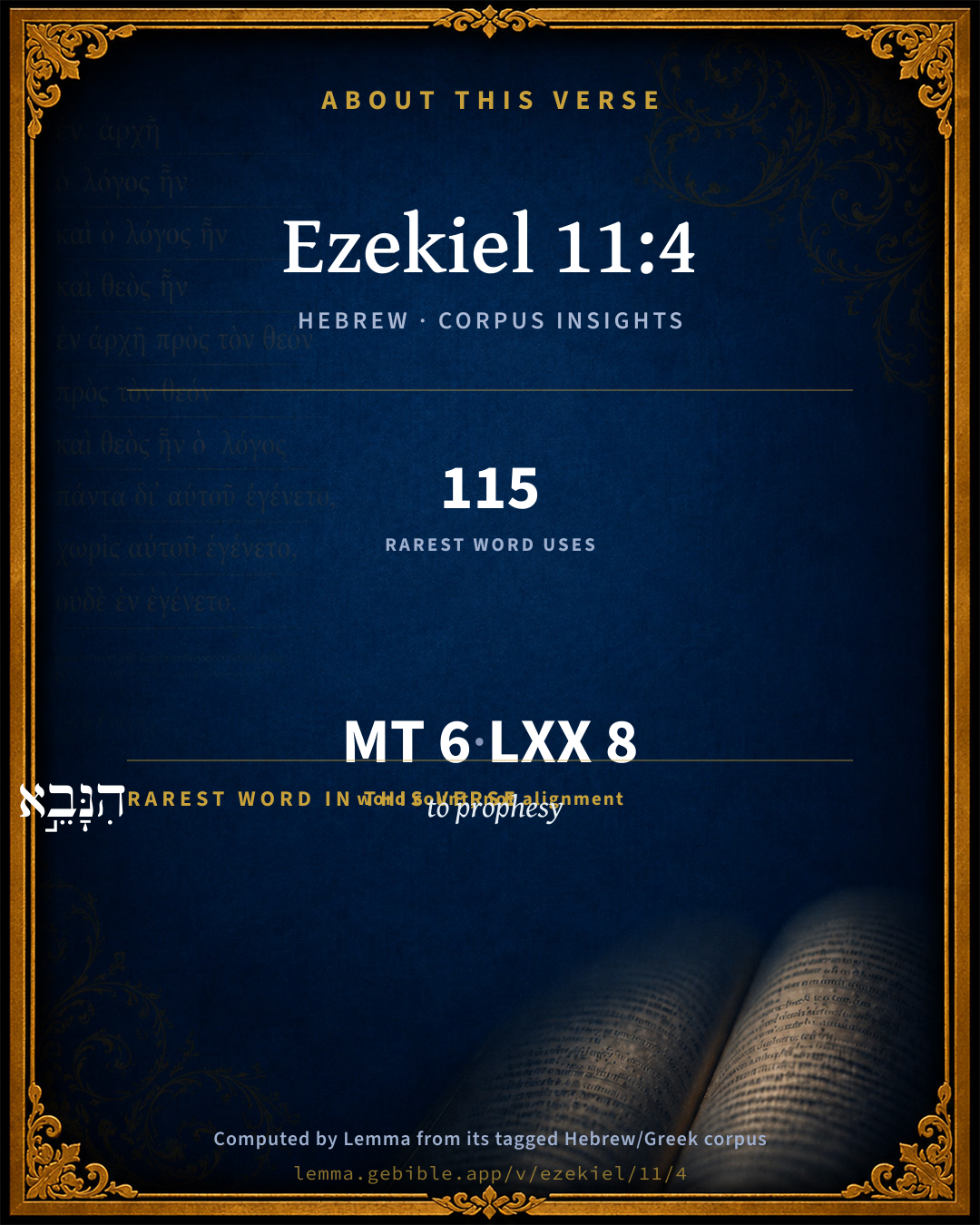
About this verse

These counts appear in no published source. They are computed here, from the morphology-tagged text and Lemma’s own curated glosses. What Lemma adds →

6
words
5
distinct lemmas
Prophets
section

Grammatical profile

  • 2 verbs
  • 2 nouns
  • 1 preposition
  • 1 adverb

Verb forms

  • הִנָּבֵ֣א Niphal · Imperative
  • הִנָּבֵ֖א Niphal · Imperative

Repetition

A word recurs within this verse — often emphatic in Hebrew:

  • הִנָּבֵ֣א to prophesy H5012 ×2

Hebrew & Septuagint length

In English translation the verse runs 8 words from the Hebrew and 8 from the Septuagint (LXX English) — the same length.

A rough comparison of the two English renderings, which tokenize alike — not a word-level alignment.

Word counts can differ between the Hebrew and the Greek without any difference in meaning — e.g. the Hebrew direct-object marker אֵת has no separate Greek word, and Greek often adds the article ὁ.

In the original languages it is 6 Hebrew tokens and 8 Greek tokens — but the two are counted differently (Hebrew bundles its prefixes and suffixes into one token; the Greek is in lemma form), so that isn’t a like-for-like length.

Cross-references

8

Topical passages linked to Ezekiel 11:4 in the Treasury of Scripture Knowledge — connected by theme and wording, ordered by reader-vote popularity; previews shown in the World English Bible.

  • Isaiah 58:1 Cry aloud, don't spare, lift up your voice like a trumpet, and declare to my people their disobedience, and to the house of Jacob their sins.
  • Ezekiel 3:2–15 So I opened my mouth, and he caused me to eat the scroll.
  • Ezekiel 3:17–21 Son of man, I have made you a watchman to the house of Israel: therefore hear the word at my mouth, and give them warning from me.
  • Ezekiel 20:46–47 Son of man, set your face toward the south, and drop [your word] toward the south, and prophesy against the forest of the field in the South;
  • Ezekiel 21:2 Son of man, set your face toward Jerusalem, and drop [your word] toward the sanctuaries, and prophesy against the land of Israel;
  • Ezekiel 25:2 Son of man, set your face toward the children of Ammon, and prophesy against them:
  • Hosea 6:5 Therefore I have cut them to pieces with the prophets; I killed them with the words of my mouth. Your judgments are like a flash of lightning.
  • Hosea 8:1 "Put the trumpet to your lips! Something like an eagle is over Yahweh's house, Because they have broken my covenant, And rebelled against my law.

Cross-references courtesy of OpenBible.info (CC BY 4.0).

Hebrew and Greek witnesses Masoretic Hebrew ↔ Greek Septuagint

The same verse in the two great witnesses to the Old Testament, shown verse-for-verse.

These are two independent witnesses, not word-aligned to each other, and the Septuagint is shown in lemma (dictionary) form.

Hebrew Ezekiel 11:4 Masoretic · Westminster Leningrad Codex

לָכֵ֖ן הִנָּבֵ֣א עֲלֵיהֶ֑ם הִנָּבֵ֖א בֶּן אָדָֽם

Therefore prophesy against them, prophesy, son of man.

World English Bible · Public Domain

Greek LXX Ezekiel 11:4 Septuagint · lemma form

διά οὗτος προφητεύω ἐπί αὐτός προφητεύω υἱός ἄνθρωπος

Therefore prophesy against them, prophesy, son of man.

LXX2012 (modern English Septuagint) · Public Domain

Hebrew: Westminster Leningrad Codex (CC BY 4.0). Greek: Septuagint (public domain); English from LXX2012 (modern English Septuagint) (Public Domain). How the Septuagint differs from the Hebrew →

Targum (Aramaic paraphrase)

1

The Targum is the ancient Jewish Aramaic paraphrase of the Hebrew Scriptures — an interpretive translation, not the Hebrew text itself. Onkelos (literal) and Pseudo-Jonathan (expansive) render the Torah, and Jonathan the Prophets. Coverage is partial: where no permissively-licensed English translation exists for a verse, only the Aramaic is shown. This is verse-level text, not a word-by-word alignment to the Hebrew.

  1. Targum Jonathan Prophets (Joshua–Malachi)
    בְּכֵן אִתְנַבֵּי עֲלֵיהוֹן אִתְנַבֵּי בַּר אָדָם:

    (no public-domain English translation for this verse)

    Targum Jonathan — Aramaic: “Mikraot Gedolot” (public domain). English: “Sefaria Community Translation” (CC0 1.0 (public-domain dedication)); “London "Chaldee Paraphrase," 1871” (public domain). Text via Sefaria.

Commentary

Notes on Ezekiel 11:4 from classic Christian and Jewish commentators (each source and its license shown beneath its notes). The classic Christian expositions comment on the surrounding passage and are grouped to its opening verse, so a note may address several verses; the Jewish commentaries on the Tanakh (Rashi and others) are per-verse, so they appear only where the commentator wrote on this verse.

Lemma curates 59 commentaries, every one of them public domain or Creative Commons licensed, each selected and text-cleaned for this edition rather than reprinted as found. About our sources →

Trapp's Complete Commentary

John Trapp

Eze 11:4 Therefore prophesy against them, prophesy, O son of man.

Ver. 4. Therefore prophesy against them, prophesy.] Urger et repetit, ne cunctetur. Out of greatest indignation against these pests, he pricketh him on to prophesy, as having vengeance "in a readiness for the disobedient." {2Co 10:6} Mockers shall be sure to have their "bands increased." {Isa 28:22}

John Trapp, A Commentary or Exposition upon All the Books of the Old and New Testament (1647–1656) — public domain. Text from a community e-Sword module.

Joseph Benson's Commentary

Eze 11:4-5. Therefore prophesy against them — Declare to them how different things shall happen to them from what they expect. And the Spirit of the Lord fell upon me — See note on Eze 3:24. And said unto me, Speak; Thus have ye said — Ye have advanced the assertion, mentioned Eze 11:3. “You have rightly said what you say: the city is the caldron, and we are the flesh, shall be fulfilled, but not as you understand it. Many of you will perish in the city. For those it will be the caldron, and they will be flesh boiled in it. But yourselves shall not be the flesh in the caldron: but you shall be taken out and elsewhere cut in pieces.” — Michaelis in Newcome. For I know the things that come into your mind —

Here God declares that, however much these men thought, and said in their hearts, The Lord seeth us not, yet still he not only saw them, but knew the things that came into their mind, every one of them, and took particular notice of that vain confidence with which they supported themselves, and endeavoured to put a good face upon a matter which they could not but know to be bad. Remember, reader, God perfectly knows not only the things that come out of our mouths, but the things that come into our minds; not only all we say, but all we think; even those thoughts which are most suddenly darted into our minds, and as suddenly slip out of them again, are perfectly known and narrowly observed by God: he knows us infinitely better than we know ourselves; he understands us afar off: the consideration whereof should oblige us to keep our hearts with all diligence, that no vain thoughts may come into them, or lodge within them.

Joseph Benson's Commentary on the Old and New Testaments (1811–1818) — public domain. Text from a community e-Sword module.

Jamieson, Fausset & Brown

Robert Jamieson, A. R. Fausset & David Brown

prophesy . . . prophesy--The repetition marks emphatic earnestness.

Jamieson, Fausset & Brown — Commentary Critical and Explanatory on the Whole Bible (1871) — public domain (CC PDM 1.0). Text via the HelloAO Bible API.

John Calvin's Commentaries

Yesterday we saw that the Jews scurrilously eluded the prophecies of Jeremiah, especially when he threatened them with God’s wrath. For he had said, that a vision was offered to him, in which Jerusalem was like a pot, and the fire lighted from the north. For a laughing-stock they said that they could rest safely within the city, because they were not yet cooked but raw, so that if that prophecy is true, said they, we shall not so quickly depart from the city. For God foretold that we should be the flesh which was about to be cooked: if this city is a caldron, we ought to remain here till we are cooked: but this has not happened. Hence what Jeremiah pronounces is vain, that we shall be dragged into exile, because these two things disagree, viz., God wishing us to rest in the city, and yet dragging us into a distant region. Since it is so, Jeremiah’s prophecy is vain; thus then they deceived themselves. But God commands another Prophet of his to rise up against them. And the repetition is emphatic, prophesy, prophesy against them For nothing is less tolerable than that men should petulantly spurn God’s anger, which ought to inspire all with fear. For if the mountains melt before him, (Isaiah 64:3,) if angels themselves tremble, (Job 4:18,) how comes it that the vessel of clay dares to conflict with its maker? (Isaiah 45:9.) And we see also how God grows angry against such perverseness; especially when he denounces, by the mouth of Isaiah, that this sin would be unpardonable. I have called you, said he, to ashes and mourning: but, on the other hand, ye have said, Let us eat and drink, and ye have turned my threats into a laughing-stock. For this was your proverb, to-morrow we shall die: as I live, your iniquity shall not go unpunished. God affirms by an oath, that he would never be appeased by the impious and profane despisers of his judgments. For this reason also he now repeats again, prophesy, prophesy. Let us go on —

John Calvin's Commentaries (1540-1563) — public domain. Text from the Calvin Translation Society English edition (1840s-50s) via the Christian Classics Ethereal Library (ccel.org). Calvin's coverage is partial (roughly two-thirds of the Bible); uncommented books and verses are honest gaps, never fabricated. The 19th-century editor's footnotes and remarks are omitted so the notes are faithfully Calvin's own voice.

The Cambridge Bible for Schools and Colleges

gen. ed. J. J. S. Perowne

4. The prophet felt called to prophesy against these men—and all this is part of the vision. See on ch. Eze_3:21.

The Cambridge Bible for Schools and Colleges (gen. ed. J. J. S. Perowne; Cambridge University Press, 1878–1918) — public domain. Text from a community e-Sword module.

John Gill's Exposition

Therefore prophesy against them,.... Evil things against them, things that are disagreeable to them; since they flatter themselves with good things, and cry peace and safety, let them know that destruction is coming upon them: or, "concerning them" (f); what will befall them, and that it will be otherwise with them than they imagine:

prophesy, O son of man; this is repeated, not only to stir up the prophet to the performance of his work and office, not fearing the faces, and revilings, and mockings of men; but to show the indignation of the Lord at their scoffs and jeers, and the certain accomplishment of what should be predicted.

(f) "de eis", V. L. "super eos", Pagninus, Montanus.

John Gill's Exposition of the Whole Bible (1746–1763) — public domain (CC PDM 1.0). Text via the HelloAO Bible API.

Matthew Poole's English Annotations

For this their atheistical temper and words, tell them beforehand what they shall suffer. The charge and command is doubled, both to engage the prophet, and to intimate a doubled misery coming upon them, a misery they shall not have courage to laugh under, though they now dare contemptuously laugh at.

Matthew Poole's English Annotations on the Holy Bible (1683–1685) — public domain. Text from a community e-Sword/MySword module.

The Pulpit Commentary

Vers. 4, 5. The prophet still, we must remember, in his vision, is bidden to do his work as a true prophet, and to rebuke the defiant speech which he had heard. As in Eze_2:2, the Spirit of Jehovah comes upon him, and throws him into the prophetic ecstasy. It is noticeable that here, as in Eze_2:3, his message is not to Judah only, but to the whole house of Israel as represented by those to whom he spoke. I know the things. This, as ever, was one of the notes of a true prophet, that he shared, as was needed for his work, in the knowledge of him from whom no secrets are (Joh_2:24, Joh_2:25; Mat_9:4; 1Co_14:25) thoughts, as well as words, were laid bare before him, as they were to his. (Heb_4:12)

The Pulpit Commentary (1880–1919), ed. H.D.M. Spence-Jones & Joseph S. Exell — public domain. Text from a community e-Sword module.

Lesson kit

Teaching starters — assembled from the data on this page, not authored interpretation. Every prompt links to the verse data it draws on. Edit before teaching.

Ezekiel, in the Prophets, opens this verse with 6 words (5 distinct Hebrew lemmas). Its most distinctive word is nâbâʼ (“to prophesy”). A historical commentator’s framing appears above. Read the whole chapter for the surrounding context.

Discussion questions

  1. What does “to prophesy” (nâbâʼ) contribute to the verse as a whole?
  2. How does Isaiah 58:1, which shares this passage’s theme, read alongside this verse?
  3. What does the repetition of “to prophesy” (2× in this one verse) do in this verse?
  4. These translations render this verse differently; the difference is in the English rendering, not the original. What questions does that raise?
  5. «הִנָּבֵ֣א» is a Niphal Imperative verb. How does that grammatical form shape the action described?
  6. Compare how Trapp's Complete Commentary and Joseph Benson's Commentary read this verse. Where do they agree or differ?

Things to notice

Reading settings

Reading text

Shown beneath each verse's original-language words.

Old Testament
Old Testament edition

Read the OT as the Masoretic Hebrew (MT) or the Greek Septuagint (LXX).

English shown for the Greek Septuagint (in the Hebrew ↔ Greek comparison).

Comparing translations? Open the Compare panel on any verse page to stack up to four side by side.