Exodus 5:17

Hebrew (Westminster Leningrad Codex) Exodus 5:17 appears in the Hebrew Old Testament. The text above is from the Westminster Leningrad Codex. Each word links to its Strong’s number, a concise gloss, and parsing drawn from the Open Scriptures Hebrew Bible morphology. Click any word for its full Brown-Driver-Briggs (BDB) entry.
Download image
Cite this verse

Exodus 5:17 (World English Bible). Public Domain. Lemma interlinear Bible study tool, https://lemma.gebible.app/v/exodus/5/17.

Show BibTeX & RIS
BibTeX
RIS
English Translation
But he said, "You are idle! You are idle! Therefore you say, 'Let us go and sacrifice to Yahweh.'
World English Bible · Public Domain
Download a study sheet

One document with this verse’s original text, its word-by-word gloss line, the meaning frame, cross-references with their text, attributed commentary, and full source and license credits — printable, and it pastes into notes with its structure intact.

This verse Autodidact and up

Study sheet (.html) Plain text (.txt)

A passage Seminary Student

Up to 50 verses in one chapter. A passage sheet keeps up to 6 commentary sources and 12 cross-references per verse, in the order this page ranks them, and says so on the sheet whenever that leaves anything out. Ask for a single verse and you get the Autodidact verse sheet above.

Everything on this page stays free to read, with no account — the sheet is a download of what is already on screen, not access to it.

Want to remove ads? Support Godless Engineer
Compare translations 3

The same verse in 3 English versions, stacked beneath the original-language interlinear above. Click any original word for its lexicon entry.

Each is an independent rendering of the whole verse — the interlinear is not word-aligned to these translations.

Highlighted words mark where these versions differ — a whole-verse word diff, not a word-by-word alignment.

  • World English Bible Public Domain
    But he said, "You are idle! You are idle! Therefore you say, 'Let us go and sacrifice to Yahweh.'
  • King James Version Public Domain
    But he said, Ye are idle, ye are idle: therefore ye say, Let us go and do sacrifice to the LORD.
  • unfoldingWord Literal Text CC BY-SA 4.0
    And he said, “You are lazy! Lazy! That is why you are saying, ‘Let us go sacrifice to Yahweh.’

unfoldingWord Literal Text — © unfoldingWord, licensed CC BY-SA 4.0. Word-aligned USFM3 via Door43 (git.door43.org/unfoldingWord/en_ult).

Versions to compare (up to 4)

3 of 4 selected

Show all 18 translations

Every available English version of this verse, each an independent rendering of the whole verse.

  • World English Bible Public Domain
    But he said, "You are idle! You are idle! Therefore you say, 'Let us go and sacrifice to Yahweh.'
  • Berean Standard Bible Public Domain
    “You are slackers!” Pharaoh replied. “Slackers! That is why you keep saying, ‘Let us go and sacrifice to the LORD.’
  • Majority Standard Bible Public Domain
    “You are slackers!” Pharaoh replied. “Slackers! That is why you keep saying, ‘Let us go and sacrifice to the LORD.’
  • King James Version Public Domain
    But he said, Ye are idle, ye are idle: therefore ye say, Let us go and do sacrifice to the LORD.
  • American Standard Version (1901) Public Domain
    But he said, Ye are idle, ye are idle: therefore ye say, Let us go and sacrifice to Jehovah.
  • Revised Version (1885) Public Domain
    But he said, Ye are idle, ye are idle: therefore ye say, Let us go and sacrifice to the LORD.
  • Geneva Bible (1599) Public Domain
    But he said, Ye are to much idle: therfore ye say, Let vs goe to offer sacrifice to the Lord.
  • Douay-Rheims (1899) Public Domain
    And he said: You are idle, and therefore you say: Let us go and sacrifice to the Lord.
  • Young's Literal Translation Public Domain
    And he saith, `Remiss -- ye are remiss, therefore ye are saying, Let us go, let us sacrifice to Jehovah;
  • Literal Standard Version CC BY-SA 4.0
    And he says, “Remiss—you are remiss, therefore you are saying, Let us go, let us sacrifice to YHWH;
  • Unlocked Literal Bible CC BY-SA 4.0
    But Pharaoh said, “You are lazy! You are lazy! You say, 'Allow us to go sacrifice to Yahweh.'
  • unfoldingWord Literal Text CC BY-SA 4.0
    And he said, “You are lazy! Lazy! That is why you are saying, ‘Let us go sacrifice to Yahweh.’
  • Darby Bible Public Domain
    And he said, Ye are idle, idle! therefore ye say, Let us go and sacrifice to Jehovah.
  • World Messianic Bible Public Domain
    But Pharaoh said, “You are idle! You are idle! Therefore you say, ‘Let’s go and sacrifice to the LORD.’
  • Webster's Bible Public Domain
    But he said, Ye are idle, ye are idle: therefore ye say, Let us go, and do sacrifice to the LORD.
  • Free Bible Version CC BY-SA 4.0
    “No, you're just lazy, lazy people!” Pharaoh replied. “That's why you keep on asking, ‘Please let us go and offer sacrifices to the Lord.’
  • Bible in Basic English Public Domain
    But he said, You have no love for work: that is why you say, Let us go and make an offering to the Lord.
  • JPS Tanakh (1917) Public Domain
    But he said: 'Ye are idle, ye are idle; therefore ye say: Let us go and sacrifice to the LORD.

Literal Standard Version (2020), Covenant Press — licensed CC BY-SA 4.0. Text via the HelloAO Bible API (eBible.org). Unlocked Literal Bible (unfoldingWord) — licensed CC BY-SA 4.0. Text via the HelloAO Bible API (eBible.org). unfoldingWord Literal Text — © unfoldingWord, licensed CC BY-SA 4.0. Word-aligned USFM3 via Door43 (git.door43.org/unfoldingWord/en_ult). Free Bible Version, Dr. Jonathan Gallagher — licensed CC BY-SA 4.0. Text via the HelloAO Bible API (eBible.org).

Word by word

More ways to search: Search by grammar → Find every occurrence → Compare this word →

Practice this passage: Drill this verse → Learn its vocabulary →

נִרְפִּ֥ים
râphâh
H7503
“relaxing”
Verb, Niphal, Participle Active, Masculine, Plural, Absolute
Part of Speech
Verb
Stem
Niphal
Form
Participle Active
Gender
Masculine
Number
Plural
State
Absolute
Full BDB Definition

Origin: a primitive root

TWOT: 2198

to sink, relax, sink down, let drop, be disheartened - (Qal) - to sink down - to sink, drop - to sink, relax, abate - to relax, withdraw - (Niphal) idle (participle) - (Piel) to let drop - (Hiphil) - to let drop, abandon, relax, refrain, forsake - to let go - to refrain, let alone - to be quiet - (Hithpael) to show oneself slack
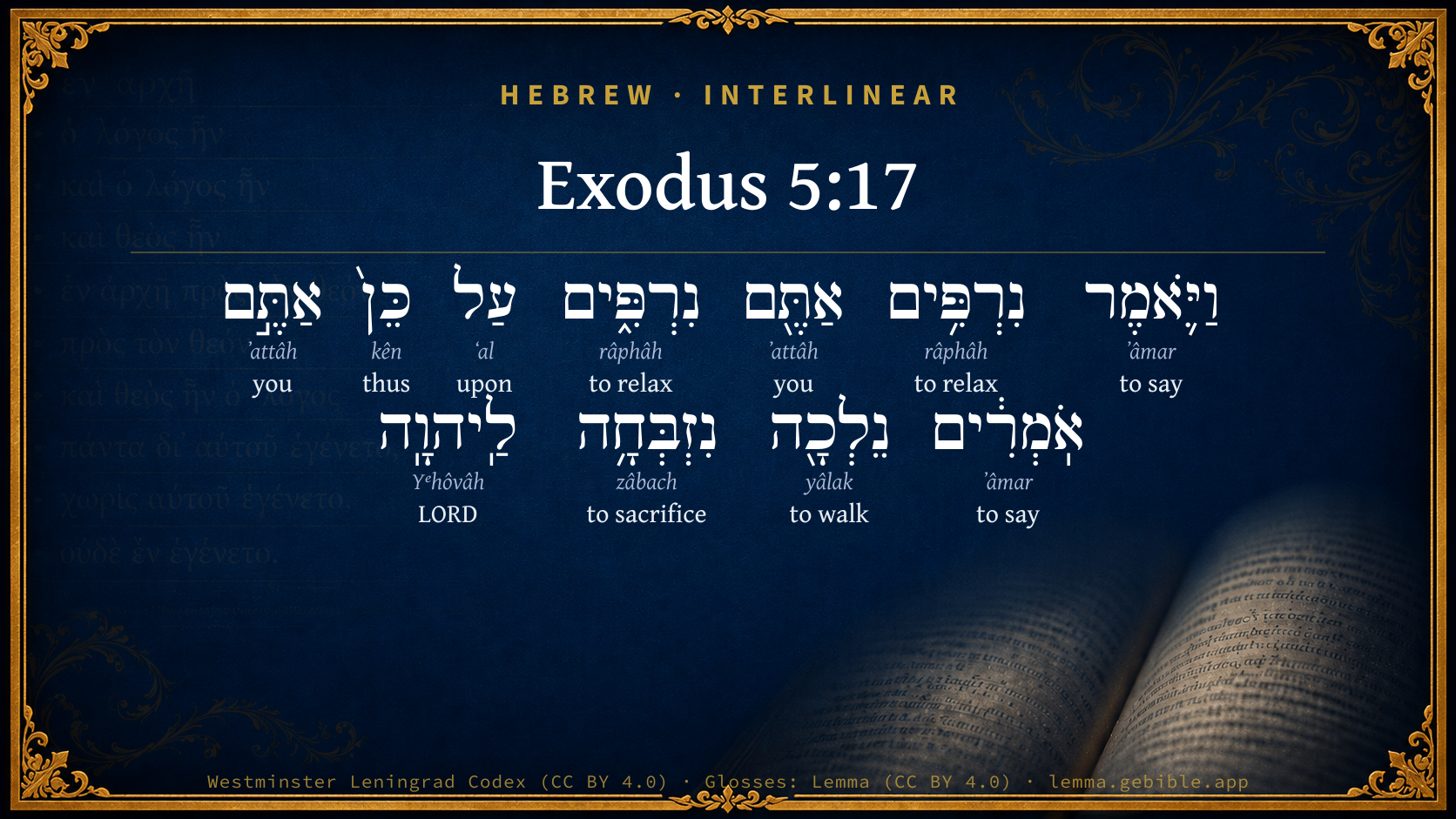
  1. וַיֹּ֛אמֶר ʼâmar H559 “and · to say” Conjunction + Verb, Qal, Sequential Imperfect, 3rd Person, Masculine, Singular
  2. אַתֶּ֖ם ʼattâh H859 “you” Pronoun, Personal, 2nd Person, Masculine, Plural
  3. נִרְפִּ֑ים râphâh H7503 “relaxing” Verb, Niphal, Participle Active, Masculine, Plural, Absolute
  4. עַל ʻal H5921 “upon” Preposition
  5. כֵּן֙ kên H3651 “thus” Particle, Demonstrative
  6. אַתֶּ֣ם ʼattâh H859 “you” Pronoun, Personal, 2nd Person, Masculine, Plural
  7. אֹֽמְרִ֔ים ʼâmar H559 “saying” Verb, Qal, Participle Active, Masculine, Plural, Absolute
  8. נֵלְכָ֖ה yâlak H3212 “to walk” Verb, Qal, Cohortative, 1st Person, Common, Plural
  9. נִזְבְּחָ֥ה zâbach H2076 “to sacrifice” Verb, Qal, Cohortative, 1st Person, Common, Plural
  10. לַֽיהוָֽה Yᵉhôvâh H3068 “to/for · LORD” Preposition + Noun, Proper

About this verse

These counts appear in no published source. They are computed here, from the morphology-tagged text and Lemma’s own curated glosses. What Lemma adds →

11
words
8
distinct lemmas
Pentateuch
section

Shared distinctive vocabulary

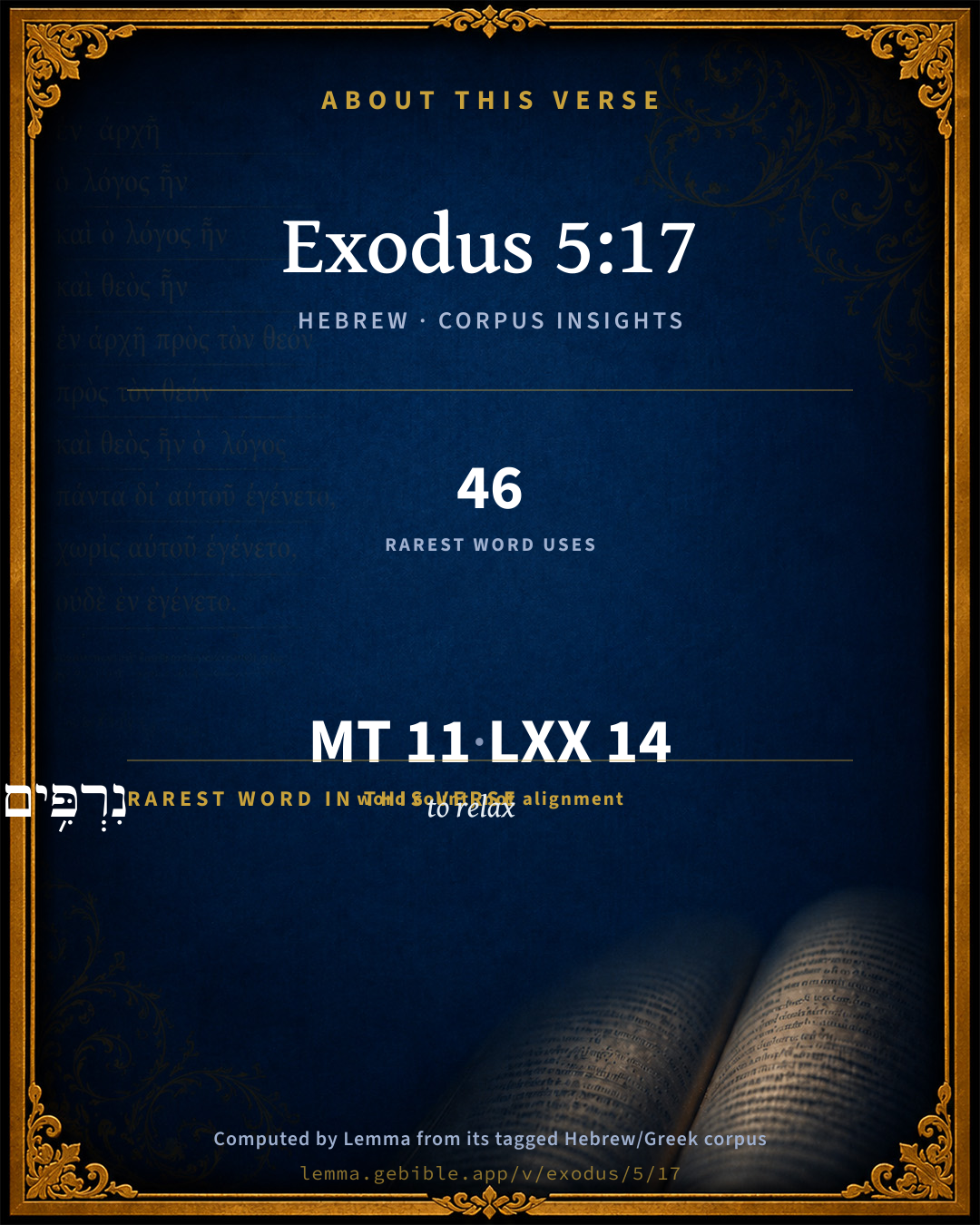
נִרְפִּ֥ים to relax H7503 occurs in 45 verses of the Hebrew Bible. Also found in:

Grammatical profile

  • 6 verbs
  • 1 noun
  • 2 pronouns
  • 1 preposition
  • 1 particle

Verb forms

  • וַיֹּ֛אמֶר Qal · Sequential Imperfect
  • נִרְפִּ֥ים Niphal · Participle Active
  • נִרְפִּ֑ים Niphal · Participle Active
  • אֹֽמְרִ֔ים Qal · Participle Active
  • נֵלְכָ֖ה Qal · Cohortative
  • נִזְבְּחָ֥ה Qal · Cohortative

Repetition

Words recur within this verse — often emphatic in Hebrew:

  • וַיֹּ֛אמֶר to say H559 ×2
  • נִרְפִּ֥ים to relax H7503 ×2
  • אַתֶּ֖ם you H859 ×2

Hebrew & Septuagint length

In English translation the verse runs 19 words from the Hebrew and 23 from the Septuagint (LXX English) — closely comparable.

A rough comparison of the two English renderings, which tokenize alike — not a word-level alignment.

Word counts can differ between the Hebrew and the Greek without any difference in meaning — e.g. the Hebrew direct-object marker אֵת has no separate Greek word, and Greek often adds the article ὁ.

In the original languages it is 11 Hebrew tokens and 14 Greek tokens — but the two are counted differently (Hebrew bundles its prefixes and suffixes into one token; the Greek is in lemma form), so that isn’t a like-for-like length.

Cross-references

4

Topical passages linked to Exodus 5:17 in the Treasury of Scripture Knowledge — connected by theme and wording, ordered by reader-vote popularity; previews shown in the World English Bible.

  • Exodus 5:8 The number of the bricks, which they made before, you require from them. You shall not diminish anything of it, for they are idle; therefore they cry, saying, 'Let us go and sacrifice to our God.'
  • Matthew 26:8 But when his disciples saw this, they were indignant, saying, "Why this waste?
  • John 6:27 Don't work for the food which perishes, but for the food which remains to eternal life, which the Son of Man will give to you. For God the Father has sealed him."
  • 2 Thessalonians 3:10–11 For even when we were with you, we commanded you this: "If anyone will not work, neither let him eat."

Cross-references courtesy of OpenBible.info (CC BY 4.0).

Hebrew and Greek witnesses Masoretic Hebrew ↔ Greek Septuagint

The same verse in the two great witnesses to the Old Testament, shown verse-for-verse.

These are two independent witnesses, not word-aligned to each other, and the Septuagint is shown in lemma (dictionary) form.

Hebrew Exodus 5:17 Masoretic · Westminster Leningrad Codex

וַיֹּ֛אמֶר נִרְפִּ֥ים אַתֶּ֖ם נִרְפִּ֑ים עַל כֵּן֙ אַתֶּ֣ם אֹֽמְרִ֔ים נֵלְכָ֖ה נִזְבְּחָ֥ה לַֽיהוָֽה

But he said, "You are idle! You are idle! Therefore you say, 'Let us go and sacrifice to Yahweh.'

World English Bible · Public Domain

Greek LXX Exodus 5:17 Septuagint · lemma form

καί εἶπον αὐτός σχολάζω σχολαστής εἰμί διά οὗτος λέγω πορεύομαι θύω ὁ θεός ἐγώ

And he said to them, You⌃ are idle, you⌃ are idlers: therefore you⌃ say, Let us go and do sacrifice to our God.

LXX2012 (modern English Septuagint) · Public Domain

Hebrew: Westminster Leningrad Codex (CC BY 4.0). Greek: Septuagint (public domain); English from LXX2012 (modern English Septuagint) (Public Domain). How the Septuagint differs from the Hebrew →

Targum (Aramaic paraphrase)

2

The Targum is the ancient Jewish Aramaic paraphrase of the Hebrew Scriptures — an interpretive translation, not the Hebrew text itself. Onkelos (literal) and Pseudo-Jonathan (expansive) render the Torah, and Jonathan the Prophets. Coverage is partial: where no permissively-licensed English translation exists for a verse, only the Aramaic is shown. This is verse-level text, not a word-by-word alignment to the Hebrew.

  1. Targum Onkelos Torah (Genesis–Deuteronomy)
    וַאֲמַר בַּטְלָנִין אַתּוּן בַּטְלָנִין עַל כֵּן אַתּוּן אָמְרִין נֵזֵיל נְדַבַּח קֳדָם יְיָ:

    (no public-domain English translation for this verse)

    Targum Onkelos — Aramaic: “Onkelos Genesis” (public domain); “Onkelos Exodus” (public domain); “Onkelos Leviticus” (public domain); “Onkelos Numbers” (public domain); “Onkelos Deuteronomy” (public domain). English: “Sefaria Community Translation” (CC0 1.0 (public-domain dedication)); “J.W. Etheridge. The Targums of Onkelos and Jonathan Ben Uzziel on the Pentateuch. London: Longmans, Green, 1862” (public domain). Text via Sefaria.

  2. Targum Pseudo-Jonathan Torah (Genesis–Deuteronomy)
    וַאֲמַר בַּטְלָנִין אַתּוּן בַּטְלָנִין בְּגִין כֵּן אַתּוּן אָמְרִין נֵזִיל נְדַבַּח נִכְסַת חַגָא קֳדָם אֱלָהָנָא

    But he said, You are idle, idle: therefore you are saying, Let us go and over the sacrifice of a festival before our God.

    Targum Pseudo-Jonathan — Aramaic: “Targum Jonathan on Genesis” (public domain); “Targum Jonathan on Exodus” (public domain); “Targum Jonathan on Leviticus” (public domain); “Targum Jonathan on Numbers” (public domain); “Targum Jonathan on Deuteronomy” (public domain). English: “The Targum of Jonathan ben Uzziel, trans. J. W. Etheridge, London, 1862” (public domain). Text via Sefaria.

Commentary

Notes on Exodus 5:17 from classic Christian and Jewish commentators (each source and its license shown beneath its notes). The classic Christian expositions comment on the surrounding passage and are grouped to its opening verse, so a note may address several verses; the Jewish commentaries on the Tanakh (Rashi and others) are per-verse, so they appear only where the commentator wrote on this verse.

Lemma curates 59 commentaries, every one of them public domain or Creative Commons licensed, each selected and text-cleaned for this edition rather than reprinted as found. About our sources →

Trapp's Complete Commentary

John Trapp

Exo 5:17 But he said, Ye [are] idle, [ye are] idle: therefore ye say, Let us go [and] do sacrifice to the LORD.

Ver. 17. Ye are idle.] {See Trapp on "Exo 5:4"} {See Trapp on "Exo 5:8"}

John Trapp, A Commentary or Exposition upon All the Books of the Old and New Testament (1647–1656) — public domain. Text from a community e-Sword module.

Geneva Bible (1599)

Geneva Bible translators

Hebrew, idle, ye are idle.

Geneva Bible (1599) marginal notes — public domain. Text via Bolls.life.

Adam Clarke's Commentary

Verse 17. Ye are idle - therefore ye say, Let us go and do sacrifice] It is common for those who feel unconcerned about their own souls to attribute the religious earnestness of others, who feel the importance of eternal things, to idleness or a disregard of their secular concerns. Strange that they cannot see there is a medium! He who has commanded them to be diligent in business, has also commanded them to be fervent in spirit, serving the Lord. He whose diligence in business is not connected with a true religious fervour of spirit, is a lover of the world; and whatever form he may have he has not the power of godliness, and therefore is completely out of the road to salvation.

Adam Clarke's Commentary on the Bible (1810–1826) — public domain. Text from a community e-Sword/MySword module.

Ellicott's Commentary for English Readers

(17) Ye are idle.—Idleness was regarded by the Egyptians as one of the worst sins. It had to be specially disclaimed in the final judgment before Osiris (Birch, in Bunsen’s Egypt, vol. v. p. 254). Men sometimes disclaimed it in the epitaphs which they placed upon their tombs (Records of the Past, vol. vi. p. 137). Pharaoh had already made the charge, by implication, against Moses and Aaron (Exo_5:4). No doubt, among the Egyptians themselves, a good deal of idleness resulted from the frequent attendance upon religious festivals (Herod. ii. 59-64). Hence the charge might seem plausible.

A Bible Commentary for English Readers, edited by Charles John Ellicott (1878–1897) — public domain. Text from a community e-Sword module.

The Cambridge Bible for Schools and Colleges

gen. ed. J. J. S. Perowne

17, 18. The king impatiently turns them away, repeating the charge of idleness which he had made before (v. 8), and insisting again that they must produce the same amount of bricks as before.

The Cambridge Bible for Schools and Colleges (gen. ed. J. J. S. Perowne; Cambridge University Press, 1878–1918) — public domain. Text from a community e-Sword module.

John Gill's Exposition

But he said, ye are idle, ye are idle,.... Instead of expressing indignation at the taskmasters, and relieving the officers and the people, he insults them in a flouting sarcastic way, charging them with sloth and idleness; and which, for the certainty of it, or, however, to show how strongly persuaded and fully assured he was of the truth of it, repeats it, and gives the following as a proof of it:

therefore ye say, let us go and do sacrifice to the Lord; suggesting that it was not so much the service and honour of God they regarded, as that they might have a leisure day from work and labour.

John Gill's Exposition of the Whole Bible (1746–1763) — public domain (CC PDM 1.0). Text via the HelloAO Bible API.

Albert Barnes' Notes on the Bible

Ye are idle - The old Egyptian language abounds in epithets which show contempt for idleness. The charge was equally offensive and ingenious; one which would be readily believed by Egyptians who knew how much public and private labors were impeded by festivals and other religious ceremonies. Among the great sins which, according to Egyptian belief, involved condemnation in the final judgment, idleness is twice mentioned.

Albert Barnes' Notes on the Bible (1834–1885) — public domain. Text from a community e-Sword/MySword module.

The Pulpit Commentary

Ye are idle, etc. Compare ver. 8. Pharaoh is evidently pleased with his "happy thought." It seems to him clever, witty, humorous, to tax overworked people with idleness; and equally clever to say to religious people religion is a mere pretence. You do not want to worship. You want a holiday." We may remark further that idleness and hypocrisy were two sins of the deepest dye, according to Egyptian notions.

The Pulpit Commentary (1880–1919), ed. H.D.M. Spence-Jones & Joseph S. Exell — public domain. Text from a community e-Sword module.

Lesson kit

Teaching starters — assembled from the data on this page, not authored interpretation. Every prompt links to the verse data it draws on. Edit before teaching.

Exodus, in the Pentateuch, opens this verse with 11 words (8 distinct Hebrew lemmas). Its most distinctive word is râphâh (“to relax”). A historical commentator’s framing appears above. Read the whole chapter for the surrounding context.

Discussion questions

  1. How does “to relax” (râphâh) shape what this verse is saying?
  2. How does Exodus 4:26, which shares the word «to relax», read alongside this verse?
  3. What does the repetition of “to say” (2× in this one verse) do in this verse?
  4. These translations render this verse differently. What is at stake in choosing one wording over another?
  5. «וַיֹּ֛אמֶר» is a Qal Sequential Imperfect verb. How does that grammatical form shape the action described?
  6. Compare how Trapp's Complete Commentary and Geneva Bible (1599) read this verse. Where do they agree or differ?

Things to notice

Reading settings

Reading text

Shown beneath each verse's original-language words.

Old Testament
Old Testament edition

Read the OT as the Masoretic Hebrew (MT) or the Greek Septuagint (LXX).

English shown for the Greek Septuagint (in the Hebrew ↔ Greek comparison).

Comparing translations? Open the Compare panel on any verse page to stack up to four side by side.