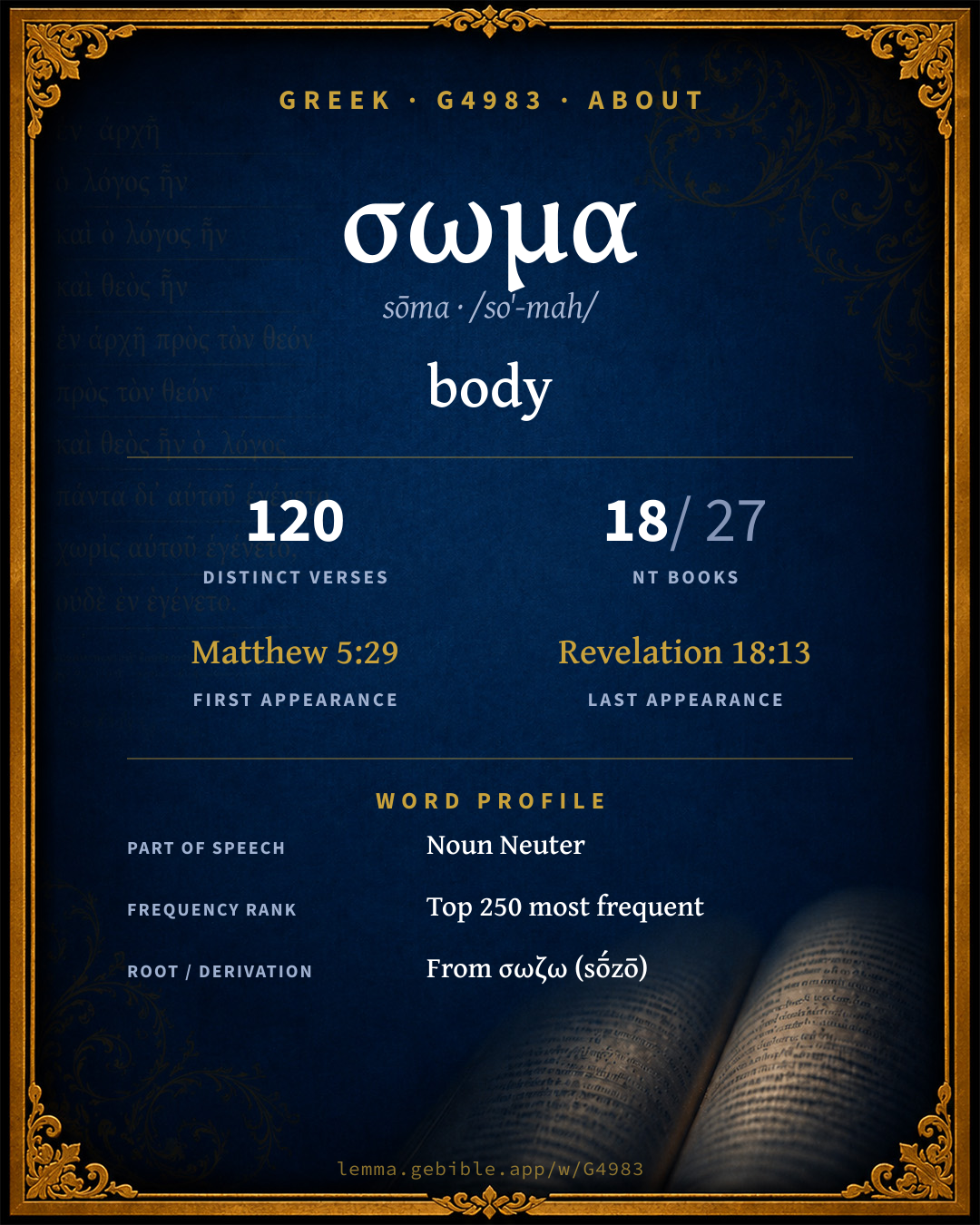
σῶμα
body
‘body’ is one of 4 main senses fuller range ↓
Full lexicon entry — Thayer's Greek Lexicon
From Thayer's Greek Lexicon
Where this word appears
See every Nominative-case word in the Greek New Testament →
Grammar key — what these labels mean
Part of speech
- Noun
- A naming word — a person, place, thing, or idea.
Case
- Nominative
- The case of the subject (and the predicate nominative).
- Genitive
- The case of source, possession, or “of” — answers “whose / from what.”
- Accusative
- The case of the direct object and of extent.
- Dative
- The case of the indirect object, means, or location — “to / for / with / in.”
Gender
- Neuter
- Grammatically neuter.
Number
- Singular
- One.
- Plural
- More than one.
Grammatical forms
- Noun, Nominative, Singular, Neuter 40 times (28%)
- Noun, Genitive, Singular, Neuter 36 times (26%)
- Noun, Accusative, Singular, Neuter 29 times (21%)
- Noun, Dative, Singular, Neuter 24 times (17%)
- Noun, Nominative, Plural, Neuter 6 times (4%)
- Noun, Accusative, Plural, Neuter 4 times (3%)
- Noun, Dative, Plural, Neuter 1 time (1%)
- Noun, Genitive, Plural, Neuter 1 time (1%)
Parsed forms decoded from the imported morphology (Robinson–Tischendorf, public domain), counted across 141 parsed occurrences — not distinct verses.
Every verse where G4983 appears — 120 distinct verses across 18 books. Click any verse to open its interlinear word-by-word view. Verse text shown in the World English Bible for context — . Each verse’s Greek form is shown with its reference; the English is not keyword-highlighted, since the data carries no word-level English alignment. Use “Compare translations” on any verse to read it across multiple English versions. This concordance covers the Greek New Testament; Septuagint (Greek Old Testament) occurrences of this word are not indexed here.
Matthew 11 verses
- Matthew 5:29 σῶμά n nom sg neut If your right eye causes you to stumble, pluck it out and throw it away from you. For it is more profitable for you that one of your members should perish, than for your whole body to be cast into Gehenna.
- Matthew 5:30 σῶμά n nom sg neut If your right hand causes you to stumble, cut it off, and throw it away from you: for it is profitable for you that one of your members should perish, and not your whole body be thrown into Gehenna.
- Matthew 6:22 σώματός σῶμά n gen sg neut n nom sg neut "The lamp of the body is the eye. If therefore your eye is sound, your whole body will be full of light.
- Matthew 6:23 σῶμά n nom sg neut But if your eye is evil, your whole body will be full of darkness. If therefore the light that is in you is darkness, how great is the darkness!
- Matthew 6:25 σώματι σῶμα n dat sg neut n nom sg neut Therefore, I tell you, don't be anxious for your life: what you will eat, or what you will drink; nor yet for your body, what you will wear. Isn't life more than food, and the body more than clothing?
- Matthew 10:28 σῶμα σῶμα n acc sg neut n acc sg neut Don't be afraid of those who kill the body, but are not able to kill the soul. Rather, fear him who is able to destroy both soul and body in Gehenna.
- Matthew 26:12 σώματός n gen sg neut For in pouring this ointment on my body, she did it to prepare me for burial.
- Matthew 26:26 σῶμά n nom sg neut As they were eating, Jesus took bread, gave thanks for it, and broke it. He gave to the disciples, and said, "Take, eat; this is my body."
- Matthew 27:52 σώματα n nom pl neut The tombs were opened, and many bodies of the saints who had fallen asleep were raised;
- Matthew 27:58 σῶμα n acc sg neut This man went to Pilate, and asked for Jesus' body. Then Pilate commanded the body to be given up.
- Matthew 27:59 σῶμα n acc sg neut Joseph took the body, and wrapped it in a clean linen cloth,
Mark 4 verses
- Mark 5:29 σώματι n dat sg neut Immediately the flow of her blood was dried up, and she felt in her body that she was healed of her affliction.
- Mark 14:8 σῶμά n acc sg neut She has done what she could. She has anointed my body beforehand for the burying.
- Mark 14:22 σῶμά n nom sg neut As they were eating, Jesus took bread, and when he had blessed, he broke it, and gave to them, and said, "Take, eat. This is my body."
- Mark 15:43 σῶμα n acc sg neut Joseph of Arimathaea, a prominent council member who also himself was looking for the Kingdom of God, came. He boldly went in to Pilate, and asked for Jesus' body.
Luke 11 verses
- Luke 11:34 σώματός σῶμά σῶμά n gen sg neut n nom sg neut n nom sg neut The lamp of the body is the eye. Therefore when your eye is good, your whole body is also full of light; but when it is evil, your body also is full of darkness.
- Luke 11:36 σῶμά n nom sg neut If therefore your whole body is full of light, having no part dark, it will be wholly full of light, as when the lamp with its bright shining gives you light."
- Luke 12:4 σῶμα n acc sg neut "I tell you, my friends, don't be afraid of those who kill the body, and after that have no more that they can do.
- Luke 12:22 σώματι n dat sg neut He said to his disciples, "Therefore I tell you, don't be anxious for your life, what you will eat, nor yet for your body, what you will wear.
- Luke 12:23 σῶμα n nom sg neut Life is more than food, and the body is more than clothing.
- Luke 17:37 σῶμα n nom sg neut They answering, asked him, "Where, Lord?" He said to them, "Where the body is, there will the vultures also be gathered together."
- Luke 22:19 σῶμά n nom sg neut He took bread, and when he had given thanks, he broke it, and gave to them, saying, "This is my body which is given for you. Do this in memory of me."
- Luke 23:52 σῶμα n acc sg neut this man went to Pilate, and asked for Jesus' body.
- Luke 23:55 σῶμα n nom sg neut The women, who had come with him out of Galilee, followed after, and saw the tomb, and how his body was laid.
- Luke 24:3 σῶμα n acc sg neut They entered in, and didn't find the Lord Jesus' body.
- Luke 24:23 σῶμα n acc sg neut and when they didn't find his body, they came saying that they had also seen a vision of angels, who said that he was alive.
John 5 verses
- John 2:21 σώματος n gen sg neut But he spoke of the temple of his body.
- John 19:31 σώματα n nom pl neut Therefore the Jews, because it was the Preparation Day, so that the bodies wouldn't remain on the cross on the Sabbath (for that Sabbath was a special one), asked of Pilate that their legs might be broken, and that they might be taken away.
- John 19:38 σῶμα n acc sg neut After these things, Joseph of Arimathaea, being a disciple of Jesus, but secretly for fear of the Jews, asked of Pilate that he might take away Jesus' body. Pilate gave him permission. He came therefore and took away his body.
- John 19:40 σῶμα n acc sg neut So they took Jesus' body, and bound it in linen cloths with the spices, as the custom of the Jews is to bury.
- John 20:12 σῶμα n nom sg neut and she saw two angels in white sitting, one at the head, and one at the feet, where the body of Jesus had lain.
Acts 1 verse
Romans 13 verses
- Romans 1:24 σώματα n acc pl neut Therefore God also gave them up in the lusts of their hearts to uncleanness, that their bodies should be dishonored among themselves,
- Romans 4:19 σῶμα n acc sg neut Without being weakened in faith, he didn't consider his own body, already having been worn out, (he being about a hundred years old), and the deadness of Sarah's womb.
- Romans 6:6 σῶμα n nom sg neut knowing this, that our old man was crucified with him, that the body of sin might be done away with, so that we would no longer be in bondage to sin.
- Romans 6:12 σώματι n dat sg neut Therefore don't let sin reign in your mortal body, that you should obey it in its lusts.
- Romans 7:4 σώματος n gen sg neut Therefore, my brothers, you also were made dead to the law through the body of Christ, that you would be joined to another, to him who was raised from the dead, that we might bring forth fruit to God.
- Romans 7:24 σώματος n gen sg neut What a wretched man I am! Who will deliver me out of the body of this death?
- Romans 8:10 σῶμα n nom sg neut If Christ is in you, the body is dead because of sin, but the spirit is alive because of righteousness.
- Romans 8:11 σώματα n acc pl neut But if the Spirit of him who raised up Jesus from the dead dwells in you, he who raised up Christ Jesus from the dead will also give life to your mortal bodies through his Spirit who dwells in you.
- Romans 8:13 σώματος n gen sg neut For if you live after the flesh, you must die; but if by the Spirit you put to death the deeds of the body, you will live.
- Romans 8:23 σώματος n gen sg neut Not only so, but ourselves also, who have the first fruits of the Spirit, even we ourselves groan within ourselves, waiting for adoption, the redemption of our body.
- Romans 12:1 σώματα n acc pl neut Therefore I urge you, brothers, by the mercies of God, to present your bodies a living sacrifice, holy, acceptable to God, which is your spiritual service.
- Romans 12:4 σώματι n dat sg neut For even as we have many members in one body, and all the members don't have the same function,
- Romans 12:5 σῶμά n nom sg neut so we, who are many, are one body in Christ, and individually members one of another.
1 Corinthians 35 verses
- 1 Corinthians 5:3 σώματι n dat sg neut For I most assuredly, as being absent in body but present in spirit, have already, as though I were present, judged him who has done this thing.
- 1 Corinthians 6:13 σῶμα σώματι n nom sg neut n dat sg neut "Foods for the belly, and the belly for foods," but God will bring to nothing both it and them. But the body is not for sexual immorality, but for the Lord; and the Lord for the body.
- 1 Corinthians 6:15 σώματα n nom pl neut Don't you know that your bodies are members of Christ? Shall I then take the members of Christ, and make them members of a prostitute? May it never be!
- 1 Corinthians 6:16 σῶμά n nom sg neut Or don't you know that he who is joined to a prostitute is one body? For, "The two," says he, "will become one flesh."
- 1 Corinthians 6:18 σώματός σῶμα n gen sg neut n acc sg neut Flee sexual immorality! "Every sin that a man does is outside the body," but he who commits sexual immorality sins against his own body.
- 1 Corinthians 6:19 σῶμα n nom sg neut Or don't you know that your body is a temple of the Holy Spirit which is in you, which you have from God? You are not your own,
- 1 Corinthians 6:20 σώματι n dat sg neut for you were bought with a price. Therefore glorify God in your body and in your spirit, which are God's.
- 1 Corinthians 7:4 σώματος σώματος n gen sg neut n gen sg neut The wife doesn't have authority over her own body, but the husband. Likewise also the husband doesn't have authority over his own body, but the wife.
- 1 Corinthians 7:34 σώματι n dat sg neut There is also a difference between a wife and a virgin. The unmarried woman cares about the things of the Lord, that she may be holy both in body and in spirit. But she who is married cares about the things of the world--how she may please her husband.
- 1 Corinthians 9:27 σῶμα n acc sg neut but I beat my body and bring it into submission, lest by any means, after I have preached to others, I myself should be rejected.
- 1 Corinthians 10:16 σώματος n gen sg neut The cup of blessing which we bless, isn't it a communion of the blood of Christ? The bread which we break, isn't it a communion of the body of Christ?
- 1 Corinthians 10:17 σῶμα n nom sg neut Because we, who are many, are one bread, one body; for we all partake of the one bread.
- 1 Corinthians 11:24 σῶμα n nom sg neut When he had given thanks, he broke it, and said, "Take, eat. This is my body, which is broken for you. Do this in memory of me."
- 1 Corinthians 11:27 σώματος n gen sg neut Therefore whoever eats this bread or drinks the Lord's cup in a manner unworthy of the Lord will be guilty of the body and the blood of the Lord.
- 1 Corinthians 11:29 σῶμα n acc sg neut For he who eats and drinks in an unworthy manner eats and drinks judgment to himself, if he doesn't discern the Lord's body.
- 1 Corinthians 12:12 σῶμα σώματος σῶμα n nom sg neut n gen sg neut n nom sg neut For as the body is one, and has many members, and all the members of the body, being many, are one body; so also is Christ.
- 1 Corinthians 12:13 σῶμα n acc sg neut For in one Spirit we were all baptized into one body, whether Jews or Greeks, whether bond or free; and were all given to drink into one Spirit.
- 1 Corinthians 12:14 σῶμα n nom sg neut For the body is not one member, but many.
- 1 Corinthians 12:15 σώματος σώματος n gen sg neut n gen sg neut If the foot would say, "Because I'm not the hand, I'm not part of the body," it is not therefore not part of the body.
- 1 Corinthians 12:16 σώματος σώματος n gen sg neut n gen sg neut If the ear would say, "Because I'm not the eye, I'm not part of the body," it's not therefore not part of the body.
- 1 Corinthians 12:17 σῶμα n nom sg neut If the whole body were an eye, where would the hearing be? If the whole were hearing, where would the smelling be?
- 1 Corinthians 12:18 σώματι n dat sg neut But now God has set the members, each one of them, in the body, just as he desired.
- 1 Corinthians 12:19 σῶμα n nom sg neut If they were all one member, where would the body be?
- 1 Corinthians 12:20 σῶμα n nom sg neut But now they are many members, but one body.
- 1 Corinthians 12:22 σώματος n gen sg neut No, much rather, those members of the body which seem to be weaker are necessary.
- 1 Corinthians 12:23 σώματος n gen sg neut Those parts of the body which we think to be less honorable, on those we bestow more abundant honor; and our unpresentable parts have more abundant propriety;
- 1 Corinthians 12:24 σῶμα n acc sg neut whereas our presentable parts have no such need. But God composed the body together, giving more abundant honor to the inferior part,
- 1 Corinthians 12:25 σώματι n dat sg neut that there should be no division in the body, but that the members should have the same care for one another.
- 1 Corinthians 12:27 σῶμα n nom sg neut Now you are the body of Christ, and members individually.
- 1 Corinthians 13:3 σῶμά n acc sg neut If I dole out all my goods to feed the poor, and if I give my body to be burned, but don't have love, it profits me nothing.
- 1 Corinthians 15:35 σώματι n dat sg neut But someone will say, "How are the dead raised?" and, "With what kind of body do they come?"
- 1 Corinthians 15:37 σῶμα n acc sg neut That which you sow, you don't sow the body that will be, but a bare grain, maybe of wheat, or of some other kind.
- 1 Corinthians 15:38 σῶμα σῶμα n acc sg neut n acc sg neut But God gives it a body even as it pleased him, and to each seed a body of its own.
- 1 Corinthians 15:40 σώματα σώματα n nom pl neut n nom pl neut There are also celestial bodies, and terrestrial bodies; but the glory of the celestial differs from that of the terrestrial.
- 1 Corinthians 15:44 σῶμα σῶμα σῶμα n nom sg neut n nom sg neut n nom sg neut It is sown a natural body; it is raised a spiritual body. There is a natural body and there is also a spiritual body.
2 Corinthians 7 verses
- 2 Corinthians 4:10 σώματι σώμασιν n dat sg neut n dat pl neut always carrying in the body the putting to death of the Lord Jesus, that the life of Jesus may also be revealed in our body.
- 2 Corinthians 5:6 σώματι n dat sg neut Being therefore always of good courage, and knowing that, while we are at home in the body, we are absent from the Lord;
- 2 Corinthians 5:8 σώματος n gen sg neut We are of good courage, I say, and are willing rather to be absent from the body, and to be at home with the Lord.
- 2 Corinthians 5:10 σώματος n gen sg neut For we must all be revealed before the judgment seat of Christ; that each one may receive the things in the body, according to what he has done, whether good or bad.
- 2 Corinthians 10:10 σώματος n gen sg neut For, "His letters," they say, "are weighty and strong, but his bodily presence is weak, and his speech is despised."
- 2 Corinthians 12:2 σώματι σώματος n dat sg neut n gen sg neut I know a man in Christ, fourteen years ago (whether in the body, I don't know, or whether out of the body, I don't know; God knows), such a one caught up into the third heaven.
- 2 Corinthians 12:3 σώματι σώματος n dat sg neut n gen sg neut I know such a man (whether in the body, or outside of the body, I don't know; God knows),
Galatians 1 verse
Ephesians 8 verses
- Ephesians 1:23 σῶμα n nom sg neut which is his body, the fullness of him who fills all in all.
- Ephesians 2:16 σώματι n dat sg neut and might reconcile them both in one body to God through the cross, having killed the hostility thereby.
- Ephesians 4:4 σῶμα n nom sg neut There is one body, and one Spirit, even as you also were called in one hope of your calling;
- Ephesians 4:12 σώματος n gen sg neut for the perfecting of the saints, to the work of serving, to the building up of the body of Christ;
- Ephesians 4:16 σῶμα σώματος n nom sg neut n gen sg neut from whom all the body, being fitted and knit together through that which every joint supplies, according to the working in measure of each individual part, makes the body increase to the building up of itself in love.
- Ephesians 5:23 σώματος n gen sg neut For the husband is the head of the wife, and Christ also is the head of the assembly, being himself the savior of the body.
- Ephesians 5:28 σώματα n acc pl neut Even so ought husbands also to love their own wives as their own bodies. He who loves his own wife loves himself.
- Ephesians 5:30 σώματος n gen sg neut because we are members of his body, of his flesh and bones.
Philippians 2 verses
- Philippians 1:20 σώματί n dat sg neut according to my earnest expectation and hope, that I will in no way be disappointed, but with all boldness, as always, now also Christ will be magnified in my body, whether by life, or by death.
- Philippians 3:21 σῶμα σώματι n acc sg neut n dat sg neut who will change the body of our humiliation to be conformed to the body of his glory, according to the working by which he is able even to subject all things to himself.
Colossians 8 verses
- Colossians 1:18 σώματος n gen sg neut He is the head of the body, the assembly, who is the beginning, the firstborn from the dead; that in all things he might have the preeminence.
- Colossians 1:22 σώματι n dat sg neut yet now he has reconciled in the body of his flesh through death, to present you holy and without blemish and blameless before him,
- Colossians 1:24 σώματος n gen sg neut Now I rejoice in my sufferings for your sake, and fill up on my part that which is lacking of the afflictions of Christ in my flesh for his body's sake, which is the assembly;
- Colossians 2:11 σώματος n gen sg neut in whom you were also circumcised with a circumcision not made with hands, in the putting off of the body of the sins of the flesh, in the circumcision of Christ;
- Colossians 2:17 σῶμα n nom sg neut which are a shadow of the things to come; but the body is Christ's.
- Colossians 2:19 σῶμα n nom sg neut and not holding firmly to the Head, from whom all the body, being supplied and knit together through the joints and ligaments, grows with God's growth.
- Colossians 2:23 σώματος n gen sg neut Which things indeed appear like wisdom in self-imposed worship, and humility, and severity to the body; but aren't of any value against the indulgence of the flesh.
- Colossians 3:15 σώματι n dat sg neut And let the peace of God rule in your hearts, to which also you were called in one body; and be thankful.
1 Thessalonians 1 verse
Hebrews 5 verses
- Hebrews 10:5 σῶμα n acc sg neut Therefore when he comes into the world, he says, "Sacrifice and offering you didn't desire, But a body did you prepare for me;
- Hebrews 10:10 σώματος n gen sg neut by which will we have been sanctified through the offering of the body of Jesus Christ once for all.
- Hebrews 10:23 σῶμα n acc sg neut let us hold fast the confession of our hope unyieldingly. For he who promised is faithful.
- Hebrews 13:3 σώματι n dat sg neut Remember those who are in bonds, as bound with them; and those who are ill-treated, since you are also in the body.
- Hebrews 13:11 σώματα n nom pl neut For the bodies of those animals, whose blood is brought into the holy place by the high priest as an offering for sin, are burned outside of the camp.
James 5 verses
- James 2:16 σώματος n gen sg neut and one of you tells them, "Go in peace, be warmed and filled;" and yet you didn't give them the things the body needs, what good is it?
- James 2:26 σῶμα n nom sg neut For as the body apart from the spirit is dead, even so faith apart from works is dead.
- James 3:2 σῶμα n acc sg neut For in many things we all stumble. If anyone doesn't stumble in word, the same is a perfect man, able to bridle the whole body also.
- James 3:3 σῶμα n acc sg neut Indeed, we put bits into the horses' mouths so that they may obey us, and we guide their whole body.
- James 3:6 σῶμα n acc sg neut And the tongue is a fire. The world of iniquity among our members is the tongue, which defiles the whole body, and sets on fire the course of nature, and is set on fire by Gehenna.
1 Peter 1 verse
Jude 1 verse
Revelation 1 verse
About this entry
At a glance — auto-summarized from this page’s data, not written by a person. Every figure links to its source below. This summary describes the numbers; it doesn’t interpret them.
At its core, σωμα (sōma) means “body.” Catalogued under 4 senses, its meaning is not single-sense. It appears 120 verses across 18 books of the Greek New Testament, among its common vocabulary. The word gravitates to 1 Corinthians (29%), then Romans and Matthew. First canonically at Matthew 5:29, it enters the text early. Each statement above links to its evidence; the full detail follows below.
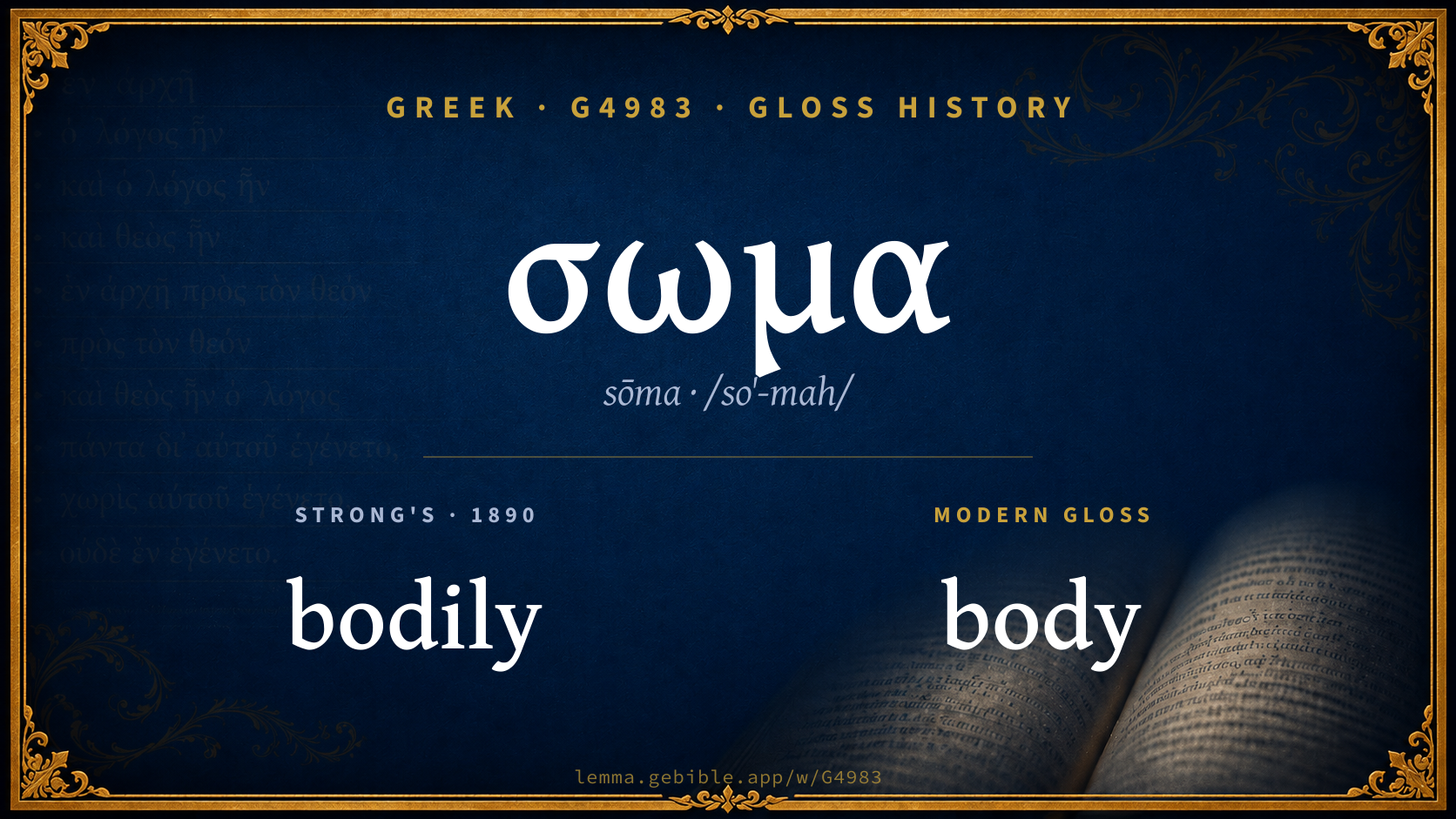
Gloss history
Strong's 1890 vs modern scholarship
About this word
Strong's G4983 catalogs a Greek word from the Greek New Testament.
These counts are not copied from any lexicon or concordance. They are computed here, from the morphology-tagged Greek New Testament. What Lemma adds →
- 120
- distinct verses
- The word appears in 120 distinct verses.
- 18 / 27
- NT books
- The word appears in 18 of 27 New Testament books.
- #119
- by frequency
- Top 250 most frequent Greek words (rank 119 of 5,347 Greek words by occurrence).
View all 120 occurrences in the concordance →
Most concentrated in
- 1 Corinthians 35 verses 29%
- Romans 13 verses 11%
- Matthew 11 verses 9%
By section of the New Testament
By traditional corpus
Conventional, traditional groupings — biblical authorship is debated, so this is a traditional corpus grouping, not an authorship claim. Some books belong to more than one corpus (Luke is in both the Gospels and the Lukan corpus, and so on), so these shares overlap and need not total 100%. Each figure is a share of the word’s 120 distinct verses.
- Pauline corpus 75 verses · 63%
- Gospels 31 verses · 26%
- Lukan (Luke–Acts) 12 verses · 10%
- General (Catholic) Epistles 7 verses · 6%
- Johannine 6 verses · 5%
- Hebrews 5 verses · 4%
- Revelation 1 verse · 1%
How translations render this word
Counts come from each version’s own published word-to-Strong’s tagging or interlinear alignment — an approximate guide to how each version renders this word, not a word-level alignment the data otherwise carries. Because each total is that version’s own tagged count, the per-version totals vary from one another and need not match the appearance or distinct-verse counts above. These counts may also differ from a printed concordance because Lemma counts each distinctly tagged rendering and does not collapse phrase taggings into a single head-word total. This is a fixed set of word-tagged versions (KJV, ASV, BSB, ULT) and does not change with the reading translation you choose elsewhere. Each version’s license is shown beside its name below (and on Sources).
- King James Version: Body 130×, Bodies 11×
- American Standard Version: Body 123×, Bodies 10×, Corpse 2×
- Berean Standard Bible: Body 116×, Bodies 14×, Physical 2×
- unfoldingWord Literal Text: Body 129×, Bodies 11×, Of 4×
King James Version Public Domain
Renders G4983 across 146 tagged occurrences — most commonly:
Plus 5 renderings that appear only once — usually multi-word phrases or single function words the recovered tagging swept in, not distinct renderings.
American Standard Version Public Domain
Renders G4983 across 148 tagged occurrences — most commonly:
Plus 13 renderings that appear only once — usually multi-word phrases or single function words the recovered tagging swept in, not distinct renderings.
Berean Standard Bible Public Domain
Renders G4983 across 135 tagged occurrences — most commonly:
Plus 3 renderings that appear only once — usually multi-word phrases or single function words the recovered tagging swept in, not distinct renderings. Not rendered by a distinct English word in 7 further occurrences.
unfoldingWord Literal Text CC BY-SA 4.0
Renders G4983 across 152 tagged occurrences — most commonly:
Plus 5 renderings that appear only once — usually multi-word phrases or single function words the recovered tagging swept in, not distinct renderings.
Senses in Thayer's
The 4 senses Thayer's distinguishes for this word, in lexicon order (not ranked by frequency or importance). The full entry — with sub-senses — is in the Lexicon Entry tab.
- the body both of men or animals
- the bodies of planets and of stars (heavenly bodies)
- is used of a (large or small) number of men closely united into one society…
- that which casts a shadow as distinguished from the shadow itself
Word origin
Derived from σωζω (sṓzō) (G4982) — to save.
From G4982 ; the body (as a sound whole) used in a very wide application literally or figuratively : - bodily body slave.
— Strong’s Exhaustive Concordance (1890), public domain.
Forms in the corpus
The 9 distinct written forms G4983 takes in the Greek New Testament, most frequent first — each parse links to that case’s occurrences in the concordance.
| Form | Parsing | Example | Uses |
|---|---|---|---|
| σῶμα sō̂ma | Noun, Nominative, Singular, Neuter | Matthew 6:25 | 55 |
| σώματος sṓmatos | Noun, Genitive, Singular, Neuter | John 2:21 | 32 |
| σώματι sṓmati | Noun, Dative, Singular, Neuter | Matthew 6:25 | 22 |
| σῶμά sō̂má | Noun, Nominative, Singular, Neuter | Matthew 5:29 | 14 |
| σώματα sṓmata | Noun, Nominative, Plural, Neuter | Matthew 27:52 | 10 |
| σώματός sṓmatós | Noun, Genitive, Singular, Neuter | Matthew 6:22 | 4 |
| σώματί sṓmatí | Noun, Dative, Singular, Neuter | Galatians 6:17 | 2 |
| σωμάτων sōmátōn | Noun, Genitive, Plural, Neuter | Revelation 18:13 | 1 |
| σώμασιν sṓmasin | Noun, Dative, Plural, Neuter | 2 Corinthians 4:10 | 1 |
Same root — word family
Other Thayer's entries built from the same root as G4983, grouped by Strong’s listed origin. These share a root / origin per the lexicon — not necessarily a shared meaning. Each links to that word’s own entry.
Derives from
Shares the same root
Derived from this word
Proper names from this root
People and places named from this root — a name, not an additional meaning of the word.
Compare all same-root words → Showing 4 of 7 — not the complete family. 2 of the same-root words are proper names (people or places). They share a root, not necessarily a meaning.
Septuagint usage
The same Greek word σωμα appears 74 times in the Greek Old Testament (Septuagint), across 66 verses in 17 books.
- 74
- LXX occurrences
- Tagged occurrences of this Greek word in the Septuagint.
- 66
- verses
- Distinct Septuagint verses containing this word.
- 17 / 39
- OT books
- The word appears in 17 of the 39 Old Testament books.
Sample Septuagint occurrences
- Genesis 15:11 σῶμα
- Leviticus 6:3 σῶμα
- Numbers 8:7 σῶμα
- Deuteronomy 21:23 σῶμα
- Joshua 8:29 σῶμα
- 1 Samuel 31:10 σῶμα
- 1 Kings 13:22 σῶμα
- 2 Kings 19:35 σῶμα
- 1 Chronicles 10:12 σῶμα
- Ezra 19:26 σῶμα
- Esther 9:14 σῶμα
- Job 3:17 σῶμα
Septuagint occurrences (same lexeme)
Every verse where the same Strong’s number (G4983) appears in the Greek Septuagint — showing the first 50 of 66. Verse text shown in the World English Bible for context; the Greek form is the matched word — the English is not keyword-highlighted.
- Genesis 15:11 σῶμα The birds of prey came down on the carcasses, and Abram drove them away.
- Genesis 34:29 σῶμα and all their wealth. They took captive all their little ones and their wives, and took as plunder everything that was in the house.
- Genesis 36:6 σῶμα Esau took his wives, his sons, his daughters, and all the members of his household, with his cattle, all his animals, and all his possessions, which he had gathered in the land of Canaan, and went into a land away from his brother Jacob.
- Genesis 47:12 σῶμα Joseph nourished his father, his brothers, and all of his father's household, with bread, according to their families.
- Genesis 47:18 σῶμα When that year was ended, they came to him the second year, and said to him, "We will not hide from my lord how our money is all spent, and the herds of cattle are my lord's. There is nothing left in the sight of my lord, but our bodies, and our lands.
- Leviticus 6:3 σῶμα or has found that which was lost, and dealt falsely therein, and swearing to a lie; in any of all these things that a man does, sinning therein;
- Leviticus 14:9 σῶμα It shall be on the seventh day, that he shall shave all his hair off his head and his beard and his eyebrows, even all his hair he shall shave off. He shall wash his clothes, and he shall bathe his body in water, then he shall be clean.
- Leviticus 15:2 σῶμα "Speak to the children of Israel, and tell them, 'When any man has a discharge from his body, because of his discharge he is unclean.
- Leviticus 15:3 σῶμα This shall be his uncleanness in his discharge: whether his body runs with his discharge, or his body has stopped from his discharge, it is his uncleanness.
- Leviticus 15:11 σῶμα "'Whoever he who has the discharge touches, without having rinsed his hands in water, he shall wash his clothes, and bathe himself in water, and be unclean until the evening.
- Leviticus 15:13 σῶμα "'When he who has a discharge is cleansed of his discharge, then he shall count to himself seven days for his cleansing, and wash his clothes; and he shall bathe his flesh in running water, and shall be clean.
- Leviticus 15:16 σῶμα "'If any man has an emission of semen, then he shall bathe all his flesh in water, and be unclean until the evening.
- Leviticus 15:19 σῶμα "'If a woman has a discharge, and her discharge in her flesh is blood, she shall be in her impurity seven days: and whoever touches her shall be unclean until the evening.
- Leviticus 15:21 σῶμα Whoever touches her bed shall wash his clothes, and bathe himself in water, and be unclean until the evening.
- Leviticus 15:27 σῶμα Whoever touches these things shall be unclean, and shall wash his clothes, and bathe himself in water, and be unclean until the evening.
- Leviticus 16:4 σῶμα He shall put on the holy linen coat, and he shall have the linen breeches on his body, and shall put on the linen sash, and he shall be dressed with the linen turban. They are the holy garments. He shall bathe his body in water, and put them on.
- Leviticus 16:24 σῶμα Then he shall bathe himself in water in a holy place, and put on his garments, and come out and offer his burnt offering and the burnt offering of the people, and make atonement for himself and for the people.
- Leviticus 16:26 σῶμα "He who lets the goat go for the scapegoat shall wash his clothes, and bathe his flesh in water, and afterward he shall come into the camp.
- Leviticus 16:28 σῶμα He who burns them shall wash his clothes, and bathe his flesh in water, and afterward he shall come into the camp.
- Leviticus 17:16 σῶμα But if he doesn't wash them, or bathe his flesh, then he shall bear his iniquity.'"
- Leviticus 19:28 σῶμα "'You shall not make any cuttings in your flesh for the dead, nor tattoo any marks on you. I am Yahweh.
- Leviticus 22:6 σῶμα the person that touches any such shall be unclean until the evening, and shall not eat of the holy things, unless he bathe his body in water.
- Numbers 8:7 σῶμα Thus shall you do to them, to cleanse them: sprinkle the water of cleansing on them, let them shave their whole bodies with a razor, and let them wash their clothes, and cleanse themselves.
- Numbers 19:7 σῶμα Then the priest shall wash his clothes, and he shall bathe his flesh in water, and afterward he shall come into the camp, and the priest shall be unclean until the even.
- Numbers 19:8 σῶμα He who burns her shall wash his clothes in water, and bathe his flesh in water, and shall be unclean until the even.
- Deuteronomy 21:23 σῶμα his body shall not remain all night on the tree, but you shall surely bury him the same day; for he who is hanged is accursed of God; that you don't defile your land which Yahweh your God gives you for an inheritance.
- Deuteronomy 23:12 σῶμα You shall have a place also outside of the camp, where you shall go forth abroad:
- Joshua 8:29 σῶμα The king of Ai he hanged on a tree until the evening: and at the going down of the sun Joshua commanded, and they took his body down from the tree, and cast it at the entrance of the gate of the city, and raised thereon a great heap of stones, to this day.
- 1 Samuel 31:10 σῶμα They put his armor in the house of the Ashtaroth; and they fastened his body to the wall of Beth-shan.
- 1 Samuel 31:12 σῶμα all the valiant men arose, and went all night, and took the body of Saul and the bodies of his sons from the wall of Beth-shan; and they came to Jabesh, and burnt them there.
- 1 Kings 13:22 σῶμα but came back, and have eaten bread and drunk water in the place of which he said to you, Eat no bread, and drink no water; your body shall not come to the tomb of your fathers.
- 1 Kings 13:24 σῶμα When he was gone, a lion met him by the way, and killed him: and his body was cast in the way, and the donkey stood by it; the lion also stood by the body.
- 1 Kings 13:28 σῶμα He went and found his body cast in the way, and the donkey and the lion standing by the body: the lion had not eaten the body, nor torn the donkey.
- 1 Kings 13:29 σῶμα The prophet took up the body of the man of God, and laid it on the donkey, and brought it back; and he came to the city of the old prophet, to mourn, and to bury him.
- 1 Kings 20:27 σῶμα The children of Israel were mustered, and were provisioned, and went against them: and the children of Israel encamped before them like two little flocks of kids; but the Syrians filled the country.
- 2 Kings 19:35 σῶμα It happened that night, that the angel of Yahweh went forth, and struck in the camp of the Assyrians one hundred eighty-five thousand: and when men arose early in the morning, behold, these were all dead bodies.
- 1 Chronicles 10:12 σῶμα all the valiant men arose, and took away the body of Saul, and the bodies of his sons, and brought them to Jabesh, and buried their bones under the oak in Jabesh, and fasted seven days.
- 1 Chronicles 28:1 σῶμα David assembled all the princes of Israel, the princes of the tribes, and the captains of the companies who served the king by division, and the captains of thousands, and the captains of hundreds, and the rulers over all the substance and possessions of the king and of his sons, with the officers, and the mighty men, even all the mighty men of valor, to Jerusalem.
- Ezra 19:26 σῶμα
- Ezra 19:37 σῶμα
- Esther 9:14 σῶμα The king commanded it so to be done: and a decree was given out in Shushan; and they hanged Haman's ten sons.
- Job 3:17 σῶμα There the wicked cease from troubling; There the weary are at rest.
- Job 6:4 σῶμα For the arrows of the Almighty are within me, My spirit drinks up their poison. The terrors of God set themselves in array against me.
- Job 7:5 σῶμα My flesh is clothed with worms and clods of dust. My skin closes up, and breaks out afresh.
- Job 13:12 σῶμα Your memorable sayings are proverbs of ashes, Your defenses are defenses of clay.
- Job 20:25 σῶμα He draws it forth, and it comes out of his body. Yes, the glittering point comes out of his liver. Terrors are on him.
- Job 33:17 σῶμα That he may withdraw man from his purpose, And hide pride from man.
- Job 33:24 σῶμα Then God is gracious to him, and says, 'Deliver him from going down to the pit, I have found a ransom.'
- Job 36:28 σῶμα Which the skies pour down And drop on man abundantly.
- Job 40:32 σῶμα
These are occurrences of the same Greek lexeme (G4983) in the Septuagint — not a translation of any one Hebrew word. The store carries no word-level Hebrew↔Greek alignment, so no Hebrew original is asserted here. Counts come from the recovered LXX Strong's tagging — high-frequency vocabulary is well covered, while rare or late forms may be untagged — so they reflect tagged occurrences and may slightly undercount.